A 17-Year-Old Hospice Cat Screamed the Moment Her Paw Touched My Kitchen Floor—Then I Laid Down One Towel and Started Questioning Everything Written in Her File.
PART3:
Fear disguised as impatience.
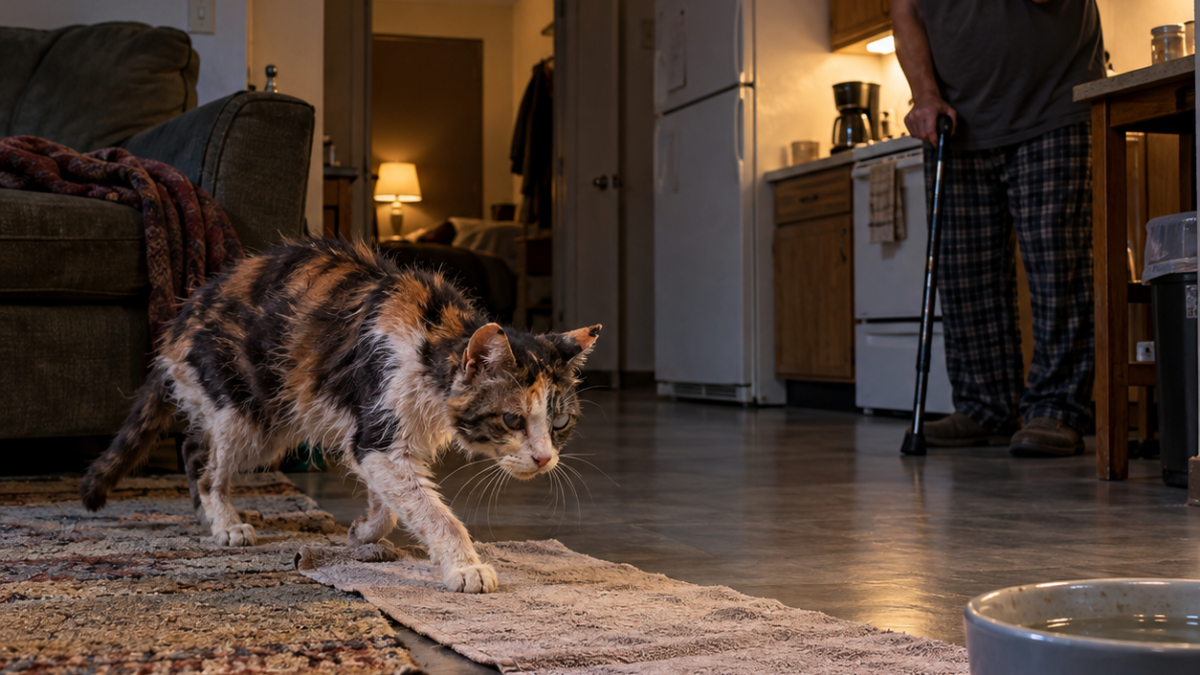
I had agreed to hospice, not a mystery. I had imagined an old cat sleeping quietly in a corner, eating soft food, maybe accepting a blanket. I had not imagined standing in my apartment at two in the morning with my leg shaking while a half-blind cat screamed at a clean floor.
Then I looked at her again.
Her body was flat.
Her ears were pinned.
Her cloudy eyes stared at nothing.
She was not being stubborn.
She was terrified.
I took an old bath towel from the bathroom and laid it across the vinyl, connecting the rug to the water bowl.
Dottie froze.
I stepped back.
For a long time, she did not move.
Then she stretched one paw forward.
It touched the towel.
She pressed slightly.
Waited.
Then placed weight on it.
Slowly, carefully, she followed the towel to the water bowl.
Before drinking, she tapped the rim twice with one paw.
Tap.
Tap.
Only then did she lower her head.
I stood there in the middle of the night, leaning on my cane, watching an old cat drink as if she had just crossed a broken bridge.
That was the first time I wondered whether Dottie was truly dying.
It was also the first time I wondered if everyone had been wrong about her.
Two days earlier, I had met Tessa Ward in a small adoption room behind the rescue office.
Tessa was forty-five, though sadness made her look older when she was not moving. She wore jeans, plain sneakers, and a dark rescue T-shirt with cat hair stuck to the front. Her hair was pulled into a careless knot, gray showing near the temples. She carried Dottie’s paperwork under one arm like it weighed more than paper should.
“You understand this is not a normal adoption,” she said.
“I understand.”
“We’re looking for a hospice foster.”
“That’s what I was told.”
“She may only have a few weeks.”
I nodded.
Tessa studied me a little too closely.
“You seem relieved by that.”
The honesty of the question irritated me.
“I like knowing what I’m agreeing to.”
“That’s fair.”
Near her feet, Dottie sat inside the carrier with her face turned toward the back.
Tessa looked down at her.
“She’s nearly blind. Her hearing is still decent. She doesn’t like being picked up. She may bite if she feels trapped.”
“I won’t pick her up unless I have to.”
“She has litter box issues too.”
“How bad?”
“It varies.”
“That sounds like a careful answer.”
“It is.”
I crouched beside the carrier, and my knee immediately protested.
“Hey, old girl.”
Dottie did not turn toward me.
She seemed less like an animal waiting to be loved and more like a folded piece of laundry someone had put away in the wrong drawer.
“She seems done,” I said.
Tessa looked at me sharply.
“Done with what?”
“Everything.”
For a second, I thought she might take the carrier and walk out.
Instead, she lowered her voice.
“Sometimes an animal stops reacting because reacting has never changed what happens next.”
I looked back at Dottie.
She still had her back to us.
“What happens if I can’t manage her?”
“You call me.”
“And you take her back?”
“Yes.”
Tessa said it quickly, but not easily.
I noticed that.
At the time, I did not know why it mattered.
The morning after Dottie crossed the towel, I woke late and found her back inside the carrier.
She had not eaten.
The water level had gone down slightly.
The towel was wrinkled where she had crossed it.
I sat on the rug and waited.
Dottie did not come out.
I moved the food dish closer. Nothing.
I opened a small can of wet food and placed it on a flat plate.
Her nose moved.
That was all.
“Suit yourself,” I said.
That evening, I worked my shift with Dottie’s carrier in my peripheral vision.
Around nine, while I was telling a woman in Sparks that the earliest available appointment for her washing machine was Thursday between noon and four, I heard Dottie step out.
I kept my voice low.
She stood near the edge of the rug.
The towel was still there.
Her ears turned toward me.
I pretended not to watch.
Dottie followed the towel to the water bowl, tapped the rim twice, and drank.
Then she smelled the food.
She took three small bites.
I felt a ridiculous amount of relief.
“Good girl,” I said.
She froze.
Her head turned toward my voice.
For one second, those cloudy eyes seemed to look directly at me.
Then she backed away and returned to the carrier.
That was the first week.
Dottie came out only when the apartment was quiet.
She ate in small amounts.
She drank after tapping the bowl twice.
She stayed on the rug or towel.
She did not groom herself.
She did not purr.
She did not play.
Every few hours, she shifted positions as if even resting made her uncomfortable.
The litter box became the first battle.
Tessa had sent a low plastic box with unscented litter. I placed it beside the rug.
The first night, Dottie approached it.
She sniffed the edge.
She placed one front paw inside.
Then she jerked backward and cried.
A few minutes later, she urinated on the towel.
I sighed.
The next morning, there was stool on the rug near the carrier.
I cleaned it.
The following day, it happened again.
I tried moving the box.
I tried placing it in a different corner.
I tried changing the amount of litter.
Then I made the mistake every person makes when impatience sounds like problem-solving.
I picked her up.
On the third night, I lifted Dottie under the chest and lowered her toward the litter box.
The change was instant.
Her body twisted.
She let out a harsh cry and bit my wrist.
Hard.
I dropped her.
She landed awkwardly on the rug and scrambled back into the carrier.
“Damn it!”
Blood ran down my hand.
I wrapped my wrist in a dish towel and stared at the carrier.
“I’m trying to help you.”
Dottie pressed herself into the back wall.
Her head was low.
Her body had gone completely still.
I called Tessa.
“She bit me.”
“Did she break the skin?”
“Yes.”
“Clean it carefully.”
“I know how to clean a cut.”
“What happened?”
“I tried putting her in the litter box.”
“You picked her up?”
“How else was I supposed to get her in there?”
Tessa went quiet.
“You said she bites when handled,” she said.
“I thought you meant if someone grabbed her wrong.”
“That may be what happened from her point of view.”
I looked at my wrist.
“You left some things out.”
“I told you everything in the file.”
“That file doesn’t explain anything.”
“No,” Tessa said softly. “It doesn’t.”
Something in her voice made me sit straighter.
“What do you know that isn’t in it?”
“Nothing certain.”
“That’s not an answer.”
“I’m sorry, Caleb.”
“You keep saying that.”
“I know.”
“I can’t have a cat using the rug as a toilet.”
“I understand.”
“Do you?”
“Yes.”
She answered so quickly that it sounded personal.
After the call, I looked toward the carrier.
Dottie had not moved.
I had spent three years being angry whenever someone told me I should just push through pain.
Walk more.
Sit less.
Stretch.
Try yoga.
Try turmeric.
Think positively.
People loved simple solutions when the pain belonged to someone else.
I knew what it felt like to be touched in the wrong place and then blamed for reacting.
Still, I had picked Dottie up because I wanted her to behave in a way that made my life easier.
That thought stayed with me.
The next morning, I sat beside the litter box and watched her.
It took nearly an hour before Dottie came out.
She approached the box.
Sniffed the litter.
Lifted one paw.
Pressed down lightly.
Her leg shook.
She pulled back.
I looked more closely.
There was no open wound, no swelling, no obvious injury.
But her toes looked strange.
Short.
Rounded.
Wrong.
I had seen declawed cats before. I had never thought much about what the word actually meant.
Dottie placed her paw into the litter again.
Her body tightened.
She withdrew and turned away.
This time, I did not stop her.
I went to the kitchen and found an empty cardboard tray from a case of canned soup. It had low sides, barely an inch high. I lined it with several layers of soft paper towels and placed it beside her carrier.
Dottie watched from the rug.
That night, she used it.
She missed one corner, but most of it landed where it should.
I stared at the tray as if she had performed a miracle.
The next day, she used it again.
And again.
And again.
She had not refused the litter box because she was stubborn.
The litter hurt her feet.
The high sides made stepping in difficult.
She had been trying to tell people that for years, and the answer written in her file had been:
Does not use litter box consistently.
I called Tessa.
“The litter hurts her.”
A pause.
“What did you use instead?”
“Paper towels in a shallow tray.”
“And she used it?”
“Three times.”
Tessa let out a breath.
“Thank you.”
“You sound like you hoped I’d figure that out.”
“I did.”
“Why didn’t you tell me?”
“I didn’t know.”
“You suspected.”
“Yes.”
“Why?”
“I’ve seen cats with damaged paws avoid litter.”
“Damaged from what?”
“You saw her feet.”
“She’s declawed.”
“Yes.”
“All four paws?”
“Yes.”
I looked at Dottie, curled inside her cardboard box, her thin body finally resting without tension.
“Who did that?”
“I don’t know.”
“You have four homes listed.”
“The records are incomplete.”
“Then find them.”
“I’m trying.”
“No. Try harder.”
I heard anger in my own voice.
Tessa did not argue.
“I will,” she said.
After that, I changed the apartment.
Not all at once.
A towel path from the rug to the water bowl.
Another to the paper-lined tray.
An old sweatshirt between the rug and the sunny square near the front window.
A folded blanket near my chair.
A cardboard tray with paper.
A water bowl that never moved.
Dottie learned each safe route as if she were mapping a dangerous city.
The first time she reached the sunny spot, she lowered herself into the warmth with such slow caution that I stopped working and watched. She could not see the parking lot outside, not really, but she could hear it.
Car doors.
Footsteps.
Distant carts.
A truck backing up.
Voices on the walkway.
Her ears moved constantly.
For the first time, Dottie looked less like a dying animal and more like a cat who had been waiting for the world to become negotiable.
One evening, I tore a paper grocery bag into flat sheets and placed them near her box.
She sniffed the paper.
Later, I heard a faint scratching sound.
Dottie was pawing at it.
No claws came out.
Of course they did not.
Still, she rubbed her feet over the paper, repeating an old motion her body remembered even after people had taken the tools away.
“Still got the idea,” I said.
Her head turned toward me.
She did not retreat into the carrier.
That felt like progress.
A few days later, my pain was bad from the moment I woke up.
There are different kinds of pain.
Some is sharp and loud. It makes you swear before you can stop yourself.
Other pain sits deep in the bone and makes every ordinary task feel heavier than it should.
That day was the second kind.
While I was working at my desk, my cane slipped from the side of the chair and hit the floor.
Dottie lifted her head from the sunny spot.
I kept typing.
A minute later, I heard her walking.
She followed the towel path toward my chair.
At the end, she stopped near my shoe.
I held my breath.
Dottie leaned forward and touched the toe of my shoe with her nose.
Then she placed one paw on top of it.
That was all.
She stood there with her damaged foot resting on mine.
After a while, she lowered herself onto the rug.
Her paw remained on my shoe.
She fell asleep like that.
I did not move for almost an hour.
That night, Dottie ate half a can of food.
Then she sat near the carrier and washed one side of her face.
It was the first time I had seen her groom herself.
I called Tessa.
“She cleaned her face,” I said.
Tessa went silent.
“You there?”
“Yes.”
“It’s not exactly a miracle.”
“No,” she said. “It’s better.”
“How?”
“A miracle doesn’t ask anything from us. Trust does.”
I did not know what to say to that.
Tessa asked if Dottie still tapped the water bowl.
“Every time,” I said.
There was another silence.
Longer.
“What?” I asked.
“Nothing.”
“You have a lot of nothing.”
“I’m still looking for the old files.”
“When will you have them?”
“Soon.”
I heard strain in her voice.
For the first time, I wondered if Tessa’s strange behavior had less to do with poor paperwork and more to do with Dottie herself.
I began studying Dottie’s feet more closely.
She did not like it.
If I touched near the toes, she pulled away.
The pads were dry and slightly uneven. A few toes sat at odd angles. She had trouble turning quickly. On the towel, she managed. On the hard floor, her back legs slid outward.
I called Tessa again.
“Who declawed her?”
“I told you, I don’t know.”
“I don’t believe you.”
“I don’t know which household did it.”
“Which household?”
“The records were transferred more than once.”
“What aren’t you telling me?”
Tessa took a long breath.
“I should have found out sooner.”
“Why you?”
“Because I handled her intake this time.”
“That doesn’t explain it.”
“No.”
“Then explain it.”
“I can’t yet.”
“You mean you won’t.”
“Yes.”
That answer made me angrier than another apology would have.
I ended the call.
For the next two days, I barely spoke to Dottie.
I fed her.
I cleaned the tray.
I changed the paper.
I kept the paths in place.
But I felt trapped.
I had expected a dying cat who would sleep most of the day and ask little from me.
Instead, I had a cat who needed the apartment redesigned around her.
Towels everywhere.
Paper in the tray.
Food warmed slightly.
Water bowl in the exact same place.
The cardboard box never moved more than an inch, or she searched for it and cried.
The problem was not that Dottie asked too much.
The problem was that I had told myself this would be temporary.
Anything feels manageable when you think it will end soon.
Then the pipe beneath my kitchen sink leaked.
Not a flood.
Just a slow puddle spreading under the cabinet and onto the vinyl.
I moved the water bowl.
Picked up the towels.
Stacked the cardboard paths on the chair so they would stay dry.
I planned to put everything back after cleaning.
My leg hurt.
I was tired.
I forgot Dottie was asleep.
The sound came from behind me.
A quick scrape.
Then a thud.
I turned.
Dottie stood halfway between the rug and the kitchen.
With the towels gone, she had stepped onto the vinyl.
Her back feet had slipped.
She tried to correct herself and slid sideways.
“Don’t move,” I said.
That was a stupid thing to say to a frightened cat.
Dottie scrambled toward what she thought was the rug.
She went the wrong direction.
Her shoulder hit the cabinet.
She cried out and ran beneath the small kitchen table.
“Dottie.”
I lowered myself to the floor.
Pain stabbed down my leg.
I reached under the table.
Dottie hissed.
“It’s okay.”
I moved my hand closer.
She bit me.
Hard.
I jerked back and hit my elbow on the table leg.
“Enough!”
Dottie flattened herself against the wall.
My hand was bleeding.
The pipe was still dripping.
My back throbbed.
The apartment smelled like wet cardboard and cat food.
“I can’t do this,” I said.
Dottie stopped hissing.
She did not come out.
She simply went still.
That was worse.
I called Tessa.
“You need to take her back.”
“What happened?”
“She slipped. She panicked. She bit me again.”
“Is she hurt?”
“I don’t know.”
“Can she walk?”
“I don’t know. She’s under the table.”
“I can come over.”
“Tomorrow.”
“Caleb—”
“Tomorrow morning. Bring the carrier.”
There was a pause.
“All right.”
I ended the call.
Dottie stayed under the table for nearly two hours.
I cleaned the leak.
Put the towel paths back.
Placed the carrier near the door.
The metal latch clicked when I opened it.
Dottie heard the sound.
She crawled out from beneath the table.
She did not look at me.
She walked slowly along the towel path to the carrier.
Then she went inside and pressed herself against the back wall.
She knew what the carrier meant.
Not a ride.
Not help.
The carrier meant a home was over.
She did not scream.
She did not fight.
She simply made herself small and waited for me to finish returning her.
I sat in my chair and looked at her.
“Stop that.”
Dottie did not move.
“You bit me.”
Her ears angled toward my voice.
“I’m not the bad guy here.”
She lowered her head.
I knew what people had said about me after my injury.
He’s hard to be around now.
He gets angry over little things.
He never wants to go anywhere.
He doesn’t even try.
Nobody asked what it felt like to wake up already tired.
Nobody asked how much effort it took to sit through dinner in a chair that made my leg burn.
They saw the reaction and named it.
They did not see the cause.
I looked at Dottie in the carrier.
Difficult.
Unpredictable.
Bites when handled.
Those words had probably followed her from home to home.
Nobody had written:
Afraid of falling.
Hurts when lifted.
Needs something soft under her feet.
I wanted to take the carrier away from the door.
I did not.
At eight the next morning, Tessa knocked.
She stepped inside carrying a thick envelope.
She looked at the carrier near the door, then at my bandaged hand.
“I’m sorry.”
“Don’t.”
“I brought the records.”
“You found them?”
“Most of them.”
She did not reach for the carrier.
Instead, she placed the envelope on my table.
“What’s in there?”
“The reason I should have told you the truth before you took her.”
I leaned against the counter.
“What truth?”
Tessa opened the envelope and removed an old photograph.
She placed it in front of me.
The picture showed a young woman sitting on the floor of a nearly empty room. Long dark hair. Tired smile. Maybe twenty-five.
In her lap was a small calico kitten with bright eyes and a half-moon missing from one ear.
I looked at Tessa.
“That’s you.”
“Yes.”
“That’s Dottie.”
“Yes.”
The room seemed to go quiet.
I looked toward the carrier.
Dottie had lifted her head.
“You owned her.”
Tessa closed her eyes.
“She was mine first.”
The words came out barely above a whisper.
“When?”
“Fifteen years ago.”
“How old was she?”
“A little over one.”
“And you gave her away?”
“Yes.”
“Why?”
“I lost my apartment.”
I waited.
Tessa sat down.
“I was working two part-time jobs. The building was sold. I had thirty days to leave. The only room I could afford didn’t allow animals.”
“So you surrendered her.”
“I thought it would be temporary.”
“But it wasn’t.”
“No.”
“You never got her back.”
Tessa shook her head.
“By the time I had a place that allowed pets, she had already been adopted.”
“And that was it?”
“I told myself she had a better home.”
“You checked?”
“Not at first.”
Her voice cracked.
“I was ashamed. I had promised I would never leave her, and then I did. It was easier to imagine her sleeping on somebody’s couch than to ask questions I might not like the answers to.”
I tapped the papers.
“What happened after that?”
“She lived with the first household for almost five years.”
“Then?”
“They moved and returned her.”
“So she was adopted again.”
“Yes.”
“That’s where she was declawed?”
“I think so.”
“You think?”
“The records say she scratched furniture. A later note says she had undergone a four-paw declaw procedure before being returned.”
I stared at her.
“Four paws.”
“Yes.”
“Then they returned her anyway.”
“Not immediately. The litter problems started later.”
“Because her feet hurt.”
“Most likely.”
“And everybody called it a behavior problem.”
“Yes.”
Dottie shifted inside the carrier.
Tessa looked toward her.
“I didn’t know it was her then,” she said.
“What do you mean?”
“She had a different name in the records. She went through two more homes. Her markings faded. Her eyes were already cloudy when she came back this last time.”
“But you recognized her.”
“Not at first.”
“How?”
Tessa looked at the water bowl.
“The tapping.”
I said nothing.
“When she was a kitten, she fell into a deep water container. After that, she always checked the edge before drinking. Two taps. Every time.”
My eyes moved to the bowl.
Tap.
Tap.
A habit held for fifteen years.
A tiny movement surviving four homes, a new name, damaged feet, blindness, old age, and every person who had failed to understand what it meant.
“You knew before you brought her to me,” I said.
“Yes.”
“How long?”
“Three weeks.”
“And you didn’t tell me.”
“I was afraid.”
“Of what?”
“That you would think I was trying to make you carry my guilt.”
“Weren’t you?”
Tessa flinched.
“Maybe.”
I turned away.
The kitchen floor was covered with towels again.
“Why didn’t you take her?”
“My apartment doesn’t allow animals.”
“Move.”
“I can’t afford to.”
The answer was simple.
That made it harder to argue with.
“Then why not say that from the beginning?”
“Because it sounds like an excuse when you’re looking at the animal you left.”
Tessa wiped her face with the heel of one hand.
“I kept telling myself I had made the responsible choice. I had nowhere for her to go. I thought giving her up meant she would have stability.”
“She didn’t.”
“No.”
“You should have checked.”
“Yes.”
“You should have told me.”
“Yes.”
I wanted her to defend herself.
I wanted her to say something wrong enough that I could stay angry without thinking.
She did not.
Dottie came to the front of the carrier.
Tessa crouched several feet away.
“Hi, Dot.”
The name sounded different in her voice.
Older.
Dottie’s ears turned.
Tessa held out her hand but did not move closer.
Dottie sniffed the air.
For several seconds, nothing happened.
Then she stepped out of the carrier.
She followed the towel to the water bowl.
Tessa watched, one hand pressed against her mouth.
Dottie raised her paw.
Tap.
Tap.
She drank.
Tessa cried without making a sound.
Dottie did not go to her.
She returned to the rug and lay beside my chair.
One paw touched my shoe.
I looked down at her.
Tessa stood.
“I’ll take her back if that’s what you want.”
“Where will she go?”
“Back to the rescue room.”
“In a cage?”
“For now.”
“She can’t walk on the floor there.”
“We can add towels.”
“Will someone keep them in the same place?”
“I’ll try.”
“That means no.”
Tessa lowered her eyes.
I looked at Dottie’s paw on my shoe.
“I’m not promising forever,” I said.
Tessa looked up.
“I understand.”
“I’m keeping her until I know how sick she actually is.”
“I understand.”
“And you’re going to tell me everything in those papers.”
“Yes.”
“No more careful answers.”
“No more.”
I picked up the carrier and put it in the closet.
Dottie’s ears followed the sound.
She did not move her paw.
The next week changed everything again.
Dottie was examined properly.
Bloodwork.
X-rays.
A better look at her feet.
A longer conversation with a veterinarian who did not read her file like a verdict.
The results were not what I expected.
Dottie was old.
She had arthritis.
Her kidneys needed watching.
Her eyes would not improve.
Her paws had chronic damage from the old surgeries.
But she was not actively dying.
There was no clear reason to believe she had only weeks.
With the right environment and regular care, she might live many more months.
Possibly longer.
When Tessa told me that, I did not feel relieved.
I felt trapped all over again.
“I agreed to hospice,” I said.
“I know.”
“This isn’t hospice.”
“Not the way we thought.”
“How long?”
“Nobody can promise.”
“A year?”
“Possibly.”
“Two?”
“Possibly.”
I sat in my chair and rubbed my leg.
Dottie slept near the window.
“You’re happy,” I said.
“I’m relieved.”
“That’s easy for you. She doesn’t live in your apartment.”
Tessa accepted that without argument.
“I know.”
“She needs special food. The floor covered. That paper tray changed constantly. I can’t leave anything in a new place.”
“I know.”
“My body already decides how I spend every day.”
“I know.”
“Stop saying that.”
Tessa looked at Dottie.
“What do you want me to say?”
I did not have an answer.
That night, I removed one towel from the path to the window.
Not because I wanted Dottie to fall.
I told myself I wanted to see how dependent she really was.
She woke, stretched, and walked toward the window.
At the gap, she stopped.
Her front paw searched for the missing towel.
She touched the vinyl.
Backed away.
Then sat there.
She did not cry.
She did not try another route.
She simply waited.
I replaced the towel.
Dottie continued to the window.
The shame I felt was immediate.
She was not manipulating me.
She was not asking for luxury.
She needed a safe path across ten feet of flooring.
I thought of all the things I needed that other people considered inconvenient.
A firm chair.
A parking space near the entrance.
Time to stand slowly.
A handrail.
A break halfway through a store.
None of those things made me weak.
They made the difference between participating and staying home.
Dottie’s towels were not special treatment.
They were access.
Once I understood that, caring for her became less irritating.
Not easy.
Just clear.
I bought inexpensive carpet runners.
Covered the main path from the living room to the bedroom.
Placed a small rug in front of the bathroom.
Used non-slip pads underneath so they would not move.
Dottie learned the new map within days.
She began leaving the living room on her own.
The first time she reached the bedroom, I was lying down with my leg elevated.
I heard her before I saw her.
Soft step.
Pause.
Soft step.
Pause.
She appeared in the doorway, whiskers forward.
“Well,” I said. “Look who figured it out.”
Dottie followed my voice to the side of the bed.
The mattress was too high for her to climb, so I placed a cardboard box beside it as a step.
She sniffed the box but did not use it that day.
Instead, I lowered my hand.
Dottie rubbed her cheek against one finger.
Then she lay on the rug and went to sleep.
After that, she began following me.
Not closely.
Dottie was still a cat.
She did not come when called.
She did not perform gratitude.
She simply arranged herself near wherever I was.
If I worked, she slept beneath the desk.
If I ate, she sat on the rug outside the kitchen.
If I watched television, she rested with one paw on my shoe.
If I used my cane, she listened for the rubber tip against the floor.
I tied a small bell beneath the handle.
The first time it rang, Dottie lifted her head.
Within a week, she could find me from any room by following that sound.
Tessa visited every Saturday.
At first, Dottie ignored her.
Tessa never forced contact.
She sat on the floor several feet away and talked softly.
“You used to climb the shower curtain,” she told Dottie once.
Dottie cleaned one shoulder.
“You stole bread from the counter.”
Dottie turned one ear.
“You slept inside my laundry basket and bit me when I tried to get my socks.”
I looked at Tessa.
“She bit you too?”
Tessa smiled faintly.
“She was always clear about her boundaries.”
“That would have been useful information.”
It was the first time I had seen Tessa smile without pain folded inside it.
Some visits, Dottie stayed near me.
Other times, she walked within a few feet of Tessa.
One afternoon, Tessa placed her hand palm down on the rug.
Dottie approached.
She sniffed Tessa’s fingers.
Tessa held completely still.
Dottie touched her nose to one knuckle.
Then walked away.
Tessa cried after she left.
I could tell because her face changed before she reached the door.
I did not comfort her.
Not then.
I was still angry.
But anger became harder to keep clean once I understood her life.
Tessa had been twenty-six when she gave Dottie up.
No savings.
No family able to help.
No apartment that allowed a cat.
She had made a decision that looked responsible on paper and broke her heart in private.
That did not erase what happened to Dottie.
It did not make fifteen years of pain acceptable.
It only made the story more human.
Most damage is not caused by monsters.
Sometimes it comes from ordinary people making the best choice they can see, then being too ashamed to look back.
One evening, I told Tessa that.
She sat at my small table.
Dottie slept near the window.
“You’re allowed to be angry with me,” Tessa said.
“I am.”
“I know.”
“But I also know what it’s like to lose the version of your life you thought you were going to have.”
Tessa looked down at her hands.
“I kept thinking I would fix it later.”
“Most people do.”
“Then later got bigger.”
“Yes.”
She looked toward Dottie.
“Do you think she remembers me?”
“I think she remembers how you sound.”
“That’s not the same.”
“No.”
Tessa nodded.
“I don’t expect it to be.”
That answer changed something between us.
Not forgiveness.
Not yet.
But honesty had finally entered the room.
Months passed.
Dottie gained almost two pounds.
Her coat softened.
She groomed every day.
She discovered crumpled paper balls made an interesting sound when pushed across the rug. Because she had no claws, she could not grab them well. She chased them anyway, batting clumsily, missing often, then looking offended when physics refused to cooperate.
She learned to use the cardboard step beside my bed.
The first time she climbed onto the mattress, she stood near my feet and seemed unsure what to do.
I patted the blanket.
She walked halfway up, turned three circles, and lay beside my hip.
I woke before dawn with one of her paws resting on my side.
She had become part of my life quietly.
Without permission.
Without announcement.
My apartment changed too.
I began working from the kitchen table instead of my chair because Dottie liked sleeping beneath it.
I bought two framed desert prints for the walls.
Nothing expensive.
Just color.
I opened a box I had not touched since moving in and found an old coffee mug, a small radio, and a stack of birthday cards.
I kept them out.
The apartment stopped looking like a place someone might abandon in an afternoon.
It began looking like someone planned to stay.
Dottie had good days and bad days.
On good days, she walked from room to room and argued loudly if breakfast was late.
On bad days, her back legs were stiff and she slept more.
She still hated being lifted.
If I had to move her, I supported her carefully and warned her with my voice first.
She stopped biting me.
Not because she had become sweet.
Because I stopped surprising her.
That difference mattered.
About seven months after she arrived, I had one of my worst pain nights.
It began in my lower back and moved down my left leg. By midnight, every position hurt. I stood to get water, and my knee gave way.
I caught the wall, but my cane fell several feet away.
I lowered myself to the bedroom floor.
I was not badly injured.
I was not in danger.
I simply could not stand yet.
People imagine dramatic moments when they think of living alone.
A fall.
A medical emergency.
A call for help.
Most of the time, it is less dramatic.
It is sitting on the floor, waiting for your body to cooperate while the apartment remains completely silent.
I leaned against the bed.
The cane lay near the doorway.
I could not reach it.
Then I heard Dottie in the living room.
She had been sleeping near the window.
The bell on the cane had made one sharp sound when it fell.
Dottie entered the hallway.
I listened to her steps on the runner.
She reached the end of the rug outside the bedroom.
There was a small strip of uncovered vinyl between the hallway runner and the rug beside my bed.
About two feet.
Usually, Dottie waited for me to place a towel there.
That night, there was no towel.
She stopped.
I could see her in the doorway.
Her head moved from side to side.
“Stay there,” I said.
Dottie heard me.
Her ears pointed forward.
“I’m okay.”
She lifted one paw.
It touched the vinyl.
She pulled it back.
“Don’t.”
Dottie stepped forward.
Her rear feet slipped slightly.
She froze.
“Dottie, stay.”
She took another step.
Her body stayed low.
She leaned against the doorframe to keep balance.
Then she crossed the strip.
Once she reached the bedroom rug, she followed my voice to where I sat.
She pressed her nose against my hand.
Then she placed one paw on top of my fingers.
Her damaged foot trembled.
I started crying.
Not because she saved my life.
She had not.
Not because she could bring me the cane.
She could not.
I cried because Dottie had spent years being returned for refusing to cross floors that hurt her.
That night, she crossed one anyway.
For me.
I rested my forehead against the side of her face.
“You stupid old cat,” I whispered.
She leaned into me.
We stayed like that until I could stand.
The next morning, I called Tessa.
“I’m adopting her.”
Tessa was quiet.
“Officially?”
“Yes.”
“Are you sure?”
“No.”
She laughed once, then began to cry.
“I’m not doing it because you feel guilty,” I said.
“I know.”
“I’m not doing it because she’s easy.”
“I know.”
“I’m doing it because she lives here.”
Tessa took a breath.
“Okay.”
“And I want the record changed.”
“What part?”
“All of it.”
We rewrote Dottie’s story.
Not the facts.
The meaning.
We did not erase the four returns.
We explained them.
We did not erase the bites.
We wrote that Dottie bit when lifted because handling caused fear and pain.
We did not hide the litter box problems.
We wrote that rough litter hurt her altered paws and that she used a soft paper-lined tray consistently.
We did not call her difficult.
We called her cautious.
Observant.
Adaptable when given a stable environment.
At the end, Tessa added one sentence:
Dottie responds best to people who assume behavior has a reason.
I read it twice.
“That should be written on every animal’s file,” I said.
“Maybe every person’s too,” Tessa replied.
Dottie lived another year and three months after I adopted her.
Nobody expected that.
Her world stayed small.
The living room.
The kitchen path.
The bedroom.
The sunny window.
My chair.
Tessa’s Saturday visits.
But small did not mean empty.
Dottie developed routines.
At six in the morning, she cried for food.
At ten, she slept near the window.
At noon, she walked to the kitchen and tapped the water bowl twice.
In the afternoon, she pushed paper balls beneath furniture and waited for me to retrieve them.
At night, she climbed onto the bed.
Sometimes she slept beside me.
Sometimes she sat facing the doorway, listening.
Tessa continued visiting.
One Saturday, she brought an old piece of fabric.
It was faded blue with tiny white dots.
“This was part of a blanket she had as a kitten,” Tessa said.
“You kept it?”
“I kept more than I should have.”
She placed the fabric on the rug.
Dottie was in her box.
Her nose lifted.
She climbed out.
Slowly, she followed the scent across the room.
Tessa sat on the floor with her hands in her lap.
Dottie reached the fabric.
She sniffed it for a long time.
Then she stepped onto it and sat down.
Tessa did not move.
“Say something,” I whispered.
Tessa swallowed.
“Hey, Dot.”
Dottie’s ears turned.
“You still check the water?”
Dottie blinked.
Tessa held out one hand.
Dottie leaned forward.
She rubbed her cheek against Tessa’s fingers.
Only once.
Then she lay down on the old fabric.
Tessa closed her eyes.
I looked away to give her privacy, even though we were all in the same room.
After that, Dottie sometimes greeted Tessa at the door.
Not always.
Cats do not provide neat endings on command.
But enough times.
Enough for Tessa to know the first year of Dottie’s life had not disappeared completely.
Enough for Dottie to learn Tessa’s voice no longer meant goodbye.
My own life changed in ways I did not expect.
I started taking short walks along the covered walkway outside my apartment.
Not far.
I still had bad days.
I still used the cane.
But I stopped treating every limitation as proof that my life was shrinking.
Dottie had taught me another way to think about it.
She did not need the whole floor.
She needed a path.
So I began looking for paths instead of mourning every door that had closed.
A shorter walk.
A better chair.
A slower schedule.
A phone call instead of a long visit.
A meal at the table instead of at my desk.
Small changes.
Soft places to step.
That was enough to begin.
Dottie’s final decline was quiet.
She started leaving food in the dish.
She slept longer.
She no longer pushed paper balls.
One morning, she walked to the water bowl, tapped it twice, and did not drink.
I sat on the floor beside her.
“You tired?”
Dottie turned toward my voice.
She placed one paw on my knee.
I called Tessa.
She arrived that afternoon.
Neither of us said what we were thinking.
Dottie lay in her cardboard box near the window. We had replaced the box several times over the year, but every new one had to be the same size. She liked high sides and one opening cut low enough for her to step through.
Tessa sat on one side.
I sat on the other.
Dottie’s breathing was slow.
Tessa placed the blue fabric beneath one of her paws.
“I’m sorry,” she said.
Dottie’s ear moved.
“I should have found you sooner.”
Dottie lifted her head slightly.
Tessa’s voice shook.
“I hope there were good days.”
I looked around the apartment.
The runners.
The paper tray.
The cardboard steps.
The worn spot beside my chair.
The framed pictures on the wall.
“There were,” I said.
Dottie stretched one paw toward my hand.
I gave her my fingers.
Her other paw rested near Tessa’s wrist.
Tessa moved closer until Dottie could touch her.
For a while, the old cat held both of us.
The woman who had loved her first.
The man who almost returned her last.
Dottie died that evening.
There was no dramatic final sound.
Her body simply relaxed.
Her paw slipped from my hand.
Tessa bent over her and cried.
I did too.
Afterward, the apartment looked wrong.
The runners were still there.
The water bowl sat in its usual place.
The paper-lined tray was clean.
For several days, I kept hearing sounds that were not real.
A paw on cardboard.
A soft cry near the kitchen.
Two taps against the water bowl.
I did not move the rugs.
Not right away.
The empty path hurt.
Removing it felt worse.
Tessa came over the next Saturday carrying Dottie’s file.
The final version.
The true version.
We sat at the table and read it together.
The first paragraph listed her age, coloring, blindness, arthritis, and altered paws.
The next section described her needs.
Soft flooring.
Stable furniture placement.
Low-sided paper-lined tray.
No forced handling.
Verbal warning before touch.
At the bottom, under history, we had written:
Dottie lived in several homes and was returned multiple times after her pain and mobility needs were misunderstood. She was not refusing to adapt. She was protecting herself from surfaces and handling that caused discomfort.
Tessa pointed to the final line.
“You should read that one.”
I did.
She loved warm windows, cardboard boxes, soft paper, and people patient enough to ask what hurt.
I sat back.
“That’s her.”
“Yes.”
Tessa folded the papers.
“I used to think giving her up was the worst thing I ever did.”
“What do you think now?”
“That leaving her story unexplained was worse.”
I understood.
Giving Dottie up had happened in one desperate month.
The labels followed her for fifteen years.
Difficult.
Dirty.
Aggressive.
Unwanted.
Words can outlive the moment that created them.
They can become the only version anyone bothers to read.
After Tessa left, I removed most of the rugs.
I cleaned the floor.
Folded the towels.
Put away the paper tray and the water bowl.
But I left one runner in the hallway.
It made no sense from a decorating standpoint.
It did not match anything.
It was worn in the center where Dottie’s paws had passed over it thousands of times.
I kept it because I needed the reminder.
People had said Dottie would not walk on normal floors.
That was true.
The part they got wrong was why.
They called her stubborn when she was scared.
They called her dirty when the litter hurt.
They called her aggressive when being lifted caused pain.
They called her unable to adjust while moving her from place to place.
For years, everyone focused on how inconvenient her reactions were.
Almost nobody asked what caused them.
I had nearly become one more person who returned her.
I had placed the carrier by the door.
I had told myself I had done enough.
The only reason Dottie stayed was that, for once, somebody paused long enough to see that the floor beneath her feet was not the same floor beneath ours.
That lesson stayed with me.
A person may seem angry because sitting hurts.
A neighbor may refuse invitations because every outing costs more energy than anyone realizes.
An old animal may hide, bite, cry, or make a mess because the world has become painful and confusing.
Understanding does not solve everything.
It does not erase limits.
It does not make care easy.
But it changes the question.
Instead of asking, “Why are you making this so difficult?”
You ask, “What is making this difficult for you?”
That small change gave Dottie almost two more years of life.
It gave Tessa a chance to face the truth without pretending the past could be undone.
And it gave me a home.
I had spent years believing I was one inconvenience away from becoming too much for other people.
Dottie had spent years being treated as if her needs were proof something was wrong with her.
We were both waiting for a world that required less from us.
We never found one.
We found something better.
A soft path through the world we already had.
Dottie did not spend seventeen years refusing to belong.
She spent seventeen years trying to stand on floors that hurt while people called her pain a personality.
In the end, she did not need a miracle.
She needed one person willing to get down on the floor, look closely, and ask the question everyone else had missed.
Where does it hurt?








