A 16-Year-Old Girl Was Told She Didn’t Belong With the Military Families and Sent to the Back Row—Seconds Later, Seven K9s Broke Formation and Ran Straight to Her.
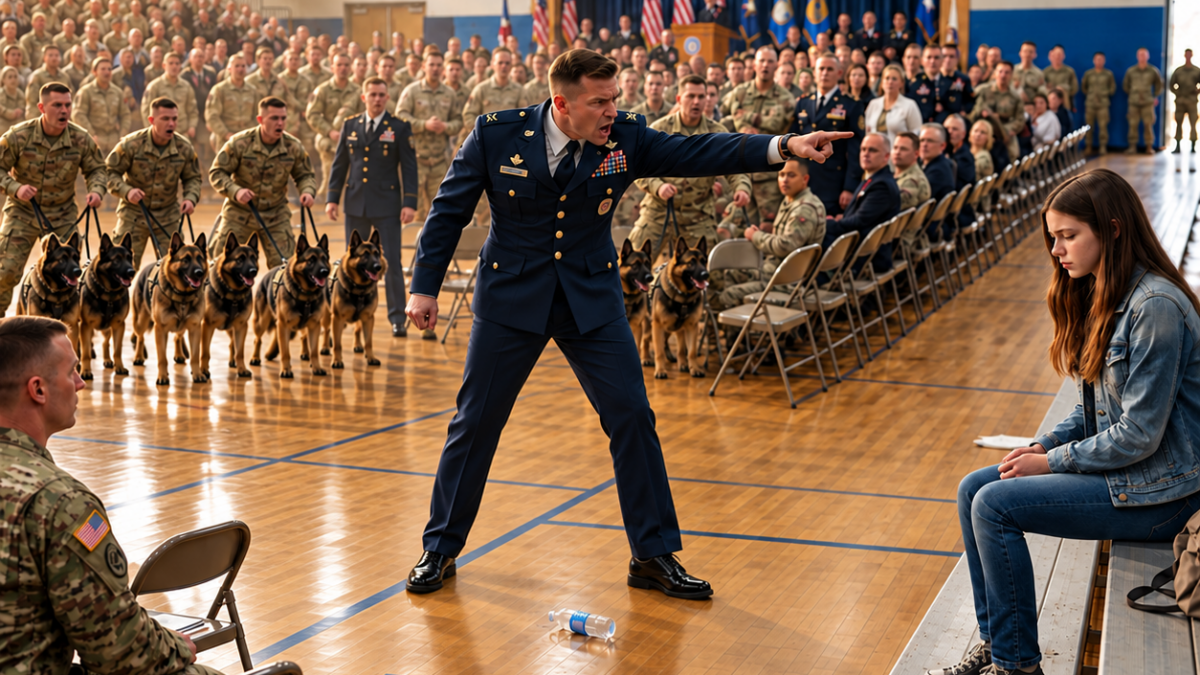
PART2:
PART3:
Her father looked at the picture for so long she thought he had not heard.
“For a while,” he said.
“What was his name?”
Daniel closed the wallet.
“It doesn’t matter now.”
But his voice told her it mattered very much.
Three years later, Daniel Doyle died on a rain-slick back road outside town.
A curve.
A tree.
No witnesses.
The police report said he likely fell asleep at the wheel.
Some people whispered that maybe it had been more than that. Some said men like him never came back right. Some said it was sad but not surprising. A teacher’s aide at school called him “troubled” when she thought Hannah could not hear.
Hannah heard everything.
After the funeral, adults handed her sentences that sounded like comfort but felt like lids being placed over boxes.
He’s at peace now.
He had demons.
He loved you the best he could.
Try to remember the good times.
But no one asked her what the good times were.
No one asked what his laugh sounded like before the house got quiet.
No one asked why he kept a photograph of a German Shepherd in his wallet.
No one asked whether the man they called troubled had once done something brave enough to break him.
So Hannah stopped offering answers.
At thirteen, she learned that grief was safer when carried quietly. If people did not know what mattered to you, they could not step on it as easily.
A month after the funeral, while Aunt Laura slept on the couch in her work clothes, Hannah opened one of Daniel’s old boxes. She did not know what she was looking for until she found it.
The photograph.
Not the wallet copy, but a larger print, soft at the edges from handling.
Young Daniel in the dirt.
The German Shepherd across his lap.
Both looking exhausted.
Both alive.
Hannah took the picture and slipped it into the front pocket of her backpack, behind an old library card and a folded math worksheet. She carried it everywhere after that. School. Grocery store. Bus stop. Dentist appointment. The back rows of rooms where she had no reason to be noticed.
She never told anyone why.
Now, sitting in the highest bleacher row at Fort Drayton, she could feel the picture in her backpack between her feet.
The ceremony was not for her.
It was for Major General Daniel Hargrove, retiring after thirty-two years of service. The whole base had turned out for him. His name appeared on the printed program in bold letters. His accomplishments filled two inside pages. People spoke about him with admiration before he ever reached the podium.
Hannah did not envy him.
She only noticed the difference.
Some men left service and were remembered in banners, speeches, polished shoes, and rows of folding chairs.
Some came home to small towns that remembered only how badly they had struggled.
Mrs. Pruitt spotted Hannah from the front and gave a small wave.
Hannah lifted her hand back.
Mrs. Pruitt was the reason she was here. She worked in the base administrative office and had always been kind to Laura when she came to clean after hours. A week earlier, she had found Hannah waiting outside the office with a library book and said, “Honey, you ever seen the K9 unit work?”
Hannah had shaken her head.
“You should come Saturday. They’ll do a demonstration at General Hargrove’s retirement. Those dogs are something special.”
Hannah almost refused.
Crowds made her nervous.
Uniforms made her chest tighten.
But Mrs. Pruitt had looked so hopeful that Hannah nodded before she could think too hard about it.
Now she regretted coming.
Not because of the dogs.
Because of the people.
Two officers’ children climbed past her, stepping over her backpack like it was trash in the aisle. One boy’s polished shoe pressed down on the toe of her sneaker.
“Sorry,” his mother said automatically, not looking back.
Hannah moved her foot under the bench.
A young lieutenant’s wife glanced up at her and smiled with the bright politeness of someone asking a favor she already expected to receive.
“Would you mind scooting down, sweetheart? We’re trying to keep our family together.”
There were empty spaces lower down, but Hannah moved anyway.
“Thank you,” the woman said, then turned back to her husband before Hannah could answer.
Hannah had become good at making room for people who never wondered who had made room for her.
The ceremony began.
There were opening remarks, applause, a prayer, another speech, and a story about General Hargrove’s first command that made the older officers laugh. Hannah listened without really listening. Her eyes drifted to the side doors where the K9 handlers waited.
Then the dogs came in.
Everything changed.
Seven handlers marched onto the floor with seven dogs moving in formation so sharp that even the children stopped squirming.
Hannah leaned forward.
She could not help it.
There were three Belgian Malinois, one Dutch Shepherd, one black Lab built lean and powerful, and two German Shepherds. The lead dog was sable-coated, broad-chested, and older than the rest. Not old, exactly, but seasoned. Silver touched his muzzle. His gaze was steady in a way that made him seem less like he was performing and more like he was assessing every person in the gym and deciding whether they deserved his attention.
His harness patch read ATLAS.
Hannah’s breath caught.
She did not know why.
The name brushed something in her, not a memory but the shape of one.
Corporal Reyes handled Atlas. He was young, maybe twenty-four, with a strong jaw and nervous pride in the way he moved. He loved that dog. Hannah could see it from the top row. The way his hand stayed close without gripping too tight. The way Atlas watched him without needing constant correction.
General Hargrove stood at the podium.
“Our military working dogs and handlers represent discipline, loyalty, and courage in one of their purest forms,” he said. “Today, I’m honored to have Fort Drayton’s K9 unit demonstrate the kind of partnership that keeps our soldiers safe.”
Applause filled the gym.
The demonstration began.
The dogs moved between rows of chairs, turned on hand signals, sat in perfect order, then rose together. Cameras lifted. Children whispered. Officers nodded approvingly.
Hannah watched Atlas.
He did everything perfectly.
Until he didn’t.
Halfway across the floor, Atlas stopped.
Not slowed.
Stopped.
His head snapped toward the bleachers.
His ears went rigid.
Corporal Reyes took two steps before feeling the leash tighten.
“Atlas,” he said quietly.
The dog did not look at him.
He looked straight at Hannah.
Her fingers closed around the edge of the bench.
For one impossible second, the entire gym seemed to narrow into a line between her and the German Shepherd standing frozen on the floor.
Atlas inhaled.
Once.
Twice.
His body changed.
It was not aggression. Hannah knew that without knowing how she knew. It was recognition so powerful it had overridden training.
“Atlas, heel,” Reyes commanded.
Atlas broke formation.
Gasps moved through the crowd. A few people laughed nervously, assuming it was part of the show.
It was not.
Atlas moved fast, low, and focused, cutting straight across the open gym floor toward the bleachers.
“Atlas, heel!” Reyes shouted.
The command cracked like a whip.
Atlas did not slow.
Then another dog broke.
Bodie, one of the Belgian Malinois, pivoted away from his handler as if pulled by the same invisible cord.
Daisy, the youngest dog, barked once and bolted.
The Dutch Shepherd followed.
Then the Lab.
Then the other two.
Within seconds, all seven military K9s were running toward Hannah Doyle.
Handlers shouted commands that should have stopped any one of those dogs cold. The dogs ignored every one.
Three hundred people fell silent.
A flag stand toppled with a metallic clatter when one dog brushed past it. Chairs scraped backward. A woman gasped. A child started crying and was quickly pulled close by his father.
Major General Hargrove stopped speaking mid-sentence.
Hannah did not move.
A normal teenager should have been terrified. She knew that later because everyone kept saying it. Seven trained military dogs rushing toward the bleachers should have made her scream, run, or at least flinch.
But Hannah felt something stranger than fear.
She felt found.
Atlas reached her first.
He climbed the bleacher steps with powerful, controlled movements and stopped one step below her. His amber eyes locked on her face. Then he released a long, low whine that silenced every breath in the gymnasium.
Hannah slid down from the bench.
She moved slowly, as though the moment might vanish if she startled it.
Atlas lowered his head.
She raised one hand.
The German Shepherd pressed his forehead into her palm.
A tremor moved through his entire body.
The other dogs settled around her in a loose half circle, no longer wild, no longer running, simply surrounding her with quiet certainty. Their bodies faced outward. Their heads stayed calm. They looked less like dogs seeking attention than soldiers forming a perimeter.
Corporal Reyes reached the bleacher steps breathless and red-faced.
“Atlas, down.”
Atlas ignored him.
“Atlas. Down.”
Nothing.
Reyes’s embarrassment faded into confusion, then something close to fear.
“Ma’am,” he said, looking at Hannah, “I’m so sorry. He’s never done this. I don’t know what got into him.”
Hannah kept her hand on Atlas’s head.
The dog’s eyes were half closed, his breathing uneven.
“It’s okay,” she whispered.
Reyes stopped.
Hannah looked down at Atlas, and the words came before she understood them.
“He’s looking for someone.”
The gym remained silent.
“I think,” she said, her voice barely audible, “he might be looking for my dad.”
Reyes stared at her.
“What?”
Hannah bent closer to Atlas.
The name had lived inside her for three years, carried quietly because people had made it too heavy to speak.
Now she let it out.
“Daniel Doyle,” she whispered.
Atlas’s ears flattened.
Then shot forward.
A sharp sound broke from his chest. Not a bark. Not a cry. Something between the two, raw enough to make several people in the front row flinch.
He pressed his entire body against Hannah’s knees like a dog trying to return to a place he had lost.
The other six dogs lowered themselves around her.
Still.
Watchful.
Corporal Reyes went pale.
“How do you know that name?”
Hannah looked up.
“He was my father.”
Reyes’s mouth opened, but no sound came.
Below them, Major General Hargrove left the podium.
That alone changed the air in the gym. Generals did not walk away from their own retirement speeches to climb bleachers unless something had gone far beyond a disrupted demonstration.
Hargrove approached slowly, eyes moving from Atlas to Hannah to the other dogs and back again.
“Young lady,” he said, and his voice carried the kind of respect nobody had offered her at the entrance, “would you mind telling me what just happened here?”
Hannah stood carefully.
Atlas stayed pressed against her leg.
“I don’t know, sir,” she said. “I’ve never met these dogs before.”
“But you said a name.”
“My dad’s name.”
“Daniel Doyle.”
“Yes, sir.”
Hargrove’s expression changed slightly.
Not recognition.
Not yet.
But attention.
“And your father served?”
“Yes, sir. Army.”
“What unit?”
“I don’t know. He didn’t talk about it much.”
Atlas whined softly.
Hannah swallowed.
“He died when I was thirteen.”
The words hung there in front of three hundred people.
Hargrove glanced at the dogs, all calm now, all unwilling to leave Hannah’s side.
“I think the ceremony can wait,” he said. “We need to have this conversation somewhere quieter.”
That was when the investigation began, though no one called it that at first.
Sergeant First Class Maria Delgado arrived with the contained urgency of someone who knew exactly how unusual the situation was and did not want civilians panicking around working dogs.
Delgado supervised Fort Drayton’s K9 unit. She had trained dogs for fourteen years, worked with handlers from three branches, and built a reputation for being impossible to impress. When she saw seven dogs gathered around Hannah, her face did not show surprise.
That made Hannah more nervous than if she had gasped.
Delgado took in the scene the way a field investigator takes in footprints.
The dogs’ positions.
Atlas’s body contact.
The handlers’ confusion.
Hannah’s stillness.
The crowd’s silence.
“Miss Doyle,” Delgado said gently, “would you come with us?”
Hannah hesitated.
The last thing she wanted was to be alone in a room full of officers.
Atlas leaned against her knee.
Delgado noticed.
“He can come.”
Corporal Reyes looked startled, then hurt.
Delgado’s eyes softened by one degree.
“For now.”
Reyes unclipped the leash from his hand and offered it toward Hannah.
The gesture moved through the room like a second shock.
A military K9 handler handing a civilian teenager the leash of his dog in front of the whole base.
Hannah took it carefully.
Atlas stepped beside her as if that was where he had always intended to stand.
The side office was small, with a metal desk, a coffee maker that smelled burned, and one window looking out toward the training field. The gym noise dulled when the door closed, but Hannah could still feel the weight of the crowd outside.
Hargrove sat across from her.
Delgado opened a notepad.
Reyes stood near the wall, arms folded, trying to look professional and failing because his eyes kept returning to Atlas with open disbelief.
Atlas lay down at Hannah’s feet and rested his head on her shoe.
“Hannah,” Delgado said, “I need to ask you some questions. You are not in trouble.”
Hannah nodded.
“Have you ever been around Atlas before today?”
“No, ma’am.”
“Any of the dogs?”
“No.”
“Has anyone from this base ever spoken to you about your father’s service?”
“No.”
Hargrove’s jaw tightened almost imperceptibly.
Delgado continued.
“What was your father’s full name?”
“Daniel Robert Doyle.”
“Rank?”
“I don’t know. Specialist, maybe? I saw it on papers once.”
“What do you remember about his service?”
Hannah twisted the cuff of her oversized jacket.
“He was gone a lot when I was little. Deployments. He came home different the last time. Quieter. He didn’t like crowds. He didn’t like fireworks. He didn’t sleep much.”
Her voice thinned.
“People didn’t understand him.”
No one interrupted.
That helped.
“He talked about a dog sometimes,” she continued. “Not much. He said there was a German Shepherd overseas. It wasn’t his dog at first. Something happened to the handler, and my dad took care of him for a while.”
Atlas’s eyes opened.
Delgado noticed.
“What else did he tell you?”
Hannah looked down at the dog.
“One time, when I was little, I asked about a picture. My dad said the dog got hurt. Badly. He said everyone told him to leave it because the mission came first.”
Reyes looked up sharply.
Hannah’s fingers moved into Atlas’s fur.
“But my dad said the dog had already given everything he had. He said he couldn’t leave a living thing behind when it trusted him.”
The room went completely still.
“He carried him,” Hannah said. “That’s what he told me. Almost two miles, I think. I used to think maybe I remembered wrong because it sounded impossible.”
Delgado’s pen stopped.
“Did he say the dog’s name?”
Hannah shook her head.
“I asked once. He said it didn’t matter anymore.”
Atlas gave a soft sound from the floor.
Hargrove leaned forward.
“Do you have the photograph?”
Hannah froze.
She had not mentioned carrying it.
Maybe he guessed. Maybe soldiers understood that children kept evidence of the dead close when the living could not be trusted with it.
Slowly, Hannah opened the front pocket of her backpack and pulled out the faded photo.
The edges were soft from years of handling. The crease in one corner had been taped from behind. The image had faded almost to sepia.
She placed it on the desk.
No one touched it at first.
Young Daniel Doyle sat in the dirt with a German Shepherd sprawled across his lap, the dog’s left flank bandaged, one ear half folded, both of them looking into the camera like the world had given them one second to breathe.
Delgado picked it up carefully.
Her face changed.
“Sir.”
Hargrove stood and came around the desk.
Delgado pointed to the dog’s left flank in the photo.
“Look at the scar pattern.”
Then she looked down at Atlas.
Hargrove followed her gaze.
Atlas shifted slightly, and the old scar beneath his harness caught the light.
Same place.
Same shape.
Same jagged line.
Hannah stopped breathing.
“This is him?” she whispered.
Delgado’s voice was rough.
“Yes.”
Hannah looked at Atlas.
The dog lifted his head and met her eyes.
All the years between them seemed to fold closed at once.
“My dad saved you,” she whispered.
Atlas stood, moved forward, and pressed his head into her stomach.
Hannah bent over him and cried without sound.
Not because she was sad exactly.
Sadness had been with her so long it had become background.
This was something else.
Proof.
Proof that her father had not been only what people whispered. Proof that before the bad years, before the accident, before the small-town pity and the awkward silences, Daniel Doyle had done something brave and tender and costly.
He had carried this dog.
This exact dog.
And eleven years later, that dog had crossed a gym full of people to find his daughter.
Delgado turned to the computer on the desk.
“I need his service record.”
Hargrove gave the authorization before she finished asking.
The search took longer than it should have.
That became part of the problem.
Files cross-referenced badly. Old deployment logs were incomplete. Some records had been digitized with missing attachments. Daniel Doyle’s name appeared in personnel records, then medical transition records, then a discharge notation written in the cool language of bureaucracy.
Honorable discharge.
Readjustment difficulties.
No active commendation pending.
Delgado kept digging.
Hargrove watched over her shoulder.
Reyes finally sat down, elbows on knees, staring at Atlas as if the dog had become history itself.
Then Delgado found the incident log.
Her face hardened as she read.
“Specialist Daniel R. Doyle. Forward K9 support attachment. Temporary auxiliary handler following evacuation of primary handler. MWD call sign Atlas Actual sustained serious injury during hostile contact. Doyle refused directive to abandon non-mobile asset due to tactical constraints and carried animal approximately two miles to extraction point.”
Hannah flinched.
Non-mobile asset.
They meant Atlas.
Her father had carried a breathing, bleeding dog two miles, and someone had typed non-mobile asset.
Delgado continued.
“Recommendation for commendation noted by field commander.”
She scrolled.
Then stopped.
“What is it?” Hargrove asked.
“There’s no final award record.”
Hargrove leaned closer.
“Why?”
Delgado clicked through the file.
“Attachment missing. Status unresolved. Administrative transfer after unit rotation.”
“That is unacceptable.”
The words were quiet, but they carried more force than a shout.
Reyes spoke from the chair.
“Sir, I know Atlas’s medical history. He had a major combat injury before he came to this base. Left flank trauma, blood loss, evacuation delay. We never had the full field context.”
Hargrove looked at Hannah.
“Nobody told your family?”
She shook her head.
“No, sir.”
“Did your father ever receive recognition for this action?”
“Not that I know of.”
“And after he died?”
Hannah looked down at her hands.
“We got a flag. Letters. Forms. My aunt tried to call about some things, but she got transferred a lot. She was working all the time. I was thirteen. We didn’t know what to ask.”
Hargrove closed his eyes briefly.
Sometimes shame enters a room quietly.
This time it came wearing stars.
“Miss Doyle,” he said, “your father’s name should have been spoken here long before today.”
Hannah wiped her face with her sleeve.
“My dad was good,” she said.
Her voice cracked.
“He got scared after he came home. He got quiet. He forgot things. He had bad days. But he was good.”
Atlas leaned harder against her.
Hargrove looked at her, and when he answered, he did not speak like a general to a teenager.
He spoke like a man correcting a record in his own heart.
“Yes,” he said. “He was.”
Outside, the gym waited.
Inside, the truth grew sharper.
Delgado printed the incident log. She printed Atlas’s medical record. She copied Daniel’s service summary and marked the missing commendation line. Hargrove made three phone calls, each shorter than the last, his voice controlled but edged.
During the second call, Hannah heard him say, “No, Colonel Bell’s retirement status does not matter to me. His name is on the original field recommendation chain. Find him.”
Delgado glanced at him.
Hannah noticed.
“Who is Colonel Bell?” she asked.
The room paused.
Hargrove turned back toward her.
“He was your father’s field commander during that deployment. Retired now.”
“Did he know?”
Hargrove did not answer immediately.
That was answer enough.
Reyes shifted uncomfortably.
Delgado’s jaw tightened.
A few minutes later, Mrs. Pruitt entered with Aunt Laura.
Laura still wore her base cleaning uniform, her hair pulled back in a messy clip, face pale with fear.
“Hannah?”
Hannah stood.
Aunt Laura crossed the room and grabbed her.
“What happened? They called the office and said there was an incident. Are you hurt?”
“No.”
“Then why is there a dog—”
Laura saw the photograph on the desk.
Her hand went to her mouth.
“Oh,” she whispered.
Atlas sniffed her shoe, then sat down beside Hannah.
Hargrove explained carefully. Not like a speech. Like a man handling something fragile that had already been dropped once.
As he spoke, Laura’s face changed from confusion to grief to anger.
“They never told us,” she said.
“No, ma’am,” Hargrove said. “It appears they did not.”
“I called after Danny died. I called three different offices. I asked if there was someone who could explain his records because I didn’t understand half the forms. They told me everything had been sent.”
Her voice sharpened.
“I was working nights. Hannah was barely talking. We were drowning, and they told me everything had been sent.”
Hargrove accepted the anger without defense.
“You deserved better.”
Laura let out a bitter laugh.
“People always say that after it’s too late.”
Hannah reached for her aunt’s hand.
Atlas placed his paw gently over Hannah’s shoe.
That almost undid all of them.
The office door opened again.
This time, a retired officer stepped in wearing a dark suit and a red tie. He was in his late sixties, silver-haired, square-jawed, with the posture of a man who had spent his life being obeyed and had not yet learned what to do in rooms where that no longer happened.
Hargrove’s face cooled.
“Colonel Bell.”
“General,” the man said. “Your aide said there was some urgency involving an old deployment file.”
His eyes moved over Hannah, then Laura, then the dog.
For one fraction of a second, recognition flashed.
Not of Hannah.
Of Atlas.
“You remember the dog,” Delgado said.
Bell’s mouth tightened.
“I remember many dogs, Sergeant.”
Atlas stood.
A low sound rumbled in his chest.
Reyes, still seated, went rigid.
Hannah placed a hand on Atlas’s shoulder.
“Easy,” she whispered.
Atlas stopped growling but did not sit.
Colonel Bell noticed that.
So did everyone else.
Hargrove picked up the printed incident log.
“Specialist Daniel Doyle carried Atlas to extraction after the dog was injured under fire.”
Bell looked toward the paper.
“That was a complicated operation.”
“I’m sure.”
“There were tactical considerations.”
“I’m sure of that too.”
Bell’s eyes narrowed.
“General, with respect, revisiting battlefield decisions eleven years later in front of civilians is rarely productive.”
Laura stiffened.
Hannah looked at the floor.
Hargrove’s voice remained calm.
“Miss Doyle is not ‘civilians’ in the way you’re using the word. She is Specialist Doyle’s daughter.”
Bell looked at Hannah again, truly looked this time.
Something like irritation crossed his face.
“I’m sorry for your loss.”
Hannah said nothing.
She had heard that sentence enough to know when it was being used as a doorstop.
Hargrove laid the paper on the desk.
“Why was the commendation never completed?”
Bell sighed, a controlled sound meant to suggest patience with unreasonable people.
“There were questions.”
“What questions?”
“Doyle disobeyed a directive.”
“To abandon a wounded military working dog.”
“To prioritize the mission and remaining personnel.”
Delgado’s eyes flashed.
“Atlas was remaining personnel.”
Bell looked at her.
“Dogs are assets, Sergeant.”
Atlas growled again.
This time, Hannah did not stop him immediately.
Bell took a step back before catching himself.
Hargrove’s voice dropped.
“Careful.”
Bell adjusted his jacket.
“I am not diminishing the animal’s value. I am saying the situation was not as simple as sentiment makes it appear. Doyle was a good soldier, but after that deployment there were concerns about judgment, emotional regulation, and adjustment. His later difficulties were consistent with those concerns.”
Hannah felt the words like a slap.
Laura stepped forward.
“You don’t get to use what happened to him after as proof that saving that dog was wrong.”
Bell looked uncomfortable now.
“That is not what I said.”
“It is exactly what you meant.”
Hannah had never heard her aunt speak to anyone like that.
Hargrove turned a page.
“The field recommendation notes extraordinary courage under hostile conditions.”
“Preliminary note.”
“Filed by Captain Aaron Mills.”
Bell’s mouth tightened.
“Mills was wounded and emotionally compromised.”
“You suppressed it.”
“I reviewed it.”
“You buried it.”
Bell said nothing.
The room became dangerously quiet.
Delgado spoke next.
“Atlas survived because of Daniel Doyle.”
Bell’s expression hardened.
“Atlas survived because the evacuation team did its job.”
“And who got him to extraction?”
No answer.
Hannah looked at the retired colonel and suddenly understood something that made her chest ache with a cleaner kind of pain.
This man had known.
All these years, someone had known.
Not the whole base. Not the town. Not the people at school. But someone had known her father once carried a wounded dog through danger and let the world remember him instead as a troubled veteran who never quite recovered.
“Did my dad ask for recognition?” Hannah asked.
Everyone turned.
Bell blinked.
“What?”
“My dad,” she said. “Did he ask you for a medal?”
Bell frowned.
“No. He did not.”
“That sounds like him.”
Bell looked away.
Hannah kept going.
“He wouldn’t have fought you for it. He wouldn’t have known how. After he came home, just going to the grocery store was hard some days. So if you said nothing, he would have carried that too.”
Her voice shook now, but it did not break.
“He carried the dog because he couldn’t leave him. Then he carried the silence because men like you decided that was easier.”
Laura started crying.
Delgado looked down at her notes.
Reyes’s eyes were wet.
Bell’s face flushed.
“Young lady, you are speaking about circumstances you do not understand.”
Atlas stepped forward.
Not lunging.
Not threatening.
Just one step.
Enough.
Bell stopped talking.
Hargrove picked up the phone on the desk.
“This record will be reopened today,” he said. “Captain Mills will be contacted. Every surviving member of that extraction team will be interviewed. The missing commendation packet will be reconstructed. And Colonel Bell, if it is determined that recognition was withheld to protect your decision-making record rather than because Specialist Doyle failed to merit it, that finding will be attached to this review.”
Bell stared at him.
“You would stain a retired officer’s record over a dog?”
Hargrove’s answer was immediate.
“No. Over a soldier.”
Bell had no reply.
He left the room with the stiff steps of a man who still believed consequences were things that happened to other people.
When the door closed, Hannah realized she was shaking.
Laura pulled her close.
Atlas pressed against both of them.
Hargrove looked at Hannah.
“I am sorry you had to hear that.”
“I’m glad I did,” Hannah said.
And strangely, she meant it.
Because now she understood.
Her father had not been forgotten by accident alone.
Some silence had been convenient.
Some paperwork had been allowed to go missing because the truth would have made powerful people uncomfortable.
That hurt.
But it also gave shape to the thing she had been fighting in the dark.
The crowd was still waiting.
Hargrove returned to the gym first. Hannah followed beside Aunt Laura, with Atlas walking calmly at her side. Reyes had handed her the leash without being asked.
When they entered, every conversation stopped.
Hannah was still wearing the same faded denim jacket.
Her shoes were still worn.
Her backpack still had a broken zipper.
Nothing about her appearance had changed.
But every face looking at her had.
The volunteer at the entrance lowered his eyes.
The lieutenant’s wife who had asked Hannah to move sat rigid, one hand pressed to her lips.
The man who had muttered she did not belong looked as though he wished the floor would open.
Hargrove stepped to the podium.
He did not pick up his prepared retirement speech.
“Before we continue,” he said, “I need to tell you why the K9 demonstration stopped.”
The gym held its breath.
“The young woman standing to my left is Hannah Doyle. She is the daughter of Specialist Daniel Robert Doyle, United States Army.”
Hannah stared at the floor.
Atlas leaned into her leg.
“Eleven years ago, during a hostile engagement overseas, Specialist Doyle carried a wounded military working dog nearly two miles to extraction after that dog’s handler had been evacuated. He did so despite danger, despite confusion, and despite the fact that abandoning that dog would have been easier to explain on paper.”
Bell stood near the side wall, having returned but not to the front. His face was stone.
Hargrove continued.
“The dog survived. That dog recovered. That dog served for years. That dog stands here today.”
Atlas lifted his head.
“The dog is Atlas.”
A sound went through the room.
Not applause.
Not yet.
Shock.
Grief.
Recognition.
“Due to failures in recordkeeping and failures in leadership that will be reviewed, Specialist Doyle’s actions were never properly recognized. His daughter was never told what her father had done. His family carried grief without the truth they deserved.”
Hargrove turned toward Hannah.
“Today, Atlas recognized the daughter of the man who saved his life. Six other military working dogs followed him. They did what we failed to do. They honored the bond.”
Hannah could feel the room looking at her, but for the first time in years, being seen did not feel like danger.
It felt like weight being lifted from one shoulder and shared.
Hargrove’s voice deepened.
“There is another truth here. Before the ceremony began, Miss Doyle was directed away from the seats reserved for military families. Someone said she did not belong here.”
The gym went painfully still.
“She belonged here more than most of us knew. And if this institution means what it says when it speaks of service, sacrifice, and family, then we must ask ourselves how often we fail to recognize the people carrying those sacrifices simply because they arrive quietly, poorly dressed, grieving, or alone.”
The volunteer covered his face.
Mrs. Pruitt cried openly.
Hargrove faced Hannah fully.
“Miss Doyle, on behalf of Fort Drayton, I apologize. To you. To your aunt. And to the memory of your father.”
He saluted.
For one second, nobody moved.
Then the old veteran near the back stood.
He raised a shaking hand in salute.
One by one, others rose.
Officers.
Handlers.
Spouses.
Veterans.
Soldiers.
The entire gymnasium stood for Hannah Doyle.
Not scattered.
Not uncertain.
Together.
The seven K9 handlers walked forward. Corporal Reyes came first. He stopped in front of Hannah and held out his hand.
“Your father was one of ours,” he said.
Hannah shook his hand.
His grip trembled.
One by one, the handlers thanked her.
Not loudly.
Not theatrically.
With the humility of people who understood that their dogs had recognized something their eyes had missed.
Then Hargrove asked if Hannah wanted to say anything.
Her first instinct was no.
She was not used to rooms waiting for her voice. She was used to adults asking questions too late or not at all. She was used to swallowing words because words made people look at her with pity.
But Atlas sat beside her, steady and warm.
Aunt Laura squeezed her hand.
So Hannah stepped to the microphone.
“I spent a long time thinking nobody wanted to know who my dad was before he got sad,” she said.
Her voice wavered, but it held.
“People remembered him as the man who came home different. The man who had a hard time. The man who died on a road in the rain. I started thinking maybe that was all anybody would ever remember.”
She looked down at Atlas.
“But today this dog remembered something else.”
Atlas watched her.
“My dad once told me he couldn’t leave a living thing behind when it trusted him. I didn’t know he was talking about Atlas. I didn’t know the story was real in a way other people could prove.”
Tears slipped down her cheeks.
“I think my dad would be glad to know Atlas got old somewhere safe. And I think he would be glad someone finally said his name without making it sound like a sad ending.”
She looked out at the crowd.
“He was more than what hurt him.”
The room stayed silent.
Hannah took a breath.
“That’s all I wanted people to know.”
The applause rose slowly.
Not the bright applause of entertainment.
The deep applause of a room that understood it had just been corrected by a sixteen-year-old girl and a dog.
In the weeks that followed, Fort Drayton moved faster than Hannah expected and slower than justice should.
Captain Aaron Mills, the wounded officer who had filed the original recommendation, was found living in Oregon. He sent a sworn statement within twenty-four hours.
Specialist Doyle carried Atlas after I ordered all available personnel to move. He understood the risk. He also understood the dog would not survive without him. I recommended commendation because I believe courage is not diminished by compassion. I stand by that recommendation.
Two other soldiers confirmed it.
One wrote that Daniel had wrapped Atlas’s wound with part of his own torn sleeve.
Another remembered Daniel saying, “He saved us twice before he went down. I’m not leaving him to die like equipment.”
The review found that the commendation packet had been improperly stalled under Colonel Bell’s authority. The official language was careful. It always was. But careful language did not hide the truth from anyone who knew how to read it.
Daniel Doyle’s record was amended.
A posthumous commendation was approved.
Bell’s personnel record received an adverse administrative note for failure to process recognition and for mischaracterizing the incident during review.
It was not enough to bring Daniel back.
Nothing was.
But paper mattered.
Records followed families. Records shaped benefits. Records shaped memory. Records decided whether a daughter inherited a name covered in whispers or one carved into honor.
At the private ceremony, Hannah wore a simple navy dress Mrs. Pruitt had bought her, but she kept the faded denim jacket over it.
Aunt Laura said nothing about the jacket.
She understood.
Hargrove, officially retired but present in a plain dark suit, handed Hannah the framed commendation. Delgado read the citation. Reyes stood with Atlas at attention.
When Daniel’s name was spoken, Atlas sat taller.
Everyone noticed.
Near the K9 training field, they unveiled a modest plaque.
In honor of Specialist Daniel Robert Doyle, who would not leave a soldier behind, even one with four legs.
Hannah traced the letters with her fingertips.
For three years, her father’s name had lived in whispers.
Now it lived in metal.
Public.
Permanent.
True.
After the ceremony, Colonel Bell approached Hannah.
He looked older than he had in the office.
Smaller too.
Not physically.
Morally.
“I owe you an apology,” he said.
Hannah looked at him.
Atlas stood beside her, calm but watchful.
Bell cleared his throat.
“I believed at the time that your father’s action complicated command review.”
“You mean he disobeyed you.”
Bell swallowed.
“Yes.”
“And saved Atlas.”
“Yes.”
Hannah waited.
Bell looked down.
“I let the disobedience matter more to me than the courage.”
Hannah did not rescue him from the sentence.
He had to stand inside it alone.
“I am sorry,” he said.
Hannah thought of all the years her father had carried things he should not have had to carry.
“Thank you for saying it,” she replied.
Bell seemed to expect more.
Forgiveness, maybe.
Absolution.
A clean ending.
Hannah gave him neither.
She simply turned back to the plaque.
Some apologies were not doors.
Some were records.
They mattered because they existed, not because they erased what came before.
Atlas’s retirement came a month later.
No working dog had ever made his wishes clearer.
That was what Delgado said, though she tried to say it in official language. Atlas was five, with deployments behind him, an injury history, and a demonstrated emotional service connection to the surviving child of the soldier who saved his life.
The army approved early honorable retirement.
Corporal Reyes supported the transfer.
That cost him something.
Hannah saw it the day he brought Atlas to the duplex.
Reyes stepped out of the base vehicle first, holding the leash with both hands. Delgado followed with a folder of medical records, command lists, feeding instructions, and more paperwork than Hannah thought one dog could require.
Atlas saw Hannah on the porch.
His ears lifted.
Reyes unclipped the leash.
“Go on,” he whispered.
Atlas ran.
He bounded up the steps and pressed into Hannah so hard she stumbled backward laughing and crying at the same time.
Aunt Laura stood behind her with both hands over her mouth.
Reyes looked away.
Delgado pretended not to notice.
Atlas inspected the duplex like a soldier clearing a new post. He sniffed the kitchen, the couch, Aunt Laura’s work shoes, the hallway closet, Hannah’s bedroom, and the dog bed they had saved up to buy.
Then he ignored the bed and lay down in front of Hannah’s door.
Reyes crouched beside him.
“You be good,” he said.
Atlas licked his chin.
Reyes laughed once, then covered his eyes with one hand.
Hannah knelt beside them.
“You can visit him.”
Reyes shook his head.
“I don’t want to confuse him.”
“You won’t.”
He looked at Atlas.
Then at Hannah.
“Maybe after he settles.”
“He already has.”
Reyes smiled through tears.
“Yeah. I guess he has.”
That night, Hannah slept with her bedroom door open.
Atlas slept across the threshold.
At three in the morning, she woke to find him standing by the front window, ears lifted, watching the dark street.
For a second, she saw her father in him.
Not literally.
But the same vigilance.
The same inability to believe safety simply because a room was quiet.
Hannah got out of bed and sat beside him.
“You’re safe,” she whispered.
Atlas looked at her.
“We both are.”
He lowered himself slowly and rested his head on her knee.
The town changed after that, though not all at once.
People who had whispered about Daniel Doyle now spoke about him carefully, sometimes awkwardly, sometimes with the discomfort of people realizing their old certainty had been cruelty wearing ignorance as a coat.
The grocery store manager stopped watching Hannah like she might steal something.
Teachers stopped calling her quiet in that pitying way and started asking what she thought.
The lieutenant’s wife from the ceremony sent a handwritten apology and included a gift card Hannah did not use for two months because accepting it felt strange.
Tyler, the volunteer, came to the duplex one afternoon with flowers and an apology rehearsed so thoroughly he stumbled over every word.
“I judged you,” he said. “I didn’t think I was judging you, but I was. I looked at your jacket and your backpack and decided you weren’t connected to anything important.”
Hannah stood on the porch with Atlas beside her.
“That hurt,” she said.
“I know.”
“No,” she replied softly. “You know now.”
Tyler nodded, face red.
“You’re right.”
That was the first apology she accepted without making the other person feel better.
It felt uncomfortable.
It also felt honest.
The base did not let Daniel Doyle’s story become a one-day headline. Hargrove made sure of that before fully stepping away. Delgado helped establish a family outreach list connected to the K9 unit, making sure surviving children, spouses, siblings, and parents of handlers and support soldiers received invitations, resources, and names of real people to call.
Hannah asked them not to name it after her father.
“He wouldn’t like that,” she said.
Instead, the program carried a sentence from his recovered file.
No one who served beside us is equipment.
Hannah liked that better.
On the first anniversary of the ceremony, Hannah returned to Fort Drayton with Aunt Laura and Atlas. No crowd gathered. No reporters. Just Delgado, Reyes, Hargrove, Mrs. Pruitt, and a few handlers standing near the plaque at sunset.
Hannah brought the photograph.
She knelt and placed it below her father’s name.
In the picture, Daniel Doyle sat in the dirt with Atlas across his lap.
Beside the plaque, the real Atlas stood older, grayer, safe.
“Dad,” Hannah whispered, “he made it.”
Atlas leaned against her shoulder.
“He got to grow old somewhere safe.”
Aunt Laura cried quietly.
Reyes looked toward the training field.
Hargrove folded his hands in front of him, no uniform, no medals, just a retired man honoring a soldier his institution had nearly forgotten.
Hannah touched the engraved letters.
For years, she had thought remembering meant holding pain tightly enough that no one could take it away.
Now she understood remembering could also mean letting others help carry it.
The plaque carried part of it.
Atlas carried part.
Aunt Laura carried part.
The record carried part.
Hannah still carried the rest, but it did not crush her the same way anymore.
By senior year, Hannah no longer sat in the last row unless she wanted to.
That seemed like a small thing to most people.
It was not small to her.
In English class, she wrote an essay about the day seven military K9s ran to her in a gym full of people who had decided she did not belong.
She wrote about shame.
About paperwork.
About the difference between being honored in speeches and being helped in real life.
She wrote about her father’s courage and his pain because she refused to separate them for other people’s comfort.
At the end, she wrote, Some people think being seen means everyone finally looks at you. I think being seen means someone recognizes what you have been carrying and does not make you carry it alone anymore.
Her teacher returned the essay with no grade.
Only one note.
This is the truest thing you’ve ever written.
Hannah kept that note behind the photograph in her backpack.
Yes, she still carried it.
Even after the plaque.
Even after the record.
Even after Atlas came home.
Not because she feared people would forget again, though sometimes she did.
She carried it because it reminded her that truth could survive quietly for years and still rise when called by name.
The following spring, Hannah received a scholarship from a veterans’ family foundation. At the ceremony, she wore the same navy dress and, over it, the denim jacket.
Atlas, gray around the muzzle now, lay at her feet.
When her name was called, he rose slowly and walked beside her to the stage.
No one told him he could not.
No one would have dared.
The presenter handed Hannah the certificate and asked if she wanted to say a few words.
This time, Hannah did not tremble at the microphone.
“My father taught me that you don’t leave someone behind just because carrying them is hard,” she said. “Atlas taught me that loyalty can remember what people forget. And the people who helped us after that day taught me that justice is not only correcting a record. It is changing what happens to the next family.”
She looked over the room.
“So if you see someone sitting in the back row, don’t assume they came with nothing. They may be carrying the story everyone else was supposed to remember.”
The applause rose around her.
Hannah accepted it.
Not because she needed applause to know her worth.
Because she had finally learned she could receive honor without shrinking from it.
That night, back at the duplex, she sat on the front steps with her textbook open and unread beside her. Atlas lay with his head against her leg, just as he had once rested against her father in the faded photograph.
The evening was warm.
Aunt Laura washed dishes inside, humming badly.
A car passed, and the driver lifted one hand in greeting.
Hannah waved back.
People knew whose daughter she was now.
But more importantly, Hannah knew.
She ran her hand over Atlas’s head.
“They said I didn’t belong there,” she whispered.
Atlas sighed.
“But you knew.”
His tail tapped once against the step.
She pulled the old photograph from her backpack and held it in the porch light.
Daniel Doyle looked impossibly young in it.
Dusty.
Tired.
Smiling.
His arm curved around Atlas like a promise.
For years, Hannah had believed the picture was proof of something lost.
Now she knew it was also proof that some bonds wait longer than people think. That loyalty can cross years, commands, crowds, and silence. That a dog can remember the hands that carried him. That a daughter can inherit more than grief.
Hannah touched the edge of the photograph.
Then she looked down at Atlas.
“You found me,” she said.
The old German Shepherd closed his eyes.
And for the first time in a long time, Hannah did not feel like the girl in the back row.
She felt seen.
She felt held.
She felt like the daughter of a man the world had finally remembered correctly.
And beside her, breathing softly in the dusk, lay the dog who had never forgotten him.








