A 13-Year-Old Retired Search-and-Rescue K9 Sat Alone in a Shelter With No Interest in Anyone—Then an Old Photograph Revealed the One Handler He Had Never Forgotten
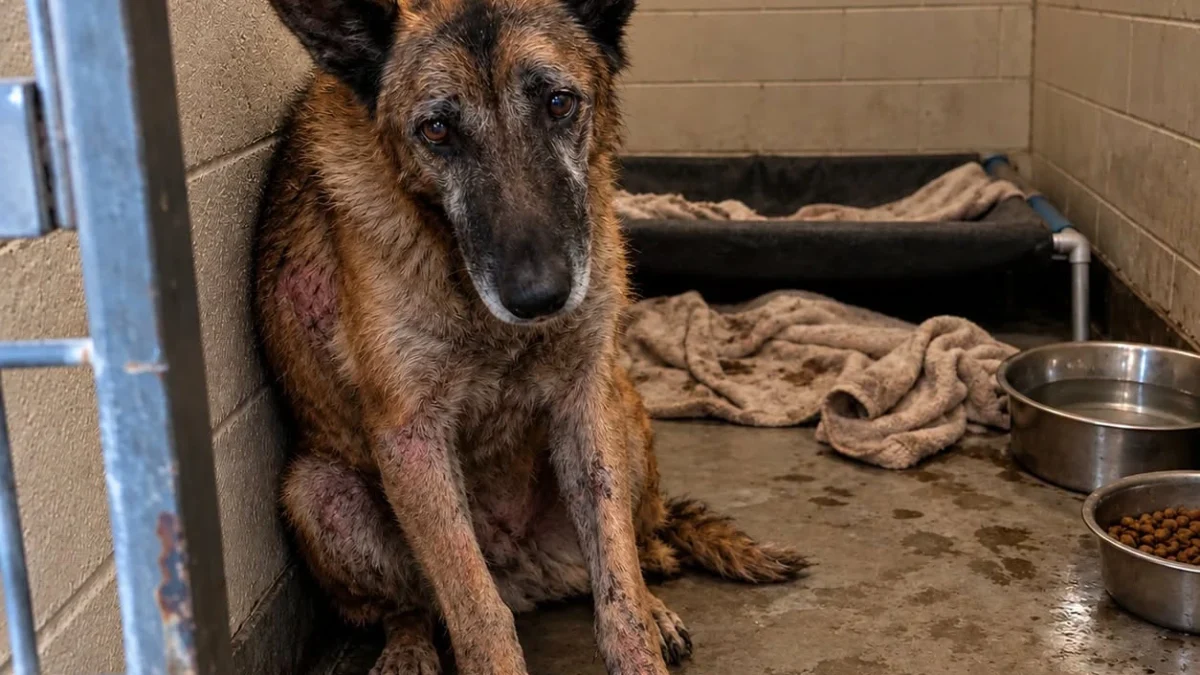
A 13-Year-Old Retired Search-and-Rescue K9 Sat Alone in a Shelter With No Interest in Anyone—Then an Old Photograph Revealed the One Handler He Had Never Forgotten
For weeks, he barely lifted his head when anyone approached, as though nothing in the world was worth getting up for anymore.
Then I found an old photograph, a name buried in his records, and one clue that made me wonder if he hadn’t given up on life at all—maybe he was still waiting for one specific person to come back.
When he arrived at our shelter, his paperwork was surprisingly thin.
Breed: Belgian Malinois.
Age: thirteen.
Male.
Former working dog.
Search and response.
Retired.
That was basically it.
No favorite toy.
No family history.
No note explaining how he liked to sleep or what made him happy.
Just administrative words attached to an old dog who had once spent his life doing something important.
He stayed in the farthest corner of Kennel 12.
Head lowered.
Front legs tucked beneath him.
Body curved inward like he was trying to take up less space.
At first, I thought he was exhausted.
Most shelter dogs react somehow.
They bark.
Pace.
Refuse food.
Press against anyone who kneels nearby.
He did none of that.
He simply sat.
“Give him time,” my coworker said.
So we did.
Soft bedding.
Quiet hours.
Good food.
Gentle walks.
I sat outside his kennel several times a day.
“Hey, old man.”
Sometimes one ear moved.
That was usually all I got.
Treats interested him enough to eat, but rarely from my hand.
Toys meant nothing.
Once, a ball rolled across the floor and touched his paw.
He looked at it.
Then looked away.
One week became two.
Then three.
Physically, he wasn’t doing terribly for thirteen.
Arthritis.
Stiffness.
Cloudy eyes.
But our veterinarian couldn’t explain the emptiness in his expression.
“He’s tired,” she said.
“Physically?”
She looked through the kennel door.
“Maybe not only physically.”
That stayed with me.
One morning, I carried his folder into the office.
I told myself I was looking for medical history.
Really, I wanted to know who he had been before he became the silent dog in Kennel 12.
The first pages were ordinary.
Dates.
Transfers.
Certifications.
Then I found an old envelope in the back.
Inside were newspaper clippings.
Reports.
Photographs.
The first picture stopped me.
There he was.
Years younger.
Lean.
Alert.
Standing in a forest beside a man in uniform.
His ears were upright.
His eyes were bright.
His whole body looked alive.
The article described a missing child who had disappeared in the woods.
PART2:
Search teams had covered miles.
This dog had found him.
Alive.
I kept reading.
An elderly hiker.
A teenager.
A man with dementia.
More searches.
More rescues.
And in almost every photograph, the same officer stood beside him.
Same face.
Same hand resting on his shoulder.
Same partnership.
One article called them inseparable.
Another quoted the officer saying:
“He’s the most loyal partner I’ve ever had.”
Then I found the date.
Four years earlier, the officer had retired.
After that, the records almost disappeared.
I looked through the office window.
The Malinois was still sitting in his corner.
Same lowered head.
Same silence.
But suddenly, I saw him differently.
What if he hadn’t stopped caring?
What if he hadn’t stopped waiting?
What if he had been waiting for one person all along?
I copied the officer’s name onto a piece of paper.
No current address.
No phone number.
No guarantee he was even still alive.
Then I found one final document folded beneath the old photographs.
There was a handwritten number in the corner.
I picked up the shelter phone.
And before I dialed, I looked once more toward Kennel 12.
For the first time in three weeks, the old Malinois had raised his head.








