A 13-Year-Old in a Wheelchair Asked Me What Flying Felt Like—So Our Biker Club Spent 412 Hours Building Him a Sidecar
A 13-Year-Old in a Wheelchair Asked Me What Flying Felt Like—So Our Biker Club Spent 412 Hours Building Him a Sidecar.
A thirteen-year-old boy who had never walked asked me one quiet question beside my Harley—“Mr. Marcus, what does flying feel like?”—and I spent the next nine months building an answer out of steel.
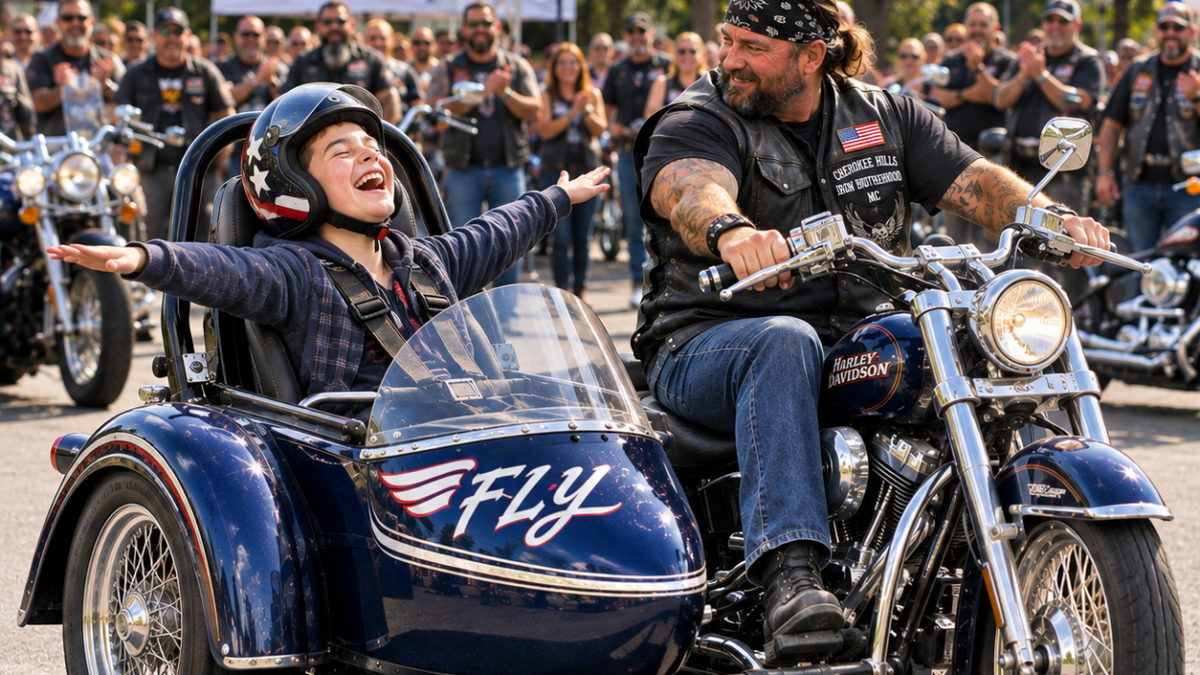
The first time he rode the sidecar we made for his wheelchair, he threw both arms into the Oklahoma wind and screamed, “I’M FLYING,” while his mother cried beside the road and three tattooed bikers took off their helmets because none of us wanted him to see grown men breaking down.
Then the video reached twelve million people, and the biological father who had abandoned Caleb in a neonatal intensive care unit eleven years earlier suddenly called wanting to be part of the boy’s life again.
My name is Marcus Drewry.
I am forty-six years old.
I am a structural welder at a steel fabrication shop on the south side of Tulsa, Oklahoma.
I have been welding professionally since I was nineteen.
I have been a patched member of the Cherokee Hills Iron Brotherhood Motorcycle Club for fourteen years.
And until May of 2023, I believed I understood what motorcycles could do.
They could carry you.
They could clear your head.
They could take a man who spent ten hours breathing welding fumes and listening to grinders scream and remind him that the world was larger than a fabrication bay.
They could bring thirty bikers to a funeral when a family had nobody else.
They could deliver toys.
Raise money.
Block traffic for a veteran’s procession.
Carry ashes.
Carry grief.
Carry men who were not good at talking.
I knew all of those things.
I did not know a motorcycle could teach a thirteen-year-old boy what flying felt like.
That took Caleb Reyna.
Caleb Patrick Reyna was born on August 14th, 2011, three weeks early, at Saint Francis Hospital in Tulsa.
He was born with myelomeningocele, a severe form of spina bifida.
The lesion was around L3-L4.
He underwent surgery within the first twenty-four hours of his life.
His first home was not his mother’s arms.
It was the neonatal intensive care unit.
His mother, Andrea Reyna, spent eighty-one days in that hospital with him.
His biological father, Kevin, lasted sixteen.
On day seventeen, Kevin told Andrea he could not handle “this kind of life.”
Then he left.
Not metaphorically.
He left the NICU family lounge.
Left the hospital.
Left his wife sitting beside an incubator.
Left his newborn son recovering from spinal surgery.
And never came back to the NICU.
I did not know any of that the day I met Caleb.
All I knew was that there was a skinny kid in a wheelchair sitting alone near the edge of a charity motorcycle ride staring at my Heritage Softail like it was the Saturn V rocket.
It was May of 2023.
Our club had organized a fundraiser for a pediatric specialty clinic on the east side of Tulsa.
Nothing glamorous.
Registration tables.
Coffee.
Donuts.
About seventy bikes.
A couple of local vendors.
One food truck.
A silent auction.
We had been doing that kind of thing for years.
Most people assume biker charity rides are about motorcycles.
They are not.
The motorcycles get people there.
The people are the point.
I had arrived early.
PART2:
My bike was a cobalt-blue Heritage Softail.
Not new.
Not fancy.
But clean enough that I would deny ever polishing it if you asked in front of the club.
I was walking from the registration table toward the parking lot when I noticed him.
Manual pediatric wheelchair.
Black frame.
Blue spokes.
Thin legs resting on footplates.
A backpack hanging from the handles.
Dark hair.
Glasses.
A notebook balanced across his lap.
He was alone.
Not abandoned.
Just alone for a minute.
His mother was apparently inside finishing paperwork.
The boy was watching the motorcycles line up.
Not casually.
Studying them.
That is different.
PART3:
I know what curiosity looks like.
I work with apprentices.
You can tell the difference between someone who thinks something looks cool and someone whose brain is trying to disassemble it.
Caleb was disassembling seventy motorcycles with his eyes.
I walked over.
Stopped about six feet away.
Did not touch his chair.
That is something people need to learn.
A wheelchair is not public property.
You do not grab it because you want to be helpful.
You do not lean on it.
You do not push without asking.
It is part of a person’s space.
I crouched so we were closer to eye level.
“You like bikes?”
He looked at me.
“Sir. I love bikes.”
Formal kid.
Very serious.
I liked him immediately.
“You ride?”
He glanced down at his chair.
Then back at me.
“No, sir.”
There was no self-pity in it.
Just information.
“I have never been on one.”
Then he added, “I would like to know what they sound like up close, please.”
I looked toward my Heritage.
“You want to hear mine?”
His entire face changed.
“Yes, sir.”
I wheeled nothing.
Touched nothing.
I stood and said, “Come on over if you want.”
Caleb pushed himself across the parking lot.
Strong shoulders.
Quick hands.
He stopped beside the bike.
I showed him the engine.
Explained where to keep his fingers.
Then I said, “Put your hand here.”
He placed his palm against the gas tank.
I started the Harley.
The vibration moved through the steel.
Caleb’s face went through maybe six expressions in three seconds.
Surprise.
Fear.
Delight.
Disbelief.
Then pure concentration.
His mouth opened.
He laughed once.
Then stopped because he was busy feeling.
I blipped the throttle lightly.
His eyes got huge.
“Again.”
Not sir this time.
I did it again.
He looked down at his own hand on the tank.
“That feels different than videos.”
“Videos cheat.”
“How?”
“Speakers give you sound.”
I tapped the tank.
“This gives you the machine.”
He nodded like I had said something technically useful.
Then he asked, “How fast does it go?”
“Fast enough for my insurance company to disapprove.”
“Seriously.”
“Faster than I need.”
He studied the handlebars.
“What does cornering feel like?”
“Depends whether you know what you’re doing.”
“What does leaning feel like?”
“Like trusting physics.”
He smiled.
Then he asked the question.
Not dramatically.
No music.
No crowd gathering.
No camera.
He kept one small hand on my cobalt-blue gas tank.
Looked up at me.
And said, “Mr. Marcus. What does flying feel like?”
I remember the exact silence after it.
The Heritage was still idling.
Engines around us were starting.
Men were shouting registration numbers.
Someone dropped a coffee.
Normal sounds.
But that question cut through all of it.
I said the first thing that came into my head.
“I don’t know, buddy.”
He frowned.
“You ride motorcycles.”
“I do.”
“Isn’t it like flying?”
“Sometimes.”
“What does it feel like?”
I could have said freedom.
People love that word.
Freedom.
Wind.
Open road.
All the usual motorcycle nonsense we print on T-shirts.
But Caleb was not asking for a slogan.
He wanted data.
Sensory information.
He had spent thirteen years watching other people run.
Jump.
Climb.
Ride.
He wanted to know something his body had never given him.
So I tried again.
“It feels…”
I stopped.
He waited.
“It feels like the world is moving around you instead of you moving through it.”
He thought about that.
“Does the wind hurt?”
“Sometimes.”
“Do you like it?”
“Yes.”
“Why?”
“Because then you know you’re moving.”
He nodded.
Then said quietly:
“I think I would like that.”
Andrea came outside a minute later.
She was maybe thirty-five.
Dark hair tied back.
Scrubs.
Tired eyes.
The kind of tired that does not come from missing one night of sleep.
It comes from years.
“Caleb.”
He looked at her.
“Mom, Mr. Marcus let me touch the engine.”
Andrea looked at me.
I raised both hands.
“He still has all ten fingers.”
She smiled.
“That’s a strong endorsement.”
Caleb said, “Mom, motorcycles feel different in person.”
“I can see that.”
Then he looked at me.
“Thank you, Mr. Marcus.”
“You’re welcome.”
He started wheeling away.
I watched him.
Something bothered me.
Not pity.
I need to be clear about that.
I do not like pity.
People confuse pity with kindness because both can make the giver feel noble.
Pity looks down.
Respect looks across.
What bothered me was that I had given him the wrong answer.
He had asked what flying felt like.
And I had described it.
That suddenly felt insufficient.
That night, I was in my garage at 11:40 p.m. staring at my Heritage.
My wife, Denise, came out wearing pajamas.
Yes, my wife is also named Denise.
No, she is not the Denise from the club. That would make this unnecessarily confusing.
She leaned in the doorway.
“What are you doing?”
“Thinking.”
“That smell explains a lot.”
I ignored her.
She looked at the motorcycle.
“What broke?”
“Nothing.”
“Then why are you staring at it?”
I told her about Caleb.
The wheelchair.
The tank.
The question.
What does flying feel like?
Denise listened.
Then said, “Sidecar.”
I looked at her.
“What?”
“Sidecar.”
“Regular sidecar won’t work.”
“Why?”
“He can’t transfer easily. Chair needs to stay with him.”
“Then build one that does.”
I stared.
She shrugged.
“You weld steel for a living.”
“It’s not that simple.”
“Nothing you like is simple.”
I hated that she was right.
The next morning, I called Howard.
Howard Bell.
Fifty-eight.
Retired Tulsa County deputy.
Brotherhood member.
Gray beard.
The kind of man who answers his phone at 6:15 a.m. already irritated.
“What?”
“I need to build a wheelchair sidecar.”
Silence.
Then:
“Go back to sleep.”
“I’m serious.”
“Of course you are.”
“Need a floor lock. Harness. Roll protection.”
“Marcus.”
“What?”
“You met this kid yesterday.”
“I know.”
“Does his mother know?”
“No.”
“Does the kid know?”
“No.”
“So currently you are secretly engineering transportation for a disabled child you met in a parking lot.”
“Yes.”
“Good. Just checking how stupid this is.”
“You helping?”
Another pause.
“Probably.”
That was how it started.
Not with a fundraiser.
Not with a viral video.
Not with a press release.
A thirteen-year-old asked a question.
A welder could not stop hearing it.
And three bikers were stupid enough to answer their phones.
The third was Russell Dean.
Fifty-two.
Industrial maintenance technician.
Former Army mechanic.
The fourth became Ryan Cole, a twenty-three-year-old prospect who had enough mechanical engineering coursework to be dangerous and enough energy to drive anywhere we told him.
Then Howard told us about Glen McAllister in Bartlesville.
Glen had spent decades building custom motorcycle rigs.
Retired now.
I called him.
Explained the idea.
His first response:
“No.”
“Why?”
“Because you’re describing a medical mobility system attached to a motorcycle, and you sound like a man with a welder who thinks confidence counts as engineering.”
“I don’t.”
“Good.”
I drove to Bartlesville.
Brought measurements.
Sketches.
Photos of Caleb’s chair.
Not his medical records.
Not yet.
Glen studied everything.
Then asked, “Does the mother know?”
“No.”
“Does the boy?”
“No.”
He looked at me over his glasses.
“You people enjoy making your lives difficult.”
“Yes.”
He tapped the drawing.
“This floor frame is wrong.”
“How?”
“Load path.”
He drew over it.
“Roll bar is wrong.”
“Okay.”
“Wheel lock is wrong.”
“Okay.”
“Harness angle is wrong.”
“Okay.”
He stared.
“You aren’t going to argue?”
“That’s why I came.”
That apparently earned me a second meeting.
Before we built anything, I spoke to Andrea.
I went to her rental house off East 41st Street.
Small place.
Two bedrooms.
Wooden porch.
Ramp along the side.
Caleb was inside doing homework.
Andrea and I sat outside with coffee.
I told her the idea.
Not the finished idea.
The possibility.
A sidecar designed around his wheelchair.
She stared at me.
“You’re serious.”
“Yes.”
“Why?”
There it was again.
Why.
I had no grand answer.
“Because he asked.”
She looked down at her coffee.
“Marcus, lots of kids ask for things.”
“I know.”
“Caleb has medical issues you don’t understand.”
“I know.”
“He has limited trunk control when he’s tired.”
“We’d build support.”
“Catheter supplies.”
“Storage compartment.”
“Emergency medication.”
“Storage.”
“Pressure areas.”
“Medical input.”
“What if you crash?”
That one mattered.
“I can’t remove risk.”
She nodded.
“So don’t promise me safety.”
“I won’t.”
That was probably when she decided to trust me.
Not because I said it would be safe.
Because I admitted it could not be perfectly safe.
She looked toward the front window.
“Do not make him a charity project.”
“I won’t.”
“He hates when people do that.”
“So do I.”
“Do not put his face on club Facebook without permission.”
“Agreed.”
“Do not tell him something is happening until you’re sure it can happen.”
“Agreed.”
Then she said something I never forgot.
“Don’t let him become the inspirational disabled kid that makes everybody else feel better about themselves.”
I nodded.
“He’s a kid who likes motorcycles.”
“Yes.”
“That’s enough.”
She watched me.
Then she said, “Okay.”
That was the beginning of 412 hours.
People ask me now why it took that long.
Because building something properly is slow.
Because every solution created three new questions.
Because we were not building a decorative sidecar.
We were building around a child’s body and mobility equipment.
The wheelchair needed to roll directly into the sidecar.
No transfer.
That meant a ramp and floor geometry.
The chair needed to lock into a welded steel frame.
That meant precise anchoring.
He needed a five-point harness with appropriate load distribution.
A padded headrest.
Roll bar.
Crash padding.
Windshield with multiple positions.
Medical compartment.
Clear access.
No sharp edges.
No hot surfaces near his legs because limited sensation meant he might not feel injury immediately.
We consulted medical professionals.
We revised.
Tested.
Loaded sandbags.
Loaded steel weights.
Shook it.
Reinforced it.
Cut welds apart.
Started over.
Glen rejected our first three frame designs.
On the fourth he said:
“I hate it less.”
Coming from Glen, that was a standing ovation.
Ryan drove to Bartlesville every Saturday for six weeks.
Howard fabricated brackets.
Russell rewired lighting.
Two club members who knew upholstery sewed padding.
My garage became impossible to use for anything else.
Denise stopped complaining after week three.
Then she began bringing food.
One night around midnight she walked in with sandwiches.
Howard was underneath the chassis.
Ryan was measuring harness anchor angles.
I was grinding a bracket.
Denise looked around.
“You all know this child has no idea you’re doing this.”
Howard said, “That’s why it’s peaceful.”
She laughed.
Then noticed the side panel.
“What color?”
I said, “Cobalt.”
“Same as the Heritage?”
“Yes.”
She smiled.
“He’ll like that.”
We painted one word on the rear quarter.
FLY.
White script.
Not inspirational.
Not “Never Give Up.”
Not “Different Ability.”
Not any of that.
Just the answer to a question.
FLY.
During the build, I got to know Andrea better.
Not romantically.
People on the internet have asked.
No.
I am married.
Andrea became family differently.
She told me about Kevin on a September evening while I was dropping off updated measurements.
We sat on her porch.
Caleb was inside.
Andrea said:
“You’re going to spend hundreds of hours in your garage building something for my son. I want you to know what kind of family he comes from before you start. So you can decide if it’s worth your time.”
Then she told me.
Kevin Reyna.
Community college.
Marriage in 2010.
Caleb born in 2011.
NICU.
Sixteen days.
Then gone.
Eleven surgeries.
Not one attended.
Child support:
$312 a month.
Paid on time.
Every month.
No extras.
No birthdays.
No hospital visits.
One card at age eight.
Twenty-dollar bill.
“Happy birthday, son. — Dad.”
Caleb told Andrea to throw it away.
When she finished, Andrea said:
“So that’s the family.”
I looked at her.
“No.”
She frowned.
“What?”
“That’s the man who left.”
I pointed toward the house.
“Family is inside.”
Her face changed.
I continued.
“I’m not building anything because some guy left.”
“Then why?”
“Because your boy asked what flying feels like.”
She started crying.
Quietly.
Embarrassed by it.
“I don’t want to be a project.”
“You’re not.”
“I don’t want him to be one.”
“He’s not.”
“What is he then?”
“A kid waiting on a sidecar.”
She laughed through tears.
That was enough.
February 9th, 2024, we finished.
Friday night.
We stood around the rig.
Nobody celebrated much.
Because it wasn’t finished until Caleb approved.
Saturday morning, Andrea brought him to my shop.
She told him he was coming to see a project.
The bay door was open.
The Heritage sat in the center.
Sidecar attached.
Cobalt blue.
Windshield.
Roll bar.
Harness.
FLY painted on the rear.
Caleb rolled in.
Stopped.
I have never seen a human face attempt that many emotions simultaneously.
He looked at the motorcycle.
Then sidecar.
Then me.
“Mr. Marcus.”
“Yeah, buddy?”
“Who is that for?”
I smiled.
“You.”
His mouth opened.
Closed.
He looked at Andrea.
She nodded.
Back at me.
“Are you sure?”
“I’ve been sure for eight months.”
His eyes filled.
He did not cry.
He rolled closer.
“May I touch it?”
“Of course.”
His hand went to the cobalt tank.
“This is the same color.”
“Yep.”
“They match.”
“They match.”
He ran one hand along the sidecar.
Saw FLY.
Then he saw the small steel plate.
That was my private addition.
Six inches by two.
Welded inside where he could see it.
Hand engraved:
BUILT FOR CALEB PATRICK REYNA
FEBRUARY 2024
BY THE BROTHERS WHO STAYED
He read it.
Once.
Then again.
“Mr. Marcus.”
“Yeah?”
“The brothers who stayed.”
“Yeah, buddy.”
He looked at me.
“That’s perfect.”
I had to walk away for a second.
Pretended I needed a wrench.
Howard later told me nobody believed me.
We loaded Caleb.
Wheelchair rolled directly into position.
Locked into the floor frame.
Harness.
Headrest.
Medical bag compartment.
Every check twice.
Then again.
Andrea followed on one of the brothers’ bikes.
Three of us rode with the rig.
We went south of Tulsa to a quiet country road off East 91st Street.
Low traffic.
Long straight section.
We had coordinated enough that nobody would surprise us.
Cold February morning.
Clear sky.
Wind.
I locked the windshield fully down.
Caleb looked at me.
“Why?”
“What did you ask me nine months ago?”
He went silent.
Then smiled.
I started the engine.
Looked over.
“You ready?”
He nodded hard.
“Buddy, you ready to fly?”
“Yes.”
I rolled out.
First gear.
Twelve miles per hour.
Slow.
Ridiculously slow if you were judging it by motorcycle standards.
Fast enough if you had never felt a road move beside you.
For the first twenty seconds, Caleb did nothing.
Eyes closed.
Face forward.
Wind hitting him.
Hair moving.
Hands resting on his lap.
I glanced over.
Then something happened.
His hands lifted.
Slowly.
Both arms came out.
Straight from his sides.
Airplane wings.
He tilted his face toward the sky.
And screamed:
“I’M FLYING!”
My vision blurred.
“MR. MARCUS!”
I laughed.
“I’M FLYING!”
He was yelling into the Oklahoma wind.
“DON’T STOP!”
I did not.
“DON’T STOP! I’M FLYING!”
I could barely see.
Not because of weather.
Because I was crying inside my helmet.
I have welded bridge sections.
Industrial platforms.
Steel frames weighing more than houses.
Nothing I ever built felt as important as that sidecar at twelve miles per hour.
Four miles.
That was our first pass.
When I stopped, Caleb’s face was soaked.
I thought he was sobbing.
Then realized he was laughing.
His whole body shook.
He laughed for four minutes.
Andrea was kneeling beside him.
Crying.
Howard stood on the shoulder holding his helmet.
Russell looked away because men over fifty suddenly become fascinated with fields when emotional.
Finally Howard said:
“Marcus.”
I looked at him.
“That’s what we built her for, brother.”
I nodded.
“Yeah.”
Caleb caught his breath.
“Mr. Marcus.”
“Yeah?”
“Can we do it again?”
I laughed.
“Yes, buddy.”
Andrea took out her phone.
Second pass.
Forty-seven seconds.
That was the video.
Caleb.
Arms out.
Wind.
Cobalt sidecar.
FLY.
His voice:
“I’M FLYING, MR. MARCUS!”
My laugh under the engine.
Then Andrea behind the phone:
“My God.”
Quiet.
Almost to herself.
“My God. He’s flying.”
She posted it that afternoon.
Personal Instagram.
About forty followers.
Family.
Friends.
Coworkers.
Nothing else.
By Monday, somebody had reposted it.
By Tuesday, one million views.
By Friday, three million.
Then twelve million.
News pages.
Motorcycle pages.
Disability advocates.
Film professionals.
A baseball player.
A country singer.
People wrote Caleb letters.
A special-effects technician sent him an old production manual.
Someone from a movie crew sent him a signed photograph.
A college engineering professor offered to show him a lab.
Caleb loved exactly one part of the fame.
Engineers answered his questions.
Everything else embarrassed him.
A reporter asked:
“How does it feel to inspire millions?”
Caleb said:
“I was just riding a motorcycle.”
That was my boy.
Then March 8th came.
Friday.
8:47 a.m.
Andrea was at work.
Her phone rang.
Tulsa number.
She answered.
“Hello?”
A man’s voice said:
“Andrea.”
She froze.
“It’s Kevin.”
Eleven years.
Some voices still survive in your nervous system.
“I saw the video.”
Andrea said nothing.
“I want to talk to him.”
She hung up.
Kevin called again.
And again.
She did not answer.
At lunch, she called me.
I was sitting at my workbench eating a ham sandwich.
“Marcus.”
Her voice sounded wrong.
“What happened?”
“He called.”
“Who?”
I knew before she answered.
“Kevin.”
I put the sandwich down.
“What did he want?”
“He saw the video.”
Of course he did.
Twelve million people had.
“He wants to talk to Caleb.”
I sat back.
“What did you say?”
“Nothing.”
“Good.”
“He keeps calling.”
“Do you want me to handle it?”
Long silence.
“Yes.”
“Okay.”
“Marcus.”
“Yeah?”
“Don’t threaten him.”
“I wasn’t planning to.”
“I know your version of not threatening people.”
“Still not threatening.”
She exhaled.
“Forward the next call.”
At 11:14 a.m., my phone rang.
Andrea’s transfer.
I answered.
“Hello?”
A man said, “Andrea?”
“This is Marcus Drewry.”
Silence.
“Andrea forwarded your call.”
Another silence.
Then:
“Marcus. I’m Caleb’s father. I’m Kevin.”
I looked at the sidecar.
It was parked twenty feet away in the shop.
FLY on the panel.
Steel plate inside.
By the brothers who stayed.
“I know who you are.”
“I saw the video.”
“I figured.”
“I want to talk to my son.”
There are moments when anger wants to be useful but isn’t.
I could have insulted him.
Called him a coward.
Asked where he had been for eleven surgeries.
Asked why a viral video succeeded where hospital rooms had failed.
Would have felt good.
Would have helped nobody.
So I gave him seven words.
“You want him? Then come here in person.”
Silence.
He said, “I don’t know if I can do that.”
“Then don’t call.”
“I don’t know what to say.”
“Then say nothing.”
“Marcus—”
“Come sit at the kitchen table.”
“I’ve been gone eleven years.”
“I know.”
“I think a phone call might be easier.”
“For who?”
He stopped.
I continued.
“Your boy has spent eleven years doing hard things.”
My voice stayed calm.
“He’s had eleven surgeries. He uses a wheelchair. He has been in rooms full of doctors. He has learned how to catheterize himself. He has learned how to explain his body to strangers. He has learned how to ask for help without losing his dignity.”
Kevin said nothing.
“You don’t get to make your first real conversation easy for yourself.”
“That isn’t fair.”
I laughed once.
“Fair?”
“I’m trying.”
“Then drive.”
“I need time.”
“Take time.”
“I don’t know if he’ll want to see me.”
“That isn’t for you to decide.”
“What if he hates me?”
“Then you sit there and let him.”
Silence.
“What if he tells me to leave?”
“Then you leave.”
“What if—”
“Kevin.”
I stopped myself.
Lowered my voice.
“If you want to be his dad, come be his dad.”
Another silence.
“No phone-call dad.”
That was what I meant.
No safe distance.
No voice without body.
No emotional parachute.
Come into the house you abandoned.
See the ramp.
See the wheelchair.
See the medical supplies.
See the mother who stayed.
See the kid.
Let him look at you.
Then take whatever comes.
Kevin whispered:
“I need to think.”
“Fine.”
I hung up.
Andrea called.
“What happened?”
I told her.
She was quiet.
Then:
“He won’t come.”
“I know.”
“You think so too?”
“Yeah.”
She started crying.
Not loudly.
“Why does that still hurt?”
Because abandonment does not become harmless just because it gets old.
I did not say that.
I said, “Because you’re human.”
That night, Andrea told Caleb.
She did not hide it.
That was important.
Children with complicated families often become detectives because adults keep making decisions about information around them.
Andrea refused to do that.
They sat at the kitchen table.
Same little house.
Medical bag on one chair.
Caleb’s engineering notebook nearby.
She said:
“Your dad called.”
Caleb stopped.
“My dad?”
“Yes.”
“Kevin?”
“Yes.”
He called him Kevin.
Not Dad.
“What did he want?”
“He saw your video.”
Caleb’s expression changed.
Not happiness.
Something colder.
“And?”
“He said he wants to talk to you.”
Caleb looked at the table.
“What did you say?”
“I hung up.”
“Mom.”
“I was surprised.”
“Did he call again?”
“Yes.”
“What happened?”
“I forwarded him to Marcus.”
That got his attention.
“What did Mr. Marcus say?”
Andrea told him.
Come in person.
Sit at the table.
No phone.
Caleb thought for a long time.
Then asked:
“Will he come?”
Andrea said the hardest honest thing a mother can say.
“I don’t know.”
Caleb nodded.
Then:
“I don’t want a phone call.”
“Okay.”
“I mean it.”
“Okay.”
“He left when I was a baby.”
“I know.”
“He can’t come back because I’m on the internet.”
Andrea swallowed.
“I know.”
“He didn’t come to surgeries.”
“No.”
“He sent twenty dollars.”
“Yes.”
Caleb looked toward his chair.
Then said:
“I want someone who will sit here.”
Andrea cried.
Caleb did not.
He continued.
“If he’s willing to come, I’ll talk.”
“You will?”
“Yes.”
“What would you say?”
“I don’t know.”
“That scares you?”
“Yes.”
He admitted it.
That matters.
Courage and fear are allowed to occupy the same chair.
Then Caleb said something Andrea repeated to me word for word later.
“I have you.”
Pause.
“I have Mr. Marcus.”
Pause.
“I have the brothers.”
He looked toward his notebook.
“I have Grandma. I have Yo-yo. I have my notebook. I have the sidecar.”
Then:
“I am not less because he isn’t here.”
Andrea lost it.
Caleb continued.
“I figured that out in fourth grade.”
Thirteen years old.
Fourth grade.
I do not know what happened in fourth grade.
Maybe some Father’s Day project.
Maybe another kid asked.
Maybe he finally stopped waiting.
Children do emotional work adults rarely see.
He took a sip of water.
Then said:
“If he comes, I’ll hear him out.”
Andrea nodded.
“But he doesn’t get to come through a phone.”
Pause.
“I deserve more than that.”
That was Caleb.
Not bitter.
Not cruel.
Not begging.
A thirteen-year-old establishing a boundary adults twice his age could not manage.
Kevin called three more times over the next eleven days.
Every time, same argument.
Phone call would be easier.
Phone call would be less stressful.
Phone call would be better for Caleb.
Every time Andrea forwarded him to me.
Every time I said:
“Come here.”
Fourth call, he got angry.
“You’re not Caleb’s father.”
Finally.
There it was.
I said, “Correct.”
“You don’t get to set the terms.”
“Correct.”
“You’re acting like you do.”
“No.”
“You think because you built him that motorcycle thing—”
“Sidecar.”
“Whatever. You think that makes you his father?”
“No.”
“Then get out of it.”
I leaned back in my chair.
“Kevin.”
“What?”
“I am not trying to be his father.”
Silence.
“I am being the man standing near him while his father decides whether to show up.”
He did not answer.
“The door is at Andrea’s house.”
I continued.
“Not mine.”
“You come through it.”
Silence.
“He decides what happens next.”
Kevin hung up.
Two months later, he called Andrea one final time.
May.
She answered.
He said:
“I can’t come.”
Andrea closed her eyes.
He continued:
“I think it’s better for everybody.”
“For everybody?”
“I just…”
He stopped.
“I want him to know I saw it.”
Andrea said nothing.
“I want him to know I’m proud of him.”
Andrea’s voice changed.
“Tell him.”
“I can’t.”
“Come here.”
“Andrea.”
“Come here and tell him.”
“I can’t.”
Then Andrea said the sentence I think ended whatever illusion remained between them.
“Then don’t send a message.”
Kevin went silent.
“He doesn’t need a message.”
Her voice shook.
“He needs a father.”
Long pause.
“If you can’t be one, stay gone.”
She hung up.
He never called again.
Not as of the last time Andrea gave me permission to write this.
I have thought about Kevin a lot.
People assume I hate him.
I don’t.
Hatred requires energy.
I use mine elsewhere.
I think Kevin is a man who panicked in a hospital at twenty-something years old.
Then one bad decision calcified into identity.
Leaving once made returning harder.
A month made it harder.
A year.
Five years.
Eleven years.
Eventually shame becomes a locked room.
Some people kick the door down.
Some decorate the room and call it home.
I do not know which Kevin will be.
The door is still open.
That is Caleb’s decision.
Not mine.
Not Andrea’s.
Caleb said he will sit at the table if Kevin walks through the door.
That is more grace than many adults would offer.
Meanwhile, Caleb kept flying.
Every Saturday we could.
Physical therapy.
Air and Space Museum.
Adapted camping weekend.
A private screening of Interstellar in Oklahoma City.
That one nearly killed me.
Not literally.
Emotionally.
One of our younger prospects knew somebody connected to a small theater doing a special screening.
We arranged transportation.
Caleb wore a black button-down shirt because apparently Christopher Nolan movies require formal attire.
During the docking scene, he leaned toward me.
“Mr. Marcus.”
“What?”
“The practical effects are better than CGI.”
“Watch the movie.”
“But—”
“Caleb.”
He whispered for another twenty minutes anyway.
On the ride home, he told me he wanted to build stunt systems.
Not movie stars.
Not director.
Engineer.
He wanted to design rigs that made impossible movement possible.
That phrase stayed with me.
Impossible movement.
A kid who could not move his legs wanted to build machines that moved people through space.
There are people who would call that inspiring.
Caleb would call it engineering.
The sidecar accumulated miles.
Five hundred.
Two thousand.
Five thousand.
Ten thousand.
Fourteen thousand four hundred thirty.
He knew the number.
Of course he did.
Every ride, he looked at the engraved plate.
BUILT FOR CALEB PATRICK REYNA.
BY THE BROTHERS WHO STAYED.
He never made a speech about it.
Didn’t need to.
That plate was not about replacing Kevin.
I want that understood.
You cannot replace a father with a motorcycle club.
That is not how human beings work.
Absence leaves its own shape.
But absence does not get to define the whole structure.
Caleb had Andrea.
His grandmother.
Friends.
Teachers.
Doctors.
Therapists.
Us.
People who stayed.
That matters.
One Saturday in October, we stopped at a diner outside Broken Arrow.
Caleb had pancakes.
I had coffee and eggs.
Howard was arguing with a waitress about whether biscuits counted as bread.
Caleb looked at me.
“Mr. Marcus.”
“Yeah?”
“Do you think Kevin is scared of me?”
Howard stopped talking.
I put down my fork.
“Why?”
“He won’t come.”
I thought.
“Maybe.”
“Why would he be scared?”
“Because you know what he did.”
Caleb considered that.
“He did it.”
“Yeah.”
“So why would I be scary?”
“Because people are sometimes more scared of being seen clearly than being hated.”
He frowned.
“That’s dumb.”
“Yes.”
“Adults are dumb.”
“Frequently.”
He ate another bite.
“Would you be scared?”
“To meet you?”
“If you had left.”
I answered honestly.
“Yes.”
“Would you come?”
I looked at him.
“I hope so.”
“You don’t know?”
“Nobody knows who they’ll be in the hardest moment until they’re in it.”
He nodded.
That answer seemed acceptable.
Then:
“If he comes, I’m going to ask him why.”
“You should.”
“What if the answer is bad?”
“It probably will be.”
“What if he says because of the wheelchair?”
Howard looked down.
Caleb did not.
He waited for me.
I said:
“Then you remember the chair is where you sit.”
I tapped his chest lightly.
“It is not who you are.”
He nodded.
“And if he couldn’t tell the difference, that was his failure.”
Caleb looked out the window.
Then smiled slightly.
“Good answer.”
“Thanks.”
“Still not as good as the sidecar.”
“Eat your pancakes.”
At fourteen, Caleb got taller.
That became a problem.
Harness geometry changed.
Head support needed adjustment.
His current sidecar would eventually become too small.
I started designing another.
Of course I did.
Denise found the drawings on our kitchen table.
“No.”
“Yes.”
“Marcus.”
“He’s growing.”
“You spent 412 hours on the first one.”
“Second will be faster.”
“You said that about our deck.”
“Different.”
“It took you two summers.”
“I was working.”
“You are always working.”
Then she looked at the drawing.
Larger frame.
Revised seating angle.
New roll bar.
Updated harness.
Medical compartment.
Same cobalt blue.
Same word.
FLY.
She sighed.
“What color?”
“You know.”
“Of course.”
The Brotherhood voted on funding.
Unanimous.
Not because Caleb was famous.
We would have built the second rig if the video had received twelve views.
Ryan joked:
“We’re going to keep building these until he’s forty.”
I said:
“Twenty-one.”
Caleb said:
“Thirty.”
Howard said:
“Marcus will be dead before then.”
I said:
“Thank you, brother.”
This is what staying looks like sometimes.
Not speeches.
Scheduled maintenance.
Harness adjustments.
Driving to physical therapy.
Remembering catheter supplies.
Knowing which gas station has accessible bathrooms.
Learning when not to help.
Knowing when to push.
Showing up Saturday.
Again.
Again.
Again.
The world likes dramatic moments.
“I’M FLYING!”
Twelve million views.
Big emotions.
But a life is built mostly from Tuesdays.
People staying after the video stops.
That is why the plate matters.
BY THE BROTHERS WHO STAYED.
Not saved.
Not rescued.
Stayed.
There is dignity in that word.
Caleb once asked me why I used it.
We were tightening one of the wheelchair locking points.
“Why not ‘built by Cherokee Hills Iron Brotherhood’?”
I looked at him.
“Too long.”
He waited.
He knew I was lying.
“Mr. Marcus.”
I sighed.
“Because clubs change.”
“So?”
“People move. People die. Patches change. Names change.”
I tightened the bolt.
“But staying is what mattered.”
He looked at the plate.
“Because Kevin left?”
“Not only.”
He nodded.
“Okay.”
Then he said:
“You stayed before you knew about Kevin.”
“Exactly.”
That kid will catch you every time.
I think about the first question often.
What does flying feel like?
I gave Caleb an answer that day in the parking lot.
The world moving around you.
Wind proving you are moving.
That was incomplete.
Now I think flying is more complicated.
Flying is not about escaping gravity.
It is about trusting what is holding you.
Aircraft fly because structure carries loads.
Wings flex.
Fasteners hold.
Frames distribute force.
Systems work together.
A failure in one component does not always destroy the aircraft because engineers build redundancy.
Maybe people are similar.
Kevin failed.
That mattered.
But Caleb had redundancy.
Andrea.
Grandmother.
Doctors.
Friends.
Club brothers.
Teachers.
Machines.
His own stubbornness.
He was held by more than one point.
That is good engineering.
Maybe good families are the same.
Not perfect.
Redundant.
If one person breaks, somebody else carries load.
If one person leaves, the whole structure does not have to collapse.
That is what I think now.
Caleb would probably correct my terminology.
He is fourteen and therefore already unbearable.
One morning last spring, we rode east.
Sun barely up.
Cold enough that he wore a full-face helmet.
Windshield halfway down.
We stopped on a hill where you could see miles of Oklahoma.
Caleb looked at me.
“Mr. Marcus.”
“Yeah?”
“You know I don’t actually think this is flying.”
I stared.
“You waited two years to tell me?”
He laughed.
“I mean technically.”
“I built an entire sidecar because you asked about flying.”
“It’s riding.”
“I want my 412 hours back.”
He laughed harder.
Then got serious.
“It feels better than what I imagined.”
That shut me up.
“How?”
He looked over the fields.
“When I asked you, I thought flying meant not feeling the chair.”
My chest tightened.
“And?”
“I still feel the chair.”
He tapped the wheel.
“I feel the straps. My back hurts sometimes. My legs are still my legs.”
He looked at me.
“But when we’re moving, none of that disappears.”
Pause.
“It just isn’t the biggest thing.”
I had to look away.
That may be the smartest definition of freedom I have ever heard.
Not that pain disappears.
Not that limitations disappear.
They stop being the biggest thing.
Caleb continued:
“That’s better.”
“Than flying?”
“Yeah.”
“Don’t tell anyone. Ruins the paint job.”
He smiled.
We rode home.
This past August, for Caleb’s birthday, we held a small ride.
Not public.
No reporters.
No social media promotion.
Just Andrea.
His grandmother.
Some friends.
The club.
Cake.
Caleb insisted on chocolate.
Howard brought vanilla just to irritate him.
We gave Caleb a small gift.
A metal model of a camera stunt rig.
Ryan had designed it.
I machined pieces.
Caleb assembled it at the picnic table.
Half the adults watched.
He told us to stop hovering.
Andrea stood beside me.
“You changed his life.”
I shook my head.
“No.”
“You did.”
“Andrea.”
“Let me say it.”
I looked at her.
She smiled.
“He was happy before you.”
“I know.”
“He had friends before you.”
“I know.”
“He had a future before you.”
“I know.”
“You didn’t save him.”
“Good.”
She nodded.
“You gave him one thing he didn’t have.”
I looked toward Caleb.
“What?”
“Speed.”
I laughed.
“That sounds irresponsible.”
“He needed something irresponsible.”
Fair.
She became quiet.
“Kevin would’ve hated motorcycles.”
“You know that?”
“Yes.”
“He thought they were dangerous.”
“Smart man.”
She smiled.
Then looked at the sidecar.
“I used to think Caleb’s life would be made of things we had to modify.”
Schools.
Cars.
Bathrooms.
Houses.
Vacation plans.
Everything adapted.
Everything complicated.
“And?”
She watched him laugh with Howard.
“You made the modification the fun part.”
I had never thought about that.
The sidecar was adapted.
Obviously.
But Caleb did not see it as a medical device.
He saw engineering.
That mattered.
The world often gives disabled people adaptations designed to disappear.
Ramps should blend in.
Braces under clothes.
Medical equipment neutral.
Quiet.
Discrete.
Caleb’s sidecar was none of those things.
Cobalt blue.
Chrome.
White script.
Loud engine.
FLY.
It did not apologize for adaptation.
It celebrated it.
Maybe that was part of why the video reached people.
Not because they saw a boy “overcoming” a wheelchair.
Caleb did not overcome spina bifida.
He still has it.
He did not defeat disability.
He rode with it.
Chair and all.
The machine was built around reality rather than pretending reality needed to disappear.
That distinction matters.
At the end of the birthday ride, Caleb asked for one more lap.
Always one more.
I locked the windshield down.
He was taller now.
Arms longer.
Voice deeper.
But he still did the same thing.
Arms out.
Face up.
Wind.
I no longer cry every time.
Only most times.
Andrea filmed nothing.
No need.
Some moments do not need an audience.
When we stopped, Caleb said:
“Mr. Marcus.”
“What?”
“When I’m twenty-one, can I drive?”
I stared at him.
“The sidecar?”
“No.”
“The Heritage?”
“Yes.”
“No.”
“Why?”
“Because I said.”
“That’s not engineering.”
“Correct. That’s dictatorship.”
“I could adapt controls.”
I hated that his brain had already solved this.
“We’ll discuss it when you’re twenty-one.”
“Seventeen.”
“Twenty-one.”
“Eighteen.”
“Twenty-one.”
“Nineteen.”
“Go ask your mother.”
He smiled.
“You’re scared she’ll say yes.”
I was.
We loaded up.
On the ride home, I thought about Kevin.
I wonder if he has seen newer videos.
Probably.
I wonder if he knows Caleb is taller.
I wonder if he knows Caleb wants to drive.
I wonder if he still tells himself staying away is better for everyone.
Maybe he does.
Human beings can build impressive moral arguments around cowardice.
But I also wonder if some night he sits alone with his phone and starts typing.
Maybe he looks up the address.
Maybe he drives past.
Maybe he has.
I do not know.
If he comes, I will not meet him at the door.
That is not my door.
Andrea will decide whether to open it.
Caleb will decide whether to sit at the table.
I will be available if they ask.
Otherwise, I will stay out.
That matters too.
Showing up does not mean making every moment yours.
One of the hardest lessons for men like me is that protection can become control if you do not know when to back away.
Caleb does not need me to fight Kevin.
He needs me to respect whatever choice he makes.
He has already decided the terms.
In person.
At the table.
No performance.
No viral reconciliation.
No cameras.
Just truth.
I think about what Kevin might say.
I’m sorry.
I was young.
I was scared.
I couldn’t handle it.
I thought you’d be better without me.
I don’t know how to make up eleven years.
Maybe all true.
Maybe none enough.
The point is not the perfect apology.
The point is coming.
Feet on porch.
Hand on door.
Body in room.
Sitting down.
Staying through the answer.
Caleb understands that better than anyone.
Because he knows something about bodies being difficult.
You do not get to choose every condition you live with.
You choose what you do inside it.
Kevin may have been afraid.
Fear explains.
It does not excuse eleven years.
Caleb may still forgive him.
Forgiveness does not erase fact.
The world tries to make complicated stories simple.
Bad father.
Good bikers.
Brave disabled kid.
Single mother hero.
That is easy.
Reality is messier.
Andrea gets tired.
Sometimes angry.
Sometimes she snaps at Caleb.
Then apologizes.
The brothers are not saints.
Howard has been divorced twice.
Russell once went six years without speaking to his own brother over money.
I have made mistakes I will not put in a public story because my wife remembers them well enough for both of us.
Caleb is not endlessly cheerful.
He can be sarcastic.
Moody.
Impossible when tired.
He hates bowel programs.
He gets angry when accessibility is treated like a favor.
He once threw a wrench across my garage because a bracket failed for the third time.
I made him pick it up.
He called me unreasonable.
I said:
“Engineers clean up their tools.”
He said:
“I am thirteen.”
I said:
“Then you’re an apprentice.”
That is family too.
Not constant inspiration.
I do not want Caleb remembered as the wheelchair kid who inspired twelve million strangers.
I want him remembered as Caleb.
Engineering nerd.
Nolan fanatic.
Terrible taste in pizza.
Boy who thinks pineapple belongs on it.
Future special-effects engineer.
Kid who asks uncomfortable questions.
Young man who knows the difference between being wanted and being convenient.
And yes.
A kid who flies.
The second sidecar is already on paper.
Larger chassis.
More upright geometry.
Revised harness.
Adjustable headrest.
New roll bar.
We will reuse some hardware.
Not enough to make Glen happy.
He has already rejected two versions.
He called the last design “optimistic nonsense.”
Which is improvement.
Ryan is doing more engineering now.
I am trying to let younger hands take over.
Hard.
Necessary.
The rear quarter panel will say the same thing.
FLY.
The internal plate will change slightly.
I have not told Caleb.
It will say:
BUILT FOR CALEB PATRICK REYNA
SECOND FLIGHT
BY THE BROTHERS WHO ARE STILL HERE
Maybe that’s sentimental.
I don’t care.
I am forty-six.
I have earned some sentiment.
When I started this story, I told you Caleb asked what flying felt like.
I thought he needed an answer from me.
I was wrong.
He gave me one.
Flying is not leaving your body.
Not escaping disability.
Not becoming somebody else.
It is trusting a machine built around exactly who you are.
It is cold Oklahoma wind hitting your face.
It is hearing a Harley engine beside you.
It is putting your arms out because you want to, not because a camera is watching.
It is knowing your medical bag is secured behind you.
Knowing the harness will hold.
Knowing your mother is following.
Knowing three men with bad knees and leather vests spent Saturday nights arguing about weld penetration because they made you a promise.
Flying is being lifted by people who showed up.
It is being carried without being diminished.
It is accepting help without becoming helpless.
It is learning that one person leaving does not mean everybody leaves.
The plate says:
BY THE BROTHERS WHO STAYED.
Caleb reads it every ride.
He does not need to say anything.
Neither do I.
There are some sentences steel says better than people.
Kevin’s name is not on the plate.
It never will be.
That is not punishment.
He did not build the rig.
If he wants his name somewhere in Caleb’s life, there is still a way.
The address is still the same.
The ramp is still beside the house.
The kitchen table still has four chairs.
Caleb is still willing to sit in one.
No guarantee of forgiveness.
No promise of love.
Only a chair.
Sometimes that is all redemption starts with.
A place to sit.
A person willing to listen.
A decision to finally show up.
Until then, Caleb is not waiting.
That matters most.
He has school.
Design projects.
Physical therapy.
Friends.
Movies.
The club.
Saturday rides.
A future.
He is not parked at the kitchen table staring at the door.
He is moving.
I think abandoned children sometimes spend years imagining life begins when the missing parent returns.
Caleb refused that.
At thirteen, he decided his life was already happening.
That may be the bravest thing he has done.
Braver than twelve miles per hour.
Braver than throwing his arms out.
Because joy can be delayed indefinitely if you keep waiting for one absent person to approve your existence.
Caleb stopped waiting.
He did not close the door.
He simply stopped standing beside it.
That is different.
One Saturday morning recently, he and I were preparing for a ride.
I checked the wheel lock.
Harness.
Headrest.
Medical bag.
He watched me.
“Mr. Marcus.”
“Yeah?”
“You check everything too much.”
“Yes.”
“Why?”
“Because I built it.”
“So?”
“If something fails, it’s my fault.”
He shook his head.
“That’s not how engineering works.”
I stared.
“Excuse me?”
“You designed with Glen. Ryan checked loads. Howard welded parts. I inspect the chair lock too.”
He pointed at the rig.
“System.”
I smiled.
“Look at you.”
“What?”
“Teaching the welder.”
“You said good structures distribute load.”
I froze.
I had.
Months earlier.
He remembered.
He tapped the sidecar.
“People too.”
There it was.
The entire story in two words.
People too.
Good structures distribute load.
A mother cannot carry everything.
A child should not.
One biker cannot.
One father certainly should not abandon his share.
But when he does, others can carry.
Not perfectly.
Not without consequence.
But enough.
We finished checks.
I lowered the windshield.
Started the Heritage.
Caleb grinned.
“Ready?”
He nodded.
I pulled onto the road.
Wind hit us.
His arms came out.
Not because he had never felt it before.
Because he still loved it.
We accelerated.
Not twelve miles per hour anymore.
A little faster now.
Safe.
Controlled.
Open road.
I could hear him laughing beside me.
And I thought about that first day.
Small hand on the tank.
Serious voice.
“What does flying feel like?”
Nine months I carried the question.
Four hundred twelve hours we built the answer.
Twelve million people watched forty-seven seconds of it.
One missing father saw it and picked up a phone.
But that phone call was never the real ending.
Neither was Kevin refusing to come.
The real ending is Saturday morning.
Again.
And again.
And again.
The bay door opens.
Caleb rolls in.
Somebody checks the harness.
Somebody packs the medical bag.
Somebody complains about the weather.
Somebody starts the Harley.
The kid smiles.
We ride.
That is the story.
Not the man who left.
The people who stayed.
And if Kevin Reyna walks through that door someday, Caleb will decide what happens next.
Until then, there is steel beneath his chair.
Wind on his face.
FLY painted in white behind him.
And a small plate above his shoulder reminding him of something every child deserves to know.
He was worth showing up for.
He always was.
He did not become valuable when twelve million people watched him.
He did not become worthy when strangers called him inspiring.
He did not become lovable because he learned to smile into the wind.
He was all of those things in the NICU.
At three weeks old.
At three.
At eight.
At eleven surgeries.
At every birthday Kevin missed.
At every quiet night Andrea did the work alone.
At every moment before I ever met him.
The sidecar did not give Caleb worth.
It gave his joy somewhere to move.
That is all.
And maybe that is what flying actually is.
Not escaping the ground.
Knowing the ground never got to decide how high you could feel.








