A 12-Year-Old Scout Got Lost in the Florida Woods—Then He Found a Kidnapped Biker’s Daughter, and 127 Hells Angels Came Roaring In.
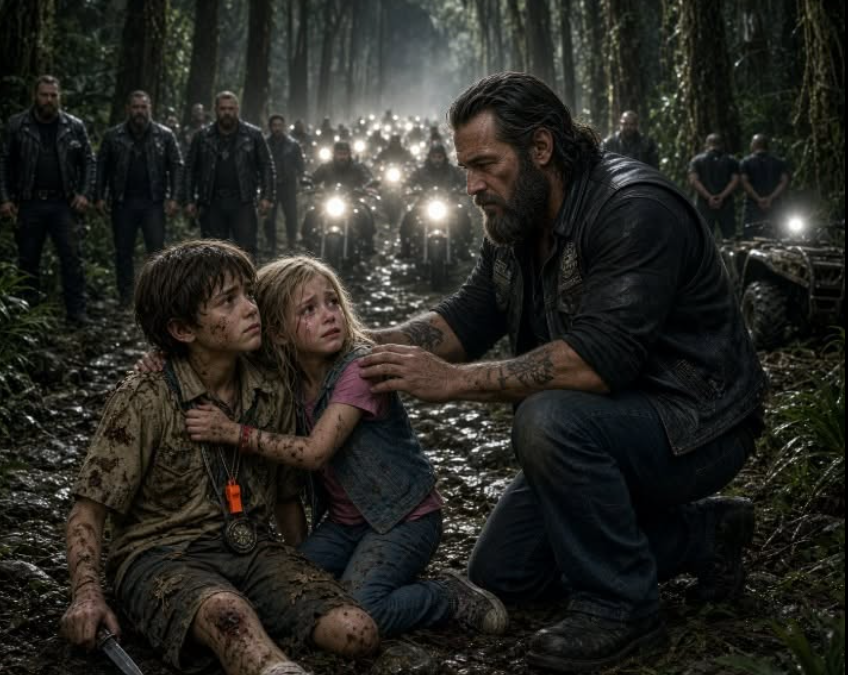
A 12-Year-Old Scout Got Lost in the Florida Woods—Then He Found a Kidnapped Biker’s Daughter, and 127 Hells Angels Came Roaring In.
The day I got lost in the Ocala National Forest, I thought the worst thing that could happen was losing my compass and disappointing my Scoutmaster.
Then I found an eight-year-old girl tied to a chair inside an abandoned hunting cabin, with two armed men outside demanding two hundred thousand dollars from her father.
I did not know her dad was a Hells Angels enforcer, and I definitely did not know that by nightfall, one hundred twenty-seven motorcycles would come roaring through the Florida woods because of what I had done.
My name is Toby Higgins.
At twelve years old, I was not brave in the way people imagine brave kids are supposed to be.
I was small for my age. I had allergies bad enough that my mother packed tissues into every backpack I owned. I followed rules because rules made the world feel less terrifying. I liked checklists, maps, compass work, knots, clean socks, and knowing exactly where the nearest adult was at all times.
In Troop 488, that made me useful but not exactly exciting.
Other boys made slingshots out of fallen branches, dared each other to eat strange berries, and tried to sneak chocolate bars into their sleeping bags even though raccoons were basically criminals with hands.
I studied merit badge requirements.
Scoutmaster Arthur Gable once told my mother, “Toby is the only boy I know who reads safety instructions for fun.”
He meant it kindly.
Mostly.
That crisp Saturday afternoon in late October, we were camped near Juniper Springs in the Ocala National Forest. The air smelled like pine needles, damp earth, and campfire smoke. Spanish moss hung from ancient oaks like gray curtains, and the trails twisted through scrub pine, palmetto thickets, sinkholes, and sandy patches that all looked similar once you turned around twice.
I was working on my land navigation skills.
Scoutmaster Gable had given me permission to complete a short solo orienteering trek, as long as I stayed within a two-mile radius of camp, carried my whistle, kept my map dry, and returned before dusk.
I had a topographical map.
An official compass.
A pencil.
A small survival kit.
A scout pocket knife.
A bright orange whistle on a lanyard around my neck.
I was prepared.
At least, I thought I was.
Half an hour into the trek, a wild boar burst through the underbrush.
If you have never seen a wild boar in Florida, understand that they do not look like something from a nature documentary. They look like a bad decision with tusks.
It crashed through the palmettos so suddenly that I stumbled backward, lost my footing, and slid down a muddy embankment.
I hit roots, leaves, rocks, and finally landed hard in a shallow ditch.
For a few seconds, I just lay there staring up at the sky through broken branches, trying to breathe.
Then I sat up.
My uniform was covered in mud.
My elbow burned.
My map had survived.
My compass had not.
The glass was cracked, and the needle had jammed against one side.
Panic rose in my throat.
Then training took over.
“Stop,” I whispered. “Think. Observe. Plan.”
It was the Scout survival acronym.
I said it again.
“Stop. Think. Observe. Plan.”
My heart slowed slightly.
The embankment I had fallen down was steeper than it looked from below, and the boar had vanished. I knew the campsite was somewhere northeast of my last marked position, but without the compass, I had to make an educated guess. I looked for higher ground, checked the angle of the sun, and started walking in the direction I hoped would lead back toward camp.
Thirty minutes later, I heard shouting.
Not a hiker.
Not a ranger.
A grown man.
Angry.
I dropped low into the palmetto bushes so fast my knees hit the dirt.
The voice came again, harsh and sharp, carrying through the trees.
I crawled forward on my belly the way our manual described for silent movement. Heel to toe. Slow. Keep branches from snapping. Watch for dry leaves.
Through the dense foliage, a clearing appeared.
In the center stood an old hunting cabin.
It looked abandoned from a distance, but it was not.
The porch sagged.
The roof leaned.
Beer cans littered the steps.
A rusty generator sat near the side wall.
Two men stood outside.
PART2:
One was tall and stringy, pacing with a burner phone pressed to his ear. The other was heavier, nervous, chewing on his thumbnail and glancing toward the tree line.
“I don’t care if he wants proof of life,” the tall man snapped into the phone. “You tell Big Jim if he doesn’t drop two hundred grand at the overpass by midnight, he’s never seeing his kid again.”
My body went cold.
Big Jim.
Two hundred thousand dollars.
His kid.
This was not hunters arguing.
This was something much worse.
The tall man hung up and shoved the heavier one.
“Kyle, check on her. Make sure she hasn’t wriggled loose. If she screams again, gag her.”
The heavier man grunted and went inside.
For one moment, I could not move.
Every rule I had ever learned fought inside my head.
Find an adult.
Signal for help.
Do not approach danger.
Do not play hero.
But there was a kid in that cabin.
A kid tied up.
A kid who might not have time for me to find my way back to camp.
I crept around the edge of the clearing, keeping thick oak trunks between me and the tall man, whose name seemed to be Dalton. He was lighting a cigarette now, swearing under his breath, and looking toward the dirt road that led away from the cabin.
The back of the cabin sat on cinder blocks.
The wood beneath the floor was rotting.
PART3:
Near the rear corner was a small window with no glass, covered only by a torn wire mesh screen.
I pulled myself up carefully and looked inside.
The cabin smelled like mildew, stale smoke, and old garbage.
In the center of the room, tied to a heavy wooden chair with thick zip ties, sat a little girl.
She was younger than me.
Maybe eight.
Blond hair matted with sweat and dirt.
Face pale.
Eyes red from crying.
She wore a tiny denim vest over a pink T-shirt, and the zip ties around her wrists had cut deep red marks into her skin.
Kyle stood over her, checking the restraints.
“Keep quiet,” he muttered. “Your daddy pays, you go home. Don’t make it worse.”
He left through the front door, letting the screen slam.
I knew I had maybe two minutes.
Maybe less.
I pulled my scout pocket knife from my belt and pried at the staples holding the mesh. The wood was so rotten it gave way faster than I expected. I peeled the mesh back, squeezed through the opening, and dropped silently onto a pile of old burlap sacks.
The girl gasped.
I put one finger to my lips.
“Shh,” I whispered. “I’m a Boy Scout. I’m here to help.”
Her eyes widened.
I rushed to the chair and looked at the zip ties.
They were thick industrial plastic, pulled tight.
“I’m going to cut these,” I whispered. “You have to stay very still.”
She nodded so fast tears spilled down her cheeks.
I angled the blade away from her skin the way Scoutmaster Gable had taught us during first-aid safety.
Slowly.
Carefully.
Sawing back and forth.
The first tie snapped.
Then the second.
She pulled her hands free and hugged them to her chest.
“What’s your name?” I whispered, moving to the ties around her ankles.
“Madison,” she breathed. “Maddy.”
“I’m Toby. We have to go out the window right now. Can you climb?”
She nodded.
The front porch creaked.
My lungs stopped.
I cut the last restraint.
Snap.
“Go,” I whispered.
I boosted Maddy through the window first. She tumbled softly into the dirt outside. I had one leg through when the front doorknob rattled.
I threw myself out the window and hit the ground beside her.
Inside the cabin, Kyle shouted.
“Dalton! She’s gone!”
“Run,” I hissed.
I grabbed Maddy’s hand, and we plunged into the thickest, darkest part of the woods.
We ran until my lungs burned.
Branches slapped our faces. Briars snagged our clothes. Maddy stumbled twice, but I did not let go of her hand. Behind us, men shouted. Something crashed. Dalton screamed curses so loud birds exploded from the trees.
I knew running straight was a mistake.
Adults had longer legs.
They would catch us if we left an easy trail.
So I forced myself to think like it was a merit badge test.
Zigzag.
Break the trail.
Step on roots when possible.
Walk backward through mud for a few yards.
Cross water if you find it.
We splashed through a shallow creek that smelled like wet leaves and sulfur. I made Maddy walk in the water longer than she wanted because I remembered reading that water could confuse tracking dogs. I did not know if they had dogs. I did not know if it mattered.
But I needed to do something.
The sun began sinking lower, turning the forest gold and then gray.
Finally, I found a massive old cypress tree with a hollowed-out base big enough for both of us to crawl inside.
We collapsed there, gasping.
Maddy was shaking badly.
I took off my scout uniform shirt and wrapped it around her shoulders, leaving myself in a white undershirt.
“Thank you,” she whispered.
“You’re okay,” I said, trying to sound like I knew that was true.
“They took me from my front yard,” she said. “I was riding my bike.”
I opened my survival kit and took out antiseptic wipes for her wrists.
“The police will find us,” I told her.
She shook her head.
“My daddy doesn’t talk to police.”
I paused.
“What do you mean?”
Her chin lifted with a strange little spark of pride, even through the fear.
“My daddy’s name is Jim. Everyone calls him Big Jim. He’s sergeant-at-arms for the Hells Angels. Orlando chapter.”
I stared at her.
Even sheltered twelve-year-olds know certain names.
Hells Angels was one of them.
I had seen documentaries. My dad once changed the channel and said, “Those are not men you want mad at you.”
And I had just rescued the daughter of one of them.
Maddy looked toward the darkening trees.
“Daddy will find us.”
“How?”
“I left my lucky jacket near the cabin. Daddy put a tracker in it. He says he always knows where I am.”
Somewhere far away, in Orlando, Maddy was right.
Big Jim Gallagher stood at the head of a long wooden table inside the Hells Angels clubhouse, staring at a digital map with a red dot blinking near the Ocala National Forest.
He was six-foot-five, built like a brick wall, with tattoos down both arms and a face pale with a father’s rage.
Dalton had made the biggest mistake of his life when he called with demands.
He thought he was speaking to a frightened parent.
He was speaking to a man who had an army.
“They took her near the Ocala perimeter,” Jim growled to the room. “Tracker pinged at an abandoned hunting lease off Route 19. They want money.”
His voice turned colder.
“They’re not getting money. They’re getting us.”
Jax, the chapter president, stood.
“How many?”
Jim’s answer was immediate.
“Everyone.”
Within ten minutes, the gates of the compound opened.
One hundred twenty-seven motorcycles rolled out into the Florida evening in a formation that shook the road beneath them.
Traffic parted.
Drivers pulled over.
People at gas stations froze with drinks halfway to their mouths.
State troopers on the median lowered their radar guns and watched the convoy pass.
This was not a ride.
This was a father bringing thunder into the woods.
Back in the cypress hollow, the forest had gone almost dark.
I heard it before Maddy did.
A distant buzzing.
High-pitched.
Mechanical.
Not motorcycles.
An ATV.
I crawled to the edge of the hollow and looked out.
Headlights bounced through the trees.
“They’re searching,” I whispered. “We have to move.”
Maddy grabbed my arm.
“I’m tired.”
“I know. But if they find us here, we’re trapped.”
We ran again.
Or tried to.
It was darker now, and fear makes you careless.
I missed the edge of a ravine.
The ground disappeared beneath us.
We slid down a steep rocky embankment, crashing into a dry creek bed below.
Pain exploded through my ankle.
I bit my lip so hard I tasted blood.
“Toby!” Maddy cried.
I tried to stand.
My right leg buckled immediately.
A flashlight beam swept over the ridge above us.
Then froze.
“Well, well,” Dalton’s voice called down. “Look what we found.”
He stood at the top of the ravine with Kyle behind him holding the light. Dalton carried a rifle. He started down toward us slowly, boots crushing loose rock.
“A little hero,” he said. “You cost us a lot of money, kid.”
I pushed Maddy behind me and pulled out my tiny scout knife.
My hand shook so hard the blade glinted wildly in the light.
Dalton laughed.
“That is adorable.”
He took another step.
Then stopped.
At first, I thought it was thunder.
Low.
Distant.
Growing.
The dirt beneath my palms began to vibrate.
Maddy lifted her head.
The rumble became louder, deeper, mechanical.
The forest lit up.
Not from lightning.
From headlights.
Dozens.
Then more.
White beams sliced through oak trunks and Spanish moss, flooding the woods with unnatural light.
The roar of engines swallowed the night.
Kyle’s flashlight began shaking.
“Dalton,” he whimpered, “is that the cops?”
Dalton’s face drained.
“Cops don’t sound like that.”
Maddy stepped out from behind me.
Her voice was no longer small.
“That’s my daddy.”
Kyle broke first.
He dropped the flashlight and ran.
He did not get far.
A motorcycle roared from the left flank, cutting across his path. Men moved through the trees, fast and silent, and within seconds his shouting stopped.
Dalton spun, trapped.
All along the ridge, bikers dismounted.
Huge silhouettes in leather and denim formed a ring around the ravine.
They did not yell.
They did not need to.
The engines idled behind them like monsters breathing in the dark.
Panic took Dalton.
He lunged toward Maddy, reaching to grab her.
My ankle screamed as I moved.
I could not fight him.
I could not outrun him.
But I had one thing left.
The whistle.
I shoved the bright orange whistle into my mouth and blew with every bit of air I had.
The shriek cut through the engines and the shouting.
Dalton flinched, hands flying toward his ears.
That second was enough.
A massive shadow dropped into the ravine.
Big Jim hit Dalton like a force of nature, driving him away from Maddy and into the dirt. Other bikers came behind him, fast and controlled. The rifle was kicked away. Dalton was pinned, cuffed with zip ties, and dragged back before he could touch either of us.
Then Big Jim turned.
The terrifying enforcer disappeared.
In his place was a father.
“Maddy!”
She ran into his arms.
“Daddy!”
He dropped to his knees and caught her, wrapping both arms around her so tightly I thought he might never let go. His face buried in her dirty blond hair, and his huge shoulders shook.
For a long moment, all I heard was the low rumble of motorcycles and a father crying into his daughter’s hair.
I sat in the dirt holding my swollen ankle, suddenly aware that I was surrounded by more leather, tattoos, engines, chains, and enormous men than I had ever seen in my life.
I felt very small.
Big Jim finally pulled back and checked Maddy’s face.
He saw her raw wrists.
His eyes darkened, flicking toward Dalton.
Maddy grabbed his chin and forced him to look back at her.
“I’m okay, Daddy.”
Then she pointed at me.
“He cut the ties. He got me out the window. He fought the bad man.”
Big Jim slowly turned toward me.
The entire forest seemed to go quiet.
He walked over, boots crunching on dry creek stones, and towered above me.
I tried to scoot backward, but my ankle flared and I winced.
Then Big Jim did something I did not expect.
He lowered himself to one knee.
Up close, he smelled like leather, gasoline, and cold night air. Tattoos crawled up his neck. Heavy rings covered his fingers. His eyes looked exhausted, angry, and grateful all at once.
“What’s your name, son?”
“Toby,” I stammered. “Toby Higgins. Troop 488.”
His gaze dropped to the tiny knife still clenched in my trembling hand.
Then to the broken zip ties around Maddy’s wrists.
A slow, respectful smile moved across his face.
“Toby Higgins,” he said. “You’ve got more heart than any grown man I know.”
I did not know what to say.
“You saved my world tonight.”
“My ankle,” I blurted, because twelve-year-olds do not always know how to respond to life-changing statements. “I think it’s sprained.”
For one second, Big Jim stared at me.
Then he laughed.
Not mockingly.
Like he could not help it.
“Boon!”
A huge red-bearded biker with military patches on his vest stepped forward carrying a trauma kit.
“Combat medic,” Jim said. “Best hands in the chapter.”
Boon knelt beside me.
“Let’s see it, little brother.”
Little brother.
No one had ever called me that before.
His hands were surprisingly gentle. He checked my ankle, wrapped it tight, and said nothing was broken.
“You’ll live,” Boon said. “But you’re not walking out.”
“My Scoutmaster is going to be so mad,” I muttered. “I went outside the two-mile radius.”
A low wave of laughter moved through the bikers.
Jax, the chapter president, stepped down into the ravine and clapped me carefully on the shoulder.
“Kid, if your Scoutmaster has complaints, we’ll handle him.”
The extraction from the woods was like something out of a dream.
Dalton and Kyle were hauled out under guard.
Maddy rode in front of Big Jim, tucked safely between his arms.
Boon lifted me onto the back of Jim’s massive Harley behind the seat.
“Hold on tight, Toby,” Jim said.
I gripped the back of his leather cut.
Then the convoy moved.
Riding through the forest surrounded by one hundred twenty-seven motorcycles was terrifying, loud, smoky, and completely against every safety rule I had ever learned.
It was also the most incredible thing I had ever experienced.
The headlights carved tunnels through the darkness. Engines growled beneath us. Branches whipped past. The men rode with impossible coordination through dirt trails and logging roads, until the wilderness opened back toward Juniper Springs.
At the campground, Scoutmaster Arthur Gable was falling apart.
It was after 10:00 p.m.
Rangers had arrived.
Local police were organizing search teams.
Arthur paced in front of a ranger truck, wringing his hands.
“He never does this,” he kept saying. “Toby is my responsible scout. He’s working toward Eagle!”
Then the ground began to tremble.
The campfires flickered.
Every adult turned toward the entrance.
A river of headlights poured through the main gate.
Over a hundred Hells Angels rolled into the campground and formed a massive semicircle around the main fire pit.
Parents grabbed children.
Rangers reached for radios.
Arthur froze with his mouth open.
Big Jim cut his engine.
The whole convoy went silent with him.
He stepped off the bike, lifted Maddy in one arm, and reached back to help me down with the other.
He set me gently on my good foot.
Arthur stared at me.
“Toby Higgins, what in heaven’s name—”
Big Jim stepped in front of him.
“You listen to me,” he said, poking one thick finger lightly but firmly against Arthur’s chest. “This kid right here is a hero. He found my daughter, broke into a locked cabin, cut her loose, led her through the woods, hid her, and kept himself between her and two armed men.”
Arthur blinked rapidly.
“He did what?”
“If he wants Eagle,” Jim continued, “you help him get it. If he wants a merit badge in saving lives, you invent one.”
Arthur nodded so fast his hat nearly fell off.
“Yes, sir. Absolutely, sir.”
The bikers erupted into cheers.
Engines revved in a salute so loud pine needles shook from the trees.
I should have hated the attention.
Normally, I would have.
But Maddy grabbed my hand and smiled.
So I smiled too.
The official story became cleaner later.
Police reports.
Statements.
Evidence.
Rescue timeline.
Dalton and Kyle were delivered to the authorities with enough proof to put them away for a long time. There were recordings, the burner phone, the cabin, the zip ties, Maddy’s statement, my statement, and plenty of men willing to confirm where they had been found.
Some details became legend.
People in Florida still tell the story differently depending on who is telling it.
Some say Dalton and Kyle were found duct-taped outside the sheriff’s office.
Some say upside down.
Some say sitting neatly on the front steps with a confession taped to one of their shirts.
I will not confirm any version.
I was twelve.
My ankle hurt.
I was asleep in a ranger station chair when most of that happened.
What I know is this:
They never got Maddy again.
Maddy went home with her father.
I went home grounded, praised, examined by a doctor, interviewed by police, hugged by my mother so hard I almost needed another doctor, and lectured by my father about how “brave” and “reckless” are often cousins.
Scoutmaster Gable wrote a report so dramatic that the council requested two follow-up statements.
I eventually earned my Eagle Scout rank.
But the badge that meant the most to me was not issued by the Boy Scouts of America.
Three months after the rescue, Big Jim came to our house.
My mother nearly fainted when she saw him on the porch.
He removed his sunglasses and held out both hands.
“Ma’am, I’m not here to scare anybody.”
She looked at his vest.
“You are not doing a great job.”
He laughed and asked if he could speak to me.
I came to the door, suddenly feeling twelve again in the worst possible way.
He handed me a small wrapped box.
Inside was a custom patch.
Black and red.
A winged skull.
Small enough to fit inside the lining of my scout sash.
The words read:
Honorary Brother.
I stared at it.
Big Jim cleared his throat.
“The Angels don’t forget a debt,” he said.
I looked up.
“Maddy okay?”
His face softened.
“She’s okay because of you.”
“I was scared.”
“Good,” he said. “Only fools aren’t scared. Brave means you did what needed doing anyway.”
I kept that patch hidden inside my sash.
Not because I was ashamed.
Because some things are not meant for everyone.
Some things are meant to remind you privately who you became when nobody expected it.
Years later, people still asked me about that day.
They wanted to know if I felt like a hero.
I never did.
Heroes, to me, seemed confident.
I was lost.
I was muddy.
My compass was broken.
My ankle hurt.
My hands shook so badly I almost dropped my knife.
But I had training.
I had a whistle.
I had a tiny blade.
I had rules.
And when the rules were not enough, I had to decide which rule mattered most.
Stay inside the radius.
Or save the girl.
Wait for adults.
Or act before adults could arrive.
Do not approach danger.
Or refuse to leave Maddy tied to a chair.
I learned something that night that no handbook had ever explained clearly.
Being prepared is not only about gear.
It is not only about knowing knots, maps, first aid, or how to start a fire with dry tinder.
Being prepared means becoming the kind of person who can still think while afraid.
It means using what you have, even if what you have is small.
A broken compass.
A scout knife.
An orange whistle.
A brain full of instructions.
A heart beating so hard it hurts.
And enough courage to take one quiet step toward someone who needs help.
Maddy and I stayed friends.
Not ordinary friends, maybe.
You do not go through something like that and then talk casually about homework as if nothing happened.
But every year, on the anniversary of that day, I got a message.
Sometimes from Maddy.
Sometimes from Big Jim.
Usually just a photo.
Maddy on her bike.
Maddy at a birthday party.
Maddy graduating eighth grade.
Maddy standing beside her father, who always looked slightly uncomfortable in pictures and always had one hand protectively near her shoulder.
Under each photo, the message was usually the same.
Still safe.
That was enough.
I grew taller eventually.
Not much.
But enough.
I still kept tissues in my backpack.
I still followed rules more than most people.
But after that day, I understood rules differently.
Rules are meant to protect life.
When following one rule means abandoning someone, you may have to reach for a higher one.
Help the helpless.
Protect the vulnerable.
Tell the truth.
Be prepared.
I went into the Ocala National Forest as a boy trying to prove he could follow a map.
I came out on the back of a Hells Angel’s motorcycle, with a sprained ankle, a ruined uniform, a rescued girl, and one hundred twenty-seven bikers cheering loud enough to shake the trees.
People say that was the day I became a legend.
They are wrong.
That was the day I learned legends are usually just scared people who do the next right thing before they have time to talk themselves out of it.
And if you ask me what courage sounded like that night, I will not tell you it sounded like engines at first.
It sounded like a little girl trying not to cry in an abandoned cabin.
It sounded like my own breathing while I sawed through plastic ties with a shaking hand.
It sounded like leaves breaking under my knees as I crawled toward danger I had no business facing.
Then, when we had done everything two kids could do, when the woods had gone dark and the bad man was coming down the ravine, courage changed shape.
It became thunder.
It became headlights through Spanish moss.
It became one hundred twenty-seven fathers, brothers, mechanics, veterans, sinners, saints, and outlaws riding through the Florida night because a child was missing and one of their own had called.
But before the thunder came, there was only a choice.
A cabin.
A knife.
A girl tied to a chair.
And a twelve-year-old Scout who was terrified enough to run, but trained enough to stay.
That is the part I remember most.
Not the motorcycles.
Not the cheers.
Not the patch hidden inside my sash.
The moment before anything heroic happened.
The moment when I knew the rulebook had run out, and the only thing left was the kind of person I wanted to be.
So I climbed through the window.
And I have been living with that choice ever since.








