A 12-Year-Old German Shepherd Was Hours From Euthanasia—Then a Police Officer Saw Him Holding a Terrified Puppy at 1:23 A.M.
A 12-Year-Old German Shepherd Was Hours From Euthanasia—Then a Police Officer Saw Him Holding a Terrified Puppy at 1:23 A.M.
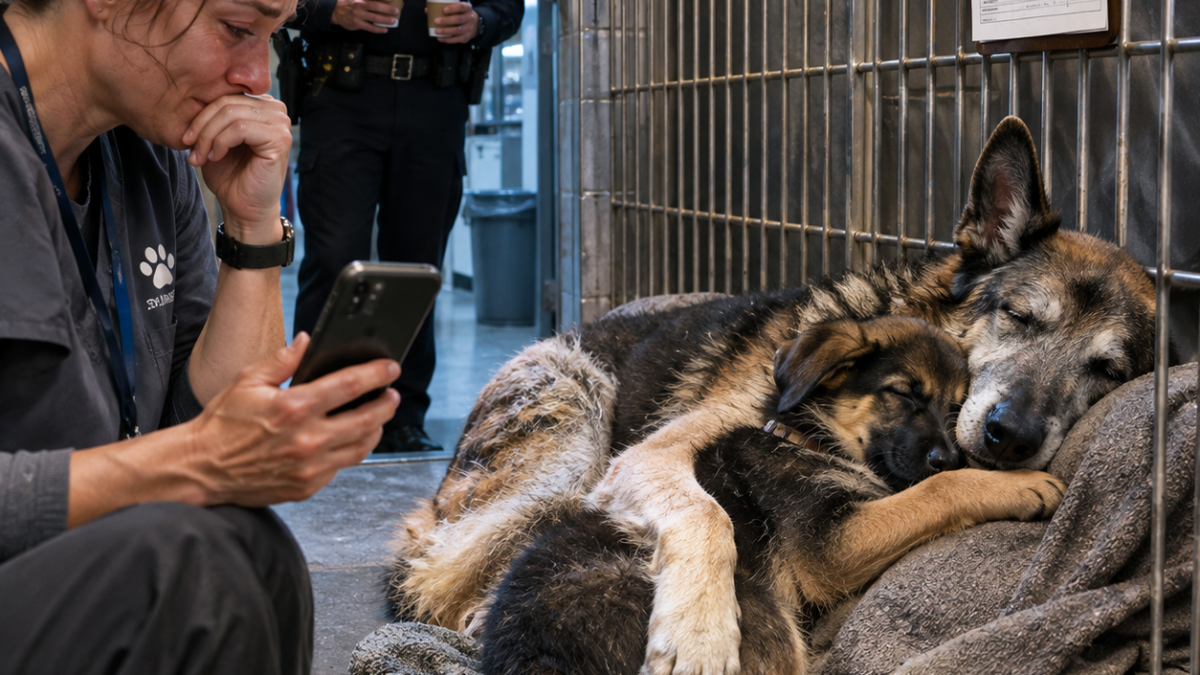
At 9:16 on Thursday night, a shelter worker photographed a terrified four-month-old puppy wrapping both paws around the neck of a twelve-year-old German Shepherd who was scheduled to die at 8:00 the next morning.
She posted the picture because every rescue was full, every foster had said no, and separating the two dogs had caused the puppy to panic so badly that the old shepherd dragged his arthritic body across his kennel every time he heard him cry.
A little after one in the morning, Boise police officer Aaron Blake saw the photograph at his empty kitchen table, looked at the old dog’s white face and the puppy sleeping beneath his leg, and made a decision that would eventually change far more than two dogs’ lives.
At 9:16 on Thursday night, Megan Carter took a photograph she wished she had never needed.
She stood outside Kennel 12 at the Ada County municipal shelter outside Boise, Idaho, holding her phone with both hands.
Inside, Duke lay beneath a faded gray blanket.
Twelve years old.
German Shepherd.
Mostly black and tan once.
Now gray had climbed across his muzzle, around his eyes, and beneath his chin.
His body had become narrow with age.
His hips hurt.
Standing after a long sleep took effort.
Cold mornings were worse.
One ear had a notch near the tip from something that had happened long before he came through the shelter doors.
Megan knew almost nothing about that part of his life.
The intake paperwork told her only what paperwork could tell.
Male.
Approximately twelve.
Microchip registered years ago to an unreachable owner.
Arthritis.
No serious aggression.
House-trained.
Good with handling.
Patient.
Available for adoption.
Five months.
That last line was the cruelest.
Five months.
Families had stopped in front of Duke’s kennel.
They always stopped.
He was handsome even in old age.
Then they read the card.
Twelve years.
Medication.
Arthritis.
Possible ongoing bloodwork.
Unknown time remaining.
And they continued walking.
Megan never blamed them.
That somehow made it harder.
Most people arriving at a shelter imagined future years.
Road trips.
Camping.
Children growing beside a dog.
Birthdays.
Christmas mornings.
A decade of photographs.
PART2:
Duke could not promise any of that.
He could promise today.
Maybe tomorrow.
Maybe two years.
Maybe six months.
Nobody knew.
Apparently today had not been enough.
Curled against Duke’s chest that night was Finn.
Four months old.
Shepherd mix.
Too-big paws.
Soft brown-and-black coat.
Still growing into his ears.
His front legs were wrapped clumsily around Duke’s neck.
Duke had one heavy foreleg resting across the puppy’s back.
Neither looked toward Megan.
Neither knew she had lifted the phone.
They were asleep.
Or close enough.
PART3:
In eleven hours, Duke was scheduled to be euthanized.
Megan took the picture.
Then lowered the phone.
“Damn it.”
Duke opened one eye.
She crouched.
“I know.”
His eye closed again.
Finn pressed closer.
Three weeks earlier, nobody would have guessed the puppy would ever trust another dog enough to sleep like that.
Finn had been found beside State Highway 55.
A road-maintenance crew discovered him beneath an overturned plastic storage bin.
No collar.
No microchip.
Underweight.
Dirty.
Terrified.
He shook whenever somebody reached over his head.
If food was placed in front of him while a person remained nearby, he would stare at it but refuse to eat.
Only after the room emptied would the bowl begin to move.
The shelter was already crowded when he arrived.
There was no quiet foster opening.
No ideal behavioral decompression room.
Just one temporary enclosure beside Kennel 12.
Megan had apologized to him while setting it up.
“You’re going next to the old guy.”
Duke barely reacted.
Finn pressed himself against the far wall.
Duke walked to the divider.
Finn froze.
The old shepherd sniffed through the wire once.
Then turned his head away.
Lay down.
That was all.
No staring.
No barking.
No pushing his nose through the divider.
No attempt to force interaction.
Finn watched him.
Ten minutes.
Fifteen.
Twenty.
Duke began eating.
Eventually Finn stood.
Approached the divider.
Stopped.
Duke continued eating.
Finn sniffed.
Duke ignored him.
Then Finn turned toward his own bowl.
Megan watched from the doorway.
He ate.
First full meal since intake.
The next day it happened again.
Duke drank.
Finn drank.
Duke approached Megan.
Finn followed halfway.
Duke lay down.
Finn slept pressed against the divider.
Within days, the puppy began copying him.
The first time Megan saw Finn enter the exercise yard with Duke, she expected the old shepherd to become irritated.
Finn had apparently decided Duke’s age made him an excellent climbing structure.
He stole Duke’s ball.
Bit his tail.
Stepped on his blanket.
Tried to crawl over his shoulders.
Duke corrected him twice.
Nothing dramatic.
A warning.
A look.
The exhausted irritation of a grandfather discovering someone had given the toddler sugar.
Then he tolerated the rest.
Megan began calling Finn Duke’s intern.
“Your training program is terrible,” she told Duke one morning.
Finn ran past carrying a stolen towel.
Duke watched him.
Megan sighed.
“Actually, maybe accurate.”
The joke stopped being funny when the shelter hit emergency capacity.
Twenty-seven dogs.
Twenty-four kennels.
Three temporary crates in the laundry room.
Two cruelty-seizure dogs arriving Friday under a legal hold.
Something had to give.
The director reviewed the list.
Medical needs.
Length of stay.
Adoption interest.
Rescue options.
Behavior.
Duke had been available longest.
His medical expenses were increasing.
Three senior-dog rescues had already been contacted.
Full.
The shelter director hated the decision.
She still made it.
Friday.
8:00 a.m.
Megan spent Thursday calling.
An Oregon senior-dog rescue.
Full.
A German Shepherd organization in Washington.
Possible transport next week.
Too late.
Two former adopters she trusted.
Both unable.
One volunteer called her landlord.
No.
By six Thursday evening, Megan had nothing.
Then Finn was moved.
A kennel had opened in the public adoption wing.
That should have been good news.
More visibility.
More foot traffic.
A puppy had a much better chance than Duke.
Megan clipped on Finn’s leash.
“Come on, little criminal.”
Finn followed enthusiastically into the corridor.
Then stopped.
He looked back.
Duke remained behind the gate.
Finn took another step.
Stopped again.
“Come on.”
Five steps.
He turned.
Duke was still there.
The puppy lowered his entire body.
By the time Megan got him around the corner, he was crying.
Not normal puppy protest.
Panic.
He scratched at the new kennel door.
Ignored chicken.
Ignored a toy.
Ignored Megan sitting beside him.
She tried walking away.
Worse.
Back in Kennel 12, Duke stopped sleeping.
Every time Finn cried somewhere down the corridor, Duke lifted his head.
Then stood.
Paced.
Slowly.
Painfully.
Turn.
Walk.
Listen.
Turn.
Walk.
Listen.
Megan lasted less than an hour.
“One night.”
She knew she was bending policy.
“Just tonight.”
She brought Finn back.
The puppy almost pulled the leash from her hand.
Duke met him at the gate.
Finn pushed under his chest.
Immediate silence.
Megan stood there with one hand covering her mouth.
Later, thunder rolled across the Treasure Valley.
Finn crawled closer.
Duke placed one leg over him.
That was when Megan took the photograph.
She sat in the staff office afterward.
Opened the shelter’s social page.
Typed:
DUKE NEEDS A HOME.
Deleted it.
Too clean.
Too easy.
She tried again.
Duke is twelve.
He has arthritis.
He has been at our shelter for five months.
Tomorrow morning, because our kennels are full and no rescue placement has opened, his time runs out.
She stared at the words.
Then wrote about Finn.
She almost typed:
They know they are saying goodbye.
Deleted that too.
She did not know what dogs understood about euthanasia schedules.
She would not invent feelings because the truth was already painful enough.
Instead:
Finn arrived terrified three weeks ago.
Duke helped him eat, sleep, approach people and begin acting like a puppy.
Tonight we attempted to move Finn into the adoption wing.
He panicked until we brought him back.
This is how I found them.
Photograph attached.
Then:
If you can responsibly adopt or foster Duke, call when we open at 8:00 tomorrow morning.
Megan stopped.
Added another paragraph.
If you are interested only because this photograph hurts, please still think carefully.
Duke is a senior dog.
He has arthritis.
He requires medication.
He may require additional veterinary care.
He needs patience and somewhere permanent.
Virality could save an animal.
Virality could also send that animal home with someone who had fallen in love with one photograph and had no idea what senior-dog care cost.
Megan had seen that happen.
Emotional adoption.
Then surprise.
Then vet bill.
Then return.
She added:
Please share with experienced adopters and rescues.
Publish.
At 1:23 Friday morning, Officer Aaron Blake sat at his kitchen table reheating chili.
Thirty-one.
Boise Police Department.
Night shift.
Divorced eleven months.
Technically, that had nothing to do with Duke.
Practically, it had everything to do with why Aaron was sitting alone in a silent duplex at one in the morning instead of sleeping.
His ex-wife once told him:
“You’re turning work into a place where nobody can ask how you’re doing.”
Aaron had told her that made no sense.
Months later, in the quiet after she moved out, it made considerably more sense.
He had volunteered for overtime constantly.
Patrol.
Reports.
Traffic details.
Anything.
His apartment contained everything necessary for a functioning human life.
Bed.
Couch.
Television.
Kitchen.
Coffee maker.
Almost nothing that suggested anybody actually wanted to be there.
Aaron saw Duke’s photograph while checking the weather.
Scrolled past.
Stopped.
Scrolled back.
Read the post.
Then read it again.
He looked at Finn’s paws around Duke.
The old dog’s white muzzle.
One foreleg across the puppy.
Aaron knew nothing about senior-dog adoption.
He did know what it looked like when somebody had become the only stable thing in someone else’s world.
He called the shelter.
Voicemail.
Of course.
They opened at eight.
He left his name and number.
Then made the mistake of checking his lease.
Pets permitted with landlord approval.
Maximum:
one dog.
Maximum weight:
sixty pounds.
Aaron looked at Duke.
German Shepherd.
Seventy-plus pounds easily.
Finn?
Currently smaller.
Eventually not.
“Great.”
He should have gone to sleep.
Instead, he texted Sergeant Diane Walsh.
Diane had worked as a Boise K9 handler for eleven years before being promoted.
Aaron typed:
You awake?
Reply thirty seconds later:
I’m a sergeant. I’m always awake when somebody wants something.
Aaron sent the photograph.
Then:
Bad idea?
Diane:
Almost certainly.
Another message.
Which one?
Aaron typed:
Old one.
Looked at Finn.
Deleted it.
Typed:
Maybe both.
Three dots.
Long pause.
Then:
That is a substantially worse idea.
Aaron smiled.
First time that night.
At 7:43 a.m., Megan drove into the shelter parking lot.
A police cruiser was already there.
Officer Blake stood beside it holding two coffees.
She parked slowly.
“You Aaron?”
“Yes.”
“You left the message?”
“Yes.”
“You’re forty minutes early.”
“I noticed.”
She unlocked the staff entrance.
Aaron started toward the kennel hall.
Megan blocked him.
“Office first.”
He followed.
She sat across from him.
“Duke is not that photograph.”
“I understand.”
“No.”
She leaned forward.
“You understand a picture.”
Aaron stopped smiling.
“He hurts some mornings.”
“Okay.”
“Medication daily.”
“Okay.”
“He may need monitoring because of the anti-inflammatory.”
“Okay.”
“He could live two years.”
Pause.
“He could live six months.”
Aaron nodded.
“We don’t know.”
“I understand.”
“No.”
Megan shook her head.
“You understand the words. I need you to understand the bill.”
That almost made him smile again.
“Okay.”
Then she explained Finn.
“Finn is not free therapy for Duke.”
“I didn’t assume—”
“He chews.”
“Puppy.”
“He occasionally fear-urinates.”
“Okay.”
“He may develop separation problems.”
“Okay.”
“He needs training.”
“Okay.”
“If Duke dies, Finn could regress significantly.”
That landed differently.
Aaron glanced toward the hall.
“You think they should stay together?”
Megan hesitated.
“If we had unlimited qualified homes?”
“Yes?”
“Yes.”
“But?”
“We don’t.”
“So Duke is priority.”
“Duke is scheduled at eight.”
Aaron checked the clock.
7:48.
“Show me.”
Duke stood when Aaron approached Kennel 12.
Slowly.
Rear legs taking a second to organize.
Finn peered from beneath his chest.
Aaron crouched outside.
Did not whistle.
Did not call their names repeatedly.
Did not stick fingers through the bars.
He simply sat.
Duke approached first.
Sniffed his hand.
One tail wag.
Finn watched from behind.
Aaron sat on the floor.
Five minutes.
Then ten.
Duke lowered himself near the gate.
Finn came forward.
Sniffed Aaron’s boot.
Retreated.
Came back.
Then stole one of Aaron’s glove liners through the kennel bars.
Megan sighed.
“That’s progress.”
Aaron watched Finn retreat proudly with the glove.
“He steals from everyone?”
“Specifically people he is beginning to trust.”
“That’s an interesting psychological system.”
Megan opened the kennel.
Duke accepted Aaron immediately.
Not dramatic.
Just tired trust.
Aaron scratched beneath his jaw.
The old dog leaned slightly harder into his hand.
Barely.
Quietly.
Aaron looked toward Finn.
“What happens to him when Duke leaves?”
“He stays here.”
“And Duke?”
Megan said nothing.
The clock said 7:56.
Aaron stood.
“I want both.”
Megan stared.
“You met them eleven minutes ago.”
“I know.”
“You live alone?”
“Yes.”
“You work nights?”
“Yes.”
“You own your house?”
“Rent.”
Her eyes narrowed.
“Pet policy?”
Aaron paused.
Megan closed her eyes.
“Of course.”
“I’m working on it.”
“You cannot adopt two shepherds into housing that does not allow two shepherds.”
“I know.”
“So what exactly is your plan?”
Aaron took out his phone.
“I have one more call.”
Diane answered immediately.
“You did it, didn’t you?”
“Not yet.”
“What do you need?”
“Temporary foster.”
Silence.
“How temporary?”
“Two weeks.”
Diane laughed once.
“You have the confidence of a man who has never looked for dog-friendly housing.”
“Three weeks.”
“No.”
“Diane.”
“I have a fenced acre.”
“Thank you.”
“I did not say yes.”
“You were getting there.”
“Your optimism is offensive.”
Pause.
“Bring them after the paperwork.”
Aaron lowered the phone.
Megan stared.
“That’s your supervisor?”
“Yes.”
“She likes you?”
“Evidence mixed.”
At 7:58, the shelter director signed a temporary hold on Duke’s euthanasia appointment.
Not because a police officer had appeared dramatically at the last second.
Because a qualified adopter application had become active.
Temporary housing had been verified.
Duke’s medical needs had been discussed.
A real plan existed.
His name disappeared from the euthanasia board.
Aaron signed preliminary commitments for both dogs pending final home approval.
At 8:21, Duke fell asleep with his head across Aaron’s boot.
Finn chewed the other lace.
Aaron looked down.
He had solved one problem.
Possibly created ten.
Still:
Both dogs were leaving alive.
That morning, that was enough.
The photograph made the rescue look cinematic.
Real life stopped being cinematic about forty-eight hours later.
Diane Walsh lived outside Kuna.
Three acres.
Two retired horses.
Fenced yard.
And the organizational personality of somebody who labeled spare batteries.
Duke adapted in one day.
Finn committed crimes.
Shoe theft.
Garden-glove destruction.
Unauthorized excavation.
One incident involving a torn bag of potting soil.
Diane texted Aaron a photograph of Finn standing in the middle of black dirt.
Caption:
ENVIRONMENTAL TERRORISM.
Aaron visited every day after shift.
Fed them.
Walked them.
Learned Duke’s medication schedule.
Worked on Finn’s confidence.
Then returned to his duplex alone and searched rental listings.
Pet friendly.
Sometimes.
One dog only.
Often.
Under fifty pounds.
Common.
German Shepherd prohibited.
Also common.
He began to understand how bonded animals ended up surrendered even by people who loved them.
Housing could break promises just as effectively as indifference.
Day Six.
Phone call.
Ruth Sanchez.
Sixty-five.
Retired after thirty-two years in emergency communications.
“I hear Walsh has your dogs.”
Aaron frowned.
“How do you know that?”
“Nothing important in this county stays secret from retired dispatchers.”
“I’m beginning to understand.”
“I own a cottage behind my house.”
Aaron stopped.
“Pet friendly?”
“Depends.”
“On?”
“Whether the owner likes you.”
“And?”
“I haven’t decided.”
The cottage was small.
One bedroom.
Hard floors.
Fenced yard.
No staircase Duke needed to climb regularly.
Ruth gave Aaron three rules.
“You repair anything Finn destroys.”
“Fair.”
“Duke does not use my porch stairs when his hips hurt.”
“Okay.”
“You do not assume being sixty-five means I need help carrying groceries.”
Aaron stared.
“Was that specifically aimed at me?”
“Yes.”
He signed the lease.
Duke and Finn moved in two weeks after the shelter photograph.
No miracle.
Deposit.
Paperwork.
Budget changes.
Dog beds.
Baby gates.
Cleaning supplies.
Duke’s first veterinary visit:
$486.
Aaron stared at the invoice.
Diane looked over his shoulder.
“Megan warned you.”
“I thought she was exaggerating.”
“She works at an animal shelter.”
“Apparently.”
“She has absolutely no reason to exaggerate veterinary expenses.”
Duke’s arthritis was significant.
But manageable.
Weight control.
Anti-inflammatory medication.
Joint support.
Gentle exercise.
No heroic mountain hikes.
Aaron told him:
“Congratulations.”
Duke looked up.
“You and I have the same exercise plan.”
Finn began working with a behavior consultant.
The goal was not to destroy his bond with Duke.
The goal was to teach him that Duke leaving a room did not mean the world had ended.
Seconds first.
Duke behind baby gate.
Finn receiving food.
Thirty seconds.
One minute.
Three.
Sometimes Finn cried.
Sometimes he ate.
Sometimes they made progress for three days and lost half of it on the fourth.
Aaron learned something important.
A bond could be beautiful and still require boundaries.
The shelter photograph continued spreading.
Local television called Megan.
She initially refused.
Later accepted one interview on conditions.
If they wanted the emotional picture, they also had to discuss:
senior-dog medical expenses.
housing problems for bonded pairs.
shelter overcrowding.
and the fact that Duke’s scheduled euthanasia had not happened because an evil employee wanted to kill him.
The shelter had been over capacity.
Twenty-seven dogs in twenty-four kennels.
More animals arriving.
Rescues full.
No foster opening.
Bad systems create awful choices without requiring a villain.
That distinction mattered to her.
Donations arrived.
Somebody anonymously paid six months of Duke’s medication.
A local property owner contacted the shelter offering a pet-friendly unit specifically for somebody willing to keep a bonded pair.
A family adopted two thirteen-year-old Chihuahuas.
Then one afternoon a man entered the adoption hall.
Megan asked:
“Looking for anything specific?”
He answered:
“Who has been here longest?”
She nearly cried.
Did not.
Kennels still needed cleaning.
Aaron’s life changed more quietly.
Ruth invited him to dinner.
He declined.
Then Finn found a loose yard latch.
Appeared at Ruth’s kitchen door.
Aaron followed five minutes later.
He ended up eating meatloaf at her table.
Duke slept beneath the chair.
Three weeks later, Aaron knew Ruth’s neighbor.
Then her nephew.
Then two retired dispatchers who possessed embarrassing information about seemingly every law-enforcement supervisor in Idaho.
His previously empty life became inconveniently populated.
He liked it.
Then he noticed something odd about Duke.
“Place.”
Duke immediately went to the bed.
More precision than Aaron expected.
He tried a hand signal Diane had once used with her K9.
Down.
Duke responded.
Stay.
Perfect.
Directional gesture.
Left.
Duke moved left.
Aaron frowned.
“Who trained you?”
Diane came over.
Watched.
Tried several cues.
Duke responded to some.
Ignored others.
Aaron said:
“Police dog?”
“Maybe.”
“Military?”
“Do not start writing movies.”
“Why not?”
“Because training exists outside police departments.”
She tested another directional signal.
“Search volunteer.”
“Scent sport.”
“Security.”
“Farm dog with an obsessive owner.”
She scratched Duke’s neck.
“Somebody put real work into him.”
The microchip record contained a name.
Calvin Price.
Old Nampa address.
Disconnected number.
The shelter had mailed a letter.
Returned.
Through the microchip company’s normal procedures, they found an old secondary contact.
Lydia Price.
Calvin’s daughter.
Aaron called.
When he said Duke’s name, the line became silent.
“Duke?”
“Yes.”
“Is he alive?”
“Yes.”
She began crying.
Duke had belonged to her father.
Calvin Price had retired from the Forest Service and volunteered with a regional wilderness search organization.
Duke had received civilian search-and-rescue foundation training.
Not police.
Not military.
Not some secretly decorated hero.
He had participated in volunteer searches and learned enough scent and directional work to explain what Aaron had seen.
“What happened to Calvin?”
“Stroke.”
“Recently?”
“Three years.”
Skilled nursing.
Lydia’s brother took Duke.
Then her brother died the previous winter.
A family friend was supposed to help rehome the dog.
Something went wrong in the transition.
Duke apparently became lost.
The microchip had never been updated.
Reports crossed county lines without connecting.
Administrative failures.
Human losses.
Bad timing.
Not deliberate abandonment.
Lydia asked the question Aaron had worried about.
“Do you want me to take him?”
Aaron looked beneath his kitchen table.
Duke asleep.
Finn pressed against his side.
“Do you want him back?”
Long silence.
Then Lydia answered honestly.
“I want him safe.”
Another pause.
“I live in Minnesota.”
Aaron waited.
“He’s twelve.”
“Yes.”
“I don’t think putting him through a cross-country move because I feel guilty would give him a better life.”
Aaron respected her immediately.
She sent photographs.
Duke younger.
Deep-colored coat.
Red search vest.
Calvin beside him.
Snow.
Forest.
Another with several volunteer search dogs resting beneath a table.
Aaron held his phone in front of Duke once.
The dog ignored it.
Of course.
Dogs do not become emotional because humans show them old photographs.
Still, the pictures mattered.
Not because Duke turned out to be extraordinary.
Because the kennel card had never contained his whole life.
Twelve-year-old German Shepherd.
Arthritis.
Available.
Those were facts.
They were not biography.
Four months after adoption, January rain fell across Boise for three days.
Rain on frozen ground.
Storm drains clogged.
Creeks rose.
Low areas flooded.
Water began entering a rear storage section of the Ada County shelter after a drainage pump failed.
This time staff acted early.
Emergency plan.
Portable kennels.
Partner shelters.
Medication bins.
Printed animal inventory.
Transport assignments.
At 2:40 p.m., dispatch requested officers for traffic control and animal transport.
Aaron responded.
Duke and Finn stayed at Ruth’s.
Safe.
At home.
Exactly where they belonged.
Aaron spent ninety minutes moving crates and directing traffic.
Then Megan appeared with two lists.
“We have a mismatch.”
“What?”
“Dog count thirty-one.”
“Transport?”
“Thirty.”
“Who?”
“Bruno.”
Pit mix.
Medical hold.
Isolation kennel.
Aaron looked toward the rear.
“How much water?”
“Ankle deep.”
“Structure?”
“Fire department says main corridor is stable.”
Good.
Nobody needed a police officer pretending to be a structural engineer.
Aaron accompanied two shelter workers.
Bruno’s kennel was empty.
At first that seemed reassuring.
Then Megan checked the paperwork.
“Ben.”
“What?”
“Ben Carter moved the medical dogs.”
“Where is he?”
Silence.
Nobody had seen Ben for fifteen minutes.
Radio.
No answer.
Now one dog and one worker were unaccounted for.
Fire Captain Maria Lopez took command.
Not Aaron.
She established teams.
Accountability.
Safe zones.
No wandering into flooded areas because somebody wanted a heroic moment.
Aaron called Ruth.
“Everything good there?”
“Yes.”
“Duke okay?”
“Sleeping.”
“Finn?”
“Attempting to disassemble something he does not own.”
“Normal.”
Aaron almost asked her to bring Duke.
His old search training.
Perfect dramatic circle.
Senior dog returning to save the shelter that nearly euthanized him.
Then common sense won.
Duke was twelve.
Arthritic.
Retired from volunteer work he had never even been formally certified to perform independently at this age.
He was not going into floodwater for anybody’s narrative satisfaction.
Security footage gave them the answer.
2:31.
Ben led Bruno from isolation toward the employee exit.
Then disappeared off camera.
Megan remembered.
“Generator enclosure.”
“Why?”
“Bruno panics around alarms.”
“Ben uses the loading bay?”
“Sometimes. Quieter.”
Exterior camera.
Ben emerged with Bruno.
Good.
They had left the building.
Aaron went outside.
Rain.
Parking lot partially flooded.
Then he saw red nylon.
Leash.
Wrapped around a fence post near a drainage channel.
Fire crew moved immediately.
Fifty yards downstream they found Ben.
Alive.
Sitting in mud.
Dislocated shoulder.
Bruno beside him.
Ben had slipped while trying to keep the frightened dog away from rushing water.
The leash caught.
Bruno stayed.
No search dog was required.
No miracle.
The shelter’s inventory system found the missing pair because somebody noticed one number did not match another.
Ben went to the hospital.
Bruno went to foster.
Every shelter animal was accounted for.
Local news heard Aaron had been there.
Reporter asked:
“Did Duke return to save the shelter that nearly killed him?”
Aaron said:
“No.”
The reporter paused.
“He wasn’t there?”
“No.”
“But Duke has search training.”
“He was home asleep.”
The reporter looked disappointed.
“What saved the shelter?”
Aaron looked toward Megan.
“Planning.”
Pause.
“Counting.”
“Firefighters.”
“Shelter staff who moved animals before the water got bad.”
Then:
“And Bruno stayed with Ben.”
Less cinematic.
Much more useful.
Megan realized the same thing.
The shelter did not need another story teaching people to wait for a heroic dog or dramatic stranger.
They needed systems that worked before disaster.
After the flood, the board reviewed their procedures.
One weakness appeared.
Bonded animals.
Some pairs had detailed notes.
Others depended on staff memory.
During the emergency evacuation, two strongly dependent dogs had accidentally been placed on separate transport vans.
Both became severely distressed.
Nobody was hurt.
But the problem was obvious.
Megan proposed a formal designation.
Not:
These dogs like each other.
Not:
They sleep together sometimes.
A behaviorally meaningful support relationship documented through repeated observation.
Transport preference.
Adoption considerations.
Emergency separation plan.
Behavior consultant reviewed it.
Shelter veterinarian agreed.
They called it:
PAIR SUPPORT FLAG.
Simple.
Operational.
Duke and Finn helped inspire it.
Not as proof that two animals should never be separated under any circumstances.
As evidence that relationships between animals can matter medically and behaviorally.
Meanwhile, donations connected to Duke and Finn eventually reached approximately $34,000.
Someone suggested a mural.
Megan said no.
“Absolutely not.”
The money became the Second Chance Companion Fund.
It paid for practical things.
Senior-dog medication support.
Behavior consultations.
Temporary boarding when housing changes threatened bonded adoptions.
Transport to qualified rescues when local kennels filled.
First recipient:
Penny.
Fourteen-year-old Beagle.
Prospective adopter could handle food and normal care.
Could not afford the immediate diagnostic bloodwork.
Fund covered it.
Penny went home.
Second case:
Two bonded mixed-breed dogs.
One adopter.
Lease permitted one animal.
The adopter had already secured new housing but could not move for ten days.
The fund covered boarding.
Both dogs later went home together.
Megan told Aaron.
He smiled.
“Sounds familiar.”
“Unfortunately.”
“What?”
“Your housing crisis created administrative policy.”
“Glad my suffering contributed.”
Duke knew none of this.
He did not know his photograph had traveled across Idaho.
Did not know donations carried his name.
Did not know another senior dog received bloodwork because somebody once saw his white muzzle beneath a shelter blanket.
Did not know the shelter had changed evacuation records partly because of his relationship with Finn.
He spent that winter sleeping beside Ruth Sanchez’s radiator.
Finn grew.
And grew.
Eventually nearly seventy pounds.
Still behaved as though Duke’s bed had unlimited capacity.
One evening Aaron came home after shift and found Duke asleep in the center of the large orthopedic bed.
Finn had somehow folded himself around the remaining space.
Half his body hung off the edge.
One paw rested across Duke’s shoulder.
Aaron stopped in the doorway.
It looked familiar.
Not identical.
Nothing was.
No kennel bars.
No fluorescent shelter lights.
No gray institutional blanket.
No euthanasia schedule hanging somewhere down the hall.
Just a small cottage.
Warm radiator.
Two food bowls.
A muddy tennis ball.
One destroyed garden glove Aaron still had not identified as belonging to him or Ruth.
Duke opened one eye.
Finn did not move.
Aaron took out his phone.
Then stopped.
Months earlier, Megan had photographed two dogs because she feared it might be the last night they spent together.
This time nobody needed the picture.
There was no deadline attached to it.
No rescue plea.
No caption asking strangers for help.
No need to prove anything.
Aaron put the phone away.
Sat on the floor beside them.
Duke shifted his head onto Aaron’s boot.
Finn stretched one leg until his paw landed across Duke’s neck.
Almost exactly like the original photograph.
Aaron smiled.
“Still stealing his bed?”
Finn’s tail thumped once without opening his eyes.
Duke sighed.
The sound of a very old dog who had accepted that retirement apparently included raising somebody else’s puppy.
The photograph from Kennel 12 had looked like a goodbye.
It had not been.
But the reason it became something else was not magic.
A shelter worker told the truth instead of exaggerating it.
A police officer arrived early.
A supervisor offered temporary space.
A retired dispatcher had an empty cottage.
A veterinarian made a treatment plan.
A behavior consultant helped Finn learn independence.
A lost microchip history was eventually reconnected with a family.
Shelter staff changed procedures.
Donors paid for practical care.
And dozens of ordinary people did small things at the correct time.
Duke never became a police K9.
He never stormed back into a flooded shelter to rescue anyone.
He never needed to.
His real achievement was quieter.
A frightened puppy learned to eat beside him.
Then sleep.
Then trust.
And because one shelter worker photographed that quiet act of kindness on what was supposed to be Duke’s final night, somebody else finally looked long enough to see him.
Not twelve years old.
Not arthritis.
Not medical cost.
Not kennel space.
A dog.
Still capable of giving something.
Still capable of needing something.
Still worth taking home.
And months later, when Finn had grown to seventy pounds and was still trying to fit into Duke’s bed, Aaron finally understood what Megan had meant the morning she warned him:
Duke was not the photograph.
She had been right.
The photograph was only ten seconds of his life.
The best part was everything that came after.








