A 12-Year-Old Boy Found a Fallen Soldier’s Dog Tags Buried in Mud and Knocked on a Biker Club’s Feared Door—Weeks Later, 800 Riders Gathered for a Reason He Never Expected
PART3:
I was pedaling past the old bridge when something flashed in the mud.
Silver.
Tiny.
There and gone under a ribbon of dirty water.
I almost kept riding.
A truck passed too close, spraying water across my jeans. My backpack strap was cutting into my shoulder. The sky was darkening, and I knew my mother would worry if I was late.
But the silver flashed again.
I stopped.
That is how these things happen, I think.
Not with destiny announcing itself.
Just a boy braking in the rain because something in a ditch caught the light.
I leaned my bike against the guardrail and climbed down the bank, slipping once, my sneakers sinking into the mud with a wet sucking sound. I reached into the water and pulled out a chain.
At first, I thought it was junk.
Then I saw the tags.
Two identical metal ovals on a beaded chain, muddy but intact, cold and heavier than they looked.
I wiped them against my jeans.
WHITFIELD
DANIEL R.
There were other numbers and letters too, things I did not understand yet. Military information. A blood type. A religion. The shape of a life reduced to stamped metal.
I stood in the ditch, rain dripping from my hair, and felt something strange move through me.
Not fear.
Not exactly.
More like responsibility.
The longer I held them, the more certain I became that I was holding something that mattered to somebody somewhere.
That evening, I showed them to my mother at the kitchen table.
She had just come home from the diner, and her hair was still pinned up crookedly beneath the scarf she wore on wet days. The overhead bulb flickered twice before settling into its weak yellow glow.
“What are these?” I asked.
She turned them over in her palm.
Her face changed.
“Dog tags.”
“Like for dogs?”
“No, baby. Military ID tags.”
She rubbed one thumb over the name.
“Somebody’s father, maybe. Somebody’s husband. Somebody’s son.”
The room became quieter.
“Can we find him?”
She looked at me in that soft, worried way she had when I latched onto something bigger than myself.
“Benjamin.”
“What?”
“Sometimes old things are old for a reason.”
“That doesn’t mean they don’t belong to somebody.”
She sighed.
Not annoyed.
Tired in the way she often was at the end of a double shift.
“You planning on doing something about this?”
“I want to find out whose they are. And I want to give them back.”
My mother stared at me for a long moment.
Then she folded my fingers back over the tags.
“All right,” she said. “Then start with someone who knows more than we do.”
The next morning, I brought the tags to Mr. Delacroix.
He was sitting at his desk before first period, eating crackers from a sleeve and grading papers with the expression of a man losing a war against handwriting.
“Mr. D?”
He looked up.
“Benjamin Cole. You either finished that assignment early, or something has gone terribly wrong.”
“I found something.”
I opened my hand.
The joking left his face.
He took the tags carefully, as if they were fragile, though they were not.
He turned them over twice.
“Vietnam era,” he said quietly.
“How do you know?”
“Format. Details. This looks late sixties, maybe early seventies.”
He leaned back.
“Where did you get these?”
“Ditch off Route 41. Near the old bridge.”
Mr. Delacroix looked at me differently then.
Not like I was a student.
Like I had walked in carrying a question from the past that had not stopped waiting.
“This is not something to take lightly,” he said. “If this man’s family is still out there, these might mean more to them than you can imagine.”
He paused.
Then added, softer, “And if he didn’t come home, these could be all that’s left.”
All that’s left.
Those words lodged inside me.
I thought about photographs I had seen in other kids’ houses: young men in uniform, smiling before going somewhere that made their mothers proud and afraid at the same time. I thought about how easy it would have been to leave those tags in the mud.
I decided, right there in Mr. Delacroix’s classroom, that I was going to find Daniel R. Whitfield.
Or whoever was still waiting for him.
It took two weeks.
Two weeks of questions, letters, library visits, newspaper archives, and dead ends.
Mr. Delacroix helped me write to the county veterans affairs office. A librarian named Ms. Hannah Reyes helped me search old newspapers on microfilm at the public library. She was small, sharp-eyed, and wore cardigans with pockets full of pens.
“What are you looking for exactly?” she asked the first afternoon.
“A man named Daniel R. Whitfield. Vietnam. Maybe Nashville.”
“That’s not much.”
“I know.”
She studied me.
“Why?”
I placed the dog tags on the table between us.
She did not touch them.
That told me she understood.
“All right,” she said. “Let’s see who he was.”
We searched military notices, local articles, obituaries, veterans’ event listings, old reunion announcements. I learned that newspapers recorded everything and still somehow failed to answer the question you needed most.
Then, on a gray Thursday afternoon, Ms. Reyes stopped scrolling and leaned closer to the screen.
“Benjamin.”
I moved beside her.
She pointed.
The article was small, buried in a community section from thirty years earlier. It mentioned a Nashville motorcycle club called the Ironclad Riders hosting a Christmas toy drive. Near the end, it referred to the club founder, Robert “Preacher” Whitfield, a Vietnam veteran whose younger brother Daniel Whitfield had been killed in Vietnam. The article said Robert had spent decades trying to locate Daniel’s personal effects, including missing dog tags that had been misplaced somewhere in the chaotic paperwork after the war.
I read the paragraph three times.
The tags were not just metal.
They were not just history.
They belonged to a brother who had been waiting thirty-one years.
My hands started shaking.
Ms. Reyes printed the article.
Then another.
Then a few more.
“What are the Ironclad Riders?” I asked.
Her expression shifted.
“You should talk to your mother.”
That was never a good sign.
At home, I showed my mother the articles.
The moment she saw the name, her face tightened.
“Everybody in Nashville knows the Ironclad Riders.”
“Good knows or bad knows?”
She wiped her hands on a dish towel, choosing her words carefully.
“The kind of knows where people tell you to stay away.”
“Why?”
“Bikers. Big motorcycles. Leather vests. Clubhouse off Trinity Lane. People say things.”
“What things?”
She looked at me.
“That they’re dangerous. That some of them have records. That there are drugs moving through that clubhouse. Maybe guns. Maybe worse.”
“But do you know that?”
She did not answer immediately.
“No,” she admitted. “I don’t know it. I know what people say.”
I hated that phrase.
What people say.
It always sounded like evidence until you tried to hold it.
“What if people say things about us?” I asked.
My mother’s face softened, then hurt.
“Benjamin.”
“They do. About our house. About Dad leaving. About you working at the diner. About my bike. About my shoes.”
“That’s different.”
“Is it?”
She looked away.
That night, I lay in bed with the dog tags on my nightstand. Moonlight caught the engraved letters.
WHITFIELD
DANIEL R.
I tried to imagine a brother waiting thirty-one years.
I tried to imagine my own father leaving something behind that mattered and never getting it back. I was angry at him, yes. But if someone found something of his in a ditch, would I want them to throw it away because they had heard things about me?
No.
By midnight, I made my decision.
I was going to bring Daniel Whitfield’s tags home.
Even if home was a clubhouse full of the most feared men in Nashville.
I did not tell my mother.
I told myself it was because she would worry.
The truth was worse.
I was afraid she would say no, and I was afraid I would have to choose between obeying her and doing what I knew was right.
So the next afternoon, I told her I was going to the library.
It was not exactly a lie.
I did go first.
I printed everything Ms. Reyes could find about Robert Whitfield and the Ironclad Riders. What I learned only made me more nervous.
Robert Whitfield, sixty-one years old, Vietnam veteran, founder of the Ironclad Riders, known as “Preacher” because he had once talked three rival clubs out of killing each other in a parking lot without raising his voice.
The club had old arrests in its history. Disturbances. Fights. Confrontations with police. Rumors that followed them everywhere.
But there were other stories too.
Smaller ones.
Buried deeper.
The Ironclad Riders running toy drives for foster kids every December. Escorting funeral processions for fallen soldiers and police officers free of charge. Raising money for a children’s burn unit after one member lost a daughter in a house fire.
Two different clubs seemed to exist in the same stack of paper.
I did not know which one waited behind the fence.
The Ironclad Riders clubhouse sat at the dead end of Trinity Lane in a converted warehouse with corrugated steel walls and a gravel lot lined with motorcycles polished to mirror shine.
A chain-link fence surrounded the property.
A hand-painted sign read:
MEMBERS ONLY.
ALL OTHERS KEEP MOVING.
The red letters looked less like a warning and more like a promise.
I stood across the street for twenty minutes.
My bicycle leaned against my leg.
The tags were in my pocket.
Every rumor I had ever heard seemed to stand between me and that gate.
Drug dealers.
Criminals.
Violent men.
Bad people.
Then I thought about what Robert Whitfield had lost.
Not rumors.
A brother.
That was real.
I crossed the street.
The gravel crunched under my sneakers, loud enough to make me wince. I had taken maybe six steps up the drive when a man stepped out from beside the door.
He was built like a refrigerator.
Thick beard. Leather vest covered in patches. Arms crossed over a chest wider than my bicycle handlebars.
His name patch read CHRISTOPHER, though I barely processed that at the time.
“You lost, kid?”
His voice was low and rough.
Not exactly unkind.
Not welcoming either.
I swallowed.
“I’m looking for Robert Whitfield.”
His eyebrows lifted.
“What would a kid like you want with Preacher?”
“Preacher?”
“That’s what we call him.”
He stepped closer.
“What’s this about?”
My fingers trembled when I reached into my pocket.
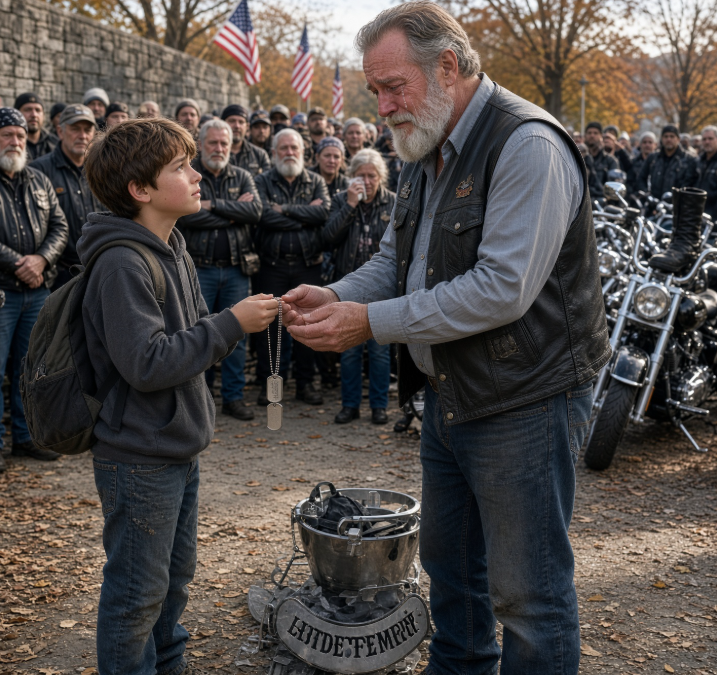
I pulled out the dog tags and held them on my open palm.
Christopher went completely still.
He did not reach for them.
He stared.
Something changed behind his eyes.
Recognition, maybe.
Or old grief surfacing after years of being buried under leather and rumor.
“Wait here,” he said.
Then he went inside.
I waited.
The lot was quiet except for wind moving through a row of motorcycles. Chrome caught the afternoon light like scattered coins. Somewhere inside, a door closed. Voices lowered. My heartbeat felt louder than all of it.
When the door opened again, a different man stepped out.
He was tall and silver-bearded, weathered in the way of someone who had been tested by the world and decided not to break where others could see it. His eyes were pale blue, sharp despite his age, and when they landed on me, I wanted to look away.
I could not.
“Christopher says you’ve got something belongs to me,” he said.
His voice was quieter than I expected.
Rough around the edges.
But not threatening.
I held the tags out.
“I found these in a ditch off Route 41. They say Whitfield, Daniel R. I did some research. I think he was your brother.”
Robert Whitfield’s face did something I had never seen an adult’s face do before.
It collapsed and rebuilt itself in the same instant.
He crossed the gravel in three long strides and took the tags from my palm with hands that were not steady.
Then he said nothing.
For a long time.
He just held them.
His thumb moved across the engraved letters slowly, carefully, the way someone might touch a scar they had carried so long it had become part of their skin.
Behind him, more men had gathered.
Christopher.
A broad-shouldered man with a gray ponytail.
A younger one with tattoos up both arms.
Others I did not know.
Nobody joked.
Nobody moved.
Finally Robert whispered, “Where did you say you found these?”
“Route 41. Near the old bridge. I was riding my bike home from school.”
He closed his eyes.
“Thirty-one years.”
I did not know what to say.
He opened his eyes again.
“Thirty-one years, and some kid finds them in a ditch.”
“I looked it up,” I said quietly. “I know he didn’t come home. I’m sorry.”
Robert looked at me then.
Really looked.
Adults often glance at children. They talk over us, around us, through us. They look at our size and think they understand our capacity.
Robert Whitfield looked at me like I had walked into his life carrying something too heavy for my age and had carried it anyway.
“What’s your name, son?”
“Benjamin. Benjamin Cole.”
“Well, Benjamin Cole.”
He closed his fist around the tags, chain looping through his fingers.
“You have any idea what you just did?”
I shook my head.
“I’ve spent thirty-one years wondering where my brother’s tags ended up. Filed requests. Wrote letters. Sat across from men in offices who promised to look into it. Gave up more times than I can count.”
His jaw tightened.
“And a twelve-year-old boy on a bicycle just walked up my driveway and put him back in my hands.”
My throat felt tight.
“I just thought somebody was missing something that mattered.”
Robert stared at me.
Then he did something that surprised every man standing behind him.
He extended his hand.
Not down at me.
Straight out.
Like I was his equal.
I took it.
His hand was weathered and scarred and much larger than mine.
He shook my hand once, firmly.
“Son,” he said, “you don’t know it yet, but you just became family to eight hundred people.”
I frowned.
“Eight hundred?”
For the first time, Robert Whitfield smiled.
A small, cracked smile.
“The Ironclad Riders aren’t just one clubhouse, kid. We’ve got brother clubs from Memphis to Knoxville to Louisville. Word travels fast in this world.”
He looked down at the tags again.
“And word of this is going to travel faster than anything I’ve ever seen.”
I did not understand yet what that meant.
I would soon enough.
By the time I got home, my mother already knew.
Stories travel faster than bicycles.
Christopher had told a cousin. The cousin worked at a diner two blocks from my mother’s. Someone called someone. Someone recognized my name. By the time I opened our kitchen door, my mother stood with both arms crossed, fear and anger shaking through her so hard she looked taller.
“You went to the Ironclad Riders clubhouse alone.”
I froze.
“I—”
“Alone, Benjamin.”
“I had to.”
“You had to?”
“I couldn’t wait for permission I knew you wouldn’t give me.”
“Benjamin Robert Cole.”
She only used my middle name when the trouble was serious enough to have a full government record.
“Do you understand what could have happened to you? Those men have reputations for a reason.”
“They didn’t hurt me.”
“That is not the point.”
“Robert Whitfield shook my hand.”
She opened her mouth.
Closed it.
“He said thank you,” I said. “He said I was the first good thing to happen to him in years.”
My mother’s anger faltered.
Not gone.
Just unsure where to stand.
“You lied to me.”
“I know.”
“That is not small.”
“I know.”
She turned away, one hand pressed to her mouth.
For a moment, I saw the whole thing from her side.
A single mother. One child. No money. No backup. A boy who went knocking at a biker clubhouse because he believed a dead man’s tags belonged to someone.
“I’m sorry,” I said.
She looked back.
Her eyes were wet now.
“I am proud of you and furious with you at the same time.”
“That seems fair.”
“It is not funny.”
“I know.”
Then she did something that told me I was not going to be grounded forever.
She pulled me into her arms.
Hard.
“You scared me,” she whispered.
“I know.”
“The world is not always kind to boys who think doing right is enough to keep them safe.”
I did not answer.
Because I had no answer.
The following week, everything got bigger.
A reporter from a local news station heard the story through the diner grapevine and requested an interview with the Ironclad Riders. Robert refused at first.
Christopher changed his mind.
“Maybe it’s time,” he said.
“Time for what?” Robert asked.
“For people to see something besides leather and old rumors.”
The segment aired Wednesday evening.
My mother and I watched from our couch.
Robert sat inside the clubhouse, vest on, face solemn, his own dog tags hanging at his chest.
Beside them hung Daniel’s.
He told the story simply.
A boy named Benjamin Cole found his brother’s lost tags in a ditch, spent two weeks researching them, and delivered them personally despite everything he had heard about the men behind the gate.
Then Robert looked into the camera.
“This town’s had opinions about us for thirty years,” he said. “Some of those opinions we earned back when we were young and stupid and angrier at the world than we had any right to be. But most of it is just what gets said, passed down, never questioned.”
He touched the tags.
“This kid didn’t ask what people said about us. He asked what was right.”
My mother did not speak for a long time after the segment ended.
Finally she said, “He sounds different than I expected.”
“Different how?”
She looked at the dark television screen.
“Human.”
That was the beginning of her changing.
Not all at once.
People do not usually let go of fear just because one news story asks them to.
But something had started.
The next day at school was worse.
Some kids thought I was a hero.
That was uncomfortable.
Some thought I was stupid.
That was familiar.
A senior named Marcus cornered me at my locker after lunch. He was the older brother of a girl in my grade and had the kind of smile that made people laugh before they knew whether something was funny.
“Heard you’re best friends with a biker gang now,” he said.
I kept my hand on my locker door.
“No.”
“You know what they do out there on Trinity Lane, right?”
I said nothing.
“My uncle says they’re running stuff out of that clubhouse. Drugs. Guns. Whatever. You’re an idiot if you think a handshake makes them good people.”
His words followed me the rest of the day.
I hated that.
I hated that after everything, rumor still had teeth.
That afternoon, instead of going home, I rode back to Trinity Lane.
Robert found me sitting on the curb across from the clubhouse, staring through the fence.
“Something on your mind, Benjamin Cole?”
I looked up.
He came over slowly and sat beside me with a grunt, joints creaking.
I told him everything Marcus had said.
Every accusation.
I watched his face closely, waiting for guilt, anger, denial.
Robert did not give me any of those.
He leaned his forearms on his knees.
“Some of what you heard has a grain of truth if you go back far enough.”
That startled me.
“Really?”
“Twenty, thirty years ago, some men wearing these colors weren’t good men. Some got arrested. Some hurt people. Some mistook rage for brotherhood.”
He looked toward the clubhouse.
“I had just come home from Vietnam. Daniel didn’t. I was angry in ways I didn’t have words for. A lot of us were. We built a family out of men nobody else knew what to do with, and for a while, we let the worst of us set the tone.”
His hand went to Daniel’s tags.
“But clubs change, same as people do. Half of us are veterans. A third of us are grandfathers. We run toy drives every December for foster kids who’d otherwise get nothing. We escort funerals for soldiers and cops free of charge because somebody should be there to make sure they go home with honor.”
He looked at me.
“Does that undo everything people say? No. Some of the old stories are true. But so are the new ones. People just prefer whichever truth lets them stop thinking.”
I sat with that.
“How do you stop people from believing the easy story?”
Robert huffed a small laugh.
“You don’t, kid. You just keep being who you are loud enough and long enough until the truth gets harder to ignore than the rumor.”
He clapped a weathered hand on my shoulder.
“You already started that.”
Three weeks after the tags changed hands, Robert Whitfield announced something the Ironclad Riders had not done in over a decade.
A full memorial ride for Daniel Whitfield.
Open to every affiliated chapter across four states.
Ending at Nashville’s Veterans Memorial Park.
The response was staggering.
Riders committed from Memphis, Knoxville, Louisville, Chattanooga, and clubs Robert had only known through old brotherhood ties formed across decades of shared grief and shared road.
By the time RSVPs stopped coming in, the number sat just under eight hundred motorcycles.
My mother watched the news coverage each evening with an expression I did not recognize.
Not fear anymore.
Not trust exactly.
Something between curiosity and respect.
“You did this,” she said one evening.
“All of this because you stopped your bike in a ditch.”
“I just wanted to give something back.”
She looked at me for a long moment.
Then she said quietly, “I think I owe some people an apology for the things I assumed about them.”
The morning of the memorial ride arrived cold and clear.
Late autumn sunlight cut sharp angles across Veterans Memorial Park. My mother and I arrived an hour early, but motorcycles already lined both sides of the road for nearly half a mile.
I could feel the engines before I fully saw them.
A low collective rumble in the chest.
Not chaos.
Not threat.
A heartbeat.
Robert found me near the memorial wall. For the first time since I had met him, he was not wearing his usual vest. He wore a pressed shirt, dark jacket, and Daniel’s tags at his collar beside his own.
“You ready for this?” he asked.
“For what?”
He looked almost nervous.
“I want you up front with me.”
My stomach dropped.
“No.”
“Yes.”
“I don’t know what to say to eight hundred people.”
“You already said everything that mattered.”
“I did?”
“You just have to say it again out loud.”
The crowd grew beyond riders.
Townspeople came. Veterans. Families. Reporters. Teachers. Neighbors. People who had crossed streets to avoid the Ironclad Riders now stood close enough to hear them breathe.
My mother stood near the front with Ms. Reyes and Mr. Delacroix, both of whom had come to see where the story they helped uncover would finally land.
Robert stepped to the podium first.
He spoke about Daniel.
Nineteen when he shipped out.
Twenty when he did not come home.
He spoke about the day the news came, about his mother dropping a coffee mug that shattered across the kitchen floor, about his father going silent in a way he never recovered from. He spoke about the decades of trying to locate Daniel’s personal effects, about letters unanswered and files misplaced, about learning to live with a missing piece so small it could fit in one hand and so large it shaped his entire life.
Then his voice cracked.
“And then a twelve-year-old boy on a bicycle walked up my driveway with something I had stopped believing I would ever see again.”
He turned.
“Benjamin.”
Every face seemed to shift toward me.
My legs felt hollow as I walked to the microphone.
The applause began before I reached it.
It rolled through the crowd like weather.
I stood there, overwhelmed, staring out at leather vests, veterans’ caps, mothers crying, men with gray beards wiping their eyes, my own mother pressing a hand to her mouth.
“I didn’t do anything special,” I said.
My voice shook but did not break.
“I found something that didn’t belong to me. And I thought about how it would feel if it were mine, lost somewhere, and nobody bothered to bring it back.”
I swallowed.
“That’s all. Anybody could have done what I did.”
Robert stepped beside me.
“No,” he said into the microphone.
The crowd quieted.
“Not anybody.”
He placed one hand on my shoulder.
“Most people needed a reason not to knock on our door. This kid needed a reason to knock. And the difference between those two things is the difference between a town that stays divided and a town that finally sees clearly.”
That was when the riders cried.
Not all loudly.
Not in a way movies would make dramatic.
But I saw it.
Men bending their heads.
Women wiping their cheeks.
Christopher, the refrigerator-shaped man who had first stopped me at the gate, turned away and pressed his knuckles to his eyes.
Nathan Cole, who had ridden down from Kentucky, stood rigid and wept without making a sound.
Even my mother cried.
The memorial ride began an hour later.
Eight hundred motorcycles moved in slow procession through Nashville. Residents came out of shops and houses along the route, phones raised, faces turned upward in awe and reconsideration.
At the front rolled a riderless motorcycle.
Daniel Whitfield’s boots rested in the stirrups.
His old helmet was secured to the seat.
An empty place moving with honor.
I rode in the lead vehicle beside Robert, watching the city watch him.
People who had whispered about the Ironclad Riders for decades now stood silently at the curb as eight hundred riders moved in disciplined unity.
No chaos.
No threat.
Just grief given form.
Respect given sound.
A city forced, for one afternoon, to see past its own rumor.
On the final stretch, I saw Marcus from school standing with his uncle.
The uncle, the man who had spread stories about drugs and guns, stood with his cap in his hands. His face had changed in a way I could not name then.
Years later, I would understand.
It is uncomfortable to watch your own certainty come apart.
After the ride, Robert gathered club leadership near the memorial and made an announcement no one had told me about.
The Ironclad Riders were establishing an annual scholarship in Daniel Whitfield’s name, funded by the club, awarded each year to a local student who demonstrated the quality Robert said I had shown him.
The willingness to see past assumption and do what was right regardless of personal risk.
“The first recipient,” Robert said, turning toward me, “won’t be eligible to apply because he earned it before we created it.”
I froze.
“Benjamin Cole,” he said, “this scholarship starts with your name attached to it. Not because you need money—though we’re setting some aside for your future too—but because every student who receives this after you needs to hear your story first.”
My mother began crying again.
Robert looked out over the crowd.
“The world does not need more people waiting for permission to do the right thing. It needs more people like a twelve-year-old boy who stopped his bike in a ditch.”
I could not speak.
My mother wrapped both arms around me and held on.
For the first time in my life, I felt the weight of being noticed not as judgment, but as honor.
In the weeks that followed, the story grew beyond Nashville.
Regional news.
Veterans organizations.
Classroom discussions.
Letters from strangers.
A retired Marine sent me a coin from his unit. A woman in Ohio wrote that her brother had died in Vietnam and thanked me for remembering someone else’s. A teacher in Texas asked permission to share the story with her students.
Mr. Delacroix turned it into a lesson.
Not about me, he said.
About Vietnam.
About memory.
About the long shadow wars cast over the people who come home and the families of those who do not.
About rumor.
About civic courage.
About the difference between history and hearsay.
“Primary sources,” he told the class, holding up a photocopy of Daniel’s dog tags.
Then he pointed at me and smiled.
“Sometimes they come out of ditches.”
I hated the attention at first.
I was still twelve.
I still had homework.
My bike chain still slipped.
My mother still worked too hard.
But something had changed.
The Ironclad Riders became part of our lives.
Robert checked on my mother when her car broke down and sent Christopher to fix it. Christopher terrified our landlord by existing near the front steps, which turned out to be useful when the landlord delayed repairing a leaking pipe.
Every December, I rode along in the support truck for the Ironclad toy drive. Not on a motorcycle—my mother drew a hard line there for several years—but close enough to feel the rumble in my bones.
I watched the same men people had feared deliver bicycles, dolls, coats, and wrapped gifts to foster kids who stood stunned in doorways.
I watched Robert hand toys to children with the gentleness of a man who had carried too much grief to ever be careless with someone else’s.
He wore Daniel’s tags every day for the rest of his life.
Beside his own.
Two brothers finally together in the only way this world allowed.
Years later, reporters still asked me what I learned that autumn afternoon in the mud beside Route 41.
I always gave the same answer.
I learned that most of what divides people is not real.
It is just a story nobody bothered to check.
That does not mean danger is never real.
It does not mean every rumor is false or every person misunderstood.
Robert was honest with me about that.
Some of the old stories about the Ironclad Riders were true.
Some men had done wrong.
Some wounds had been earned.
But people are not only the worst headline anyone ever wrote about them.
And groups are not only the easiest fear attached to their name.
Sometimes the truth is buried deeper.
In toy drives no one reports.
In funeral escorts no one thanks.
In old men carrying grief under leather vests.
In a brother waiting thirty-one years for two pieces of metal to come home.
In a boy with a bicycle who almost kept riding.
The Ironclad Riders never forgot me.
Nashville never forgot that day.
Not because eight hundred motorcycles rolled through its streets.
But because for one afternoon, eight hundred riders proved what one child had guessed before anyone else was willing to admit it:
People are rarely exactly what the rumors say they are.
And sometimes all it takes to break a lie open is one person willing to walk up to the gate, hold out what belongs to the truth, and knock.