A 10-Year-Old Shelter Cat Had Just Five Minutes Left—Then He Reached Through the Bars, Wrapped One Paw Around the Veterinarian’s Finger, and Wouldn’t Let Go
PART3:
We were over capacity by twenty-eight animals. Kitten season had started early. Two hoarding cases had filled isolation. Our foster network was exhausted. Donations were down. Three staff members had called in sick that week. The county contract required us to accept strays, but did not provide enough funding for the number arriving.
The director, Marlene Shaw, sat at the head of the table with both hands around her coffee.
Marlene was not a villain.
That matters.
People want cruelty to wear an obvious face. They want the person making painful decisions to look cold and satisfied so anger knows where to land. Marlene was not cold. She had mortgaged her own house once to keep the shelter open. She knew every long-term animal by name. She carried antacids in her pocket and cried in the supply closet when no one was supposed to know.
But she was also the director.
And directors make lists.
“Cat Room B,” she said, reading from the census sheet. “We have six over our comfortable capacity and eleven over ideal. Long-stay reviews need to happen this week.”
I looked down before she said it.
Number 418 was already highlighted.
“Midnight?” I said.
Marlene did not meet my eyes.
“One hundred and six days.”
“He’s healthy.”
“I know.”
“Behavior?”
“Good.”
“Then no.”
She sighed.
“Mateo.”
“No.”
A younger tech named Ashley sat beside me, twisting a pen in her fingers. “We could repost him.”
“We have,” Marlene said.
“New photos?”
“We did that last month.”
“Foster?”
“No open cat fosters.”
I tapped the paper.
“He is healthy and affectionate. We do not euthanize healthy, affectionate cats for time.”
“Then show me where to put the four coming from animal control this afternoon,” Marlene said quietly.
The room went still.
I hated her for saying it.
I hated that she was right to ask.
I hated that every answer in that room would hurt someone.
“We can add temporary crates,” I said.
“In the hallway?”
“If we need to.”
“For how long?”
“As long as it takes.”
Marlene’s face softened with sadness.
“That’s what we always say.”
The decision was postponed.
Not canceled.
Postponed.
That became the pattern.
At 110 days, postponed.
At 114, postponed.
At 118, he returned to the list.
By then, four more cats had arrived from a fire-damaged apartment building. Two were badly burned. One was pregnant. One belonged to an owner no one could locate. Every cage was full. Every foster plea had gone unanswered. We had cats in offices, cats in pop-up crates, cats in the employee break room. The shelter smelled of stress, bleach, and too many lives stacked too close.
On Thursday, Marlene came to my office at 6:40 p.m.
I was finishing medical notes.
She shut the door.
That was how I knew.
“No,” I said before she spoke.
She sat down.
“Midnight is on tomorrow’s list.”
“No.”
“Mateo.”
“He is healthy.”
“He is unadopted.”
“That is not a disease.”
“I know.”
“Then don’t ask me to treat it like one.”
Her eyes reddened.
“I am not asking you because I don’t care. I am asking you because we are out of space and out of options.”
“We are never out of options for a healthy cat.”
“Then give me one.”
I opened my mouth.
Nothing came.
That was the terrible part.
I could not foster him. My house already had three children, a senior Golden Retriever named Benji, two recovering bottle kittens in our laundry room, and my wife’s patience stretched in ways she was too loving to complain about but too honest to hide.
I could not magically create adopters.
I could not build a new room by morning.
I could not undo the surrender.
I could not make people choose an older black cat when cages of kittens chirped at them like tiny salesmen.
Marlene slid the file toward me.
“End of day tomorrow,” she said. “Last appointment. I’m sorry.”
After she left, I sat alone in my office and stared at the file.
Number 418.
Midnight.
Male neutered.
Ten years.
Affectionate.
I went into Cat Room B before leaving.
The lights were dimmed for the evening. Most of the cats were asleep or pretending to be. Number 418 sat at the front of his cage, paws tucked beneath him, eyes half closed.
When I approached, he stood and pressed his head against the bars.
I placed one finger near him.
He rubbed his cheek along it.
“I’m sorry,” I whispered.
He purred.
That almost made me angry.
Not at him.
At the world that allowed sweetness to go unnoticed until it became inconvenient.
I went home late.
My wife, Elena, was folding laundry at the kitchen table when I walked in.
She looked up once and knew.
Elena had been married to me for fifteen years. She knew the difference between ordinary tired and shelter tired. Ordinary tired sat in my shoulders. Shelter tired lived behind my eyes.
“Bad list?” she asked.
I nodded.
“Dog or cat?”
“Cat.”
“Medical?”
“No.”
She folded a small T-shirt slowly.
“Behavioral?”
“No.”
“Space?”
I did not answer.
She closed her eyes.
“Oh, Mateo.”
Our youngest, Sofia, ran into the kitchen then, wearing mismatched pajamas and holding a stuffed unicorn by one leg.
“Daddy, Benji took my sock.”
From the living room, Benji thumped his tail against the rug, completely unashamed.
I lifted Sofia into my arms.
She smelled like shampoo and crayons.
“Tell Benji socks are not food,” I said.
“I did. He said nothing.”
“That sounds like Benji.”
She laughed.
For a few minutes, I let myself be only her father.
I helped retrieve the sock. I checked our son Gabriel’s math homework. I listened to our oldest daughter, Lucia, explain a friendship drama at school with the seriousness of a courtroom attorney. I tucked Sofia in twice because the first tuck was, apparently, structurally unsound.
But later, after the house quieted, Elena found me in the laundry room sitting beside the bottle kittens’ carrier.
“You’re thinking about bringing the cat home,” she said.
“No.”
“Liar.”
I smiled faintly.
“I’m thinking about how I can’t.”
“That’s different.”
“Yes.”
She sat beside me on the floor.
“What’s he like?”
“Black. Older. Sweet.”
“What’s his name?”
“Midnight at the shelter. Number 418 in the file.”
She made a face.
“Number 418?”
“Intake number.”
“No animal should die with a number as the last thing someone calls him.”
I looked at her.
She held up a hand.
“That was not permission.”
“I didn’t say anything.”
“You said it with your face.”
“We have Benji.”
“Yes.”
“And the kittens.”
“Yes.”
“And three children.”
“I was present for that.”
“And Friday is already chaos.”
She tilted her head.
“What did you say?”
“Nothing.”
“You said Friday.”
I rubbed my forehead.
“I meant tomorrow. Friday.”
But something in my chest had shifted when I said the word.
Friday.
The day he was scheduled to die.
The day everyone was tired.
The day people looked at the clock and thought about going home.
The day a life became the last task on a list.
Elena watched me carefully.
“We cannot save every animal, Mateo.”
“I know.”
“You say that like you know it, but you carry every one like proof you failed.”
I looked away.
She touched my hand.
“If you bring home every animal you feel guilty about, you will drown. And so will we.”
“I know.”
“But if one animal reaches something in you that is not guilt, pay attention.”
I did not sleep well.
Friday morning began badly.
A parvo puppy crashed in isolation. A German Shepherd came in with a chain embedded in his neck. A woman screamed at the front desk because we would not take her neighbor’s cat without proof of ownership. Two kittens died before noon. The washing machine flooded. Someone used the last clean towels and did not restock.
At 1:30, Marlene asked if I was okay.
“No,” I said.
She nodded.
“Me neither.”
At 3:40, the shelter began that end-of-week settling that never felt peaceful. Staff cleaned cages. Volunteers finished walks. The lobby emptied. The phones slowed. Outside, rain tapped against the windows, soft at first, then harder.
Number 418 was last on my schedule.
End of the day.
End of the week.
End of the list.
At 3:50, I walked to the treatment room and prepared what I needed.
I will not describe it in detail.
Not because I am ashamed of the process. Done properly, euthanasia is gentle. It is sometimes a mercy. I have seen animals in pain relax for the first time in weeks. I have seen suffering end. I believe in that mercy when mercy is truly what is being offered.
But that day was not mercy.
That was what hurt.
At 3:55, I walked into Cat Room B.
Ashley was there, cleaning the sink.
She looked at me, then at cage 418.
“Do you want help?” she asked.
“No.”
My voice sounded strange.
I opened the cage.
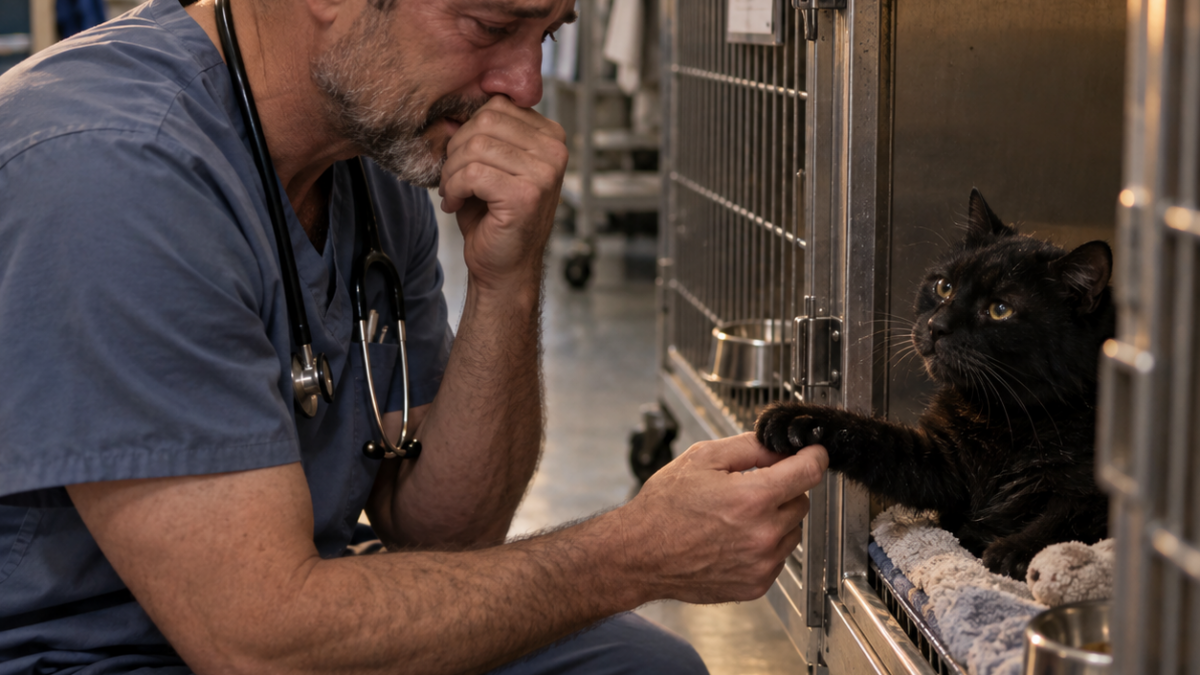
Number 418 sat at the back on his fleece blanket.
“Hey,” I whispered.
He blinked.
I reached inside slowly, one hand under his chest, the other ready to support his back end.
Before I touched him, he moved.
Not away.
Toward me.
He lifted one black paw and slipped it between the cage bars.
Then he wrapped it around my index finger.
I froze.
His claws were out, but barely. Just enough to hold. Not enough to hurt.
He did not swat.
Did not scratch.
Did not panic.
He held my finger.
Then he looked straight into my eyes.
I have handled thousands of cats. Frightened cats. Angry cats. Feral cats. Sick cats. Dying cats. Cats who spat, bit, hid, froze, screamed, climbed walls, buried their faces in towels, or went limp with terror.
No cat had ever reached out and held my hand.
Ashley stopped moving behind me.
The room became so quiet I could hear the rain against the high window.
I remained there, bent in front of cage 418, one finger held by a ten-year-old black cat who had been affectionate for 120 days without being chosen by anyone.
His eyes did not accuse me.
That would have been easier.
They asked.
Not in words.
In contact.
In the light pressure of one paw around one finger five minutes before four.
I thought of every intake number. Every file. Every end-of-day list. Every time I had told myself procedure made unbearable things survivable. Every time I had believed sadness was proof I was still decent.
Then I thought of what Elena had said.
If one animal reaches something in you that is not guilt, pay attention.
I whispered, “Damn it.”
Ashley made a sound that was half laugh, half sob.
I gently loosened his paw, but he tightened again.
Not hard.
Just enough.
As if to say, not yet.
I closed my eyes.
Then I did something no protocol could have predicted.
I closed the cage door.
Number 418 kept holding my finger through the bars.
“Ashley,” I said.
“Yes?”
“Tell Marlene I need ten minutes.”
Her voice shook.
“Okay.”
“And don’t let anyone touch the treatment tray.”
“Okay.”
I stayed another moment.
Then I slowly withdrew my finger.
The cat let go.
I went into my office, closed the door, sat down, and called my wife.
Elena answered on the third ring.
“Hi.”
“I’m bringing one home.”
Silence.
Then, carefully, “Which one?”
“The one who grabbed my hand.”
Another pause.
“What does that mean?”
“I’ll explain later.”
“Mateo.”
“I know.”
“No, listen to me. I am not saying no. I am asking whether this is guilt or something else.”
I looked at my finger.
A tiny crescent mark from one claw rested near the knuckle.
“Something else.”
Her voice softened.
“Then bring him home.”
I pressed my hand over my eyes.
“Thank you.”
“Don’t thank me yet. Benji may file a complaint.”
I laughed once, brokenly.
“Elena?”
“Yes?”
“His name is Friday.”
She was quiet for a moment.
Then she said, “Of course it is.”
Marlene stood outside my office when I opened the door.
Ashley must have found her.
Marlene’s face was tired.
“You’re taking him?”
“Yes.”
She nodded.
“Adoption or foster?”
“Adoption.”
“You sure?”
“No.”
For the first time all day, she smiled.
“That’s honest.”
“I’m sure he’s not dying today.”
Her smile disappeared, replaced by something fragile and relieved.
“I can live with that.”
I signed the paperwork myself.
It was absurd and formal and sacred all at once.
Animal ID: 418.
Name: Midnight.
New name: Friday.
Adopter: Mateo Ramos.
At 4:18 p.m., Friday left the shelter in a carrier on the passenger seat of my car.
The rain had eased by then.
I sat in the parking lot for a full minute before turning the key.
Friday was silent.
I looked at the carrier.
“You have no idea what you just did, do you?”
He stared back through the mesh.
Maybe he did.
At home, chaos greeted him.
Benji, our twelve-year-old Golden Retriever, shuffled to the door with his usual optimism, tail waving like a dusty flag. The bottle kittens mewled from the laundry room. Sofia yelled, “Daddy brought a cat!” before I had removed my shoes. Gabriel asked if the cat was sick. Lucia asked if we were fostering or adopting because, at twelve, she had begun sorting emotional risks into categories.
“Adopting,” Elena said from the kitchen doorway.
All three children went still.
“Really?” Lucia asked.
I nodded.
“His name is Friday.”
Sofia gasped. “Like the day?”
“Exactly.”
“Was he born on Friday?”
“No.”
“Did he do something on Friday?”
“Yes,” I said. “He held my hand.”
That satisfied her more than any paperwork would have.
We set Friday up in the laundry room because it was quiet, warm, and had a door that closed. Litter box in one corner. Food and water. Soft bed. Carrier open. Nightlight. We moved the bottle kittens temporarily to our bedroom, which Elena said with the look of a woman updating the household disaster map in her mind.
Friday did not leave the carrier while we watched.
When we gave him space, he slipped out and vanished behind the dryer.
For two days, he lived there.
We saw proof of him more than him.
Food gone.
Litter used.
Water lowered.
A black tail disappearing if the door opened too quickly.
The children were disappointed, but to their credit, gentle.
“Is he scared?” Sofia asked.
“Yes.”
“Of us?”
“Of everything changing.”
“But it changed good.”
“He doesn’t know that yet.”
She thought about this.
“So we wait?”
“Yes.”
Waiting is hard for children.
It is harder for adults who think love should be visible if it is working.
But we waited.
On the third day, Friday came out during dinner.
We were eating spaghetti at the kitchen table. Benji slept under Gabriel’s chair, hoping gravity would deliver meat sauce. The house smelled of garlic, tomato, laundry soap, and warm bread.
The laundry room door was open.
Friday appeared in the doorway like a shadow deciding whether to become real.
No one moved.
Even Sofia, miracle of miracles, stayed quiet.
Friday walked into the kitchen.
Slowly.
Tail low but not tucked.
He stopped near the refrigerator and sat down.
The whole family continued chewing with the intense discipline of people pretending not to witness history.
Benji lifted his head.
Friday stared at him.
Benji, whose approach to cats had always been enthusiastic but deeply unsuccessful, seemed to understand something important. He lowered his head back onto his paws and sighed.
Friday remained in the kitchen until dinner ended.
Then he returned behind the dryer.
On the fourth day, he jumped onto the couch.
On the fifth day, he slept on Lucia’s bed.
She came into our room at 6:20 in the morning with tears in her eyes.
“What happened?” Elena asked, sitting up.
Lucia whispered, “He picked me.”
Friday had curled against the bend of her knees sometime during the night. She had woken afraid to move, trapped under the weight of being chosen.
“I need to pee,” she said, crying harder, “but I don’t want to ruin it.”
Elena laughed into her hand.
I went to Lucia’s room and found Friday blinking at me from the quilt, entirely comfortable, one paw resting on my daughter’s ankle.
The same paw.
I knew it before I checked.
The Monday after I brought Friday home, I returned to work.
I passed Cat Room B.
Cage 418 was occupied by another cat.
A young gray tabby with a respiratory infection and frightened eyes. Her chart had already been clipped to the door. Different number. Different story. Same cage.
That was the hardest part.
Not bringing Friday home.
Not telling my children why he hid behind the dryer.
Not explaining to Elena that I was both relieved and ashamed.
The hardest part was seeing the empty cage filled again.
Because rescue does not pause to honor your breakthrough.
The machine keeps moving.
One life leaves, another enters. One cage empties, another animal needs it. One miracle does not solve the system that required a miracle.
I stood in the doorway too long.
Ashley found me there.
“She’s sweet,” she said softly, nodding toward the gray tabby.
I swallowed.
“What’s her name?”
“Number 426.”
I closed my eyes.
“No.”
Ashley looked at me.
“We’re not doing that,” I said.
“What?”
“Numbers as names on the floor. Intake numbers in records, fine. But not on cage cards. Every animal gets a name before the public sees them.”
Ashley nodded slowly.
“Okay.”
“And new photos for long-stay cats every two weeks.”
“Okay.”
“And I want a review of every euthanasia decision involving space-only cats.”
She looked past me toward Marlene’s office.
“That’s going to be a fight.”
“I know.”
I was ready for one.
Friday had not only changed my home.
He had ruined my ability to accept certain things quietly.
The argument lasted weeks.
Not because anyone wanted animals to die nameless. Again, cruelty rarely announces itself plainly. The resistance came wrapped in practicality.
Staff had no time.
Names confused records.
Photos required volunteers.
Long-stay promotions had limited impact.
Space was still space.
Capacity was still capacity.
Every objection had truth in it.
That is what makes systems hard to change. They are built from real limitations hardened into habits.
But Friday’s paw stayed in my mind.
That small black paw around my finger at 3:55.
Five minutes between everything and nothing.
So we changed what we could.
Not enough.
Never enough.
But something.
Every cat received a public name within twenty-four hours. A volunteer photography team formed. Long-stay animals got updated profiles written by people who actually spent time with them. We began a “Last Look” foster plea system before any healthy animal could be placed on a space-based euthanasia list. Local rescues were contacted earlier, not at the final hour. Senior-cat adoption fees were sponsored by donors after Ashley, without asking permission, posted a picture of Friday in Lucia’s bed and told only part of the story.
She did not post the cage photo yet.
That came later.
Six months later.
By then, Friday had become part of our home in the way cats do: gradually, then absolutely.
He had opinions.
Strong ones.
He disliked closed doors. He preferred Lucia’s room at night but Elena’s lap during movies. He tolerated Gabriel’s quiet reading voice and avoided Sofia’s louder affection unless she approached with the solemn care of a priestess. He adored Benji in a way Benji did not deserve but deeply appreciated.
Every evening, after dinner, Friday climbed into my lap.
Not Elena’s.
Not the children’s.
Mine.
He would circle twice, settle heavily, and knead my shirt with one paw.
Always the same paw.
The one that had reached through the bars.
The first time he did it, I had to turn my face away.
Elena noticed.
She always noticed.
“You okay?” she asked.
Friday pressed his paw into my sweater.
“Yes,” I lied.
She sat beside me.
“You know,” she said softly, “he didn’t just ask you to save him.”
I looked at her.
“He gave you a way back.”
I could not answer.
Because she was right.
I had been losing pieces of myself to the work for years. Not the compassion exactly, but the expectation that compassion could change anything. I had begun to believe my job was simply to witness loss kindly. Friday reminded me that sometimes kindness must interrupt the process.
Sometimes it must close the cage door and make a phone call.
Six months after his adoption, Ashley came to my office.
She held her phone in both hands.
“I need to ask you something.”
I looked up from vaccination records.
“That sounds serious.”
“It is.”
She sat down.
“I have a photo from that day.”
I knew immediately.
“The cage?”
She nodded.
“I was in the hallway behind you. I didn’t mean to take it at first. I had my phone because Marlene asked me to document kennel repairs. Then he grabbed your hand, and I just… I took one picture.”
My throat tightened.
“Show me.”
She turned the phone.
The image was slightly blurred.
It showed my back, shoulders bent in front of cage 418. The cage door was open. Friday’s black paw reached through the bars and wrapped around my finger. My hand was still. His face was partly visible in shadow, amber eyes fixed on me.
I stared at it for a long time.
Ashley spoke carefully.
“I want to post it. With your permission. Not to make you look like some hero. I swear. I want people to understand what five minutes can mean.”
I leaned back.
The photo felt private.
It also felt bigger than me.
“What would you write?”
She handed me a draft.
This cat was scheduled to be euthanized at 4 p.m. on a Friday. At 3:55, he reached through the bars and grabbed the veterinarian’s hand. The veterinarian took him home. Five minutes made the difference between everything and nothing.
I read it three times.
“Use his name,” I said.
“Friday?”
“Yes. He has a name.”
Ashley smiled.
“I was hoping you’d say that.”
The post went up that night.
By morning, it had been shared thousands of times.
By lunch, news stations were calling.
By dinner, the shelter phone would not stop ringing.
People asked about Friday, but they also asked about other senior cats. Other black cats. Other animals who had been waiting too long.
Cage 426, the gray tabby we had named Mabel, was adopted by a retired school librarian who said, “I saw that black cat holding the vet’s hand and realized I’d been waiting for a sign.”
A twelve-year-old tuxedo named George went home with a college professor.
A diabetic cat named Peaches found a foster who later failed, gloriously, and adopted her.
The shelter received donations earmarked for senior-cat care.
Not enough to solve everything.
But enough to buy time.
Time is sometimes the most expensive medicine in shelter work.
The post also brought anger.
People demanded to know why Friday had been on a euthanasia list if he was healthy. Some accused us of murder. Some called me a saint, which made me almost as uncomfortable. Some threatened staff who had cried over the same lists they were being condemned for creating.
Marlene and I made a video together.
No dramatic music.
No excuses.
We explained capacity. We explained space-based euthanasia. We explained the difference between individual blame and systemic failure. We explained that every adoption, every foster, every spay and neuter appointment, every donation, every shared post before the final hour mattered.
Then Marlene said something I will never forget.
“Please do not wait until an animal has five minutes left to decide their life matters.”
That line changed more than the photo did.
At home, Friday remained unimpressed by his fame.
He slept on laundry.
Knocked a pen off my desk during a remote interview.
Walked across my laptop while I was answering a reporter’s question about compassion fatigue.
Bit the corner of a certificate the mayor sent.
Refused every expensive cat bed donated by companies after the story went viral and continued sleeping in a cardboard box from a toaster oven.
He was, in other words, a cat.
Two years have passed since that Friday afternoon.
I still work at the shelter.
I still do the hard part when true mercy requires it.
I still hurt.
Good.
I want to.
But I no longer measure my strength by how much pain I can swallow quietly. I measure it differently now.
Did I ask one more question?
Did I look one more time?
Did I call one more foster?
Did I remember the animal’s name?
Did I allow a paw around my finger to matter?
Friday is twelve now.
His arthritis is a little worse. He takes joint supplements hidden in food he pretends not to like. His black fur has thinned slightly near his shoulders. The white patch under his chin has grown more noticeable. His eyes are still amber, still steady, still capable of stopping me in my tracks.
Every night, after the children go to bed and Benji settles with a groan near the couch, Friday climbs into my lap.
He turns once.
Twice.
Then he presses that same paw into my shirt.
Slowly.
Softly.
Over and over.
Sometimes I place one finger beneath it.
He curls around it.
Not as tightly as he did through the cage bars.
He does not have to.
He is not asking to be saved anymore.
He is home.
But every time he holds my finger, I remember.
A Friday afternoon.
A cage labeled 418.
A list printed because there was not enough space.
A cat described as affectionate for 120 days.
A clock moving toward four.
A paw reaching through the bars.
And the terrible, beautiful truth that a life can change inside five minutes.
Not because the whole world becomes kinder.
Not because the system disappears.
Not because love solves capacity, funding, abandonment, illness, or human failure.
But because one living creature reaches out.
And one exhausted person, standing at the edge of what he thought he could bear, stops long enough to be reached.








