A 10-Year-Old Orphan Gave a Freezing Biker His Dead Mother’s Last Blanket—The Next Morning, 80 Motorcycles Surrounded His Elementary School and Their Leader Asked for Him by Name.
PART2:
The night everything changed, Ms. Daley sent me to the convenience store for milk.
Ms. Daley was the woman supervising Cedar Ridge most evenings. She was not cruel in the dramatic way people imagine when they hear children’s home. She did not scream much. She did not hit. She kept the paperwork straight and the medicine locked and the pantry counted.
But she had a way of making children feel like inventory.
“Carter,” she said from the kitchen doorway, holding out a few folded bills. “Run to King’s for milk.”
It was already getting dark.
Freezing rain had started falling.
I looked toward the front windows where ice tapped at the glass.
“Can someone else go?”
She gave me the look adults give when they have already decided a request is a test of your attitude.
“It’s three blocks.”
“It’s cold.”
“Then walk fast.”
I wanted to tell her my coat was too thin.
I wanted to tell her my shoes leaked near the left toe.
I wanted to tell her the blanket under my coat was the only reason winter did not feel like it was trying to climb inside my bones.
But kids like me learned early that need had to be rationed.
Ask too often, and adults stopped hearing the words and started hearing trouble.
So I took the money.
“Yes, ma’am.”
Outside, St. Louis looked hard and wet under the streetlights.
Cars hissed along the road.
The sidewalk shone with freezing rain.
PART3:
By the time I reached King’s Convenience, my fingers hurt inside my gloves. I bought the milk, tucked the receipt in my pocket because Ms. Daley always wanted receipts, and started back.
On the way, I cut beneath the interstate overpass because it blocked some of the wind.
That was where I saw him.
At first, I noticed the motorcycle.
Huge.
Black.
Chrome reflecting the orange streetlights.
Its front tire had blown apart.
The bike leaned awkwardly near the curb, wrong in a way even a kid could understand. Pieces of rubber lay in the wet road. A scrape of metal marked where it had slid. Rainwater gathered around the wheels and ran in thin streams toward the gutter.
Then I saw the man sitting beside it.
He was enormous.
Gray beard.
Leather vest.
Heavy boots.
Tattoos climbing both arms.
The patch across his back read:
IRON SAINTS MC.
Every instinct I had learned in foster care told me to keep walking.
Adults always talk about stranger danger like danger wears a name tag.
But children who grow up passed from house to house learn stranger danger differently. Sometimes danger smiles. Sometimes it works for the system. Sometimes it asks if you are hungry. Sometimes it says, “Don’t tell.” Sometimes it looks completely ordinary.
This man did not look ordinary.
He looked like the warning poster.
I should have kept walking.
Then I noticed his hands.
They were shaking.
Not a little.
Violently.
His jeans were ripped at one knee, and his jacket was gone. He wore only a thermal shirt beneath his leather vest. Freezing rain slicked his beard and ran down the sides of his face. His lips had a bluish cast even under the orange lights.
He tried lighting a cigarette, but his fingers shook so badly that the lighter fell into a puddle.
He stared at it.
Then he lowered his head.
I knew that kind of cold.
The kind that hurts first.
Then somehow stops hurting.
That was the dangerous part.
I walked closer.
His head snapped up.
“You lost, kid?”
His voice was rough and deep, but not mean.
“No.”
“Then go home.”
I looked at his lips.
“You’re freezing.”
He gave me a tired smile.
“Pretty observant.”
“Where’s your coat?”
“Road took it.”
He pointed toward the motorcycle.
“My guys are coming.”
“When?”
He looked toward the empty road.
“Soon.”
I knew what soon sounded like when adults didn’t know the answer.
Soon was what the first foster family said when I asked when I would see my mother’s sister.
Soon was what the social worker said when I asked when they would find me a permanent placement.
Soon was what Ms. Daley said when the heat broke.
Soon meant nobody knew.
Soon meant wait and hope you can last.
I put the bag of milk down.
Then I unzipped my coat.
The blanket was wrapped around my body underneath it.
I always wore it that way during winter.
Not outside where people could see it and ask questions.
Not loose enough for another kid to grab.
Under the coat.
Close.
Mine.
I pulled it free.
The cold hit me instantly.
The biker frowned.
“What are you doing?”
I held the blanket toward him.
“Take it.”
He stared at me.
“No.”
“You need it.”
“So do you.”
“I have a coat.”
It was a terrible coat.
We both knew it.
He shook his head.
“I’m not taking a blanket from a kid.”
I remembered something a paramedic had once told us after an unhoused man in our neighborhood had been found outside during a freeze. He had come to Cedar Ridge because one of the younger kids kept asking what happened when people got too cold.
The paramedic had said, “Shivering means the body is still fighting. When someone stops shivering, that’s when you worry.”
I looked at the biker’s hands.
“You’re shaking really hard,” I said. “If you stop shaking, that’s worse.”
The man stared at me differently then.
Not like I was a kid.
Like I had just said something he understood.
“Where’d you learn that?”
“Life.”
For several seconds, neither of us spoke.
Then I pushed the blanket into his hands.
“Borrow it.”
His fingers closed around the wool.
He looked down at it.
“This important?”
I swallowed.
“It was my mom’s.”
His eyes came back to mine.
For the first time, the hard expression disappeared completely.
“Kid…”
“She’d tell me to give it to you.”
I wasn’t sure that was true.
But I wanted it to be.
I wanted my mother to be the kind of person who would see a freezing stranger under an overpass and give him the last warm thing she had. I wanted to believe I had not misunderstood her just because I had lost her too young.
The biker slowly wrapped the blanket around his shoulders.
Almost immediately, his shivering eased a little.
Not gone.
But less violent.
He breathed out through his nose and closed his eyes for one second.
“What’s your name?”
“Noah.”
“Ray.”
He held out one giant hand.
“People call me Bear,” he said. “Real name’s Ray Dalton.”
I shook his hand.
His skin felt like ice.
Ray looked toward the hill where Cedar Ridge sat beyond the road, a dark brick building with too many windows and not enough light.
“You live around here?”
I pointed uphill.
His expression changed when he saw the building.
“You at that group home?”
I nodded.
He looked at my shoes, my coat, then at the building again.
Something passed across his face that I could not understand.
Not pity exactly.
Something angrier.
Something sadder.
“I’ll get this back to you,” he said.
“You don’t have to.”
“Yes,” he said, and his voice changed in a way that made the words feel less like a promise and more like a vow. “I do.”
I picked up the milk and walked away.
I looked back once.
Ray was still sitting under the overpass, wrapped in my mother’s blanket, watching me climb the hill.
I never expected to see him again.
That night was miserable.
Without the blanket, I curled into a ball beneath my sheet and wore my sweatshirt to bed. The radiator clanged like it was working hard, but the room stayed cold enough that I could see my breath if I turned toward the window.
For the first time since my mother died, nothing familiar covered me.
No red-and-black wool.
No cedar smell.
No weight across my shoulders.
No pretending.
I regretted giving it away.
Then I hated myself for regretting it.
That was the worst part.
I kept thinking about Ray’s hands shaking.
His blue lips.
The way he said, “I’ll get this back to you.”
Then I thought about all the adults who had promised things and disappeared.
Promise is a dangerous word when you are a child with a file.
By morning, I had convinced myself the blanket was gone forever.
School wasn’t much warmer.
Jefferson Elementary was old, with tall windows, worn floors, and classrooms that smelled like pencil shavings and wet coats. The heat worked better than Cedar Ridge, but only just.
I sat in the back of Room 12 while Mrs. Parker taught fractions.
Mrs. Parker was kind in a tired way. She had twenty-seven students, two broken pencil sharpeners, one boy who threw erasers when frustrated, and me, who rarely caused trouble because quiet children are often mistaken for fine ones.
I was good at being unnoticed.
At Cedar Ridge, being noticed usually meant someone wanted something.
At school, being noticed meant questions.
Where are your parents?
Why do you live there?
Is it true kids at group homes get locked in rooms?
Do you get Christmas presents?
Are you an orphan?
That word followed me around like a tin can tied to a string.
Orphan boy.
A kid named Travis had called me that for months.
Mrs. Parker told him to stop when she heard it.
He stopped when she could hear it.
That morning, I kept my arms folded tight and tried not to think about the blanket.
Then the windows started vibrating.
A low rumble rolled through the building.
At first, everyone thought it was construction.
Then it grew louder.
And louder.
Children rushed toward the windows.
Mrs. Parker tried ordering everyone back to their seats, but nobody listened.
I finally stood.
What I saw outside made my stomach drop.
Motorcycles.
Dozens of them.
Black machines filled the street in front of Jefferson Elementary.
One after another, riders pulled into the parking lot.
Leather vests.
Heavy boots.
The same patch.
IRON SAINTS.
The principal’s voice cracked over the intercom.
“Teachers, secure your classrooms immediately.”
Doors locked.
Blinds dropped.
Kids began crying.
Emily Ross crawled beneath her desk.
Travis whispered, “They’re here for somebody.”
I could not breathe.
Because somehow I knew.
The engines shut off.
The silence afterward frightened everyone more than the noise had.
I moved closer to the narrow gap beside the blind.
The riders parted.
One man walked through them.
Gray beard.
Heavy shoulders.
A slight limp.
Ray.
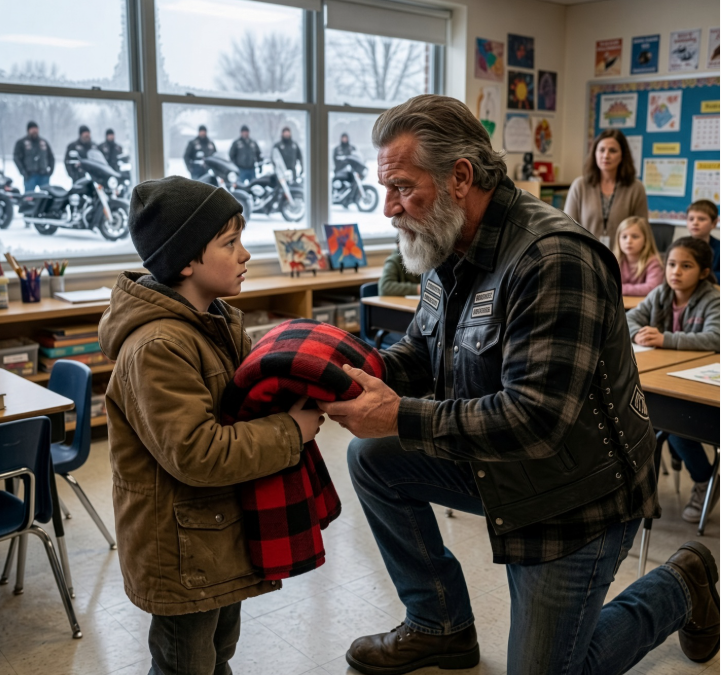
And folded over his arm was my mother’s red-and-black blanket.
Our principal, Mr. Albright, hurried outside and confronted him.
Even through the glass, I could see how nervous he was. Mr. Albright was tall and usually moved with the confidence of a man who believed children were the most dangerous thing in his building.
But he looked very small standing before nearly eighty bikers.
They exchanged a few words.
Then Ray looked straight up at the school windows.
He pointed toward our building.
And I watched our principal’s face lose all its color when Ray said words I could somehow read clearly from his lips:
“I’m here for Noah Carter.”
Every head in my classroom turned toward me.
Nobody spoke.
Even Mrs. Parker stared.
“What does he mean?” she whispered.
I couldn’t answer because heavy footsteps had already entered the hallway downstairs.
The sound traveled through the old building.
Slow.
Steady.
Getting closer.
Emily crawled farther beneath her desk.
Mrs. Parker stood between me and the door.
“Noah, stay behind me.”
But I wasn’t afraid of Ray.
Not exactly.
I was afraid of what eighty men coming to find one ten-year-old boy might mean.
The footsteps reached our floor.
Stopped outside Room 10.
Then Room 11.
Then our doorknob moved.
Mrs. Parker gasped.
The principal unlocked the door from the hallway.
Ray stood behind him.
Two other bikers waited several feet back.
Ray looked enormous beneath the fluorescent lights.
Wet boots.
Leather vest.
Gray beard.
A bandage near his temple that had not been there the night before.
But the moment he saw me, his face softened.
“There you are.”
I stepped around Mrs. Parker.
“Hi, Ray.”
The entire classroom seemed to stop breathing.
He lifted the folded blanket.
“Told you I’d return it.”
I walked toward him.
When he placed it in my arms, I pressed it against my chest.
It was warm.
It smelled different now—leather, gasoline, cold air, and something medicinal mixed with the old cedar scent I remembered.
“You came all the way here just for this?”
Ray looked at me for a long moment.
“No.”
My stomach tightened.
Then he turned toward the classroom.
“I came here because this kid saved my life last night.”
Nobody moved.
Not even Travis.
Ray explained that after I left, his condition had gotten worse. His friends reached him about twenty minutes later and took him to an urgent-care clinic. The doctor told him his body temperature had dropped dangerously low.
“The blanket kept the wind off me,” Ray said. “Another twenty minutes without it, things could’ve ended differently.”
I stared at him.
I had not thought I saved anyone.
I had just seen someone cold.
Ray reached into his vest.
Mrs. Parker stiffened.
He noticed and moved slowly.
Then he pulled out a small metal coin.
He placed it in my palm.
On one side was the Iron Saints emblem.
On the other were four words:
NO ONE RIDES ALONE.
“This belongs to you now.”
“I’m not a biker.”
A few people laughed nervously.
Ray smiled.
“No. But you understand the rule better than some men who’ve been riding thirty years.”
Then he lowered his voice.
“There’s a phone number on the card underneath it. If you’re ever stranded, hungry, scared, or just need somebody to answer, you call.”
My throat tightened.
“Why?”
His smile disappeared.
“Because nobody should be ten years old and already know what freezing alone feels like.”
Those words hit someplace inside me I had spent years protecting.
I looked down quickly.
Ray understood.
He did not hug me.
He did not make me talk.
He simply squeezed my shoulder once.
Before leaving, he turned to Mrs. Parker and the principal.
“He’s a good kid,” he said.
It was such a simple sentence.
But nobody had said it about me in a long time.
Not where I could hear it.
The bikers left minutes later.
When their engines started, the entire building shook again.
I stood at the window.
Ray climbed onto his repaired motorcycle.
Before riding away, he looked up and raised two fingers toward me.
I did the same.
By lunch, everybody knew.
Kids who normally ignored me wanted to sit beside me.
A boy who had called me orphan boy for months suddenly acted like we were friends.
I hated that part.
Yesterday, I had been invisible.
Today, I was interesting because eighty motorcycles had appeared.
That is a strange kind of attention.
It does not feel like being loved.
It feels like being discovered.
But something else changed too.
Mrs. Parker stopped me after class.
“I’m sorry,” she said.
“For what?”
She looked uncomfortable.
“For noticing today that I hadn’t really noticed you before.”
I did not know what to say to that.
Adults think apologies repair things quickly.
Sometimes they do not.
Sometimes they just open a door that should have been open already.
But I nodded.
Because I could tell she meant it.
After school, I tightened my coat and started the mile-long walk back to Cedar Ridge.
I had barely reached the corner when a motorcycle rolled alongside me.
The rider lifted his visor.
He was younger than Ray, with dark skin, kind eyes, and a scar across his chin.
“Carter?”
I froze.
“Yeah.”
“Bear says you’re not walking home in twenty-degree weather.”
He handed me a helmet.
I looked back at the school.
Teachers were watching from the doors.
Students from the buses.
For once, nobody called me orphan boy.
The rider waited.
No pressure.
Just waited.
That mattered.
I put on the helmet.
Ten minutes later, I was riding through St. Louis with my hands gripping the sides of the seat and my mother’s blanket wrapped beneath my coat.
For once, the city did not look enormous.
For once, I was not walking through it alone.
When we reached Cedar Ridge, Ms. Daley was standing outside.
She had obviously seen something on the local news because the cigarette in her hand stopped halfway to her mouth.
The biker killed the engine.
“Ms. Daley?”
She nodded cautiously.
“Bear asked me to tell you Noah gets cold easy.”
That was all.
No threat.
No yelling.
The rider restarted his motorcycle and disappeared down the street.
Ms. Daley stared after him.
Then at me.
Something strange happened that night.
At dinner, she called me by my name.
Usually I was Carter.
Sometimes just hey.
But that night, she said, “Noah, there’s more soup if you want it.”
A small thing.
Maybe meaningless to anyone else.
It was not meaningless to me.
The next week, Cedar Ridge’s heating system was finally repaired after a county worker visited.
I never knew whether Ray had anything to do with that.
I never asked.
Sometimes, when people help you quietly, asking too much feels like pulling the blanket off the act.
The Iron Saints did not adopt me.
They did not magically fix my childhood.
Life did not become a fairy tale.
I still lived at Cedar Ridge.
I still had court hearings, social workers, donated clothes, and nights when I missed my mother so badly my chest hurt.
But every few weeks, one of those motorcycles would appear outside.
Sometimes Ray brought a burger.
Sometimes he brought a math workbook and said he had no idea how fractions worked anymore, so I had better teach him before his brain rusted.
Sometimes he took me to the clubhouse on a Saturday afternoon, where the men fixed bikes while I did homework at a scarred wooden table.
The clubhouse did not look like the dangerous place people probably imagined.
It smelled like coffee, rubber, oil, and old wood.
There was a pool table with one leg shorter than the others.
A bulletin board covered with charity ride flyers, funeral cards, and photos of men standing beside motorcycles in places I had never seen.
A refrigerator full of sodas labeled in black marker because one member named Frankie apparently stole root beer like a raccoon.
The bikers never treated me like a charity case.
If I wanted a soda, I swept the floor.
If I wanted to learn how an engine worked, I handed over tools.
If I wanted help with homework, I had to explain the assignment first because Ray said, “A man ought to at least know what he’s confused about.”
Ray insisted on that.
“Kindness ain’t pity,” he once told me. “Never confuse the two.”
I did not understand the difference right away.
Pity looked down.
Kindness sat beside.
Pity made you feel smaller.
Kindness made room for you to stand.
Ray was very good at making room.
He never asked too many questions about my mother.
But if I brought her up, he listened.
Not like adults who leaned in too hard and made sympathy into a performance.
He listened like he was holding a tool steady.
Carefully.
Usefully.
One Saturday at the clubhouse, I asked him why everyone called him Bear.
He laughed.
“Because I’m cheerful and delicate.”
A man across the room yelled, “Because you growl at everybody before breakfast.”
Ray pointed a wrench at him.
“Lies.”
The man lifted both hands.
“Documented history.”
I smiled so hard my face hurt.
It was strange, being allowed into a place where grown men teased each other without making the room feel unsafe.
At Cedar Ridge, jokes often had hooks in them.
At the clubhouse, jokes bounced off leather and came back warm.
The first time I fell asleep there, I was eleven.
I had been doing homework while rain hit the windows. The room was warm. Engines ticked as they cooled in the garage. Someone was laughing in the next room.
I woke up with my mother’s blanket over my shoulders.
Ray was across the room, pretending to read a motorcycle magazine upside down.
“You put this on me?” I asked.
“Nope.”
“Ray.”
“Must’ve walked over there itself.”
I pulled the blanket tighter.
It smelled like cedar, leather, and exhaust by then.
It no longer smelled only like the past.
That scared me at first.
Then it comforted me.
Maybe love could gather new smells and still be the same blanket.
Maybe memory did not disappear just because life kept touching it.
Years passed.
I eventually left Cedar Ridge.
Not in one dramatic rescue.
Not in a perfect adoption with smiling photos and a bedroom painted blue.
I aged out through a kinship placement with a distant cousin who did her best, which is more than some kids get and less than every kid deserves.
Ray stayed.
So did the Iron Saints, in their strange, stubborn way.
When I was fifteen and thought I knew everything, Ray taught me how to change a tire and then told me I was dangerously overconfident for someone who had installed the lug nuts backward.
When I was sixteen, he came to my first part-time job interview and waited outside on his bike because I said I did not need anyone to come in.
When I got rejected from a summer program I wanted badly, he took me to a diner, bought me pancakes, and said, “Feel bad today. Try again tomorrow. Don’t make a religion out of one no.”
When I graduated high school, there were twelve motorcycles in the parking lot.
Ray sat in the front row wearing a button-down shirt that looked painfully unfamiliar on him. His beard was trimmed. His boots were polished. He looked miserable and proud.
He clapped louder than anyone when my name was called.
Mrs. Parker came too.
She had transferred schools years earlier, but somehow she heard. She hugged me afterward and said, “I still have the newspaper clipping from the day the motorcycles came.”
I laughed.
“I don’t know if that’s sweet or weird.”
“Both,” she said.
That was the right answer.
I finished community college two years later.
Then I got a job with a nonprofit that helped foster youth transition into apartments, jobs, bank accounts, doctor appointments, and all the ordinary adult things most people learn by being shown.
I knew what happened when nobody showed you.
I knew how easy it was to become eighteen on paper and still feel ten under an overpass, hoping soon meant someone was coming.
The day I graduated, Ray was there again.
Same vest.
Same gray beard.
Older now.
Slower in the knees.
Still impossible to miss.
The Iron Saints filled nearly a whole row.
One of them cried openly and blamed allergies.
It was December.
No flowers were blooming.
I let him have the lie.
I kept my mother’s blanket through every move.
The wool thinned.
One corner frayed.
Another corner was patched after it snagged on a bed frame in my first apartment.
No matter how many times I washed it, I swear there was still the faintest trace of leather and engine exhaust beneath the smell of cedar.
For years, I thought that meant the blanket had changed.
Later, I understood it meant I had.
Ray died on a cold morning in February.
Heart failure.
The call came before sunrise.
I was thirty-two years old, standing in my kitchen with coffee brewing, and when I saw Frankie’s name on my phone, something in me knew before I answered.
Some grief announces itself before words.
At Ray’s memorial, men with gray beards and grown children told stories about thousands of miles they had ridden together.
They spoke about rides through rain, breakdowns in Kansas, arguments over routes, roadside repairs, bad coffee, and the time Ray got into a shouting match with a gas station clerk because the man had mocked a homeless veteran outside.
They talked about him like bikers talk about love.
With insults around the edges so the tenderness does not show too easily.
When it was my turn to speak, I carried the blanket to the front.
The room went very quiet.
I told them about the overpass.
About a freezing man everybody else had driven past.
About a scared ten-year-old boy who gave away the only thing that made him feel safe.
Then I told them what took me years to understand.
That night, I thought I was giving Ray a blanket.
But the next morning, he gave me something I needed even more.
Proof that I could matter to someone.
Proof that being forgotten was not the same thing as being worthless.
And proof that sometimes family enters your life wearing leather, riding a deafening motorcycle, and keeping a promise nobody expected them to keep.
I unfolded the blanket just enough for everyone to see the red-and-black wool.
“My mother left me this,” I said. “Ray brought it back. But he also made sure I knew why she would have wanted me to give it away.”
I had to stop there.
For a moment, I was ten again.
Cold.
Lonely.
Holding milk under an overpass.
Ray’s old road captain stood up in the back and said, “No one rides alone.”
The room answered together.
“No one rides alone.”
I cried then.
Not neatly.
Not adult-like.
I cried the way children cry when something finally reaches the place they have been guarding for years.
After the service, Frankie handed me a small wooden box.
“Bear wanted you to have this,” he said.
Inside was Ray’s Iron Saints coin.
Not the one he had given me in Room 12.
His own.
Scratched.
Heavy.
Worn smooth at the edges.
Under it was a folded note in Ray’s handwriting.
Noah,
You gave me your mother’s blanket when you had every reason to keep walking.
That told me more about who raised you than any story could.
You were never alone because you were worthless.
You were alone because people failed.
Don’t confuse the two.
Keep the blanket warm.
Pass it on when you know it’s time.
—Bear
I pressed the note against my chest.
For a long time, I could not move.
Today, my mother’s blanket rests across the back of the chair in my office.
The same office where foster kids sit across from me pretending they do not care whether anyone cares.
Teenagers with trash bags instead of suitcases.
Little boys who steal snacks because hunger taught them not to trust dinner.
Girls who flinch when adults raise their voices.
Kids who say they are fine with the dead-eyed confidence of people who learned too early that fine is the password that makes grown-ups leave you alone.
Sometimes they look at the blanket.
Sometimes they ask.
Sometimes they don’t.
I never force the story.
But when a child tells me nothing they own matters, I tell them I once believed that too.
When a child says nobody comes back, I tell them sometimes someone does.
When a child says kindness is stupid because it costs too much, I tell them about a freezing man under an overpass and the next morning when eighty motorcycles surrounded an elementary school because one boy gave away the only thing he had left.
I still have the first Iron Saints coin too.
NO ONE RIDES ALONE.
It sits in the wooden box beside Ray’s.
Two coins.
One blanket.
A life I almost walked through believing I was disposable.
When I was ten, I had believed the blanket was the last piece of my mother I possessed.
I know better now.
The blanket was never the most important thing she left me.
She left me the instinct to see a freezing stranger and refuse to walk away.
She left me the courage to be cold for someone who was colder.
She left me a heart that could still move toward another person even after the world had taught me to protect myself first.
And because I listened to that instinct one winter night, a stranger refused to walk away from me too.
That is how family happens sometimes.
Not through blood.
Not through paperwork.
Not through perfect timing.
Sometimes family begins when one person says, “Borrow it,” and another person says, “I’ll bring it back.”
And then does.
So if you ever think one small act cannot matter, remember a boy under a frozen overpass holding a red-and-black blanket.
Remember the man shaking too hard to light a cigarette.
Remember the school windows vibrating.
Remember the engines shutting off.
Remember the terrifying biker walking through frightened hallways with warmth folded over his arm.
And remember this:
The world changes every time somebody decides another human being should not have to freeze alone.








