A 10-Year-Old Girl Stood Alone Beside Her Father’s Name at a Military Memorial—Then Two K9s Broke Formation and Walked Straight to Her. Văn bản đã dán (1)
PART3:
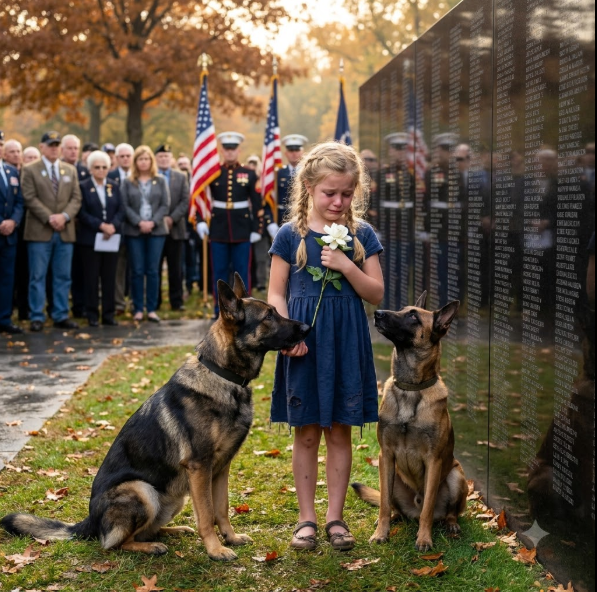
What she had not expected was how small the carved letters felt under her hand.
Her father had been tall. Loud when he laughed. Warm when he hugged her. He smelled like soap, leather, coffee, and the peppermint gum he chewed when he was trying to stay awake after long flights.
He called her mi corazón.
My heart.
A person like that should not fit inside a line of carved letters.
But the world had done many things Maya did not understand.
This was only one of them.
She stepped back from the wall and held the gardenia tighter.
Her father had loved gardenias because of a mistake.
The first time he came home from deployment when Maya was four, the airport flower cart had been almost empty. The roses were wilted. The carnations looked tired. Only a bundle of gardenias remained in a little plastic sleeve near the register.
The woman at the stand told him they smelled like summer.
Daniel Reyes bought them immediately.
Maya still remembered him walking through the airport doors in uniform, duffel bag over one shoulder, face thinner than she remembered, smile breaking open the second he saw her. She ran toward him so fast her shoes slapped against the floor.
He dropped the bag, crouched, and caught her.
“There’s my heart,” he whispered.
Then he handed her the gardenias.
“For you,” he said, “because I came home.”
After that, it became their thing.
Every time he returned, he brought gardenias.
Every time, before he hugged anyone else.
Even when she was old enough to know deployments were dangerous.
Even when she was old enough to notice the way her mother used to stare at the door after he left.
Even after her mother died suddenly from an aneurysm when Maya was eight, and Daniel came home on emergency leave with eyes so red that Maya could not look at them for long.
He still brought gardenias.
“For you,” he told her at the funeral, pressing the flowers into her shaking hands. “Because I came home.”
He went back overseas three months later.
He never came home again.
The master of ceremonies stepped to the podium.
The microphone gave a soft pop, then steadied.
“Ladies and gentlemen, please rise if you are able.”
Chairs scraped against the grass.
Hands moved to hearts.
The flags lifted in the breeze.
Maya stood straighter.
She did not have to rise. She had not sat down.
The ceremony began with the national anthem, then a prayer, then speeches about duty, honor, courage, and sacrifice. The words were important, Maya supposed. Adults seemed to need those words when they talked about the dead.
But none of them sounded like her father.
Her father would have said the microphone was too loud.
He would have whispered that the mayor’s tie looked like a picnic blanket.
He would have complained softly that nobody ever served decent coffee at these things.
Then he would have squeezed Maya’s shoulder and stood still when the names began, because he understood what mattered even when he made jokes about everything else.
At the podium, the chaplain spoke of eternal rest.
Maya looked at the gardenia.
Rest did not feel like the right word.
Her father had never been good at resting.
Neither had Ranger.
The thought came quickly, and with it the ache.
Ranger was her father’s dog.
Not pet.
Not mascot.
Partner.
That was what Daniel always said.
Military working dog.
Belgian Malinois.
Fawn-colored, dark ears, black muzzle, eyes too smart to lie to.
Ranger had been trained in explosives detection, patrol, and protection. He had served beside Daniel for three years. They slept near each other, ate near each other, worked near each other, trusted each other in places Maya only knew from letters her father wrote in careful handwriting on lined paper.
Daniel wrote real letters.
Not only emails.
Not only video calls.
“People deserve something they can hold,” he told Maya once.
She had kept every letter in a shoebox under her bed at Ruth’s house.
The one in her dress pocket today was the last one.
She had folded and unfolded it so many times that the paper had gone soft and the creases were almost fuzzy beneath her fingertips.
She knew the words by heart.
Mi corazón,
This morning was quiet before patrol. Quiet in the way places get when they are pretending to be harmless. Ranger sat beside me watching the sun come up like he was judging it for being late.
Some mornings out here, I think the dog understands something the rest of us are still trying to figure out. He’s not scared. He’s not proud. He’s just fully there, doing his job, because that’s what you do.
Remember that. You don’t have to feel brave every second. Just be fully where you are and do the next right thing.
I love you more than every star you can see and every star you can’t.
Dad
She had never met Ranger.
That was one of the griefs nobody understood.
When Daniel was killed, people told her Ranger had survived.
Then they told her he was reassigned.
Then someone told Ruth he had been injured later and retired.
Then nobody returned the calls.
Ruth wrote letters.
Maya watched her do it at the kitchen table late at night, glasses low on her nose, pen moving slowly across paper.
To whom it may concern.
My son, Staff Sergeant Daniel Reyes, served as a military working dog handler.
His canine partner’s name was Ranger.
My granddaughter Maya Reyes is requesting information regarding Ranger’s retirement status.
The letters went out.
Silence came back.
After a while, Ruth stopped telling Maya when she mailed one.
But Maya saw the envelopes.
She saw the file folder Ruth kept in the top drawer of the sideboard.
Daniel/Ranger.
Maya did not ask every day.
She wanted to.
But she knew Ruth was already carrying too much.
The ceremony moved on.
A widow in the front row touched a silver brooch pinned to her jacket. Inside it was a photograph of a young man’s face. An old veteran closed his eyes during Taps, his lips moving silently. A little boy in a collared shirt fidgeted until his father placed a gentle hand on his knee.
Maya did not fidget.
When Taps played, she closed her eyes like the veterans did.
The notes rose clear and aching into the bright morning air.
Every note seemed to know exactly where it was going.
When it ended, the silence afterward felt larger than the music.
Then the master of ceremonies returned.
“At this time,” he said, “we ask you to turn your attention to the east pathway as we honor another group of service members whose loyalty, courage, and sacrifice often go without full recognition. Please welcome the 43rd Military Working Dog Detachment.”
A ripple moved through the crowd.
Maya turned her head.
Six handlers entered along the pathway.
Beside them walked six dogs.
German Shepherds.
Belgian Malinois.
Lean.
Alert.
Disciplined.
Their paws moved almost silently over the stone path. Their ears were forward. Their eyes scanned without wandering. Their bodies held that impossible combination of calm and readiness Maya had seen in photographs of Ranger.
For the first time that morning, something inside her opened.
Not happiness.
Not exactly.
Recognition.
Not of a dog she knew, but of a world her father had belonged to.
The dogs moved into position at the edge of the ceremony space. One by one, they sat beside their handlers. Perfectly still. Perfectly focused.
The crowd murmured appreciatively.
A child whispered, “Look, dogs!”
His mother hushed him.
Maya took one small step closer.
Still outside the rope.
Still alone.
Staff Sergeant Marcus Webb noticed the girl because one of his dogs noticed first.
Marcus was the senior handler in the unit, thirty-eight years old, tall, broad-shouldered, with a calm face and tired eyes. He had spent sixteen years working with military dogs. He trusted them more than he trusted most people, not because dogs were magical, but because they were honest.
Major, the Belgian Malinois at his side, shifted his head slightly.
Not much.
Two inches.
Toward the edge of the crowd.
Marcus’s eyes flicked down.
“Easy,” he murmured.
Major resettled.
Beside the next handler, a German Shepherd named Atlas flicked one ear in the same direction.
His handler corrected him quietly.
Atlas obeyed.
Mostly.
Marcus followed their attention and saw the child in the navy dress.
She was standing near the memorial wall, holding a white flower.
No adult beside her.
No chair.
No program in her hand.
No one watching her.
Marcus frowned.
There were many reasons a working dog might shift attention at a public ceremony. Food. Another animal. Sudden movement. A handler’s stress. The unexpected scent of something trained into them.
This felt like none of those.
The master of ceremonies gave a brief tribute to military working dogs, speaking of loyalty, sacrifice, service, and the bond between dog and handler.
Marcus had heard versions of that speech before.
He respected it.
He also knew speeches made things sound clean.
The bond between dog and handler was not clean.
It was mud, blood, sweat, repetition, frustration, trust built over months and sometimes shattered in one second. It was a dog refusing food after losing a handler. It was a handler sleeping beside a kennel because the dog would not settle. It was grief without language.
Marcus looked again at the girl.
Her eyes were fixed on the dogs with a focus he had seen before in family members who were not just watching animals.
They were searching for someone.
The name reading began.
A senior officer stepped to the microphone. A polished bell stood near him.
“Captain Andrew Mills.”
The bell rang once.
“Sergeant First Class Ellen Porter.”
The bell rang once.
“Corporal James Whitaker.”
The bell rang once.
Each name moved through the crowd like a stone dropped into deep water.
People bowed their heads.
Some cried.
Some stared forward, unblinking.
The K9s stayed in formation.
Maya knew where her father’s name would come.
Reyes after Ramsey.
Before Sullivan.
Her hands tightened around the flower stem.
The officer read two more names.
Then one more.
“Staff Sergeant Daniel Reyes.”
The bell rang.
Maya closed her eyes.
In through your nose, mi corazón.
Hold.
Out slow.
Do not build fear a house.
Her father’s voice came so clearly that for a second she almost felt his hand on her shoulder.
At the exact moment the bell’s sound thinned into the air, Major turned his head.
Atlas turned too.
The movement was small, but Marcus saw it.
Both dogs looked toward Maya.
Not vaguely.
Not briefly.
With focus.
Marcus’s body sharpened.
“Major,” he whispered.
Major resettled, but not fully.
His attention remained split, one part on Marcus, one part on the girl.
Marcus looked at Atlas.
Same thing.
Across the lawn, Maya opened her eyes.
She looked at the wall.
Then at the flower.
Then at the K9 unit.
Major’s nose worked once.
Then again.
The breeze had shifted.
It moved from the wall toward the formation. Across the grass. Across Maya. Across the gardenia. Across the worn letter in her pocket. Across a child who had once been held by Daniel Reyes, whose clothes had hung for years in a house that had once held Daniel’s jacket, Daniel’s soap, Daniel’s handwriting, Daniel’s memory.
Dogs understand the world in layers humans never notice.
They know stress by chemistry.
Fear by salt.
Illness by change.
Belonging by scent.
Major had never worked with Daniel Reyes.
Neither had Atlas.
But working dogs were trained through scent profiles. Handlers. Uniforms. Gear. Shared spaces. Human signatures lingering where humans believed they had vanished.
Major’s body told him something his training could not put into words.
That child carried a trace connected to one of their own.
Marcus knew enough to feel the hair rise along his arms.
The ceremony moved toward its final prayer.
The chaplain stepped forward.
Families began shifting slightly, sensing the end.
Then Major stood.
No command.
No bark.
No startle.
He simply stood.
Atlas stood a second later.
Both handlers reacted immediately.
“Major, sit.”
“Atlas, sit.”
The dogs did not sit.
They walked.
Calmly.
Purposefully.
Through the gap between the ceremony space and the outer perimeter.
Directly toward Maya.
A ripple of alarm went through the handlers.
Marcus took three quick steps, ready to intercept.
Then he stopped.
His command died in his throat.
Because Major was not out of control.
Atlas was not either.
They were moving with the solemn certainty of dogs who had found something they were trained, in the deepest part of themselves, to recognize.
The remaining four K9s held formation.
Still.
Silent.
As if they understood this was not theirs to interrupt.
The chaplain’s voice faltered.
People turned.
Heads shifted row by row, following the movement of the two dogs.
Maya froze.
For one terrifying second, she thought she had done something wrong.
Maybe she had stood too close.
Maybe she had made the dogs break formation.
Maybe someone would be angry.
She tightened her grip on the gardenia and stepped back until her shoulder nearly touched the stone wall.
Major reached her first.
He did not jump.
He did not bark.
He sat at her feet.
Atlas sat beside him.
Major lowered his head and pressed it gently against her left hand, the hand holding the flower.
Atlas looked up at her face.
Maya stared down at them.
The gardenia trembled.
Her lips parted, but no sound came.
The whole ceremony seemed to disappear.
No podium.
No chairs.
No flags.
No crowd.
Just two dogs sitting at her feet as if they had come to tell her something no human had bothered to say.
They knew.
Somehow, they knew.
The first sob escaped before she could stop it.
She covered her mouth with one hand, but the sound had already happened.
Her shoulders shook.
Major leaned his head harder into her hand.
Atlas stayed perfectly still.
The chaplain stopped speaking completely.
The memorial grounds went silent.
Every person who had failed to notice the lonely child at the edge of the ceremony was now looking directly at her.
Marcus approached slowly.
Not like a handler correcting an animal.
Like a man approaching a wound.
He lowered himself to one knee a few feet away.
“Hey,” he said softly. “My name is Marcus.”
Maya tried to wipe her face with her wrist.
“I’m sorry.”
The apology hit him harder than he expected.
“For what?”
“They came over.”
“I know.”
“I didn’t call them.”
“I know that too.”
She looked toward the handlers, toward the crowd, toward all the faces suddenly turned her way.
“I didn’t mean to mess up the ceremony.”
Marcus sat fully on the grass because kneeling still made him feel too tall.
“You didn’t mess up anything,” he said.
“My grandma said stay outside the rope.”
Marcus glanced at the rope behind the dogs.
“You did.”
She sniffed.
One of the Gold Star mothers in the front row pressed a hand to her chest.
Marcus kept his voice low.
“What’s your name?”
“Maya.”
“Maya what?”
“Maya Reyes.”
There it was.
Marcus felt something settle into place.
He looked toward the wall.
“Staff Sergeant Daniel Reyes?”
Her eyes filled again.
“My dad.”
The words moved outward.
Not loudly.
But enough.
Whispers spread across the nearest rows.
Her dad.
Reyes.
That’s his daughter.
She was standing alone.
Marcus looked at the gardenia.
“He liked those?”
Maya nodded.
“He brought them to me when he came home.”
Major’s eyes half closed as the scent of the flower shifted in the breeze.
Marcus glanced at him, then back at Maya.
“Is someone here with you?”
“My grandma is coming at noon.”
“You came early?”
“I wanted to see his name before the ceremony.”
She reached into her dress pocket and pulled out a worn envelope.
“This is his letter.”
Marcus did not ask to take it.
He only looked.
The return address told him enough.
Unit designation.
Deployment marker.
A timeline that made sense.
His expression changed before he could stop it.
Maya saw it.
“You know it?”
“I know the unit.”
She held the envelope against her chest.
“Do you know Ranger?”
Marcus became very still.
The question was too direct to dodge and too important to soften badly.
“I know of him,” he said.
Maya’s whole face changed.
“Is he alive?”
“Yes.”
The answer landed like a bell.
Her mouth trembled.
“Where?”
Marcus looked at Major, still pressed against her hand, and Atlas, still watching her.
Then he looked at the crowd that had fallen silent around them.
“He’s at a working dog retirement facility in this state.”
Maya seemed to stop breathing.
“For real?”
“For real.”
“Is he okay?”
“He’s cared for.”
That was true.
Not complete.
But true.
Maya was a child, not foolish.
She heard what he did not say.
“Does he miss my dad?”
Marcus swallowed.
Every adult nearby seemed to lean toward his answer.
“I think Ranger misses him too,” he said.
Maya looked down at Major.
Then at Atlas.
Then at her father’s name on the wall.
“Can I meet him?”
Four words.
No speech that morning had held more power.
Marcus looked toward the other handler.
Staff Sergeant Brooks gave a small nod.
Marcus took out his phone.
Before he could dial, a man in a gray suit strode toward them from the front row. His name was Colonel Victor Leland, retired, chairman of the memorial foundation. His hair was silver, his posture perfect, his expression already arranged into controlled displeasure.
“Staff Sergeant Webb,” he said quietly, though the microphone near the podium still caught part of his voice. “Please return the dogs to formation.”
Marcus did not stand.
“Sir, give me one minute.”
“We are in the middle of a formal ceremony.”
Maya flinched.
Major’s ears shifted.
Marcus rose slowly.
“With respect, sir, this child is the daughter of Staff Sergeant Daniel Reyes.”
Leland glanced at Maya, then at the wall, then at the crowd watching him.
His expression softened too late.
“Of course,” he said. “But there are procedures for family seating and participation. She should have been properly registered.”
Maya’s cheeks reddened.
“I didn’t know I had to register to bring my dad a flower.”
The silence after that sentence was sharp.
Leland looked briefly annoyed, then embarrassed that people had seen him look annoyed.
Marcus kept his eyes on the retired colonel.
“Sir, the dogs identified something the rest of us missed.”
“The dogs disrupted the program.”
“No,” Marcus said. “They corrected it.”
The words carried.
Someone in the crowd breathed out hard.
A veteran near the back removed his cap and held it against his chest.
Leland’s jaw tightened.
Marcus turned away and made the call.
“Ellis? It’s Webb. I’m at the county memorial. I need information on a retired Malinois named Ranger. Former handler Staff Sergeant Daniel Reyes.”
Maya stared at him.
Major stayed against her leg.
Atlas remained beside her.
Marcus listened.
His eyes moved once to Maya.
“How far?”
Pause.
“Bring him.”
Leland stepped closer.
“You cannot simply summon another dog into a public memorial.”
Marcus covered the phone.
“Colonel, there are six military working dogs already here. Two of them just found the daughter of a fallen K9 handler before any adult in charge did. Let this happen.”
Leland looked around.
The crowd was no longer watching the podium.
They were watching him.
He stepped back.
Marcus returned to the call.
“Yes. Main gate. I’ll clear it.”
Maya whispered, “He’s coming?”
Marcus looked at her.
“Yes.”
Her knees seemed to weaken.
Ruth arrived seventeen minutes later, earlier than noon because Marcus had called her from Maya’s phone contact card. She moved through the crowd as fast as her aching knees allowed, cardigan buttoned wrong, eyes wide with fear until she saw Maya safe beside the dogs.
“Maya.”
Maya turned and ran.
Ruth caught her, gardenia and all.
For the first time that morning, Maya cried into someone’s shoulder.
Ruth held her tightly, one hand cupping the back of her head.
“I’m here, baby. I’m here.”
Marcus explained quietly.
Ruth listened.
When he told her Ranger was alive and on his way, Ruth closed her eyes.
“Oh, Daniel,” she whispered.
Leland approached with the careful dignity of a man trying to recover control.
“Mrs. Reyes, I want to personally apologize for any confusion regarding seating arrangements.”
Ruth looked at him.
“My granddaughter stood alone for two hours.”
Leland’s face tightened.
“I was not aware—”
“You were sent our names three times.”
Marcus’s eyes moved to Leland.
Maya looked up at her grandmother.
Ruth’s voice was quiet, but it had changed.
“When the ceremony notice came, I called your office. I said Daniel Reyes’s mother and daughter would attend. A woman told me the Gold Star section was already assigned.”
Leland clasped his hands.
“That sounds like an unfortunate administrative misunderstanding.”
“I wrote again.”
No answer.
“I wrote about Ranger too.”
Maya went still.
Ruth kept going.
“For eighteen months, I wrote to every liaison address your office gave me. My son named us as family contacts if Ranger was ever retired. I know because he told me before he deployed. He said, ‘Mama, if something happens and Ranger comes home old, don’t let him end up with strangers.’”
Maya stared at her.
“Grandma.”
Ruth’s face crumpled for half a second, then steadied.
“I didn’t want to tell you until I had answers.”
Leland’s mouth opened.
Closed.
Marcus watched him carefully.
There was a difference between a man surprised by an error and a man afraid of a record.
Leland looked afraid.
Before anyone could say more, a van turned through the memorial gate.
The crowd parted almost instinctively.
The van was white, with the logo of the state military working dog retirement facility on the door.
A man in khaki work pants stepped out. Ellis Brandt, the facility manager, had gray hair, a weathered face, and eyes already wet.
He opened the side door.
Ranger came down the ramp slowly.
He was nine years old now.
Fawn-colored.
Dark ears.
Black muzzle dusted with gray.
His body still carried strength, but age had touched him. His left hind leg favored slightly when he stepped down, the old injury showing in the first few movements.
His head lifted immediately.
His nose worked the air.
Ellis held the lead loosely.
“He knows,” Ellis said.
Maya stood very still.
Ruth put both hands on her shoulders.
Marcus stepped back.
No one instructed the crowd to be quiet.
They simply were.
Ranger moved across the grass.
Steady.
Focused.
The lead went slack almost at once.
He passed Major and Atlas, who remained seated.
He stopped first at the wall.
At Daniel’s name.
His nose touched the granite.
A sound came from him then.
Not a bark.
Not a whine.
Something low and broken and old.
Maya made the same sound in her throat.
“Ranger,” she whispered.
The dog turned.
His eyes found her.
For one long second, neither moved.
Then Ranger walked to her and sat directly in front of her.
Formal.
Straight.
As if reporting for duty.
Maya sank to her knees in the grass.
Her navy dress spread around her.
The gardenia dropped between them.
She wrapped both arms around Ranger’s neck and buried her face in his fur.
No one heard what she said.
No one tried.
Ranger stayed still for one breath.
Then he leaned his whole body into her.
Ruth covered her mouth and cried silently.
Marcus bowed his head.
Ellis turned away and wiped his face with his sleeve.
Maya picked up the gardenia and tucked it gently under Ranger’s collar.
“He brought these to me,” she whispered. “Every time he came home.”
Ranger closed his eyes.
Around them, veterans stood.
Not because the program told them to.
Because something true was happening.
The widow with the silver brooch rose first.
Then a Gold Star father.
Then an old Marine in the back row.
Then nearly everyone.
They stood in silence while a ten-year-old girl held the dog who had once kept her father alive.
The ceremony ended without the planned closing remarks.
Nobody complained.
People moved slowly afterward, as if leaving too quickly would be disrespectful.
Some came to Ruth and spoke Daniel’s name.
Some apologized without fully knowing what for.
Some simply placed a hand over their heart and walked away.
Maya stayed near the wall with Ranger for almost an hour.
Ruth sat beside her in the grass.
Marcus stood nearby, not hovering, just present.
Eventually, Maya looked up at him.
“Can he come home with us?”
The question hurt because Marcus wanted to say yes immediately.
Instead, he knelt.
“We have to do it the right way.”
Maya’s face tightened.
“The right way is why nobody told us where he was.”
Ruth closed her eyes.
Marcus accepted the blow because it was deserved, even if he had not caused the wound.
“You’re right,” he said. “Then we do it the honest way. No disappearing paperwork. No unanswered letters. I’ll help.”
Maya looked at Ranger.
“Promise?”
Marcus looked at the dog, then at Daniel’s name.
“I promise.”
Promises made to grieving children should frighten grown men.
This one frightened Marcus enough to keep it.
That afternoon, he began calling people.
By sunset, he had learned enough to know the story was not only sad.
It was wrong.
Daniel Reyes had filed a retirement preference addendum six weeks before his final deployment.
In it, he named Ruth Reyes as family contact if Ranger was ever retired stateside.
Maya’s name was included.
The document had been received.
It had never been processed.
Ruth’s letters had not vanished.
They had been scanned into the memorial foundation’s family liaison archive.
Forwarded twice.
Marked pending.
Then closed.
The closure note was signed by an administrator under Victor Leland.
Reason: no actionable priority.
No actionable priority.
Marcus stared at those words on his screen until Major, lying beside his chair, lifted his head.
A child had stood alone at a memorial with a flower because her grief had been marked no actionable priority.
The next morning, Marcus called Colonel Callum Pierce, who oversaw regional military working dog retirement transitions.
By noon, an internal review was opened.
By the end of the week, Ruth sat in a conference room at the retirement facility with a folder of copies in front of her.
Maya sat beside her.
Ranger lay at Maya’s feet, head on her shoe.
Colonel Pierce looked older than he had sounded on the phone. His uniform was immaculate, but his face had the weary discomfort of a man reading proof that a system he trusted had failed a child.
“I want to begin,” he said, “by saying this should not have happened.”
Ruth did not soften.
“No, it should not have.”
Maya kept one hand on Ranger’s head.
Pierce looked at her.
“Maya, I am sorry.”
She studied him.
Adults said sorry many different ways.
Some meant, Please stop making me feel bad.
Some meant, I do not want consequences.
Some meant, I see the harm.
She thought Colonel Pierce meant the last one.
“Did my dad want Ranger to come to us?” she asked.
“Yes,” Pierce said. “He named your grandmother as the first contact.”
Maya’s face changed.
Not relief.
Not exactly.
Something heavier.
“My dad didn’t forget.”
Ruth’s hand went to her mouth.
Pierce’s voice softened.
“No. He did not.”
Maya looked down at Ranger.
“Grandma didn’t fail either.”
“No,” Pierce said. “She did not.”
Ruth turned her face toward the window.
Marcus, standing near the back wall, looked at the floor.
Sometimes justice begins not with punishment, but with moving the blame to the place it belongs.
The investigation widened.
Victor Leland claimed the issue had been administrative.
Then emails surfaced.
Donor-facing families should be prioritized for ceremony outreach.
Avoid complicated survivor requests unless media or board interest exists.
Working dog retirement contacts are outside memorial scope unless publicity value is clear.
Publicity value.
That phrase ended the polite part of his career.
The memorial foundation board voted him out within two weeks.
The liaison administrator resigned before disciplinary action could be completed.
A formal apology was sent to Ruth and Maya.
Ruth read it once, folded it, and placed it in the Daniel/Ranger folder.
“Do you accept it?” Marcus asked.
“I accept that it exists,” Ruth said.
That was all she was willing to give.
Policy changed after that.
Not because institutions become compassionate overnight.
Because evidence forces them to become more careful.
From then on, when a military working dog retired, any family named in a handler’s preference documents had to be contacted directly.
Not through a foundation.
Not through a donor office.
Not through someone deciding what grief had value.
Directly.
With proof.
With follow-up.
With names attached.
Marcus brought Ruth a copy of the new procedure once it was signed.
Maya read the first page carefully, sounding out some of the longer words.
“So no one else has to write letters forever?” she asked.
“That’s the idea,” Marcus said.
Maya frowned.
“Ideas aren’t enough.”
Ruth smiled faintly.
“She gets that from me.”
Marcus nodded.
“That’s why it’s policy now.”
Ranger’s move into Ruth’s house happened slowly.
He was not simply handed over because the story made people cry.
He was a retired military working dog with age, injury, training, habits, and grief of his own.
There were home visits.
Assessments.
Trial stays.
Veterinary checks.
Maya understood.
Mostly.
But every time Ranger had to go back to the facility after a visit, she became quiet in that old way Ruth hated.
The first time Ranger entered Ruth’s house, he stopped in the hallway.
On the mantel sat Daniel’s photograph.
He was in uniform, smiling slightly, one hand resting on Ranger’s head.
Ranger stared at it.
Then he sat.
Maya stood behind him.
“That’s him,” she whispered.
Ranger did not move.
Ruth cried in the kitchen where she thought nobody could see.
The second visit lasted all afternoon.
Ranger explored the house carefully.
Kitchen.
Living room.
Back door.
Hallway.
Maya’s bedroom doorway.
Then he returned to the mantel and lay beneath it.
The third visit was overnight.
Ranger slept outside Maya’s bedroom door.
Not in her room.
At the door.
On duty.
Maya woke at two in the morning and found him there, head lifted, ears forward.
“You can sleep,” she whispered.
Ranger blinked.
He did not move.
By Christmas, Ranger was home permanently.
Ruth bought him a bed.
He ignored it.
He slept by Maya’s door.
She bought him a blue collar.
He tolerated it.
She tucked gardenias near his bowl once, but he tried to eat one, so Ruth said memorial symbolism had limits.
For the first time in two years, the little house twelve miles from the memorial had a rhythm that was not built only around loss.
Ranger’s bowl by the back door.
Leash on the hook.
Dog hair on Maya’s dress.
Muddy paw prints in the hall.
Vet appointments on the calendar.
Walks after school.
Maya still missed her father.
That did not change.
Grief did not leave because Ranger arrived.
But it changed shape.
It was no longer a locked room.
It had a door now.
A living bridge.
At night, Maya sometimes sat on the hallway floor and read Daniel’s letters aloud.
Ranger would lie with his head on his paws, listening.
When she read the line about him watching the sunrise, his ears moved.
Some mornings out here, I think the dog understands something the rest of us are still trying to figure out.
Maya touched Ranger’s head.
“He was talking about you,” she said.
Ranger exhaled.
“And maybe me too.”
Spring came.
Then summer.
Maya started volunteering twice a month at the retirement facility with Ruth. At first, she folded towels and filled water bowls. Later, she read aloud in the quiet room where older dogs rested.
Some days were hard.
A retired Shepherd named Knox cried when a man with a deep voice walked past because he sounded like his old handler.
A black Lab named Mercy refused to sleep unless someone left a boot beside her bed.
Maya cried in the car after those visits.
Ruth once asked if she wanted to stop.
Maya shook her head.
“Sad doesn’t always mean bad.”
Ruth repeated that later to Marcus.
“She’s raising me now,” Ruth said.
Marcus smiled.
“She’s good at it.”
One year after the ceremony, Maya returned to the memorial.
This time, she had an assigned seat.
So did Ruth.
So did Ranger.
The foundation had a new director, a woman named Elaine Porter who introduced herself to Maya first, then Ruth, then Ranger.
That order mattered.
“We are honored you came,” Elaine said.
Maya held a gardenia.
“I came for my dad.”
Elaine nodded.
“Of course.”
The K9 unit entered along the east path again.
Major and Atlas were there.
This time, when they saw Maya, they did not break formation.
They did not need to.
She was already seen.
But after the ceremony, Marcus brought them over.
Major pressed his head against Maya’s hand.
Atlas touched noses with Ranger.
Maya smiled.
“You remember,” she whispered.
Marcus heard her and said nothing.
At the podium that year, Elaine announced the Daniel Reyes and Ranger Working Dog Family Outreach Program.
Real letters would be mailed to families named in retirement preference documents.
Not only emails.
Not only forms.
Letters.
Maya had insisted.
“My dad said people deserve something they can hold,” she told the board.
No one argued.
The program started small.
Then grew.
Within two years, three other regions adopted similar policies.
Families who had not known where their loved one’s K9 partner retired received updates.
Some met the dogs.
Some chose not to because grief is personal and not every bridge is one someone can cross.
But they were asked.
That was the point.
They were asked.
Ranger grew older.
His muzzle whitened.
His left hind leg stiffened in cold weather.
He still checked Daniel’s photograph every time he entered the house.
He still slept by Maya’s door.
He still leaned into her when Daniel’s name was spoken.
When Ranger died, Maya was thirteen.
He went peacefully on the rug beneath the mantel, with Maya’s hand on his neck and Ruth sitting beside him.
Marcus came when Ruth called.
He stood in the doorway for a long moment, cap in hand.
Major had retired by then too. He came the next day and lay beside Ranger’s collar for nearly an hour.
Maya buried a gardenia under the peach tree in the backyard.
Then she placed one at the memorial wall the following November.
“For Dad,” she said, laying the first flower down.
Then the second.
“For Ranger.”
Years later, people still told the story in the simple way stories travel best.
Nobody noticed the quiet girl at the memorial until the K9s ran to her.
That version was true.
But it was not the whole truth.
The whole truth was that Maya Reyes came to the memorial carrying a flower, a letter, and a grief too large for a child’s hands.
The whole truth was that adults had failed her long before the ceremony began.
The whole truth was that two dogs noticed what people had walked past.
The whole truth was that Ranger had been waiting too.
The whole truth was that Daniel Reyes had not forgotten his daughter, and Ruth Reyes had not failed her granddaughter, and love had left a paper trail that arrogance tried to bury.
The whole truth was that loyalty does not always end where life ends.
Sometimes it waits in a dog’s memory.
Sometimes it stays folded in a letter.
Sometimes it clings to a child’s dress, a white flower, a carved name on a granite wall.
And sometimes, on a bright autumn morning, it moves through the air toward two trained K9s who suddenly stand, ignore every command, and walk straight to the person everyone else should have seen from the beginning.
Maya never believed Ranger brought her father back.
Nothing could do that.
But Ranger brought back proof.
Proof that Daniel had loved her beyond the last goodbye.
Proof that the bond between handler and dog had not vanished into paperwork and silence.
Proof that even when people failed to notice her, love still knew exactly where she was.
The last time Maya visited the memorial before leaving for college, she went alone at sunrise.
Ruth was older then and sleeping more. Marcus had transferred to a training command but still called every November. The outreach program had its own office now, and every month real letters went out to families who deserved something they could hold.
Maya stood before the wall in a navy coat.
Not a dress this time.
A coat.
In her hands were two gardenias.
The stone was still cold when she touched her father’s name.
“Hi, Dad,” she whispered.
The grounds were empty except for wind, flags, and birds moving through the trees.
She placed one gardenia below Daniel Reyes.
The other beside it.
“For Ranger,” she said.
Then she stepped back.
For a moment, she could almost see them again.
Major and Atlas crossing the grass.
Marcus lowering himself to her level.
Ruth arriving with fear in her face.
Ranger walking through the gate, older, limping, certain.
A crowd finally understanding that the quiet girl at the edge of the ceremony had carried the deepest reason for being there.
Maya wiped one tear from her cheek.
Then she smiled.
Not because the grief was gone.
Because it had become part of her without taking all of her.
She turned toward the gate as the sun rose behind the memorial wall.
This time, she did not leave like a child hoping someone would notice.
She left visible.
She left loved.
She left carrying two names that would never be forgotten.
And behind her, carved in granite and held in memory, Daniel Reyes remained what he had always been.
A soldier.
A father.
A handler.
A man who once wrote that Ranger was not scared, not proud, just fully there, doing the job.
Maya understood those words now.
Sometimes the job was guarding a soldier.
Sometimes the job was finding his daughter.
And sometimes the job was teaching an entire crowd that the smallest person at the memorial might be carrying the largest love.








