A 10-Year-Old Girl Saved $114 in a Glass Jar for the Shelter Cat Nobody Wanted—Then the Staff Read the Note She Left Beside His Cage
PART3:
He stopped lifting his head when someone opened the kennel door.
Our veterinarian said Oliver was healthy enough physically, but emotionally, he was shutting down.
“He’s grieving,” Dr. Mercer told me one afternoon after examining him.
“And scared. He lost his first owner, then lost two homes after that. He doesn’t trust anything that looks like hope.”
Oliver’s original owner had been an elderly woman named Mrs. Calder, who passed away a few months before he arrived at our shelter.
Her neighbor told us Oliver had slept beside her recliner every day for years.
After she died, there were no relatives willing to take him.
He came to us with one worn blanket, a half-used bag of senior cat food, and a little note written by the neighbor that said, “His name is Oliver. He loved her very much.”
That sentence had stayed with me.
He loved her very much.
Maybe that was why shelter life broke him so deeply.
Oliver was not unfriendly.
He was not mean.
He was not broken.
He was simply a cat who had already given his whole heart once and did not understand why the person he loved had disappeared.
The little girl seemed to understand that before any of us explained it to her.
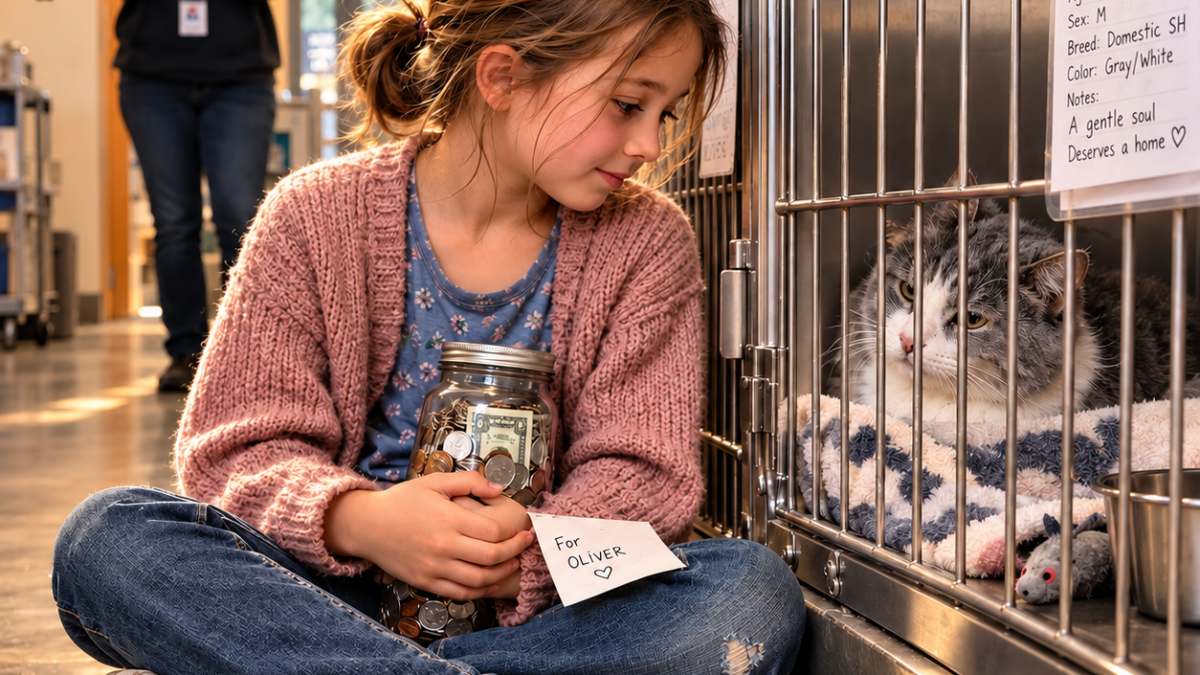
She sat down on the concrete floor beside Oliver’s kennel, crossed her legs, and placed the glass jar in her lap.
Then she started talking to him.
Not loudly.
Not in the high, excited voice children often use with animals.
Softly.
Like she was telling secrets.
Oliver did not come forward that first day.
He barely lifted his head.
But he did open his eyes.
I watched from the doorway as the girl unscrewed the metal lid of the jar.
The sound was small but distinct.
She reached into her pocket and took out two quarters and a dime.
She dropped them inside.
The coins clinked against the glass.
Oliver blinked.
The girl smiled.
“I got sixty cents today,” she whispered.
“Mrs. Palmer gave me extra because I pulled weeds by the mailbox too.”
Then she screwed the lid back on, hugged the jar to her chest, and sat there with him for nearly forty minutes.
Her mother stood near the end of the hall, quietly waiting.
At the time, I assumed they were thinking about adopting Oliver.
I was wrong.
They were not thinking.
The little girl had already decided.
She simply had not told the rest of us yet.
Her name was Lily.
I learned that the second Saturday she came.
She arrived wearing denim shorts, a faded yellow T-shirt, and sneakers with one pink shoelace and one white one.
Her hair was tied back in a crooked ponytail, and the same glass jar was tucked beneath her arm.
This time, she brought seventy-five cents.
The next week, one dollar and twelve cents.
The week after that, three dollars even, mostly quarters, which she counted twice before putting them into the jar.
Every Saturday afternoon, almost like clockwork, Lily came to sit with Oliver.
She never asked to hold him.
She never begged us to open the kennel.
She never complained that he did not come to her right away.
She simply sat on the floor near him and talked.
She told him about school.
About how she hated multiplication but liked reading.
About how her neighbor’s lawn mower was loud and scary at first, but she had learned how to push it straight.
About how she had made a lemonade stand and one man paid two dollars but only took one cup.
About how her birthday had been small that year, but she had saved the money her aunt sent instead of buying the purple backpack she wanted.
Every visit ended the same way.
She opened the jar.
Dropped in whatever she had earned that week.
Then whispered, “Food for Oliver.”
At first, I thought she meant she was donating to his care.
Children often fixate on one animal at shelters.
They collect cans, bring blankets, draw pictures, make little homemade signs.
It is one of the sweetest parts of rescue work.
But Lily was not just visiting Oliver.
She was building something.
One Saturday afternoon, she accidentally left her notebook on a chair near the adoption desk.
It was a little spiral-bound notebook with a kitten sticker on the front and her name written in purple marker across the top.
I would never have opened it if it had looked private.
But the first page had fallen open, and there, in careful handwriting, were columns of numbers.
Lemonade stand: $4.25
Mrs. Palmer grass: $6.00
Birthday money saved: $10.00
Helped Mr. Dean carry groceries: $2.00
Did not buy ice cream: $1.50
At the bottom of the page, underlined twice, were four words:
Food for Oliver.
I stood there staring at it until my throat tightened.
There were pages and pages like that.
Every quarter accounted for.
Every dollar folded into purpose.
Every small sacrifice written down in the handwriting of a ten-year-old child who had decided that a cat nobody wanted still deserved a future.
I found Lily and her mother in the cat wing.
Lily was sitting with Oliver as usual, one hand resting on the floor near the kennel door. Oliver had moved closer than I had ever seen him move for anyone else. He was not touching her, but he was lying near the front of the kennel instead of hiding in the back.
Her mother, Maria, stood nearby with tired eyes and a grocery store uniform shirt still tucked into her black pants.
I handed the notebook back gently.
“I think Lily left this up front.”
Maria’s face changed when she saw it.
“Oh,” she whispered.
Lily looked up quickly.
“I was going to get it.”
“I didn’t mean to read,” I said. “It opened on the desk.”
Lily’s cheeks turned pink.
Maria closed her eyes for a moment, as if she had been carrying a conversation for weeks and knew it had finally arrived.
“She’s been saving,” Maria said quietly.
“For Oliver?” I asked.
Lily looked down at the jar in her lap.
“Yes.”
I crouched so I was level with her.
“Sweetheart, what are you saving for?”
She swallowed.
“His food.”
Maria put a hand on her daughter’s shoulder.
“And adoption,” she added softly.
Lily’s eyes filled immediately.
“Mom.”
“I’m sorry, baby. But they need to know.”
That was when the whole story came out.
Lily was ten years old.
Her father had worked construction until a back surgery left him unable to work regularly. The recovery had not gone well. Medical bills stacked up. Then missed paychecks. Then late rent. Then one notice after another until the family lost their apartment and moved into a tiny rental behind Maria’s cousin’s house.
They were not homeless, but they were close enough to feel the ground cracking beneath them.
Maria worked extra shifts whenever she could. Lily’s father took small repair jobs when his pain allowed. Some weeks, they were fine. Some weeks, they had to choose very carefully. Groceries first. Gas second. Medicine. School supplies. Utility bills. The kind of arithmetic that makes every dollar feel like it has too many jobs.
A cat adoption fee was not impossible in theory.
But food, vaccines, supplies, and future vet care made it impossible in practice.
Maria had told Lily the truth.
Not cruelly.
Just honestly.
“We can’t take on a pet right now.”
But Lily kept coming.
Not because she was spoiled.
Not because she thought whining would change reality.
Because she had made a plan.
She mowed lawns.
Sold lemonade.
Helped neighbors carry groceries.
Saved birthday money.
Skipped ice cream.
Collected quarters like treasure.
And every Saturday, she brought the jar to Oliver so he would know someone was still trying.
I looked at the girl on the floor.
Then at Oliver.
He had placed one gray paw against the kennel door.
Lily noticed and smiled.
“He does that now,” she whispered. “Only sometimes.”
Maria’s eyes filled.
“I told her we might not be able to adopt him even if she saved the fee,” she said. “But she said if she couldn’t bring him home, she still wanted him to have food.”
I had worked in rescue long enough to know that love was not always enough.
That is one of the hardest truths.
People think shelter workers want every emotional adoption to happen. We do not. We want animals to go where they can be safe, fed, treated, housed, and kept. Love matters, but so do rent, transportation, vet access, and stability. A child’s good heart cannot pay for emergency surgery.
So I did not say yes that day.
I wanted to.
Every sentimental part of me wanted to open Oliver’s kennel, place him in Lily’s arms, waive every fee, send them home with a bag of food, and tell myself love would figure out the rest.
But I had seen what happened when adoptions were built only on hope.
Animals came back.
Children got heartbroken.
Parents felt ashamed.
And the animal suffered twice.
So instead, I sat with Maria in my office while Lily stayed with Oliver under Jenna’s supervision.
Maria cried before I even finished asking how they were doing.
“I hate telling her no,” she said. “She’s not asking for toys. She’s not asking for clothes. She just loves that cat.”
“I can see that.”
“But what if he gets sick? What if we can’t afford it? What if we take him and then something happens and he ends up back here again?” She wiped her eyes. “I can’t do that to him. Or to her.”
That was the moment I truly respected Maria.
Because saying no to a child’s dream is hard.
Saying no because you understand the weight of responsibility is love in one of its least appreciated forms.
“We can talk through options,” I said.
“I don’t want charity.”
“I’m not offering pity.”
She looked at me.
“I know what people think when families like ours adopt pets.”
“What do they think?”
“That we shouldn’t. That if we struggle, we don’t deserve anything extra. That animals are for people with savings accounts and fenced yards and perfect houses.”
I leaned back.
“I’ve met wealthy adopters who returned cats for scratching couches. I’ve met poor adopters who would skip meals before missing a vet appointment. Money matters, Maria. I won’t pretend it doesn’t. But it is not the only measure of care.”
She cried harder then, quietly, with one hand over her mouth.
We talked for nearly an hour.
About pet food assistance programs.
Low-cost vaccination clinics.
A local veterinary fund for emergency care.
A senior cat sponsorship donor who sometimes helped with medical costs for older animals.
About what Oliver needed, not just emotionally, but practically.
By the end, nothing was decided.
But something had opened.
The next Saturday, Lily came again.
And the next.
And the next.
Oliver changed slowly.
So slowly that if you were not watching closely, you might miss it.
But we were watching.
At first, he only lifted his head when Lily entered the hallway. Then he began moving toward the front of the kennel before she sat down. Then, one afternoon, he ate while she was there.
That may not sound like much.
It was everything.
Oliver had been eating just enough to keep us from panic. A few bites here, a few bites there. Some days he ignored breakfast entirely. We tried different foods. Different bowls. Warmed food. Quiet feeding times. Medications to help appetite. Nothing worked consistently.
But when Lily sat beside him and talked softly through the kennel door, Oliver ate.
The first time it happened, Jenna came running to my office.
“You need to see this.”
I followed her to the cat wing.
Lily sat cross-legged on the floor, reading from a library book. Oliver stood at his bowl, eating slowly but steadily.
Dr. Mercer happened to be there that afternoon and watched with his arms folded.
“Well,” he said softly, “there’s our treatment plan.”
After that, we adjusted Oliver’s feeding schedule around Lily’s visits whenever we could. On Saturdays, we held one meal until she arrived. She would sit down, open her book or tell him about her week, and Oliver would eat.
Shelter work teaches you that healing often looks ordinary.
A cat eating beside a child.
A scared animal closing his eyes.
A paw reaching through metal bars.
A girl adding a dollar bill to a jar.
Summer passed in heat, sweat, and quarters.
The glass jar grew heavier.
Its metal lid changed color along the edges from all the opening and closing. Lily counted the money every night, Maria told me later. She counted and recounted it on the bedroom floor, stacking quarters into little towers, smoothing dollar bills, writing totals in her notebook.
She did not spend her birthday money.
She did not buy the purple backpack.
She did not buy ice cream from the truck that came through the neighborhood playing music every Friday.
When a neighbor paid her five dollars for helping carry groceries, she put four dollars in the jar and kept one because Maria insisted she should buy herself something small.
Lily used that one dollar to buy Oliver a toy mouse from the discount bin.
He ignored the toy mouse entirely.
Lily was delighted anyway.
“He might like it later,” she said.
By early September, the jar had $84.37.
By late September, $96.25.
By October, $108.00.
Then, on a Saturday morning after mowing Mrs. Palmer’s lawn one final time before cooler weather settled in, Lily reached her goal.
$114.
Not crisp bills.
Not a neat check.
A jar full mostly of quarters and carefully folded one-dollar bills.
Coins earned under a summer sun.
Bills saved from birthdays and errands.
Small sacrifices made by a child who had every reason to keep something for herself but kept choosing Oliver instead.
She arrived that afternoon wearing her yellow T-shirt and carrying the jar with both hands.
Maria walked behind her, eyes already wet.
Lily did not go straight to Oliver’s kennel that day.
She came to the front desk.
The jar made a heavy sound when she set it down.
Then she handed me a folded note.
Her fingers trembled.
I opened it.
The handwriting was careful, slower than usual, as if she had written each letter with all the seriousness in her heart.
I know he is old, but I already love him.
I had to turn away for a second.
When I looked back, Lily was staring at me with a courage so fragile it made my chest ache.
“I know it might not be enough,” she said quickly. “But I can keep saving. I can do more lawns next summer. And I can help with food. I wrote down how much food costs, and I know he needs shots, and Mom said there are clinics, and I know he’s not a kitten, but I don’t want a kitten.”
Her voice cracked.
“I want Oliver.”
Maria put both hands on her daughter’s shoulders.
“She understands it’s a big responsibility,” she said. “We all do.”
I looked at the jar.
Then at the note.
Then down the hallway toward Oliver’s kennel.
He was standing at the front.
Watching.
As if he knew this visit was different.
I asked Lily to wait with Jenna for a moment.
Then I called our board president.
Then Dr. Mercer.
Then the donor who sponsored senior cat adoptions.
There are moments in shelter work when rules matter.
There are also moments when the whole point of having a community is to carry what one family cannot carry alone.
By the time we finished making calls, the remaining adoption fees were covered.
Oliver’s next round of vaccines was covered.
A starter supply of food was covered.
Dr. Mercer agreed to keep Oliver under the senior cat fund for basic care for the first year.
We also arranged for Maria to access our pet food pantry if things got tight.
When I walked back into the cat wing, Lily was sitting beside Oliver’s kennel with the jar in her lap, whispering something to him.
I stood in front of her.
“Lily.”
She looked up.
I crouched.
“You saved $114.”
She nodded.
“And you worked very hard for it.”
Her chin trembled.
“Yes, ma’am.”
“And we all agree that anyone who works that hard for a cat nobody else waited for has already proven something important.”
Her eyes widened.
“What?”
“That love can be responsible too.”
Maria covered her mouth.
“The shelter is going to cover the rest,” I said. “And Dr. Mercer is going to help with Oliver’s basic medical care for the first year.”
Lily stared at me.
“You mean…”
I smiled.
“Oliver can go home today.”
For one second, she did not move.
Then she started crying.
Not loud.
Just overwhelmed, silent tears spilling down her face as she hugged the jar to her chest.
Maria knelt beside her, crying too.
Jenna cried.
I cried.
Even Dr. Mercer, who claimed allergies every time emotions entered the room, had to remove his glasses and clean them for suspiciously long.
Oliver watched us all from inside the kennel.
Then he meowed.
One soft, raspy little sound.
It was the first time I had heard him make a sound in weeks.
Lily laughed through her tears.
“He said yes.”
I opened the kennel door.
For a moment, Oliver stayed still.
Then Lily placed her hand gently inside, palm up.
She did not grab.
Did not rush.
Did not demand that this moment look like a movie.
Oliver sniffed her fingers.
Then stepped forward and pressed his forehead into her hand.
Maria whispered, “Oh, honey.”
Lily closed her eyes.
“I told you I’d come back,” she whispered to him.
Oliver went home with them that afternoon.
Not in a fancy carrier.
In a sturdy borrowed one from the shelter, lined with the blue blanket from his kennel because we wanted him to have something familiar.
We sent food.
Medication records.
Vet paperwork.
A list of tips.
The toy mouse he still had not acknowledged.
And the glass jar.
Lily tried to leave the jar with us.
“For other cats,” she said.
I knelt in front of her.
“Someday, if you want to help other cats, we would be honored. But I think this jar belongs with Oliver.”
“With Oliver?”
“Yes. So he remembers how long someone loved him before he even came home.”
Lily looked at the jar, then at Oliver inside the carrier.
“Okay,” she said.
Maria held the carrier on the drive home while Lily sat beside it and kept one hand against the door so Oliver could smell her fingers.
Later, Maria told me he did not hide when they reached the house.
He stepped out slowly into Lily’s bedroom, sniffed the edge of the bed, the little rug, the stack of library books, the cardboard scratcher they had bought from the dollar store, and the shelf where Lily had placed the glass jar.
Then he climbed onto the bed.
Turned in a circle.
And lay down.
That night, he slept beside the jar.
Not in the soft new bed the shelter had given him.
Not on the blanket.
Beside the jar.
As if he understood that the little glass container had held more than money.
It had held proof.
Proof that someone kept coming back.
Weeks passed.
Then months.
Oliver gained weight.
His fur grew softer.
His eyes became brighter.
He still did not like loud noises or sudden movements. He still hid when unfamiliar adults came over. He still preferred quiet rooms, soft blankets, and Lily’s voice above all others.
But he ate.
He played with the toy mouse eventually, though Maria admitted he mostly batted it once and then looked proud of himself for the rest of the afternoon.
He followed Lily from room to room.
He slept on her homework.
He sat in the window while she practiced spelling words.
When she cried because a girl at school made fun of her old backpack, Oliver climbed into her lap and stayed there until she stopped.
The purple backpack never mattered as much as she thought it would.
Oliver mattered more.
Maria sent updates often.
A photo of Oliver sitting beside the jar.
Oliver curled against Lily’s knees.
Oliver with one paw on her notebook.
Oliver sleeping on the borrowed blue blanket.
Oliver lying beside Lily while she counted coins again, this time for the shelter’s winter food drive.
The caption under that one read:
She says Oliver had a jar, so the other cats should have one too.
That was how the “Oliver Jar” began.
At first, it was just Lily bringing coins to the shelter when she could.
Then Maria shared the story with a few friends.
Then the shelter posted a photo of Oliver beside the original jar, with Lily’s permission.
The post spread farther than any of us expected.
Not because it was dramatic.
Because it was pure.
A ten-year-old girl had saved $114 for an old anxious cat nobody wanted.
And people were tired, I think, of stories where cruelty got the last word.
Donations began arriving.
Five dollars.
Ten.
Twenty.
One envelope from an elderly woman contained three quarters and a note that said, “For the lonely ones.”
A child mailed in a dollar taped to construction paper with a drawing of Oliver.
A local hardware store placed a jar on the counter labeled Food for Oliver’s Friends.
By winter, the Oliver Fund had enough money to cover adoption fees and starter supplies for several senior and special-needs cats.
Cats who had been waiting months began going home.
Mabel, twelve years old, adopted by a retired librarian.
Boots, missing one eye, adopted by a college student who said he liked imperfect things because he was one too.
Clementine, shy and diabetic, adopted by a nurse who was not afraid of insulin.
Harold, a grumpy orange senior with arthritis, adopted by a widower who said he wanted someone to complain with during baseball games.
Every time one of them left, Lily came to the shelter and put a coin in the jar.
“For Oliver’s friends,” she would say.
One afternoon, our director, Anne, stood in the cat hallway watching Lily sit with a newly arrived senior cat who had not yet come out of hiding.
Anne had been in rescue for twenty-two years. She was practical, blunt, and harder to impress than anyone I knew.
But that day, her eyes were wet.
“Most people come here looking for the prettiest cat,” she said softly.
I nodded toward Lily.
“She came every week for the loneliest one.”
Anne wiped her cheek quickly.
“That’s the kind of person the world needs more of.”
I agreed.
A year after Oliver’s adoption, we held a small event at the shelter.
Nothing fancy.
A folding table with lemonade, cookies, a poster board with photos of Oliver, and a little sign that read:
The Oliver Jar Anniversary — Helping the Cats Who Wait the Longest.
Lily was eleven by then.
Taller.
Still shy.
Still carrying more kindness than most adults knew how to hold.
She brought Oliver in a carrier lined with his blue blanket. He was not thrilled about returning to the shelter, and we made the visit short. But when Lily opened the carrier in a quiet room, Oliver stepped out, sniffed, looked around, then climbed straight into her lap.
“He knows he’s not staying,” Maria whispered.
That made me cry before the event even began.
During the event, Anne asked Lily if she wanted to say anything.
Lily shook her head at first.
Then she looked at Oliver.
Then at the jar on the table.
She stood beside her mother and spoke so softly everyone had to lean in.
“I just didn’t want him to think nobody was coming.”
That was all.
One sentence.
Enough to explain everything.
The room went completely silent.
Then Dr. Mercer took off his glasses again.
“Allergies,” he muttered.
Nobody believed him.
Oliver lived with Lily’s family for many years.
He never became a bold cat.
Never a social butterfly.
Never the kind of animal who greeted guests at the door or posed happily for everyone’s camera.
He remained Oliver.
Gentle.
Careful.
Devoted to the girl who had refused to let him disappear into the back of a shelter kennel.
He slept beside the glass jar every night.
Even after Maria bought him a soft round bed.
Even after the shelter gave him a better one.
Even after Lily placed the jar on her bookshelf and surrounded it with little notes, photos, and a ribbon from the anniversary event.
Oliver chose the floor beneath it.
Sometimes he rested his chin against the base of the shelf.
Sometimes he curled with one paw touching the wood.
Maybe it smelled like Lily’s hands.
Maybe he liked the corner.
Maybe we were all sentimental humans imagining meaning where there was only habit.
But I do not think so.
I have seen too many animals recognize objects tied to safety.
A blanket.
A toy.
A carrier that once meant fear but later meant going home.
A glass jar full of quarters and one-dollar bills that became, somehow, the sound of someone not giving up.
Years later, when people asked me which rescue story stayed with me most, I did not choose the most dramatic one.
Not the dog pulled from a storm drain.
Not the kitten saved from a car engine.
Not the horse found starving and brought back to health.
I chose Oliver.
Because Oliver reminded me that rescue is not always one grand act.
Sometimes it is a child showing up every Saturday.
Sometimes it is sixty-three cents.
Then seventy-five.
Then one dollar and twelve.
Sometimes it is not buying ice cream.
Not buying a backpack.
Not giving up when the animal you love is still too scared to love you back.
Sometimes rescue is a mother being honest about money and still making room for hope.
A shelter choosing partnership instead of judgment.
A veterinarian saying, “We can help.”
A community dropping coins into jars because one little girl taught them that the lonely ones are worth waiting for.
People often say Lily saved Oliver with $114.
That is true, but not complete.
She saved him with consistency.
With patience.
With the kind of love that does not demand immediate reward.
She saved him by sitting on cold concrete beside his kennel week after week, proving in the only language Oliver trusted that she would return.
And Oliver saved something too.
He reminded all of us why shelter work matters.
Not because every story ends perfectly.
Many do not.
But because every animal waiting behind a kennel door is more than their fear, more than their age, more than the number of times they have been returned.
And every child who chooses compassion over convenience deserves to be taken seriously.
The last time I visited Lily’s house, Oliver was older, slower, and rounder around the middle. Lily was a teenager by then, taller than her mother, with braces and a stack of schoolbooks on her desk. The glass jar still sat on the shelf in her room.
The lid was worn almost silver around the edges.
Oliver lay beneath it, half asleep.
Lily sat on the floor beside him and scratched gently under his chin.
“He still likes it here best,” she said.
“I can see that.”
She smiled.
“I used to count the money every night.”
“I know.”
“I was scared someone would adopt him before I had enough.”
“I remember.”
She looked down at Oliver.
“But nobody did.”
There was sadness in that.
And gratitude.
And the strange mercy of timing.
“No,” I said softly. “Nobody did.”
Oliver opened his eyes and looked at her.
Lily leaned down and kissed the top of his head.
“I’m glad he waited for me.”
I thought about correcting her.
Thought about saying he had not chosen to wait, that he had been passed over, returned, overlooked.
But then I looked at Oliver under that shelf, beside that old glass jar, with the girl who had loved him before anyone made it easy.
Maybe he had waited.
In the only way a heart can wait after being broken.
And maybe Lily had arrived just in time to prove that waiting had not been for nothing.
Some people save animals with money.
Some with homes.
Some with medical care.
Some with transportation, food, blankets, or late-night emergency calls.
And some save them by refusing to let hope die in the long space between wanting and being able.
Lily did not have much.
A jar.
A notebook.
A summer of odd jobs.
A heart too steady to be discouraged by an old cat hiding in the back of a kennel.
But she gave what she had.
And because she kept giving it, Oliver went home.
That is the part I still carry.
Not the exact amount.
Not the viral post.
Not the fund that came later.
I carry the image of a little girl placing a heavy glass jar beside a shelter kennel, handing me a folded note, and believing with every trembling breath that an old gray-and-white cat was worth all the quarters in the world.
The note said:
I know he is old, but I already love him.
And maybe, in the end, that was all Oliver had ever needed someone to say.
Not, He is young.
Not, He is perfect.
Not, He is easy.
Not, He is exactly what I imagined.
Just:
I know who he is.
And I love him anyway.








