A 10-Year-Old Girl Saved $114 for the Shelter Cat Everyone Kept Rejecting—Then Staff Found the Note She Left Beside His Cage
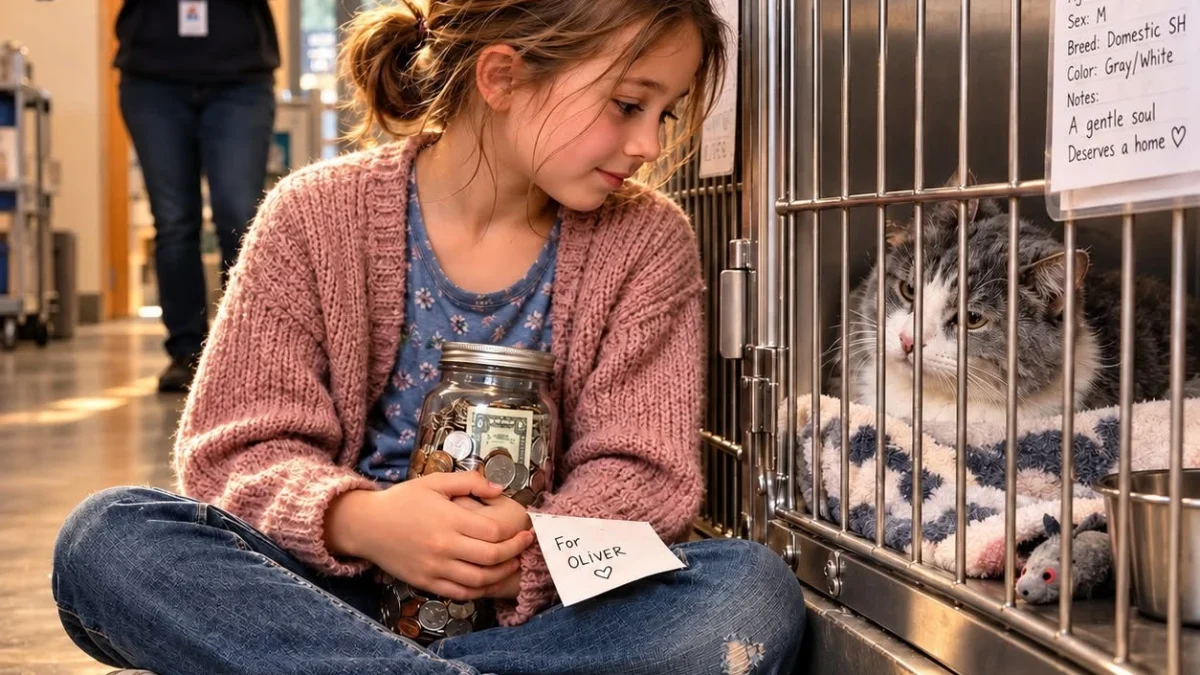
A 10-Year-Old Girl Saved $114 for the Shelter Cat Everyone Kept Rejecting—Then Staff Found the Note She Left Beside His Cage
She was only ten years old, but every Saturday she walked into our shelter carrying the same glass jar against her chest like it held the most important promise in the world.
Everyone else passed by Oliver because the old gray-and-white cat was anxious, quiet, and had already been adopted and returned twice.
But week after week, that little girl added one quarter and one folded dollar at a time until the jar held $114—and when we finally found the note she left beside his cage, every volunteer in the hallway went silent.
The first time I noticed her was a hot Saturday afternoon in June.
I had been running that small animal shelter for almost nine years.
I thought I knew the difference between children who loved visiting animals and families actually considering adoption.
Most kids ran toward the kittens.
Pressed their faces against the glass.
Pointed at puppies.
Begged their parents to take home whatever animal was fluffiest.
This girl did none of that.
She walked straight past every bright-eyed kitten in the front room.
Past the cats who reached through the bars.
Past the animals who knew exactly how to make strangers stop.
All the way to the final kennel.
Oliver’s.
He was gray and white.
Older.
Heavy ruff around his neck.
Tired yellow eyes.
And a face that always looked like it was waiting for someone who had already decided not to return.
Oliver was not charming.
At least not in the way shelter animals usually needed to be.
He didn’t press his paws through the bars.
He didn’t meow at visitors.
If someone moved too quickly, he shrank into the back corner.
If children became loud, he turned his face toward the wall.
Oliver had been adopted twice.
Returned twice.
The first family said he hid too much.
The second said he “wouldn’t bond.”
Both times we explained that he needed patience.
Both families promised they understood.
Both brought him back.
After the second return, Oliver changed.
He stopped greeting the morning volunteers.
Started leaving food untouched.
Spent almost every day curled tightly on the folded blue blanket in his kennel.
Then this little girl arrived.
She sat cross-legged on the floor outside his cage.
Didn’t reach inside.
Didn’t call him.
Didn’t ask him to come closer.
She simply opened a book and began reading quietly.
Oliver watched her.
That was all.
PART2:
The next Saturday, she came back.
Same jar.
Same spot.
Same quiet voice.
Then again.
And again.
I eventually learned her name was Sophie.
Every week, before leaving, she slipped money into the jar.
Sometimes quarters.
Sometimes crumpled dollar bills.
Once, a five.
“What are you saving for?” I asked.
She looked at Oliver.
“Him.”
I assumed she meant adoption fees.
But Sophie’s mother gently shook her head.
Their apartment didn’t allow pets.
Sophie knew that.
She had always known.
Still, she kept saving.
By late summer, Oliver had started moving toward the front of his cage when Sophie arrived.
Not for anyone else.
Only her.
Then one Saturday, Sophie didn’t come.
Neither did she come the next week.
On the third Saturday, we found the glass jar sitting outside Oliver’s kennel.
$114 inside.
Beside it was a folded piece of notebook paper.
Oliver was sitting beside the bars, staring at it.
I picked up the note.
The first line was written in careful purple marker.
And before I finished the second sentence, I understood Sophie had never been saving money to take Oliver home.
She had been saving it for something none of us had thought to give him.








