A 10-Year-Old Boy Carried an Injured Biker’s Heavy Bag Nearly a Mile for Help—Days Later, the Roar of 400 Motorcycles Outside the Gas Station Left Him Speechless
PART3:
“They roar down Highway 60 in packs, leather vests, tattoos, loud engines, beards like wild men. Trouble, every one of them.”
Ryan had never had a reason to doubt her.
So whenever he heard the distant thunder of engines, he crossed to the far side of the road.
The way he might avoid a dog he did not know.
The way children avoid what the adults they trust tell them is dangerous.
He never wondered what the riders’ names were.
Never wondered where they were going.
Never wondered whether they had mothers, sons, jobs, grief, or people waiting for them.
To Ryan, they were a category.
Motorcycle men.
Trouble.
That particular Tuesday in July started like any other.
The heat settled early, thick and wet, the kind that made the asphalt shimmer by nine in the morning. Cicadas screamed from the fence lines. The air above the soybean fields wavered as if the whole county were trapped behind glass.
Ryan had spent the morning at his grandmother’s house.
She made him toast, corrected his posture twice, and reminded him that his mother worked too hard for him to be careless with his shoes.
At noon, Elizabeth called to say she had been held up another hour.
“Stay with Grandma,” she said over the phone.
Ryan looked toward the living room, where Ruth had the television turned to a game show he had already seen twice.
“Can I walk home?”
“It’s hot.”
“I have water.”
“Stay off the shoulder when trucks pass.”
“I know.”
“And go straight home.”
“I will.”
“Ryan.”
“I promise.”
Promises had become serious things in their house.
He meant it.
He hugged his grandmother goodbye, ignored her reminder not to talk to strangers, and started down Farm Road 182.
The sun pressed on the back of his neck.
His oversized sneakers slapped the cracked road.
He kicked a small rock ahead of him, trying to keep it moving without letting it roll into the ditch. He imagined it was a spaceship. Then a shark tooth. Then nothing at all.
He was maybe half a mile down the road when he heard it.
Not engines.
Not a truck.
A groan.
Low.
Human.
Pained.
Ryan stopped walking.
At first, he thought it came from the field.
Then he heard it again.
He turned toward the gravel shoulder.
That was when he saw the motorcycle.
It lay on its side near the ditch, one wheel still spinning slowly. Chrome flashed beneath dust. One saddlebag had torn loose. The handlebar was bent. A dark smear ran across the gravel where the bike had slid.
A few feet away lay a man.
One leg twisted at an angle that made Ryan’s stomach turn.
Everything his grandmother had planted in him shouted at once.
Run.
Cross the road.
Get away.
Motorcycle men are trouble.
Do not get close.
For one second, Ryan obeyed the voice inside his head.
He took one step back.
Then the man groaned again.
Not angry.
Not threatening.
Afraid.
That was what stopped Ryan.
Fear sounds the same in everybody.
It did not matter that the man was big and broad-shouldered, with a gray beard and faded tattoos down both forearms. It did not matter that his leather vest was covered in patches Ryan did not understand. It did not matter that he looked exactly like the kind of man Ruth had warned him about.
He sounded like Ryan had sounded once when he fell off the porch steps and broke his wrist.
Raw.
Embarrassed.
Hurting too badly to pretend.
Ryan crept closer.
“Hey,” he said.
His voice came out smaller than he wanted.
The man’s eyes opened. Bloodshot, unfocused at first, then sharpening when they found Ryan.
“Kid,” he rasped. “You got a phone?”
Ryan’s face burned.
He shook his head.
His mother could not afford a phone for him yet, a fact that had embarrassed him for most of the school year.
The man let his head fall back against the gravel.
“Figures.”
He did not say it meanly.
More like life had played one more joke and he was too tired to be surprised.
“Okay,” the man said. “Okay. Listen to me. There’s a gas station maybe a mile back the way you came. Conoco. You know it?”
Ryan nodded.
“Run there. Tell them James is hurt on 182. Tell them to call 911.”
Ryan swallowed.
“Your leg…”
“Don’t look at it.”
“I already did.”
The man gave something that might have been a laugh if pain had not broken it in half.
“Then you know I’m not walking.”
Ryan hesitated only another second.
Then he nodded.
“I’ll go.”
He had already turned when the man’s hand shot out.
Not fast.
Not threatening.
Just urgent.
His fingers caught the strap of a scuffed leather saddlebag lying near the motorcycle.
“Take this,” James said.
Ryan looked down.
“What?”
“The bag. Please. Don’t leave it out here.”
Ryan did not understand why a bag mattered so much when the man’s leg was clearly broken and sweat was running down his pale face.
But something in James’s voice made it impossible to argue.
He picked up the saddlebag.
It was heavier than he expected.
The leather was worn soft with years of handling. A brass buckle, tarnished by weather and time, hung from the flap. The strap was dark from sweat and road dust.
Ryan slung it across his small shoulder. It pulled him sideways.
“I’ll be right back,” he promised.
Then he ran.
The gas station was farther than he remembered.
Or maybe it only felt that way because he was running with July heat pressing down on him like a hand.
The bag bounced hard against his hip.
His backpack thumped his spine.
His water bottle slapped inside it.
His sneakers, too big and half untied, hit the cracked asphalt again and again.
Sweat stung his eyes.
His lungs burned.
At one point, the strap dug so deeply into his shoulder that he almost shifted the bag to his arms. But something about holding it close to his chest felt safer, so he clutched it tighter and kept going.
He thought about James lying in the gravel.
He thought about the twisted leg.
He thought about his grandmother saying trouble, every one of them.
Then he thought about James’s voice.
Please.
Don’t leave it out here.
By the time the faded Conoco sign came into view, Ryan’s legs felt rubbery.
He burst through the door so suddenly the bell above it smacked against the glass.
The woman behind the counter looked up sharply.
Donna Prescott had worked that register for eleven years. She was heavyset, gray-streaked, and famous for not being impressed by much. She knew which teenagers tried to steal gum, which farmers bought coffee at five in the morning, and which traveling salesmen thought friendliness meant they could call her sweetheart.
She took one look at Ryan and came around the counter.
“There’s a man hurt,” Ryan gasped, bending over with both hands on his knees. “On the road. Farm Road 182. His name is James. His motorcycle is hurt bad, and his leg—”
Donna did not waste time asking questions.
She grabbed the phone behind the counter and dialed 911 while pressing a bottle of water into Ryan’s hands.
“You did good, sweetheart,” she said, already relaying the location to the dispatcher. “You did real good.”
Ryan sank onto the floor for a moment, the saddlebag still clutched against him.
His heart hammered so hard it hurt.
Donna stayed on the phone, calm and fast.
Farm Road 182.
Motorcycle crash.
Adult male.
Broken leg.
Conscious.
Boy ran for help.
Yes, ambulance needed.
Yes, sheriff too.
When she hung up, she looked at Ryan.
“You know that man?”
“No, ma’am.”
“Just found him?”
Ryan nodded.
“He was lying there, and…”
He stopped.
He did not know how to explain the first second.
The almost-running.
The shame of it.
The way fear had spoken in his grandmother’s voice.
Donna’s eyes moved to the bag in his lap.
“That’s a road bag.”
Ryan looked down.
“A what?”
“Bikers carry them. Patches, IDs, personal things. Sometimes things they don’t want separated from them.”
“He asked me to grab it,” Ryan said. “Told me not to leave it. He seemed real worried.”
Donna’s expression softened in a way that made Ryan think she understood something he did not.
“Well,” she said, “ambulance is coming. You want to walk back with me and make sure he’s not alone till they get there?”
Ryan thought of his grandmother again.
Those motorcycle men.
Trouble.
Every one of them.
But now the image in his mind was not trouble.
It was James’s hand reaching for the bag instead of his own injured leg.
James’s voice cracking with worry over something Ryan did not yet understand.
Ryan nodded.
They walked back together.
Donna moved quicker than her size suggested, her keys clipped to her belt loop, a wet towel and first-aid kit tucked under one arm. Ryan matched her pace, the saddlebag now slung over his shoulder, the strap cutting into him in a way that felt strangely like responsibility.
When they reached James, he was still conscious.
Barely.
His face was pale and slick with sweat. His breathing was shallow and controlled, the deliberate kind of breathing people do when panic is near and they are trying not to let it win.
“You came back,” James said when he saw Ryan.
Something in his voice broke a little.
Like he had not quite believed it would happen.
“Told you I would,” Ryan said.
He knelt beside him and set the saddlebag down within reach, though he did not fully let go of the strap.
Some part of him understood that letting go too fast might feel like abandonment.
Donna knelt on James’s other side.
“Ambulance is coming, hon. Ten minutes, maybe less.”
James’s eyes stayed on Ryan.
“What’s your name, kid?”
“Ryan.”
“Ryan what?”
“Holloway.”
“James Kowalski,” the man said, extending a trembling hand.
Ryan shook it.
The hand was rough, warm, and weaker than he expected.
For reasons he could not explain, that handshake made him feel older than ten.
Like he had crossed some invisible threshold and could not uncross it.
“You know what’s in that bag?” James asked.
Ryan shook his head.
James breathed out.
Half laugh.
Half wince.
“My whole life, more or less.”
Ryan glanced at the leather bag.
“Really?”
“Twenty-two years riding with the same club. Every patch I ever earned. Photos of my boy. He’s grown now, lives in Denver, doesn’t call much.”
James swallowed hard.
“But I keep his picture anyway.”
Ryan looked down.
He knew something about fathers who became far away.
James fumbled weakly with the buckle.
His face tightened from pain.
Ryan leaned forward.
“I can help.”
James nodded.
Ryan opened the bag carefully.
Inside were folded patches, a worn wallet, two photographs sealed in plastic, and a faded bandana wrapped around something small and hard.
James nodded toward it.
“That.”
Ryan unwrapped the bandana.
Inside lay a brass medallion, worn nearly smooth, engraved with wings and the words:
Brotherhood Forever.
“This belonged to Frank Delgado,” James said.
His voice changed on the name.
“Best friend I ever had. Rode with him fifteen years before cancer took him. That medallion’s the only thing of his I’ve got left.”
Ryan held the small brass object in his palm.
Only then did he understand the weight of what he had carried.
Not just leather.
Not just metal.
Memory.
Grief.
Friendship.
A man’s son.
A dead friend.
Twenty-two years of a life Ryan knew nothing about.
James looked at him.
“You didn’t have to come back for me.”
Ryan swallowed.
“Lot of folks wouldn’t have,” James said. “Lot of folks look at a man like me and cross the street.”
Ryan felt heat rise in his face.
“My grandma says bikers are trouble,” he admitted.
It felt wrong to lie to a man who had just handed him his grief without flinching.
James let out a short, pained laugh.
“Your grandma’s not entirely wrong, kid. Some of us are trouble.”
Donna snorted.
James glanced at her.
“Some of us more than others.”
Then his face tightened as pain spiked through his leg.
Donna reached to steady him.
James breathed through it.
When he could speak again, his voice was thinner.
“Most of us just found a family on two wheels because the one we were born into didn’t work out so good.”
Ryan stared at the medallion.
“You’ll understand that better someday, maybe,” James said.
In the distance, sirens began to wail.
Faint at first.
Then growing.
Ryan also heard something beneath them.
A low rumble.
Far-off thunder on a clear day.
It made the hair on his arms rise before he understood what it was.
The ambulance arrived before the source of the rumble came into view.
Paramedics moved quickly.
Questions.
Pain level.
Allergies.
Can you feel your toes?
Don’t move, sir.
We’ve got you.
They splinted James’s leg and prepared to load him onto a gurney.
Ryan stood beside Donna, still holding the saddlebag, unsure what to do with it now.
“Hang on to it,” James called as they lifted him.
His voice was tight with pain, but firm.
“Please. Just hang on to it till someone comes for it. Don’t let it go to lost and found.”
Ryan straightened.
“I promise.”
He meant it with the solemnity only a child can bring to a promise, before adulthood teaches people all the ways promises can be negotiated.
As the ambulance pulled away toward Cox Medical Center, sirens fading down Highway 60, the rumble Ryan had heard earlier grew louder.
It resolved into the unmistakable sound of motorcycle engines.
Not one.
Not two.
Many.
A chorus vibrating through the ground before the bikes themselves came into view.
Donna placed a hand on Ryan’s shoulder.
“That’ll be his club.”
Ryan stiffened.
“Word travels fast on the road,” Donna said. “Bikers got their own network. Faster than the news sometimes.”
The first riders came around the bend within minutes.
Three men on heavy cruisers.
Leather vests marked with patches Ryan could not read from where he stood.
They pulled onto the shoulder where James’s motorcycle still lay on its side. One of them, a broad man with a shaved head and a gray goatee, swung off his bike and walked toward Donna and Ryan with quick, urgent steps.
“Where is he?” the man asked. “James. Where’d they take him?”
“Cox Medical,” Donna said. “Ambulance just left. Leg’s broken, but he was talking. Stable, far as I could tell.”
The man exhaled.
Some of the tension left his shoulders.
Only then did he seem to notice Ryan standing quietly beside Donna with the saddlebag clutched against his chest.
“You the one who found him?”
Ryan nodded, suddenly nervous under the man’s scrutiny.
“This is Ryan,” Donna said. “He ran a mile to the station to call it in. Then he walked back with me and stayed till the ambulance came.”
The man’s expression shifted.
Surprise first.
Then something gentler.
“That’s James’s bag,” he said.
“He asked me to hold on to it,” Ryan said. “Told me not to let it go to lost and found. I promised.”
The biker extended one rough, scarred hand.
“Marcus Webb.”
Ryan shook it.
“I ride with James. Been riding together going on fifteen years.”
Marcus looked at the bag again.
Something unreadable crossed his face.
“You know what’s in there?”
“Some of it,” Ryan said.
“Some?”
“He showed me the medallion.”
Marcus stilled.
“Frank’s medallion?”
Ryan nodded.
The name changed Marcus’s face.
Surprise.
Then grief.
Then respect.
More bikes were arriving now, pulling onto the shoulder in twos and threes. Engines idled down. Riders swung off and gathered in small clusters, asking questions, looking toward the motorcycle, toward the road, toward Ryan.
He felt small among them.
Dozens of leather-clad figures.
Tattooed.
Weathered.
Some exactly like the men his grandmother had warned him about.
But no one looked at him the way he expected.
No one sneered.
No one cursed at him.
No one shoved past him.
Instead, words moved through the crowd like a current.
That’s the boy.
He ran for help.
He carried James’s road bag.
Kid stayed.
An older woman dismounted near the back of the group.
Silver hair.
Weathered face.
Kind eyes.
Her leather vest was as worn as any of the men’s.
She approached Ryan directly, then crouched to his level.
“You’re the boy who stayed with him.”
It was not a question.
“Yes, ma’am.”
“Most people wouldn’t have.”
Ryan looked down.
“Most people see us coming and cross the street,” she said. “You know that?”
Ryan thought of all the times he had done exactly that.
“I know,” he admitted. “I almost did too.”
Her eyes softened.
“Until what?”
“Until I heard him.”
“What did you hear?”
Ryan looked toward the place where James had been lying.
“He sounded scared,” he said. “Like a regular person.”
The woman’s eyes glistened.
“We are regular people, sweetheart. We just happen to ride.”
She squeezed his shoulder and stood.
Then she turned to Marcus.
“Secure the bike. Somebody call Denise before she hears it secondhand.”
Marcus nodded and pulled out his phone.
Ryan watched the machinery of this community move into action around him.
Practical.
Coordinated.
Urgent.
Not like strangers.
Like family.
Two riders worked to get James’s motorcycle upright.
Another photographed the crash scene for insurance.
Someone collected broken pieces from the gravel.
Someone else called Cox Medical.
Marcus stayed near Ryan.
Not hovering.
Guarding.
The fear Ryan had carried down Farm Road 182 for years every time he heard engines began to loosen.
Not all at once.
But enough.
Three days passed before Ryan saw James again.
Elizabeth Holloway had been horrified when she heard the story.
Then tearfully proud.
Then horrified again.
“You approached a stranger on the roadside?”
“He was hurt.”
“You ran on the road in this heat?”
“I had to call 911.”
“You carried a strange man’s bag?”
“He asked me to.”
“You went back?”
“I promised.”
That stopped her.
She sat beside him on the edge of his bed that night, hands folded tightly in her lap.
“I should have taught you different,” she said.
Ryan frowned.
“What do you mean?”
“Your grandma raised me on those same stories. About bikers. About who to fear. Who to avoid. I never questioned it much.”
Ryan looked down.
“You were scared?”
“When I heard? Yes. But I’m proud too.” Her voice shook. “You did something braver than most grown men would have done.”
Ryan did not feel brave.
He felt mostly like he had made a promise and kept it.
That seemed like the least a person could do.
But he kept James’s saddlebag with him for those three days.
He would not let it out of his sight.
He slept with it beside his bed.
Checked the buckle every few hours.
Opened it only once, just enough to make sure the medallion was still wrapped safely in the bandana.
On the fourth day, Marcus Webb came to the Holloway trailer in his truck.
He stood on the small porch, hat in hand, looking strangely nervous for a man who had seemed so solid on the roadside.
Elizabeth opened the door.
“Mrs. Holloway?”
“Yes?”
“Name’s Marcus Webb. I ride with James.”
Ryan appeared behind his mother almost immediately, the saddlebag already over his shoulder.
Marcus looked down at him and smiled.
“James is asking for you.”
Ryan’s heart jumped.
“Is he okay?”
“Banged up. Casted from hip to ankle. Mad as a wet hornet. So yes, he’s okay.”
Elizabeth pressed a hand against the doorframe.
“What does he want?”
“To see Ryan. Doctors say he can have visitors now.” Marcus hesitated. “James also wants him there for something else. Something the club’s putting together, if that’s all right with you.”
“What kind of something?”
Marcus chose his words carefully.
“A thank-you.”
Elizabeth looked at Ryan.
He was already reaching for his shoes.
At Cox Medical Center, James was propped up in bed, leg elevated and encased in a heavy cast. Color had returned to his face, though he still looked tired in the particular way of someone healing from pain that had taken more than sleep could replace.
When Ryan walked in, James’s whole face changed.
“There he is,” he said. “My hero.”
Ryan’s ears burned.
“I’m not a hero.”
“No?”
“I just did what you asked.”
Ryan set the saddlebag carefully on the bed beside him.
James studied him for a long moment.
Adults sometimes looked at children that way when deciding how much truth they could handle.
“Let me tell you something, Ryan. Twenty-two years I’ve been riding. I’ve seen men do incredible things. I’ve also seen men look away when it mattered.”
Ryan shifted his weight.
“You’re ten years old, and you didn’t look away. That’s not nothing. That’s not close to nothing.”
James reached for the saddlebag with steadier hands and opened it.
He withdrew the brass medallion wrapped in the faded bandana.
“This belonged to Frank Delgado,” he said. “Best man I ever knew.”
Ryan had heard the name once already, but now, in the hospital light, it seemed heavier.
“When he was dying, he made me promise the club would never let a debt go unpaid. Not money. Not that kind of debt. He meant loyalty. Kindness. Courage. He said if somebody outside the family did something that mattered, we had to make sure they knew what it meant to us.”
James turned the medallion over in his hand.
“I didn’t think I’d get the chance to keep that promise so soon. And I sure didn’t think it would be a ten-year-old boy who reminded me why it mattered.”
He pressed the medallion into Ryan’s palm and closed the boy’s fingers around it.
Ryan’s eyes widened.
“I can’t take this.”
“This was Frank’s.”
“It’s yours.”
James nodded.
“It is. And I’m not giving it away forever. I’m asking you to hold it for a while, same way you held onto that bag.”
Ryan looked down at the worn brass wings.
“Why me?”
“Because Frank would have wanted it carried by somebody who understood what it means to stay when it would be easier to walk away.”
Ryan’s throat tightened.
“Saturday,” James said, “some folks are going to want to thank you properly. I think it’s time you understood exactly what you walked into that day.”
“What’s happening Saturday?”
James smiled.
Tired.
Genuine.
“You’ll see, kid. Be at the gas station by ten. Bring your mama.”
He paused.
“And if your grandma wants to come, bring her too.”
Saturday morning arrived hot and bright, the sky over Springfield a hard, cloudless blue.
Ryan stood outside the Conoco station with his mother on one side and his grandmother on the other.
Ruth had come reluctantly.
“I still don’t understand why all this fuss is necessary,” she had said twice on the drive over.
But she wore her good blouse, and Ryan noticed she had also brought tissues in her purse.
The medallion hung on a leather cord beneath his shirt.
He had touched it so many times that morning that Elizabeth finally said, “If you rub that thing any harder, you’ll erase it.”
Ryan stopped for almost a full minute.
Then touched it again.
At first, there was nothing but ordinary sound.
A passing truck.
Birds in the field.
The low hum of the gas station’s ice machine.
Donna stood near the front door, arms folded, smiling like she knew a secret.
Then the sound came.
Faint at first.
Engines.
Dozens.
Then hundreds.
A rolling thunder building steadily until it seemed to fill the whole sky.
Ruth’s hand tightened on Ryan’s shoulder.
Old instinct.
Old fear.
But Ryan did not flinch.
He stood his ground.
The motorcycles came around the bend in formation.
Row after row.
Chrome flashing in the sunlight.
Leather vests.
Helmets.
Patches.
Flags.
The procession slowed and filled the gas station lot, then the shoulder, then the road beyond it.
Bike after bike after bike.
More than Ryan could count.
Marcus Webb led them.
Behind him, Ryan spotted faces from the roadside and hundreds more he did not know.
Riders had come from clubs across Missouri.
Some from Kansas.
Some from Arkansas.
Some from farther, Marcus would later explain, because word traveled through the biker community fast and thorough, carried by a network built on decades of mutual respect.
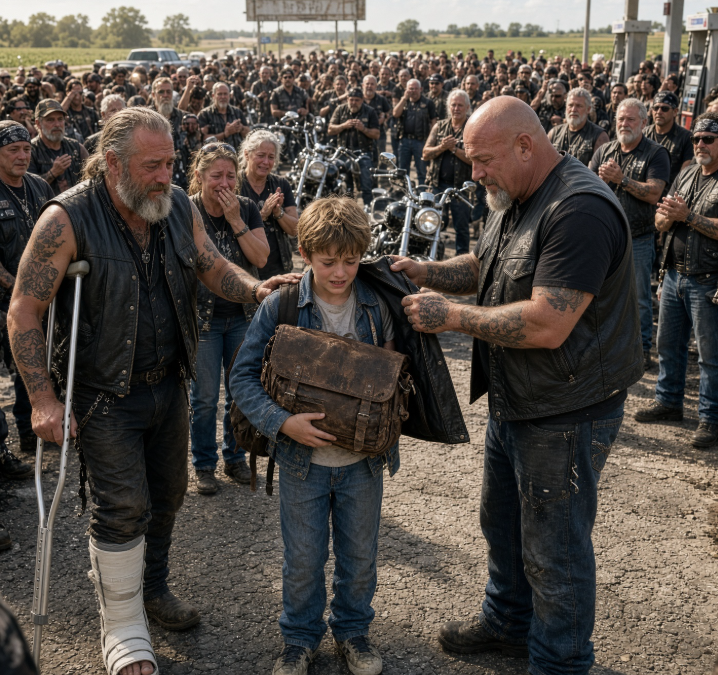
Four hundred riders.
That was the number someone eventually settled on.
Ryan never counted.
It never seemed to matter.
James arrived separately in Marcus’s truck.
His casted leg was propped awkwardly, but he insisted on being there rather than watching from a hospital bed.
When Marcus helped him hobble out on crutches, the assembled riders fell into sudden silence.
Engines cut off almost in unison.
One by one.
Until the only sound was Missouri wind moving through the soybean fields.
James made his way slowly to where Ryan stood beside his mother.
The crowd parted for him, forming a wide half circle.
“Most of you know the story by now,” James said.
His voice carried in the quiet, rough from pain and emotion.
“But I wanted you all to meet him properly.”
He turned slightly and looked at Ryan.
“This is Ryan Holloway. Ten years old. Found me on the side of the road with a busted leg and every reason in the world to keep walking.”
A few riders murmured.
“He didn’t know me from Adam. Didn’t know what we were. What we stood for. Probably grew up hearing the same things most folks hear about people who look like us.”
James glanced toward Ruth.
Not accusing.
Just truthful.
Ruth’s face colored.
But she did not look away.
“He stayed anyway,” James continued. “Ran a mile for help. Carried my road bag because I asked him to. Then came back because he made a promise and wasn’t about to break it.”
The crowd was still.
“Frank Delgado used to say the truest measure of a person wasn’t what they did when people were watching. It was what they did when nobody would have blamed them for walking away.”
James’s voice caught.
Just slightly.
“This boy is ten years old, and he already understands that better than most grown men I’ve known.”
Ryan stared at the ground.
He felt too small for the words.
Too small for all the eyes.
Too small for the medallion beneath his shirt.
“So today,” James said, “on behalf of every rider standing here and every club represented in this lot, I want to say thank you. Not just from me, but from all of us. Because when you helped me, you helped every person who calls this brotherhood family.”
The crowd began to applaud.
Then cheer.
Four hundred voices rose together in the summer heat.
Ryan’s throat tightened with an emotion too large for his small body to hold easily.
His mother’s hand found his shoulder.
On his other side, Ruth stood frozen, tears shining unshed in her eyes.
Her old certainties about those motorcycle men seemed to crumble visibly in the face of what stood before her.
Marcus stepped forward carrying something folded over one arm.
A small leather vest.
New.
Stiff.
On the back was a patch with wings echoing the medallion Ryan wore beneath his shirt.
Beneath it were the words:
Honorary Member.
Marcus crouched slightly.
“This doesn’t make you a rider,” he said. “You’ve got some years before you’re old enough for that conversation, and your mama gets final say regardless.”
Elizabeth nodded firmly.
Several riders laughed.
“But it makes you family,” Marcus continued. “Officially. Permanently. Any one of these four hundred people, if you ever need anything, anything at all, you call and we come.”
He looked Ryan in the eyes.
“That’s not a metaphor, kid. That’s a promise. Same as the one you kept for James.”
He helped Ryan into the vest.
The leather felt heavy on his shoulders.
Not too heavy.
Just heavy enough to remind him it was there.
Ryan looked out at the sea of riders.
Weathered faces.
Worn leather.
Gray beards.
Braided hair.
Tattoos.
Women with kind eyes.
Men who looked rough until they smiled.
People his grandmother had taught him to fear.
People who had come because one of their own had been hurt and a boy had helped him.
James put one steadying hand on Ryan’s shoulder.
Together, they stood at the center of four hundred riders who had come from across three states to say one word to a ten-year-old boy who had carried a stranger’s bag for a mile.
Thank you.
The engines started again one by one.
The sound built back into rolling thunder.
This time Ryan did not flinch.
He felt it instead.
Not as a warning.
As a welcome.
After the ceremony, riders lined up to shake his hand.
Some knelt because he was small.
Some pressed coins, pins, or patches into his palm.
One woman gave him a small card with a phone number and said, “Your mama ever needs help changing a tire, call me.”
A man with a beard down to his chest told him, “You did right by James. That means you did right by us.”
Another said, “Never let anyone teach you that fear is the same thing as wisdom.”
Ryan did not fully understand that one yet.
But Elizabeth heard it.
So did Ruth.
Donna came out with bottled water and sandwiches, refusing payment from anyone.
“I’m feeding half a county today, apparently,” she said.
Marcus tried to hand her cash anyway.
She swatted his hand.
“Put that away before I charge you double.”
James sat in a folding chair near the gas station door, leg propped, laughing whenever somebody told the story wrong.
“No, he didn’t drag me out of a burning ditch,” he said at one point. “Boy ran for help, carried the bag, came back, and kept his promise. That’s plenty.”
To Ryan, the day became a blur of sun, leather, engine noise, and hands.
But a few moments stayed clear.
His mother wiping her eyes when she thought he was not looking.
His grandmother accepting a cup of coffee from Marcus Webb and saying thank you.
Donna telling everyone who would listen that Ryan had burst through the door like “a little half-drowned messenger,” even though he had not been wet at all.
James touching the medallion beneath Ryan’s shirt and nodding once.
Not like a man giving a gift.
Like a man recognizing it had gone where it needed to go.
That night, back at the trailer, Ryan placed the vest carefully over the back of a kitchen chair.
Ruth sat at the table.
She had not said much on the drive home.
Now she looked at the vest.
Then at Ryan.
“I was wrong,” she said.
Ryan turned.
His grandmother rarely admitted mistakes.
The room seemed to know it and went quiet around her.
“About all of them?” Ryan asked.
Ruth folded her hands.
“About thinking I knew somebody by the sound they made coming down the road.”
Elizabeth looked down.
Ryan touched the leather vest.
“James said some bikers are trouble.”
Ruth gave a small, watery laugh.
“Some church ladies are too.”
That startled a laugh out of Elizabeth.
Then Ryan laughed.
Then Ruth did.
And for the first time in months, the trailer sounded lighter than it had.
Not fixed.
Not easy.
But lighter.
A week later, James came by the Holloway trailer with Marcus driving.
He was still on crutches, but stubborn enough to refuse help getting to the porch until he nearly fell and Marcus muttered, “Idiot,” under his breath.
Ryan met them outside.
James handed him a small framed photograph.
It showed Ryan at the Conoco station, standing in the new leather vest, surrounded by riders. James was beside him on crutches. Marcus behind them. Elizabeth’s hands on Ryan’s shoulders. Ruth at the edge of the frame, eyes red but smiling.
On the back, James had written:
Ryan Holloway — the boy who didn’t look away.
Ryan read it twice.
“I didn’t do that much.”
James sighed.
“You keep saying that.”
“Because it’s true.”
James lowered himself carefully into a porch chair.
“Sit down, kid.”
Ryan sat.
James pointed toward the road.
“Let me tell you something about grown men. Most of us spend half our lives hoping we’ll do the right thing when it counts. Not the easy thing. Not the safe thing. The right thing. But you never really know until the moment comes.”
Ryan looked at him.
“You had your moment on Farm Road 182. You were scared. You could’ve kept walking. Nobody would’ve blamed you because most people wouldn’t have known.”
“I would’ve known,” Ryan said.
James smiled.
“That’s the part that matters.”
For a while, they sat quietly.
The Missouri heat pressed against the porch roof.
Somewhere down the road, a dog barked.
Then Ryan asked the question that had been sitting in him since the hospital.
“Do you miss Frank?”
James’s face changed.
“Every day.”
“Does it stop?”
“No.”
Ryan looked down.
“My dad left.”
James did not speak right away.
“He alive?”
“Yeah.”
“Calls?”
“No.”
James nodded slowly.
“That’s a different kind of missing.”
Ryan picked at a loose thread on his shorts.
“Sometimes I think if I was better, he would call.”
James leaned forward.
“Listen to me. Your father’s silence is not a grade you earned.”
Ryan blinked.
No one had said it that way before.
“Grown folks fail for grown-folk reasons,” James said. “Kids always think it’s about them. It almost never is.”
Ryan swallowed hard.
“Then why does it feel like it?”
James looked toward the road.
“Because being left makes your mind try to solve a problem that isn’t yours.”
Ryan did not answer.
James tapped the photograph.
“You carried my bag because I asked you to. You carried something heavy that didn’t belong to you. That was kind. But don’t carry your father’s leaving the same way. That one isn’t yours.”
For reasons Ryan could not explain, that hurt and helped at the same time.
James did not push.
He sat beside him until the tight feeling in Ryan’s chest loosened.
After that, James became part of their life in a way nobody announced.
He called Elizabeth before coming over.
He brought groceries once and pretended they were “extra from the club pantry.”
Elizabeth pretended to believe him.
Marcus helped fix the trailer steps after Ruth nearly tripped.
Donna hired Elizabeth for a few weekend shifts that paid better than the diner.
A rider named Denise dropped off a used bicycle for Ryan, freshly repaired, with new tires and a note that said:
Every road starts somewhere.
Ruth said, “This is too much.”
Marcus answered, “No, ma’am. This is what we do.”
At first, Ruth did not know what to do with that.
Then one afternoon, Ryan saw her sitting on the porch with Marcus, drinking sweet tea and asking him about his grandchildren.
People can change.
Not always quickly.
Not always beautifully.
But sometimes, when truth arrives loud enough, it shakes loose what fear built.
Months passed.
The medallion stayed on Ryan’s dresser most nights, but he wore it on days when he felt nervous.
First day of school.
Parent-teacher night.
The afternoon his father finally called after almost a year and Ryan chose not to answer because he was not ready.
The day James took him, Elizabeth, and Ruth to a charity ride—not to ride, just to watch.
The road began to mean something different to Ryan.
Engines no longer made him cross away.
He still moved safely to the shoulder.
He still respected loud machines and fast roads.
But fear no longer decided what he saw.
He saw people now.
Marcus, who looked scary until he laughed.
Denise, who rode better than half the men and made sure everyone knew it.
Donna, who was not a biker but somehow became family anyway.
James, who limped when it rained but still showed up.
And Frank Delgado, whom Ryan never met but somehow carried with him in brass wings and a promise.
Years later, Ryan would remember that summer as the season his world became larger.
Before Farm Road 182, his life had been small.
Trailer.
Diner.
Grandmother’s house.
School.
A father-shaped silence.
Warnings about people he did not know.
After James, the world cracked open.
Not into something simple.
Not all strangers were safe.
Not all warnings were wrong.
But people could not be sorted by leather, engines, tattoos, church clothes, trailers, or addresses.
People had to be known by what they did when someone was lying hurt in the gravel.
Ryan kept the vest even after he outgrew it.
Elizabeth offered to store it away once, when he was fourteen and taller, his voice changing, his sneakers finally fitting properly.
“No,” he said.
He hung it on the wall above his desk.
Beneath it, he kept the photograph from the gas station and the leather cord with Frank’s medallion.
James had said he was only asking Ryan to hold it for a while.
But he never asked for it back.
On Ryan’s eighteenth birthday, the sound came again.
Engines.
Not four hundred this time.
Maybe thirty.
Enough to shake the windows.
Ryan stepped outside and found James, Marcus, Donna, Denise, and a line of riders outside the trailer. Elizabeth stood on the porch laughing with her hand over her mouth. Ruth, older now, leaned on a cane and pretended she had not known.
James walked forward slowly.
His limp remained.
So did his grin.
“Your mama says you passed your motorcycle safety course.”
Ryan looked at Elizabeth.
She held up both hands.
“I said you passed. I did not say I approved of anything reckless.”
Marcus wheeled a motorcycle forward.
Not new.
Not expensive.
A used Honda Rebel, black, polished until it shone.
Ryan stared.
“No.”
James nodded.
“Yes.”
“I can’t—”
“Club bike,” Marcus said. “Passed down to learners. You don’t own it. You earn time with it.”
Elizabeth pointed at Marcus.
“That was the compromise.”
Ryan looked at James.
James reached into his jacket and pulled out the brass medallion.
Not the same one.
A second one.
Newer, though made in the same shape.
Wings.
Brotherhood Forever.
“Frank’s stays with you,” James said. “This one is yours.”
Ryan’s throat closed.
James pressed it into his palm.
“You’re old enough now to ride,” he said. “But you became one of us long before you ever touched a throttle.”
Ryan looked at the riders.
At his mother.
At his grandmother.
At Donna wiping her eyes beside the mailbox.
At James, who was alive because Ryan had run and returned.
“I was scared that day,” Ryan said.
James smiled.
“Good.”
“Good?”
“Only fools aren’t scared. Courage isn’t not being scared, kid. It’s keeping your promise anyway.”
Ryan looked down at the medallion.
The summer heat.
The cracked road.
The leather bag cutting into his shoulder.
James’s voice.
Don’t leave it out here.
He had not understood then that some things are heavier than they look.
A bag.
A promise.
A stranger’s trust.
A whole community’s gratitude.
A boy’s choice not to look away.
Ryan understood now.
Not completely.
Maybe people spend their whole lives understanding such things more deeply.
But enough.
That evening, after everyone left, Ryan sat with Ruth on the porch.
She watched the road.
“Never thought I’d live to see the day I’d be grateful for motorcycle noise,” she said.
Ryan smiled.
“Me neither.”
Ruth touched his hand.
“I taught you fear.”
Ryan looked at her.
“You also taught me to pray for people.”
She swallowed.
“You learned the rest on your own.”
Ryan looked toward Farm Road 182.
“I almost walked away.”
“But you didn’t.”
That was the whole story, really.
He almost did.
He did not.
Everything came after.
The gas station.
Donna.
Marcus.
James.
Four hundred motorcycles.
The vest.
The medallion.
A family rebuilt wider than blood.
Years later, when people told the story, they usually started with the big part.
Four hundred riders.
Engines rolling like thunder.
A ten-year-old boy honored in a gas station parking lot.
But Ryan always thought the real story began earlier.
Before the applause.
Before the vest.
Before anyone knew his name.
It began with a boy standing alone on a hot road, staring at a hurt man he had been raised to fear.
It began in the second before he chose whether to keep walking.
That second mattered.
Most important seconds do not announce themselves.
They come disguised as inconvenience.
Fear.
Uncertainty.
A stranger in the gravel.
A bag that looks like just a bag.
A voice asking, please.
Ryan kept the medallion long after James passed away many years later.
Cancer, like Frank.
The club rode behind the hearse, engines low and steady, and Ryan rode with them.
Not as a boy.
Not as an honorary member.
As a man.
At the graveside, Marcus stood beside him, older now, beard fully gray.
“You still got Frank’s medallion?” he asked.
Ryan touched the cord beneath his shirt.
“Always.”
Marcus nodded.
“James knew where to leave it.”
Ryan looked at the line of motorcycles, at the riders standing shoulder to shoulder, at Elizabeth and Ruth seated beneath a tent, both older, both part of this strange family now.
“He told me I was only holding it for a while.”
Marcus smiled.
“Sometimes forever is a while.”
Ryan laughed softly.
Then he looked toward the road beyond the cemetery.
Somewhere in the distance, a motorcycle downshifted.
The sound rolled through the afternoon.
Once, it would have made him cross the street.
Now it felt like a voice calling him home.
Ryan Holloway never forgot what James told him in that hospital room.
Some people look away when it matters.
Some people stay.
At ten years old, Ryan had not understood brotherhood, grief, road bags, club patches, or brass medallions.
He had not understood that a bag could hold a man’s whole life.
He had not understood that the family you find can sometimes become more faithful than the family that left.
He had only understood that someone was hurt, someone had asked him for help, and a promise was something you kept even when it got heavy.
That was enough.
Sometimes it still is.
And somewhere in Missouri, long after that July day had become a story told at club meetings, charity rides, and family tables, people still remembered the boy who carried an injured motorcyclist’s bag for a mile.
Not because he was fearless.
He was not.
Not because he knew what was inside.
He did not.
But because he carried it anyway.
Because he came back.
Because he proved, at ten years old, that the truest measure of a person is not what they do when applause is waiting.
It is what they do on an empty road, under a brutal sun, when nobody would have blamed them for walking away.
Ryan did not walk away.
And four hundred engines came to thank him for it.