6 Doctors Dismissed the Screaming Girl—Then a Rookie Nurse Checked Her Foot and Froze
PART3:
A full-body sound that tore out of her before she could stop it.
Rachel flinched like someone had struck her.
“Please don’t,” she whispered. “Every time somebody straightens it, she screams.”
Every time.
The phrase stayed with me.
Daniel exhaled.
“She’s scared. She’s been examined all day.”
“I know,” I said.
“You’re new here, Emily. This happens. Kids guard injuries. Pain cycles build. We can’t admit every stable knee injury because the family is scared.”
“I know.”
He started toward the curtain again.
I heard myself speak before I fully understood I was going to.
“Don’t take those leads off yet.”
Daniel stopped.
His hand stayed on the curtain.
For a second, the room went still.
Rachel looked at me.
Megan kept crying, one hand gripping the bed rail.
Daniel turned slowly.
“She’s cleared.”
“I want to check one thing.”
“Check her vitals.”
“I will.”
“And discharge her.”
I looked at Megan.
Her knee was back against her chest now.
Her breathing was beginning to settle.
That was the first piece.
Not the scream.
Not the pain.
The way it eased when her knee bent again.
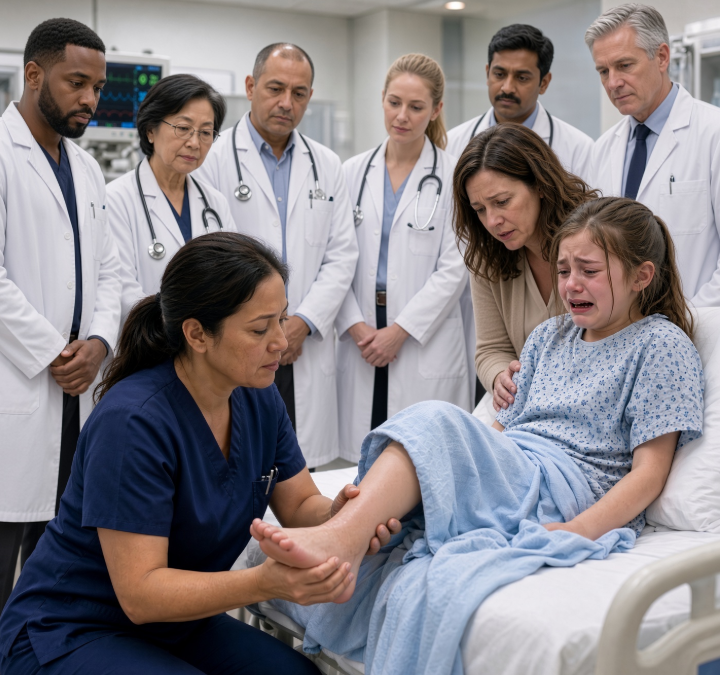
I crouched beside the bed so Megan could see my face.
“I’m going to move your leg a little,” I said. “You tell me when to stop. When you say stop, I stop.”
Rachel leaned forward immediately.
“Please don’t. Every time somebody straightens it—”
“I heard you,” I said gently.
Then I looked at Megan.
“You’re in control. Say stop, and I stop.”
Megan swallowed. Her lips trembled. She did not trust me yet, and she had no reason to. Adults had been touching her injured leg all day, and every one of them had needed something from her: relax, hold still, straighten, bend, tell me where it hurts, one more time.
I slid one hand beneath her heel and the other beneath her calf, supporting the weight instead of pulling.
“I’m not going to force it.”
She gave the smallest nod.
I lowered the knee slowly.
One inch.
Two.
Three.
Megan’s fingers locked around the rail.
“Stop.”
I stopped immediately.
She screamed anyway.
I brought the leg back up.
Within seconds, her breathing began to settle again.
Daniel looked toward the hallway.
“The knee has already been examined.”
“I’m not checking the knee.”
That brought his eyes back to me.
I lowered the leg again, only to the same position.
Megan’s toes curled first.
Her breathing caught.
Then the scream came.
“There,” I said softly.
I raised the leg again.
The pain eased almost immediately.
Rachel stared at her daughter.
“Why does it keep doing that?”
I didn’t answer because I didn’t know.
That was the part no one tells you about catching something important.
It does not arrive as certainty.
It arrives as discomfort.
A small wrongness.
A pattern that repeats.
A question you cannot put down.
“Megan,” I asked, “where does it start?”
She sniffed hard, trying to breathe.
“Behind my knee.”
“Then where?”
She pointed shakily toward her calf.
“It burns down there.”
Daniel stepped closer.
“Could be swelling.”
“It could.”
I touched Megan’s left foot.
Warm.
Then the right.
I stopped.
Left again.
Right again.
There was a difference.
Subtle.
Not ice-cold.
Not blue.
Not dramatic.
But cooler.
Daniel’s pager vibrated.
“We have three kids waiting for beds.”
His eyes moved toward the discharge papers.
I understood what he meant.
I was holding a bed.
I was delaying a completed discharge.
I was the rookie nurse slowing down a floor that did not have room for hesitation.
Megan shifted again, and her knee drifted toward straight. Her face tightened before she made a sound.
I caught her leg and supported it.
My fingers brushed her right foot again.
Cooler.
I checked the left.
Then right.
Still cooler.
Daniel noticed my face.
“What?”
“I’m not comfortable completing the discharge.”
“Based on what?”
“Same position, same pain response, and her right foot is cooler now.”
“That doesn’t automatically make it dangerous.”
“No.”
I met his eyes.
“But it changed.”
Rachel stopped packing the papers into her bag.
Daniel lowered his voice.
“You’re holding a bed against a completed discharge.”
I looked at the wheelchair beside the bed.
If I was wrong, I would delay a cleared patient, frustrate an attending, slow down admissions, and attach my name to a hold that six physicians had not considered necessary.
If I was right, the next person to notice the change might be Megan’s mother in the parking lot.
Megan whimpered as her knee slipped again.
I steadied it.
“Put my name on the hold.”
Daniel stared at me.
For a long second, no one spoke.
Then he took the discharge papers, folded them beneath the chart, and said, “Twenty minutes. Then I need a reason.”
He walked out.
The room exhaled.
I did not.
I pulled the blanket away from Megan’s feet and checked pulses.
Left ankle.
Easy.
Right ankle.
Present.
But weaker.
Rachel watched my face.
“Is that bad?”
“I don’t know yet.”
The honest answer frightened her.
It frightened me too.
I looked at the clock.
Nineteen minutes.
The wheelchair was still beside the bed.
The discharge could still happen.
And I had nineteen minutes to find out whether the smallest thing six physicians had missed was nothing.
Or the reason Megan should not leave.
I checked again.
Left foot.
Right foot.
Still cooler.
I found the pulse at her ankle again.
Left easy.
Right present but weaker.
Megan stared at me.
“Am I in trouble?”
“No.”
“Did I do something wrong?”
“No, sweetheart.”
“Then why does everybody keep looking like that?”
That question hurt more than it should have.
Because she was twelve.
Because she had been screaming all day.
Because somewhere between the first exam and the sixth, adults had begun responding less to her fear and more to their own conclusion about it.
“You didn’t do anything wrong,” I said. “Your body is telling us something. I’m trying to understand what.”
Megan’s eyes filled again.
“They think I’m being dramatic.”
Rachel’s face tightened.
“No one said that.”
Megan looked at her.
“They didn’t have to.”
I had no answer.
Then Megan shifted slightly, trying to make room as Rachel reached for the sneaker on the floor.
Her knee drifted toward straight.
Her face changed before the cry came.
I put two fingers over the right pulse.
It weakened beneath them.
“Bend your knee back,” I said.
Megan pulled it toward her chest.
The pulse strengthened.
I froze.
Then I checked again.
Extension.
Weaker.
Flexion.
Stronger.
Same movement.
Same change.
I reached for the handheld Doppler.
The machine chirped awake.
Left foot first.
A clean rhythmic rush filled the room.
Then right.
A thinner signal answered.
Present.
But different.
Daniel appeared at the curtain.
“Ten minutes.”
His eyes dropped to the Doppler.
“What are you doing?”
“Comparing circulation.”
“I gave you twenty minutes to reassess her, not start another workup.”
“I’m not diagnosing anything.”
I switched the Doppler off.
“Her right foot is cooler. The distal signal changes with position.”
Daniel stepped closer.
“You’re sure?”
“I’m sure it changes.”
“Vitals stable?”
“Yes.”
“Then swelling could explain it.”
“It could.”
I held his gaze.
“But I need you to see the change before she leaves.”
Rachel looked between us.
“Are you saying she shouldn’t go home?”
“I’m saying something is different when her leg straightens, and I don’t know why yet.”
Daniel’s pager vibrated again.
Someone called from the hallway.
“Daniel, room nine.”
He glanced at the clock.
“Repeat the vitals. If they stay stable, we finish the discharge.”
Then he was gone.
The old plan was still alive.
I wrapped the blood pressure cuff around Megan’s arm.
Blood pressure stable.
Oxygen normal.
Heart rate elevated, but nothing dramatic enough to stop discharge by itself.
Rachel reached under the bed for Megan’s sneaker again.
“So we can go?”
Megan shifted to make room.
Her knee began to straighten.
Her expression changed.
“Wait.”
I supported her heel.
“Bend it back.”
She did.
I checked the pulse.
Stronger again.
Rachel stared.
“It comes back.”
“Yes.”
“It gets stronger.”
“Yes.”
“Why?”
“I don’t know.”
That was still the truth.
But now I had something more than discomfort.
I had a reproducible change.
I opened the nursing record and typed carefully.
Right foot cooler than left. Distal pulse weaker with extension, improves with flexion. Pain increases with extension.
I read it twice.
No diagnosis.
No theory.
Only what changed and when.
Then I selected reassessment.
A warning appeared on the screen.
Discharge pending. Attending review of new clinical finding.
Rachel lowered the sneaker.
“What did you do?”
“I made the change part of the discharge decision.”
Daniel returned less than a minute later.
He saw the alert before he reached the bed.
“You stopped the discharge.”
“I documented a reproducible change.”
“Her vitals are stable.”
“They are.”
“Six physicians have already examined that knee.”
“I know.”
“If this holds the room, your name stays attached to it.”
“It should.”
Daniel stared at me.
I did not reach for the Doppler.
I did not explain again.
I moved to the side of the bed and left the foot of it open.
For the first time, Daniel stopped looking toward the hallway.
He pulled on gloves.
“Show me exactly what you saw.”
I looked at Megan.
“Only if she agrees.”
That shifted something.
Daniel’s attention moved from me to the girl in the bed.
Megan tightened her hands around the blanket, then gave a small nod.
I supported her heel.
“You say stop. We stop.”
She swallowed.
Daniel placed two fingers at her ankle.
I lowered the leg.
Two inches.
Three.
Megan’s face tightened.
Daniel’s expression changed, but he said nothing.
I stopped.
“That’s the position.”
Daniel kept his fingers where they were.
His pager vibrated again.
This time, he ignored it.
“Bring it back.”
I bent the knee.
Megan exhaled.
Daniel waited.
Checked again.
Then he looked at me.
“It changes.”
He turned to the workstation and canceled the discharge.
The wheelchair was pulled away from the doorway.
Rachel lowered Megan’s sneaker to the floor.
Daniel picked up the phone.
“I need vascular imaging on twelve. Knee trauma, positional pain, changing distal pulse.”
The coordinator on the other end said ultrasound had two patients ahead. I could hear the muffled voice but not the words.
Daniel looked at me.
“What changes first?”
“Pain.”
He repeated it into the phone.
“Then temperature,” I said. “Then the pulse becomes harder to find. Flexion improves it.”
“Every time?”
“Every time I’ve checked.”
Daniel relayed the sequence and hung up.
Then he wrote on the whiteboard:
Neurovascular checks every five minutes. Temperature. Color. Pulse. Pain.
“Keep the knee where she’s comfortable. Nobody straightens it just to prove this again.”
Rachel looked from him to me.
“So something is blocking her blood flow?”
Daniel answered before I could.
“We don’t know that. We know position changes what we’re finding at her foot. We still don’t know why.”
That distinction mattered.
I had stopped a discharge.
I had not solved the case.
Daniel started toward the curtain, then stopped.
“Emily.”
I looked up.
“Good hold.”
It was the first acknowledgement he had given me.
Then he left.
At 2:41, Megan’s right foot remained cooler.
At 2:46, the pulse was present but faint.
I documented both without straightening her knee.
Megan watched me.
“Are they going to make me do it again?”
“Not just to watch you hurt.”
“Then how will they know what’s wrong?”
I adjusted the blanket over her.
“We gave them the pattern. Now they need to find the reason.”
At 2:51, Daniel returned.
“Change?”
“Still cooler. Pulse present but faint. Holding in flexion. Color unchanged.”
He accepted the report without repeating the exam.
A transport coordinator appeared behind him.
“Vascular can take her now.”
The stretcher rolled beside the bed.
A transporter reached automatically for Megan’s ankle.
She recoiled.
I caught his wrist before he lifted the leg.
“Support under the knee. Keep the position she chose.”
The transporter looked at Daniel.
“Do it,” Daniel said.
Megan transferred without the scream that had followed every earlier attempt to straighten her leg.
I checked the foot again once she was settled.
Pulse still present.
Daniel handed me the chart.
“Go with her.”
I glanced toward the assignment board.
“I have rooms four and seven.”
“I’ll cover them.”
“You already have room nine.”
Daniel looked toward the packed hallway, then back at Megan.
“They need the nurse who saw the sequence.”
I took the chart.
An hour earlier, I was the new nurse expected to finish discharge instructions.
Now the discharge was gone, the attending had changed his workflow, and Megan was being taken for vascular imaging because I had made a small change impossible to dismiss.
But as the stretcher entered the hallway, Megan reached out and caught my sleeve.
“You’re coming, right?”
I looked at her hand gripping my uniform.
“Yes.”
“Stay with me.”
“I’m here.”
She did not let go.
I walked beside the stretcher toward Vascular.
Daniel had finally started trusting my judgment.
Megan had started trusting me too.
And I was beginning to understand that those were not the same responsibility.
The ultrasound technician looked at me before touching Megan’s leg.
“What position are we protecting?”
“Flexed. Pain rises with extension. Distal pulse weakens after.”
He slid a foam support beneath Megan’s knee.
“Then we start there.”
As the probe moved behind her injured knee, Megan looked at me.
“Where does the pain start?” the technician asked.
Megan waited.
I did not answer for her.
She glanced at me.
I gave one small nod.
“Behind my knee,” she said.
“Then?”
“It burns down my calf before the worst pain.”
The technician typed her words beside the images.
“I need one small position change,” he said. “I’ll stop as soon as I have what I need.”
Megan’s shoulders tightened.
“How small?”
“Less than downstairs.”
“And you’ll stop?”
“Yes.”
She looked at me again.
I wanted to say, He will.
I wanted to promise.
But I also wanted her to hear herself ask the right question and receive the answer.
So I stayed quiet.
Megan nodded.
The technician lowered the knee slightly.
The Doppler signal changed.
“That’s enough.”
He returned the leg to the support and saved the image.
Nobody asked me to reproduce the finding again.
They were building the study around the sequence I had documented.
My phone vibrated.
Room four: discharge teaching.
Then again.
Room seven: family requesting nurse.
Both rooms were still under my name.
Daniel was covering them on top of his own patients.
I had spent my first week proving I could carry whatever assignment I was given.
Now I had a different decision to make.
Keep two rooms attached to my name so I looked capable.
Or admit I was no longer the nurse actually caring for them.
“Emily?” Megan said.
I looked back.
“I’m here.”
Rachel glanced toward my phone.
“Do you need to go?”
I stepped into the hallway and called the charge nurse.
“I need rooms four and seven reassigned.”
“Daniel said he’s covering until you come back.”
“I’m not coming back yet.”
“Both rooms?”
I looked through the glass at Megan, her knee supported, her eyes searching for me even through the window.
“Both.”
“You sure?”
“I can’t be responsible for patients I’m not there to care for.”
A minute later, my name disappeared from room four.
Then room seven.
On the board, it simply looked like the rookie nurse had given away two patients.
No one saw the reason.
That was fine.
I went back inside.
The technician was closing the imaging file.
“Vascular will want the sequence from whoever saw it.”
“That’s me.”
“Then stay until they have it.”
Daniel appeared at the doorway. His eyes flicked briefly to the assignment board.
“You reassigned them?”
“Yes.”
“Why?”
“Because I don’t know how long this will take, and I wasn’t actually covering them anymore.”
He studied me.
I did not explain further.
“Dr. Blake is coming with a portable Doppler,” he said. “He’ll want your timeline.”
“I’ll give it to him.”
Daniel nodded and left.
Megan reached for my sleeve again.
“You’re staying until they know?”
“Yes.”
“Can you stay after that?”
I pulled a chair closer.
For a moment, the easiest answer was yes.
I could have become the one person she trusted. The one adult who listened. The nurse who protected her from everyone else.
It would have felt kind.
It would also have been wrong.
“Right now, I’m here,” I said. “But you shouldn’t have to depend on one nurse to be heard.”
Megan frowned.
“What if they don’t listen?”
“Then we make sure they know exactly what you need to tell them.”
“Like what?”
“Where it starts. What changes first. What makes it worse. What makes it better. And when you want them to stop.”
Megan looked down at her knee.
“I can tell them that.”
“Yes. And they have to stop.”
The curtain opened.
Dr. Aaron Blake entered with a portable Doppler. He looked first at the chart, then at me.
“You’re the nurse who caught the positional change?”
“Yes.”
Before I could begin, Megan spoke from the bed.
“It starts behind my knee. Then it burns down my calf. Straightening makes it worse.”
Aaron looked at her.
“And bending it makes it better?”
Megan nodded.
I stayed quiet.
Aaron pulled a stool beside the bed.
“Okay, Megan. Then you tell me before I move anything.”
Megan glanced once at me, then back at him.
“I will.”
Aaron set the portable Doppler beside her bed.
“I need one small position change to compare the signal.”
Megan’s hand closed around my sleeve.
“No more.”
Aaron stopped.
Rachel leaned forward.
“She’s had enough.”
No one moved.
I felt Megan’s grip tighten.
Hours ago, adults had kept examining a knee they thought they understood. Now everyone was waiting for me to decide what happened next.
That was not what I wanted Megan to learn.
I pulled a stool closer.
“Ask him what he needs.”
Megan looked at Aaron.
“Do you have to make it hurt again?”
“No,” Aaron said. “I need the smallest movement that gives me useful information.”
“And if I say stop?”
“I stop right away.”
“Right away?”
“Right away.”
Megan looked at me.
I said nothing.
After a moment, she nodded.
“Okay.”
Aaron placed the probe against her foot.
A steady rush filled the speaker.
“Ready?”
“Ready.”
He lowered the knee slightly.
“Stop.”
Aaron stopped immediately.
His hand came away.
“Done.”
Megan blinked.
“That’s it?”
“That’s enough.”
He returned the knee to the support.
The Doppler signal strengthened.
He saved both readings without repeating the movement.
Megan slowly released my sleeve.
Rachel stared at the machine.
“So the screaming really was telling us something.”
“The pain changed with position,” I said. “Now the blood flow reading changes with it.”
Megan looked down.
“They thought I was being dramatic.”
“They were looking at your injured knee,” I said. “I noticed something changed when the position changed.”
Megan looked at me.
“You believed me?”
I paused.
“I believed something was happening. That was enough to keep looking.”
Aaron studied the readings, then sent them to his attending.
Rachel turned to me.
“If they want surgery, you’ll tell us what we should do, right?”
The question carried more weight than she knew.
A few hours earlier, my judgment had barely been enough to hold a discharge for twenty minutes. Now Rachel was ready to hand me a decision that did not belong to me.
“I’ll tell you exactly what I observed,” I said. “Dr. Blake and his attending need to explain what it means and what they recommend.”
Rachel frowned.
“But you’re the one I trust.”
I held her gaze.
“Then let me help you know who else you need to trust.”
The room went quiet.
Aaron pulled a chair beside Megan.
“That starts with me,” he said. “My attending is reviewing the images. When I hear back, I’ll tell you what we know, what we don’t know, and what happens next.”
Megan looked at him.
“If somebody moves my leg again, can I tell them to stop?”
“Yes.”
“Even if they’re a doctor?”
“Yes.”
That answer mattered.
Aaron’s phone rang.
He listened, then looked toward the doorway.
“Vascular wants her upstairs.”
Daniel entered.
“What changed?”
I answered first.
“Small extension produced a measurable drop in the Doppler signal. It improved again in flexion.”
Daniel turned to Aaron.
“What does that mean?”
“Enough concern to transfer her now. My attending will review the imaging with the family before any decision.”
Daniel looked at Megan.
“Do you understand what happens next?”
Megan nodded.
“They’re taking me upstairs. Dr. Blake is going to explain what they found before Mom agrees to anything.”
“Good.”
Aaron stepped out to arrange the transfer.
Rachel moved her chair closer to Megan.
I picked up the chart.
“I’ll give the next nurse the sequence.”
Megan’s hand moved toward my sleeve.
Then stopped.
“Can I tell her?”
“Yes.”
“What if I forget something?”
“I’ll be there.”
Megan considered that, then nodded.
“Okay.”
A transport nurse named Sarah rolled in a stretcher.
“How do you want the leg?”
“Flexed and supported,” Aaron said from the doorway. “No full extension.”
Sarah adjusted the stretcher around Megan’s position instead of moving Megan to fit it.
Rachel looked at me.
“You’re coming.”
I looked at Sarah.
“You’re with her through the vascular handoff all the way?”
Sarah nodded.
“Then we hand off together.”
I moved beside Megan.
“Listen closely. If I miss something, you correct me.”
Megan nodded.
I began.
“Right knee injury during soccer. X-rays negative for fracture. Pain begins behind the knee with extension, then burning down the calf. Right foot becomes cooler. Distal pulse weakens toward extension and improves with flexion. Current supported position has kept the pulse stable.”
Sarah wrote it down, then looked directly at Megan.
“What did she miss?”
Megan thought.
“My foot gets numb.”
I looked at her.
“When?”
“Before it gets really bad.”
Sarah stopped writing.
“Before the worst pain?”
“Yeah. Every time, I think.”
Sarah added it.
“Then that goes with us.”
Megan watched her write it down.
She did not look at me for approval.
Sarah clipped the call button beside Megan’s hand.
“Burning, numbness, more pain, anything different—you tell me.”
Megan took the button.
“Even if I’m not sure it matters?”
“Especially then.”
Daniel entered as I picked up the chart. His hand moved toward it automatically.
I handed it to Sarah instead.
“Original timeline is in front.”
Sarah tucked it beneath the transfer tablet.
“I’ve got it.”
Megan looked at me.
“What if they don’t understand me upstairs?”
I opened my mouth.
Sarah answered first.
“Then tell me again.”
Megan looked at her.
Sarah tapped the chart beneath her arm.
“I know what happened. I know what position we’re protecting. If something changes, you tell me.”
Megan glanced at me.
I gave one small nod.
“Okay,” she said.
Sarah released the brakes.
Rachel walked on one side of the stretcher, Aaron on the other.
At the elevator, Megan lifted the call button slightly.
Sarah noticed.
“Keep it.”
The doors opened.
Megan looked back at me once.
“You’re not coming?”
“You’ve got Sarah. She has the timeline. And you know what to tell her.”
Megan looked at Sarah.
Then down at the button in her hand.
“Okay.”
The doors closed.
I stayed where I was.
Daniel stood beside me for a moment, then handed me a new chart.
“Room eleven.”
I took it.
“Okay.”
A call light sounded down the hall.
I turned toward it.
Behind me, Megan was going upstairs with the protected position, the original timeline, a nurse who knew what to listen for, and her own voice.
For the first time that day, I did not feel like leaving meant abandoning her.
I had barely reached the nurse’s station when the phone rang.
Sarah’s voice came through.
“Vascular wants your original timeline before they finalize the plan.”
Daniel looked up from the next chart.
“Go. I’ll cover here.”
Less than ten minutes after handing Megan off, I was back in the elevator with the one thing the scan could not reconstruct.
What had changed first?
When I entered the vascular bay, Megan’s knee was still flexed over the foam support. Sarah stood beside her. Aaron was at the monitor with Dr. Karen Whitmore, the vascular attending. Daniel arrived behind me with the orthopedic consultant and two physicians who had examined Megan earlier.
Six doctors stood in the room.
Karen opened my timeline.
“Walk me through it.”
I did.
“Pain changed with extension first. Then the right foot became cooler. The distal pulse weakened after that. Flexion improved both.”
One of the earlier physicians checked his tablet.
“Her pulse was present when I examined her.”
“It was present when I first checked too,” I said. “The change was positional.”
Karen looked at Megan.
“What happens before the pain gets really bad?”
Megan answered without looking at me.
“It starts behind my knee. Then it burns down my calf. Then my foot gets numb.”
Sarah tapped her note.
“She added the numbness during handoff.”
Karen turned the monitor toward the room.
“Then look at this.”
She traced the vessel behind Megan’s injured knee.
“Supported here, flow improves.”
She advanced the image.
“As the knee approaches extension, the vessel is compressed and flow drops.”
One physician leaned closer.
“That quickly?”
“Fast enough to match the sequence.”
Megan stared at the screen.
“So when I screamed…”
Karen turned toward her.
“Your pain was changing when your circulation changed.”
Megan looked around at the doctors.
“So I wasn’t being dramatic?”
“No,” Karen said. “You were telling us something.”
Rachel covered her mouth.
For a moment, nobody spoke.
Then Karen entered the restriction.
Knee flexed and supported. No full extension for positioning or transport.
The orthopedic consultant nodded.
“I’ll revise the injury plan around it.”
One of the earlier physicians looked at the images.
“Do we need to reproduce the drop ourselves before—”
“No,” Daniel said.
Everyone looked at him.
He looked at Megan.
“We have the images. We have the timeline. She doesn’t need to hurt again so we can watch it happen one more time.”
Megan’s shoulders relaxed.
The physician closed the examination window on his tablet.
“Agreed.”
Karen pulled a chair beside the bed.
“Megan, first we protect the circulation. Then we treat what’s causing the compression. I’ll explain the options before you and your mom decide anything.”
“Can you do that without straightening my leg again?”
“Yes. We have enough information.”
I stepped away from the bedside.
Megan did not reach for me.
She stayed focused on Karen.
One of the physicians who had signed the original discharge approached me.
“Your first temperature difference was 2:36?”
I checked the timeline.
“2:36.”
“First documented pulse comparison was 2:41?”
“Yes.”
He corrected his note.
“Got it.”
No argument.
No excuse.
Just a changed record.
A technician entered and reached toward Megan’s leg.
“I need her a little flatter for—”
“No full extension,” Sarah said.
The technician stopped.
“Vascular restriction?”
“Yes.”
He moved the equipment instead of Megan.
I watched from the doorway.
Hours earlier, I had needed twenty minutes just to keep the discharge from happening.
Now the restriction survived without me saying a word.
Megan pointed at the monitor.
“Can you show me where it gets squeezed?”
Karen turned the screen toward her.
“Right here.”
Megan studied the image.
“And that’s why my foot changed?”
“Yes.”
Six doctors looked at the same image.
Megan asked another question.
No one interrupted.
No one reached for her leg.
This time, they listened first.
Daniel caught me before I reached the elevator.
“They’re taking Megan back soon. I told her I’d come back before she went.”
“Then go.”
I stepped back into the vascular bay.
Karen was beside Megan with the procedure tablet. Sarah checked the transfer order at the foot of the bed. Nobody stopped when I entered.
“Does that mean I’ll wake up with my leg straight?” Megan asked.
“No,” Karen said. “The positioning restriction stays in place.”
“Okay. Keep going.”
Sarah looked at her handoff sheet.
“I added numbness before peak pain.”
Megan shook her head.
“Burning first. Numbness after.”
Sarah corrected it immediately.
“Better?”
“Yeah.”
Rachel noticed me near the doorway.
“You came back?”
“I said I would.”
Megan held up four fingers.
“I asked four questions.”
“Good.”
A transport technician entered. Before touching Megan, he read the order clipped to the rail.
“Flexed and supported.”
“Correct,” Sarah said.
He adjusted the equipment around Megan’s bent knee without moving it.
No one had to remind him why.
Karen closed the tablet.
“Anything else before we go?”
Megan thought.
“If my foot gets numb again, I tell Sarah.”
“Immediately,” Sarah said.
Megan nodded.
The brakes released.
As the stretcher reached the doorway, Megan looked at me.
“You’re staying here?”
“I am.”
She was quiet for a beat.
Then nodded.
“Okay.”
The stretcher moved into the hall.
At the elevator, Megan said something I couldn’t hear.
Sarah leaned closer and listened.
The doors closed.
I turned back toward the unit.
Daniel was waiting with another chart.
“Room eleven. Seven-year-old abdominal pain.”
I took it.
At the nurse’s station, another nurse met us.
“Vitals are stable. Labs don’t show much. Mom says he’s been complaining since breakfast.”
Daniel reached for the chart, then stopped.
“What did he tell you?”
The nurse paused.
“He says it hurts when he jumps, but not when he lies still.”
Daniel kept the chart closed.
“What else?”
“The car ride made it worse.”
“Where does he say it starts?”
“Lower right side, I think.”
Daniel looked toward the room.
“Let’s hear it from him.”
Inside, the boy sat curled beside his mother, one hand over his stomach. The monitor showed steady numbers.
Daniel pulled up a stool instead of opening the chart.
“Your mom says your stomach hurts. I want to hear it from you. What makes it worse?”
“Jumping.”
“Anything else?”
“Bumps.”
“What kind of bumps?”
“In the car.”
Daniel nodded.
“Show me where it starts.”
The boy pointed with one finger.
Daniel watched the hand, not the monitor.
“And then where does it go?”
The boy traced a short path across his abdomen.
Daniel listened until he finished.
Only then did he open the chart.
“Put his words in the note,” he told the nurse. “Exactly how he said them.”
I stood near the curtain.
Daniel did not look toward me for approval.
He did not mention Megan.
He simply asked the boy the next question and waited for the answer.
Hours earlier, I had needed twenty minutes to convince him that stable numbers did not erase what a child was telling us.
Now another monitor showed stable numbers.
Another chart offered an easy first impression.
And Daniel had already changed what he did first.
I said nothing.
I didn’t need to.
Four days later, I was finishing morning handoff when a familiar voice came from the pediatric hallway.
“I told Mom I don’t need the wheelchair.”
I looked up.
Megan Cole was walking toward the nurse’s station with Rachel beside her, a small brace supporting her right knee. Rachel carried follow-up paperwork instead of the sneaker she had clutched four days earlier.
“They said you could walk,” Rachel reminded her.
“Very carefully,” Megan said, rolling her eyes.
Then she smiled.
I looked down at her feet.
Four days earlier, discharge papers had been waiting while one sneaker sat beside the bed.
Now both shoes were planted on the floor.
“How does it feel?” I asked.
Megan considered the question.
“Sore.”
Then she smiled wider.
“But normal sore.”
A medical assistant came through the clinic door with a tablet.
“Before we take you back, tell me what still bothers you.”
Megan answered without looking at Rachel or me.
“Bending it all the way. Walking is okay if I go slow. Sometimes there’s still pulling behind my knee.”
“Any burning down the calf?”
“No.”
“Numbness?”
“No.”
“Anything else?”
Megan thought.
“No.”
The assistant entered her answers, then looked at Rachel.
“Anything you want to add?”
Rachel shook her head.
“That’s exactly what she’s been telling me.”
“Okay, come on back, Megan.”
Megan took two careful steps, then stopped.
“Emily?”
“Yeah?”
“Thanks for not sending me home.”
I held her gaze.
“You gave us the information. I just made sure someone answered it.”
Megan smiled.
“You did.”
Rachel touched my arm lightly.
“Thank you.”
I nodded.
Megan started toward the clinic door, then looked back.
“I’m still asking questions.”
“Good.”
She followed the medical assistant down the hall.
Rachel beside her.
Neither of them looked back again.
I watched until the door closed.
Then a call light sounded behind me.
“Emily, room six needs discharge teaching.”
“Coming.”
I picked up the chart and walked back toward the unit.
At the nurse’s station, Daniel was finishing a note while another nurse gave him an update. He listened until she finished, asked one question, and moved on to the next patient.
No one mentioned Megan.
No one needed to.
A printer started.
A monitor chirped.
Someone called for a blanket.
The pediatric floor kept moving.
I reached room six, knocked once, and stepped inside. The family looked up. The discharge instructions were already printed.
I pulled a chair beside the bed instead of standing over them.
“Before we go through these,” I said, “tell me what questions you still have.”
The mother began.
I listened.
That was all I had done with Megan at first.
Listened long enough to notice that the story her body was telling did not match the ending written on her chart.
I did not save her alone.
I did not diagnose her alone.
I did not treat her alone.
But I stopped long enough to ask why a child kept screaming.
And sometimes, in a hospital full of alarms, pages, orders, results, and overcrowded hallways, the smallest act of courage is not dramatic at all.
Sometimes it is a rookie nurse standing beside a bed everyone else is ready to empty and saying:
Not yet.
Something changed.
We need to listen one more time.








