47 Bikers Were Accused of Kidnapping 22 Foster Kids—Then the Children Told the Truth
PART3:
As if children could sleep beside mold and rats while adults got around to justice.
I was exhausted by the time Marcus called me on a Thursday night in November.
Marcus Reed was a friend of mine.
We had ridden together for years, though I was never patched into his club.
He belonged to Desert Storm Veterans MC.
Fifty members.
Every one of them former military.
Marines.
Army.
Navy.
Air Force.
A few men who still stood like someone might call formation at any minute.
They were loud, tattooed, stubborn, and more organized than most government offices I had worked with.
Every year they did toy drives, funeral escorts, home repairs for disabled veterans, and quiet things they never posted online.
Marcus had served two tours overseas and came back with one bad knee, three medals he never talked about, and a habit of noticing people the world preferred to ignore.
When he called, I was sitting at my kitchen table with three case files open and a microwave dinner going cold beside my laptop.
“Brother,” he said, “how bad is it?”
I did not pretend not to understand.
“Bright Futures?”
“Yeah.”
I rubbed my eyes.
“Worse than bad.”
“How many kids?”
“Twenty-two.”
“How many have somewhere to go?”
“None.”
Marcus went quiet.
Then he said, “The club wants to step in.”
I almost laughed.
“Marcus, unless your club suddenly became a licensed child welfare agency, I do not know how that helps.”
“What if we took them to the Grand Canyon for a week?”
I stared at the phone.
“What?”
“A camp in Arizona sits empty over winter. We know the owner. Cabins. Dining hall. Horses nearby. Trails. Plenty of room. The guys want to cover it.”
“Marcus.”
“Just listen.”
“No, you listen. These are state wards. You cannot just ride up with motorcycles and collect foster children like you’re checking out library books.”
“We would not take them on bikes. Not the little ones. Vans. Trucks. Proper seats. Medical team. Trauma counselors. Full food setup. We do it right.”
“Doing an illegal thing neatly does not make it legal.”
He sighed.
“Robert, those kids are rotting in that place.”
“I know.”
“You’ve been fighting for months.”
“I know.”
“And the system is moving?”
I said nothing.
Because that was the problem.
The system was not moving.
It was adjusting itself.
It was reviewing.
It was monitoring.
It was scheduling.
It was always about to act.
Children grow up while adults are about to act.
Marcus lowered his voice.
“What if they got one good week?”
I leaned back in my chair.
“That is not enough.”
“No,” he said. “But it is more than they have.”
That sentence stayed with me.
One good week.
That was all he had said.
Not adoption.
Not rescue fantasy.
Not the kind of hero nonsense people use when they do not understand trauma.
Just one good week.
Seven days where nobody screamed.
Seven days without mold.
Without broken showers.
Without rats.
Without locked office doors and overworked staff moving through the building like jailers too tired to be cruel on purpose.
Seven days where twenty-two children could be fed, checked by doctors, held accountable without being punished for existing, and maybe reminded that the world still had wide skies in it.
I should have said no.
Immediately.
Completely.
Professionally.
Instead, I asked, “How serious are you?”
Marcus answered, “The club already voted.”
That was the seed of it.
The most beautiful, most reckless, most out-of-its-mind thing I have ever put my name to.
For the next two weeks, Desert Storm Veterans MC became a logistics operation.
I had worked with nonprofits that could not organize a backpack drive with that level of precision.
Jackson Hale led it.
Jackson was seventy years old, a retired Marine gunnery sergeant with a white beard down his chest and a row of service ribbons stitched into the inside of his cut.
He did not speak loudly.
He did not need to.
Men rearranged their lives when Jackson cleared his throat.
He secured the camp in Arizona.
Marcus handled transportation.
Another member, Tom, reached out to a retired pediatrician.
A biker named Sarge coordinated food donations.
A nurse practitioner volunteered.
Two trauma counselors agreed to come for the week.
A dentist in Flagstaff offered emergency exams.
A church group donated winter coats.
A sporting goods store donated sleeping bags.
Somebody’s cousin who owned a wholesale warehouse sent pallets of cereal, socks, toiletries, cocoa mix, and more snacks than any responsible adult should have approved.
The club bought helmets.
Booster seats.
Padded jackets.
First-aid kits.
Emergency radios.
A backup generator.
Every child would have a designated adult.
Every adult would be sober, background-checked through veteran volunteer programs, and assigned a specific role.
Jackson built a binder so detailed it could have passed inspection by the Pentagon.
Medical information.
Medication schedules.
Emergency contacts.
Itineraries.
Maps.
Liability waivers.
Consent forms.
Transportation rosters.
Cabin assignments.
Diet restrictions.
Behavior notes.
Crisis plans.
He handed it to me one night in his garage.
I flipped through it in silence.
“You really did all this.”
Jackson looked offended.
“You thought we were just going to wing it?”
“Honestly?”
He raised one eyebrow.
I closed the binder.
“No.”
That was not entirely true.
Part of me had.
That was my prejudice.
Not against bikers.
Against hope.
Hope without paperwork had hurt too many children.
But the paperwork was there.
The planning was there.
The adults were there.
The question was whether I was willing to risk my career to give twenty-two children something the system had failed to provide.
Safety.
Care.
Attention.
Joy.
I barely slept the night before.
November 18th.
Saturday.
Six in the morning.
The sky over Bright Futures was still dark when the first engine rolled down the street.
Then another.
Then another.
Forty-seven motorcycles came toward that tired building sounding like a thunderstorm learning discipline.
Behind them were vans, trucks, and two buses donated by a veteran outreach group.
The children woke before staff could stop them.
Faces appeared at windows.
Small hands pressed against glass.
A few kids screamed.
A few started crying.
Most just stared.
Nothing in their lives had ever looked like that.
The front doors opened, and Patricia Wells, the director of Bright Futures, came stumbling downstairs still cinching her bathrobe.
Patricia was not evil.
I need to say that because stories like this make people want simple villains.
She was worse than evil in some ways.
She was tired, defensive, underqualified for the disaster she managed, and very good at explaining why nothing could be fixed yet.
She had learned that if a child welfare building did not catch fire, everyone called survival a success.
“What is going on out here?” she demanded. “Who are all these people?”
Jackson met her on the steps.
“Morning, ma’am.”
“Do not ma’am me. Why are there motorcycles outside my facility?”
“These men are taking the kids camping,” I said.
Her head snapped toward me.
“Excuse me?”
“A week,” I said. “Camp in Arizona. Every cent covered. Medical support. Counseling. Full supervision.”
Patricia stared at me as if I had lost my mind.
Maybe I had.
“You cannot move state wards across state lines.”
“I have documentation.”
“You do not have authorization from me.”
“No,” I said. “I do not.”
Her face went the color of a ripe plum.
“I am calling the police.”
Jackson nodded toward the office.
“You do that. While you’re on the phone, we’ll ask the kids whether they want to see the Grand Canyon.”
She pointed at me.
“You will lose your job.”
“I know.”
“You may lose your license.”
“I know.”
“You may go to jail.”
Jackson looked at me then.
Not asking if I had considered it.
Knowing I had.
I had spent nineteen years telling children that adults were supposed to protect them.
At some point, words either become action or rot in your mouth.
We gathered all twenty-two children in the common room.
Some were still in pajamas.
Some clutched blankets.
Some watched the bikers like they expected the trick to turn cruel.
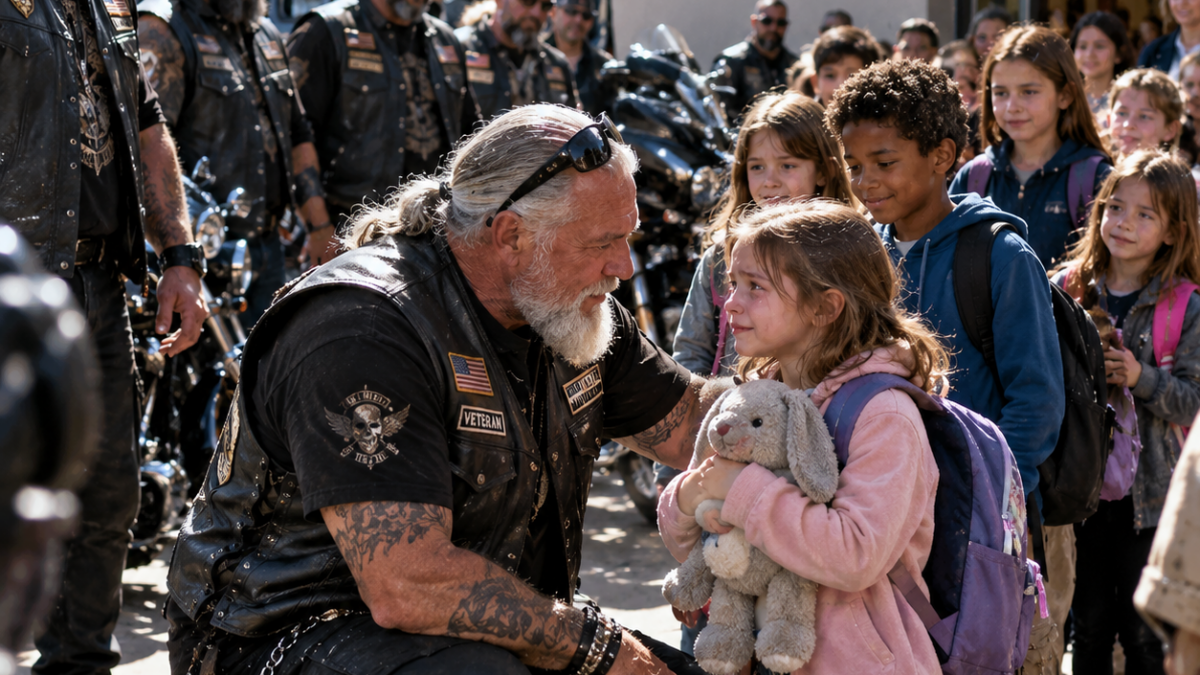
Little Emma sat with her stuffed rabbit pressed under her chin.
DeShawn stood at the back, arms crossed, expression hard enough to cut glass.
Marcus stepped forward.
“My name is Marcus. These are my brothers. We’re all veterans. We would like to take you on an adventure.”
Nobody spoke.
He continued.
“We have a camp ready. Food. Cabins. Horses. Counselors. Doctors. Clothes. We are asking you if you want to come with us for one week.”
Emma raised her hand.
Marcus turned to her like she had just asked a question in a military briefing.
“Yes, ma’am?”
“Are you gonna hurt us?”
The room cracked open.
Not visibly.
But every adult felt it.
That was the lesson these children had learned.
Unknown adults meant danger.
Kindness meant conditions.
Surprises meant prepare for impact.
Jackson lowered himself to one knee in front of Emma.
His old knees popped loudly enough that Carlos almost smiled.
“No, baby girl,” he said softly. “We are not going to hurt you. We are going to keep you safe. We want to take you to the Grand Canyon, put you on horses, feed you too much hot chocolate, and give you one good week. But only if you want to come.”
DeShawn spoke from the back.
“What happens if we say no?”
Jackson looked at him.
“Then we ride out, and you do not see us again.”
“You won’t make us?”
“No.”
“You won’t punish us?”
“No.”
“You won’t say we ruined it for everybody?”
“No.”
DeShawn studied him.
“You’re lying.”
Jackson did not flinch.
“Maybe life taught you to think that. But no, son, I am not lying.”
For a long moment, nobody moved.
Then Maya stood.
Twelve years old.
Too thin.
Too watchful.
A child who had learned to read danger before breakfast.
“I want to go,” she said. “I’ve never been anywhere.”
After that, they came one at a time.
Carlos.
Jasmine.
Aiden.
Twin brothers Leo and Luis.
Nine-year-old Tasha.
Fifteen-year-old Brianna, who pretended she was only going because the rest of them were helpless.
Emma came last, clutching her rabbit.
She walked to Jackson.
“Can Bunny come too?”
Jackson looked at the stuffed rabbit with military seriousness.
“Bunny appears mission-essential.”
Emma nodded.
“Then Bunny goes.”
Every one of them said yes.
All twenty-two.
Even DeShawn.
Patricia was still shouting into the office phone when we started loading.
We did not rush.
That mattered.
No grabbing.
No dragging.
No chaos.
Each child had a bag.
Each child had a designated adult.
The little ones rode in vans with seatbelts checked twice.
The older kids chose whether to ride in the buses or sit behind a biker for the short ceremonial stretch to the highway staging point.
Helmets.
Jackets.
Gloves.
Names checked off a roster.
Medication bags sealed and logged.
I signed every transfer sheet with a hand steadier than I felt.
At 6:38 a.m., we pulled away from Bright Futures.
Children pressed their faces to windows.
Some cried quietly.
Some laughed before they seemed to trust the sound.
DeShawn sat in the rear of the first van, arms crossed, trying very hard not to look impressed.
Fifteen miles past the county line, law enforcement caught us.
Six cruisers.
Full lights.
The lead patrol car swung sideways across the shoulder.
For a moment, every worst possible outcome stood in the road.
Armed officers.
Frightened children.
Bikers already judged by their vests.
A headline waiting to become permanent.
Jackson lifted one hand.
Every engine went silent.
That discipline saved us.
No revving.
No shouting.
No movement toward officers.
No hands near pockets.
Jackson walked alone to the lead officer carrying the binder.
I went with him.
The officer was Sergeant Luis Ortega.
I knew him from emergency placements years before.
He looked at me like he hoped I had a better explanation than the dispatcher did.
“Robert,” he said, “tell me this is not what it looks like.”
“It is not what it looks like.”
“The call said forty-seven bikers kidnapped twenty-two foster children and crossed state lines.”
“That is what Patricia said.”
“Is it true?”
“No.”
He looked past me at the vans.
Children stared back through the windows.
Some scared.
Some defiant.
Some pleading before anyone had asked them anything.
Jackson handed him the binder.
“Sergeant, consent forms, medical consents, itinerary, roster, emergency contacts, and custodial documentation. Mr. Chen is the licensed social worker attached to these cases. Every child was asked directly. Every child consented to the trip. No child was forced.”
Ortega opened the binder.
He flipped page after page.
His face changed slowly.
Not approval.
Not yet.
But the expression of a man realizing this was not chaos.
Behind us, Carlos slipped out of the van before anyone could stop him.
He was ten, small, and usually careful around police.
That morning, fear made him brave.
“Please don’t send us back,” he said.
Ortega looked down.
Carlos was crying now, but he kept talking.
“That place is bad. There’s bugs in the food. The showers don’t work right. Aiden got bit by something in his bed, and nobody cared. Please. We just want one good week.”
No officer training manual prepares a person for that.
Ortega looked at Carlos.
Then at the line of bikers.
Then at the children pressed against the windows.
Then at me.
“How long?”
“One week,” Jackson said. “They come back safe, fed, medically checked, and happy.”
Ortega closed the binder.
He looked at me first.
“You understand what you’re risking?”
“Yes.”
“You understand I should turn every vehicle around?”
“Yes.”
Then he looked at Jackson.
“If one of these kids gets a scratch, I will personally come looking for you.”
Jackson straightened.
“You have my word as a Marine.”
Ortega held his eyes for a long moment.
Then he handed the binder back.
“I never saw you.”
He pointed at me.
“And Robert?”
“Yes?”
“Make it count.”
We did.
The camp sat in northern Arizona beneath a wide clean sky that looked too big for children raised under fluorescent lights.
It had been strung with Christmas lights.
Not cheap blinking lights thrown up carelessly.
Good lights.
Warm lights.
Wrapped around porch rails, cabin posts, and the dining hall entrance.
Someone had painted welcome signs with each child’s name.
Not “Welcome Foster Kids.”
Names.
Welcome, Emma.
Welcome, DeShawn.
Welcome, Maya.
Welcome, Carlos.
Twenty-two signs.
Twenty-two beds made with fresh sheets.
Twenty-two backpacks waiting on bunks with toiletries, socks, notebooks, flashlights, and stuffed animals for the younger ones.
The dining hall smelled like chili, cornbread, cocoa, and cinnamon rolls.
For a while, the kids just stood there.
Children who have not been given much do not always know how to receive.
Aiden whispered, “Which beds are ours?”
Marcus pointed toward the cabin list.
“You pick.”
“All week?”
“All week.”
“No one else is coming to take it?”
“No one.”
Aiden walked into the cabin slowly and put one hand on a bunk like he was checking whether it was real.
Emma climbed onto Jackson’s lap the first night during dinner.
She had known him less than twelve hours.
Somehow, she had chosen.
“Is this heaven?” she whispered.
Jackson’s eyes filled.
“No, baby girl,” he said. “But it is pretty close.”
The next seven days ran on something close to magic.
Not perfect magic.
Real magic.
The kind with panic attacks, nightmares, tantrums, medication schedules, spilled juice, trust issues, and one teenager trying to run away on day two because happiness scared him more than misery.
That was DeShawn.
Marcus found him half a mile down the dirt road.
He did not shout.
Did not grab him.
Did not threaten consequences.
He just walked beside him.
For forty minutes, neither said a word.
Finally, DeShawn said, “If I leave first, nobody gets to send me away.”
Marcus answered, “That makes sense.”
DeShawn stopped.
“You’re supposed to say it doesn’t.”
“I’m not here to argue with what kept you alive.”
That was the first crack in DeShawn’s armor.
Not the last.
They rode horses.
They fished.
They hiked.
They sat at the canyon rim wrapped in donated coats, staring into red stone and silence older than any file written about them.
Some cried.
Some got bored after five minutes and asked about lunch.
Both reactions were allowed.
That mattered too.
The bikers did not demand gratitude.
They did not force the children to perform healing.
They did not say, “Look at all we did for you.”
They simply stayed.
Presence.
That was the thing no program had managed to budget properly.
Every biker spent hours with the child assigned to him.
No phones.
No distractions.
No checking out when the conversation got hard.
DeShawn told Marcus about the night his mother overdosed.
Marcus listened.
Maya finally told Jackson about the uncle who hurt her and the aunt who called her a liar because truth would have made the family inconvenient.
Jackson listened.
Carlos drew pictures of his father, who had died in a work accident.
A biker named Tom sat beside him and let the boy talk until his voice gave out.
Jasmine yelled at Sarge for thirty minutes because she did not believe adults who said they cared.
Sarge stood there and took it.
When she finally ran out of words, he handed her a bottle of water.
“You done for now?”
She glared at him.
“For now.”
“Good. Dinner’s in ten.”
She stared.
“That’s it?”
“That’s it.”
“You’re not mad?”
“I’ve been yelled at by drill instructors and three ex-wives. You need better material.”
Jasmine laughed despite herself.
The doctors ran checkups.
Every child needed something.
Dental work.
Glasses.
Vaccines.
Prescription refills.
Skin treatments.
Inhalers.
A proper evaluation for chronic pain.
Twelve needed glasses.
Three had prescriptions that had not been filled consistently.
Six had dental issues that should have been addressed months earlier.
DeShawn had six cavities and an infected molar that had been hurting for nearly a year.
Emma needed glasses so badly that when she put them on, she stood completely still.
Then she whispered, “Trees have edges.”
The retired pediatrician turned away so no one would see his face.
By day five, the press found us.
A helicopter appeared first.
Then reporters at the front gate.
Then the headline that would have ruined us if the children had not been alive, safe, fed, and brave enough to speak.
BIKERS KIDNAP FOSTER KIDS.
The story ran before facts could catch their breath.
Patricia gave an interview in front of Bright Futures, crying about unauthorized removal and endangered minors.
A state spokesperson said the department was investigating.
The internet did what the internet does.
Some people demanded arrests.
Some people called us heroes.
Most people knew nothing and felt strongly anyway.
Jackson watched the news in silence.
Then he stood.
“Bring the kids out.”
I said, “Jackson, no.”
“They get to decide.”
“They’re children.”
“They’re the ones everybody’s talking about.”
That stopped me.
He was right.
Again.
We asked them.
Not ordered.
Asked.
All twenty-two wanted to stand outside.
Some wanted to speak.
Some did not.
Both were allowed.
Jackson faced the cameras first.
He wore his vest, his white beard moving slightly in the cold wind.
Behind him stood twenty-two children in warm coats.
Some held cocoa.
Emma wore her new glasses.
DeShawn stood beside Marcus, jaw tight, dental receipt in one hand.
“You want a story?” Jackson said. “Here’s your story. These children were left to rot by a system that was supposed to protect them. We gave them seven days of safety, medical care, food, clean beds, and adults who did not walk away. You tell me who the criminals are.”
Reporters shouted questions.
Jackson ignored most of them.
Then Emma stepped forward.
She held up her glasses.
“I can see now,” she said.
Her voice was tiny, but microphones catch what matters.
“Nobody got me glasses before.”
The shouting stopped.
DeShawn stepped forward next.
He held up his dental paperwork.
“I had six cavities,” he said. “Been hurting for a year. They got me to a dentist in two days.”
He looked straight into the nearest camera.
“You keep saying they kidnapped us. Ask us if we wanted to go back.”
A reporter asked softly, “Did you?”
DeShawn laughed once.
It was not a happy sound.
“No.”
By morning, the narrative had turned inside out.
Not completely.
Stories never reverse cleanly.
But enough.
The public started asking different questions.
Why had Bright Futures stayed open?
Why had medical neglect gone unnoticed?
Why had it taken bikers to get children dental care?
Why had a group home under state oversight deteriorated to that level?
Donations began pouring in.
Coats.
Money.
Food.
Offers from dentists, doctors, attorneys, foster families, churches, veteran groups, therapists.
The governor’s office got involved by noon.
Inspectors arrived at Bright Futures by afternoon.
By the end of the week, the building was shut down.
Patricia lost her job.
An investigation opened into administrative neglect, funding misuse, and oversight failures.
The state suspended me before I made it back to Nevada.
That was fair.
I had known the cost.
But the best part came after the headlines.
Real families started calling.
Not savior fantasies.
Not people chasing a news story for attention.
Families who had watched the children speak and realized they were not case files.
They were children.
Within three months, eighteen of the twenty-two were in loving homes.
Not perfect homes.
Perfect is not real.
But stable homes.
Homes with working locks, dentist appointments, school clothes, bedtime routines, and adults who showed up the next morning.
DeShawn went home with Marcus and his wife, Evelyn.
They had lost their only son in Afghanistan.
For years, Marcus told people he was done raising children.
Then DeShawn sat beside him at the canyon rim and said, “I don’t know how to be somebody’s son.”
Marcus answered, “That’s fine. I don’t know how to be your father yet either. We can learn.”
They did.
It was ugly at first.
Healing often is.
DeShawn tested every boundary.
Marcus held.
DeShawn cursed him.
Marcus held.
DeShawn packed a bag three times.
Marcus sat on the porch every time and waited.
Eventually, DeShawn stopped packing.
Emma went home with Jackson and his wife, Ruth.
A seventy-year-old Marine and his wife adopted a six-year-old girl because Ruth said she had looked at Emma’s face on television and understood there was no version of their future that did not include her.
The first week, Emma slept with the light on.
The second week, she asked if she could call Jackson “sir.”
He told her, “Only if I can call you ma’am.”
By the third month, she called him Grandpa Jack.
By the sixth, Dad slipped out by accident.
Nobody corrected it.
The four oldest kids aged out before anyone came for them.
That part still hurts.
The club did not drop them.
They set up scholarship funds.
Apartments.
Trade school connections.
Job leads.
Emergency phone lists.
Every Sunday, Desert Storm Veterans MC hosted dinner for any of the twenty-two who wanted to come.
Some came every week.
Some came once a month.
Some disappeared for a while and returned ashamed.
Nobody scolded them.
Jackson always said, “Door’s open.”
I lost my job.
Officially, the reason was gross violation of protocol, unauthorized interstate transport of state wards, and endangerment of minors.
Unofficially, it was because I had made the department look exactly as negligent as it had been.
They held a hearing.
I sat in a beige room while three administrators explained all the things I should have done instead.
Escalated internally.
Requested emergency review.
Documented concerns.
Filed supervisory complaints.
I had done all of those things.
They knew I had.
Everyone in that room knew the machine had been warned, fed paper, and given time.
The machine had responded by continuing to be a machine.
When they asked whether I regretted my actions, I said, “I regret that it took forty-seven bikers to do what this department should have done.”
That ended the meeting quickly.
I lost my position.
I kept my license after a disciplinary review, though with restrictions and a formal reprimand.
I took a job with a nonprofit six months later.
Less pay.
More freedom.
Better coffee.
I do not regret a minute of it.
People ask whether I would do it again.
That is the wrong question.
The right question is why it had to happen that way at all.
Why twenty-two children had to become a scandal before they became visible.
Why mold and rats mattered less when only caseworkers knew.
Why glasses appeared after cameras.
Why dental pain became urgent only when a teenager held a receipt on television.
Why “protocol” moved faster to punish me than it had to close Bright Futures.
I still believe systems matter.
I have to.
Without systems, vulnerable children are at the mercy of whoever feels heroic that day.
That is dangerous.
But systems without courage become storage units for suffering.
Rules are supposed to protect children.
When rules become excuses to leave them in harm, something has already broken.
Jackson died last year.
Heart attack.
Fast.
At home.
Ruth said he had been making pancakes for Emma when he stopped mid-sentence and sat down like he was tired.
By the time the ambulance arrived, he was gone.
The funeral was held in the largest church in town, and it still was not big enough.
Veterans came.
Bikers came.
Foster families came.
Social workers came, including some who had once signed my disciplinary paperwork and now could not meet my eyes.
All twenty-two children came.
Some were grown.
Some still carried childhood in their faces.
Every one of them wore a patch that read:
HONORARY MEMBER.
DeShawn gave the eulogy.
He stood at the front in a black vest, shoulders broad now, voice steady until it wasn’t.
“Jackson and his brothers taught me that family does not come from blood,” he said. “Family is who shows up. Who fights for you. Who loves you when nobody else is willing.”
He lifted the edge of his vest.
“I’m a biker now. Not because of the bike. Because I finally learned what brotherhood is.”
Emma sang Amazing Grace.
She was ten then, standing beside Ruth, wearing a blue dress and the glasses Jackson used to polish with the corner of his shirt.
Ruth had put her in voice lessons after discovering the child who once whispered in group-home hallways had a voice that could fill a church.
When Emma sang, every biker in that room lowered his head.
Even Marcus cried.
He denied it later.
Nobody believed him.
After the service, we rode.
Not because Jackson needed noise.
Because he had spent his life gathering men who did not know how to say goodbye unless engines carried part of the grief.
The twenty-two rode in the front vehicles.
No child left behind.
No file closed quietly.
No bed empty without someone noticing.
I rode behind Marcus, the wind hard against my face, the desert opening wide around us.
For a moment, I was back on that morning outside Bright Futures.
The kids at the windows.
The bikes in the street.
The police lights fifteen miles later.
Carlos crying, Please don’t send us back.
I used to wonder whether I had done the right thing.
Not because of the outcome.
Because outcomes can trick you.
A reckless act that ends well is still reckless.
A rule broken for good reasons can still teach dangerous lessons.
I have spent years holding both truths.
We should not live in a world where bikers have to extract children from state care to get them medical treatment.
We should not praise chaos as policy.
We should not build systems so weak that the only way to save children is to risk becoming a headline.
But when I think of Emma seeing leaves clearly for the first time through new glasses, when I think of DeShawn sleeping through the night on Marcus’s porch because he finally believed nobody would move him before morning, when I think of Maya placing both hands on a horse’s neck and whispering things she had never told a therapist, I know this much:
Those children needed adults to stop waiting for permission to care.
And forty-seven bikers did.
Not perfectly.
Not legally enough to satisfy every form.
Not safely enough to make any administrator comfortable.
But with more preparation, accountability, and love than Bright Futures had managed in years.
The headline said we kidnapped them.
The children said we brought them back to life.
I know which version I believe.
Years later, I still keep a photograph on my desk.
Twenty-two kids at the Grand Canyon.
Wind in their hair.
Jackson kneeling in the center with Emma on one knee and Carlos leaning against his shoulder.
Marcus standing behind DeShawn, not touching him, just close enough that the boy knew he could.
The desert behind them looked impossible.
Wide.
Beautiful.
Uncaged.
On the back of the photo, Jackson wrote one sentence before he died.
One good week can teach a child the world is bigger than the room that hurt them.
That was what we gave them.
One good week.
Then the world finally had to answer for the years it took away.








