3 Families Returned This Retired K9—Until a Nurse Read His Collar and Whispered, “I Remember You”
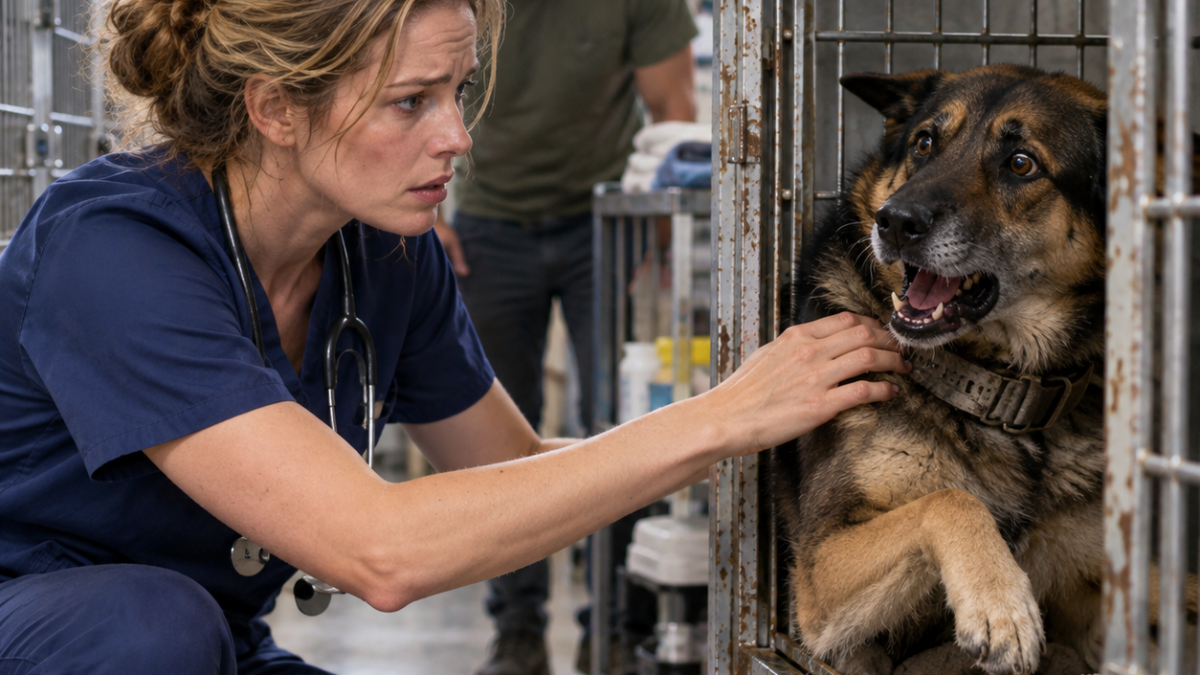
PART2:
The German Shepherd was bigger than she had expected up close. Not young-big, not soft-big. Working-big. Built under the coat like a structure that had survived weather. Gray gathered around his muzzle and above his eyes. His paws were large and scarred along the knuckles. A full water bowl sat near the wall. His food was almost untouched.
Around his neck was an old dark leather collar.
Not hospital issue.
Not program issue.
Too worn for that.
A scratched metal plate sat half-hidden beneath the thick fur at his throat.
“What did he do?” Emily asked.
Mark turned from the board.
“What?”
“The family. Why did they bring him back?”
Mark exhaled.
“Wouldn’t let the husband touch him. Wouldn’t take food. Ignored every command except down. Spent half the visit blocking doorways.”
“Bite?”
“No.”
“Snap?”
“No.”
“Growl?”
“No.”
Mark looked at her.
“He doesn’t have to hurt somebody to be wrong for a home.”
Emily did not argue.
That was true.
A dog could be unsafe without drawing blood. A home could be wrong without anyone being cruel. A return could be necessary and still break something.
Months out of military service, Rook had been placed through the hospital’s partner program with families prepared to give a retired working dog a quiet life. Three times, he had come back.
Mark tapped the paperwork against his leg.
“People want a dog they can live with. Rook acts like he’s still waiting for orders nobody’s giving him.”
“Rook?” Emily repeated.
“Program name. Easier for placement.”
Emily looked again at the old collar.
At the plate.
Mark followed her gaze.
“Came with him,” he said. “Records aren’t clear.”
The shepherd lifted his head.
The collar shifted.
Fluorescent light crossed the scratched metal, exposing one word before the fur settled over it again.
Wraith.
Emily read it silently first.
Then once aloud.
“Wraith.”
The shepherd’s eyes found hers.
Not fast.
Not eager.
But something changed.
A thin line of attention moved through him like current through wire.
Mark glanced from Emily to the dog.
“Old service name, call sign, maybe. Like I said, records aren’t clear. We kept Rook for the placement file.”
Emily kept looking at the collar.
Whatever Wraith had once meant, the dog carrying the name had already been returned by three families who wanted nothing more from him.
A sound came from the hallway behind them.
Wheels whispering against polished floor.
A rehabilitation aide was pushing a veteran past the kennel, one leg elevated beneath a gray blanket. The man in the wheelchair wore a faded Marine Corps sweatshirt and had both hands resting loosely on the chair arms, but his right hand twitched once when the wheel squeaked.
Rook changed instantly.
His ears lifted.
His head came up.
Before the wheelchair reached the kennel doorway, he was standing.
He moved to the front of the enclosure and angled his body between the passing veteran and the open corridor behind him.
No growl.
No bark.
No teeth.
Silent.
Balanced.
Watching.
The veteran passed.
Rook held position until the wheelchair disappeared around the corner.
Only then did he step back, turn once, and return to the same place on the concrete where he could see the rehabilitation wing doors.
Emily’s coffee stopped halfway to her mouth.
Mark was already looking at his paperwork.
“When does he leave?” she asked.
“Transport review Monday morning.”
“Transport where?”
“Regional holding facility.”
Emily looked at the dog again.
“And after that?”
Mark’s jaw moved slightly.
“That depends.”
It was an honest answer.
That made it worse.
“Can that move?”
“Not without something measurable in his file.”
Emily set her coffee on the counter.
“How long do I have?”
Mark studied her.
“Until tomorrow afternoon.”
“Give me that.”
“For what?”
“To watch him before somebody asks him for something.”
Mark’s expression tightened.
“Three families already watched him.”
“No,” Emily said. “They tried to take him home.”
She crouched.
Rook’s shoulders tightened immediately.
Emily stopped.
She did not finish lowering herself toward him. She did not reach through the gate. She did not soften her voice and keep moving as if good intentions gave her permission to ignore the warning in his body.
Instead, she sat on the floor several feet from the gate, turned her body sideways, and rested her hands loosely in her lap.
Mark frowned.
“What are you doing?”
“Watching from the floor.”
“Why?”
“He noticed me crouch, so I stopped.”
The ventilation system breathed overhead. Somewhere farther down the hall, metal instruments rattled inside a cart. Rook shifted. His collar gave a faint metallic click.
Emily did not look directly at the plate again.
“Every family walks straight up to him,” she said.
“That’s usually how introductions work.”
“And every time he backs away.”
“He’s trained,” Mark said. “Commands should give him structure.”
“He heard them.”
“He ignored them.”
Emily watched Rook’s reflection in the kennel glass instead of turning toward him.
“He didn’t ignore the room.”
Mark’s expression changed just slightly.
Rook’s attention moved with every sound from the rehabilitation wing.
Wheelchairs.
Uneven footsteps.
Doors opening.
Doors closing.
The distant beep of a monitor.
The rubber tip of a cane.
The scrape of a walker.
Not the food.
Not the toys.
Not the people trying to take him home.
The corridor.
The patients.
The vulnerable motion passing through doorways.
Emily waited.
After nearly a minute, Rook’s shoulders lowered.
He stepped back once, then settled onto the concrete while she remained on the floor outside the gate.
His eyes stayed on the doorway.
Mark glanced at the clock.
“Tomorrow afternoon doesn’t move.”
“I know.”
“Then whatever you think you’re seeing, find it fast.”
He walked toward the office.
Emily remained on the floor.
Rook’s breathing slowly evened out.
Then a cane tapped against the hallway tile.
Once.
Twice.
Before the veteran carrying it reached the kennel, Rook was on his feet again.
He moved forward, turned sideways, and placed himself between the injured man and the open doorway.
The veteran passed.
Rook held position until the sound of the cane faded down the corridor.
Then he looked once at Emily.
She looked at the scratched plate beneath his throat.
Wraith.
Three families had seen a dog who would not settle into a home.
Mark had seen a retired K9 waiting for orders nobody was giving him.
Emily finally understood what everyone else had called refusal.
Rook was not waiting to be taken home.
He was still guarding someone.
The transfer order was waiting when Emily returned for her next shift.
Mark set Rook’s file on the counter between them.
“Monday, eight hundred hours.”
Through the kennel window, the shepherd was standing exactly where Emily had left him, watching an older veteran work his way down the corridor with a walker.
Click.
Step.
Click.
Step.
Rook’s ears tracked every uneven movement.
The scratched plate beneath his collar stayed mostly hidden, but Emily no longer needed to see it to remember the name engraved there.
Wraith.
“Final behavior notes are due tomorrow afternoon,” Mark said.
Emily kept watching the dog.
“Give me until then.”
“For what?”
“To find out whether he’s refusing people or refusing what people keep asking him to become.”
Mark rubbed one hand across his jaw.
“Three placements failed. Emily, I can delay paperwork. I can’t invent a reason to keep him here.”
“Don’t invent one.”
She slid the file back toward him.
“Let him give us one.”
Mark studied her.
He was not an unkind man. That was why the file weighed on him. Cruel people did not lose sleep over transfer forms. But Mark had spent years trying to make hard decisions before hope made them messier. He knew how quickly people projected meaning onto military dogs. Every scar became a heroic mission. Every stare became loyalty. Every hesitation became trauma. People wanted stories. Programs needed documentation.
A dog could not survive on sentiment.
But sometimes a dog could be destroyed by the absence of it.
Mark pulled the transfer sheet from the folder and left it unsigned.
“Tomorrow afternoon,” he said. “I need something measurable.”
“Fair.”
Emily went back to work.
She changed dressings, checked vitals, helped a patient through a panic spike after a tray crashed in the medication room, called respiratory therapy twice, argued with a printer, found an extra blanket for a retired Army mechanic who insisted he was not cold while visibly shivering, and drank exactly three swallows of coffee before it became too bitter to justify.
On every break, she returned to Rook’s kennel and changed almost nothing.
Same chair.
Same distance.
Same quiet warning before the outer door opened.
No reaching through the gate.
No repeated commands.
No treats held between her fingers like a bargain.
When a rehabilitation aide suggested calling Rook over, Emily shook her head.
“Leave him an exit.”
“You want him to do nothing?”
“I want to see what he does when nobody pushes him.”
For the first ten minutes, Rook stayed near the rear wall.
His food remained untouched.
Emily opened a patient chart and read while sitting sideways outside the gate. Afternoon light stretched across the concrete, catching dust in the air. Rook watched the corridor, not her.
A wheelchair passed outside.
His head lifted.
A supply cart followed.
One ear turned.
Then a veteran with a cane paused near the drinking fountain.
Rook stood until the man moved on.
Emily wrote down the time.
Nothing else.
Twenty minutes passed before claws scraped softly against the floor.
Emily did not look up.
Rook approached the bowl, stopped, looked at her, then ate.
A few mouthfuls at first.
Then more.
Emily marked the distance between them and the time he began.
When Mark read the sheet later, he frowned.
“Eating with you six feet away doesn’t make him placement-ready.”
“No.”
“Then what did we learn?”
Emily glanced through the glass.
“He eats when nobody asks him for anything.”
“That could mean a dozen things.”
“It could.” She tapped the observation sheet. “But now it’s something we can test instead of something we assume.”
Mark looked at the notes again.
Wheelchair.
Cart.
Cane.
Food.
Distance.
He sighed.
“Tomorrow morning, inside the enclosure.”
“I stay at the gate,” Emily said.
“His choice whether you get close.”
She nodded.
“Exactly.”
The next morning, the air inside Rook’s enclosure smelled of damp fur and floor antiseptic.
Mark remained beyond the gate while Emily placed Rook’s bowl on the concrete and stepped away. She did not call him. She did not use his program name. She did not say Wraith either, though the old name rested in her mind with surprising weight.
Rook waited forty seconds before approaching.
He ate.
When he finished, he stayed within several feet of her instead of retreating to the rear wall.
Emily noticed the change.
She did not reward it with movement.
That restraint was harder than it looked.
Humans liked to claim progress. They liked to mark it with touch, praise, a happy voice, a sudden hand extended toward the very creature who had just risked coming closer. Emily had seen it in patients too. Someone took one step after surgery, and the room burst into applause. Someone spoke after days of silence, and ten people leaned in. Sometimes the attention felt like love. Sometimes it felt like pressure wearing a better coat.
Emily waited.
Rook looked toward the corridor, then back at her.
The old leather collar had twisted against his neck, the buckle pressing crookedly into the thick fur. Emily raised one hand slowly, not to grab him, just to straighten it.
Rook exploded backward.
The metal bowl shot across the concrete with a violent scrape. His hindquarter struck the wall. His body locked rigid, eyes fixed not on Emily’s face, but on her hand.
Mark’s fingers closed around the gate latch.
“Emily, stay there.”
She lowered her hand immediately.
Then she stepped sideways, clearing Rook’s path to the doorway.
“I’m backing off.”
No command.
No soothing touch.
No second attempt.
Rook’s chest moved fast beneath his coat.
Emily kept her hands visible and waited.
Five seconds.
Ten.
The shepherd shifted sideways, not deeper into the kennel, but toward the corridor.
His shoulder turned toward the doorway.
His eyes went back to the veteran’s wing.
Even frightened, he had returned to the same position.
Emily looked at the collar.
The leather had shifted enough to expose part of the scratched plate.
Raw.
Then fur covered it again.
She knew the word.
What she did not know was why a hand moving toward that collar frightened him more than a stranger sitting inside his enclosure.
“Write that down,” she said.
Mark released the latch.
“What exactly?”
“He ate with me inside. He stayed near me after he finished. He didn’t react when I moved around the enclosure.”
Emily kept her eyes on Rook.
“The reaction started when my hand moved toward the collar.”
Mark looked at the worn leather.
“Which makes him harder to place.”
“Maybe.”
“Maybe?”
Emily picked up the observation sheet from the floor.
“Hard to place describes our problem. It doesn’t explain his.”
Mark was quiet.
Rook’s breathing slowed.
A walker clicked somewhere beyond the glass.
His ears turned immediately toward it.
His body followed.
Emily added one more note to the sheet.
Mark watched her write.
“You still think the doorway matters more than the collar?”
“I think they’re two different questions.”
“Which one comes first?”
Emily looked through the kennel window toward the rehabilitation wing. An elderly veteran was moving slowly past with an aide beside him. Rook tracked every step.
“The one he keeps answering.”
Mark followed her gaze.
For the first time, he did not look at the dog’s untouched toys, the placement form, or the handling notes.
He watched where Rook was watching.
The veteran reached the end of the corridor.
Only then did the shepherd settle.
Mark left the transfer form unsigned on the counter.
“Tomorrow,” he said, “show me what he’s watching for.”
Emily looked at Rook.
Yesterday, everyone had been asking why the retired K9 would not become somebody’s dog.
Now, Mark had finally asked what Rook was still trying to do.
The next morning, Mark was waiting outside Rook’s enclosure with the observation sheet folded beneath his arm.
He did not touch the gate.
“You said he’s watching for something,” he said. “Show me.”
Emily looked through the glass.
Rook was already awake, standing where the kennel corridor opened toward the rehabilitation wing. His body faced the doorway. His eyes tracked movement beyond it.
“Not in here,” she said.
Mark’s eyebrows lifted.
“You want him out?”
“Controlled room. No handling test. No placement commands unless safety requires one. We watch what he chooses when there’s something real to respond to.”
Mark checked the wall clock.
“Fifteen minutes.”
Twenty minutes later, Rook entered a small rehabilitation room on a loose lead held by Mark.
Warm sunlight cut across the rubber flooring. Parallel bars ran along one wall, polished by use. The room smelled faintly of disinfectant, vinyl padding, and the particular kind of effort that lived in rehab spaces: sweat, antiseptic, metal, fear, stubbornness.
Rook ignored the equipment.
His attention locked onto Daniel Price.
Daniel was twenty-six, a Marine, and still young enough that the gray shadow under his eyes looked like an insult life had no right to give him. He was halfway between the parallel bars, moving carefully on forearm crutches. Before each difficult step, he tugged once at the strap around his right wrist, shifted his weight, then moved.
Rook watched every adjustment.
Daniel glanced over.
“That the dog nobody wants?”
“That’s the one,” Mark said.
Emily stayed near the wall.
Daniel looked from Rook to Emily.
“What am I supposed to do?”
“What you were already doing.”
“That’s it?”
“That’s it.”
Daniel looked at Rook once more, then returned to the bars.
Mark let the lead hang loose.
Out of habit, he said, “Rook, sit.”
One of Rook’s ears turned toward him.
Nothing else did.
Mark glanced at Emily.
She raised one hand.
“Wait.”
Daniel reached the end of the bars and began his turn. His right crutch planted slightly wider than the left. He corrected it. Behind him, an aide pulled a stainless steel tray from a supply cart. The edge caught.
Metal struck tile with a sharp crash.
Daniel flinched.
His right crutch slipped several inches.
Rook moved before anyone said his name.
He crossed the room fast.
Not toward the fallen tray.
Not toward the aide.
Toward Daniel.
He stopped beside the Marine and angled his body between Daniel and the open doorway.
No bark.
No growl.
Silent.
Balanced.
Watching.
Daniel froze with both hands locked around the crutches.
Mark began gathering the loose lead.
“Don’t,” Emily said.
He stopped.
Rook was not pulling toward the noise.
He was not looking at the tray at all.
His eyes moved from Daniel’s unstable stance to the open doorway, then back to Daniel.
Emily kept her voice level.
“Daniel, you steady?”
He tested the rubber tip of his right crutch against the floor.
“Give me a second.”
“Take it.”
Daniel breathed out.
His fingers found the wrist strap.
One tug.
He reset the crutch himself.
“Okay.”
Emily did not tell him to move.
Daniel made that decision.
He shifted his left foot and completed the turn.
Rook moved with him.
Daniel took another step.
The shepherd matched it, close enough to respond, far enough not to touch him.
Step.
Pause.
Step.
By the third, Daniel’s grip had loosened.
By the fifth, he was looking ahead instead of down.
The fallen tray remained behind them.
Rook never looked back at it.
He stayed beside Daniel until the Marine reached the chair and lowered himself into it.
Only then did Rook step away.
Mark stared at the slack lead in his hand.
“He heard the crash.”
“Yes,” Emily said.
“But he didn’t go after it.”
“No.”
Mark looked toward Daniel.
“He went to him.”
Daniel rested the crutches against his knees.
“Felt like he knew I was off balance before I did.”
Emily did not answer for Rook.
She did not need to.
Mark looked down at the command section of his observation sheet.
Sit: no response.
Then at Daniel.
Then at Rook.
“He still ignored the command.”
Emily nodded.
“Yes.”
“And chose this instead.”
“Yes.”
The answer landed differently when Mark said it himself.
Rook stood near the center of the room, positioned where he could see Daniel, Emily, Mark, and the corridor at once.
“That doesn’t make him ready for somebody’s living room,” Mark said.
“No.”
Emily looked at the same doorway.
“Maybe that’s not the question anymore.”
Silence settled over the room.
Daniel rubbed his thumb once across the wrist strap.
“Can I try another pass?”
Mark looked at him.
“You don’t have to prove anything for the dog.”
“I know.”
Daniel set the crutches beneath his arms.
“I want to see what he does.”
Emily stepped farther back.
“Then it’s your session.”
Daniel stood.
No tray fell this time.
No one called Rook.
Daniel moved between the bars at his normal pace.
One step.
Two.
Rook watched from the center of the room.
Daniel reached the first difficult turn.
His shoulders tightened.
His thumb caught the wrist strap.
Rook stood.
He crossed the room and stopped several feet away.
Daniel saw him, took one breath, reset his right crutch, and continued.
Rook followed.
Mark’s eyes dropped to the observation sheet.
This time, when his pen moved, he did not write beneath the command section.
He drew a single line through placement evaluation.
Beneath it, he wrote functional behavior assessment.
Daniel reached the chair and sat.
“So what happens now?” he asked.
Mark looked at the new heading.
“One supervised session tomorrow. We document what he does without pretending we already know what it means.”
Emily nodded.
“You approve the canine protocol.”
Mark looked at Daniel.
“And you participate only if you want to.”
Daniel tightened the wrist strap once, then released it.
“I’ll do it.”
Mark handed Emily the sheet.
Two days earlier, everyone had measured Rook by the commands he ignored, the hands he avoided, and the homes he could not fit into.
Now, the first measurable thing in his favor had come from a decision nobody had ordered him to make.
The dog nobody wanted had not forgotten how to work.
Everyone had simply been asking him to stop.
The next afternoon, Mark stayed against the wall with his clipboard and let the lead hang loose.
Daniel sat beside the parallel bars, one forearm crutch across his knees, thumb brushing once across the strap at his right wrist.
Rook waited near the doorway.
“Same thing as yesterday?” Daniel asked.
Emily shook her head.
“Yesterday we watched what he did when you lost balance. Today we find out what happens when nothing goes wrong.”
Daniel glanced at Rook.
“What do I do?”
“Your normal session. Don’t perform for him.”
“And him?”
“We give him the same deal.”
Emily took a chair several feet away and sat.
Mark wrote the time at the top of the assessment sheet.
No command followed.
Daniel stood.
His sneakers gave a soft squeak against the rubber floor as he entered the parallel bars. The first steps were controlled. Rook remained at the doorway.
Daniel reached the turn.
His shoulders tightened.
His right hand closed harder around the rail.
His thumb caught the wrist strap.
Emily saw it.
So did Rook.
“Pause,” she said.
Daniel’s jaw tightened.
“I’m fine.”
“I know.”
Emily stayed in her chair.
“Take one breath before you decide what comes next.”
Daniel drew air through his nose and released it slowly.
Across the room, Rook’s ears shifted.
Daniel’s shoulders dropped half an inch.
Rook left the doorway.
He crossed the room without looking at Emily or Mark and lowered himself several feet from the bars.
Daniel noticed him.
Emily said nothing.
Another breath.
Longer this time.
Rook’s chest rose and fell against the mat.
Daniel watched once, then exhaled.
Not perfectly with the dog.
Close enough.
He adjusted his grip and moved.
Step.
Pause.
Breathe.
Rook stood when Daniel advanced.
When Daniel stopped, the shepherd settled again.
On the second pass, Emily gave only one reminder.
On the third, none.
Daniel reached the difficult turn, felt his shoulders rise, and stopped himself.
Breathe.
Reset.
Step.
Rook remained beside the bars.
By the fourth pass, Daniel was no longer looking toward Emily at all.
Mark lowered his clipboard.
“He’s pacing himself off the dog.”
Emily kept her voice quiet.
“For now. We don’t want dependence. I want Daniel to own the rhythm eventually.”
Daniel heard her at the chair.
He lowered himself carefully and wiped his forehead with the back of his wrist.
“You think I’m going to depend on him?”
Emily looked at him.
“I think anything useful should leave you with more choices, not fewer.”
Daniel considered that.
Then he looked toward the far end of the bars.
His thumb touched the wrist strap once.
“One more.”
Emily did not answer.
Neither did Mark.
Daniel stood because he had decided to.
This time, Rook stayed where he was.
Daniel took the first step alone.
Then the second.
His shoulders tightened before the turn.
He paused.
One breath.
Reset.
Another step.
Rook watched from several feet away.
Daniel completed the turn.
Only then did the shepherd rise and follow, keeping distance between them.
Mark’s pen moved across the sheet.
Daniel reached the chair and sat. His breathing was heavier now, but controlled.
He looked at Rook and smiled faintly.
“You made me do that one myself.”
Rook settled near the bars.
Emily said, “Maybe he knew you could.”
Daniel looked at her.
“Or maybe he’s a dog.”
A smile touched Emily’s face.
“Also possible.”
Mark almost laughed.
Instead, he looked down at what he had written.
“That gives me something usable.”
“What?” Daniel asked.
Mark read from the sheet.
“Spontaneous proximity during increased patient tension. Maintains distance. No physical interference. Disengages when support isn’t required.”
Emily looked at him.
“Keep that last one.”
Mark nodded and underlined it once.
Daniel left with an aide a few minutes later.
Mark opened the therapy room door.
“Come on, Rook.”
One ear turned toward him.
The shepherd stayed beside the empty chair Daniel had just left.
Mark waited instead of repeating himself immediately.
Emily noticed.
Then Rook lowered his head and pushed his muzzle beneath the old leather collar.
Once again, the strap had twisted against his neck.
Beneath its worn edge, the scratched plate caught a blade of afternoon light.
Wraith.
Then it disappeared beneath his fur.
Emily already knew the name.
What she still did not know was why the collar itself seemed to carry a different kind of weight.
Rook rubbed at it again.
Mark shortened his grip on the loose lead.
“We need the room in ten minutes.”
“Don’t pull him.”
Mark looked at the collar.
“If something under there is hurting him, we can’t ignore it.”
“Agreed.”
Emily stepped back inside, then stopped before Rook’s shoulders could tighten.
“But the last time I reached for it, he hit the wall trying to get away.”
Mark loosened his grip again.
“So what do you want to do?”
Emily watched Rook press his muzzle beneath the leather.
“Find out whether he wants help before we decide he needs handling.”
Mark glanced at the clock.
“Five minutes.”
He stepped into the hallway.
This time, he did not call Rook again.
Emily lowered herself to the rubber floor and turned slightly sideways, the same position she had taken outside his kennel days earlier. She placed one open hand on the mat between them.
No command.
No reach.
No treat.
Rook looked at her palm, then toward the doorway.
The ventilation fan whispered overhead.
In the hall, Mark’s pen stopped clicking.
Rook looked back at Emily.
She left her hand exactly where it was.
A few days earlier, everyone had measured him by whether he would surrender control when a stranger reached for him.
Emily had started measuring something else.
What he did when control remained his.
Rook took one step toward her, then stopped.
Emily did not move.
Until now, she had learned about him by watching what he chose to protect.
The collar was different.
If he wanted her to understand anything about it, the next move had to be his.
Rook stared at Emily’s open hand for so long that the room seemed to settle around them.
Somewhere beyond the half-open door, rubber wheels crossed the tile and faded down the corridor.
Emily did not move.
Neither did Mark.
Rook pressed his muzzle beneath the old collar again, then looked at her.
“I’m not taking it,” Emily said quietly.
One ear shifted toward her voice.
Rook stepped closer.
Stopped.
Another step brought him within reach.
Emily resisted the instinct to meet him halfway.
His nose touched her fingertips.
Warm breath crossed her skin.
Then he pulled back.
She stayed exactly where she was.
A few seconds passed.
Rook approached again.
This time, he lowered his head until the side of his muzzle rested against her palm.
The weight surprised her more than the contact.
Emily let him stay there without closing her fingers around him.
Behind her, Mark shifted one shoe against the floor.
Rook’s ear turned toward the sound.
His head remained in Emily’s hand.
“Close the door halfway,” she said quietly.
Mark did it without asking why.
The hallway softened.
Rook’s breathing slowed.
Emily moved her fingers carefully through the fur beneath his jaw and stopped before touching the leather.
He knew where her hand was.
He could leave.
He did not.
Her thumb brushed the edge of the collar.
His body tightened instantly.
Emily removed her hand.
“Okay. Nothing else.”
No correction.
No second attempt.
Rook lifted his head and watched her.
Emily lowered her palm to the mat again.
Five seconds passed.
Then ten.
Rook stepped closer and lowered his head a second time, more deliberately now.
The worn leather settled directly against Emily’s fingers.
She waited.
Rook stayed.
Only then did she slide one finger beneath the strap.
The skin underneath was warm but clear.
No swelling.
No abrasion.
The buckle had twisted enough to press awkwardly into his coat.
Emily eased the leather away and loosened it one notch.
Rook’s breathing changed.
He did not retreat.
Beneath her thumb, the scratched metal plate shifted.
Cold metal.
Worn edges.
Wraith turned briefly into the light.
Emily already knew that name.
What she did not know was what remained on the other side of the plate.
Or why a hand approaching this collar frightened him more than almost anything else she had seen.
One movement of her thumb would have turned it over.
She stopped.
Rook had not come to her so she could solve him.
The collar had been bothering him.
He had allowed her to help.
That was all he had offered.
Emily let the plate settle beneath his fur and withdrew her hand.
Rook stayed beside her.
Mark looked at the collar.
“You could have turned it.”
“Yes.”
“Why didn’t you?”
Emily looked at Rook.
“Because he asked for help with the collar. He didn’t ask me to take everything I could get.”
Mark was quiet.
Emily rested her hand on her knee.
“Trust isn’t permission to keep going.”
Mark looked at the shepherd for another second, then stepped toward the doorway.
His hand reached for the frame and stopped.
“Can I come in?”
Emily looked at him.
That was new.
Two days earlier, Mark had reached for a latch the instant Rook recoiled. Yesterday, he had learned to wait before repeating a command. Now, he was waiting before crossing a doorway.
Emily glanced at Rook.
His body remained loose, but his eyes had shifted toward Mark.
“Give him a second.”
Mark nodded.
He stayed where he was.
Rook looked at him, then toward the open space beside Emily.
Several seconds passed.
The shepherd lowered himself onto the mat.
Emily nodded once.
Mark entered.
No reach for the collar.
No shortening of the lead.
He simply crossed the room and stopped several feet away.
The change was small enough that anyone passing in the corridor would have missed it.
Emily did not.
Rook turned toward the empty therapy chair Daniel had used, then touched his nose once to the loosened collar.
No panic this time.
Emily followed his gaze.
The chair.
The doorway.
The collar.
He kept returning to all three when nobody told him where to look.
Mark lowered his clipboard.
“Transport decision is tomorrow. I know what we saw with Daniel is useful.” He looked at the empty chair. “But useful isn’t the same as safe enough to build a role around.”
Emily looked at him.
A few days earlier, Mark had been asking whether Rook could fit into somebody’s home.
Now he was asking what evidence they still needed.
“Then we test the part we haven’t answered.”
“Which is?”
“Whether Rook can help without Daniel becoming dependent on him.”
Mark glanced at the shepherd.
“And whether he can walk away.”
“Exactly.”
Mark looked down at the assessment sheet.
“Tomorrow morning. One controlled evaluation.”
Emily nodded.
“Daniel gets a choice. So does Rook.”
Mark almost smiled.
“You were going to say that.”
“Yes.”
He picked up the clipboard and stopped at the doorway, glancing once toward the collar.
“And that stays alone.”
Emily looked at the scratched plate hidden beneath Rook’s fur.
“Unless there’s a medical reason to touch it.”
“Veterinary first.”
“Yes.”
Mark nodded and stepped into the hall.
From farther down the rehabilitation wing came the faint rhythm of Daniel’s crutches.
Tap.
Step.
Tap.
Step.
Rook’s ears lifted.
He rose, but he did not rush toward the sound.
He simply watched the corridor.
Emily stood and moved out of his path.
The collar sat more comfortably against his neck now.
The name beneath the fur had not changed.
Wraith.
Emily had known the word since the first day.
What had changed was everything around it.
At first, the collar had been another mystery people wanted to take from him and inspect.
Now Rook had approached her with it on his own.
Emily could have learned more by turning the plate over.
Instead, she had learned something more important by stopping.
Rook looked once at her, then toward the sound of Daniel’s crutches.
Emily gave him the space between them.
This time, he was the one who decided whether to cross it.
At 4:20 that afternoon, Mark placed two forms on the counter.
Rook’s transfer order sat on the left.
Emily’s observation sheets sat on the right.
Neither had been signed.
“I need something before five,” Mark said.
Through the rehabilitation room glass, Rook rested near the wall, the loosened leather collar still around his neck. His eyes were closed. One ear turned when a walker clicked past the doorway.
Emily picked up the transfer form.
Routine handling.
Response to household commands.
Physical contact with unfamiliar adults.
Three categories that had helped three families decide he did not belong with them.
She set the page down.
“I’m not recommending another home.”
Mark leaned against the counter.
“Then regional holding stays active.”
“I know.”
“And tomorrow morning, he can be on that transport unless I have a documented reason to pause it.”
Emily looked through the glass.
“Then document what we actually know.”
Mark pulled the functional assessment closer.
“Which is?”
Emily turned the pages one at a time.
“Rook moved toward Daniel when his balance changed. Maintained distance. No physical interference. Disengaged when Daniel regained control. Remained out of the way when Daniel completed a pass himself.”
She looked at Mark.
“He responds to changes in Daniel without being commanded to. He can stay close without making contact, and he can leave without Daniel falling apart.”
Mark nodded toward the last line.
“That one matters most.”
“Enough to stop the transfer?”
“Enough to justify one controlled evaluation. Not enough to promise what it means.”
Mark studied her.
“You know, I could write this more strongly.”
“So could I.”
“And you won’t.”
“No.”
“Why?”
Emily looked through the glass at Rook.
“Because if the only way to give him a fair chance is to exaggerate the evidence, then it isn’t a fair record.”
Mark was quiet.
The ice machine hummed farther down the corridor.
A wheelchair rolled past the rehabilitation room door.
Rook opened his eyes, lifted his head, tracked it until it disappeared, then settled again.
Mark uncapped his pen.
“All right. One controlled veteran support evaluation. Existing rehab routine. We document engagement, distance, disengagement, and patient response.”
Emily nodded.
“No obedience test unless safety requires it. No forced handling.”
Mark’s eyes moved briefly toward the collar.
“Veterinary staff if there’s a medical concern.”
Emily looked at him.
He had remembered all three without prompting.
“Yes.”
Mark wrote the conditions beneath the authorization.
Then he stopped with the pen above the signature line.
“One more thing. Daniel does not participate because he thinks Rook’s future depends on him.”
“Agreed.”
“If he says no, this ends here.”
“Agreed.”
Mark signed.
Not the transfer cancellation.
The evaluation authorization.
The transfer form remained beside it, still waiting.
“Eight-thirty tomorrow.”
Emily took the consent page upstairs.
Daniel was sitting near the window with his forearm crutches beside him, his thumb pulling once at the strap around his right wrist. Outside, the late afternoon light had turned the parking lot gold. A helicopter moved somewhere beyond the glass, too far away to hear clearly but close enough that Daniel’s eyes found the sky.
He saw the paper before Emily said anything.
“They approved it.”
“They approved an evaluation.”
Daniel looked at her.
“So you need me?”
“No.”
His finger stopped on the strap.
Emily placed the consent form on the table between them.
“We need your answer. Those aren’t the same thing.”
Daniel glanced toward the hallway.
“Would doing it help Rook stay?”
Emily could have said yes.
She could have told him the transfer form was still downstairs unsigned and let guilt do the rest.
Instead, she said, “Maybe. But his future isn’t your responsibility.”
Daniel looked back at her.
“Feels like it is if I’m the reason they’re reconsidering him.”
“You’re part of the evidence. You’re not the price of it.”
Daniel said nothing.
Emily pulled a chair closer but left the form where it was.
“Tomorrow isn’t about proving Rook deserves to stay. It’s about finding out whether what happens between you is useful without either of you having to keep doing it.”
Daniel rubbed his thumb across the strap.
“If I stop halfway through?”
“The session stops.”
“If he walks away?”
“He walks away.”
“If he ignores me completely?”
“Then Mark writes that down.”
Daniel gave a faint smile.
“You really know how to sell this.”
“I’m trying not to.”
That got a short laugh from him.
He looked at the consent page again.
“When do you need it?”
“Before eight-thirty.”
“Can I think about it?”
Emily stood.
“That’s why I left you the paper.”
She walked out without asking for an answer.
Near the end of her shift, Daniel found her at the nurse’s station.
The consent form was folded once in his hand.
He placed it beside her chart, signed.
Emily looked up.
“For Rook?”
Daniel shook his head.
“Yesterday, I made the turn before he came with me.”
His thumb touched the wrist strap, then released it.
“I want to know if I can do that again.”
Emily picked up the form.
“That’s a reason I can use.”
Daniel nodded.
“Eight-thirty.”
“Eight-thirty.”
By the time Emily returned to the rehabilitation wing, most of the afternoon light had drained from the windows.
Mark stood beside the open kennel access door.
Rook waited on the other side.
Beyond him, the therapy room was empty. Parallel bars caught the pale light. Daniel’s chair sat where it always did.
Emily placed his signed consent beside Mark’s authorization on the counter.
The unsigned transfer form remained underneath them.
“Everything’s ready,” Mark said.
Then he looked at Rook.
“Except him.”
He did not call the dog.
Emily entered the therapy room first and moved away from the doorway.
Mark stayed beside the gate.
Rook watched them both.
His gaze shifted toward the parallel bars, then down the corridor toward the veteran rooms.
The scratched plate beneath his collar caught the light as he turned his head.
Wraith.
Emily knew the name.
She still did not know what history had made that piece of metal different from everything else he allowed near him.
Yesterday, she could have turned the plate over.
She had chosen not to.
Now there was nothing left for her to do at all.
Five seconds passed.
Rook remained at the threshold.
Mark’s hand rested against the gate.
“His choice,” he said.
Emily looked at him.
A week earlier, Mark had measured the old shepherd by how quickly he obeyed.
Now he was willing to let the clock run while the dog decided whether to enter.
Ten seconds.
Rook looked toward Emily.
She did not call him.
He looked toward the empty chair.
Then he stepped across the threshold.
One step.
A pause.
Another.
He walked to the center of the rehabilitation room, turned once, and settled where he could see both the parallel bars and the doorway.
Mark closed the gate behind him without touching the collar.
Emily looked at the counter.
Daniel’s consent.
Mark’s authorization.
Rook’s transfer order beneath them, still unsigned.
Three pieces of paper could define what the hospital was allowed to do tomorrow.
None of them could define what Rook would choose when Daniel entered the room.
That was the point.
Daniel had agreed to show up for himself.
Mark had agreed to record what happened instead of what he hoped would happen.
Emily had refused to make the evidence larger than it was.
And Rook had crossed the doorway because no one had ordered him through it.
Tomorrow would not decide whether the dog nobody wanted deserved saving.
It would decide whether the people around him had finally learned the difference between giving him a purpose and giving him the room to choose one.
The next morning, Rook entered the rehabilitation room on his own.
Daniel was already between the parallel bars, forearm crutches planted against the rubber floor, his thumb tightening once at the strap around his right wrist before the first difficult turn.
Emily stood near the treatment counter.
Mark remained by the wall with the lead slack in his hand.
No one called Rook.
No one told him where to stand.
The shepherd watched Daniel complete one slow pass, then settled several feet from the bars.
Tap.
Step.
Tap.
Step.
The ventilation system whispered overhead.
Daniel reached the far end and stopped.
His shoulders rose with a short breath.
For a moment, his eyes went toward Rook.
Then he looked back at the bars.
He loosened his grip, inhaled through his nose, and let the breath out slowly.
His shoulders dropped.
He started back without looking toward Emily for instruction.
Rook remained where he was for the first two steps.
On the third, he stood.
He crossed the room and fell into position beside Daniel.
Not touching him.
Not leading him.
Simply matching his pace.
Daniel glanced down.
“There you are.”
Another step.
Rook moved with him.
Mark’s pen traveled quietly across the assessment sheet.
Emily watched Daniel complete the turn.
No stumble.
No command.
No crisis for Rook to solve.
Just a man doing the work himself and an old dog choosing when to walk beside him.
Then Rook stopped.
His head lowered.
He pushed his muzzle beneath the worn leather collar once and looked toward Emily.
She did not move.
Rook rubbed at the strap again.
Emily crouched several feet away and opened one hand.
No call.
No reach.
Daniel stopped between the bars.
“You want me to wait?”
Emily kept her eyes on Rook.
“Your session.”
Daniel considered that.
Then he continued.
Tap.
Step.
Rook could follow him.
He could stay where he was.
He could walk away from both of them.
Instead, he crossed to Emily.
One step.
Another.
His nose touched her palm.
Then he lowered his head until the old collar rested against her fingers.
Emily waited.
Rook stayed.
She slid one finger beneath the leather, checking the skin the same way she had the day before.
Warm.
Clear.
No swelling.
The buckle was sitting properly now.
There was nothing she needed to fix.
Emily started to withdraw.
Rook leaned into her hand.
The movement rolled the collar farther than it had before.
The scratched plate turned with it.
Its face showed the name she had already read days ago.
Wraith.
Emily felt no surprise at the word this time.
She knew the name.
What caught her was the edge of the plate.
A second line had been stamped there, shallow enough that she had never seen it from across the kennel. Most of it had been worn smooth. Only fragments remained.
A faded medical transfer code.
Then two letters separated by a slash.
Emily’s fingers went still.
Not because the code told her who Rook was.
Because she had seen that format before.
Years earlier, during a military casualty transfer, Emily had carried a clear property pouch from one medical team to the next. Inside had been an identification tag, personal effects, and a folded K9 movement card that was supposed to remain with a wounded medic’s transfer packet until final handoff.
Emily had checked the inventory twice because one item on the card had seemed strange among the watch, tags, and field gear.
A working dog.
Wraith.
The name had been printed in black block letters beside the same kind of transfer notation now worn almost smooth beneath her thumb.
She had never seen the dog then.
She had never known where he went after the handoff.
She had only remembered that someone somewhere in the evacuation chain had made certain the dog’s name stayed with the wounded man all the way through it.
Emily looked down at Rook.
Suddenly, the old collar did not explain everything.
It explained one thing.
He had once belonged to a working relationship built around staying with someone when leaving would have been easier.
“I remember you,” she whispered.
Rook lifted his eyes to her.
Mark’s pen stopped.
Daniel paused at the far end of the bars.
“You knew him?” Mark asked.
Emily shook her head.
“No.”
She looked again at the worn edge of the plate.
“I knew the name.”
Mark waited.
“Years ago. Casualty transfer. A medic came through with a canine movement card in his property packet.”
Mark glanced at the collar.
“Wraith.”
Emily nodded.
“I saw it once. His handler, maybe. The paperwork tied them together for the transfer. That’s all I know.”
She let the uncertainty remain exactly where it belonged.
No heroic story.
No invented mission.
No claim the old record could not support.
Mark took one step forward, then stopped before entering Rook’s space.
“Can I see the plate?”
Emily looked at Rook.
The shepherd’s head still rested against her hand.
“Not from him.”
Mark understood.
“Okay.”
He stepped back.
Emily let the collar roll naturally beneath the fur.
She did not remove it.
She did not turn it again.
Whatever else the worn metal had once carried belonged to a history none of them needed to take from him to justify what he was doing now.
Rook lifted his head and looked toward Daniel.
The Marine was waiting between the bars, one hand resting against the familiar wrist strap.
“Should I keep going?” Daniel asked.
Emily stood and moved out of Rook’s path.
“You tell me.”
Daniel looked at the distance still ahead of him.
Then he nodded.
“Yeah.”
He took one step.
Rook stayed beside Emily.
Daniel took another.
His shoulders tightened slightly at the turn.
He breathed.
Reset his crutch.
Continued.
Three steps.
Four.
Rook watched.
Daniel reached halfway before the shepherd left Emily and crossed back to him.
He fell into pace without touching him.
Daniel smiled but kept his eyes ahead.
Mark looked down at the assessment sheet.
His pen moved again.
Support offered without command.
Patient continues during disengagement.
Re-engagement voluntary.
Beneath the sheet lay the transfer form that had followed Rook through the week.
Mark pulled it free.
He did not tear it up.
He did not make a promise he had no authority to make.
He folded it once and placed it aside.
“I have enough to recommend suspending household placement pending program and veterinary review.”
Emily looked at him.
“Based on today?”
“Based on the pattern.” Mark glanced toward Daniel and Rook. “Today confirmed it.”
That mattered more than the collar.
Emily looked at the old leather resting beneath Rook’s fur.
Wraith had given her a piece of his past, but the past was not the evidence that saved him from being misunderstood again.
His choices were.
Daniel reached the chair and lowered himself into it.
Rook stepped away on his own and returned to the center of the room.
Mark closed the assessment folder.
Days earlier, he had asked what made this dog suitable for somebody’s home.
Now he looked at Emily and asked a different question.
“What does he need to keep doing this safely?”
Emily watched Daniel catch his breath without reaching for Rook.
She watched Rook choose the distance between them.
Then she looked at Mark.
The name on the collar had finally found its history, but the question that mattered belonged to the present.
“A way to leave,” she said.
Mark glanced at Rook.
“And if he comes back?”
Emily watched the old shepherd turn toward Daniel again.
“Then we pay attention to why.”
The ventilation system whispered above them.
Daniel stood for another pass.
No one called Rook.
No one needed to.
For the first time, Wraith was no longer a mystery they needed to solve.
He was a choice they had finally learned how to respect.
The next morning, the folded transfer form was still on the counter.
Mark placed a fresh assessment sheet over it.
At the top, he had already written CONTROLLED VETERAN SUPPORT EVALUATION.
Beneath it were the same limits Emily had spent the week defending.
No forced contact.
No unnecessary commands.
Rook may disengage.
Patient may stop at any time.
Veterinary clearance required for any ongoing role.
Emily read the page once.
“You remembered.”
Mark capped his pen.
“It’s the protocol now.”
Through the glass, Daniel lowered himself into the chair beside the parallel bars. His forearm crutches rested against his knees. Rook settled several feet away, the old leather collar loose around his neck.
When the overhead light caught the scratched plate, Wraith flashed once beneath the fur and disappeared again.
Nobody reached for it.
Nobody asked about the past.
Today was about what happened when Rook chose not to help.
Mark entered first and stopped near the center of the room.
Instead of deciding where everyone belonged, he looked toward Daniel.
“Where do you want me?”
Daniel studied the space by the door.
“There.”
Mark moved there.
Daniel looked at Rook.
“And if he walks away, nobody brings him back.”
“Agreed,” Mark said.
Emily took her place near the treatment counter and said nothing.
Daniel stood.
Rook rose with him.
Tap.
Step.
Breathe.
For the first few steps, they moved together.
Daniel reached the center of the bars.
Rook stopped.
Daniel took another step before realizing the shepherd was no longer beside him.
His right hand tightened around the crutch.
His thumb found the familiar wrist strap.
Emily saw the old reflex move through his shoulders.
The brief rise of tension.
The instinct to look for the thing that had helped him before.
Rook remained in the center of the room.
He watched Daniel.
He did not move.
Neither did Emily.
Daniel looked toward Rook once.
Then he closed his eyes.
One breath through the nose.
Slow release.
Another.
His shoulders lowered.
His grip loosened.
He tested the right crutch against the floor, shifted his weight, and stepped forward alone.
One step.
Two.
Three.
The rhythm returned.
Tap.
Step.
Breathe.
By the time Daniel reached the far end, he was no longer looking toward Rook.
He turned carefully and reset his stance.
The shepherd remained where he was.
Daniel looked at him.
“You’re really making me do this one.”
Rook’s ears shifted.
Emily almost smiled.
Daniel drew another breath.
“Fine.”
He started back.
One step.
Two.
Three.
Halfway across the room, Rook stood.
He crossed the distance and fell into pace beside Daniel.
Daniel smiled, but kept both hands on his crutches.
He did not reach down.
He did not call Rook closer.
He simply kept walking.
When they reached the chair, Daniel lowered himself into it and looked toward Emily.
“I didn’t need him.”
Emily shook her head.
“No.”
Daniel glanced at Rook.
“Still glad he came back.”
“Those can both be true.”
Mark’s pen moved across the assessment sheet.
Daniel’s smile faded into something quieter.
He looked at the parallel bars he had just crossed.
“Do it again?” Emily asked.
Daniel considered the question.
Then he shook his head.
“Not for the assessment.”
He leaned the crutches against his knees.
“That was enough.”
Mark wrote one final line and lowered the clipboard.
He did not ask Rook for another demonstration.
He did not ask Daniel to produce a cleaner result.
“Then we stop,” he said.
That mattered too.
Outside the room, Mark placed the completed sheet beside the folded transfer form.
“The recommendation from yesterday stands,” he said. “Suspend household placement pending K9 program and veterinary review. This goes in as supporting documentation.”
Emily read the nursing section.
Voluntary engagement.
Voluntary disengagement.
Patient maintains learned regulation during canine absence.
No forced physical interaction required.
“Good.”
She signed only beneath her observations and handed the clipboard back.
Mark signed his section.
The transfer form stayed folded.
No ceremony.
No promise that Rook had found a permanent role.
Just enough evidence to stop sending him toward a life he had repeatedly shown them did not fit.
Later that afternoon, Emily passed the smaller therapy room and heard Daniel before she saw him.
“You’re good there.”
She stopped outside the open door.
Mark stood near the wall.
Rook lay several feet from the parallel bars, gray muzzle across his paws.
Emily had not scheduled this session.
She had not positioned anyone in the room.
Mark looked toward Daniel.
“Need anything moved?”
“No.”
Daniel tightened the strap around his right wrist once.
“I’m doing another pass.”
He stood.
Mark did not reach for the lead.
Daniel took the first step alone.
Then another.
Rook watched.
At the first turn, Daniel’s shoulders rose.
He stopped.
Breathed.
Reset the crutch.
Continued.
Three steps later, Rook stood and followed.
Mark made a note without changing position.
Emily remained in the doorway.
No one had noticed her yet.
For a moment, instinct pulled her forward.
Check Daniel’s breathing.
Check Rook’s distance.
Make sure Mark saw what she saw.
Then Mark spoke without looking away from the pair.
“Let him choose it.”
Daniel nodded.
“I am.”
Emily stopped.
The words were simple.
A week earlier, she had been the only person in the corridor willing to wait long enough to understand what Rook was doing.
Now Mark was protecting the same space without her.
Daniel reached the turn.
Rook stayed several feet behind him.
Nobody called the dog closer.
Nobody corrected the distance.
A call light blinked at the nurse’s station.
Emily looked toward it, then back into the therapy room.
Daniel was moving.
Rook was choosing.
Mark was waiting.
The door remained open.
Emily turned away and picked up the waiting chart.
No one had found Rook a new owner.
They had done something harder.
They had stopped treating ownership as the answer.
They had given Daniel room to discover that support did not have to become dependence.
They had given Rook room to leave without making leaving a failure.
And they had changed the record so the next person would not have to guess what Emily had seen.
Behind her, the soft rhythm continued.
Tap.
Step.
Breathe.
She did not turn around.
For the first time, Emily was no longer the person holding the understanding together.
She had become unnecessary.
That was how she knew it was working.
Three weeks later, Emily passed the rehabilitation room with a patient chart tucked beneath one arm and nearly kept walking.
Nearly.
Through the open doorway, Daniel was moving between the parallel bars without his crutches.
His right hand hovered above the rail, close enough to catch himself but no longer gripping it.
One step.
Two.
Rook lay several feet away, gray muzzle across his front paws, watching without following.
The old leather collar remained around his neck, properly fitted now and cleared along with the rest of his veterinary review.
Near the doorway hung a new hospital working vest.
Plain.
Clean.
Waiting on its hook.
Mark stood beside the equipment cabinet with another nurse.
He noticed Emily in the hall but did not call her inside.
“Let him choose the distance,” he told the nurse. “And don’t use the vest to tell him when he has to work.”
The nurse nodded.
“If he chooses the room, the vest follows.”
“Got it.”
Emily stayed in the doorway.
Three weeks earlier, Mark had needed her to explain why pressure changed Rook’s behavior.
Now he was teaching someone else how not to create it.
Daniel reached the far end of the bars.
His breathing shortened.
Rook lifted his head.
Emily felt the old instinct move through her.
One step into the room.
One reminder to slow the breath.
One quiet instruction before Daniel’s shoulders climbed any higher.
She stopped.
Daniel stopped too.
He closed his eyes.
In through the nose.
Slow release.
His shoulders lowered.
Rook remained where he was.
Daniel opened his eyes and looked toward him.
“I’m okay.”
Rook’s ears shifted.
Daniel turned and started back alone.
One step.
Two.
Three.
Halfway across the room, Rook rose.
He walked to Daniel’s side and matched his pace.
No command.
No signal.
Daniel did not reach for him.
They simply finished together.
The nurse beside Mark reached instinctively toward the working vest.
Mark touched the hanger before she could lift it.
“Wait.”
Her hand dropped.
So they waited.
Rook left Daniel at the end of the bars and walked toward the doorway on his own.
He stopped beneath the vest.
Mark unhooked it and held it low instead of moving toward him.
Rook sniffed the fabric.
Paused.
Then stepped forward.
Mark waited another second before fastening it around him, his hands staying clear of the old collar.
For a moment, the scratched plate caught the light beneath the new fabric.
Wraith.
Then the vest settled over it, and the name disappeared.
Emily watched without moving.
Three weeks ago, everyone had wanted the collar to explain the dog.
Now, no one needed it to.
“Hey, Emily.”
Daniel had noticed her.
“Hey.”
He nodded toward the far end of the bars.
“Six passes yesterday.”
“I heard.”
“Going for seven.”
Emily smiled.
“Then I’m probably slowing you down.”
Daniel laughed softly.
“Probably.”
He turned back toward the bars.
He did not ask her to stay.
Emily stepped into the corridor.
At the nurse’s station, Mark caught up with her and slid Rook’s updated program sheet into the chart rack.
“Final approvals came through.”
Emily opened the folder.
The household placement track had been suspended. In its place was a supervised veteran support plan approved through the canine program and veterinary channels with periodic reassessment instead of a promise that one successful week had solved everything.
Her observations were there.
But so were Mark’s.
Daniel’s rehab notes.
The veterinary review.
No single person owned the conclusion.
Mark tapped the folder once.
“Anything you want changed?”
Emily read the first page.
Three weeks earlier, the same file had been built around everything Rook would not do.
Accept unfamiliar handling.
Respond consistently to placement commands.
Settle into household routine.
Now the language was different.
Voluntary engagement.
Distance.
Patient consent.
Ability to disengage.
Veterinary oversight.
Functional purpose.
Emily closed the folder.
“No.”
Mark waited.
She looked through the open therapy room door.
Daniel was already moving again.
Rook stood several feet away in the new vest, the old collar still underneath. The other nurse waited near the doorway with her hands relaxed at her sides.
She did not call him.
She did not reach.
Daniel reached the turn.
His shoulders rose.
He paused.
Breathed.
Continued.
Rook watched him take two steps alone before joining him.
“They’ve got it,” Emily said.
Mark followed her gaze.
“Yeah.”
A call light sounded farther down the corridor.
Emily picked up the next chart and headed toward it.
She passed the rehabilitation room without stopping this time.
Behind her came the soft rhythm she knew by heart now.
Step.
Pause.
Breathe.
No one called her back.
No one called Rook closer.
At the turn, Daniel kept moving.
Mark stayed near the wall.
The nurse waited.
Rook chose the distance for himself.
Emily kept walking.
She had never needed him to belong to her.
She had never needed to be the person who understood him forever.
She had only needed everyone else to stop deciding what he was before giving him enough room to show them.
Three weeks ago, a transfer form had been waiting for a dog nobody wanted.
Now the form was gone.
Daniel was walking.
Mark was teaching someone else to wait.
And Wraith’s old name rested quietly beneath a vest nobody had forced him to wear.
Emily answered the call light at the end of the corridor.
Behind her, the rehabilitation room carried on without her.
This time, that was the victory.
Not applause.
Not adoption photos.
Not a retired K9 finally becoming what three families had wanted him to be.
The victory was quieter than that.
A dog had been allowed to keep his past without being trapped inside it.
A patient had been allowed to receive support without surrendering independence.
A coordinator had learned that a failed command was not always failed communication.
And a nurse had remembered a name just long enough to help everyone else stop calling the wrong one.
By winter, the hospital no longer introduced Rook as the dog returned by three families.
They stopped using that sentence because it made his story sound like a defect when it had really been a misunderstanding.
He became Rook on the schedule.
Wraith on the collar.
And something else entirely in the rehab wing.
Not a mascot.
Not a miracle.
Not a pet handed out to wounded men and women as comfort.
He was a working presence with rules around him.
Choice around him.
Exits around him.
When he entered the rehabilitation room, nobody cheered.
When he left, nobody acted disappointed.
Patients were told the truth.
“He may come near you. He may not. Do not call him unless instructed. Do not reach for his collar. If he walks away, let him.”
Some patients found that strange.
Then they learned.
A retired Army sergeant with a tremor in his right hand learned that Rook would lie several feet away and breathe steadily during balance work, never touching, never forcing, simply present.
A young woman recovering from a spinal injury learned that if she cursed during a difficult transfer and then laughed at herself, Rook would lift one ear, decide she was fine, and go back to sleep.
A Vietnam veteran who refused group therapy sat once in the rehab room while Rook watched the doorway, and after twenty minutes, the man said, “He doesn’t like people coming up behind him either.”
No one made too much of it.
That was Emily’s rule.
No turning every reaction into therapy.
No turning every patient into a story.
No turning Rook into proof of anything he had not chosen to show.
But changes happened anyway.
Small ones.
Human ones.
The kind that did not look dramatic until enough of them gathered.
Daniel stopped tightening the imaginary wrist strap after the crutches were gone.
Mark stopped saying “placement failure” unless the record required it.
The new nurses learned to read distance before reading obedience.
And Emily, who had once carried a property pouch through a military casualty transfer and remembered a dog’s name only because it had seemed too important to misplace, stopped wondering whether memory mattered if it arrived years late.
It had mattered.
Not because she knew the whole story.
She never did.
The medic connected to that old transfer file remained only fragments in hospital archives: initials, injury code, evacuation date, canine movement notation, incomplete destination. Enough to confirm that Wraith had once moved through the system beside a wounded handler. Not enough to turn his life into a clean legend.
Emily refused to fill in the blanks.
People asked.
Donors asked.
A local paper asked.
Someone from hospital communications suggested a feature titled “The Dog Who Remembered His Mission.”
Emily said no.
“He’s not a headline,” she told them.
Mark, standing beside her, added, “And we don’t know his mission.”
The communications woman looked disappointed.
“But people love a full-circle story.”
Emily glanced through the glass at Rook, who was ignoring everyone while Daniel attempted his ninth unaided pass.
“Then tell them this one,” she said. “Three families returned a dog because everyone kept asking the wrong question. A nurse recognized a name, but the name didn’t save him. His behavior did. The people around him finally learned how to watch.”
The woman frowned.
“That’s less catchy.”
Mark said, “It’s more true.”
Emily almost smiled.
Truth was not always catchy.
Sometimes truth lay on a rehab room floor several feet from a patient, waiting to see whether it was needed.
Sometimes it wore an old leather collar under a plain working vest.
Sometimes it ignored sit because sit was not the task.
One late evening, after the corridor had quieted and most of the patients were asleep, Emily passed the rehabilitation room and found Rook alone with Mark.
The vest hung on its hook.
The old collar rested loose around the dog’s neck.
Mark was sitting on the floor, back against the wall, clipboard beside him.
Rook lay near the doorway facing the hall.
Emily stopped.
“Long day?”
Mark looked up.
“For both of us.”
Rook’s eyes moved toward Emily, then back to the corridor.
She stepped inside and sat on the chair near the treatment counter.
No one spoke for a while.
The hospital settled around them: distant monitor tones, wheels rolling far away, a nurse laughing softly at the station, rain ticking against the narrow window.
Mark looked at Rook.
“You know what bothers me?”
Emily waited.
“I thought I was being realistic.”
“You were.”
He glanced at her.
“That’s not forgiveness.”
“No. It’s context.”
Mark rubbed both hands over his face.
“I looked at the forms. Three returns. Handling concerns. Refusal to settle. I kept asking what family could manage him. I never asked whether family placement made any sense.”
“You asked eventually.”
“After you forced me to.”
“I didn’t force you.”
“You sat on the floor and made me feel stupid.”
Emily smiled faintly.
“That’s different.”
Mark’s eyes went back to Rook.
“I keep thinking about those families.”
“So do I.”
“They weren’t bad people.”
“No.”
“But they were wrong for him.”
“Yes.”
“And we made him pay for that.”
Emily did not soften it.
“Yes.”
Mark nodded once, accepting the weight because there was no useful place to put it down.
“I hate that.”
“That’s good,” Emily said.
He looked at her.
“Hating it won’t change what happened.”
“No. But it may change what you do next.”
Rook shifted near the doorway.
His collar plate clicked faintly against the ring.
Mark listened to the sound.
“Wraith,” he said quietly.
Rook’s ear moved.
Mark did not repeat the name.
That mattered too.
Emily looked at the dog’s broad back, the gray at his muzzle, the stillness that no longer seemed empty to her.
“He can be both,” she said.
“Both what?”
“Rook and Wraith.”
Mark considered that.
Then he nodded.
“Yeah.”
For a long time, the three of them stayed in the low hospital light, no one asking anything from the old dog.
Eventually, footsteps sounded down the hall.
Uneven.
Slow.
Tap.
Step.
Tap.
Step.
Rook lifted his head.
Daniel appeared in the doorway without crutches, one hand hovering near the wall but not touching it.
Emily stood halfway before catching herself.
Daniel noticed.
“Don’t.”
She stopped.
He grinned.
“See? I can train too.”
Mark laughed under his breath.
Rook stood.
He did not rush to Daniel.
He waited.
Daniel crossed the threshold.
One step.
A breath.
Another.
Rook moved beside him for three steps, then drifted away.
Daniel kept going.
When he reached the chair, he sat, not because he had fallen into it, but because he had chosen to rest.
Rook returned to the doorway.
Daniel looked at him.
“You know, the first day I met him, I called him the dog nobody wanted.”
Emily remembered.
Mark did too.
Daniel looked embarrassed now.
“I was wrong.”
Rook settled at the threshold, eyes on the hall.
Emily said, “You didn’t know him yet.”
Daniel shook his head.
“No. I didn’t know what I was looking at.”
That sentence remained in the room after he said it.
It was the whole story, maybe.
Three families had not known what they were looking at.
Mark had not known.
The Sterile forms and placement categories had not known.
Even Emily, at first, had only known enough to stop and watch.
The difference was not that she had understood everything.
The difference was that she had not rushed to decide.
Some beings could only tell the truth slowly.
Some had been trained by pain, duty, or war to speak in movement instead of sound.
Some did not refuse because they were broken.
They refused because the question was wrong.
Months later, the old transfer form was framed nowhere.
Emily made sure of that.
There was no display case for the collar.
No plaque telling visitors about Wraith’s past.
No dramatic poster with a wounded soldier and a loyal dog gazing into the distance.
The collar stayed where it belonged.
On Rook.
Under the vest when he chose to work.
Visible when he chose not to.
Sometimes, when afternoon light crossed the rehabilitation room just right, the scratched plate flashed for half a second.
Wraith.
Then it vanished beneath fur again.
Most people never noticed.
That was fine.
The people who needed to know had learned a deeper thing than the name.
They had learned to leave the door open.
They had learned to let him walk away.
They had learned that support given freely was stronger than obedience forced too soon.
And they had learned that a dog returned by three families was not always a dog who had failed three homes.
Sometimes he was a dog whose purpose had survived every wrong place.
Sometimes he was still guarding someone.
Sometimes he was waiting for the first human patient enough to see it.
On the first anniversary of the day Emily read the collar, Daniel returned to the rehabilitation wing wearing jeans instead of hospital pants.
He walked without crutches.
Not perfectly.
Not effortlessly.
But upright, steady, and smiling like a man who knew the difference between being healed and being finished.
He brought a paper bag from the bakery downtown and handed it to the nurses’ station.
“Donuts,” he said. “Before anyone says thank you, they were day-old and half-price.”
“Very heroic,” Emily said.
“I do what I can.”
Rook was lying near the rehab room doorway, vest off, collar visible.
Daniel looked at him.
“Hey, old man.”
Rook lifted his head.
His tail moved once against the floor.
For Rook, that was practically a parade.
Daniel lowered himself into the chair near the wall.
Not because he needed it.
Because he respected old rituals.
Emily stood beside the counter, holding a chart she did not need. Mark leaned in the doorway with a paper cup of coffee. The new nurse from months before adjusted equipment near the parallel bars.
Daniel looked around the room.
“Feels smaller now.”
Emily said, “Rooms do that when you’re less afraid of them.”
He nodded.
Then his eyes went to Rook.
“Does he still choose?”
Mark answered before Emily could.
“Every day.”
Daniel smiled.
“Good.”
Rook stood then.
Slowly.
Gray-muzzled, broad-shouldered, a little stiff in the hips.
He crossed the room, stopped beside Daniel’s chair, and looked toward the parallel bars.
Daniel laughed softly.
“You serious?”
Rook waited.
Mark raised both hands.
“No assessment. No schedule. No pressure.”
Daniel looked at Emily.
She shrugged.
“Your choice.”
He stood.
No crutches.
No wrist strap.
No hand on the rail at first.
One step.
Then another.
Rook moved beside him.
Not close enough to touch.
Close enough to say, if bodies could speak, I am here if you need me.
Halfway down the bars, Daniel stopped.
Not because he lost balance.
Because he was crying.
Emily looked away first.
Then Mark.
Then the nurse.
Not because emotion was shameful.
Because some moments deserved privacy, even when they happened in rooms full of witnesses.
Daniel wiped his face with the heel of one hand and laughed once, embarrassed.
“Sorry.”
Emily said, “Don’t be.”
Daniel looked down at Rook.
“You never needed to be mine, did you?”
Rook’s ears shifted.
“You just needed somebody to stop sending you away from the thing you still knew how to do.”
Rook did not answer.
Dogs rarely bothered answering when humans finally caught up.
Daniel finished the pass.
At the chair, Rook stepped away before Daniel sat.
Voluntary disengagement.
Patient maintains regulation during canine absence.
Mark had written that line months before.
Now it lived in the room without needing a clipboard.
Daniel sat and breathed.
Rook returned to the doorway.
Emily watched him settle there, facing the corridor where wheelchairs, walkers, canes, nurses, veterans, fear, frustration, pain, and courage all passed through in ordinary hospital light.
The old dog placed his gray muzzle on his paws.
His collar plate rested just visible beneath his fur.
Wraith.
Emily remembered the first time she saw the name in a military transfer packet years before.
Just ink on paper then.
A detail she could have forgotten.
A name attached to a working dog she had never met.
She had not saved him that day.
She had not known he needed saving.
But memory had waited inside her until it became useful.
That, too, felt like a kind of grace.
Not the loud kind.
Not the kind people applauded.
The kind that hid in the back of the mind until the right door opened.
Mark came to stand beside her.
“You okay?”
Emily looked at Rook.
Then at Daniel, who was laughing now because the nurse had caught him trying to steal a second donut from the bag.
“Yeah,” she said. “I’m okay.”
Mark followed her gaze.
“You know, I used to think the best outcome was finding him a home.”
Emily nodded.
“And now?”
Mark watched Rook watch the corridor.
“Now I think maybe home isn’t always a couch.”
Emily smiled faintly.
“No?”
“Maybe sometimes it’s the place where what you are makes sense.”
Rook’s ear flicked toward them.
Emily lowered her voice.
“Careful. That almost sounded poetic.”
“Don’t tell anyone.”
She looked again at the old shepherd.
Three families had returned him.
Not because he was worthless.
Not because he was unlovable.
Not because he had nothing left to give.
They had returned him because they were asking him to stop being the only version of himself he still trusted.
A house could not heal that by being large.
A yard could not soothe it by being fenced.
A family could not fix it by wanting him badly enough.
What healed him was not ownership.
It was understanding.
It was distance.
It was consent.
It was a room where no one touched his collar just because they could.
It was a patient allowed to say yes or no.
It was a coordinator willing to cross out the wrong heading.
It was a nurse who knew that silence was not always calm.
And it was an old name, scratched into metal, waiting under fur until someone looked closely enough.
Years later, people still told the story wrong sometimes.
They said a nurse read a collar and saved a dog.
Emily always corrected them.
Not sharply.
But clearly.
“The collar helped us pause,” she would say. “Rook saved himself by showing us who he was when we finally stopped pushing.”
Some people understood.
Some did not.
That was all right.
Not every story could teach every person.
But at Willow Veterans Medical Center, the lesson stayed.
It stayed in the protocol.
It stayed in the way new staff were trained to enter the room slowly.
It stayed in the questions asked before a dog was labeled difficult.
What does he choose?
What changes his body?
What does he avoid?
What does he return to?
What are we asking him to become?
And what is he already trying to do?
Those questions changed more than Rook’s file.
They changed the way people looked at quiet refusal.
In dogs.
In patients.
In themselves.
One autumn morning, when sunlight cut low across the rehab floor and the maple trees outside the windows burned red, Emily passed the room and saw Rook lying beneath the vest hook.
He was older now.
The gray had spread.
His breathing was slower.
His working days had been reduced, carefully, respectfully, with veterinary oversight and no sentimental denial of time. Some mornings, he chose the room. Some mornings, he chose the mat near Mark’s office and slept through two entire sessions without anyone making that mean failure.
That morning, a new patient stood at the parallel bars.
Older than Daniel had been.
A woman with silver hair, a rebuilt knee, and the expression of someone furious at needing help.
“I don’t want the dog,” she said.
Emily, standing by the doorway, almost smiled.
No one moved Rook.
No one called him.
No one explained him too much.
Mark simply said, “That’s fine. He doesn’t want anything from you either.”
The woman looked offended.
Then curious.
Rook lifted his head, considered her, and put it back down.
The woman began her first pass.
Slow.
Angry.
Determined.
Halfway through, her breath caught.
Not from pain alone.
From fear.
Emily saw it.
So did Mark.
So did Rook.
The old shepherd rose.
He crossed half the room, stopped several feet from the bars, and lowered himself onto the mat.
The woman stared at him.
“What’s he doing?”
Emily said, “Waiting.”
“For what?”
“To see whether you need him.”
The woman’s mouth tightened.
“I don’t.”
Rook stayed where he was.
The woman took another step.
Then another.
At the turn, her shoulders shook.
She did not ask for help.
Rook did not move closer.
She breathed.
Reset.
Continued.
When she reached the chair, she sat hard and glared at the dog.
“He’s very presumptuous.”
Mark said, “He’s been called worse.”
The woman looked at Rook for a long moment.
Then, very quietly, she said, “He didn’t touch me.”
“No,” Emily said.
“He didn’t crowd me.”
“No.”
The woman swallowed.
“Good.”
Rook closed his eyes.
The scratched plate beneath his collar caught the light for one brief second.
Wraith.
Then it disappeared again.
Emily kept walking.
She no longer stopped every time.
She no longer needed to.
Behind her, Mark explained the rules to the new patient.
He told her Rook could leave.
He told her she could stop.
He told her no one would force either of them to prove anything.
Emily heard the woman say, “That seems fair.”
Fair.
Such a small word.
Such a hard one to earn.
At the end of the corridor, Emily answered another call light.
A patient needed water.
Another needed pain medication.
Someone’s daughter wanted an update.
A monitor beeped in the wrong rhythm.
The day moved forward.
Behind her, in the rehabilitation room, an old dog with two names watched a frightened woman take another step.
No one called him closer.
No one told him to stay.
And when he rose, it was because he chose to.
That was the truth Emily had fought for from the beginning.
Not that Rook was easy.
Not that Wraith’s past made him magical.
Not that every returned dog could become a hospital support dog if someone only loved him enough.
The truth was more demanding than that.
Living beings deserved to be understood before they were judged.
They deserved records that measured more than failure.
They deserved people patient enough to ask whether refusal was really communication.
They deserved the dignity of choice whenever choice could be safely given.
Three families had returned Rook because he would not become their dog.
But in the end, he had never been refusing love.
He had been refusing the wrong life.
A nurse read his collar and remembered a name.
A coordinator learned to wait.
A Marine learned to walk without turning support into a cage.
And an old retired K9, once nearly sent away because nobody knew what to do with him, found a place where his silence finally made sense.
Not a forever home.
Something rarer.
A room where he could enter or leave.
A purpose no one forced onto him.
A name no one tried to take.
And a corridor full of people who, day by day, step by step, learned that sometimes the one everyone calls broken is the only one still doing exactly what he was born to do.








