𝗙𝗨𝗟𝗟 𝗦𝗧𝗢𝗥𝗬: At Thanksgiving, My DIL Snatched My Plate and Said, “You’ve Had Enough, Grandma”
𝗙𝗨𝗟𝗟 𝗦𝗧𝗢𝗥𝗬 


Like age itself was an accusation.
Like being sixty-seven had turned me into a child.
Like she had the right to decide when I was finished eating.
The room went completely silent.
My fork slipped from my fingers.
It hit the dining table with a small metallic sound.
That sound is what I remember most clearly.
Not Amanda’s voice.
Not the faces around the table.
My fork.
Clattering down.
A tiny sound marking the exact second I stopped pretending nothing was wrong.
Three years earlier, none of this would have seemed possible.
Frank was still alive then.
My husband.
My best friend.
The only man I had ever loved.
We married when I was twenty-four and he was twenty-six.
Forty years together.
Not perfect years.
Real years.
Mortgage payments.
Car repairs.
Arguments over thermostat settings.
One particularly memorable war over whether the garage needed to be organized alphabetically, which Frank somehow believed was a reasonable thing to suggest.
But there was respect.
Always.
Frank never made me feel small.
If we disagreed, I still knew I mattered.
If I changed my mind, he listened.
If he made a decision that affected us both, he asked me first.
We built our colonial home on Maple Street together.
Not literally.
Neither of us could build anything more complicated than a bookshelf without swearing.
But we chose it together.
Saved for it together.
Paid the mortgage together.
Raised Travis there.
Planted the two maple trees out front ourselves.
Painted the kitchen three different colors over four decades.
Hosted every Thanksgiving in that dining room after Frank’s mother became too frail to host.
The house held our marriage in its walls.
Then Frank died.
Heart failure.
Sudden enough that I did not have time to prepare.
Slow enough that I had time to understand exactly what I was losing.
For three days, he remained in the hospital.
Machines.
Doctors.
Small improvements followed by setbacks.
On the final night, he squeezed my hand.
“You’ll be okay.”
I shook my head.
“Don’t tell me that.”
“Aubrey.”
“No.”
“I know you.”
His voice was weak.
“You’ll hurt.”
“Yes.”
“You’ll be angry.”
“Yes.”
“You’ll keep living anyway.”
I cried.
“I don’t want to without you.”
“You don’t have to want to yet.”
Those were the last clear words he said to me.
After the funeral, the house changed.
Not physically.
Emotionally.
Every room seemed too large.
His coffee mug remained in the cabinet.
His slippers beside the bed.
A navy cardigan on the back of a chair.
I would enter a room and briefly expect him to be there.
Then grief would arrive again.
Travis worried about me.
He was forty then.
An accountant.
Dependable.
Gentle.
Conflict-avoidant in a way that had frustrated Frank since Travis was a teenager.
“He’d negotiate with a burglar about which television to take.”
Frank once joked.
That was Travis.
Good heart.
Weak spine when confrontation appeared.
At first, his concern after Frank died was exactly what I needed.
He called daily.
Brought the children.
Fixed small things around the house.
Then one evening:
“Mom, you shouldn’t be here alone.”
“I’m not helpless.”
“I didn’t say that.”
“It sounded close.”
He smiled.
“What if we moved in?”
I looked at him.
Travis and Amanda were living in a cramped apartment.
Lily, Travis’s daughter from his first marriage, was eleven then.
The twins, Emma and Jackson, were barely toddlers.
Amanda worked as a real-estate agent.
Travis worked long hours during tax season.
They needed space.
I had too much.
At the time, it seemed perfect.
Not me moving into their home.
Them moving into mine.
That distinction mattered.
At least, it should have.
“I could convert the study downstairs into my room.”
I suggested.
“You take the upstairs bedrooms.”
“Mom, you don’t have to give up your room.”
“I don’t need the master suite anymore.”
Even saying that hurt.
But the thought of little feet running through the house again felt comforting.
We agreed to split utilities and property taxes.
I would cook most evenings because I enjoyed it.
I would help with the twins.
They would help maintain the house.
Family supporting family.
Frank would have liked it.
At least, that was what I told myself.
In the beginning, living together worked.
The twins brought noise back.
Lily and I resumed our old habit of reading together.
She loved books like Frank had.
Fantasy novels.
Mysteries.
Anything with dragons.
Sometimes we sat in the living room reading in companionable silence.
Amanda was polite.
She thanked me for dinners.
Complimented how easily the children adjusted.
Said things like:
“It’s so nice having another woman around.”
I wanted to believe we were becoming close.
The first changes were small.
Kitchen cabinets.
I had arranged them the same way for decades.
Plates near the dishwasher.
Spices beside the stove.
Baking dishes under the island.
One morning, I opened a cabinet and found everything moved.
“Amanda?”
She came in carrying coffee.
“I reorganized.”
“Why?”
“The old setup wasn’t efficient.”
“It worked for me.”
She smiled.
“You’ll adjust.”
Not cruel.
Not overt.
Just decided.
Six months later, she announced we should repaint the living room.
Frank and I had chosen warm yellow.
It caught afternoon sunlight beautifully.
Amanda wanted gray.
“Neutral colors improve resale value.”
“We’re not selling.”
“You never know.”
I looked at Travis.
He stared at his phone.
“A fresh coat wouldn’t hurt.”
So the yellow disappeared.
Gray walls.
White furniture.
Decorative pillows nobody was permitted to lean against.
I told myself paint was just paint.
Then family activities began happening without me.
Amanda created a shared calendar.
My bridge club somehow never appeared.
She scheduled outings during my regular afternoons with the twins.
Preschool began.
Then swimming lessons.
Then music activities.
All good things.
But always during times that gradually made me less necessary.
When I mentioned it to Travis:
“She means well, Mom.”
“I know.”
“She just likes structure.”
“I know.”
“Can you be flexible?”
For the kids.
That phrase became my weakness.
For the kids.
So I became flexible.
I bent.
Again.
Again.
Again.
Until Thanksgiving arrived and I barely recognized the shape I had bent myself into.
It was my first Thanksgiving since Frank died that I actually wanted to celebrate.
The previous two had been survival.
The first year, I cried while chopping celery because Frank always stole pieces from the cutting board.
The second, I made it through dinner but went to bed at seven.
This year felt different.
Grief was still there.
But softer around the edges.
I wanted tradition back.
Three weeks before Thanksgiving, I pulled out my recipe cards.
They were yellow with age.
Butter stains.
Vanilla fingerprints.
Frank’s handwriting in the margins.
MORE SAGE.
NO WALNUTS.
DOUBLE GRAVY.
I smiled.
For the first time in a long time, remembering him hurt and comforted me at once.
I ordered a twenty-pound turkey from Peterson’s butcher shop.
Mr. Peterson had known our family for years.
“I saved you an extra neck for the gravy.”
He said.
“You remembered.”
“Frank would haunt me if I forgot.”
I laughed.
That felt good.
When I carried the turkey home, Amanda was waiting with a typed menu.
“I made adjustments.”
She said.
I set the turkey down.
“What adjustments?”
“Jessica and Paul are coming.”
Her friends.
“They’re Paleo.”
I scanned the list.
Roasted cauliflower.
Brussels sprouts.
Sugar-free cranberry compote.
No sweet potato casserole.
No cornbread stuffing.
No marshmallows.
No traditional cranberry relish.
I looked up.
“Where are our family dishes?”
Amanda sighed.
“Nobody eats all that sugary heavy food anymore.”
“The children do.”
“They shouldn’t.”
“Travis loves the stuffing.”
“He has cholesterol issues.”
She glanced at my middle.
“And frankly, we all should be more mindful.”
There it was.
Small enough to deny.
Sharp enough to wound.
“What if I make both?”
I asked.
“Traditional and your menu?”
Travis walked in.
Perfect timing.
“What’s wrong?”
“Your mother doesn’t like the menu.”
Amanda said.
“I didn’t say that.”
“I’m trying to keep everyone healthy.”
She continued.
“Especially after your physical.”
Travis’s expression changed.
His cholesterol was mildly elevated.
Nothing serious.
He hated discussing it.
“I’m sure everything will be good.”
He murmured.
Then escaped to his office.
Amanda won.
Not because she was right.
Because she understood exactly which pressure point would end the conversation.
The next battle was seating.
For forty years, Frank sat at the head of our dining table.
I sat opposite him.
After his death, nobody sat in his chair for two Thanksgivings.
This year, I decided I was ready.
Not replacing him.
Continuing.
I made name cards.
The night before Thanksgiving, I found Amanda moving them.
My card went halfway down the table.
Hers went at the head.
“I planned to sit there.”
I said.
“Oh.”
She did not look surprised.
“It’s easier for serving if I sit here.”
“I’m doing most of the cooking.”
“Yes, but your hip has been bothering you.”
“Occasionally.”
“This way you don’t need to get up.”
Again.
Presented as care.
Experienced as removal.
Before I could respond, her phone rang.
She stepped into the pantry.
I continued setting silverware.
Then heard:
“No, it’s fine.”
Pause.
“Travis’s mother is still insisting on making all those outdated dishes.”
I froze.
Another pause.
“I know.”
“She’s becoming a lot.”
Then laughter.
“Sometimes I think we should’ve put her in that senior community across town.”
My hands went cold.
“Having her here is becoming such a burden.”
Burden.
That word followed me to my bedroom.
I sat on my bed.
Looked at Frank’s photograph.
“I’m trying.”
I whispered.
As if he could reassure me I was not difficult.
Not intrusive.
Not useless.
The next morning, I got up before sunrise.
Thanksgiving.
I put on the apron Frank had given me.
It read:
KISS THE COOK.
He had bought it as a joke after burning dinner one Valentine’s Day.
I tied it around my waist.
Then I cooked.
And for several hours, I was myself again.
Sage.
Onions.
Butter.
Turkey.
Pie crust.
The kitchen filled with familiar smells.
Emma and Jackson climbed onto stools.
They placed pecans on the sweet potato casserole.
Mostly correctly.
Lily helped roll dough.
“Grandma.”
“Yes?”
“Mom would freak out if she saw how much flour is on the counter.”
“Amanda isn’t your mother.”
I reminded gently.
Lily’s mother had died when she was nine.
Amanda had been her stepmother for five years.
“Right.”
She said.
Then quietly:
“She acts like she is.”
I looked at her.
There was something in her voice I should have explored.
But Thanksgiving chaos pulled us forward.
Guests arrived.
Travis’s cousins.
Amanda’s parents, Gerald and Patricia.
Jessica and Paul with their Paleo sermon.
By two o’clock, my table looked beautiful.
Grandmother’s lace tablecloth.
Wedding china.
Silver candlesticks.
Turkey in the center.
I almost cried.
For one moment, I felt Frank standing behind me.
You did good, Aubrey.
Travis carved the turkey from Frank’s old place.
That hurt.
And warmed me.
Amanda sat at the head.
I let it go.
Conversation began.
Compliments.
Laughter.
Even Jessica took cranberry relish after explaining for twenty minutes that refined sugar caused inflammation.
I filled my plate modestly.
Turkey.
Stuffing.
Green beans.
Small mashed potatoes.
A spoonful of cranberry relish.
Nothing excessive.
Then Amanda looked across the table.
“Aubrey.”
“Yes?”
“Do you really need that much dark meat?”
Everyone heard.
My face warmed.
“It’s one piece.”
“Dark meat has much more fat.”
I smiled.
Took a bite.
Conversation slowly resumed.
But now I was aware of my plate.
Aware of chewing.
Aware of everyone.
Halfway through dinner, I took a bite of stuffing.
Frank’s stuffing.
For one second, I closed my eyes.
Sage.
Cornbread.
Celery.
Home.
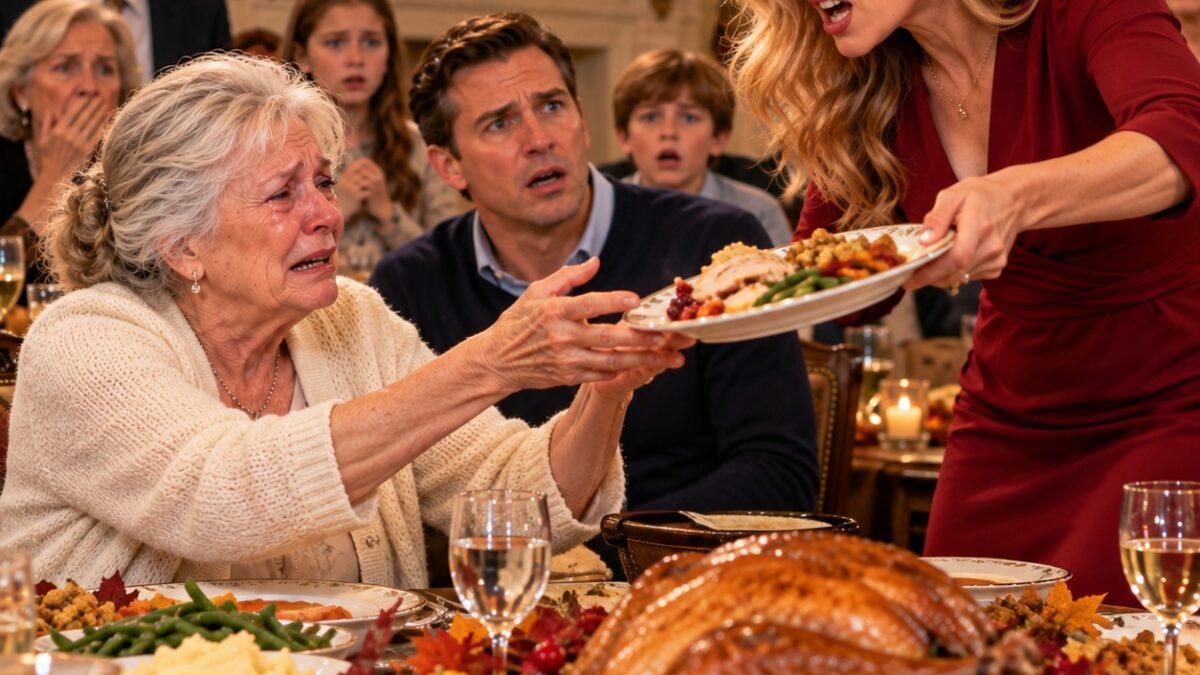
Then my plate moved.
I opened my eyes.
Amanda stood beside me.
Her hand gripping the edge.
At first, I thought she was joking.
“What are you doing?”
She pulled harder.
“You’ve had enough, Grandma.”
The room stopped.
She lifted my plate.
“We’re not running a retirement buffet.”
Nobody laughed.
My fork fell.
Amanda carried my dinner toward the kitchen.
Then called back:
“I think Grandma needs to watch her figure.”
She looked at Travis.
“Doctor said so, right?”
My son froze.
Because no doctor had said that.
I knew it.
He knew it.
At least he should have.
My last physical had been excellent.
Travis stared at the table.
Finally:
“I think that’s unnecessary.”
Barely audible.
“Mom can eat what she wants.”
Too late.
I looked around.
Cousins avoiding my eyes.
Amanda’s parents uncomfortable.
Jessica fascinated.
Paul suddenly obsessed with his water glass.
Lily’s face bright red.
The twins confused.
I felt naked.
Humiliated.
At my own table.
In my own house.
Eating my own food.
I stood.
“Excuse me.”
Nobody stopped me.
I walked to my bedroom.
Closed the door.
Sat on the edge of the bed.
And listened.
The holiday continued.
Plates.
Voices.
Then laughter.
Dessert.
My Thanksgiving moved on without me.
That hurt more than the plate.
I had spent forty years building those traditions.
Amanda removed me from them in ten seconds.
And everyone adjusted.
Like I was already gone.
I did not sleep.
I kept seeing her hand.
My plate sliding away.
My son’s face.
That weak defense.
By morning, I expected an apology.
From Travis at least.
Nothing.
At ten, I came out.
Lily was watching the twins.
“Where’s everyone?”
“Black Friday shopping.”
Then Lily looked up.
“What Amanda did was really mean.”
My throat tightened.
“I told Dad.”
“Thank you.”
“He looked guilty.”
“He should.”
Lily hesitated.
“Grandma?”
“Yes?”
“You’re not going to leave, right?”
I stared.
“Why would I leave?”
She shrugged.
“I don’t know.”
The answer bothered me.
I spent the day cleaning.
No one had saved me dessert.
I found some pie in the refrigerator.
For a ridiculous second, I hesitated before eating it.
That frightened me.
One public humiliation.
And already I was policing myself.
When Travis and Amanda returned with shopping bags, neither mentioned Thanksgiving.
Travis patted my shoulder.
Amanda reorganized the refrigerator.
She threw away some of my leftovers to make space for juice-cleanse bottles.
That became the new normal.
Not apology.
Escalation.
My favorite kitchen items moved to high shelves.
When I asked why:
“We need easy access for things we actually use.”
We.
Meaning not me.
My reading chair was moved from the sunny window to a dark corner.
“Better flow.”
Amanda explained.
“Direct sunlight ages skin anyway.”
Family dinners suddenly happened on bridge-club nights.
Laundry appeared in the machine when I needed it.
The twins accumulated activities exactly during times I used to have with them.
And Lily:
“She’s a teenager.”
Amanda said.
“She needs peers, not constant grandmother time.”
It was not one big cruelty.
That would have been easier.
It was erosion.
One grain at a time.
Then, two weeks after Thanksgiving, I heard voices upstairs.
Amanda and Travis.
Bedroom door slightly open.
“I think we need to discuss options for your mother.”
Amanda said.
My body went still.
“What options?”
“Senior living.”
“Amanda.”
“I picked up brochures.”
“Mom does not need assisted living.”
“Not yet.”
Silence.
“But look at this place.”
“Memory care.”
My stomach dropped.
“She doesn’t have dementia.”
“Everyone declines eventually.”
Then:
“She’d be around people her own age.”
“It’s probably lonely for her here.”
Lonely.
In my own house.
Because Amanda had spent two years isolating me.
I backed away quietly.
That night, I went into the home office.
I am not proud of searching her desk.
But fear had replaced etiquette.
Inside a folder marked FAMILY PLANNING:
Assisted-living brochures.
Retirement communities.
One checklist partially filled out.
SENIOR TRANSITION PLAN.
My name.
Aubrey Williams.
At sixty-seven.
Healthy.
Financially competent.
Driving.
Cooking.
Volunteering.
Bridge club twice a month.
Suddenly, I was a transition plan.
December worsened.
Amanda’s coworkers visited.
They whispered.
One woman asked:
“Is that the mother-in-law?”
Another:
“Is the old lady giving you trouble?”
Amanda sighed.
“You have no idea.”
Then:
“I’m basically running a retirement home without being paid.”
They laughed.
I stood in the hallway holding a laundry basket.
Something changed in me.
But I still did nothing.
Not yet.
Christmas decorations went up without my ornaments.
Forty years of handmade decorations remained in basement boxes.
Amanda used silver balls.
Blue ribbon.
White lights.
A department-store Christmas.
Travis worked late.
Avoided me when home.
When I finally tried:
“Can we talk?”
He rubbed his forehead.
“Mom, please.”
“It’s important.”
“Can we not do this during the holidays?”
“Do what?”
“Create conflict.”
I stared at him.
Peace meant silence.
Specifically mine.
The final straw came three days before Christmas.
I had barely slept.
Stress upset my stomach.
I spent the day in bed.
That evening, I opened my dresser looking for a clean nightgown.
Something was missing.
My wedding photograph.
Silver frame.
Frank and me.
Wedding day.
I searched.
Closet.
Nightstand.
Bathroom.
Then opened a lower drawer.
There it was.
Face down.
Under scarves.
The glass cracked directly across Frank’s face.
I sat on the floor.
Held it.
And something inside me broke.
But not the way it had on Thanksgiving.
At Thanksgiving, I broke inward.
This time, something broke open.
Anger.
Not wild anger.
Clear anger.
I looked around my room.
The downstairs study.
The room I had voluntarily moved into so my son’s family could have more space.
Inside the house Frank and I had bought.
Paid for.
Raised our child in.
I remembered Amanda’s brochures.
Her friends laughing.
Her hand taking my plate.
And finally asked myself a simple question:
Why was I behaving like a guest?
That night, I planned.
The next morning, I called Harold Greenberg.
Frank’s attorney.
Our attorney for thirty years.
“Aubrey.”
His voice softened.
“It’s been too long.”
“I need help.”
“Legal?”
“I think so.”
“Come at four.”
No questions.
At his office, Harold hugged me.
Tea waited.
Earl Grey.
One sugar.
Frank had clearly told everybody my habits.
For an hour, I talked.
Everything.
Paint.
Cabinets.
Calendar.
Food comments.
Thanksgiving.
My plate.
Brochures.
Wedding photograph.
Harold listened.
Took notes.
Then opened our file.
“First question.”
He said.
“Whose name is on the deed?”
“I assumed mine and Travis’s now.”
“Why?”
“Because they’ve been paying half the property taxes.”
Harold looked at me sharply.
“Aubrey.”
He turned the deed around.
My name.
Only mine.
After Frank died, our joint ownership transferred completely to me.
“They do not own your house.”
Harold said.
“They have no legal right to force you out.”
I stared.
“What about putting me in a facility?”
“Without your consent?”
“No.”
“What if they say I’m incompetent?”
“You are clearly not.”
“And that requires legal and medical procedures, not Amanda filling out a brochure.”
I laughed.
Then cried.
Relief.
Fear.
Embarrassment.
“How did I forget this was my house?”
Harold’s expression softened.
“You didn’t forget.”
“You were grieving.”
“And somebody slowly trained you to behave as if ownership belonged to whoever spoke with the most confidence.”
That sentence stayed with me.
Then we reviewed finances.
Frank’s insurance.
Savings.
Retirement income.
And an investment portfolio.
Frank began investing small amounts when Travis was young.
Forty years of growth.
I had known it existed.
I had never understood how much.
Harold showed me.
I stared.
“I have that?”
“You do.”
“I could live independently?”
“Comfortably.”
“For life?”
“If managed prudently.”
My hands began trembling.
I was not dependent.
Not financially.
Not legally.
Only emotionally.
That was the chain Amanda had been pulling.
My fear of losing family.
I went home different.
I did not confront anyone.
First, preparation.
I called Margaret.
My oldest friend.
She lived in a beautiful senior apartment community.
Not assisted living.
Independent apartments.
Yoga classes.
Garden club.
Bridge.
“Is that unit across from you still open?”
“Aubrey.”
She practically shouted.
“Are you finally moving here?”
“Maybe.”
“What happened?”
“Family business.”
Margaret went quiet.
“Whatever you need.”
Then Dr. Reynolds.
A therapist I had seen briefly after Frank died.
I described everything.
She said:
“Aubrey, what you’re describing is emotional elder abuse.”
The phrase shocked me.
“Abuse?”
“Yes.”
“She hasn’t hit me.”
“Abuse does not require physical violence.”
“She controls food.”
“Belittles age.”
“Restricts access to family.”
“Moves belongings.”
“Creates false health narratives.”
“Discusses institutionalizing you without basis.”
“And publicly humiliates you.”
I stared at the carpet.
“Am I overreacting?”
“No.”
“Actually, you have underreacted.”
That hurt.
Because it was true.
I documented everything.
Dates.
Comments.
Photographs.
Wedding frame.
Moved furniture.
Senior brochures.
Household restrictions.
I researched elder rights.
And the more I read, the angrier I became at myself.
Not for being victimized.
For confusing endurance with kindness.
But the hardest conversation remained Travis.
One afternoon, Amanda took the twins shopping.
Lily was at a friend’s house.
I asked Travis to sit outside.
Frank had built the patio table himself.
Badly.
One leg remained shorter than the others.
We put folded cardboard underneath it for years.
Travis sat.
Nervous.
“Mom?”
“Are you happy?”
“What?”
“With your marriage.”
His eyes dropped.
“Things are complicated.”
“That wasn’t the question.”
Silence.
Then:
“No.”
His eyes filled.
“I’m not happy.”
I waited.
“If I push back…”
He whispered.
“Amanda threatens to take the twins.”
My heart sank.
“She says because I work so much, she’ll get full custody.”
“She says Lily isn’t really hers anyway, so I can keep Lily and she’ll take the twins.”
“Travis.”
“I can’t lose my kids.”
He cried.
My forty-two-year-old son cried like the little boy who once broke a neighbor’s window and confessed before I even asked.
“I didn’t know what to do.”
“Why didn’t you defend me at Thanksgiving?”
His shame deepened.
“I should have.”
“Yes.”
“She told me your doctor said you needed portion control.”
“She lied.”
“I know now.”
“What?”
“I called him.”
He wiped his face.
“Last week.”
“He said your health is fine.”
“She lied to me.”
I reached for his hand.
“Yes.”
Then:
“But you also chose to believe her without asking me.”
He nodded.
“I’m sorry.”
“I know.”
I told him about Harold.
The deed.
My finances.
The brochures.
Dr. Reynolds.
He stared.
“The house is entirely yours?”
“Yes.”
“I thought after Dad died…”
“So did I.”
“But it isn’t relevant.”
“What is relevant is what’s happening inside it.”
Travis looked toward the house.
“What are you going to do?”
“Make changes.”
He swallowed.
“What kind?”
“I haven’t decided all of them.”
“I will support you.”
I studied him.
“Even if Amanda threatens you?”
Fear passed across his face.
Then determination.
“I’m going to talk to a family-law attorney.”
“I’ll help pay.”
“No.”
“Mom—”
“I’m offering help.”
“Not control.”
“Learn the difference.”
He almost smiled.
We had our first honest conversation in months.
By New Year’s, I was ready.
I chose January first intentionally.
New beginning.
I asked everyone to attend lunch.
Amanda.
Travis.
Children.
Amanda’s parents.
Gerald and Patricia.
Amanda did not like that I planned a menu without her.
I ignored it.
Pot roast.
Mashed potatoes.
Green-bean casserole.
Fresh rolls.
Everything Frank loved.
Everything familiar.
At one, everyone sat.
We ate.
I waited until they had taken several bites.
Then tapped my water glass.
The room quieted.
“I need to say something.”
Amanda leaned back.
Already irritated.
I looked at her.
“Three months ago, at Thanksgiving, you took my plate from my hands in front of this family.”
Her expression tightened.
“Oh, Aubrey.”
“No.”
I held up my hand.
“You will listen.”
Silence.
“You said I had eaten enough.”
“You called this house a retirement buffet.”
“You told people my doctor had restricted my diet.”
“That was untrue.”
Amanda looked at Travis.
He did not rescue her.
I continued.
“That incident was not isolated.”
I listed everything.
Moving my possessions.
Restricting time with grandchildren.
False health concerns.
Assisted-living brochures.
Friends mocking me.
Wedding photo hidden and broken.
By the time I finished, Amanda’s parents looked horrified.
Gerald cleared his throat.
Patricia stared at Amanda.
Then I stood.
Took a folder from the sideboard.
Placed copies around the table.
“This is the deed.”
Amanda frowned.
“To what?”
“My home.”
I looked at her.
“My name is the only name on it.”
Silence.
“This is a summary of my financial assets.”
“Why are you showing us this?”
“Because you have spent months behaving as though I am an elderly dependent living by your generosity.”
“I am not.”
I faced her directly.
“I welcomed you into my home.”
“I gave you and Travis the upstairs bedrooms.”
“I helped raise your children.”
“I cooked.”
“I contributed financially.”
“I stepped aside repeatedly because I believed family harmony required compromise.”
“My compromise became your permission.”
Amanda stood.
“This is insane.”
“You are twisting everything.”
“Travis.”
She snapped.
“Tell her.”
My son looked at his wife.
A long time.
Then:
“No.”
Her face changed.
“What?”
“I should’ve said something months ago.”
He swallowed.
“What you did to Mom was wrong.”
“Seriously?”
“Yes.”
“She’s difficult.”
“She is not.”
“She interferes.”
“She lives here.”
“She is constantly around.”
“It’s her house.”
Amanda’s voice rose.
“So now you’re taking her side?”
Travis stood.
“I am not choosing Mom over you.”
“I am choosing what is right over what is wrong.”
The room froze.
Frank would have been proud.
I slid one final document across the table.
“Amanda.”
“What is that?”
“Formal notice.”
“Notice of what?”
“To vacate the property within thirty days.”
Her face drained.
“You can’t do this.”
“I can.”
“This is my home.”
“No.”
I said calmly.
“It is mine.”
“You have been welcome here.”
“You are no longer welcome to live here.”
She turned on Travis.
“You’re allowing this?”
Travis looked broken.
But steady.
“Yes.”
“You pathetic mama’s boy.”
“Enough.”
Gerald said suddenly.
Amanda turned.
“Dad?”
He looked embarrassed.
“Amanda.”
“Some of the things Aubrey described…”
He shook his head.
“That isn’t how your mother and I raised you.”
Amanda stared at Patricia.
“You too?”
Patricia reached toward me.
“Aubrey.”
“I owe you an apology.”
“For what?”
“For Thanksgiving.”
“I watched.”
“I knew it was cruel.”
“And I said nothing.”
Her eyes filled.
“That was cowardly.”
Amanda looked around.
Everyone had moved away from her emotionally.
She changed tactics.
“Fine.”
“If this is what you want, Travis and I will take the children and leave tonight.”
Travis flinched.
I stayed calm.
“Travis can stay.”
“So can the children.”
“My issue is your behavior.”
“You don’t get to decide where my children live.”
Then Lily spoke.
“I want to stay.”
Every head turned.
She sat straight.
Fourteen.
Pale.
Determined.
Amanda snapped:
“This has nothing to do with you.”
“It has everything to do with me.”
“You’re a child.”
“In family court, they listen to kids my age.”
I stared at her.
She looked at me.
“I want to stay with Dad and Grandma.”
Amanda’s face twisted.
“You ungrateful little—”
“Stop.”
Travis’s voice was stronger than I had ever heard it.
Amanda pointed at Lily.
“After everything I have done for you.”
Lily laughed bitterly.
“Like hiding Grandma’s wedding picture?”
Amanda froze.
“I saw you.”
Silence.
“You moved her chair.”
“You took away her plate.”
“You make fun of her with your friends.”
“You say she’s old like it’s something disgusting.”
Tears filled Lily’s eyes.
“And Dad never says anything.”
Travis looked devastated.
“I’m sorry.”
Lily turned away.
Amanda realized she had no ally left.
She threw down her napkin.
Stormed out.
Seconds later, front door.
Car engine.
Then quiet.
The twins started crying.
They were four.
They did not understand.
I moved to them.
Emma climbed into my lap.
“Is Mommy mad?”
“Yes.”
“Because I ate too much?”
My heart shattered.
“No.”
I held her face.
“No, sweetheart.”
“This is adult stuff.”
“None of it is because of you.”
Jackson crawled beside me.
“Mommy coming back?”
Travis knelt.
“She loves you.”
He said.
“We’re going to work things out.”
“Different adults may live in different houses.”
“But you are loved in all of them.”
That night, after everyone left, I stood in my bedroom.
Frank’s wedding photograph was repaired.
New glass.
Back on the dresser.
I touched his face.
“I finally did it.”
I whispered.
I did not feel victorious.
I felt terrified.
But also whole.
The next weeks were painful.
Amanda stayed with her parents.
She communicated with Travis through hostile messages.
Accusations.
Threats.
Then, unexpectedly, Gerald and Patricia encouraged her to get help.
They had watched her controlling behavior increase for years.
Apparently, not only toward me.
Toward Travis too.
Travis began therapy.
One night, after the children slept, he sat with me in the kitchen.
“I didn’t see it.”
He said.
“I think you did.”
He stared.
“You just didn’t want to name it.”
He nodded.
“She controlled our finances.”
“Who I saw.”
“When I came home.”
“If I went out with friends, she called every hour.”
“If I disagreed, she threatened divorce.”
“Then custody.”
His voice shook.
“It happened slowly.”
“So did what happened to me.”
He looked at me.
“It’s emotional abuse.”
“Yes.”
“I thought abuse meant hitting.”
“So did I.”
There was strange comfort in understanding that neither of us had imagined what happened.
But understanding did not excuse our choices.
Travis had failed me.
He admitted it.
Repeatedly.
Without demanding immediate forgiveness.
That helped.
By February, lawyers reached an agreement.
Travis and Amanda divorced.
Joint legal custody.
The twins would spend regular time with both parents.
Lily remained primarily with Travis.
She had no desire to live with Amanda.
Travis provided a fair settlement so Amanda could buy her own home.
Not punishment.
Separation.
The day Amanda collected her belongings, Harold advised me to leave.
So I spent the afternoon with Margaret.
Cards.
Coffee.
Pretending not to stare at the clock.
When I returned, Travis stood at the front door.
Tired.
“She’s gone.”
“Everything?”
“Everything she wanted.”
“She returned the keys.”
I walked inside.
The house felt enormous.
Gray walls.
Bare spaces where Amanda’s furniture had been.
Cold decorative pieces removed.
Lily stood in the living room.
“It feels like the house can breathe.”
She said.
Exactly.
Over the next months, we rebuilt.
Together.
I did not simply return everything to how it had been with Frank.
That would have been another kind of control.
The children lived there too.
Travis lived there.
We chose things together.
Some modern furniture stayed.
Warm colors returned.
Family photographs went back on walls.
Frank’s chair returned to the window.
My kitchen items came down from unreachable shelves.
My recipe cards returned to their old drawer.
The twins adapted.
Children can tolerate change when adults give them security instead of forcing them to manage adult emotions.
They visited Amanda regularly.
Video calls.
Weekends.
Holidays according to the custody plan.
I never spoke badly about their mother.
That was important.
What happened between Amanda and me did not erase the fact she was their mother.
Lily changed most visibly.
She invited friends over.
Stayed downstairs instead of hiding in her room.
One afternoon, I overheard her showing a friend the kitchen.
“This is Grandma’s famous kitchen.”
She said.
“She makes the best cookies in Massachusetts.”
Then:
“She’s teaching me all the secret recipes.”
I stood in the pantry and cried.
Quietly.
My recovery took longer.
For months, food embarrassed me.
If someone watched me serve myself, I took less.
At restaurants, I sometimes ordered salads I did not want because I imagined Amanda’s voice.
You’ve had enough.
Dr. Reynolds noticed.
“That moment became symbolic.”
She explained.
“It was not about calories.”
“It communicated that someone else had authority over your body.”
“That you could not trust your needs.”
“That taking up space invited punishment.”
I swallowed.
“How do I fix that?”
“Practice.”
So I practiced.
Ordering dessert.
Sitting in my chair.
Saying no.
Going to bridge club without explaining myself.
Inviting friends to my home.
Choosing what time I went to bed.
Simple choices.
They felt revolutionary.
I began volunteering at the local library.
Saturday story hour.
Children sitting cross-legged while I read.
It reminded me of the woman I had been before grief and conflict shrank my world.
Margaret dragged me to senior yoga.
“I hate yoga.”
“You’ve never done yoga.”
“Exactly.”
I loved it.
Not because I became flexible.
I did not.
But being surrounded by women my own age who laughed about knees, grandchildren, widows, dating, medication schedules, and stubborn adult children reminded me that aging was not a humiliation.
It was simply living long enough to accumulate stories.
Travis changed too.
Therapy gave him vocabulary for things he had spent years enduring.
Boundary.
Manipulation.
Threat.
Appeasement.
He learned that keeping peace by surrendering every time is not peace.
It is delayed conflict with interest.
That sentence came from his therapist.
I stole it.
He reconnected with friends.
Became more present with his children.
Sometimes he apologized to Lily.
Not once.
Repeatedly.
“For not seeing.”
“For not protecting you.”
“For letting you believe silence was normal.”
She did not immediately forgive.
That was her right.
Trust grows at its own pace.
By summer, they were better.
Not because everything was forgotten.
Because everything could finally be talked about.
Then Thanksgiving approached again.
The date itself made my body tense.
I could almost feel Amanda’s fingers on my plate.
Travis noticed.
“What if we don’t do Thanksgiving here?”
“What do you mean?”
“New tradition.”
We rented a cabin in the Berkshires.
Nothing formal.
No lace tablecloth.
No seating chart.
No pressure.
The twins demanded macaroni and cheese with the turkey.
Lily decided to attempt chocolate pecan pie.
Travis suggested pajamas.
We agreed.
On Thanksgiving morning, snow dusted the trees.
I cooked in a small unfamiliar kitchen.
The twins stole cheese.
Lily burned the first pie crust.
Travis forgot to thaw something he insisted he was responsible for.
It was imperfect.
And wonderful.
At dinner, everyone served themselves.
Nobody commented on portions.
Nobody monitored plates.
I took turkey.
Stuffing.
Mac and cheese.
Mashed potatoes.
Then went back for more stuffing.
For a second, my hand hesitated.
Lily noticed.
Without saying anything, she pushed the serving dish toward me.
I looked at her.
She smiled.
I took more.
Later, we shared what we were thankful for.
Jackson said dinosaurs.
Emma said snow.
Travis said:
“Second chances.”
Lily looked at me.
“I’m thankful Grandma taught me you’re allowed to say enough.”
My throat closed.
I held her hand.
Then I said:
“I’m thankful I learned that standing up for yourself isn’t selfish.”
“It protects the people who truly love you too.”
Because that was what I had failed to understand.
When I tolerated Amanda’s treatment for the sake of the children, I thought I was protecting them from conflict.
Instead, I was teaching them to watch disrespect and accept it.
When I finally drew a boundary, Lily learned something.
Travis learned something.
Even the twins learned something.
Love does not require humiliation.
Family does not cancel dignity.
Age does not eliminate autonomy.
And silence is not always kindness.
By spring, the house felt like home again.
Warm yellow walls.
Morning sunlight.
Frank’s photographs beside newer family pictures.
The twins’ drawings on the refrigerator.
Lily’s books everywhere.
Travis’s shoes constantly in the wrong place.
I complained.
He said:
“It finally feels normal.”
He was right.
One Sunday morning, I stood at the stove making pancakes.
Blueberry.
Frank’s favorite.
I was humming.
I realized it only when Travis entered.
“You’re happy.”
He said.
I stopped.
Then smiled.
“I am.”
Not healed.
I do not believe people return to some untouched version of themselves after loss or abuse.
Changed.
But happy.
Yes.
I placed pancakes on a plate.
Travis stole one.
I slapped his wrist lightly.
“Wait.”
He grinned.
“Controlling.”
“Get out.”
He laughed.
For one dangerous second, I heard Frank.
Same laugh.
I had to turn away.
Travis noticed.
“Dad?”
I nodded.
He hugged me.
We stood in the kitchen.
No speeches.
Just grief passing through and moving on.
That afternoon, the whole family gathered around my table.
Travis.
Lily.
Jackson.
Emma.
I looked at them.
Frank and I had once believed our legacy was the house.
Maple trees.
Mortgage paid.
Furniture.
Savings.
I understood differently now.
The real legacy was what children learned inside those walls.
How people spoke to each other.
What behavior was tolerated.
Whether love had boundaries.
Whether age deserved respect.
Whether apology meant change.
Whether courage remained possible after sixty.
Amanda tried to take my plate.
But the plate was never the most important thing she tried to take.
She tried to take my authority over myself.
My confidence.
My position in the family.
My physical space.
My traditions.
My home.
My relationship with my grandchildren.
Eventually, even my belief that I deserved ordinary respect.
And for too long, I helped her.
Not intentionally.
Every time I said:
It’s easier not to argue.
Every time I accepted:
She means well.
Every time I swallowed hurt because:
It’s for the kids.
I handed over another small piece of myself.
That realization was painful.
But empowering.
Because if I had participated in disappearing, I could participate in returning.
I could choose my chair.
My meal.
My friends.
My kitchen.
My schedule.
My boundaries.
My life.
That is what I did.
A year after the Thanksgiving incident, I repaired the wedding china cabinet.
One hinge had been loose for years.
Frank always promised to fix it.
Never did.
Daniel from down the street helped me.
Not the Daniel from some romantic story.
Just Daniel.
Seventy-one.
Terrible jokes.
Good screwdriver.
He asked:
“Why keep dishes you barely use?”
I stared.
“These survived forty years of family dinners.”
He raised both hands.
“Question withdrawn.”
I began using them more often.
Not only holidays.
Sunday breakfast.
Lily’s birthday.
Random Tuesday dinner.
Why save beautiful things for special occasions when life itself becomes fragile with age?
One evening, Emma ate spaghetti from the wedding china.
Tomato sauce everywhere.
I laughed.
Frank would have panicked.
Then pretended he did not care.
The plate Amanda had taken from me was still there.
I knew which one.
Tiny scratch near the edge.
For months, I avoided it.
Then one Sunday, I chose it deliberately.
Served myself roast chicken.
Potatoes.
Green beans.
Dinner roll.
Sat at the head of my table.
Not because I needed to dominate anyone.
Because nobody should be afraid of their own place.
Lily noticed the plate.
“Is that…”
“Yes.”
She looked at me carefully.
“You okay?”
I cut my chicken.
“Took me long enough.”
She smiled.
Halfway through dinner, I went back for potatoes.
No hesitation.
That felt more powerful than the eviction notice.
Legal documents restored control of my house.
But healing meant restoring trust in myself.
Amanda and I rarely speak.
We exchange polite words during the twins’ events.
Birthdays.
Preschool performances.
Later kindergarten activities.
We are not enemies.
I do not need her suffering.
Her life changed significantly after the divorce.
She attended counseling for a while.
Her parents told Travis she began understanding some of her behavior.
Whether she fully changed, I cannot say.
It is no longer my responsibility to monitor her growth.
That is another boundary.
You do not have to remain emotionally attached to someone just because they hurt you.
Sometimes recovery means allowing them to become irrelevant.
The twins love their mother.
I support that.
Travis co-parents respectfully.
He does not allow manipulation through the children.
Amanda knows that now.
Lily remains cautious around her.
That relationship is theirs to manage.
I do not force forgiveness.
I do not force reconciliation.
I learned too much about autonomy to steal someone else’s.
One afternoon, Amanda approached me after Emma’s school performance.
“Aubrey.”
“Yes?”
She looked uncomfortable.
“I’m sorry about Thanksgiving.”
I had imagined that apology hundreds of times.
In every imaginary version, I delivered a devastating speech.
Something sharp.
Perfect.
Instead, when the real moment came, I simply said:
“Thank you.”
She blinked.
“That’s it?”
“What else do you need?”
“I don’t know.”
She looked down.
“I was awful to you.”
“Yes.”
“I was stressed.”
“I know.”
“That doesn’t excuse it.”
“No.”
She swallowed.
“I thought if I controlled everything, nothing would fall apart.”
I considered that.
“And did it work?”
A sad smile.
“No.”
“No.”
We stood quietly.
Then she said:
“I’m sorry.”
Again.
“I believe you.”
That was enough.
Forgiveness did not mean inviting her back into my house.
It meant I did not need to carry the moment like a weapon anymore.
I could remember it without reliving it.
That is different.
At sixty-seven, I thought my important battles were behind me.
I had buried parents.
Raised a child.
Survived financial worries.
Worked.
Retired.
Cared for a dying husband.
I thought aging meant gradually stepping back.
Making room.
Being easier.
Needing less.
I was wrong.
Aging did not require disappearance.
If anything, it gave me perspective.
I had spent decades earning the right to know what mattered.
Respect mattered.
Kindness mattered.
Peace mattered.
But peace without dignity was surrender.
Family mattered.
But family without boundaries could become the place where harm was easiest to excuse.
Traditions mattered.
But only if they remained alive enough to change.
That is why our second Thanksgiving in the Berkshires meant so much.
It was not Frank’s Thanksgiving.
Not my mother’s.
Not Amanda’s perfect-hostess version.
It was ours.
Messy.
Macaroni.
Pajamas.
Chocolate pecan pie.
Laughter.
No assigned head of table.
Nobody controlling anybody’s plate.
And that became the tradition we kept.
Every year now, we rent somewhere different.
Sometimes mountains.
Sometimes coast.
Once, a farmhouse where the heating failed and everyone wore coats during dinner.
Best Thanksgiving we ever had.
The twins still request macaroni.
Lily has perfected the chocolate pecan pie.
Travis brings one ridiculous new dish annually.
I remain in charge of stuffing.
Some authority should never be surrendered.
At dinner, before eating, we talk about Frank.
One memory each.
The first year, everyone cried.
Later, laughter mixed in.
Jackson’s favorite story is the year Frank dropped the turkey.
He did.
Full turkey.
Kitchen floor.
He looked at me.
I looked at him.
Then we rinsed the bottom and served it anyway.
Nobody died.
Travis once said:
“Mom!”
I replied:
“It was 1997.”
“We had different standards.”
Frank would approve of that version.
What I remember most about him now is not dying.
For a long time, death covered everything.
Now, life has returned around it.
His bad dancing.
His habit of whistling off-key.
His obsession with hardware stores.
His inability to wrap presents.
The way he held my hand in public even after forty years.
The way he would have reacted if he saw Amanda take my plate.
That thought used to make me angry.
He would have stood up instantly.
Probably too aggressively.
But eventually, I asked myself:
Why did I need to imagine Frank defending me?
I could defend myself.
That was the lesson.
Not:
Find someone stronger.
Become willing to use your own strength.
Mine had not disappeared when Frank died.
Grief buried it.
Fear buried it.
Amanda’s criticism buried it.
But it remained.
The morning I called Harold, I dug it back up.
I sometimes speak at the senior center now.
Not formally.
Dr. Reynolds once invited me to join a discussion about family boundaries.
I told my story.
Afterward, a seventy-four-year-old woman approached.
“My daughter controls my bank card.”
She whispered.
“Do you want her to?”
“No.”
“Then talk to someone qualified.”
She looked terrified.
“She’ll be angry.”
“Yes.”
“What if she stops speaking to me?”
I understood.
That is the real weapon.
Not always money.
Not always housing.
Fear of losing family.
I told her:
“I can’t tell you what decision to make.”
“But I can tell you that love built entirely on your fear of abandonment is not safe love.”
She cried.
So did I.
That is why I share the story now.
Not because I enjoy describing humiliation.
I do not.
That plate still embarrasses me if I think too long about the faces around the table.
But silence protects patterns.
The minute I named what was happening, possibilities appeared.
Legal information.
Financial independence.
Therapy.
Margaret.
Travis’s honesty.
Lily’s courage.
None of those things could help while I remained committed to pretending everything was fine.
Sometimes the first boundary is simply telling the truth.
This hurts me.
This is not okay.
This needs to change.
Those sentences sound small.
They are not.
They changed my life.
Last Sunday, I made dinner.
Roast beef.
Mashed potatoes.
Carrots.
Fresh rolls.
Lily brought her boyfriend.
A sweet boy who was terrified of me.
Good.
The twins are older now.
Loud.
Hungry constantly.
Travis looked relaxed.
After dinner, I brought out apple pie.
I cut myself a generous slice.
Vanilla ice cream.
Jackson stared.
“Grandma.”
My hand paused.
He grinned.
“That slice is huge.”
The room went silent for one second.
Then Lily kicked him under the table.
“Ow!”
He looked confused.
I started laughing.
Hard.
So hard tears came.
Everyone stared.
Finally, I said:
“You’re right.”
I added another spoonful of ice cream.
“It is.”
Jackson shrugged.
“Can I have one that big?”
“Yes.”
I cut him one.
That moment would once have hurt.
Now it was simply funny.
Because nobody was policing me.
Nobody was shaming me.
A child noticing pie was not abuse.
Context matters.
Intent matters.
Power matters.
I had learned the difference.
After everyone left, Travis helped wash dishes.
He picked up the old wedding plate.
The one with the scratch.
“Remember this?”
He asked.
“Yes.”
His face changed.
“I still hate that I sat there.”
“I know.”
“I should have stopped her.”
“Yes.”
He dried the plate slowly.
“I’m sorry.”
“You’ve apologized.”
“I know.”
“Then keep living differently.”
He looked at me.
“That’s it?”
“That’s everything.”
Apologies matter.
Change matters more.
He put the plate away carefully.
Then hugged me.
After he left, I sat alone in the living room.
Warm yellow walls.
Frank’s chair by the window.
His photograph on the mantel.
The house quiet.
Not empty.
Quiet.
There is a difference.
For years after Frank died, I feared being alone.
That fear is partly why I tolerated so much.
I thought any family around me was better than silence.
Now I know peaceful solitude is infinitely better than being surrounded by people who make you disappear.
But I am fortunate.
I have both.
Independence.
And family.
Not because I clung to them.
Because boundaries made the relationships healthier.
Lily once asked me:
“Grandma, were you scared when you gave Amanda the eviction notice?”
“Terrified.”
“You didn’t look scared.”
“That’s because I’m an excellent actress.”
She laughed.
Then:
“I thought brave people weren’t scared.”
“No.”
“Brave people are usually scared.”
“Then what makes them brave?”
“They decide fear doesn’t get the final vote.”
She wrote that down.
Apparently for a school essay.
I charged her royalties.
That conversation reminded me how closely children watch us.
When Amanda humiliated me and I stayed silent, Lily noticed.
When I stood up, she noticed that too.
We teach children boundaries long before we explain them.
Every time they watch adults respect or violate each other, they are learning.
That thought still humbles me.
I wish I had acted sooner.
But regret can become another form of self-punishment.
I acted when I was ready.
That has to be enough.
Today, my house belongs to me in every sense again.
Legal.
Emotional.
Practical.
But I no longer think ownership means everyone must follow my preferences.
The children leave toys out.
Travis occasionally invites people without enough warning.
Lily rearranges bookshelves in ways that offend my librarian soul.
I complain.
We laugh.
Difference does not threaten me anymore.
Control is not the same as belonging.
Amanda taught me that accidentally.
Home is not the place where one person gets everything their way.
It is the place where everyone can exist without being diminished.
That is what Frank and I built.
That is what we nearly lost.
That is what we rebuilt.
The warm yellow walls are back.
But we kept Amanda’s modern kitchen stools because Emma loves them.
Frank’s reading chair returned to the window.
But beside it sits a sleek lamp Lily chose.
My old cornucopia comes out every Thanksgiving before we leave for our trip.
The twins think it is ugly.
They are correct.
I display it anyway.
Family traditions survive best when we can laugh at them.
And my wedding photograph sits where it belongs.
Unbroken now.
Frank smiling.
Me beside him.
Two young people with no idea what forty years would bring.
Sometimes I look at that photograph and tell him:
“You were right.”
About what?
A hundred things.
Mostly:
I kept living.
Not because I wanted to at first.
Because eventually life became mine again.
The plate incident used to feel like the lowest point.
Now I see it differently.
It was the moment humiliation became impossible to ignore.
Amanda took something small.
A dinner plate.
But in doing so, she accidentally showed me everything else I had allowed to be taken.
Once I saw that, I could not unsee it.
And once I stopped making myself small, the entire structure changed.
My daughter-in-law told me:
“You’ve had enough, Grandma.”
She was right.
Just not about food.
I had had enough of being mocked.
Enough of being managed.
Enough of hearing my age used as evidence against my judgment.
Enough of watching my son confuse fear with peace.
Enough of being grateful for scraps of belonging inside the home I owned.
Enough of disappearing.
So I stood up.
Not that Thanksgiving.
I wish I had.
But eventually.
And when I did, I did not throw anyone’s plate.
I did not scream.
I did not humiliate Amanda in front of strangers.
I found my deed.
Called my attorney.
Checked my finances.
Spoke to a therapist.
Talked honestly with my son.
Prepared.
Then I drew a line.
Thirty days.
That was all.
And that line did more than remove Amanda from my house.
It brought me back into my own life.
I am sixty-eight now.
Still cooking.
Still eating dessert.
Still doing yoga badly.
Still playing bridge.
Still volunteering.
Still missing Frank.
Still learning.
And every Thanksgiving, before taking my first bite, I look around at the people I love.
Then I look down at my plate.
Full.
Chosen by me.
And I smile.
Because nobody gets to decide when I have had enough except me.








