𝗙𝗨𝗟𝗟 𝗦𝗧𝗢𝗥𝗬 Two “HOA Inspectors” Kept Entering My Yard With Clipboards and a Badge—But One Photo They Took Made Me Realize They Were Never Inspecting Anything
𝗙𝗨𝗟𝗟 𝗦𝗧𝗢𝗥𝗬
My home was supposed to be the one place where nobody carrying a clipboard got to tell me I needed permission to live there.
Which was why the footsteps on my side yard that Tuesday morning immediately felt wrong.
I was sitting at my kitchen table with a cup of coffee when I heard gravel crunch outside.
Not at the front walkway.
Beside the house.
I froze.
The footsteps continued toward the backyard.
I stood and looked through the side window.
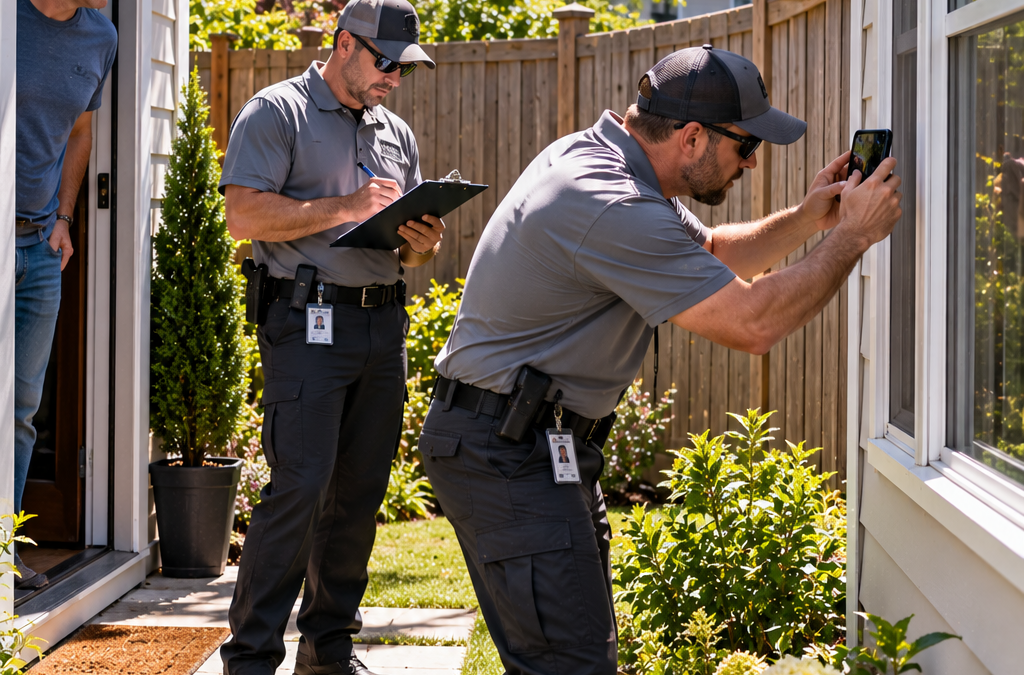
Two men were walking slowly along my fence.
One had a tape measure extended vertically against the boards.
The other was taking photographs.
For a moment, I thought they might be utility workers.
Then the photographer turned toward the house and aimed his phone directly at one of my windows.
I opened the back door.
“Can I help you?”
Neither man startled.
That bothered me later.
People who accidentally wander onto private property usually react when the homeowner suddenly appears.
These two behaved as if I were interrupting them.
The taller one looked over his shoulder.
“Morning.”
“What are you doing?”
He tapped his clipboard.
“HOA inspection.”
I actually thought I had misheard him.
“What?”
“HOA compliance.”
He pointed toward my fence.
“Your height appears to exceed allowable specifications.”
I stared at him.
“We don’t have an HOA.”
He gave me a patient little smile.
It was the kind adults use when explaining something obvious to a child.
“New management company.”
“For what HOA?”
“The residential association.”
“There is no residential association.”
“The transition notice was distributed last month.”
“No, it wasn’t.”
His partner kept taking photographs.
I stepped farther outside.
“Stop taking pictures of my property.”
The second man finally lowered his phone.
The tall one said, “Ma’am, interference with an inspection may result in additional violations.”
I almost laughed.
“Additional violations from who?”
He tapped the badge clipped near his belt.
I looked at it.
The plastic card showed a vague patriotic-looking logo—something like an eagle over a shield.
Underneath it were several lines of text too small to read from where I stood.
It was laminated badly.
One corner already looked like it was separating.
“Let me see your identification.”
He held the badge up for perhaps two seconds.
Not long enough for me to read it properly.
Then he dropped it.
“Compliance services.”
“That isn’t identification.”
“We aren’t required to provide personal identification.”
“Then show me documentation from this HOA.”
“You’ll receive formal notice by mail.”
“I want it now.”
“You’ll receive formal notice.”
His tone had changed.
No more polite smile.
He sounded irritated that I had asked questions.
That irritation made me pay closer attention.
The second man moved toward my driveway.
He photographed the side of my garage.
Then the shed.
Then my car.
I saw him angle his phone downward.
“Why are you photographing my vehicle?”
He didn’t answer.
“Hey.”
He took another picture.
This one clearly included my license plate.
I walked toward him.
“What does my license plate have to do with a fence inspection?”
The tall man stepped between us.
“Documentation.”
“Of what?”
“Property conditions.”
“My plate isn’t a property condition.”
“Everything visible during inspection may be documented.”
“Get off my property.”
He sighed as though I were creating unnecessary trouble.
“You’re making this more difficult than it needs to be.”
“No. I’m telling two strangers to leave my yard.”
For several seconds, nobody moved.
The silence felt different then.
Less bureaucratic.
More personal.
The taller man looked at me carefully.
Not angry.
Assessing.
Then he smiled again.
“Fine. You’ll receive the violation notice.”
They walked away.
I watched them get into a dark sedan parked around the corner.
I couldn’t see the entire license plate from my yard, but I caught enough of it to remember the first few characters.
I wrote them down.
Then I went back inside.
For the next hour, I tried to convince myself there was a reasonable explanation.
Maybe some neighborhood association had formed without my realizing it.
Maybe local law allowed something like that.
Maybe paperwork had gone to an old address.
Maybe they were contractors working for some municipal program and using the wrong terminology.
But every explanation collapsed under the same basic fact.
They had been in my side yard without permission.
Photographing my windows.
My shed.
My car.
My license plate.
And they had behaved as though my asking questions was the violation.
I checked my mailbox every day that week.
Nothing arrived.
No HOA letter.
No management notice.
No compliance report.
No dues statement.
Nothing.
After two weeks, I convinced myself it had been a bizarre mistake.
I should have known better.
Three weeks after the first visit, I came home shortly after noon and saw the same dark sedan parked near the cul-de-sac.
My stomach tightened immediately.
The two men were at my house again.
This time I found them beside the garage.
The shorter one had his face close to the small window in the side door.
The taller man was writing something.
“What the hell are you doing?”
They turned.
The tall man looked almost annoyed to see me.
“Follow-up inspection.”
“You were told to stay off my property.”
“We’re authorized to inspect exterior conditions.”
“By who?”
“The association.”
“The association that still hasn’t sent me one piece of paperwork?”
“You were notified.”
“No, I wasn’t.”
He looked down at his clipboard.
“Your boat trailer is also noncompliant.”
I stared at him.
“What boat trailer?”
He pointed toward my garage.
My small utility trailer was stored inside.
From the side window, if someone pressed close enough to the glass, you could see part of it.
The fact that he knew it was there meant he had been looking inside.
“You were looking through my garage window?”
“It’s visible from the exterior.”
“You walked twelve feet onto my property and put your face against my window.”
“We don’t need permission to document visible violations.”
“You absolutely need permission to wander around my yard.”
“Not during authorized compliance inspections.”
“Authorized by what?”
His expression hardened.
“You’re becoming confrontational.”
That sentence did something to me.
I wasn’t shouting.
I wasn’t threatening him.
I was asking why two strangers were peering through my windows.
And he had turned my reaction into the problem.
“Give me the association’s phone number.”
“You’ll receive communication in writing.”
“Give me the management company address.”
“You’ll receive communication in writing.”
“Your supervisor?”
“Compliance office doesn’t release direct numbers.”
“Your full name?”
“It’s on my identification.”
“The badge you won’t let me read?”
He closed the clipboard.
“If you continue interfering with inspections, we’ll document that as well.”
“Document whatever you want from the public street.”
“We determine inspection access.”
“No. I determine who walks through my yard.”
He stared at me for several seconds.
Then he said quietly, “People make these situations much more expensive for themselves when they refuse to cooperate.”
There it was.
The threat beneath the uniform.
Pay.
Comply.
Be quiet.
Don’t question us.
It sounded exactly like the worst HOA stories I’d heard, only somehow uglier because these people wouldn’t even identify the organization supposedly granting them authority.
I stepped backward and pointed toward the road.
“Leave.”
They did.
Slowly.
Deliberately.
As if they wanted me to understand that departure was their decision, not mine.
That afternoon, I walked two houses down to Carol’s place.
She was watering pots on her porch.
“Carol, has anyone claiming to be from an HOA been here?”
The color changed in her face.
“Two men?”
“Gray shirts?”
“Clipboards?”
My stomach dropped.
“Yes.”
She set the watering can down.
“They came last week.”
“What did they want?”
“My mailbox.”
I looked toward the white flower-painted mailbox by the road.
“What about it?”
“They said it was four inches too low.”
I stared at her.
“Four inches too low for what?”
“HOA specifications.”
“We don’t have an HOA.”
“I told them that.”
“What did they say?”
“New management.”
Same phrase.
Word for word.
Carol wrapped both hands around the porch railing.
“They walked around back too.”
“What?”
“They said they needed to verify my shed setback.”
“Did you let them?”
“I didn’t know I could stop them.”
That sentence hit me harder than I expected.
She hadn’t invited them.
She hadn’t trusted them.
She simply believed the uniforms meant she didn’t have the right to say no.
“Did they photograph anything?”
“Everything.”
“Your car?”
She thought for a moment.
“Yes.”
“License plate?”
“I think so.”
A cold sensation moved through me.
“Did you ever get a letter?”
“No.”
Carol leaned toward me.
“Dana, what is this?”
“I don’t know yet.”
I started knocking on doors.
By that evening, I had spoken with six neighbors.
Three had seen the men.
All three had been given different violations.
Mailbox height.
Shed setback.
Fence color.
One homeowner had been warned about “improper exterior storage” because children’s bicycles were visible beside the garage.
Another had been questioned about when he usually moved his work truck from the driveway.
That one bothered me.
“Why did they ask when you move it?”
He shrugged.
“They said vehicles couldn’t remain parked continuously.”
“What exactly did they ask?”
He thought.
“Something like, ‘Is it normally gone during work hours?'”
I felt my stomach tighten.
“How did you answer?”
“I told them I’m gone most weekdays.”
The next morning, I stopped treating this like a neighborhood misunderstanding.
I started checking.
First, the county property records.
Our subdivision had recorded covenants related to utilities and development restrictions from when the neighborhood was first built.
No HOA declaration.
No association ownership.
No mandatory membership organization.
No assessment authority.
Nothing.
I called the county clerk.
A woman there confirmed what I already suspected.
There was no recorded homeowners association governing our subdivision.
Then I called the city planning department.
Same answer.
No HOA.
No recently formed district.
No neighborhood compliance entity with authority over private landscaping, fences, mailboxes, or sheds.
Then I searched the state business registry using the management company name printed on the badge.
Nothing.
I tried variations.
Nothing.
I searched the supposed association name.
Nothing.
I searched the logo.
Nothing.
Finally, I called the number one neighbor had written down after seeing it briefly on a clipboard.
Disconnected.
That was when the situation changed completely in my mind.
Until then, the question had been:
Why is an HOA bothering us?
Now the question was:
Who were these men?
And what were they really collecting?
I sat at my kitchen table and wrote down everything I’d seen.
Fence measurements.
Photographs of windows.
Shed.
Garage.
Vehicle.
License plate.
The trailer inside my garage.
Questions about when a neighbor’s work truck left.
Carol’s shed.
Another family’s bicycles.
Dogs.
Gates.
Property access.
The list looked different when it was all in one place.
They weren’t simply cataloging cosmetic violations.
They were learning how each property worked.
Where fences were high.
Where gates were located.
Whether garages had windows.
Which homes had dogs.
When vehicles were gone.
What was stored inside.
How easily someone could move around the exterior without being seen.
A thought formed that I didn’t want to believe.
Reconnaissance.
I sat there staring at the word.
Then I crossed it out because it sounded paranoid.
Five minutes later, I wrote it again.
I kept coming back to one detail.
My license plate.
There was no possible cosmetic HOA violation connected to my plate.
None.
If their concern was fence height, why photograph my vehicle identification?
Unless the fence wasn’t really the point.
I called the non-emergency police number.
I explained what had happened.
The officer I spoke to listened but couldn’t do much based solely on my description.
Had anything been stolen?
No.
Had they forced entry?
No.
Had they threatened me physically?
No.
Did I have their full names?
No.
A full license plate?
Not yet.
I was told to call immediately if they returned and entered the property after being told not to.
So I prepared for them.
I installed two additional security cameras.
One covered my driveway.
The other covered the side yard and gate.
I adjusted the angles until I could clearly see anyone approaching the backyard.
I enabled audio.
I replaced a weak gate latch.
I photographed everything myself.
Then I waited.
Waiting was worse than I expected.
Every unfamiliar car bothered me.
Every time my dog barked at the side fence, I looked at the camera feed.
I started checking the locks twice before bed.
The men had accomplished something without stealing a single object from me.
They had made my own property feel exposed.
Before, my side yard had simply been the space between the house and fence.
Now I imagined strangers moving through it.
Looking.
Recording.
Planning.
Two and a half weeks passed.
Then, on a Thursday morning, my phone alerted me to movement.
I was working inside.
I opened the camera application.
Gray shirts.
My pulse jumped.
The same two men had returned.
They didn’t knock.
That detail mattered.
If they truly wanted compliance, you would expect them to speak with the homeowner.
Instead, they went directly down the side of the house.
The tall man carried the clipboard.
The shorter man carried his phone.
They stopped beside the fence.
He took photographs.
Then the shorter man moved to the shed.
He photographed the lock.
The lock.
Not the roof.
Not the paint.
The lock.
I felt every hair on my arms rise.
The audio picked up their voices.
“Dog?”
The shorter man asked.
The tall one looked toward the house.
“Usually back.”
“Big?”
“Medium.”
“Garage?”
“Attached access from side.”
They weren’t discussing compliance.
They were discussing access.
My hands started shaking.
I hit record on my phone even though the security system was already recording.
Then I heard the tall man say something that froze me.
“This one might be worth flagging.”
The other man asked, “Weekday?”
“Looks like.”
Those words removed the last doubt I had.
There was no HOA.
There were no violations.
There were no inspections.
They were evaluating homes.
My homes.
My neighbors’ homes.
Like inventory.
I reached for my phone to call police.
Then the shorter man walked toward my side gate.
He grabbed the handle.
My dog was in the backyard.
A fifty-pound mixed breed who barked loudly but had never bitten anyone.
I watched the man test the latch.
Once.
Twice.
Then he opened the gate.
That was it.
I dialed 911.
“I have two men trespassing on my property right now,” I said. “They’ve been impersonating HOA inspectors for months. One of them has just opened my private backyard gate. I have them on camera.”
The dispatcher asked whether they had weapons.
“I don’t see any.”
“Are you inside?”
“Yes.”
“Stay inside.”
I gave descriptions.
Gray polos.
Dark pants.
Badges.
Dark sedan.
Then I gave the partial plate I had written down from the very first visit.
The dispatcher repeated it.
“Officers are responding.”
On the camera, my dog rushed toward the open gate barking.
The man jumped backward.
“Jesus.”
The tall one laughed.
“Told you.”
Then the shorter man pulled the gate closed.
They kept walking.
No panic.
No urgency.
They had done this enough times to believe they were safe.
They moved toward Carol’s house.
I stayed inside.
Those eleven minutes before police arrived felt endless.
I watched the camera feed.
I watched the street.
I resisted every instinct to confront them myself.
Then two patrol vehicles entered the cul-de-sac.
The men were standing beside Carol’s mailbox.
The timing was almost surreal.
One of them had a tape measure extended when the first officer stepped out.
He lowered it slowly.
The officer approached.
I couldn’t hear the conversation from my house, so I walked to the edge of my front porch.
A second officer positioned himself near the sedan.
The tall man began talking immediately.
Even from a distance, I could see the confident gestures.
Clipboard raised.
Badge displayed.
He had probably performed that routine dozens of times.
Then the officer asked for something.
The man’s posture changed.
Another question.
The second officer joined them.
The shorter man reached toward his back pocket.
The officer told him to keep his hands visible.
Carol came outside.
Then another neighbor.
Then another.
Within five minutes, half the cul-de-sac seemed to be watching.
I walked toward the officers.
One recognized my description and asked if I had made the call.
“Yes.”
“These are the men?”
“Yes.”
The tall man turned toward me.
His expression wasn’t frightened.
It was furious.
“This homeowner has repeatedly interfered with authorized compliance inspections.”
The officer looked at him.
“Authorized by what organization?”
“The residential association.”
“What is the legal name?”
He gave one.
I recognized it from the fake badge.
The officer asked for identification.
The man showed the laminated card.
“Government-issued ID.”
The tall man’s face tightened.
“This is our company credential.”
“I asked for government-issued identification.”
He eventually produced a driver’s license.
The officer looked at the card.
Then the badge.
“Names don’t match.”
The man started explaining.
“Field personnel use assigned compliance names for privacy.”
I almost couldn’t believe what I was hearing.
The officer looked at the shorter man.
“Your ID.”
Same problem.
Another fake name.
The officers separated them.
One began checking the vehicle.
The other asked me to explain everything from the beginning.
I told him about the first visit.
The fence.
The photographs.
The license plate.
The second visit.
The garage window.
The nonexistent letters.
The business registry.
The cameras.
The gate.
Then I showed him the footage.
When the audio reached the conversation about the dog and the house being worth “flagging,” the officer’s expression changed.
“Can you send this to us?”
“Yes.”
“All of it?”
“Every visit I captured.”
He nodded.
“Do that.”
Then something happened I wasn’t expecting.
The second officer walked back from the sedan and quietly spoke to the first.
They both looked at the two men.
Then one asked me, “You said they photographed your license plate during the first contact?”
“Yes.”
“You’re sure?”
“I watched him do it.”
“Do you have their vehicle plate?”
“I have a partial from that day. The driveway camera should have the full plate from today.”
He nodded.
“Good.”
The officers kept the men there for nearly an hour.
Eventually, both were detained.
The sedan was not immediately released.
I assumed the matter would end as a trespassing investigation.
I was wrong.
That afternoon, a detective called me.
He asked for a detailed statement.
Then another detective called two days later.
This one worked with investigators from a neighboring county.
He asked questions I hadn’t expected.
Had the men ever asked when I was away?
Had they asked whether I worked from home?
Had they shown interest in alarm systems?
Had they photographed doors or windows?
Had they looked into vehicles?
Did they know I had a dog?
I answered yes to almost everything.
Then he asked about the license plate again.
“Why does everyone keep asking about that?”
There was a pause.
“Because we found vehicle information in materials connected to the suspects.”
“What kind of information?”
“I can’t discuss everything while the investigation is active.”
“Are you saying they were tracking cars?”
“I’m saying the photographs may not have been random.”
That was enough.
Over the next several weeks, the truth emerged piece by piece.
The two men were not running a fake HOA scheme for fines.
That would have been bad enough.
They weren’t trying to collect dues.
They weren’t planning to send fake invoices.
The HOA story was camouflage.
A costume.
An excuse to stand on private property in daylight without immediately triggering suspicion.
And it had worked.
They had visited homes across three subdivisions.
None of those subdivisions had mandatory HOAs.
The men wore professional-looking clothing.
They carried clipboards.
They used vague bureaucratic language.
They spoke confidently.
When homeowners questioned them, they became authoritative.
When homeowners resisted, they implied fines, legal action, or future consequences.
Their entire strategy depended on one human reaction:
Most people do not want conflict with someone who appears official.
Especially on their own doorstep.
A clipboard gave them permission homeowners had never actually granted.
A laminated badge made people doubt their own memory.
A polo shirt transformed trespassing into “inspection.”
And while homeowners worried about fence heights and mailbox rules, the men were collecting something entirely different.
Information.
They documented which homes had visible alarm systems.
Which properties had cameras.
Which gates were locked.
Which gates weren’t.
Which households had dogs.
What type.
Where homeowners parked.
Whether expensive tools or recreational equipment could be seen through garage windows.
Where sheds stood.
How backyard access worked.
When cars usually disappeared during the day.
And, in some cases, license plate information that helped them identify vehicles associated with the property.
My skin crawled every time investigators explained another detail.
I kept thinking about that first morning.
How casually the shorter man had photographed my car.
How I had almost accepted “documentation” as an answer.
The photograph that bothered me most turned out to be one of the most useful pieces of evidence.
My security footage, combined with the plate information connected to the sedan, allowed investigators to link the men to movements between multiple neighborhoods.
Then came the burglaries.
Police identified a pattern.
Several homes burglarized in neighboring counties had something in common.
Weeks earlier, residents had reported unfamiliar “inspectors,” “compliance officers,” or “neighborhood representatives” walking around their properties.
At the time, nobody connected the visits.
One homeowner remembered two men inspecting a fence.
Another thought they were checking drainage.
Another had been told a backyard structure violated neighborhood standards.
Then the homeowner left town.
The house was burglarized.
Tools.
Electronics.
Jewelry.
Cash.
Anything portable and valuable.
One family had thousands of dollars in equipment taken from a garage.
Another had damage to a rear door.
Another returned from vacation to find rooms torn apart.
The men hadn’t been randomly choosing houses.
They were studying them first.
That realization made me sick.
They had looked through my garage window because they wanted to know what was inside.
They had asked about my dog because they wanted to know whether the dog complicated entry.
They had photographed my gate.
My shed lock.
My vehicle.
The compliance inspection had been a dress rehearsal for a crime.
And if I hadn’t become suspicious, I might have helped them.
That was the part that disturbed me most.
Imagine the conversation if I had believed them completely.
“When are you usually home?”
Weekends.
“Is that vehicle normally parked here?”
No, I drive to work Monday through Friday.
“Is that your dog?”
Yes, but I board him whenever I travel.
“Do you have access through this gate?”
Sure, it doesn’t lock.
Each answer would have sounded harmless inside an inspection.
Together, those answers could tell a burglar exactly when and how to enter.
Carol took the news badly.
She came to my house one afternoon and sat at my kitchen table.
Her face was pale.
“I told them I visit my daughter every Wednesday.”
I looked at her.
“Why?”
“They asked whether my trash cans were normally left near the garage on Wednesdays. I said no because I’m usually gone all afternoon.”
Her voice broke.
“I told them when my house was empty.”
“You didn’t know.”
“But I told them.”
“They manipulated you.”
She looked down.
“They were in my backyard, Dana.”
“I know.”
“I showed them the gate.”
I reached across the table.
“They designed the whole thing to make people cooperate.”
That was the truth.
They weren’t successful because my neighbors were foolish.
They were successful because they understood something basic about authority.
People have been trained their entire lives to comply with uniforms.
Utility workers.
Inspectors.
Delivery employees.
Government contractors.
HOA representatives.
Most of us hesitate before telling someone with credentials to leave.
They used that hesitation.
The criminal case moved forward.
I gave a formal statement.
So did Carol.
So did several other residents.
Investigators collected security footage from multiple properties.
My recordings were especially useful because the audio was clear.
Their conversation about “flagging” homes wasn’t easy to explain away.
Neither was the gate.
Neither were the fake badges.
Neither were the false names.
The full license plate from my driveway camera tied their sedan to other locations.
What had begun with a blurry badge and a ridiculous fence violation became part of a larger case.
Months earlier, I had thought the license plate photograph they took of my car was simply invasive.
Now it became symbolic of the whole operation.
They had photographed mine because they thought they were collecting information on me.
They never imagined I would record theirs.
By the time the case reached court, investigators had connected the pair to a string of residential burglaries and attempted burglaries.
There were additional charges related to unlawful entry, impersonation, fraud-related conduct, and property crimes.
I attended part of the proceedings.
Seeing them inside a courtroom was strange.
No polos.
No clipboards.
No fake laminated badges.
No confident talk about compliance.
Without the costume, they looked ordinary.
That may have been the most unsettling thing about them.
Nothing about either man would have made me cross the street.
Nothing would have warned Carol.
They looked like people you might see loading groceries into a car.
Their power had never come from being physically intimidating.
It came from convincing people that questions were inappropriate.
During the proceedings, one defense argument suggested that some homeowners had voluntarily permitted the men onto their property.
I nearly laughed when I heard that.
Voluntary.
As though telling a retired teacher that she was subject to an official property inspection and could face consequences for interference was somehow the same as receiving an invitation.
My attorney later explained that civil claims often turn on details like consent, representation, damages, and documented intrusion.
Fortunately, we had evidence.
Video.
Audio.
Witness statements.
Fake credentials.
Property records showing no HOA existed.
And, most importantly, a broader criminal investigation showing why the men had been gathering information.
Several homeowners pursued related civil claims.
I was included alongside four others whose properties had been repeatedly entered or documented.
The damages weren’t about emotional outrage alone.
People had spent money responding to the intrusion.
Locks had been replaced.
Cameras installed.
Alarm systems upgraded.
Damaged property repaired.
Legal costs accumulated.
Victims of the related burglaries had direct losses.
After the criminal convictions and subsequent civil proceedings, the combined monetary judgment and restitution connected to the homeowners in our group reached roughly forty-one thousand dollars.
The number mattered.
But it never felt like the most important outcome.
Money could pay for new cameras.
It couldn’t erase the feeling of watching strangers study your windows.
It could reimburse a broken lock.
It couldn’t make Carol forget that she had unknowingly told criminals when her house was empty.
It could compensate some costs.
It couldn’t give us back the innocence we had before two men walked into the neighborhood wearing matching shirts.
For weeks after the arrests, people behaved differently.
Neighbors who rarely spoke started comparing doorbell footage.
We learned one family had a recording of the men from months earlier.
Another resident remembered seeing the dark sedan slowly driving the street twice before any “inspection” occurred.
Someone else remembered a stranger asking whether a house belonged to a family that “traveled often.”
Details that had looked meaningless in isolation suddenly formed a pattern.
That frightened all of us.
It also changed the neighborhood.
We created a group chat.
Not a homeowners association.
Everyone was very clear about that.
Nobody wanted dues.
Nobody wanted architectural rules.
Nobody wanted Carol’s mailbox measured.
The chat had one purpose.
If something strange happened, everyone knew immediately.
Unknown contractor walking property lines?
Photo.
Suspicious vehicle?
Message.
Someone claiming to represent the city?
Verify the department before giving access.
A person asking unusual questions about a neighbor’s schedule?
Post it.
The point wasn’t paranoia.
It was verification.
That distinction became important to me.
I didn’t want to spend the rest of my life assuming everyone at my door was a criminal.
Most utility workers really are utility workers.
Most delivery drivers are delivering packages.
Most contractors are doing their jobs.
The lesson wasn’t that uniforms are fake.
The lesson was that uniforms aren’t proof.
Authority should survive a reasonable question.
A legitimate inspector can identify the agency.
A legitimate organization has contact information.
A legitimate business exists in public records.
A legitimate notice can be verified independently.
Someone who becomes hostile simply because you ask who they are deserves more scrutiny, not less.
I thought about that second visit often.
The tall man standing beside my garage.
Me asking his name.
Him refusing.
Then telling me that I was “becoming confrontational.”
That was the trick.
He needed me to feel rude.
He needed me to believe that protecting my own privacy made me unreasonable.
He needed embarrassment to override instinct.
For years, I’d thought intimidation looked loud.
A raised voice.
A clenched fist.
A threat.
Those men taught me that intimidation can sound extremely polite.
“Compliance requirement.”
“Authorized inspection.”
“Management policy.”
“Additional violation.”
“Failure to cooperate.”
All ordinary phrases.
Put them together with a badge, and they can make a homeowner step aside from his own gate.
The first time those men came onto my property, I had been confused.
The second time, angry.
The third time, I was ready.
That progression probably saved several homes from being targeted.
Maybe mine too.
I sometimes wonder what would have happened if I’d never questioned the license plate photo.
Suppose I’d simply accepted that they needed it.
Suppose I’d ignored them.
Eventually, perhaps they would have decided my house was worth entering.
Maybe I would have come home one afternoon to a broken door.
Maybe they would have waited until I traveled.
Maybe my dog would have been inside.
That possibility still makes me angry.
Because burglars stealing property is one thing.
Burglars entering a home when an animal or person unexpectedly remains inside is something else entirely.
Their reconnaissance didn’t eliminate that risk.
It simply made them more confident.
And confident criminals take chances.
A few months after everything ended, I was outside repairing a loose fence board.
Carol walked over.
She looked at the tape measure in my hand and laughed.
“Inspection?”
“Very serious one.”
“Am I compliant?”
I looked toward her painted mailbox.
“Absolutely not.”
She laughed harder.
It felt good.
Normal.
For the first time in months, a joke about an HOA didn’t make my stomach tighten.
She leaned against the fence.
“You know what’s funny?”
“What?”
“I always thought I’d hate living under an HOA.”
“Same.”
“Turns out I hated living under an imaginary one even more.”
That line stayed with me.
Because an imaginary HOA had almost worked.
There were no bylaws.
No board.
No dues.
No recorded covenants.
No management company.
No authority whatsoever.
Yet for six months, two men managed to behave as though they had the right to inspect private homes.
And people listened.
Not because the men had legal power.
Because they performed power convincingly.
That was the whole operation.
Gray polos.
Clipboards.
Badges.
A little bureaucracy.
A lot of confidence.
When challenged, they didn’t retreat.
They escalated.
They implied consequences.
They acted offended.
They made the homeowner feel like the unreasonable one.
By the time someone finally checked whether the organization existed, they had already collected months of information.
I had spent years believing I escaped HOA harassment by buying in a neighborhood without one.
I learned that absence of an HOA couldn’t protect me from someone willing to invent one.
Only verification could do that.
Today, my neighborhood still has no homeowners association.
I hope it stays that way.
Carol’s mailbox is still too low according to whatever imaginary standard those men invented.
My fence is still the same height.
The utility trailer is still in my garage.
My shed hasn’t moved an inch.
My dog still races toward the side gate whenever somebody approaches.
The difference is the camera mounted above him.
The gate locks automatically now.
And when someone unfamiliar walks onto the property, I don’t assume a shirt, badge, clipboard, or confident tone gives them authority.
I ask.
Who sent you?
What organization?
Where can I verify it?
Show me your identification.
I’ll call the office myself.
If the answer is legitimate, verification takes minutes.
If someone becomes angry because I asked, that tells me something too.
The dark sedan disappeared from our streets after the arrests.
For months, I caught myself looking for it anyway.
Then one afternoon, almost a year after the first encounter, I was cleaning files on my computer and found the original security footage.
I opened it.
There they were.
The tall man walked down my side yard.
The shorter one raised his phone.
He photographed the fence.
The shed.
My window.
Then my car.
I froze the image on the moment he aimed at the license plate.
Back then, I hadn’t understood why that bothered me so much.
Now I did.
It was the one action that didn’t fit their story.
A fence inspector might photograph a fence.
A landscaping inspector might photograph plants.
A code inspector might photograph a structure.
But somebody claiming to enforce neighborhood aesthetics had no reason to document the identification number attached to my car.
That inconsistency had been tiny.
One photograph.
A few seconds.
But it had been enough to make me suspicious.
Suspicion became questions.
Questions became records.
Records became cameras.
Cameras became evidence.
And evidence turned two apparently legitimate inspectors back into what they had always been:
Strangers trespassing on private property while studying homes for crime.
I closed the footage.
Then I went outside.
The cul-de-sac looked almost exactly the way it had three years earlier when I bought my house.
Kids riding bicycles.
Different-colored shutters.
Carol’s ridiculous mailbox.
A garden overflowing with tomatoes.
A boat parked where no committee had approved it.
Ordinary freedom.
I realized that was what the two men had exploited too.
We lived in a place where neighbors generally trusted one another and where official-looking strangers were rare enough to be accepted without much suspicion.
They saw trust as vulnerability.
For a while, they were right.
But they made one mistake.
They became too comfortable.
They kept returning.
They pushed farther.
They looked through windows.
They opened gates.
They photographed things they couldn’t explain.
Eventually, their confidence created the evidence that exposed them.
I used to think protecting my property meant locks, fences, cameras, and insurance.
Those things matter.
But the most important protection I gained from that experience was simpler.
I stopped confusing appearance with authority.
A badge is only plastic until you verify who issued it.
A uniform is only clothing.
A clipboard doesn’t create jurisdiction.
And anyone who walks onto my property claiming power over my home had better be prepared to explain exactly where that power comes from.
Those two men had no answer.
They never had one.
All they had was the hope that nobody would ask.
𝗧𝗛𝗘 𝗘𝗡𝗗
Two “HOA Inspectors” Kept Entering My Yard With Clipboards and a Badge—But One Photo They Took Made Me Realize They Were Never Inspecting Anything
The two men standing beside my bedroom windows told me they had every right to be there because the homeowners association had authorized an inspection.
There was only one problem with that claim: in the twenty-two-year history of my neighborhood, there had never been a homeowners association.
I remember exactly what they looked like the first morning I saw them.
Matching gray polo shirts.
Dark work pants.
Black shoes.
Clipboards tucked against their ribs.
Laminated badges hanging from retractable clips near their belts.
From a distance, they looked official.
That was the point.
Nothing about either man screamed danger.
They weren’t wearing masks.
They weren’t climbing fences in the middle of the night.
They weren’t carrying crowbars.
They didn’t whisper.
They didn’t run.
They walked across my property at nine-thirty on a Tuesday morning with the relaxed confidence of men who expected me to believe they belonged there.
And for the first thirty seconds, I almost did.
I had bought my house three years earlier specifically because the neighborhood did not have an HOA.
That was one of the first questions I asked my real estate agent.
“No association?” I had said.
“No association,” she assured me.
“No monthly dues?”
“No.”
“No architectural committee?”
“No.”
“No board deciding what color my front door can be?”
She laughed.
“Nobody here cares what color your front door is.”
Perfect.
The house itself wasn’t extravagant.
Three bedrooms.
Two bathrooms.
A detached shed behind the garage.
A decent backyard surrounded by a six-foot wooden fence.
The street ended in a cul-de-sac lined with mature trees and houses that looked different enough from one another to feel human.
One family had dark blue shutters.
Another had a red door.
Carol, the retired teacher two houses down, had an old white mailbox covered in hand-painted flowers.
A family across the street put up enough Christmas lights every December to guide aircraft.
Nobody issued violations.
Nobody measured hedges.
Nobody sent threatening letters.
People simply tried not to make life miserable for one another.
After hearing years of stories from friends who lived under aggressive HOA boards, that freedom mattered to me.
I’d heard about people fined because garbage cans were visible for a few hours after collection.
A friend of mine once received a warning because her children’s bicycles had been left near the garage.
Another had been told her garden planters were the wrong shade of brown.
I wanted none of it.
My home was supposed to be the one place where nobody carrying a clipboard got to tell me I needed permission to live there.
Which was why the footsteps on my side yard that Tuesday morning immediately felt wrong.
I was sitting at my kitchen table with a cup of coffee when I heard gravel crunch outside.
Not at the front walkway.
Beside the house.
I froze.
The footsteps continued toward the backyard.
I stood and looked through the side window.
Two men were walking slowly along my fence.
One had a tape measure extended vertically against the boards.
The other was taking photographs.
For a moment, I thought they might be utility workers.
Then the photographer turned toward the house and aimed his phone directly at one of my windows.
I opened the back door.
“Can I help you?”
Neither man startled.
That bothered me later.
People who accidentally wander onto private property usually react when the homeowner suddenly appears.
These two behaved as if I were interrupting them.
The taller one looked over his shoulder.
“Morning.”
“What are you doing?”
He tapped his clipboard.
“HOA inspection.”
I actually thought I had misheard him.
“What?”
“HOA compliance.”
He pointed toward my fence.
“Your height appears to exceed allowable specifications.”
I stared at him.
“We don’t have an HOA.”
He gave me a patient little smile.
It was the kind adults use when explaining something obvious to a child.
“New management company.”
“For what HOA?”
“The residential association.”
“There is no residential association.”
“The transition notice was distributed last month.”
“No, it wasn’t.”
His partner kept taking photographs.
I stepped farther outside.
“Stop taking pictures of my property.”
The second man finally lowered his phone.
The tall one said, “Ma’am, interference with an inspection may result in additional violations.”
I almost laughed.
“Additional violations from who?”
He tapped the badge clipped near his belt.
I looked at it.
The plastic card showed a vague patriotic-looking logo—something like an eagle over a shield.
Underneath it were several lines of text too small to read from where I stood.
It was laminated badly.
One corner already looked like it was separating.
“Let me see your identification.”
He held the badge up for perhaps two seconds.
Not long enough for me to read it properly.
Then he dropped it.
“Compliance services.”
“That isn’t identification.”
“We aren’t required to provide personal identification.”
“Then show me documentation from this HOA.”
“You’ll receive formal notice by mail.”
“I want it now.”
“You’ll receive formal notice.”
His tone had changed.
No more polite smile.
He sounded irritated that I had asked questions.
That irritation made me pay closer attention.
The second man moved toward my driveway.
He photographed the side of my garage.
Then the shed.
Then my car.
I saw him angle his phone downward.
“Why are you photographing my vehicle?”
He didn’t answer.
“Hey.”
He took another picture.
This one clearly included my license plate.
I walked toward him.
“What does my license plate have to do with a fence inspection?”
The tall man stepped between us.
“Documentation.”
“Of what?”
“Property conditions.”
“My plate isn’t a property condition.”
“Everything visible during inspection may be documented.”
“Get off my property.”
He sighed as though I were creating unnecessary trouble.
“You’re making this more difficult than it needs to be.”
“No. I’m telling two strangers to leave my yard.”
For several seconds, nobody moved.
The silence felt different then.
Less bureaucratic.
More personal.
The taller man looked at me carefully.
Not angry.
Assessing.
Then he smiled again.
“Fine. You’ll receive the violation notice.”
They walked away.
I watched them get into a dark sedan parked around the corner.
I couldn’t see the entire license plate from my yard, but I caught enough of it to remember the first few characters.
I wrote them down.
Then I went back inside.
For the next hour, I tried to convince myself there was a reasonable explanation.
Maybe some neighborhood association had formed without my realizing it.
Maybe local law allowed something like that.
Maybe paperwork had gone to an old address.
Maybe they were contractors working for some municipal program and using the wrong terminology.
But every explanation collapsed under the same basic fact.
They had been in my side yard without permission.
Photographing my windows.
My shed.
My car.
My license plate.
And they had behaved as though my asking questions was the violation.
I checked my mailbox every day that week.
Nothing arrived.
No HOA letter.
No management notice.
No compliance report.
No dues statement.
Nothing.
After two weeks, I convinced myself it had been a bizarre mistake.
I should have known better.
Three weeks after the first visit, I came home shortly after noon and saw the same dark sedan parked near the cul-de-sac.
My stomach tightened immediately.
The two men were at my house again.
This time I found them beside the garage.
The shorter one had his face close to the small window in the side door.
The taller man was writing something.
“What the hell are you doing?”
They turned.
The tall man looked almost annoyed to see me.
“Follow-up inspection.”
“You were told to stay off my property.”
“We’re authorized to inspect exterior conditions.”
“By who?”
“The association.”
“The association that still hasn’t sent me one piece of paperwork?”
“You were notified.”
“No, I wasn’t.”
He looked down at his clipboard.
“Your boat trailer is also noncompliant.”
I stared at him.
“What boat trailer?”
He pointed toward my garage.
My small utility trailer was stored inside.
From the side window, if someone pressed close enough to the glass, you could see part of it.
The fact that he knew it was there meant he had been looking inside.
“You were looking through my garage window?”
“It’s visible from the exterior.”
“You walked twelve feet onto my property and put your face against my window.”
“We don’t need permission to document visible violations.”
“You absolutely need permission to wander around my yard.”
“Not during authorized compliance inspections.”
“Authorized by what?”
His expression hardened.
“You’re becoming confrontational.”
That sentence did something to me.
I wasn’t shouting.
I wasn’t threatening him.
I was asking why two strangers were peering through my windows.
And he had turned my reaction into the problem.
“Give me the association’s phone number.”
“You’ll receive communication in writing.”
“Give me the management company address.”
“You’ll receive communication in writing.”
“Your supervisor?”
“Compliance office doesn’t release direct numbers.”
“Your full name?”
“It’s on my identification.”
“The badge you won’t let me read?”
He closed the clipboard.
“If you continue interfering with inspections, we’ll document that as well.”
“Document whatever you want from the public street.”
“We determine inspection access.”
“No. I determine who walks through my yard.”
He stared at me for several seconds.
Then he said quietly, “People make these situations much more expensive for themselves when they refuse to cooperate.”
There it was.
The threat beneath the uniform.
Pay.
Comply.
Be quiet.
Don’t question us.
It sounded exactly like the worst HOA stories I’d heard, only somehow uglier because these people wouldn’t even identify the organization supposedly granting them authority.
I stepped backward and pointed toward the road.
“Leave.”
They did.
Slowly.
Deliberately.
As if they wanted me to understand that departure was their decision, not mine.
That afternoon, I walked two houses down to Carol’s place.
She was watering pots on her porch.
“Carol, has anyone claiming to be from an HOA been here?”
The color changed in her face.
“Two men?”
“Gray shirts?”
“Clipboards?”
My stomach dropped.
“Yes.”
She set the watering can down.
“They came last week.”
“What did they want?”
“My mailbox.”
I looked toward the white flower-painted mailbox by the road.
“What about it?”
“They said it was four inches too low.”
I stared at her.
“Four inches too low for what?”
“HOA specifications.”
“We don’t have an HOA.”
“I told them that.”
“What did they say?”
“New management.”
Same phrase.
Word for word.
Carol wrapped both hands around the porch railing.
“They walked around back too.”
“What?”
“They said they needed to verify my shed setback.”
“Did you let them?”
“I didn’t know I could stop them.”
That sentence hit me harder than I expected.
She hadn’t invited them.
She hadn’t trusted them.
She simply believed the uniforms meant she didn’t have the right to say no.
“Did they photograph anything?”
“Everything.”
“Your car?”
She thought for a moment.
“Yes.”
“License plate?”
“I think so.”
A cold sensation moved through me.
“Did you ever get a letter?”
“No.”
Carol leaned toward me.
“Dana, what is this?”
“I don’t know yet.”
I started knocking on doors.
By that evening, I had spoken with six neighbors.
Three had seen the men.
All three had been given different violations.
Mailbox height.
Shed setback.
Fence color.
One homeowner had been warned about “improper exterior storage” because children’s bicycles were visible beside the garage.
Another had been questioned about when he usually moved his work truck from the driveway.
That one bothered me.
“Why did they ask when you move it?”
He shrugged.
“They said vehicles couldn’t remain parked continuously.”
“What exactly did they ask?”
He thought.
“Something like, ‘Is it normally gone during work hours?'”
I felt my stomach tighten.
“How did you answer?”
“I told them I’m gone most weekdays.”
The next morning, I stopped treating this like a neighborhood misunderstanding.
I started checking.
First, the county property records.
Our subdivision had recorded covenants related to utilities and development restrictions from when the neighborhood was first built.
No HOA declaration.
No association ownership.
No mandatory membership organization.
No assessment authority.
Nothing.
I called the county clerk.
A woman there confirmed what I already suspected.
There was no recorded homeowners association governing our subdivision.
Then I called the city planning department.
Same answer.
No HOA.
No recently formed district.
No neighborhood compliance entity with authority over private landscaping, fences, mailboxes, or sheds.
Then I searched the state business registry using the management company name printed on the badge.
Nothing.
I tried variations.
Nothing.
I searched the supposed association name.
Nothing.
I searched the logo.
Nothing.
Finally, I called the number one neighbor had written down after seeing it briefly on a clipboard.
Disconnected.
That was when the situation changed completely in my mind.
Until then, the question had been:
Why is an HOA bothering us?
Now the question was:
Who were these men?
And what were they really collecting?
I sat at my kitchen table and wrote down everything I’d seen.
Fence measurements.
Photographs of windows.
Shed.
Garage.
Vehicle.
License plate.
The trailer inside my garage.
Questions about when a neighbor’s work truck left.
Carol’s shed.
Another family’s bicycles.
Dogs.
Gates.
Property access.
The list looked different when it was all in one place.
They weren’t simply cataloging cosmetic violations.
They were learning how each property worked.
Where fences were high.
Where gates were located.
Whether garages had windows.
Which homes had dogs.
When vehicles were gone.
What was stored inside.
How easily someone could move around the exterior without being seen.
A thought formed that I didn’t want to believe.
Reconnaissance.
I sat there staring at the word.
Then I crossed it out because it sounded paranoid.
Five minutes later, I wrote it again.
I kept coming back to one detail.
My license plate.
There was no possible cosmetic HOA violation connected to my plate.
None.
If their concern was fence height, why photograph my vehicle identification?
Unless the fence wasn’t really the point.
I called the non-emergency police number.
I explained what had happened.
The officer I spoke to listened but couldn’t do much based solely on my description.
Had anything been stolen?
No.
Had they forced entry?
No.
Had they threatened me physically?
No.
Did I have their full names?
No.
A full license plate?
Not yet.
I was told to call immediately if they returned and entered the property after being told not to.
So I prepared for them.
I installed two additional security cameras.
One covered my driveway.
The other covered the side yard and gate.
I adjusted the angles until I could clearly see anyone approaching the backyard.
I enabled audio.
I replaced a weak gate latch.
I photographed everything myself.
Then I waited.
Waiting was worse than I expected.
Every unfamiliar car bothered me.
Every time my dog barked at the side fence, I looked at the camera feed.
I started checking the locks twice before bed.
The men had accomplished something without stealing a single object from me.
They had made my own property feel exposed.
Before, my side yard had simply been the space between the house and fence.
Now I imagined strangers moving through it.
Looking.
Recording.
Planning.
Two and a half weeks passed.
Then, on a Thursday morning, my phone alerted me to movement.
I was working inside.
I opened the camera application.
Gray shirts.
My pulse jumped.
The same two men had returned.
They didn’t knock.
That detail mattered.
If they truly wanted compliance, you would expect them to speak with the homeowner.
Instead, they went directly down the side of the house.
The tall man carried the clipboard.
The shorter man carried his phone.
They stopped beside the fence.
He took photographs.
Then the shorter man moved to the shed.
He photographed the lock.
The lock.
Not the roof.
Not the paint.
The lock.
I felt every hair on my arms rise.
The audio picked up their voices.
“Dog?”
The shorter man asked.
The tall one looked toward the house.
“Usually back.”
“Big?”
“Medium.”
“Garage?”
“Attached access from side.”
They weren’t discussing compliance.
They were discussing access.
My hands started shaking.
I hit record on my phone even though the security system was already recording.
Then I heard the tall man say something that froze me.
“This one might be worth flagging.”
The other man asked, “Weekday?”
“Looks like.”
Those words removed the last doubt I had.
There was no HOA.
There were no violations.
There were no inspections.
They were evaluating homes.
My homes.
My neighbors’ homes.
Like inventory.
I reached for my phone to call police.
Then the shorter man walked toward my side gate.
He grabbed the handle.
My dog was in the backyard.
A fifty-pound mixed breed who barked loudly but had never bitten anyone.
I watched the man test the latch.
Once.
Twice.
Then he opened the gate.
That was it.
I dialed 911.
“I have two men trespassing on my property right now,” I said. “They’ve been impersonating HOA inspectors for months. One of them has just opened my private backyard gate. I have them on camera.”
The dispatcher asked whether they had weapons.
“I don’t see any.”
“Are you inside?”
“Yes.”
“Stay inside.”
I gave descriptions.
Gray polos.
Dark pants.
Badges.
Dark sedan.
Then I gave the partial plate I had written down from the very first visit.
The dispatcher repeated it.
“Officers are responding.”
On the camera, my dog rushed toward the open gate barking.
The man jumped backward.
“Jesus.”
The tall one laughed.
“Told you.”
Then the shorter man pulled the gate closed.
They kept walking.
No panic.
No urgency.
They had done this enough times to believe they were safe.
They moved toward Carol’s house.
I stayed inside.
Those eleven minutes before police arrived felt endless.
I watched the camera feed.
I watched the street.
I resisted every instinct to confront them myself.
Then two patrol vehicles entered the cul-de-sac.
The men were standing beside Carol’s mailbox.
The timing was almost surreal.
One of them had a tape measure extended when the first officer stepped out.
He lowered it slowly.
The officer approached.
I couldn’t hear the conversation from my house, so I walked to the edge of my front porch.
A second officer positioned himself near the sedan.
The tall man began talking immediately.
Even from a distance, I could see the confident gestures.
Clipboard raised.
Badge displayed.
He had probably performed that routine dozens of times.
Then the officer asked for something.
The man’s posture changed.
Another question.
The second officer joined them.
The shorter man reached toward his back pocket.
The officer told him to keep his hands visible.
Carol came outside.
Then another neighbor.
Then another.
Within five minutes, half the cul-de-sac seemed to be watching.
I walked toward the officers.
One recognized my description and asked if I had made the call.
“Yes.”
“These are the men?”
“Yes.”
The tall man turned toward me.
His expression wasn’t frightened.
It was furious.
“This homeowner has repeatedly interfered with authorized compliance inspections.”
The officer looked at him.
“Authorized by what organization?”
“The residential association.”
“What is the legal name?”
He gave one.
I recognized it from the fake badge.
The officer asked for identification.
The man showed the laminated card.
“Government-issued ID.”
The tall man’s face tightened.
“This is our company credential.”
“I asked for government-issued identification.”
He eventually produced a driver’s license.
The officer looked at the card.
Then the badge.
“Names don’t match.”
The man started explaining.
“Field personnel use assigned compliance names for privacy.”
I almost couldn’t believe what I was hearing.
The officer looked at the shorter man.
“Your ID.”
Same problem.
Another fake name.
The officers separated them.
One began checking the vehicle.
The other asked me to explain everything from the beginning.
I told him about the first visit.
The fence.
The photographs.
The license plate.
The second visit.
The garage window.
The nonexistent letters.
The business registry.
The cameras.
The gate.
Then I showed him the footage.
When the audio reached the conversation about the dog and the house being worth “flagging,” the officer’s expression changed.
“Can you send this to us?”
“Yes.”
“All of it?”
“Every visit I captured.”
He nodded.
“Do that.”
Then something happened I wasn’t expecting.
The second officer walked back from the sedan and quietly spoke to the first.
They both looked at the two men.
Then one asked me, “You said they photographed your license plate during the first contact?”
“Yes.”
“You’re sure?”
“I watched him do it.”
“Do you have their vehicle plate?”
“I have a partial from that day. The driveway camera should have the full plate from today.”
He nodded.
“Good.”
The officers kept the men there for nearly an hour.
Eventually, both were detained.
The sedan was not immediately released.
I assumed the matter would end as a trespassing investigation.
I was wrong.
That afternoon, a detective called me.
He asked for a detailed statement.
Then another detective called two days later.
This one worked with investigators from a neighboring county.
He asked questions I hadn’t expected.
Had the men ever asked when I was away?
Had they asked whether I worked from home?
Had they shown interest in alarm systems?
Had they photographed doors or windows?
Had they looked into vehicles?
Did they know I had a dog?
I answered yes to almost everything.
Then he asked about the license plate again.
“Why does everyone keep asking about that?”
There was a pause.
“Because we found vehicle information in materials connected to the suspects.”
“What kind of information?”
“I can’t discuss everything while the investigation is active.”
“Are you saying they were tracking cars?”
“I’m saying the photographs may not have been random.”
That was enough.
Over the next several weeks, the truth emerged piece by piece.
The two men were not running a fake HOA scheme for fines.
That would have been bad enough.
They weren’t trying to collect dues.
They weren’t planning to send fake invoices.
The HOA story was camouflage.
A costume.
An excuse to stand on private property in daylight without immediately triggering suspicion.
And it had worked.
They had visited homes across three subdivisions.
None of those subdivisions had mandatory HOAs.
The men wore professional-looking clothing.
They carried clipboards.
They used vague bureaucratic language.
They spoke confidently.
When homeowners questioned them, they became authoritative.
When homeowners resisted, they implied fines, legal action, or future consequences.
Their entire strategy depended on one human reaction:
Most people do not want conflict with someone who appears official.
Especially on their own doorstep.
A clipboard gave them permission homeowners had never actually granted.
A laminated badge made people doubt their own memory.
A polo shirt transformed trespassing into “inspection.”
And while homeowners worried about fence heights and mailbox rules, the men were collecting something entirely different.
Information.
They documented which homes had visible alarm systems.
Which properties had cameras.
Which gates were locked.
Which gates weren’t.
Which households had dogs.
What type.
Where homeowners parked.
Whether expensive tools or recreational equipment could be seen through garage windows.
Where sheds stood.
How backyard access worked.
When cars usually disappeared during the day.
And, in some cases, license plate information that helped them identify vehicles associated with the property.
My skin crawled every time investigators explained another detail.
I kept thinking about that first morning.
How casually the shorter man had photographed my car.
How I had almost accepted “documentation” as an answer.
The photograph that bothered me most turned out to be one of the most useful pieces of evidence.
My security footage, combined with the plate information connected to the sedan, allowed investigators to link the men to movements between multiple neighborhoods.
Then came the burglaries.
Police identified a pattern.
Several homes burglarized in neighboring counties had something in common.
Weeks earlier, residents had reported unfamiliar “inspectors,” “compliance officers,” or “neighborhood representatives” walking around their properties.
At the time, nobody connected the visits.
One homeowner remembered two men inspecting a fence.
Another thought they were checking drainage.
Another had been told a backyard structure violated neighborhood standards.
Then the homeowner left town.
The house was burglarized.
Tools.
Electronics.
Jewelry.
Cash.
Anything portable and valuable.
One family had thousands of dollars in equipment taken from a garage.
Another had damage to a rear door.
Another returned from vacation to find rooms torn apart.
The men hadn’t been randomly choosing houses.
They were studying them first.
That realization made me sick.
They had looked through my garage window because they wanted to know what was inside.
They had asked about my dog because they wanted to know whether the dog complicated entry.
They had photographed my gate.
My shed lock.
My vehicle.
The compliance inspection had been a dress rehearsal for a crime.
And if I hadn’t become suspicious, I might have helped them.
That was the part that disturbed me most.
Imagine the conversation if I had believed them completely.
“When are you usually home?”
Weekends.
“Is that vehicle normally parked here?”
No, I drive to work Monday through Friday.
“Is that your dog?”
Yes, but I board him whenever I travel.
“Do you have access through this gate?”
Sure, it doesn’t lock.
Each answer would have sounded harmless inside an inspection.
Together, those answers could tell a burglar exactly when and how to enter.
Carol took the news badly.
She came to my house one afternoon and sat at my kitchen table.
Her face was pale.
“I told them I visit my daughter every Wednesday.”
I looked at her.
“Why?”
“They asked whether my trash cans were normally left near the garage on Wednesdays. I said no because I’m usually gone all afternoon.”
Her voice broke.
“I told them when my house was empty.”
“You didn’t know.”
“But I told them.”
“They manipulated you.”
She looked down.
“They were in my backyard, Dana.”
“I know.”
“I showed them the gate.”
I reached across the table.
“They designed the whole thing to make people cooperate.”
That was the truth.
They weren’t successful because my neighbors were foolish.
They were successful because they understood something basic about authority.
People have been trained their entire lives to comply with uniforms.
Utility workers.
Inspectors.
Delivery employees.
Government contractors.
HOA representatives.
Most of us hesitate before telling someone with credentials to leave.
They used that hesitation.
The criminal case moved forward.
I gave a formal statement.
So did Carol.
So did several other residents.
Investigators collected security footage from multiple properties.
My recordings were especially useful because the audio was clear.
Their conversation about “flagging” homes wasn’t easy to explain away.
Neither was the gate.
Neither were the fake badges.
Neither were the false names.
The full license plate from my driveway camera tied their sedan to other locations.
What had begun with a blurry badge and a ridiculous fence violation became part of a larger case.
Months earlier, I had thought the license plate photograph they took of my car was simply invasive.
Now it became symbolic of the whole operation.
They had photographed mine because they thought they were collecting information on me.
They never imagined I would record theirs.
By the time the case reached court, investigators had connected the pair to a string of residential burglaries and attempted burglaries.
There were additional charges related to unlawful entry, impersonation, fraud-related conduct, and property crimes.
I attended part of the proceedings.
Seeing them inside a courtroom was strange.
No polos.
No clipboards.
No fake laminated badges.
No confident talk about compliance.
Without the costume, they looked ordinary.
That may have been the most unsettling thing about them.
Nothing about either man would have made me cross the street.
Nothing would have warned Carol.
They looked like people you might see loading groceries into a car.
Their power had never come from being physically intimidating.
It came from convincing people that questions were inappropriate.
During the proceedings, one defense argument suggested that some homeowners had voluntarily permitted the men onto their property.
I nearly laughed when I heard that.
Voluntary.
As though telling a retired teacher that she was subject to an official property inspection and could face consequences for interference was somehow the same as receiving an invitation.
My attorney later explained that civil claims often turn on details like consent, representation, damages, and documented intrusion.
Fortunately, we had evidence.
Video.
Audio.
Witness statements.
Fake credentials.
Property records showing no HOA existed.
And, most importantly, a broader criminal investigation showing why the men had been gathering information.
Several homeowners pursued related civil claims.
I was included alongside four others whose properties had been repeatedly entered or documented.
The damages weren’t about emotional outrage alone.
People had spent money responding to the intrusion.
Locks had been replaced.
Cameras installed.
Alarm systems upgraded.
Damaged property repaired.
Legal costs accumulated.
Victims of the related burglaries had direct losses.
After the criminal convictions and subsequent civil proceedings, the combined monetary judgment and restitution connected to the homeowners in our group reached roughly forty-one thousand dollars.
The number mattered.
But it never felt like the most important outcome.
Money could pay for new cameras.
It couldn’t erase the feeling of watching strangers study your windows.
It could reimburse a broken lock.
It couldn’t make Carol forget that she had unknowingly told criminals when her house was empty.
It could compensate some costs.
It couldn’t give us back the innocence we had before two men walked into the neighborhood wearing matching shirts.
For weeks after the arrests, people behaved differently.
Neighbors who rarely spoke started comparing doorbell footage.
We learned one family had a recording of the men from months earlier.
Another resident remembered seeing the dark sedan slowly driving the street twice before any “inspection” occurred.
Someone else remembered a stranger asking whether a house belonged to a family that “traveled often.”
Details that had looked meaningless in isolation suddenly formed a pattern.
That frightened all of us.
It also changed the neighborhood.
We created a group chat.
Not a homeowners association.
Everyone was very clear about that.
Nobody wanted dues.
Nobody wanted architectural rules.
Nobody wanted Carol’s mailbox measured.
The chat had one purpose.
If something strange happened, everyone knew immediately.
Unknown contractor walking property lines?
Photo.
Suspicious vehicle?
Message.
Someone claiming to represent the city?
Verify the department before giving access.
A person asking unusual questions about a neighbor’s schedule?
Post it.
The point wasn’t paranoia.
It was verification.
That distinction became important to me.
I didn’t want to spend the rest of my life assuming everyone at my door was a criminal.
Most utility workers really are utility workers.
Most delivery drivers are delivering packages.
Most contractors are doing their jobs.
The lesson wasn’t that uniforms are fake.
The lesson was that uniforms aren’t proof.
Authority should survive a reasonable question.
A legitimate inspector can identify the agency.
A legitimate organization has contact information.
A legitimate business exists in public records.
A legitimate notice can be verified independently.
Someone who becomes hostile simply because you ask who they are deserves more scrutiny, not less.
I thought about that second visit often.
The tall man standing beside my garage.
Me asking his name.
Him refusing.
Then telling me that I was “becoming confrontational.”
That was the trick.
He needed me to feel rude.
He needed me to believe that protecting my own privacy made me unreasonable.
He needed embarrassment to override instinct.
For years, I’d thought intimidation looked loud.
A raised voice.
A clenched fist.
A threat.
Those men taught me that intimidation can sound extremely polite.
“Compliance requirement.”
“Authorized inspection.”
“Management policy.”
“Additional violation.”
“Failure to cooperate.”
All ordinary phrases.
Put them together with a badge, and they can make a homeowner step aside from his own gate.
The first time those men came onto my property, I had been confused.
The second time, angry.
The third time, I was ready.
That progression probably saved several homes from being targeted.
Maybe mine too.
I sometimes wonder what would have happened if I’d never questioned the license plate photo.
Suppose I’d simply accepted that they needed it.
Suppose I’d ignored them.
Eventually, perhaps they would have decided my house was worth entering.
Maybe I would have come home one afternoon to a broken door.
Maybe they would have waited until I traveled.
Maybe my dog would have been inside.
That possibility still makes me angry.
Because burglars stealing property is one thing.
Burglars entering a home when an animal or person unexpectedly remains inside is something else entirely.
Their reconnaissance didn’t eliminate that risk.
It simply made them more confident.
And confident criminals take chances.
A few months after everything ended, I was outside repairing a loose fence board.
Carol walked over.
She looked at the tape measure in my hand and laughed.
“Inspection?”
“Very serious one.”
“Am I compliant?”
I looked toward her painted mailbox.
“Absolutely not.”
She laughed harder.
It felt good.
Normal.
For the first time in months, a joke about an HOA didn’t make my stomach tighten.
She leaned against the fence.
“You know what’s funny?”
“What?”
“I always thought I’d hate living under an HOA.”
“Same.”
“Turns out I hated living under an imaginary one even more.”
That line stayed with me.
Because an imaginary HOA had almost worked.
There were no bylaws.
No board.
No dues.
No recorded covenants.
No management company.
No authority whatsoever.
Yet for six months, two men managed to behave as though they had the right to inspect private homes.
And people listened.
Not because the men had legal power.
Because they performed power convincingly.
That was the whole operation.
Gray polos.
Clipboards.
Badges.
A little bureaucracy.
A lot of confidence.
When challenged, they didn’t retreat.
They escalated.
They implied consequences.
They acted offended.
They made the homeowner feel like the unreasonable one.
By the time someone finally checked whether the organization existed, they had already collected months of information.
I had spent years believing I escaped HOA harassment by buying in a neighborhood without one.
I learned that absence of an HOA couldn’t protect me from someone willing to invent one.
Only verification could do that.
Today, my neighborhood still has no homeowners association.
I hope it stays that way.
Carol’s mailbox is still too low according to whatever imaginary standard those men invented.
My fence is still the same height.
The utility trailer is still in my garage.
My shed hasn’t moved an inch.
My dog still races toward the side gate whenever somebody approaches.
The difference is the camera mounted above him.
The gate locks automatically now.
And when someone unfamiliar walks onto the property, I don’t assume a shirt, badge, clipboard, or confident tone gives them authority.
I ask.
Who sent you?
What organization?
Where can I verify it?
Show me your identification.
I’ll call the office myself.
If the answer is legitimate, verification takes minutes.
If someone becomes angry because I asked, that tells me something too.
The dark sedan disappeared from our streets after the arrests.
For months, I caught myself looking for it anyway.
Then one afternoon, almost a year after the first encounter, I was cleaning files on my computer and found the original security footage.
I opened it.
There they were.
The tall man walked down my side yard.
The shorter one raised his phone.
He photographed the fence.
The shed.
My window.
Then my car.
I froze the image on the moment he aimed at the license plate.
Back then, I hadn’t understood why that bothered me so much.
Now I did.
It was the one action that didn’t fit their story.
A fence inspector might photograph a fence.
A landscaping inspector might photograph plants.
A code inspector might photograph a structure.
But somebody claiming to enforce neighborhood aesthetics had no reason to document the identification number attached to my car.
That inconsistency had been tiny.
One photograph.
A few seconds.
But it had been enough to make me suspicious.
Suspicion became questions.
Questions became records.
Records became cameras.
Cameras became evidence.
And evidence turned two apparently legitimate inspectors back into what they had always been:
Strangers trespassing on private property while studying homes for crime.
I closed the footage.
Then I went outside.
The cul-de-sac looked almost exactly the way it had three years earlier when I bought my house.
Kids riding bicycles.
Different-colored shutters.
Carol’s ridiculous mailbox.
A garden overflowing with tomatoes.
A boat parked where no committee had approved it.
Ordinary freedom.
I realized that was what the two men had exploited too.
We lived in a place where neighbors generally trusted one another and where official-looking strangers were rare enough to be accepted without much suspicion.
They saw trust as vulnerability.
For a while, they were right.
But they made one mistake.
They became too comfortable.
They kept returning.
They pushed farther.
They looked through windows.
They opened gates.
They photographed things they couldn’t explain.
Eventually, their confidence created the evidence that exposed them.
I used to think protecting my property meant locks, fences, cameras, and insurance.
Those things matter.
But the most important protection I gained from that experience was simpler.
I stopped confusing appearance with authority.
A badge is only plastic until you verify who issued it.
A uniform is only clothing.
A clipboard doesn’t create jurisdiction.
And anyone who walks onto my property claiming power over my home had better be prepared to explain exactly where that power comes from.
Those two men had no answer.
They never had one.
All they had was the hope that nobody would ask.




