𝗙𝗨𝗟𝗟 𝗦𝗧𝗢𝗥𝗬 The woman standing at the bottom of my mountain told the driver to keep climbing even after I warned her the road ended above a forty-foot ravine. Eighty yards later, her contractor’s truck was buried to the axle on my land, and she was already explaining why somehow I was the one who would be paying for it.
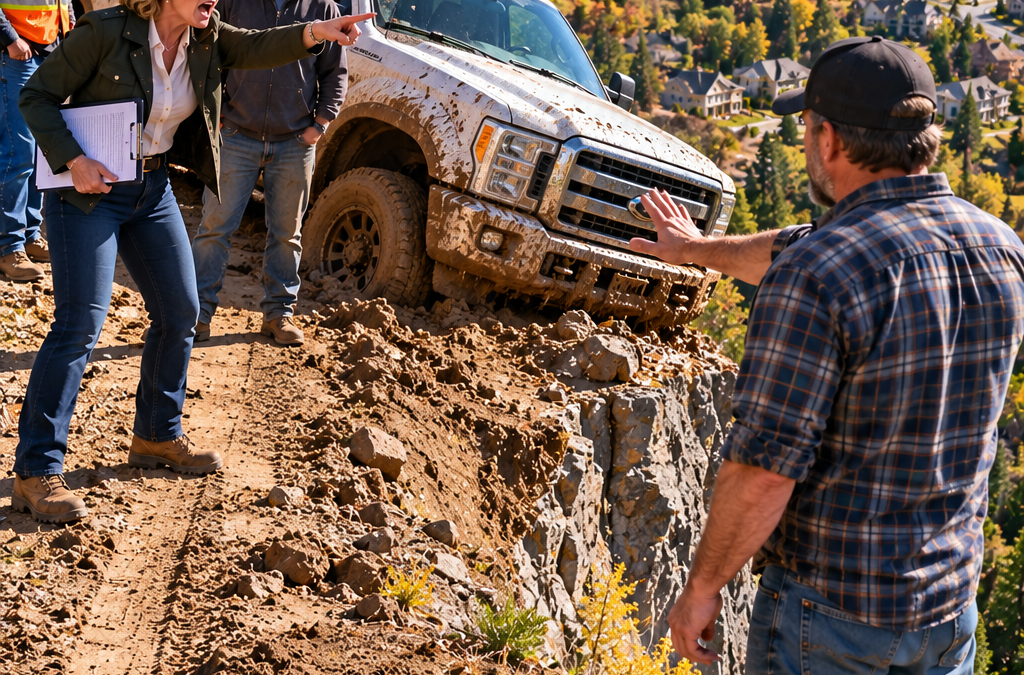
𝗙𝗨𝗟𝗟 𝗦𝗧𝗢𝗥𝗬
The trouble started with a letter.
Cream envelope.
Embossed seal.
Heavy paper.
The sort of stationery designed to make an ordinary complaint feel like a court order.
COMSTOCK FALLS HOMEOWNERS ASSOCIATION.
NOTICE OF VIOLATION.
Code 14B.
Unsightly vegetation encroachment.
I read the first paragraph twice because I assumed I had misunderstood it.
According to the letter, vegetation from my property was “negatively affecting the visual corridor and common-area presentation of the Comstock Falls community.”
The violation involved trees and brush along my lower property line.
Trees.
On my land.
Wild trees on a wooded mountain ridge were apparently violating the aesthetic expectations of a neighborhood I didn’t belong to.
I laughed.
That was my first mistake.
Not legally.
Emotionally.
Laughing made me treat the letter like stupidity instead of what it really was.
A test.
Regina was checking whether I would obey.
I called the number at the bottom.
A woman answered.
“Comstock Falls compliance.”
“This is Dale Mercer. I received a vegetation notice.”
A pause.
Then her voice changed slightly.
“Yes, Mr. Mercer.”
“You sent this?”
“I did.”
“Why?”
“The letter explains the violation.”
“My property isn’t in Comstock Falls.”
“Your property borders the association.”
“I know where I live.”
“There are visual-impact provisions concerning adjacent parcels.”
“No, there aren’t.”
A longer pause.
Then she said, “I’m sorry?”
“I have the recorded declaration. It doesn’t bind nonmember parcels.”
Her tone cooled immediately.
“Mr. Mercer, properties bordering association jurisdiction are expected to maintain reasonable compatibility with community standards.”
“Expected by who?”
“The HOA.”
“That wasn’t my question.”
Silence.
I leaned against the workbench in my shop.
I had a radio chassis open in front of me and a soldering iron cooling beside it.
“What exactly do you want me to do?”
“Trim the vegetation along the lower boundary.”
“How much?”
“The undergrowth should be cleared approximately twenty feet from the common visual corridor, and several trees have been identified for removal.”
I looked through the shop window toward the ridge.
“You want me to cut mature trees.”
“Some appear unhealthy.”
“They’re not.”
“Our inspection indicated otherwise.”
That got my attention.
“Inspection?”
“Yes.”
“From where?”
“The adjacent common area.”
“Did anyone enter my property?”
“No one entered the residence.”
I stopped.
“That isn’t what I asked.”
She didn’t answer.
“Regina, did somebody cross my property line?”
“Our compliance review was conducted according to association procedure.”
“I am not part of your association.”
“We expect voluntary compliance from neighboring owners where community appearance is affected.”
There it was.
Voluntary compliance.
A phrase that sounds polite until you realize the person using it expects obedience.
“I’m declining.”
“I wouldn’t recommend that.”
“Why?”
“Noncompliance can escalate.”
I almost laughed again.
“Escalate into what?”
“Additional notices. Assessments. Enforcement costs.”
“You can’t assess me.”
“You are adjacent to association jurisdiction.”
“I’m not a member.”
“We’re going in circles.”
“No. You are.”
She inhaled slowly.
“Mr. Mercer, I’m trying to resolve this informally.”
“So am I. Stop sending me violations.”
Then she laughed.
Not loudly.
Just enough for me to hear contempt in it.
“You’re making this more difficult than necessary.”
I looked at the circuit board in front of me.
“No. The property map is actually very simple.”
I ended the call.
For two weeks, nothing happened.
I thought maybe somebody on the board had explained the obvious to her.
Then the second letter arrived.
Same envelope.
Same seal.
This one included fines.
Two hundred dollars per week.
Escalating.
The letter claimed I had failed to correct the vegetation violation within the required period.
It also warned that continued noncompliance might result in contractor access to “remediate offending conditions.”
I read that sentence slowly.
Contractor access.
Then I noticed the attachment.
A color photograph of my driveway gate.
The image was taken from behind the gate.
Inside my property.
I knew because of the angle.
You could see the backs of the warning signs.
I stood in the kitchen staring at it.
The first letter had been absurd.
This was different.
Someone had entered my land.
Not by accident.
Not because they were lost.
To document me.
I didn’t call Regina.
I went outside.
Near the gate, mounted high in an oak, was a trail camera.
I had installed it years earlier after tools disappeared from a shed.
Most months, it recorded deer.
Occasionally raccoons.
Sometimes delivery drivers who ignored the sign.
I pulled the memory card.
Back inside, I loaded the images onto my computer.
There she was.
Regina Kowalc.
Green HOA jacket.
Black pants.
Clipboard.
Timestamped three days before the second letter.
She had parked a white SUV with a green stripe outside my gate.
Then she had walked around the gate where the fence dropped near the drainage ditch.
One frame showed her reading the NO TRESPASSING sign.
The next showed her stepping past it.
Another showed her standing inside my property, photographing the gate.
There were more.
She walked almost two hundred feet up the driveway.
Took pictures of trees.
The shoulder.
My gravel.
She stayed eighteen minutes.
Then left.
I sat in front of the screen feeling something cold settle in my stomach.
The fines didn’t bother me anymore.
The arrogance did.
She had already spoken to me.
She already knew I disputed HOA jurisdiction.
She knew the property was private.
Then she physically crossed the boundary to manufacture evidence for a fine she had no legal authority to issue.
I saved the images in three places.
One external drive.
One cloud backup.
One printed set.
Old habit.
I used to do field work for a state land-use compliance office.
Fifteen years.
That was a chapter of my life almost nobody in Comstock Falls knew about because there was no reason they should.
I had inspected right-of-way violations.
Boundary encroachments.
Illegal grading.
Unpermitted access roads.
Easement disputes.
Utility corridors.
I wasn’t a lawyer.
Never claimed to be.
But I had spent fifteen years reading plats, deeds, statutes, recorded easements, enforcement notices, and administrative decisions.
When a property owner said, “That road has always been there,” my job had been to find out whether that mattered legally.
When a contractor said, “We thought we had permission,” I asked for the permission.
When two maps disagreed, I learned quickly that the prettiest map was rarely the most important one.
Eventually I left.
The bureaucracy wore me down.
I went back to electronics because machines were less exhausting.
But I never forgot how land law worked.
More importantly, I never forgot how evidence worked.
So I didn’t confront Regina about the trail-camera footage.
Not yet.
I waited.
That was rung two.
Rung three came on a Saturday morning.
It had rained for most of the week.
The upper part of my drive drains well because I maintain it.
The old logging spur does not.
That spur leaves the main gravel drive near a sharp switchback and cuts east through the trees.
It hasn’t been actively used for logging in decades.
I occasionally walk it.
Sometimes I take the utility vehicle partway down when conditions are dry.
But I never graded the outer section because there was no reason to.
Past a certain point, the road narrows.
The soil gets soft.
The right shoulder drops away toward a ravine roughly forty feet below.
That is why I put up the third sign.
PRIVATE ROAD
STEEP GRADE
NO OUTLET
Underneath, in smaller letters:
NO COMMERCIAL VEHICLES BEYOND THIS POINT.
I was in the house working on an old public-safety radio when I heard an engine.
Not a pickup.
Diesel.
Low.
Straining.
Then tires spinning.
I went to the porch.
Through the trees, I could see movement near the lower switchback.
I grabbed my jacket and walked down.
Regina’s white HOA SUV was parked partly across my drive.
My gate stood open.
I never left that gate open.
Behind the SUV was a flatbed truck.
Medium-duty.
Heavy.
Too heavy for the wet upper road.
The driver was trying to climb the switchback.
The rear tires spun and threw mud against the embankment.
Regina stood beside the SUV with her clipboard.
I remember feeling less surprise than I should have.
Some part of me had been expecting her.
“Stop the truck.”
The driver looked toward me.
Regina turned.
For half a second, she looked irritated that I was home.
Then the expression disappeared.
“Mr. Mercer.”
“What are you doing?”
“We’re here to perform corrective work.”
“No, you’re not.”
She lifted the clipboard.
“We have authority to inspect and remediate unresolved violations.”
“Not on my property.”
“The board authorized contractor access.”
“The board can’t authorize entry onto land it doesn’t control.”
She held up one page.
“We have an order.”
I walked closer.
“Court order?”
“Compliance order.”
“From a court?”
“From the association.”
“So no.”
She tightened her mouth.
“It is legally enforceable under the governing documents.”
“Which don’t apply to me.”
“We’ve already discussed that.”
“Yes. You were wrong then too.”
The truck driver had stopped moving.
Good.
I pointed down the drive.
“Back it out.”
Regina turned toward him.
“Keep going.”
He looked between us.
I stared at her.
“Don’t.”
She ignored me.
“Continue to the work area.”
The driver hesitated.
“Ma’am, he says this is private.”
“It is within the HOA’s enforcement boundary.”
“No, it isn’t.”
I stepped toward the driver’s side.
“Listen to me. This road gets worse above the switchback.”
Regina moved between us.
“Do not interfere with our contractor.”
“You have a truck about to go off my mountain.”
“That’s dramatic.”
“No. That’s topography.”
I pointed ahead.
“The main drive turns left toward my house. The spur continues straight. Do not take that truck onto the spur.”
The driver leaned out.
“Where’s the work area?”
Regina pointed uphill.
“The vegetation zone.”
“You don’t have a work area.”
She turned on me.
“Mr. Mercer, if you obstruct authorized compliance activity, the association will document that separately.”
Something inside me went very quiet.
“Regina.”
She stopped.
“I am telling you directly, in front of your contractor, that neither of you has permission to enter farther onto this property.”
She stared at me.
“And I am telling you the HOA has jurisdiction.”
“No.”
“The board disagrees.”
“The board doesn’t get to disagree with a county plat.”
She raised the clipboard slightly.
“Proceed.”
The driver made the worst decision of the morning.
He listened to her.
The truck climbed.
Slowly.
The diesel engine growled as the tires fought the mud.
I moved off the road.
There was nothing I could safely do to stop a multi-ton vehicle.
At the switchback, the driver made the left turn.
For a moment, I thought maybe he would head toward the house.
Then Regina shouted.
“Straight ahead.”
I actually felt my stomach drop.
The driver corrected.
The truck entered the logging spur.
“Stop!”
He kept going.
The first thirty yards were firm enough.
Then the road narrowed.
I followed on foot but stayed well behind.
“Stop the truck!”
The driver finally slowed.
Regina had walked up behind me.
“He needs to reach the marked area.”
“There is no marked area.”
“He can turn around farther up.”
“No, he can’t.”
She looked at the road.
“You said this was a logging road.”
“Old logging spur.”
“Then logging trucks used it.”
“Forty years ago when it was maintained.”
The driver kept creeping forward.
Sixty yards.
Seventy.
Then the right rear tires slid.
Not dramatically.
Just six inches.
But on a road like that, six inches matters.
The driver hit the throttle.
The tires spun.
Mud sprayed.
The truck slid again.
“Brake!” I shouted.
He did.
Too late.
The outer shoulder collapsed beneath the rear axle.
The truck dropped hard on the passenger side.
Metal slammed against mud.
The bed tilted toward the ravine.
The front end twisted left.
The driver killed the engine.
For several seconds, nobody moved.
Then I heard the driver swear.
I approached carefully from the uphill side.
“Stay in the cab until I tell you.”
He looked terrified now.
“How bad?”
“Don’t move.”
Regina came up behind me.
“What happened?”
I turned slowly.
“What do you think happened?”
“The road failed.”
“No.”
“The road was unsafe.”
“Yes.”
“Then why wasn’t it barricaded?”
I stared at her.
There were moments during the entire dispute when I questioned whether Regina genuinely heard herself.
“Three signs.”
“That isn’t a barricade.”
“One says no trespassing.”
“This isn’t about trespassing.”
“One says private road.”
“We have compliance authority.”
“One says no commercial vehicles.”
“That sign may not meet county standards.”
I almost admired the commitment.
Almost.
The truck sat axle-deep in mud, leaning toward a forty-foot ravine, and she was criticizing the typography of my warning sign.
The driver climbed out through the uphill door.
His boots hit mud.
He looked at Regina.
“You told me this was common property.”
“It is.”
I said, “No, it isn’t.”
He looked at me.
“You said the road was maintained.”
Regina answered before I could.
“The access corridor should be maintained by the property owner.”
I laughed once.
The driver didn’t.
He walked back down toward the main road.
Regina stared at the truck.
Then she said something I remember word for word.
“This is a private matter now. We will be filing a claim.”
I turned toward her.
“A claim against who?”
“You.”
“For what?”
“Property damage.”
I looked at the truck.
Then at her.
“You entered my property without permission.”
“We had authorization.”
“From yourselves.”
“The road was not reasonably maintained.”
“You ignored three signs and a direct verbal warning.”
“You’re responsible for dangerous conditions.”
“On a private logging spur you were specifically told not to use?”
“We’ll let insurance determine that.”
That was rung four.
I took out my phone.
Regina’s eyes narrowed.
“Who are you calling?”
“The sheriff.”
For the first time that day, she stopped talking.
I called the county non-emergency line.
I explained that an unauthorized commercial vehicle had entered posted private property and become stuck.
I told the dispatcher there was no injury.
No immediate danger unless someone attempted to move the truck improperly.
I mentioned the ravine.
And I mentioned that I had trail-camera evidence of earlier unauthorized entries.
A deputy arrived about forty minutes later.
His name was Deputy Aaron Mills.
I’d seen him around town but didn’t know him.
He parked at the gate, then walked up because the road was blocked by Regina’s SUV and the recovery situation.
He looked at the signs first.
That told me something about him.
He didn’t begin by asking who was angry.
He looked at the physical facts.
Then he looked at the truck.
“That’s not coming out easily.”
“No.”
He turned toward Regina.
“Ma’am, is this your vehicle?”
“It is contracted to the HOA.”
“Who instructed the driver to enter?”
“I did.”
“Do you have written permission from the property owner?”
“We have association authority to inspect and correct violations.”
Deputy Mills looked at me.
“You part of the HOA?”
“No.”
Regina spoke.
“His parcel borders our jurisdiction.”
The deputy looked back at her.
“That isn’t what I asked.”
I almost smiled.
“Do you have written permission?” he repeated.
Regina held up the clipboard.
“We have a compliance order.”
“From who?”
“The association.”
“Court?”
“No.”
“County?”
“No.”
“Property owner?”
She said nothing.
He wrote something down.
Then looked at me.
“You have a deed or survey?”
“In the house.”
“Can you get it?”
“Yes.”
I brought him a copy.
He compared the parcel description to the map I had.
Then he walked down toward the gate and checked the boundary pin.
When he came back, Regina was explaining the vegetation violation.
Deputy Mills interrupted.
“Ma’am, I’m not seeing an HOA parcel here.”
“The association’s jurisdiction includes adjacent visual corridors.”
“That’s not ownership.”
“It creates compliance obligations.”
“Maybe civil obligations. I’m asking why your contractor drove onto posted private land without permission.”
Regina looked at me.
“He has repeatedly refused inspection.”
“That’s his right if you don’t have legal access.”
She flushed.
I could see her getting angry now.
“Deputy, with respect, this is a complex HOA matter.”
“I agree.”
He looked at the truck.
“Which is why you probably shouldn’t have driven a flatbed into it without documentation.”
That was when I mentioned my old job.
Not dramatically.
I didn’t announce it like some secret credential.
I simply said, “I used to do field compliance work for the state land-use office.”
Regina looked at me.
“What?”
“Fifteen years.”
“You never mentioned that.”
“You never asked.”
Deputy Mills looked interested.
“What kind?”
“Boundary disputes. Rights-of-way. Easement enforcement. Unpermitted access.”
Regina gave a short, dismissive laugh.
“You’re not an attorney.”
“Never said I was.”
“Then stop pretending you’re one.”
“I don’t need to be an attorney to read the trespass statute.”
Her face changed.
Just slightly.
There it was.
The first crack.
I had spent weeks being treated like an ignorant property owner who would eventually obey because the stationery looked official.
Now she was realizing I knew exactly what questions to ask.
I retrieved a printed copy of the relevant state statute from my office.
I had printed it after seeing the trail-camera footage.
I read the applicable section.
Knowingly entering or remaining on posted private property without consent.
Enhanced notice requirements.
Signage.
Direct verbal notice.
I pointed toward the road.
“We have posted notice.”
I pointed toward Regina.
“She acknowledged seeing the signs.”
Then toward the truck.
“I verbally withdrew consent before the vehicle continued.”
Deputy Mills wrote again.
Regina crossed her arms.
“This is absurd.”
“No,” I said. “Sending fines to a nonmember parcel is absurd.”
She turned sharply.
“You owe those assessments.”
“Show me the recorded covenant binding my land.”
“You’re within the influence area.”
“That isn’t a legal term in your declaration.”
“We use it for compliance purposes.”
“You made it up.”
“Don’t accuse me of misconduct.”
I took the second violation letter from my folder.
Deputy Mills looked at it.
Then at me.
“These fines?”
“Yes.”
“Have you paid any?”
“No.”
“Do they have lien rights?”
“No.”
Regina snapped, “That hasn’t been determined.”
I looked at her.
“It was determined when my parcel was excluded from the plat.”
“You’re interpreting documents.”
“So are you.”
Deputy Mills raised a hand.
“All right.”
He looked at Regina.
“I’m documenting the unauthorized-entry complaint. The ownership and fine issues are civil unless the county determines otherwise.”
Then he turned to me.
“Don’t touch the truck.”
“I wasn’t planning to.”
“Don’t block reasonable recovery once they arrange it.”
“I won’t.”
Then back to Regina.
“And nobody comes farther onto this property without the owner’s permission.”
Regina stared at him.
“We need access to retrieve the truck.”
“For recovery only, coordinated with him.”
Her jaw tightened.
“This is HOA business.”
“Not anymore.”
That line stayed with me.
The same phrase Regina had used.
Only now it meant something very different.
The deputy left.
Regina followed soon afterward.
The truck stayed.
That afternoon, I filed a formal county complaint.
I attached everything.
The original violation notice.
The escalating fine notice.
The photograph taken from inside my property.
Trail-camera images.
Timestamped.
Three separate unauthorized incursions once I reviewed older footage.
Regina had entered before the first letter too.
I hadn’t noticed because I hadn’t checked that far back.
Three visits.
Three times past the signs.
Clipboard in hand every time.
I included the video from the morning of the truck incident.
My camera had recorded enough audio to capture my direct warning.
Do not take that truck onto the spur.
Then Regina’s instruction.
Straight ahead.
That one clip changed the recovery dispute immediately.
The HOA’s insurer refused to treat the truck damage as my responsibility without further review.
The towing company came out the following day.
One driver took a look and refused the job.
“Too much side load.”
A second crew tried the day after that.
Their first winch setup didn’t move the truck.
The rear axle had sunk deeper overnight.
They repositioned.
The cable snapped.
The sound cracked across the ridge like a rifle shot.
Everyone froze.
The tow operator swore.
After that, they stopped.
The truck remained on my mountain.
Day three.
Day four.
Day five.
Every morning I walked down and checked that it hadn’t shifted closer to the ravine.
I didn’t touch it.
I photographed it.
Logged conditions.
Then went back to work.
By day six, neighbors from Comstock Falls had started coming to the lower road just to look.
Some stood outside my gate taking pictures.
I didn’t engage.
Regina sent another letter claiming I was “unreasonably delaying recovery.”
My attorney—because by then I had hired one—responded with a single question.
Please identify any date on which Mr. Mercer denied a properly coordinated recovery request.
There wasn’t one.
I had never denied access for recovery.
I had only required competent people, insurance, and a plan that would not send a truck into the ravine.
Meanwhile, the county complaint moved.
I expected a boundary review.
Maybe a warning to the HOA.
What happened instead was much bigger.
The county planning office forwarded part of the complaint to the state licensing board.
The reason was Regina’s title.
COMPLIANCE DIRECTOR.
Apparently, the county official reviewing the letters looked at the HOA’s recorded governance documents and couldn’t find any such position.
Neither could my attorney.
Then a homeowner inside Comstock Falls requested the association bylaws.
Same result.
No compliance director.
There was an architectural committee.
A property manager.
A board secretary.
A board president.
No office called Compliance Director.
Regina had invented it.
Two years earlier, according to later records.
She had persuaded the board that enforcement needed to be “streamlined.”
The board allowed her to coordinate violations.
Then, slowly, the role changed.
Letterhead appeared.
A title appeared.
A separate email account.
COMPLIANCE DIRECTOR.
Most board members assumed someone else had formally approved it.
Nobody had.
That discovery made them ask another question.
Who approved the fine schedule?
The answer was worse.
Nobody.
The escalating compliance charges Regina had been sending were not part of the adopted HOA penalty schedule.
She had created a parallel system she called “voluntary correction assessments.”
The phrase voluntary was buried in the fine print.
Homeowners saw official stationery, deadlines, and escalating dollar amounts and paid.
Some because they were afraid of liens.
Some because the amounts were small enough not to justify fighting.
Some because Regina told them payment was the fastest way to close their file.
Then the board treasurer found irregularities.
A percentage of the voluntary payments went to an outside “compliance administration” account.
That account was controlled through a small consulting company connected to Regina.
My tree fine had not been an isolated case.
I was simply the first person outside the HOA to push hard enough that county officials started pulling threads.
Once they did, everything came apart.
The HOA president called me.
Carol Hinsley.
Until that phone call, I had spoken to her maybe twice in ten years.
She sounded exhausted.
“Mr. Mercer?”
“Dale is fine.”
“This is Carol Hinsley from Comstock Falls.”
“I know.”
There was a pause.
“I owe you an apology.”
That surprised me.
I said nothing.
She continued.
“I’ve reviewed your parcel records.”
“Okay.”
“Your property is clearly outside the association.”
“Yes.”
“I understand that now.”
“You could have understood it before the second letter.”
“I know.”
Her voice cracked slightly.
Not theatrically.
She sounded genuinely sick.
“I didn’t know she was going onto your property.”
“Three times.”
“I’ve seen the footage.”
“And the fines?”
Another pause.
“We’re investigating that.”
“You should.”
“Dale, I need you to understand something. The board believed Regina was operating within the authority she’d been given.”
“What authority?”
“That’s part of what we’re trying to determine.”
“That sounds like none.”
She exhaled.
“Probably.”
For the first time since the whole thing started, my anger softened.
Carol wasn’t defensive.
She wasn’t telling me I misunderstood.
She wasn’t hiding behind community standards.
She sounded like someone who had just discovered she had trusted the wrong person.
“How much money are we talking about?”
I asked.
“I can’t discuss the full numbers yet.”
“That bad?”
“Yes.”
I looked through the window toward the logging spur.
The truck was still visible between trees.
“What do you want from me?”
“Nothing right now.”
That surprised me more.
“We’re suspending all enforcement actions associated with Regina pending review.”
“Good.”
“And we will coordinate the truck recovery through counsel.”
“Good.”
Then she said quietly:
“I’m sorry this happened on your land.”
I believed her.
That mattered.
The flatbed finally came out on day eleven.
A professional heavy-recovery crew arrived with two trucks, ground anchors, cribbing, and a man who spent almost an hour walking the spur before anybody touched a cable.
That was the difference between authority and competence.
Regina had looked at the road and decided confidence would make it safe.
The recovery supervisor looked at the same road and respected what it could do.
They stabilized the flatbed first.
Then lifted the rear axle.
Then winched the truck sideways in controlled increments.
It took most of the afternoon.
I watched from my porch for part of it with coffee.
Not because I was celebrating.
Because eleven days of tension were finally leaving my property.
When the truck reached stable gravel, one of the recovery operators walked up to me.
“You’re lucky it didn’t roll.”
“I know.”
“Driver said somebody told him this was HOA common land.”
“Regina.”
He shook his head.
“Signs looked pretty clear to me.”
“Apparently not clear enough.”
The towing company that had originally sent the flatbed got dragged into the investigation too.
At first, management claimed their driver had been told the road was an authorized HOA service corridor.
Then internal messages surfaced.
Regina had specifically instructed them to disregard private-property signage because, in her words, “the association possesses enforcement access.”
That statement went into the county file.
The company had a county service contract.
The county did not appreciate contractors knowingly bypassing posted private-property notices based on an unsupported HOA claim.
The contract was later terminated.
I didn’t ask for that.
By then, I wasn’t asking for much of anything.
Events had developed their own momentum.
The Comstock Falls board held an emergency meeting.
Carol invited me.
I almost declined.
Then my attorney said I should attend.
“Not to argue,” he told me. “Just hear what they put on the record.”
The clubhouse was full.
Real homeowners this time.
People Regina had actually had some authority over.
I sat near the back.
Regina sat at the board table.
No green jacket.
No clipboard.
That struck me immediately.
Without them, she looked smaller.
Carol opened the meeting.
“We are here to address irregularities identified in the association’s compliance and enforcement process.”
People murmured.
Regina leaned toward her microphone.
“I object to the characterization of irregularities.”
Carol looked at her.
“The board reviewed the documents.”
“The process was approved informally.”
“By whom?”
Silence.
One board member opened a binder.
“We have no vote.”
Regina said, “Not every operational decision requires a formal board vote.”
“The fine schedule does.”
“It wasn’t a fine schedule.”
Several homeowners laughed bitterly.
Regina’s face hardened.
“It was a voluntary compliance framework.”
A man in the front stood.
“You sent me a letter saying I owed six hundred dollars.”
“You voluntarily resolved the matter.”
“You threatened additional enforcement.”
“I explained possible consequences.”
Another woman raised her hand.
“You told me paying would prevent a lien.”
Regina looked toward Carol.
“This is becoming a hostile proceeding.”
Carol’s face was pale.
“Regina, did you receive a percentage of the payments?”
The room changed.
Every whisper stopped.
Regina didn’t answer.
Carol repeated the question.
“Did you or an entity under your control receive a percentage of voluntary compliance payments?”
“My administrative company was compensated for processing work.”
Someone shouted, “You were paying yourself?”
Regina’s voice rose.
“I performed services.”
“Who approved the contract?” Carol asked.
“The arrangement was known.”
“Who approved it?”
Regina looked around the table.
Nobody spoke.
A woman behind me said, “Oh my God.”
Carol closed her eyes for half a second.
Then she looked toward me.
“This began because of Mr. Mercer’s complaint.”
Dozens of people turned.
I didn’t enjoy that.
Carol continued.
“His property is outside Comstock Falls jurisdiction. There was no legal basis for the notices sent to him.”
Regina interrupted.
“His vegetation affected community property.”
“That doesn’t make him a member.”
“He refused reasonable cooperation.”
I felt the old anger return.
But I stayed seated.
Carol said, “He did not owe us cooperation.”
That sentence mattered more than any apology.
Regina stared at her.
Carol continued.
“He did not owe assessments. He did not owe fines. We had no authority to send a contractor onto his parcel.”
“The contractor entered under my direction.”
“Yes.”
“To enforce association interests.”
“Which did not extend onto his property.”
Regina stood.
“I will not sit here and be treated like a criminal for doing the job this board asked me to do.”
Nobody answered.
Then a homeowner said from the back:
“We didn’t ask you to pocket our fines.”
Regina grabbed her bag and walked out.
No dramatic speech.
No apology.
No glance toward me.
Just the door closing behind her.
Within a week, she was removed from every HOA role.
Paid.
Volunteer.
Formal.
Informal.
All of it.
The state opened an inquiry into the compliance-payment system.
I wasn’t involved in most of that.
I provided my records when asked.
The homeowners who had paid Regina’s voluntary assessments received notices that the payments were under review.
Refunds followed.
Some were small.
A hundred dollars.
Two hundred.
Others were much larger.
One retired couple had paid nearly four thousand dollars over two years because Regina repeatedly threatened escalating action over landscaping and exterior repairs.
When I heard that, any satisfaction I might have felt disappeared.
Four thousand dollars matters to most people.
It matters even more when you’re living on retirement income.
The board hired outside counsel.
They audited enforcement records.
They rewrote procedures.
No single person could issue monetary demands anymore.
Every violation had to tie to an adopted rule.
Every fine had to receive proper board authorization.
And jurisdiction had to be verified before any enforcement letter was sent.
That last rule became known unofficially as the Mercer rule.
I hated that name.
I told Carol not to use it.
She laughed for the first time in weeks.
“We don’t use it in writing.”
“Good.”
The HOA also sent me a formal acknowledgment.
This time, it wasn’t just an apology letter.
My attorney insisted on something stronger.
The document identified my parcel by legal description.
It stated clearly that the eleven acres were outside the recorded Comstock Falls HOA boundary.
It confirmed that association covenants, assessments, landscaping standards, architectural rules, and enforcement procedures did not apply to my land.
It acknowledged my private access road.
The document was notarized.
Then recorded with the county.
That was more than I had asked for.
At the beginning, I wanted one thing.
Leave me alone.
Close my gate.
Stop walking my land.
Don’t tell me which trees to cut.
Instead, I ended up with a recorded document proving the HOA couldn’t do any of those things.
Carol handed me a copy personally.
We met at the gate.
She looked at the repaired shoulder where the flatbed had entered.
“I’m sorry.”
“You already said that.”
“I know.”
“You don’t have to keep saying it.”
“I probably do.”
I looked at her.
She seemed older than she had a month earlier.
“You didn’t put the truck up there.”
“No. But I was president.”
“That doesn’t make you responsible for everything another person hid.”
“It makes me responsible for checking.”
Fair enough.
I appreciated that answer.
She looked toward the trees.
“We should have checked your parcel before the first letter.”
“Yes.”
“We should have checked Regina’s authority.”
“Yes.”
“We should have checked the payments.”
“Yes.”
She gave me a tired smile.
“You could make this easier.”
“I could lie.”
She laughed.
Then grew serious again.
“Why didn’t you tell us about your old state job?”
“Why would I?”
“I don’t know.”
“That’s the problem.”
She looked confused.
“People shouldn’t have to prove professional expertise before you respect their property line.”
Carol nodded slowly.
“No.”
“They shouldn’t.”
That was the heart of it.
I had known the statutes.
I had old experience.
I understood evidence.
Those things helped me.
But I should not have needed them.
A seventy-year-old widow outside the HOA would have had the same property rights.
A twenty-five-year-old mechanic.
A teacher.
A cashier.
Someone who had never seen a plat before.
Private land does not become less private because the owner doesn’t know how to cite a statute.
That thought bothered me long after Regina disappeared.
Because I kept wondering how many people had paid her simply because they assumed official-looking paper meant somebody had checked.
How many saw the gold seal and thought:
They must be allowed to do this.
How many believed the title.
Compliance Director.
How many believed a clipboard.
A logo.
A white SUV with a green stripe.
Authority has costumes.
Most of the time, we don’t notice them until somebody wears one without the authority underneath.
My mountain recovered slowly.
The flatbed left deep ruts on the logging spur.
The outer shoulder needed repair.
The HOA’s insurer paid for that after the footage showed exactly how the truck got there.
I hired a local excavation operator I trusted.
He stabilized the edge.
Added stone.
Restored drainage.
I did not widen the road.
I did not make it suitable for trucks.
I had no reason to.
It remained what it had always been.
An old logging spur on private land.
Grass started appearing in the tire marks by late spring.
At first just a few blades.
Then thicker patches.
Rain softened the sharp edges.
Leaves filled the shallow depressions.
Nature doesn’t care much about human embarrassment either.
Give it time and most scars become ordinary ground again.
Sometimes in the evening, I still walk down there.
I stand near the place where the flatbed sat for eleven days.
If I look carefully, I can still see part of the rut.
I remember Regina standing there with that clipboard.
“This is a private matter now. We will be filing a claim.”
At the time, I was furious.
Now it feels almost surreal.
She had crossed two posted boundaries.
Sent a contractor past three signs.
Ignored a direct warning.
Ordered a commercial truck onto an unsafe spur.
Then watched it sink and immediately decided the person who warned her should pay.
That is what control did to her.
It made every consequence somebody else’s fault.
If I refused her letter, I was difficult.
If I protected my boundary, I was obstructing enforcement.
If her truck got stuck, I had created a dangerous road.
If homeowners questioned the fines, they were resisting compliance.
If the board questioned her side payments, they were attacking the work she had done.
There was always another explanation.
Never the obvious one.
She had gone too far.
I later heard Regina moved out of Comstock Falls.
I don’t know where.
I didn’t ask.
I heard rumors about attorneys.
About the state inquiry.
About repayment agreements.
I stayed out of it.
By then, I had enough.
I wanted quiet again.
I went back to radios.
Back to the shop.
Back to mornings when the loudest sound was a soldering-station fan and wind against the metal roof.
For a while, every vehicle I heard on the lower road made me look toward the gate.
That bothered me.
Before Regina, the gate was just a gate.
Afterward, it became something I checked twice.
I added a camera angle.
Replaced the latch.
Not because I was afraid.
Because trust had been made expensive.
Clara noticed.
“You know they aren’t coming back.”
“I know.”
“Then why do you keep checking?”
I looked toward the drive.
“Habit.”
She knew better.
One afternoon she stood beside me at the gate.
The original three signs were still there.
The NO TRESPASSING sign.
The private-road warning.
The commercial-vehicle warning.
I had added a fourth.
Smaller.
Mounted lower.
Easy to miss unless you actually stopped and read.
It said:
I READ MY OWN LAND SURVEYS.
Clara stared at it.
Then looked at me.
“That is the most Dale sign you’ve ever made.”
“I don’t know what that means.”
“Yes, you do.”
“It doesn’t threaten anyone.”
“No.”
“It doesn’t insult anyone.”
“Not technically.”
“I thought it was clear.”
She laughed.
“That’s the problem. You always think being technically clear makes you less sarcastic.”
Maybe she was right.
Nobody from the HOA has asked me what the sign means.
Part of me hopes they never do.
Part of me would enjoy explaining it.
The county acknowledgment sits in my safe now.
So do the violation letters.
Trail-camera printouts.
The deputy’s incident number.
The recorded boundary document.
I kept everything.
Not because I expect another fight.
Because evidence has value long after memory starts editing itself.
If I told the story without those records, someone might say I exaggerated.
Surely an HOA representative didn’t trespass three separate times.
Surely she didn’t create a fake enforcement title.
Surely she didn’t order a truck past three warnings.
Surely she didn’t issue fines to property outside the HOA.
Surely money didn’t flow into a side company.
But people say surely when they don’t want to believe how ordinary bad decisions can become when nobody asks the first basic question.
Do we actually have the authority to do this?
That question could have prevented everything.
Before the first letter:
Is Dale’s property inside the HOA?
No.
Stop.
Before Regina crossed the gate:
Do we have permission to inspect?
No.
Stop.
Before the second fine:
Can we assess nonmembers?
No.
Stop.
Before the flatbed entered:
Do we have a legal right of access?
No.
Stop.
Before the driver reached the logging spur:
Is this road safe for a commercial truck?
No.
Stop.
Five opportunities.
Any one of them would have prevented the rest.
Instead, every warning became something Regina interpreted as resistance.
That is what still troubles me most.
Not the money.
Not the truck.
Not even the trespass.
The mindset.
Some people hear “no” and ask why.
Others hear “no” and immediately start searching for a way to overpower it.
Regina was the second kind.
My land became a challenge because I would not recognize authority she did not possess.
Once she decided I was defiant, every step became justified in her own mind.
The letter.
The fines.
The photographs.
The contractor.
The claim.
It escalated because backing down would have required her to admit the first letter had been wrong.
That small admission could have saved everyone a great deal of time.
Instead, she chose escalation.
I spent fifteen years around land disputes.
The worst ones rarely begin with complicated law.
They begin with pride.
A fence six inches off line.
A driveway used without written permission.
A ditch moved thirty years ago.
A tree someone believes marks a boundary.
Then somebody decides compromise means weakness.
Documents become weapons.
Neighbors stop talking.
Lawyers arrive.
People spend ten thousand dollars fighting over land worth five thousand because, by then, the dispute isn’t about land anymore.
It is about refusing to lose.
I thought I had left that world when I left the state office.
Then it drove a flatbed truck through my gate.
The irony is that I never wanted to beat Comstock Falls.
I wasn’t angry at the homeowners.
Most of them didn’t know my name.
Some of them eventually sent notes apologizing for what happened.
One man came up to the gate and said:
“I paid one of those compliance charges.”
“How much?”
“Eight hundred.”
“What for?”
“My shed.”
He shook his head.
“I thought it was real.”
“It looked real.”
“That’s what bothers me.”
I understood.
He stared at the small sign.
I READ MY OWN LAND SURVEYS.
Then smiled.
“I get it.”
“You’re the first.”
He laughed.
That conversation stayed with me too.
Because he wasn’t foolish.
That mattered.
People sometimes tell stories like this as though anyone who pays an invalid demand deserves what happened because they should have known better.
I don’t believe that.
Systems are supposed to make authority clear.
Ordinary people should not need fifteen years of land-use experience to distinguish a legitimate HOA assessment from a manufactured one.
They should be able to trust that a board verifies jurisdiction before threatening fines.
They should be able to trust that an official title exists.
They should be able to trust that the person collecting enforcement money isn’t secretly taking a percentage.
That is why Carol’s response mattered.
She didn’t protect Regina once she saw the evidence.
She didn’t pretend the problem was bad communication.
She opened the books.
She let the board ask ugly questions.
She refunded people.
She hired outside counsel.
She put my exclusion in writing.
That does not erase what happened.
But accountability rarely erases damage.
It prevents repetition.
Eventually, the HOA stopped feeling like an enemy below the ridge.
It went back to being what it should have been all along.
A private association for people who voluntarily belonged to it.
Nothing more.
Sometimes I see Carol when I drive through town.
We wave.
Once she brought an old tabletop radio to my shop.
“Can you fix this?”
I looked at the wooden case.
“Probably.”
“It was my father’s.”
“That makes parts harder to find.”
“I can wait.”
I opened the back.
Vacuum tubes.
Dust.
Old cloth wiring.
A simple machine by modern standards.
“You know,” she said, “I almost didn’t bring it.”
“Why?”
“I thought you might not want HOA business.”
“This isn’t HOA business.”
She smiled.
“No. It isn’t.”
I fixed it.
Didn’t charge her extra.
Didn’t waive the bill either.
Fair is fair.
A week later she picked it up.
I turned the dial.
Static filled the shop.
Then music came through.
Clear enough.
She listened for a moment.
“My father used to play baseball games on that.”
“Then don’t leave it running unattended. Wiring is old.”
She laughed.
“Always a compliance officer.”
I looked at her.
She realized what she’d said.
“Oh.”
Then we both laughed.
That was when I knew the whole thing had finally stopped owning space inside my head.
I could laugh without anger.
The ridge is quiet again.
That’s what I wanted from the beginning.
I wake early.
Make coffee.
Walk the property.
Some mornings fog sits below the ridge and hides Comstock Falls completely.
On those mornings, the mountain looks the way it probably did before anyone drew subdivision lines across the lower slopes.
No HOA.
No common area.
No compliance director.
Just trees and rock.
I know the legal boundaries are still there even when I cannot see them.
That is something people forget.
A property line doesn’t need a fence to exist.
A right doesn’t need a person standing over it every day.
And authority doesn’t become real merely because nobody has challenged it recently.
Regina mistook silence for permission.
She thought because I had ignored the HOA for years, the HOA could gradually reach uphill.
First trees.
Then inspections.
Then fines.
Then contractor access.
Each step was small enough to sound reasonable if you ignored the one before it.
That is how overreach usually works.
Nobody arrives saying:
Today I intend to seize authority I do not have.
They say:
We’re just asking for cooperation.
We’re just conducting an inspection.
We’re just protecting community standards.
We’re just enforcing a rule.
We’re just sending a contractor.
Then one morning there’s a flatbed truck sitting axle-deep in mud on land they had no right to enter.
I learned something from those eleven days.
Boundaries are easiest to protect before someone becomes comfortable crossing them.
That does not mean you have to be angry.
It does not mean every disagreement deserves a lawyer.
It means clarity matters.
When the first letter arrived, I laughed.
If I could go back, I wouldn’t laugh.
I would respond once in writing.
Parcel number.
Recorded exclusion.
No jurisdiction.
No consent to entry.
Do not contact me with enforcement demands.
Nothing emotional.
Nothing long.
Just a clean line.
Maybe Regina would have ignored that too.
Probably.
But the record would have been even simpler.
That is another thing land-use work taught me.
The best evidence usually looks boring.
Dates.
Maps.
Photographs.
Receipts.
A five-sentence letter.
The dramatic moment happens later.
The boring paperwork decides what it means.
For me, the most important evidence wasn’t some secret deed.
It wasn’t a courtroom surprise.
It was ordinary.
A county plat everyone could have checked.
A trail camera anybody could buy.
Three signs anyone could read.
A video of me saying stop.
That was enough.
Regina created the rest herself.
Her letters.
Her unauthorized title.
Her payment records.
Her instructions to the contractor.
Her own confidence became evidence.
I sometimes think about the driver too.
He was not a villain in this.
He made a bad decision.
He should have stopped when the property owner told him to.
But Regina had told him she had authority.
His employer had told him he was entering HOA common land.
He trusted the person carrying the clipboard.
Then the truck sank.
When the recovery crew finally pulled it out, he came back with the company’s manager.
He stood near the gate while paperwork was signed.
Before leaving, he walked over.
“Mr. Mercer?”
“Dale.”
He rubbed the back of his neck.
“I should’ve listened.”
“Yes.”
I didn’t soften it.
He nodded.
“I thought she knew.”
“I know.”
“I saw the signs.”
“I know that too.”
He looked embarrassed.
“Sorry.”
“Accepted.”
That was enough.
People make mistakes.
The difference is what they do after.
He admitted his.
Carol admitted hers.
The board corrected theirs.
Regina never did.
At least not to me.
Maybe that is why I remember her differently from everyone else involved.
Not because she caused the first mistake.
Anyone can misunderstand a boundary.
Because every new piece of evidence became something she tried to dominate instead of learn from.
That was the real problem.
My property is still eleven acres.
No more.
No less.
The HOA did not collapse.
Comstock Falls did not lose its landscaping.
Nobody’s property value vanished because my trees remained untrimmed.
The world continued perfectly well without Regina deciding what happened above the ridge.
The vegetation she called unsightly is still there.
Some of the oaks are taller now.
The brush thickened along one section.
Deer use it for cover.
A hawk nests in one pine she wanted removed.
Every autumn the leaves turn red and gold.
From below, I imagine it looks less like a planned visual corridor than ever.
Nobody has sent me a violation.
Good.
The gate stays closed.
Most days.
When I’m expecting deliveries, I open it.
When the propane truck comes, I meet the driver.
Everyone else reads the signs.
Four of them now.
The smallest is still my favorite.
I READ MY OWN LAND SURVEYS.
Maybe someday somebody will ask what it means.
I’ll probably tell them this:
It means I spent fifteen years watching people get themselves into trouble because they assumed confidence was the same thing as authority.
It means a document does not become binding because it arrives in a cream envelope.
It means a title does not become real because someone prints it beneath their name.
It means private property stays private even when the people on the other side of the line find that inconvenient.
Mostly, though, it means I learned not to laugh at the first letter anymore.
I read it.
Then I read the map.
Then I check the line.
The rut where the truck sat is almost gone now.
Grass pushed through it.
Rain flattened the edges.
Another season and I probably won’t be able to find the exact place without looking hard.
I like that.
I don’t need a monument.
I don’t need the scar.
I don’t need a stuck truck on the mountain to remind anybody who won.
Winning was never what I wanted.
I wanted the ridge quiet.
I wanted my gate respected.
I wanted people who had no authority over me to stop pretending they did.
Eventually, I got exactly that.
It just took three trespasses, two fake fines, one invented job title, a county complaint, a state inquiry, eleven days of a flatbed truck sitting in the mud, and a room full of homeowners finally asking the question somebody should have asked before any of it began.
Does she actually have the right to do this?
She didn’t.
And once everyone finally checked the paperwork, there wasn’t much left to argue about.





