𝗙𝗨𝗟𝗟 𝗦𝗧𝗢𝗥𝗬 The HOA Towed My Old Pickup Off the Gravel Road My Grandfather Built and Never Asked Who Actually Owned the Ground Beneath It
𝗙𝗨𝗟𝗟 𝗦𝗧𝗢𝗥𝗬
The kind of white sneakers that had clearly never touched mud.
There was nothing wrong with any of that.
What mattered was the way she spoke.
Diane had a habit of giving instructions when ordinary conversation would have worked.
If somebody parked slightly over a line, she did not ask them to move.
She told them where they were permitted to park.
If a child rode a bicycle on the clubhouse walkway, she did not say, “Be careful.”
She explained the rule.
Everything became authority.
Everything became enforcement.
Within weeks of becoming president, she began sending violation notices over garbage cans, garden decorations, basketball hoops, and grass height.
Again, that was none of my business.
Pine Ridge residents had joined the HOA.
I had not.
My ranch predated the development by decades.
I paid no HOA dues.
Signed no HOA covenants.
Attended no HOA meetings.
As far as I was concerned, Diane could regulate the color of every flowerpot inside Pine Ridge Estates if the homeowners let her.
She just could not regulate mine.
The first letter arrived three weeks after she became president.
I opened my mailbox one afternoon and found an envelope stamped with the Pine Ridge Estates Homeowners Association logo.
I nearly threw it away unopened.
Then curiosity got me.
The letter informed me that my pickup truck had been observed “parked for prolonged periods in violation of community street-parking standards.”
I read that sentence twice.
Then I looked down the road.
My old Ford pickup was parked where it had been for years.
Half on the gravel shoulder beside my workshop.
Entirely on ranch property.
I laughed.
My truck was nothing special.
A faded dark-green Ford from the 1990s.
Rust beginning around the wheel wells.
Cracked dashboard.
Bench seat.
Engine still strong.
I used it for feed, tools, fence posts, lumber, and almost anything else that did not require the larger ranch truck.
Diane apparently saw it differently.
According to the letter, it was an “unsightly inoperable vehicle.”
It was not inoperable.
I had driven it that morning.
The letter demanded that I move it within seventy-two hours.
I folded the page.
Put it in a drawer.
And forgot about it.
Another letter came ten days later.
Then another.
This time there was language about “continued noncompliance.”
I ignored that too.
Then they complained about my fence.
Apparently weathered cedar did not comply with Pine Ridge Estates’ approved fencing colors.
The month after that, I received a notice about the barn roof.
Then the mailbox.
Then the old utility trailer beside my workshop.
Then, unbelievably, the American flag mounted outside the workshop.
That notice claimed the flagpole height might violate architectural restrictions.
I stared at that one for a long time.
Then I put it in the same drawer as the rest.
The drawer became my HOA file.
Not because I took them seriously.
Because I had learned over the years that ridiculous paperwork still needed to be saved.
Diane eventually came to my house in person.
It was late afternoon.
I was replacing hinges on a gate near the barn when her black SUV pulled into my drive.
She stepped out holding a thick blue folder.
I already knew this was not going to be a social visit.
“Mr. Brooks?”
I straightened.
“That’s me.”
“I’m Diane Mercer.”
“I know.”
She seemed slightly disappointed that I did not ask how.
“I’m president of the Pine Ridge Estates Homeowners Association.”
“I know that too.”
She glanced toward the pickup.
“That’s the vehicle we’ve been contacting you about.”
“Yes.”
“It needs to be moved.”
“Why?”
“Because it is parked on HOA-controlled property.”
I looked down at the gravel beneath her shoes.
Then back at her.
“No.”
She smiled.
It was not a friendly smile.
It was the smile of someone who believed the conversation had reached the part where the other person would be corrected.
“We’ve already confirmed ownership.”
I leaned against the fence post.
“Have you?”
“Yes.”
“Interesting.”
“The roadway and adjacent shoulder are maintained as part of the Pine Ridge access corridor.”
“That doesn’t make them yours.”
“We have maps.”
“So do I.”
Her smile tightened.
“Mr. Brooks, I’m trying to resolve this without additional enforcement.”
I nearly laughed.
“Enforcement against who?”
“You.”
“I’m not in your HOA.”
“That does not mean you can obstruct common access areas.”
“My truck is parked on my ranch road.”
“This road serves Pine Ridge residents.”
“That still doesn’t make it your road.”
She opened the folder.
“I’m not here to debate historical ownership.”
“That’s probably because history isn’t going to help you.”
She looked up sharply.
“You’ve been issued multiple notices.”
“Yes.”
“And ignored them.”
“Yes.”
“That’s not how community enforcement works.”
“I’m not part of your community association.”
“You benefit from the surrounding development.”
That was a new one.
“How?”
“Property values.”
I looked across my pasture.
At the barn.
At cattle standing near the creek.
“My grandfather bought this place before half these houses existed.”
“That isn’t relevant.”
“It seems pretty relevant when you’re trying to tell me who owns his road.”
Her voice cooled.
“You have until Friday to move the truck.”
“Or?”
“Further action.”
“What kind?”
She closed the folder.
“You’ll find out if necessary.”
Then she returned to her SUV.
I watched her drive away.
I did not stop her.
I did not argue harder.
Because by then I already knew something Diane did not know I knew.
Six weeks earlier, while cleaning out my grandfather’s old office, I had found a wooden cabinet behind a stack of feed ledgers.
My grandfather saved everything.
Receipts.
Farm equipment manuals.
Tax records.
Old photographs.
He had boxes of papers dating back decades.
Inside that cabinet was a yellow legal envelope with handwriting across the front.
ROAD DOCUMENTS – KEEP
I sat down at his old desk and opened it.
Inside were engineering drawings from the early 1960s.
Construction receipts.
Drainage permits.
A county filing.
Maintenance contracts.
And an easement document recorded long before Pine Ridge Estates existed.
I read everything once.
Then again.
My grandfather had been meticulous.
The road was not public.
It had never been dedicated to the county.
It was not jointly owned.
The underlying land belonged entirely to the ranch.
The easement language dealt only with limited utility access associated with older neighboring parcels.
Nothing in the file gave Pine Ridge Estates permanent residential access.
That caught my attention.
Because residents had been using a section of the gravel road for years.
I had assumed the developer eventually recorded something.
So I checked.
I hired a licensed surveyor named Paul Wescott.
Paul had worked in the county for more than twenty-five years.
I gave him the old documents and asked him one question.
“Tell me exactly who owns this road.”
He spent nearly two weeks researching.
He pulled county maps.
Historic plats.
Deeds.
Subdivision filings.
Development plans.
Then he came to the ranch with GPS equipment and marked the boundaries.
When he finished, we stood beside the same stretch of gravel where my pickup usually sat.
He looked down at his notes.
Then at me.
“Daniel, your grandfather did this right.”
“How right?”
“One of the cleanest chains I’ve seen.”
“So?”
“So the road is yours.”
“All of it?”
“Everything inside these markers.”
“What about Pine Ridge?”
He turned toward the subdivision entrance.
“That’s where it gets interesting.”
I followed his gaze.
“What?”
“Their entrance connects to your private road.”
“I know.”
“I can’t find a permanent recorded access agreement.”
I stared at him.
“None?”
“Not one giving the subdivision the rights they seem to think they have.”
“What about prescriptive access?”
“That’s something an attorney would need to analyze based on the full history. I’m just telling you what the recorded documents show.”
I looked down the road.
Cars moved in and out of Pine Ridge Estates every day.
School buses.
Delivery trucks.
Contractors.
Residents.
Hundreds of trips.
“You’re sure?”
Paul smiled.
“I’m a surveyor. Being sure is what you’re paying me for.”
That night I barely slept.
Not because I wanted to shut the subdivision down.
I did not.
Most residents had never done anything to me.
I was not angry at families driving to work.
I was not angry at children riding the school bus.
What bothered me was the assumption.
Somewhere along the line, the developer had begun using my family’s road as though legal access were settled.
Everyone else had simply accepted it.
Then Diane went one step farther.
She decided using the road meant owning it.
And owning it meant she could tow my truck from it.
I took Paul’s survey to an attorney.
She confirmed that the ownership records were strong and advised me not to interfere with ordinary residential traffic while she reviewed possible access claims.
So I waited.
That was why Diane’s threats did not scare me.
I knew what she did not.
What surprised me was how quickly she escalated.
Two weeks after visiting my ranch, I woke to the sound of diesel outside.
Heavy diesel.
I pulled on jeans and walked to the front porch.
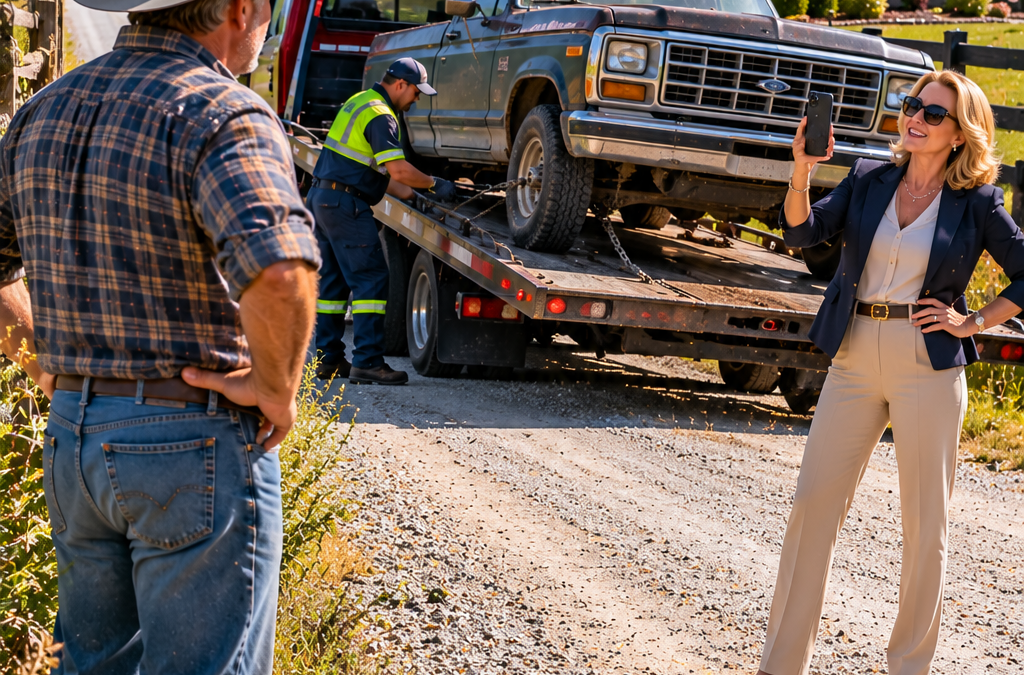
A tow truck was parked beside my pickup.
Amber lights flashed.
The driver was attaching his rig.
Three HOA board members stood nearby.
And Diane was on the sidewalk.
Phone held vertically.
Recording.
She looked almost radiant.
A few residents had come outside.
Curtains moved in nearby windows.
People were watching.
I walked toward the road.
The tow truck driver saw me coming.
He immediately looked tense.
He had probably done enough repossessions and impounds to know that vehicle owners rarely came outside smiling.
“Morning,” I said.
“Morning.”
He pointed toward the truck.
“You Daniel Brooks?”
“Yes.”
“This your Ford?”
“Yes.”
He shifted uncomfortably.
“I’ve got an authorization for removal.”
“From who?”
Before he could answer, Diane stepped forward.
“From Pine Ridge Estates.”
I looked at her phone.
“You recording?”
“For documentation.”
“Good idea.”
She smiled wider.
“This vehicle has been illegally parked on HOA property for months.”
The driver looked from Diane to me.
“Sir, do you object to the tow?”
I could feel everyone waiting.
Diane expected shouting.
Maybe threats.
Maybe me standing in front of the truck.
I looked at my old pickup.
Then at the road.
Then at Diane.
“No.”
The driver blinked.
“No?”
“Nope.”
“You’re okay with me taking it?”
“I didn’t say I was okay with it.”
He frowned.
“But you don’t object?”
“Not physically.”
Diane laughed.
“There’s no need to be dramatic, Mr. Brooks.”
I looked at her.
“I’m not being dramatic.”
She tilted the phone slightly, making sure both of us were in frame.
“This could have been avoided months ago if you had simply respected the rules.”
I said nothing.
The driver finished securing the pickup.
He looked at me one more time.
“You sure?”
I tipped my hat.
“Do what you were hired to do.”
He shrugged.
The winch tightened.
My truck rolled onto the flatbed.
I watched the tires leave the gravel.
Something about the sight hurt more than I expected.
That old Ford had hauled feed for my father.
My grandfather had ridden in it before he died.
It had scratches from twenty years of ranch work.
Watching strangers take it away made my stomach twist.
But I did not show Diane.
Because the truck was not what mattered.
The road did.
The tow truck pulled away.
Diane actually clapped once.
A small, satisfied clap.
Then she walked toward me.
“I hope this teaches you something.”
I folded my arms.
“It might.”
Her grin widened.
“So you admit you were wrong?”
“I didn’t say that.”
“You just let the vehicle go.”
“I did.”
“Because you finally understand the HOA controls this road.”
“No.”
Her smile weakened.
“Then why didn’t you stop the tow?”
I looked at her for a moment.
“Because I wanted to see how far you were willing to go.”
That unsettled her.
Only slightly.
She recovered quickly.
“Your threats aren’t going to change anything.”
“That wasn’t a threat.”
She lifted her phone again.
“Anything else you’d like to say?”
“No.”
She walked away.
I stood beside the empty patch of gravel.
A neighbor named Tom Harper approached after the board members left.
He had bought vegetables from me for years.
“Daniel.”
“Morning.”
“You okay?”
“I’m fine.”
“That was pretty rough.”
“I’ve had worse mornings.”
He looked down the road.
“I thought you’d fight them.”
“I did.”
He frowned.
“You barely said anything.”
I looked toward Diane’s house.
“Not every fight needs to happen on the same day.”
The following morning, I made one phone call.
By late morning, Paul was back at the ranch.
This time he was not alone.
He brought two technicians and additional GPS equipment.
I had also contacted the county land records office and requested certified copies of the relevant filings.
By noon, people were watching from porches again.
Diane appeared after twenty minutes.
She marched across the sidewalk.
“What’s going on?”
Paul continued setting up a tripod.
I answered.
“Survey.”
“We already have a subdivision survey.”
“This isn’t your survey.”
“What are they measuring?”
“Property.”
“Why?”
“You’ll see.”
Her face tightened.
“I’m asking you directly.”
“And I answered.”
She looked at Paul.
“Are you authorized to survey HOA property?”
Paul glanced at me.
Then at her.
“I’m surveying Mr. Brooks’s property.”
“That includes HOA roadway.”
Paul stopped.
“Ma’am, I think that statement is exactly why I’m here.”
Her confidence shifted.
Just a fraction.
Over the next hour, Paul and his crew worked methodically.
They located recorded monuments.
Took GPS measurements.
Compared coordinates with the subdivision plat.
Then came the moment Diane had never imagined.
Paul walked toward the subdivision entrance carrying bright orange survey stakes.
He placed one at the road edge.
Then another.
Then another.
The line ran directly across the area Diane had been calling HOA property.
Residents began gathering.
Diane stepped toward him.
“What are you doing?”
Paul stood.
“Marking the recorded property line.”
“This road is Pine Ridge access.”
“It may be used for access.”
“That means it belongs to Pine Ridge.”
Paul looked at her calmly.
“No, ma’am.”
The crowd went quiet.
She stared at him.
“What did you say?”
“The underlying roadway is privately owned.”
“By who?”
Paul turned slightly toward me.
“Daniel Brooks.”
I heard someone behind me whisper, “Oh, hell.”
Diane shook her head.
“That is impossible.”
Paul opened his field binder.
“These coordinates are based on the recorded deed, historic construction records, and subdivision filings.”
“You’re mistaken.”
“I’m not.”
“We have been maintaining this entrance.”
“Maintenance doesn’t automatically change fee ownership.”
“This has been treated as HOA property for years.”
“That doesn’t change the recorded boundary.”
She turned toward me.
“You arranged this.”
“Yes.”
Her voice rose.
“Because of the tow?”
“No.”
I looked directly at her.
“I arranged the first survey six weeks before you towed my truck.”
That stopped her.
Completely.
“You what?”
“You heard me.”
For the first time since she became HOA president, Diane Mercer looked genuinely uncertain.
I continued.
“I knew exactly who owned this road when you came to my house.”
Her face changed.
“Then why didn’t you tell me?”
“I did.”
“No, you didn’t.”
“I told you it was my road.”
“You never showed me documentation.”
“You never asked.”
Her mouth opened.
Closed.
I could almost see the moment she remembered our conversation.
We’ve already confirmed ownership.
Have you?
She had been so certain.
Too certain to check.
Paul handed her a certified map.
She read it.
Then another document.
Her face lost color.
“This can’t be current.”
“It is.”
“The subdivision would never have been approved without legal access.”
That was the next question.
And it was a good one.
Within thirty minutes, two county officials arrived.
I had requested their presence because once the boundary had been confirmed, I wanted the access issue addressed properly.
A sheriff’s deputy came too.
Not to arrest anyone.
Not to threaten anyone.
Just to prevent an argument from becoming something worse.
The tow company owner showed up shortly after.
He drove a white pickup.
The moment he stepped out, I could see he was nervous.
He walked directly toward me.
“Mr. Brooks?”
“Yes.”
“My driver called me last night after you didn’t object. Something didn’t feel right.”
“You were told the HOA owned the road?”
“Yes.”
Diane spoke immediately.
“Because our records showed that.”
One county official looked at her.
“Which recorded deed?”
“Our association maps.”
“I’m asking about the deed.”
Silence.
The tow company owner looked at her.
“You told us you controlled the property.”
“We believed we did.”
“That’s not what your authorization said.”
Diane stiffened.
The deputy stepped closer.
“What did the authorization say?”
The tow company owner looked uncomfortable.
“That the HOA was the property owner and authorized removal of an illegally parked vehicle.”
The deputy looked toward me.
“Was the pickup registered to you?”
“Yes.”
“Operational?”
“Yes.”
“Parked inside this surveyed private roadway?”
Paul nodded.
“Entirely.”
The deputy looked at Diane.
Her face had gone pale.
“I acted based on association records.”
Nobody answered.
Because there was not much left to say.
The county official reviewed the old construction records.
Then the subdivision plat.
Then the recorded easement documents my grandfather had kept.
Eventually he looked up.
“The ownership is clear.”
Diane crossed her arms.
“What does that mean?”
“It means Pine Ridge Estates does not own this roadway.”
“And access?”
“That requires additional review.”
“Residents have used it for years.”
“I understand.”
“So we have rights.”
“You may have access arguments. That is not the same thing as ownership.”
I felt something in my chest loosen.
Not triumph.
Relief.
For months Diane had spoken about ownership as though repeating it could make it true.
Now someone with no interest in our argument had read the records.
The land had answered for itself.
The tow company owner turned toward me.
“Mr. Brooks, I’m sorry.”
I nodded.
“I believe you acted on what you were told.”
“I want your truck returned.”
“Good.”
“No fee.”
“I wasn’t planning to pay one.”
He almost smiled.
“Fair enough.”
My pickup came home that evening.
The same driver brought it back.
He unloaded it carefully.
Then walked over.
“For what it’s worth, I’m sorry.”
“Not your fault.”
“I should’ve checked ownership.”
“We both learned something.”
He looked toward Diane’s house.
“I think some people learned more than others.”
I laughed.
The truck started on the first turn of the key.
I drove it back to the exact patch of gravel where it had been parked before.
Then things became more complicated.
The county reviewed the subdivision access history.
The developer had used part of my family’s road during construction.
Temporary arrangements existed in old files.
Utility permissions existed.
But nobody could locate a completed permanent recorded roadway agreement granting the HOA the broad ownership and control Diane had been claiming.
It was a mess.
A legal mess.
Not because residents had done anything wrong.
Most had purchased homes assuming access was settled.
The problem went back to development paperwork.
Somewhere between construction, subdivision approval, and later HOA administration, assumption had replaced documentation.
My attorney advised me immediately.
“Do not block residents.”
“I wasn’t going to.”
“Good.”
“I don’t want people trapped.”
“This needs to be resolved carefully.”
“I agree.”
But several things changed while negotiations continued.
Contractors needing expanded roadway access contacted me.
Utility work involving my parcel required permission.
Any attempt to modify drainage, widen the road, add signage, or perform substantial work on the private section required my approval.
Suddenly the HOA that had treated me like a nuisance needed my signature.
Phone calls started.
Emails.
Meeting requests.
Diane sent three.
I ignored the first two.
The third came through the board’s attorney.
I agreed.
The meeting took place in the Pine Ridge clubhouse.
I had never been inside.
Ironically, Diane had once sent me a violation notice for a property supposedly governed by a building I had never entered.
My attorney sat beside me.
Diane sat across the table.
Three board members were with her.
Their attorney sat at the end.
Nobody smiled.
Diane spoke first.
“I think we’ve gotten off on the wrong foot.”
I looked at her.
“That’s one way to put it.”
She ignored the comment.
“The board wants to resolve the roadway matter in a way that protects all parties.”
“So do I.”
Her eyes searched my face.
I think she expected anger.
Maybe revenge.
She had humiliated me publicly.
Filmed my truck being taken.
Clapped.
Told the neighborhood I had finally learned my lesson.
Now she needed something from me.
I could have made that moment cruel.
I did not.
Because the residents were not Diane.
Families lived there.
Children rode buses there.
People had mortgages.
Jobs.
Emergencies.
They had bought homes in good faith.
I was not going to turn their lives into weapons against one unreasonable board president.
My attorney opened our proposal.
A permanent recorded easement.
Defined roadway width.
Maintenance responsibilities.
Drainage protections.
No ownership transfer.
No expansion without written approval.
Liability provisions.
Compensation based on fair valuation.
And a clear acknowledgment that the road remained part of the Brooks ranch.
The board attorney read everything.
Then looked at Diane.
She was visibly unhappy.
“This gives him veto authority over future expansion.”
My attorney answered.
“It gives the property owner control over expansion beyond the defined easement.”
Diane looked at me.
“You’re doing this because of the truck.”
“No.”
“You expect me to believe that?”
“I’m doing it because my grandfather built this road and your board tried to take control of it without checking whether you owned it.”
“We acted based on longstanding practice.”
“You had my truck removed.”
“Because it was obstructing community property.”
“It wasn’t community property.”
“We believed it was.”
“And that belief was enough for you to tow somebody else’s vehicle?”
She tightened her jaw.
“We’re trying to move forward.”
“Then move forward.”
One board member, a man I knew slightly named Robert, spoke.
“I think Daniel’s proposal is reasonable.”
Diane looked at him.
“You haven’t considered the precedent.”
“What precedent?”
“Giving an outside property owner this degree of control.”
Robert rubbed his forehead.
“He already owns the road.”
That sentence changed the room.
Simple.
Obvious.
Diane stared at him.
Robert continued.
“We aren’t giving him ownership.”
He pointed toward the documents.
“We’re asking him for access to something he already owns.”
For once, Diane had no answer.
Negotiations continued for several weeks.
There were disagreements.
Language changed.
Survey descriptions were refined.
Maintenance costs were divided.
Insurance provisions were added.
But we eventually reached an agreement.
The permanent easement was recorded.
Pine Ridge residents received secure legal access.
My ranch retained ownership.
The HOA received no authority over my barn, truck, fence, mailbox, flagpole, workshop, or anything else outside the easement.
I required that language explicitly.
After months of letters, I wanted no ambiguity left for some future board president to “interpret.”
I also required the HOA to withdraw every notice it had sent me.
That part bothered Diane.
“They’re already irrelevant.”
“Then withdrawing them shouldn’t be difficult.”
She looked toward her attorney.
He nodded.
“They should be rescinded.”
She signed.
I received a written acknowledgment stating that the Brooks ranch was not subject to Pine Ridge Estates HOA rules.
I framed that one.
Not in the house.
In the workshop.
About a month later, Diane resigned as HOA president.
I did not celebrate.
I did not attend the meeting.
Tom called me afterward.
“You hear?”
“About what?”
“Diane resigned.”
“Did she?”
“You don’t sound surprised.”
“I’m not.”
“People weren’t happy about the towing thing.”
“I figured.”
“Especially after they found out the road wasn’t ours.”
“The road wasn’t the residents’ mistake.”
“I know.”
He paused.
“Still. She made it everybody’s problem.”
That was true.
The new HOA board contacted me within days.
Their president was a retired school principal named Susan Clarke.
She came to the ranch alone.
No clipboard.
No folder.
No threats.
She walked up to my workshop and stopped several feet away.
“Mr. Brooks?”
“Daniel.”
“Then I’m Susan.”
She held out her hand.
I shook it.
“I wanted to apologize on behalf of the board.”
“You weren’t on the board when most of it happened.”
“I am now.”
“That’s fair.”
She looked toward the pickup.
“That the famous truck?”
I laughed.
“I guess.”
“People tell the story like it was hauled away by helicopter.”
“Give it another year.”
She smiled.
“I wanted you to know we don’t intend to create problems.”
“Neither do I.”
“We appreciate you working out the easement.”
“I never had a problem with the residents using the road.”
She nodded.
“I know.”
That was the beginning of something normal.
For the first time in a long time, Pine Ridge and the ranch became neighbors again instead of opposing sides.
The HOA paid its share of road maintenance.
I coordinated major repairs.
Residents still waved.
Some still bought vegetables.
Nothing dramatic.
Exactly the way I preferred it.
My old Ford pickup remained on the ranch.
I could have replaced it.
Probably should have.
The transmission slipped slightly on cold mornings.
The driver’s seat had a tear patched with gray tape.
Rust had eaten through the lower edge of the passenger door.
But every time I considered selling it, I remembered that tow truck.
Not with anger anymore.
Almost with amusement.
A year after everything happened, I was filling a pothole near the subdivision entrance when a teenage boy stopped on his bicycle.
“Mr. Brooks?”
“Yeah?”
“My dad said this whole road is yours.”
“Your dad exaggerates.”
He looked confused.
“Well, the land under it is part of the ranch.”
“So can you close it whenever you want?”
“No.”
“Why not?”
“There’s an easement now.”
He stared at me.
“What’s that?”
I leaned on the shovel.
“It means your family has a legal right to cross the road even though somebody else owns the land.”
“Oh.”
He thought about it.
“So the HOA owns the right but not the road?”
“Close enough.”
He nodded like he had learned something important.
Then he pointed toward my truck.
“Is that the one they towed?”
I laughed.
“How does everybody know about that?”
“My dad told me.”
“Of course he did.”
“Why did you let them take it?”
That question had followed me for months.
I looked toward the gravel road.
“Because sometimes stopping somebody from making a mistake teaches them less than letting them finish.”
He looked puzzled.
“That sounds like something my grandfather would say.”
“Your grandfather sounds exhausting.”
He laughed and rode away.
But the question stayed with me.
Why did I let them take it?
The simple answer was that I knew I had evidence.
But that was only part of it.
I had spent months being told I was wrong by people who never checked.
Every notice from Diane assumed authority.
Every conversation began with a conclusion.
She never came to me and said:
“Daniel, our records appear to conflict. Can we compare documents?”
If she had, the whole thing could have ended over coffee.
I would have shown her the survey.
Shown her my grandfather’s road papers.
Called the county.
Worked out the access problem without ever involving a tow truck.
Instead, she wanted submission.
She wanted the image.
The victory.
My ugly ranch pickup being hauled away while she recorded it for everyone to see.
That was why she brought her phone.
She did not want documentation.
She wanted proof of dominance.
She wanted residents to watch what happened when somebody ignored her.
And for a few minutes, she got exactly that image.
My truck on the flatbed.
Me standing beside the road.
Her smiling.
If she posted that video, I imagine it looked convincing.
A stubborn rancher finally forced to follow the rules.
But videos end where the person recording chooses to stop.
Land records do not.
The camera never showed the 1960s construction permit sitting in my house.
It never showed the easement documents.
It never showed Paul’s survey.
It never showed the county filing.
It never showed the road underneath the tow truck belonged to the same ranch as the vehicle being removed.
That was the difference between appearance and reality.
Diane cared about appearance.
My grandfather cared about paperwork.
In the end, I was fortunate he had.
I sometimes sit in his old office and look through those files.
His handwriting is still on some of them.
Short notes.
Dates.
Names.
Amounts.
One receipt for gravel has a handwritten comment across the bottom:
KEEP ROAD PRIVATE.
Four words.
Probably written in less than five seconds.
Decades later, they carried more weight than an HOA president’s entire folder.
That humbled me.
My grandfather never knew Pine Ridge Estates would exist.
He never knew Diane.
Never imagined his grandson would one day argue over a pickup truck with an HOA.
He simply believed property mattered enough to document correctly.
He protected the road because he understood something I nearly forgot.
Things people assume today can become disputes tomorrow.
Paper survives memory.
The ranch has changed since his time.
I use newer equipment.
There are fewer cattle.
The old south barn came down after a windstorm.
But the road still follows the same route he built.
The gravel is newer.
The culverts have been replaced.
The ditch is deeper.
Still the same road.
Every morning Pine Ridge residents drive across part of it under a recorded legal easement.
That does not bother me.
It never did.
What mattered was consent.
The difference between someone using something with permission and somebody declaring it theirs.
That difference sounds small until somebody crosses it.
Diane crossed it when she started mailing me rules.
She crossed it again when she came to my house and told me the road belonged to her HOA.
Then she crossed it completely when she had my truck removed.
The tow was not the beginning of the conflict.
It was simply the moment her assumption became impossible to ignore.
And strangely, that is why I am glad I did not stop it.
Had I run outside waving documents before the driver attached the cable, Diane might have backed down.
Temporarily.
She might have called it a misunderstanding.
Then another letter would arrive six months later.
Another president might try again.
The road ownership might remain buried.
The developer’s missing access agreement might never be corrected.
By letting the mistake become real, I forced everyone to confront the underlying problem.
Not because I planned every consequence.
I did not.
I only knew that Diane was acting on ownership she did not have.
And I knew the cleanest evidence sometimes comes from allowing people to follow their certainty to its natural conclusion.
The result was larger than my pickup.
Pine Ridge finally received permanent legal access.
My ranch received permanent protection.
The HOA’s authority was clearly defined.
Future boards could not casually reinterpret old maps.
The residents no longer depended on assumptions.
And I no longer opened my mailbox wondering which piece of ranch life Diane had decided to regulate that week.
That was worth far more than the tow bill.
A few years have passed now.
Diane still lives in Pine Ridge.
We rarely speak.
Once, while I was driving the pickup toward town, I saw her at the subdivision entrance.
She was walking her dog.
I slowed because she was near the road.
She looked at the truck.
Then at me.
For one second, the whole thing passed between us without either of us saying anything.
The tow truck.
The survey stakes.
The meeting.
The signatures.
Then she gave a small nod.
I returned it.
No apology.
No argument.
That was enough.
I do not need everyone who wronged me to spend the rest of their life feeling ashamed.
I needed the problem corrected.
It was.
The old pickup still runs.
Barely, some days.
I keep telling myself this will be the year I replace it.
Then I turn the key.
The engine catches.
And I remember my father driving it through the same pasture.
I remember my grandfather sitting in the passenger seat near the end of his life, complaining that modern trucks had too many electronics.
I remember the look on Diane’s face when the surveyor told her exactly where she was standing.
So I keep the truck.
Not as a trophy.
As part of the ranch.
There are dents in the bed from fence posts.
Scratches from feed sacks.
A crease in the rear bumper from the time I backed into a stock trailer during a thunderstorm.
Nothing about it is beautiful in the way Diane understood beauty.
But everything on a working ranch eventually shows wear.
That is not neglect.
It is evidence that something has been used.
I think that was another thing Diane never understood.
She looked at the pickup and saw something ugly parked near her expensive subdivision.
I looked at it and saw decades.
Same with the gravel road.
She saw an entrance corridor.
I saw my grandfather on a borrowed grader shaping it while my father, still a teenager, spread stone with a shovel.
She saw property values.
I saw family history.
Neither emotion decides legal ownership.
That is why deeds exist.
But when the deed and memory both point to the same answer, it becomes difficult to tolerate someone arriving with a clipboard and pretending neither matters.
Today there is a small marker near the ranch side of the subdivision entrance.
Nothing aggressive.
It identifies the road as privately owned and notes that subdivision access is governed by recorded easement.
Susan suggested it.
“Maybe we should make it clear,” she said.
I agreed.
Clarity would have saved everyone a great deal of trouble.
The funny part is that most Pine Ridge residents probably do not even notice the marker now.
It has become part of the scenery.
Kids ride bicycles past it.
Delivery vans pass it.
Residents drive to work.
Nobody thinks twice.
That is what a functioning agreement looks like.
Boring.
Predictable.
Clear.
No threats.
No towing.
No filming someone’s humiliation.
Just rights and responsibilities written down where everyone can understand them.
Sometimes Tom still jokes about that morning.
We were fixing a fence last fall when he pointed toward the pickup.
“You ever going to park that somewhere legal?”
I looked at him.
“You want to walk home?”
He laughed.
“That truck might not make it home anyway.”
“Keep talking.”
He slapped the fender.
The rust flaked under his hand.
“You know, Diane probably did you a favor.”
I stared at him.
“How do you figure?”
“If she hadn’t towed this thing, you might never have forced the access paperwork.”
“I found the paperwork before the tow.”
“Yeah, but maybe you would’ve let it go.”
I considered that.
Maybe he was right.
Before Diane escalated, I had no desire to disrupt anyone.
I might have put the survey in a drawer.
Told her to stop sending letters.
Let residents continue using the road exactly as before.
But her decision changed the stakes.
She did not merely misunderstand ownership.
She exercised control based on the misunderstanding.
There is a difference.
That difference cost the HOA embarrassment, legal fees, and a president.
It also finally fixed an access problem that should have been resolved decades earlier.
Tom looked at me.
“So?”
“So what?”
“Did she do you a favor?”
“No.”
He laughed.
“Worth trying.”
That evening, after we repaired the fence, I drove slowly back toward the house.
The sun was dropping behind the ridge.
Long shadows stretched across the pasture.
As I reached the section of gravel beside Pine Ridge, two cars passed going home.
Both drivers waved.
I waved back.
That is how I prefer things.
No enemies.
No grudges.
Just boundaries.
I parked the Ford in nearly the same spot where it had been sitting the morning Diane had it towed.
Turned off the engine.
For a few seconds I stayed behind the wheel.
The cab smelled like old vinyl, dust, and engine heat.
Then I looked through the windshield at the road.
I remembered the amber lights.
The cable tightening.
Diane holding her phone.
Her smile.
The way the tow driver looked at me, waiting for an explosion.
And my own strange calm.
People sometimes mistake calm for surrender.
Diane did.
She thought I was smiling because I had finally accepted defeat.
The truth was almost the opposite.
I smiled because, for the first time in months, I no longer needed to argue with her.
She had made the issue bigger than her clipboard.
Bigger than her letters.
Bigger than an HOA meeting.
Once she authorized the tow, ownership had to be examined.
And once ownership was examined, confidence no longer mattered.
Only records did.
That morning she had a phone.
A board title.
A tow truck.
And an audience.
I had a seventy-acre ranch, a recorded deed, my grandfather’s files, and the patience not to interrupt her mistake.
For a few hours, her side looked stronger.
That is sometimes how these things work.
The loudest person looks powerful first.
The person holding the paper looks powerful last.
I stepped out of the pickup and closed the door.
The old hinges groaned.
I rested my hand against the roof for a moment.
Then I walked toward the house.
Behind me, headlights moved along the gravel road.
Families returning home.
People using it exactly as they were legally entitled to use it now.
That matters to me.
I never wanted a victory that hurt them.
I wanted a boundary that protected everyone.
They got permanent access.
I kept my land.
And the HOA learned that authority is not created by assumption.
Diane once told me she hoped seeing my pickup disappear would teach me that nobody ignored HOA rules.
She was right about one thing.
That morning taught me something.
Just not what she intended.
It taught me that sometimes the most expensive mistake a person can make is becoming completely certain before checking the facts.
And sometimes the strongest response is not shouting.
It is not threatening.
It is not standing in front of a tow truck.
Sometimes you simply tip your hat, let them finish, and wait for the paperwork to catch up.
𝗧𝗛𝗘 𝗘𝗡𝗗
The HOA Towed My Old Pickup Off the Gravel Road My Grandfather Built and Never Asked Who Actually Owned the Ground Beneath It
The HOA president stood on the shoulder filming as a tow truck dragged my old pickup away, smiling like she had finally broken the stubborn rancher who had ignored her for months. I smiled back because she was so focused on taking my truck that she never stopped to ask the one question that mattered most—who owned the road beneath her feet.
My name is Daniel Brooks.
I own seventy acres outside Pine Ridge, though saying I own it never feels quite right.
Land like mine does not feel like something a person simply purchases and possesses.
It feels inherited even when paperwork changes hands.
My grandfather bought the property in the early 1960s, when the area was mostly pasture, scrub oak, and long stretches of dirt road.
Back then, Pine Ridge was not a subdivision.
There were no entrance monuments.
No decorative streetlights.
No matching mailboxes.
No HOA.
There were cattle fences, tractors, barns, and people who knew exactly where one property ended because they had spent half their lives repairing the fence between them.
My grandfather, Henry Brooks, came to that land with almost nothing.
He had worked construction after leaving the Army, saved everything he could, and eventually bought seventy acres from an older rancher who was retiring.
The property had no proper driveway from the county highway.
Just a narrow trail that became mud whenever it rained.
So my grandfather built one.
Not metaphorically.
He hired a grader for two days, hauled gravel with a borrowed dump truck, dug drainage ditches by hand in places the machine could not reach, and paid a local crew to install culverts where water crossed the low ground.
The result was a narrow gravel road running from the county highway to the ranch.
About three-quarters of a mile.
Nothing fancy.
But it worked.
He maintained it every year.
After storms, he filled ruts.
In summer, he pulled weeds from the shoulders.
Every few years, he ordered another load of crushed stone.
When the county offered to help widen part of it in the 1970s, he declined because he did not want any confusion about ownership.
“This road stays ours,” he told my father.
My father repeated that sentence to me when I was old enough to drive.
And when the ranch eventually became mine, I treated the road the same way.
For decades, nobody questioned it.
Nobody needed to.
Then the land around us changed.
Developers started buying farms.
Pastures disappeared.
Trees came down.
Utility lines went in.
Expensive houses appeared where cattle had grazed when I was a kid.
Eventually a large subdivision called Pine Ridge Estates was built directly east of my property.
At first, I did not mind.
The developer approached me several times during construction.
His trucks sometimes needed temporary access near the edge of our gravel road.
He asked.
I said yes when it did not interfere with ranch work.
That is how things used to operate.
You asked.
Someone answered.
You respected the answer.
The subdivision finished.
Families moved in.
A homeowners association was created about a year later.
For the first few years, I had no real problem with them.
Most residents were friendly.
People waved when I passed.
Some bought tomatoes, peppers, eggs, or squash from my garden.
Children occasionally stopped at the fence to watch the cattle.
One family even brought their young son over because he had never seen a calf up close.
I let him feed one through the fence.
His mother thanked me three times.
That was Pine Ridge as I knew it.
Different lifestyles beside each other.
No drama.
Then Diane Mercer became HOA president.
I first met Diane at a summer neighborhood event.
She had moved into Pine Ridge Estates only about eighteen months earlier.
She was probably in her early fifties.
Perfect hair.
Expensive sunglasses.
The kind of white sneakers that had clearly never touched mud.
There was nothing wrong with any of that.
What mattered was the way she spoke.
Diane had a habit of giving instructions when ordinary conversation would have worked.
If somebody parked slightly over a line, she did not ask them to move.
She told them where they were permitted to park.
If a child rode a bicycle on the clubhouse walkway, she did not say, “Be careful.”
She explained the rule.
Everything became authority.
Everything became enforcement.
Within weeks of becoming president, she began sending violation notices over garbage cans, garden decorations, basketball hoops, and grass height.
Again, that was none of my business.
Pine Ridge residents had joined the HOA.
I had not.
My ranch predated the development by decades.
I paid no HOA dues.
Signed no HOA covenants.
Attended no HOA meetings.
As far as I was concerned, Diane could regulate the color of every flowerpot inside Pine Ridge Estates if the homeowners let her.
She just could not regulate mine.
The first letter arrived three weeks after she became president.
I opened my mailbox one afternoon and found an envelope stamped with the Pine Ridge Estates Homeowners Association logo.
I nearly threw it away unopened.
Then curiosity got me.
The letter informed me that my pickup truck had been observed “parked for prolonged periods in violation of community street-parking standards.”
I read that sentence twice.
Then I looked down the road.
My old Ford pickup was parked where it had been for years.
Half on the gravel shoulder beside my workshop.
Entirely on ranch property.
I laughed.
My truck was nothing special.
A faded dark-green Ford from the 1990s.
Rust beginning around the wheel wells.
Cracked dashboard.
Bench seat.
Engine still strong.
I used it for feed, tools, fence posts, lumber, and almost anything else that did not require the larger ranch truck.
Diane apparently saw it differently.
According to the letter, it was an “unsightly inoperable vehicle.”
It was not inoperable.
I had driven it that morning.
The letter demanded that I move it within seventy-two hours.
I folded the page.
Put it in a drawer.
And forgot about it.
Another letter came ten days later.
Then another.
This time there was language about “continued noncompliance.”
I ignored that too.
Then they complained about my fence.
Apparently weathered cedar did not comply with Pine Ridge Estates’ approved fencing colors.
The month after that, I received a notice about the barn roof.
Then the mailbox.
Then the old utility trailer beside my workshop.
Then, unbelievably, the American flag mounted outside the workshop.
That notice claimed the flagpole height might violate architectural restrictions.
I stared at that one for a long time.
Then I put it in the same drawer as the rest.
The drawer became my HOA file.
Not because I took them seriously.
Because I had learned over the years that ridiculous paperwork still needed to be saved.
Diane eventually came to my house in person.
It was late afternoon.
I was replacing hinges on a gate near the barn when her black SUV pulled into my drive.
She stepped out holding a thick blue folder.
I already knew this was not going to be a social visit.
“Mr. Brooks?”
I straightened.
“That’s me.”
“I’m Diane Mercer.”
“I know.”
She seemed slightly disappointed that I did not ask how.
“I’m president of the Pine Ridge Estates Homeowners Association.”
“I know that too.”
She glanced toward the pickup.
“That’s the vehicle we’ve been contacting you about.”
“Yes.”
“It needs to be moved.”
“Why?”
“Because it is parked on HOA-controlled property.”
I looked down at the gravel beneath her shoes.
Then back at her.
“No.”
She smiled.
It was not a friendly smile.
It was the smile of someone who believed the conversation had reached the part where the other person would be corrected.
“We’ve already confirmed ownership.”
I leaned against the fence post.
“Have you?”
“Yes.”
“Interesting.”
“The roadway and adjacent shoulder are maintained as part of the Pine Ridge access corridor.”
“That doesn’t make them yours.”
“We have maps.”
“So do I.”
Her smile tightened.
“Mr. Brooks, I’m trying to resolve this without additional enforcement.”
I nearly laughed.
“Enforcement against who?”
“You.”
“I’m not in your HOA.”
“That does not mean you can obstruct common access areas.”
“My truck is parked on my ranch road.”
“This road serves Pine Ridge residents.”
“That still doesn’t make it your road.”
She opened the folder.
“I’m not here to debate historical ownership.”
“That’s probably because history isn’t going to help you.”
She looked up sharply.
“You’ve been issued multiple notices.”
“Yes.”
“And ignored them.”
“Yes.”
“That’s not how community enforcement works.”
“I’m not part of your community association.”
“You benefit from the surrounding development.”
That was a new one.
“How?”
“Property values.”
I looked across my pasture.
At the barn.
At cattle standing near the creek.
“My grandfather bought this place before half these houses existed.”
“That isn’t relevant.”
“It seems pretty relevant when you’re trying to tell me who owns his road.”
Her voice cooled.
“You have until Friday to move the truck.”
“Or?”
“Further action.”
“What kind?”
She closed the folder.
“You’ll find out if necessary.”
Then she returned to her SUV.
I watched her drive away.
I did not stop her.
I did not argue harder.
Because by then I already knew something Diane did not know I knew.
Six weeks earlier, while cleaning out my grandfather’s old office, I had found a wooden cabinet behind a stack of feed ledgers.
My grandfather saved everything.
Receipts.
Farm equipment manuals.
Tax records.
Old photographs.
He had boxes of papers dating back decades.
Inside that cabinet was a yellow legal envelope with handwriting across the front.
ROAD DOCUMENTS – KEEP
I sat down at his old desk and opened it.
Inside were engineering drawings from the early 1960s.
Construction receipts.
Drainage permits.
A county filing.
Maintenance contracts.
And an easement document recorded long before Pine Ridge Estates existed.
I read everything once.
Then again.
My grandfather had been meticulous.
The road was not public.
It had never been dedicated to the county.
It was not jointly owned.
The underlying land belonged entirely to the ranch.
The easement language dealt only with limited utility access associated with older neighboring parcels.
Nothing in the file gave Pine Ridge Estates permanent residential access.
That caught my attention.
Because residents had been using a section of the gravel road for years.
I had assumed the developer eventually recorded something.
So I checked.
I hired a licensed surveyor named Paul Wescott.
Paul had worked in the county for more than twenty-five years.
I gave him the old documents and asked him one question.
“Tell me exactly who owns this road.”
He spent nearly two weeks researching.
He pulled county maps.
Historic plats.
Deeds.
Subdivision filings.
Development plans.
Then he came to the ranch with GPS equipment and marked the boundaries.
When he finished, we stood beside the same stretch of gravel where my pickup usually sat.
He looked down at his notes.
Then at me.
“Daniel, your grandfather did this right.”
“How right?”
“One of the cleanest chains I’ve seen.”
“So?”
“So the road is yours.”
“All of it?”
“Everything inside these markers.”
“What about Pine Ridge?”
He turned toward the subdivision entrance.
“That’s where it gets interesting.”
I followed his gaze.
“What?”
“Their entrance connects to your private road.”
“I know.”
“I can’t find a permanent recorded access agreement.”
I stared at him.
“None?”
“Not one giving the subdivision the rights they seem to think they have.”
“What about prescriptive access?”
“That’s something an attorney would need to analyze based on the full history. I’m just telling you what the recorded documents show.”
I looked down the road.
Cars moved in and out of Pine Ridge Estates every day.
School buses.
Delivery trucks.
Contractors.
Residents.
Hundreds of trips.
“You’re sure?”
Paul smiled.
“I’m a surveyor. Being sure is what you’re paying me for.”
That night I barely slept.
Not because I wanted to shut the subdivision down.
I did not.
Most residents had never done anything to me.
I was not angry at families driving to work.
I was not angry at children riding the school bus.
What bothered me was the assumption.
Somewhere along the line, the developer had begun using my family’s road as though legal access were settled.
Everyone else had simply accepted it.
Then Diane went one step farther.
She decided using the road meant owning it.
And owning it meant she could tow my truck from it.
I took Paul’s survey to an attorney.
She confirmed that the ownership records were strong and advised me not to interfere with ordinary residential traffic while she reviewed possible access claims.
So I waited.
That was why Diane’s threats did not scare me.
I knew what she did not.
What surprised me was how quickly she escalated.
Two weeks after visiting my ranch, I woke to the sound of diesel outside.
Heavy diesel.
I pulled on jeans and walked to the front porch.
A tow truck was parked beside my pickup.
Amber lights flashed.
The driver was attaching his rig.
Three HOA board members stood nearby.
And Diane was on the sidewalk.
Phone held vertically.
Recording.
She looked almost radiant.
A few residents had come outside.
Curtains moved in nearby windows.
People were watching.
I walked toward the road.
The tow truck driver saw me coming.
He immediately looked tense.
He had probably done enough repossessions and impounds to know that vehicle owners rarely came outside smiling.
“Morning,” I said.
“Morning.”
He pointed toward the truck.
“You Daniel Brooks?”
“Yes.”
“This your Ford?”
“Yes.”
He shifted uncomfortably.
“I’ve got an authorization for removal.”
“From who?”
Before he could answer, Diane stepped forward.
“From Pine Ridge Estates.”
I looked at her phone.
“You recording?”
“For documentation.”
“Good idea.”
She smiled wider.
“This vehicle has been illegally parked on HOA property for months.”
The driver looked from Diane to me.
“Sir, do you object to the tow?”
I could feel everyone waiting.
Diane expected shouting.
Maybe threats.
Maybe me standing in front of the truck.
I looked at my old pickup.
Then at the road.
Then at Diane.
“No.”
The driver blinked.
“No?”
“Nope.”
“You’re okay with me taking it?”
“I didn’t say I was okay with it.”
He frowned.
“But you don’t object?”
“Not physically.”
Diane laughed.
“There’s no need to be dramatic, Mr. Brooks.”
I looked at her.
“I’m not being dramatic.”
She tilted the phone slightly, making sure both of us were in frame.
“This could have been avoided months ago if you had simply respected the rules.”
I said nothing.
The driver finished securing the pickup.
He looked at me one more time.
“You sure?”
I tipped my hat.
“Do what you were hired to do.”
He shrugged.
The winch tightened.
My truck rolled onto the flatbed.
I watched the tires leave the gravel.
Something about the sight hurt more than I expected.
That old Ford had hauled feed for my father.
My grandfather had ridden in it before he died.
It had scratches from twenty years of ranch work.
Watching strangers take it away made my stomach twist.
But I did not show Diane.
Because the truck was not what mattered.
The road did.
The tow truck pulled away.
Diane actually clapped once.
A small, satisfied clap.
Then she walked toward me.
“I hope this teaches you something.”
I folded my arms.
“It might.”
Her grin widened.
“So you admit you were wrong?”
“I didn’t say that.”
“You just let the vehicle go.”
“I did.”
“Because you finally understand the HOA controls this road.”
“No.”
Her smile weakened.
“Then why didn’t you stop the tow?”
I looked at her for a moment.
“Because I wanted to see how far you were willing to go.”
That unsettled her.
Only slightly.
She recovered quickly.
“Your threats aren’t going to change anything.”
“That wasn’t a threat.”
She lifted her phone again.
“Anything else you’d like to say?”
“No.”
She walked away.
I stood beside the empty patch of gravel.
A neighbor named Tom Harper approached after the board members left.
He had bought vegetables from me for years.
“Daniel.”
“Morning.”
“You okay?”
“I’m fine.”
“That was pretty rough.”
“I’ve had worse mornings.”
He looked down the road.
“I thought you’d fight them.”
“I did.”
He frowned.
“You barely said anything.”
I looked toward Diane’s house.
“Not every fight needs to happen on the same day.”
The following morning, I made one phone call.
By late morning, Paul was back at the ranch.
This time he was not alone.
He brought two technicians and additional GPS equipment.
I had also contacted the county land records office and requested certified copies of the relevant filings.
By noon, people were watching from porches again.
Diane appeared after twenty minutes.
She marched across the sidewalk.
“What’s going on?”
Paul continued setting up a tripod.
I answered.
“Survey.”
“We already have a subdivision survey.”
“This isn’t your survey.”
“What are they measuring?”
“Property.”
“Why?”
“You’ll see.”
Her face tightened.
“I’m asking you directly.”
“And I answered.”
She looked at Paul.
“Are you authorized to survey HOA property?”
Paul glanced at me.
Then at her.
“I’m surveying Mr. Brooks’s property.”
“That includes HOA roadway.”
Paul stopped.
“Ma’am, I think that statement is exactly why I’m here.”
Her confidence shifted.
Just a fraction.
Over the next hour, Paul and his crew worked methodically.
They located recorded monuments.
Took GPS measurements.
Compared coordinates with the subdivision plat.
Then came the moment Diane had never imagined.
Paul walked toward the subdivision entrance carrying bright orange survey stakes.
He placed one at the road edge.
Then another.
Then another.
The line ran directly across the area Diane had been calling HOA property.
Residents began gathering.
Diane stepped toward him.
“What are you doing?”
Paul stood.
“Marking the recorded property line.”
“This road is Pine Ridge access.”
“It may be used for access.”
“That means it belongs to Pine Ridge.”
Paul looked at her calmly.
“No, ma’am.”
The crowd went quiet.
She stared at him.
“What did you say?”
“The underlying roadway is privately owned.”
“By who?”
Paul turned slightly toward me.
“Daniel Brooks.”
I heard someone behind me whisper, “Oh, hell.”
Diane shook her head.
“That is impossible.”
Paul opened his field binder.
“These coordinates are based on the recorded deed, historic construction records, and subdivision filings.”
“You’re mistaken.”
“I’m not.”
“We have been maintaining this entrance.”
“Maintenance doesn’t automatically change fee ownership.”
“This has been treated as HOA property for years.”
“That doesn’t change the recorded boundary.”
She turned toward me.
“You arranged this.”
“Yes.”
Her voice rose.
“Because of the tow?”
“No.”
I looked directly at her.
“I arranged the first survey six weeks before you towed my truck.”
That stopped her.
Completely.
“You what?”
“You heard me.”
For the first time since she became HOA president, Diane Mercer looked genuinely uncertain.
I continued.
“I knew exactly who owned this road when you came to my house.”
Her face changed.
“Then why didn’t you tell me?”
“I did.”
“No, you didn’t.”
“I told you it was my road.”
“You never showed me documentation.”
“You never asked.”
Her mouth opened.
Closed.
I could almost see the moment she remembered our conversation.
We’ve already confirmed ownership.
Have you?
She had been so certain.
Too certain to check.
Paul handed her a certified map.
She read it.
Then another document.
Her face lost color.
“This can’t be current.”
“It is.”
“The subdivision would never have been approved without legal access.”
That was the next question.
And it was a good one.
Within thirty minutes, two county officials arrived.
I had requested their presence because once the boundary had been confirmed, I wanted the access issue addressed properly.
A sheriff’s deputy came too.
Not to arrest anyone.
Not to threaten anyone.
Just to prevent an argument from becoming something worse.
The tow company owner showed up shortly after.
He drove a white pickup.
The moment he stepped out, I could see he was nervous.
He walked directly toward me.
“Mr. Brooks?”
“Yes.”
“My driver called me last night after you didn’t object. Something didn’t feel right.”
“You were told the HOA owned the road?”
“Yes.”
Diane spoke immediately.
“Because our records showed that.”
One county official looked at her.
“Which recorded deed?”
“Our association maps.”
“I’m asking about the deed.”
Silence.
The tow company owner looked at her.
“You told us you controlled the property.”
“We believed we did.”
“That’s not what your authorization said.”
Diane stiffened.
The deputy stepped closer.
“What did the authorization say?”
The tow company owner looked uncomfortable.
“That the HOA was the property owner and authorized removal of an illegally parked vehicle.”
The deputy looked toward me.
“Was the pickup registered to you?”
“Yes.”
“Operational?”
“Yes.”
“Parked inside this surveyed private roadway?”
Paul nodded.
“Entirely.”
The deputy looked at Diane.
Her face had gone pale.
“I acted based on association records.”
Nobody answered.
Because there was not much left to say.
The county official reviewed the old construction records.
Then the subdivision plat.
Then the recorded easement documents my grandfather had kept.
Eventually he looked up.
“The ownership is clear.”
Diane crossed her arms.
“What does that mean?”
“It means Pine Ridge Estates does not own this roadway.”
“And access?”
“That requires additional review.”
“Residents have used it for years.”
“I understand.”
“So we have rights.”
“You may have access arguments. That is not the same thing as ownership.”
I felt something in my chest loosen.
Not triumph.
Relief.
For months Diane had spoken about ownership as though repeating it could make it true.
Now someone with no interest in our argument had read the records.
The land had answered for itself.
The tow company owner turned toward me.
“Mr. Brooks, I’m sorry.”
I nodded.
“I believe you acted on what you were told.”
“I want your truck returned.”
“Good.”
“No fee.”
“I wasn’t planning to pay one.”
He almost smiled.
“Fair enough.”
My pickup came home that evening.
The same driver brought it back.
He unloaded it carefully.
Then walked over.
“For what it’s worth, I’m sorry.”
“Not your fault.”
“I should’ve checked ownership.”
“We both learned something.”
He looked toward Diane’s house.
“I think some people learned more than others.”
I laughed.
The truck started on the first turn of the key.
I drove it back to the exact patch of gravel where it had been parked before.
Then things became more complicated.
The county reviewed the subdivision access history.
The developer had used part of my family’s road during construction.
Temporary arrangements existed in old files.
Utility permissions existed.
But nobody could locate a completed permanent recorded roadway agreement granting the HOA the broad ownership and control Diane had been claiming.
It was a mess.
A legal mess.
Not because residents had done anything wrong.
Most had purchased homes assuming access was settled.
The problem went back to development paperwork.
Somewhere between construction, subdivision approval, and later HOA administration, assumption had replaced documentation.
My attorney advised me immediately.
“Do not block residents.”
“I wasn’t going to.”
“Good.”
“I don’t want people trapped.”
“This needs to be resolved carefully.”
“I agree.”
But several things changed while negotiations continued.
Contractors needing expanded roadway access contacted me.
Utility work involving my parcel required permission.
Any attempt to modify drainage, widen the road, add signage, or perform substantial work on the private section required my approval.
Suddenly the HOA that had treated me like a nuisance needed my signature.
Phone calls started.
Emails.
Meeting requests.
Diane sent three.
I ignored the first two.
The third came through the board’s attorney.
I agreed.
The meeting took place in the Pine Ridge clubhouse.
I had never been inside.
Ironically, Diane had once sent me a violation notice for a property supposedly governed by a building I had never entered.
My attorney sat beside me.
Diane sat across the table.
Three board members were with her.
Their attorney sat at the end.
Nobody smiled.
Diane spoke first.
“I think we’ve gotten off on the wrong foot.”
I looked at her.
“That’s one way to put it.”
She ignored the comment.
“The board wants to resolve the roadway matter in a way that protects all parties.”
“So do I.”
Her eyes searched my face.
I think she expected anger.
Maybe revenge.
She had humiliated me publicly.
Filmed my truck being taken.
Clapped.
Told the neighborhood I had finally learned my lesson.
Now she needed something from me.
I could have made that moment cruel.
I did not.
Because the residents were not Diane.
Families lived there.
Children rode buses there.
People had mortgages.
Jobs.
Emergencies.
They had bought homes in good faith.
I was not going to turn their lives into weapons against one unreasonable board president.
My attorney opened our proposal.
A permanent recorded easement.
Defined roadway width.
Maintenance responsibilities.
Drainage protections.
No ownership transfer.
No expansion without written approval.
Liability provisions.
Compensation based on fair valuation.
And a clear acknowledgment that the road remained part of the Brooks ranch.
The board attorney read everything.
Then looked at Diane.
She was visibly unhappy.
“This gives him veto authority over future expansion.”
My attorney answered.
“It gives the property owner control over expansion beyond the defined easement.”
Diane looked at me.
“You’re doing this because of the truck.”
“No.”
“You expect me to believe that?”
“I’m doing it because my grandfather built this road and your board tried to take control of it without checking whether you owned it.”
“We acted based on longstanding practice.”
“You had my truck removed.”
“Because it was obstructing community property.”
“It wasn’t community property.”
“We believed it was.”
“And that belief was enough for you to tow somebody else’s vehicle?”
She tightened her jaw.
“We’re trying to move forward.”
“Then move forward.”
One board member, a man I knew slightly named Robert, spoke.
“I think Daniel’s proposal is reasonable.”
Diane looked at him.
“You haven’t considered the precedent.”
“What precedent?”
“Giving an outside property owner this degree of control.”
Robert rubbed his forehead.
“He already owns the road.”
That sentence changed the room.
Simple.
Obvious.
Diane stared at him.
Robert continued.
“We aren’t giving him ownership.”
He pointed toward the documents.
“We’re asking him for access to something he already owns.”
For once, Diane had no answer.
Negotiations continued for several weeks.
There were disagreements.
Language changed.
Survey descriptions were refined.
Maintenance costs were divided.
Insurance provisions were added.
But we eventually reached an agreement.
The permanent easement was recorded.
Pine Ridge residents received secure legal access.
My ranch retained ownership.
The HOA received no authority over my barn, truck, fence, mailbox, flagpole, workshop, or anything else outside the easement.
I required that language explicitly.
After months of letters, I wanted no ambiguity left for some future board president to “interpret.”
I also required the HOA to withdraw every notice it had sent me.
That part bothered Diane.
“They’re already irrelevant.”
“Then withdrawing them shouldn’t be difficult.”
She looked toward her attorney.
He nodded.
“They should be rescinded.”
She signed.
I received a written acknowledgment stating that the Brooks ranch was not subject to Pine Ridge Estates HOA rules.
I framed that one.
Not in the house.
In the workshop.
About a month later, Diane resigned as HOA president.
I did not celebrate.
I did not attend the meeting.
Tom called me afterward.
“You hear?”
“About what?”
“Diane resigned.”
“Did she?”
“You don’t sound surprised.”
“I’m not.”
“People weren’t happy about the towing thing.”
“I figured.”
“Especially after they found out the road wasn’t ours.”
“The road wasn’t the residents’ mistake.”
“I know.”
He paused.
“Still. She made it everybody’s problem.”
That was true.
The new HOA board contacted me within days.
Their president was a retired school principal named Susan Clarke.
She came to the ranch alone.
No clipboard.
No folder.
No threats.
She walked up to my workshop and stopped several feet away.
“Mr. Brooks?”
“Daniel.”
“Then I’m Susan.”
She held out her hand.
I shook it.
“I wanted to apologize on behalf of the board.”
“You weren’t on the board when most of it happened.”
“I am now.”
“That’s fair.”
She looked toward the pickup.
“That the famous truck?”
I laughed.
“I guess.”
“People tell the story like it was hauled away by helicopter.”
“Give it another year.”
She smiled.
“I wanted you to know we don’t intend to create problems.”
“Neither do I.”
“We appreciate you working out the easement.”
“I never had a problem with the residents using the road.”
She nodded.
“I know.”
That was the beginning of something normal.
For the first time in a long time, Pine Ridge and the ranch became neighbors again instead of opposing sides.
The HOA paid its share of road maintenance.
I coordinated major repairs.
Residents still waved.
Some still bought vegetables.
Nothing dramatic.
Exactly the way I preferred it.
My old Ford pickup remained on the ranch.
I could have replaced it.
Probably should have.
The transmission slipped slightly on cold mornings.
The driver’s seat had a tear patched with gray tape.
Rust had eaten through the lower edge of the passenger door.
But every time I considered selling it, I remembered that tow truck.
Not with anger anymore.
Almost with amusement.
A year after everything happened, I was filling a pothole near the subdivision entrance when a teenage boy stopped on his bicycle.
“Mr. Brooks?”
“Yeah?”
“My dad said this whole road is yours.”
“Your dad exaggerates.”
He looked confused.
“Well, the land under it is part of the ranch.”
“So can you close it whenever you want?”
“No.”
“Why not?”
“There’s an easement now.”
He stared at me.
“What’s that?”
I leaned on the shovel.
“It means your family has a legal right to cross the road even though somebody else owns the land.”
“Oh.”
He thought about it.
“So the HOA owns the right but not the road?”
“Close enough.”
He nodded like he had learned something important.
Then he pointed toward my truck.
“Is that the one they towed?”
I laughed.
“How does everybody know about that?”
“My dad told me.”
“Of course he did.”
“Why did you let them take it?”
That question had followed me for months.
I looked toward the gravel road.
“Because sometimes stopping somebody from making a mistake teaches them less than letting them finish.”
He looked puzzled.
“That sounds like something my grandfather would say.”
“Your grandfather sounds exhausting.”
He laughed and rode away.
But the question stayed with me.
Why did I let them take it?
The simple answer was that I knew I had evidence.
But that was only part of it.
I had spent months being told I was wrong by people who never checked.
Every notice from Diane assumed authority.
Every conversation began with a conclusion.
She never came to me and said:
“Daniel, our records appear to conflict. Can we compare documents?”
If she had, the whole thing could have ended over coffee.
I would have shown her the survey.
Shown her my grandfather’s road papers.
Called the county.
Worked out the access problem without ever involving a tow truck.
Instead, she wanted submission.
She wanted the image.
The victory.
My ugly ranch pickup being hauled away while she recorded it for everyone to see.
That was why she brought her phone.
She did not want documentation.
She wanted proof of dominance.
She wanted residents to watch what happened when somebody ignored her.
And for a few minutes, she got exactly that image.
My truck on the flatbed.
Me standing beside the road.
Her smiling.
If she posted that video, I imagine it looked convincing.
A stubborn rancher finally forced to follow the rules.
But videos end where the person recording chooses to stop.
Land records do not.
The camera never showed the 1960s construction permit sitting in my house.
It never showed the easement documents.
It never showed Paul’s survey.
It never showed the county filing.
It never showed the road underneath the tow truck belonged to the same ranch as the vehicle being removed.
That was the difference between appearance and reality.
Diane cared about appearance.
My grandfather cared about paperwork.
In the end, I was fortunate he had.
I sometimes sit in his old office and look through those files.
His handwriting is still on some of them.
Short notes.
Dates.
Names.
Amounts.
One receipt for gravel has a handwritten comment across the bottom:
KEEP ROAD PRIVATE.
Four words.
Probably written in less than five seconds.
Decades later, they carried more weight than an HOA president’s entire folder.
That humbled me.
My grandfather never knew Pine Ridge Estates would exist.
He never knew Diane.
Never imagined his grandson would one day argue over a pickup truck with an HOA.
He simply believed property mattered enough to document correctly.
He protected the road because he understood something I nearly forgot.
Things people assume today can become disputes tomorrow.
Paper survives memory.
The ranch has changed since his time.
I use newer equipment.
There are fewer cattle.
The old south barn came down after a windstorm.
But the road still follows the same route he built.
The gravel is newer.
The culverts have been replaced.
The ditch is deeper.
Still the same road.
Every morning Pine Ridge residents drive across part of it under a recorded legal easement.
That does not bother me.
It never did.
What mattered was consent.
The difference between someone using something with permission and somebody declaring it theirs.
That difference sounds small until somebody crosses it.
Diane crossed it when she started mailing me rules.
She crossed it again when she came to my house and told me the road belonged to her HOA.
Then she crossed it completely when she had my truck removed.
The tow was not the beginning of the conflict.
It was simply the moment her assumption became impossible to ignore.
And strangely, that is why I am glad I did not stop it.
Had I run outside waving documents before the driver attached the cable, Diane might have backed down.
Temporarily.
She might have called it a misunderstanding.
Then another letter would arrive six months later.
Another president might try again.
The road ownership might remain buried.
The developer’s missing access agreement might never be corrected.
By letting the mistake become real, I forced everyone to confront the underlying problem.
Not because I planned every consequence.
I did not.
I only knew that Diane was acting on ownership she did not have.
And I knew the cleanest evidence sometimes comes from allowing people to follow their certainty to its natural conclusion.
The result was larger than my pickup.
Pine Ridge finally received permanent legal access.
My ranch received permanent protection.
The HOA’s authority was clearly defined.
Future boards could not casually reinterpret old maps.
The residents no longer depended on assumptions.
And I no longer opened my mailbox wondering which piece of ranch life Diane had decided to regulate that week.
That was worth far more than the tow bill.
A few years have passed now.
Diane still lives in Pine Ridge.
We rarely speak.
Once, while I was driving the pickup toward town, I saw her at the subdivision entrance.
She was walking her dog.
I slowed because she was near the road.
She looked at the truck.
Then at me.
For one second, the whole thing passed between us without either of us saying anything.
The tow truck.
The survey stakes.
The meeting.
The signatures.
Then she gave a small nod.
I returned it.
No apology.
No argument.
That was enough.
I do not need everyone who wronged me to spend the rest of their life feeling ashamed.
I needed the problem corrected.
It was.
The old pickup still runs.
Barely, some days.
I keep telling myself this will be the year I replace it.
Then I turn the key.
The engine catches.
And I remember my father driving it through the same pasture.
I remember my grandfather sitting in the passenger seat near the end of his life, complaining that modern trucks had too many electronics.
I remember the look on Diane’s face when the surveyor told her exactly where she was standing.
So I keep the truck.
Not as a trophy.
As part of the ranch.
There are dents in the bed from fence posts.
Scratches from feed sacks.
A crease in the rear bumper from the time I backed into a stock trailer during a thunderstorm.
Nothing about it is beautiful in the way Diane understood beauty.
But everything on a working ranch eventually shows wear.
That is not neglect.
It is evidence that something has been used.
I think that was another thing Diane never understood.
She looked at the pickup and saw something ugly parked near her expensive subdivision.
I looked at it and saw decades.
Same with the gravel road.
She saw an entrance corridor.
I saw my grandfather on a borrowed grader shaping it while my father, still a teenager, spread stone with a shovel.
She saw property values.
I saw family history.
Neither emotion decides legal ownership.
That is why deeds exist.
But when the deed and memory both point to the same answer, it becomes difficult to tolerate someone arriving with a clipboard and pretending neither matters.
Today there is a small marker near the ranch side of the subdivision entrance.
Nothing aggressive.
It identifies the road as privately owned and notes that subdivision access is governed by recorded easement.
Susan suggested it.
“Maybe we should make it clear,” she said.
I agreed.
Clarity would have saved everyone a great deal of trouble.
The funny part is that most Pine Ridge residents probably do not even notice the marker now.
It has become part of the scenery.
Kids ride bicycles past it.
Delivery vans pass it.
Residents drive to work.
Nobody thinks twice.
That is what a functioning agreement looks like.
Boring.
Predictable.
Clear.
No threats.
No towing.
No filming someone’s humiliation.
Just rights and responsibilities written down where everyone can understand them.
Sometimes Tom still jokes about that morning.
We were fixing a fence last fall when he pointed toward the pickup.
“You ever going to park that somewhere legal?”
I looked at him.
“You want to walk home?”
He laughed.
“That truck might not make it home anyway.”
“Keep talking.”
He slapped the fender.
The rust flaked under his hand.
“You know, Diane probably did you a favor.”
I stared at him.
“How do you figure?”
“If she hadn’t towed this thing, you might never have forced the access paperwork.”
“I found the paperwork before the tow.”
“Yeah, but maybe you would’ve let it go.”
I considered that.
Maybe he was right.
Before Diane escalated, I had no desire to disrupt anyone.
I might have put the survey in a drawer.
Told her to stop sending letters.
Let residents continue using the road exactly as before.
But her decision changed the stakes.
She did not merely misunderstand ownership.
She exercised control based on the misunderstanding.
There is a difference.
That difference cost the HOA embarrassment, legal fees, and a president.
It also finally fixed an access problem that should have been resolved decades earlier.
Tom looked at me.
“So?”
“So what?”
“Did she do you a favor?”
“No.”
He laughed.
“Worth trying.”
That evening, after we repaired the fence, I drove slowly back toward the house.
The sun was dropping behind the ridge.
Long shadows stretched across the pasture.
As I reached the section of gravel beside Pine Ridge, two cars passed going home.
Both drivers waved.
I waved back.
That is how I prefer things.
No enemies.
No grudges.
Just boundaries.
I parked the Ford in nearly the same spot where it had been sitting the morning Diane had it towed.
Turned off the engine.
For a few seconds I stayed behind the wheel.
The cab smelled like old vinyl, dust, and engine heat.
Then I looked through the windshield at the road.
I remembered the amber lights.
The cable tightening.
Diane holding her phone.
Her smile.
The way the tow driver looked at me, waiting for an explosion.
And my own strange calm.
People sometimes mistake calm for surrender.
Diane did.
She thought I was smiling because I had finally accepted defeat.
The truth was almost the opposite.
I smiled because, for the first time in months, I no longer needed to argue with her.
She had made the issue bigger than her clipboard.
Bigger than her letters.
Bigger than an HOA meeting.
Once she authorized the tow, ownership had to be examined.
And once ownership was examined, confidence no longer mattered.
Only records did.
That morning she had a phone.
A board title.
A tow truck.
And an audience.
I had a seventy-acre ranch, a recorded deed, my grandfather’s files, and the patience not to interrupt her mistake.
For a few hours, her side looked stronger.
That is sometimes how these things work.
The loudest person looks powerful first.
The person holding the paper looks powerful last.
I stepped out of the pickup and closed the door.
The old hinges groaned.
I rested my hand against the roof for a moment.
Then I walked toward the house.
Behind me, headlights moved along the gravel road.
Families returning home.
People using it exactly as they were legally entitled to use it now.
That matters to me.
I never wanted a victory that hurt them.
I wanted a boundary that protected everyone.
They got permanent access.
I kept my land.
And the HOA learned that authority is not created by assumption.
Diane once told me she hoped seeing my pickup disappear would teach me that nobody ignored HOA rules.
She was right about one thing.
That morning taught me something.
Just not what she intended.
It taught me that sometimes the most expensive mistake a person can make is becoming completely certain before checking the facts.
And sometimes the strongest response is not shouting.
It is not threatening.
It is not standing in front of a tow truck.
Sometimes you simply tip your hat, let them finish, and wait for the paperwork to catch up.





