𝗙𝗨𝗟𝗟 𝗦𝗧𝗢𝗥𝗬 The HOA President Who Had Spent Months Trying to Break Me Showed Up at My Door With a Battering Ram and an “Inspection Order”
𝗙𝗨𝗟𝗟 𝗦𝗧𝗢𝗥𝗬
I had rented apartments where landlords entered after giving notice.
I had lived in a duplex where I could hear every argument on the other side of the wall.
I had spent years dealing with parking spaces, rent increases, neighbors smoking outside my bedroom window, and maintenance requests that disappeared into management portals.
This house was supposed to be different.
A door I could close.
Walls that belonged to me.
A little yard.
A mortgage with my name on it.
The HOA dues seemed like the price of living somewhere neat and quiet.
At first, I had no problems.
I paid every assessment on time.
I cut my grass every Saturday unless it rained.
I brought my trash cans in after pickup.
I didn’t park commercial vehicles outside.
I didn’t paint anything purple.
I didn’t install satellite dishes in forbidden locations.
If there was such a thing as an invisible homeowner, I tried to be one.
For almost four years, it worked.
Then I started attending board meetings.
That was my mistake.
Or rather, Denise Caldwell believed it was.
Denise had been president of the Maple Ridge Court HOA for six years.
Before retirement, she had worked in residential real estate.
She liked reminding people of that.
Almost every disagreement eventually included some version of, “I’ve been in property for thirty-two years.”
She was in her early sixties, always perfectly dressed, always carrying a leather folder, always speaking as if the conversation had already been settled before you opened your mouth.
Some people intimidate by shouting.
Denise rarely shouted.
She did something more effective.
She spoke to adults as if they were disobedient children.
At meetings, she sat at the center of the table.
The board technically had five members.
In practice, it had Denise and four people who usually waited to see how she voted.
She interpreted every rule as broadly as possible when she wanted to enforce it and as narrowly as possible when somebody asked for transparency.
She loved phrases like “community standards,” “board discretion,” and “protecting property values.”
Those phrases could mean almost anything.
I didn’t dislike her at first.
I thought she was overbearing.
That was all.
Then the annual dues increased twelve percent.
No special assessment.
No major project.
No obvious emergency.
Twelve percent.
At the next community meeting, I raised my hand.
Denise was halfway through a slide about seasonal landscaping.
“Yes?”
“Can we talk about the dues increase?”
Her smile tightened.
“It was explained in the annual notice.”
“The notice said operational costs increased.”
“Correct.”
“Which costs?”
She looked down at her papers.
“Landscaping. Insurance. Administrative expenses.”
“Do we have a breakdown?”
“The board reviewed the numbers.”
“Can homeowners review them?”
There was a pause.
Nothing dramatic.
But I felt the room change.
Denise looked at me for several seconds.
“Homeowners elect the board to manage the association.”
“I understand.”
“Then I’m not sure what you’re asking.”
“I’m asking to see the reserve and expense records.”
A man across the aisle turned toward me.
Someone else stopped looking at their phone.
Denise folded her hands.
“If you have concerns, you can submit them in writing.”
“Are the records available?”
“Submit your request.”
“Okay.”
I did.
Three days later, I received my first violation notice.
My mailbox post, according to Denise, was leaning three degrees off vertical.
Three degrees.
That exact number was printed in bold.
The letter said I had ten days to correct it or face a fifty-dollar fine, escalating daily.
I went outside with a level.
The post looked straight.
The level said it was straight.
I measured from multiple sides.
Still straight.
My neighbor across the street, Tom, saw me crouching beside the mailbox.
“What are you doing?”
“Apparently my mailbox is leaning.”
He looked at it.
“No, it isn’t.”
“Three degrees.”
He stared at me.
“Three?”
“According to the HOA.”
Tom laughed.
I didn’t.
I should have challenged it.
Instead, I dug around the base, reset the soil, braced the post for two days, took photographs with the level, and submitted them.
Why?
Because it seemed easier.
Fighting an HOA over an imaginary three-degree lean sounded exhausting.
That was the first lesson Denise taught me.
Make compliance slightly easier than resistance and most people will comply.
A week later, another letter arrived.
My trash cans had remained visible from the street for an “excessive period” after garbage collection.
Pickup happened at eleven in the morning.
I returned home from work at 5:40.
The violation photograph was time-stamped 4:12 p.m.
Apparently five hours was excessive.
I brought the cans behind the house.
Another week passed.
A third notice.
My grass exceeded the maximum permitted height by one-quarter inch.
I stared at that one for a while.
Then I walked outside with a ruler because by that point Denise had turned me into a man who measured grass.
The next letter was about a wind chime.
My mother had given it to me years earlier.
Small brass tubes.
Soft sound.
It hung beneath the porch roof.
The notice cited the HOA’s nuisance provision and claimed it produced “repetitive noise capable of disturbing nearby residents.”
My nearest neighbor was Frank Delgado.
His house was about fifty feet away.
I walked over that evening.
Frank was rolling his garbage cans toward the curb.
“Hey, Frank.”
“Hey.”
I pointed toward my porch.
“Can you hear that wind chime from your house?”
He listened.
A light breeze moved it.
Barely audible.
“Sometimes.”
“Does it bother you?”
He looked confused.
“No.”
“Anybody in your house complain?”
“My wife’s been dead six years.”
I immediately regretted the question.
“Sorry.”
He waved it away.
“Why?”
I showed him the notice.
Frank read it.
His eyebrows rose.
“This because of you?”
“No complaints that I know of.”
He handed it back.
“You fighting with the HOA?”
“Apparently.”
He gave me a look I didn’t fully understand then.
“Keep your paperwork.”
“What?”
“Every letter. Every picture. Every email.”
I smiled.
“You sound like a lawyer.”
“No.”
That was all he said.
At the time, I thought he was simply a careful man.
I had no idea what he did for a living.
The pattern became obvious after the fourth notice.
I attended another board meeting.
This time, I submitted my financial records request in writing and asked when I could inspect the association’s books.
Denise stared at me.
“We received your request.”
“When will the records be available?”
“The board is reviewing whether your request is overly burdensome.”
“It’s one year’s financial statements.”
“We have processes.”
“Does the process include a deadline?”
Her face changed.
Only slightly.
I had embarrassed her.
Not intentionally.
But in front of twenty homeowners, I had forced her to answer a question she didn’t want to answer.
Two days later, I received a $200 fine for repeated exterior compliance violations.
There was no hearing.
No detailed breakdown.
Just a notice saying prior warnings established a pattern of noncompliance.
I emailed Denise.
Please identify the specific unresolved violation supporting this fine.
She replied fourteen minutes later.
The board’s determination is final unless appealed according to the governing documents.
So I appealed.
At the hearing, Denise presided over the appeal of Denise’s own enforcement decision.
I pointed that out.
She didn’t appreciate it.
“You are not appealing me personally.”
“You signed every notice.”
“I sign official correspondence as board president.”
“You also voted on the fine?”
“The board voted.”
“Did you?”
“Yes.”
“And now you’re deciding whether your decision was correct?”
One board member looked down at the table.
Denise’s cheeks reddened.
“This confrontational attitude is exactly why these matters have escalated.”
That sentence told me more than she meant it to.
The fines weren’t escalating because of grass.
They were escalating because of my attitude.
Because I asked questions.
Because I didn’t treat her title like authority over me.
That was when irritation became concern.
I started documenting everything.
I bought a binder.
Every letter went inside.
Every envelope.
Every email.
Every photograph.
I created a timeline.
Financial request.
Mailbox violation.
Second records request.
Trash-can violation.
Board meeting question.
Grass violation.
Appeal.
Wind-chime notice.
It looked ridiculous laid out on paper.
It also looked deliberate.
Then Denise discovered my garden gnome.
The gnome had belonged to my father.
He had a ridiculous red hat and a cracked blue coat.
He stood beside a flower bed near my back patio where nobody could see him unless they walked halfway around my house.
One afternoon, I received a notice calling it an “unauthorized exterior structure.”
I actually laughed.
Then I saw the fine.
Four hundred dollars.
Failure to remove it within seventy-two hours would result in additional penalties and potential lien enforcement.
I called Denise.
It was the first time I confronted her directly outside a meeting.
She answered on the fourth ring.
“Maple Ridge HOA.”
“It’s me.”
A pause.
“I assume this concerns the violation.”
“It’s a garden gnome.”
“It is an unapproved decorative structure.”
“It’s twelve inches tall.”
“Dimensions are not the only consideration.”
“It’s behind my house.”
“The association has architectural standards.”
“It’s a gnome, Denise.”
Her voice became cold.
“Your refusal to take compliance seriously is becoming a pattern.”
“No. Your obsession with me is becoming a pattern.”
That silence lasted several seconds.
Then she said, “Be very careful.”
“What is that supposed to mean?”
“It means homeowners who repeatedly violate association rules can face serious consequences.”
“Over a garden gnome?”
“Over noncompliance.”
I took the gnome inside.
Not because she was right.
Because I wasn’t willing to risk my house over my father’s ridiculous ceramic decoration.
That night, I sat at the kitchen table with the binder open.
For the first time, I felt something close to shame.
Not because of anything I had done.
Because she was succeeding.
I was changing how I lived in my own home.
Before walking outside, I wondered what she would photograph.
When I put my trash out, I watched the clock.
When I mowed, I measured the grass.
When wind moved the porch chime, I took it down.
I looked at my own property through Denise Caldwell’s eyes.
What could she use?
What could she twist?
What would the next envelope contain?
That is what petty authority does when it becomes personal.
It shrinks your world.
Not all at once.
In inches.
A mailbox.
A trash can.
A blade of grass.
A piece of decoration.
Then one day you realize you are asking permission inside the life you paid for.
So I stopped cooperating quietly.
I filed a formal statutory request for HOA financial records.
I requested reserve statements.
Vendor contracts.
Meeting minutes.
Legal expenses.
Landscaping invoices.
Management fees.
Insurance records.
Every document homeowners were entitled to inspect.
I sent it certified.
Denise received it on a Monday.
Tuesday afternoon, she appeared at my front door.
Not an email.
Not a letter.
Denise herself.
She pounded hard enough that I thought something had happened.
When I opened the door, she was standing less than two feet from me.
No smile.
No folder.
No board members.
Just anger.
“Do you think you’re smarter than the board?”
That was her opening sentence.
I stared at her.
“What?”
“You know exactly what you’re doing.”
“I asked for records.”
“You are harassing volunteers.”
“By asking how my dues are spent?”
Her eyes narrowed.
“People like you move into a well-run community and immediately think you know better than everyone who built it.”
“I’ve lived here four years.”
“And until recently, you understood how things work.”
There it was.
Until recently.
Until I started questioning her.
I kept my voice level.
“If the books are fine, let me see them.”
“You don’t get to dictate terms to this board.”
“I’m not dictating anything.”
“You are creating disruption.”
“Denise, you’re standing on my porch because I requested financial records.”
She stepped closer.
“You think you’re smarter than the board?”
“You already asked that.”
She pointed past me into my house.
“We’ll see how smart you are when we take this house.”
Everything inside me went still.
I laughed.
Not because it was funny.
Because sometimes your brain rejects a threat when it is too absurd to process immediately.
“You’re threatening to take my home?”
“I’m explaining consequences.”
“For asking to see HOA records?”
“For continued noncompliance.”
“Get off my property.”
Her face hardened.
“Excuse me?”
“You heard me.”
“You’re making a mistake.”
“Leave.”
She stood there another second.
Then she turned and walked down my steps.
At the sidewalk, she looked back.
That image stayed with me later.
Denise beneath the streetlight.
Her leather purse over one shoulder.
My quiet beige house behind me.
She looked perfectly ordinary.
That was the unsettling part.
People imagine abuse of power as something dramatic.
Usually it looks boring.
A person with a title.
A piece of paper.
A threat delivered in a calm voice.
Two weeks later, I received the emergency inspection notice.
It claimed the HOA had received credible information suggesting an unapproved structural modification inside my residence.
I read the sentence twice.
Then again.
I had changed nothing.
No walls.
No plumbing.
No electrical work.
No additions.
No converted garage.
Nothing.
I emailed immediately.
Please identify the alleged structural modification.
Denise replied:
The purpose of inspection is to determine the nature and extent of the violation.
I wrote:
I do not consent to entry into my home. Please provide the contractual and legal authority you believe permits forced inspection of the interior.
No response.
The next day, I received a second notice.
The board had held an emergency session.
Without notifying me.
Without inviting me.
Without identifying evidence.
The board had voted to authorize inspection.
I called an attorney.
He read the documents and told me essentially what I already suspected.
An HOA may have certain inspection rights depending on governing documents and state law.
That does not mean it can physically force entry into an occupied private home whenever it wants.
“Do not let them in,” he said.
“What if they come?”
“Tell them to leave.”
“What if they refuse?”
“Call law enforcement.”
The whole conversation felt absurd.
I remember saying, “We’re talking about an HOA.”
My attorney replied, “You’re talking about people. Don’t assume people stay reasonable because the organization they’re acting through is boring.”
Tuesday morning, I woke at six-thirty.
Nothing felt unusual.
I showered.
Checked email.
Fed the dog.
Started coffee.
At 8:17, I heard vehicles outside.
I looked through the kitchen window.
A white utility van.
A dark crossover.
Denise’s silver sedan.
My stomach tightened immediately.
Three doors opened.
Two men got out of the van.
Both wore black vests.
One carried a clipboard.
The other went around the back and removed a short battering ram.
I stared through the glass.
For several seconds, I genuinely believed I was misunderstanding what I saw.
A battering ram.
At my house.
Because an HOA wanted to inspect for an addition that didn’t exist.
Denise walked up my path behind them.
She carried a folder under one arm.
Three hard knocks hit the door.
I set down my mug.
Another three.
“Maple Ridge Compliance Enforcement!”
I almost laughed again.
Instead, I opened the door about halfway.
“What are you doing?”
The man with the clipboard spoke.
“We have an authorized inspection order.”
“From a judge?”
He looked toward Denise.
She stepped forward.
“From the HOA board.”
“I already told you I don’t consent.”
“The governing documents give the association inspection rights.”
“Not forced entry.”
She opened her folder.
“You have refused access.”
“Correct.”
“That refusal has created an emergency compliance situation.”
“Nothing inside my house is an emergency.”
“That’s what we’re here to determine.”
I looked at the two men.
“Who are you?”
“Contracted compliance officers.”
“Are you police?”
“No.”
“Are you county code enforcement?”
“No.”
“Do you have a warrant?”
The clipboard man hesitated.
“No.”
I pointed toward the driveway.
“Then get off my property.”
Denise moved between us verbally before anyone moved physically.
“The board has unanimously authorized entry.”
“I don’t care if the board voted one hundred to zero.”
Her mouth tightened.
“You signed the covenants when you purchased this home.”
“I did not sign away the Fourth Amendment.”
“This is not a criminal search.”
“Then you definitely don’t have authority to break down my door.”
She took another step.
“Open the house for inspection and none of this has to be difficult.”
I remember staring at her.
Three months of notices.
Fines.
Threats.
The gnome.
The records request.
Her words on my porch.
We’ll see how smart you are when we take this house.
And suddenly the whole thing made sense.
This was not an inspection.
This was humiliation.
She wanted me standing aside while her people walked through my bedrooms and closets because I had challenged her in public.
She wanted every homeowner who heard about it to understand what happened to people who refused to cooperate.
“No,” I said.
Denise looked at the man holding the ram.
“Proceed.”
He hesitated.
“Ma’am—”
“The board authorization is in the packet.”
I pointed at him.
“If you touch my door, I will report you for breaking and entering.”
He looked from me to Denise.
The second contractor said quietly, “Denise, maybe we should—”
She cut him off.
“We have already discussed this.”
Then she looked directly at me.
“You had your chance.”
The first strike hit.
The sound went through my chest.
I shoved against the door instinctively.
“What the hell are you doing?”
Denise stepped back.
“Do not interfere with enforcement.”
“You’re breaking into my house!”
The second strike landed.
The jamb split.
The door flew inward several inches.
I stumbled backward.
That was when fear replaced anger.
Real fear.
Because there were two men at my broken door and I no longer knew how far this ridiculous situation could go.
I remember thinking about my phone.
I remember wondering whether I could reach it.
I remember thinking about the dog barking from the bedroom.
I remember the coffee mug still in my hand.
The details were stupidly clear.
A chip in the tile.
A splinter caught against the baseboard.
The smell of coffee.
Denise’s perfume.
The contractor breathing hard.
Then the door opened.
The men stepped over the threshold.
I shouted.
And Frank Delgado appeared.
He had been home that morning.
I learned later that his home office faced my street.
He heard the first pounding and looked outside.
He saw the unmarked van.
He saw the men in tactical-style vests.
He saw the ram.
At first, he thought it might be a legitimate law enforcement operation he hadn’t been notified about.
Then he watched.
No marked units.
No uniformed officers.
No proper announcement.
No warrant service procedure.
And he recognized Denise.
That changed everything.
Frank didn’t come running outside waving a gun.
He did what experienced law enforcement officers do.
He observed.
He called dispatch.
He identified himself.
He started walking toward the house.
By the time the second blow broke the door frame, he had seen enough.
“Everybody freeze.”
The clipboard slipped from one contractor’s hand and hit the porch.
The other man lowered the ram.
Denise turned.
Her face changed when she saw the badge.
It happened instantly.
All the certainty disappeared.
Frank stopped near the bottom step.
“Sheriff’s department. Hands where I can see them.”
Denise stared.
“Frank?”
“Step away from the doorway.”
“This is an HOA enforcement matter.”
“Step away from the doorway.”
“But—”
“Now.”
She stepped back.
I had never heard Frank speak like that.
He looked at me.
“You all right?”
I nodded.
“I think so.”
“Anybody injured?”
“No.”
He looked at the two contractors.
“Both of you come outside slowly.”
They obeyed.
One started explaining before Frank even asked.
“Sir, we were told the association had legal authority—”
“Stop.”
Frank pointed toward the lawn.
“Stand there.”
Then he looked at Denise.
“Did you authorize them to force that door?”
Her face had gone pale.
“The board authorized an inspection.”
“That’s not what I asked.”
“We have covenants.”
“Did you tell them to force entry?”
She looked toward the contractors.
One of them looked away.
Frank repeated the question.
“Did you tell them to force entry?”
Denise’s voice dropped.
“I told them to proceed with the authorized inspection.”
The man who had carried the ram spoke.
“She told me to hit the door.”
Denise turned sharply.
“You had the paperwork.”
Frank raised one hand.
“Nobody talk to each other.”
A patrol unit arrived less than three minutes later.
Then another.
Neighbors began appearing on porches.
I hated that.
Part of me wanted everyone to see what Denise had done.
Another part wanted to disappear.
There is something violating about standing inside your damaged home while strangers gather outside to watch.
Frank came into the hallway.
He didn’t cross farther than necessary.
He looked at the broken frame.
The wood scattered across the floor.
The damaged lock.
Then he looked at me.
“Tell me exactly what happened from the beginning.”
So I did.
The notices.
The records request.
The fines.
The threat.
The inspection order.
I brought him the binder.
He flipped through the first few pages.
“You’re kidding.”
“No.”
He read the mailbox letter.
“Three degrees?”
“Apparently.”
He looked toward the lawn where Denise was speaking to a deputy.
“Keep this.”
“I planned to.”
“No. I mean preserve everything. Emails too.”
“Frank…”
I hesitated.
“Are you actually the sheriff?”
For the first time that morning, he almost smiled.
“County sheriff.”
“How did I not know that?”
“You never asked.”
Despite everything, I laughed.
It came out strangely.
Half laugh.
Half exhausted breath.
Then I looked at my door.
The laughter stopped.
Outside, Denise’s voice rose.
“This is outrageous. I am the president of this association.”
Frank turned his head.
One of his deputies said something I couldn’t hear.
Denise pointed toward my house.
“He agreed to the bylaws when he purchased.”
Frank walked back outside.
I followed as far as the doorway.
“Mrs. Caldwell,” he said, “I’m going to explain something once.”
She crossed her arms.
“This association has legal authority.”
“You may have civil authority to issue notices, levy properly authorized fines, enforce recorded covenants, and pursue remedies through the courts.”
“Exactly.”
“None of that allows you to break down somebody’s door.”
“We had an inspection authorization.”
“From a judge?”
“The board.”
“The board is not a court.”
“Our counsel said—”
“Your counsel gave you permission to use a battering ram?”
That stopped her.
Frank continued.
“You can write a violation letter. You can initiate a civil action. Depending on your documents and state law, you may seek a lien through legal process. You cannot hire private citizens, dress them in enforcement vests, destroy a homeowner’s door, and force your way into an occupied residence because five HOA board members voted on it.”
Denise looked around at the neighbors watching.
That embarrassed her.
I could tell.
And Denise Caldwell hated embarrassment more than she feared consequences.
“This man has been obstructive for months.”
Frank’s expression changed.
“Obstructive isn’t a crime.”
“He refused inspection.”
“Also not permission for you to commit one.”
She actually scoffed.
“A crime?”
Frank pointed toward my broken doorway.
“What do you call that?”
“The association will repair any incidental damage.”
I felt something snap inside me.
“Incidental?”
Everyone looked at me.
I stepped onto the porch.
“You threatened to take my house.”
Denise’s mouth opened.
“You fined me over grass. You fined me over my father’s garden gnome. You told me we’d see how smart I was when you took my home.”
“That is not what I—”
“I have everything in writing.”
Her face tightened.
“Not everything.”
“No?”
I looked at Frank.
“I have a door camera.”
Denise went completely still.
I had installed it after her porch threat.
Mostly because I wanted documentation if she returned.
The camera had recorded the entire event.
Audio included.
Her arrival.
The discussion.
My refusal.
Her order.
Proceed.
Both blows.
Everything.
One of the deputies looked at Frank.
Frank nodded.
“Preserve the footage.”
“I will.”
That was when Denise finally understood.
Until that second, I think she believed she could still explain the situation.
Call it a misunderstanding.
Call it enforcement.
Call it damage during inspection.
Say the contractors exceeded instructions.
Say I became aggressive.
But cameras don’t care who has been HOA president for six years.
They don’t care how many people usually vote with you.
They don’t care whether you once sold expensive houses or whether you can quote Section 8.4 of the architectural guidelines from memory.
The camera had recorded a woman ordering a private contractor to smash through a door after the homeowner explicitly refused consent.
Everything after that moved quickly.
The two contractors were separated.
Both gave statements.
Neither protected Denise.
Why would they?
They had been foolish, but they understood immediately that the person who had hired them had placed them in serious trouble.
One produced text messages from Denise.
She had arranged the “enforcement visit.”
She had discussed bringing equipment if necessary.
She had assured them that HOA authorization permitted entry.
Frank read the messages at the scene.
His expression became harder with every screen.
Denise was eventually placed in handcuffs.
I wish I could tell you I felt satisfaction.
I expected to.
For months I had imagined someone finally telling her no.
I had imagined her being embarrassed.
I had imagined the board discovering that she couldn’t simply manufacture authority because nobody challenged her.
But when the deputy brought her hands behind her back, I didn’t feel triumphant.
I felt sick.
Because three months earlier, we had been arguing over financial records.
Now my front door was broken and a sixty-something-year-old woman from my HOA was standing on my lawn in handcuffs.
How does something that stupid get that far?
Denise looked toward me.
There was fear in her face.
Real fear.
The same feeling I had carried every time one of her envelopes arrived.
“I didn’t know,” she said.
Frank heard her.
“You didn’t know what?”
She looked at him.
“I didn’t know you were sheriff.”
He stared at her.
That was the worst possible answer.
Frank’s voice went quiet.
“You shouldn’t need a sheriff living next door to know you can’t break into somebody’s home.”
Denise looked down.
She kept repeating that the board had approved it.
That phrase became almost pathetic.
The board approved it.
The board approved it.
The board approved it.
As if repeating it could turn a homeowners association into a government.
As if five people around a folding table could vote themselves police powers.
As if a laminated rulebook could become a warrant.
The contractors were charged.
So was Denise.
The exact charges changed during review, but the case centered on criminal trespass and property damage arising from the forced entry.
I spent the rest of that morning giving statements.
A crime-scene technician photographed my door.
A deputy collected copies of the HOA documents.
I exported the doorbell-camera footage twice.
One copy went to investigators.
One went to my attorney.
Frank gave his own statement as a direct witness.
That mattered enormously.
He had seen them arrive.
He had seen the equipment.
He had watched the forced entry from outside.
And unlike me, he had no personal dispute with Denise.
He was simply there.
A neutral witness with decades of law-enforcement experience.
By afternoon, the neighborhood Facebook page was chaos.
People had photographs.
Someone had filmed Denise being placed into the patrol car.
Rumors spread.
Some claimed I had attacked the contractors.
Others said the sheriff had “raided” the HOA.
One post claimed federal agents were involved.
That one made me laugh.
Then the board sent an email asking residents not to speculate.
The message referred to the incident as “an unfortunate misunderstanding concerning covenant enforcement.”
I read that phrase at least five times.
Then I forwarded it to my lawyer.
His response was one sentence.
Do not reply to them directly anymore.
I didn’t.
The next week changed Maple Ridge Court.
Not visibly.
The lawns were still trimmed.
The black mailboxes still stood in their neat rows.
Garbage pickup still happened Thursday.
But people started talking.
Really talking.
A woman named Carla from Birch Hollow Drive knocked on my door one afternoon.
The temporary plywood covering the broken frame was still visible behind me.
She looked at it.
“Oh my God.”
“Yeah.”
She held up a folder.
“I think Denise did this to me too.”
Not the door.
The targeting.
Carla had questioned a landscaping contract eighteen months earlier.
Within two weeks, she received violation notices for driveway staining, an allegedly unapproved planter, and curtains supposedly visible from the street in a prohibited color.
“I thought I was imagining it,” she said.
“You weren’t.”
Another homeowner came forward.
Then a third.
Same pattern.
Question spending.
Receive violations.
Challenge a board action.
Get fined.
Ask for records.
Get threatened with enforcement.
The details differed.
The sequence didn’t.
Denise had not been enforcing rules evenly.
She had been using rules to discipline people who challenged her.
That realization hurt more than the money.
Because until then, part of me still wondered whether I had made things worse by pushing back.
Maybe I had become confrontational.
Maybe the notices were technically valid.
Maybe Denise was just obsessive rather than retaliatory.
Then other people spread their letters across my kitchen table.
Same language.
Same timing.
Same signature.
I wasn’t paranoid.
I was a target.
That gave my civil attorney a clear path.
We filed suit.
Property damage.
Costs.
Legal fees.
Claims arising from the forced entry.
Emotional distress.
We also challenged every fine and lien-related action tied to the retaliatory enforcement history.
The HOA’s insurer responded quickly.
They reviewed the footage.
They reviewed the contractor messages.
They reviewed Denise’s authorization.
Then they denied coverage for portions of the incident on the basis that intentional forced entry into an occupied private residence fell outside legitimate association activity.
That was devastating for Denise.
She had spent months acting as if the HOA’s resources were her resources.
Its lawyers.
Its money.
Its authority.
Its insurance.
Suddenly the institution she had hidden behind was stepping away.
The board hired separate counsel.
Then, for the first time, the other directors started protecting themselves.
Meeting minutes appeared.
Emails surfaced.
One board member claimed he believed the “emergency inspection” would consist of a written demand and an exterior review.
Another said Denise had described the contractors as licensed compliance professionals.
A third claimed he never understood that forced entry was contemplated.
Denise insisted they all knew.
Maybe some did.
Maybe some didn’t.
I stopped caring.
I wasn’t trying to destroy them.
I wanted my house repaired.
I wanted the false fines gone.
I wanted the lien threat removed.
I wanted the harassment to stop.
Most importantly, I wanted the record to reflect what had actually happened.
Negotiations lasted less than two months.
The video made prolonged denial difficult.
Frank’s statement made it worse.
The contractor messages finished the rest.
The settlement required payment for the door, frame, locks, interior repairs, and my legal costs associated with the forced entry.
The fines were reversed.
Every retaliatory violation still on my account was cleared.
The lien threat disappeared.
The board entered a formal statement into its meeting minutes acknowledging that forced entry had not been a lawful enforcement mechanism and that homeowners retained legal rights independent of HOA governing documents.
The apology was written in legal language.
Cold.
Careful.
Probably negotiated word by word.
But it existed.
That mattered.
Denise resigned before the settlement was finalized.
Her resignation letter blamed “an increasingly hostile environment toward volunteer community leadership.”
She never apologized to me personally.
Not once.
I didn’t expect her to.
People who abuse authority rarely describe themselves that way when the authority disappears.
In their own story, they are almost always victims of people who refused to cooperate.
The first board meeting after her resignation was packed.
I sat in the back.
Frank sat two rows ahead of me.
I had never seen that many Maple Ridge residents in one room.
The temporary board president opened by saying the association would immediately review its enforcement procedures.
A man behind me whispered, “About damn time.”
For once, nobody shushed him.
The financial records were released.
That was almost anticlimactic.
There was no giant embezzlement scandal.
No secret mansion.
No missing million dollars.
But there were questionable expenses.
Unusually expensive landscaping contracts.
Legal consultations that had never been clearly disclosed.
High management fees.
And thousands of dollars spent pursuing minor violations that could have been resolved with ordinary conversations.
Denise hadn’t been protecting the neighborhood.
She had been feeding a system that made her feel powerful.
That was worse in a different way.
The new board changed the enforcement process.
No single board member could initiate escalating fines without review.
Homeowners received clearer notice and appeal rights.
Interior inspections required actual consent or proper legal process.
Retaliation complaints went to an outside management representative.
Financial records became easier to access.
None of those changes were revolutionary.
That was what struck me.
Everything we needed had always been ordinary.
Transparency.
Due process.
Restraint.
A recognition that rules do not erase ownership.
The new front door was installed three weeks after settlement.
I chose a heavier one than before.
Not because I expected another battering ram.
Because after somebody breaks your door, even once, you think differently about doors.
The carpenter replaced the entire damaged frame.
When he pulled out the old wood, he found where the ram had split the jamb almost all the way to the stud.
“Who did this?” he asked.
“The HOA.”
He stopped working.
“The what?”
I laughed.
“It takes a while to explain.”
He shook his head.
“I’ve installed doors after burglaries. Angry exes. Police warrants. Never an HOA.”
“Add it to the list.”
When he finished, I stood outside looking at the house.
Same beige siding.
Same porch.
Same little flower bed.
But something in me had changed.
For months, Denise had trained me to feel watched.
After she was gone, it took time to stop.
The first time my grass grew slightly too long because rain prevented me from mowing, I noticed it from the driveway and felt a flash of panic.
Then I remembered.
No Denise.
No retaliatory letter.
No photograph taken from a passing car.
I left it.
The world did not end.
My trash cans stayed beside the garage until six-thirty one evening.
Nobody fined me.
I rehung my mother’s wind chime.
It moved in the evening breeze.
Frank was in his driveway.
I called across.
“Still bothering you?”
He listened.
“Terrible.”
I laughed.
“So loud.”
“Probably need tactical response.”
That was Frank.
Dry humor.
Few words.
After everything settled, I finally asked why he had never told me he was sheriff.
We were standing beside our mailboxes.
“Didn’t seem relevant.”
“You run law enforcement for the county.”
“Still have to take the trash out.”
Fair point.
I thanked him again.
He looked uncomfortable.
“You don’t owe me anything.”
“You stopped them.”
“I did my job.”
“You were off duty.”
“I was home.”
He looked toward my house.
“I saw two men with a ram entering a residence without lawful process. Doesn’t matter whose house it is.”
That sentence stayed with me.
Doesn’t matter whose house it is.
That was the principle Denise never understood.
She thought rules mattered differently depending on who had authority.
Frank believed the law mattered regardless of who stood behind the door.
Months later, I saw Denise once.
At the grocery store.
She was near the produce section.
I spotted her before she saw me.
For a second, every emotion came back.
The envelopes.
The threat.
The splintering wood.
The shock of strangers stepping into my hallway.
I wondered what I would say if she approached me.
Nothing clever came.
No triumphant speech.
No perfect line.
Then she looked up.
Our eyes met.
She froze.
I didn’t.
I picked up the apples I needed and put them in my cart.
Denise turned down another aisle.
That was it.
And surprisingly, that felt better than any confrontation.
She no longer had the power to make my heart race because an envelope appeared in the mail.
She was just a woman in a grocery store.
I was just a man buying apples.
That’s what losing power looks like sometimes.
Not handcuffs.
Not courtrooms.
Irrelevance.
A year after the incident, my father’s garden gnome went back outside.
I put him beside the front flower bed this time.
Fully visible from the street.
The red hat was more faded.
The crack in his coat had widened.
One morning, the new HOA president walked past while I was pulling weeds.
She stopped.
“Is that the famous gnome?”
I looked at him.
“Apparently.”
She smiled.
“I think he’s ugly.”
“He is.”
“But I’m not sending a violation letter.”
“Then we’re making progress.”
She laughed and continued walking.
The mailbox still stands at the curb.
I checked it with a level once after all this was over.
It was slightly off.
Maybe a degree.
Maybe two.
Definitely not three.
I left it.
Sometimes I think about how ridiculous the whole conflict sounds when reduced to the first letter.
A mailbox.
Three degrees.
That’s where it started.
But it didn’t really start there.
It started the moment Denise learned that enforcement could be used as punishment.
It started every time somebody obeyed a questionable notice because fighting felt harder.
Every time a homeowner paid a fine rather than risk escalation.
Every time the board treated questions as disloyalty.
Every time Denise walked away from a meeting believing nobody would challenge her.
Power rarely becomes abusive in one dramatic leap.
It grows through successful tests.
Can I send this notice?
Nobody stops me.
Can I increase this fine?
Nobody stops me.
Can I threaten a lien?
Nobody stops me.
Can I intimidate someone at their door?
Nobody stops me.
Can I invent an emergency inspection?
Nobody stops me.
Can I hire men?
Can I bring a battering ram?
Can I break the door?
That morning, Denise finally reached the test she couldn’t pass.
Not because I suddenly became more courageous.
Not because I outsmarted her.
Because there happened to be a witness two houses away who understood instantly where HOA authority ended.
I have thought about that more than anything.
What if Frank hadn’t been home?
I would have called 911.
The camera still would have recorded everything.
The law would still have been the law.
But those men might have made it farther into my house before deputies arrived.
They might have searched rooms.
Opened doors.
Walked through my private life.
Denise might have stood inside my home giving instructions.
That thought still makes my stomach tighten.
People laughed afterward when they heard the story.
“An HOA with a battering ram?”
It sounds absurd.
It was absurd.
It was also terrifying.
Those two things can exist together.
I learned that owning a home doesn’t automatically make you feel secure.
Security comes from knowing boundaries matter.
The property line.
The front door.
The line between rules and law.
The line between inconvenience and harassment.
The line between enforcement and retaliation.
Denise erased those lines one at a time until someone with real legal authority forced her to see them again.
Today, Maple Ridge Court looks almost exactly as it did before.
Same beige houses.
Same hedges.
Same black mailboxes.
The golf carts come out in summer.
Kids ride bicycles around the cul-de-sac.
People complain about leaf pickup.
Someone always thinks the Christmas decorations stay up too long.
Ordinary neighborhood problems.
That is how it should be.
The HOA still exists.
I still pay dues.
There are still rules.
I am not anti-HOA because of what happened.
Rules can protect neighborhoods.
Shared maintenance requires money.
Common areas need management.
Disputes need procedures.
But an HOA is not a government simply because its letters have a logo.
A board president is not a judge because she sits at the center of a table.
A violation notice is not a warrant.
A unanimous vote is not permission to commit a crime.
And ownership still means something after the covenants are signed.
That may sound obvious.
It didn’t feel obvious while my door was breaking apart.
The damage in my hallway has been repaired.
The fines are gone.
The lien threat is gone.
Denise is gone.
The binder remains.
I keep it on a shelf in my office.
Sometimes people ask why I haven’t thrown it away.
Maybe someday I will.
For now, I keep it because it reminds me how gradually unreasonable behavior can become normal.
The first page is the mailbox notice.
Three degrees.
The last document is the settlement.
Between them are months of intimidation.
Letters.
Pictures.
Emails.
Threats.
Appeals.
Fines.
An inspection order.
Police reports.
Repair invoices.
Court filings.
A whole conflict built from one woman’s inability to tolerate being questioned.
The strangest thing is that I never wanted to defeat Denise.
I wanted to understand where my dues were going.
That was it.
One question.
One request for records.
Had she answered it normally, my door would still be the original one.
The contractors would never have been arrested.
The HOA would never have paid lawyers to clean up her decisions.
Three homeowners might never have realized they had also been targeted.
Denise might still be president.
Instead, she treated a homeowner’s question like rebellion.
And because every smaller act of intimidation had worked before, she kept going.
Right up to my front door.
Then through it.
That was where her authority ended.
Not because a sheriff happened to live nearby.
His presence exposed the truth faster.
But the truth was already there.
My house was mine.
The law was still the law.
And no HOA vote could turn her anger into a warrant.
These days, when I walk to the curb in the morning, I sometimes stop beside that supposedly crooked mailbox.
Frank’s mailbox is two houses down.
If he’s outside, we wave.
Nothing dramatic.
No badge.
No patrol cars.
No shouting.
Just two neighbors collecting mail.
The wind chime moves behind me.
The gnome stands by the flowers.
The grass isn’t always exactly the approved height.
And Maple Ridge Court somehow survives.
That is the ending Denise never expected.
She spent months trying to teach me that the board could control every inch of my property if it wanted to.
Instead, she taught the entire neighborhood something else.
Rules have limits.
Titles have limits.
Fear has limits.
And the moment someone has to break down your door to prove how much authority they have, they have already crossed the line that proves they never had that authority at all.
𝗧𝗛𝗘 𝗘𝗡𝗗
The HOA President Who Had Spent Months Trying to Break Me Showed Up at My Door With a Battering Ram and an “Inspection Order”
For three months, Denise Caldwell used my mailbox, my lawn, my trash cans, and even a garden gnome as excuses to remind me that she believed my home belonged to her rules before it belonged to me.
The morning she arrived with two hired men and a battering ram, I finally understood that she had stopped trying to fine me into silence and decided to frighten me into submission.
The first blow against my front door sounded like a gunshot.
Wood cracked somewhere near the deadbolt.
A picture frame fell from the hallway wall.
And for one frozen second, I stood inside my own home holding a half-filled coffee mug, unable to accept what I was watching.
A man I had never met was standing on my porch with a battering ram.
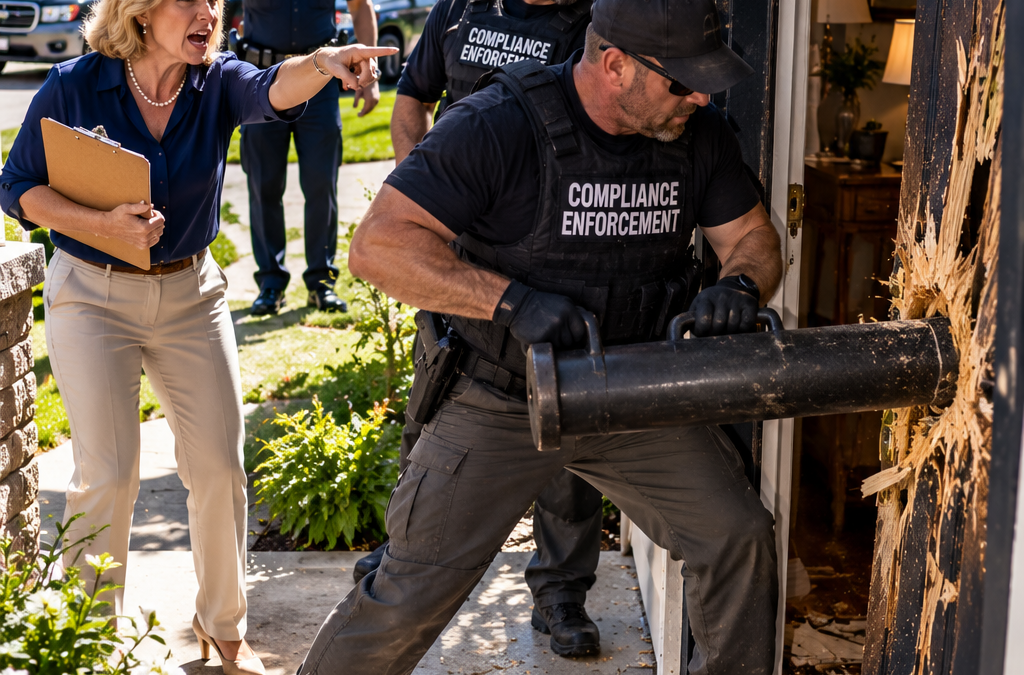
Another man beside him wore a black tactical-style vest with the words COMPLIANCE ENFORCEMENT across the chest.
And directly behind them stood Denise Caldwell.
President of the Maple Ridge Court Homeowners Association.
She was wearing cream-colored slacks, a navy blouse, and the same narrow smile she wore at board meetings whenever somebody disagreed with her.
There was no police officer.
No sheriff’s deputy.
No court official.
No judge’s order.
Just Denise.
Two private contractors.
And a stack of HOA paperwork she believed gave her the right to enter my home.
“You need to stop,” I shouted.
Denise barely looked at me.
“The board has authorized an emergency inspection.”
“You don’t have a warrant.”
“This is an HOA matter.”
“You are standing at my front door with a battering ram.”
Her expression hardened.
“You have had multiple opportunities to cooperate.”
I remember those words.
Not because they were clever.
Because of the way she said them.
Calmly.
Almost pleasantly.
As if I were the unreasonable one.
As if three months of harassment had been some kind of patient negotiation on her part.
As if my failure to bow my head had finally forced her to do something regrettable.
The man holding the ram looked uncertain.
I pointed at him.
“If you hit that door again, you’re breaking into my house.”
He looked toward Denise.
That should have been the moment it ended.
She should have stopped.
She should have realized that whatever fantasy of authority she had built around herself was about to collide with something real.
Instead, she gave him a small nod.
The second strike broke the frame.
The door jumped inward.
A strip of painted wood tore free and landed across my hallway floor.
I stepped backward.
Not because I was afraid of Denise.
Not exactly.
I was afraid of what people become when they believe nobody can stop them.
The door swung open.
The two men stepped inside.
And that was when a voice came from across my front yard.
“Everybody freeze.”
It wasn’t loud.
It didn’t need to be.
The men stopped.
Denise turned.
I looked past them through my shattered doorway.
A man was walking toward us from two houses down.
Frank Delgado.
The quiet neighbor who waved when he checked his mail.
The man I’d spoken to maybe six times in four years.
Except he wasn’t wearing jeans and an old Ohio State sweatshirt that morning.
He was wearing a badge.
His radio was already in his hand.
And the look on his face made the two men inside my house understand something Denise still had not.
This wasn’t an HOA dispute anymore.
It was a crime scene.
My name doesn’t matter much to what happened.
What matters is the house.
And the street.
Maple Ridge Court was one of those neighborhoods that looked peaceful enough to make you suspicious of anything louder than a lawn mower.
It was a cul-de-sac of twenty-six homes, nearly identical in shape and color.
Beige siding.
White trim.
Small front porches.
Two-car garages.
Trimmed hedges.
Black mailboxes.
The HOA documents actually specified the approved mailbox color down to the manufacturer code.
When I bought my home, I thought that was ridiculous.
I also thought it was harmless.
I had been wrong about both.
I moved into Maple Ridge Court four years before the morning my door came apart.
I wasn’t wealthy.
I wasn’t politically connected.
I wasn’t interested in neighborhood drama.
I had saved for years to buy the house.
It was the first place I had ever owned entirely on my own.
That mattered to me.
The first night after closing, I sat on the living room floor surrounded by unopened boxes because I hadn’t assembled the couch yet.
I ate takeout Chinese food with a plastic fork and stared around the room.
The place wasn’t big.
Three bedrooms.
Two bathrooms.
A kitchen that had been renovated sometime around the beginning of the century and was beginning to show it.
But it was mine.
That word had weight.
Mine.
I had rented apartments where landlords entered after giving notice.
I had lived in a duplex where I could hear every argument on the other side of the wall.
I had spent years dealing with parking spaces, rent increases, neighbors smoking outside my bedroom window, and maintenance requests that disappeared into management portals.
This house was supposed to be different.
A door I could close.
Walls that belonged to me.
A little yard.
A mortgage with my name on it.
The HOA dues seemed like the price of living somewhere neat and quiet.
At first, I had no problems.
I paid every assessment on time.
I cut my grass every Saturday unless it rained.
I brought my trash cans in after pickup.
I didn’t park commercial vehicles outside.
I didn’t paint anything purple.
I didn’t install satellite dishes in forbidden locations.
If there was such a thing as an invisible homeowner, I tried to be one.
For almost four years, it worked.
Then I started attending board meetings.
That was my mistake.
Or rather, Denise Caldwell believed it was.
Denise had been president of the Maple Ridge Court HOA for six years.
Before retirement, she had worked in residential real estate.
She liked reminding people of that.
Almost every disagreement eventually included some version of, “I’ve been in property for thirty-two years.”
She was in her early sixties, always perfectly dressed, always carrying a leather folder, always speaking as if the conversation had already been settled before you opened your mouth.
Some people intimidate by shouting.
Denise rarely shouted.
She did something more effective.
She spoke to adults as if they were disobedient children.
At meetings, she sat at the center of the table.
The board technically had five members.
In practice, it had Denise and four people who usually waited to see how she voted.
She interpreted every rule as broadly as possible when she wanted to enforce it and as narrowly as possible when somebody asked for transparency.
She loved phrases like “community standards,” “board discretion,” and “protecting property values.”
Those phrases could mean almost anything.
I didn’t dislike her at first.
I thought she was overbearing.
That was all.
Then the annual dues increased twelve percent.
No special assessment.
No major project.
No obvious emergency.
Twelve percent.
At the next community meeting, I raised my hand.
Denise was halfway through a slide about seasonal landscaping.
“Yes?”
“Can we talk about the dues increase?”
Her smile tightened.
“It was explained in the annual notice.”
“The notice said operational costs increased.”
“Correct.”
“Which costs?”
She looked down at her papers.
“Landscaping. Insurance. Administrative expenses.”
“Do we have a breakdown?”
“The board reviewed the numbers.”
“Can homeowners review them?”
There was a pause.
Nothing dramatic.
But I felt the room change.
Denise looked at me for several seconds.
“Homeowners elect the board to manage the association.”
“I understand.”
“Then I’m not sure what you’re asking.”
“I’m asking to see the reserve and expense records.”
A man across the aisle turned toward me.
Someone else stopped looking at their phone.
Denise folded her hands.
“If you have concerns, you can submit them in writing.”
“Are the records available?”
“Submit your request.”
“Okay.”
I did.
Three days later, I received my first violation notice.
My mailbox post, according to Denise, was leaning three degrees off vertical.
Three degrees.
That exact number was printed in bold.
The letter said I had ten days to correct it or face a fifty-dollar fine, escalating daily.
I went outside with a level.
The post looked straight.
The level said it was straight.
I measured from multiple sides.
Still straight.
My neighbor across the street, Tom, saw me crouching beside the mailbox.
“What are you doing?”
“Apparently my mailbox is leaning.”
He looked at it.
“No, it isn’t.”
“Three degrees.”
He stared at me.
“Three?”
“According to the HOA.”
Tom laughed.
I didn’t.
I should have challenged it.
Instead, I dug around the base, reset the soil, braced the post for two days, took photographs with the level, and submitted them.
Why?
Because it seemed easier.
Fighting an HOA over an imaginary three-degree lean sounded exhausting.
That was the first lesson Denise taught me.
Make compliance slightly easier than resistance and most people will comply.
A week later, another letter arrived.
My trash cans had remained visible from the street for an “excessive period” after garbage collection.
Pickup happened at eleven in the morning.
I returned home from work at 5:40.
The violation photograph was time-stamped 4:12 p.m.
Apparently five hours was excessive.
I brought the cans behind the house.
Another week passed.
A third notice.
My grass exceeded the maximum permitted height by one-quarter inch.
I stared at that one for a while.
Then I walked outside with a ruler because by that point Denise had turned me into a man who measured grass.
The next letter was about a wind chime.
My mother had given it to me years earlier.
Small brass tubes.
Soft sound.
It hung beneath the porch roof.
The notice cited the HOA’s nuisance provision and claimed it produced “repetitive noise capable of disturbing nearby residents.”
My nearest neighbor was Frank Delgado.
His house was about fifty feet away.
I walked over that evening.
Frank was rolling his garbage cans toward the curb.
“Hey, Frank.”
“Hey.”
I pointed toward my porch.
“Can you hear that wind chime from your house?”
He listened.
A light breeze moved it.
Barely audible.
“Sometimes.”
“Does it bother you?”
He looked confused.
“No.”
“Anybody in your house complain?”
“My wife’s been dead six years.”
I immediately regretted the question.
“Sorry.”
He waved it away.
“Why?”
I showed him the notice.
Frank read it.
His eyebrows rose.
“This because of you?”
“No complaints that I know of.”
He handed it back.
“You fighting with the HOA?”
“Apparently.”
He gave me a look I didn’t fully understand then.
“Keep your paperwork.”
“What?”
“Every letter. Every picture. Every email.”
I smiled.
“You sound like a lawyer.”
“No.”
That was all he said.
At the time, I thought he was simply a careful man.
I had no idea what he did for a living.
The pattern became obvious after the fourth notice.
I attended another board meeting.
This time, I submitted my financial records request in writing and asked when I could inspect the association’s books.
Denise stared at me.
“We received your request.”
“When will the records be available?”
“The board is reviewing whether your request is overly burdensome.”
“It’s one year’s financial statements.”
“We have processes.”
“Does the process include a deadline?”
Her face changed.
Only slightly.
I had embarrassed her.
Not intentionally.
But in front of twenty homeowners, I had forced her to answer a question she didn’t want to answer.
Two days later, I received a $200 fine for repeated exterior compliance violations.
There was no hearing.
No detailed breakdown.
Just a notice saying prior warnings established a pattern of noncompliance.
I emailed Denise.
Please identify the specific unresolved violation supporting this fine.
She replied fourteen minutes later.
The board’s determination is final unless appealed according to the governing documents.
So I appealed.
At the hearing, Denise presided over the appeal of Denise’s own enforcement decision.
I pointed that out.
She didn’t appreciate it.
“You are not appealing me personally.”
“You signed every notice.”
“I sign official correspondence as board president.”
“You also voted on the fine?”
“The board voted.”
“Did you?”
“Yes.”
“And now you’re deciding whether your decision was correct?”
One board member looked down at the table.
Denise’s cheeks reddened.
“This confrontational attitude is exactly why these matters have escalated.”
That sentence told me more than she meant it to.
The fines weren’t escalating because of grass.
They were escalating because of my attitude.
Because I asked questions.
Because I didn’t treat her title like authority over me.
That was when irritation became concern.
I started documenting everything.
I bought a binder.
Every letter went inside.
Every envelope.
Every email.
Every photograph.
I created a timeline.
Financial request.
Mailbox violation.
Second records request.
Trash-can violation.
Board meeting question.
Grass violation.
Appeal.
Wind-chime notice.
It looked ridiculous laid out on paper.
It also looked deliberate.
Then Denise discovered my garden gnome.
The gnome had belonged to my father.
He had a ridiculous red hat and a cracked blue coat.
He stood beside a flower bed near my back patio where nobody could see him unless they walked halfway around my house.
One afternoon, I received a notice calling it an “unauthorized exterior structure.”
I actually laughed.
Then I saw the fine.
Four hundred dollars.
Failure to remove it within seventy-two hours would result in additional penalties and potential lien enforcement.
I called Denise.
It was the first time I confronted her directly outside a meeting.
She answered on the fourth ring.
“Maple Ridge HOA.”
“It’s me.”
A pause.
“I assume this concerns the violation.”
“It’s a garden gnome.”
“It is an unapproved decorative structure.”
“It’s twelve inches tall.”
“Dimensions are not the only consideration.”
“It’s behind my house.”
“The association has architectural standards.”
“It’s a gnome, Denise.”
Her voice became cold.
“Your refusal to take compliance seriously is becoming a pattern.”
“No. Your obsession with me is becoming a pattern.”
That silence lasted several seconds.
Then she said, “Be very careful.”
“What is that supposed to mean?”
“It means homeowners who repeatedly violate association rules can face serious consequences.”
“Over a garden gnome?”
“Over noncompliance.”
I took the gnome inside.
Not because she was right.
Because I wasn’t willing to risk my house over my father’s ridiculous ceramic decoration.
That night, I sat at the kitchen table with the binder open.
For the first time, I felt something close to shame.
Not because of anything I had done.
Because she was succeeding.
I was changing how I lived in my own home.
Before walking outside, I wondered what she would photograph.
When I put my trash out, I watched the clock.
When I mowed, I measured the grass.
When wind moved the porch chime, I took it down.
I looked at my own property through Denise Caldwell’s eyes.
What could she use?
What could she twist?
What would the next envelope contain?
That is what petty authority does when it becomes personal.
It shrinks your world.
Not all at once.
In inches.
A mailbox.
A trash can.
A blade of grass.
A piece of decoration.
Then one day you realize you are asking permission inside the life you paid for.
So I stopped cooperating quietly.
I filed a formal statutory request for HOA financial records.
I requested reserve statements.
Vendor contracts.
Meeting minutes.
Legal expenses.
Landscaping invoices.
Management fees.
Insurance records.
Every document homeowners were entitled to inspect.
I sent it certified.
Denise received it on a Monday.
Tuesday afternoon, she appeared at my front door.
Not an email.
Not a letter.
Denise herself.
She pounded hard enough that I thought something had happened.
When I opened the door, she was standing less than two feet from me.
No smile.
No folder.
No board members.
Just anger.
“Do you think you’re smarter than the board?”
That was her opening sentence.
I stared at her.
“What?”
“You know exactly what you’re doing.”
“I asked for records.”
“You are harassing volunteers.”
“By asking how my dues are spent?”
Her eyes narrowed.
“People like you move into a well-run community and immediately think you know better than everyone who built it.”
“I’ve lived here four years.”
“And until recently, you understood how things work.”
There it was.
Until recently.
Until I started questioning her.
I kept my voice level.
“If the books are fine, let me see them.”
“You don’t get to dictate terms to this board.”
“I’m not dictating anything.”
“You are creating disruption.”
“Denise, you’re standing on my porch because I requested financial records.”
She stepped closer.
“You think you’re smarter than the board?”
“You already asked that.”
She pointed past me into my house.
“We’ll see how smart you are when we take this house.”
Everything inside me went still.
I laughed.
Not because it was funny.
Because sometimes your brain rejects a threat when it is too absurd to process immediately.
“You’re threatening to take my home?”
“I’m explaining consequences.”
“For asking to see HOA records?”
“For continued noncompliance.”
“Get off my property.”
Her face hardened.
“Excuse me?”
“You heard me.”
“You’re making a mistake.”
“Leave.”
She stood there another second.
Then she turned and walked down my steps.
At the sidewalk, she looked back.
That image stayed with me later.
Denise beneath the streetlight.
Her leather purse over one shoulder.
My quiet beige house behind me.
She looked perfectly ordinary.
That was the unsettling part.
People imagine abuse of power as something dramatic.
Usually it looks boring.
A person with a title.
A piece of paper.
A threat delivered in a calm voice.
Two weeks later, I received the emergency inspection notice.
It claimed the HOA had received credible information suggesting an unapproved structural modification inside my residence.
I read the sentence twice.
Then again.
I had changed nothing.
No walls.
No plumbing.
No electrical work.
No additions.
No converted garage.
Nothing.
I emailed immediately.
Please identify the alleged structural modification.
Denise replied:
The purpose of inspection is to determine the nature and extent of the violation.
I wrote:
I do not consent to entry into my home. Please provide the contractual and legal authority you believe permits forced inspection of the interior.
No response.
The next day, I received a second notice.
The board had held an emergency session.
Without notifying me.
Without inviting me.
Without identifying evidence.
The board had voted to authorize inspection.
I called an attorney.
He read the documents and told me essentially what I already suspected.
An HOA may have certain inspection rights depending on governing documents and state law.
That does not mean it can physically force entry into an occupied private home whenever it wants.
“Do not let them in,” he said.
“What if they come?”
“Tell them to leave.”
“What if they refuse?”
“Call law enforcement.”
The whole conversation felt absurd.
I remember saying, “We’re talking about an HOA.”
My attorney replied, “You’re talking about people. Don’t assume people stay reasonable because the organization they’re acting through is boring.”
Tuesday morning, I woke at six-thirty.
Nothing felt unusual.
I showered.
Checked email.
Fed the dog.
Started coffee.
At 8:17, I heard vehicles outside.
I looked through the kitchen window.
A white utility van.
A dark crossover.
Denise’s silver sedan.
My stomach tightened immediately.
Three doors opened.
Two men got out of the van.
Both wore black vests.
One carried a clipboard.
The other went around the back and removed a short battering ram.
I stared through the glass.
For several seconds, I genuinely believed I was misunderstanding what I saw.
A battering ram.
At my house.
Because an HOA wanted to inspect for an addition that didn’t exist.
Denise walked up my path behind them.
She carried a folder under one arm.
Three hard knocks hit the door.
I set down my mug.
Another three.
“Maple Ridge Compliance Enforcement!”
I almost laughed again.
Instead, I opened the door about halfway.
“What are you doing?”
The man with the clipboard spoke.
“We have an authorized inspection order.”
“From a judge?”
He looked toward Denise.
She stepped forward.
“From the HOA board.”
“I already told you I don’t consent.”
“The governing documents give the association inspection rights.”
“Not forced entry.”
She opened her folder.
“You have refused access.”
“Correct.”
“That refusal has created an emergency compliance situation.”
“Nothing inside my house is an emergency.”
“That’s what we’re here to determine.”
I looked at the two men.
“Who are you?”
“Contracted compliance officers.”
“Are you police?”
“No.”
“Are you county code enforcement?”
“No.”
“Do you have a warrant?”
The clipboard man hesitated.
“No.”
I pointed toward the driveway.
“Then get off my property.”
Denise moved between us verbally before anyone moved physically.
“The board has unanimously authorized entry.”
“I don’t care if the board voted one hundred to zero.”
Her mouth tightened.
“You signed the covenants when you purchased this home.”
“I did not sign away the Fourth Amendment.”
“This is not a criminal search.”
“Then you definitely don’t have authority to break down my door.”
She took another step.
“Open the house for inspection and none of this has to be difficult.”
I remember staring at her.
Three months of notices.
Fines.
Threats.
The gnome.
The records request.
Her words on my porch.
We’ll see how smart you are when we take this house.
And suddenly the whole thing made sense.
This was not an inspection.
This was humiliation.
She wanted me standing aside while her people walked through my bedrooms and closets because I had challenged her in public.
She wanted every homeowner who heard about it to understand what happened to people who refused to cooperate.
“No,” I said.
Denise looked at the man holding the ram.
“Proceed.”
He hesitated.
“Ma’am—”
“The board authorization is in the packet.”
I pointed at him.
“If you touch my door, I will report you for breaking and entering.”
He looked from me to Denise.
The second contractor said quietly, “Denise, maybe we should—”
She cut him off.
“We have already discussed this.”
Then she looked directly at me.
“You had your chance.”
The first strike hit.
The sound went through my chest.
I shoved against the door instinctively.
“What the hell are you doing?”
Denise stepped back.
“Do not interfere with enforcement.”
“You’re breaking into my house!”
The second strike landed.
The jamb split.
The door flew inward several inches.
I stumbled backward.
That was when fear replaced anger.
Real fear.
Because there were two men at my broken door and I no longer knew how far this ridiculous situation could go.
I remember thinking about my phone.
I remember wondering whether I could reach it.
I remember thinking about the dog barking from the bedroom.
I remember the coffee mug still in my hand.
The details were stupidly clear.
A chip in the tile.
A splinter caught against the baseboard.
The smell of coffee.
Denise’s perfume.
The contractor breathing hard.
Then the door opened.
The men stepped over the threshold.
I shouted.
And Frank Delgado appeared.
He had been home that morning.
I learned later that his home office faced my street.
He heard the first pounding and looked outside.
He saw the unmarked van.
He saw the men in tactical-style vests.
He saw the ram.
At first, he thought it might be a legitimate law enforcement operation he hadn’t been notified about.
Then he watched.
No marked units.
No uniformed officers.
No proper announcement.
No warrant service procedure.
And he recognized Denise.
That changed everything.
Frank didn’t come running outside waving a gun.
He did what experienced law enforcement officers do.
He observed.
He called dispatch.
He identified himself.
He started walking toward the house.
By the time the second blow broke the door frame, he had seen enough.
“Everybody freeze.”
The clipboard slipped from one contractor’s hand and hit the porch.
The other man lowered the ram.
Denise turned.
Her face changed when she saw the badge.
It happened instantly.
All the certainty disappeared.
Frank stopped near the bottom step.
“Sheriff’s department. Hands where I can see them.”
Denise stared.
“Frank?”
“Step away from the doorway.”
“This is an HOA enforcement matter.”
“Step away from the doorway.”
“But—”
“Now.”
She stepped back.
I had never heard Frank speak like that.
He looked at me.
“You all right?”
I nodded.
“I think so.”
“Anybody injured?”
“No.”
He looked at the two contractors.
“Both of you come outside slowly.”
They obeyed.
One started explaining before Frank even asked.
“Sir, we were told the association had legal authority—”
“Stop.”
Frank pointed toward the lawn.
“Stand there.”
Then he looked at Denise.
“Did you authorize them to force that door?”
Her face had gone pale.
“The board authorized an inspection.”
“That’s not what I asked.”
“We have covenants.”
“Did you tell them to force entry?”
She looked toward the contractors.
One of them looked away.
Frank repeated the question.
“Did you tell them to force entry?”
Denise’s voice dropped.
“I told them to proceed with the authorized inspection.”
The man who had carried the ram spoke.
“She told me to hit the door.”
Denise turned sharply.
“You had the paperwork.”
Frank raised one hand.
“Nobody talk to each other.”
A patrol unit arrived less than three minutes later.
Then another.
Neighbors began appearing on porches.
I hated that.
Part of me wanted everyone to see what Denise had done.
Another part wanted to disappear.
There is something violating about standing inside your damaged home while strangers gather outside to watch.
Frank came into the hallway.
He didn’t cross farther than necessary.
He looked at the broken frame.
The wood scattered across the floor.
The damaged lock.
Then he looked at me.
“Tell me exactly what happened from the beginning.”
So I did.
The notices.
The records request.
The fines.
The threat.
The inspection order.
I brought him the binder.
He flipped through the first few pages.
“You’re kidding.”
“No.”
He read the mailbox letter.
“Three degrees?”
“Apparently.”
He looked toward the lawn where Denise was speaking to a deputy.
“Keep this.”
“I planned to.”
“No. I mean preserve everything. Emails too.”
“Frank…”
I hesitated.
“Are you actually the sheriff?”
For the first time that morning, he almost smiled.
“County sheriff.”
“How did I not know that?”
“You never asked.”
Despite everything, I laughed.
It came out strangely.
Half laugh.
Half exhausted breath.
Then I looked at my door.
The laughter stopped.
Outside, Denise’s voice rose.
“This is outrageous. I am the president of this association.”
Frank turned his head.
One of his deputies said something I couldn’t hear.
Denise pointed toward my house.
“He agreed to the bylaws when he purchased.”
Frank walked back outside.
I followed as far as the doorway.
“Mrs. Caldwell,” he said, “I’m going to explain something once.”
She crossed her arms.
“This association has legal authority.”
“You may have civil authority to issue notices, levy properly authorized fines, enforce recorded covenants, and pursue remedies through the courts.”
“Exactly.”
“None of that allows you to break down somebody’s door.”
“We had an inspection authorization.”
“From a judge?”
“The board.”
“The board is not a court.”
“Our counsel said—”
“Your counsel gave you permission to use a battering ram?”
That stopped her.
Frank continued.
“You can write a violation letter. You can initiate a civil action. Depending on your documents and state law, you may seek a lien through legal process. You cannot hire private citizens, dress them in enforcement vests, destroy a homeowner’s door, and force your way into an occupied residence because five HOA board members voted on it.”
Denise looked around at the neighbors watching.
That embarrassed her.
I could tell.
And Denise Caldwell hated embarrassment more than she feared consequences.
“This man has been obstructive for months.”
Frank’s expression changed.
“Obstructive isn’t a crime.”
“He refused inspection.”
“Also not permission for you to commit one.”
She actually scoffed.
“A crime?”
Frank pointed toward my broken doorway.
“What do you call that?”
“The association will repair any incidental damage.”
I felt something snap inside me.
“Incidental?”
Everyone looked at me.
I stepped onto the porch.
“You threatened to take my house.”
Denise’s mouth opened.
“You fined me over grass. You fined me over my father’s garden gnome. You told me we’d see how smart I was when you took my home.”
“That is not what I—”
“I have everything in writing.”
Her face tightened.
“Not everything.”
“No?”
I looked at Frank.
“I have a door camera.”
Denise went completely still.
I had installed it after her porch threat.
Mostly because I wanted documentation if she returned.
The camera had recorded the entire event.
Audio included.
Her arrival.
The discussion.
My refusal.
Her order.
Proceed.
Both blows.
Everything.
One of the deputies looked at Frank.
Frank nodded.
“Preserve the footage.”
“I will.”
That was when Denise finally understood.
Until that second, I think she believed she could still explain the situation.
Call it a misunderstanding.
Call it enforcement.
Call it damage during inspection.
Say the contractors exceeded instructions.
Say I became aggressive.
But cameras don’t care who has been HOA president for six years.
They don’t care how many people usually vote with you.
They don’t care whether you once sold expensive houses or whether you can quote Section 8.4 of the architectural guidelines from memory.
The camera had recorded a woman ordering a private contractor to smash through a door after the homeowner explicitly refused consent.
Everything after that moved quickly.
The two contractors were separated.
Both gave statements.
Neither protected Denise.
Why would they?
They had been foolish, but they understood immediately that the person who had hired them had placed them in serious trouble.
One produced text messages from Denise.
She had arranged the “enforcement visit.”
She had discussed bringing equipment if necessary.
She had assured them that HOA authorization permitted entry.
Frank read the messages at the scene.
His expression became harder with every screen.
Denise was eventually placed in handcuffs.
I wish I could tell you I felt satisfaction.
I expected to.
For months I had imagined someone finally telling her no.
I had imagined her being embarrassed.
I had imagined the board discovering that she couldn’t simply manufacture authority because nobody challenged her.
But when the deputy brought her hands behind her back, I didn’t feel triumphant.
I felt sick.
Because three months earlier, we had been arguing over financial records.
Now my front door was broken and a sixty-something-year-old woman from my HOA was standing on my lawn in handcuffs.
How does something that stupid get that far?
Denise looked toward me.
There was fear in her face.
Real fear.
The same feeling I had carried every time one of her envelopes arrived.
“I didn’t know,” she said.
Frank heard her.
“You didn’t know what?”
She looked at him.
“I didn’t know you were sheriff.”
He stared at her.
That was the worst possible answer.
Frank’s voice went quiet.
“You shouldn’t need a sheriff living next door to know you can’t break into somebody’s home.”
Denise looked down.
She kept repeating that the board had approved it.
That phrase became almost pathetic.
The board approved it.
The board approved it.
The board approved it.
As if repeating it could turn a homeowners association into a government.
As if five people around a folding table could vote themselves police powers.
As if a laminated rulebook could become a warrant.
The contractors were charged.
So was Denise.
The exact charges changed during review, but the case centered on criminal trespass and property damage arising from the forced entry.
I spent the rest of that morning giving statements.
A crime-scene technician photographed my door.
A deputy collected copies of the HOA documents.
I exported the doorbell-camera footage twice.
One copy went to investigators.
One went to my attorney.
Frank gave his own statement as a direct witness.
That mattered enormously.
He had seen them arrive.
He had seen the equipment.
He had watched the forced entry from outside.
And unlike me, he had no personal dispute with Denise.
He was simply there.
A neutral witness with decades of law-enforcement experience.
By afternoon, the neighborhood Facebook page was chaos.
People had photographs.
Someone had filmed Denise being placed into the patrol car.
Rumors spread.
Some claimed I had attacked the contractors.
Others said the sheriff had “raided” the HOA.
One post claimed federal agents were involved.
That one made me laugh.
Then the board sent an email asking residents not to speculate.
The message referred to the incident as “an unfortunate misunderstanding concerning covenant enforcement.”
I read that phrase at least five times.
Then I forwarded it to my lawyer.
His response was one sentence.
Do not reply to them directly anymore.
I didn’t.
The next week changed Maple Ridge Court.
Not visibly.
The lawns were still trimmed.
The black mailboxes still stood in their neat rows.
Garbage pickup still happened Thursday.
But people started talking.
Really talking.
A woman named Carla from Birch Hollow Drive knocked on my door one afternoon.
The temporary plywood covering the broken frame was still visible behind me.
She looked at it.
“Oh my God.”
“Yeah.”
She held up a folder.
“I think Denise did this to me too.”
Not the door.
The targeting.
Carla had questioned a landscaping contract eighteen months earlier.
Within two weeks, she received violation notices for driveway staining, an allegedly unapproved planter, and curtains supposedly visible from the street in a prohibited color.
“I thought I was imagining it,” she said.
“You weren’t.”
Another homeowner came forward.
Then a third.
Same pattern.
Question spending.
Receive violations.
Challenge a board action.
Get fined.
Ask for records.
Get threatened with enforcement.
The details differed.
The sequence didn’t.
Denise had not been enforcing rules evenly.
She had been using rules to discipline people who challenged her.
That realization hurt more than the money.
Because until then, part of me still wondered whether I had made things worse by pushing back.
Maybe I had become confrontational.
Maybe the notices were technically valid.
Maybe Denise was just obsessive rather than retaliatory.
Then other people spread their letters across my kitchen table.
Same language.
Same timing.
Same signature.
I wasn’t paranoid.
I was a target.
That gave my civil attorney a clear path.
We filed suit.
Property damage.
Costs.
Legal fees.
Claims arising from the forced entry.
Emotional distress.
We also challenged every fine and lien-related action tied to the retaliatory enforcement history.
The HOA’s insurer responded quickly.
They reviewed the footage.
They reviewed the contractor messages.
They reviewed Denise’s authorization.
Then they denied coverage for portions of the incident on the basis that intentional forced entry into an occupied private residence fell outside legitimate association activity.
That was devastating for Denise.
She had spent months acting as if the HOA’s resources were her resources.
Its lawyers.
Its money.
Its authority.
Its insurance.
Suddenly the institution she had hidden behind was stepping away.
The board hired separate counsel.
Then, for the first time, the other directors started protecting themselves.
Meeting minutes appeared.
Emails surfaced.
One board member claimed he believed the “emergency inspection” would consist of a written demand and an exterior review.
Another said Denise had described the contractors as licensed compliance professionals.
A third claimed he never understood that forced entry was contemplated.
Denise insisted they all knew.
Maybe some did.
Maybe some didn’t.
I stopped caring.
I wasn’t trying to destroy them.
I wanted my house repaired.
I wanted the false fines gone.
I wanted the lien threat removed.
I wanted the harassment to stop.
Most importantly, I wanted the record to reflect what had actually happened.
Negotiations lasted less than two months.
The video made prolonged denial difficult.
Frank’s statement made it worse.
The contractor messages finished the rest.
The settlement required payment for the door, frame, locks, interior repairs, and my legal costs associated with the forced entry.
The fines were reversed.
Every retaliatory violation still on my account was cleared.
The lien threat disappeared.
The board entered a formal statement into its meeting minutes acknowledging that forced entry had not been a lawful enforcement mechanism and that homeowners retained legal rights independent of HOA governing documents.
The apology was written in legal language.
Cold.
Careful.
Probably negotiated word by word.
But it existed.
That mattered.
Denise resigned before the settlement was finalized.
Her resignation letter blamed “an increasingly hostile environment toward volunteer community leadership.”
She never apologized to me personally.
Not once.
I didn’t expect her to.
People who abuse authority rarely describe themselves that way when the authority disappears.
In their own story, they are almost always victims of people who refused to cooperate.
The first board meeting after her resignation was packed.
I sat in the back.
Frank sat two rows ahead of me.
I had never seen that many Maple Ridge residents in one room.
The temporary board president opened by saying the association would immediately review its enforcement procedures.
A man behind me whispered, “About damn time.”
For once, nobody shushed him.
The financial records were released.
That was almost anticlimactic.
There was no giant embezzlement scandal.
No secret mansion.
No missing million dollars.
But there were questionable expenses.
Unusually expensive landscaping contracts.
Legal consultations that had never been clearly disclosed.
High management fees.
And thousands of dollars spent pursuing minor violations that could have been resolved with ordinary conversations.
Denise hadn’t been protecting the neighborhood.
She had been feeding a system that made her feel powerful.
That was worse in a different way.
The new board changed the enforcement process.
No single board member could initiate escalating fines without review.
Homeowners received clearer notice and appeal rights.
Interior inspections required actual consent or proper legal process.
Retaliation complaints went to an outside management representative.
Financial records became easier to access.
None of those changes were revolutionary.
That was what struck me.
Everything we needed had always been ordinary.
Transparency.
Due process.
Restraint.
A recognition that rules do not erase ownership.
The new front door was installed three weeks after settlement.
I chose a heavier one than before.
Not because I expected another battering ram.
Because after somebody breaks your door, even once, you think differently about doors.
The carpenter replaced the entire damaged frame.
When he pulled out the old wood, he found where the ram had split the jamb almost all the way to the stud.
“Who did this?” he asked.
“The HOA.”
He stopped working.
“The what?”
I laughed.
“It takes a while to explain.”
He shook his head.
“I’ve installed doors after burglaries. Angry exes. Police warrants. Never an HOA.”
“Add it to the list.”
When he finished, I stood outside looking at the house.
Same beige siding.
Same porch.
Same little flower bed.
But something in me had changed.
For months, Denise had trained me to feel watched.
After she was gone, it took time to stop.
The first time my grass grew slightly too long because rain prevented me from mowing, I noticed it from the driveway and felt a flash of panic.
Then I remembered.
No Denise.
No retaliatory letter.
No photograph taken from a passing car.
I left it.
The world did not end.
My trash cans stayed beside the garage until six-thirty one evening.
Nobody fined me.
I rehung my mother’s wind chime.
It moved in the evening breeze.
Frank was in his driveway.
I called across.
“Still bothering you?”
He listened.
“Terrible.”
I laughed.
“So loud.”
“Probably need tactical response.”
That was Frank.
Dry humor.
Few words.
After everything settled, I finally asked why he had never told me he was sheriff.
We were standing beside our mailboxes.
“Didn’t seem relevant.”
“You run law enforcement for the county.”
“Still have to take the trash out.”
Fair point.
I thanked him again.
He looked uncomfortable.
“You don’t owe me anything.”
“You stopped them.”
“I did my job.”
“You were off duty.”
“I was home.”
He looked toward my house.
“I saw two men with a ram entering a residence without lawful process. Doesn’t matter whose house it is.”
That sentence stayed with me.
Doesn’t matter whose house it is.
That was the principle Denise never understood.
She thought rules mattered differently depending on who had authority.
Frank believed the law mattered regardless of who stood behind the door.
Months later, I saw Denise once.
At the grocery store.
She was near the produce section.
I spotted her before she saw me.
For a second, every emotion came back.
The envelopes.
The threat.
The splintering wood.
The shock of strangers stepping into my hallway.
I wondered what I would say if she approached me.
Nothing clever came.
No triumphant speech.
No perfect line.
Then she looked up.
Our eyes met.
She froze.
I didn’t.
I picked up the apples I needed and put them in my cart.
Denise turned down another aisle.
That was it.
And surprisingly, that felt better than any confrontation.
She no longer had the power to make my heart race because an envelope appeared in the mail.
She was just a woman in a grocery store.
I was just a man buying apples.
That’s what losing power looks like sometimes.
Not handcuffs.
Not courtrooms.
Irrelevance.
A year after the incident, my father’s garden gnome went back outside.
I put him beside the front flower bed this time.
Fully visible from the street.
The red hat was more faded.
The crack in his coat had widened.
One morning, the new HOA president walked past while I was pulling weeds.
She stopped.
“Is that the famous gnome?”
I looked at him.
“Apparently.”
She smiled.
“I think he’s ugly.”
“He is.”
“But I’m not sending a violation letter.”
“Then we’re making progress.”
She laughed and continued walking.
The mailbox still stands at the curb.
I checked it with a level once after all this was over.
It was slightly off.
Maybe a degree.
Maybe two.
Definitely not three.
I left it.
Sometimes I think about how ridiculous the whole conflict sounds when reduced to the first letter.
A mailbox.
Three degrees.
That’s where it started.
But it didn’t really start there.
It started the moment Denise learned that enforcement could be used as punishment.
It started every time somebody obeyed a questionable notice because fighting felt harder.
Every time a homeowner paid a fine rather than risk escalation.
Every time the board treated questions as disloyalty.
Every time Denise walked away from a meeting believing nobody would challenge her.
Power rarely becomes abusive in one dramatic leap.
It grows through successful tests.
Can I send this notice?
Nobody stops me.
Can I increase this fine?
Nobody stops me.
Can I threaten a lien?
Nobody stops me.
Can I intimidate someone at their door?
Nobody stops me.
Can I invent an emergency inspection?
Nobody stops me.
Can I hire men?
Can I bring a battering ram?
Can I break the door?
That morning, Denise finally reached the test she couldn’t pass.
Not because I suddenly became more courageous.
Not because I outsmarted her.
Because there happened to be a witness two houses away who understood instantly where HOA authority ended.
I have thought about that more than anything.
What if Frank hadn’t been home?
I would have called 911.
The camera still would have recorded everything.
The law would still have been the law.
But those men might have made it farther into my house before deputies arrived.
They might have searched rooms.
Opened doors.
Walked through my private life.
Denise might have stood inside my home giving instructions.
That thought still makes my stomach tighten.
People laughed afterward when they heard the story.
“An HOA with a battering ram?”
It sounds absurd.
It was absurd.
It was also terrifying.
Those two things can exist together.
I learned that owning a home doesn’t automatically make you feel secure.
Security comes from knowing boundaries matter.
The property line.
The front door.
The line between rules and law.
The line between inconvenience and harassment.
The line between enforcement and retaliation.
Denise erased those lines one at a time until someone with real legal authority forced her to see them again.
Today, Maple Ridge Court looks almost exactly as it did before.
Same beige houses.
Same hedges.
Same black mailboxes.
The golf carts come out in summer.
Kids ride bicycles around the cul-de-sac.
People complain about leaf pickup.
Someone always thinks the Christmas decorations stay up too long.
Ordinary neighborhood problems.
That is how it should be.
The HOA still exists.
I still pay dues.
There are still rules.
I am not anti-HOA because of what happened.
Rules can protect neighborhoods.
Shared maintenance requires money.
Common areas need management.
Disputes need procedures.
But an HOA is not a government simply because its letters have a logo.
A board president is not a judge because she sits at the center of a table.
A violation notice is not a warrant.
A unanimous vote is not permission to commit a crime.
And ownership still means something after the covenants are signed.
That may sound obvious.
It didn’t feel obvious while my door was breaking apart.
The damage in my hallway has been repaired.
The fines are gone.
The lien threat is gone.
Denise is gone.
The binder remains.
I keep it on a shelf in my office.
Sometimes people ask why I haven’t thrown it away.
Maybe someday I will.
For now, I keep it because it reminds me how gradually unreasonable behavior can become normal.
The first page is the mailbox notice.
Three degrees.
The last document is the settlement.
Between them are months of intimidation.
Letters.
Pictures.
Emails.
Threats.
Appeals.
Fines.
An inspection order.
Police reports.
Repair invoices.
Court filings.
A whole conflict built from one woman’s inability to tolerate being questioned.
The strangest thing is that I never wanted to defeat Denise.
I wanted to understand where my dues were going.
That was it.
One question.
One request for records.
Had she answered it normally, my door would still be the original one.
The contractors would never have been arrested.
The HOA would never have paid lawyers to clean up her decisions.
Three homeowners might never have realized they had also been targeted.
Denise might still be president.
Instead, she treated a homeowner’s question like rebellion.
And because every smaller act of intimidation had worked before, she kept going.
Right up to my front door.
Then through it.
That was where her authority ended.
Not because a sheriff happened to live nearby.
His presence exposed the truth faster.
But the truth was already there.
My house was mine.
The law was still the law.
And no HOA vote could turn her anger into a warrant.
These days, when I walk to the curb in the morning, I sometimes stop beside that supposedly crooked mailbox.
Frank’s mailbox is two houses down.
If he’s outside, we wave.
Nothing dramatic.
No badge.
No patrol cars.
No shouting.
Just two neighbors collecting mail.
The wind chime moves behind me.
The gnome stands by the flowers.
The grass isn’t always exactly the approved height.
And Maple Ridge Court somehow survives.
That is the ending Denise never expected.
She spent months trying to teach me that the board could control every inch of my property if it wanted to.
Instead, she taught the entire neighborhood something else.
Rules have limits.
Titles have limits.
Fear has limits.
And the moment someone has to break down your door to prove how much authority they have, they have already crossed the line that proves they never had that authority at all.




