PART 2: HOA Karen Stole My Farm’s Water During a Drought—Then She Learned Who Controlled the Tap
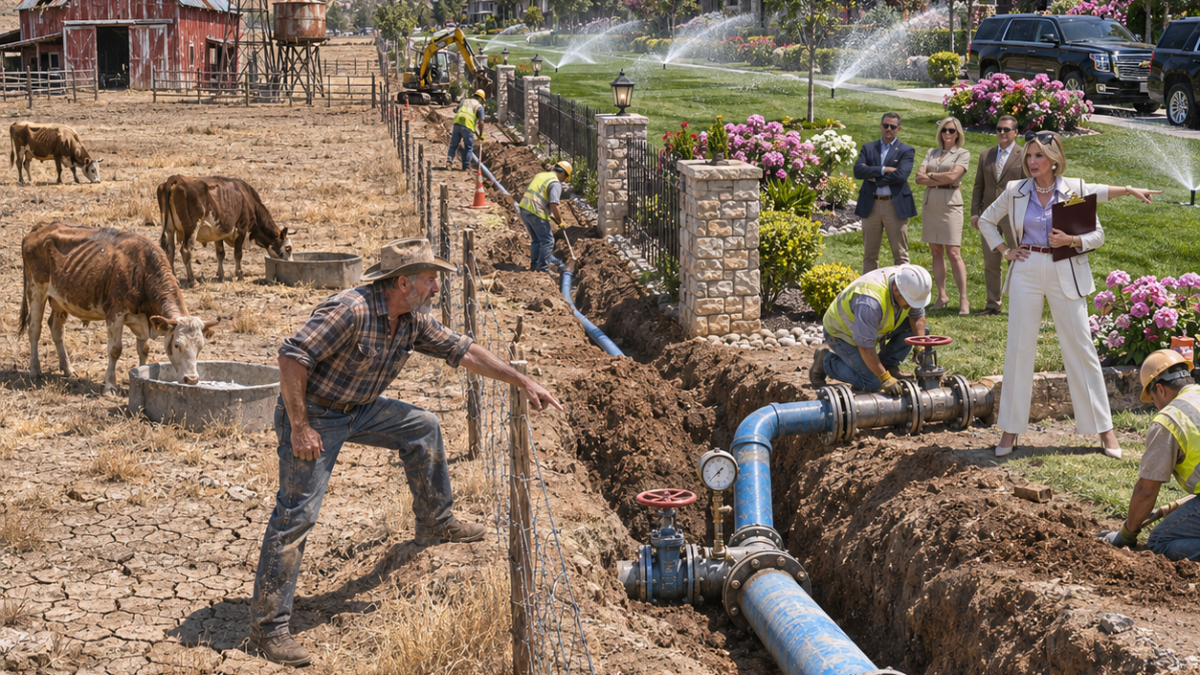
The morning my forty-year-old well coughed up nothing but hot air while my cattle bawled beside empty troughs, I could hear sprinklers ticking across the fence at Crescent Meadows, feeding perfect green lawns with water that should have been keeping my farm alive.
By sunset, I had followed a strip of freshly disturbed soil from my irrigation line toward the HOA and found new pipe buried beneath mulch and decorative stone, running straight toward the neighborhood whose president had spent years telling me my barn, tractor, rooster, and very existence ruined her property values.
I wanted to rip that pipe out with my bare hands, but when an old plumber looked at the pressure readings and told me somebody had been stealing far more water than one backyard could use, I realized Sarah Murphy hadn’t just crossed my fence—she had built something big enough to destroy my farm if I moved before I understood it.
My name is Jose Flores, and before Crescent Meadows arrived, water was something I respected but rarely feared.
My father dug our original well before I was born.
He used to tell me a farmer could survive bad prices, bad weather, broken machinery, and even a bad season if he protected three things: his soil, his seed, and his water.
The well had survived everything Texas threw at us.
Heat waves.
Dry years.
Storm damage.
Years when wheat barely paid for diesel.
Years when soybeans saved the farm.
It had never gone dry.
Then Crescent Meadows appeared five years earlier.
The city called it development.
I called it what happened when open ground became expensive enough for men in clean boots to start drawing rectangles on maps.
Within two years, luxury houses covered the land north of my farm.
Then came the HOA.
Then came Sarah Murphy.
The first letter she ever sent me claimed my barn door failed to “harmonize with community standards.”
I wasn’t in her HOA.
The second complained that my rooster created a “hostile sound environment.”
Still not in her HOA.
The third fined me $250 because my tractor could be seen from the road.
I drove the fine back to her office myself.
“Jose,” she said, smiling behind her desk, “we all have to make sacrifices to preserve property values.”
“I already made mine.”
She raised an eyebrow.
“I left the tractor exactly where it was.”
We never became friends.
Then the drought came.
Stage Four.
No decorative fountains.
No routine lawn watering.
No waste.
The county put strict limits on everybody.
My wheat turned pale.
Clover curled at the edges.
I started cutting irrigation hours.
The cattle crowded the troughs longer.
But Crescent Meadows somehow got greener.
Every time I drove past, sprinklers shimmered over lawns so bright they looked artificial.
Children ran through backyard misters.
Sarah’s three-tier fountain poured water down polished stone day and night.
I finally called Earl Thompson, the plumber who had kept half the farms in our county running since before most people knew what PVC was.
He spent an hour checking my pump, lines, gauges, and pressure.
Then he stood up slowly.
“Jose.”
“What?”
“You don’t have a leak.”
“That good?”
“No.”
He wiped his hands.
“Somebody’s taking your water.”
I laughed because the alternative was believing him.
“Who steals water?”
Earl looked toward Crescent Meadows.
“Somebody with a lot of grass.”
That evening, I walked my fence.
Near the north irrigation junction, I found a smooth strip of recently disturbed earth.
Too straight.
Too fresh.
I knelt.
Brushed away loose soil.
White pipe.
New.
I followed it twenty yards.
Then fifty.
It crossed toward Crescent Meadows and disappeared beneath decorative mulch on their side.
My pulse hammered.
I could hear water moving through it.
I wanted a shovel.
Instead, I got a camera.
The next morning, my friend Linda Hayes at the county office pulled the official utility plans.
Crescent Meadows had one legal municipal connection.
No secondary line.
No approved connection to my farm.
“Jose,” she said quietly, “if this pipe is coming from your well, somebody has a serious problem.”
Two nights later, my trail camera caught a Crescent Meadows maintenance contractor at the junction.
Reflective vest.
HOA logo.
Flashlight.
He knelt beside the illegal line and adjusted the diversion feeding water toward the subdivision.
I watched the footage twice.
Then I looked through my kitchen window at fields my father had spent his life protecting.
Across the fence, Sarah’s fountain glittered beneath landscape lights.
And suddenly I understood why my well had been dying.
PART 2
I didn’t sleep that night.
Every time I closed my eyes, I heard the sound of my cattle bawling beside the trough.
It had been one of those noises that farmers understand immediately.
Not panic.
Not yet.
Discomfort moving toward distress.
Animals don’t care about HOA politics.
They don’t care about property values.
They don’t care who signed what landscaping contract.
They need water.
My crops needed water.
My soil needed water.
And while I had been cutting irrigation hours because I thought nature was taking more than I could give, somebody had been pulling from the same well to keep fountains decorative.
At four in the morning, I walked outside.
The stars were sharp.
The dirt under my boots was dry enough to powder.
I stopped beside the well house.
Dad had built the original structure around it himself.
Not pretty.
Corrugated roof.
Old wood.
Concrete pad patched three times.
Sarah would have hated it.
That thought almost made me laugh.
Instead, I rested one hand against the wall.
I remembered being maybe nine years old, sitting on an overturned bucket while Dad repaired a pump.
He had handed me a wrench.
“Wrong size,” I’d complained.
He laughed.
“Then find the right one.”
That was Dad.
No speeches.
No motivational wisdom.
You had a problem.
You found the right tool.
Standing there in the dark, I realized anger wasn’t the right tool yet.
Evidence was.
—
At sunrise, I called Linda again.
“I need everything public you can legally give me about Crescent Meadows water permits.”
She paused.
“Jose.”
“Yeah?”
“Legally.”
“I heard you.”
“I mean it.”
“I don’t want favors.”
“Good.”
“I want records.”
“That I can do.”
By ten, I was sitting across from her with utility maps, landscaping permits, inspection histories, and drought allocations spread between us.
Linda had worked for the county resource office for twenty years.
Nothing surprised her easily.
This did.
“Crescent Meadows applied for landscaping improvements six months ago.”
“What kind?”
“Hardscape.”
“Planting beds.”
“Drainage.”
“Irrigation?”
She shook her head.
“No approved new water infrastructure.”
“So the pipe isn’t on the permit.”
“No.”
“Any private-well agreement?”
“No.”
“Any easement through my property?”
“No.”
“Any application under my name?”
“Nothing.”
She looked toward me.
“If they tapped your private well deliberately during Stage Four restrictions…”
She stopped.
“What?”
“That’s not a neighborhood misunderstanding.”
I leaned back.
“I know.”
“Don’t touch anything yet.”
“I was about to tell you the same thing.”
She smiled faintly.
“Maybe we’re both learning.”
—
I called Earl.
He met me after lunch.
We followed the line carefully from my side.
He examined the connection without disturbing it.
Then whistled.
“Clean installation.”
“Meaning?”
“Meaning whoever did this knew what they were doing.”
“Could it accidentally connect to their irrigation?”
Earl stared at me.
“Jose.”
“Humor me.”
“You don’t accidentally trench across a property line, tie into somebody else’s supply, bury the run, hide it under landscaping, and feed a neighborhood irrigation system.”
“Good.”
“Why good?”
“I wanted to hear you say it.”
He looked toward Crescent Meadows.
“You calling the sheriff?”
“Soon.”
“Soon?”
“I want the whole picture.”
Earl grunted.
“That sounds like revenge talking.”
“No.”
“It sounds exactly like revenge talking.”
I turned.
“Dad dug that well.”
“I know.”
“My cattle are thirsty because Sarah wanted a green lawn.”
“I know.”
“And you’re telling me to relax?”
“No.”
He wiped sweat from his forehead.
“I’m telling you angry men make great witnesses for the other side.”
That shut me up.
Earl pointed at the line.
“You want to win?”
“Yes.”
“Then stop thinking about Sarah.”
“How?”
“Think about the pipe.”
That was good advice.
Mechanical.
Specific.
Something I understood.
So I documented the pipe.
Measurements.
Photos.
Location.
Pressure behavior.
The visible branch.
The buried run.
No tampering.
No theatrics.
Just proof.
—
Two days later, I got more.
The trail camera caught the same contractor again.
He arrived after midnight.
White utility truck.
Crescent Meadows logo.
He checked the junction.
Then walked toward their side of the fence.
I had added a second camera focused farther north.
It caught him opening the small HOA service shed near the landscaped boundary.
Inside, I could see enough to establish where the line entered their system.
Not every detail.
Enough.
I saved both clips.
Then called the sheriff’s non-emergency number.
Deputy Carlos Mendoza came out.
Young.
Calm.
He watched the footage on my porch.
Then looked at the dry field.
“How long has your pressure been dropping?”
“Several weeks.”
“You noticed their water use continuing?”
“Yes.”
“County restrictions apply to them?”
“Yes.”
“Any permission from you?”
“No.”
“Any written agreement?”
“No.”
He watched the video again.
“You want to make a report?”
“Yes.”
“Good.”
He typed.
“Don’t go disconnecting anything on their property.”
“I wasn’t planning to.”
His eyes shifted toward me.
“You were thinking about it.”
“I’m a farmer.”
“That wasn’t an answer.”
I smiled.
“No.”
“Good.”
—
The county water authority sent an inspector the next morning.
His name was Colin Pierce.
He wore a sun-faded county cap and carried the exhausted expression of a man who had spent the summer explaining drought regulations to wealthy people.
We walked the line.
He inspected my registered private well.
Reviewed the legal connection.
Then examined the unauthorized branch.
“This wasn’t approved.”
“I know.”
“Do you know who installed it?”
“Camera shows HOA maintenance.”
He watched.
Then exhaled.
“That’s going in the report.”
“How fast?”
“Fast as government can move.”
I grimaced.
“That doesn’t inspire confidence.”
He smiled.
“Fair.”
Then his expression hardened.
“Jose, if your supply is being diverted, you’re entitled to isolate your own system.”
“So I can stop the flow?”
“On your side, yes, provided you don’t damage infrastructure beyond your property and you document what you’re doing.”
I called Mendoza.
Then Earl.
Then Mark Reynolds.
Mark wasn’t law enforcement.
He managed the agricultural co-op and had dealt with more irrigation fights than anybody I knew.
He drove out in an old pickup with a cracked dashboard.
He listened.
Then said:
“Do it clean.”
“Meaning?”
“Your valve.”
“Your property.”
“Your water.”
“Shut off the unauthorized branch from your side.”
“Document before and after.”
“Notify county.”
“Notify sheriff.”
“Then let Sarah explain why her fountains stopped when your well stopped feeding them.”
I looked at him.
“You enjoying this?”
“A little.”
“Earl says revenge makes a bad witness.”
“Earl’s right.”
“So?”
“Evidence can still be funny.”
—
At dawn the next morning, with the county report filed and law enforcement notified, I closed my own lawful control point feeding the unauthorized branch and secured access to it.
No digging into Crescent Meadows.
No damage.
No tricks.
Just my water no longer leaving my property through an illegal connection.
I set a camera on the junction.
Then made coffee.
By nine, the first sprinkler sputtered.
By ten, Sarah’s fountain stopped.
At eleven, the koi pond pump was circulating whatever water remained.
By noon, Crescent Meadows had discovered drought.
From my porch, I could see Sarah standing on her front lawn.
Phone in one hand.
Hose in the other.
She turned the handle.
Nothing.
Her body went rigid.
Then a white maintenance truck arrived.
The same contractor from my footage.
He went toward the boundary.
My camera recorded him checking the dead branch.
Then calling someone.
Sarah appeared minutes later.
Even from that distance, I could tell she was furious.
She pointed.
He shook his head.
She pointed again.
He shook his head harder.
I almost smiled into my coffee.
Almost.
Then I looked at the field.
This wasn’t a joke.
My wheat was still damaged.
Water stolen during drought doesn’t reappear because you catch the thief.
—
The next forty-eight hours changed everything.
County inspectors entered Crescent Meadows through proper authority.
The irrigation shed was examined.
Permits compared.
Contractor records requested.
The HOA received a violation notice for unauthorized diversion and drought-rule breaches.
The amount wasn’t catastrophic.
Around ten thousand dollars once the initial penalties and associated issues were counted.
But money wasn’t Sarah’s biggest problem.
Her image was.
Crescent Meadows sold itself as the county’s model sustainable neighborhood.
Sarah had personally hosted conservation events.
Photos circulated of her standing beside that three-tier fountain giving speeches about responsible water use.
Now investigators were asking why the community’s supposedly restricted irrigation had been supplied from a farmer’s private well.
Residents began asking too.
—
Sarah arrived at my fence three days later.
Designer sunglasses.
Cream-colored blouse.
Sandals that cost more than most of my work boots combined.
“Jose.”
I kept repairing a post.
“We need to talk.”
“Then talk.”
“There has been a misunderstanding.”
I drove the staple into the wood.
“What kind?”
“A plumbing issue.”
I looked at her.
“A plumbing issue crossed my property line?”
“You know what I mean.”
“No.”
She removed her sunglasses.
“Our maintenance contractor made an error.”
“Under whose contract?”
“The HOA’s.”
“Who approved the work?”
“The board.”
“Who signed the landscaping package?”
She stared.
“You’re trying to interrogate me.”
“No.”
I leaned on the post driver.
“County investigators will do that.”
Her smile tightened.
“We should resolve this as neighbors.”
“I tried being your neighbor for five years.”
“Jose.”
“You fined me for a tractor.”
“That was before.”
“Before you stole water?”
Her face changed.
“Watch your language.”
“Why?”
“You could expose yourself to defamation claims.”
I laughed.
“Sarah, there’s video of your maintenance crew operating the connection.”
“Video can be misunderstood.”
“Then explain it.”
She looked toward the farm.
“You didn’t need all that water.”
That sentence hit me harder than denial would have.
“What?”
“Your well has substantial capacity.”
“My crops were dying.”
“Everybody is suffering.”
“Your fountain wasn’t.”
Her jaw tightened.
“You have agricultural priority.”
“Exactly.”
“So you received more than residential users.”
I stepped closer.
“And you decided that meant you could take the difference?”
“I didn’t say that.”
“You just did.”
She put her sunglasses back on.
“I’ll speak with the board.”
“Good.”
“We’ll make this right.”
“I’m not interested in promises.”
She turned.
At the road, I called after her.
“Sarah.”
She stopped.
“My father dug that well.”
For the first time, she looked uncertain.
Then she drove away.
—
That night I sat at the kitchen table staring at Dad’s old ledger.
He wrote everything down.
Rainfall.
Planting dates.
Repairs.
Diesel.
Cattle losses.
And water.
I found the year he’d deepened the well.
His handwriting:
**Pump holding good. Jose says the water tastes like iron. Told him to quit complaining and drink it.**
I laughed.
Then didn’t.
The page blurred.
I rubbed my eyes.
I’d lost Dad years earlier.
Long enough ago that grief usually stayed in the background.
But watching the farm dry while strangers wasted his water had opened something old.
I wasn’t protecting infrastructure.
I was protecting continuity.
This farm existed because people before me worked hard enough that I inherited choices.
Sarah treated water like decoration.
Dad treated it like survival.
Those worlds had finally collided.
—
Mark came by the next morning.
“You look awful.”
“Everybody’s becoming a critic.”
He put a folder on the table.
“What is that?”
“Clear Stream Utilities.”
I frowned.
“Why?”
“You asked me last week whether I knew Daniel Brooks.”
“Yes.”
“I called him.”
Clear Stream was the private utility serving several rural residential zones, including Crescent Meadows’ legal domestic supply.
I knew the company.
Small.
Old system.
Constant complaints.
Daniel had owned it for decades.
Mark opened the folder.
“Company’s in trouble.”
“How much trouble?”
“Tax debt.”
“Deferred maintenance.”
“Late-paying customers.”
“Crescent Meadows?”
“Biggest customer.”
“Also biggest pain in his backside.”
I leaned back.
“Why are you showing me this?”
“Because Daniel’s looking for investors.”
I stared.
Mark smiled.
“No.”
“You haven’t heard the idea.”
“I know the idea.”
“Do you?”
“You want me to buy the water company.”
“Control position.”
I laughed.
“You’ve lost your mind.”
“Maybe.”
“I farm.”
“You manage irrigation systems, budgets, equipment, employees, and water use every day.”
“Not a utility.”
“Daniel stays.”
“Why would I do this?”
Mark looked toward the field.
“Because you just discovered how badly this county needs someone who understands water isn’t landscaping.”
That hit differently.
Not revenge.
Opportunity.
Still crazy.
But different.
—
I met Daniel Brooks two days later.
Clear Stream’s office sat beside a mechanic shop downtown.
One story.
Faded sign.
Air conditioner making a noise that suggested its final wishes should be recorded.
Daniel was sixty-something.
Thin.
Tired.
He shook my hand.
“Jose Flores.”
“Daniel.”
“You’re the farmer Sarah stole water from.”
“Apparently that’s my new title.”
He laughed.
“Better than mine.”
“Which is?”
“Idiot who owns a water company during the worst drought in decades.”
We sat.
He explained the business.
Not glamorous.
Pumps.
Storage.
Meters.
Leaks.
Billing.
Regulatory filings.
Customers who believed unlimited water was a constitutional right.
“Crescent Meadows?”
He groaned.
“They call every week.”
“Why?”
“Pressure.”
“Rates.”
“Fountain exemptions.”
“Pool refills.”
“Special service.”
“Late payments.”
I raised an eyebrow.
“They’re late?”
“Often.”
“During this?”
“Sarah believes rules are conversation starters.”
I smiled.
“I’ve noticed.”
Daniel became serious.
“Mark says you’re interested.”
“I’m listening.”
He handed me financials.
The company wasn’t dead.
Just neglected.
Good infrastructure undercapitalized.
Steady customer base.
Aging equipment.
Enough revenue to survive if managed correctly.
“Why sell?”
“My wife wants me home.”
Daniel looked out the window.
“I’ve spent thirty years taking emergency calls at dinner.”
“Fair.”
“I don’t need to leave completely.”
“So stay.”
He looked at me.
“As?”
“Operating partner.”
His eyebrows rose.
“You’re serious.”
“Maybe.”
“That’s a dangerous word.”
“Lawyers taught me.”
—
I did not buy Clear Stream overnight.
The source version of this story makes it sound like I heard the company was available and purchased it before lunch.
Real money doesn’t work that way.
Neither do regulated utilities.
There were accountants.
Lawyers.
County approvals.
Financial review.
Environmental compliance.
Existing debt.
Tariffs.
Service obligations.
Board structure.
I nearly quit three times before closing.
Sarah helped.
Not intentionally.
Every time the paperwork made me want to walk away, I drove past Crescent Meadows.
The dry fountain reminded me why water governance mattered.
Not because I wanted to control Sarah’s tap.
Because nobody should control somebody else’s water through theft or favoritism.
If I bought in, I wanted rules.
Clear ones.
Published ones.
Applied to everybody.
That mattered more than revenge.
—
While the transaction moved forward, Sarah held a barbecue.
Invitation addressed personally to me.
**COMMUNITY RECONCILIATION EVENT**
Doug from the hardware store called it:
“An ambush with coleslaw.”
I agreed.
Then attended.
Crescent Meadows still looked expensive.
But drought had started stripping away the illusion.
Lawns yellowing.
Flower beds thinning.
The fountain empty.
The HOA had rented a water tank for permitted event use.
Somebody had hidden the supply hose under decorative rocks.
Of course.
Sarah stood near the grill.
Pink floral blouse.
Wineglass.
Smile sharpened for public use.
“Jose!”
Heads turned.
I walked over.
“Sarah.”
“So glad you came.”
“I heard there’d be water.”
Three people nearby coughed into their napkins.
Her smile twitched.
“We’re hoping to move past the recent misunderstanding.”
“County calls it unauthorized diversion.”
“Jose.”
“What?”
“You don’t need to make everything hostile.”
I picked up a plate.
“Interesting.”
“What?”
“You stole my water and I’m hostile.”
Her husband Greg joined us.
Tall.
Golf tan.
Vice president of something called community aesthetics.
He lowered his voice.
“Sarah’s under a lot of stress.”
“So are my crops.”
“There’s no reason to keep escalating.”
“I’m not.”
“You called investigators.”
“Because you stole water.”
“Allegedly.”
I looked at him.
“Your maintenance crew is on video.”
Greg’s jaw tightened.
“You don’t want this turning into a lawsuit.”
“It’s already a legal investigation.”
Sarah stepped in.
“Enough.”
A dozen homeowners had stopped pretending not to listen.
She smiled at them.
“We are handling this.”
I looked at her.
“Are you?”
“Yes.”
“Then tell everybody where your irrigation water came from during drought restrictions.”
Her face went still.
Someone asked:
“Sarah?”
She laughed.
“Jose is being dramatic.”
Another homeowner:
“Did we use his well?”
“No.”
I said nothing.
That was important.
Let her choose.
Sarah continued.
“There was a contractor routing error.”
A man near the drinks table said:
“For weeks?”
“That’s under review.”
I took a sip of lemonade.
“County has the video.”
Sarah glared.
Then Greg said:
“Could we discuss compensation privately?”
The crowd reacted.
Small sounds.
Whispers.
Sarah turned toward him.
Wrong move.
He had just told everyone there was something to compensate.
I set down my plate.
“My cows don’t drink apologies.”
Then left.
—
Mark called that night.
“You poked the nest.”
“They invited me.”
“Same difference.”
“How’s Clear Stream?”
“Due diligence almost complete.”
I stared out at the fields.
“You still think this is smart?”
“No.”
I laughed.
“Helpful.”
“I think it’s risky.”
“Better.”
“And useful.”
“Why?”
“Because Clear Stream has been managed like a dying family business.”
“What would you change?”
“A lot.”
“Especially drought allocation.”
I nodded.
“Agriculture.”
“Essential household use.”
“Emergency services.”
“Then nonessential.”
“Exactly.”
“Fountains?”
“Last.”
“Decorative lawns?”
“Last.”
“HOA vanity ponds?”
“Very last.”
I smiled.
“Now you’re talking.”
—
The county hit Crescent Meadows with additional penalties.
Not enough to destroy the HOA.
Enough to create questions.
Residents demanded invoices.
Permit records.
Maintenance contracts.
Sarah kept saying:
“Everything is being reviewed.”
Apparently that phrase means:
Please stop asking until I think of something.
Half the board didn’t like it.
Two members resigned.
A third demanded an outside audit.
Greg supported Sarah publicly but looked increasingly uncomfortable.
Then Daniel called.
“Jose.”
“Yeah?”
“Board approved the equity transaction.”
I sat down.
“Seriously?”
“You’re majority owner subject to the final regulatory filings already underway.”
I looked toward the well house.
For a moment, the entire fight felt unreal.
“Daniel.”
“Congratulations.”
“I think.”
He laughed.
“First lesson.”
“What?”
“Never answer your phone during dinner.”
—
My first official action was not:
Cut off Crescent Meadows.
That would have been personal.
And stupid.
Instead, Clear Stream submitted a revised drought-management plan through proper channels.
Agricultural supply protected within lawful priority frameworks.
Emergency services protected.
Residential essential use maintained.
Nonessential outdoor irrigation restricted heavily.
Decorative fountains prohibited during severe drought.
Repeated violations subject to published surcharges or service limitation consistent with the utility’s approved rules.
Every customer received the same notice.
Every customer.
Not just Crescent Meadows.
That mattered.
Jolene, our part-time office administrator, printed the first copy.
“Boss.”
“Don’t call me boss.”
“You own most of the company.”
“Still Jose.”
She handed me the page.
“Crescent Meadows is going to hate this.”
“Good policy isn’t designed around whether Sarah likes it.”
“That’s a yes.”
I signed.
—
The emails began within hours.
Most customers understood.
Farmers practically sent thank-you notes.
Some suburban customers complained.
Normal.
Then Crescent Meadows.
Formal letter.
**DEMAND FOR DROUGHT EXEMPTION**
Sarah claimed their landscaping was essential to property values.
Jolene read it.
“Want to answer?”
“Standard response.”
“Which one?”
“No exemptions for decorative water use under Stage Four.”
“Anything else?”
“No.”
“You don’t want to write ‘nice fountain’?”
“Very much.”
“Growth.”
—
Within days, Crescent Meadows’ legal municipal supply remained available for essential household needs.
But the excessive outdoor use stopped.
The community’s irrigation systems stayed mostly dry.
The fountain remained off.
Koi pond use had to follow restrictions.
Pools couldn’t be treated like bottomless decorative reservoirs.
Sarah called.
Jolene held out the receiver.
“It’s the queen.”
“Jolene.”
“Sorry.”
I took it.
“Clear Stream Utilities, Jose Flores.”
Silence.
Then:
“You’re enjoying this.”
“Hello, Sarah.”
“You bought the company.”
“Yes.”
“This is retaliation.”
“No.”
“You rewrote the rules to target Crescent Meadows.”
“Rules apply by customer class and drought use.”
“You cut our allotment.”
“Your nonessential use exceeded drought standards.”
“We pay for water.”
“You pay for lawful service.”
“Property values are collapsing.”
“My wheat already collapsed.”
Silence.
Then her voice softened.
“Jose.”
That surprised me.
“Our community can’t operate like this.”
“Your homes have household water.”
“You know what I mean.”
“I do.”
“You want an apology.”
“I wanted you not to steal from me.”
“We can settle.”
“County investigation is separate.”
“Please.”
That word sounded unnatural coming from Sarah.
“Pay the penalties.”
“Cooperate with the investigation.”
“Open your HOA records to members.”
“Then Clear Stream will treat Crescent Meadows exactly like every other customer.”
“Exactly?”
“Yes.”
“No punishment.”
“No favoritism either.”
She went quiet.
“You think you’ve won.”
“No.”
I looked toward my field.
“I think we finally have the same rules.”
She hung up.
—
Sarah tried political pressure next.
County commissioner.
Mayor’s office.
Drought committee.
Regulators.
Every complaint produced the same answer:
Clear Stream’s restrictions had been filed.
Reviewed.
Approved.
Consistent with county drought requirements.
She even suggested discrimination against Crescent Meadows.
Our counsel requested evidence.
None came.
Then she made a worse choice.
Two maintenance contractors were caught tampering with a metering enclosure serving the community.
Security cameras recorded them.
An automated alert brought a technician.
Sheriff’s deputies arrived.
Nobody lost household water.
The system was made safe.
But the incident report included a phone number tied to Sarah’s authorization chain.
That hit the newspaper.
**CRESCENT MEADOWS OFFICIALS QUESTIONED AFTER WATER-METER INCIDENT**
Sarah’s board was done.
Emergency meeting.
Suspension.
Greg resigned.
A no-confidence vote removed Sarah from the presidency.
The crown finally came off.
—
She came to my gate one final time as HOA president.
Hot afternoon.
Sunhat.
Oversized sunglasses.
Her shoulders looked lower.
“Jose.”
“Yes?”
“You’ve made your point.”
I said nothing.
“You won.”
“Did I?”
She laughed bitterly.
“You own the utility.”
“My board removed me.”
“My house looks dead.”
“My neighbors hate me.”
“And you’re asking if you won?”
I leaned against the gate.
“I wanted my water back.”
“You got it.”
“I wanted the stealing stopped.”
“It stopped.”
“Then we’re done.”
Her lips tightened.
“No apology speech?”
“From me?”
“You’ve humiliated me.”
I shook my head.
“Sarah, I didn’t install the pipe.”
She looked away.
“You don’t understand what it was like.”
“Then explain.”
“The residents expected everything.”
“Perfect lawns.”
“Full ponds.”
“Green parks.”
“They blamed me when restrictions came.”
“So you stole from me.”
“I solved a problem.”
“No.”
I kept my voice quiet.
“You moved the cost of your problem onto my farm.”
That landed.
She swallowed.
“You could’ve given us water.”
“You could’ve asked.”
Silence.
That was the whole fight.
Could have asked.
She didn’t.
Sarah turned.
At her car she said:
“I’m not apologizing.”
“Okay.”
“You’ll wait forever.”
“I don’t need one.”
She froze.
That bothered her more than if I’d demanded it.
I went back to repairing the gate.
—
Running Clear Stream changed me.
I expected to hate the meetings.
I did.
I expected to hate regulation.
Sometimes.
I didn’t expect to care about the company.
But I did.
Daniel stayed as operating partner.
Jolene became full time.
We hired another technician.
Repaired aging lines.
Replaced failing pumps.
Improved leak detection.
Worked with farmers on better scheduling.
Not glamorous.
Useful.
During drought, every saved gallon mattered.
Mark joined an advisory committee.
He loved telling people:
“I made Jose buy the place.”
Not true.
But close enough.
Clear Stream’s finances improved.
So did reliability.
Farmers who had once watched pressure swing unpredictably began getting more stable delivery.
Households had clearer notices.
Nobody received secret exemptions because they knew somebody.
That part mattered to me most.
—
Crescent Meadows deteriorated socially before it deteriorated physically.
Residents turned on the old board.
Invoices surfaced.
Maintenance contracts.
Water-project expenses.
Questions about what Sarah had authorized.
A former secretary named Emily Watson quit quietly after the investigation started.
At the time, I didn’t know how important she would become.
The HOA attempted another election.
Sarah campaigned.
Nobody trusted her.
The vote failed.
Then members began discussing dissolution.
The bylaws required sixty percent.
They got it.
Crescent Meadows HOA—the organization Sarah had used like a personal kingdom—was dissolved.
The houses remained.
The residents remained.
But the machinery of fines and committees that had empowered her disappeared.
I expected satisfaction.
Instead, I felt uneasy.
A neighborhood is more than its worst leader.
There were families there.
People with mortgages.
Children.
Older residents.
Most had never touched my well.
I didn’t want them harmed.
So Clear Stream worked directly with individual account holders during the transition.
Essential domestic water stayed protected.
Drought rules stayed in place.
No revenge.
No collective punishment.
Sarah hated that too.
Because it removed the story she wanted to tell.
I wasn’t destroying Crescent Meadows.
I was applying rules.
—
Without the old HOA dues and organization, maintenance became messy.
Landscaping suffered.
The decorative sign faded.
Some residents converted lawns to gravel and drought-resistant plants.
One man put up a hand-painted sign:
**WELCOME TO CRESCENT DUST FIELDS**
I laughed hard enough to pull over.
But some problems weren’t funny.
Drainage had been neglected.
Common-area maintenance contracts dissolved.
When heavy rain finally came, parts of the streets flooded.
I felt no satisfaction watching families move sandbags.
Water had been the weapon in our conflict.
I wasn’t going to become the man who enjoyed seeing it hurt innocent people.
Clear Stream crews helped where our infrastructure was involved.
The county handled drainage.
Neighbors helped neighbors.
That was more important than who had once voted for Sarah.
—
Then her house went up for auction.
Mark sent me the link.
“Don’t.”
“What?”
“Don’t buy it.”
I laughed.
“I wasn’t going to.”
“You paused.”
“I was appreciating irony.”
The listing showed the once-perfect lawn brown.
Fountain removed.
Koi pond empty.
House price reduced.
I closed the page.
No victory there.
Just consequences.
—
A month later, a letter arrived at Clear Stream.
Sarah’s handwriting.
**Jose,**
**You’ve taken everything I had. I hope you’re proud. Crescent Meadows is gone. My home is gone. But if it makes you feel any better, you were right. We took water from you. I never thought it would cost this much.**
**Sarah Murphy**
I read it twice.
Then put it in my drawer.
Daniel came in.
“You okay?”
“Yeah.”
“What?”
I handed him the letter.
He read.
“That’s almost an apology.”
“Almost.”
“Feel good?”
“No.”
“Why?”
I looked through the window.
“Because she still thinks I took everything.”
Daniel folded the page.
“She lost things because of what she did.”
“I know.”
“But?”
“But revenge sounds different when the other person is no longer powerful.”
He nodded.
“That’s probably healthy.”
—
The farm recovered slowly.
That summer’s lost crops didn’t magically return.
Some fields needed reseeding.
The cattle weight loss cost money.
I had to adjust planting.
But the well pressure stabilized.
The irrigation lines hummed again.
One evening, I stood beside the north field as water moved properly through the system.
Dad used to say you could hear whether machinery was happy.
He was right.
Pumps under strain sound different.
Lines starving for pressure sound different.
That evening everything sounded steady.
I closed my eyes.
For the first time in months, water sounded like water again.
Not evidence.
Not theft.
Not power.
Just water.
—
Then Emily Watson came into my office.
Early thirties.
Tired.
Notebook against her chest.
“Mr. Flores?”
“Jose.”
“I used to work for Sarah Murphy.”
That got my attention.
“As?”
“HOA secretary.”
“Okay.”
“I left after the investigation.”
She sat.
“I need to show you something.”
She opened the notebook.
Copies.
Meeting minutes.
Invoices.
Maintenance approvals.
One after another tied to the unauthorized water connection.
Sarah’s signature.
A memo:
**Extend waterline through north service boundary. Use maintenance contractor. Do not discuss county approval until dry season concludes.**
Another:
**Costs can be reimbursed through landscaping account once restrictions ease.**
I stared.
“Where were these?”
“Archive cabinet.”
“Why weren’t they in the first records?”
“They were moved.”
“By who?”
“I don’t know.”
She swallowed.
“I found them when I packed my office.”
“Why bring them now?”
“Sarah’s suing.”
I leaned back.
“Who?”
“County.”
“Clear Stream.”
“You.”
I laughed.
Not because it was funny.
Because apparently some people treat consequences as invitations to file new paperwork.
“She says the investigation destroyed her reputation.”
Emily nodded.
“Her attorney is Blake Carson.”
I knew the name.
Developer-side lawyer.
Good one.
“Why help me?”
Emily looked down.
“Because I typed some of these.”
My expression changed.
“I didn’t know what they meant.”
“Did you sign them?”
“No.”
“But I sent emails.”
“Emily.”
She looked up.
“You should get your own lawyer before talking more.”
Her eyes filled.
“I can’t afford one.”
“I’ll have our counsel give you contact information for independent legal aid. Not my lawyer representing you. Your own advice.”
She nodded.
“Thank you.”
Then she whispered:
“I should’ve said something earlier.”
“You were an employee.”
“That’s not an excuse.”
“No.”
I thought about all the times I had stayed quiet in my own life because speaking meant trouble.
“It’s an explanation.”
—
Sarah’s lawsuit hit the news.
Her lawyer called me a vindictive farmer abusing corporate power.
That phrase became the opening sentence on two local broadcasts.
Powerful businessman.
Water tycoon.
Retaliatory utility owner.
I nearly laughed.
My truck still had baling wire holding one part of the seat together.
But optics mattered.
That bothered me.
Because there was a grain of truth Sarah could exploit.
I had become the majority owner of the utility after she stole from me.
People could reasonably ask whether my policy decisions were personal.
So I did something she never would have done.
I disclosed the conflict.
The Clear Stream board created independent review of Crescent Meadows-related decisions.
County drought officials verified our policies.
Outside counsel reviewed the tariff.
Daniel and another director handled matters where my personal dispute could create a conflict.
Mark said:
“You’re tying your own hands.”
“Good.”
“Why good?”
“Because if the policy only works when I personally control it, it’s a bad policy.”
He smiled.
“Look at you.”
“What?”
“Corporate governance.”
“Don’t insult me.”
—
The courthouse smelled like dust and old coffee.
Sarah arrived in gray.
Not pearls.
No sunglasses.
Blake Carson beside her.
Reporters packed the hallway.
I wore my cleanest work shirt.
Old hat.
Mark called it “strategic farmer branding.”
I told him to shut up.
Inside, Sarah’s argument was simple.
She had been unfairly targeted.
The water diversion had been a contractor error.
County enforcement had damaged Crescent Meadows.
My acquisition of Clear Stream created retaliation.
The utility restrictions were allegedly discriminatory.
Her reputation and property had suffered.
Blake was good.
He made chaos sound organized.
He made Sarah sound like a community volunteer overwhelmed by technical mistakes.
For an hour, I almost understood why people had trusted her.
Then evidence started.
County permits.
No authorization.
Utility maps.
No connection.
Camera footage.
Maintenance contractor.
Recorded branch.
Drought restrictions.
Clear Stream policy approved across customer classes.
Independent review.
Then Emily.
She walked to the witness stand visibly shaking.
Sarah looked at her.
For the first time, Sarah’s confidence cracked.
Blake asked preliminary questions.
Then our counsel began.
“Ms. Watson, did you work for Crescent Meadows HOA?”
“Yes.”
“In what role?”
“Administrative secretary.”
“Did you prepare board correspondence?”
“Yes.”
“Did you retain copies of certain water-project records?”
“Yes.”
She opened the notebook.
One by one.
Sarah Murphy directive.
Sarah Murphy approval.
Sarah Murphy instruction not to discuss county authorization.
Sarah Murphy reimbursement memo.
The courtroom became silent.
Blake objected to authenticity.
Emily explained how the records were created.
County investigators confirmed matching files.
Signatures.
Dates.
Contractor invoices.
Then came an email from Sarah to Greg:
**Jose won’t know the difference until the drought is over. Once restrictions lift, we’ll close the temporary connection and nobody has to make it an issue.**
I looked at Sarah.
She did not look back.
There it was.
Not accident.
Not misunderstanding.
Plan.
—
Blake tried to recover.
“Mrs. Murphy believed the HOA had emergency landscaping authority.”
Emily answered:
“She told us not to tell the county.”
“Because paperwork wasn’t complete?”
“She said approval would never come during Stage Four.”
“Did she ever say she intended to steal water?”
“No.”
“Thank you.”
Our attorney stood.
“Did Mrs. Murphy know the water came from Mr. Flores’s private well?”
Emily hesitated.
Then:
“Yes.”
“How?”
“I was present when the contractor told her.”
“What did she say?”
Emily looked toward Sarah.
“Use it until somebody makes us stop.”
The room went still.
That was the end of Sarah’s narrative.
Not the end of the lawsuit.
But the moment everyone knew where it was going.
—
The judge dismissed Sarah’s claims.
He also referred questions raised by the evidence back to the appropriate authorities for review.
Outside, reporters surrounded me.
A young woman shouted:
“Mr. Flores, do you feel vindicated?”
I looked at the courthouse doors.
Sarah had not come out yet.
“Relieved.”
“Do you regret buying Clear Stream?”
“No.”
“Was this revenge?”
I thought about the dead wheat.
The cattle.
Dad’s well.
The dried fountain.
The board vote.
Emily shaking on the stand.
Then said:
“Water always finds its level.”
She smiled.
“Meaning?”
“Eventually the truth does too.”
That made the paper.
—
Sarah disappeared from public life after that.
For a while, anyway.
Crescent Meadows land changed hands.
Some developers bought properties cheaply.
But the county had changed too.
Water planning mattered now.
Nobody wanted another neighborhood designed around unlimited decorative use during drought.
A new project eventually replaced much of the old Crescent Meadows identity.
Smaller lots.
Drought-resistant landscaping.
Rain capture.
Shared gardens.
No giant fountains.
They called it Willow Bend.
No mandatory HOA.
A voluntary co-op committee handled shared landscaping and common maintenance.
Clear Stream supplied water under the same drought rules everybody else lived under.
The first family I met there was Daniel and Elise Ford.
Young couple.
New baby.
Daniel shook my hand.
“Are you really Jose?”
“That depends.”
He laughed.
“We’ve heard the story.”
“Which version?”
“The one where you bought a water company because somebody stole your well.”
“Close enough.”
Elise pointed toward their front yard.
Gravel.
Native grass.
Two small trees.
“No lawn?”
She smiled.
“We like having drinking water.”
“Smart.”
—
Clear Stream grew.
Slowly.
We didn’t become some giant corporation.
That wasn’t the point.
Two technicians became four.
Then six.
Jolene eventually became office manager.
Daniel reduced his hours.
We installed more efficient pumps.
Solar support at remote facilities.
Better storage planning.
Leak monitoring.
Clear drought communication.
Other towns copied parts of our allocation framework.
The local paper called it:
**THE FLORES STANDARD**
I hated the name.
Mark loved it.
“You’re famous.”
“I want to farm.”
“You own a utility.”
“Temporary mistake.”
“You’ve said that for three years.”
He had a point.
—
The strangest thing was how people treated me differently.
Same boots.
Same truck.
Same dusty hat.
Before:
Old farmer.
After:
Mr. Flores.
Sir.
Utility owner.
Community leader.
I hated that.
Respect tied to money isn’t respect.
One afternoon, a businessman at a county luncheon shook my hand too long.
“Jose, we should talk development.”
“No.”
“You haven’t heard—”
“No.”
He laughed.
“You’re difficult.”
“That’s how I got the company.”
Mark nearly spit coffee.
—
Sarah’s name slowly disappeared.
Then one spring morning, a dark blue sedan pulled into my farm.
A woman stepped out.
Short hair.
Professional clothes.
“Mr. Flores?”
“Jose.”
“I have something from Sarah Murphy.”
Everything in me tightened.
Not fear.
Old muscle memory.
She handed me a thick envelope.
Then left.
I carried it to the porch.
Opened it.
Letter.
Cashier’s check.
**$5,000.**
I read.
**Jose,**
**I sold what little I had left. This is what I should have paid before any of this started. For the fines, the trouble, the water, and maybe a fraction of the peace I cost you.**
I stopped.
Then continued.
**I’m not asking you to forgive me.**
**I live quietly now. No fountains. No big lawn. I volunteer at a community garden twice a week. We teach children how to grow vegetables using less water.**
I smiled despite myself.
**It feels strange.**
**But it feels right.**
**Maybe this is what I should have understood all along.**
**Sarah**
I read it again.
No excuse.
No complaint.
No blame.
That was new.
I looked at the check.
Five thousand dollars wasn’t enough to repay the crop damage.
Legal fees.
Stress.
Years of conflict.
It also wasn’t the point.
For the first time, Sarah had given something without trying to control what happened next.
That mattered.
—
I deposited the check.
Not into my account.
I put it into Willow Bend’s community garden fund.
Jolene asked:
“You sure?”
“Yes.”
“Why?”
I looked at the check copy.
“She stole water to keep decorative plants alive.”
“And?”
“Let the money grow food.”
Jolene smiled.
“That’s annoyingly poetic.”
“Don’t tell Mark.”
Too late.
Mark found out.
Told everyone.
—
A year after the worst drought season, the county held a water stewardship gathering.
Not an awards gala.
Thank God.
Picnic tables.
Farmers.
Families.
County staff.
Kids carrying little plants.
The community garden sat along the edge of what had once been Crescent Meadows.
Vegetables.
Herbs.
Native flowers.
Rain barrels.
No three-tier fountain.
The mayor asked me to say a few words.
I refused.
Mark volunteered me.
Traitor.
I stood in front of maybe a hundred people.
No prepared speech.
I looked toward the garden.
Then toward the farmland beyond it.
“I’m not much for speaking.”
Several farmers laughed.
They knew.
“When this started, I thought I was fighting for my well.”
I paused.
“I was.”
“But a well isn’t only water.”
“My father dug mine.”
“It fed my family before it fed my crops.”
“It kept cattle alive.”
“It gave me the ability to keep farming when years were bad.”
I looked toward the old Crescent Meadows land.
“Sarah saw water as something that should always be available because people paid for a certain lifestyle.”
“I saw it as something you use carefully because nothing living survives without it.”
“That was the real fight.”
Not me versus Sarah.
Not farmer versus HOA.
Use versus entitlement.
I didn’t say that part out loud.
It sounded too much like a lecture.
Instead:
“We’ve got better rules now.”
“We’ve got better meters.”
“Better storage.”
“Better planning.”
“But none of that matters if people still think conservation is somebody else’s job.”
I looked at the children.
“So don’t waste water.”
“That’s my speech.”
Laughter.
Applause.
I stepped down.
A little boy tugged my sleeve.
“Mr. Flores?”
“Yes?”
“Did you really buy a whole company to beat the bad people?”
I laughed.
“That’s the fun version.”
“What’s the real version?”
“I bought a struggling company.”
“That’s boring.”
“Very.”
“Did it work?”
I looked at the garden.
“Yeah.”
He held out a small pot.
Pepper plant.
“You want one?”
“Absolutely.”
—
That pepper plant ended up on my porch.
It produced six peppers.
Five were good.
One looked like it had reconsidered life halfway through growing.
I kept the seeds anyway.
Dad would’ve approved.
—
The following winter brought rain.
Real rain.
Not enough to erase the drought in one season.
Enough.
Water pooled in shallow places.
The pasture smelled dark and rich.
Clear Stream’s reservoirs recovered.
Restrictions eased gradually.
Not all at once.
Sarah had taught me one useful thing unintentionally.
People remember the moment you loosen rules.
They forget why rules existed.
So we stayed cautious.
Fountains could return under normal conditions.
Some did.
But Willow Bend never installed one.
Instead, they expanded the garden.
—
One afternoon, I drove past Sarah’s old lot.
The house was gone.
New smaller home.
Gravel beds.
Mesquite.
Rain barrel.
A child rode a bicycle across the driveway.
No trace of Sarah.
At first, that felt strange.
For years, I had associated the place with conflict.
Then I realized land doesn’t hold grudges.
People do.
The soil had moved on.
Maybe I should too.
—
Daniel eventually retired from Clear Stream completely.
We held a small dinner.
He gave me the old company key ring.
Thirty-one keys.
Half of them no longer opened anything.
“Tradition.”
“What am I supposed to do with these?”
“Suffer.”
He smiled.
“You saved the company.”
“No.”
“You did.”
“We saved each other.”
He considered.
“Too sentimental.”
“Retirement makes people soft.”
“True.”
He pointed at me.
“Don’t let this place become your kingdom.”
That caught me.
“What?”
“Utilities make people powerful.”
“I know.”
“Do you?”
He leaned closer.
“Sarah stole because she thought she knew what everyone deserved.”
I didn’t answer.
“You’ll have customers who waste water.”
“You’ll have farmers who demand more than their share.”
“You’ll have officials asking favors.”
“And one day you’ll think: I know better.”
I looked at him.
“What do I do?”
“Keep rules bigger than yourself.”
That may have been the best advice anyone gave me after Dad died.
—
We created stronger governance.
Independent directors.
Published conservation standards.
Appeal process.
Conflict disclosures.
No customer restriction could be created solely by me.
No special exemption either.
Mark mocked me.
“You bought the company for power and immediately designed a system to limit your own.”
“I didn’t buy it for power.”
“You bought it because Sarah stole from you.”
“Different.”
“Sure.”
But Daniel was right.
Sarah’s original sin wasn’t wanting green grass.
It was believing her goal justified taking somebody else’s resource without consent.
If I used Clear Stream to punish people I disliked, I would become the same story wearing different boots.
I never wanted that.
—
Years later, drought returned.
Not as bad.
Still serious.
This time Clear Stream was ready.
Customers knew thresholds in advance.
Farmers had plans.
Residents had clear restrictions.
No secret exemptions.
Willow Bend’s consumption dropped almost immediately.
The community garden survived using stored rainwater and careful scheduling.
I stood beside one of the shared beds with Daniel and Elise’s son.
He was older now.
Maybe ten.
“Why can’t we water whenever?”
“Because there’s not enough.”
“But the pipe still works.”
“Yes.”
“So there is water.”
I smiled.
“That’s how people get in trouble.”
He frowned.
“What?”
“Thinking that because something comes out when you turn a handle, there’s an unlimited amount behind it.”
He considered.
Then nodded.
Kids understand more than adults when you don’t bury the point under politics.
—
Earl died that year.
That one hurt.
Old plumber.
Bad language.
Good man.
At his funeral, his daughter told me he’d kept one newspaper clipping about the water case taped inside his garage cabinet.
The headline showed me beside the Clear Stream sign.
Under it, Earl had written:
**TOLD HIM HE HAD A THIEF.**
Of course he had.
I laughed at the funeral.
Then cried in my truck afterward.
Grief is strange that way.
I kept one of Earl’s old pipe wrenches in the well house.
Not because it was valuable.
Because it reminded me that the first person who told me the truth wasn’t a regulator.
Wasn’t a lawyer.
Wasn’t a businessman.
Just an old plumber listening carefully to a system that didn’t sound right.
—
Linda retired too.
At her retirement lunch, I gave her a rain gauge.
She said:
“After everything, that’s your gift?”
“You work in water.”
“I worked in records.”
“Less decorative.”
She laughed.
Then grew serious.
“You know I almost didn’t tell you about the permit issue.”
“Why?”
“I didn’t want to get involved.”
“Everybody says that.”
“Because getting involved is expensive.”
“True.”
She looked at me.
“But if nobody does…”
“Sarah wins.”
Linda nodded.
“Not just Sarah.”
She meant every system that survives because decent people prefer quiet.
I understood.
—
My farm changed over the years.
Less wheat.
More drought-resistant crops.
Better irrigation.
More soil cover.
Some of that would have happened anyway.
Climate doesn’t negotiate.
But the water theft accelerated my thinking.
Dad farmed the best way he knew.
My job wasn’t to imitate him forever.
It was to preserve what mattered while adapting what didn’t.
That included the well.
We upgraded it.
Not replaced.
Improved.
I kept the old well-house wall.
Sarah would’ve called it aesthetically inconsistent.
That thought still made me smile.
—
The original unauthorized pipe was removed under county supervision years earlier.
I kept a short section.
Earl had cut it after the investigation closed.
He handed it to me.
“Souvenir.”
I stored it in the barn.
One afternoon, a reporter doing a retrospective story asked to see it.
I brought it out.
She photographed it.
“This started everything?”
“Pretty much.”
“Looks ordinary.”
“Most bad decisions do.”
She asked:
“If you had discovered it today, would you still buy Clear Stream?”
I thought.
“Yes.”
“Still restrict Crescent Meadows?”
“I’d apply the same drought rules.”
“Still fight Sarah?”
“I’d fight the theft.”
“Difference?”
“People aren’t policies.”
She waited.
“Sarah made bad choices.”
“The policy needed to stop those choices without becoming revenge.”
The reporter smiled.
“You’ve gotten more diplomatic.”
“Unfortunately.”
—
I never saw Sarah again.
Not in person.
Her letter was enough.
Years later, I heard through someone that she still volunteered at the community garden where she lived.
Maybe true.
Maybe not.
I didn’t investigate.
That was another sign the story had ended.
For a long time, I wanted to know what she was doing.
Whether she regretted it.
Whether she was miserable.
Whether she talked about me.
Then I stopped caring.
Peace is when the person who hurt you no longer gets free space in your thoughts.
—
I kept her $5,000 letter.
Not the check.
That went into the garden.
The letter sits in a drawer beneath Dad’s well ledger.
Two pieces of paper.
Dad:
**Pump holding good.**
Sarah:
**We stole from you.**
One from before the conflict.
One from after.
Sometimes I think the whole story fits between them.
A generation built something.
Another person took it for granted.
Then everyone learned what it was worth.
—
On my seventy-something birthday—I stopped advertising exact numbers after a while—Mark came to the farm.
We sat on the porch.
He brought a bottle of good whiskey.
“That means you want something.”
“Retirement.”
“Yours?”
“Yours.”
“From what?”
“Clear Stream.”
I looked toward the fields.
“You trying to fire me?”
“Trying to keep you alive.”
“Rude.”
“Board can run it.”
“Jolene can run half the county by herself.”
“Exactly.”
I thought about Daniel’s warning.
Don’t let it become your kingdom.
Maybe it was time.
“What if they ruin it?”
Mark smiled.
“There it is.”
“What?”
“Control.”
I glared.
He raised his glass.
“You taught Sarah a lesson and became old enough to need it yourself.”
I hated him.
Mostly because he was right.
—
I stepped back over the next year.
Stayed on the board.
Stopped handling daily operations.
A younger general manager took over.
Smart woman named Priya Shah.
First month, she changed a maintenance schedule I’d designed.
I hated it.
Then realized her version was better.
Humbling.
Good.
Clear Stream no longer needed Jose Flores to work.
That meant we had built something healthy.
—
The farm still needed me.
Or I liked pretending it did.
I spent mornings checking irrigation.
Afternoons repairing things nobody asked me to repair.
Evenings on the porch.
One summer night, I sat listening to water move through the line.
Not much.
Just enough.
I remembered the morning my well coughed air.
The cattle.
The cracked soil.
The sprinklers across the fence.
Sarah’s fountain.
That anger felt distant now.
Almost like it belonged to another man.
Maybe it did.
—
Willow Bend held another community garden event on the tenth anniversary of the old Crescent Meadows dissolution.
They invited me.
I almost declined.
Then remembered the $5,000 Sarah sent.
So I went.
The garden had grown huge.
Tomatoes.
Peppers.
Squash.
Herbs.
Wildflowers.
A rainwater system.
Shade pavilion.
Children everywhere.
Near the entrance stood a small plaque.
**COMMUNITY WATER GARDEN**
**BUILT WITH SHARED RESOURCES AND SHARED RESPONSIBILITY**
No names.
Good.
Elise found me.
“You recognize this area?”
I looked around.
“Sarah’s fountain used to be about there.”
She laughed.
“Really?”
“Three tiers.”
“That seems excessive.”
“It was.”
A boy ran past carrying a watering can.
I watched him carefully pour around one tomato plant.
Not dumping.
Not playing.
Just enough.
Elise said:
“We teach them to water the roots.”
“Smart.”
“Not the leaves.”
“Smarter.”
“And only what the plant needs.”
I smiled.
“Best policy meeting I’ve attended in years.”
—
That evening, I stayed after everyone left.
Same as before.
Sat on my truck tailgate.
No speech.
No cameras.
No Sarah.
Mark brought two sodas.
“You did good, old man.”
“We.”
“Still doing that humble thing?”
“Trying.”
He handed me one.
We listened.
Nearby, water trickled slowly through the garden line.
Steady.
Controlled.
Useful.
Not wasted.
The sound reminded me of Dad’s well.
I thought about Sarah’s letter.
Maybe she had learned.
Maybe losing everything forced her to understand something she should have known before.
I didn’t need to decide whether that redeemed her.
Redemption isn’t a vote other people take.
It’s what you do afterward.
If she was really teaching children to grow food with less water, good.
That was enough for me.
—
The sun disappeared.
Lights came on along Willow Bend.
Not decorative fountains.
Just porch lights.
Homes.
Families.
Ordinary life.
Mark asked:
“Ever regret buying Clear Stream?”
I took a drink.
“Every board meeting.”
“Seriously.”
I thought.
“No.”
“Because you beat Sarah?”
“No.”
“Then?”
“Because before, water was something everybody fought over when things got bad.”
“And?”
“Now we plan before it gets bad.”
He nodded.
“Less exciting.”
“That’s the point.”
—
I drove home after dark.
County Road 46 was quiet.
When I reached the farm, I stopped at the well house.
Turned off the truck.
Moonlight across the roof.
Same rough wall.
Same concrete pad.
Updated equipment inside.
Dad would recognize it.
Mostly.
I walked over.
Placed my hand against the old boards.
For years, I’d told the story as the time an HOA stole my water and I bought the company that supplied theirs.
That’s true.
Good headline too.
But it isn’t what I remember most.
I remember the cattle.
I remember Earl saying:
“You got yourself a thief.”
I remember Linda lowering her voice over the permits.
I remember the first camera clip.
I remember Sarah saying I didn’t need all that water.
I remember the anger.
Then the moment I decided not to tear the pipe out and give her a chance to call me crazy.
Patience saved me.
Evidence saved me.
Other people telling the truth saved me.
Money gave me leverage.
But none of those things mattered if I became as careless with power as Sarah had been.
That lesson stayed.
—
I opened the well-house door.
Pump humming.
Pressure steady.
No stolen branch.
No hidden line.
Just the system doing what it had been built to do.
Water moved beneath my feet toward the fields.
Quiet.
Invisible.
Essential.
Dad once told me the most important things on a farm are the things you stop noticing when they work.
Water.
Fence.
Soil.
Trust.
He didn’t include that last one.
I added it myself.
Sarah had stolen the first.
Broken the fourth.
Eventually, both came back.
Slowly.
—
On my porch, I poured one small whiskey.
The pepper plant from the stewardship event had long since died.
I kept seeds from it.
Every spring, I planted another.
That year’s plant had three bright peppers.
I picked one.
Set it beside my glass.
Across the fields, irrigation moved through the dark.
Not too much.
Enough.
The exact word Sarah never understood.
Enough.
She wanted enough water for the homes.
Enough for the lawns.
Enough for the fountain.
Enough to keep appearances perfect.
But enough had always meant something different on a farm.
Enough to keep cattle alive.
Enough to get seed through a hot week.
Enough to leave something in the ground.
Enough for the next person.
That’s why Dad’s well survived forty years.
And that’s why the lesson outlasted Crescent Meadows.
Sarah thought owning influence meant she could take whatever kept her world beautiful.
I learned that owning the company meant the opposite.
It meant saying no when everybody wanted more than the system could safely give.
Including me.
Especially me.
The pump cycled off.
For a moment, the ranch went completely quiet.
Then crickets.
Wind.
A cow somewhere near the south pasture.
Normal sounds.
I raised the glass toward the well house.
Not to revenge.
Not to winning.
To the man who dug it.
“To Dad.”
Then I sat there and listened to the water waiting underground.
Exactly where it belonged.
[END OF STORY]

