𝗙𝗨𝗟𝗟 𝗦𝗧𝗢𝗥𝗬 The HOA president taped an $18,000 violation notice to my mailbox because I had replaced thirsty Kentucky bluegrass with native wildflowers, then told me foreclosure was simply what happened to homeowners who refused to obey. I signed for the notice, smiled at her across the street, and said nothing about the forty-year-old document in my grandfather’s estate that could turn every oversized fine her board had collected into a liability.
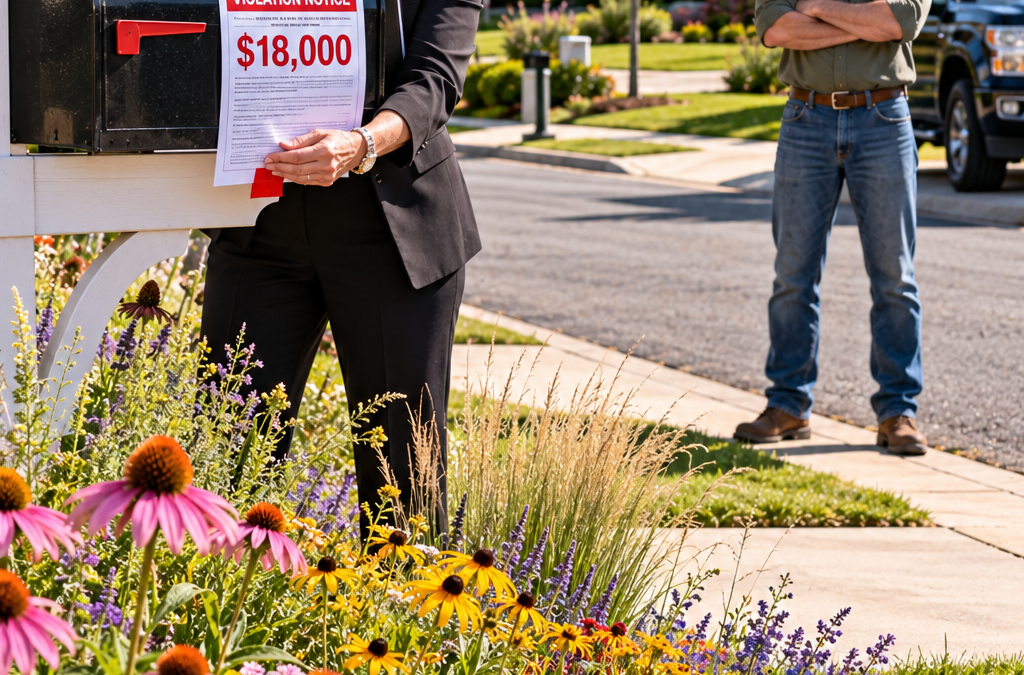
𝗙𝗨𝗟𝗟 𝗦𝗧𝗢𝗥𝗬
My mother had used her maiden name after remarrying, and I had done the same legally years earlier for personal reasons, so almost nobody inside the neighborhood connected me to Walter Asheford.
The title was transferred to me through the estate.
No announcement.
No ceremonial welcome.
Just another ownership change in HOA records.
I could have introduced myself.
I didn’t.
Partly because I was exhausted.
Partly because I wanted anonymity.
And partly because I was curious.
Grandpa had always been proud of Asheford Pines.
He used to call it the development that saved his company.
I wanted to understand what it had become.
For the first few weeks, I liked the neighborhood.
The houses were older but maintained.
Mature trees lined the streets.
People walked dogs in the evening.
Children rode bicycles past the house.
The community pool was busy on weekends.
Then I met Gloria Holt.
She arrived eight days after I moved in.
I was replacing a loose board on the side gate when I heard heels clicking against the driveway.
I looked up.
Gloria stood there holding a tablet.
Late fifties.
Perfectly styled blond hair.
White blouse.
Dark slacks.
Gold bracelet.
She looked like she had dressed for a corporate meeting and accidentally wandered into my yard.
“You’re the new owner?”
“I am.”
She extended a hand.
“Gloria Holt. President of the Asheford Pines Homeowners Association.”
I shook it.
“Nice to meet you.”
Her eyes moved past me toward the yard.
“You’re doing work?”
“Fixing the gate.”
“Replacing it?”
“One board.”
She nodded.
“Good. Any full replacement requires architectural review.”
“I’ll remember that.”
She looked toward the front lawn.
At that time, the yard was mostly ordinary Kentucky bluegrass.
Brown at the edges.
Thin beneath the trees.
The previous owner had run irrigation constantly trying to keep it alive through increasingly hot summers.
Gloria said, “You’ll want to bring the turf back.”
“What’s wrong with it?”
“It’s patchy.”
“I noticed.”
“We enforce lawns fairly strictly.”
There was something about the way she said it.
Not helpful.
Not welcoming.
A warning disguised as neighborhood advice.
“I’ll take care of it.”
Her smile returned.
“Wonderful. We find that new owners who start out cooperating tend to have a much easier experience.”
I looked at her.
“Easier?”
“With compliance.”
She tapped the tablet.
“We’re protective of standards here.”
Then she walked away.
That interaction bothered me.
Not enough to start a war.
But enough that I remembered it.
I spent the next month reading.
Not HOA documents at first.
Agricultural reports.
Water recommendations.
Native landscaping programs.
The county had been encouraging lower-water residential planting.
Summer restrictions were becoming common.
The old bluegrass required ridiculous amounts of irrigation.
So I hired a landscape designer.
We created a plan.
Native plants.
Low-water grasses.
Pollinator beds.
A clean stone border.
A small patch of traditional lawn near the walkway.
I checked the HOA rules.
The language required landscaping to be maintained.
There was an approved plant appendix, but nothing I found clearly prohibited native beds across the entire front yard.
There was language about “harmonious appearance.”
Vague.
Predictably vague.
I sent the landscaping plan to the HOA office anyway.
No response.
I emailed again.
Nothing.
After eighteen days, I called.
The manager said the architectural committee had a backlog.
“How long?”
“Could be another month.”
“Your rules say thirty days.”
“We’re aware.”
“So if you don’t respond within thirty days?”
“You should wait for approval.”
“That isn’t what the rule says.”
Silence.
Then, “I wouldn’t proceed without written approval.”
I proceeded.
That was when Gloria decided I needed to be taught something.
The first notice arrived five days after the old grass came out.
COURTESY NOTICE.
Unapproved landscaping modification.
No fine.
I responded in writing.
I included my original submission.
Delivery receipt.
Relevant HOA section.
Landscape plan.
County water-conservation recommendation.
I asked for the specific provision prohibiting the installation.
No substantive answer.
A week later, the second notice arrived.
$250.
I disputed it.
Gloria called me personally.
“I saw your letter.”
“Good.”
“You seem confused about how architectural approval works.”
“I submitted the plan.”
“You began work without approval.”
“After your stated review period.”
“That doesn’t create automatic permission.”
“Your governing documents say applications not acted upon within thirty days are deemed approved unless prohibited elsewhere.”
She went quiet.
Not long.
Just long enough to tell me she wasn’t used to homeowners quoting the documents.
Then she said, “You’re interpreting that provision incorrectly.”
“How?”
“The board determines interpretation.”
“That isn’t an answer.”
Her tone changed.
“Mr. Mercer, I’ve been president for seven years.”
“Congratulations.”
“I know these documents.”
“Then tell me what I’m missing.”
“The neighborhood requires consistent turf presentation.”
“Where?”
“Throughout the guidelines.”
“Which section?”
“You’re being argumentative.”
There it was.
I would hear that word often.
Argumentative.
In Gloria’s world, asking her to identify the rule she was enforcing was not a request.
It was defiance.
I said, “I’m asking for a citation.”
“You have a violation notice.”
“That isn’t a citation.”
“The board doesn’t have time to debate every homeowner who doesn’t like a decision.”
“Then maybe don’t issue decisions you can’t explain.”
Silence.
Her voice became cold.
“You have ten days to restore approved turf.”
“No.”
“Excuse me?”
“I said no.”
“You don’t get to refuse.”
“I just did.”
She hung up.
The third notice came certified.
The fine had grown.
Late fee.
Continuing violation.
Administrative charge.
Then another.
And another.
Gloria began leaving voicemail messages.
The first sounded rehearsed.
“This is your final courtesy call regarding unresolved landscape noncompliance.”
Courtesy.
I saved it.
The second was less friendly.
“Continued refusal will result in escalation.”
Saved.
The third mentioned a lien.
Saved.
The fourth said, “The board has been extremely patient with you.”
Saved.
Meanwhile, I started paying attention to how Gloria treated everyone else.
I attended HOA meetings.
Quietly.
Sat near the back.
Didn’t introduce myself beyond my first name.
What I saw bothered me more than my own dispute.
A retired teacher named Sandra stood before the board asking why she owed almost $6,000 over a fence stain.
Gloria barely looked at her.
“The fence wasn’t an approved color.”
“It was brown.”
“Not the approved brown.”
“I corrected it.”
“After enforcement.”
“I corrected it within three weeks.”
“The fines had already accrued.”
Sandra looked at the board.
“I live on Social Security.”
Gloria said, “Financial circumstances don’t waive covenants.”
Sandra’s face reddened.
“I’ve lived here twenty-three years.”
“That doesn’t exempt you either.”
I watched her return to her chair with tears in her eyes.
Two weeks later, another homeowner challenged a mailbox-height fine.
Then an elderly couple disputed penalties for a temporary medical ramp installed after the husband broke his hip.
Gloria called the ramp “an unauthorized exterior alteration.”
The wife said, “He couldn’t get into the house.”
“You still needed approval.”
“It was an emergency.”
“You could have requested expedited review.”
“I called three times.”
Gloria glanced toward the manager.
“We don’t have a record.”
The woman looked stunned.
I took notes.
Not because I had already decided to destroy the board.
I hadn’t.
I was trying to understand whether my experience was unusual.
It wasn’t.
Ordinary homeowners were treated like accounts.
Fine.
Fee.
Deadline.
Lien.
Compliance.
The vocabulary changed.
The method didn’t.
Gloria used rules the way some people use volume.
If someone challenged her, she raised the administrative pressure until surrender became cheaper than resistance.
Then something happened that made the fight personal in a different way.
One afternoon, I was watering the wildflowers when my neighbor Linda came outside.
We had spoken several times before.
She was friendly.
Her husband had helped me move a heavy workbench into the garage.
When she saw me, she stopped.
I waved.
She looked away.
Then crossed to the opposite side of the street.
That evening, another neighbor texted me.
You should see the Facebook group.
I wasn’t a member.
He sent screenshots.
Gloria had posted from her personal account.
No name.
But the address wasn’t difficult to identify from context.
Some residents believe environmental buzzwords excuse deliberate disregard for established neighborhood standards. Consistent enforcement protects everyone’s property values.
Below it:
Seventeen laughing emojis.
Comments.
Make them pay.
Rules are rules.
People move here then want to change everything.
If you don’t like the HOA, leave.
One woman wrote:
Foreclose if you have to. That’s what liens are for.
I stared at that comment longer than I should have.
Foreclose.
Over flowers.
I screenshotted everything.
That night, I drove to my grandfather’s old office.
His building had been closed since his death.
Estate lawyers came and went.
Boxes were everywhere.
I sat in his chair.
Leather cracked at the arms.
Behind the desk were the metal filing cabinets I’d mocked my whole childhood.
I opened one.
ASHEFORD PINES—ORIGINAL.
The folder was thick.
I pulled it out.
Inside were old plats.
Developer agreements.
Declarations.
Utility easements.
Road dedication records.
Amendments.
I spent three hours reading.
Most of it meant almost nothing without context.
Legal descriptions.
Cross-references.
Definitions.
Then I found Section 14.
Developer Reserved Oversight.
At first, I assumed it had expired.
Many developer-control provisions do.
So I read carefully.
Then again.
Then I called the estate attorney.
His name was Jonathan Price.
“Are you awake?”
“It is nine-thirty.”
“So yes.”
“What did you find?”
I read him part of the clause.
Silence.
“Jonathan?”
“Send me that.”
I photographed the pages.
Ten minutes later he called.
“Where was this?”
“Original development file.”
“Any amendments attached?”
“Several. Nothing I’ve seen terminates this section.”
“I need the whole file.”
“What does it mean?”
“It means don’t do anything yet.”
“That isn’t an answer.”
“It means I want to verify whether this survived subsequent amendments.”
“What if it did?”
Another pause.
Then:
“Then your HOA board has a problem.”
The clause was strange.
Very Walter Asheford.
When the original development was created in 1987, Grandpa reserved certain approval rights for the developer and its successors.
Most normal development-control rights were designed to expire after sales reached a threshold.
But Section 14 contained a narrow continuation provision.
As long as an Asheford heir or designated successor owned a residence inside the original platted community, that successor retained final approval authority over three categories.
Certain changes to common-area landscaping enforcement.
Board election certification.
And fine schedules exceeding $500 for a single continuing violation.
I read that last one repeatedly.
Any penalty schedule permitting cumulative assessments in excess of five hundred dollars required written concurrence from Asheford Development Group or its lawful successor while the reservation remained active.
I was the lawful successor.
I owned a residence inside the original platted community.
Not just indirectly.
This house.
Maple Loop.
Jonathan brought in another attorney who specialized in HOA and real-estate law.
Her name was Rachel Mendoza.
They spent almost two weeks tracing amendments.
They reviewed county recordings.
Board documents.
Developer transfers.
Estate succession.
I didn’t tell Gloria anything.
Not yet.
Finally, Rachel called me into her office.
She had the original agreement copied beside current Asheford Pines governing documents.
“I’m going to be careful because courts can interpret old developer clauses narrowly.”
“Okay.”
“But?”
She tapped Section 14.
“But this language appears to remain operative.”
My heart beat faster.
“You’re sure?”
“I’m confident enough to say the board should have accounted for it.”
“Meaning?”
“The current bylaws incorporate portions of the original development agreement by reference.”
“I saw that.”
“They didn’t terminate this reservation.”
“So every fine over $500—”
“Slow down.”
She held up a hand.
“Not every violation itself. The issue is the penalty schedule that allows cumulative assessments above that threshold.”
“Which Gloria uses constantly.”
“Apparently.”
I leaned forward.
“How many fines have they collected?”
Rachel looked at Jonathan.
He said, “We don’t know.”
I thought of Sandra.
Six thousand dollars.
The medical ramp.
Fence stains.
Mailbox heights.
“How do we find out?”
“Records request.”
That afternoon I submitted one.
As a homeowner, I requested financial reports, enforcement revenue, adopted fine schedules, board minutes approving penalty structures, and records showing developer-successor concurrence where required.
The HOA manager acknowledged receipt.
Three days later, Gloria called.
“Why are you requesting six years of enforcement records?”
“Curious.”
“About what?”
“How much money the HOA makes from fines.”
“That isn’t your concern.”
“I’m a homeowner.”
“You’re also currently delinquent.”
“I dispute the fines.”
“That doesn’t make you current.”
“Send the records.”
Her voice hardened.
“This feels retaliatory.”
“Retaliatory against whom?”
“The board.”
“For asking what the board collected?”
“You’ve become increasingly hostile since being told your landscaping violates standards.”
I smiled even though she couldn’t see me.
“Gloria, if a records request feels hostile, maybe the records are interesting.”
She hung up.
I started attending every meeting.
Gloria noticed.
At first, she ignored me.
Then she started using my case as an example.
“Certain residents have decided personal preference outweighs community obligations.”
She never said my name.
She didn’t have to.
One night she looked directly at me while saying it.
I smiled.
That irritated her.
I wanted her irritated.
Not because I enjoyed provoking her.
Because irritated people become careless.
The records eventually arrived.
Incomplete.
Rachel sent a second demand.
More documents came.
We built a spreadsheet.
Fine revenue by year.
Individual enforcement accounts where names were available.
Collection costs.
Late fees.
We estimated roughly $340,000 in fines over six years that crossed the $500 threshold under the schedule adopted without Asheford successor concurrence.
That didn’t automatically mean every dollar was recoverable.
Rachel reminded me repeatedly.
Different facts.
Statutes of limitation.
Individual circumstances.
Possible defenses.
But the exposure was real.
The board had been operating as if Section 14 did not exist.
No approval from Walter.
No approval from his estate.
No approval from me.
Nothing.
And the modern bylaws still referenced the agreement containing the clause.
Jonathan asked, “What do you want to do?”
I thought about that.
The easiest answer would have been to send Gloria a lawyer’s letter immediately.
Cancel my fine.
Force compliance.
End it.
But I kept seeing Sandra standing in the clubhouse saying she lived on Social Security.
The wife explaining the medical ramp.
The Facebook comment.
Foreclose if you have to.
I said, “I want to know how far Gloria will take mine.”
Rachel frowned.
“Why?”
“Because if I stop her now, she calls it a misunderstanding.”
Jonathan leaned back.
“And if you let her continue?”
“She documents exactly what the system does to someone she thinks can’t fight back.”
Rachel studied me.
“You understand there are risks.”
“Yes.”
“Don’t miss any legal deadlines.”
“I won’t.”
“And don’t deliberately incur avoidable damages just for drama.”
“I understand.”
So I waited.
The fine grew.
$7,000.
$9,500.
$12,000.
Gloria sent notices.
I disputed each one.
Calmly.
In writing.
She rejected each dispute.
Then the $18,000 letter arrived.
I signed for it.
And did nothing visible.
Three days later, Gloria appeared at my house.
Not in the office.
Not at a meeting.
My house.
I was trimming dead growth from the flower bed.
Her white SUV stopped at the curb.
She walked up the driveway holding a folder.
I didn’t stand.
“You received the certified notice.”
“I did.”
“You signed.”
“I did.”
“Then why haven’t you responded?”
“I’ve responded to every previous notice.”
“You haven’t paid.”
“Because I dispute the debt.”
She looked at the flowers.
“You’ve also made no attempt to cure the violation.”
“I like the flowers.”
“This isn’t about what you like.”
“That’s unfortunate. It’s my yard.”
Her mouth tightened.
“Your yard exists inside a covenant-controlled community.”
“I know.”
“Then why are you forcing this?”
“I’m not.”
“You could end it today.”
“How?”
“Restore approved turf. Pay the outstanding balance. Reimburse legal processing costs.”
“Eighteen thousand dollars.”
“Currently.”
“Currently?”
“Penalties continue.”
I stared at her.
She clearly enjoyed that word.
Currently.
As if the number were alive.
I stood.
“Gloria, do you hear yourself?”
“I’m enforcing rules.”
“You’re threatening a homeowner with foreclosure over flowers.”
“You were given repeated opportunities.”
“Foreclosure.”
“If a lien remains unpaid, the board has remedies.”
“My house is paid off.”
“That makes collection simpler, not harder.”
That sentence told me more about her than everything before it.
I looked at her for a long moment.
She seemed to realize she’d said too much.
Then she added, “I’m simply describing process.”
“No.”
I set the pruning shears down.
“You’re describing my house like it’s collateral for your authority.”
“Pay your obligations and there won’t be a problem.”
I almost told her everything.
Section 14.
Walter.
The estate.
The $340,000.
I wanted to watch the confidence leave her face.
But not yet.
So I smiled.
“Okay.”
She frowned.
“Okay what?”
“I understand your position.”
“Good.”
She straightened.
“I hope you’ll make the responsible choice.”
Then she walked away.
That evening, Gloria posted again.
Sometimes enforcement feels harsh, but boards that refuse to enforce covenants put every homeowner’s investment at risk. Personal attacks will not deter us from protecting Asheford Pines.
I saved it.
One week later, I received notice of a board hearing regarding my account.
Thursday.
7:00 p.m.
Clubhouse.
The agenda listed my case first.
Rachel asked whether I wanted her present.
“No.”
“Why?”
“I want Gloria comfortable.”
Jonathan laughed.
Rachel didn’t.
“You are enjoying this too much.”
“No.”
I thought about it.
“Maybe a little.”
Then I became serious.
“But I want homeowners there.”
“How?”
“The agenda is public.”
Word traveled.
Sandra knew.
The couple with the medical ramp knew.
Several neighbors who’d paid fines knew.
By Thursday night, the clubhouse was more crowded than usual.
About sixty people.
Folding chairs filled.
People stood along the wall.
Styrofoam coffee cups.
Whispered conversations.
Gloria sat behind the long board table.
Three other directors beside her.
The community manager at one end.
Gloria wore a red blazer.
I remember that because the color made her seem even more confident.
She tapped the microphone.
“Let’s come to order.”
The room quieted.
She moved directly to my case.
“First item, continuing landscape enforcement at 18 Maple Loop.”
She glanced toward me.
“The homeowner is present.”
I stood near the third row.
Gloria continued.
“This matter has consumed an unreasonable amount of board resources.”
I almost smiled.
“The property owner has repeatedly refused to comply with established landscaping standards despite numerous notices, opportunities to cure, and attempts by the association to resolve this informally.”
Informally.
Eighteen thousand dollars.
Potential foreclosure.
Informal.
She continued.
“The current outstanding balance is $18,000, exclusive of additional legal costs.”
Someone behind me whispered, “Jesus.”
Gloria heard.
She kept going.
“The board will tonight consider further collection action and authorization of lien enforcement.”
There it was.
Publicly.
Not a voicemail.
Not vague language.
Lien enforcement.
My house.
She looked toward me.
“Would you like to make a final statement before the board votes?”
Final statement.
The arrogance of that phrase almost impressed me.
I stood.
“I would.”
I had brought a leather document case.
I walked toward the front.
Gloria watched me.
“So everyone knows,” she said, “this hearing is limited to the landscaping violation. We will not entertain unrelated grievances.”
“I understand.”
I placed the case on the table.
She looked impatient.
“Please keep your comments to five minutes.”
“I don’t think that will be enough.”
“Five minutes.”
One board member, a man named Steven, said, “Let’s hear him.”
Gloria looked irritated.
“Five minutes.”
I nodded.
“Before you vote on my fine, I’d like to introduce myself properly.”
Gloria frowned.
“We know who you are.”
“No.”
I opened the case.
“You know the name on my mailbox.”
I removed the first document.
“My legal name is Jack Mercer.”
Several people nodded.
I placed another page down.
“But my mother was Elizabeth Asheford.”
The room shifted.
Not silence yet.
Confusion.
Gloria stared at me.
I continued.
“Walter Asheford was my grandfather.”
Now the silence came.
Absolute.
Someone near the back whispered, “What?”
Gloria’s face didn’t change immediately.
Then her eyes moved toward the document.
I placed Grandpa’s certified death certificate on the table.
Next to it, letters testamentary from the estate.
Then the successor documentation related to Asheford Development Group.
Gloria said, “What is this?”
“My inheritance documentation.”
Her voice sharpened.
“What does your family relationship have to do with landscaping?”
“A lot.”
I removed the original 1987 development agreement.
Not a photocopy.
A certified copy from county records.
I laid it flat.
The old Asheford Development Group name appeared at the top.
Gloria stared.
One board member leaned closer.
I turned to Section 14.
“This is the original agreement governing developer-reserved rights in Asheford Pines.”
Gloria waved one hand.
“Developer control expired decades ago.”
“Most of it did.”
“Then this is irrelevant.”
“No.”
I pointed.
“This provision didn’t.”
Steven adjusted his glasses.
“What provision?”
I read it.
Not every word.
Enough.
As long as an Asheford heir or lawful successor owned a residence inside the original platted community, the successor retained specified approval rights.
Landscaping enforcement frameworks.
Board election certification.
Penalty structures allowing cumulative fines exceeding $500.
Gloria interrupted.
“That cannot possibly still be valid.”
I looked at her.
“Your current bylaws incorporate this agreement by reference.”
“No.”
“They do.”
The community manager had gone pale.
She was already flipping through a binder.
I continued.
“My attorneys traced every recorded amendment.”
Gloria said, “Your attorneys?”
“Two.”
The room stirred.
“This clause was never terminated.”
She shook her head.
“That’s absurd.”
“Maybe.”
I pointed to the documents.
“But it’s recorded.”
Steven said, “Gloria, have we ever gotten developer-successor approval for the fine schedule?”
She snapped, “The developer doesn’t exist.”
I answered.
“Asheford Development Group’s successor does.”
Gloria looked at me.
I let the silence sit.
Then said:
“Me.”
I will remember her face for the rest of my life.
The confidence didn’t disappear all at once.
It cracked.
First confusion.
Then calculation.
Then the first hint of fear.
She looked toward the manager.
The manager wouldn’t meet her eyes.
I continued.
“Every fine issued under a cumulative schedule exceeding $500 required written concurrence while the reservation remained active.”
Someone in the audience said, “Wait.”
I turned slightly.
Sandra was sitting near the aisle.
Her eyes were wide.
I looked back at the board.
“You never got that concurrence from Walter Asheford.”
Gloria didn’t answer.
“You never got it from his estate.”
Silence.
“And you definitely never got it from me.”
Steven leaned toward the manager.
“How much fine revenue are we talking about?”
Gloria interrupted.
“This is completely outside tonight’s agenda.”
“No,” I said.
“It is tonight’s agenda.”
She glared at me.
“We are discussing your landscaping violation.”
“Your $18,000 fine against me is the reason we’re discussing whether your fine schedule was valid.”
Gloria’s voice rose.
“You intentionally concealed this.”
There it was.
Her first defense wasn’t that I was wrong.
It was that I hadn’t stopped her sooner.
I looked directly at her.
“I asked you repeatedly for the basis of your authority.”
“You knew who you were.”
“I knew exactly who I was.”
“And you let fines accumulate.”
“Yes.”
The room erupted in murmurs.
Gloria seized on it.
“You see? This was a trap.”
I nodded.
“In a way.”
People became louder.
I raised a hand.
The room quieted enough.
“I didn’t create the trap, Gloria.”
I pointed toward the $18,000 notice.
“You did.”
She stared at me.
I continued.
“I planted flowers.”
“You violated—”
“I submitted a plan.”
“You didn’t receive approval.”
“You ignored it beyond your own review period.”
“The board has discretion.”
“And when I asked for a specific rule, you called me argumentative.”
“You were.”
“When I disputed the fines, you increased them.”
“Under the enforcement policy.”
“The enforcement policy you never had authority to adopt at those amounts.”
She opened her mouth.
I kept going.
“When I asked for records, you called the request retaliatory.”
“That is not—”
“You told me my paid-off home made collection easier.”
That hit the room hard.
Several people reacted audibly.
Gloria’s face reddened.
“I explained the lien process.”
“You stood in my driveway and described foreclosure over wildflowers.”
“Because you refused to comply.”
I looked around the room.
“That’s exactly the point.”
Silence.
I opened another folder.
“Over the last several weeks, my attorneys reviewed the HOA’s enforcement records that were produced after my formal request.”
Gloria’s expression changed again.
I continued.
“Based on those records, approximately $340,000 in fines appear to have been collected under penalty structures exceeding the Section 14 threshold without required Asheford successor concurrence.”
This time the room exploded.
Actual chaos.
“What?”
“How much?”
“Three hundred forty thousand?”
“Are you serious?”
Gloria slammed her hand on the table.
“Order!”
Nobody cared.
Sandra stood.
Her voice shook.
“I paid six thousand dollars.”
The room quieted.
She looked at me.
“For my fence?”
I nodded carefully.
“Your account is among the records my attorneys flagged for review.”
Her eyes filled.
“So I can get it back?”
“I can’t promise the legal outcome of any individual claim.”
Gloria seized on that.
“Exactly.”
I turned toward Sandra.
“But you absolutely have the right to demand review and documentation. And if the fine was collected under an unauthorized schedule, my attorneys believe there is a strong basis to seek reimbursement.”
Sandra covered her mouth.
A man across the room stood.
“They took forty-eight hundred from me over my driveway.”
Another voice:
“Seven hundred for a mailbox.”
Another:
“Three thousand for temporary parking.”
Then the wife of the man with the medical ramp stood.
“You fined us while my husband couldn’t walk.”
Gloria hit the table again.
“This meeting is becoming disorderly.”
The woman looked at her.
“You threatened a lien while he was recovering from surgery.”
“That is not an accurate characterization.”
“I have the letter.”
People started shouting.
Steven pushed his chair back.
“Everyone, please.”
Gloria turned on me.
“This is exactly what you wanted.”
I looked at her.
“No.”
“Yes.”
She pointed.
“You moved here under another name, withheld your identity, deliberately violated standards, allowed fines to accumulate, and now you’re humiliating this board.”
I felt anger rise.
Not explosive.
Cold.
I leaned toward the table.
“Do you know why I stayed quiet?”
“To create leverage.”
“No.”
“Then enlighten us.”
I looked around the room.
“Because I wanted to know how this board treated someone it thought had no leverage.”
Nobody moved.
I continued.
“I wanted to know what happened when an ordinary homeowner asked for the rule.”
Gloria stared.
“I wanted to know what happened when someone couldn’t afford to write a six-thousand-dollar check.”
I glanced toward Sandra.
“When someone needed a medical ramp.”
The elderly woman began crying.
“When someone disagreed with you.”
I looked back at Gloria.
“You showed me.”
Gloria said nothing.
“The letters became harsher.”
I counted with my fingers.
“Fees.”
“Late fees.”
“Legal costs.”
“Lien threats.”
“Foreclosure.”
I let my hand fall.
“You didn’t know my grandfather’s name was connected to mine, so you treated me exactly the way you treat everybody you think won’t fight back.”
The room was silent now.
No shouting.
That silence hurt Gloria more.
She reached for water.
Her hand shook slightly.
Then she said, “You should have disclosed who you were.”
I almost laughed.
“Why?”
“So the board could properly evaluate the circumstances.”
“No.”
I shook my head.
“You mean you would have treated me differently.”
She didn’t answer.
“That is exactly why I didn’t tell you.”
Steven covered his mouth with one hand.
Another board member stared at the table.
Gloria tried one last time.
“The landscaping violation itself remains valid regardless of this developer clause.”
“Fine.”
That surprised her.
I nodded.
“Then let’s discuss the flowers separately.”
She hesitated.
“But the $18,000 fine does not.”
“The board will seek counsel.”
“Please do.”
“My attorneys already have.”
Her eyes flashed.
“This isn’t a courtroom.”
“No.”
I looked around.
“But everyone here is a witness.”
That landed.
Hard.
I removed one final document.
Rachel had prepared it that morning.
Formal notice demanding suspension of disputed enforcement, preservation of records, independent audit of fine collections, and review of potentially unauthorized assessments.
I placed copies in front of each director.
Gloria didn’t touch hers.
I said, “Before you vote to put a lien on my house, I suggest you read page three.”
Steven picked it up.
“What is this?”
“Notice from counsel.”
He read.
His face changed.
The board attorney wasn’t present.
Gloria suddenly looked very aware of that.
She said, “We’re going into executive session.”
Someone shouted, “No!”
Another homeowner said, “Vote in public!”
The manager whispered something to Gloria.
Steven said, “We need to pause enforcement immediately.”
Gloria snapped, “We need legal advice.”
“Then pause it.”
“Steven—”
“I am not voting for a lien tonight.”
Another director, Maria Chen, raised her hand.
“Neither am I.”
Gloria looked stunned.
“You haven’t even reviewed the issue.”
Maria said quietly, “That’s the problem.”
The room went silent again.
Maria continued.
“We apparently haven’t reviewed any of this.”
Gloria’s face turned red.
She looked at me.
Then at Sandra.
Then at the crowd.
Finally she said, “Motion to suspend the fine pending counsel review.”
Steven shook his head.
“No.”
Gloria stared.
“What?”
“Rescind his fine.”
Her jaw dropped.
“We don’t know—”
“We know enough to know eighteen thousand dollars shouldn’t remain on his account while our authority to impose it is disputed.”
Maria nodded.
“I second.”
Gloria looked toward the fourth director.
He nodded too.
All eyes returned to her.
She had spent years controlling those meetings.
That night, control disappeared in less than an hour.
The vote was four to zero.
My $18,000 fine was rescinded.
No lien.
No foreclosure.
No continuing daily penalties.
But nobody went home.
Residents demanded answers.
Sandra asked for her enforcement file.
Three other homeowners did the same.
Someone asked whether the HOA carried insurance for board misconduct.
Someone else asked how much had been spent on collection attorneys.
Another wanted every enforcement vote for the previous six years produced.
Gloria kept saying the same phrases.
We need counsel.
We’ll review.
This is more complicated than it appears.
Incomplete information.
Administrative issues.
She sounded nothing like the woman who had stood in my driveway describing foreclosure as routine.
At 10:20 p.m., the meeting finally ended.
Sandra found me outside.
She was crying.
Not dramatically.
Quietly.
She held the folder containing her old fence violation against her chest.
“I borrowed money from my daughter to pay them.”
I didn’t know what to say.
She continued.
“I thought if I didn’t, they’d take the house.”
My throat tightened.
“How long ago?”
“Two years.”
I nodded.
“My attorney will help explain the review process.”
She wiped her face.
“I felt so stupid.”
“You weren’t stupid.”
“They kept sending letters.”
“I know.”
“I couldn’t sleep.”
I knew that too.
Maybe not for years.
But I knew the feeling.
She looked back toward the clubhouse.
“Gloria acted like I was a criminal.”
I said, “That’s why we’re checking everything.”
Sandra hugged me.
I wasn’t expecting it.
For all the satisfaction I’d felt watching Gloria’s confidence collapse, that hug changed the emotion entirely.
This wasn’t fun anymore.
It wasn’t a clever inheritance twist.
There were real families behind those numbers.
The next week was brutal for the board.
Homeowners flooded the management office with records requests.
Rachel and Jonathan formally notified the HOA’s counsel.
The association’s insurance carrier became involved.
An independent accounting firm was retained.
Three board members resigned within seven days.
Steven stayed temporarily to help stabilize records.
Maria stayed too.
The fourth resigned.
Gloria refused.
At first.
She sent a community-wide email claiming “misinformation” had created unnecessary panic.
That email lasted approximately twelve minutes before homeowners began replying with copies of their enforcement letters.
The board’s attorney told everyone to stop discussing the matter publicly.
Gloria stopped answering direct homeowner emails.
Then the independent audit began.
Auditors reviewed enforcement revenue.
Fine schedules.
Collection policies.
Minutes.
Approvals.
Legal bills.
They found exactly what our initial review suggested.
The board had adopted escalating penalty schedules without obtaining the concurrence required under the surviving developer-reservation language.
Again, that didn’t mean every underlying HOA rule was invalid.
It meant the board’s authority to impose certain levels of cumulative financial punishment had been exceeded.
That distinction mattered.
I made sure people understood it.
This wasn’t a magic document erasing the entire HOA.
It was a document limiting how far the board could go.
And Gloria had spent years behaving as if there were no limit.
The refund process began.
Sandra was first among the homeowners I knew personally.
Her $6,000 came back.
When the check arrived, she walked straight to my house.
I was outside deadheading coneflowers.
She held up the envelope.
“They refunded it.”
I smiled.
“All of it?”
“Six thousand.”
She started crying.
Again.
Then she laughed.
“I hate that I’ve cried this much over a fence.”
“You weren’t crying over a fence.”
“No.”
She looked at the flowers.
“I think I finally understand why you wouldn’t cut these down.”
I smiled.
“Because they’re beautiful?”
“No.”
She pointed toward Gloria’s street.
“Because she told you to.”
We both laughed.
In total, eleven other families received refunds during the first round of corrections.
Some amounts were small.
Others were thousands.
Additional accounts required individual review.
Interest and legal questions took longer.
The audit remained open.
Gloria’s presidency did not survive.
At an emergency board meeting, residents demanded her resignation.
She refused.
“I have done nothing but enforce the governing documents consistently.”
A man near the back said, “That’s the problem.”
She glared.
“You all enjoyed high property values while this board did the hard work.”
Another homeowner shouted, “You fined my mother three grand after my father died because her lawn turned brown.”
Gloria looked toward the board.
“This is mob behavior.”
Maria responded quietly, “No. This is accountability.”
The membership initiated removal procedures.
Gloria resigned before the final vote.
Her resignation letter blamed “an increasingly hostile environment” and “organized personal attacks.”
She never mentioned the $340,000.
She never mentioned Section 14.
She never mentioned Sandra.
She never mentioned foreclosure threats.
After she stepped down, Asheford Pines created an interim board.
A full election followed.
This time, every candidate received copies of the original governing documents before taking office.
Including Section 14.
My inherited approval rights became an awkward subject.
Some homeowners expected me to take control.
I didn’t want that.
The whole experience had taught me exactly what happened when too much authority accumulated in too few hands.
I worked with counsel to establish a transparent process around the surviving developer rights and began exploring whether portions could be formally retired or amended in a way that protected homeowners without leaving obsolete private power hanging over the community indefinitely.
Grandpa would probably have hated that.
He loved control.
I had seen what control became after forty years of people forgetting why it existed.
The wildflower issue ended quietly.
The new architectural committee reviewed my original application.
They approved it.
Officially.
Not because I forced them.
Because they actually read the landscaping standards, water recommendations, and plant plan.
One committee member even asked whether the HOA should add native landscaping options to the approved list.
I laughed when he said it.
“Seems reasonable.”
By the next spring, three other homes had converted parts of their lawns to native plantings.
Gloria would have considered it the beginning of civilization’s collapse.
The neighborhood survived.
Property values survived.
Butterflies definitely improved.
As for my yard, the flowers became thicker in year two.
Purple coneflowers spread near the walkway.
Black-eyed Susans filled the sunny side.
Bees worked the bee balm from morning until evening.
I still kept one patch of conventional grass.
Not because the HOA demanded it.
Because I liked having somewhere to set a chair.
One Saturday, I was sitting there when Jonathan stopped by.
He had a box from Grandpa’s estate in his trunk.
“More paperwork.”
I groaned.
“I thought we were done.”
“With Walter Asheford?”
He laughed.
“We may never be done.”
He placed the box on my porch.
Inside were contracts from the seventies and eighties.
Land records.
Old correspondence.
Notes.
I picked up one handwritten letter from Grandpa.
He had written it to a lawyer during the original development.
Jonathan asked, “Do you regret moving here?”
I thought about it.
“No.”
“Really?”
“Really.”
“You got threatened with foreclosure over flowers.”
“I know.”
“Your grandfather left you a legal grenade.”
“I know.”
“You spent months dealing with an audit.”
“I know.”
He smiled.
“So why no regret?”
I looked across the street.
A couple pushed a stroller beneath the maples.
Sandra was working near her fence.
The same fence that had once cost her six thousand dollars.
“Because now I understand what he built.”
Jonathan nodded.
“And?”
“And what people turned it into.”
That was the part Grandpa never saw.
Developers love documents because documents create systems.
But systems outlive the people who understand why each provision exists.
Walter had included Section 14 because he didn’t trust future boards with unlimited financial enforcement.
I found notes suggesting he’d worried about exactly that.
One handwritten margin comment read:
Assessment power should correct conduct, not become revenue.
I stared at that sentence for a long time.
Grandpa was not a gentle man.
He fined contractors.
Sued partners.
Fired people.
Argued over inches on surveys.
But even he understood there was a difference between enforcement and extraction.
Somewhere along the way, Asheford Pines forgot.
Gloria especially.
Under her leadership, fines became leverage.
Fear became efficient.
Most people complied because they couldn’t afford not to.
That was why the $18,000 notice had seemed normal to her.
She didn’t see eighteen thousand dollars.
She saw pressure.
Enough pressure to make me surrender.
She couldn’t imagine that a homeowner might stand there holding the very authority she’d forgotten existed.
People occasionally asked why I didn’t reveal myself immediately.
Some meant it as criticism.
You could have stopped it sooner.
Maybe.
That’s something I’ve thought about more than I admitted publicly.
Could Sandra have received her money sooner?
Could the medical-ramp couple have avoided months of stress?
Maybe.
But I hadn’t known about Section 14 when I moved in.
By the time I found it, my attorneys still needed weeks to verify it.
And once verified, the board was already deep into documenting exactly how it operated.
There is a difference between letting someone harm people and allowing existing conduct to become visible enough that it cannot be dismissed.
I never encouraged Gloria to fine anyone.
Never asked her to escalate.
Never fabricated evidence.
I simply stopped rescuing her from her own decisions.
Every letter she sent was hers.
Every voicemail.
Every Facebook post.
Every threat.
Every board vote.
By the time Section 14 appeared on that table, nobody could say this had been a single clerical mistake.
The pattern was already written.
By her.
A few months after Gloria resigned, I saw her in a grocery store.
She was near the produce section.
I almost walked past.
Then she saw me.
For a moment, neither of us spoke.
She looked tired.
Not defeated exactly.
Just older.
Finally she said, “Happy?”
I stopped.
“With what?”
“You know.”
I looked at her.
“No.”
That seemed to surprise her.
“You destroyed my reputation.”
“No, Gloria.”
I kept my voice quiet.
“I put your paperwork on a table.”
Her jaw tightened.
“You knew exactly what you were doing.”
“Yes.”
“You let people think I was corrupt.”
“I didn’t tell them what to think.”
“You called the fine structure illegal.”
“My attorneys called it unauthorized under the reservation clause.”
“You embarrassed me publicly.”
“You were preparing to vote on a lien against my house publicly.”
“That was enforcement.”
“So was my response.”
She stared at me.
Then said, “Your grandfather would have understood what it takes to run a community.”
That irritated me more than anything else she could have said.
I stepped closer.
“My grandfather wrote the clause you ignored.”
She didn’t answer.
“He understood exactly why boards needed limits.”
“You think you’re better than everyone because of your name.”
I almost laughed.
“You didn’t know my name.”
Silence.
“That was the whole point.”
Her face changed.
I continued.
“You thought I was ordinary.”
“You are ordinary.”
“Exactly.”
I nodded.
“That’s how you should have treated me.”
She looked away.
I left.
That was the last conversation we ever had.
The audit continued for months.
Some findings involved poor controls rather than deliberate wrongdoing.
That distinction matters.
Not every problem was Gloria personally stealing money.
There were weak accounting procedures.
Board members relying too heavily on management.
Legal expenses approved without sufficient scrutiny.
Fine revenue treated almost as a regular budget line.
Administrative charges without clear documentation.
The more auditors looked, the clearer it became that the culture had developed slowly.
Gloria hadn’t invented everything.
But she had embraced it.
Used it.
Expanded it.
Defended it.
The association’s new leadership changed enforcement procedures.
No fine could escalate past certain thresholds without review.
Homeowners received clearer appeal rights.
Hearings had to identify the specific rule involved.
Medical and safety modifications received expedited treatment.
Fine revenue was separated in financial reports.
Large enforcement actions required counsel review.
And, most importantly, the board began treating questions as questions rather than insubordination.
That sounds small.
It wasn’t.
The difference between:
Show me the rule.
and
You’re being argumentative.
can be the difference between governance and bullying.
Sandra became one of the strongest advocates for reform.
At first, she hated speaking publicly.
Then something changed.
The woman who had once stood trembling before Gloria now sat on a homeowner advisory committee.
During one meeting, a board member proposed increasing the fine for repeat parking violations.
Sandra raised her hand.
“Why?”
The board member began explaining.
She listened.
Then asked:
“What problem are we trying to solve?”
I smiled from the back.
That was the question nobody used to ask.
Gloria’s board started with punishment.
The new board increasingly started with purpose.
There were still rules.
Still arguments.
Still violations.
Of course there were.
Any neighborhood with hundreds of people will have conflict.
The goal wasn’t to create an HOA with no authority.
It was to create one that remembered authority was a tool, not an identity.
My relationship with Grandpa’s legacy changed too.
Before I moved to Maple Loop, Walter Asheford was mostly a complicated family memory.
Strict.
Demanding.
Successful.
Emotionally awkward.
He had never told me he loved me easily.
Instead, he’d show up with a toolbox when something broke.
He paid for my first semester of college, then criticized the classes I chose.
He remembered every contract but forgot birthdays.
When he died, people talked about what he’d built.
Neighborhoods.
Shopping centers.
Roads.
I kept thinking about what he had failed to build.
Relationships.
Time with family.
Softness.
Then I found Section 14.
Not a sentimental document.
Not a letter to me.
Just another legal clause.
Yet reading his old notes around it showed me something unexpected.
Grandpa had thought about the people who would live in those houses after he was gone.
Not perfectly.
But enough to worry that future boards might weaponize fines.
One memo to his lawyer said:
Association authority must be sufficient to maintain standards but never broad enough to threaten ownership over trivial matters.
I sat in his office holding that page for almost ten minutes.
Threaten ownership over trivial matters.
Forty years later, Gloria had stood in my driveway threatening foreclosure over flowers.
Grandpa had predicted her without knowing her name.
That realization made the whole story feel less like revenge.
More like maintenance.
I wasn’t using his power to crush the board.
I was using a forgotten limit to restore balance.
Eventually, I had Section 14 framed.
Not the whole document.
Just a certified excerpt and Grandpa’s handwritten memo.
I hung it in my home office.
Not in the living room.
Not as a trophy.
As a reminder.
Rules can be forgotten.
Limits can be forgotten faster.
Every organization remembers what it is allowed to do.
Far fewer remember what it is forbidden from doing.
The wildflowers bloomed again the following spring.
Better than the first year.
The front bed turned purple and yellow.
One morning, I found Sandra standing near the sidewalk.
She was taking pictures.
“Evidence?” I asked.
She laughed.
“My granddaughter loves butterflies.”
A monarch moved between the flowers.
Sandra watched it.
Then said, “You know, Gloria told everyone this would destroy the look of the street.”
“Apparently the street survived.”
“Barely.”
She smiled.
Then grew serious.
“Thank you.”
“You already thanked me.”
“I know.”
“For the refund?”
“For making me understand I wasn’t crazy.”
That stopped me.
She continued.
“For two years, I thought maybe I was the problem. Every time I asked about that fence fine, they talked to me like I was stupid.”
I looked at her.
“You weren’t.”
“I know that now.”
She walked home.
I stood there for a while after she left.
That may have been the biggest thing Gloria’s board took from people.
Not money.
Confidence.
When every challenge is treated like defiance, people stop trusting their own judgment.
They start thinking:
Maybe I am difficult.
Maybe I misunderstood.
Maybe everyone else knows something I don’t.
That’s how an $18,000 landscaping fine becomes possible.
Not because eighteen thousand dollars for flowers makes sense.
Because someone in authority says it does.
Then says it again.
Then prints it on letterhead.
Then adds a deadline.
Then mentions a lien.
Then a lawyer.
Then foreclosure.
Each layer makes absurdity look more official.
Until someone asks to see the foundation.
My foundation happened to be forty years old.
Signed.
Recorded.
Referenced in their own documents.
And sitting in a filing cabinet nobody on the current board had bothered to open.
The irony wasn’t lost on me.
Gloria spent years telling homeowners to read the rules.
She hadn’t read all of them herself.
The most important rule in the neighborhood, at least for her fine system, was the one she didn’t know existed.
Years later, people still occasionally refer to me as “the wildflower guy.”
I don’t mind.
I’ve heard worse.
New homeowners sometimes hear a distorted version of the story.
Apparently in one version, I secretly owned the entire subdivision.
I didn’t.
In another, I inherited the HOA.
I didn’t.
Someone told me they heard I fired the whole board personally.
Definitely not.
The real story is less cinematic and more interesting.
I inherited a contractual right.
A board forgot it existed.
A president treated homeowners harshly because she believed nobody could stop her.
Then one enforcement case forced everyone to read the documents again.
That’s it.
No secret police.
No hidden billionaire.
Just paper.
Grandpa would appreciate that.
One evening, I was going through another estate box when I found an old photograph.
Walter standing in what would become Asheford Pines.
Nothing behind him.
Just field.
He was maybe forty.
Work boots.
Rolled sleeves.
Survey stakes in the ground.
On the back he’d written:
Maple Loop alignment, April 1986.
I carried the picture outside.
My house sat on land that had been dirt behind him in that photograph.
The oak near my driveway wasn’t there.
Neither were the sidewalks.
Or Sandra’s house.
Or the clubhouse where Gloria once tried to put a lien on my home.
I walked down Maple Loop.
Kids played basketball.
Someone grilled in a backyard.
A dog barked behind a fence.
The neighborhood Grandpa imagined had become a real place full of lives he never knew.
That’s the thing developers can forget.
They build property.
Then people turn property into home.
Once that happens, rules stop being abstract.
A fine isn’t a number.
It’s someone’s grocery budget.
Legal costs aren’t a line item.
They’re sleep lost at two in the morning.
A lien isn’t administrative language.
It’s a family imagining their home being taken.
Gloria understood documents.
What she didn’t understand was weight.
The emotional weight of the tools she used.
Maybe she did and simply didn’t care.
I can’t know.
What I know is that after everything, I never wanted another homeowner in Asheford Pines to sit at a kitchen table staring at a violation letter and feel as if the association’s logo mattered more than the truth.
The reforms weren’t perfect.
No system is.
There were still angry meetings.
Still people who thought every rule was tyranny.
Still people who wanted stricter enforcement.
That’s normal.
The difference was that disagreement no longer automatically triggered escalation.
Sometimes people talked.
Sometimes the board admitted mistakes.
Imagine that.
Once, a new board member called me after a homeowner challenged a landscaping notice.
“We may have cited the wrong section.”
“What are you going to do?”
“Withdraw it and send a corrected notice if there’s still a violation.”
I smiled.
“Sounds reasonable.”
He hesitated.
“That’s it?”
“What do you mean?”
“I thought you’d lecture me.”
“For correcting a mistake?”
“No.”
He laughed.
“Gloria would’ve fought for three months before admitting it.”
“I know.”
That was why she lost.
Not because she made mistakes.
Everybody does.
Because every challenge to her authority became a test she believed she had to win.
That mentality made compromise impossible.
It also made her predictable.
The $18,000 fine wasn’t an accident.
It was the logical endpoint of a system where backing down looked weaker than escalating.
And that’s why I don’t regret letting it reach that number.
At $250, Gloria could have called it a misunderstanding.
At $500, maybe a clerical issue.
At $18,000 with a foreclosure threat and years of comparable cases behind it, nobody could pretend the problem was one flower bed.
The scale exposed the culture.
Months after the audit began, Rachel sent me an updated report.
Refunds.
Procedural changes.
Remaining disputes.
She called afterward.
“You realize this started because you wanted lower-water landscaping.”
“Technically.”
“Your flowers have become very expensive flowers.”
“For the HOA.”
She laughed.
“Any regrets?”
I looked through the window.
The garden was moving in the wind.
“No.”
“None?”
“One.”
“What?”
“I wish Grandpa could’ve seen the meeting.”
Rachel laughed.
“He would’ve been unbearable.”
“Absolutely.”
I could picture him.
Walter sitting in the back.
Probably furious Gloria hadn’t read his contract.
Probably equally furious I waited months to use it.
He would have stood up afterward and told everybody he had predicted this in 1987.
Then he would have demanded someone fix the clubhouse coffee.
I miss him more now than I did immediately after the funeral.
Grief is strange.
At first, you miss the obvious things.
Voice.
Face.
Habits.
Later, you miss the arguments you would have had.
The questions you didn’t know to ask.
I would have asked him why he wrote Section 14.
Maybe the memo already answered.
Maybe there was a story.
A board in some earlier development that got too aggressive.
A homeowner he knew.
A lesson learned the hard way.
I’ll never know.
What I do know is that he left behind exactly the kind of thing he always trusted most.
Words on paper.
Recorded where people couldn’t easily rewrite them.
The $18,000 notice is framed too.
People think I’m joking when I say that.
It’s hanging in my office beneath Section 14.
One wall contains the HOA demand.
The other contains the clause that stopped it.
I didn’t frame the notice to celebrate beating Gloria.
I framed it because the contrast matters.
One document looked terrifying.
Cream paper.
Embossed logo.
Formal language.
Deadline.
Threats.
The other looked boring.
Old type.
Legal terminology.
Forty-year-old signatures.
Yet the boring document had the actual power.
Appearance and authority are not the same thing.
I learned that on my porch with cold coffee in my hand.
The neighborhood is different now.
Not dramatically.
Asheford Pines still looks like Asheford Pines.
Same brick houses.
Same mature trees.
Same pool.
Same clubhouse.
But there are more native gardens.
A few rain barrels.
Solar panels on some roofs.
One homeowner painted his front door dark green after getting approval, and nobody’s property value collapsed.
Sandra’s fence is still the exact brown that supposedly justified six thousand dollars in penalties.
Every time I walk past it, I smile.
She notices.
“Still legal,” she calls.
“So far.”
My relationship with the HOA is almost boring now.
That’s perfect.
I receive budget notices.
Election ballots.
Occasional maintenance announcements.
Nobody leaves threatening voicemails.
Nobody arrives at my driveway to explain that my paid-off home makes collection easier.
The new president is a retired accountant named Denise.
She disagrees with me plenty.
That’s healthy.
At one meeting, she rejected one of my suggestions for changing common-area landscaping.
I smiled.
“Are you sure you want to tell an Asheford no?”
Half the room froze.
Denise stared at me.
Then I laughed.
She threw a pen at my folder.
The room laughed too.
That moment mattered.
Authority had become something people could joke about again.
Not fear.
One autumn morning, I found a letter in my mailbox from the HOA.
Cream envelope.
Embossed seal.
For half a second, my body remembered.
Stomach tightening.
Pulse changing.
Then I opened it.
Annual meeting notice.
Nothing else.
I stood there laughing at myself.
Trauma is probably too strong a word for what happened to me.
But institutional pressure leaves habits.
You learn to distrust envelopes.
Phone calls.
Certain phrases.
Final notice.
Noncompliance.
Legal remedies.
I understood Sandra better after that.
I understood why she had borrowed money instead of fighting.
Not everyone has lawyers in their phone.
Not everyone inherits a developer clause.
Most people see an official notice and assume the issuer knows something they don’t.
That is why people with authority have a responsibility to use it carefully.
Gloria didn’t.
That was her failure.
Not being strict.
Not enforcing rules.
Not caring about standards.
Her failure was treating uncertainty as weakness and homeowners as obstacles.
She assumed nobody would ever read deeply enough to challenge the machinery.
My grandfather used to say contracts rewarded patience.
I think people do too.
Patience reveals them.
Give someone enough time and enough perceived power, and eventually they show you what they think power is for.
Gloria showed me.
So I let her letters pile up.
I let her threats get stronger.
I let her stand in my driveway and tell me my mortgage-free house was easier to collect against.
Then, when she asked the board to authorize a lien in front of sixty neighbors, I gave her the one thing she had never bothered to ask for.
The original paperwork.
I didn’t need to shout.
Didn’t need to insult her.
Didn’t need to threaten revenge.
I opened a folder.
That was enough.
Today, when I sit on my porch, the wildflowers reach almost to my knees in places.
The garden changes every year.
Some plants disappear.
Others spread.
Birds eat seeds.
Bees crowd the purple blossoms.
Leaves collect between stems in autumn.
It isn’t perfect.
That’s why I like it.
Gloria wanted uniformity because uniformity is easy to regulate.
My grandfather built rows of similar houses because developers need efficiency.
But neighborhoods aren’t blueprints forever.
People arrive.
They age.
Families change.
Priorities shift.
Rules have to survive contact with real life.
When they don’t, somebody should be allowed to ask why.
That’s what my fight taught Asheford Pines.
Maybe that’s what Grandpa’s clause was always supposed to do.
Not keep the Asheford family powerful.
Keep the board from forgetting that its power had a ceiling.
One evening near the end of summer, I sat on the porch with a glass of iced tea.
The sun was low.
The wildflowers caught the orange light.
Sandra walked past.
She stopped at the sidewalk.
“You know, I hated those flowers when you planted them.”
I looked at her.
“What?”
“They looked messy.”
I laughed.
“You never said that.”
“I was afraid you’d think I was on Gloria’s side.”
“Traitor.”
She smiled.
“They grew on me.”
A monarch butterfly passed between us.
Sandra watched it.
Then she said, “Maybe I just needed time.”
“Most things do.”
She continued walking.
I looked at the mailbox.
Same mailbox where the $18,000 notice had arrived.
For a moment, I could still see myself standing there with cold coffee, wondering just how far Gloria intended to go.
Now I knew.
As far as she believed nobody could stop her.
That’s usually the danger.
Not rules.
Not organizations.
Not even strict enforcement by itself.
The danger begins when the people enforcing rules start believing the absence of resistance means the absence of limits.
Gloria mistook compliance for consent.
Fear for respect.
Silence for weakness.
And my anonymity for powerlessness.
She was wrong on all four.
I finished my drink and walked down into the garden.
There were weeds.
Actual weeds.
I pulled a few.
Then stopped.
A black-eyed Susan had grown close to the mailbox.
I thought about moving it.
Instead, I left it.
That flower hadn’t asked an architectural committee where it was allowed to grow.
It had found sunlight.
Taken root.
Stayed.
The whole garden was still there.
So was my house.
So was Sandra’s fence.
So were the families Gloria once threatened with numbers large enough to make them feel helpless.
The difference now was that everyone understood something the old board had forgotten.
Authority matters.
Rules matter.
Documents matter.
But limits matter too.
Especially limits.
My grandfather put one into an agreement in 1987.
For decades, almost nobody noticed it.
Then one woman decided eighteen thousand dollars was a reasonable punishment for planting flowers she didn’t approve of.
And suddenly everybody started reading.
I still hear Walter’s voice sometimes when I open those old filing cabinets.
People remember what they want.
Paper remembers what they signed.
He was right.
Gloria remembered being president.
She remembered the board’s enforcement power.
She remembered fines, liens, deadlines, and collection procedures.
She forgot the paragraph that told her where that power stopped.
The paper didn’t.
And neither do I.
The flowers bloom every spring now.
No violation notice follows.
No threatening voicemail.
No daily fine.
Just color spreading across the front yard where dying bluegrass used to be.
Sometimes I stand there in the morning with coffee and listen to bees moving through the plants.
It is an ordinary sound.
An ordinary yard.
An ordinary house.
That’s the ending I wanted.
Not revenge.
Not control.
Ordinary ownership without somebody using a rulebook as a weapon.
The $18,000 fine is gone.
Gloria’s board is gone.
Families got money back.
The neighborhood learned what had been buried in its own governing documents.
And I finally understood the thing my grandfather had spent his entire life trying to teach me.
You don’t win against bad authority by becoming louder than it.
You make it prove itself.
Then you read the fine print it hoped nobody else would.





