𝗙𝗨𝗟𝗟 𝗦𝗧𝗢𝗥𝗬 The HOA president stood in my driveway, looked at the flood barrier that had already saved my house once, and told me it was an eyesore she would fine me $500 a day to keep. Three weeks later, I would stand in that same driveway listening to emergency sirens while thousands of gallons of stormwater rushed toward the one place she had spent years protecting more fiercely than anyone’s home.
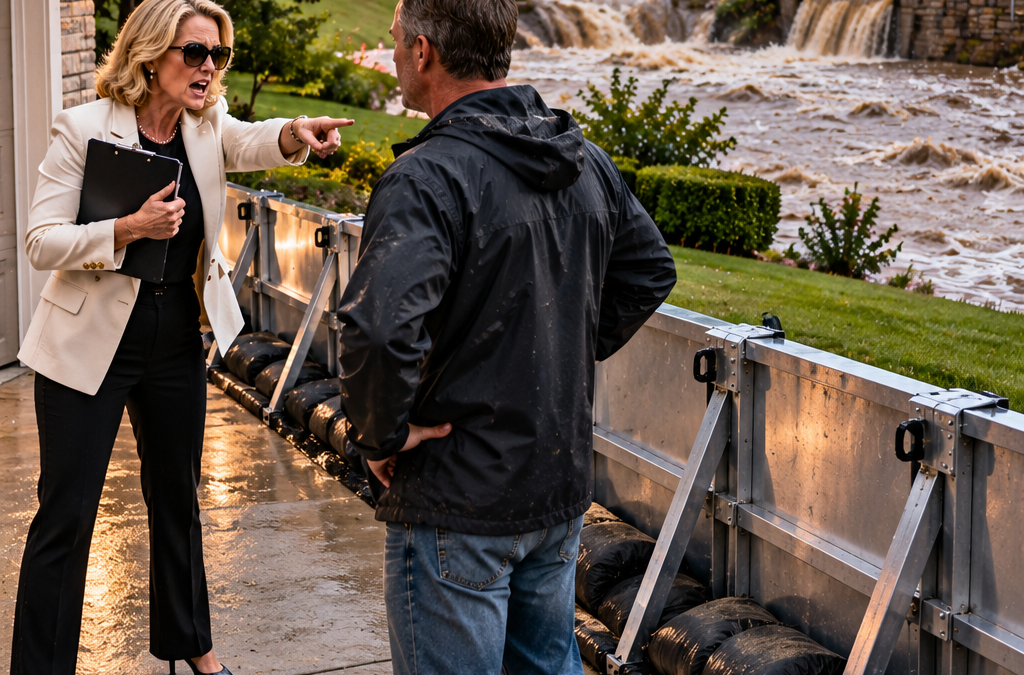
𝗙𝗨𝗟𝗟 𝗦𝗧𝗢𝗥𝗬
The room where my wife had sat beside her mother during the final months of cancer treatment.
Things insurance money could never replace.
The rain weakened just before sunrise.
The water stopped rising.
Our house escaped.
Three of our nearby neighbors weren’t as lucky.
The home two doors down took several inches of water through the garage.
Another family lost flooring and drywall in two rooms.
One elderly couple spent almost four months fighting an insurance company over repairs.
Afterward, I promised myself I would never stand helplessly behind that glass again.
I started researching flood mitigation.
Not sandbags.
Not temporary plastic.
Something real.
I contacted contractors and engineers.
Eventually, I found a company that specialized in modular flood barriers used for commercial properties and flood-prone residences.
The system consisted of aluminum panels that slid into permanently mounted vertical tracks.
When there was no storm, the panels could be stored.
When a hurricane approached, I could install the entire system around the vulnerable sections of the house in less than an hour.
The barrier was engineer-rated.
Code compliant.
Pressure tested.
Professionally installed.
It cost me a little over eleven thousand dollars.
Elena thought I was insane when she saw the estimate.
“Eleven thousand?”
“I know.”
“For something we might use once every few years?”
“We almost lost the back of the house last year.”
She looked at the number again.
“You’re really serious about this.”
“I never want to stand in that kitchen watching water come toward us again.”
She understood after that.
We paid for it.
The installation took two days.
The permanent tracks were visible if you knew where to look, but they weren’t particularly dramatic.
During storms, once the aluminum panels were inserted, the system became obvious.
Was it beautiful?
No.
It looked industrial.
Functional.
Like something designed by engineers who cared more about hydraulic pressure than landscaping.
That was exactly what I wanted.
The first real test came the following hurricane season.
A tropical storm strengthened unexpectedly before landfall and dropped nearly a foot of rain across the county.
I installed the panels the afternoon before the storm arrived.
That night, water again filled the drainage easement.
It crossed part of our yard.
It reached the barrier.
Then it stopped.
I watched from inside.
The system held.
The next morning, our property was muddy and littered with branches, but the house was dry.
Across the street, a garage flooded.
A neighbor named Thomas walked over while I was removing debris.
He stared at the aluminum wall around the back patio.
“That thing actually worked?”
“Exactly like they said it would.”
He shook his head.
“I should’ve done that.”
“You probably should.”
He laughed.
Within two weeks, three neighbors asked for the contractor’s information.
I thought maybe Cedar Ridge would finally start taking flood mitigation seriously.
Instead, I received a certified letter.
I opened it at the kitchen counter.
Elena was making coffee.
“What is it?”
“HOA.”
She groaned.
“What did we do now?”
I started reading.
Then I stopped.
“What?”
I read the first paragraph again.
NOTICE OF ARCHITECTURAL VIOLATION.
The letter stated that my flood mitigation system failed to conform to Section 14, Subsection C of Cedar Ridge Estates’ architectural guidelines.
The violation concerned “visible structural elements inconsistent with neighborhood aesthetic standards.”
I laughed.
Not because it was funny.
Because I genuinely assumed there had been a mistake.
Elena looked at me.
“What?”
“They’re calling the flood barrier an architectural violation.”
“The thing that just kept our house from flooding?”
“Yes.”
She stared at me.
“You’re joking.”
I handed her the letter.
She read it.
Her expression changed.
“They want it removed?”
“Apparently.”
“It’s permanent?”
“The tracks are permanent. The panels aren’t.”
She pointed at the paper.
“It says all components.”
“I see that.”
“Marcus, that’s ridiculous.”
“I know.”
At the bottom was the name of the HOA president.
Gloria Aldrich.
Gloria had been president for nearly four years.
She was in her late fifties, always dressed like she was about to chair a corporate meeting, and possessed the unsettling confidence of someone who had gone a very long time without hearing the word no.
She had turned HOA enforcement into something resembling a personal mission.
People had received violation notices for basketball hoops left out overnight.
One family was warned because their child’s playhouse could supposedly be seen above a hedge.
A retired veteran on our street had argued with Gloria for three months over the placement of a flagpole.
Her favorite phrase was “community standards.”
She used it the way some people use the law.
As though the phrase itself ended the argument.
I called the HOA office.
The administrator answered.
“This is Marcus Hale. I received a violation notice.”
“Yes, Mr. Hale.”
“It concerns my flood barrier.”
“I see that.”
“It isn’t decorative.”
“I understand.”
“It’s safety equipment.”
“The architectural committee classified the installed tracks and barrier system as an exterior structure.”
“The system was professionally engineered.”
“The issue isn’t engineering.”
“That sentence doesn’t make you hear the problem?”
Silence.
I continued.
“This system kept my house from flooding during the last storm.”
“I understand your concern.”
“No. You understand what I’m saying. That’s different.”
“Mr. Hale, you’ll need to speak to President Aldrich if you want to appeal the decision.”
“Fine.”
She transferred me.
Gloria answered after several rings.
“Marcus.”
The way she said my name told me she already knew why I was calling.
“Gloria, I got your letter.”
“I assumed you would.”
“You’re ordering me to remove flood protection from my house.”
“We’re asking you to comply with the same architectural standards that apply to everyone.”
“It isn’t a pergola.”
“I didn’t say it was.”
“It isn’t landscaping.”
“I know.”
“It keeps water out of my home.”
She sighed softly.
“Marcus, rules are rules.”
There it was.
“That’s your answer?”
“What would you like me to say?”
“I’d like you to say you’re not going to force a homeowner in a hurricane zone to remove professionally installed flood protection because you don’t like how it looks.”
“You’re mischaracterizing the issue.”
“How?”
“The structure was installed without architectural approval.”
“I didn’t know flood barriers required approval.”
“Any exterior modification requires approval.”
“It passed county code.”
“County code and HOA approval are separate matters.”
I leaned against the counter.
“Then I’ll submit an application.”
“The committee has already reviewed the installation.”
“So approve it retroactively.”
“We aren’t inclined to do that.”
“Why?”
She hesitated.
Only slightly.
But I heard it.
“Because the barrier is inconsistent with the appearance of the community.”
“It’s only assembled when there’s a storm.”
“The tracks remain visible.”
“You have to walk behind my house to notice them.”
“They are visible from portions of the golf course.”
That sentence changed everything.
“The golf course.”
“Yes.”
“So this is about golfers seeing aluminum tracks.”
“This is about maintaining a consistent visual standard throughout Cedar Ridge.”
“My house nearly flooded.”
“And I’m sympathetic.”
“No, you’re not.”
“Excuse me?”
“If you were sympathetic, we wouldn’t be having this conversation.”
Her voice hardened.
“We cannot create individual exceptions whenever an owner believes their circumstances are unique.”
“Everyone here is in the same floodplain.”
“Then everyone still has to follow the rules.”
“Maybe everyone should have a barrier.”
“That’s precisely the problem.”
I paused.
“What?”
“If we allow one unapproved structure, other owners will expect the same treatment.”
I almost laughed again.
“You’re worried other homeowners might protect their houses from flooding?”
“I’m concerned about uncontrolled exterior modifications.”
“Gloria, listen to yourself.”
“I’m not going to argue.”
“Good. Approve it.”
“No.”
A simple, flat word.
I closed my eyes.
“Then I’m appealing.”
“You are entitled to request a hearing.”
“I’ll bring the engineer.”
“You can bring whatever documentation you feel is relevant.”
The hearing was scheduled twelve days later.
I prepared like I was going to court.
Maybe that sounds excessive.
But the barrier had already done exactly what I bought it to do.
It had proven itself.
I brought the installation documents.
Engineering specifications.
County permits.
Photographs from the previous storm.
Insurance information.
I even asked the engineer who designed the system to write a letter confirming that the barrier was properly installed, removable during non-emergency periods, and appropriate for our flood exposure.
The meeting took place in the clubhouse.
Four board members sat behind a long table.
Gloria occupied the center seat.
The fifth board member attended by video.
I stood before them with a binder.
For almost twenty minutes, I explained everything.
The flooding history.
The drainage easement.
The cost of the system.
The fact that nearby houses had suffered damage.
I showed photographs.
One picture showed brown stormwater less than two feet from our rear doors during the earlier hurricane.
Another showed the installed barrier holding water back.
A board member named Linda actually looked concerned.
“How much damage do you think you avoided?”
“Potentially tens of thousands.”
Gloria interrupted.
“That isn’t really relevant to the architectural question.”
Linda looked at her.
“It seems relevant to him.”
Gloria folded her hands.
“We all understand the purpose of the structure.”
I turned to her.
“Then what exactly are we discussing?”
“Aesthetics and compliance.”
“Safety should outweigh aesthetics.”
“That’s your opinion.”
“No. That’s what the system is designed for.”
Gloria looked down at my photographs.
“The rear elevation of your property is highly visible from the seventh fairway.”
I stared at her.
There it was again.
The golf course.
“So?”
“Cedar Ridge is marketed as a premium golf community.”
“My house isn’t a billboard.”
“Your property contributes to the visual character of the development.”
“My property also sits beside a drainage channel.”
“You knew that when you bought it.”
That hit harder than she probably intended.
I leaned toward the table.
“So because I bought a house beside a drainage easement, I deserve to flood?”
“I didn’t say that.”
“You’re saying I can’t protect it.”
“There are other mitigation options.”
“Name one.”
She paused.
“Landscaping can assist with drainage.”
I looked at the engineer’s report in front of me.
“You think shrubs stop hurricane runoff?”
“Don’t be sarcastic.”
“I’m asking a serious question.”
One of the other board members looked uncomfortable.
I continued.
“I spent eleven thousand dollars installing something designed specifically for this risk. It worked. I have documented proof that it worked. And you’re telling me decorative landscaping is preferable because golfers don’t like seeing metal.”
Gloria’s face tightened.
“No one said golfers complained.”
“Then who complained?”
She didn’t answer.
I looked at each board member.
“Who filed the violation?”
Silence.
Gloria finally said, “The architectural committee identified it during an inspection.”
“What inspection?”
“Routine.”
“From the golf course?”
“Marcus—”
“From the seventh fairway?”
She shifted in her chair.
“It was visible.”
That was enough.
This had never been about building codes.
It wasn’t about structural safety.
It wasn’t even really about a missing approval application.
My flood barrier interfered with the view.
Cedar Ridge wanted to look like a resort.
And the woman in charge considered anything reminding prospective buyers that the neighborhood flooded to be bad for the brand.
I pushed my binder toward them.
“You have the county permit.”
Nobody moved.
“You have the engineer certification.”
Silence.
“You have proof it protected my home.”
Linda looked down.
Gloria did not.
“I am asking for an exemption.”
Gloria said, “The board will deliberate.”
They asked me to leave the room.
I waited in the hallway for almost thirty minutes.
When they called me back inside, Gloria already had the letter printed.
That told me the discussion had probably been decided before I ever walked in.
“The board voted four to one to deny your appeal.”
Linda wouldn’t meet my eyes.
I assumed she had been the one dissenting vote.
Gloria slid the paper across the table.
“You have seventy-two hours to remove the barrier system.”
I looked at the document.
“And if I don’t?”
“A fine of five hundred dollars per day will begin after the compliance deadline.”
“Five hundred dollars every day?”
“Yes.”
“The system cost eleven thousand.”
“I’m aware.”
“And you expect me to destroy it.”
“We expect you to remove the unapproved components.”
I read farther.
The fines would compound weekly.
Administrative costs could be added.
Legal collection could follow.
A lien was possible if the balance remained unpaid.
I looked at Gloria.
“You’re willing to put a lien on my house over flood protection.”
“Marcus, nobody wants that.”
“You just voted for the mechanism that does exactly that.”
“If you comply, there won’t be any fines.”
She said it almost gently.
That made me angrier.
“You’ve made compliance more important than whether my family is safe.”
“That is unfair.”
“No. What’s unfair is that I brought you engineering evidence and you brought me a golf-course view.”
Her eyes narrowed.
“You have seventy-two hours.”
I left before I said something I would regret.
That night, Elena found me sitting at the kitchen table with the letter in front of me.
“What are we going to do?”
I didn’t answer immediately.
I had calculated the numbers.
Five hundred dollars per day.
Three thousand five hundred per week.
If the HOA escalated it legally, attorney fees could become part of the balance.
I could fight.
But lawsuits take time.
Money.
Energy.
And hurricane season was already approaching its peak.
“I’ll take it down.”
She stared at me.
“You’re serious?”
“I can’t let them rack up fines while we fight.”
“What if another storm comes?”
“I’ll keep the panels.”
“They’re ordering you to remove the tracks.”
“I know.”
“Marcus.”
I rubbed my forehead.
“I know.”
There was something humiliating about removing that system.
Not because of the work.
Because every bolt represented a decision I knew was wrong.
I spent Saturday morning disassembling the visible components.
I removed the tracks the HOA had specifically complained about.
I patched mounting points.
I stacked every aluminum panel carefully against the garage wall.
Elena watched me for a while.
“Why aren’t you selling them?”
“Because I’m not throwing away eleven thousand dollars.”
“You really think we’ll use them again?”
I looked toward the backyard.
“Yes.”
She heard something in my voice.
“You’re worried.”
“I always worry during hurricane season.”
“No. More than usual.”
She was right.
Three months before the fight over my barrier, the county had sent a floodplain coordinator named Andrea Reyes to one of our community meetings.
Most residents barely remembered it.
I did.
The presentation had been dry.
Maps.
Drainage basins.
Infrastructure maintenance.
Half the room had been checking phones.
Gloria had seemed visibly impatient.
Then Andrea pulled up a diagram of our neighborhood drainage system.
She pointed to the large culvert running beneath the golf course’s back nine.
“This structure is approaching the end of its anticipated service period.”
That got my attention.
Andrea continued.
“There has been erosion near the outlet and evidence of partial obstruction.”
A resident asked whether homes were at risk.
“Under ordinary rainfall, probably not. Under a major tropical event, there is concern.”
Gloria leaned toward the microphone.
“Has the county declared the structure unsafe?”
“No.”
“So there’s no immediate violation?”
Andrea paused.
“That’s not what I’m saying.”
“What are you saying?”
“I’m saying failure under extreme hydraulic load is possible.”
Several people looked up then.
Andrea changed slides.
“If the culvert were to become obstructed or structurally fail, stormwater would seek another flow path.”
“Toward the homes?” I asked.
Andrea looked at the map.
“Water will move toward the lowest available elevation.”
“Where is that?”
She zoomed out.
“I’d need the detailed elevation model.”
Nobody asked anything else.
Gloria thanked her.
The meeting moved on to landscaping contracts.
But the question bothered me.
Where was the lowest elevation?
Later that week, I found the county topographic data online.
I studied it because I was planning my own flood mitigation.
The answer surprised me.
The lowest major open area in Cedar Ridge wasn’t my yard.
It wasn’t the drainage ditch.
It was the golf course.
Specifically, part of the back nine leading toward the eighteenth hole.
The same course the board treated like sacred ground.
I filed the information away.
I wasn’t planning revenge.
I wasn’t hoping anything would happen.
I simply wanted to understand how water moved through the neighborhood.
After I removed my barrier, Gloria sent me an email.
Marcus,
Thank you for bringing the property back into compliance with Cedar Ridge architectural standards. We appreciate your cooperation and commitment to preserving the visual integrity of our community.
She copied the entire board.
I read it twice.
Then I deleted it.
Nine days later, a tropical disturbance formed over warm water offshore.
At first, it wasn’t much.
A cluster of thunderstorms.
Meteorologists mentioned it briefly.
I started watching.
Every morning before work.
Every evening after dinner.
The system strengthened.
Then weakened.
Then strengthened again.
Elena found me staring at a forecast cone on my laptop.
“You’re doing it again.”
“I know.”
“It’s still a tropical storm.”
“For now.”
She looked toward the garage.
“You kept all the barrier parts?”
“Yes.”
“Even the tracks?”
“Everything.”
Four days later, the storm became a hurricane.
Cedar Ridge sent out an emergency-preparedness email.
Secure outdoor furniture.
Check generators.
Bring decorations inside.
Clear storm drains near your property.
The final paragraph read:
Residents are also reminded to ensure exterior landscaping remains orderly ahead of this weekend’s scheduled club tournament activities, weather permitting.
I read that line three times.
Then I showed Elena.
She stared at me.
“Are they insane?”
“Possibly.”
“They’re still talking about the golf tournament?”
“Apparently.”
“What about the culvert?”
“I haven’t heard anything.”
“You think they fixed it?”
“No.”
“How do you know?”
“Because major drainage work requires county permits. I checked.”
She looked at me.
“They did nothing?”
“As far as I can tell.”
The forecast worsened that night.
The hurricane was expected to make landfall less than fifty miles away.
Rain totals could exceed twelve inches.
I walked into the garage and stood in front of the stacked barrier panels.
Elena followed.
“What are you thinking?”
“You know what I’m thinking.”
“They’ll fine us.”
“They can fine the roof after it floats away.”
“Marcus.”
“I took it down because I wasn’t going to let them financially bleed us while the weather was quiet.”
I touched one of the aluminum panels.
“But I’m not leaving this house unprotected with a hurricane coming.”
“What about the tracks?”
“I can reinstall them.”
“How long?”
“Couple hours.”
She looked outside.
The sky was already turning gray.
“Do it.”
I started that evening.
Every bolt went back in.
Every bracket.
Every seal.
I worked under portable lights as the wind increased.
Around nine, my neighbor Thomas walked over.
He saw the panels.
“I thought the HOA banned that thing.”
“They did.”
“You putting it back anyway?”
“Yes.”
He smiled.
“Need help?”
For a second, I didn’t say anything.
Then I handed him a wrench.
Together, we finished before midnight.
The barrier stood exactly as it had during the previous storm.
Ugly.
Industrial.
Strong.
I took a picture.
Not for social media.
For evidence.
If Gloria wanted to fine me, she could explain later why the system had been reinstalled during a declared hurricane emergency.
The storm made landfall shortly after midnight.
At first, it sounded like ordinary heavy rain.
Then the wind arrived.
The house shuddered.
Palm trees bent until their fronds were nearly horizontal.
Rain struck the windows so hard it sounded like handfuls of gravel.
Around one in the morning, the power flickered.
At two, it went out completely.
The generator started thirty seconds later.
Elena and I sat in the living room with emergency alerts glowing on our phones.
Neither of us slept.
At 2:40, the county issued a flash-flood warning.
At 3:05, I checked the rear doors.
Water was already spreading across the backyard.
My stomach tightened.
The barrier stood between it and the house.
At 3:30, the water reached the lower panels.
Elena stood behind me.
“It’s rising fast.”
“I know.”
“Is it holding?”
“So far.”
The sound outside became strange.
Not simply rain.
Rushing.
A continuous low roar.
Like a river had appeared behind our fence.
Around four, we heard something metallic crash in the darkness.
I couldn’t see what it was.
The drainage easement was overflowing.
Water pressed against the barrier.
The aluminum panels flexed slightly under the load.
I checked the seals with a flashlight.
Dry.
“Marcus.”
Elena’s voice was quiet.
“What?”
“Thank you for putting it back.”
I looked at her.
Neither of us needed to say the rest.
If I had obeyed Gloria that night, water might already have been inside.
By five, the worst wind began moving inland.
Rain continued.
Just after sunrise, I opened the front door.
Our street looked wounded.
Branches everywhere.
A section of fencing had collapsed across the road.
Leaves plastered every surface.
My driveway had perhaps two inches of standing water.
Nothing catastrophic.
I walked around the side of the house wearing boots and a raincoat.
Then I stopped.
The backyard no longer looked like a yard.
The drainage channel had disappeared beneath a wide sheet of moving water.
It had breached its banks completely.
Water streamed beyond my property toward the golf course.
Not slowly.
With force.
I watched patio furniture tumble through the current.
A garbage bin spun in circles before disappearing beyond a row of trees.
Thomas came outside.
“Holy hell.”
“You seeing that?”
“Where’s it going?”
I knew.
I remembered Andrea Reyes standing in the clubhouse.
Water will move toward the lowest available elevation.
“The course.”
Thomas looked at me.
“What?”
“The lowest ground is the course.”
We both stared toward the trees.
Somewhere beyond them was the back nine.
Then I heard another sound.
A deep crack.
Not thunder.
Something structural.
The water surged.
Thomas stepped backward.
“What was that?”
“I think the culvert.”
Within minutes, the flow increased.
Water that should have traveled through the drainage system was now spreading across open ground.
The culvert beneath the back nine had either collapsed or become fully blocked.
There was nowhere else for the runoff to go.
And water does not care about architectural standards.
It doesn’t care about landscaping.
It doesn’t care about property values.
It doesn’t care whether a neighborhood brochure describes a golf course as “pristine.”
Water follows gravity.
By nine that morning, the HOA group chat exploded.
The first video came from a homeowner overlooking the eighteenth hole.
At first, I couldn’t understand what I was seeing.
Then I realized the fairway was gone.
Completely gone.
The eighteenth green sat beneath brown floodwater.
Only the top of the flagstick remained visible.
Another video showed the ninth green.
Water moved across it with an actual current.
Golf carts had been pushed sideways against a maintenance fence.
A sand bunker had disappeared.
Someone posted:
IS THAT THE GOLF COURSE???
Another replied:
Not anymore.
Then came a photograph that spread through the neighborhood within minutes.
Gloria Aldrich stood in chest-high rubber waders near the edge of what had once been the ninth fairway.
Her expensive HOA jacket was soaked.
Her hair was pulled beneath a rain hood.
Behind her, Cedar Ridge’s manicured golf course looked like a muddy lake.
Nobody needed a caption.
By lunchtime, county crews confirmed what had happened.
The aging culvert beneath the back nine had partially collapsed under storm pressure.
Debris blocked the remaining opening.
Runoff backed up rapidly.
With the drainage path restricted, the water redirected toward the lowest open elevation.
Exactly as Andrea had warned.
The golf course absorbed it.
More than four acres went underwater.
Parts of the clubhouse patio were submerged.
Water reached the lower glass doors.
Irrigation equipment disappeared.
Several golf carts were damaged.
Electrical components had to be replaced.
Two greens suffered major erosion.
One bunker essentially washed away.
The preliminary repair estimate eventually came in just under two hundred thousand dollars.
That didn’t include the longer-term drainage work.
I stood in my dry kitchen reading the estimate on my phone.
Behind me, the flood barrier was still holding.
Elena walked in.
“How bad?”
“Almost two hundred thousand.”
“The course?”
“Just the initial damage.”
She looked outside.
Then at me.
“Do you feel bad?”
I thought about it.
“For the residents paying for it? Yes.”
“For Gloria?”
I didn’t answer.
She smiled slightly.
“That’s what I thought.”
I didn’t post anything in the community group.
I didn’t take pictures of my dry living room.
I didn’t write I told you so.
I didn’t have to.
The neighbors did it.
Thomas posted two photographs side by side.
One showed my backyard.
Floodwater stopped at the aluminum barrier.
My doors were dry.
The second showed the eighteenth hole beneath several feet of water.
His caption said:
Maybe flood protection wasn’t the real eyesore.
Within an hour, dozens of people had reacted.
Then someone reposted the engineering letter I had submitted during my appeal.
Another homeowner wrote:
Didn’t Marcus bring this exact issue to the board?
Someone answered:
Yes. They made him remove it.
Another:
Because it was visible from the golf course.
Then Linda, the board member who had voted against forcing me to remove the barrier, wrote something I never expected.
For accuracy, I opposed the violation decision. Mr. Hale provided engineering documentation showing the system was an appropriate flood mitigation measure.
That changed the conversation instantly.
Until then, people could have assumed the board simply didn’t understand.
Linda’s statement showed they had understood.
They had received evidence.
They had ignored it.
Someone asked:
Did the board know about the culvert warning too?
Nobody answered.
Then another resident uploaded the minutes from the county floodplain presentation.
Andrea Reyes’s warning was right there.
Partial obstruction.
Aging infrastructure.
Risk under extreme hydraulic load.
Alternative flow path toward lower elevation.
People began asking questions.
Why hadn’t the culvert been repaired?
Why had the board spent money resurfacing a clubhouse patio instead?
Why was landscaping upgraded near the course entrance while drainage infrastructure remained untouched?
Why had the board aggressively enforced aesthetic violations during hurricane season but failed to address a documented drainage risk?
Gloria finally posted a statement that afternoon.
She called the flooding an “extraordinary and unforeseeable weather event.”
That was a mistake.
Because it had been foreseen.
Literally.
By the county.
In a room full of people.
Three months earlier.
A resident named Jennifer replied with a screenshot of the meeting minutes.
Unforeseeable?
The thread exploded.
Gloria disabled comments.
That made it worse.
The next afternoon, I received an email from the HOA.
I expected a new violation notice because the barrier was standing again.
Instead, the subject line read:
TEMPORARY EMERGENCY WAIVER — FLOOD MITIGATION STRUCTURES.
I stared at it.
Elena leaned over my shoulder.
“You’ve got to be kidding me.”
The email stated that due to recent storm impacts, temporary flood mitigation devices would be permitted until further review by the architectural committee.
No apology.
No acknowledgment.
No mention of the fact that my system had been engineer certified all along.
Just a waiver.
Two weeks later, the board announced an emergency meeting.
I attended.
The clubhouse couldn’t be used because flood repairs were still underway, so the meeting took place in a community recreation hall.
It was packed.
Gloria sat at the front.
For the first time since I had known her, she looked tired.
Not defeated.
Gloria did not know how to look defeated.
But tired.
The meeting began with the damage report.
A contractor described erosion.
Turf replacement.
Electrical repairs.
Irrigation damage.
Drainage reconstruction.
Then the treasurer explained that reserve funds would not cover everything.
An assessment increase was likely.
That was when the room turned.
A man in the front stood.
“How much?”
“We don’t know yet.”
“You know enough to tell us we’re paying more.”
“We’re reviewing options.”
A woman behind him said, “Why are we paying for damage the board was warned about?”
Gloria leaned toward the microphone.
“The severity of this storm exceeded expectations.”
I heard someone laugh bitterly.
The woman continued.
“The county told you the culvert could fail.”
“The county did not order replacement.”
“So you waited until it collapsed?”
“We followed the recommendations available to us.”
“No, you didn’t.”
Gloria’s jaw tightened.
Another resident raised his hand.
“You had money for architectural enforcement against Marcus.”
Gloria looked toward me.
Every head in the room seemed to follow.
The resident continued.
“You had lawyers threatening him over a flood barrier, but you didn’t have money to inspect the culvert?”
Applause broke out.
Gloria struck the table with the gavel.
“Please.”
Then Thomas stood.
I had never seen him speak at an HOA meeting before.
He pointed toward me.
“That man’s house stayed dry.”
The room went quiet.
“Mine almost didn’t,” he continued. “I was standing beside him the morning after the storm. I watched water moving toward that course. He protected his property because he paid attention. You punished him for it.”
Gloria interrupted.
“The barrier violated existing guidelines.”
Thomas laughed.
“Then your guidelines were stupid.”
People applauded again.
Gloria’s face flushed.
I almost felt sorry for her.
Almost.
Then she looked directly at me.
“Marcus, would you like to address the board?”
I hadn’t planned to speak.
But I stood.
I walked to the microphone.
For several seconds, I said nothing.
I looked around the room.
Many of the people there had lost landscaping.
Some had water damage.
Almost all were about to pay for repairs to a golf course they had been told was the crown jewel of Cedar Ridge.
“I don’t want anyone here to misunderstand something,” I said.
The room settled.
“I didn’t want that golf course to flood.”
I looked toward Gloria.
“I didn’t want the culvert to fail. I didn’t want anyone’s dues to increase. And I definitely didn’t reinstall my barrier because I was hoping to prove somebody wrong.”
I paused.
“I installed it because I was scared.”
That word felt more honest than anything else I could have said.
“Two years ago, I stood behind my back door and watched floodwater rise until it was almost inside my home.”
Nobody interrupted.
“I remember my wife carrying boxes upstairs. I remember wondering what we’d lose. I remember knowing there was absolutely nothing I could do if that water came another inch.”
Elena sat near the back.
Our eyes met.
“So afterward, I spent eleven thousand dollars to make sure I never felt that helpless again.”
I turned toward the board.
“The system worked.”
My voice became firmer.
“I brought you photographs.”
“Engineering records.”
“Permits.”
“I showed you what happened to neighboring homes.”
“And you still told me that the view from the golf course mattered more.”
Gloria shifted.
I continued.
“You gave me seventy-two hours to remove something designed to protect my family.”
The room was silent now.
“And I did.”
I swallowed.
“That was the part nobody saw.”
“People saw aluminum panels.”
“They saw architectural rules.”
“But I was the one in my garage unscrewing bolts from equipment I knew might be the only thing keeping water out of my house.”
I looked at Gloria.
“You sent me an email thanking me for cooperating.”
She lowered her eyes for the first time.
“Then a hurricane formed.”
“And I had to choose between your rules and my family.”
“I chose my family.”
Someone clapped.
Then another.
I raised a hand.
I didn’t want applause.
“This isn’t about revenge.”
I looked around.
“It shouldn’t take two hundred thousand dollars in damage for a neighborhood to understand that safety infrastructure is not decoration.”
Nobody spoke.
“A flood barrier doesn’t have to be pretty.”
“A culvert doesn’t have to be visible.”
“Drainage maps don’t sell houses.”
“But when the rain comes, those things matter more than grass color, fairway views, newsletters, or brochures.”
I stepped away from the microphone.
That was all I had to say.
The board voted later that evening to suspend enforcement of the flood-barrier restriction.
A formal bylaw review began the following week.
Six weeks later, Section 14, Subsection C was amended.
The new language was simple.
Engineer-certified flood mitigation structures could no longer be rejected solely on aesthetic grounds.
Permanent mounting components were allowed where required for emergency deployment.
Homeowners still had to submit basic documentation.
But the HOA could no longer force someone to choose between compliance and flood protection because a piece of safety equipment offended the visual theme of a fairway.
Nobody put my name in the amendment.
They didn’t need to.
Every person in Cedar Ridge knew why it existed.
My violation was withdrawn.
The HOA formally confirmed that I could keep the barrier permanently installed according to the engineer’s specifications.
They also removed any record of the architectural infraction from my account.
I received the letter one afternoon.
I read it at the kitchen table.
Elena sat across from me.
“That’s it?”
“That’s it.”
“No apology?”
“No.”
She laughed.
“Of course.”
I folded the paper.
I thought the same thing.
Gloria never apologized.
Not directly.
She never told me she had been wrong.
She never admitted the board had valued appearance over risk.
Instead, she began describing the revised rule as part of Cedar Ridge’s “new commitment to climate resiliency.”
When I read that phrase in the newsletter, I almost choked on my coffee.
But by then, the residents were paying attention.
People started attending meetings.
They requested engineering reports.
They asked about drainage maintenance.
They demanded financial records related to deferred infrastructure work.
And they kept returning to the county warning.
Why had it been ignored?
Records eventually showed that the board had discussed having the culvert inspected.
The work had been delayed.
Then delayed again.
Money had been allocated elsewhere.
Some of it went toward landscaping improvements near the clubhouse and golf-course entrance.
Nothing illegal.
Nothing dramatic.
Just priorities.
Appearance first.
Infrastructure later.
Until later became too late.
Three months after the storm, Gloria resigned as HOA president.
Her letter said she wanted to focus on “personal and family priorities.”
Nobody publicly challenged the wording.
There was no point.
Her support on the board was gone.
Residents were asking too many questions.
The new president was Linda.
One of her first actions was to establish an infrastructure review committee.
The drainage system was inspected throughout the development.
The failed culvert was replaced.
Additional overflow channels were created.
Several low-lying properties received updated flood-risk guidance.
Homeowners who wanted barriers like mine were given a list of engineering requirements instead of violation threats.
Thomas installed one the following spring.
So did five other families.
The irony was impossible to miss.
Two years earlier, Gloria had told me that if the HOA allowed my barrier, “everyone would want one.”
She had been right.
People did want them.
Because they worked.
Gloria sold her house the following year.
I learned about it because the buyer knocked on my door one Saturday morning.
He was probably in his early forties.
Polite.
Nervous.
“Are you Marcus?”
“Yes.”
“My wife and I are buying the Aldrich house.”
I tried not to smile.
“What can I do for you?”
He glanced toward the back of my property.
“I heard you know quite a bit about flood barriers.”
That time I did smile.
“A little.”
He asked about the contractor.
I gave him the information.
Before leaving, he said, “Our realtor mentioned there was some kind of rule change after the hurricane.”
“There was.”
“Anything I should know?”
I thought about how much of the story to tell.
Then I said, “Read the drainage maps before you worry about the landscaping rules.”
He nodded.
“Good advice.”
“It was expensive advice.”
My barrier still stands today.
The mounting tracks are visible.
Nobody complains.
During hurricane season, I inspect the seals.
I test every fastening point.
The panels remain stacked in the garage, labeled in installation order.
Elena used to joke that I treated them like military equipment.
Maybe I do.
Because when the weather turns, those aluminum panels stop being pieces of metal.
They become a line.
On one side is everything a storm can take.
On the other is my home.
There have been smaller storms since then.
Nothing like that hurricane.
Each time a tropical system enters the forecast, Cedar Ridge changes.
People clear drains.
The HOA sends actual flood-preparedness notices now.
Not reminders about landscaping.
Contractors inspect the culverts.
Neighbors check on older residents.
And when I install my barrier, nobody sees an eyesore anymore.
At least nobody says it.
Sometimes I walk past the golf course in the early evening.
You would never know what happened.
The eighteenth hole is green again.
The bunker was rebuilt.
The irrigation system was replaced.
The fairway looks exactly the way Gloria always wanted it to look.
Perfect.
Controlled.
Expensive.
But I can’t look at it without remembering that morning after the hurricane.
Brown water.
A flagstick barely visible above the flood.
Golf carts sitting half submerged.
The course that had supposedly justified forcing me to remove my protection turned into four acres of water because the infrastructure beneath it had been treated as less important than appearances.
That is the part of the story I still think about.
Not the money.
Not Gloria standing in waders.
Not the rule change.
The priorities.
Because disasters have a way of revealing what people value.
Before the storm, the board believed control was leadership.
They believed enforcing uniformity meant protecting the community.
They believed a neat fairway proved the neighborhood was well managed.
And they believed homeowners like me should obey first and question later.
Then the rain came.
The water didn’t care who was president.
It didn’t read Section 14.
It didn’t respect architectural review decisions.
It moved downhill.
Straight across the land the board had spent so much time making beautiful.
My house stayed dry because I finally stopped caring whether Gloria approved.
For a long time, I wondered whether reinstalling the barrier had technically made me the difficult homeowner she always claimed I was.
Eventually I stopped asking.
I had followed the rules.
I had filed the appeal.
I had produced professional evidence.
I had sat in front of four people and calmly explained that their decision could put my home at risk.
They heard me.
They simply believed their priorities mattered more.
When an actual hurricane arrived, I wasn’t going to let their pride decide whether my family woke up standing in floodwater.
That wasn’t rebellion.
It was responsibility.
There is still a copy of Gloria’s original violation letter in my fireproof box.
I could have thrown it away years ago.
I kept it.
Not because I enjoy remembering the argument.
Because of one sentence near the bottom.
Failure to remove the unapproved structure within seventy-two hours will result in continuing fines until compliance is achieved.
Whenever I read it, I remember myself in the garage with a socket wrench, taking apart the one system that had already proven capable of protecting us.
I remember Elena asking what we would do if another storm came.
I remember telling her I was keeping the panels.
Just in case.
Three weeks later, that decision mattered more than either of us could have imagined.
Sometimes vindication arrives as an apology.
Sometimes it arrives as a reversed fine.
Sometimes it arrives as a new rule quietly inserted into an HOA handbook by people who refuse to admit why it is there.
Mine arrived at six in the morning after a hurricane.
I stood in a raincoat beside the same flood barrier Gloria had called an eyesore.
Behind me, my living room was dry.
In front of me, stormwater was racing toward the golf course.
And for the first time since that certified letter arrived, I didn’t feel angry.
I felt sad.
Because none of it had needed to happen.
The county had warned them.
I had warned them.
The engineer had warned them.
The flooded garages from the previous storm had warned them.
Every piece of evidence pointed in the same direction.
Cedar Ridge had a water problem.
Gloria had chosen to treat it like an appearance problem.
Two hundred thousand dollars later, the neighborhood finally understood the difference.
My home still backs up to the same drainage easement.
The hurricanes still come.
The water still rises.
But now, when I slide those aluminum panels into place, I don’t feel like I’m violating the character of Cedar Ridge.
I feel like I’m protecting the only part of Cedar Ridge that was ever truly mine to protect.
My family.
My home.
And the line I should never have been forced to defend in the first place.
𝗧𝗛𝗘 𝗘𝗡𝗗
The HOA president stood in my driveway, looked at the flood barrier that had already saved my house once, and told me it was an eyesore she would fine me $500 a day to keep. Three weeks later, I would stand in that same driveway listening to emergency sirens while thousands of gallons of stormwater rushed toward the one place she had spent years protecting more fiercely than anyone’s home.
I had lived in Cedar Ridge Estates for six years before I learned that a homeowners association could care more about a view from a golf cart than the safety of the families paying its dues.
Until then, I had mostly stayed out of HOA politics.
I paid my assessments on time.
I kept my lawn trimmed.
I replaced my mailbox when the board changed the approved style.
When the architectural committee sent out a memo saying trash cans had to be hidden behind fencing, I built the fence.
I wasn’t interested in fighting anyone.
I had a wife, a mortgage, a demanding job, and enough responsibilities without spending Tuesday evenings arguing about shrubs in the clubhouse.
Cedar Ridge was the kind of place people bought into because everything looked controlled.
The lawns were cut at nearly identical heights.
The sidewalks were pressure-washed.
The entrances had stone pillars with perfectly clipped hedges beneath them.
And winding through the middle of the development was the thing the HOA was proudest of: an eighteen-hole private golf course.
You could not attend a community meeting without hearing about that course.
It was in the sales brochures.
It was on the website.
It appeared on the cover of nearly every neighborhood newsletter.
Every new buyer was told that Cedar Ridge offered “resort-style living centered around a championship-caliber golf experience.”
I didn’t golf.
I never cared about the course.
What I cared about was the drainage easement behind my house.
Our property sat near one of the lower residential sections of the development. Behind the fence was a broad drainage channel designed to carry stormwater away from the homes and toward a larger system running beneath the back nine of the golf course.
Most of the year, the ditch was almost dry.
During hurricane season, it became something else entirely.
The first time I truly understood how vulnerable our house was came during a Category 2 storm two years after we moved in.
The hurricane itself wasn’t especially memorable by coastal standards.
Strong wind.
Heavy rain.
Downed branches.
A few hours without power.
But the rainfall was relentless.
Around two in the morning, I walked into the kitchen and noticed something strange outside the glass doors.
Water.
It had spread across the entire backyard.
Not puddles.
A sheet of muddy water.
I grabbed a flashlight, opened the back door, and immediately shut it again.
The water was already several inches deep against the threshold.
My wife, Elena, came downstairs behind me.
“What is it?”
“Get towels.”
She looked through the glass.
“Oh my God.”
For the next three hours, we did everything desperate homeowners do when they know towels aren’t going to stop nature.
I pushed rolled blankets against the doors.
I moved furniture.
I carried boxes from the lower shelves in the garage upstairs.
Every fifteen minutes, I checked the waterline.
It rose.
Then rose again.
At one point, it reached within less than an inch of the rear door seal.
I stood there with my hand against the glass, watching brown water ripple on the other side.
There was nothing I could do.
That helplessness stayed with me.
People talk about homes as investments.
Numbers.
Equity.
Square footage.
Resale value.
But when you are watching floodwater push toward the place where your family sleeps, none of that matters.
I wasn’t thinking about property value.
I was thinking about our photographs.
Our furniture.
Our daughter’s old school projects stored in boxes.
My father’s tools in the garage.
The room where my wife had sat beside her mother during the final months of cancer treatment.
Things insurance money could never replace.
The rain weakened just before sunrise.
The water stopped rising.
Our house escaped.
Three of our nearby neighbors weren’t as lucky.
The home two doors down took several inches of water through the garage.
Another family lost flooring and drywall in two rooms.
One elderly couple spent almost four months fighting an insurance company over repairs.
Afterward, I promised myself I would never stand helplessly behind that glass again.
I started researching flood mitigation.
Not sandbags.
Not temporary plastic.
Something real.
I contacted contractors and engineers.
Eventually, I found a company that specialized in modular flood barriers used for commercial properties and flood-prone residences.
The system consisted of aluminum panels that slid into permanently mounted vertical tracks.
When there was no storm, the panels could be stored.
When a hurricane approached, I could install the entire system around the vulnerable sections of the house in less than an hour.
The barrier was engineer-rated.
Code compliant.
Pressure tested.
Professionally installed.
It cost me a little over eleven thousand dollars.
Elena thought I was insane when she saw the estimate.
“Eleven thousand?”
“I know.”
“For something we might use once every few years?”
“We almost lost the back of the house last year.”
She looked at the number again.
“You’re really serious about this.”
“I never want to stand in that kitchen watching water come toward us again.”
She understood after that.
We paid for it.
The installation took two days.
The permanent tracks were visible if you knew where to look, but they weren’t particularly dramatic.
During storms, once the aluminum panels were inserted, the system became obvious.
Was it beautiful?
No.
It looked industrial.
Functional.
Like something designed by engineers who cared more about hydraulic pressure than landscaping.
That was exactly what I wanted.
The first real test came the following hurricane season.
A tropical storm strengthened unexpectedly before landfall and dropped nearly a foot of rain across the county.
I installed the panels the afternoon before the storm arrived.
That night, water again filled the drainage easement.
It crossed part of our yard.
It reached the barrier.
Then it stopped.
I watched from inside.
The system held.
The next morning, our property was muddy and littered with branches, but the house was dry.
Across the street, a garage flooded.
A neighbor named Thomas walked over while I was removing debris.
He stared at the aluminum wall around the back patio.
“That thing actually worked?”
“Exactly like they said it would.”
He shook his head.
“I should’ve done that.”
“You probably should.”
He laughed.
Within two weeks, three neighbors asked for the contractor’s information.
I thought maybe Cedar Ridge would finally start taking flood mitigation seriously.
Instead, I received a certified letter.
I opened it at the kitchen counter.
Elena was making coffee.
“What is it?”
“HOA.”
She groaned.
“What did we do now?”
I started reading.
Then I stopped.
“What?”
I read the first paragraph again.
NOTICE OF ARCHITECTURAL VIOLATION.
The letter stated that my flood mitigation system failed to conform to Section 14, Subsection C of Cedar Ridge Estates’ architectural guidelines.
The violation concerned “visible structural elements inconsistent with neighborhood aesthetic standards.”
I laughed.
Not because it was funny.
Because I genuinely assumed there had been a mistake.
Elena looked at me.
“What?”
“They’re calling the flood barrier an architectural violation.”
“The thing that just kept our house from flooding?”
“Yes.”
She stared at me.
“You’re joking.”
I handed her the letter.
She read it.
Her expression changed.
“They want it removed?”
“Apparently.”
“It’s permanent?”
“The tracks are permanent. The panels aren’t.”
She pointed at the paper.
“It says all components.”
“I see that.”
“Marcus, that’s ridiculous.”
“I know.”
At the bottom was the name of the HOA president.
Gloria Aldrich.
Gloria had been president for nearly four years.
She was in her late fifties, always dressed like she was about to chair a corporate meeting, and possessed the unsettling confidence of someone who had gone a very long time without hearing the word no.
She had turned HOA enforcement into something resembling a personal mission.
People had received violation notices for basketball hoops left out overnight.
One family was warned because their child’s playhouse could supposedly be seen above a hedge.
A retired veteran on our street had argued with Gloria for three months over the placement of a flagpole.
Her favorite phrase was “community standards.”
She used it the way some people use the law.
As though the phrase itself ended the argument.
I called the HOA office.
The administrator answered.
“This is Marcus Hale. I received a violation notice.”
“Yes, Mr. Hale.”
“It concerns my flood barrier.”
“I see that.”
“It isn’t decorative.”
“I understand.”
“It’s safety equipment.”
“The architectural committee classified the installed tracks and barrier system as an exterior structure.”
“The system was professionally engineered.”
“The issue isn’t engineering.”
“That sentence doesn’t make you hear the problem?”
Silence.
I continued.
“This system kept my house from flooding during the last storm.”
“I understand your concern.”
“No. You understand what I’m saying. That’s different.”
“Mr. Hale, you’ll need to speak to President Aldrich if you want to appeal the decision.”
“Fine.”
She transferred me.
Gloria answered after several rings.
“Marcus.”
The way she said my name told me she already knew why I was calling.
“Gloria, I got your letter.”
“I assumed you would.”
“You’re ordering me to remove flood protection from my house.”
“We’re asking you to comply with the same architectural standards that apply to everyone.”
“It isn’t a pergola.”
“I didn’t say it was.”
“It isn’t landscaping.”
“I know.”
“It keeps water out of my home.”
She sighed softly.
“Marcus, rules are rules.”
There it was.
“That’s your answer?”
“What would you like me to say?”
“I’d like you to say you’re not going to force a homeowner in a hurricane zone to remove professionally installed flood protection because you don’t like how it looks.”
“You’re mischaracterizing the issue.”
“How?”
“The structure was installed without architectural approval.”
“I didn’t know flood barriers required approval.”
“Any exterior modification requires approval.”
“It passed county code.”
“County code and HOA approval are separate matters.”
I leaned against the counter.
“Then I’ll submit an application.”
“The committee has already reviewed the installation.”
“So approve it retroactively.”
“We aren’t inclined to do that.”
“Why?”
She hesitated.
Only slightly.
But I heard it.
“Because the barrier is inconsistent with the appearance of the community.”
“It’s only assembled when there’s a storm.”
“The tracks remain visible.”
“You have to walk behind my house to notice them.”
“They are visible from portions of the golf course.”
That sentence changed everything.
“The golf course.”
“Yes.”
“So this is about golfers seeing aluminum tracks.”
“This is about maintaining a consistent visual standard throughout Cedar Ridge.”
“My house nearly flooded.”
“And I’m sympathetic.”
“No, you’re not.”
“Excuse me?”
“If you were sympathetic, we wouldn’t be having this conversation.”
Her voice hardened.
“We cannot create individual exceptions whenever an owner believes their circumstances are unique.”
“Everyone here is in the same floodplain.”
“Then everyone still has to follow the rules.”
“Maybe everyone should have a barrier.”
“That’s precisely the problem.”
I paused.
“What?”
“If we allow one unapproved structure, other owners will expect the same treatment.”
I almost laughed again.
“You’re worried other homeowners might protect their houses from flooding?”
“I’m concerned about uncontrolled exterior modifications.”
“Gloria, listen to yourself.”
“I’m not going to argue.”
“Good. Approve it.”
“No.”
A simple, flat word.
I closed my eyes.
“Then I’m appealing.”
“You are entitled to request a hearing.”
“I’ll bring the engineer.”
“You can bring whatever documentation you feel is relevant.”
The hearing was scheduled twelve days later.
I prepared like I was going to court.
Maybe that sounds excessive.
But the barrier had already done exactly what I bought it to do.
It had proven itself.
I brought the installation documents.
Engineering specifications.
County permits.
Photographs from the previous storm.
Insurance information.
I even asked the engineer who designed the system to write a letter confirming that the barrier was properly installed, removable during non-emergency periods, and appropriate for our flood exposure.
The meeting took place in the clubhouse.
Four board members sat behind a long table.
Gloria occupied the center seat.
The fifth board member attended by video.
I stood before them with a binder.
For almost twenty minutes, I explained everything.
The flooding history.
The drainage easement.
The cost of the system.
The fact that nearby houses had suffered damage.
I showed photographs.
One picture showed brown stormwater less than two feet from our rear doors during the earlier hurricane.
Another showed the installed barrier holding water back.
A board member named Linda actually looked concerned.
“How much damage do you think you avoided?”
“Potentially tens of thousands.”
Gloria interrupted.
“That isn’t really relevant to the architectural question.”
Linda looked at her.
“It seems relevant to him.”
Gloria folded her hands.
“We all understand the purpose of the structure.”
I turned to her.
“Then what exactly are we discussing?”
“Aesthetics and compliance.”
“Safety should outweigh aesthetics.”
“That’s your opinion.”
“No. That’s what the system is designed for.”
Gloria looked down at my photographs.
“The rear elevation of your property is highly visible from the seventh fairway.”
I stared at her.
There it was again.
The golf course.
“So?”
“Cedar Ridge is marketed as a premium golf community.”
“My house isn’t a billboard.”
“Your property contributes to the visual character of the development.”
“My property also sits beside a drainage channel.”
“You knew that when you bought it.”
That hit harder than she probably intended.
I leaned toward the table.
“So because I bought a house beside a drainage easement, I deserve to flood?”
“I didn’t say that.”
“You’re saying I can’t protect it.”
“There are other mitigation options.”
“Name one.”
She paused.
“Landscaping can assist with drainage.”
I looked at the engineer’s report in front of me.
“You think shrubs stop hurricane runoff?”
“Don’t be sarcastic.”
“I’m asking a serious question.”
One of the other board members looked uncomfortable.
I continued.
“I spent eleven thousand dollars installing something designed specifically for this risk. It worked. I have documented proof that it worked. And you’re telling me decorative landscaping is preferable because golfers don’t like seeing metal.”
Gloria’s face tightened.
“No one said golfers complained.”
“Then who complained?”
She didn’t answer.
I looked at each board member.
“Who filed the violation?”
Silence.
Gloria finally said, “The architectural committee identified it during an inspection.”
“What inspection?”
“Routine.”
“From the golf course?”
“Marcus—”
“From the seventh fairway?”
She shifted in her chair.
“It was visible.”
That was enough.
This had never been about building codes.
It wasn’t about structural safety.
It wasn’t even really about a missing approval application.
My flood barrier interfered with the view.
Cedar Ridge wanted to look like a resort.
And the woman in charge considered anything reminding prospective buyers that the neighborhood flooded to be bad for the brand.
I pushed my binder toward them.
“You have the county permit.”
Nobody moved.
“You have the engineer certification.”
Silence.
“You have proof it protected my home.”
Linda looked down.
Gloria did not.
“I am asking for an exemption.”
Gloria said, “The board will deliberate.”
They asked me to leave the room.
I waited in the hallway for almost thirty minutes.
When they called me back inside, Gloria already had the letter printed.
That told me the discussion had probably been decided before I ever walked in.
“The board voted four to one to deny your appeal.”
Linda wouldn’t meet my eyes.
I assumed she had been the one dissenting vote.
Gloria slid the paper across the table.
“You have seventy-two hours to remove the barrier system.”
I looked at the document.
“And if I don’t?”
“A fine of five hundred dollars per day will begin after the compliance deadline.”
“Five hundred dollars every day?”
“Yes.”
“The system cost eleven thousand.”
“I’m aware.”
“And you expect me to destroy it.”
“We expect you to remove the unapproved components.”
I read farther.
The fines would compound weekly.
Administrative costs could be added.
Legal collection could follow.
A lien was possible if the balance remained unpaid.
I looked at Gloria.
“You’re willing to put a lien on my house over flood protection.”
“Marcus, nobody wants that.”
“You just voted for the mechanism that does exactly that.”
“If you comply, there won’t be any fines.”
She said it almost gently.
That made me angrier.
“You’ve made compliance more important than whether my family is safe.”
“That is unfair.”
“No. What’s unfair is that I brought you engineering evidence and you brought me a golf-course view.”
Her eyes narrowed.
“You have seventy-two hours.”
I left before I said something I would regret.
That night, Elena found me sitting at the kitchen table with the letter in front of me.
“What are we going to do?”
I didn’t answer immediately.
I had calculated the numbers.
Five hundred dollars per day.
Three thousand five hundred per week.
If the HOA escalated it legally, attorney fees could become part of the balance.
I could fight.
But lawsuits take time.
Money.
Energy.
And hurricane season was already approaching its peak.
“I’ll take it down.”
She stared at me.
“You’re serious?”
“I can’t let them rack up fines while we fight.”
“What if another storm comes?”
“I’ll keep the panels.”
“They’re ordering you to remove the tracks.”
“I know.”
“Marcus.”
I rubbed my forehead.
“I know.”
There was something humiliating about removing that system.
Not because of the work.
Because every bolt represented a decision I knew was wrong.
I spent Saturday morning disassembling the visible components.
I removed the tracks the HOA had specifically complained about.
I patched mounting points.
I stacked every aluminum panel carefully against the garage wall.
Elena watched me for a while.
“Why aren’t you selling them?”
“Because I’m not throwing away eleven thousand dollars.”
“You really think we’ll use them again?”
I looked toward the backyard.
“Yes.”
She heard something in my voice.
“You’re worried.”
“I always worry during hurricane season.”
“No. More than usual.”
She was right.
Three months before the fight over my barrier, the county had sent a floodplain coordinator named Andrea Reyes to one of our community meetings.
Most residents barely remembered it.
I did.
The presentation had been dry.
Maps.
Drainage basins.
Infrastructure maintenance.
Half the room had been checking phones.
Gloria had seemed visibly impatient.
Then Andrea pulled up a diagram of our neighborhood drainage system.
She pointed to the large culvert running beneath the golf course’s back nine.
“This structure is approaching the end of its anticipated service period.”
That got my attention.
Andrea continued.
“There has been erosion near the outlet and evidence of partial obstruction.”
A resident asked whether homes were at risk.
“Under ordinary rainfall, probably not. Under a major tropical event, there is concern.”
Gloria leaned toward the microphone.
“Has the county declared the structure unsafe?”
“No.”
“So there’s no immediate violation?”
Andrea paused.
“That’s not what I’m saying.”
“What are you saying?”
“I’m saying failure under extreme hydraulic load is possible.”
Several people looked up then.
Andrea changed slides.
“If the culvert were to become obstructed or structurally fail, stormwater would seek another flow path.”
“Toward the homes?” I asked.
Andrea looked at the map.
“Water will move toward the lowest available elevation.”
“Where is that?”
She zoomed out.
“I’d need the detailed elevation model.”
Nobody asked anything else.
Gloria thanked her.
The meeting moved on to landscaping contracts.
But the question bothered me.
Where was the lowest elevation?
Later that week, I found the county topographic data online.
I studied it because I was planning my own flood mitigation.
The answer surprised me.
The lowest major open area in Cedar Ridge wasn’t my yard.
It wasn’t the drainage ditch.
It was the golf course.
Specifically, part of the back nine leading toward the eighteenth hole.
The same course the board treated like sacred ground.
I filed the information away.
I wasn’t planning revenge.
I wasn’t hoping anything would happen.
I simply wanted to understand how water moved through the neighborhood.
After I removed my barrier, Gloria sent me an email.
Marcus,
Thank you for bringing the property back into compliance with Cedar Ridge architectural standards. We appreciate your cooperation and commitment to preserving the visual integrity of our community.
She copied the entire board.
I read it twice.
Then I deleted it.
Nine days later, a tropical disturbance formed over warm water offshore.
At first, it wasn’t much.
A cluster of thunderstorms.
Meteorologists mentioned it briefly.
I started watching.
Every morning before work.
Every evening after dinner.
The system strengthened.
Then weakened.
Then strengthened again.
Elena found me staring at a forecast cone on my laptop.
“You’re doing it again.”
“I know.”
“It’s still a tropical storm.”
“For now.”
She looked toward the garage.
“You kept all the barrier parts?”
“Yes.”
“Even the tracks?”
“Everything.”
Four days later, the storm became a hurricane.
Cedar Ridge sent out an emergency-preparedness email.
Secure outdoor furniture.
Check generators.
Bring decorations inside.
Clear storm drains near your property.
The final paragraph read:
Residents are also reminded to ensure exterior landscaping remains orderly ahead of this weekend’s scheduled club tournament activities, weather permitting.
I read that line three times.
Then I showed Elena.
She stared at me.
“Are they insane?”
“Possibly.”
“They’re still talking about the golf tournament?”
“Apparently.”
“What about the culvert?”
“I haven’t heard anything.”
“You think they fixed it?”
“No.”
“How do you know?”
“Because major drainage work requires county permits. I checked.”
She looked at me.
“They did nothing?”
“As far as I can tell.”
The forecast worsened that night.
The hurricane was expected to make landfall less than fifty miles away.
Rain totals could exceed twelve inches.
I walked into the garage and stood in front of the stacked barrier panels.
Elena followed.
“What are you thinking?”
“You know what I’m thinking.”
“They’ll fine us.”
“They can fine the roof after it floats away.”
“Marcus.”
“I took it down because I wasn’t going to let them financially bleed us while the weather was quiet.”
I touched one of the aluminum panels.
“But I’m not leaving this house unprotected with a hurricane coming.”
“What about the tracks?”
“I can reinstall them.”
“How long?”
“Couple hours.”
She looked outside.
The sky was already turning gray.
“Do it.”
I started that evening.
Every bolt went back in.
Every bracket.
Every seal.
I worked under portable lights as the wind increased.
Around nine, my neighbor Thomas walked over.
He saw the panels.
“I thought the HOA banned that thing.”
“They did.”
“You putting it back anyway?”
“Yes.”
He smiled.
“Need help?”
For a second, I didn’t say anything.
Then I handed him a wrench.
Together, we finished before midnight.
The barrier stood exactly as it had during the previous storm.
Ugly.
Industrial.
Strong.
I took a picture.
Not for social media.
For evidence.
If Gloria wanted to fine me, she could explain later why the system had been reinstalled during a declared hurricane emergency.
The storm made landfall shortly after midnight.
At first, it sounded like ordinary heavy rain.
Then the wind arrived.
The house shuddered.
Palm trees bent until their fronds were nearly horizontal.
Rain struck the windows so hard it sounded like handfuls of gravel.
Around one in the morning, the power flickered.
At two, it went out completely.
The generator started thirty seconds later.
Elena and I sat in the living room with emergency alerts glowing on our phones.
Neither of us slept.
At 2:40, the county issued a flash-flood warning.
At 3:05, I checked the rear doors.
Water was already spreading across the backyard.
My stomach tightened.
The barrier stood between it and the house.
At 3:30, the water reached the lower panels.
Elena stood behind me.
“It’s rising fast.”
“I know.”
“Is it holding?”
“So far.”
The sound outside became strange.
Not simply rain.
Rushing.
A continuous low roar.
Like a river had appeared behind our fence.
Around four, we heard something metallic crash in the darkness.
I couldn’t see what it was.
The drainage easement was overflowing.
Water pressed against the barrier.
The aluminum panels flexed slightly under the load.
I checked the seals with a flashlight.
Dry.
“Marcus.”
Elena’s voice was quiet.
“What?”
“Thank you for putting it back.”
I looked at her.
Neither of us needed to say the rest.
If I had obeyed Gloria that night, water might already have been inside.
By five, the worst wind began moving inland.
Rain continued.
Just after sunrise, I opened the front door.
Our street looked wounded.
Branches everywhere.
A section of fencing had collapsed across the road.
Leaves plastered every surface.
My driveway had perhaps two inches of standing water.
Nothing catastrophic.
I walked around the side of the house wearing boots and a raincoat.
Then I stopped.
The backyard no longer looked like a yard.
The drainage channel had disappeared beneath a wide sheet of moving water.
It had breached its banks completely.
Water streamed beyond my property toward the golf course.
Not slowly.
With force.
I watched patio furniture tumble through the current.
A garbage bin spun in circles before disappearing beyond a row of trees.
Thomas came outside.
“Holy hell.”
“You seeing that?”
“Where’s it going?”
I knew.
I remembered Andrea Reyes standing in the clubhouse.
Water will move toward the lowest available elevation.
“The course.”
Thomas looked at me.
“What?”
“The lowest ground is the course.”
We both stared toward the trees.
Somewhere beyond them was the back nine.
Then I heard another sound.
A deep crack.
Not thunder.
Something structural.
The water surged.
Thomas stepped backward.
“What was that?”
“I think the culvert.”
Within minutes, the flow increased.
Water that should have traveled through the drainage system was now spreading across open ground.
The culvert beneath the back nine had either collapsed or become fully blocked.
There was nowhere else for the runoff to go.
And water does not care about architectural standards.
It doesn’t care about landscaping.
It doesn’t care about property values.
It doesn’t care whether a neighborhood brochure describes a golf course as “pristine.”
Water follows gravity.
By nine that morning, the HOA group chat exploded.
The first video came from a homeowner overlooking the eighteenth hole.
At first, I couldn’t understand what I was seeing.
Then I realized the fairway was gone.
Completely gone.
The eighteenth green sat beneath brown floodwater.
Only the top of the flagstick remained visible.
Another video showed the ninth green.
Water moved across it with an actual current.
Golf carts had been pushed sideways against a maintenance fence.
A sand bunker had disappeared.
Someone posted:
IS THAT THE GOLF COURSE???
Another replied:
Not anymore.
Then came a photograph that spread through the neighborhood within minutes.
Gloria Aldrich stood in chest-high rubber waders near the edge of what had once been the ninth fairway.
Her expensive HOA jacket was soaked.
Her hair was pulled beneath a rain hood.
Behind her, Cedar Ridge’s manicured golf course looked like a muddy lake.
Nobody needed a caption.
By lunchtime, county crews confirmed what had happened.
The aging culvert beneath the back nine had partially collapsed under storm pressure.
Debris blocked the remaining opening.
Runoff backed up rapidly.
With the drainage path restricted, the water redirected toward the lowest open elevation.
Exactly as Andrea had warned.
The golf course absorbed it.
More than four acres went underwater.
Parts of the clubhouse patio were submerged.
Water reached the lower glass doors.
Irrigation equipment disappeared.
Several golf carts were damaged.
Electrical components had to be replaced.
Two greens suffered major erosion.
One bunker essentially washed away.
The preliminary repair estimate eventually came in just under two hundred thousand dollars.
That didn’t include the longer-term drainage work.
I stood in my dry kitchen reading the estimate on my phone.
Behind me, the flood barrier was still holding.
Elena walked in.
“How bad?”
“Almost two hundred thousand.”
“The course?”
“Just the initial damage.”
She looked outside.
Then at me.
“Do you feel bad?”
I thought about it.
“For the residents paying for it? Yes.”
“For Gloria?”
I didn’t answer.
She smiled slightly.
“That’s what I thought.”
I didn’t post anything in the community group.
I didn’t take pictures of my dry living room.
I didn’t write I told you so.
I didn’t have to.
The neighbors did it.
Thomas posted two photographs side by side.
One showed my backyard.
Floodwater stopped at the aluminum barrier.
My doors were dry.
The second showed the eighteenth hole beneath several feet of water.
His caption said:
Maybe flood protection wasn’t the real eyesore.
Within an hour, dozens of people had reacted.
Then someone reposted the engineering letter I had submitted during my appeal.
Another homeowner wrote:
Didn’t Marcus bring this exact issue to the board?
Someone answered:
Yes. They made him remove it.
Another:
Because it was visible from the golf course.
Then Linda, the board member who had voted against forcing me to remove the barrier, wrote something I never expected.
For accuracy, I opposed the violation decision. Mr. Hale provided engineering documentation showing the system was an appropriate flood mitigation measure.
That changed the conversation instantly.
Until then, people could have assumed the board simply didn’t understand.
Linda’s statement showed they had understood.
They had received evidence.
They had ignored it.
Someone asked:
Did the board know about the culvert warning too?
Nobody answered.
Then another resident uploaded the minutes from the county floodplain presentation.
Andrea Reyes’s warning was right there.
Partial obstruction.
Aging infrastructure.
Risk under extreme hydraulic load.
Alternative flow path toward lower elevation.
People began asking questions.
Why hadn’t the culvert been repaired?
Why had the board spent money resurfacing a clubhouse patio instead?
Why was landscaping upgraded near the course entrance while drainage infrastructure remained untouched?
Why had the board aggressively enforced aesthetic violations during hurricane season but failed to address a documented drainage risk?
Gloria finally posted a statement that afternoon.
She called the flooding an “extraordinary and unforeseeable weather event.”
That was a mistake.
Because it had been foreseen.
Literally.
By the county.
In a room full of people.
Three months earlier.
A resident named Jennifer replied with a screenshot of the meeting minutes.
Unforeseeable?
The thread exploded.
Gloria disabled comments.
That made it worse.
The next afternoon, I received an email from the HOA.
I expected a new violation notice because the barrier was standing again.
Instead, the subject line read:
TEMPORARY EMERGENCY WAIVER — FLOOD MITIGATION STRUCTURES.
I stared at it.
Elena leaned over my shoulder.
“You’ve got to be kidding me.”
The email stated that due to recent storm impacts, temporary flood mitigation devices would be permitted until further review by the architectural committee.
No apology.
No acknowledgment.
No mention of the fact that my system had been engineer certified all along.
Just a waiver.
Two weeks later, the board announced an emergency meeting.
I attended.
The clubhouse couldn’t be used because flood repairs were still underway, so the meeting took place in a community recreation hall.
It was packed.
Gloria sat at the front.
For the first time since I had known her, she looked tired.
Not defeated.
Gloria did not know how to look defeated.
But tired.
The meeting began with the damage report.
A contractor described erosion.
Turf replacement.
Electrical repairs.
Irrigation damage.
Drainage reconstruction.
Then the treasurer explained that reserve funds would not cover everything.
An assessment increase was likely.
That was when the room turned.
A man in the front stood.
“How much?”
“We don’t know yet.”
“You know enough to tell us we’re paying more.”
“We’re reviewing options.”
A woman behind him said, “Why are we paying for damage the board was warned about?”
Gloria leaned toward the microphone.
“The severity of this storm exceeded expectations.”
I heard someone laugh bitterly.
The woman continued.
“The county told you the culvert could fail.”
“The county did not order replacement.”
“So you waited until it collapsed?”
“We followed the recommendations available to us.”
“No, you didn’t.”
Gloria’s jaw tightened.
Another resident raised his hand.
“You had money for architectural enforcement against Marcus.”
Gloria looked toward me.
Every head in the room seemed to follow.
The resident continued.
“You had lawyers threatening him over a flood barrier, but you didn’t have money to inspect the culvert?”
Applause broke out.
Gloria struck the table with the gavel.
“Please.”
Then Thomas stood.
I had never seen him speak at an HOA meeting before.
He pointed toward me.
“That man’s house stayed dry.”
The room went quiet.
“Mine almost didn’t,” he continued. “I was standing beside him the morning after the storm. I watched water moving toward that course. He protected his property because he paid attention. You punished him for it.”
Gloria interrupted.
“The barrier violated existing guidelines.”
Thomas laughed.
“Then your guidelines were stupid.”
People applauded again.
Gloria’s face flushed.
I almost felt sorry for her.
Almost.
Then she looked directly at me.
“Marcus, would you like to address the board?”
I hadn’t planned to speak.
But I stood.
I walked to the microphone.
For several seconds, I said nothing.
I looked around the room.
Many of the people there had lost landscaping.
Some had water damage.
Almost all were about to pay for repairs to a golf course they had been told was the crown jewel of Cedar Ridge.
“I don’t want anyone here to misunderstand something,” I said.
The room settled.
“I didn’t want that golf course to flood.”
I looked toward Gloria.
“I didn’t want the culvert to fail. I didn’t want anyone’s dues to increase. And I definitely didn’t reinstall my barrier because I was hoping to prove somebody wrong.”
I paused.
“I installed it because I was scared.”
That word felt more honest than anything else I could have said.
“Two years ago, I stood behind my back door and watched floodwater rise until it was almost inside my home.”
Nobody interrupted.
“I remember my wife carrying boxes upstairs. I remember wondering what we’d lose. I remember knowing there was absolutely nothing I could do if that water came another inch.”
Elena sat near the back.
Our eyes met.
“So afterward, I spent eleven thousand dollars to make sure I never felt that helpless again.”
I turned toward the board.
“The system worked.”
My voice became firmer.
“I brought you photographs.”
“Engineering records.”
“Permits.”
“I showed you what happened to neighboring homes.”
“And you still told me that the view from the golf course mattered more.”
Gloria shifted.
I continued.
“You gave me seventy-two hours to remove something designed to protect my family.”
The room was silent now.
“And I did.”
I swallowed.
“That was the part nobody saw.”
“People saw aluminum panels.”
“They saw architectural rules.”
“But I was the one in my garage unscrewing bolts from equipment I knew might be the only thing keeping water out of my house.”
I looked at Gloria.
“You sent me an email thanking me for cooperating.”
She lowered her eyes for the first time.
“Then a hurricane formed.”
“And I had to choose between your rules and my family.”
“I chose my family.”
Someone clapped.
Then another.
I raised a hand.
I didn’t want applause.
“This isn’t about revenge.”
I looked around.
“It shouldn’t take two hundred thousand dollars in damage for a neighborhood to understand that safety infrastructure is not decoration.”
Nobody spoke.
“A flood barrier doesn’t have to be pretty.”
“A culvert doesn’t have to be visible.”
“Drainage maps don’t sell houses.”
“But when the rain comes, those things matter more than grass color, fairway views, newsletters, or brochures.”
I stepped away from the microphone.
That was all I had to say.
The board voted later that evening to suspend enforcement of the flood-barrier restriction.
A formal bylaw review began the following week.
Six weeks later, Section 14, Subsection C was amended.
The new language was simple.
Engineer-certified flood mitigation structures could no longer be rejected solely on aesthetic grounds.
Permanent mounting components were allowed where required for emergency deployment.
Homeowners still had to submit basic documentation.
But the HOA could no longer force someone to choose between compliance and flood protection because a piece of safety equipment offended the visual theme of a fairway.
Nobody put my name in the amendment.
They didn’t need to.
Every person in Cedar Ridge knew why it existed.
My violation was withdrawn.
The HOA formally confirmed that I could keep the barrier permanently installed according to the engineer’s specifications.
They also removed any record of the architectural infraction from my account.
I received the letter one afternoon.
I read it at the kitchen table.
Elena sat across from me.
“That’s it?”
“That’s it.”
“No apology?”
“No.”
She laughed.
“Of course.”
I folded the paper.
I thought the same thing.
Gloria never apologized.
Not directly.
She never told me she had been wrong.
She never admitted the board had valued appearance over risk.
Instead, she began describing the revised rule as part of Cedar Ridge’s “new commitment to climate resiliency.”
When I read that phrase in the newsletter, I almost choked on my coffee.
But by then, the residents were paying attention.
People started attending meetings.
They requested engineering reports.
They asked about drainage maintenance.
They demanded financial records related to deferred infrastructure work.
And they kept returning to the county warning.
Why had it been ignored?
Records eventually showed that the board had discussed having the culvert inspected.
The work had been delayed.
Then delayed again.
Money had been allocated elsewhere.
Some of it went toward landscaping improvements near the clubhouse and golf-course entrance.
Nothing illegal.
Nothing dramatic.
Just priorities.
Appearance first.
Infrastructure later.
Until later became too late.
Three months after the storm, Gloria resigned as HOA president.
Her letter said she wanted to focus on “personal and family priorities.”
Nobody publicly challenged the wording.
There was no point.
Her support on the board was gone.
Residents were asking too many questions.
The new president was Linda.
One of her first actions was to establish an infrastructure review committee.
The drainage system was inspected throughout the development.
The failed culvert was replaced.
Additional overflow channels were created.
Several low-lying properties received updated flood-risk guidance.
Homeowners who wanted barriers like mine were given a list of engineering requirements instead of violation threats.
Thomas installed one the following spring.
So did five other families.
The irony was impossible to miss.
Two years earlier, Gloria had told me that if the HOA allowed my barrier, “everyone would want one.”
She had been right.
People did want them.
Because they worked.
Gloria sold her house the following year.
I learned about it because the buyer knocked on my door one Saturday morning.
He was probably in his early forties.
Polite.
Nervous.
“Are you Marcus?”
“Yes.”
“My wife and I are buying the Aldrich house.”
I tried not to smile.
“What can I do for you?”
He glanced toward the back of my property.
“I heard you know quite a bit about flood barriers.”
That time I did smile.
“A little.”
He asked about the contractor.
I gave him the information.
Before leaving, he said, “Our realtor mentioned there was some kind of rule change after the hurricane.”
“There was.”
“Anything I should know?”
I thought about how much of the story to tell.
Then I said, “Read the drainage maps before you worry about the landscaping rules.”
He nodded.
“Good advice.”
“It was expensive advice.”
My barrier still stands today.
The mounting tracks are visible.
Nobody complains.
During hurricane season, I inspect the seals.
I test every fastening point.
The panels remain stacked in the garage, labeled in installation order.
Elena used to joke that I treated them like military equipment.
Maybe I do.
Because when the weather turns, those aluminum panels stop being pieces of metal.
They become a line.
On one side is everything a storm can take.
On the other is my home.
There have been smaller storms since then.
Nothing like that hurricane.
Each time a tropical system enters the forecast, Cedar Ridge changes.
People clear drains.
The HOA sends actual flood-preparedness notices now.
Not reminders about landscaping.
Contractors inspect the culverts.
Neighbors check on older residents.
And when I install my barrier, nobody sees an eyesore anymore.
At least nobody says it.
Sometimes I walk past the golf course in the early evening.
You would never know what happened.
The eighteenth hole is green again.
The bunker was rebuilt.
The irrigation system was replaced.
The fairway looks exactly the way Gloria always wanted it to look.
Perfect.
Controlled.
Expensive.
But I can’t look at it without remembering that morning after the hurricane.
Brown water.
A flagstick barely visible above the flood.
Golf carts sitting half submerged.
The course that had supposedly justified forcing me to remove my protection turned into four acres of water because the infrastructure beneath it had been treated as less important than appearances.
That is the part of the story I still think about.
Not the money.
Not Gloria standing in waders.
Not the rule change.
The priorities.
Because disasters have a way of revealing what people value.
Before the storm, the board believed control was leadership.
They believed enforcing uniformity meant protecting the community.
They believed a neat fairway proved the neighborhood was well managed.
And they believed homeowners like me should obey first and question later.
Then the rain came.
The water didn’t care who was president.
It didn’t read Section 14.
It didn’t respect architectural review decisions.
It moved downhill.
Straight across the land the board had spent so much time making beautiful.
My house stayed dry because I finally stopped caring whether Gloria approved.
For a long time, I wondered whether reinstalling the barrier had technically made me the difficult homeowner she always claimed I was.
Eventually I stopped asking.
I had followed the rules.
I had filed the appeal.
I had produced professional evidence.
I had sat in front of four people and calmly explained that their decision could put my home at risk.
They heard me.
They simply believed their priorities mattered more.
When an actual hurricane arrived, I wasn’t going to let their pride decide whether my family woke up standing in floodwater.
That wasn’t rebellion.
It was responsibility.
There is still a copy of Gloria’s original violation letter in my fireproof box.
I could have thrown it away years ago.
I kept it.
Not because I enjoy remembering the argument.
Because of one sentence near the bottom.
Failure to remove the unapproved structure within seventy-two hours will result in continuing fines until compliance is achieved.
Whenever I read it, I remember myself in the garage with a socket wrench, taking apart the one system that had already proven capable of protecting us.
I remember Elena asking what we would do if another storm came.
I remember telling her I was keeping the panels.
Just in case.
Three weeks later, that decision mattered more than either of us could have imagined.
Sometimes vindication arrives as an apology.
Sometimes it arrives as a reversed fine.
Sometimes it arrives as a new rule quietly inserted into an HOA handbook by people who refuse to admit why it is there.
Mine arrived at six in the morning after a hurricane.
I stood in a raincoat beside the same flood barrier Gloria had called an eyesore.
Behind me, my living room was dry.
In front of me, stormwater was racing toward the golf course.
And for the first time since that certified letter arrived, I didn’t feel angry.
I felt sad.
Because none of it had needed to happen.
The county had warned them.
I had warned them.
The engineer had warned them.
The flooded garages from the previous storm had warned them.
Every piece of evidence pointed in the same direction.
Cedar Ridge had a water problem.
Gloria had chosen to treat it like an appearance problem.
Two hundred thousand dollars later, the neighborhood finally understood the difference.
My home still backs up to the same drainage easement.
The hurricanes still come.
The water still rises.
But now, when I slide those aluminum panels into place, I don’t feel like I’m violating the character of Cedar Ridge.
I feel like I’m protecting the only part of Cedar Ridge that was ever truly mine to protect.
My family.
My home.
And the line I should never have been forced to defend in the first place.




