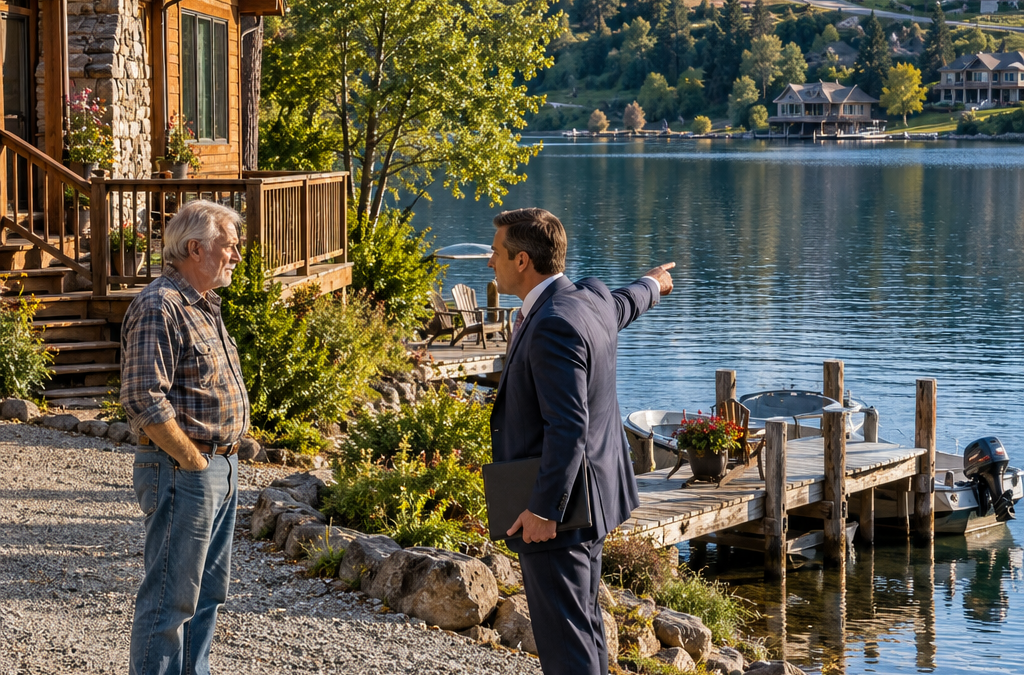
𝗙𝗨𝗟𝗟 𝗦𝗧𝗢𝗥𝗬 The HOA president stood at the edge of my father’s driveway and told him that the lake beside the house he had built with his own hands no longer belonged to him. My father never raised his voice, because somewhere in an old barn sat a rusted metal box containing a piece of paper that was older than her HOA, older than her subdivision, and far more powerful than anything she could threaten him with.
𝗙𝗨𝗟𝗟 𝗦𝗧𝗢𝗥𝗬
The lake hadn’t suddenly migrated into their development.
At first, the new HOA mostly ignored us.
Occasionally we received a letter addressed to “Adjacent Property Owner.”
One asked us not to park near construction access.
Another complained that Dad’s old boat dock did not visually conform to “community shoreline aesthetics.”
He laughed at that one.
“Community shoreline.”
He handed me the letter.
“Since when do they have a shoreline?”
I shrugged.
Dad looked toward the lake.
“A committee with a logo doesn’t own water, son.”
That became one of those sentences our family repeated as a joke.
For a while, that was all it was.
A joke.
Then Carol Ashby became president of the Sunridge Estates HOA.
I first met her at a community open house.
She was probably in her mid-fifties.
Sharp haircut.
Sharp clothes.
Sharp voice.
Everything about her seemed designed to make other people move out of her way before she had to ask.
Carol had the habit of holding eye contact a second too long whenever someone disagreed with her.
She smiled constantly, but the smile never seemed connected to warmth.
My father distrusted her immediately.
Not because she was an HOA president.
Because she talked about ownership as if it were something granted by whoever happened to sit at the head of a meeting table.
The first serious letter arrived in early spring.
URGENT HOA COMPLIANCE NOTICE.
Dad opened it while standing at the kitchen counter.
I was visiting that weekend.
He read the first paragraph.
Then he frowned.
“What?”
He handed it to me.
According to the letter, Sunridge Estates had conducted a “jurisdictional review” of the development’s common water features.
The HOA now claimed that Miller’s Rest Lake fell within its common-area jurisdiction under a revised community plat.
As a result, any swimming, boating, fishing, docking, shoreline maintenance, or other lake use supposedly required authorization from the HOA.
My father stared at me.
I read it again.
“This can’t be serious.”
Dad reached for the phone.
He called the number at the bottom.
After being transferred twice, he got Carol.
He put the call on speaker.
“Mrs. Ashby, this is Daniel Ren.”
“I know who you are, Mr. Ren.”
“I just received a letter about my lake.”
“Yes.”
“Why?”
There was a short pause.
“Because your property has been benefiting from unrestricted access to a community water feature.”
Dad’s face changed.
Not anger yet.
Confusion.
“Say that again.”
“The lake falls within the revised Sunridge community plat.”
“No, it doesn’t.”
“Our records indicate otherwise.”
“Your records are wrong.”
“Mr. Ren—”
“I’ve owned this property since 1987.”
“That doesn’t necessarily resolve the question of water access.”
Dad looked toward me.
I saw disbelief in his eyes.
“My family owned the lake before your subdivision existed.”
Carol’s voice became colder.
“The current legal framework is what governs, not informal historical use.”
“Historical use?”
Dad almost laughed.
“It’s on my deed.”
“That issue has been reviewed.”
“By whom?”
“Our counsel.”
“Then send me the documents.”
“We can provide the relevant references.”
“I want the deed.”
“Mr. Ren—”
“If you own my lake, Carol, send me the deed.”
She went quiet.
Then she said, “The lake belongs to the community now.”
Dad stopped breathing for half a second.
I still remember it.
The way his fingers tightened around the edge of the counter.
“What did you say?”
“You may apply for guest lake access like everyone else.”
Guest access.
To his own lake.
Dad’s face went pale.
Then red.
I thought he was going to explode.
Instead, his voice became very quiet.
“Mrs. Ashby, do not call me a guest on my own property again.”
Carol didn’t back down.
“I’m explaining the current rules.”
“No. You’re telling me something belongs to you because you wrote it into a rule.”
“Our attorney will follow up.”
“I’ll be waiting.”
She hung up.
My father placed the phone down carefully.
For several seconds, neither of us spoke.
Then he looked through the window toward Miller’s Rest.
“Guest access.”
I shook my head.
“This has to be a mistake.”
Dad didn’t answer.
Three days later, a bright red sticker appeared on our dock.
VIOLATION.
UNAUTHORIZED USE OF COMMUNITY WATERWAY.
Dad found it at seven in the morning.
He carried it back to the house in his fist.
Someone from the HOA had come onto our property during the night or early morning, walked down to our dock, and attached it.
That bothered him almost as much as the language.
“They came down here without permission.”
I read the sticker.
“They must have crossed the side trail.”
“Exactly.”
“We should call them.”
“No.”
Dad’s voice was flat.
“I’m done calling people who think repeating something makes it true.”
That night, he pulled every land document he could find from the office.
The kitchen table disappeared beneath deeds, tax records, old surveys, maps, closing paperwork, insurance documents, and correspondence from the county.
Dad went through everything.
I made coffee.
Around midnight, I found him staring at the original 1987 deed.
“What are you looking for?”
“Something that tells me why they think they can do this.”
“You already know they can’t.”
“Knowing and proving aren’t always the same thing.”
That was pure Dad.
I sat opposite him.
He tapped the deed.
“This proves I own the seventeen acres.”
“Right.”
“But Carol isn’t saying she owns the house. She’s claiming some revised plat gave them rights to the lake.”
“So?”
“So I want to know where that claim came from.”
He leaned back.
Then looked toward the dark window.
“They picked the wrong lake.”
He said it without drama.
No raised voice.
No fist on the table.
But I knew my father well enough to understand what it meant.
He was done treating Carol as a nuisance.
From that moment forward, she had his full attention.
The HOA escalated anyway.
Within two weeks, contractors installed a chain-link fence across an access trail near the eastern side of the property.
The trail had existed longer than I had been alive.
It connected our driveway to the lower shoreline and boat launch.
Dad used it constantly.
The fence completely blocked vehicle access.
He called the HOA.
Carol answered.
“You put a fence across my access road.”
“It’s part of the community security boundary.”
“It’s on an access route I use to reach my dock.”
“You have other access.”
“On foot.”
“Then you still have access.”
“My boat trailer doesn’t walk.”
“Mr. Ren, sarcasm isn’t productive.”
“And fences across property you don’t own are?”
“The fence follows the association’s mapped jurisdiction.”
“Your map is wrong.”
“That’s your opinion.”
“No, Carol. That’s land.”
There was a pause.
Then she said, “You need to start cooperating.”
Dad laughed once.
“With what?”
“The community you’re surrounded by.”
“I was here first.”
“That doesn’t exempt you.”
“From your HOA?”
“From changes in the area.”
Dad’s voice tightened.
“You can change everything around me. You cannot change what I own.”
Carol hung up.
After the fence, fines started arriving.
Two hundred dollars a week.
Unauthorized lake usage.
Improper docking.
Unapproved shoreline access.
Failure to obtain recreational permit.
Dad refused every one.
He kept them in a folder.
Never paid.
Never wrote a check.
Never acknowledged the debt.
Carol responded by adding late fees.
Then legal review fees.
Then administrative charges.
One afternoon I drove out and found Dad standing at the water’s edge.
The boat was tied to the dock.
He wasn’t fishing.
He was just looking across the lake.
“How much are they claiming now?”
“Little over three thousand.”
“You okay?”
“Fine.”
“You don’t look fine.”
He kicked a pebble into the water.
“I spent half my life here.”
“I know.”
“Built that house when nobody wanted this land.”
“I know.”
“Now some woman in a blazer moves into a house built fifteen minutes ago and tells me I’m a guest.”
His voice broke slightly on the last word.
That hurt more than if he’d shouted.
My father wasn’t sentimental in public.
He didn’t talk about feelings.
He fixed things.
He worked.
He moved forward.
Seeing him reduced to defending his right to stand beside the lake he’d cared for for decades made something inside me turn hard.
“We’ll fight it.”
Dad looked at me.
“We shouldn’t have to.”
“No.”
“But we will.”
He nodded.
A week later, another certified letter arrived.
This one cited something called the 1994 Sunridge Plat Amendment.
According to the HOA, the amendment established historical development rights over the lake and adjoining shoreline.
Dad read the date twice.
“Nineteen ninety-four.”
“Seven years after you bought the property.”
“Exactly.”
The letter claimed the amendment granted the developer authority to incorporate certain “adjacent water resources” into future community infrastructure.
I searched online.
Nothing obvious appeared.
Dad called the county.
The clerk said we’d need to request historical records.
Then, almost casually, Dad said:
“Your grandfather had land papers.”
I looked at him.
“What?”
“In the old barn.”
“What kind?”
“No idea.”
“You’ve never checked?”
“Never needed to.”
The old barn sat on the far end of our acreage.
It had been used mostly for storage since before I was born.
Dad’s voice became quieter.
“Your grandfather kept a metal box in there.”
“Why?”
“Land documents. Survey work. Water records. Stuff from when he worked in the valley.”
I stared at him.
“Maybe we should open that box.”
Dad looked toward the barn.
“Maybe we should.”
What Carol Ashby didn’t know was that my grandfather, Miller Ren, had not simply been a farmer who happened to own land beside the lake.
Before farming full-time, he had worked as a civil engineer.
He had helped design drainage, irrigation, and water-control systems throughout that part of the county.
The lake itself had once been part of a much larger water project.
Grandpa understood every drainage channel, boundary marker, easement, and flow restriction in the valley.
He also kept records.
A lot of records.
The next morning, Dad and I drove the truck toward the barn.
The building leaned slightly to one side.
One door barely closed.
Dust floated in the shafts of light coming through gaps in the siding.
We spent almost an hour moving old equipment.
Toolboxes.
Fishing gear.
Cans of bolts.
Broken furniture.
Then Dad pointed toward a shelf behind a stack of lumber.
“There.”
A metal document box sat beneath a canvas tarp.
The hinges were rusted.
Dad carried it to an old workbench.
For a moment, he didn’t open it.
“You nervous?” I asked.
“No.”
“You’re staring at it.”
“Shut up.”
I smiled.
He forced the latch.
It snapped loose.
Inside were folders wrapped in yellowing paper.
Hand-drawn surveys.
Engineering notes.
County correspondence.
Old tax documents.
Deeds.
Then I saw a folder.
MILLER’S REST—WATER RIGHTS—1962.
Dad stopped moving.
Neither of us spoke.
He opened it slowly.
The first document was a deed.
Then a county water-rights registration.
Then survey maps.
Grandpa’s handwriting ran along the margins.
Dad read silently for several minutes.
“What?”
He handed me the deed.
“Read the description.”
I did.
I wasn’t an attorney.
But I understood enough.
The legal description did not stop at the shoreline.
It described the entire water body.
The lake itself.
There was also language granting control extending fifty feet beyond portions of the surveyed shoreline.
I looked at Dad.
“He owned the water?”
Dad nodded slowly.
“And the rights transferred?”
“Looks like it.”
“To you?”
“If these records match the county.”
We both looked at the old papers.
Suddenly Carol’s confident phone calls seemed much smaller.
But Dad didn’t celebrate.
Not yet.
“We verify everything.”
That afternoon, we went to the county records office.
An older clerk named Diane helped us.
She had worked there forever.
Dad handed her the 1962 documents.
She adjusted her glasses.
“These are old.”
“That’s the idea.”
She entered record numbers into the system.
Pulled microfilm references.
Retrieved digitized plats.
We sat in front of a large monitor while she compared legal descriptions.
Then she stopped.
“Wait.”
Dad leaned forward.
“What?”
Diane zoomed in on the original subdivision records.
Then returned to Grandpa’s deed.
“This predates Sunridge.”
“By decades.”
“No, I mean the ownership chain.”
She pointed.
“This lake was separately conveyed in 1962.”
Dad nodded.
“That’s what we’re trying to confirm.”
She pulled another record.
Original county plat.
Water rights registration.
Survey notation.
Then she looked at us.
“This isn’t subdivision common property.”
My heart started pounding.
Dad stayed still.
“You’re sure?”
Diane nodded.
“The developer’s later holdings surrounded it, but this parcel and the lake weren’t part of the developer’s original title.”
“What about the 1994 amendment?”
She searched.
Found it.
Read.
Then frowned.
“This is strange.”
“What?”
“The amendment references future incorporation of adjacent water resources.”
“That’s what they’re relying on.”
Diane shook her head.
“But you can’t amend title you don’t own.”
Dad looked at me.
I understood immediately.
The HOA’s entire claim depended on a developer document trying to treat Miller’s Rest as if the developer controlled it.
But the developer had never owned the lake.
Never received it.
Never purchased it.
Never acquired the water rights.
The 1994 amendment could not transfer what wasn’t theirs to transfer.
Diane leaned closer to the monitor.
“This thing was filed thirty-two years after your father’s original ownership record.”
“My father’s,” Dad corrected.
“Right.”
She looked at the 1962 deed again.
“It’s remarkably clear.”
Dad said quietly, “They built their entire claim around something that was never theirs.”
Diane didn’t answer.
She didn’t need to.
We ordered certified copies of everything.
The deed.
Water rights.
Plat maps.
Chain of title.
County survey.
The 1994 amendment.
Dad also contacted the county legal department and requested a formal review.
For the first time since the fight started, he seemed calm again.
Not relieved.
Focused.
Meanwhile Carol became more aggressive.
At HOA meetings, she started carrying a folder labeled:
REN PROPERTY—PENDING RESOLUTION.
One neighbor later told us she’d referred to Dad as “the holdout.”
Another said Carol claimed the HOA was protecting residents from a property owner who wanted “special treatment.”
Special treatment.
He wanted access to his own lake.
Then Carol sent a thirty-day compliance notice.
If Dad did not recognize HOA jurisdiction and pay the outstanding fines, the association would consider all available remedies.
Liens.
Legal fees.
Mediation.
Enforcement action.
Dad placed the letter in his folder.
“She’s getting nervous.”
I looked at him.
“How do you get nervous from that?”
“People who feel secure don’t keep adding threats.”
The county legal response arrived several days later.
Dad read it at the kitchen table.
Then handed it to me.
The language was formal.
Careful.
But devastating.
Based on the recorded chain of title, the lake and associated water rights remained outside the Sunridge development’s original legal holdings.
The 1994 plat amendment did not appear capable of conveying or incorporating property the developer did not own.
Any claim by the HOA would therefore require some independent legal instrument.
No such instrument appeared in the county record.
Dad folded the letter.
“Now we meet.”
He requested a formal meeting with the HOA board.
Carol agreed almost immediately.
That surprised me.
Then we learned why.
She was bringing an attorney.
The meeting took place in the Sunridge clubhouse.
A building Dad had watched being constructed from bare dirt.
The board sat on one side of a long table.
Dad and I sat opposite them.
Carol was at the center.
Beside her was the HOA attorney, Preston Hale.
Expensive suit.
Silver watch.
Smooth voice.
He had the kind of confidence that probably worked well on people who arrived unprepared.
Carol smiled when Dad sat down.
“Mr. Ren.”
“Carol.”
“We’re glad you’ve finally agreed to resolve this.”
Dad glanced at me.
That wording told us everything.
Preston opened a leather folder.
“Mr. Ren, I’ve reviewed the dispute.”
“Good.”
“We believe this matter has become unnecessarily adversarial.”
Dad leaned back.
“You fenced off my boat access.”
“We’re not here to relitigate tone.”
Dad almost smiled.
Preston continued.
“The association would prefer an amicable solution.”
He slid a folder across the table.
“We’re prepared to offer a settlement.”
Dad didn’t touch it.
“What kind?”
“Financial consideration in exchange for your acknowledgment of association jurisdiction over the lake and withdrawal of all related objections.”
Carol folded her hands.
“It’s generous.”
Dad looked at the folder.
Then at Preston.
“You’re offering me money.”
“Correct.”
“To let you claim my lake.”
Preston’s smile tightened.
“We’re offering compensation to resolve disputed rights.”
“Why would I sell you something you already claim you own?”
Silence.
One board member looked at Carol.
Dad continued.
“Either the lake is yours or it isn’t.”
Preston said, “Property disputes often involve overlapping claims.”
“Do you have a deed?”
“We have development instruments.”
“Do you have a deed?”
“The relevant plat documents—”
“That’s not what I asked.”
Carol interrupted.
“We aren’t going to sit here while you interrogate counsel.”
Dad looked at her.
“You’ve been interrogating my ownership for months.”
“Everyone eventually cooperates, Mr. Ren.”
There was that smile again.
Smug.
Certain.
Like compliance was simply a matter of applying enough pressure.
She continued.
“You’ve accumulated fines. You’re approaching a formal enforcement deadline. Continuing this fight is going to become expensive.”
Dad nodded.
“For somebody.”
Carol’s eyes narrowed.
Preston changed tone.
“If this isn’t resolved, the association may pursue collection remedies.”
“Against what?”
“Outstanding assessments and fines.”
“I’m not a member of your HOA.”
“The association’s position is that your use rights subject you to certain obligations.”
Dad laughed.
“No.”
Preston leaned forward.
“You should understand the risk of legal escalation.”
“I do.”
“Liens may be available.”
Dad stopped smiling.
“If you put a fraudulent lien on my property, we’ll have a different conversation.”
Carol said, “Threats aren’t productive.”
Dad turned toward her.
“I’m not threatening you. I’m telling your lawyer to be careful.”
Preston raised one hand.
“Let’s lower the temperature.”
Dad remained completely calm.
“My temperature is fine.”
“Then perhaps you should review the settlement.”
Dad pushed the unopened folder back across the table.
“Why would I settle for something I already own?”
Preston’s confidence slipped for the first time.
Carol exhaled sharply.
“This arrogance is exactly why we’ve gotten nowhere.”
Dad looked at her.
“Arrogance?”
“Yes.”
“You moved here decades after me, put a fence across my access, fined me for fishing in my own water, called me a guest, and now you’re offering me money to acknowledge your ownership.”
He leaned slightly forward.
“Which one of us is arrogant?”
Carol’s face hardened.
“Your emotional attachment doesn’t determine title.”
Dad smiled.
“No.”
Then he reached down beside his chair.
“Paper does.”
He placed a thick folder on the table.
Carol’s eyes dropped to it.
So did Preston’s.
The county recorder’s stamp was visible on top.
I watched Carol notice the year.
Her expression changed.
Not dramatically.
A tiny break in confidence.
But I saw it.
Dad opened the folder.
“Before this meeting ends, there’s something all of you need to see.”
He placed the first certified document in front of Preston.
“Original deed. Recorded in 1962.”
Preston pulled it closer.
Dad placed the next.
“County water-rights record.”
Then another.
“Original survey.”
Another.
“Chain of title.”
Then the county legal opinion.
“And this arrived this week.”
Preston stopped speaking entirely.
He read the deed.
Then the water-rights document.
Then he returned to the deed.
Carol looked irritated.
“What does it say?”
Preston didn’t answer.
She turned to Dad.
“What exactly are you claiming?”
Dad’s voice remained calm.
“I’m not claiming anything.”
He tapped the documents.
“I’m showing you what the county already recorded.”
Preston looked at him.
“Where did you obtain these?”
“County recorder.”
“The originals?”
“My father’s records.”
Carol frowned.
“Your father?”
“My father bought the lake in 1962.”
Preston read faster.
Dad continued.
“Not lakefront access. Not recreational rights. The lake.”
He pointed toward the legal description.
“Entire body of water.”
Then the water rights.
“Exclusive rights associated with Miller’s Rest.”
Another document.
“Boundary control extending beyond sections of shoreline.”
Carol’s mouth opened.
Then closed.
Dad slid over the 1994 Sunridge amendment.
“This is what you’ve been relying on.”
Preston looked at it.
Dad placed the original 1962 plat beside it.
“Your amendment came thirty-two years later.”
Carol finally spoke.
“So?”
Dad stared at her.
“So your developer never owned Miller’s Rest.”
Her face went still.
Preston turned another page.
Dad continued.
“The subdivision could not transfer the lake into HOA common property because the developer didn’t own it.”
Carol shook her head.
“That can’t be right.”
Preston looked at her.
That look was enough.
Not anger.
Not agreement.
Concern.
Carol saw it too.
“This can’t be right,” she repeated.
Dad leaned back.
“It’s not just right.”
He tapped the county certification.
“It’s recorded.”
Then the water-rights seal.
“Certified.”
Then the legal opinion.
“And confirmed.”
The room went quiet.
Nobody moved.
Preston reviewed the county letter.
His earlier confidence was gone.
He read one paragraph twice.
Then asked, “Has county counsel issued any additional opinion?”
“That’s the formal response.”
Preston nodded slowly.
Carol stared at the documents.
“What about historical development rights?”
Dad answered.
“Rights to what?”
“The lake.”
“Your developer never owned it.”
“The amendment clearly—”
“Carol.”
Dad’s voice was quiet.
“You cannot give yourself something another person owns by typing it into your paperwork.”
Her face flushed.
“We relied on legal documents.”
“You relied on a document that describes property the developer never controlled.”
“We had no reason to believe—”
“I gave you plenty of reasons.”
Carol went silent.
Dad started counting.
“I told you the first day.”
One finger.
“I demanded proof.”
Second.
“You entered my property and put a violation sticker on my dock.”
Third.
“You fenced my access.”
Fourth.
“You fined me every week.”
Fifth.
“You threatened liens.”
Sixth.
“You called me a guest.”
He lowered his hand.
“And at no point did you walk into the county recorder’s office and check whether you owned the lake.”
Carol stared at him.
“Don’t make this personal.”
My father laughed.
That was the first time he actually laughed during the meeting.
“You put a chain-link fence between me and the water my family has cared for since before your subdivision existed.”
He looked directly at her.
“It became personal the day you decided I wasn’t worth verifying.”
Preston spoke quickly.
“I think everyone should avoid making admissions until we’ve reviewed the title history.”
Dad nodded.
“You should review it.”
“We’ll need time.”
“You’ve already had months.”
“We weren’t provided these documents.”
“They’ve been public for sixty years.”
Carol said, “This is an administrative confusion.”
Dad looked at her.
“No.”
“It’s clearly a records issue.”
“No.”
“Then what would you call it?”
“Your problem.”
Her face hardened.
Dad wasn’t finished.
He reached into the folder one last time.
“I brought one more thing.”
He slid a document across the table.
Preston looked down.
His expression changed immediately.
Carol leaned toward him.
“What is it?”
Dad answered.
“Notice of intent to sue.”
Carol sat back.
Dad continued.
“Wrongful fines.”
He pointed toward another page.
“Interference with property access.”
Another.
“Damage from the fence installation.”
Another.
“Harassment.”
He looked at Preston.
“And any improper attempt to place a lien or cloud my title.”
Carol’s face went pale.
“This is unnecessary.”
Dad stared at her.
“You put a fence across my driveway.”
“Access trail.”
“My property.”
“You refused every effort to resolve this.”
Dad’s jaw tightened.
“Your idea of resolution was me signing away rights I already own.”
Preston raised his hand.
“Mr. Ren, let’s not escalate unnecessarily.”
Dad looked at him.
“I spent months trying not to.”
He turned toward Carol.
“She kept escalating.”
Carol pushed her chair back slightly.
“You could have brought these documents earlier.”
I couldn’t stay quiet.
“He didn’t know they existed.”
She looked at me.
“Exactly.”
I stared at her.
“You didn’t know your documents were valid either.”
That silenced her.
Preston closed the folder slowly.
“I think the prudent course is to suspend all enforcement activity while we conduct a complete title review.”
Dad nodded.
“Remove the fence.”
“We’ll discuss interim measures.”
“Remove the fence.”
“Mr. Ren—”
“It is physically preventing access to property your own county records now show is mine.”
Preston looked toward Carol.
She wouldn’t meet his eyes.
He said, “We’ll address it.”
Dad stood.
“Good.”
Carol said, “We’re not finished.”
Dad looked down at her.
“For the first time since this began, Carol, I agree.”
Then he walked out.
I followed him.
We didn’t say anything until we reached the truck.
Dad sat behind the wheel.
Closed the door.
Put both hands on the steering wheel.
Then just sat there.
I looked at him.
“You okay?”
He nodded.
A few seconds passed.
Then his eyes filled.
Not tears exactly.
Just enough moisture that he blinked several times.
“They called me a guest.”
I knew that had been the part he couldn’t let go.
I put a hand on his shoulder.
“They won’t again.”
He started the truck.
The fallout moved faster than I expected.
Within a week, the HOA suspended every fine.
Not canceled yet.
Suspended.
Their attorney requested certified title records independently.
The county provided the same documents.
Then Sunridge’s title company became involved.
Then the developer’s old records were reviewed.
Every trail led to the same conclusion.
The lake had never belonged to the subdivision.
The HOA’s plat amendment had treated nearby water as if it were available for future incorporation, but the underlying ownership had never transferred.
No deed.
No easement.
No conveyance.
Nothing.
The chain-link fence came down first.
Dad stood at the end of the trail while contractors removed it.
Carol wasn’t there.
He didn’t say a word to them.
When the final post was pulled from the ground, he walked down to the boat launch.
Two months after the board meeting, Sunridge Estates sent a formal notice to every homeowner.
The language was painfully careful.
After review of historical county records and title documentation, the association acknowledged that Miller’s Rest Lake and associated water rights were privately owned by the Ren family and were not HOA common property.
All related violation notices were rescinded.
Every fine removed.
All collection activity canceled.
The HOA agreed to pay for damage caused by the fence installation.
It also covered legal expenses connected to resolving the dispute.
Then came the apology.
Dad read it once.
Folded it.
Put it in the same folder as the violation notices.
“That’s it?” I asked.
“What?”
“You don’t want to frame it?”
He gave me a look.
“I’m not decorating my house with stupidity.”
Carol lasted only a little longer.
Residents had begun asking questions.
Not just about the lake.
About how a board could spend months threatening someone over property without verifying basic ownership.
People requested meeting minutes.
Legal bills.
Copies of the plat.
Some discovered that HOA funds had been spent pursuing the dispute.
Others learned Carol had been warned early that the title history might be complicated.
At the next packed meeting, residents demanded an explanation.
I attended with Dad.
Carol sat at the front.
She looked different.
Smaller somehow.
Not physically.
Authority had simply stopped fitting her the way it used to.
One homeowner asked, “Why didn’t the board verify the lake title before issuing fines?”
Carol answered, “We relied on historical development documents.”
Another asked, “Did anyone check county records?”
“We believed our existing documentation was sufficient.”
“That’s not what I asked.”
She hesitated.
“No.”
A murmur passed through the room.
Another homeowner stood.
“How much did this cost us?”
Carol said the exact number wasn’t available yet.
People became angry.
Someone asked whether she had personally authorized the fence.
Another asked why the HOA treated Daniel as if he were an association member when his property wasn’t even part of Sunridge.
Carol tried to defend herself.
“We were acting to protect community assets.”
Dad whispered beside me, “They weren’t assets.”
I almost laughed.
Then a resident asked the question that ended everything.
“If you didn’t own the lake, what exactly were you protecting it from?”
Carol had no answer.
She resigned shortly afterward.
The announcement cited personal reasons.
Nobody believed that was the whole story.
I didn’t care.
Neither did Dad.
He had what mattered.
His access.
His title.
His lake.
The damaged trail was repaired that spring.
Dad replaced several trees removed near the fence line.
He repainted the old Miller’s Rest sign.
Same weathered oak board.
Same name.
He refused every suggestion that he install a larger sign or mark the shoreline more aggressively.
“Why?” I asked.
“So they know?”
He looked at me.
“I know.”
That was enough for him.
Summer returned.
So did the quiet.
For the first time in more than a year, Dad took the old boat onto the lake without wondering whether an HOA employee would photograph him from the walking trail.
He fished.
Caught almost nothing.
Complained about that.
Everything felt normal again.
One evening we sat on the dock.
The water was nearly still.
Sunridge houses glowed around parts of the distant shoreline.
The development wasn’t going anywhere.
Neither were we.
Dad held a fishing rod loosely in one hand.
“You know what bothers me most?”
“Carol?”
“No.”
“The fence?”
“No.”
“Guest access?”
He looked at me.
“Well, that still bothers me.”
I laughed.
He stared across the water.
“What bothers me is how close they came to making me doubt myself.”
That surprised me.
“You never seemed doubtful.”
“I was.”
“When?”
“Every time one of those letters came.”
He looked down.
“They had attorneys. Logos. Certified mail. Board votes. Maps.”
He paused.
“I had memories.”
“And a deed.”
“Eventually.”
He smiled faintly.
“But before we found those old documents, part of me wondered whether I had missed something.”
I understood.
That was the real power behind everything Carol had done.
Not law.
Certainty.
She acted so certain that Dad was wrong.
She repeated the claim until even the man who had lived there for thirty years started wondering whether some obscure filing had somehow erased everything he knew.
Dad said, “That’s how people get pushed around.”
“By HOAs?”
“By anybody.”
He looked at me.
“Someone puts a title under their name and starts talking like they can’t be questioned.”
The sun dropped lower.
“They expect you to panic before you check.”
I looked toward the house.
“What would’ve happened if Grandpa hadn’t kept that box?”
Dad thought about it.
“The county still had the records.”
“We wouldn’t have known where to start.”
“No.”
He nodded.
“That’s why you keep paper.”
I smiled.
“That’s your lesson?”
“That’s one of them.”
Years passed.
Sunridge eventually built another recreational pond inside property it actually owned.
That became the community water feature.
Miller’s Rest remained private.
There were occasional questions about shoreline access, but the HOA never tried to assert jurisdiction again.
New board members introduced themselves politely.
Nobody used the words guest access.
Dad aged.
His knees got worse.
He stopped walking the entire property.
Then he stopped taking the boat out alone.
But almost every evening when weather allowed, he sat on the dock.
Sometimes I joined him.
Sometimes he preferred being alone.
On the anniversary of the board meeting, I drove out with dinner.
I found him sitting in his usual chair.
The old metal document box was beside him.
I laughed.
“What are you doing with that?”
“Cleaning the barn.”
“You carried it all the way down here?”
“Wanted to look at something.”
He opened it.
The papers were stored properly now.
Plastic archival sleeves.
Copies separated from originals.
Dad had learned.
He pulled out the 1962 deed.
The county seal was faded on the original.
He ran his finger across the legal description.
“They tried to take the one thing they never bothered to check the paperwork on.”
I sat beside him.
“They didn’t really take it.”
“Tried.”
He looked toward Sunridge.
“That’s the important part.”
We watched the sun move across the water.
Then I asked something I’d never asked before.
“Were you scared?”
Dad smiled.
“Of Carol?”
“Of losing the lake.”
His smile disappeared.
“Yes.”
That answer surprised me.
My father had seemed unshakable through almost everything.
“You never said that.”
“What good would it have done?”
“I don’t know.”
He folded his hands.
“I kept thinking about your grandfather.”
“Why?”
“Because he knew land.”
Dad looked at the deed.
“He would’ve been furious if I let somebody talk me out of something he spent his life securing.”
“You weren’t going to.”
“I didn’t know that in the beginning.”
We sat quietly.
Then he said, “There was one night I thought maybe I should just pay the fines.”
I turned.
“Seriously?”
“Your mother was still alive then. She hated the stress.”
I hadn’t known.
Dad continued.
“I thought maybe if I paid, they’d leave us alone.”
“But you didn’t.”
“No.”
“Why?”
He looked across the lake.
“Because I knew paying wasn’t the end.”
He was right.
Carol didn’t want two hundred dollars a week.
She wanted recognition.
Once Dad paid, the HOA could point to that payment as acceptance that he was subject to their authority.
The fishing permits would come next.
Then dock rules.
Then access limits.
Then maybe assessments.
Dad said, “Sometimes the cheapest way out costs the most later.”
That sounded like something Grandpa would have said.
Maybe he had.
After Dad’s health began declining, I took over more of the property maintenance.
Taxes.
Repairs.
Dock inspections.
Tree removal.
Shoreline care.
Every time I opened the document cabinet, I saw the old Miller’s Rest folder.
I never moved it far.
Some memories deserve easy access.
Carol Ashby became little more than a name from an ugly period.
I heard she moved several years later.
Sunridge continued.
Different president.
Different management company.
Different priorities.
Most residents living there now probably don’t know the story.
But sometimes somebody does.
A newer homeowner once walked over while I was repairing the dock.
“Are you Daniel’s son?”
“I am.”
He pointed toward the lake.
“Is it true your family owns the whole thing?”
“That’s what the deed says.”
He laughed.
“Our HOA documents specifically say Miller’s Rest isn’t association property.”
“Good documents.”
He looked confused.
I smiled.
“Long story.”
The irony still makes me laugh.
After everything Carol did trying to absorb the lake into the HOA, the association eventually amended its own documents to make absolutely clear that the lake was not theirs.
Dad had forced them to memorialize the exact opposite of what Carol wanted.
Not with power.
Not with money.
Not with threats.
With records.
That was what stayed with me.
Carol always looked powerful during the fight.
She had the board.
The lawyer.
The certified letters.
The contractors.
The fence.
The violation stickers.
Every tool of organized authority.
Dad looked like exactly what she assumed he was.
An older man living on an outdated property surrounded by a modern development.
She mistook quiet for weakness.
She mistook age for confusion.
She mistook his unwillingness to shout for fear.
Most dangerously, she mistook paperwork generated by her own organization for ownership.
My father never made that mistake.
He knew there was a difference between somebody claiming authority and actually possessing it.
He just had to find the proof.
The proof wasn’t glamorous.
No secret recording.
No dramatic witness.
No hidden fortune.
A deed.
A survey.
Water-rights records.
Documents filed by people who had been dead for years.
That was enough.
Dad once told me that land has a long memory.
I thought he meant sentimental memory.
Family history.
Old trails.
Fishing spots.
Places where people built houses and raised children.
Now I understand he meant something else too.
Land remembers on paper.
Every transfer.
Every boundary.
Every easement.
Every legal description.
People come and go.
Boards change.
Developers disappear.
Neighborhood names are invented.
But somewhere, if people did their jobs properly, the record remains.
Carol tried to rewrite history with a 1994 amendment.
The problem was that 1962 had already happened.
And no amount of confidence could change that.
The last anniversary Dad spent on the dock before his health made it difficult, I brought two beers.
He barely drank his.
We watched the water.
After a while, he said, “Remember what I told you when they first sent that letter?”
“You’ve told me a lot of things.”
“A committee with a logo doesn’t own water.”
I laughed.
“I remember.”
He nodded toward the lake.
“Still true.”
Then he leaned back and closed his eyes.
Wind moved across Miller’s Rest.
Small ripples touched the dock posts.
Somewhere across the lake, I could hear children laughing from one of the Sunridge houses.
That sound didn’t bother Dad.
He had never wanted to keep people from enjoying the beauty around us.
That was another thing Carol never understood.
Ownership wasn’t hostility.
Boundaries weren’t cruelty.
Dad would have happily allowed a neighbor to fish if they asked.
He often did.
He let kids retrieve balls from the shoreline.
Let residents photograph sunsets.
Helped one family recover a kayak after a storm.
What he wouldn’t do was accept the idea that kindness could be converted into entitlement.
That’s what the HOA attempted.
They saw decades of open, quiet use and decided it could be reclassified as community property.
They assumed Dad’s lack of fences meant lack of rights.
Then when he objected, they built a fence themselves.
That contradiction still amazes me.
The fence is long gone now.
You can barely tell where the posts were.
Grass grew back.
The damaged soil recovered.
Dad planted two maples near the trail.
They’re tall now.
Miller’s Rest still reflects the sky the way it did when I was a child.
Sometimes I stand on the dock and picture the day Dad first brought me there in 1987.
No houses beyond the trees.
No paved roads.
No clubhouse.
No HOA.
Just water.
Then I think of Carol telling him:
“The lake belongs to the community now.”
How easy it sounded when she said it.
How certain.
As though history could be transferred with a sentence.
As though ownership was whatever the person speaking most confidently said it was.
She learned otherwise.
My father never celebrated her resignation.
Never insulted her afterward.
Never asked for revenge.
He wanted the fence gone.
The fines erased.
The damage repaired.
The title acknowledged.
Once that happened, he was finished.
I asked him once whether he wished he’d sued for more.
He frowned.
“More what?”
“Money.”
“For what?”
“They put you through hell.”
He looked toward the water.
“I got the lake.”
“You already had the lake.”
“Exactly.”
That was my father.
He didn’t need to beat Carol.
He needed her to stop pretending she’d beaten him.
After he died, the property passed to me.
The first evening after the funeral, I drove out alone.
The house felt different without him.
Empty in a way houses only feel after someone dies.
I walked down to the dock.
His chair was still there.
For a long time, I couldn’t sit in it.
So I stood.
The water was dark.
I thought about selling.
Just briefly.
Seventeen acres was work.
Taxes were expensive.
Maintenance never stopped.
Sunridge homes around us were worth fortunes now.
Developers would have paid more than Dad could ever have imagined in 1987.
Then I saw the old sign.
MILLER’S REST.
Dad had repainted it only two years earlier.
I remembered him sitting beside the metal document box.
They tried to take the one thing they never bothered to check the paperwork on.
I went back inside.
Opened the cabinet.
Found the 1962 deed.
I read the same legal description Dad had read.
The same one Grandpa had secured.
Three generations connected by a few pages of paper and a body of water.
I didn’t sell.
I don’t know if I ever will.
Maybe someday circumstances will change.
Dad would understand that.
He wasn’t against change.
He was against pretending the past never existed simply because it became inconvenient.
Sunridge can build around Miller’s Rest.
People can move in.
Roads can expand.
Neighborhood boards can change.
None of that bothers me.
What matters is that the line remains honest.
This is yours.
This is mine.
Ask before crossing it.
That principle should be simple.
Carol turned it into a war because she believed authority gave her the right to skip the asking.
She was wrong.
And every year, on the anniversary of that boardroom meeting, I sit where Dad used to sit.
Sometimes I bring the old folder with me.
Not because I’m afraid another HOA president will appear with a fence crew.
The current board knows better.
I bring it because I like the symbolism.
Out on the lake, the world looks uncomplicated.
Water.
Trees.
Sky.
But in that folder is the reason Miller’s Rest stayed ours when someone decided it shouldn’t.
No shouting.
No intimidation.
No dramatic confrontation with bulldozers.
Just facts that had been waiting patiently for somebody to read them.
That may be the part I admire most about my father.
During the worst months of the fight, Carol was loud.
Her notices were urgent.
Her deadlines were bold.
Her threats came by certified mail.
Everything about the HOA demanded immediate attention.
Dad’s evidence did none of that.
It sat for decades inside a rusted metal box in a dark barn.
Silent.
Dusty.
Almost forgotten.
But truth doesn’t become weaker because nobody is shouting it.
When Dad finally put those papers on the boardroom table, Carol’s months of threats collapsed in minutes.
Not because he outsmarted the law.
Because he finally forced everyone in that room to look at what the law had been saying all along.
The developer never owned the lake.
The HOA never owned the lake.
Carol never owned the lake.
My family did.
And sometimes the strongest thing a person can bring into a room full of powerful people is not anger.
It’s proof.
𝗧𝗛𝗘 𝗘𝗡𝗗
The HOA president stood at the edge of my father’s driveway and told him that the lake beside the house he had built with his own hands no longer belonged to him. My father never raised his voice, because somewhere in an old barn sat a rusted metal box containing a piece of paper that was older than her HOA, older than her subdivision, and far more powerful than anything she could threaten him with.
My father, Daniel Ren, had never been the kind of man who needed to tell people what belonged to him.
He simply took care of it.
That was how he approached land, tools, family, promises—everything.
In 1987, long before gated entrances, landscaped medians, decorative stone monuments, and HOA newsletters appeared in that part of the county, he bought seventeen acres wrapped around a quiet lake in a valley where the roads were still mostly dirt.
I was a kid then.
I remember riding beside him in an old pickup the first time he took me there.
The road narrowed until trees brushed both mirrors.
Then the forest opened.
And there it was.
Water so still that the sky seemed to have fallen into the ground.
My father turned off the engine.
For a long time, he didn’t say anything.
Neither did I.
Then he looked at the lake and said, “Your grandfather would have liked this.”
My grandfather’s name was Miller.
He had spent most of his life working around land and water in that valley.
So when my father eventually built our house along the shoreline, he called the lake Miller’s Rest.
The name was never on a fancy sign.
There was no brass plaque.
Dad simply painted the words onto a weathered piece of oak and nailed it to a post near the dock.
MILLER’S REST.
That was enough.
My father built the house slowly.
He hired help for the foundation and electrical work, but almost everything else passed through his own hands.
Framing.
Siding.
Decking.
Cabinets.
Dock repairs.
Fencing.
I remember carrying boards that were too heavy for me because I wanted to be useful.
Sometimes he’d let me hold the level while he worked.
Other times he’d hand me a broom and tell me that sweeping was a legitimate construction skill.
We weren’t wealthy.
The house wasn’t luxurious.
But when we finished it, it felt like the richest place in the world.
The lake was ten steps beyond the yard.
We swam there in summer.
Fished from the dock before sunrise.
Skated near the shallow edge during the rare winters cold enough to freeze it.
My mother used to sit on the porch with coffee while Dad and I went out in the old aluminum boat.
There were no neighbors close enough to see.
No security gates.
No rules about dock colors or shoreline furniture.
No monthly dues.
No committee deciding where someone could park a canoe.
For nearly thirty years, Miller’s Rest was simply part of our life.
Then the valley changed.
It began slowly.
Survey flags appeared along the road.
Trees were marked.
Heavy equipment arrived.
A developer bought a huge section of surrounding land and announced plans for a gated residential community.
Sunridge Estates.
The name sounded absurd to me because there had never been anything called Sunridge in that valley.
But developers like names that make land sound as if it has always been waiting to become expensive.
By 2015, the woods around us had been transformed.
Paved streets.
Large houses.
Decorative streetlamps.
A clubhouse.
Walking trails.
Private security.
And, inevitably, a homeowners association.
Our seventeen acres remained outside the subdivision.
That seemed obvious.
Dad had owned his property decades before Sunridge existed.
His deed hadn’t changed.
Our shoreline hadn’t moved.
The lake hadn’t suddenly migrated into their development.
At first, the new HOA mostly ignored us.
Occasionally we received a letter addressed to “Adjacent Property Owner.”
One asked us not to park near construction access.
Another complained that Dad’s old boat dock did not visually conform to “community shoreline aesthetics.”
He laughed at that one.
“Community shoreline.”
He handed me the letter.
“Since when do they have a shoreline?”
I shrugged.
Dad looked toward the lake.
“A committee with a logo doesn’t own water, son.”
That became one of those sentences our family repeated as a joke.
For a while, that was all it was.
A joke.
Then Carol Ashby became president of the Sunridge Estates HOA.
I first met her at a community open house.
She was probably in her mid-fifties.
Sharp haircut.
Sharp clothes.
Sharp voice.
Everything about her seemed designed to make other people move out of her way before she had to ask.
Carol had the habit of holding eye contact a second too long whenever someone disagreed with her.
She smiled constantly, but the smile never seemed connected to warmth.
My father distrusted her immediately.
Not because she was an HOA president.
Because she talked about ownership as if it were something granted by whoever happened to sit at the head of a meeting table.
The first serious letter arrived in early spring.
URGENT HOA COMPLIANCE NOTICE.
Dad opened it while standing at the kitchen counter.
I was visiting that weekend.
He read the first paragraph.
Then he frowned.
“What?”
He handed it to me.
According to the letter, Sunridge Estates had conducted a “jurisdictional review” of the development’s common water features.
The HOA now claimed that Miller’s Rest Lake fell within its common-area jurisdiction under a revised community plat.
As a result, any swimming, boating, fishing, docking, shoreline maintenance, or other lake use supposedly required authorization from the HOA.
My father stared at me.
I read it again.
“This can’t be serious.”
Dad reached for the phone.
He called the number at the bottom.
After being transferred twice, he got Carol.
He put the call on speaker.
“Mrs. Ashby, this is Daniel Ren.”
“I know who you are, Mr. Ren.”
“I just received a letter about my lake.”
“Yes.”
“Why?”
There was a short pause.
“Because your property has been benefiting from unrestricted access to a community water feature.”
Dad’s face changed.
Not anger yet.
Confusion.
“Say that again.”
“The lake falls within the revised Sunridge community plat.”
“No, it doesn’t.”
“Our records indicate otherwise.”
“Your records are wrong.”
“Mr. Ren—”
“I’ve owned this property since 1987.”
“That doesn’t necessarily resolve the question of water access.”
Dad looked toward me.
I saw disbelief in his eyes.
“My family owned the lake before your subdivision existed.”
Carol’s voice became colder.
“The current legal framework is what governs, not informal historical use.”
“Historical use?”
Dad almost laughed.
“It’s on my deed.”
“That issue has been reviewed.”
“By whom?”
“Our counsel.”
“Then send me the documents.”
“We can provide the relevant references.”
“I want the deed.”
“Mr. Ren—”
“If you own my lake, Carol, send me the deed.”
She went quiet.
Then she said, “The lake belongs to the community now.”
Dad stopped breathing for half a second.
I still remember it.
The way his fingers tightened around the edge of the counter.
“What did you say?”
“You may apply for guest lake access like everyone else.”
Guest access.
To his own lake.
Dad’s face went pale.
Then red.
I thought he was going to explode.
Instead, his voice became very quiet.
“Mrs. Ashby, do not call me a guest on my own property again.”
Carol didn’t back down.
“I’m explaining the current rules.”
“No. You’re telling me something belongs to you because you wrote it into a rule.”
“Our attorney will follow up.”
“I’ll be waiting.”
She hung up.
My father placed the phone down carefully.
For several seconds, neither of us spoke.
Then he looked through the window toward Miller’s Rest.
“Guest access.”
I shook my head.
“This has to be a mistake.”
Dad didn’t answer.
Three days later, a bright red sticker appeared on our dock.
VIOLATION.
UNAUTHORIZED USE OF COMMUNITY WATERWAY.
Dad found it at seven in the morning.
He carried it back to the house in his fist.
Someone from the HOA had come onto our property during the night or early morning, walked down to our dock, and attached it.
That bothered him almost as much as the language.
“They came down here without permission.”
I read the sticker.
“They must have crossed the side trail.”
“Exactly.”
“We should call them.”
“No.”
Dad’s voice was flat.
“I’m done calling people who think repeating something makes it true.”
That night, he pulled every land document he could find from the office.
The kitchen table disappeared beneath deeds, tax records, old surveys, maps, closing paperwork, insurance documents, and correspondence from the county.
Dad went through everything.
I made coffee.
Around midnight, I found him staring at the original 1987 deed.
“What are you looking for?”
“Something that tells me why they think they can do this.”
“You already know they can’t.”
“Knowing and proving aren’t always the same thing.”
That was pure Dad.
I sat opposite him.
He tapped the deed.
“This proves I own the seventeen acres.”
“Right.”
“But Carol isn’t saying she owns the house. She’s claiming some revised plat gave them rights to the lake.”
“So?”
“So I want to know where that claim came from.”
He leaned back.
Then looked toward the dark window.
“They picked the wrong lake.”
He said it without drama.
No raised voice.
No fist on the table.
But I knew my father well enough to understand what it meant.
He was done treating Carol as a nuisance.
From that moment forward, she had his full attention.
The HOA escalated anyway.
Within two weeks, contractors installed a chain-link fence across an access trail near the eastern side of the property.
The trail had existed longer than I had been alive.
It connected our driveway to the lower shoreline and boat launch.
Dad used it constantly.
The fence completely blocked vehicle access.
He called the HOA.
Carol answered.
“You put a fence across my access road.”
“It’s part of the community security boundary.”
“It’s on an access route I use to reach my dock.”
“You have other access.”
“On foot.”
“Then you still have access.”
“My boat trailer doesn’t walk.”
“Mr. Ren, sarcasm isn’t productive.”
“And fences across property you don’t own are?”
“The fence follows the association’s mapped jurisdiction.”
“Your map is wrong.”
“That’s your opinion.”
“No, Carol. That’s land.”
There was a pause.
Then she said, “You need to start cooperating.”
Dad laughed once.
“With what?”
“The community you’re surrounded by.”
“I was here first.”
“That doesn’t exempt you.”
“From your HOA?”
“From changes in the area.”
Dad’s voice tightened.
“You can change everything around me. You cannot change what I own.”
Carol hung up.
After the fence, fines started arriving.
Two hundred dollars a week.
Unauthorized lake usage.
Improper docking.
Unapproved shoreline access.
Failure to obtain recreational permit.
Dad refused every one.
He kept them in a folder.
Never paid.
Never wrote a check.
Never acknowledged the debt.
Carol responded by adding late fees.
Then legal review fees.
Then administrative charges.
One afternoon I drove out and found Dad standing at the water’s edge.
The boat was tied to the dock.
He wasn’t fishing.
He was just looking across the lake.
“How much are they claiming now?”
“Little over three thousand.”
“You okay?”
“Fine.”
“You don’t look fine.”
He kicked a pebble into the water.
“I spent half my life here.”
“I know.”
“Built that house when nobody wanted this land.”
“I know.”
“Now some woman in a blazer moves into a house built fifteen minutes ago and tells me I’m a guest.”
His voice broke slightly on the last word.
That hurt more than if he’d shouted.
My father wasn’t sentimental in public.
He didn’t talk about feelings.
He fixed things.
He worked.
He moved forward.
Seeing him reduced to defending his right to stand beside the lake he’d cared for for decades made something inside me turn hard.
“We’ll fight it.”
Dad looked at me.
“We shouldn’t have to.”
“No.”
“But we will.”
He nodded.
A week later, another certified letter arrived.
This one cited something called the 1994 Sunridge Plat Amendment.
According to the HOA, the amendment established historical development rights over the lake and adjoining shoreline.
Dad read the date twice.
“Nineteen ninety-four.”
“Seven years after you bought the property.”
“Exactly.”
The letter claimed the amendment granted the developer authority to incorporate certain “adjacent water resources” into future community infrastructure.
I searched online.
Nothing obvious appeared.
Dad called the county.
The clerk said we’d need to request historical records.
Then, almost casually, Dad said:
“Your grandfather had land papers.”
I looked at him.
“What?”
“In the old barn.”
“What kind?”
“No idea.”
“You’ve never checked?”
“Never needed to.”
The old barn sat on the far end of our acreage.
It had been used mostly for storage since before I was born.
Dad’s voice became quieter.
“Your grandfather kept a metal box in there.”
“Why?”
“Land documents. Survey work. Water records. Stuff from when he worked in the valley.”
I stared at him.
“Maybe we should open that box.”
Dad looked toward the barn.
“Maybe we should.”
What Carol Ashby didn’t know was that my grandfather, Miller Ren, had not simply been a farmer who happened to own land beside the lake.
Before farming full-time, he had worked as a civil engineer.
He had helped design drainage, irrigation, and water-control systems throughout that part of the county.
The lake itself had once been part of a much larger water project.
Grandpa understood every drainage channel, boundary marker, easement, and flow restriction in the valley.
He also kept records.
A lot of records.
The next morning, Dad and I drove the truck toward the barn.
The building leaned slightly to one side.
One door barely closed.
Dust floated in the shafts of light coming through gaps in the siding.
We spent almost an hour moving old equipment.
Toolboxes.
Fishing gear.
Cans of bolts.
Broken furniture.
Then Dad pointed toward a shelf behind a stack of lumber.
“There.”
A metal document box sat beneath a canvas tarp.
The hinges were rusted.
Dad carried it to an old workbench.
For a moment, he didn’t open it.
“You nervous?” I asked.
“No.”
“You’re staring at it.”
“Shut up.”
I smiled.
He forced the latch.
It snapped loose.
Inside were folders wrapped in yellowing paper.
Hand-drawn surveys.
Engineering notes.
County correspondence.
Old tax documents.
Deeds.
Then I saw a folder.
MILLER’S REST—WATER RIGHTS—1962.
Dad stopped moving.
Neither of us spoke.
He opened it slowly.
The first document was a deed.
Then a county water-rights registration.
Then survey maps.
Grandpa’s handwriting ran along the margins.
Dad read silently for several minutes.
“What?”
He handed me the deed.
“Read the description.”
I did.
I wasn’t an attorney.
But I understood enough.
The legal description did not stop at the shoreline.
It described the entire water body.
The lake itself.
There was also language granting control extending fifty feet beyond portions of the surveyed shoreline.
I looked at Dad.
“He owned the water?”
Dad nodded slowly.
“And the rights transferred?”
“Looks like it.”
“To you?”
“If these records match the county.”
We both looked at the old papers.
Suddenly Carol’s confident phone calls seemed much smaller.
But Dad didn’t celebrate.
Not yet.
“We verify everything.”
That afternoon, we went to the county records office.
An older clerk named Diane helped us.
She had worked there forever.
Dad handed her the 1962 documents.
She adjusted her glasses.
“These are old.”
“That’s the idea.”
She entered record numbers into the system.
Pulled microfilm references.
Retrieved digitized plats.
We sat in front of a large monitor while she compared legal descriptions.
Then she stopped.
“Wait.”
Dad leaned forward.
“What?”
Diane zoomed in on the original subdivision records.
Then returned to Grandpa’s deed.
“This predates Sunridge.”
“By decades.”
“No, I mean the ownership chain.”
She pointed.
“This lake was separately conveyed in 1962.”
Dad nodded.
“That’s what we’re trying to confirm.”
She pulled another record.
Original county plat.
Water rights registration.
Survey notation.
Then she looked at us.
“This isn’t subdivision common property.”
My heart started pounding.
Dad stayed still.
“You’re sure?”
Diane nodded.
“The developer’s later holdings surrounded it, but this parcel and the lake weren’t part of the developer’s original title.”
“What about the 1994 amendment?”
She searched.
Found it.
Read.
Then frowned.
“This is strange.”
“What?”
“The amendment references future incorporation of adjacent water resources.”
“That’s what they’re relying on.”
Diane shook her head.
“But you can’t amend title you don’t own.”
Dad looked at me.
I understood immediately.
The HOA’s entire claim depended on a developer document trying to treat Miller’s Rest as if the developer controlled it.
But the developer had never owned the lake.
Never received it.
Never purchased it.
Never acquired the water rights.
The 1994 amendment could not transfer what wasn’t theirs to transfer.
Diane leaned closer to the monitor.
“This thing was filed thirty-two years after your father’s original ownership record.”
“My father’s,” Dad corrected.
“Right.”
She looked at the 1962 deed again.
“It’s remarkably clear.”
Dad said quietly, “They built their entire claim around something that was never theirs.”
Diane didn’t answer.
She didn’t need to.
We ordered certified copies of everything.
The deed.
Water rights.
Plat maps.
Chain of title.
County survey.
The 1994 amendment.
Dad also contacted the county legal department and requested a formal review.
For the first time since the fight started, he seemed calm again.
Not relieved.
Focused.
Meanwhile Carol became more aggressive.
At HOA meetings, she started carrying a folder labeled:
REN PROPERTY—PENDING RESOLUTION.
One neighbor later told us she’d referred to Dad as “the holdout.”
Another said Carol claimed the HOA was protecting residents from a property owner who wanted “special treatment.”
Special treatment.
He wanted access to his own lake.
Then Carol sent a thirty-day compliance notice.
If Dad did not recognize HOA jurisdiction and pay the outstanding fines, the association would consider all available remedies.
Liens.
Legal fees.
Mediation.
Enforcement action.
Dad placed the letter in his folder.
“She’s getting nervous.”
I looked at him.
“How do you get nervous from that?”
“People who feel secure don’t keep adding threats.”
The county legal response arrived several days later.
Dad read it at the kitchen table.
Then handed it to me.
The language was formal.
Careful.
But devastating.
Based on the recorded chain of title, the lake and associated water rights remained outside the Sunridge development’s original legal holdings.
The 1994 plat amendment did not appear capable of conveying or incorporating property the developer did not own.
Any claim by the HOA would therefore require some independent legal instrument.
No such instrument appeared in the county record.
Dad folded the letter.
“Now we meet.”
He requested a formal meeting with the HOA board.
Carol agreed almost immediately.
That surprised me.
Then we learned why.
She was bringing an attorney.
The meeting took place in the Sunridge clubhouse.
A building Dad had watched being constructed from bare dirt.
The board sat on one side of a long table.
Dad and I sat opposite them.
Carol was at the center.
Beside her was the HOA attorney, Preston Hale.
Expensive suit.
Silver watch.
Smooth voice.
He had the kind of confidence that probably worked well on people who arrived unprepared.
Carol smiled when Dad sat down.
“Mr. Ren.”
“Carol.”
“We’re glad you’ve finally agreed to resolve this.”
Dad glanced at me.
That wording told us everything.
Preston opened a leather folder.
“Mr. Ren, I’ve reviewed the dispute.”
“Good.”
“We believe this matter has become unnecessarily adversarial.”
Dad leaned back.
“You fenced off my boat access.”
“We’re not here to relitigate tone.”
Dad almost smiled.
Preston continued.
“The association would prefer an amicable solution.”
He slid a folder across the table.
“We’re prepared to offer a settlement.”
Dad didn’t touch it.
“What kind?”
“Financial consideration in exchange for your acknowledgment of association jurisdiction over the lake and withdrawal of all related objections.”
Carol folded her hands.
“It’s generous.”
Dad looked at the folder.
Then at Preston.
“You’re offering me money.”
“Correct.”
“To let you claim my lake.”
Preston’s smile tightened.
“We’re offering compensation to resolve disputed rights.”
“Why would I sell you something you already claim you own?”
Silence.
One board member looked at Carol.
Dad continued.
“Either the lake is yours or it isn’t.”
Preston said, “Property disputes often involve overlapping claims.”
“Do you have a deed?”
“We have development instruments.”
“Do you have a deed?”
“The relevant plat documents—”
“That’s not what I asked.”
Carol interrupted.
“We aren’t going to sit here while you interrogate counsel.”
Dad looked at her.
“You’ve been interrogating my ownership for months.”
“Everyone eventually cooperates, Mr. Ren.”
There was that smile again.
Smug.
Certain.
Like compliance was simply a matter of applying enough pressure.
She continued.
“You’ve accumulated fines. You’re approaching a formal enforcement deadline. Continuing this fight is going to become expensive.”
Dad nodded.
“For somebody.”
Carol’s eyes narrowed.
Preston changed tone.
“If this isn’t resolved, the association may pursue collection remedies.”
“Against what?”
“Outstanding assessments and fines.”
“I’m not a member of your HOA.”
“The association’s position is that your use rights subject you to certain obligations.”
Dad laughed.
“No.”
Preston leaned forward.
“You should understand the risk of legal escalation.”
“I do.”
“Liens may be available.”
Dad stopped smiling.
“If you put a fraudulent lien on my property, we’ll have a different conversation.”
Carol said, “Threats aren’t productive.”
Dad turned toward her.
“I’m not threatening you. I’m telling your lawyer to be careful.”
Preston raised one hand.
“Let’s lower the temperature.”
Dad remained completely calm.
“My temperature is fine.”
“Then perhaps you should review the settlement.”
Dad pushed the unopened folder back across the table.
“Why would I settle for something I already own?”
Preston’s confidence slipped for the first time.
Carol exhaled sharply.
“This arrogance is exactly why we’ve gotten nowhere.”
Dad looked at her.
“Arrogance?”
“Yes.”
“You moved here decades after me, put a fence across my access, fined me for fishing in my own water, called me a guest, and now you’re offering me money to acknowledge your ownership.”
He leaned slightly forward.
“Which one of us is arrogant?”
Carol’s face hardened.
“Your emotional attachment doesn’t determine title.”
Dad smiled.
“No.”
Then he reached down beside his chair.
“Paper does.”
He placed a thick folder on the table.
Carol’s eyes dropped to it.
So did Preston’s.
The county recorder’s stamp was visible on top.
I watched Carol notice the year.
Her expression changed.
Not dramatically.
A tiny break in confidence.
But I saw it.
Dad opened the folder.
“Before this meeting ends, there’s something all of you need to see.”
He placed the first certified document in front of Preston.
“Original deed. Recorded in 1962.”
Preston pulled it closer.
Dad placed the next.
“County water-rights record.”
Then another.
“Original survey.”
Another.
“Chain of title.”
Then the county legal opinion.
“And this arrived this week.”
Preston stopped speaking entirely.
He read the deed.
Then the water-rights document.
Then he returned to the deed.
Carol looked irritated.
“What does it say?”
Preston didn’t answer.
She turned to Dad.
“What exactly are you claiming?”
Dad’s voice remained calm.
“I’m not claiming anything.”
He tapped the documents.
“I’m showing you what the county already recorded.”
Preston looked at him.
“Where did you obtain these?”
“County recorder.”
“The originals?”
“My father’s records.”
Carol frowned.
“Your father?”
“My father bought the lake in 1962.”
Preston read faster.
Dad continued.
“Not lakefront access. Not recreational rights. The lake.”
He pointed toward the legal description.
“Entire body of water.”
Then the water rights.
“Exclusive rights associated with Miller’s Rest.”
Another document.
“Boundary control extending beyond sections of shoreline.”
Carol’s mouth opened.
Then closed.
Dad slid over the 1994 Sunridge amendment.
“This is what you’ve been relying on.”
Preston looked at it.
Dad placed the original 1962 plat beside it.
“Your amendment came thirty-two years later.”
Carol finally spoke.
“So?”
Dad stared at her.
“So your developer never owned Miller’s Rest.”
Her face went still.
Preston turned another page.
Dad continued.
“The subdivision could not transfer the lake into HOA common property because the developer didn’t own it.”
Carol shook her head.
“That can’t be right.”
Preston looked at her.
That look was enough.
Not anger.
Not agreement.
Concern.
Carol saw it too.
“This can’t be right,” she repeated.
Dad leaned back.
“It’s not just right.”
He tapped the county certification.
“It’s recorded.”
Then the water-rights seal.
“Certified.”
Then the legal opinion.
“And confirmed.”
The room went quiet.
Nobody moved.
Preston reviewed the county letter.
His earlier confidence was gone.
He read one paragraph twice.
Then asked, “Has county counsel issued any additional opinion?”
“That’s the formal response.”
Preston nodded slowly.
Carol stared at the documents.
“What about historical development rights?”
Dad answered.
“Rights to what?”
“The lake.”
“Your developer never owned it.”
“The amendment clearly—”
“Carol.”
Dad’s voice was quiet.
“You cannot give yourself something another person owns by typing it into your paperwork.”
Her face flushed.
“We relied on legal documents.”
“You relied on a document that describes property the developer never controlled.”
“We had no reason to believe—”
“I gave you plenty of reasons.”
Carol went silent.
Dad started counting.
“I told you the first day.”
One finger.
“I demanded proof.”
Second.
“You entered my property and put a violation sticker on my dock.”
Third.
“You fenced my access.”
Fourth.
“You fined me every week.”
Fifth.
“You threatened liens.”
Sixth.
“You called me a guest.”
He lowered his hand.
“And at no point did you walk into the county recorder’s office and check whether you owned the lake.”
Carol stared at him.
“Don’t make this personal.”
My father laughed.
That was the first time he actually laughed during the meeting.
“You put a chain-link fence between me and the water my family has cared for since before your subdivision existed.”
He looked directly at her.
“It became personal the day you decided I wasn’t worth verifying.”
Preston spoke quickly.
“I think everyone should avoid making admissions until we’ve reviewed the title history.”
Dad nodded.
“You should review it.”
“We’ll need time.”
“You’ve already had months.”
“We weren’t provided these documents.”
“They’ve been public for sixty years.”
Carol said, “This is an administrative confusion.”
Dad looked at her.
“No.”
“It’s clearly a records issue.”
“No.”
“Then what would you call it?”
“Your problem.”
Her face hardened.
Dad wasn’t finished.
He reached into the folder one last time.
“I brought one more thing.”
He slid a document across the table.
Preston looked down.
His expression changed immediately.
Carol leaned toward him.
“What is it?”
Dad answered.
“Notice of intent to sue.”
Carol sat back.
Dad continued.
“Wrongful fines.”
He pointed toward another page.
“Interference with property access.”
Another.
“Damage from the fence installation.”
Another.
“Harassment.”
He looked at Preston.
“And any improper attempt to place a lien or cloud my title.”
Carol’s face went pale.
“This is unnecessary.”
Dad stared at her.
“You put a fence across my driveway.”
“Access trail.”
“My property.”
“You refused every effort to resolve this.”
Dad’s jaw tightened.
“Your idea of resolution was me signing away rights I already own.”
Preston raised his hand.
“Mr. Ren, let’s not escalate unnecessarily.”
Dad looked at him.
“I spent months trying not to.”
He turned toward Carol.
“She kept escalating.”
Carol pushed her chair back slightly.
“You could have brought these documents earlier.”
I couldn’t stay quiet.
“He didn’t know they existed.”
She looked at me.
“Exactly.”
I stared at her.
“You didn’t know your documents were valid either.”
That silenced her.
Preston closed the folder slowly.
“I think the prudent course is to suspend all enforcement activity while we conduct a complete title review.”
Dad nodded.
“Remove the fence.”
“We’ll discuss interim measures.”
“Remove the fence.”
“Mr. Ren—”
“It is physically preventing access to property your own county records now show is mine.”
Preston looked toward Carol.
She wouldn’t meet his eyes.
He said, “We’ll address it.”
Dad stood.
“Good.”
Carol said, “We’re not finished.”
Dad looked down at her.
“For the first time since this began, Carol, I agree.”
Then he walked out.
I followed him.
We didn’t say anything until we reached the truck.
Dad sat behind the wheel.
Closed the door.
Put both hands on the steering wheel.
Then just sat there.
I looked at him.
“You okay?”
He nodded.
A few seconds passed.
Then his eyes filled.
Not tears exactly.
Just enough moisture that he blinked several times.
“They called me a guest.”
I knew that had been the part he couldn’t let go.
I put a hand on his shoulder.
“They won’t again.”
He started the truck.
The fallout moved faster than I expected.
Within a week, the HOA suspended every fine.
Not canceled yet.
Suspended.
Their attorney requested certified title records independently.
The county provided the same documents.
Then Sunridge’s title company became involved.
Then the developer’s old records were reviewed.
Every trail led to the same conclusion.
The lake had never belonged to the subdivision.
The HOA’s plat amendment had treated nearby water as if it were available for future incorporation, but the underlying ownership had never transferred.
No deed.
No easement.
No conveyance.
Nothing.
The chain-link fence came down first.
Dad stood at the end of the trail while contractors removed it.
Carol wasn’t there.
He didn’t say a word to them.
When the final post was pulled from the ground, he walked down to the boat launch.
Two months after the board meeting, Sunridge Estates sent a formal notice to every homeowner.
The language was painfully careful.
After review of historical county records and title documentation, the association acknowledged that Miller’s Rest Lake and associated water rights were privately owned by the Ren family and were not HOA common property.
All related violation notices were rescinded.
Every fine removed.
All collection activity canceled.
The HOA agreed to pay for damage caused by the fence installation.
It also covered legal expenses connected to resolving the dispute.
Then came the apology.
Dad read it once.
Folded it.
Put it in the same folder as the violation notices.
“That’s it?” I asked.
“What?”
“You don’t want to frame it?”
He gave me a look.
“I’m not decorating my house with stupidity.”
Carol lasted only a little longer.
Residents had begun asking questions.
Not just about the lake.
About how a board could spend months threatening someone over property without verifying basic ownership.
People requested meeting minutes.
Legal bills.
Copies of the plat.
Some discovered that HOA funds had been spent pursuing the dispute.
Others learned Carol had been warned early that the title history might be complicated.
At the next packed meeting, residents demanded an explanation.
I attended with Dad.
Carol sat at the front.
She looked different.
Smaller somehow.
Not physically.
Authority had simply stopped fitting her the way it used to.
One homeowner asked, “Why didn’t the board verify the lake title before issuing fines?”
Carol answered, “We relied on historical development documents.”
Another asked, “Did anyone check county records?”
“We believed our existing documentation was sufficient.”
“That’s not what I asked.”
She hesitated.
“No.”
A murmur passed through the room.
Another homeowner stood.
“How much did this cost us?”
Carol said the exact number wasn’t available yet.
People became angry.
Someone asked whether she had personally authorized the fence.
Another asked why the HOA treated Daniel as if he were an association member when his property wasn’t even part of Sunridge.
Carol tried to defend herself.
“We were acting to protect community assets.”
Dad whispered beside me, “They weren’t assets.”
I almost laughed.
Then a resident asked the question that ended everything.
“If you didn’t own the lake, what exactly were you protecting it from?”
Carol had no answer.
She resigned shortly afterward.
The announcement cited personal reasons.
Nobody believed that was the whole story.
I didn’t care.
Neither did Dad.
He had what mattered.
His access.
His title.
His lake.
The damaged trail was repaired that spring.
Dad replaced several trees removed near the fence line.
He repainted the old Miller’s Rest sign.
Same weathered oak board.
Same name.
He refused every suggestion that he install a larger sign or mark the shoreline more aggressively.
“Why?” I asked.
“So they know?”
He looked at me.
“I know.”
That was enough for him.
Summer returned.
So did the quiet.
For the first time in more than a year, Dad took the old boat onto the lake without wondering whether an HOA employee would photograph him from the walking trail.
He fished.
Caught almost nothing.
Complained about that.
Everything felt normal again.
One evening we sat on the dock.
The water was nearly still.
Sunridge houses glowed around parts of the distant shoreline.
The development wasn’t going anywhere.
Neither were we.
Dad held a fishing rod loosely in one hand.
“You know what bothers me most?”
“Carol?”
“No.”
“The fence?”
“No.”
“Guest access?”
He looked at me.
“Well, that still bothers me.”
I laughed.
He stared across the water.
“What bothers me is how close they came to making me doubt myself.”
That surprised me.
“You never seemed doubtful.”
“I was.”
“When?”
“Every time one of those letters came.”
He looked down.
“They had attorneys. Logos. Certified mail. Board votes. Maps.”
He paused.
“I had memories.”
“And a deed.”
“Eventually.”
He smiled faintly.
“But before we found those old documents, part of me wondered whether I had missed something.”
I understood.
That was the real power behind everything Carol had done.
Not law.
Certainty.
She acted so certain that Dad was wrong.
She repeated the claim until even the man who had lived there for thirty years started wondering whether some obscure filing had somehow erased everything he knew.
Dad said, “That’s how people get pushed around.”
“By HOAs?”
“By anybody.”
He looked at me.
“Someone puts a title under their name and starts talking like they can’t be questioned.”
The sun dropped lower.
“They expect you to panic before you check.”
I looked toward the house.
“What would’ve happened if Grandpa hadn’t kept that box?”
Dad thought about it.
“The county still had the records.”
“We wouldn’t have known where to start.”
“No.”
He nodded.
“That’s why you keep paper.”
I smiled.
“That’s your lesson?”
“That’s one of them.”
Years passed.
Sunridge eventually built another recreational pond inside property it actually owned.
That became the community water feature.
Miller’s Rest remained private.
There were occasional questions about shoreline access, but the HOA never tried to assert jurisdiction again.
New board members introduced themselves politely.
Nobody used the words guest access.
Dad aged.
His knees got worse.
He stopped walking the entire property.
Then he stopped taking the boat out alone.
But almost every evening when weather allowed, he sat on the dock.
Sometimes I joined him.
Sometimes he preferred being alone.
On the anniversary of the board meeting, I drove out with dinner.
I found him sitting in his usual chair.
The old metal document box was beside him.
I laughed.
“What are you doing with that?”
“Cleaning the barn.”
“You carried it all the way down here?”
“Wanted to look at something.”
He opened it.
The papers were stored properly now.
Plastic archival sleeves.
Copies separated from originals.
Dad had learned.
He pulled out the 1962 deed.
The county seal was faded on the original.
He ran his finger across the legal description.
“They tried to take the one thing they never bothered to check the paperwork on.”
I sat beside him.
“They didn’t really take it.”
“Tried.”
He looked toward Sunridge.
“That’s the important part.”
We watched the sun move across the water.
Then I asked something I’d never asked before.
“Were you scared?”
Dad smiled.
“Of Carol?”
“Of losing the lake.”
His smile disappeared.
“Yes.”
That answer surprised me.
My father had seemed unshakable through almost everything.
“You never said that.”
“What good would it have done?”
“I don’t know.”
He folded his hands.
“I kept thinking about your grandfather.”
“Why?”
“Because he knew land.”
Dad looked at the deed.
“He would’ve been furious if I let somebody talk me out of something he spent his life securing.”
“You weren’t going to.”
“I didn’t know that in the beginning.”
We sat quietly.
Then he said, “There was one night I thought maybe I should just pay the fines.”
I turned.
“Seriously?”
“Your mother was still alive then. She hated the stress.”
I hadn’t known.
Dad continued.
“I thought maybe if I paid, they’d leave us alone.”
“But you didn’t.”
“No.”
“Why?”
He looked across the lake.
“Because I knew paying wasn’t the end.”
He was right.
Carol didn’t want two hundred dollars a week.
She wanted recognition.
Once Dad paid, the HOA could point to that payment as acceptance that he was subject to their authority.
The fishing permits would come next.
Then dock rules.
Then access limits.
Then maybe assessments.
Dad said, “Sometimes the cheapest way out costs the most later.”
That sounded like something Grandpa would have said.
Maybe he had.
After Dad’s health began declining, I took over more of the property maintenance.
Taxes.
Repairs.
Dock inspections.
Tree removal.
Shoreline care.
Every time I opened the document cabinet, I saw the old Miller’s Rest folder.
I never moved it far.
Some memories deserve easy access.
Carol Ashby became little more than a name from an ugly period.
I heard she moved several years later.
Sunridge continued.
Different president.
Different management company.
Different priorities.
Most residents living there now probably don’t know the story.
But sometimes somebody does.
A newer homeowner once walked over while I was repairing the dock.
“Are you Daniel’s son?”
“I am.”
He pointed toward the lake.
“Is it true your family owns the whole thing?”
“That’s what the deed says.”
He laughed.
“Our HOA documents specifically say Miller’s Rest isn’t association property.”
“Good documents.”
He looked confused.
I smiled.
“Long story.”
The irony still makes me laugh.
After everything Carol did trying to absorb the lake into the HOA, the association eventually amended its own documents to make absolutely clear that the lake was not theirs.
Dad had forced them to memorialize the exact opposite of what Carol wanted.
Not with power.
Not with money.
Not with threats.
With records.
That was what stayed with me.
Carol always looked powerful during the fight.
She had the board.
The lawyer.
The certified letters.
The contractors.
The fence.
The violation stickers.
Every tool of organized authority.
Dad looked like exactly what she assumed he was.
An older man living on an outdated property surrounded by a modern development.
She mistook quiet for weakness.
She mistook age for confusion.
She mistook his unwillingness to shout for fear.
Most dangerously, she mistook paperwork generated by her own organization for ownership.
My father never made that mistake.
He knew there was a difference between somebody claiming authority and actually possessing it.
He just had to find the proof.
The proof wasn’t glamorous.
No secret recording.
No dramatic witness.
No hidden fortune.
A deed.
A survey.
Water-rights records.
Documents filed by people who had been dead for years.
That was enough.
Dad once told me that land has a long memory.
I thought he meant sentimental memory.
Family history.
Old trails.
Fishing spots.
Places where people built houses and raised children.
Now I understand he meant something else too.
Land remembers on paper.
Every transfer.
Every boundary.
Every easement.
Every legal description.
People come and go.
Boards change.
Developers disappear.
Neighborhood names are invented.
But somewhere, if people did their jobs properly, the record remains.
Carol tried to rewrite history with a 1994 amendment.
The problem was that 1962 had already happened.
And no amount of confidence could change that.
The last anniversary Dad spent on the dock before his health made it difficult, I brought two beers.
He barely drank his.
We watched the water.
After a while, he said, “Remember what I told you when they first sent that letter?”
“You’ve told me a lot of things.”
“A committee with a logo doesn’t own water.”
I laughed.
“I remember.”
He nodded toward the lake.
“Still true.”
Then he leaned back and closed his eyes.
Wind moved across Miller’s Rest.
Small ripples touched the dock posts.
Somewhere across the lake, I could hear children laughing from one of the Sunridge houses.
That sound didn’t bother Dad.
He had never wanted to keep people from enjoying the beauty around us.
That was another thing Carol never understood.
Ownership wasn’t hostility.
Boundaries weren’t cruelty.
Dad would have happily allowed a neighbor to fish if they asked.
He often did.
He let kids retrieve balls from the shoreline.
Let residents photograph sunsets.
Helped one family recover a kayak after a storm.
What he wouldn’t do was accept the idea that kindness could be converted into entitlement.
That’s what the HOA attempted.
They saw decades of open, quiet use and decided it could be reclassified as community property.
They assumed Dad’s lack of fences meant lack of rights.
Then when he objected, they built a fence themselves.
That contradiction still amazes me.
The fence is long gone now.
You can barely tell where the posts were.
Grass grew back.
The damaged soil recovered.
Dad planted two maples near the trail.
They’re tall now.
Miller’s Rest still reflects the sky the way it did when I was a child.
Sometimes I stand on the dock and picture the day Dad first brought me there in 1987.
No houses beyond the trees.
No paved roads.
No clubhouse.
No HOA.
Just water.
Then I think of Carol telling him:
“The lake belongs to the community now.”
How easy it sounded when she said it.
How certain.
As though history could be transferred with a sentence.
As though ownership was whatever the person speaking most confidently said it was.
She learned otherwise.
My father never celebrated her resignation.
Never insulted her afterward.
Never asked for revenge.
He wanted the fence gone.
The fines erased.
The damage repaired.
The title acknowledged.
Once that happened, he was finished.
I asked him once whether he wished he’d sued for more.
He frowned.
“More what?”
“Money.”
“For what?”
“They put you through hell.”
He looked toward the water.
“I got the lake.”
“You already had the lake.”
“Exactly.”
That was my father.
He didn’t need to beat Carol.
He needed her to stop pretending she’d beaten him.
After he died, the property passed to me.
The first evening after the funeral, I drove out alone.
The house felt different without him.
Empty in a way houses only feel after someone dies.
I walked down to the dock.
His chair was still there.
For a long time, I couldn’t sit in it.
So I stood.
The water was dark.
I thought about selling.
Just briefly.
Seventeen acres was work.
Taxes were expensive.
Maintenance never stopped.
Sunridge homes around us were worth fortunes now.
Developers would have paid more than Dad could ever have imagined in 1987.
Then I saw the old sign.
MILLER’S REST.
Dad had repainted it only two years earlier.
I remembered him sitting beside the metal document box.
They tried to take the one thing they never bothered to check the paperwork on.
I went back inside.
Opened the cabinet.
Found the 1962 deed.
I read the same legal description Dad had read.
The same one Grandpa had secured.
Three generations connected by a few pages of paper and a body of water.
I didn’t sell.
I don’t know if I ever will.
Maybe someday circumstances will change.
Dad would understand that.
He wasn’t against change.
He was against pretending the past never existed simply because it became inconvenient.
Sunridge can build around Miller’s Rest.
People can move in.
Roads can expand.
Neighborhood boards can change.
None of that bothers me.
What matters is that the line remains honest.
This is yours.
This is mine.
Ask before crossing it.
That principle should be simple.
Carol turned it into a war because she believed authority gave her the right to skip the asking.
She was wrong.
And every year, on the anniversary of that boardroom meeting, I sit where Dad used to sit.
Sometimes I bring the old folder with me.
Not because I’m afraid another HOA president will appear with a fence crew.
The current board knows better.
I bring it because I like the symbolism.
Out on the lake, the world looks uncomplicated.
Water.
Trees.
Sky.
But in that folder is the reason Miller’s Rest stayed ours when someone decided it shouldn’t.
No shouting.
No intimidation.
No dramatic confrontation with bulldozers.
Just facts that had been waiting patiently for somebody to read them.
That may be the part I admire most about my father.
During the worst months of the fight, Carol was loud.
Her notices were urgent.
Her deadlines were bold.
Her threats came by certified mail.
Everything about the HOA demanded immediate attention.
Dad’s evidence did none of that.
It sat for decades inside a rusted metal box in a dark barn.
Silent.
Dusty.
Almost forgotten.
But truth doesn’t become weaker because nobody is shouting it.
When Dad finally put those papers on the boardroom table, Carol’s months of threats collapsed in minutes.
Not because he outsmarted the law.
Because he finally forced everyone in that room to look at what the law had been saying all along.
The developer never owned the lake.
The HOA never owned the lake.
Carol never owned the lake.
My family did.
And sometimes the strongest thing a person can bring into a room full of powerful people is not anger.
It’s proof.




