𝗙𝗨𝗟𝗟 𝗦𝗧𝗢𝗥𝗬 The HOA President Parked Her Golf Cart at My Property Line and Ordered Me to Tear Down a Barn on Five Acres She Had Never Controlled
𝗙𝗨𝗟𝗟 𝗦𝗧𝗢𝗥𝗬
Enough height to store equipment.
A section for animals.
A future workshop along one side.
Nothing extravagant.
Just strong.
Useful.
Built to last.
When I finally had enough money, I started the permit process.
Because my property was agricultural, the requirements were relatively straightforward, but I didn’t cut corners.
I submitted the plans.
Setbacks.
Dimensions.
Drainage.
Electrical plans for the section that would eventually become the workshop.
County zoning reviewed it.
The building department reviewed it.
I paid the fees.
An inspector visited the site.
The county approved the permit.
I kept copies of everything.
That habit would later save me a great deal of trouble.
At the time, it was just organization.
Construction started in early spring.
The first week was excavation and footings.
The second week, concrete.
Then the frame started rising.
I came by every evening after work.
Sometimes the crew had already left.
I’d park beside the gravel drive and walk around the structure by myself.
One evening, only the main posts were standing.
The sun was going down behind them.
I remember touching one of the posts and imagining what the place would look like finished.
After twelve years of saving, the thing I had pictured in my mind finally had a physical shape.
That feeling is difficult to describe if you’ve never waited years for something ordinary.
A barn was not a mansion.
Nobody was going to put it in a magazine.
But every beam represented time.
Hours worked.
Things postponed.
Money not spent.
It meant more to me than its price.
For about three weeks, construction was peaceful.
Then Karen arrived.
I didn’t know her name yet.
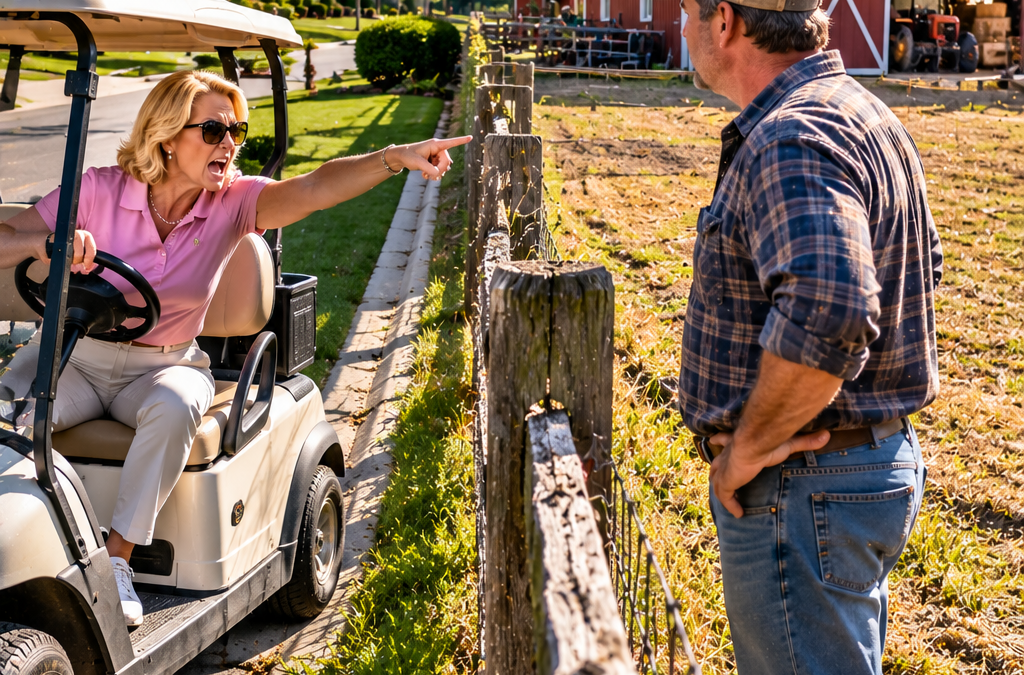
All I saw was a white golf cart approaching along the subdivision side of the boundary.
That alone was strange.
There was no legal road connecting Maple Hollow to my property.
She had driven across a strip of HOA common grass until she reached the fence line.
She wore a wide visor, large sunglasses, white pants, and a sleeveless polo shirt with the Maple Hollow logo embroidered near the collar.
She stopped the cart directly opposite where I was helping stack lumber.
She didn’t wave.
Didn’t say hello.
Didn’t ask whether I owned the property.
She raised one hand and pointed at the barn.
“You need to stop this immediately.”
I thought I had misheard her.
“Excuse me?”
“Construction needs to stop.”
I looked behind me at the crew.
Then back at her.
“Why?”
“It violates Maple Hollow’s architectural standards.”
I stared at her for several seconds.
“I’m not in Maple Hollow.”
Her mouth tightened.
“This structure is directly visible from our community.”
“That doesn’t make me part of your community.”
“It’s inconsistent with the established aesthetic.”
I almost laughed.
Not because she was funny.
Because the sentence was so absurd I couldn’t believe she had said it seriously.
“It’s a barn.”
“Exactly.”
“My property is zoned agricultural.”
She removed her sunglasses.
That was the first clear look I got at her face.
She had the expression of someone deeply irritated that I had not immediately apologized.
“Structures of this size require architectural review.”
“From the county.”
“From our architectural committee.”
“No.”
She blinked.
“No?”
“No. Your committee has nothing to do with my land.”
Her face changed.
Not much.
But enough.
Apparently people didn’t tell Karen no very often.
“You may want to familiarize yourself with the Maple Hollow community documents.”
“I don’t belong to Maple Hollow.”
“The property borders the community.”
“So?”
“The board has jurisdiction over exterior impacts affecting property values.”
“No, it doesn’t.”
Her voice cooled.
“Are you an attorney?”
“No.”
“Then perhaps you shouldn’t make legal conclusions.”
I wiped dust from my hands.
“Are you an attorney?”
She didn’t answer immediately.
“No.”
“Then I guess we’re even.”
One of the workers coughed to hide a laugh.
Karen heard it.
Her cheeks tightened.
She put her sunglasses back on.
“We’ll see about that.”
Then she turned the golf cart around and drove away.
I watched her disappear behind the trees.
The contractor beside me said, “Friend of yours?”
“Apparently.”
I thought that was the end of it.
Three days later, I opened my mailbox and found an envelope with the Maple Hollow Estates logo.
My first reaction was confusion.
Then I saw the words printed across the top.
NOTICE OF VIOLATION
I opened it standing beside the mailbox.
The letter stated that I was constructing an unauthorized accessory structure inconsistent with Maple Hollow community standards.
It ordered me to stop work immediately.
It demanded architectural plans for review.
And it threatened a five-hundred-dollar-per-day fine beginning if construction continued.
Five hundred dollars.
Per day.
On property that was not part of their HOA.
I actually laughed.
I carried the letter inside and called the number at the bottom.
A management employee answered.
I gave her the parcel address.
“I’m calling because somebody sent a violation notice to the wrong property.”
She put me on hold.
A few minutes later, another voice came on.
Familiar.
“This is Karen.”
I recognized her immediately.
“The golf cart.”
There was a pause.
“I am the president of the Maple Hollow Estates Homeowners Association.”
“That explains the attitude.”
“What can I help you with?”
“You sent me a five-hundred-dollar-a-day fine.”
“The association sent you a notice of noncompliance.”
“I’m not a member of the association.”
“That issue is not as simple as you’re representing it.”
“It seems pretty simple.”
“The parcel has historically been treated as part of the Maple Hollow influence area.”
I almost put the phone down to make sure I had heard correctly.
“The what?”
“The influence area.”
“Is that a legal term?”
“It is how the board has managed adjacent parcels.”
“Managed?”
“Yes.”
“You don’t manage my property.”
“Your parcel has effectively been absorbed into the community boundary over time.”
I stopped smiling.
“What does ‘effectively absorbed’ mean?”
“It means the board’s jurisdiction has long extended to parcels functionally associated with Maple Hollow.”
“Show me the recorded document.”
“What document?”
“The annexation.”
Silence.
“The amended declaration. The deed restriction. Anything with my parcel number on it.”
Karen’s voice hardened.
“You’re becoming unnecessarily adversarial.”
“I’m asking you to prove you have authority to fine me.”
“Our records are clear.”
“Send them.”
“We are not obligated to educate every property owner on decades of community history.”
“Then send me the one page that says I belong to your HOA.”
Another pause.
Instead of answering, she said, “You also owe past assessments.”
I thought I had misheard her.
“What?”
“If the property has not been paying dues, the account will need to be reconciled.”
“I have never received a dues bill.”
“That does not necessarily eliminate the obligation.”
“How much are you claiming I owe?”
“I would have to calculate the balance, including administrative fees.”
I sat down.
This had stopped being funny.
“You are telling me that land I bought independently, with a separate deed, agricultural zoning, and no HOA covenant somehow owes your subdivision retroactive dues?”
“That is the board’s position.”
“Based on what?”
“I’ve already explained that.”
“No, you’ve repeated a claim.”
Karen exhaled sharply.
“The barn construction will cease until you submit the appropriate plans.”
“No.”
“You will begin accruing fines.”
“You can write whatever number you want on paper. I don’t owe you anything.”
“We’ll see.”
She hung up.
The words were almost identical to what she had said at the property line.
We’ll see.
That became Karen’s favorite kind of threat.
Not specific enough to challenge.
Just vague enough to create anxiety.
The next letter arrived four days later.
Then another.
The claimed fines rose.
Five hundred dollars.
One thousand.
Two thousand.
Administrative fees appeared.
Document processing fees.
Legal review charges.
One notice referred to “continued defiance of board authority.”
Defiance.
That word told me everything.
This wasn’t about architecture.
Karen considered refusal a personal offense.
I kept building.
But I also started documenting.
Every envelope.
Every letter.
Every postmark.
Every voicemail.
Every email.
I made digital copies.
I created a folder on my computer and another in cloud storage.
I took photographs showing the construction progress and permit numbers.
I recorded dates.
Then Karen began visiting regularly.
Every few afternoons, the white golf cart appeared.
Sometimes she stayed on the HOA side of the boundary.
Sometimes she drove onto the edge of my gravel entrance until I told her to leave.
She photographed workers.
Vehicles.
Materials.
The barn.
Me.
One evening, I walked toward her while she was holding her phone up.
“Are you taking pictures of me?”
“I’m documenting violations.”
“From my property?”
“I’m on the shoulder.”
“You’re six feet past the survey stake.”
She looked down.
Then back at me.
“This access has historically been used by the community.”
“Get off my land.”
“You really should reconsider your tone.”
“My tone doesn’t change the property line.”
She drove away.
The next day, someone sent me screenshots from Maple Hollow’s private Facebook group.
Karen had posted a photograph of my barn.
The caption described it as an “unauthorized commercial agricultural structure threatening community property values.”
She claimed the board was “taking all appropriate enforcement measures.”
Comments piled up underneath.
Some residents asked what business I planned to operate.
I wasn’t operating one.
Others complained about livestock smell.
There were no livestock yet.
Someone said barns attracted rodents.
Another claimed the building would reduce resale values by ten percent.
Karen replied beneath several comments, thanking residents for “standing with the board.”
Then she posted a petition.
Protect Maple Hollow Property Values.
It demanded that construction cease.
I read it twice.
Then I put my phone down.
I had spent twelve years saving for that land.
I had followed every county rule.
I had built well within required setbacks.
The structure was clean, professionally built, and legal.
Yet a woman who had never contributed one dollar to my property was telling hundreds of strangers that I was a threat to their homes.
That was the moment annoyance turned into something heavier.
I started feeling watched.
Every unfamiliar car made me wonder whether somebody was photographing the property.
Every county vehicle made my stomach tighten.
Every letter in the mailbox became something I hesitated to open.
Karen hadn’t gained legal power over me.
But she had discovered something almost as effective.
She could create pressure.
Noise.
Fear.
She could make normal life exhausting enough that giving in started to feel attractive.
I understood why people surrendered to petty authority.
Not because they believed it.
Because they got tired.
I wasn’t going to let that happen.
The first time the HOA threatened a lien, I hired an attorney.
His name was Daniel Mercer.
He handled land-use disputes, zoning cases, easements, boundary conflicts, and municipal matters.
His office was forty minutes away.
I brought him a box of documents.
He read the deed first.
Then the subdivision declaration.
Then the county parcel map.
“You’re not in this HOA.”
“That’s what I’ve been saying.”
“Not even close.”
“They claim my parcel was informally absorbed.”
Daniel looked up.
“Informally annexed?”
“That’s their phrase.”
He laughed once.
“That’s not how property restrictions work.”
“I asked for paperwork.”
“They give you any?”
“No.”
He opened another letter.
“And they’re charging you dues?”
“They say they’ll calculate them retroactively.”
“Have they sent a number?”
“Not yet.”
Daniel leaned back.
“Don’t speak to them directly anymore.”
“Why?”
“Because either their president doesn’t understand the law or she understands it very well and thinks you don’t.”
“Which is worse?”
“The second.”
He sent Maple Hollow a formal letter.
It identified my parcel.
Cited the recorded deed.
Referenced the absence of HOA covenants.
Demanded that the association cease issuing fines or claiming jurisdiction unless it could produce recorded legal authority.
For about a week, everything stopped.
No golf cart.
No notices.
No calls.
I thought the letter had worked.
Then Karen escalated.
The HOA’s attorney replied that Maple Hollow reserved all rights concerning “historically integrated peripheral parcels.”
Daniel read the phrase aloud in his office.
“Historically integrated peripheral parcels.”
“Is that real?”
“It’s English.”
“That’s not what I asked.”
“No.”
He started researching.
Not just my deed.
The HOA itself.
The original declaration.
Amendments.
Plat maps.
County filings.
Board minutes he could obtain.
Property records for parcels surrounding Maple Hollow.
Two weeks later, he called.
“I found something.”
I drove to his office.
He had six parcel maps spread across the table.
Mine was one.
The others were properties along the northern and western edges of Maple Hollow.
“These parcels have something in common,” he said.
“They’re outside the subdivision?”
“Yes. And Maple Hollow has treated all of them like members.”
“How?”
“Violation notices. Dues. Architectural control.”
“Legally?”
“That’s the problem.”
Daniel pulled out an HOA document filed years earlier.
Karen had already been president when it was created.
The board had attempted to redefine what it called the “community service and appearance boundary.”
The language purported to include adjacent parcels that benefited from proximity to Maple Hollow roads, landscaping, and services.
But the document had not followed the legal procedure required to annex outside property into an HOA.
The parcel owners hadn’t voted.
Some hadn’t been notified.
No valid deed restrictions had been recorded against their land.
There was no proper amendment adding them to the declaration.
The HOA had essentially written a document saying its authority was larger than the authority recorded in the property records.
“Can they do that?” I asked.
Daniel gave me a look.
“If they could, any HOA could vote your house into its jurisdiction tomorrow.”
“So this is worthless?”
“As an annexation? It appears void.”
“Why would they do it?”
“Money may be part of it.”
He pointed at the other parcels.
“Some of these owners have been paying dues.”
I stared at him.
“Why?”
“Probably because the HOA told them they had to.”
“How many?”
“At least six I’ve identified.”
“For how long?”
“That varies.”
My anger changed.
Until then, I had thought Karen was obsessed with my barn.
Now I wondered whether the barn was only the first time she had encountered someone who demanded proof.
Daniel continued digging.
Construction progressed.
Roof.
Siding.
Doors.
Concrete floor.
The barn was nearly finished.
Karen’s online posts became angrier.
She called me a “noncompliant neighboring owner.”
She claimed I was “exploiting technicalities.”
That one made Daniel laugh.
“Technicality?”
He held up my deed.
“This is the technicality.”
The barn passed final county inspection.
The inspector signed the paperwork.
I framed a copy as a joke and hung it temporarily inside the workshop section.
The final construction day was clear and cool.
The crew finished before noon.
After they left, I stood inside alone.
The smell of fresh lumber and concrete was still strong.
Sunlight came through the open double doors.
I ran my hand along one of the interior posts.
Twelve years.
That was what I kept thinking.
Twelve years to get here.
I opened both large doors and stepped outside.
Then I heard tires on gravel.
A vehicle turned into my driveway.
White.
Marked.
Sheriff’s cruiser.
I didn’t panic.
But I wasn’t surprised either.
Some part of me had expected Karen eventually to call the police.
The deputy stepped out.
He looked tired.
Not hostile.
Just tired.
“Are you the property owner?”
“Yes.”
“We received a complaint regarding an illegal structure and a property dispute.”
“Let me guess. Maple Hollow.”
He looked at me.
“You’ve dealt with this before?”
“Not with you.”
I gestured toward the barn.
“Give me a minute.”
Inside, I had already prepared a folding table.
That was how predictable Karen had become.
On it sat a folder containing my deed, county permit, zoning approval, inspection reports, site plan, and Daniel’s correspondence with the HOA.
The deputy looked at the table.
“You were expecting company?”
“I was expecting her.”
He almost smiled.
I showed him the deed first.
Then the permit.
Then the final inspection.
He read everything carefully.
“Any court orders related to this property?”
“None.”
“The caller stated there was an active order prohibiting construction.”
“There isn’t.”
He looked at me.
“You’re certain?”
“My attorney would love to see one.”
He went back to his cruiser.
I could see him using the laptop.
A few minutes later, the golf cart appeared.
Karen.
Of course.
She drove faster than usual.
Stopped hard near the driveway.
Got out before the cart was fully settled.
“Officer, thank God.”
The deputy looked at her.
“Ma’am, are you the complainant?”
“I am the HOA president.”
“That wasn’t my question.”
She blinked.
“Yes.”
She pointed at the barn.
“This structure is illegal.”
The deputy glanced at the paperwork.
“The county issued a permit.”
“Not under our regulations.”
“He says the property isn’t part of your association.”
Karen laughed.
That same dismissive little sound I had learned to hate.
“He’s been making that claim for months.”
“It’s not a claim.”
I held up the deed.
Karen ignored me.
She moved closer to the deputy.
“This property was annexed into Maple Hollow years ago.”
“Do you have documentation?”
“Our attorney has it.”
Daniel had been asking for that documentation for weeks.
I almost admired her ability to say the same lie with fresh confidence.
The deputy asked, “Is there a court order requiring him to stop construction?”
Karen hesitated.
“The board issued an enforcement order.”
“Is it a court order?”
“It’s legally binding under the community covenants.”
“Ma’am.”
His voice changed slightly.
“Is there a court order?”
She looked at me.
Then back at him.
“Not from a judge.”
“So no.”
She crossed her arms.
“The board has authority.”
The deputy returned to his laptop.
“I’ve checked the county GIS and parcel information. His property is zoned agricultural. The building permit is valid. Inspection is complete.”
Karen’s face tightened.
“He intends to harbor livestock.”
“It’s agricultural land.”
“That will create odor.”
“That’s not a sheriff’s matter.”
“He intends to operate a business.”
I spoke.
“No, I don’t.”
Karen pointed at me.
“He said he was building a workshop.”
The deputy looked at me.
“Are you running a commercial operation?”
“No.”
“A workshop on agricultural property isn’t automatically a commercial business anyway,” he said.
Karen looked increasingly desperate.
“This structure violates our neighborhood design plan.”
The deputy closed the laptop.
“Ma’am, this property is not in your HOA’s jurisdiction.”
Karen stared at him.
The words seemed not to register.
He repeated them.
“According to the county records I’m looking at, this parcel is separate from Maple Hollow Estates. He has not violated any law by building this barn.”
Karen’s face lost color.
“But our board—”
“I’m talking about law, not board policy.”
“He refused compliance.”
“He’s not required to comply with an HOA he doesn’t belong to.”
Silence.
For the first time since I met Karen, she had no immediate response.
No threat.
No smile.
No “we’ll see.”
Nothing.
Then the deputy continued.
“And I need to address the information provided in the call.”
Karen’s eyes narrowed.
“What information?”
“The report stated that he was violating a court order.”
“I said an enforcement order.”
“The dispatcher notes say court order.”
“I may have said legal order.”
The deputy watched her carefully.
“Repeatedly providing false information to law enforcement can become a serious issue.”
Her mouth opened.
He continued before she could interrupt.
“If you have a civil dispute, you handle it through attorneys and the courts. You do not represent a nonexistent court order to create police intervention.”
“I did not lie.”
“I’m telling you to be careful.”
Karen looked toward me.
For the first time, I saw fear beneath the anger.
Not guilt.
Fear.
There is a difference.
She wasn’t suddenly sorry for months of harassment.
She was frightened because someone with actual authority had told her there were boundaries she couldn’t invent.
She climbed back into her golf cart without saying another word.
The deputy watched her drive away.
Then he looked at me.
“Keep your documents.”
“I have an attorney.”
“Good.”
He handed back the permit.
“This sounds like it’s getting bigger than a barn.”
He had no idea how right he was.
Neither did I.
Daniel called the following morning.
I told him about the sheriff.
When I finished, he was quiet.
“What?”
“I want a copy of the incident report.”
“Why?”
“Because I’ve found more.”
He had contacted two of the adjacent property owners.
Both believed they were HOA members.
Neither had ever knowingly joined.
One had been paying Maple Hollow dues for eight years.
The other had paid for eleven.
“They have HOA documents,” I said.
“They have invoices.”
“Same thing?”
“No.”
Daniel explained it carefully.
A homeowners association’s authority over property usually comes through recorded covenants or another legally valid mechanism binding the parcel.
Sending someone a bill does not create a covenant.
Paying that bill because you were told you owed it does not necessarily cure an invalid annexation.
The homeowners had simply trusted Maple Hollow’s representation that their parcels had become part of the association.
“How much money?”
“Thousands per property.”
“And Karen knows?”
“She signed some of the assessment notices personally.”
That was the moment the case stopped being about me.
Daniel prepared a formal report outlining the attempted annexation.
The lack of required procedure.
The absence of recorded amendments.
The collection of dues.
The fines.
The enforcement letters.
My property was included as the clearest recent example because I had refused from the beginning.
The sheriff’s incident added something important.
It showed that Karen had attempted to involve law enforcement by claiming authority she did not possess.
Daniel sent the relevant materials to the state attorney general’s consumer protection division and the appropriate state offices overseeing nonprofit and association conduct.
I didn’t expect much.
Government investigations have their own pace.
Then one of the other property owners contacted another.
And another.
Five joined the complaint.
One woman named Margaret had paid Maple Hollow for nearly a decade.
She was sixty-eight.
Her parcel had belonged to her husband before he died.
She invited me into her kitchen and brought out a folder of HOA receipts.
“I thought we had to,” she said.
“Did you ever sign anything?”
“No.”
“Did your husband?”
“Not that I know.”
She pulled out a letter from Karen.
It threatened a lien for unpaid dues.
The language was almost identical to the letters I had received.
Margaret looked embarrassed.
“I paid because I was afraid they’d take the house.”
I felt something twist inside me.
“That’s what she wanted.”
“I should’ve asked questions.”
“No.”
I shook my head.
“You shouldn’t need a land-use attorney every time somebody sends you an invoice.”
Margaret looked at the papers.
“How long has she been doing this?”
That became the question everyone wanted answered.
The state inquiry started quietly.
Requests for records.
Financial statements.
Board minutes.
Assessment ledgers.
Annexation documents.
Bank records.
Management contracts.
Karen initially told residents it was a routine review prompted by a “disgruntled neighboring landowner.”
Me.
She posted an announcement accusing outside parties of trying to interfere with Maple Hollow’s governance.
She never used my name.
She didn’t need to.
Everybody knew.
Her supporters attacked me online.
One called me bitter.
Another claimed I was trying to avoid paying my fair share while benefiting from Maple Hollow’s property values.
That argument fascinated me.
Apparently the fact that their subdivision existed near my land meant I owed them money.
By that logic, every house near a nice restaurant owed the restaurant dues.
I stopped reading the comments.
Daniel told me something important.
“Let Karen talk.”
“Why?”
“Because she’s documenting her mindset for us.”
I followed his advice.
Then the records started coming out.
The invalid annexation was worse than we thought.
Years earlier, Maple Hollow had wanted to expand the dues base.
There had been discussions about several adjacent parcels.
Some board members raised questions about whether those owners could legally be added.
Karen pushed the issue.
The board adopted what it called a jurisdictional expansion policy.
But they never obtained the required owner consent.
Never properly amended the declaration.
Never recorded enforceable restrictions against the parcels.
Never completed the legal process necessary to bring the land into the HOA.
Yet billing began anyway.
Some owners challenged it.
They received enforcement letters.
Others paid.
The association treated the payments as proof the parcels belonged.
Years of repetition transformed an invalid decision into something Karen apparently believed could no longer be questioned.
Then investigators started looking at the money.
That was where everything accelerated.
Dues collected from the outside parcels had been placed into the association’s general accounts.
Fines were collected too.
Administrative charges appeared.
Legal fees.
Processing fees.
Late penalties.
But several categories did not reconcile cleanly with the annual budgets provided to homeowners.
Thousands of dollars in fees were poorly documented.
Some expenses had been approved without the procedures required by the bylaws.
Recordkeeping was inconsistent.
Not every irregularity was necessarily criminal.
But taken together, they painted a picture of an organization that had been operating with far less discipline than Karen’s confident letters suggested.
Residents became furious.
Not because of my barn.
Because they realized the woman who had spent years lecturing them about strict compliance had not been following the association’s own rules.
The irony was impossible to miss.
Karen had fined people for leaving garbage cans visible.
Meanwhile, major governance decisions weren’t properly recorded.
She had lectured people about approved paint colors.
Meanwhile, the HOA was collecting money from land it did not legally govern.
She had threatened liens over tiny violations.
Meanwhile, some of the HOA’s own financial records couldn’t clearly account for fees it had collected.
The first emergency community meeting after the investigation became public was packed.
I wasn’t technically a member, so I had no voting rights and no reason to attend.
Margaret called me afterward.
“You should have seen it.”
“What happened?”
“Karen tried to blame you.”
I laughed.
“Of course.”
“She said this all started because you refused to be a good neighbor.”
“What did people say?”
“Someone asked her whether being a good neighbor meant paying dues to an HOA you don’t belong to.”
I wished I had been there for that.
Karen’s grip started weakening.
Two board members resigned.
A third publicly stated that he had relied on Karen and the management company for representations about the annexed parcels.
Then the attorney general’s office issued findings challenging the association’s collection practices concerning non-member landowners.
Refunds became unavoidable.
Maple Hollow was ordered to return improperly collected dues and fees.
For some owners, that meant years of payments.
Margaret cried when Daniel explained what she was likely getting back.
“I could’ve used that money when my husband was sick.”
There was nothing to say to that.
That was the part people missed when they called HOA disputes petty.
Five hundred dollars here.
A hundred dollars there.
A late fee.
An administrative charge.
To an organization, those are ledger entries.
To a household, they are groceries.
Medication.
Utility bills.
A car repair.
Hours of someone’s life.
Karen had always spoken about assessments as if compliance mattered more than the people paying them.
Now the same numbers were being calculated in reverse.
The other affected property owners joined legal action seeking restitution.
The case developed into a broader group claim.
I was included because Maple Hollow had attempted to impose dues, fines, and restrictions on my parcel.
My barn became Exhibit A for what happened when one outside owner refused to accept their invented authority.
Karen was removed from the board before the larger case reached final judgment.
The board initially described it as a leave of absence.
Nobody believed that.
A week later, her name disappeared from the HOA website.
Then a formal notice confirmed new officers had been appointed.
The white golf cart vanished too.
That surprised me.
For months, I had associated its little electric motor with trouble.
Sometimes I would hear a golf cart somewhere in Maple Hollow and instinctively look toward the property line.
Then one day I realized I hadn’t seen Karen in weeks.
The barn stood exactly where it always had.
Fully permitted.
Fully inspected.
Fully mine.
But the legal case kept expanding.
Refund liabilities hurt Maple Hollow badly.
Legal fees mounted.
The board’s prior actions were challenged.
The governing structure itself came under scrutiny because amendments, voting records, and financial administration had become tangled together over years of poor governance.
I asked Daniel one afternoon whether the HOA could survive.
“Maybe.”
“That doesn’t sound confident.”
“It’s fixable in theory.”
“In practice?”
He looked at the files.
“That depends on whether the association’s current legal structure can be separated from years of invalid actions without causing more problems than restructuring entirely.”
I thought about the houses inside Maple Hollow.
“What happens to the homeowners?”
“They still own their homes.”
“I mean roads, common areas, pool.”
“Those issues will have to be resolved.”
I didn’t celebrate.
I wanted Karen stopped.
I wanted the illegal fines erased.
I wanted people refunded.
But hundreds of residents lived there.
Most hadn’t created this mess.
The HOA may have been abusive under Karen, but it also maintained common property.
Reality was more complicated than simply cheering for destruction.
Six months after the sheriff first drove into my driveway, the court issued its ruling.
Maple Hollow’s existing HOA organization was dissolved.
The exact transition of common assets required additional legal handling, but the association Karen had used as a personal enforcement machine ceased operating in its former form.
I sat in Daniel’s office reading the order.
“That’s really it?”
“For that association, yes.”
“Six months.”
“Six months.”
I thought about the first time Karen stopped her golf cart at my property line.
You need to stop this immediately.
She had been so certain.
Not curious.
Not cautious.
Certain.
She never asked to see my permit.
Never asked whether my land was part of the HOA.
Never checked whether she actually had authority before issuing threats.
She simply saw something she didn’t like and assumed her title gave her power over it.
One phone call to the sheriff had exposed the difference between assumed authority and real authority.
But the phone call alone did not destroy Maple Hollow.
Karen’s history did.
The illegal annexation.
The dues.
The fines.
The missing procedures.
The financial irregularities.
The years of relying on intimidation because so few people asked for proof.
My barn was only the loose thread.
Karen pulled it herself.
Residents changed after the dissolution.
At first, some blamed me.
I expected that.
Their routines had been disrupted.
They had legal meetings.
Asset questions.
Maintenance uncertainty.
Arguments about what kind of new neighborhood organization, if any, should replace the old system.
It was easier for some people to blame the outsider with the barn than acknowledge years of poor governance inside their own community.
But that faded as more records became public.
People began understanding that if the problem hadn’t surfaced through me, it would eventually have surfaced through someone else.
Maybe during a home sale.
Maybe during a lien challenge.
Maybe when one of the illegally billed parcel owners died and an estate attorney checked the deed.
Karen’s system depended on nobody looking too closely.
Systems like that always have an expiration date.
Margaret received her refund.
So did the other outside property owners.
My fake fines disappeared entirely.
The retroactive dues claim vanished.
The threats stopped.
The barn stayed.
A year later, I finally put animals in it.
Just a few goats at first.
Karen had once told the sheriff I was harboring illegal livestock before a single animal lived on the property.
The first morning I opened the barn door and watched two goats wander into the pasture, I laughed.
There was something deeply satisfying about how ordinary it was.
No violation notice.
No golf cart.
No photographs.
No petition.
Just animals standing on agricultural land beside a legal agricultural barn.
Exactly what the county permit had allowed from the beginning.
I built the workshop section that winter.
Workbench.
Tool cabinets.
Electrical outlets along the wall.
A heater.
Nothing commercial.
Just my space.
Sometimes I worked late with the doors closed while rain hit the metal roof.
Those nights were when the twelve years of saving felt most worth it.
The barn wasn’t merely still standing because I had won an argument.
It stood because I had refused to let somebody else’s confidence become more important than my deed.
I eventually heard that Karen moved away.
Out of state, according to people in Maple Hollow.
I never confirmed where.
I didn’t care enough to find out.
Someone said she sold quickly.
Someone else said she couldn’t stand the way residents treated her after the investigation.
Maybe those stories were exaggerated.
Small communities love a dramatic ending.
What I know is that she disappeared from the place she had once controlled.
Her reputation didn’t survive the records.
People who had defended her started pretending they never trusted her.
People who had feared her started telling stories.
The strangest part was hearing how many.
A retired couple had been fined repeatedly over a fence until they paid thousands for replacement.
A young mother received escalating notices after questioning a landscaping contract.
Another resident claimed Karen had threatened legal action over a basketball hoop placed several feet from an approved location.
Maybe every complaint was legitimate.
Maybe some were exaggerated after the fact.
I can’t know.
What I do know is that Karen had created a culture where people assumed challenging her would make their lives worse.
That alone was enough.
Authority doesn’t have to be unlimited to become abusive.
It only has to feel too expensive to challenge.
Karen understood that instinctively.
A violation letter costs very little to send.
Fighting one may require hours.
Phone calls.
Documents.
Meetings.
Legal advice.
People surrender because they have jobs.
Children.
Mortgages.
Ill parents.
Lives.
Karen mistook exhaustion for consent.
That was the foundation of her power.
I happened to be stubborn enough, angry enough, and prepared enough to make resistance cheaper than surrender.
And I had something else.
Paperwork.
People laugh about paperwork until they need it.
My deed.
Permit.
Inspection certificates.
Photographs.
Certified letters.
Screenshots.
Voicemails.
Attorney correspondence.
County maps.
Every time Karen made another accusation, I added another document.
By the end, my evidence filled boxes.
Her authority fit on nothing.
That contrast still stays with me.
Karen had titles.
President.
Board.
Compliance.
Community standards.
Jurisdiction.
I had records.
When actual authorities became involved, records won.
The deputy who came to my barn never raised his voice.
He didn’t humiliate Karen.
He didn’t lecture her dramatically.
He checked the facts.
That was enough.
He looked at the county map.
Looked at the permit.
Looked at the deed.
Then said what Karen had refused to accept for months.
This property isn’t in your HOA’s jurisdiction.
A simple sentence.
Everything afterward flowed from it.
Not because the sheriff dissolved the HOA.
He didn’t.
Not because one false report automatically created a state investigation.
It didn’t.
But Karen had spent years building a system around one assumption:
Nobody would force her to prove that Maple Hollow had the authority she claimed.
The sheriff’s call forced the first real comparison between her words and public records.
Daniel forced the next.
The other property owners forced more.
Investigators followed.
Courts followed.
Once the documents started being compared, the illusion couldn’t survive.
I sometimes wonder what would have happened if I had obeyed her that first afternoon.
Imagine it.
Karen pulls up in her golf cart.
She points at my half-built barn.
You need to stop this immediately.
And I do.
I call the contractor.
Tell him to leave.
Lose deposits.
Pay cancellation costs.
Maybe tear down the frame.
Then the violation letter arrives.
I pay.
Then the HOA claims retroactive dues.
Maybe I negotiate.
Maybe I write a check because hiring a lawyer feels expensive.
Karen adds my parcel to another spreadsheet.
Years pass.
At some point, I might even begin believing I belonged to Maple Hollow.
That thought bothers me.
Not because I came close to doing it.
Because other people had.
Margaret did.
For years.
She didn’t pay because Maple Hollow was legally right.
She paid because their letterhead looked official and the threat looked expensive.
Karen had built power out of presentation.
That is why I never laugh at threatening paperwork anymore.
A false claim can still cause real fear.
An invalid fine can still keep someone awake.
A nonexistent lien threat can still make an elderly widow write a check.
Words don’t need legal authority to hurt people.
They only need to convince someone authority exists.
The rebuilt neighborhood structure that eventually replaced parts of the old HOA was much narrower.
Residents organized maintenance arrangements for the common property.
Some services became voluntary.
Others were managed under new recorded agreements drafted with actual legal oversight.
I stayed outside all of it.
Exactly where I had always been.
The property line never moved.
That’s one of the strangest things about the entire story.
For all the meetings, letters, threats, investigations, lawyers, refunds, and court orders, my land never changed location.
The five acres were exactly where the deed said they were on the day I bought them.
Karen’s golf cart didn’t move the boundary.
Her violation letters didn’t move it.
A board vote didn’t move it.
A Facebook petition didn’t move it.
Calling the sheriff didn’t move it.
The fight existed because Karen thought authority could stretch simply because she wanted it to.
It couldn’t.
Sometimes I stand at the far edge of my pasture and look toward Maple Hollow.
The neighborhood is still there.
The houses didn’t collapse because my barn existed.
Property values didn’t fall off a cliff.
The sky didn’t change color.
People still mow lawns.
Kids still ride bikes.
Delivery vans still come and go.
The catastrophic consequences Karen predicted never happened.
My barn did not destroy Maple Hollow.
Her leadership nearly did.
There is a lesson in that distinction.
She spent enormous energy protecting the neighborhood from an imaginary threat outside its boundaries while ignoring very real problems inside the organization she controlled.
My barn was visible.
Her bad governance wasn’t.
So she attacked the thing people could see.
That made sense politically.
It did not make sense legally.
By the end, residents weren’t furious because they could see my roof above the tree line.
They were furious because they had finally seen the books.
I have changed since then too.
Before Karen, I assumed property ownership was mostly physical.
You buy something.
You maintain it.
You pay taxes.
It’s yours.
Now I understand that ownership also requires attention.
You keep records.
You read notices.
You verify claims.
You ask for authority in writing.
You don’t assume official-looking language is official.
You don’t let somebody turn repetition into truth.
And sometimes you have to spend money defending something you already paid for.
That last part still irritates me.
I shouldn’t have needed Daniel.
I shouldn’t have needed months of documentation.
I shouldn’t have needed to explain my own deed to an organization with no legal connection to it.
But fairness and reality aren’t the same thing.
Sometimes protecting your rights costs money even when you are unquestionably right.
The important thing is knowing which fights matter.
The barn mattered.
Not because it was a barn.
Because Karen wasn’t asking me to move a fence three inches.
She was demanding that I accept a completely invented premise.
That my private land belonged under her control.
Once I accepted that premise, every later argument would begin from it.
The barn.
Animals.
Workshop.
Land use.
Future sale.
Maybe even who could buy the property after me.
That’s why I couldn’t compromise.
You can’t compromise over whether someone has authority that does not exist.
Either the parcel belonged to Maple Hollow or it didn’t.
It didn’t.
Everything after that was noise.
A few months after the final legal issues were resolved, I found the first HOA violation letter while cleaning the workshop.
I had kept a copy inside a drawer.
The paper was slightly wrinkled.
Maple Hollow logo at the top.
Formal language.
Five-hundred-dollar daily fine.
Unauthorized structure.
Community standards.
I read it again.
Then I walked outside.
The barn stood in front of me.
Metal siding catching the afternoon light.
Double doors open.
Tools inside.
Goats near the fence.
Nothing about it had changed.
The letter had once scared me.
Now it looked ridiculous.
I considered throwing it away.
Instead, I framed it.
Not prominently.
It’s hanging near the workbench.
People sometimes ask about it.
I tell them it’s the most expensive piece of worthless paper anyone ever sent me.
The wording still makes me smile.
FAILURE TO COMPLY MAY RESULT IN ADDITIONAL ENFORCEMENT ACTION.
They certainly got additional enforcement action.
Just not the kind Karen expected.
The last time I saw her was before she moved.
I was driving home.
She was standing beside a moving truck outside her house.
For a moment, I considered continuing without stopping.
Then she saw me.
We looked at each other.
I pulled over.
Not because I wanted revenge.
Not because I needed an apology.
I was curious.
I got out.
Karen folded her arms.
“What do you want?”
Same tone.
Softer now.
“Nothing.”
“Then why stop?”
I looked at the moving truck.
“Heard you were leaving.”
“People talk too much.”
“They do.”
She looked toward my property beyond the neighborhood.
“You happy?”
It was an odd question.
“About what?”
“Everything.”
“The barn?”
“The HOA.”
I thought before answering.
“I’m happy people got their money back.”
Her jaw tightened.
“You destroyed this community.”
There it was.
Even then.
No reflection.
No acknowledgment.
“You really believe that?”
“You started all of it.”
“I built a barn.”
“You refused to cooperate.”
“With rules that didn’t apply to me.”
She looked away.
“The association had functioned for years.”
“That doesn’t mean it was functioning legally.”
“You could have handled it privately.”
“I tried. I asked you for documentation.”
“You wanted a fight.”
“No, Karen.”
I looked directly at her.
“You wanted obedience.”
That landed.
She didn’t respond.
For several seconds, neither of us spoke.
Then I said the one thing I had wanted her to understand from the beginning.
“You never had to like my barn.”
Her eyes came back to me.
“You never had to think it was pretty. You never had to believe it helped your property values. You could’ve complained about it every day for the rest of your life.”
I pointed toward the edge of the neighborhood.
“But you did not own my five acres.”
Her face hardened.
I continued.
“That was the whole problem.”
I got back into my truck.
Karen never apologized.
I didn’t need her to.
Some people think closure requires the other person to admit they were wrong.
It doesn’t.
Sometimes closure is simply reaching a point where their refusal no longer has power over you.
I drove home.
The barn doors were open when I arrived.
The sunset was turning the metal roof orange.
I parked and stood there for a while.
Twelve years of saving.
Months of harassment.
Letters.
Threats.
A sheriff’s cruiser.
Lawyers.
State investigators.
Court filings.
All because one woman stopped at a property line and decided she could move it with confidence.
The barn is older now.
There are scratches on the doors.
Mud along the lower siding.
The concrete floor has stains.
Tools cover the workbench.
It no longer looks new.
That’s a good thing.
It looks used.
It looks lived in.
It looks like what I always intended it to be.
Some mornings, I arrive before sunrise.
I switch on the lights.
The animals hear me and start moving.
I make coffee on a little machine in the workshop.
Then I open the big doors.
From there, if I look toward the east, I can see a few Maple Hollow rooftops above the trees.
I don’t feel anger anymore.
Mostly I feel relief.
The boundary is quiet.
Nobody drives a golf cart to it.
Nobody takes pictures.
Nobody tells me which structures I can build.
Nobody sends me five-hundred-dollar fines.
The peace is almost ordinary.
That’s what I wanted from the beginning.
Not revenge.
Not the destruction of an HOA.
Not headlines.
Five acres.
A barn.
Room to work.
Room to breathe.
Karen turned it into something bigger because she could not tolerate one fact.
I was outside her control.
In the end, that fact remained exactly what it had been on the first afternoon she pointed at my barn.
My deed was mine.
My permit was valid.
My barn was legal.
Her HOA had no jurisdiction over any of it.
The sheriff didn’t create that truth.
My lawyer didn’t create it.
The investigators didn’t create it.
The court didn’t create it.
They only forced Karen to confront what had been true all along.
She had authority inside the boundaries the law gave her.
Not one inch beyond them.
And all those years she spent pretending otherwise eventually cost her the one thing she cared about most.
Control.




