𝗙𝗨𝗟𝗟 𝗦𝗧𝗢𝗥𝗬 The HOA President Laughed at My Deed While Her $4 Million Clubhouse Rose Across Land My Family Had Owned Since 1978
𝗙𝗨𝗟𝗟 𝗦𝗧𝗢𝗥𝗬
Maybe the equipment was beside my property.
Maybe I had misjudged the line from the road.
Maybe the HOA was working on land adjacent to mine.
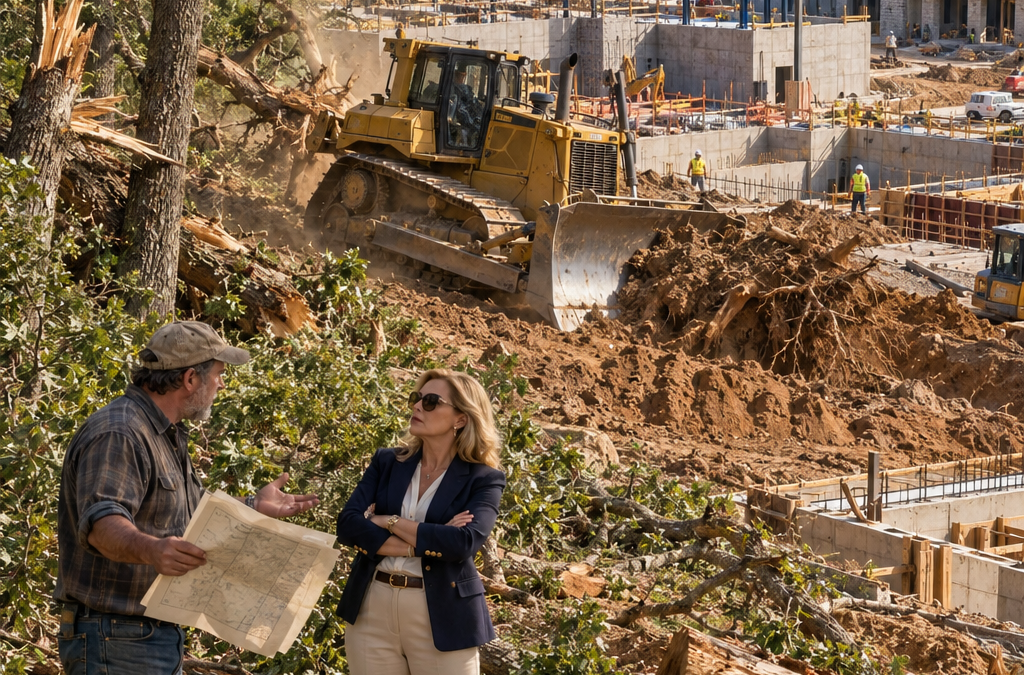
Then the bulldozer pushed over an oak tree.
Not a sapling.
A real oak.
Thirty inches through the trunk at least.
The roots tore upward.
The tree leaned.
Then it crashed.
I pulled onto the shoulder so hard that gravel sprayed behind me.
My hands were already shaking when I got out.
I climbed through an opening in the temporary fence.
A worker in a hard hat noticed me.
“Sir, you can’t be in here.”
I kept walking.
“Whose project is this?”
“You need a vest.”
“Whose project?”
He looked toward another man near the excavator.
The second man approached.
“Can I help you?”
“Why are you digging here?”
“This is the Somerset Hills amenity expansion.”
“What expansion?”
“New clubhouse.”
I stared at him.
“Where?”
He pointed around us.
“Here.”
My heart started pounding.
“This is my land.”
He looked genuinely confused.
“No, sir.”
“Yes.”
“The HOA owns the parcel.”
“They don’t.”
He glanced toward the construction trailer.
“I don’t handle property issues.”
“Who authorized this?”
“Somerset Hills HOA.”
“Who specifically?”
“The board.”
“When?”
“Project’s been in planning for over a year.”
“How long?”
He checked his memory.
“Eighteen months, maybe.”
Eighteen months.
I had received nothing.
No letter.
No certified notice.
No purchase offer.
No easement request.
No phone call.
Nothing.
Meanwhile, they had designed a building.
Hired architects.
Hired surveyors.
Secured permits.
Awarded contracts.
And begun clearing land my grandfather bought before most of the people making those decisions were even living in the county.
I walked farther into the site.
My grandfather’s clearing was gone.
Not damaged.
Gone.
The three oaks were down.
The ground had been churned into mud.
A construction trailer sat almost exactly where he used to unfold that chair.
I don’t know how long I stood there.
The worker finally said, more gently this time, “Sir, you really need to call the HOA.”
I looked at him.
“They know this isn’t theirs.”
He didn’t answer.
I drove home.
I shouldn’t have.
I should have driven directly to the county recorder.
I should have called a lawyer.
Instead, I called Somerset Hills because some naive part of me still believed there had been a mistake.
A woman answered.
“Somerset Hills Association.”
“I need to speak with someone about the clubhouse construction.”
“Are you a resident?”
“No.”
“Then I can take a message.”
“You are building it on my property.”
There was a pause.
Then she said, “I’m sorry?”
“The land where you’re building the new clubhouse belongs to me.”
She began typing.
“May I have your name?”
I gave it.
Another pause.
“I see the parcel.”
“Good.”
“The parcel is association property.”
“No. It isn’t.”
“According to our records, it is.”
“Your records are wrong.”
“Sir, the board has been planning this project for more than a year.”
“That doesn’t make you the owner.”
Her tone changed.
It became patronizing.
“I’m sure there may be some confusion about historical boundaries.”
“There isn’t.”
“I can note your concern.”
“My concern?”
“Yes.”
“You have bulldozers on land I own.”
She exhaled.
The sound was small but unmistakable.
Annoyance.
“Sir, we are not going to stop a multimillion-dollar approved construction project because someone calls claiming ownership.”
Someone.
I gripped the phone harder.
“I am not someone claiming ownership. I am the recorded owner.”
Then she laughed.
Actually laughed.
Not loudly.
Just one short, dismissive sound.
It lasted maybe half a second.
I would remember it for years.
“Sir, Somerset Hills has attorneys and professional surveyors. I assure you, the association did not accidentally build on somebody else’s property.”
I closed my eyes.
“You might want to assure yourself again.”
Then I hung up.
That laugh changed something in me.
Before it, I still believed I was dealing with an error.
After it, I understood I was dealing with arrogance.
I requested a meeting with the board.
The earliest date they offered was three weeks away.
“Construction needs to stop until then,” I said.
The administrator told me she could not halt an approved project without board authority.
“Then get board authority.”
“The board president has been informed of your claim.”
“And?”
“She has instructed construction to continue.”
That was the first time I heard about Evelyn Harcourt.
President of the Somerset Hills HOA.
Evelyn had spent years in luxury property management before joining the board.
Residents later described her to me as efficient.
Strict.
Difficult.
Controlling.
Her supporters said she had “professionalized” Somerset Hills.
Her critics said she treated the association as if she owned every house inside the gates.
By the time I met her, I understood why.
I spent the three weeks before the meeting gathering documents.
My grandfather’s 1978 deed.
My mother’s inheritance records.
Probate documents.
Tax statements.
County parcel maps.
Old survey markers.
Everything.
I placed them in a binder.
I also called the county planning office.
They confirmed Somerset Hills had received approval for an amenity center.
But county approval, they explained, relied partly on plans submitted by the HOA.
The county wasn’t certifying ownership.
It was approving construction based on the applicant’s representations.
“Did anybody verify whose parcel it was?” I asked.
The county employee hesitated.
“Property ownership disputes are generally civil matters.”
That answer would become painfully familiar.
When the board meeting finally came, construction had continued every single day.
More trees were gone.
Excavation had begun.
A temporary road had been cut through part of the property.
I arrived at the Somerset Hills clubhouse fifteen minutes early.
Their existing clubhouse was already impressive.
Tall stone columns.
A reception desk.
Leather furniture.
Framed photographs of golf tournaments and charity galas.
Apparently that wasn’t enough.
They wanted another one.
The meeting room held a long polished table.
Seven board members sat on one side.
Evelyn Harcourt sat in the center.
She was probably in her late fifties.
Perfect silver-blonde hair.
Dark blazer.
Gold watch.
Pearl earrings.
She had the kind of posture that made everyone else in the room seem slightly underdressed.
I sat opposite her.
She didn’t offer coffee.
Didn’t introduce the other board members.
Didn’t ask how I was doing.
She looked at the folder in front of me.
“I understand you believe there’s a boundary issue.”
“I know there’s a boundary issue.”
She smiled faintly.
“Let’s try to keep this constructive.”
“I’m trying.”
I opened the binder.
“This deed is from 1978.”
I slid it toward her.
“My grandfather bought five acres.”
She barely looked at it.
“This is the current county parcel map.”
Another page.
“This is the probate transfer to my mother.”
Another.
“This is the transfer from my mother to me.”
Evelyn rested one hand on the table.
“Our surveyor reached a different conclusion.”
“Where is that survey?”
“Our counsel has reviewed it.”
“I asked to see it.”
“You can request documents through counsel.”
“Your bulldozers are already on my property.”
She sighed.
Not angry.
Bored.
That somehow made me angrier.
“Mister—”
She used my name.
“The association has spent eighteen months planning this project. Engineering has been completed. Financing has been approved. The county approved the construction package. Contracts have been signed.”
“None of that proves you own the land.”
“Our professionals disagree with you.”
“My deed doesn’t.”
“Old deeds can contain outdated descriptions.”
“It isn’t outdated.”
“Our surveyor says otherwise.”
One of the board members shifted uncomfortably.
I leaned forward.
“Are you telling me you’re building a four-million-dollar clubhouse on land you don’t legally own?”
Evelyn smiled.
Actually smiled.
“We are building a four-million-dollar amenity center on association property.”
“It isn’t association property.”
“If you disagree, you’re welcome to take it up with our attorneys.”
It was the tone that stayed with me.
Not merely confident.
Contemptuous.
She didn’t think I could stop them.
Why would she?
She had an HOA with hundreds of homeowners paying dues.
A legal budget.
Professional counsel.
Engineers.
Architects.
Contractors.
Insurance.
I had a binder.
She looked at me and saw a man attached to an old piece of woodland.
Someone inconvenient.
Someone who would eventually get tired.
Or scared.
Or broke.
I stood.
The chair legs scraped across the floor.
Everyone looked at me.
I gathered my papers.
Then I looked directly at Evelyn.
“I will.”
Her smile remained.
“Excuse me?”
“You said take it up with your attorneys.”
I closed the binder.
“I will.”
Then I walked out.
I wish I could say that was the moment I became fearless.
It wasn’t.
By the time I reached my truck, my hands were shaking.
I sat behind the wheel for nearly ten minutes before starting the engine.
I wasn’t wealthy.
I had savings.
Not lawsuit-against-a-multimillion-dollar-HOA savings.
I knew enough about civil litigation to understand that being right and being able to afford proving you’re right are very different things.
But I also knew what happened if I did nothing.
The building would finish.
The land would disappear beneath concrete.
A year later, they’d point to a completed clubhouse and say changing anything would be too disruptive.
Five years later, someone would claim my family had abandoned its rights.
Ten years later, nobody would remember the dispute at all.
So I started with the most basic thing.
A survey.
The first surveyor I contacted refused the job after learning Somerset Hills was involved.
“Conflict?” I asked.
“Business relationship.”
The second had done subcontract work for the development.
The third agreed.
His name was Paul Redmond.
He was nearly seventy, semi-retired, and had been surveying property in the county since before Somerset Hills existed.
He spent two days on the land.
I followed him for part of it.
He located monuments.
Compared legal descriptions.
Checked bearings.
Measured distances.
Pulled historic plats.
On the third day, he called me.
“How bad is it?” I asked.
“Bad for them.”
“How much?”
“You better come to my office.”
Paul laid two maps on a table.
One showed my parcel.
The other showed the HOA’s construction plan.
He placed transparent overlays across them.
The building footprint was almost entirely inside my boundary.
I stared.
“How far?”
“Depending on the corner, around fifty-five to sixty feet beyond where their survey places the line.”
“Sixty feet?”
“Almost.”
“Could you be wrong?”
He looked insulted.
“I could always be wrong.”
Then he tapped three monument references.
“But I’m not.”
He showed me the old survey call.
The modern county GIS information.
Physical monuments.
My grandfather’s deed.
Everything aligned.
“How does somebody miss sixty feet?”
Paul looked at the HOA plan.
“That’s the interesting question.”
I paid him money I could barely afford.
Then I sent the report to Somerset Hills.
Certified mail.
Email.
Copy to their attorney.
I included a simple request.
Stop construction immediately until ownership is resolved.
Their lawyer replied.
Two lines.
The Association maintains its position regarding ownership of the disputed parcel. All further correspondence should be directed to legal counsel.
That was it.
Forty years of family ownership.
A professional survey.
Mature trees already destroyed.
And they gave me two sentences.
Construction continued.
They didn’t slow down after receiving my report.
They accelerated.
Within weeks, the foundation excavation was completed.
Then concrete trucks arrived.
I drove past one morning and saw forms surrounding the footprint.
Another day, rebar.
Then the pour.
I sat in my truck across the road and watched wet concrete fill what used to be forest floor.
There is a helplessness unlike anything else in watching someone permanently alter something you own while lawyers tell you the argument will take time.
I wanted to drive through the construction gate.
Block the equipment.
Chain myself to a tree.
Anything physical.
Anything immediate.
My attorney hadn’t even been hired yet, and already everyone I called said the same thing.
“Don’t interfere with the workers.”
“Don’t trespass on the active site.”
Trespass.
On my own land.
The word nearly broke me.
Four months after the first bulldozer, structural steel rose above the remaining trees.
Every beam felt like an insult.
The building was designed to be beautiful.
Stone exterior.
Large windows.
Covered terrace.
Pool deck.
Event space.
Fitness rooms.
Commercial kitchen.
I hated it.
Not because it was ugly.
Because it was beautiful at the expense of something that had mattered to my family.
The worst day came when I walked the remaining western edge of the parcel.
I found one of my grandfather’s old boundary markers half buried beneath disturbed soil.
Not a legal monument.
Just a steel post he had driven decades earlier.
I remembered him painting the top red.
Most of the paint had disappeared.
I sat beside it.
For the first time since the dispute began, I cried.
Not dramatically.
I just sat in the dirt and let it happen.
My mother was gone.
My grandfather was gone.
There was nobody left who remembered those woods the way I did.
And I had begun feeling as if failing to stop the HOA meant I had failed them too.
That wasn’t rational.
But grief rarely is.
Around that time, things outside the construction dispute began happening.
An anonymous complaint was filed against the portion of my property not under construction, claiming excessive vegetation and code violations.
A county inspector came out.
He found nothing requiring significant action.
My mail began arriving inconsistently.
Probably coincidence.
Maybe not.
Then somebody left a note underneath the windshield wiper of my truck while I was inside a hardware store.
Three words.
DROP IT. YOU’LL LOSE.
I stood in the parking lot reading it.
No signature.
No explanation.
I took a photograph before touching it.
Then I put it into my growing evidence folder.
Evelyn denied knowing anything about it when my lawyer eventually asked.
By then, I had finally found a lawyer willing to take the case.
Her name was Sarah Whitmore.
Small office.
No marble lobby.
No giant litigation team.
No framed photographs of attorneys shaking hands with senators.
Just Sarah, one paralegal, and a conference table covered with paper.
I brought everything.
Deeds.
Survey.
Photographs.
Letters.
County records.
The anonymous note.
Sarah spent almost an hour reading before she said anything substantial.
Finally, she leaned back.
“They know about your survey?”
“Yes.”
“And they kept building?”
“Yes.”
“They received written notice?”
“Multiple times.”
“Before the foundation?”
“Yes.”
She looked again at the construction timeline.
Then she smiled slightly.
“What?”
“They’re not just wrong.”
I waited.
“They’re arrogant.”
“That’s good?”
“For them? No.”
She closed the folder.
“Arrogance gets expensive because arrogant people keep making decisions after reasonable people would stop.”
That was the first hopeful thing anyone had said to me in months.
Sarah filed suit.
Trespass.
Unlawful construction on private property.
Unjust enrichment.
Declaratory relief establishing ownership.
Damages.
Injunctive relief.
The list sounded enormous.
The HOA responded with three attorneys.
Three.
At the first conference, their lead attorney looked at Sarah’s appearance filing and asked whether she had associates assisting her.
She said, “No.”
He smiled.
I saw it.
So did she.
Outside afterward, I asked if it bothered her.
“Not remotely.”
“They’ve got an entire firm.”
She shrugged.
“They also have one property line.”
The HOA attacked from every angle.
They questioned the age of the deed descriptions.
They challenged our survey methodology.
They argued reliance on county approvals.
They argued good faith.
They argued historical assumptions about the parcel.
They suggested my grandfather’s records were incomplete.
At one point, one of their attorneys said during settlement discussions that litigation could consume more money than I could reasonably afford.
Sarah told me afterward that translated to one thing.
“They think you’re broke.”
“They’re not completely wrong.”
She looked at me.
“Don’t ever confuse having less money with having less evidence.”
The first settlement offer arrived three months after suit was filed.
The HOA would pay me a modest amount in exchange for granting an easement covering the existing clubhouse footprint.
They would keep the building.
I would release all claims.
There was also a confidentiality clause.
I read the number twice.
It wasn’t trivial.
But compared with the value of the land and the benefit they would receive, it was insulting.
I rejected it.
Evelyn attended the next mediation personally.
That was the first time I had seen her since the board meeting.
She looked exactly the same.
Calm.
Controlled.
Expensive blazer.
She sat across from me with her attorneys.
During a break, when the lawyers were in separate rooms, she passed me in the hallway.
“You should take the offer.”
I stopped.
“Why?”
“Because this isn’t going to end the way you think.”
“You don’t know how I think it ends.”
She folded her arms.
“Somerset Hills has resources.”
“So?”
“You have a five-acre woodland parcel.”
“Had.”
Her face tightened.
“Nobody stole anything from you.”
“You cut down my trees and poured concrete.”
“Because the association owns the land.”
“You’ve seen my survey.”
“We have our own.”
“Then why are you offering me money?”
That stopped her.
Only for a second.
Then she smiled.
“To make an annoyance go away.”
There it was.
An annoyance.
I stepped closer.
“Your four-million-dollar clubhouse is sitting on my annoyance.”
For the first time, she lost the smile.
“Be careful you don’t bankrupt yourself trying to prove that.”
I stared at her.
That was the moment the story stopped being about whether I could accept money.
They really believed I would break.
Not because their evidence was stronger.
Because their bank account was.
The second settlement offer was almost double.
I rejected that too.
My friends thought I was losing my mind.
One said, “Take the money. This is consuming you.”
He wasn’t wrong.
The case had become part of every day.
I woke thinking about surveys.
I went to sleep thinking about depositions.
Legal invoices arrived faster than I could comfortably pay them.
I sold an investment I had hoped to hold another decade.
I stopped taking vacations.
I postponed replacing my truck.
There were nights I lay awake calculating how much longer I could continue.
Sometimes I hated myself for caring so much.
It was five acres.
Trees.
Dirt.
Memories.
Four million dollars of construction was already there.
Maybe practical adults accepted the money and moved on.
Then I’d remember Evelyn’s smile.
Be careful you don’t bankrupt yourself.
And something in me refused.
Not out of pride alone.
Because if money allowed them to convert trespass into ownership, then deeds meant nothing whenever the trespasser was rich enough.
The case moved into depositions.
That was where Sarah began finding cracks.
The HOA surveyor had relied on a monument that did not match the monument referenced in the original legal description.
At first, their attorneys treated that as a technical disagreement.
Sarah didn’t.
She subpoenaed field notes.
Survey calculations.
Correspondence.
Old plats.
GPS data.
Emails between the HOA and the surveying company.
One evening, nearly a year after I first saw the bulldozers, she called me.
“Can you come in tomorrow?”
“What happened?”
“I want to show you something.”
“Good or bad?”
“For us?”
“Yes.”
“Very good.”
The next morning, she had maps covering the conference table.
Paul, my surveyor, was there.
Sarah pointed at one specific reference.
“This is the monument their survey starts from.”
I nodded.
“Wrong monument.”
“How wrong?”
Paul answered.
“Enough to shift the property line almost sixty feet.”
I stared at the maps.
Sarah continued.
“The survey description calls for an older monument farther west. Their surveyor appears to have tied into a newer marker associated with a neighboring phase of the subdivision.”
“Could that be an honest mistake?”
“Possibly.”
“But?”
“But once that origin point moved, every following line moved with it.”
Paul placed the plans over our boundary map.
The clubhouse appeared almost perfectly inside my land.
I felt my throat tighten.
For a year, people had treated this like a complicated dispute.
It wasn’t.
Someone had started measuring from the wrong place.
Sarah looked at me.
“They just built a four-million-dollar mistake.”
I didn’t laugh.
Neither did she.
Because those words meant we were closer to proving ownership.
They did not restore the trees.
They did not refund the sleepless nights.
They did not guarantee what a judge would do about the building.
But for the first time, I could see the end of the road.
The HOA’s attorneys fought the survey error aggressively.
They called it immaterial.
Then explainable.
Then subject to interpretation.
Their own surveyor’s deposition was brutal.
Sarah walked him through each reference point.
“Did you personally locate the monument identified in the 1978 deed?”
“No.”
“Why not?”
“We relied on the established subdivision control point.”
“Was that control point the monument described in the deed?”
“No.”
“Did you verify the relationship between the two?”
“We used available records.”
“That wasn’t my question.”
Silence.
She repeated it.
“Did you verify the relationship between the monument you used and the monument legally described in the deed?”
“No.”
“Approximately how much did that choice move the boundary?”
Their attorney objected.
The surveyor eventually answered.
“Approximately fifty-eight to sixty feet.”
I watched Evelyn across the room.
She looked down.
Not once during the deposition did she look at me.
The third settlement offer arrived soon afterward.
It was serious money.
Enough to erase every legal bill.
Enough to replace what I had spent and still leave me with more money than I had expected to make from five wooded acres in my lifetime.
The agreement would transfer the relevant land to the HOA.
They would keep the clubhouse.
I would release all claims.
Confidentiality remained mandatory.
I sat at Sarah’s table staring at the figure.
“Most people would take this,” I said.
“Yes.”
“Would you?”
“I’m not the client.”
“That’s not what I asked.”
Sarah thought for a moment.
“If I only cared about financial risk? Probably.”
“That’s what everyone keeps telling me.”
“Because financially, settlement buys certainty.”
“And if I refuse?”
“We go to trial.”
“Could we lose?”
“Any lawyer who tells you no is lying.”
“How strong are we?”
“Very.”
“How strong?”
She pointed at the survey.
“They started sixty feet from the wrong monument. Their own expert admitted it.”
“Then why settle?”
“Because judges are human. Appeals happen. Remedies can be complicated. Structures built during title disputes create equitable questions. Litigation is risk.”
I looked through the conference-room window.
“What do you want?”
“Personally?”
“Yes.”
“I want the judge to say it’s mine.”
Sarah smiled.
“Then don’t sign.”
So I didn’t.
The trial date was set.
Somerset Hills changed strategy.
Suddenly, Evelyn began describing the dispute publicly as an attempt by an outside landowner to threaten a “community asset.”
Community asset.
A four-million-dollar building they had placed on somebody else’s land.
Residents sent me messages.
Some angry.
Some apologetic.
One man wrote that hundreds of families shouldn’t suffer because of an old survey mistake.
I wrote back only once.
The mistake became their choice after I notified them and they continued building.
That was the distinction people kept missing.
Had Somerset Hills stopped construction the first week, I would have believed it was an accident.
Had Evelyn sat across from me and said, “We may have a serious boundary problem. Let’s investigate,” this story would have ended differently.
Instead, she received my deed.
Continued.
Received my survey.
Continued.
Received legal notice.
Continued.
Poured concrete.
Raised steel.
Completed most of a four-million-dollar building.
Every additional dollar they spent was supposed to make stopping them feel more unreasonable.
That was their strategy.
Build enough reality and eventually reality becomes ownership.
Sarah called it “construction by intimidation.”
The trial began fourteen months after I saw the first bulldozer.
I barely slept the night before.
I went through my grandfather’s documents one final time.
The original deed was yellowing at the edges.
His signature wasn’t on it as prominently as I remembered.
Just paper.
Ink.
Legal description.
Book and page numbers.
It felt absurd that so much could depend on something so ordinary.
Before leaving for court, I drove to the property.
The clubhouse was nearly finished.
Stone walls.
Huge windows.
Pool deck.
Landscaping beginning around the entrance.
For the first time, I walked close enough to see my reflection in the glass.
The building was impressive.
I hated admitting it.
My grandfather would have hated it.
Or maybe he would have laughed at the absurdity.
I touched one of the remaining oak trees along the western edge.
“I’m going,” I said quietly.
There was nobody there to hear me.
Then I drove to court.
The courtroom was more crowded than I expected.
HOA board members filled much of the front row.
Residents sat behind them.
Three HOA attorneys occupied one table.
Sarah and I sat at the other.
One lawyer against three.
One old deed against millions of dollars.
At least that was how it looked.
But by then I understood something Evelyn never had.
Evidence doesn’t care how many chairs your legal team fills.
The judge spent hours working through the history.
The 1978 deed.
Subsequent transfers.
Tax records.
Original survey references.
Modern boundary measurements.
The HOA’s acquisition documents.
Development approvals.
Construction timeline.
My written objections.
Then came the survey issue.
Paul testified.
So did the HOA’s surveyor.
Sarah projected the maps onto a courtroom screen.
First the correct monument.
Then the monument Somerset Hills used.
The difference became obvious even to people who knew nothing about surveying.
The lines moved.
The parcel shifted.
The clubhouse footprint followed.
Almost sixty feet.
Their attorney tried to argue that the original monument had become uncertain over time.
Sarah produced historical documentation identifying it.
He argued the subdivision control point had been accepted locally for years.
Sarah asked whether local convenience could rewrite a recorded deed.
He argued reliance.
Sarah introduced every notice I sent before major construction milestones.
The board knew there was a dispute before the foundation was poured.
The board knew there was a professional competing survey before steel went up.
They continued anyway.
By afternoon, Evelyn’s posture had changed.
The woman who once smiled when I asked whether she was building on my land now sat rigidly behind her attorneys.
The judge reviewed one page of notes.
Then another.
Finally, he looked toward the HOA’s lead counsel.
“I have a question.”
The attorney stood.
“Yes, Your Honor.”
The judge pointed toward the exhibit.
“Can you explain how your client’s survey moved this boundary approximately sixty feet without anyone discovering the discrepancy during eighteen months of project planning?”
The lawyer began talking about competing interpretations.
The judge stopped him.
“I’m asking about the physical measurement.”
Another answer.
More technical language.
The judge’s expression didn’t change.
“Was the monument used by your surveyor the monument referenced in the 1978 deed?”
The attorney glanced toward his survey expert.
“No, Your Honor.”
“Did your client know there was a dispute before pouring the foundation?”
“Yes, Your Honor, but—”
“Did your client receive the plaintiff’s survey before continuing vertical construction?”
“Yes.”
The courtroom became silent.
Not quiet.
Silent.
There is a difference.
Quiet is absence of noise.
Silence has weight.
I could hear air moving through the vent above us.
The judge looked down.
Turned a page.
Then looked toward our table.
At me.
“Sir.”
My heart started beating harder.
“Would you please stand?”
For some reason, those words terrified me more than anything else that day.
I looked at Sarah.
She touched my forearm once.
Barely.
I stood.
My legs felt unsteady.
I had imagined the ruling a hundred times.
Maybe a thousand.
I had imagined the judge dismissing part of the case.
Ordering compensation.
Ordering a new survey.
Splitting the parcel.
Giving the HOA an easement.
Ordering mediation.
Declaring some strange equitable solution nobody expected.
I had never imagined being asked to stand.
The judge looked directly at me.
Then he spoke.
“This court finds that the property at issue is contained within the parcel acquired by your grandfather in 1978 and subsequently transferred through the chain of title presented here.”
Nobody moved.
“The evidence establishes that the association’s survey relied upon an incorrect monument, resulting in a material displacement of the boundary.”
I stopped breathing.
“The property is yours.”
Three words.
I had waited more than a year for them.
The property is yours.
I felt Sarah’s hand touch my sleeve again.
The judge continued.
“It has remained yours throughout the period relevant to this dispute.”
Behind me, somebody gasped.
The judge wasn’t finished.
“The association received notice of the competing ownership claim and survey discrepancy while construction was ongoing and elected to proceed.”
The HOA attorney stood.
“Your Honor—”
“Sit down. I am not finished.”
He sat.
The judge looked back at me.
“What has been constructed upon that parcel was constructed without valid ownership of the underlying land and after repeated notice of the dispute.”
My chest tightened.
I had focused so completely on getting the land legally confirmed that I had barely allowed myself to think about what happened to the building.
Sarah had explained possible remedies.
Removal.
Damages.
Transfer.
Negotiated purchase.
Equitable relief.
Nothing was guaranteed.
Then the judge addressed it.
Under the ruling, the structure attached to and constructed almost entirely upon my land, under the specific circumstances established in the case, became part of the property interest awarded to me, subject to final remedy language and limited issues that would be resolved in the judgment.
For a second, I didn’t understand.
Then Sarah whispered beside me.
“You own the building.”
I turned toward her.
“What?”
She kept her eyes forward.
“You own it.”
Behind the HOA attorneys, Evelyn’s face turned white.
The room broke into whispers.
The judge called for order.
I remained standing.
Fourteen months earlier, I had stopped beside a construction site asking why strangers were digging on my land.
Now I stood in a courtroom being told that the building they had insisted I was too powerless to stop belonged to me.
Four million dollars.
Their stone.
Their steel.
Their glass.
Their pool complex.
Their arrogance.
Built into my property.
I didn’t smile.
I couldn’t.
All I could think about was the trees.
That surprised me.
I had won.
The land was mine.
The building was mine.
Yet the first image in my mind was my grandfather sitting beneath those three oaks.
The court could return ownership.
It couldn’t return that.
Outside the courtroom, reporters approached.
I hadn’t expected them.
Apparently the case had attracted local attention because of the size of the building and the property implications.
I said almost nothing.
Somerset Hills announced its intent to appeal before sunset.
Evelyn released a statement calling the ruling “legally unprecedented and harmful to the interests of hundreds of homeowners.”
Not once did she mention that they had continued construction after receiving notice.
Not once did she admit the survey error.
Not once did she say my family had owned the parcel since 1978.
The appeal took months.
During that period, the clubhouse remained caught in legal limbo.
The HOA couldn’t treat it as fully theirs.
I couldn’t simply do whatever I wanted with it while appellate questions remained.
Security stayed on site.
Maintenance continued under temporary arrangements.
The building sat there like a monument to the longest year of my life.
Evelyn resigned from the HOA presidency halfway through the appeal.
Her official statement said she wanted to spend more time with family.
Maybe that was true.
Residents later told me enough board members had turned against her that she likely would have been removed anyway.
The project had become a financial nightmare.
Legal fees.
Construction costs.
Appeal costs.
Emergency board meetings.
Insurance fights.
Special assessments.
Every decision she had dismissed as someone else’s problem came back into the neighborhood budget.
The appeal failed.
The lower ruling stood.
I remember the call from Sarah.
I was outside.
“You’re done,” she said.
“What?”
“They affirmed.”
I sat down on the tailgate of my truck.
“That’s it?”
“That’s it.”
No courtroom.
No dramatic standing.
Just a phone call.
After almost two years, the fight ended with me sitting on a truck tailgate staring at dirt.
“What happens now?”
Sarah laughed.
“Now you decide what you want to do with your clubhouse.”
My clubhouse.
Even then the phrase sounded absurd.
Somerset Hills requested a meeting.
Not through threats this time.
Not through letters describing their position as final.
A request.
I agreed.
The new board president was a man named Howard Bennett.
He brought two board members and an attorney.
We met inside the disputed building.
It was the first time I had entered after final judgment.
The lobby had vaulted ceilings.
Stone floors.
A fireplace.
Floor-to-ceiling windows looking toward the pool.
I stood there thinking about the phone call where the association employee laughed at the idea that they could possibly have built on somebody else’s land.
Howard looked uncomfortable.
“I suppose we should start by acknowledging the obvious.”
“That would be new.”
He smiled despite himself.
“The property is yours.”
“Yes.”
“The structure is yours.”
“Yes.”
“We would like to discuss continued community use.”
For a moment, I could almost hear Evelyn.
The association has resources.
You should take the offer.
You’ll bankrupt yourself.
I looked around at the building.
I could have shut it down.
I could have fenced it off.
I could have converted it into something private simply to make a point.
I could have demanded a ridiculous amount of money.
Part of me wanted to.
The angry part.
The part that remembered every tree falling.
But hundreds of homeowners had paid for that building through dues.
Most of them had never approved a bad survey.
Most didn’t know my land was involved.
Many were just families living inside the development.
I had spent almost two years arguing that ownership mattered.
If I immediately used ownership as a weapon against people who hadn’t caused the problem, what exactly had I proved?
So we negotiated.
On my terms this time.
Somerset Hills leased part of the building back from me.
Not cheaply.
I wasn’t pretending the previous years hadn’t happened.
The rent was substantial.
Fair for the quality and size of the facility, but substantial enough that nobody would ever again describe my property as free land waiting for the HOA to decide how to use it.
The lease contained protections Evelyn would have hated.
Clear boundaries.
Maintenance obligations.
Insurance.
No expansion without my written consent.
No additional structures.
No changes to the remaining wooded area.
No assumption of ownership through long-term use.
No adverse possession claims.
No implied rights.
Everything written.
Everything recorded where appropriate.
Everything explicit.
The swimming pool and part of the clubhouse remained available to the community under the lease.
Other portions I kept outside their control.
The five-acre parcel remains mine.
The deed remains in my family name.
I also did something that mattered more to me than the money.
I protected what remained of the trees.
A conservation restriction now covers the undeveloped portion of the property.
Nobody gets to quietly extend parking into it.
Nobody gets to move another boundary marker.
Nobody gets to decide that an old oak is interfering with community growth.
Not without confronting documents far stronger than the ones Evelyn once laughed at.
Years have passed.
The clubhouse still stands.
People hold events there.
Children swim in the pool during summer.
Somerset Hills residents probably don’t think about me every time they walk through the lobby.
Good.
I don’t need them to.
Sometimes I drive past.
The first thing I see is the roofline above the trees.
There are days I still hate that building.
Not because of the lawsuit.
Because of what used to be there.
You can win a property case and still lose something.
That is the part victory stories usually leave out.
My grandfather’s three oaks are gone.
No judge could order them reassembled.
No settlement could put forty years back into their trunks.
The soil beneath the building will never again look the way it did when I was twelve years old sitting beside my grandfather.
There is grief inside that victory.
I accepted that eventually.
One spring, I took an old photograph of my grandfather out to the remaining trees.
He was sitting in his folding chair.
One of the lost oaks behind him.
I stood near the edge of the conservation area and looked from the photograph to the clubhouse.
For years I had wondered what he would have thought.
Would he have told me to take the first settlement?
Would he have called me stubborn?
Probably.
He was practical.
But I also remembered something else he used to say.
“A fence doesn’t tell you where the land is. The deed does.”
He said it whenever neighbors argued about old farm boundaries.
At the time, I thought it was boring adult talk.
Decades later, it became the sentence at the center of my life.
Somerset Hills had a fence.
Gates.
Roads.
Professional landscaping.
A board.
Attorneys.
Plans.
Permits.
Millions of dollars.
They had everything that looked like ownership.
I had the deed.
That was enough.
Not quickly.
Not cheaply.
Not painlessly.
But eventually.
Every few months, a lease payment comes from Somerset Hills.
When I see the deposit, I don’t think, They pay me now.
I think about the first board meeting.
Evelyn barely glancing at my grandfather’s deed.
Her smile.
We’re building on HOA land.
I think about the mediation hallway.
Be careful you don’t bankrupt yourself.
And sometimes I still think about the woman on the phone laughing.
She was so certain.
That laugh used to make me furious.
Now it mostly reminds me how dangerous certainty becomes when nobody verifies it.
A four-million-dollar building exists today because an entire organization trusted its confidence more than a property record.
Someone made a survey error.
That was the first mistake.
Mistakes happen.
What came after was different.
The board chose not to stop.
They chose not to investigate honestly.
They chose not to treat my deed as serious.
They chose not to pause when my survey arrived.
They chose to assume that completing the building would give them more leverage.
And Evelyn chose to believe that if the dispute became expensive enough, I would disappear.
That was the real mistake.
Not sixty feet.
The belief that money could move a boundary.
It couldn’t.
The county approval couldn’t.
The HOA vote couldn’t.
The construction contract couldn’t.
Four million dollars couldn’t.
The law still found the old line beneath all that concrete.
A few years after the case ended, I ran into Evelyn.
It happened in a restaurant about twenty miles away.
She was sitting with another woman.
I saw her before she saw me.
For a second, all the old anger returned.
Then her eyes found mine.
She stopped talking.
I didn’t approach her.
She didn’t approach me.
We simply looked at each other across the room.
I wondered whether she remembered telling me I’d bankrupt myself.
I wondered whether she thought about the clubhouse.
I wondered whether she blamed me.
Then I realized I didn’t care.
That surprised me more than anything.
For nearly two years, Evelyn had occupied space in my head every day.
Her decisions affected my sleep.
My finances.
My mood.
My memories of my grandfather.
Now she was simply another person sitting at another table.
I nodded once.
Not friendly.
Not hostile.
Then I returned to my dinner.
That was freedom in a way the judgment had not been.
The court gave me my land.
Time gave me back my peace.
I still own all five acres.
Technically, I own considerably more improvements than my grandfather ever imagined.
Sometimes that makes me laugh.
He bought woods in 1978 because he wanted somewhere quiet to sit.
Decades later, an HOA spent four million dollars giving his grandson a clubhouse.
He would have appreciated the absurdity.
But I hope if he could see it, he’d notice the trees first.
The ones still standing.
I’d tell him I saved those.
I’d tell him I tried to save the others.
I’d tell him I didn’t sell when they first asked.
I’d tell him I didn’t sell after they built.
I’d tell him that when powerful people insisted his deed didn’t matter anymore, I carried it into court anyway.
And I’d tell him about the moment the judge asked me to stand.
I can still feel it.
My knees almost weak.
Sarah’s hand touching my arm.
Three HOA attorneys across the room.
Board members behind them.
Evelyn sitting in the front row.
The judge looking directly at me.
“Sir, would you please stand?”
Those words scared me at first.
Now they mean something entirely different.
For more than a year, Somerset Hills had tried to make me feel small.
Too poor to fight.
Too insignificant to delay their project.
Too emotional about an old wooded parcel.
Too uninformed to understand their professional survey.
Too weak to challenge a board controlling hundreds of expensive homes.
Every letter.
Every construction truck.
Every legal threat.
Every settlement offer.
Every day they kept building was another message:
Sit down.
Accept it.
Take what we’re offering.
Go away.
Then the judge asked me to stand.
So I did.
And for the first time since the bulldozers arrived, everyone in that room had to recognize something my grandfather’s deed had said all along.
The land was mine.
It had always been mine.
Their money had never changed that.
Their clubhouse had never changed that.
Their laughter had never changed that.
Today, when I drive past the property, the clubhouse rises beyond a line of surviving oaks.
People see stone columns and expensive windows.
I see a boundary.
I see the exact place where arrogance finally ran into something it could not vote away.
I see the last trees from the woods my grandfather loved.
And I see proof that sometimes standing your ground doesn’t look dramatic at first.
Sometimes it looks like an old deed inside a worn folder.
A survey you can barely afford.
One lawyer sitting across from three.
A year of wondering whether you’re destroying yourself for something everybody else says you should sell.
Then one day somebody in a black robe asks you to stand.
And you realize you already have been.
𝗧𝗛𝗘 𝗘𝗡𝗗
The HOA President Laughed at My Deed While Her $4 Million Clubhouse Rose Across Land My Family Had Owned Since 1978
The first bulldozer was already tearing through my grandfather’s trees when the HOA president looked me in the eye and told me I was confused about who owned my own land.
By the time I understood how far she was willing to go to prove me powerless, four million dollars of concrete and steel were rising from five acres my family had protected for more than forty years.
My grandfather bought those five acres in 1978.
Long before the gates.
Long before the stone entrance monuments.
Long before anybody imagined that four hundred expensive homes, a golf course, a swimming complex, and a homeowners association would eventually surround the place on three sides.
Back then, the land was mostly woods.
Oak.
Hickory.
A few maples near the low ground.
There was a narrow creek cutting along the eastern edge and a dirt path my grandfather used when he wanted to get away from everybody.
He never built a house there.
Never cleared it.
Never tried to turn it into anything profitable.
That confused people.
Even as a kid, I remember asking him why he kept paying taxes on land he didn’t seem to use.
He looked at me as if I had asked why anyone needed sky.
“Not everything has to become something else,” he said.
That was my grandfather.
He distrusted anybody who couldn’t look at a piece of land without immediately imagining concrete on top of it.
He worked most of his life in a machine shop.
Six days a week when I was young.
His hands were permanently scarred from metal, heat, grease, and work.
But on Sunday afternoons during summer, he’d drive out to those woods with an old folding chair, a thermos, and sometimes a fishing pole even though the creek barely held anything worth catching.
There was one particular clearing beneath three mature oaks.
That was his place.
When I was eight, he started taking me with him.
We would sit there for hours.
Sometimes he talked.
Mostly he didn’t.
I didn’t understand the value of silence then.
I do now.
When he died, he left the land to my mother.
When she died, it passed to me.
By then, the world around those five acres looked nothing like the one my grandfather had known.
The farms west of us had been sold.
A developer bought hundreds of surrounding acres.
Roads appeared.
Then drainage systems.
Then houses.
Then a guardhouse.
Eventually the development became Somerset Hills, one of the largest gated HOA communities in the county.
Their homes started at well over a million dollars.
Some sold for three times that.
There was a golf course curling through the center of the development, a fitness building, tennis courts, fountains, walking paths, and enough landscaping crews to maintain a small university.
My little patch of woods remained.
Five acres.
Nothing fancy.
Nothing improved.
Nothing they controlled.
Every few years, somebody asked if I wanted to sell it.
The first offer came from the original developer.
I declined.
A few years later, the HOA contacted my mother.
She declined too.
After she passed, they tried me.
The letters always sounded polite.
Somerset Hills remains interested in discussing a mutually beneficial acquisition of your parcel.
I would read the number.
Think about it briefly.
Then say no.
The truth was, I didn’t need the land.
At least not in any practical sense.
I didn’t farm it.
I didn’t live there.
I didn’t hunt.
I didn’t harvest timber.
It cost me property taxes every year and produced nothing measurable in return.
But every time I walked through those trees, I remembered my grandfather’s folding chair.
I remembered the sound of the creek.
I remembered sitting beside him at twelve years old, pretending I understood whatever lesson he was trying to teach me simply because I didn’t want to disappoint him.
The land was unnecessary.
That was exactly why I loved it.
It had survived without needing to justify itself.
Then came the Tuesday morning that changed everything.
I was driving past the property on my way to meet a contractor across town.
I almost didn’t notice the equipment at first.
Somerset Hills had construction projects constantly.
Roof work.
Road resurfacing.
Drainage.
Landscaping.
Their maintenance operation seemed endless.
Then I saw the orange construction fencing.
It ran across my tree line.
I slowed.
There was an excavator behind it.
A bulldozer.
Survey stakes.
A portable office trailer.
Several pickup trucks.
For a second, my brain tried to fit what I was seeing into a version of reality that made sense.
Maybe the equipment was beside my property.
Maybe I had misjudged the line from the road.
Maybe the HOA was working on land adjacent to mine.
Then the bulldozer pushed over an oak tree.
Not a sapling.
A real oak.
Thirty inches through the trunk at least.
The roots tore upward.
The tree leaned.
Then it crashed.
I pulled onto the shoulder so hard that gravel sprayed behind me.
My hands were already shaking when I got out.
I climbed through an opening in the temporary fence.
A worker in a hard hat noticed me.
“Sir, you can’t be in here.”
I kept walking.
“Whose project is this?”
“You need a vest.”
“Whose project?”
He looked toward another man near the excavator.
The second man approached.
“Can I help you?”
“Why are you digging here?”
“This is the Somerset Hills amenity expansion.”
“What expansion?”
“New clubhouse.”
I stared at him.
“Where?”
He pointed around us.
“Here.”
My heart started pounding.
“This is my land.”
He looked genuinely confused.
“No, sir.”
“Yes.”
“The HOA owns the parcel.”
“They don’t.”
He glanced toward the construction trailer.
“I don’t handle property issues.”
“Who authorized this?”
“Somerset Hills HOA.”
“Who specifically?”
“The board.”
“When?”
“Project’s been in planning for over a year.”
“How long?”
He checked his memory.
“Eighteen months, maybe.”
Eighteen months.
I had received nothing.
No letter.
No certified notice.
No purchase offer.
No easement request.
No phone call.
Nothing.
Meanwhile, they had designed a building.
Hired architects.
Hired surveyors.
Secured permits.
Awarded contracts.
And begun clearing land my grandfather bought before most of the people making those decisions were even living in the county.
I walked farther into the site.
My grandfather’s clearing was gone.
Not damaged.
Gone.
The three oaks were down.
The ground had been churned into mud.
A construction trailer sat almost exactly where he used to unfold that chair.
I don’t know how long I stood there.
The worker finally said, more gently this time, “Sir, you really need to call the HOA.”
I looked at him.
“They know this isn’t theirs.”
He didn’t answer.
I drove home.
I shouldn’t have.
I should have driven directly to the county recorder.
I should have called a lawyer.
Instead, I called Somerset Hills because some naive part of me still believed there had been a mistake.
A woman answered.
“Somerset Hills Association.”
“I need to speak with someone about the clubhouse construction.”
“Are you a resident?”
“No.”
“Then I can take a message.”
“You are building it on my property.”
There was a pause.
Then she said, “I’m sorry?”
“The land where you’re building the new clubhouse belongs to me.”
She began typing.
“May I have your name?”
I gave it.
Another pause.
“I see the parcel.”
“Good.”
“The parcel is association property.”
“No. It isn’t.”
“According to our records, it is.”
“Your records are wrong.”
“Sir, the board has been planning this project for more than a year.”
“That doesn’t make you the owner.”
Her tone changed.
It became patronizing.
“I’m sure there may be some confusion about historical boundaries.”
“There isn’t.”
“I can note your concern.”
“My concern?”
“Yes.”
“You have bulldozers on land I own.”
She exhaled.
The sound was small but unmistakable.
Annoyance.
“Sir, we are not going to stop a multimillion-dollar approved construction project because someone calls claiming ownership.”
Someone.
I gripped the phone harder.
“I am not someone claiming ownership. I am the recorded owner.”
Then she laughed.
Actually laughed.
Not loudly.
Just one short, dismissive sound.
It lasted maybe half a second.
I would remember it for years.
“Sir, Somerset Hills has attorneys and professional surveyors. I assure you, the association did not accidentally build on somebody else’s property.”
I closed my eyes.
“You might want to assure yourself again.”
Then I hung up.
That laugh changed something in me.
Before it, I still believed I was dealing with an error.
After it, I understood I was dealing with arrogance.
I requested a meeting with the board.
The earliest date they offered was three weeks away.
“Construction needs to stop until then,” I said.
The administrator told me she could not halt an approved project without board authority.
“Then get board authority.”
“The board president has been informed of your claim.”
“And?”
“She has instructed construction to continue.”
That was the first time I heard about Evelyn Harcourt.
President of the Somerset Hills HOA.
Evelyn had spent years in luxury property management before joining the board.
Residents later described her to me as efficient.
Strict.
Difficult.
Controlling.
Her supporters said she had “professionalized” Somerset Hills.
Her critics said she treated the association as if she owned every house inside the gates.
By the time I met her, I understood why.
I spent the three weeks before the meeting gathering documents.
My grandfather’s 1978 deed.
My mother’s inheritance records.
Probate documents.
Tax statements.
County parcel maps.
Old survey markers.
Everything.
I placed them in a binder.
I also called the county planning office.
They confirmed Somerset Hills had received approval for an amenity center.
But county approval, they explained, relied partly on plans submitted by the HOA.
The county wasn’t certifying ownership.
It was approving construction based on the applicant’s representations.
“Did anybody verify whose parcel it was?” I asked.
The county employee hesitated.
“Property ownership disputes are generally civil matters.”
That answer would become painfully familiar.
When the board meeting finally came, construction had continued every single day.
More trees were gone.
Excavation had begun.
A temporary road had been cut through part of the property.
I arrived at the Somerset Hills clubhouse fifteen minutes early.
Their existing clubhouse was already impressive.
Tall stone columns.
A reception desk.
Leather furniture.
Framed photographs of golf tournaments and charity galas.
Apparently that wasn’t enough.
They wanted another one.
The meeting room held a long polished table.
Seven board members sat on one side.
Evelyn Harcourt sat in the center.
She was probably in her late fifties.
Perfect silver-blonde hair.
Dark blazer.
Gold watch.
Pearl earrings.
She had the kind of posture that made everyone else in the room seem slightly underdressed.
I sat opposite her.
She didn’t offer coffee.
Didn’t introduce the other board members.
Didn’t ask how I was doing.
She looked at the folder in front of me.
“I understand you believe there’s a boundary issue.”
“I know there’s a boundary issue.”
She smiled faintly.
“Let’s try to keep this constructive.”
“I’m trying.”
I opened the binder.
“This deed is from 1978.”
I slid it toward her.
“My grandfather bought five acres.”
She barely looked at it.
“This is the current county parcel map.”
Another page.
“This is the probate transfer to my mother.”
Another.
“This is the transfer from my mother to me.”
Evelyn rested one hand on the table.
“Our surveyor reached a different conclusion.”
“Where is that survey?”
“Our counsel has reviewed it.”
“I asked to see it.”
“You can request documents through counsel.”
“Your bulldozers are already on my property.”
She sighed.
Not angry.
Bored.
That somehow made me angrier.
“Mister—”
She used my name.
“The association has spent eighteen months planning this project. Engineering has been completed. Financing has been approved. The county approved the construction package. Contracts have been signed.”
“None of that proves you own the land.”
“Our professionals disagree with you.”
“My deed doesn’t.”
“Old deeds can contain outdated descriptions.”
“It isn’t outdated.”
“Our surveyor says otherwise.”
One of the board members shifted uncomfortably.
I leaned forward.
“Are you telling me you’re building a four-million-dollar clubhouse on land you don’t legally own?”
Evelyn smiled.
Actually smiled.
“We are building a four-million-dollar amenity center on association property.”
“It isn’t association property.”
“If you disagree, you’re welcome to take it up with our attorneys.”
It was the tone that stayed with me.
Not merely confident.
Contemptuous.
She didn’t think I could stop them.
Why would she?
She had an HOA with hundreds of homeowners paying dues.
A legal budget.
Professional counsel.
Engineers.
Architects.
Contractors.
Insurance.
I had a binder.
She looked at me and saw a man attached to an old piece of woodland.
Someone inconvenient.
Someone who would eventually get tired.
Or scared.
Or broke.
I stood.
The chair legs scraped across the floor.
Everyone looked at me.
I gathered my papers.
Then I looked directly at Evelyn.
“I will.”
Her smile remained.
“Excuse me?”
“You said take it up with your attorneys.”
I closed the binder.
“I will.”
Then I walked out.
I wish I could say that was the moment I became fearless.
It wasn’t.
By the time I reached my truck, my hands were shaking.
I sat behind the wheel for nearly ten minutes before starting the engine.
I wasn’t wealthy.
I had savings.
Not lawsuit-against-a-multimillion-dollar-HOA savings.
I knew enough about civil litigation to understand that being right and being able to afford proving you’re right are very different things.
But I also knew what happened if I did nothing.
The building would finish.
The land would disappear beneath concrete.
A year later, they’d point to a completed clubhouse and say changing anything would be too disruptive.
Five years later, someone would claim my family had abandoned its rights.
Ten years later, nobody would remember the dispute at all.
So I started with the most basic thing.
A survey.
The first surveyor I contacted refused the job after learning Somerset Hills was involved.
“Conflict?” I asked.
“Business relationship.”
The second had done subcontract work for the development.
The third agreed.
His name was Paul Redmond.
He was nearly seventy, semi-retired, and had been surveying property in the county since before Somerset Hills existed.
He spent two days on the land.
I followed him for part of it.
He located monuments.
Compared legal descriptions.
Checked bearings.
Measured distances.
Pulled historic plats.
On the third day, he called me.
“How bad is it?” I asked.
“Bad for them.”
“How much?”
“You better come to my office.”
Paul laid two maps on a table.
One showed my parcel.
The other showed the HOA’s construction plan.
He placed transparent overlays across them.
The building footprint was almost entirely inside my boundary.
I stared.
“How far?”
“Depending on the corner, around fifty-five to sixty feet beyond where their survey places the line.”
“Sixty feet?”
“Almost.”
“Could you be wrong?”
He looked insulted.
“I could always be wrong.”
Then he tapped three monument references.
“But I’m not.”
He showed me the old survey call.
The modern county GIS information.
Physical monuments.
My grandfather’s deed.
Everything aligned.
“How does somebody miss sixty feet?”
Paul looked at the HOA plan.
“That’s the interesting question.”
I paid him money I could barely afford.
Then I sent the report to Somerset Hills.
Certified mail.
Email.
Copy to their attorney.
I included a simple request.
Stop construction immediately until ownership is resolved.
Their lawyer replied.
Two lines.
The Association maintains its position regarding ownership of the disputed parcel. All further correspondence should be directed to legal counsel.
That was it.
Forty years of family ownership.
A professional survey.
Mature trees already destroyed.
And they gave me two sentences.
Construction continued.
They didn’t slow down after receiving my report.
They accelerated.
Within weeks, the foundation excavation was completed.
Then concrete trucks arrived.
I drove past one morning and saw forms surrounding the footprint.
Another day, rebar.
Then the pour.
I sat in my truck across the road and watched wet concrete fill what used to be forest floor.
There is a helplessness unlike anything else in watching someone permanently alter something you own while lawyers tell you the argument will take time.
I wanted to drive through the construction gate.
Block the equipment.
Chain myself to a tree.
Anything physical.
Anything immediate.
My attorney hadn’t even been hired yet, and already everyone I called said the same thing.
“Don’t interfere with the workers.”
“Don’t trespass on the active site.”
Trespass.
On my own land.
The word nearly broke me.
Four months after the first bulldozer, structural steel rose above the remaining trees.
Every beam felt like an insult.
The building was designed to be beautiful.
Stone exterior.
Large windows.
Covered terrace.
Pool deck.
Event space.
Fitness rooms.
Commercial kitchen.
I hated it.
Not because it was ugly.
Because it was beautiful at the expense of something that had mattered to my family.
The worst day came when I walked the remaining western edge of the parcel.
I found one of my grandfather’s old boundary markers half buried beneath disturbed soil.
Not a legal monument.
Just a steel post he had driven decades earlier.
I remembered him painting the top red.
Most of the paint had disappeared.
I sat beside it.
For the first time since the dispute began, I cried.
Not dramatically.
I just sat in the dirt and let it happen.
My mother was gone.
My grandfather was gone.
There was nobody left who remembered those woods the way I did.
And I had begun feeling as if failing to stop the HOA meant I had failed them too.
That wasn’t rational.
But grief rarely is.
Around that time, things outside the construction dispute began happening.
An anonymous complaint was filed against the portion of my property not under construction, claiming excessive vegetation and code violations.
A county inspector came out.
He found nothing requiring significant action.
My mail began arriving inconsistently.
Probably coincidence.
Maybe not.
Then somebody left a note underneath the windshield wiper of my truck while I was inside a hardware store.
Three words.
DROP IT. YOU’LL LOSE.
I stood in the parking lot reading it.
No signature.
No explanation.
I took a photograph before touching it.
Then I put it into my growing evidence folder.
Evelyn denied knowing anything about it when my lawyer eventually asked.
By then, I had finally found a lawyer willing to take the case.
Her name was Sarah Whitmore.
Small office.
No marble lobby.
No giant litigation team.
No framed photographs of attorneys shaking hands with senators.
Just Sarah, one paralegal, and a conference table covered with paper.
I brought everything.
Deeds.
Survey.
Photographs.
Letters.
County records.
The anonymous note.
Sarah spent almost an hour reading before she said anything substantial.
Finally, she leaned back.
“They know about your survey?”
“Yes.”
“And they kept building?”
“Yes.”
“They received written notice?”
“Multiple times.”
“Before the foundation?”
“Yes.”
She looked again at the construction timeline.
Then she smiled slightly.
“What?”
“They’re not just wrong.”
I waited.
“They’re arrogant.”
“That’s good?”
“For them? No.”
She closed the folder.
“Arrogance gets expensive because arrogant people keep making decisions after reasonable people would stop.”
That was the first hopeful thing anyone had said to me in months.
Sarah filed suit.
Trespass.
Unlawful construction on private property.
Unjust enrichment.
Declaratory relief establishing ownership.
Damages.
Injunctive relief.
The list sounded enormous.
The HOA responded with three attorneys.
Three.
At the first conference, their lead attorney looked at Sarah’s appearance filing and asked whether she had associates assisting her.
She said, “No.”
He smiled.
I saw it.
So did she.
Outside afterward, I asked if it bothered her.
“Not remotely.”
“They’ve got an entire firm.”
She shrugged.
“They also have one property line.”
The HOA attacked from every angle.
They questioned the age of the deed descriptions.
They challenged our survey methodology.
They argued reliance on county approvals.
They argued good faith.
They argued historical assumptions about the parcel.
They suggested my grandfather’s records were incomplete.
At one point, one of their attorneys said during settlement discussions that litigation could consume more money than I could reasonably afford.
Sarah told me afterward that translated to one thing.
“They think you’re broke.”
“They’re not completely wrong.”
She looked at me.
“Don’t ever confuse having less money with having less evidence.”
The first settlement offer arrived three months after suit was filed.
The HOA would pay me a modest amount in exchange for granting an easement covering the existing clubhouse footprint.
They would keep the building.
I would release all claims.
There was also a confidentiality clause.
I read the number twice.
It wasn’t trivial.
But compared with the value of the land and the benefit they would receive, it was insulting.
I rejected it.
Evelyn attended the next mediation personally.
That was the first time I had seen her since the board meeting.
She looked exactly the same.
Calm.
Controlled.
Expensive blazer.
She sat across from me with her attorneys.
During a break, when the lawyers were in separate rooms, she passed me in the hallway.
“You should take the offer.”
I stopped.
“Why?”
“Because this isn’t going to end the way you think.”
“You don’t know how I think it ends.”
She folded her arms.
“Somerset Hills has resources.”
“So?”
“You have a five-acre woodland parcel.”
“Had.”
Her face tightened.
“Nobody stole anything from you.”
“You cut down my trees and poured concrete.”
“Because the association owns the land.”
“You’ve seen my survey.”
“We have our own.”
“Then why are you offering me money?”
That stopped her.
Only for a second.
Then she smiled.
“To make an annoyance go away.”
There it was.
An annoyance.
I stepped closer.
“Your four-million-dollar clubhouse is sitting on my annoyance.”
For the first time, she lost the smile.
“Be careful you don’t bankrupt yourself trying to prove that.”
I stared at her.
That was the moment the story stopped being about whether I could accept money.
They really believed I would break.
Not because their evidence was stronger.
Because their bank account was.
The second settlement offer was almost double.
I rejected that too.
My friends thought I was losing my mind.
One said, “Take the money. This is consuming you.”
He wasn’t wrong.
The case had become part of every day.
I woke thinking about surveys.
I went to sleep thinking about depositions.
Legal invoices arrived faster than I could comfortably pay them.
I sold an investment I had hoped to hold another decade.
I stopped taking vacations.
I postponed replacing my truck.
There were nights I lay awake calculating how much longer I could continue.
Sometimes I hated myself for caring so much.
It was five acres.
Trees.
Dirt.
Memories.
Four million dollars of construction was already there.
Maybe practical adults accepted the money and moved on.
Then I’d remember Evelyn’s smile.
Be careful you don’t bankrupt yourself.
And something in me refused.
Not out of pride alone.
Because if money allowed them to convert trespass into ownership, then deeds meant nothing whenever the trespasser was rich enough.
The case moved into depositions.
That was where Sarah began finding cracks.
The HOA surveyor had relied on a monument that did not match the monument referenced in the original legal description.
At first, their attorneys treated that as a technical disagreement.
Sarah didn’t.
She subpoenaed field notes.
Survey calculations.
Correspondence.
Old plats.
GPS data.
Emails between the HOA and the surveying company.
One evening, nearly a year after I first saw the bulldozers, she called me.
“Can you come in tomorrow?”
“What happened?”
“I want to show you something.”
“Good or bad?”
“For us?”
“Yes.”
“Very good.”
The next morning, she had maps covering the conference table.
Paul, my surveyor, was there.
Sarah pointed at one specific reference.
“This is the monument their survey starts from.”
I nodded.
“Wrong monument.”
“How wrong?”
Paul answered.
“Enough to shift the property line almost sixty feet.”
I stared at the maps.
Sarah continued.
“The survey description calls for an older monument farther west. Their surveyor appears to have tied into a newer marker associated with a neighboring phase of the subdivision.”
“Could that be an honest mistake?”
“Possibly.”
“But?”
“But once that origin point moved, every following line moved with it.”
Paul placed the plans over our boundary map.
The clubhouse appeared almost perfectly inside my land.
I felt my throat tighten.
For a year, people had treated this like a complicated dispute.
It wasn’t.
Someone had started measuring from the wrong place.
Sarah looked at me.
“They just built a four-million-dollar mistake.”
I didn’t laugh.
Neither did she.
Because those words meant we were closer to proving ownership.
They did not restore the trees.
They did not refund the sleepless nights.
They did not guarantee what a judge would do about the building.
But for the first time, I could see the end of the road.
The HOA’s attorneys fought the survey error aggressively.
They called it immaterial.
Then explainable.
Then subject to interpretation.
Their own surveyor’s deposition was brutal.
Sarah walked him through each reference point.
“Did you personally locate the monument identified in the 1978 deed?”
“No.”
“Why not?”
“We relied on the established subdivision control point.”
“Was that control point the monument described in the deed?”
“No.”
“Did you verify the relationship between the two?”
“We used available records.”
“That wasn’t my question.”
Silence.
She repeated it.
“Did you verify the relationship between the monument you used and the monument legally described in the deed?”
“No.”
“Approximately how much did that choice move the boundary?”
Their attorney objected.
The surveyor eventually answered.
“Approximately fifty-eight to sixty feet.”
I watched Evelyn across the room.
She looked down.
Not once during the deposition did she look at me.
The third settlement offer arrived soon afterward.
It was serious money.
Enough to erase every legal bill.
Enough to replace what I had spent and still leave me with more money than I had expected to make from five wooded acres in my lifetime.
The agreement would transfer the relevant land to the HOA.
They would keep the clubhouse.
I would release all claims.
Confidentiality remained mandatory.
I sat at Sarah’s table staring at the figure.
“Most people would take this,” I said.
“Yes.”
“Would you?”
“I’m not the client.”
“That’s not what I asked.”
Sarah thought for a moment.
“If I only cared about financial risk? Probably.”
“That’s what everyone keeps telling me.”
“Because financially, settlement buys certainty.”
“And if I refuse?”
“We go to trial.”
“Could we lose?”
“Any lawyer who tells you no is lying.”
“How strong are we?”
“Very.”
“How strong?”
She pointed at the survey.
“They started sixty feet from the wrong monument. Their own expert admitted it.”
“Then why settle?”
“Because judges are human. Appeals happen. Remedies can be complicated. Structures built during title disputes create equitable questions. Litigation is risk.”
I looked through the conference-room window.
“What do you want?”
“Personally?”
“Yes.”
“I want the judge to say it’s mine.”
Sarah smiled.
“Then don’t sign.”
So I didn’t.
The trial date was set.
Somerset Hills changed strategy.
Suddenly, Evelyn began describing the dispute publicly as an attempt by an outside landowner to threaten a “community asset.”
Community asset.
A four-million-dollar building they had placed on somebody else’s land.
Residents sent me messages.
Some angry.
Some apologetic.
One man wrote that hundreds of families shouldn’t suffer because of an old survey mistake.
I wrote back only once.
The mistake became their choice after I notified them and they continued building.
That was the distinction people kept missing.
Had Somerset Hills stopped construction the first week, I would have believed it was an accident.
Had Evelyn sat across from me and said, “We may have a serious boundary problem. Let’s investigate,” this story would have ended differently.
Instead, she received my deed.
Continued.
Received my survey.
Continued.
Received legal notice.
Continued.
Poured concrete.
Raised steel.
Completed most of a four-million-dollar building.
Every additional dollar they spent was supposed to make stopping them feel more unreasonable.
That was their strategy.
Build enough reality and eventually reality becomes ownership.
Sarah called it “construction by intimidation.”
The trial began fourteen months after I saw the first bulldozer.
I barely slept the night before.
I went through my grandfather’s documents one final time.
The original deed was yellowing at the edges.
His signature wasn’t on it as prominently as I remembered.
Just paper.
Ink.
Legal description.
Book and page numbers.
It felt absurd that so much could depend on something so ordinary.
Before leaving for court, I drove to the property.
The clubhouse was nearly finished.
Stone walls.
Huge windows.
Pool deck.
Landscaping beginning around the entrance.
For the first time, I walked close enough to see my reflection in the glass.
The building was impressive.
I hated admitting it.
My grandfather would have hated it.
Or maybe he would have laughed at the absurdity.
I touched one of the remaining oak trees along the western edge.
“I’m going,” I said quietly.
There was nobody there to hear me.
Then I drove to court.
The courtroom was more crowded than I expected.
HOA board members filled much of the front row.
Residents sat behind them.
Three HOA attorneys occupied one table.
Sarah and I sat at the other.
One lawyer against three.
One old deed against millions of dollars.
At least that was how it looked.
But by then I understood something Evelyn never had.
Evidence doesn’t care how many chairs your legal team fills.
The judge spent hours working through the history.
The 1978 deed.
Subsequent transfers.
Tax records.
Original survey references.
Modern boundary measurements.
The HOA’s acquisition documents.
Development approvals.
Construction timeline.
My written objections.
Then came the survey issue.
Paul testified.
So did the HOA’s surveyor.
Sarah projected the maps onto a courtroom screen.
First the correct monument.
Then the monument Somerset Hills used.
The difference became obvious even to people who knew nothing about surveying.
The lines moved.
The parcel shifted.
The clubhouse footprint followed.
Almost sixty feet.
Their attorney tried to argue that the original monument had become uncertain over time.
Sarah produced historical documentation identifying it.
He argued the subdivision control point had been accepted locally for years.
Sarah asked whether local convenience could rewrite a recorded deed.
He argued reliance.
Sarah introduced every notice I sent before major construction milestones.
The board knew there was a dispute before the foundation was poured.
The board knew there was a professional competing survey before steel went up.
They continued anyway.
By afternoon, Evelyn’s posture had changed.
The woman who once smiled when I asked whether she was building on my land now sat rigidly behind her attorneys.
The judge reviewed one page of notes.
Then another.
Finally, he looked toward the HOA’s lead counsel.
“I have a question.”
The attorney stood.
“Yes, Your Honor.”
The judge pointed toward the exhibit.
“Can you explain how your client’s survey moved this boundary approximately sixty feet without anyone discovering the discrepancy during eighteen months of project planning?”
The lawyer began talking about competing interpretations.
The judge stopped him.
“I’m asking about the physical measurement.”
Another answer.
More technical language.
The judge’s expression didn’t change.
“Was the monument used by your surveyor the monument referenced in the 1978 deed?”
The attorney glanced toward his survey expert.
“No, Your Honor.”
“Did your client know there was a dispute before pouring the foundation?”
“Yes, Your Honor, but—”
“Did your client receive the plaintiff’s survey before continuing vertical construction?”
“Yes.”
The courtroom became silent.
Not quiet.
Silent.
There is a difference.
Quiet is absence of noise.
Silence has weight.
I could hear air moving through the vent above us.
The judge looked down.
Turned a page.
Then looked toward our table.
At me.
“Sir.”
My heart started beating harder.
“Would you please stand?”
For some reason, those words terrified me more than anything else that day.
I looked at Sarah.
She touched my forearm once.
Barely.
I stood.
My legs felt unsteady.
I had imagined the ruling a hundred times.
Maybe a thousand.
I had imagined the judge dismissing part of the case.
Ordering compensation.
Ordering a new survey.
Splitting the parcel.
Giving the HOA an easement.
Ordering mediation.
Declaring some strange equitable solution nobody expected.
I had never imagined being asked to stand.
The judge looked directly at me.
Then he spoke.
“This court finds that the property at issue is contained within the parcel acquired by your grandfather in 1978 and subsequently transferred through the chain of title presented here.”
Nobody moved.
“The evidence establishes that the association’s survey relied upon an incorrect monument, resulting in a material displacement of the boundary.”
I stopped breathing.
“The property is yours.”
Three words.
I had waited more than a year for them.
The property is yours.
I felt Sarah’s hand touch my sleeve again.
The judge continued.
“It has remained yours throughout the period relevant to this dispute.”
Behind me, somebody gasped.
The judge wasn’t finished.
“The association received notice of the competing ownership claim and survey discrepancy while construction was ongoing and elected to proceed.”
The HOA attorney stood.
“Your Honor—”
“Sit down. I am not finished.”
He sat.
The judge looked back at me.
“What has been constructed upon that parcel was constructed without valid ownership of the underlying land and after repeated notice of the dispute.”
My chest tightened.
I had focused so completely on getting the land legally confirmed that I had barely allowed myself to think about what happened to the building.
Sarah had explained possible remedies.
Removal.
Damages.
Transfer.
Negotiated purchase.
Equitable relief.
Nothing was guaranteed.
Then the judge addressed it.
Under the ruling, the structure attached to and constructed almost entirely upon my land, under the specific circumstances established in the case, became part of the property interest awarded to me, subject to final remedy language and limited issues that would be resolved in the judgment.
For a second, I didn’t understand.
Then Sarah whispered beside me.
“You own the building.”
I turned toward her.
“What?”
She kept her eyes forward.
“You own it.”
Behind the HOA attorneys, Evelyn’s face turned white.
The room broke into whispers.
The judge called for order.
I remained standing.
Fourteen months earlier, I had stopped beside a construction site asking why strangers were digging on my land.
Now I stood in a courtroom being told that the building they had insisted I was too powerless to stop belonged to me.
Four million dollars.
Their stone.
Their steel.
Their glass.
Their pool complex.
Their arrogance.
Built into my property.
I didn’t smile.
I couldn’t.
All I could think about was the trees.
That surprised me.
I had won.
The land was mine.
The building was mine.
Yet the first image in my mind was my grandfather sitting beneath those three oaks.
The court could return ownership.
It couldn’t return that.
Outside the courtroom, reporters approached.
I hadn’t expected them.
Apparently the case had attracted local attention because of the size of the building and the property implications.
I said almost nothing.
Somerset Hills announced its intent to appeal before sunset.
Evelyn released a statement calling the ruling “legally unprecedented and harmful to the interests of hundreds of homeowners.”
Not once did she mention that they had continued construction after receiving notice.
Not once did she admit the survey error.
Not once did she say my family had owned the parcel since 1978.
The appeal took months.
During that period, the clubhouse remained caught in legal limbo.
The HOA couldn’t treat it as fully theirs.
I couldn’t simply do whatever I wanted with it while appellate questions remained.
Security stayed on site.
Maintenance continued under temporary arrangements.
The building sat there like a monument to the longest year of my life.
Evelyn resigned from the HOA presidency halfway through the appeal.
Her official statement said she wanted to spend more time with family.
Maybe that was true.
Residents later told me enough board members had turned against her that she likely would have been removed anyway.
The project had become a financial nightmare.
Legal fees.
Construction costs.
Appeal costs.
Emergency board meetings.
Insurance fights.
Special assessments.
Every decision she had dismissed as someone else’s problem came back into the neighborhood budget.
The appeal failed.
The lower ruling stood.
I remember the call from Sarah.
I was outside.
“You’re done,” she said.
“What?”
“They affirmed.”
I sat down on the tailgate of my truck.
“That’s it?”
“That’s it.”
No courtroom.
No dramatic standing.
Just a phone call.
After almost two years, the fight ended with me sitting on a truck tailgate staring at dirt.
“What happens now?”
Sarah laughed.
“Now you decide what you want to do with your clubhouse.”
My clubhouse.
Even then the phrase sounded absurd.
Somerset Hills requested a meeting.
Not through threats this time.
Not through letters describing their position as final.
A request.
I agreed.
The new board president was a man named Howard Bennett.
He brought two board members and an attorney.
We met inside the disputed building.
It was the first time I had entered after final judgment.
The lobby had vaulted ceilings.
Stone floors.
A fireplace.
Floor-to-ceiling windows looking toward the pool.
I stood there thinking about the phone call where the association employee laughed at the idea that they could possibly have built on somebody else’s land.
Howard looked uncomfortable.
“I suppose we should start by acknowledging the obvious.”
“That would be new.”
He smiled despite himself.
“The property is yours.”
“Yes.”
“The structure is yours.”
“Yes.”
“We would like to discuss continued community use.”
For a moment, I could almost hear Evelyn.
The association has resources.
You should take the offer.
You’ll bankrupt yourself.
I looked around at the building.
I could have shut it down.
I could have fenced it off.
I could have converted it into something private simply to make a point.
I could have demanded a ridiculous amount of money.
Part of me wanted to.
The angry part.
The part that remembered every tree falling.
But hundreds of homeowners had paid for that building through dues.
Most of them had never approved a bad survey.
Most didn’t know my land was involved.
Many were just families living inside the development.
I had spent almost two years arguing that ownership mattered.
If I immediately used ownership as a weapon against people who hadn’t caused the problem, what exactly had I proved?
So we negotiated.
On my terms this time.
Somerset Hills leased part of the building back from me.
Not cheaply.
I wasn’t pretending the previous years hadn’t happened.
The rent was substantial.
Fair for the quality and size of the facility, but substantial enough that nobody would ever again describe my property as free land waiting for the HOA to decide how to use it.
The lease contained protections Evelyn would have hated.
Clear boundaries.
Maintenance obligations.
Insurance.
No expansion without my written consent.
No additional structures.
No changes to the remaining wooded area.
No assumption of ownership through long-term use.
No adverse possession claims.
No implied rights.
Everything written.
Everything recorded where appropriate.
Everything explicit.
The swimming pool and part of the clubhouse remained available to the community under the lease.
Other portions I kept outside their control.
The five-acre parcel remains mine.
The deed remains in my family name.
I also did something that mattered more to me than the money.
I protected what remained of the trees.
A conservation restriction now covers the undeveloped portion of the property.
Nobody gets to quietly extend parking into it.
Nobody gets to move another boundary marker.
Nobody gets to decide that an old oak is interfering with community growth.
Not without confronting documents far stronger than the ones Evelyn once laughed at.
Years have passed.
The clubhouse still stands.
People hold events there.
Children swim in the pool during summer.
Somerset Hills residents probably don’t think about me every time they walk through the lobby.
Good.
I don’t need them to.
Sometimes I drive past.
The first thing I see is the roofline above the trees.
There are days I still hate that building.
Not because of the lawsuit.
Because of what used to be there.
You can win a property case and still lose something.
That is the part victory stories usually leave out.
My grandfather’s three oaks are gone.
No judge could order them reassembled.
No settlement could put forty years back into their trunks.
The soil beneath the building will never again look the way it did when I was twelve years old sitting beside my grandfather.
There is grief inside that victory.
I accepted that eventually.
One spring, I took an old photograph of my grandfather out to the remaining trees.
He was sitting in his folding chair.
One of the lost oaks behind him.
I stood near the edge of the conservation area and looked from the photograph to the clubhouse.
For years I had wondered what he would have thought.
Would he have told me to take the first settlement?
Would he have called me stubborn?
Probably.
He was practical.
But I also remembered something else he used to say.
“A fence doesn’t tell you where the land is. The deed does.”
He said it whenever neighbors argued about old farm boundaries.
At the time, I thought it was boring adult talk.
Decades later, it became the sentence at the center of my life.
Somerset Hills had a fence.
Gates.
Roads.
Professional landscaping.
A board.
Attorneys.
Plans.
Permits.
Millions of dollars.
They had everything that looked like ownership.
I had the deed.
That was enough.
Not quickly.
Not cheaply.
Not painlessly.
But eventually.
Every few months, a lease payment comes from Somerset Hills.
When I see the deposit, I don’t think, They pay me now.
I think about the first board meeting.
Evelyn barely glancing at my grandfather’s deed.
Her smile.
We’re building on HOA land.
I think about the mediation hallway.
Be careful you don’t bankrupt yourself.
And sometimes I still think about the woman on the phone laughing.
She was so certain.
That laugh used to make me furious.
Now it mostly reminds me how dangerous certainty becomes when nobody verifies it.
A four-million-dollar building exists today because an entire organization trusted its confidence more than a property record.
Someone made a survey error.
That was the first mistake.
Mistakes happen.
What came after was different.
The board chose not to stop.
They chose not to investigate honestly.
They chose not to treat my deed as serious.
They chose not to pause when my survey arrived.
They chose to assume that completing the building would give them more leverage.
And Evelyn chose to believe that if the dispute became expensive enough, I would disappear.
That was the real mistake.
Not sixty feet.
The belief that money could move a boundary.
It couldn’t.
The county approval couldn’t.
The HOA vote couldn’t.
The construction contract couldn’t.
Four million dollars couldn’t.
The law still found the old line beneath all that concrete.
A few years after the case ended, I ran into Evelyn.
It happened in a restaurant about twenty miles away.
She was sitting with another woman.
I saw her before she saw me.
For a second, all the old anger returned.
Then her eyes found mine.
She stopped talking.
I didn’t approach her.
She didn’t approach me.
We simply looked at each other across the room.
I wondered whether she remembered telling me I’d bankrupt myself.
I wondered whether she thought about the clubhouse.
I wondered whether she blamed me.
Then I realized I didn’t care.
That surprised me more than anything.
For nearly two years, Evelyn had occupied space in my head every day.
Her decisions affected my sleep.
My finances.
My mood.
My memories of my grandfather.
Now she was simply another person sitting at another table.
I nodded once.
Not friendly.
Not hostile.
Then I returned to my dinner.
That was freedom in a way the judgment had not been.
The court gave me my land.
Time gave me back my peace.
I still own all five acres.
Technically, I own considerably more improvements than my grandfather ever imagined.
Sometimes that makes me laugh.
He bought woods in 1978 because he wanted somewhere quiet to sit.
Decades later, an HOA spent four million dollars giving his grandson a clubhouse.
He would have appreciated the absurdity.
But I hope if he could see it, he’d notice the trees first.
The ones still standing.
I’d tell him I saved those.
I’d tell him I tried to save the others.
I’d tell him I didn’t sell when they first asked.
I’d tell him I didn’t sell after they built.
I’d tell him that when powerful people insisted his deed didn’t matter anymore, I carried it into court anyway.
And I’d tell him about the moment the judge asked me to stand.
I can still feel it.
My knees almost weak.
Sarah’s hand touching my arm.
Three HOA attorneys across the room.
Board members behind them.
Evelyn sitting in the front row.
The judge looking directly at me.
“Sir, would you please stand?”
Those words scared me at first.
Now they mean something entirely different.
For more than a year, Somerset Hills had tried to make me feel small.
Too poor to fight.
Too insignificant to delay their project.
Too emotional about an old wooded parcel.
Too uninformed to understand their professional survey.
Too weak to challenge a board controlling hundreds of expensive homes.
Every letter.
Every construction truck.
Every legal threat.
Every settlement offer.
Every day they kept building was another message:
Sit down.
Accept it.
Take what we’re offering.
Go away.
Then the judge asked me to stand.
So I did.
And for the first time since the bulldozers arrived, everyone in that room had to recognize something my grandfather’s deed had said all along.
The land was mine.
It had always been mine.
Their money had never changed that.
Their clubhouse had never changed that.
Their laughter had never changed that.
Today, when I drive past the property, the clubhouse rises beyond a line of surviving oaks.
People see stone columns and expensive windows.
I see a boundary.
I see the exact place where arrogance finally ran into something it could not vote away.
I see the last trees from the woods my grandfather loved.
And I see proof that sometimes standing your ground doesn’t look dramatic at first.
Sometimes it looks like an old deed inside a worn folder.
A survey you can barely afford.
One lawyer sitting across from three.
A year of wondering whether you’re destroying yourself for something everybody else says you should sell.
Then one day somebody in a black robe asks you to stand.
And you realize you already have been.




