𝗙𝗨𝗟𝗟 𝗦𝗧𝗢𝗥𝗬 The HOA President Gave Me Ten Minutes to Abandon My Own Property While Her Crew Started Measuring It Like They Already Owned It
𝗙𝗨𝗟𝗟 𝗦𝗧𝗢𝗥𝗬
The tone of someone who believed refusing to accept a lie was evidence that you were difficult.
I reached into the chest pocket of my work jacket.
My phone was already recording.
I had started it the moment I recognized her voice from underneath the Bronco.
I pulled it out openly now and held it chest-high.
Deborah looked at it.
Her expression changed.
Only slightly.
But I saw it.
“Say that again,” I said.
“What?”
“The part where your association has jurisdiction over my property.”
Her eyes narrowed.
“You’re recording us?”
“Yes.”
“Without permission?”
“We’re standing outside.”
“That’s not what I asked.”
“I know.”
She looked toward Carl.
Then back at me.
For the first time since walking up my driveway, some of the certainty left her face.
It lasted maybe two seconds.
Then the old Deborah returned.
“Fine.”
She straightened.
“Brookline Ridge Homeowners Association has enforcement authority over this property, and you have been notified repeatedly of violations.”
I kept the phone pointed toward her.
“Good.”
“Good?”
“Thank you.”
She did not understand why I looked calmer.
That was exactly how I wanted it.
The truth was, I had been waiting for something like this.
Not this exact confrontation.
Not three people marching onto my land and giving me orders.
But some moment when Deborah’s arrogance would finally become useful evidence instead of just another envelope in my mailbox.
My five acres sat along a wooded ridge west of Brookline Ridge.
The land had once belonged to a much larger agricultural parcel before developers began buying acreage in the late 1980s.
By the mid-1990s, Brookline Ridge had been built around several older properties that remained privately held.
Mine was one of them.
I bought it three years before Deborah showed up in my driveway.
I knew there was an HOA nearby.
That alone did not bother me.
People could organize their neighborhood however they wanted.
I just did not want to join.
Before signing the purchase agreement, I asked my realtor directly.
“Is this parcel subject to Brookline Ridge?”
She said no.
I asked the title company.
They said no.
I checked the county records.
Same answer.
The property was separate.
Five acres.
Private parcel.
No HOA covenants attached.
That was one of the main reasons I bought it.
I had spent twenty-two years running an automotive repair business.
By the time I sold my share to my former partner, I had accumulated more projects than any sensible man should own.
The Bronco.
A 1966 Chevy pickup.
Half a motorcycle that might someday become a whole motorcycle.
Engines.
Transmissions.
Tools I had bought before some of my neighbors were born.
I wanted land where I could build a workshop and spend my mornings fixing things nobody else cared enough to save.
The county permitted the workshop.
I poured the slab.
Built the structure.
Installed power legally.
Passed inspection.
Everything was documented.
For the first year, nobody bothered me.
Then Deborah became HOA president.
The first letter claimed my workshop required approval from the Brookline Ridge Architectural Review Committee.
I called the HOA office.
A receptionist answered.
I explained my parcel was outside their boundary.
Two days later Deborah called me personally.
“Our map shows your property inside the community planning area.”
“Planning area isn’t the same thing as HOA membership.”
“The distinction is not relevant for enforcement.”
That sentence should have warned me.
“Actually, I think that distinction is the entire issue.”
“Mr. Mercer, people often misunderstand how association boundaries work.”
“I understand how my deed works.”
“I’m trying to help you avoid fines.”
“You can’t fine me.”
“We’ll see.”
That was how it began.
The second letter concerned my Chevy.
The third concerned the workshop siding.
The fourth concerned my mailbox.
By the time I received a notice demanding that I submit landscaping plans for review, I stopped finding any of it amusing.
I sent them copies of my deed.
No response.
I sent the county parcel map.
They sent another violation.
I sent a certified letter stating that HOA representatives were not authorized to enter my property without permission.
Two weeks later I found three orange flags near my back fence.
Nobody admitted putting them there.
After the fourth or fifth violation notice, I stopped being angry.
Anger was not helping.
So I became methodical.
I started researching.
I spent an entire Saturday at the county clerk’s office.
Then another.
Brookline Ridge had been founded in the early 1990s.
The paperwork was not simple.
There were original covenants.
Supplemental declarations.
Phased-development plats.
Boundary amendments.
Utility easements.
Road dedications.
Dozens of pages filled with legal descriptions that seemed intentionally designed to make ordinary people give up halfway through.
I did not give up.
If Deborah wanted to turn five acres into a paperwork war, I had time.
I followed every parcel number.
Every reference.
Every amendment.
Then I found something dated June 1994.
At first, it looked unimportant.
A boundary correction.
The developer had discovered that an early plat mistakenly included acreage that was never supposed to belong to the association-controlled development.
So an amendment was recorded.
The legal description changed.
Almost forty acres were removed from the association boundary along the ridge.
My five acres sat directly inside that excluded strip.
I stared at the map.
Then at the written description.
Then back at the map.
The document had been recorded by Brookline Ridge itself.
There was no ambiguity.
Their own predecessor organization had legally filed the corrected boundary.
And the corrected boundary ended almost a quarter mile from my workshop.
I made copies.
Then I hired a surveyor.
His name was Mike Harrigan.
He had been doing boundary work for thirty years.
I handed him everything without telling him what conclusion I wanted.
“Just tell me where their legal boundary stops.”
He spent several days reviewing the records.
Then he came out to my property.
We walked the ridge.
He placed survey markers.
Took measurements.
Compared old monuments.
When he finished, we stood near the workshop.
He pointed east through the trees.
“The HOA line ends over there.”
“How far?”
“Close to thirteen hundred feet from where we’re standing.”
I looked at him.
“So they don’t have jurisdiction here.”
He laughed once.
“Not unless they’ve invented a new way to move recorded property boundaries.”
I hired a real estate attorney next.
Her name was Rachel Cole.
She read the 1994 amendment twice.
Then the survey.
Then my deed.
Then the HOA notices.
She looked up.
“They have no authority over your parcel.”
“None?”
“Not based on these documents.”
“What about the letters?”
“They can send letters. People can mail almost anything.”
“Fines?”
“They don’t have a covenant relationship giving them the right to enforce HOA fines against this parcel.”
“Inspections?”
She paused.
“What inspections?”
I told her about the flags.
The people I had seen walking near the workshop.
The board member who once photographed my vehicles from halfway up the driveway.
Her expression changed.
“Did you give them permission?”
“No.”
“Ever?”
“No.”
“Did you tell them the property was private?”
“More than once.”
“Keep documenting every entry.”
“Why?”
“Because there is a difference between making a mistaken claim on paper and repeatedly entering land after the owner disputes your authority.”
She explained civil trespass.
Not dramatically.
Not like television.
There was no magical dollar amount every time a shoe touched the grass.
But unauthorized entry mattered.
Intent mattered.
Notice mattered.
A documented pattern could matter.
Especially if the association was entering private land to conduct inspections it had no legal authority to perform.
“Do not provoke them,” she told me.
“I wasn’t planning to.”
“Do not threaten them.”
“Fine.”
“Do not exaggerate.”
“I won’t.”
“Just preserve evidence.”
So I did.
That was the folder sitting in my workshop the morning Deborah arrived.
Copies of every violation notice.
Certified-mail receipts.
My deed.
The 1994 amendment.
Mike’s survey.
County maps.
Photographs of flags.
Dates of known visits.
A written timeline.
And a letter Rachel had drafted notifying the HOA that I disputed any claimed jurisdiction over my property.
The HOA had received it two months earlier.
They knew.
Or at least they had been given every opportunity to know.
That was why Deborah’s presence on my driveway was different from the earlier letters.
She was no longer simply mistaken.
She had been warned.
Now, with my phone recording, she was asserting the same authority anyway.
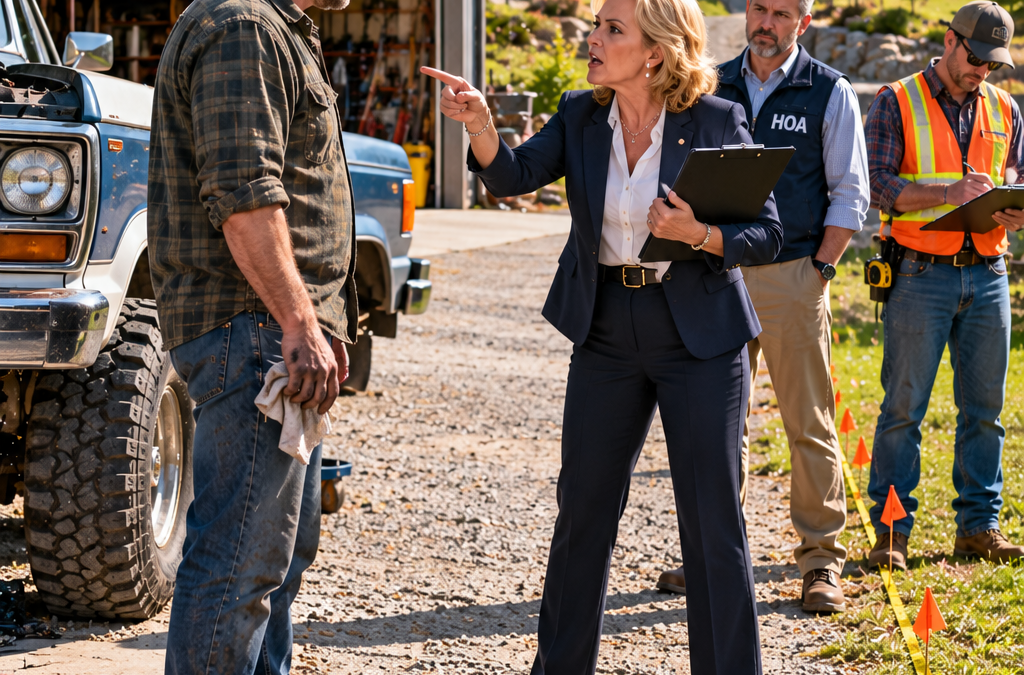
The man with the measuring tape stepped off the gravel.
I watched him cross the first survey stake.
“Hey.”
He stopped.
“What?”
“Don’t go farther.”
Deborah immediately said, “He’s authorized.”
“By who?”
“The association.”
I kept the camera pointed toward them.
“That isn’t what I asked.”
Mark looked uncomfortable.
Deborah did not.
“We are conducting a compliance inspection.”
“On private property.”
“HOA-regulated property.”
“No.”
She exhaled sharply.
“We are not repeating this argument.”
“Then leave.”
Her face hardened.
“Excuse me?”
“You heard me.”
Carl stepped between us verbally.
“Daniel, calm down.”
“I am calm.”
“You’re escalating.”
“No, Carl. Three people walked onto my property uninvited. One of them is carrying survey flags. I’m telling you to leave.”
Deborah raised the clipboard.
“You do not have the right to interfere with an authorized association inspection.”
I almost admired the confidence.
Almost.
“So you’re refusing to leave?”
She looked straight into the phone camera.
“Yes.”
That word mattered.
I knew it.
She did not.
Mark began walking again.
He stepped through my grass toward the tree line.
I filmed him.
He pulled an orange flag from his pouch.
He pushed it into the soil.
I felt anger move through me so quickly that my fingers tightened around the phone.
That small action bothered me more than the letters.
More than the fines they had threatened.
More than the mailbox nonsense.
He had planted a marker in my land because Deborah had told him he could.
My land.
I had paid for it.
Paid taxes on it.
Cleared brush from it.
Built on it.
Spent mornings drinking coffee while deer crossed it.
And three strangers were behaving as though my ownership existed only if their board recognized it.
“Remove that flag.”
Mark looked back toward Deborah.
She shook her head.
He left it.
I kept recording.
Deborah glanced at her watch.
“Mr. Mercer, we’ve already spent too much time here. You need to stop working and vacate the property while we complete the inspection.”
For several seconds I genuinely thought I had misunderstood.
“Say that again.”
“You need to vacate.”
“My property.”
“This site.”
“This site is my property.”
“Your refusal to recognize community jurisdiction doesn’t eliminate it.”
Something about the sentence made my stomach turn.
Not because it was legally convincing.
Because of how completely she believed authority flowed from her saying it aloud.
“How long do I have?”
“Ten minutes.”
I looked toward the workshop.
Then back at her.
“Ten minutes to leave my own land.”
“Yes.”
“Or what?”
“We will contact the sheriff’s department.”
Carl shifted uncomfortably.
I pointed the camera directly at Deborah.
“Let me make sure I have this correctly. You are ordering me to leave property titled in my name so your HOA can inspect it.”
“That is correct.”
“And if I refuse?”
“We will have law enforcement remove you.”
I nodded.
“Thank you.”
She frowned.
“For what?”
“Being clear.”
The first hint of uncertainty appeared.
She looked at the phone.
“You think recording this changes anything?”
“No.”
That was true.
The recording did not change the boundary.
The 1994 amendment had already done that.
It only preserved what she was choosing to do despite it.
Mark planted another flag.
Then another.
I filmed each one.
Deborah began listing alleged violations.
Workshop placement.
Vehicle visibility.
Outdoor storage.
Fencing setback.
Mailbox color.
She even claimed my stack of firewood might violate “uniform streetscape requirements.”
I let her talk.
Every sentence made the same point more clearly.
She was trying to enforce Brookline Ridge rules on property Brookline Ridge had excluded from its own jurisdiction thirty-two years earlier.
Then she said the line I would remember more clearly than anything else from that morning.
“We have done this before.”
I lowered the phone slightly.
“What?”
She must have mistaken my surprise for intimidation because her confidence returned.
“We’ve conducted enforcement inspections on disputed parcels before.”
Carl glanced at her.
That was the first time I saw concern on his face.
Deborah continued.
“Property owners always object at first. Eventually they understand the association has broader authority than they assumed.”
I stared at her.
“How many?”
“How many what?”
“Property owners.”
“That isn’t relevant.”
“You said you’ve done this before.”
“I said people have challenged our enforcement.”
“And nobody stopped you?”
Her lips tightened into something close to a smile.
“Nobody has ever successfully fought us on it.”
There are moments when someone gives you more than you expected.
I had hoped for evidence of their entry.
Maybe evidence that Deborah knew I disputed jurisdiction.
I had not expected her to volunteer a possible pattern involving other properties.
I kept my voice neutral.
“Nobody?”
“That’s correct.”
I thought about Rachel.
Do not provoke them.
Do not threaten them.
Preserve evidence.
So I simply said:
“That’s interesting.”
Deborah checked her watch.
“Six minutes.”
“To what?”
“To vacate.”
“Right.”
I leaned against the edge of the workshop.
Carl looked increasingly uncomfortable.
“Deborah, maybe we should—”
She cut him off.
“No. We’ve given him more than enough time.”
He lowered his voice.
“We might want counsel here before—”
“Our attorney has already advised us that enforcement is permitted.”
That was another useful statement.
Whether it was true or not, I did not know.
I suspected she was exaggerating.
But she had now dragged the HOA’s legal process into the recording too.
I said nothing.
Five minutes passed.
Nobody moved.
Mark measured from the workshop corner toward the tree line.
He wrote something on a pad.
Deborah dictated observations.
Carl mostly watched me.
Finally, Deborah checked her watch.
“Your ten minutes are up.”
I nodded.
“Okay.”
“You need to leave.”
“No.”
“Then I am contacting law enforcement.”
“Please do.”
She froze.
The reaction was immediate.
People who threaten police usually expect one of two responses.
Fear.
Or surrender.
What they do not expect is enthusiasm.
“You want me to call?”
“I’d love a deputy here.”
Her eyes narrowed.
“You’re trying to make a scene.”
“You’re standing in my driveway.”
“You’ve been warned.”
“Call them.”
She stared at me for another second.
Then pulled out her phone.
I remained where I was.
While she called, I walked into the workshop.
Not to leave.
To get the folder.
I set it on my workbench near the open door.
Then I returned outside.
Deborah was describing me to dispatch as “agitated.”
I almost laughed.
I had barely raised my voice.
“Yes,” she said into the phone. “He is refusing to comply with an HOA enforcement inspection.”
Pause.
“No, he hasn’t threatened us.”
Another pause.
“Yes, we are currently on the property.”
I looked at Carl.
He looked away.
Deborah continued.
“He has been ordered to vacate.”
Another pause.
Her expression changed slightly.
“I understand. Yes. We’ll wait.”
She ended the call.
“They’re sending someone.”
“Good.”
“You may want to reconsider before the deputy arrives.”
“Why?”
“Because refusing a lawful property directive can become more serious once law enforcement is involved.”
I stared at her.
“Whose property directive?”
“The association’s.”
“On whose land?”
She did not answer.
For the next twenty minutes, the four of us waited.
It was one of the strangest stretches of silence I have ever experienced.
Birds moved through the trees.
A truck passed on the county road.
The Bronco remained on jack stands behind me.
Mark stopped measuring.
Even he seemed to recognize that continuing might be unwise.
Deborah stood near the driveway entrance, arms crossed.
She tried to look calm.
But every few minutes she glanced toward my workshop.
Toward the folder.
She had noticed it.
Good.
Eventually a sheriff’s cruiser turned into the drive.
No lights.
No siren.
The deputy parked behind Deborah’s SUV and stepped out.
He was in his forties, tall, tired-looking, and immediately cautious.
“Morning.”
Deborah walked toward him before he had taken three steps.
“Deputy, thank you. I’m Deborah Whitmore, president of Brookline Ridge HOA. This homeowner is interfering with an authorized compliance inspection and refusing to vacate the regulated area.”
The deputy looked at me.
Then at the workshop.
Then at the five acres surrounding us.
“Who owns the property?”
Deborah answered before I could.
“He does, technically, but it falls under our jurisdiction.”
The word technically almost made me smile.
The deputy looked at her.
“What does that mean?”
“The parcel is subject to Brookline Ridge enforcement.”
I spoke.
“No, it isn’t.”
Deborah snapped toward me.
“Please let me finish.”
The deputy held up a hand.
“I’ll hear both sides.”
She looked irritated but continued.
“We have issued multiple notices regarding unapproved structures, vehicles, fencing, and other violations. Mr. Mercer has refused every attempt at compliance. Today we came to document conditions, and he became obstructive.”
“Did he threaten you?”
“No.”
“Touch anyone?”
“No.”
“Damage anything?”
“No.”
“Block your vehicle?”
“No.”
The deputy looked at me.
“Sir?”
“My name’s Daniel Mercer. I own the parcel.”
“Do you have identification?”
I handed it to him.
“Do you have anything showing ownership?”
“Yes.”
“I’d like to see it.”
“Absolutely.”
I walked into the workshop.
Deborah called after me.
“The ownership itself isn’t disputed.”
I stopped and looked back.
“That’s the first correct thing you’ve said today.”
Her face tightened.
I carried the folder outside.
I did not hand the deputy everything.
Only two documents.
First, the county plat showing my parcel.
Second, the 1994 Brookline Ridge boundary amendment.
I had highlighted the relevant legal description and attached Mike’s survey overlay.
The deputy read the parcel map.
Then the amendment.
Then the overlay.
He looked toward Deborah.
“Do you have your association boundary documents?”
She raised the clipboard.
“I have our current compliance map.”
“Recorded document?”
“It’s an internal association map.”
“I’m asking for the recorded boundary.”
She hesitated.
“Our management company maintains those records.”
The deputy looked again at what I had handed him.
“Where are we right now?”
I pointed to the survey overlay.
“Here.”
“And according to this line?”
“Brookline Ridge ends over there.”
I pointed east.
“About a quarter mile away.”
The deputy looked in that direction.
Then back at the map.
He read the amendment again.
Deborah stepped closer.
“That filing is outdated.”
I had been waiting for that.
“No, it isn’t.”
She ignored me.
“The HOA has exercised authority over this area for years.”
The deputy looked at her.
“Do you have a newer recorded amendment expanding the boundary?”
“We have established enforcement practice.”
“That’s not what I asked.”
She straightened.
“Our attorney can clarify.”
“Do you have anything here showing this parcel inside the HOA?”
She lifted the compliance map.
He looked at it.
Then at the recorded county filing.
“I’m not seeing where your internal map overrides a recorded boundary document.”
Deborah’s face began losing color.
“You’re not an HOA attorney.”
“No, ma’am.”
“So you’re not qualified to interpret our covenants.”
“I’m qualified to determine whether I’m removing a property owner from land county records show belongs to him.”
Silence.
That was the moment.
The entire morning turned.
I could feel it.
Until then, Deborah had occupied the space as though she controlled it.
The clipboard.
The orders.
The countdown.
The sheriff call.
Everything depended on one assumption:
That when someone with greater authority arrived, that person would stand behind her.
Instead, the deputy looked toward the orange flags.
“Who placed those?”
Mark slowly raised a hand.
“I did.”
“On whose direction?”
His eyes shifted toward Deborah.
“The association.”
The deputy looked at me.
“Did you authorize them?”
“No.”
“Did you ask these people to leave?”
“Yes.”
“When?”
“About half an hour ago. More than once.”
The deputy turned toward Deborah.
“Ma’am, based on the documents I’m looking at, it appears Mr. Mercer owns this parcel and Brookline Ridge’s recorded boundary stops substantially east of here.”
She shook her head.
“That is not the association’s position.”
“I understand.”
“No, I don’t think you do.”
Her voice sharpened.
“This man has spent two years deliberately refusing community standards. He leaves unapproved vehicles visible. He constructed that workshop without architectural permission. He openly mocks board authority. If you allow him to ignore enforcement, every homeowner will think they can do the same.”
The deputy looked at the workshop.
“Did the county permit it?”
“Yes,” I said.
He looked at Deborah.
“Is he a member of your HOA?”
“He falls within our enforcement area.”
“That wasn’t the question.”
She did not answer.
I did.
“No.”
Deborah glared at me.
The deputy returned my documents.
Then he said quietly:
“Ma’am, unless you have a recorded instrument establishing authority over this parcel, I’m not removing him.”
Her mouth opened.
He continued.
“In fact, based on what he’s shown me and what you’ve told me, the immediate property issue appears to be that you and the other two individuals are currently on privately owned land after the owner asked you to leave.”
Her face went completely white.
Carl looked down.
Mark immediately bent over and pulled the nearest orange flag out of the ground.
Deborah turned toward him.
“What are you doing?”
“I’m taking these out.”
“Leave them.”
“No.”
It was the first sensible thing Mark had said all morning.
He walked toward the next flag.
The deputy looked at Deborah.
“How many times have you been on this property?”
She said nothing.
I answered.
“Several documented visits.”
“That’s exaggerated,” she snapped.
I looked directly at her.
“You told me twenty minutes ago that you’ve done this before and nobody ever fought you.”
Her eyes flicked toward my phone.
I lifted it slightly.
“Still recording.”
The expression on her face changed.
She finally understood.
Not everything.
But enough.
I continued.
“You were notified two months ago in writing that this parcel was outside your jurisdiction.”
“That letter disputed our authority. It did not establish anything.”
“The 1994 filing established it.”
“You cannot expect volunteer board members to understand every historic technical amendment.”
I almost laughed.
“You’ve been threatening fines based on those technical documents for two years.”
“That’s different.”
“How?”
“We acted in good faith.”
I stepped toward the workbench and opened the folder.
“Would you like to see how much good faith I’ve documented?”
The deputy looked at me.
“What else is in there?”
“Every notice they sent. Certified letters. Dates of inspections. Photographs of flags. Survey. Deed. Correspondence with counsel.”
Deborah’s voice rose.
“You had an attorney this whole time?”
“For two months.”
“And you never told us?”
“My attorney sent you a letter.”
“Our management office receives dozens of letters.”
“That sounds like your problem.”
She stared at me.
The fury was returning.
But it looked different now.
Before, it had been the anger of someone convinced she was powerful.
Now it was the anger of someone realizing her certainty had become evidence.
“You set this up.”
I shook my head.
“No.”
“You deliberately allowed us to come here.”
“I didn’t invite you.”
“You could have shown us that amendment immediately.”
“I sent it to your management company.”
“That isn’t the same thing.”
“I told you to leave today.”
“You wanted this confrontation.”
“No, Deborah.”
My voice stayed low.
“You wanted this confrontation. You drove onto my property with two people and a clipboard. You told me I had ten minutes to abandon my own land. You threatened to have me removed by the sheriff. I just stopped protecting you from the consequences of being wrong.”
For the first time all morning, she had no immediate answer.
The deputy cleared his throat.
“I think everyone needs to separate.”
He looked at Deborah, Carl, and Mark.
“Mr. Mercer has asked you to leave. You need to leave.”
Deborah looked stunned.
“You’re ordering us off?”
“I’m telling you the property owner has revoked permission for you to remain.”
“We’re an HOA board.”
“I understand.”
“We have official business.”
“Not on this parcel, based on the documents I’ve seen.”
She looked toward me.
“This isn’t finished.”
I believed her.
That was Deborah’s problem.
Nothing was ever finished when reality failed to give her the outcome she wanted.
I held the phone steady.
“Anything else you want recorded?”
Her jaw tightened.
She turned and walked toward her SUV.
Carl followed immediately.
Mark gathered the remaining flags first.
I watched every one come out of the ground.
That mattered to me more than I expected.
One by one.
Orange marker after orange marker.
Removed from soil they never should have entered.
Before Mark left, he walked over.
Quietly.
“Sorry.”
I looked at him.
“You know where the line is now?”
He nodded.
“Yeah.”
“That’s all I wanted.”
He left.
Deborah drove away without looking at me.
The deputy remained.
He looked toward the Bronco.
“Seventy-eight?”
“Yeah.”
“What are you doing to it?”
“Replacing half the suspension because apparently I enjoy suffering.”
He smiled.
Then his expression became serious.
“Document everything from today.”
“I already am.”
“Good.”
“Can I ask you something?”
“Sure.”
“If they come back?”
“Call us. Don’t get into a physical confrontation.”
“I won’t.”
“I’m not making a legal determination about civil liability. That’s for lawyers and courts. But you have clearly told them to leave, and they now know the ownership dispute exists.”
“That’s enough for me.”
He nodded.
Before leaving, he glanced at the folder.
“Looks like you did your homework.”
“For two months.”
“Most people don’t.”
“I think they were counting on that.”
He did not disagree.
Rachel called me thirty minutes after he left.
I had already sent her the video.
She watched the important sections while we were on the phone.
Every few minutes she stopped.
“She actually said that?”
“Yes.”
“She gave you ten minutes to vacate?”
“Yes.”
“She said they’d done this before?”
“Yes.”
“And they placed markers after you told them to leave?”
“Yes.”
Long silence.
Then:
“Save the original recording in three places.”
“Already did.”
“Do not edit it.”
“I won’t.”
“Do not post it online.”
“I wasn’t planning to.”
“Good.”
“What happens now?”
“Now we send them a very different letter.”
The HOA’s attorney contacted Rachel within four days.
That alone told me Deborah’s board finally understood the seriousness of the situation.
For two years, every letter they sent me had been written as though compliance was inevitable.
Now their attorney wanted “clarification.”
Rachel gave it to him.
She sent the recorded 1994 amendment.
The professional survey.
County records.
My deed.
The HOA’s previous notices.
Their proof of receipt of our earlier warning.
Still photographs from the video showing board representatives past my surveyed boundary after I explicitly told them to leave.
And a transcript of Deborah telling me to vacate my own property.
The response changed quickly.
Their attorney no longer called my workshop unauthorized.
He called the matter a “boundary misunderstanding.”
I remember reading that phrase at Rachel’s office.
“A misunderstanding?”
Rachel nodded.
“That’s what they’re calling it.”
“They threatened to have me removed by police.”
“I know.”
“They’ve been sending me fines for two years.”
“I know.”
“They planted survey flags after I told them to leave.”
“I know.”
“And now it’s a misunderstanding?”
“That is the first stage of people realizing the other side kept records.”
I leaned back.
“What do we do?”
“We calculate what we can actually support.”
That mattered to me.
I did not want some fantasy lawsuit for millions of dollars.
I was angry, but I was not trying to turn five acres and a Bronco into a lottery ticket.
I wanted the harassment finished.
Permanently.
Rachel reviewed every known entry onto the land.
Some could be proven.
Some could not.
We did not include the ones we could not prove.
She reviewed correspondence.
The threat of fines.
The invalid violation notices.
My certified warnings.
The video.
Legal expenses.
Survey costs.
Everything.
Then she drafted the claim.
Civil trespass.
Interference with property rights.
Declaratory relief confirming the parcel was outside HOA jurisdiction.
Recovery of appropriate costs and damages.
Retraction of prior notices.
No theatrical number.
No emotional exaggeration.
Just what we could support.
The HOA’s insurance carrier became involved almost immediately.
Then something unexpected happened.
Other homeowners started asking questions.
Word about the sheriff visit spread through Brookline Ridge.
I had not posted the video.
I never needed to.
Carl apparently told another board member what happened.
Someone else mentioned the 1994 amendment.
Within two weeks, residents were asking whether other boundary properties had received violation notices.
Deborah hated that.
I knew because she called me.
Personally.
Despite the attorneys.
I almost did not answer.
Then I remembered Rachel’s instructions.
So I did.
“Daniel.”
“Deborah.”
“I think we need to talk without lawyers.”
“No.”
“You haven’t even heard what I’m proposing.”
“And you haven’t heard me say no enough times.”
“This situation has gotten completely out of hand.”
“I agree.”
“There is no reason for you to punish the entire association over an administrative error.”
“Administrative error?”
“You know what I mean.”
“No. Explain it.”
She went quiet.
Then:
“Historic boundary records were not accurately reflected in the association’s operational maps.”
“That sounds different from what you told the sheriff.”
“We were working with the records available to us.”
“You had the 1994 filing.”
“I personally had never seen it.”
“My attorney mailed it to the management company two months before you came onto my property.”
“That doesn’t mean the board reviewed it.”
“That’s not my problem.”
Her voice became sharper.
“You deliberately withheld information during our inspection.”
I laughed once.
“Deborah, you walked onto my land after being told your authority was disputed. You ordered me off it. Now you’re blaming me because you didn’t read your own files?”
“I’m trying to resolve this.”
“No. Rachel is resolving it.”
“You really intend to sue your neighbors?”
There it was.
The emotional pivot.
For two years, I had been the violator.
The defiant homeowner.
The man refusing community standards.
Now that the paperwork had turned against them, suddenly we were neighbors.
“You didn’t treat me like a neighbor.”
“That’s unfair.”
“You threatened my property over a green mailbox.”
“That was never about the mailbox.”
“I know.”
Silence.
That was probably the most honest exchange we ever had.
Because it had never been about the mailbox.
Or the Bronco.
Or the workshop.
It was about submission.
My five acres sat beside Brookline Ridge but outside Deborah’s control.
She could not tolerate that.
Every vehicle became an excuse.
Every structure became an excuse.
Every letter was another attempt to make me accept authority she did not possess.
“I’m not discussing the claim with you,” I said.
“Daniel—”
“Talk to Rachel.”
Then I ended the call.
Six weeks after the sheriff stood in my driveway, the insurance carrier agreed to settle.
The amount covered the documented trespass claims we pursued, my legal expenses, survey costs, and related damages.
But the money was not the term I cared about most.
The most important language was contained on one page.
Brookline Ridge Homeowners Association formally acknowledged that my parcel was not subject to its declaration, rules, architectural review authority, fines, or enforcement procedures.
They rescinded every violation notice.
Every fine.
Every demand.
They agreed not to enter my property for inspections without my permission or another valid legal basis.
And they issued a written retraction acknowledging that prior enforcement had been based on an incorrect understanding of the association boundary.
I read that page more carefully than I read the check.
For two years, Deborah had tried to turn my ownership into something conditional.
As though my right to use my property existed only until her board objected.
Now her own association had signed a document saying the opposite.
The five acres had always been outside their authority.
Not because I won them back.
Because the HOA had never possessed them in the first place.
Deborah stepped down as president several months later.
I do not know whether the settlement caused it directly.
Nobody ever told me.
I know there was pressure from homeowners.
I know questions were asked about enforcement procedures.
I know board meetings became much better attended after residents learned what had happened.
And I know the next president sent me exactly one letter.
It was not a violation.
It was an apology.
Short.
Professional.
No excuses.
I kept it.
I kept Deborah’s letters too.
All of them.
They sit in the same folder as the 1994 amendment.
That folder is much thinner emotionally than it used to be.
For months, opening it raised my blood pressure.
Now it mostly reminds me of something important.
Confidence is not authority.
A clipboard is not a deed.
A title on an HOA board does not move a recorded boundary.
And repetition does not turn an invented power into a real one.
The workshop is still standing.
So is the Bronco.
I eventually finished the suspension.
Then I discovered the rear differential needed attention, because apparently forty-eight-year-old trucks do not respect a man’s retirement plans.
The mailbox is still green.
I considered painting it black once.
Not because of the HOA.
The paint really was getting bad.
Then I laughed and bought another can of green.
There is something else at the driveway now.
A small weatherproof frame attached to a post just inside my property line.
Inside is a reduced copy of the relevant section of the 1994 amendment.
Nothing sarcastic.
No insults.
No names.
Just the document.
The recorded boundary is highlighted.
Underneath it, in plain lettering, is a simple notice:
PRIVATE PROPERTY
NOT WITHIN BROOKLINE RIDGE HOA
Some people have told me the sign is unnecessary.
They are probably right.
Nobody from the association has stepped onto my property since the settlement.
Not Deborah.
Not Carl.
Not another inspector.
Not one person carrying a tape measure.
Still, I like having it there.
Not as a threat.
As a reminder.
Mostly to myself.
Because the hardest part of those two years was not the paperwork.
It was not the fines.
It was not even the morning Deborah threatened to call the sheriff.
The hardest part was how relentless pressure can make you question something you know is true.
I had the deed.
I had checked the county records before buying.
I had county permits.
I knew the parcel was mine.
But after enough official-looking envelopes arrived, I started wondering whether I had missed something.
Maybe there was some covenant buried somewhere.
Maybe some legal mechanism I did not understand.
Maybe Deborah knew something I did not.
That is how people like her gain ground.
Not necessarily because they are right.
Because they sound certain.
They use formal language.
Sections.
Violations.
Deadlines.
Enforcement.
Legal escalation.
After a while, the person receiving those letters starts defending himself before anyone has established that he owed them an explanation in the first place.
That was the trap.
I nearly fell into it.
The best decision I made was to stop arguing and start verifying.
I did not need to be louder than Deborah.
I needed a recorded amendment.
I did not need to insult her.
I needed a survey.
I did not need to convince the board I was right.
I needed evidence strong enough that their opinion became irrelevant.
That Tuesday morning taught me the rest.
When Deborah stood in my driveway and said, “Ten minutes,” part of me wanted to unload two years of anger on her.
I wanted to tell her exactly what was in the folder.
I wanted to hold the 1994 document in front of her face and watch her confidence disappear.
Instead, I recorded.
I let her speak.
I let her tell me the HOA controlled my land.
I let her tell the camera I had to vacate.
I let her authorize the measuring.
I let her say they had done it before.
I let her call the sheriff.
That required more discipline than I expected.
But sometimes the most powerful thing you can do when someone is confidently wrong is give them enough room to document it themselves.
Deborah thought silence meant weakness.
She mistook patience for uncertainty.
She saw the grease on my hands, the old Bronco, the workshop, and five wooded acres and probably assumed I was just another homeowner she could bury beneath letters until I gave up.
She never imagined I had spent weekends in the county clerk’s office.
She never imagined a surveyor had already walked the line.
She never imagined a real estate attorney had read every page.
Most of all, she never imagined Brookline Ridge itself had created the document that defeated her claim decades before either of us lived there.
That is still the part I find almost poetic.
I did not beat the HOA with some obscure loophole.
I did not discover a technicality hidden in my deed.
I used their own paperwork.
Their own 1994 amendment.
Their own recorded boundary.
Their own signatures from decades earlier.
All I did was read what they had forgotten.
A year after the settlement, I was working outside when a truck slowed near my driveway.
A man about my age rolled down the window.
“You Daniel?”
I set down the wrench in my hand.
“Depends.”
He laughed.
“I’m not from the HOA.”
“That improves your chances.”
He introduced himself.
He owned land farther north along the ridge.
Older parcel.
Similar history.
He had received two HOA letters about fence placement.
Someone told him to talk to me.
I did not tell him what to do.
I did not pretend his situation was identical.
I pointed toward the county records office.
“Start there.”
“What am I looking for?”
“Everything.”
He frowned.
“That sounds like a lot.”
“It is.”
“What if they’re right?”
“Then at least you’ll know.”
“And if they’re wrong?”
I looked toward the framed amendment beside my driveway.
“Then you’ll know that too.”
He thanked me and drove away.
That conversation stayed with me.
Because that was ultimately what the entire fight had been about.
Knowing.
Not assuming.
Not accepting Deborah’s version because she printed it on letterhead.
Not assuming I was right because I wanted to be.
Checking.
Documents.
Maps.
Dates.
Boundaries.
Facts.
That process stripped away all the noise.
Deborah could call the workshop ugly.
That was an opinion.
She could dislike my vehicles.
Opinion.
She could hate the green mailbox.
Definitely an opinion.
But whether Brookline Ridge legally included my land was not a matter of taste.
There was a line.
Recorded.
Measured.
Filed.
And that line sat almost a quarter mile away.
I still see Deborah occasionally.
She remained in the neighborhood after leaving the board.
The first time we crossed paths after the settlement was at a gas station.
I was filling my pickup.
She pulled in two pumps away.
For a second, neither of us said anything.
Then she looked at me.
I expected hostility.
Instead she said:
“Daniel.”
“Deborah.”
Another silence.
Finally:
“I hope you’re satisfied.”
It was such a Deborah thing to say that I almost smiled.
“I’m satisfied it’s finished.”
“You embarrassed a lot of people.”
“No.”
Her eyebrows rose.
“You embarrassed yourself.”
Her expression hardened.
I thought she might start another argument.
She did not.
She looked away.
I finished pumping gas.
Before leaving, I said something I had wanted to say for a long time.
“You know what would have prevented all of it?”
She looked back.
“What?”
“One question.”
“What question?”
“‘Daniel, can you show me your boundary documents?’”
She said nothing.
“If you had asked me that before the first violation letter, I would’ve shown you.”
Her face softened slightly.
Only slightly.
“We believed our records were correct.”
“I know.”
“That’s what nobody understands.”
“I understand.”
She looked surprised.
I continued.
“The problem wasn’t that you were wrong. Everybody gets something wrong eventually.”
“Then what was the problem?”
“You refused to check.”
That landed differently.
Her eyes shifted away.
“And every time somebody questioned you, you treated the question like disobedience.”
She gripped the gas nozzle.
I nodded toward her.
“That’s what cost the HOA.”
I got into my truck.
She never answered.
Maybe she disagreed.
Maybe she knew I was right.
It did not matter anymore.
That evening, I returned to the workshop.
The Bronco sat with its hood open.
Sunlight came through the trees at an angle, turning dust in the air gold.
I switched on an old radio.
Picked up a wrench.
And went back to work.
That was the life I had wanted when I bought the property.
Not a war.
Not a settlement.
Not a victory over an HOA.
A workshop.
Old trucks.
Five acres.
Quiet.
For two years, Deborah had made me feel as though wanting to be left alone was itself an act of defiance.
Now the silence felt different.
Earned, maybe.
I could hear the creek behind the trees.
A woodpecker somewhere near the ridge.
Metal clicking as the Bronco cooled.
No approaching footsteps.
No clipboard.
No tape measure.
No one telling me I had ten minutes to disappear from the place I owned.
I looked toward the folder sitting on the shelf above my workbench.
The settlement papers were inside now.
So was the signed acknowledgement.
The final page carried Brookline Ridge’s letterhead.
The same logo that had appeared on every violation notice.
Only the words had changed.
For two years, their letters had told me what they claimed I had done wrong.
Now one of their letters finally admitted what they had done wrong.
That mattered more than the check.
Money gets spent.
Legal fees get paid.
Surveyors cash their invoices.
A written record remains.
And the record now says what the land itself had been saying all along.
This place was never theirs to control.
Sometimes I think back to the exact moment Deborah told me the ten minutes had expired.
I can still see her standing there.
Clipboard tucked beneath one arm.
Certain the sheriff was coming to remove me.
Certain authority would arrive wearing a badge and validate everything she had been saying.
The irony is that she was almost right about one thing.
Authority did arrive.
It just asked to see the paperwork.
And paperwork was the one thing Deborah had never expected anyone else to read.
That was her mistake.
She believed power came from being the person willing to issue the order.
I learned something different.
Real authority has boundaries.
It has documents.
It has limits.
And when someone refuses to respect those limits, the smartest response is not always to shout louder.
Sometimes you pull out your phone.
Sometimes you let them speak.
Sometimes you wait for them to plant their own flags in the wrong soil.
Then you open the folder.
The orange flags are long gone now.
But I kept one.
Mark missed it that morning.
I found it beside the tree line the following day.
For a while, it sat in the back of my truck.
Eventually I put it on a shelf in the workshop.
A cheap plastic flag on a thin metal stem.
Nothing valuable.
Nothing official.
Just something Deborah’s crew pushed into land they assumed they could control.
Every time I notice it, I remember her saying:
“Nobody’s ever fought us on it.”
Maybe that was true.
Maybe other people had moved the fence.
Changed the mailbox.
Paid the fine.
Let the inspector walk the property.
Maybe they decided resistance cost too much.
I do not judge them.
People have jobs.
Families.
Mortgages.
Health problems.
Nobody buys a home hoping to spend weekends reading thirty-year-old boundary amendments.
Organizations like Brookline Ridge are supposed to make neighborhoods easier to live in.
When they work properly, maybe they do.
But any organization becomes dangerous when the people running it stop asking where their authority ends.
Deborah stopped asking.
She assumed.
Then she enforced the assumption.
The strange thing is, if she had admitted the mistake after the first county map I sent her, I would have forgotten her name by now.
There would have been no attorney.
No sheriff.
No lawsuit.
No settlement.
No framed amendment by my driveway.
She could have written one sentence:
We reviewed your documentation and confirmed your parcel falls outside Brookline Ridge jurisdiction.
That would have ended everything.
Instead, she needed to win.
And because she needed to win, she kept escalating until the question was no longer whether my mailbox should be black.
The question became whether Brookline Ridge had any right to tell me anything at all.
They did not.
The Bronco runs now.
Mostly.
It still leaks a little oil because, like me, it has reached an age where perfection is unrealistic.
I take it out on weekends.
Sometimes I park it beside the workshop with the hood raised.
Nobody photographs it.
Nobody sends letters.
Nobody measures the distance from the tires to some imaginary HOA setback.
My mailbox remains green.
The workshop remains exactly where the county approved it.
Five acres of trees still rise behind it.
And that small framed amendment still hangs beside the driveway.
Rain has faded the highlighted line slightly.
I replace the copy every year.
The original stays safely inside.
People sometimes assume I display it because I am proud of winning.
That is not quite right.
I display it because I spent two years being told a boundary did not matter.
Now nobody walking up my driveway gets to make that mistake again.
The sign does not threaten anyone.
It does not insult Brookline Ridge.
It simply tells the truth before someone reaches the workshop.
Private property.
Outside HOA jurisdiction.
A line.
Nothing more.
But I learned that lines matter.
Property lines.
Legal lines.
Personal lines.
There are people who will respect a boundary the moment you show it to them.
And there are people like Deborah, who treat a boundary as an obstacle to be argued away.
For those people, being polite is not always enough.
You need evidence.
You need patience.
And sometimes you need to let them call the sheriff themselves.
I never wanted Deborah standing in my driveway that Tuesday morning.
But looking back, I am glad I was under the Bronco when I heard those footsteps.
Glad I reached for my phone.
Glad I did not explode.
Glad I had already done the work.
Because when she finally told me I had ten minutes to leave my own property, I did not have to convince her she was wrong.
I only had to let her keep talking until the evidence arrived.
Ten minutes later, she still had the clipboard.
I still had the land.
And for the first time in two years, everyone standing in that driveway finally understood which one of those things actually mattered.




