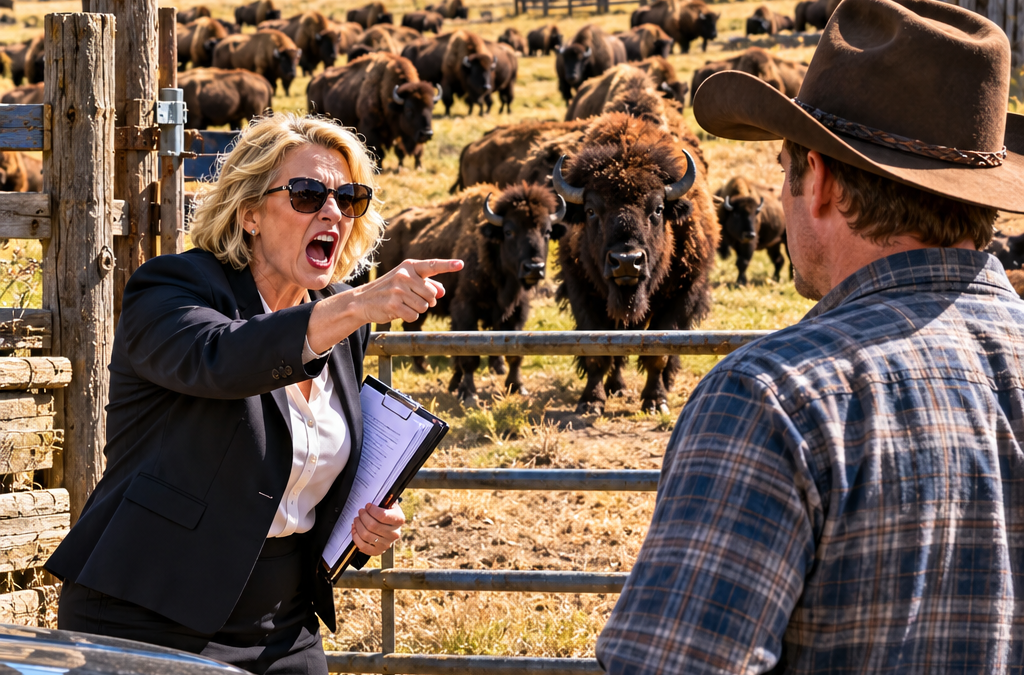
𝗙𝗨𝗟𝗟 𝗦𝗧𝗢𝗥𝗬 The HOA president gave me fourteen days to remove forty-three bison from land my family had owned since before her gated community existed, and she spoke as if the ranch had already stopped belonging to me. What she didn’t know was that four months before he died, my grandfather had hidden a letter with my name on it inside his desk, and he had written it for the exact day someone came after his herd.
𝗙𝗨𝗟𝗟 𝗦𝗧𝗢𝗥𝗬
The argument that ended our relationship happened when I was twenty-eight.
My mother had died the year before.
Walt wanted me to move west.
He said the ranch needed younger hands and that I was wasting my life in Ohio.
I told him my life wasn’t his to schedule.
He told me warehouse management wasn’t a life.
I told him at least I had built mine without inheriting ten thousand acres.
He went quiet.
That should have warned me.
Then he said, “You think this place was handed to me?”
I said something cruel.
Something about him caring more about land than his own daughter.
My mother.
His daughter.
The one subject neither of us knew how to discuss.
He ordered me out.
I left.
He didn’t call.
Neither did I.
Six years passed.
And now he had left me everything.
Two weeks after the funeral, I flew to Montana.
Henry met me at a small airport.
He was older than his voice had sounded.
Gray mustache.
Brown suit.
The kind of attorney who still carried paper files.
He drove.
The farther we went, the quieter everything became.
Town disappeared.
Then subdivisions.
Then most pavement.
Mountains rose in the distance.
Open grassland stretched beyond the road.
At one point I asked, “How much farther?”
Henry said, “Forty minutes.”
I looked out the window.
“There’s nothing out here.”
He smiled.
“That’s why your grandfather liked it.”
The ranch entrance was marked by two stone pillars and an old steel gate.
WHITFIELD RANCH.
Below it, on a weathered wooden sign:
EST. 1987.
The road climbed gradually.
Then we reached the first ridge.
Henry stopped the truck.
“Why are we stopping?”
“Look.”
I turned.
Forty-three bison were moving across the valley below us.
Not running.
Not grazing in one place.
Moving.
A broad, dark mass flowing through pale grass.
I had seen buffalo in zoos.
Parks.
Photographs.
That hadn’t prepared me.
They looked ancient.
Heavy.
Almost prehistoric.
Wind lifted dust around them.
One large bull separated from the herd and stood sideways on the slope.
For a moment, I forgot to breathe.
Henry watched me.
“Your grandfather built that herd from six animals.”
“Six?”
“Over thirty years.”
I looked down into the valley.
“How?”
“Patience.”
That sounded like Walt.
The ranch house sat on a rise overlooking the western pasture.
It was older than I expected.
Stone foundation.
Weathered timber.
Deep porch.
Metal roof.
The original core of the building supposedly dated back to territorial days, though Grandpa had rebuilt half of it over the years.
Inside, almost nothing had changed from what I remembered.
Same heavy dining table.
Same cast-iron stove.
Same gun cabinet.
Same photograph of my mother at seventeen.
That picture stopped me.
She was standing beside Grandpa on the porch.
Both smiling.
Before everything became complicated.
I looked away.
Henry placed a folder on the table.
“There’s staff information.”
“Staff?”
“A full-time foreman. Seasonal hands. Veterinarian. Hay arrangements.”
I stared at him.
“Henry, I manage a warehouse.”
“I know.”
“I don’t know anything about buffalo.”
“Bison.”
“See?”
He almost smiled.
I sat down.
“Why did he leave this to me?”
Henry looked toward the window.
“He never changed his will.”
“That doesn’t answer the question.”
“No.”
He folded his hands.
“But it may be the only answer I have.”
For the first several days, I planned to sell.
I told myself that was the logical thing.
The land was valuable.
The ranch required skill.
The animals needed care.
I had a job in Ohio.
An apartment.
Health insurance.
A life.
Then I met Tom Avery, the ranch foreman.
Tom had worked for Walt for twenty-one years.
He was sixty-two and built like a fence post.
Long.
Lean.
Weathered.
He shook my hand once and said, “You look like your mother.”
Not your grandfather.
My mother.
That almost made me like him immediately.
He taught me the basics.
Where the wells were.
Which pastures held water late in summer.
Which fences needed repair.
Where the herd preferred to bed during storms.
Which cow had a bad habit of breaking gates.
Which bull not to approach on foot.
One afternoon we stood on a hill watching the bison graze.
I asked, “Did Walt name them?”
Tom grinned.
“Every damn one.”
“Seriously?”
“Would deny it if you asked.”
He pointed.
“Big cow near the wash? Edith.”
“Why Edith?”
“Woman at the bank who denied his first ranch loan.”
I laughed.
Tom pointed again.
“Old bull with the scar. Franklin.”
“Who was Franklin?”
“County commissioner Walt hated.”
“That sounds like him.”
Tom became quiet.
“Your grandfather talked about you.”
I looked at him.
“When?”
“All the time.”
I felt something tighten behind my ribs.
“That seems unlikely.”
“Suit yourself.”
“What did he say?”
“That you were stubborn.”
“That sounds more likely.”
“Said you got it from him.”
I looked away.
Tom continued.
“Said you’d come back eventually.”
“He was wrong.”
“You’re standing here.”
“I came for probate.”
Tom shrugged.
“Still standing here.”
I stayed another week.
Then another.
Something happened slowly.
I started waking before sunrise without an alarm.
I learned to read weather from the western ridge.
I learned the difference between a bison warning grunt and ordinary herd noise.
I learned that forty-three animals could completely disappear into ninety-five hundred acres and then somehow appear near the house when you least expected them.
At night, the silence was deeper than any silence I had known.
No trucks backing into loading docks.
No warehouse radio.
No upstairs neighbor.
I started thinking about Ohio less.
Then one evening, I called my supervisor.
“I’m not coming back.”
Long pause.
“You serious?”
“I think so.”
“You think?”
“I’m sure.”
“You bought a ranch?”
“Inherited.”
“Since when do you ranch?”
“Since approximately ten days ago.”
He laughed.
I didn’t.
I sold most of what I owned.
Ended the apartment lease.
Packed one truck.
Moved west.
For the first time in years, I had no idea what my life would look like six months ahead.
I liked that more than I expected.
I thought the hard part would be becoming a rancher.
I was wrong.
The hardest part arrived in a certified envelope on a gray Tuesday morning.
I found it on the porch after checking a broken water line.
Heavy cream paper.
Dark green seal.
RIDGE CREST HOMEOWNERS ASSOCIATION.
I stood there with mud on my boots and read the name twice.
Homeowners association?
On a ranch?
I opened it.
NOTICE OF VIOLATION: RESTRICTED LIVESTOCK ZONE.
My confusion disappeared by the second paragraph.
The HOA claimed forty-three bison were being maintained within a restricted buffer zone adjacent to Ridge Crest Estates.
Under a “Shared Boundary and Land Use Agreement” dated 2015, large livestock were supposedly prohibited within one-half mile of the community boundary.
Removal deadline:
Fourteen days.
Failure to comply:
$500 per animal, per day.
I read the number again.
Forty-three animals.
Five hundred dollars each.
Twenty-one thousand five hundred dollars.
Every day.
I sat down on the porch step.
There had to be a mistake.
The bison had grazed those pastures for decades.
The HOA was eleven years old.
The ranch was nearly forty.
I read the letter again.
Then a third time.
There was a signature at the bottom.
Evelyn Cross.
President, Ridge Crest Homeowners Association.
I called immediately.
A woman answered.
“Ridge Crest management.”
“This is Dale Whitfield.”
A pause.
“Regarding the ranch?”
“That depends. Did you just send me a letter ordering forty-three bison off my property?”
“I’ll transfer you to President Cross.”
I expected hold music.
Instead, Evelyn came on immediately.
“Mr. Whitfield.”
Her voice was sharp.
Controlled.
She sounded as though she’d been waiting.
“I just received your notice.”
“Yes.”
“There’s some mistake.”
“No.”
“My bison have been on this ranch since before Ridge Crest existed.”
“That doesn’t exempt the property from the boundary agreement.”
“What agreement?”
“The 2015 Shared Boundary and Land Use Agreement.”
“I’ve never seen it.”
“Your grandfather signed it.”
That stopped me.
“Walt?”
“Yes.”
“I want a copy.”
“One was included.”
I went back through the envelope.
There it was.
Photocopy.
Signature page.
Walter Whitfield.
I stared at it.
The signature looked right.
My stomach dropped.
Evelyn said, “Mr. Whitfield?”
“I’m here.”
“The restriction is very clear.”
I scanned the language.
Half-mile livestock buffer.
Large grazing animals prohibited.
“Why am I only hearing about this now?”
“Your grandfather had been given years to reach compliance.”
“Years?”
“We were patient.”
I almost laughed.
“You’re telling me the HOA knowingly allowed forty-three bison to violate this for years and suddenly I have fourteen days?”
“Your grandfather’s situation was unique.”
“What does that mean?”
“It means we attempted to resolve matters cooperatively while he was alive.”
“And now?”
“You inherited the property. The board expects compliance.”
I looked through the window toward the eastern pasture.
A dozen bison were visible beyond the fence.
“You want me to move forty-three bison off a third of the ranch in two weeks.”
“That is the deadline.”
“They’re not cattle you put in a trailer behind a pickup.”
“That is not the HOA’s responsibility.”
I felt my temper rise.
“Evelyn, where exactly do you think these animals are supposed to go?”
“Elsewhere on your property.”
“The restriction cuts through our established grazing rotation.”
“Then revise your operation.”
“Based on a neighborhood that showed up twenty-eight years after my grandfather bought the ranch?”
Her voice hardened.
“Your grandfather signed the agreement.”
“That’s what I’m trying to understand.”
“There’s nothing to understand.”
“There usually is.”
“Mr. Whitfield, let me make this easy.”
Something about the way she said it made me sit straighter.
“You have fourteen days.”
“I heard you.”
“On day fifteen, fines begin.”
“Twenty-one thousand five hundred dollars per day.”
“Correct.”
“You say that like it’s normal.”
“It’s an enforcement schedule.”
“It’s extortionate.”
“Watch your language.”
I almost laughed.
“You’re threatening over half a million dollars a month.”
“You can avoid every dollar by complying.”
“And if I don’t?”
“The association will pursue all remedies available to it.”
“Such as?”
“Fines. Injunctive relief. Recovery of attorney’s fees. Potential action affecting use of the restricted acreage.”
My hand tightened around the phone.
“Are you threatening my land?”
“I am explaining the consequences of continued noncompliance.”
I had heard that kind of language before.
People use passive words when they want threats to sound administrative.
I said, “Send everything in writing.”
“We already have.”
“Good.”
“Mr. Whitfield.”
“What?”
“Your grandfather spent years making this unnecessarily difficult.”
I went still.
“You didn’t know my grandfather.”
“I dealt with him.”
“That isn’t the same thing.”
“He was unreasonable.”
My jaw tightened.
“Careful.”
There was a pause.
Then she said, “Fourteen days.”
She hung up.
I stood in Walt’s kitchen staring at the copy of his signature.
For the first time since moving there, I felt trapped.
Not by the ranch.
By uncertainty.
If the agreement was valid, I had a problem.
A huge one.
Almost a third of the useful grazing land fell within that half-mile boundary.
Moving the herd permanently would force major changes.
Water access.
Winter feeding.
Fencing.
Rotation.
The ranch might survive.
But not easily.
And if the HOA could really fine me $21,500 every day, fighting could become financially catastrophic before a court ever reached the merits.
That evening, I showed the agreement to Tom.
He read it twice.
“Walt sign this?”
“Looks like it.”
Tom scratched his jaw.
“Doesn’t make sense.”
“That’s helpful.”
“I’m serious.”
“Maybe he got tired.”
Tom looked at me.
“Your grandfather?”
“People change.”
“Not that much.”
I sat down.
“My aunt said he stopped fighting them.”
Tom laughed.
“What?”
“You believed her?”
“She knew him.”
“So did I.”
Tom dropped the agreement onto the table.
“Walt didn’t stop fighting because he made peace.”
“How do you know?”
“Because the week before he went into the hospital, he had me move the eastern herd straight through the disputed pasture.”
I looked at him.
“Why?”
“He said, ‘Let them watch.’”
That sounded exactly like Walt.
And suddenly the agreement bothered me even more.
That night, I slept maybe two hours.
Every time I closed my eyes, numbers appeared.
$21,500.
Day one.
$43,000.
Day two.
$107,500.
Day five.
I imagined attorneys.
Court orders.
Trucks hauling bison.
The ranch fragmented.
I had inherited something extraordinary only to discover I might not understand the legal trap hidden inside it.
Around 1:45 a.m., I got out of bed.
Walt’s study was at the back of the house.
I had avoided it.
Not intentionally.
At least, that’s what I told myself.
His desk still held his glasses.
A coffee mug with a cracked handle.
Yellow legal pads.
Pens.
The room smelled faintly like cedar and pipe tobacco even though he’d quit smoking years earlier.
I turned on the desk lamp.
Started opening drawers.
Tax records.
Veterinary receipts.
Feed contracts.
Old correspondence.
Nothing.
Then I remembered something Tom had said.
“Walt trusted drawers more than computers.”
So I kept looking.
At 2:17 a.m., I pulled the bottom drawer completely out.
Nothing inside.
I almost shoved it back.
Then my flashlight caught tape underneath.
A large envelope was taped to the bottom panel.
My name was written across the front.
DALE.
My hands froze.
I sat on the floor.
For a moment, I couldn’t open it.
The handwriting was unmistakable.
Heavy block letters.
Walt.
I peeled the envelope loose.
Inside was a letter.
Four pages.
Dated four months before his death.
And behind it, a certified county document.
I started reading.
Dale,
If you’re reading this, I’m either dead or too sick to deal with those fools myself.
I laughed once.
Then my eyes burned.
The next line hurt worse.
I’m hoping dead, because I don’t want you seeing me weak.
That was Walt.
Even in a farewell letter, incapable of making grief simple.
I kept reading.
If Ridge Crest finally came for the buffalo, don’t panic and don’t move a single animal until you check the records.
They’ll show you the 2015 boundary agreement.
Look at the date.
Then look at the grazing easement attached behind this letter.
Take both to Park County.
Do not trust anybody’s summary, including mine.
Read the recorded documents.
I stopped.
Read it again.
Then unfolded the paper behind the letter.
PARK COUNTY AGRICULTURAL GRAZING EASEMENT.
Recorded 1988.
One year after Walt bought the ranch.
The document protected agricultural and grazing use across the property, including the eastern sections.
I read until legal language blurred.
Then returned to Walt’s letter.
They wanted me to sign their agreement because the developer couldn’t finish financing without something showing I’d cooperate with the neighborhood.
I signed because I gave them language about fencing, road noise, drainage, and good-neighbor rules.
They slipped in the livestock buffer during revisions.
I caught it.
So did my lawyer.
We never treated it as controlling because the county easement came first and cannot be erased by an HOA agreement without the proper release and county process.
They know that.
Or they should.
If they come after you, make them prove otherwise.
Then came the line that broke me.
I hope they never do.
Not because I’m worried about the ranch.
Because if you’re reading this, it means you came back.
I put the letter down.
For six years, I had convinced myself Walt didn’t care enough to call.
Maybe he had convinced himself the same thing about me.
Pride is powerful that way.
It can take two people who love each other and make both of them wait for the other to move first.
I wiped my face.
Picked up the letter again.
Near the bottom, he had written:
Don’t sell because you’re angry with me.
Sell if you don’t want the life.
Those are different things.
And if you keep the ranch, keep the buffalo.
They belong here more than either of us does.
Walt.
No “Love, Grandpa.”
Of course not.
He could protect ninety-five hundred acres from beyond the grave, but he still couldn’t write the word love.
I sat on his study floor until nearly four.
Then I called Henry at seven.
He answered sounding half asleep.
“What happened?”
“I found a letter.”
“From Walter?”
“Yes.”
“Where?”
“Under his desk drawer.”
Henry was silent.
“That sounds like him.”
“There’s a grazing easement.”
“I know.”
I stood.
“You know?”
“I knew there were agricultural protections. I didn’t know what Ridge Crest intended to rely on.”
“You couldn’t have mentioned this during probate?”
“I gave you the recorded property packet.”
“Henry, it was three binders.”
“I told you to read them.”
I almost laughed.
Walt had chosen the right lawyer.
“I need someone who understands this.”
“I’ll give you a name.”
By ten that morning, I was in the office of a land-use attorney named Rachel Bennett.
She read the HOA agreement.
Then the 1988 easement.
Then Walt’s letter.
She didn’t say anything for several minutes.
I hated that.
“Well?”
She looked at me.
“Your grandfather was right about one thing.”
“Which thing?”
“Don’t move the bison.”
I exhaled.
“Does the easement win?”
“Slow down.”
“I don’t have slow. I have thirteen days.”
“You have a recorded agricultural easement from 1988 protecting grazing use. We need to verify its exact terms, whether it has ever been released, modified, terminated, or superseded, and how it interacts with the 2015 agreement.”
“Walt said it never was.”
“Walter isn’t the county record.”
That line sounded so much like his letter that I almost smiled.
“Okay.”
Rachel pointed to the 2015 document.
“Also, I want to know what authority Ridge Crest believes allows them to impose $500 per animal per day on property outside the association.”
“Outside?”
She looked at me.
“Your ranch isn’t an HOA lot.”
“No.”
“Then where do their fines come from?”
I hadn’t even thought about that.
“They said boundary agreement.”
“An agreement can create contractual remedies. It doesn’t automatically create HOA membership.”
My fear began turning into focus.
“What do you need?”
“Everything.”
The next three days moved fast.
Rachel pulled county records.
A surveyor named Paul Denton mapped the 1988 easement against the current property lines and the Ridge Crest boundary.
A county records clerk named Marie helped us locate every amendment.
We checked.
No release.
No termination.
No recorded revocation.
The easement remained active.
The language explicitly protected livestock grazing and agricultural operations across the eastern portion of the ranch.
More importantly, the original developer acquired the Ridge Crest land subject to the existing recorded agricultural easement.
That mattered.
The neighborhood hadn’t appeared first and then been burdened by my ranch.
The ranch use was there first.
Recorded first.
The development came later with notice.
Rachel explained it carefully.
“They bought land beside an existing agricultural operation that already had protected use rights.”
“So Evelyn knows?”
“She should know.”
“Could their 2015 agreement override it?”
“Not simply by pretending the earlier easement isn’t there.”
“Walt signed the agreement.”
“Yes.”
“That scares me.”
“It should. Signed agreements matter.”
I frowned.
“That’s not comforting.”
“I’m not paid to comfort you.”
She tapped the document.
“The question is whether the livestock-buffer language was enforceable against the protected grazing rights without proper modification of the recorded easement. Based on what I’m seeing, their position is very weak.”
“Weak or dead?”
Rachel looked at me.
“Don’t get dramatic before we finish.”
By day four, the county survey confirmed it.
The half-mile restriction overlapped land specifically protected for agricultural grazing.
By day five, Rachel obtained county confirmation that no valid release had ever been recorded.
By day six, she found correspondence from 2016 between Walt’s attorney and Ridge Crest counsel.
One sentence mattered more than anything else.
Whitfield Ranch does not concede that the neighborhood agreement modifies or extinguishes preexisting agricultural rights established by the 1988 recorded easement.
They had known.
The HOA had known for years.
I stared at the letter.
“They knew.”
Rachel nodded.
“At least their prior counsel was expressly told.”
“And Evelyn called Walt unreasonable.”
Rachel closed the file.
“Don’t call her.”
“I wasn’t going to.”
“You were thinking about it.”
“I absolutely was.”
“Don’t.”
So I didn’t.
The HOA kept contacting me.
Day eight.
Another notice.
Failure to begin animal relocation would be considered evidence of willful noncompliance.
Day nine.
Evelyn left a voicemail.
“Mr. Whitfield, your refusal to communicate responsibly is making this more difficult than necessary.”
I saved it.
Day ten.
A certified warning.
Three days remaining before enforcement.
I saved that too.
Then I requested an emergency board meeting.
Evelyn called within an hour.
“This meeting is unnecessary.”
“I disagree.”
“The agreement is clear.”
“Then explaining it in front of your board should be easy.”
Silence.
“What are you planning?”
“To attend.”
“Don’t play games, Mr. Whitfield.”
I almost smiled.
“You gave me fourteen days to relocate forty-three bison.”
“And you’ve wasted eleven of them.”
“No.”
I looked at Walt’s letter on the table.
“I’ve used them.”
Her voice sharpened.
“You inherited your grandfather’s attitude.”
That one hit me strangely.
For six years I would have taken it as an insult.
Now?
“Thank you.”
She hung up.
The meeting happened on day eleven.
Ridge Crest had a clubhouse bigger than the house I’d grown up in.
Stone entrance.
Vaulted ceiling.
Golf-course photographs on the walls.
Residents had heard about the buffalo dispute, so the room was full.
Some were angry at me before I even entered.
I heard whispers.
Dangerous animals.
Property values.
Children.
Smell.
A woman near the door said, “Why can’t he just move them?”
I wanted to turn around and ask where.
Instead, I kept walking.
Tom came with me.
So did Rachel.
I carried one folder.
Walt’s folder.
Evelyn sat at the center of the board table.
She looked exactly like I expected from her voice.
Early sixties.
Silver-blond hair.
Dark blazer.
Perfect posture.
She had the composed expression of someone who thought the meeting was procedural theater before an inevitable victory.
She saw Rachel.
Her eyes narrowed.
“Counsel?”
Rachel sat beside me.
“Observing.”
Evelyn looked toward the board.
“Let’s begin.”
Then directly at me.
“Mr. Whitfield, you’ve received eleven days of your fourteen-day compliance period. We have seen no meaningful relocation activity.”
“Correct.”
A few residents muttered.
Evelyn continued.
“The board has been more than patient, considering the history with your grandfather.”
Tom shifted beside me.
I put a hand on his arm.
Evelyn saw.
Her smile was faint.
“We understand this is an emotional transition. You’ve inherited significant property and livestock you may not be equipped to manage.”
There it was.
Condescension wrapped in sympathy.
I said nothing.
She continued.
“However, inheritance does not erase contractual obligations.”
“I agree.”
That seemed to surprise her.
“Good.”
She lifted the 2015 agreement.
“This document bears Walter Whitfield’s signature.”
“It does.”
“It establishes a half-mile restricted livestock buffer.”
“That’s what it says.”
“Then I don’t understand why we’re here.”
I placed the folder on the table.
“Because that’s not the only document.”
Her smile disappeared slightly.
I opened the folder.
“Before we talk about compliance, I’d like you to look at page one.”
I slid the certified easement across the table.
Evelyn didn’t touch it immediately.
One board member leaned closer.
“What is that?”
She picked it up.
Read the title.
Her expression changed.
Slowly.
Exactly the way I had imagined.
Not shock at first.
Recognition.
Then calculation.
“1988 Agricultural Grazing Easement,” she read.
“Recorded with Park County.”
She looked at me.
“This is old.”
“Yes.”
“Very old.”
“That’s usually how prior rights work.”
Rachel touched my arm lightly.
A reminder.
Stay calm.
Evelyn kept reading.
“This doesn’t automatically invalidate a later agreement.”
“No.”
I nodded.
“But keep reading.”
Her jaw tightened.
One board member asked, “What does it do?”
I answered.
“It protects agricultural use, including grazing, across the eastern ranch acreage your 2015 restriction attempts to control.”
Evelyn looked toward the HOA attorney.
A man named Lawrence Kent.
He had been quiet until then.
Now he extended his hand.
“May I?”
She gave him the easement.
He read.
Then read again.
I opened the folder farther.
“Page two is the county certification showing the easement remains active.”
Another document.
“Page three is the survey overlay.”
Paul had prepared a clean map.
Red line:
Ridge Crest boundary.
Blue:
Half-mile claimed restriction.
Green:
1988 protected grazing area.
The blue and green overlapped almost completely.
Murmurs moved through the room.
Evelyn shook her head.
“The 2015 agreement was executed by your grandfather voluntarily.”
“Yes.”
“He accepted the restriction.”
Rachel spoke for the first time.
“Not necessarily in the manner you’re suggesting.”
Evelyn turned.
“And you are?”
“Rachel Bennett. Counsel for Mr. Whitfield.”
Lawrence sat straighter.
Rachel continued.
“The 1988 easement was recorded decades earlier and burdened later development interests with notice of existing agricultural rights. We have found no recorded release or amendment extinguishing those rights.”
Evelyn looked toward Lawrence.
He didn’t immediately respond.
That scared her.
I could see it.
She said, “But Walter signed.”
I nodded.
“He did.”
“Then why wouldn’t that govern?”
I reached for another document.
“Because Walt’s attorney answered that question in 2016.”
I slid the letter over.
“This was sent to your previous HOA counsel.”
Lawrence read it.
His mouth tightened.
Evelyn leaned toward him.
“What?”
He handed her the page.
I said, “The ranch expressly refused to concede that the boundary agreement modified the existing grazing easement.”
Evelyn read.
Her face flushed.
“This proves nothing.”
“It proves your HOA knew there was a prior agricultural-rights dispute.”
“The board believed it was resolved.”
“How?”
“Walter stopped contesting enforcement.”
Tom laughed.
Evelyn looked sharply toward him.
“You find this amusing?”
Tom leaned forward.
“Ma’am, three weeks before he went to the hospital, Walt moved the herd straight through your disputed pasture and told me to make sure you saw it.”
Several people laughed.
Not cruelly.
But enough.
Evelyn’s expression hardened.
“This isn’t a comedy.”
“No,” I said.
“It isn’t.”
I thought about sleepless nights.
The possibility of moving the herd.
The fear of losing land I had barely begun to understand.
Then I thought about Walt writing my name on an envelope.
I looked at Evelyn.
“You gave me fourteen days.”
“Yes.”
“You threatened $500 per animal per day.”
“That’s the authorized enforcement schedule.”
“Authorized by what?”
“The boundary agreement and association enforcement authority.”
Rachel spoke.
“Mr. Whitfield’s ranch is not an HOA member parcel.”
Silence.
A board member turned toward Evelyn.
“He’s not in the association?”
She looked irritated.
“He is subject to shared-boundary restrictions.”
“That wasn’t the question.”
The board member looked at Lawrence.
“Can we fine him under our HOA schedule?”
Lawrence hesitated.
“We need to review the contractual enforcement provisions.”
The room shifted.
Evelyn said quickly, “We have legal authority.”
Lawrence looked at her.
“I said we need to review it.”
That was the moment her control started slipping.
She turned back to me.
“You came here intending to ambush us.”
I almost laughed.
“No.”
“You withheld this document.”
“You didn’t ask.”
“Your grandfather withheld it too.”
“It was recorded before your subdivision existed.”
Her face reddened.
“Don’t be clever.”
I stared at her.
“I’m not being clever. I’m telling you where you could have found it.”
“You knew we were relying on the 2015 agreement.”
“For eleven days.”
“And instead of cooperating, you hired counsel.”
“Yes.”
“A surveyor.”
“Yes.”
“County officials.”
“Yes.”
She leaned forward.
“That isn’t neighborly.”
Something inside me snapped.
Not into rage.
Into clarity.
“Neighborly?”
I looked around the room.
Then back at her.
“You threatened to charge me twenty-one thousand five hundred dollars every day.”
Her voice stayed hard.
“Because you’re violating an agreement.”
“You threatened a ranch that existed before your first foundation was poured.”
“Age doesn’t eliminate obligations.”
“No.”
I nodded.
“Which is exactly why the 1988 easement matters.”
Several residents murmured.
I continued.
“My grandfather bought that land in 1987.”
I pointed toward the window.
“Those bison were grazing there before some of these streets had names.”
Evelyn tried to interrupt.
I kept going.
“You moved next to an agricultural operation.”
“We didn’t move anything. This community—”
“Your developer did.”
I pointed at the county map.
“And when they did, this easement was already recorded.”
Rachel whispered, “Dale.”
I slowed down.
Then I said the thing I had been holding back.
“My grandfather expected this.”
Evelyn stared.
“What?”
I opened Walt’s letter.
The room went quiet.
I didn’t read all of it.
That belonged to me.
But I read one section.
“If Ridge Crest finally came for the buffalo, don’t panic and don’t move a single animal until you check the records.”
Tom looked down.
My voice nearly broke.
I continued.
“Look at the deed restriction they cite. Then look at the original county grazing easement from 1988. Compare the dates.”
Someone near the back whispered, “He knew?”
I folded the letter.
“He wrote this four months before he died.”
For the first time, Evelyn looked unsettled in a way that had nothing to do with legal strategy.
She said, “Your grandfather was obsessed with fighting this community.”
“No.”
I shook my head.
“He was obsessed with protecting his ranch.”
“He caused years of unnecessary hostility.”
“You built sixty houses beside forty-three bison and decided the bison were the intrusion.”
That got a reaction.
Several homeowners exchanged glances.
Not everyone was on her side anymore.
One man raised his hand.
Evelyn ignored him.
He spoke anyway.
“Were we told about the grazing easement when we bought?”
Lawrence looked toward him.
“That would depend on your title documents.”
Another resident said, “I wasn’t.”
Someone else:
“I remember agricultural-use disclosures.”
The room started buzzing.
Evelyn slammed one hand lightly on the table.
“Enough.”
The room quieted.
She looked at me.
“You still have three days.”
I almost admired the stubbornness.
“Evelyn.”
“The board has not withdrawn its notice.”
Rachel leaned toward the microphone.
“Then I strongly recommend the board suspend enforcement until counsel completes title review.”
Evelyn ignored her.
“The deadline stands.”
Lawrence spoke.
“Evelyn.”
She turned.
“We should suspend.”
Her face changed.
“Excuse me?”
He lowered his voice, but everyone heard.
“I need time to review the easement and prior correspondence.”
“You’ve already reviewed the 2015 agreement.”
“Not against this complete record.”
“We cannot let one rancher dictate—”
“This isn’t about dictating.”
Lawrence looked directly at her.
“It’s about whether your enforcement position is legally supportable.”
The room went completely still.
Evelyn’s jaw tightened.
“I want a board vote.”
One member immediately said, “Suspend.”
Another nodded.
“Agreed.”
Evelyn stared.
A third board member slowly raised her hand.
“Until counsel reviews everything.”
Three votes.
Evelyn had lost.
Not the entire dispute.
But the deadline.
The fourteen-day clock stopped with three days remaining.
I exhaled for what felt like the first time in eleven days.
Evelyn looked at me.
“This isn’t over.”
I thought about Walt’s handwriting.
“No.”
I said quietly.
“It isn’t.”
The next three weeks were the longest of my life.
Ridge Crest retained outside counsel.
The county reviewed the easement.
Park County land-use officials confirmed the original agricultural protections remained recorded and active.
The survey was independently checked.
The HOA’s attorneys tried several arguments.
The 2015 agreement constituted waiver.
The grazing easement was outdated.
The easement protected general agricultural use but not bison specifically.
Rachel answered every one.
The ranch had historically supported bison grazing for decades.
The use was continuous.
The easement had never been properly extinguished.
Later private neighborhood restrictions could not simply erase an earlier recorded interest without the required legal process.
Most damaging for Ridge Crest was the old correspondence showing Walt had never conceded the point.
He hadn’t surrendered.
He had simply stopped attending their meetings.
That was different.
One afternoon, Rachel called.
“The county issued its determination.”
I stopped repairing a gate.
“And?”
“They reaffirmed the easement.”
I closed my eyes.
“You’re sure?”
“Very.”
“The buffalo stay?”
“The county isn’t ordering them removed.”
I sat down on the ground.
Tom was nearby.
He looked at me.
I gave him a thumbs-up.
He smiled.
Rachel continued.
“Ridge Crest could still attempt litigation, but their position has gotten substantially weaker.”
“What about fines?”
“The HOA has withdrawn the pending notice.”
I laughed.
Not loudly.
Just enough.
“Say that again.”
“Every current violation notice related to the bison has been withdrawn.”
“No $500 per animal?”
“No.”
“No daily fine?”
“No.”
I looked across the pasture.
Edith—the cow named after the banker—was grazing near the fence.
For eleven days, every animal had looked like a ticking financial bomb.
Now they were animals again.
“Rachel.”
“Yes?”
“Thank you.”
“You paid me.”
“Still.”
She laughed.
“You’re welcome.”
The HOA sent the formal withdrawal two days later.
The language was careful.
After review of historical land-use instruments and county guidance, Ridge Crest Homeowners Association rescinded its livestock enforcement notice pending future coordination regarding shared-boundary matters.
No apology.
Of course not.
No admission.
Just bureaucratic retreat.
I didn’t care.
I carried the letter into Walt’s study.
Placed it beside his.
For a long time, I stood there.
“You knew,” I said aloud.
The room didn’t answer.
Neither did he.
I sat in his chair.
Then I finally cried.
Not because of the HOA.
Because of six lost years.
Because he had written me a letter instead of calling.
Because I had waited for him to apologize.
He had waited for me.
Because inheritance couldn’t give those years back.
Walt had protected the ranch.
He had protected the herd.
But he hadn’t known how to protect us from ourselves.
Maybe neither had I.
Two months later, Evelyn Cross resigned from the board.
The official explanation was personal reasons.
People around Ridge Crest told a different story.
Residents had started asking why the board issued catastrophic fines without fully reviewing title history.
Some wanted to know how much legal money had been spent fighting Walt.
Others demanded copies of old correspondence.
A few were furious that agricultural-use rights affecting their boundary had not been better understood.
Evelyn reportedly blamed outside interference.
I never confronted her again.
I didn’t need to.
One morning, I saw her car stopped along the county road.
She sat behind the wheel watching the bison move across the eastern pasture.
For a second, our eyes met.
She drove away.
That was enough.
Life on the ranch settled into rhythm.
Spring became summer.
Calves came.
We repaired two miles of fence.
The well pump failed in July.
A storm dropped a cottonwood across the south road.
I learned that ranching had no interest in whether I’d won a legal dispute.
Work continued.
Always.
That was comforting.
The herd remained forty-three for a while.
Then forty-six after calving season.
Tom said Walt would have complained we were overstocking.
Then added, “He’d also have named every calf before breakfast.”
I started doing it without realizing.
One little bull kept charging feed buckets.
I named him Henry after the estate lawyer.
Henry Pike was offended when I told him.
“That animal weighs how much?”
“Not enough yet.”
“You couldn’t name something pleasant after me?”
“Buffalo are pleasant.”
“Bison.”
I smiled.
“Look at you learning.”
The ranch slowly became mine.
That sounds simple.
It wasn’t.
For months I felt like I was borrowing Walt’s life.
His house.
His truck.
His herd.
His neighbors.
His chair.
Even his enemies.
Then one morning I realized I had stopped asking what he would do every time something broke.
I was making decisions.
Some were probably wrong.
That was okay.
I had kept the ranch not because his letter ordered me to.
It didn’t.
He had explicitly told me to sell if I didn’t want the life.
I kept it because somewhere between Ohio and Montana, I discovered that I did want it.
The fight with Ridge Crest only clarified that.
When Evelyn threatened to take control of a third of the grazing land, I had felt something far stronger than financial fear.
I had felt protective.
Of the land.
The herd.
Even Walt.
That surprised me.
My anger at him had survived six years.
But it had never erased love.
Anger rarely does.
It just makes love harder to use.
I framed the first page of Walt’s letter.
Not the entire thing.
Most of it stays in the desk.
Private.
The framed portion contains two sentences.
Don’t panic.
Read the recorded documents.
That was Walt in eight words.
Emotion second.
Paperwork first.
Sometimes I imagine how the boardroom meeting would have gone if he’d been alive.
Evelyn would have started speaking.
Walt would have interrupted after thirty seconds.
Rachel says I inherited his impatience.
Tom says I inherited his face when I’m angry.
I’m not sure either is a compliment.
One evening, nearly a year after I arrived, I rode out to the ridge where I’d first seen the herd.
Sunset turned the grass copper.
The bison were moving toward water.
Forty-six now.
The calves stayed close to their mothers.
Dust hung behind them.
I thought about my first visit with Henry.
Back then, the animals looked almost unreal.
Like scenery attached to someone else’s property.
Now I knew them.
Not like Walt had.
Not yet.
But enough.
I knew which cow would turn on a dog.
Which bull preferred the north watering point.
Which calf had been born during a thunderstorm.
Which pasture they would choose when the wind shifted west.
I knew where the ranch flooded.
Where snow drifted.
Where fencing failed.
Where Walt had carved initials into a post in 1989.
That knowledge had crept into me slowly.
Just like grief.
Just like belonging.
Tom rode up beside me.
“You staying?”
I looked at him.
“What kind of question is that?”
“One I asked you a year ago.”
“You didn’t ask.”
“I was thinking it.”
I smiled.
“Yeah.”
I watched the herd.
“I’m staying.”
Tom nodded.
“Knew it.”
“Everybody says that after they’re right.”
He laughed.
We sat there until the bison disappeared over the rise.
The Ridge Crest houses were visible far to the east.
Large roofs.
Golf-course trees.
Streetlights beginning to glow.
They looked small from that distance.
That mattered somehow.
For months, Evelyn had made her HOA seem enormous.
Powerful.
Capable of deciding what could live where on a ranch bigger than her entire development.
From the ridge, the neighborhood looked exactly like what it was.
Sixty houses beside nine thousand five hundred acres.
Not the other way around.
That didn’t make the residents bad.
Most of them weren’t.
Some eventually introduced themselves.
One couple invited me for dinner.
Another asked permission to photograph the herd from their side of the boundary.
A family with two young boys stood at the fence one afternoon watching the bison.
I walked over.
The younger boy asked, “Are they dangerous?”
“Yes.”
His mother looked alarmed.
I smiled.
“That’s why we respect the fence.”
He pointed toward a large cow.
“What’s her name?”
I almost said we didn’t name them.
Then I remembered Walt.
“Edith.”
“Why Edith?”
“Long story.”
The boy waved at her.
Edith ignored him.
That interaction made me realize something important.
Walt’s conflict had been with the HOA board.
Not with every person who lived there.
I didn’t want to inherit his grudges along with his land.
So I worked with the new board.
Not submissively.
Carefully.
We created clearer procedures for fence repairs near the shared boundary.
Emergency contacts.
Fire access.
Notification before large ranch operations close to homes.
Reasonable things.
Things neighbors should have agreed on without pretending one side owned the other.
The new HOA president was a retired teacher named Melissa Grant.
At our first meeting, she came to the ranch.
No ultimatum.
No lawyer.
Just boots and a notebook.
She looked at the bison.
“They’re bigger in person.”
“Everyone says that.”
She smiled.
“I read the old files.”
“I’m sorry.”
“That woman fined you twenty-one thousand dollars a day?”
“Threatened to.”
Melissa shook her head.
“I don’t understand what she thought was going to happen.”
“She thought I’d panic.”
“Did you?”
“Yes.”
That surprised her.
I laughed.
“People think you have to be fearless to push back.”
I looked toward Walt’s house.
“I was terrified.”
“Didn’t look like it at the meeting.”
“That’s because my lawyer told me to stop talking whenever I got angry.”
Melissa laughed.
That relationship changed everything.
No friendship exactly.
But respect.
Boundaries recognized both ways.
That’s all Walt had really demanded.
Respect the ranch.
Don’t pretend development erased what came before it.
One afternoon, my aunt visited.
She hadn’t come since the funeral.
We sat on the porch.
She looked toward the herd.
“You really stayed.”
“So everyone keeps telling me.”
She smiled.
Then became serious.
“I should’ve told you more about the HOA.”
“Why didn’t you?”
“Walter asked me not to.”
I frowned.
“Why?”
“He thought you’d sell.”
“That makes no sense.”
“He didn’t want you making the decision because you were afraid of a fight.”
I stared at her.
“That manipulative old—”
She started laughing.
“That’s him.”
I stopped.
Then laughed too.
She looked at me.
“He was scared you wouldn’t come.”
I didn’t answer.
“He talked about calling you.”
“When?”
“Constantly.”
“Then why didn’t he?”
“You know why.”
Pride.
I looked toward the yard.
“I could’ve called.”
“Yes.”
That answer hurt because she didn’t try to comfort me.
Sometimes truth isn’t comforting.
We sat quietly.
Then she said, “He kept your warehouse business card in his wallet.”
I turned.
“What?”
“The one you gave him when you got promoted.”
“That was eight years ago.”
“I know.”
She opened her purse.
Pulled out a worn leather wallet.
Walt’s.
Henry had given her some personal effects.
She handed it to me.
Inside, behind his driver’s license, was my business card.
DALE WHITFIELD
OPERATIONS SUPERVISOR.
Not even my last promotion.
The edges were soft from years of wear.
I swallowed.
My aunt said, “He was proud of you.”
“He had a strange way of showing it.”
“He was your grandfather.”
That wasn’t an excuse.
It was an explanation.
I kept the card.
It now sits in the same desk drawer where I found his letter.
Years will pass.
Maybe someday another dispute will come.
Land attracts disputes.
Water.
Fences.
Access.
Development.
Rights that people think disappeared because everyone stopped talking about them.
When that happens, I’ll do what Walt told me.
Don’t panic.
Read the documents.
But that’s not the most important thing he left me anymore.
At first, I thought the grazing easement was the inheritance inside the inheritance.
The secret weapon.
The old paper that saved the ranch.
I was wrong.
The thing that saved me was the letter.
Not legally.
Personally.
Without it, Rachel still might have found the easement.
The county records existed.
The ranch would still have had a strong case.
But I might never have understood Walt.
I might have spent the rest of my life believing he left me property because he had no one else.
The letter told me something different.
He had thought about me.
Planned for me.
Expected me.
Protected a future I had given him no reason to believe would happen.
He couldn’t call.
Couldn’t apologize.
Couldn’t say love.
So he did what he knew how to do.
He filed paper.
He preserved rights.
He hid an envelope.
It was imperfect.
Frustrating.
Completely Walter Whitfield.
And somehow enough.
Two years after I inherited the ranch, I replaced the sign at the entrance.
The old one had rotted.
WHITFIELD RANCH.
EST. 1987.
Tom asked whether I wanted to change the name.
“To what?”
“Dale’s Buffalo Kingdom.”
I stared at him.
He laughed.
I kept the old name.
Not because the ranch belonged to Walt forever.
Because Whitfield was mine too.
One evening after we installed the sign, I walked down to the study.
Opened the bottom drawer.
The place where the envelope had been taped was still marked by old adhesive.
I ran my thumb across it.
Then looked at the first HOA violation letter.
I had saved that too.
Fourteen days.
Remove every animal.
$500 per bison per day.
The language seemed almost absurd now.
At the time, it had terrified me.
That’s important to remember.
Victories look inevitable only after they’re over.
On that first Tuesday, I didn’t know about the easement.
I didn’t know whether Walt had really surrendered land rights.
I didn’t know whether I could afford the legal battle.
I didn’t even know whether I was capable of running the ranch.
All I knew was that a woman I had never met had sent me a letter telling me that forty-three animals my grandfather spent decades raising had to disappear in two weeks.
And for several hours, I believed she might actually be able to make that happen.
That is what authority does when it arrives on official letterhead.
It creates fear before it proves itself.
Evelyn counted on that.
Maybe she’d used it before.
Maybe Walt was right that she knew the easement complicated her case.
Maybe she genuinely believed the 2015 agreement gave the HOA control.
I’ll never know exactly what was in her head.
I know what she did.
She issued an ultimatum without acknowledging the earlier recorded rights.
She threatened a financially devastating fine.
She treated a ranch older than her development as though it were an inconvenience attached to her neighborhood.
And when evidence appeared, her first instinct was not to reassess.
It was to push harder.
That was her mistake.
Not being wrong.
Everyone can be wrong.
Her mistake was believing that admitting uncertainty would weaken her authority.
So she kept escalating until even her own lawyer told her to stop.
I think about that whenever someone tells me Walt was difficult.
He was.
But difficult people aren’t automatically wrong.
Easy people aren’t automatically right.
The records decide property rights more reliably than personality.
That’s why the easement mattered.
It didn’t care whether Evelyn wore a blazer and spoke confidently.
It didn’t care whether Walt had offended half the county.
It had been recorded in 1988.
It existed before Ridge Crest.
That was enough.
Every spring now, the herd moves onto the eastern grass when the timing is right.
The first year after the dispute, I stood at the fence and watched them cross into the same half-mile zone Evelyn had ordered cleared.
No protest.
No HOA vehicles.
No violation sticker.
Just buffalo moving through grass.
Forty-three had become forty-six.
Then fifty.
We sold a few.
Added others.
Managed genetics.
The number changes.
The principle doesn’t.
The land is still agricultural.
Still protected.
Still used the way Walt intended.
Sometimes Melissa from Ridge Crest sends me a text before a neighborhood event.
Lots of kids near east fence Saturday.
I reply:
We’ll keep the herd west until evening.
No contract required.
No threat.
Just neighbors.
Amazing what happens when people stop trying to dominate each other.
Last fall, I found myself talking to Edith.
Yes.
The buffalo.
I was checking a water trough.
She stood several yards away watching me.
I said, “You caused a lot of trouble.”
She kept chewing.
“Forty-three of you nearly cost me twenty-one thousand dollars a day.”
Nothing.
Then I realized exactly what I was doing.
Talking to buffalo.
I looked around.
Tom was leaning against the truck fifty yards away laughing.
“Don’t say it,” I shouted.
He yelled back:
“You’re turning into Walt!”
Maybe I am.
I don’t mind as much as I used to.
Not in every way.
I hope I’m better at calling people before six years pass.
Better at apologizing.
Better at saying what I mean before I’m dying and forced to hide it under a desk drawer.
But the parts of Walt that belonged to this land?
Patience.
Stubbornness.
Respect for records.
Protecting what matters.
I’ll take those.
Every year, on the anniversary of the board meeting, I ride to the eastern ridge near sunset.
Not because I celebrate defeating an HOA.
That feels smaller with time.
I go because that’s the place where I finally understood what I’d inherited.
At first, I thought it was 9,500 acres.
Then forty-three bison.
Then the easement.
None of those were the full inheritance.
Walt left me responsibility.
A place that needed someone to care enough to understand it.
A herd that depended on decisions made by people.
A history recorded in deeds and fence lines.
And a chance to finish a conversation we had been too proud to finish while he was alive.
I can never give him my half of that conversation.
That is the part I carry.
I can only answer in the way I live now.
I stayed.
I kept the ranch.
I kept the buffalo.
I learned the work.
I stopped treating the inheritance like compensation for losing him and started treating it like an invitation to understand him.
Some evenings, that is enough.
Other evenings, it isn’t.
Grief doesn’t resolve because a legal dispute ends cleanly.
But it changes shape.
One night, nearly three years after Walt died, I sat alone on the porch.
Thunderstorms had passed north of us.
The air smelled like wet grass.
The herd was dark shapes in the distance.
I had Walt’s letter with me.
I don’t read it often.
That night I did.
At the bottom, beneath his signature, there was a line I had overlooked the first time because the ink was faint.
P.S. You were right about one thing. I should have called.
I stared at it.
Then laughed and cried at the same time.
Typical Walt.
One sentence.
Buried under everything else.
An apology after four pages of land-use instructions.
I turned the page over.
Nothing more.
I said aloud:
“So should I.”
Wind moved across the porch.
That was the closest we would ever get to making peace.
Maybe it was enough.
The next morning, the sun rose clear.
I walked down toward the east pasture before breakfast.
The bison were already moving.
Large bodies through high grass.
Calves between cows.
Dust behind them.
No idea they had ever been the subject of legal letters.
No idea someone once put a price of $500 per animal per day on their existence.
They just moved where the grass took them.
Exactly where they had moved under Walt.
Exactly where the 1988 easement protected them.
Exactly where they belonged.
I stopped at the fence.
A few years earlier, I’d been standing in an Ohio warehouse wondering when my real life would begin.
Then a dead man left me ninety-five hundred acres and forty-three buffalo.
Then an HOA president tried to convince me I had fourteen days to erase the very thing that made the land what it was.
She thought she was dealing with an inexperienced heir.
She was right about that.
I was inexperienced.
Scared.
Angry.
Completely unprepared for half of what came with the ranch.
What she underestimated wasn’t me.
It was the history beneath me.
The recorded rights.
The work Walt had done decades before Ridge Crest existed.
The fact that property doesn’t forget simply because new people arrive with newer documents.
And the fact that one stubborn old rancher, knowing he might not live long enough to fight the next battle himself, had taken time to leave instructions for the grandson he hadn’t spoken to in six years.
The herd reached the ridge.
For a moment, every animal was outlined against the morning sky.
I thought about the first time I’d seen them from Henry’s truck.
Back then, they had looked like something I had inherited accidentally.
Now they looked like home.
I rested my arms on the fence.
“Morning, Walt,” I said.
I don’t know whether I meant the ranch.
The memory.
The old man.
Maybe all three.
Then I opened the gate and went to work.





