𝗙𝗨𝗟𝗟 𝗦𝗧𝗢𝗥𝗬 The HOA President Gave Me 30 Days to Destroy the Only Green Lawn on Our Street or She’d Put a Lien on My Home
𝗙𝗨𝗟𝗟 𝗦𝗧𝗢𝗥𝗬
That sounds sentimental now.
At the time, it was simply satisfying.
I had reduced my water use dramatically.
The yard looked healthy.
I had spent my own money.
I had done the work myself where I could.
And I hadn’t bothered anybody.
At least that was what I thought.
Three weeks after I finished planting, I opened my mailbox and found a thick white envelope with the HOA logo in the corner.
I almost left it on the counter unopened.
Then I noticed the words CERTIFIED NOTICE.
Inside was a formal violation letter.
According to the HOA, my landscaping failed to comply with the community’s “uniform appearance standards.”
The letter specifically claimed that all visible portions of residential lots were required to contain “traditional turf grass” maintained at an approved height.
I read that sentence twice.
Then three times.
There was no mention of whether the grass was healthy.
No mention of water restrictions.
No mention of drought.
No mention of the fact that my yard looked greener than half the neighborhood.
At the bottom of the letter was a deadline.
Thirty days.
Restore the property to approved turf landscaping or face escalating fines.
I laughed when I first read it.
Not because it was funny.
Because I genuinely assumed someone had made a mistake.
I called the management office the next morning.
A woman named Denise answered.
I gave her my address and explained that I had received a landscaping violation.
There was a pause while she pulled up my account.
Then her voice changed.
“Oh,” she said. “Yes. That property.”
That property.
The way she said it immediately told me this wasn’t an automated letter.
“Yes,” I said. “That property. I’m calling because I think there’s been some confusion. I didn’t stop maintaining my yard. I converted it to native drought-tolerant landscaping.”
“We’re aware of what you did.”
That stopped me.
“Okay.”
“It isn’t approved landscaping.”
“According to what?”
“The community standards.”
“Which standard?”
Another pause.
Then she read from something on her screen.
“Visible lawn areas must maintain a uniform appearance consistent with neighborhood aesthetics.”
“That doesn’t answer the question.”
“Sir—”
“Does the governing document actually say I have to maintain Kentucky bluegrass?”
“It requires turf.”
“Buffalo grass is turf.”
“It isn’t the approved turf.”
“Where does it define approved turf?”
Her tone hardened.
“This isn’t optional.”
“I understand what you’re saying. I’m asking where the rule is.”
“You have thirty days to restore the lawn.”
“I’d like the section number.”
“You received the violation notice.”
“The notice isn’t the governing document.”
She exhaled into the phone.
I could almost hear her deciding I was going to be difficult.
“You’re welcome to attend the next board meeting.”
“I probably will.”
“Then I suggest you use the thirty days wisely.”
She hung up.
I sat there staring at my phone.
That was the moment the dispute stopped being funny.
Not serious yet.
But irritating.
I had spent years assuming that if the HOA ever contacted me, there would at least be a clear rule behind it.
So that night I went online and downloaded every governing document available through the neighborhood portal.
The main declaration was fifty-two pages.
I printed the whole thing.
My dining room table disappeared under paper.
I made coffee and started reading.
It was mind-numbing.
Setbacks.
Architectural review.
Fence materials.
Utility easements.
Roof maintenance.
Parking.
Signs.
Exterior structures.
Common areas.
Drainage.
Maintenance obligations.
I nearly quit several times.
Then I reached page thirty-one.
And found a sentence that made me sit up.
I read it once.
Then again.
Then slowly, word by word.
Under the maintenance section, the declaration stated that landscaping must be maintained in a manner consistent with reasonable water-conservation practices and applicable state and local ordinances.
I stared at those words for a long time.
Reasonable water-conservation practices.
Applicable state and local ordinances.
It sounded important.
But I didn’t yet know how important.
I took a picture of the page.
Then I searched Colorado law.
Within an hour, I found what I had been looking for.
Two years earlier, the state had enacted protections for homeowners who installed qualifying drought-tolerant, native, or water-efficient landscaping.
Homeowners associations could still establish reasonable maintenance requirements.
They could regulate weeds.
They could regulate neglected property.
They could require designs to meet certain safety standards.
But they couldn’t simply ban water-efficient landscaping in favor of traditional high-water turf when state law protected the alternative.
And conflicting HOA rules could not override the statute.
I sat alone at my dining room table close to midnight, surrounded by pages, reading the same provisions until the legal language started making sense.
The HOA wasn’t merely being unreasonable.
There was a very real possibility they were wrong.
Legally wrong.
I considered calling them the next morning.
I didn’t.
That decision would later become important.
At the time, I simply wanted to understand everything before I showed them what I had found.
I had dealt with enough bureaucracies in my life to know that once you reveal your strongest argument, people stop explaining themselves honestly.
They start defending themselves.
So I waited.
The thirty-day deadline passed.
On day thirty-two, I received the first fine.
One hundred dollars.
The notice described my landscaping as a continuing violation.
A week later, the next fine doubled.
Then another letter arrived.
This one contained language about collection remedies.
Legal costs.
Assessment enforcement.
And, eventually, a lien.
I read that word several times.
Lien.
Over grass.
I walked outside holding the letter.
Across the street, sprinklers were running in the middle of a ninety-degree afternoon despite the watering restrictions.
Half the water was landing on concrete.
It ran down the curb in a shining stream.
My buffalo grass moved quietly in the dry wind.
And my HOA was threatening my house.
That was when neighbors began noticing.
Certified envelopes tend to attract attention.
So do HOA violation placards.
One evening, a man named Robert from three houses down stopped while walking his dog.
“I heard they’re after you about the yard.”
“Apparently.”
He looked at the grass.
“Looks better than mine.”
I smiled.
“Don’t tell them.”
He didn’t laugh.
“My water bill almost tripled this summer.”
“So did a lot of people’s.”
He lowered his voice.
“You know they fined the Parkers last year?”
“For what?”
“They replaced part of their front lawn with rock and native plants. Board made them put sod back.”
I hadn’t known that.
A few days later another neighbor told me about an older couple on the next street.
Same thing.
Then another.
The pattern became obvious.
The HOA had been enforcing its preferred landscaping standard as though the new state law didn’t exist.
Maybe they didn’t know.
Maybe they didn’t care.
At that point I still wasn’t sure which possibility bothered me more.
Then I met Linda Mercer.
Linda was the HOA president.
I had seen her before, of course.
Everyone had.
She had lived in the neighborhood for nearly twenty years and had served on the board in one capacity or another for most of the last decade.
She was in her late fifties, always meticulously dressed, always carrying a leather folder or clipboard at meetings, always speaking with the calm certainty of someone who believed being elected by sixty homeowners had granted her constitutional authority.
People joked about avoiding Linda when doing anything visible from the street.
I used to think those jokes were exaggerated.
Then she came to my house.
It was a Saturday morning.
I was pulling weeds near the side garden when a white SUV stopped at the curb.
Linda stepped out.
She was wearing cream-colored pants, sunglasses, and shoes that looked wildly impractical for walking through dirt.
She didn’t greet me.
She stood on the sidewalk looking across my property.
Then she said, “This needs to be corrected.”
I straightened.
“Good morning to you too.”
She removed her sunglasses.
“I assume you’ve received the notices.”
“I have.”
“And yet nothing has changed.”
“Correct.”
Her eyes narrowed slightly.
“May I ask why?”
“You can.”
She waited.
I went back to pulling a weed.
“Are you going to answer?”
“I was waiting for the question.”
Her jaw tightened.
“Why haven’t you restored the lawn?”
“Because I don’t believe I’m required to.”
“You are.”
“Where?”
“In the governing documents.”
“Which section?”
That bothered her.
I saw it immediately.
People like Linda were comfortable being obeyed.
Questions irritated her.
“I don’t have the documents memorized,” she said.
“I do have the relevant section.”
“Then you should know you’re in violation.”
“I know what page thirty-one says.”
For the first time, she looked uncertain.
Only for a second.
Then it disappeared.
“The board has already reviewed this.”
“Did the board review the state statute?”
“This isn’t about state law.”
“HOA rules are governed by state law.”
“This is about community standards.”
“No. It’s about whether your standards are enforceable.”
Her expression changed.
Not dramatically.
She simply became colder.
“I’ve been dealing with homeowners in this community for a very long time,” she said. “I can tell you that challenging the association almost never ends the way homeowners think it will.”
It was the first statement that felt less like an explanation and more like a threat.
I stood up.
“Is that supposed to convince me?”
“It’s supposed to save you money.”
“My landscaping is legal.”
“Your landscaping is ugly.”
There it was.
Not noncompliant.
Not dangerous.
Ugly.
Her opinion.
She gestured toward the native flowers.
“Do you understand what happens when people are allowed to do this?”
“Save water?”
“Everyone starts interpreting the rules however they want. One yard becomes a prairie. Another becomes gravel. Someone else puts cactus in the front. Before long, there’s no uniformity.”
“So this is about appearance.”
“It is about property values.”
“Do you have evidence my yard lowered anyone’s property value?”
“I don’t need to justify every board decision to you.”
“Actually, if you’re threatening a lien on my house, you might.”
She took one step closer.
“You have until the date specified in the notice.”
“And if I don’t?”
“We will use every enforcement mechanism available to us.”
“Even if the rule violates state law?”
“The board’s attorney can worry about that.”
Then she smiled.
It wasn’t friendly.
“If I were you, I’d worry about your lawn.”
She walked back to her SUV.
I watched her drive away.
That conversation changed something in me.
Until then, I had assumed the HOA might back down if someone calmly showed them the law.
Now I realized Linda wasn’t interested in whether I was right.
She was interested in whether I complied.
Those are not the same thing.
At the next board meeting, she made that even clearer.
I arrived early and took a seat in the back.
About thirty residents attended.
Most meetings barely attracted ten.
Word had spread.
Linda opened with routine matters.
Pool maintenance.
Trash collection.
A damaged entry sign.
Then she reached “landscaping enforcement.”
She never said my name.
She didn’t have to.
“Recently,” she began, “the board has encountered an instance in which a homeowner has deliberately removed approved landscaping and replaced it with vegetation inconsistent with established community character.”
I could feel heads turning toward me.
Linda continued.
“While we recognize current concerns regarding water use, individual homeowners cannot simply ignore governing standards whenever they find compliance inconvenient.”
Inconvenient.
My water bill wasn’t inconvenient.
The drought wasn’t inconvenient.
State law wasn’t inconvenient.
But I stayed quiet.
Then she said something I still remember almost word for word.
“If one homeowner is permitted to disregard the landscaping requirements, the board loses its ability to protect the aesthetic integrity of the entire neighborhood. This is a dangerous precedent.”
Dangerous.
That was the word she chose.
A lawn full of native grass and flowers was dangerous.
She continued talking about property values, uniformity, enforcement authority.
Then a woman in the second row raised her hand.
“What about the state law?”
Linda’s face tightened.
“Our counsel is aware of all applicable laws.”
That wasn’t an answer.
The woman tried again.
“Doesn’t the new law protect drought-tolerant landscaping?”
Linda leaned toward the microphone.
“This board will not conduct legal debates from the floor.”
A few people murmured.
Then Robert raised his hand.
“Has the HOA updated its landscaping rules since that law passed?”
Linda stared at him.
“I don’t believe this line of questioning is productive.”
That answer told me more than anything else she had said.
She didn’t know.
Or she knew and didn’t want to admit it.
I went home that evening more convinced than ever that page thirty-one mattered.
A week later, things escalated.
I came home from work and saw a landscaping truck parked near my curb.
Behind it sat a compact skid-steer loader.
For a moment, I thought someone nearby was having construction done.
Then I saw Linda.
She was standing near the edge of my yard with two men wearing work gloves.
I pulled into the driveway and got out.
“What are you doing?”
Linda turned.
“We’re assessing the restoration work.”
“What restoration work?”
“Your lawn.”
I looked at the machine.
Then at her.
“You’re not touching my property.”
“The association has enforcement rights.”
“You do not have permission to enter my property and remove landscaping.”
“You were given notice.”
“Notice is not permission.”
One of the workers looked uncomfortable.
He glanced from Linda to me.
“Ma’am,” he said quietly, “you told us this was association property.”
Linda turned sharply.
“I told you the association had authority.”
“That’s not the same thing.”
I stepped closer.
“This is private property. I have not authorized any work.”
The worker immediately raised both hands.
“Then we’re not doing anything.”
Linda’s face reddened.
“You have been given multiple opportunities.”
“And now I’m giving you one. Get the equipment away from my house.”
“You are making this far more difficult than necessary.”
“No. You’re standing in front of my home with machinery after threatening me over landscaping that uses less water during a drought. You’re making this difficult.”
She lowered her voice.
“You really want to go to war over grass?”
I looked at her.
“No, Linda. Apparently you do.”
The landscaping crew left.
Linda stayed long enough to photograph my yard from several angles.
Before getting into her SUV, she said, “The next communication you receive may come from counsel.”
She was right.
Six weeks after the first violation letter, a process server came to my door.
That was the moment the fear became real.
He handed me the papers.
I signed.
He left.
I stood in the entryway reading the first page.
The HOA had filed for an injunction.
They wanted a judge to order me to remove the native landscaping and reinstall traditional sod within fifteen days.
If I refused, they were asking for authority to impose continuing fines.
They also sought recovery of legal fees.
The language was clinical.
That made it worse.
My home had suddenly become a legal case number.
I walked into the kitchen and sat down.
For the first time since the dispute began, I wondered whether I had made a mistake.
It is easy to feel brave when you’re arguing with someone on your sidewalk.
Court papers are different.
The words carry weight.
Injunction.
Attorney fees.
Enforcement.
Lien.
I had a mortgage.
Savings, yes, but not unlimited savings.
I had responsibilities.
A lawsuit could become expensive even if I was right.
And right didn’t always mean safe.
That night I barely slept.
Around two in the morning, I walked downstairs and looked through the front window.
The yard was silver under the streetlights.
Nothing about it looked rebellious.
Nothing about it looked dangerous.
It was just grass.
Grass suited to the place where it was growing.
And someone was taking me to court because I refused to kill it.
The next afternoon, I called Priya Shah.
A neighbor had recommended her.
She specialized in property disputes, land-use issues, and homeowner association law.
Her office wasn’t impressive.
That helped.
No enormous marble lobby.
No expensive fountain.
Just shelves full of binders and a conference table with a scratch near one corner.
I brought everything.
The violation letters.
Fine notices.
Lien threat.
Lawsuit.
Photographs.
Water bills.
My landscaping plan.
The state statute.
And page thirty-one.
Priya listened without interrupting.
Then she read the HOA complaint.
After that, she read the landscaping standard.
Finally, she reached page thirty-one.
She read the conservation clause.
Then she read it again.
She looked at me.
“When was this declaration adopted?”
I gave her the date.
“And when did the state statute take effect?”
I told her.
She opened her laptop.
For the next several minutes, I watched her compare documents.
Then she leaned back.
“Did the HOA ever amend its landscaping standards after the statute changed?”
“I don’t know.”
“Do you have the amendments?”
“I downloaded everything on the portal.”
We went through them.
None addressed the landscaping provision.
Priya became very still.
Then she said, “They just filed a lawsuit that’s going to force them to explain why they’re enforcing a rule they were legally required to update.”
I didn’t immediately understand.
“So I’m okay?”
She gave me a look attorneys probably reserve for clients who ask impossible questions.
“I didn’t say that.”
My stomach tightened.
“What are you saying?”
“I’m saying they have problems.”
She tapped page thirty-one.
“Several.”
She laid them out carefully.
First, state law protected qualifying water-efficient landscaping.
Second, the HOA’s own declaration required its landscaping standards to remain consistent with reasonable water-conservation practices and applicable state law.
Third, from what she could see, the association had continued enforcing an older internal standard without formally bringing that standard into compliance.
“If the facts are what they appear to be,” she said, “they aren’t just asking the court to enforce a questionable rule.”
She turned the complaint toward me.
“They’re asking the court to enforce a rule their own declaration may subordinate to current law.”
I stared at the papers.
“So why would their attorney file this?”
“Maybe counsel hasn’t been given the full history. Maybe the board thinks the rule is enforceable. Maybe they believe you’ll settle before anyone tests it.”
“Linda definitely believes I’ll settle.”
Priya nodded.
“That happens.”
“She tried to bring a landscaping crew onto my property.”
Priya stopped writing.
“Tell me exactly what happened.”
I did.
She added several notes.
When I finished, she closed the folder.
“Do not speak to Linda about the merits anymore.”
“I wasn’t planning to.”
“Good. Don’t antagonize her. Don’t threaten her. Don’t post anything online. Don’t touch the yard beyond ordinary maintenance. Take photographs weekly. Keep every letter. Keep every envelope. Document any contact.”
“What do you think she’s going to do?”
“I don’t know.”
She looked at me.
“But people who believe authority belongs to them personally often make useful mistakes when someone stops obeying.”
The hearing was six weeks away.
Those six weeks changed the way I saw my neighborhood.
Before the lawsuit, I knew houses.
During the lawsuit, I started knowing people.
The Parkers came over one evening carrying a folder.
They had paid $600 in landscaping fines the previous year after replacing a section of turf with drought-resistant plants.
“They told us we’d lose if we challenged it,” Mrs. Parker said.
“Who told you?”
“Linda.”
Of course.
Another couple had paid $450.
An elderly widower named Thomas had been fined repeatedly because he’d reduced his lawn and installed native ground cover after his water bill became unaffordable.
He eventually gave up and put sod back.
When he showed me the receipts, his hands shook.
“I couldn’t keep paying fines,” he said. “My wife had just died. I wasn’t going to spend what I had left fighting people over a yard.”
That conversation stayed with me.
For Linda, landscaping enforcement was a policy.
For Thomas, it had been groceries.
Medication.
Heating.
Grief.
The more neighbors I spoke to, the less the case felt like mine.
Priya warned me not to turn it into a crusade.
“We defend the claim in front of us,” she said.
But she also asked for copies of every fine notice neighbors were willing to provide.
By the fourth week, we had identified at least four households that had been penalized under the same landscaping rule after the state law changed.
That mattered.
So did Linda’s behavior.
She started driving past my house more often.
Maybe she always had.
Maybe I simply noticed now.
Twice I saw her slow near the curb.
One afternoon, she stopped and photographed the yard.
I walked outside.
She lowered her phone.
“Can I help you?”
“Routine compliance documentation.”
“From the public street?”
“Yes.”
“Fine.”
I turned to leave.
“You could still stop this,” she called.
I looked back.
“Stop what?”
“The litigation.”
“By destroying my landscaping.”
“By complying with the rules.”
“The rules you’re being asked to prove are enforceable.”
Her eyes hardened.
“You seem very confident.”
“I’m confident enough to let a judge read them.”
That landed.
She walked toward me.
“I hope your attorney has explained something to you.”
“I’m listening.”
“If the association wins, you may be responsible for far more than replacing a lawn.”
“I understand.”
“Legal fees can ruin people.”
There was something almost casual about the way she said it.
That bothered me more than if she’d shouted.
“You’ve lived here eleven years,” she continued. “You’ve never had a problem with the board before. Why throw that away?”
“I’m not throwing anything away.”
“You are choosing conflict.”
“No. I planted grass.”
She shook her head.
“This attitude is exactly why enforcement matters.”
I thought of Thomas.
Of the Parkers.
Of four households paying fines because they had believed people like Linda knew what they were talking about.
“Then enforce it in court.”
Her face went rigid.
“Gladly.”
The hearing arrived on a cold morning after weeks of heat had finally broken.
I barely ate breakfast.
Priya told me that was normal.
It didn’t help.
The courthouse felt strangely ordinary.
Security bins.
Fluorescent lights.
People staring at phones.
Attorneys walking quickly through hallways carrying files.
My dispute had consumed my thoughts for almost three months.
Inside the courthouse, it was simply another item on a docket.
The hearing room was smaller than I expected.
Linda was already there.
She sat beside the HOA’s attorney at one table.
She wore a navy suit and had several binders stacked neatly in front of her.
When I entered, she looked at me.
No smile.
No nod.
Nothing.
Priya and I sat at the opposite table.
Then I turned and saw the gallery.
Neighbors.
A lot of them.
Robert.
The Parkers.
Thomas.
People I knew only by face.
People I’d never expected to spend a weekday morning watching a landscaping case.
That did something to me.
I had spent weeks feeling as though I was defending myself.
Seeing them there reminded me that everyone behind me had something at stake.
The judge entered.
We stood.
The hearing began.
The HOA’s attorney went first.
He was polished and calm.
He described the dispute as straightforward.
A homeowner had purchased property subject to recorded covenants.
Those covenants authorized landscaping standards.
The homeowner knowingly altered his landscaping without proper approval.
The association issued notice.
The homeowner refused to cure.
Fines were imposed.
The violation continued.
Therefore, according to the HOA, an injunction was appropriate.
He displayed photographs of my yard.
I almost laughed.
The pictures made it look beautiful.
Native flowers along the border.
Buffalo grass across the open space.
No trash.
No overgrowth.
No broken structures.
No safety hazard.
Just a different kind of lawn.
The attorney read the uniform landscaping provision.
Linda watched the judge carefully, as though she expected the hearing to end right there.
Then Priya stood.
She didn’t begin with emotion.
She didn’t mention Linda.
She didn’t mention the threats.
She didn’t talk about bees or drought or my water bill.
She began with the document.
“Your Honor, the association has quoted one portion of its governing rules. We would ask the court to consider the declaration as a whole.”
She handed up the relevant page.
Page thirty-one.
My page.
The one I had photographed at midnight.
Priya read the sentence aloud.
Landscaping must be maintained in a manner consistent with reasonable water-conservation practices and applicable state and local ordinances.
The room was silent.
Then Priya moved to the statute.
She explained the state protections for qualifying drought-tolerant and water-efficient landscaping.
She explained when they had taken effect.
She explained that HOA rules conflicting with those protections could not simply remain enforceable because the association preferred the older standard.
Then she turned toward opposing counsel.
“The association’s complaint relies on a landscaping restriction that predates the statutory change.”
The HOA attorney stood.
“The association maintains authority to establish reasonable aesthetic standards.”
Priya nodded.
“We don’t dispute that.”
That seemed to surprise him.
She continued.
“The question isn’t whether an HOA may regulate landscaping. The question is whether this HOA may use an unrevised rule to prohibit landscaping protected by state law when its own declaration expressly requires consistency with applicable law and reasonable water conservation.”
The judge looked toward the HOA attorney.
“Counsel, was the landscaping rule amended after the statute took effect?”
He flipped through his binder.
For the first time that morning, he looked uncertain.
“Your Honor, I would need to confirm the amendment history.”
Priya already had it.
Every amendment.
Every recorded change.
None fixed the landscaping provision.
The judge repeated the question.
“Was it amended?”
The attorney spoke quietly with Linda.
I watched her expression change.
At first, irritation.
Then confusion.
Then something closer to alarm.
She opened one binder.
Then another.
Pages moved.
Whispers.
Nothing.
Finally the attorney stood.
“To the best of my knowledge, Your Honor, there was no formal amendment specifically addressing the landscaping provision after enactment of the statute.”
There it was.
The sentence Priya had expected.
The air in the room changed.
I could feel it.
The HOA had entered court claiming I refused to obey its rules.
Now the judge was asking why the HOA had never brought those rules into compliance with the law it was required to follow.
The attorney tried to recover.
He argued that the board’s design authority survived.
That uniformity served legitimate community interests.
That my installation had been done without architectural approval.
Priya was ready for that too.
She produced my photographs.
Maintenance records.
Plant list.
Water-use comparison.
And most importantly, the language of the statute itself.
Reasonable standards were one thing.
A functional prohibition was another.
The judge looked at my yard photographs again.
“Is the association claiming this property is unmaintained?”
The HOA attorney hesitated.
“Not exactly, Your Honor.”
“Is it claiming the vegetation is invasive?”
“No.”
“A safety hazard?”
“No.”
“Obstructing sidewalks or sightlines?”
“No.”
“Then what specifically is the injury?”
He looked toward Linda.
She whispered something.
He answered.
“The association believes the design is inconsistent with community aesthetics.”
The judge leaned back.
“That wasn’t my question.”
Another silence.
Behind me, somebody shifted in a chair.
My heart was pounding so hard I could hear it.
Linda’s posture had changed completely.
The confidence she carried into the room was gone.
Priya then introduced the enforcement history.
Not everything.
Just enough.
She explained that my case did not appear to be an isolated misunderstanding.
The association had continued issuing penalties based on the same outdated landscaping policy after the state law changed.
The judge looked sharply toward the HOA.
“How many homeowners?”
The attorney glanced at Linda.
She stared at her binder.
“I don’t have that information,” he said.
The judge looked back at Priya.
“Do you?”
Priya did not exaggerate.
“We have documentation concerning at least four other households, Your Honor. There may be additional cases within the association’s records.”
The judge’s expression changed.
That was the moment I knew this was no longer simply about whether I had to remove buffalo grass.
“Counsel,” she said to the HOA attorney, “how many homeowners have been fined under this landscaping standard since the statute took effect?”
“I cannot answer that today.”
“Why not?”
“We were not prepared to address association-wide enforcement history at this hearing.”
The judge’s voice remained calm.
“Your client initiated litigation seeking equitable relief based on this rule. Its enforceability is not collateral to the hearing.”
Linda leaned toward her lawyer again.
He whispered something back.
She shook her head.
For months, Linda had treated the rules as a weapon she could point in one direction.
Now the judge had turned the same document around.
I remembered Linda standing on my sidewalk saying she didn’t need to justify every board decision to me.
She did now.
Not to me.
To the court.
And unlike me, the court couldn’t be threatened with a lien.
Priya returned to the central point.
The association’s own governing declaration required consistency with applicable law.
The newer state statute protected the kind of water-efficient landscaping I had installed.
The HOA had not shown that its blanket turf requirement had been properly revised or could lawfully override those protections.
The injunction, she argued, should be denied.
The fines should not stand.
The judge asked several more questions.
Some were technical.
Some concerned notice.
Some concerned board procedure.
Then she looked at the photographs again.
I waited.
The few seconds before she spoke felt longer than the previous three months.
“The association’s request for injunctive relief is denied.”
I didn’t breathe.
Not yet.
She continued.
The HOA had not established a lawful basis for forcing removal of the landscaping under the outdated standard presented to the court.
The conflict between that standard, the conservation clause in the declaration, and current state law was not something the association could solve merely by repeatedly fining a homeowner.
Then she addressed the enforcement history.
Because the HOA appeared to have assessed other homeowners under the same rule after the statutory change, the court required the association to identify affected accounts and correct improperly imposed penalties.
Refunds would include applicable interest.
The association was also directed to bring its landscaping rules into formal compliance within ninety days.
The judge warned counsel that continued enforcement of a conflicting rule could create additional exposure.
I looked at Linda.
She wasn’t looking at the judge anymore.
She was looking down.
For the first time since I’d met her, she had nothing to say.
The hearing ended.
People behind me began standing.
Priya touched my arm.
“Don’t celebrate in here.”
I hadn’t realized I was smiling.
Outside the courtroom, Linda caught up with us.
Her attorney tried to stop her.
She ignored him.
“This isn’t over,” she said.
Priya turned before I could answer.
“The court issued its order.”
“You embarrassed this association.”
Linda was looking at me, not Priya.
I stared at her.
For three months, I had imagined what I might say if we reached that moment.
Something sharp.
Something memorable.
I had imagined telling her she had done this to herself.
But looking at her then, I didn’t feel triumphant.
Mostly I felt tired.
So I said the simplest thing I could.
“No, Linda. I planted a lawn.”
Her face tightened.
I continued.
“You sent the fines. You threatened the lien. You hired the lawyer. You tried to bring machinery onto my property. You filed the lawsuit. I just stopped saying yes.”
She said nothing.
Her attorney quietly took her by the elbow.
They walked away.
The consequences unfolded over the next several months.
The HOA’s legal bill exceeded forty thousand dollars.
That number spread through the neighborhood almost immediately.
Then came the refund review.
The board had to examine previous landscaping violations issued after the state law changed.
Homeowners who had paid qualifying fines received notices.
The Parkers got their money back.
So did the other households we’d identified.
Thomas called me after receiving his letter.
“They’re refunding it,” he said.
I could hear something in his voice I hadn’t heard before.
Relief.
Not because the amount was enormous.
Because someone had finally acknowledged that he should never have been pressured into paying it.
“I wish my wife were here,” he told me.
That one hurt.
The HOA eventually amended its landscaping rules.
The new standards still required maintenance.
They still prohibited weeds and neglected lots.
They still regulated hardscaping, sightlines, and certain design issues.
But they could no longer pretend every homeowner was required to maintain a wall-to-wall high-water lawn.
Native grass was recognized.
Drought-tolerant landscaping was recognized.
Water-efficient designs were recognized.
Exactly what should have happened two years earlier.
There was a cost.
The legal expenses and refunds placed pressure on the association’s budget.
Homeowners eventually received a special assessment.
Nobody liked that.
I didn’t either.
I remember opening that notice and feeling a complicated kind of anger.
Every household was paying for a fight most of us never wanted.
Some neighbors blamed Linda.
A few blamed me.
One man stopped me near the mailbox and said none of this would have cost anything if I had simply put the sod back.
I asked him whether he believed an HOA should be allowed to enforce an illegal rule simply because challenging it cost money.
He didn’t answer.
He walked away.
I understood his frustration.
Money is real.
Principles sound noble until an invoice arrives.
But that was exactly why boards like Linda’s often got away with things.
They relied on the calculation that surrender was cheaper.
Pay the fine.
Replace the grass.
Repaint the door.
Move the fence.
Stop asking questions.
Don’t hire a lawyer.
Don’t risk fees.
Don’t become the difficult homeowner.
Most people weren’t cowards.
They were busy.
They had children.
Mortgages.
Jobs.
Sick parents.
Medical bills.
They didn’t have the time or money to turn every improper HOA decision into a legal battle.
Linda had understood that.
She had built her authority around it.
That was what made her behavior so damaging.
She didn’t need every rule to be right.
She only needed homeowners to believe resisting her would hurt more than obeying.
The election that year was different.
Usually, board elections attracted little attention.
That year, the meeting room was full.
Linda did not run for another term.
Whether that was her decision or because she knew she wouldn’t win, I never found out.
She sold her house the following spring.
I saw the moving truck one morning.
We never spoke again.
The neighborhood changed after that.
Not dramatically.
There was no revolution.
Nobody tore down the entrance monument.
The HOA still existed.
Meetings were still boring.
People still argued about parking.
But something important had shifted.
Homeowners started reading notices before paying them.
Board members began citing actual sections when issuing violations.
Meeting minutes became more detailed.
Someone created a compliance committee to review state-law changes annually.
And little by little, the neighborhood became less obsessed with forcing every front yard to look identical.
That autumn, Robert removed nearly half his bluegrass.
The Parkers expanded their native beds.
A family at the end of the street installed a low-water landscape with ornamental grasses and flowering perennials.
The next spring, Thomas replaced the sod the HOA had once forced him to reinstall.
He planted buffalo grass.
I helped him.
We spent a Saturday morning working quietly in the dirt.
At one point he sat back on his heels and looked across the yard.
“My wife would’ve liked this,” he said.
I didn’t know what to say.
So I just nodded.
By midsummer, his yard was green.
Mine was too.
The drought didn’t disappear.
Neither did the heat.
But my water use stayed far below what it had been when I maintained traditional turf.
The bees returned.
So did the butterflies.
Sometimes I would stand on the porch in the evening and watch the flowers moving in the wind.
For months, those plants had felt like evidence.
Evidence in photographs.
Evidence in legal filings.
Evidence of alleged noncompliance.
After the case ended, they became plants again.
That may sound insignificant.
It wasn’t.
There had been nights during the lawsuit when I wondered whether I was putting my home at risk for something stupid.
Grass.
Flowers.
A principle buried in a fifty-two-page document.
There were moments when I wanted to call Priya and tell her to settle.
There were moments when Linda’s warnings worked exactly as intended.
I imagined losing.
I imagined enormous attorney fees.
I imagined a lien.
I imagined explaining to people that I had put myself through all of it because I refused to reinstall Kentucky bluegrass.
Fear has a way of making unreasonable demands seem reasonable.
Just comply.
Just make it disappear.
Just give them what they want.
But every time I reached that point, I went back to page thirty-one.
One sentence.
Reasonable water-conservation practices and applicable state and local ordinances.
The board had its own rules sitting in front of it the entire time.
So did I.
The difference was that I finally read them.
That’s what stayed with me most.
Not the courtroom.
Not Linda’s face when her attorney admitted the rule had never been amended.
Not even the refunds.
It was the realization that authority often sounds much stronger than it actually is when nobody asks to see the foundation underneath it.
Linda spoke with certainty.
The violation letters looked official.
The fines looked official.
The lien threat looked official.
The lawsuit was official.
None of those things automatically made her interpretation right.
For years, residents had treated the HOA’s statements as conclusions.
I learned to treat them as claims.
A claim can be checked.
A rule can be read.
An authority can be limited.
A document can contradict the person waving it in your face.
I don’t regret refusing that first thirty-day demand.
I regret that it took a lawsuit for the association to do what it should have done when the law changed.
I regret that Thomas spent money he shouldn’t have had to spend while grieving his wife.
I regret that other homeowners were intimidated into replacing landscaping that was already helping them conserve water.
And I regret that the final legal cost fell partly on neighbors who had nothing to do with Linda’s decisions.
But I don’t regret the yard.
I don’t regret page thirty-one.
And I don’t regret making them prove they had the power they claimed.
Because they didn’t.
Two summers after the hearing, we had another dry August.
The city announced watering restrictions again.
Sprinklers across the subdivision ran less frequently.
Some traditional lawns went brown.
Mine didn’t.
The buffalo grass softened into the heat without collapsing.
The flowers kept blooming.
One evening I sat on the front steps with a glass of water and watched a bee move slowly through a cluster of purple blossoms.
Thomas walked past.
He stopped at the sidewalk.
“Still an eyesore?” he asked.
I laughed.
“Apparently.”
He looked up and down the street.
Several houses now had native landscaping.
Another had removed most of its turf.
Across from me, Robert had converted the strip beside his driveway.
Thomas smiled.
“Funny.”
“What?”
“Looks like the neighborhood survived.”
I looked around.
Kids were riding bicycles near the corner.
Someone was grilling.
A dog barked behind a fence.
The mountains were darkening beneath the evening sky.
Nothing had collapsed.
Property values hadn’t vanished.
The subdivision hadn’t descended into chaos because people planted grass that could survive Colorado.
Life had continued.
Only now we used less water doing it.
Thomas kept walking.
I stayed on the steps until the light began to fade.
Eleven years earlier, when I bought that house, I thought ownership meant the deed with my name on it.
The lawsuit taught me something more complicated.
Owning property doesn’t mean nobody can regulate what you do with it.
Communities need rules.
Neighbors affect one another.
Reasonable standards matter.
But a rule is not reasonable simply because someone with a title says it is.
And power doesn’t become legitimate merely because it arrives on official letterhead.
Linda had confused enforcement with authority.
Then she had confused authority with obedience.
By the time we reached court, she seemed to believe that my refusal to submit was itself proof that I was wrong.
That was why she kept escalating.
One letter became fines.
Fines became threats.
Threats became machinery at my curb.
Then came lawyers.
Then court.
At every stage, she could have opened the same fifty-two-page document I did.
She could have read page thirty-one.
She could have looked at the new state law.
She could have said, “We need to update our rules.”
Instead, she decided the homeowner had to be the problem.
That decision cost the association more than forty thousand dollars in legal fees before refunds were even counted.
It cost Linda her credibility.
It cost the board the trust of the neighborhood.
And in the end, none of it changed the thing she had been determined to destroy.
My lawn stayed.
Not because I was more powerful than the HOA.
I wasn’t.
Not because I had more money.
I didn’t.
It stayed because once somebody finally forced the argument out of threatening letters and into a courtroom, the question became very simple.
What did the law actually say?
That question had always been there.
Buried beneath fifty-two pages of rules.
Waiting for someone to read it.
The HOA had spent months trying to teach me that resistance was expensive.
What they taught me instead was that unquestioned authority can be much more expensive.
My yard is still there today.
The buffalo grass still bends in the summer wind.
The wildflowers still return.
The bees still find them.
And every time I walk across that lawn, I think about the morning Linda Mercer stood on my sidewalk, looked at the only landscape on the street thriving through a drought, and ordered me to destroy it.
She thought the strongest thing she had was the HOA rulebook.
She never imagined I would be the one who actually read it.
𝗧𝗛𝗘 𝗘𝗡𝗗
The HOA President Gave Me 30 Days to Destroy the Only Green Lawn on Our Street or She’d Put a Lien on My Home
The first time the HOA president threatened to take my house over my lawn, she was standing on grass that had survived a drought her own sprinklers couldn’t beat.
She looked down at the bees moving through my wildflowers, called the entire yard an eyesore, and told me I had thirty days to destroy it.
I had lived in that house for eleven years.
It sat on a half-acre lot in a quiet subdivision outside Denver, the kind of neighborhood people described as peaceful because nothing dramatic ever seemed to happen there.
The streets curved gently between two-story homes with stone facades, three-car garages, trimmed hedges, and mailboxes approved from the same catalog. Most families knew one another well enough to wave but not well enough to know what happened behind closed doors.
For most of those eleven years, that suited me.
I paid my HOA dues.
I kept my property clean.
I shoveled my sidewalk in winter, trimmed the trees near the road, fixed my fence when windstorms loosened the boards, and never gave the board a reason to remember my name.
I wasn’t interested in neighborhood politics.
If somebody wanted to argue for forty minutes about whether a mailbox should be black or dark bronze, they were welcome to it.
I had other things to do.
Then the drought came.
That summer seemed to drain the color out of Colorado.
By June, every afternoon felt bleached.
The foothills west of us disappeared behind a pale haze. The soil hardened. The creek near the subdivision dropped until you could see stones that had been underwater for years.
Every morning, people dragged hoses across their lawns before the heat arrived.
By July, local water restrictions tightened.
Certain addresses could irrigate on certain days. Watering hours were limited. Notices from the utility warned residents that reservoir levels were falling.
And still our neighborhood kept trying to pretend we lived somewhere wet.
Automatic sprinklers clicked on before dawn.
Water ran down gutters.
Mist drifted across driveways.
People poured thousands of gallons onto Kentucky bluegrass that had never belonged in that climate in the first place.
Then they watched it die anyway.
My water bill had been rising for years, but that summer it became ridiculous.
I remember standing in my kitchen with the bill in one hand and looking through the window at a lawn that was already turning brown despite all the water I was giving it.
Something about it finally felt absurd.
I was spending money to fight the climate.
The neighborhood was doing the same thing.
The grass was losing.
So I started researching.
Not casually.
I became obsessive about it.
I read state university extension guides. I studied drought-resistant landscaping. I learned which native grasses could handle Colorado’s dry summers, which wildflowers would survive on natural rainfall once established, how deep different root systems grew, and how much water conventional turf consumed compared with native alternatives.
The more I learned, the more irrational my lawn seemed.
Kentucky bluegrass wasn’t evil.
It was simply thirsty.
Very thirsty.
And I had half an acre of it.
I eventually settled on buffalo grass for most of the open areas, with carefully planned sections of drought-tolerant native flowers along the borders.
I wasn’t creating an abandoned field.
I wasn’t letting weeds take over.
I designed it.
I mapped the planting areas.
I removed invasive plants.
I installed edging.
I left clear sightlines near the sidewalk and driveway.
I chose species that grew naturally in our region.
The final landscaping used roughly eighty percent less water than the lawn it replaced.
That number mattered to me.
So did what happened next.
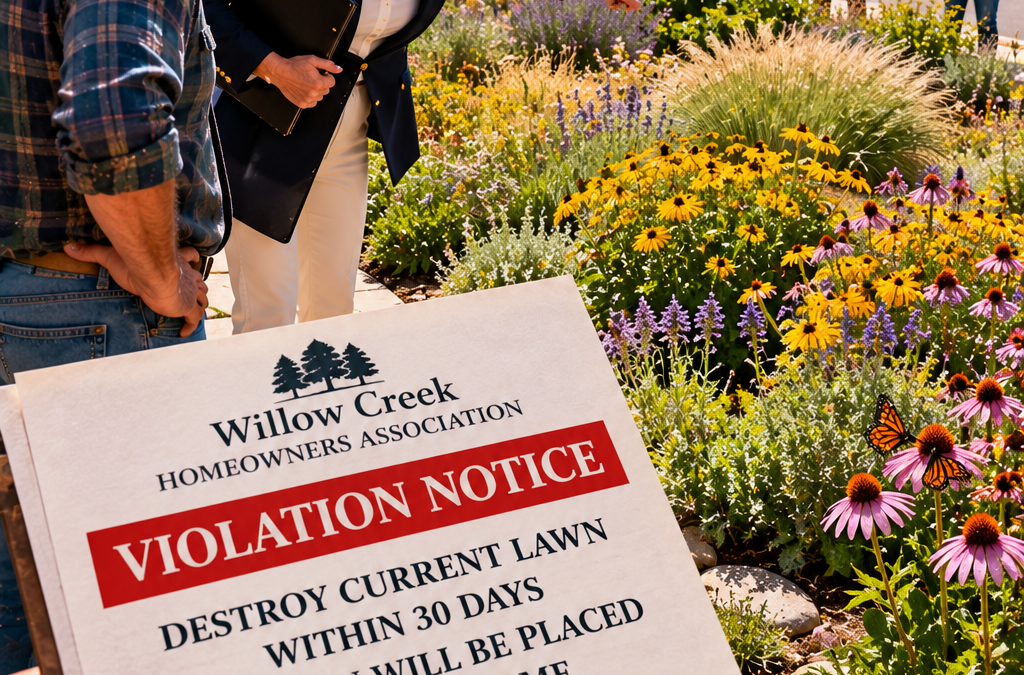
By late July, when most of my neighbors’ yards looked scorched, mine was alive.
Not golf-course green.
Alive.
There was a difference.
Buffalo grass had a softer, natural texture. The flower beds moved in the wind instead of sitting rigidly against the ground. Bees appeared. Then butterflies. Small birds began dropping into the yard in the mornings.
I stood outside one evening after a long, hot day and realized I could hear insects humming in the flowers.
I hadn’t heard that in my old lawn.
I remember thinking, This is what this land wanted to be.
That sounds sentimental now.
At the time, it was simply satisfying.
I had reduced my water use dramatically.
The yard looked healthy.
I had spent my own money.
I had done the work myself where I could.
And I hadn’t bothered anybody.
At least that was what I thought.
Three weeks after I finished planting, I opened my mailbox and found a thick white envelope with the HOA logo in the corner.
I almost left it on the counter unopened.
Then I noticed the words CERTIFIED NOTICE.
Inside was a formal violation letter.
According to the HOA, my landscaping failed to comply with the community’s “uniform appearance standards.”
The letter specifically claimed that all visible portions of residential lots were required to contain “traditional turf grass” maintained at an approved height.
I read that sentence twice.
Then three times.
There was no mention of whether the grass was healthy.
No mention of water restrictions.
No mention of drought.
No mention of the fact that my yard looked greener than half the neighborhood.
At the bottom of the letter was a deadline.
Thirty days.
Restore the property to approved turf landscaping or face escalating fines.
I laughed when I first read it.
Not because it was funny.
Because I genuinely assumed someone had made a mistake.
I called the management office the next morning.
A woman named Denise answered.
I gave her my address and explained that I had received a landscaping violation.
There was a pause while she pulled up my account.
Then her voice changed.
“Oh,” she said. “Yes. That property.”
That property.
The way she said it immediately told me this wasn’t an automated letter.
“Yes,” I said. “That property. I’m calling because I think there’s been some confusion. I didn’t stop maintaining my yard. I converted it to native drought-tolerant landscaping.”
“We’re aware of what you did.”
That stopped me.
“Okay.”
“It isn’t approved landscaping.”
“According to what?”
“The community standards.”
“Which standard?”
Another pause.
Then she read from something on her screen.
“Visible lawn areas must maintain a uniform appearance consistent with neighborhood aesthetics.”
“That doesn’t answer the question.”
“Sir—”
“Does the governing document actually say I have to maintain Kentucky bluegrass?”
“It requires turf.”
“Buffalo grass is turf.”
“It isn’t the approved turf.”
“Where does it define approved turf?”
Her tone hardened.
“This isn’t optional.”
“I understand what you’re saying. I’m asking where the rule is.”
“You have thirty days to restore the lawn.”
“I’d like the section number.”
“You received the violation notice.”
“The notice isn’t the governing document.”
She exhaled into the phone.
I could almost hear her deciding I was going to be difficult.
“You’re welcome to attend the next board meeting.”
“I probably will.”
“Then I suggest you use the thirty days wisely.”
She hung up.
I sat there staring at my phone.
That was the moment the dispute stopped being funny.
Not serious yet.
But irritating.
I had spent years assuming that if the HOA ever contacted me, there would at least be a clear rule behind it.
So that night I went online and downloaded every governing document available through the neighborhood portal.
The main declaration was fifty-two pages.
I printed the whole thing.
My dining room table disappeared under paper.
I made coffee and started reading.
It was mind-numbing.
Setbacks.
Architectural review.
Fence materials.
Utility easements.
Roof maintenance.
Parking.
Signs.
Exterior structures.
Common areas.
Drainage.
Maintenance obligations.
I nearly quit several times.
Then I reached page thirty-one.
And found a sentence that made me sit up.
I read it once.
Then again.
Then slowly, word by word.
Under the maintenance section, the declaration stated that landscaping must be maintained in a manner consistent with reasonable water-conservation practices and applicable state and local ordinances.
I stared at those words for a long time.
Reasonable water-conservation practices.
Applicable state and local ordinances.
It sounded important.
But I didn’t yet know how important.
I took a picture of the page.
Then I searched Colorado law.
Within an hour, I found what I had been looking for.
Two years earlier, the state had enacted protections for homeowners who installed qualifying drought-tolerant, native, or water-efficient landscaping.
Homeowners associations could still establish reasonable maintenance requirements.
They could regulate weeds.
They could regulate neglected property.
They could require designs to meet certain safety standards.
But they couldn’t simply ban water-efficient landscaping in favor of traditional high-water turf when state law protected the alternative.
And conflicting HOA rules could not override the statute.
I sat alone at my dining room table close to midnight, surrounded by pages, reading the same provisions until the legal language started making sense.
The HOA wasn’t merely being unreasonable.
There was a very real possibility they were wrong.
Legally wrong.
I considered calling them the next morning.
I didn’t.
That decision would later become important.
At the time, I simply wanted to understand everything before I showed them what I had found.
I had dealt with enough bureaucracies in my life to know that once you reveal your strongest argument, people stop explaining themselves honestly.
They start defending themselves.
So I waited.
The thirty-day deadline passed.
On day thirty-two, I received the first fine.
One hundred dollars.
The notice described my landscaping as a continuing violation.
A week later, the next fine doubled.
Then another letter arrived.
This one contained language about collection remedies.
Legal costs.
Assessment enforcement.
And, eventually, a lien.
I read that word several times.
Lien.
Over grass.
I walked outside holding the letter.
Across the street, sprinklers were running in the middle of a ninety-degree afternoon despite the watering restrictions.
Half the water was landing on concrete.
It ran down the curb in a shining stream.
My buffalo grass moved quietly in the dry wind.
And my HOA was threatening my house.
That was when neighbors began noticing.
Certified envelopes tend to attract attention.
So do HOA violation placards.
One evening, a man named Robert from three houses down stopped while walking his dog.
“I heard they’re after you about the yard.”
“Apparently.”
He looked at the grass.
“Looks better than mine.”
I smiled.
“Don’t tell them.”
He didn’t laugh.
“My water bill almost tripled this summer.”
“So did a lot of people’s.”
He lowered his voice.
“You know they fined the Parkers last year?”
“For what?”
“They replaced part of their front lawn with rock and native plants. Board made them put sod back.”
I hadn’t known that.
A few days later another neighbor told me about an older couple on the next street.
Same thing.
Then another.
The pattern became obvious.
The HOA had been enforcing its preferred landscaping standard as though the new state law didn’t exist.
Maybe they didn’t know.
Maybe they didn’t care.
At that point I still wasn’t sure which possibility bothered me more.
Then I met Linda Mercer.
Linda was the HOA president.
I had seen her before, of course.
Everyone had.
She had lived in the neighborhood for nearly twenty years and had served on the board in one capacity or another for most of the last decade.
She was in her late fifties, always meticulously dressed, always carrying a leather folder or clipboard at meetings, always speaking with the calm certainty of someone who believed being elected by sixty homeowners had granted her constitutional authority.
People joked about avoiding Linda when doing anything visible from the street.
I used to think those jokes were exaggerated.
Then she came to my house.
It was a Saturday morning.
I was pulling weeds near the side garden when a white SUV stopped at the curb.
Linda stepped out.
She was wearing cream-colored pants, sunglasses, and shoes that looked wildly impractical for walking through dirt.
She didn’t greet me.
She stood on the sidewalk looking across my property.
Then she said, “This needs to be corrected.”
I straightened.
“Good morning to you too.”
She removed her sunglasses.
“I assume you’ve received the notices.”
“I have.”
“And yet nothing has changed.”
“Correct.”
Her eyes narrowed slightly.
“May I ask why?”
“You can.”
She waited.
I went back to pulling a weed.
“Are you going to answer?”
“I was waiting for the question.”
Her jaw tightened.
“Why haven’t you restored the lawn?”
“Because I don’t believe I’m required to.”
“You are.”
“Where?”
“In the governing documents.”
“Which section?”
That bothered her.
I saw it immediately.
People like Linda were comfortable being obeyed.
Questions irritated her.
“I don’t have the documents memorized,” she said.
“I do have the relevant section.”
“Then you should know you’re in violation.”
“I know what page thirty-one says.”
For the first time, she looked uncertain.
Only for a second.
Then it disappeared.
“The board has already reviewed this.”
“Did the board review the state statute?”
“This isn’t about state law.”
“HOA rules are governed by state law.”
“This is about community standards.”
“No. It’s about whether your standards are enforceable.”
Her expression changed.
Not dramatically.
She simply became colder.
“I’ve been dealing with homeowners in this community for a very long time,” she said. “I can tell you that challenging the association almost never ends the way homeowners think it will.”
It was the first statement that felt less like an explanation and more like a threat.
I stood up.
“Is that supposed to convince me?”
“It’s supposed to save you money.”
“My landscaping is legal.”
“Your landscaping is ugly.”
There it was.
Not noncompliant.
Not dangerous.
Ugly.
Her opinion.
She gestured toward the native flowers.
“Do you understand what happens when people are allowed to do this?”
“Save water?”
“Everyone starts interpreting the rules however they want. One yard becomes a prairie. Another becomes gravel. Someone else puts cactus in the front. Before long, there’s no uniformity.”
“So this is about appearance.”
“It is about property values.”
“Do you have evidence my yard lowered anyone’s property value?”
“I don’t need to justify every board decision to you.”
“Actually, if you’re threatening a lien on my house, you might.”
She took one step closer.
“You have until the date specified in the notice.”
“And if I don’t?”
“We will use every enforcement mechanism available to us.”
“Even if the rule violates state law?”
“The board’s attorney can worry about that.”
Then she smiled.
It wasn’t friendly.
“If I were you, I’d worry about your lawn.”
She walked back to her SUV.
I watched her drive away.
That conversation changed something in me.
Until then, I had assumed the HOA might back down if someone calmly showed them the law.
Now I realized Linda wasn’t interested in whether I was right.
She was interested in whether I complied.
Those are not the same thing.
At the next board meeting, she made that even clearer.
I arrived early and took a seat in the back.
About thirty residents attended.
Most meetings barely attracted ten.
Word had spread.
Linda opened with routine matters.
Pool maintenance.
Trash collection.
A damaged entry sign.
Then she reached “landscaping enforcement.”
She never said my name.
She didn’t have to.
“Recently,” she began, “the board has encountered an instance in which a homeowner has deliberately removed approved landscaping and replaced it with vegetation inconsistent with established community character.”
I could feel heads turning toward me.
Linda continued.
“While we recognize current concerns regarding water use, individual homeowners cannot simply ignore governing standards whenever they find compliance inconvenient.”
Inconvenient.
My water bill wasn’t inconvenient.
The drought wasn’t inconvenient.
State law wasn’t inconvenient.
But I stayed quiet.
Then she said something I still remember almost word for word.
“If one homeowner is permitted to disregard the landscaping requirements, the board loses its ability to protect the aesthetic integrity of the entire neighborhood. This is a dangerous precedent.”
Dangerous.
That was the word she chose.
A lawn full of native grass and flowers was dangerous.
She continued talking about property values, uniformity, enforcement authority.
Then a woman in the second row raised her hand.
“What about the state law?”
Linda’s face tightened.
“Our counsel is aware of all applicable laws.”
That wasn’t an answer.
The woman tried again.
“Doesn’t the new law protect drought-tolerant landscaping?”
Linda leaned toward the microphone.
“This board will not conduct legal debates from the floor.”
A few people murmured.
Then Robert raised his hand.
“Has the HOA updated its landscaping rules since that law passed?”
Linda stared at him.
“I don’t believe this line of questioning is productive.”
That answer told me more than anything else she had said.
She didn’t know.
Or she knew and didn’t want to admit it.
I went home that evening more convinced than ever that page thirty-one mattered.
A week later, things escalated.
I came home from work and saw a landscaping truck parked near my curb.
Behind it sat a compact skid-steer loader.
For a moment, I thought someone nearby was having construction done.
Then I saw Linda.
She was standing near the edge of my yard with two men wearing work gloves.
I pulled into the driveway and got out.
“What are you doing?”
Linda turned.
“We’re assessing the restoration work.”
“What restoration work?”
“Your lawn.”
I looked at the machine.
Then at her.
“You’re not touching my property.”
“The association has enforcement rights.”
“You do not have permission to enter my property and remove landscaping.”
“You were given notice.”
“Notice is not permission.”
One of the workers looked uncomfortable.
He glanced from Linda to me.
“Ma’am,” he said quietly, “you told us this was association property.”
Linda turned sharply.
“I told you the association had authority.”
“That’s not the same thing.”
I stepped closer.
“This is private property. I have not authorized any work.”
The worker immediately raised both hands.
“Then we’re not doing anything.”
Linda’s face reddened.
“You have been given multiple opportunities.”
“And now I’m giving you one. Get the equipment away from my house.”
“You are making this far more difficult than necessary.”
“No. You’re standing in front of my home with machinery after threatening me over landscaping that uses less water during a drought. You’re making this difficult.”
She lowered her voice.
“You really want to go to war over grass?”
I looked at her.
“No, Linda. Apparently you do.”
The landscaping crew left.
Linda stayed long enough to photograph my yard from several angles.
Before getting into her SUV, she said, “The next communication you receive may come from counsel.”
She was right.
Six weeks after the first violation letter, a process server came to my door.
That was the moment the fear became real.
He handed me the papers.
I signed.
He left.
I stood in the entryway reading the first page.
The HOA had filed for an injunction.
They wanted a judge to order me to remove the native landscaping and reinstall traditional sod within fifteen days.
If I refused, they were asking for authority to impose continuing fines.
They also sought recovery of legal fees.
The language was clinical.
That made it worse.
My home had suddenly become a legal case number.
I walked into the kitchen and sat down.
For the first time since the dispute began, I wondered whether I had made a mistake.
It is easy to feel brave when you’re arguing with someone on your sidewalk.
Court papers are different.
The words carry weight.
Injunction.
Attorney fees.
Enforcement.
Lien.
I had a mortgage.
Savings, yes, but not unlimited savings.
I had responsibilities.
A lawsuit could become expensive even if I was right.
And right didn’t always mean safe.
That night I barely slept.
Around two in the morning, I walked downstairs and looked through the front window.
The yard was silver under the streetlights.
Nothing about it looked rebellious.
Nothing about it looked dangerous.
It was just grass.
Grass suited to the place where it was growing.
And someone was taking me to court because I refused to kill it.
The next afternoon, I called Priya Shah.
A neighbor had recommended her.
She specialized in property disputes, land-use issues, and homeowner association law.
Her office wasn’t impressive.
That helped.
No enormous marble lobby.
No expensive fountain.
Just shelves full of binders and a conference table with a scratch near one corner.
I brought everything.
The violation letters.
Fine notices.
Lien threat.
Lawsuit.
Photographs.
Water bills.
My landscaping plan.
The state statute.
And page thirty-one.
Priya listened without interrupting.
Then she read the HOA complaint.
After that, she read the landscaping standard.
Finally, she reached page thirty-one.
She read the conservation clause.
Then she read it again.
She looked at me.
“When was this declaration adopted?”
I gave her the date.
“And when did the state statute take effect?”
I told her.
She opened her laptop.
For the next several minutes, I watched her compare documents.
Then she leaned back.
“Did the HOA ever amend its landscaping standards after the statute changed?”
“I don’t know.”
“Do you have the amendments?”
“I downloaded everything on the portal.”
We went through them.
None addressed the landscaping provision.
Priya became very still.
Then she said, “They just filed a lawsuit that’s going to force them to explain why they’re enforcing a rule they were legally required to update.”
I didn’t immediately understand.
“So I’m okay?”
She gave me a look attorneys probably reserve for clients who ask impossible questions.
“I didn’t say that.”
My stomach tightened.
“What are you saying?”
“I’m saying they have problems.”
She tapped page thirty-one.
“Several.”
She laid them out carefully.
First, state law protected qualifying water-efficient landscaping.
Second, the HOA’s own declaration required its landscaping standards to remain consistent with reasonable water-conservation practices and applicable state law.
Third, from what she could see, the association had continued enforcing an older internal standard without formally bringing that standard into compliance.
“If the facts are what they appear to be,” she said, “they aren’t just asking the court to enforce a questionable rule.”
She turned the complaint toward me.
“They’re asking the court to enforce a rule their own declaration may subordinate to current law.”
I stared at the papers.
“So why would their attorney file this?”
“Maybe counsel hasn’t been given the full history. Maybe the board thinks the rule is enforceable. Maybe they believe you’ll settle before anyone tests it.”
“Linda definitely believes I’ll settle.”
Priya nodded.
“That happens.”
“She tried to bring a landscaping crew onto my property.”
Priya stopped writing.
“Tell me exactly what happened.”
I did.
She added several notes.
When I finished, she closed the folder.
“Do not speak to Linda about the merits anymore.”
“I wasn’t planning to.”
“Good. Don’t antagonize her. Don’t threaten her. Don’t post anything online. Don’t touch the yard beyond ordinary maintenance. Take photographs weekly. Keep every letter. Keep every envelope. Document any contact.”
“What do you think she’s going to do?”
“I don’t know.”
She looked at me.
“But people who believe authority belongs to them personally often make useful mistakes when someone stops obeying.”
The hearing was six weeks away.
Those six weeks changed the way I saw my neighborhood.
Before the lawsuit, I knew houses.
During the lawsuit, I started knowing people.
The Parkers came over one evening carrying a folder.
They had paid $600 in landscaping fines the previous year after replacing a section of turf with drought-resistant plants.
“They told us we’d lose if we challenged it,” Mrs. Parker said.
“Who told you?”
“Linda.”
Of course.
Another couple had paid $450.
An elderly widower named Thomas had been fined repeatedly because he’d reduced his lawn and installed native ground cover after his water bill became unaffordable.
He eventually gave up and put sod back.
When he showed me the receipts, his hands shook.
“I couldn’t keep paying fines,” he said. “My wife had just died. I wasn’t going to spend what I had left fighting people over a yard.”
That conversation stayed with me.
For Linda, landscaping enforcement was a policy.
For Thomas, it had been groceries.
Medication.
Heating.
Grief.
The more neighbors I spoke to, the less the case felt like mine.
Priya warned me not to turn it into a crusade.
“We defend the claim in front of us,” she said.
But she also asked for copies of every fine notice neighbors were willing to provide.
By the fourth week, we had identified at least four households that had been penalized under the same landscaping rule after the state law changed.
That mattered.
So did Linda’s behavior.
She started driving past my house more often.
Maybe she always had.
Maybe I simply noticed now.
Twice I saw her slow near the curb.
One afternoon, she stopped and photographed the yard.
I walked outside.
She lowered her phone.
“Can I help you?”
“Routine compliance documentation.”
“From the public street?”
“Yes.”
“Fine.”
I turned to leave.
“You could still stop this,” she called.
I looked back.
“Stop what?”
“The litigation.”
“By destroying my landscaping.”
“By complying with the rules.”
“The rules you’re being asked to prove are enforceable.”
Her eyes hardened.
“You seem very confident.”
“I’m confident enough to let a judge read them.”
That landed.
She walked toward me.
“I hope your attorney has explained something to you.”
“I’m listening.”
“If the association wins, you may be responsible for far more than replacing a lawn.”
“I understand.”
“Legal fees can ruin people.”
There was something almost casual about the way she said it.
That bothered me more than if she’d shouted.
“You’ve lived here eleven years,” she continued. “You’ve never had a problem with the board before. Why throw that away?”
“I’m not throwing anything away.”
“You are choosing conflict.”
“No. I planted grass.”
She shook her head.
“This attitude is exactly why enforcement matters.”
I thought of Thomas.
Of the Parkers.
Of four households paying fines because they had believed people like Linda knew what they were talking about.
“Then enforce it in court.”
Her face went rigid.
“Gladly.”
The hearing arrived on a cold morning after weeks of heat had finally broken.
I barely ate breakfast.
Priya told me that was normal.
It didn’t help.
The courthouse felt strangely ordinary.
Security bins.
Fluorescent lights.
People staring at phones.
Attorneys walking quickly through hallways carrying files.
My dispute had consumed my thoughts for almost three months.
Inside the courthouse, it was simply another item on a docket.
The hearing room was smaller than I expected.
Linda was already there.
She sat beside the HOA’s attorney at one table.
She wore a navy suit and had several binders stacked neatly in front of her.
When I entered, she looked at me.
No smile.
No nod.
Nothing.
Priya and I sat at the opposite table.
Then I turned and saw the gallery.
Neighbors.
A lot of them.
Robert.
The Parkers.
Thomas.
People I knew only by face.
People I’d never expected to spend a weekday morning watching a landscaping case.
That did something to me.
I had spent weeks feeling as though I was defending myself.
Seeing them there reminded me that everyone behind me had something at stake.
The judge entered.
We stood.
The hearing began.
The HOA’s attorney went first.
He was polished and calm.
He described the dispute as straightforward.
A homeowner had purchased property subject to recorded covenants.
Those covenants authorized landscaping standards.
The homeowner knowingly altered his landscaping without proper approval.
The association issued notice.
The homeowner refused to cure.
Fines were imposed.
The violation continued.
Therefore, according to the HOA, an injunction was appropriate.
He displayed photographs of my yard.
I almost laughed.
The pictures made it look beautiful.
Native flowers along the border.
Buffalo grass across the open space.
No trash.
No overgrowth.
No broken structures.
No safety hazard.
Just a different kind of lawn.
The attorney read the uniform landscaping provision.
Linda watched the judge carefully, as though she expected the hearing to end right there.
Then Priya stood.
She didn’t begin with emotion.
She didn’t mention Linda.
She didn’t mention the threats.
She didn’t talk about bees or drought or my water bill.
She began with the document.
“Your Honor, the association has quoted one portion of its governing rules. We would ask the court to consider the declaration as a whole.”
She handed up the relevant page.
Page thirty-one.
My page.
The one I had photographed at midnight.
Priya read the sentence aloud.
Landscaping must be maintained in a manner consistent with reasonable water-conservation practices and applicable state and local ordinances.
The room was silent.
Then Priya moved to the statute.
She explained the state protections for qualifying drought-tolerant and water-efficient landscaping.
She explained when they had taken effect.
She explained that HOA rules conflicting with those protections could not simply remain enforceable because the association preferred the older standard.
Then she turned toward opposing counsel.
“The association’s complaint relies on a landscaping restriction that predates the statutory change.”
The HOA attorney stood.
“The association maintains authority to establish reasonable aesthetic standards.”
Priya nodded.
“We don’t dispute that.”
That seemed to surprise him.
She continued.
“The question isn’t whether an HOA may regulate landscaping. The question is whether this HOA may use an unrevised rule to prohibit landscaping protected by state law when its own declaration expressly requires consistency with applicable law and reasonable water conservation.”
The judge looked toward the HOA attorney.
“Counsel, was the landscaping rule amended after the statute took effect?”
He flipped through his binder.
For the first time that morning, he looked uncertain.
“Your Honor, I would need to confirm the amendment history.”
Priya already had it.
Every amendment.
Every recorded change.
None fixed the landscaping provision.
The judge repeated the question.
“Was it amended?”
The attorney spoke quietly with Linda.
I watched her expression change.
At first, irritation.
Then confusion.
Then something closer to alarm.
She opened one binder.
Then another.
Pages moved.
Whispers.
Nothing.
Finally the attorney stood.
“To the best of my knowledge, Your Honor, there was no formal amendment specifically addressing the landscaping provision after enactment of the statute.”
There it was.
The sentence Priya had expected.
The air in the room changed.
I could feel it.
The HOA had entered court claiming I refused to obey its rules.
Now the judge was asking why the HOA had never brought those rules into compliance with the law it was required to follow.
The attorney tried to recover.
He argued that the board’s design authority survived.
That uniformity served legitimate community interests.
That my installation had been done without architectural approval.
Priya was ready for that too.
She produced my photographs.
Maintenance records.
Plant list.
Water-use comparison.
And most importantly, the language of the statute itself.
Reasonable standards were one thing.
A functional prohibition was another.
The judge looked at my yard photographs again.
“Is the association claiming this property is unmaintained?”
The HOA attorney hesitated.
“Not exactly, Your Honor.”
“Is it claiming the vegetation is invasive?”
“No.”
“A safety hazard?”
“No.”
“Obstructing sidewalks or sightlines?”
“No.”
“Then what specifically is the injury?”
He looked toward Linda.
She whispered something.
He answered.
“The association believes the design is inconsistent with community aesthetics.”
The judge leaned back.
“That wasn’t my question.”
Another silence.
Behind me, somebody shifted in a chair.
My heart was pounding so hard I could hear it.
Linda’s posture had changed completely.
The confidence she carried into the room was gone.
Priya then introduced the enforcement history.
Not everything.
Just enough.
She explained that my case did not appear to be an isolated misunderstanding.
The association had continued issuing penalties based on the same outdated landscaping policy after the state law changed.
The judge looked sharply toward the HOA.
“How many homeowners?”
The attorney glanced at Linda.
She stared at her binder.
“I don’t have that information,” he said.
The judge looked back at Priya.
“Do you?”
Priya did not exaggerate.
“We have documentation concerning at least four other households, Your Honor. There may be additional cases within the association’s records.”
The judge’s expression changed.
That was the moment I knew this was no longer simply about whether I had to remove buffalo grass.
“Counsel,” she said to the HOA attorney, “how many homeowners have been fined under this landscaping standard since the statute took effect?”
“I cannot answer that today.”
“Why not?”
“We were not prepared to address association-wide enforcement history at this hearing.”
The judge’s voice remained calm.
“Your client initiated litigation seeking equitable relief based on this rule. Its enforceability is not collateral to the hearing.”
Linda leaned toward her lawyer again.
He whispered something back.
She shook her head.
For months, Linda had treated the rules as a weapon she could point in one direction.
Now the judge had turned the same document around.
I remembered Linda standing on my sidewalk saying she didn’t need to justify every board decision to me.
She did now.
Not to me.
To the court.
And unlike me, the court couldn’t be threatened with a lien.
Priya returned to the central point.
The association’s own governing declaration required consistency with applicable law.
The newer state statute protected the kind of water-efficient landscaping I had installed.
The HOA had not shown that its blanket turf requirement had been properly revised or could lawfully override those protections.
The injunction, she argued, should be denied.
The fines should not stand.
The judge asked several more questions.
Some were technical.
Some concerned notice.
Some concerned board procedure.
Then she looked at the photographs again.
I waited.
The few seconds before she spoke felt longer than the previous three months.
“The association’s request for injunctive relief is denied.”
I didn’t breathe.
Not yet.
She continued.
The HOA had not established a lawful basis for forcing removal of the landscaping under the outdated standard presented to the court.
The conflict between that standard, the conservation clause in the declaration, and current state law was not something the association could solve merely by repeatedly fining a homeowner.
Then she addressed the enforcement history.
Because the HOA appeared to have assessed other homeowners under the same rule after the statutory change, the court required the association to identify affected accounts and correct improperly imposed penalties.
Refunds would include applicable interest.
The association was also directed to bring its landscaping rules into formal compliance within ninety days.
The judge warned counsel that continued enforcement of a conflicting rule could create additional exposure.
I looked at Linda.
She wasn’t looking at the judge anymore.
She was looking down.
For the first time since I’d met her, she had nothing to say.
The hearing ended.
People behind me began standing.
Priya touched my arm.
“Don’t celebrate in here.”
I hadn’t realized I was smiling.
Outside the courtroom, Linda caught up with us.
Her attorney tried to stop her.
She ignored him.
“This isn’t over,” she said.
Priya turned before I could answer.
“The court issued its order.”
“You embarrassed this association.”
Linda was looking at me, not Priya.
I stared at her.
For three months, I had imagined what I might say if we reached that moment.
Something sharp.
Something memorable.
I had imagined telling her she had done this to herself.
But looking at her then, I didn’t feel triumphant.
Mostly I felt tired.
So I said the simplest thing I could.
“No, Linda. I planted a lawn.”
Her face tightened.
I continued.
“You sent the fines. You threatened the lien. You hired the lawyer. You tried to bring machinery onto my property. You filed the lawsuit. I just stopped saying yes.”
She said nothing.
Her attorney quietly took her by the elbow.
They walked away.
The consequences unfolded over the next several months.
The HOA’s legal bill exceeded forty thousand dollars.
That number spread through the neighborhood almost immediately.
Then came the refund review.
The board had to examine previous landscaping violations issued after the state law changed.
Homeowners who had paid qualifying fines received notices.
The Parkers got their money back.
So did the other households we’d identified.
Thomas called me after receiving his letter.
“They’re refunding it,” he said.
I could hear something in his voice I hadn’t heard before.
Relief.
Not because the amount was enormous.
Because someone had finally acknowledged that he should never have been pressured into paying it.
“I wish my wife were here,” he told me.
That one hurt.
The HOA eventually amended its landscaping rules.
The new standards still required maintenance.
They still prohibited weeds and neglected lots.
They still regulated hardscaping, sightlines, and certain design issues.
But they could no longer pretend every homeowner was required to maintain a wall-to-wall high-water lawn.
Native grass was recognized.
Drought-tolerant landscaping was recognized.
Water-efficient designs were recognized.
Exactly what should have happened two years earlier.
There was a cost.
The legal expenses and refunds placed pressure on the association’s budget.
Homeowners eventually received a special assessment.
Nobody liked that.
I didn’t either.
I remember opening that notice and feeling a complicated kind of anger.
Every household was paying for a fight most of us never wanted.
Some neighbors blamed Linda.
A few blamed me.
One man stopped me near the mailbox and said none of this would have cost anything if I had simply put the sod back.
I asked him whether he believed an HOA should be allowed to enforce an illegal rule simply because challenging it cost money.
He didn’t answer.
He walked away.
I understood his frustration.
Money is real.
Principles sound noble until an invoice arrives.
But that was exactly why boards like Linda’s often got away with things.
They relied on the calculation that surrender was cheaper.
Pay the fine.
Replace the grass.
Repaint the door.
Move the fence.
Stop asking questions.
Don’t hire a lawyer.
Don’t risk fees.
Don’t become the difficult homeowner.
Most people weren’t cowards.
They were busy.
They had children.
Mortgages.
Jobs.
Sick parents.
Medical bills.
They didn’t have the time or money to turn every improper HOA decision into a legal battle.
Linda had understood that.
She had built her authority around it.
That was what made her behavior so damaging.
She didn’t need every rule to be right.
She only needed homeowners to believe resisting her would hurt more than obeying.
The election that year was different.
Usually, board elections attracted little attention.
That year, the meeting room was full.
Linda did not run for another term.
Whether that was her decision or because she knew she wouldn’t win, I never found out.
She sold her house the following spring.
I saw the moving truck one morning.
We never spoke again.
The neighborhood changed after that.
Not dramatically.
There was no revolution.
Nobody tore down the entrance monument.
The HOA still existed.
Meetings were still boring.
People still argued about parking.
But something important had shifted.
Homeowners started reading notices before paying them.
Board members began citing actual sections when issuing violations.
Meeting minutes became more detailed.
Someone created a compliance committee to review state-law changes annually.
And little by little, the neighborhood became less obsessed with forcing every front yard to look identical.
That autumn, Robert removed nearly half his bluegrass.
The Parkers expanded their native beds.
A family at the end of the street installed a low-water landscape with ornamental grasses and flowering perennials.
The next spring, Thomas replaced the sod the HOA had once forced him to reinstall.
He planted buffalo grass.
I helped him.
We spent a Saturday morning working quietly in the dirt.
At one point he sat back on his heels and looked across the yard.
“My wife would’ve liked this,” he said.
I didn’t know what to say.
So I just nodded.
By midsummer, his yard was green.
Mine was too.
The drought didn’t disappear.
Neither did the heat.
But my water use stayed far below what it had been when I maintained traditional turf.
The bees returned.
So did the butterflies.
Sometimes I would stand on the porch in the evening and watch the flowers moving in the wind.
For months, those plants had felt like evidence.
Evidence in photographs.
Evidence in legal filings.
Evidence of alleged noncompliance.
After the case ended, they became plants again.
That may sound insignificant.
It wasn’t.
There had been nights during the lawsuit when I wondered whether I was putting my home at risk for something stupid.
Grass.
Flowers.
A principle buried in a fifty-two-page document.
There were moments when I wanted to call Priya and tell her to settle.
There were moments when Linda’s warnings worked exactly as intended.
I imagined losing.
I imagined enormous attorney fees.
I imagined a lien.
I imagined explaining to people that I had put myself through all of it because I refused to reinstall Kentucky bluegrass.
Fear has a way of making unreasonable demands seem reasonable.
Just comply.
Just make it disappear.
Just give them what they want.
But every time I reached that point, I went back to page thirty-one.
One sentence.
Reasonable water-conservation practices and applicable state and local ordinances.
The board had its own rules sitting in front of it the entire time.
So did I.
The difference was that I finally read them.
That’s what stayed with me most.
Not the courtroom.
Not Linda’s face when her attorney admitted the rule had never been amended.
Not even the refunds.
It was the realization that authority often sounds much stronger than it actually is when nobody asks to see the foundation underneath it.
Linda spoke with certainty.
The violation letters looked official.
The fines looked official.
The lien threat looked official.
The lawsuit was official.
None of those things automatically made her interpretation right.
For years, residents had treated the HOA’s statements as conclusions.
I learned to treat them as claims.
A claim can be checked.
A rule can be read.
An authority can be limited.
A document can contradict the person waving it in your face.
I don’t regret refusing that first thirty-day demand.
I regret that it took a lawsuit for the association to do what it should have done when the law changed.
I regret that Thomas spent money he shouldn’t have had to spend while grieving his wife.
I regret that other homeowners were intimidated into replacing landscaping that was already helping them conserve water.
And I regret that the final legal cost fell partly on neighbors who had nothing to do with Linda’s decisions.
But I don’t regret the yard.
I don’t regret page thirty-one.
And I don’t regret making them prove they had the power they claimed.
Because they didn’t.
Two summers after the hearing, we had another dry August.
The city announced watering restrictions again.
Sprinklers across the subdivision ran less frequently.
Some traditional lawns went brown.
Mine didn’t.
The buffalo grass softened into the heat without collapsing.
The flowers kept blooming.
One evening I sat on the front steps with a glass of water and watched a bee move slowly through a cluster of purple blossoms.
Thomas walked past.
He stopped at the sidewalk.
“Still an eyesore?” he asked.
I laughed.
“Apparently.”
He looked up and down the street.
Several houses now had native landscaping.
Another had removed most of its turf.
Across from me, Robert had converted the strip beside his driveway.
Thomas smiled.
“Funny.”
“What?”
“Looks like the neighborhood survived.”
I looked around.
Kids were riding bicycles near the corner.
Someone was grilling.
A dog barked behind a fence.
The mountains were darkening beneath the evening sky.
Nothing had collapsed.
Property values hadn’t vanished.
The subdivision hadn’t descended into chaos because people planted grass that could survive Colorado.
Life had continued.
Only now we used less water doing it.
Thomas kept walking.
I stayed on the steps until the light began to fade.
Eleven years earlier, when I bought that house, I thought ownership meant the deed with my name on it.
The lawsuit taught me something more complicated.
Owning property doesn’t mean nobody can regulate what you do with it.
Communities need rules.
Neighbors affect one another.
Reasonable standards matter.
But a rule is not reasonable simply because someone with a title says it is.
And power doesn’t become legitimate merely because it arrives on official letterhead.
Linda had confused enforcement with authority.
Then she had confused authority with obedience.
By the time we reached court, she seemed to believe that my refusal to submit was itself proof that I was wrong.
That was why she kept escalating.
One letter became fines.
Fines became threats.
Threats became machinery at my curb.
Then came lawyers.
Then court.
At every stage, she could have opened the same fifty-two-page document I did.
She could have read page thirty-one.
She could have looked at the new state law.
She could have said, “We need to update our rules.”
Instead, she decided the homeowner had to be the problem.
That decision cost the association more than forty thousand dollars in legal fees before refunds were even counted.
It cost Linda her credibility.
It cost the board the trust of the neighborhood.
And in the end, none of it changed the thing she had been determined to destroy.
My lawn stayed.
Not because I was more powerful than the HOA.
I wasn’t.
Not because I had more money.
I didn’t.
It stayed because once somebody finally forced the argument out of threatening letters and into a courtroom, the question became very simple.
What did the law actually say?
That question had always been there.
Buried beneath fifty-two pages of rules.
Waiting for someone to read it.
The HOA had spent months trying to teach me that resistance was expensive.
What they taught me instead was that unquestioned authority can be much more expensive.
My yard is still there today.
The buffalo grass still bends in the summer wind.
The wildflowers still return.
The bees still find them.
And every time I walk across that lawn, I think about the morning Linda Mercer stood on my sidewalk, looked at the only landscape on the street thriving through a drought, and ordered me to destroy it.
She thought the strongest thing she had was the HOA rulebook.
She never imagined I would be the one who actually read it.




