𝗙𝗨𝗟𝗟 𝗦𝗧𝗢𝗥𝗬 The HOA President Decided My Old Tractor Was a Threat to the Neighborhood and Wouldn’t Stop Until the Sheriff Came
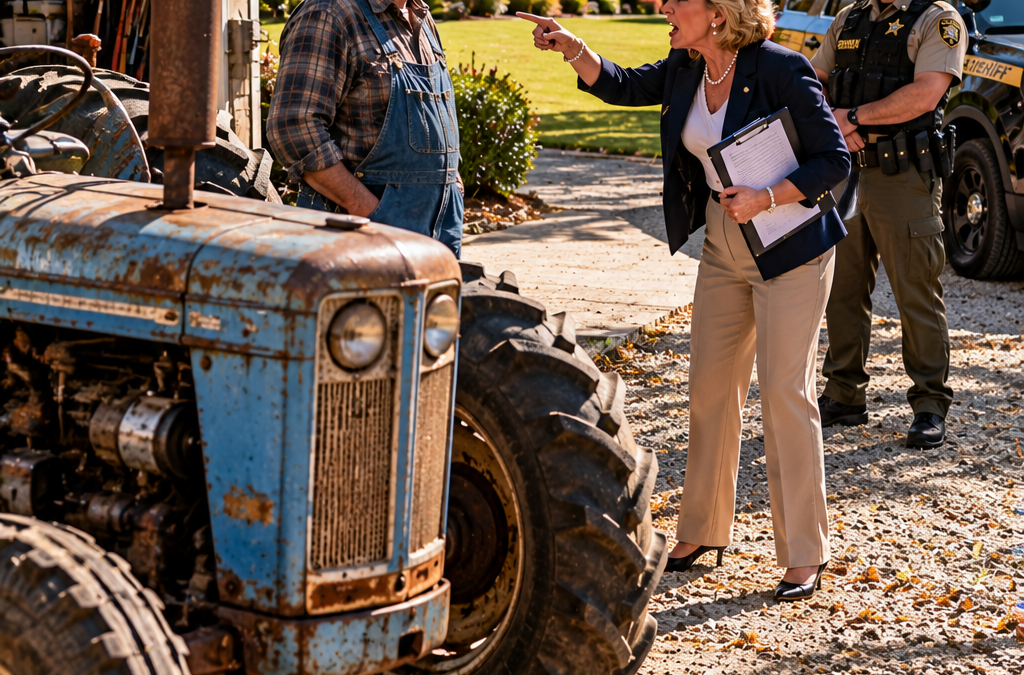
𝗙𝗨𝗟𝗟 𝗦𝗧𝗢𝗥𝗬
That tractor became part of my life on Maple Hollow Lane.
I used it to mow the back field.
I hauled firewood with it.
Dragged fallen branches after storms.
Moved mulch.
Pulled fence posts.
When snow came, I mounted a little front blade and cleared my driveway.
Then I usually cleared two or three others.
Mrs. Patterson next door was seventy-eight and lived alone.
Tom across the road had arthritis in both knees.
Neither ever asked me directly.
I just did it.
That was what neighbors used to do on Maple Hollow Lane.
Then the subdivision grew.
Open lots became houses.
Houses became a development.
And eventually the development became an HOA.
For several years, the HOA barely affected me.
There were meetings.
Newsletters.
Rules about garbage cans and paint colors.
I paid what I owed and otherwise kept to myself.
Then the board changed.
And Deborah became president.
She arrived in our lives the way some storms arrive—not violently at first, but with enough pressure in the air that everyone starts closing windows.
She had lived in the neighborhood for less time than many of us.
That did not stop her from behaving as though she had personally designed it.
Deborah loved rules.
More accurately, she loved enforcing them.
There was a difference.
A person who respects rules also respects their limits.
Deborah respected only the part where someone else had to obey.
She attended every board function carrying a laminated binder thick enough to qualify as furniture.
She photographed garbage cans left visible after collection day.
She measured lawn edges.
She once sent a warning to a family because a child’s bicycle remained beside their garage for forty-eight hours.
When people disagreed, she tilted her head and spoke to them in the slow, patient tone normally reserved for explaining consequences to a child.
“Rules exist for everyone.”
That was one of her favorite sentences.
Her other favorite was:
“If we allow one exception, where does it end?”
I had little interaction with her until the tractor became her target.
The first notice appeared on my mailbox on a Tuesday afternoon.
It was taped directly to the post.
I saw the white paper when I drove home from town.
At first, I assumed it was advertising.
Then I noticed the HOA logo.
I pulled into the driveway, walked back, and removed it.
The heading read:
NOTICE OF VIOLATION
Underneath:
Unauthorized industrial equipment must be removed within ten days pursuant to HOA Bylaw 4.2.
I read it twice.
Then I looked toward the side yard.
My tractor sat exactly where it had sat for years beneath the metal carport.
I actually laughed.
Not because I thought the situation was funny.
Because sometimes absurdity reaches a point where your body does not know how else to respond.
“Industrial equipment?”
I said the words aloud.
The tractor appeared unimpressed.
I carried the notice inside and pulled out the HOA documents I had kept since the subdivision rules were first established.
I had learned years earlier never to throw away paperwork involving property.
Bylaw 4.2 existed.
It did not say what Deborah claimed it said.
The section concerned the storage of commercial construction machinery and prohibited equipment “used primarily for active commercial business operations” from being stored in visible residential areas.
Backhoes.
Excavators.
Commercial loaders.
Heavy construction equipment.
My tractor was none of those things.
It was privately owned.
Used only on my property and occasionally to help neighbors.
It had been there long before the current rule.
I wrote a short response.
I cited the bylaw.
Explained what the tractor was.
Included the year and model.
Mentioned its noncommercial use.
I ended politely.
I thought that would finish it.
Three days later, Deborah appeared in my driveway.
I was splitting firewood behind the garage when I heard a car door shut.
She walked toward me carrying her clipboard.
“Russell?”
“Yeah.”
“We need to discuss the vehicle.”
I looked past her.
“What vehicle?”
“The tractor.”
“That’s a tractor.”
“I’m aware.”
“Then we’re making progress.”
She did not smile.
“I received your response.”
“Good.”
“It does not resolve the violation.”
I leaned the splitting maul against the stump.
“Why not?”
“Because the board considers the equipment commercial grade.”
I looked toward the tractor.
Then back at her.
“Commercial grade?”
“Yes.”
“It’s from 1974.”
“That has nothing to do with classification.”
“It has quite a lot to do with what the machine actually is.”
She glanced toward it as if viewing something diseased.
“The appearance alone is inconsistent with community standards.”
There it was.
Not safety.
Not commercial use.
Appearance.
“What appearance?”
“It’s visibly rusted.”
“So am I.”
Her mouth tightened.
“This isn’t funny.”
“No, Deborah. What isn’t funny is you standing on my property telling me a tractor I’ve had here for years suddenly violates a rule that doesn’t apply to it.”
“It is industrial machinery.”
“No.”
“It clearly is.”
“Based on what?”
“Size. Construction. Exposed mechanical components.”
I stared at her.
“It’s an old farm tractor.”
“It could be used commercially.”
“So could my pickup.”
“That isn’t the same thing.”
“My lawn mower could be used commercially.”
“You’re being argumentative.”
“I’m asking you to explain your own accusation.”
She looked down at her clipboard.
“The board has determined the tractor qualifies as a commercial-grade construction vehicle and an exterior nuisance.”
I walked several steps toward the carport.
“Come look at it.”
She hesitated.
“Excuse me?”
“Come here.”
I pointed to the faded Ford badge.
“Look. It’s not a bulldozer. It isn’t a loader. It isn’t some contractor parking equipment here overnight. It’s a small farm tractor.”
“I can see what it is.”
“Apparently not.”
Her expression went cold.
“You have seven days remaining.”
“For what?”
“To remove it.”
“And if I don’t?”
“Fines will begin.”
I studied her face.
She was completely serious.
There are moments when you realize a disagreement is not about misunderstanding.
That matters.
Misunderstandings can be corrected.
You show someone evidence.
You explain.
They reconsider.
This was different.
Deborah did not need information.
She needed obedience.
The tractor had become a test.
And I had failed it by saying no.
“I’m not removing it.”
“You may reconsider when penalties accumulate.”
“I doubt it.”
“The board also has enforcement mechanisms available.”
“Then use whichever ones are legal.”
Her eyes narrowed.
“You’re choosing to make this difficult.”
“No. I’m choosing not to throw away my grandfather’s tractor because you think rust violates the neighborhood aesthetic.”
Her face changed slightly when I said grandfather.
For half a second, I thought there might be some recognition that this machine meant something beyond its appearance.
Then it vanished.
“Sentiment does not override community regulations.”
That sentence stayed with me.
Sentiment does not override community regulations.
As if a neighborhood handbook somehow outranked memory.
As if everything a person loved had to justify itself before a committee.
She turned and walked back toward her car.
Before leaving, she said, “Seven days.”
I called after her.
“It’ll still be there.”
It was.
And seven days later, the first fine arrived.
Fifty dollars.
I appealed it in writing.
The next week brought another violation.
One hundred dollars.
The week after that, one hundred fifty.
The letters became increasingly dramatic.
“Continued noncompliance.”
“Failure to remediate.”
“Ongoing nuisance condition.”
“Potential enforcement escalation.”
By the fourth letter, you would have thought I had installed a chemical refinery beside the creek.
I responded every time.
I included photographs showing where the tractor was stored.
I attached the county zoning language for agricultural and residential utility equipment.
I sent a copy of the property deed referencing the land’s agricultural history.
I highlighted Bylaw 4.2.
I even called the county zoning office.
A man there asked me what equipment I had.
“A 1974 Ford tractor.”
Silence.
“Doing what?”
“Sitting under a carport.”
“Are you running a business?”
“No.”
“Repair shop?”
“No.”
“Construction company?”
“No.”
“Then why are we talking?”
“HOA.”
He sighed.
“Ah.”
That one sound told me he had received similar calls before.
I asked if the county required any commercial permit.
“No.”
Industrial registration?
“No.”
Hazard permit?
“No.”
Storage permit?
“No.”
He emailed me a statement confirming that ordinary privately owned agricultural equipment used for property maintenance did not require commercial heavy-equipment permitting.
I forwarded it to the HOA.
Deborah responded with one sentence.
County classification does not override HOA aesthetic authority.
I printed the email and placed it in a folder.
By then, I had started saving everything.
Every letter.
Every envelope.
Every photograph.
Every email.
Every fine.
Because people like Deborah have a strange relationship with paperwork.
They use it to intimidate others while assuming nobody will organize enough paperwork to challenge them.
The tractor became a regular subject at HOA meetings.
At first, I did not attend.
Tom told me what was happening.
“She’s obsessed with it.”
“Why?”
“She keeps calling it heavy machinery.”
“It weighs less than half the trucks parked in this neighborhood.”
“I know.”
“What do other people say?”
“Depends who’s there.”
A handful supported Deborah.
Not because they knew anything about the tractor.
Some admitted they had never seen it.
But Deborah used phrases that made the issue sound serious.
“Hazard.”
“Liability.”
“Property values.”
“Community standards.”
“Danger to children.”
Those words have power when repeated often enough.
Especially among people who do not know the facts.
At one meeting, according to Tom, Deborah displayed a photograph of my tractor on a projector.
She had taken the picture from the road.
The machine sat under the carport with part of my woodpile visible behind it.
“She called it an attractive nuisance,” Tom said.
I nearly spit out my coffee.
“Attractive?”
“Legal term.”
“I know what it means.”
“She says kids could climb on it.”
“Kids could climb on my pickup.”
“That’s what I said.”
“You defended me?”
“I asked whether we were banning riding mowers too.”
I smiled.
“How’d that go?”
“She didn’t enjoy the question.”
Mrs. Patterson defended me more directly.
She had lived beside me for fourteen years.
The previous winter, after eight inches of snow fell overnight, I had cleared her entire driveway before she woke.
She stood at an HOA meeting and told Deborah exactly what she thought.
“That tractor has helped more people on this road than this board ever has.”
Deborah responded that personal anecdotes were irrelevant to enforcement.
Mrs. Patterson later told me she almost threw her purse at her.
Still, the fines continued.
By week five, they exceeded six hundred dollars.
Then came the certified letter.
I had to sign for it.
Inside was a warning that continued failure to comply could lead the HOA to pursue collection remedies, including placing a lien against my property where legally permitted.
That one did not make me laugh.
I sat at my kitchen table holding the letter for a long time.
Six hundred dollars was not going to ruin me.
But that was not the point.
The threat of a lien changed the emotional weight of the situation.
I had worked for what I owned.
Every acre.
Every tool.
Every board in that house.
I had no mortgage anymore.
I had spent decades making payments until the place finally belonged to me without a bank standing behind it.
Now Deborah was waving the possibility of a lien because she did not like a tractor.
I felt anger.
But under the anger was something worse.
Weariness.
I remember looking through the kitchen window at the carport.
For the first time, I wondered whether fighting was worth it.
Maybe I should build walls around the carport.
Maybe move the tractor behind the shed.
Maybe cover it.
Maybe give Deborah enough of what she wanted that she would find another target.
Then I hated myself for thinking it.
Not because compromise is weakness.
It is not.
But this would not have been compromise.
This would have been surrendering to a rule she had invented.
And I knew something else.
If I moved the tractor because she bullied me, it would not end there.
Next would be the woodpile.
Then the shed.
Then the fencing.
Then the old utility trailer.
People who confuse authority with entitlement rarely become satisfied after the first victory.
So I paid nothing.
I appealed every fine.
And I waited.
Deborah escalated.
She posted a photo in the neighborhood Facebook group.
I did not use Facebook much, but Tom showed it to me.
There was my tractor.
Underneath, Deborah had written:
This is what our community is currently being forced to tolerate despite repeated enforcement efforts. Neighborhood standards protect everyone’s investment.
Forced to tolerate.
I stared at those words.
My tractor sat more than forty feet from the road.
It did not block anyone.
It made no noise unless I used it.
It produced no commercial traffic.
It harmed nobody.
Yet somehow everyone was “forced to tolerate” its existence.
The comments divided quickly.
A few people complained.
Most asked what exactly was wrong with it.
One resident wrote:
Russell plowed my driveway with that thing when I was sick. Leave him alone.
Another:
Are we really doing this now?
Deborah began deleting comments.
That only made people more interested.
A week later, she changed tactics.
Safety.
Suddenly the tractor was not merely ugly.
It was dangerous.
She claimed the exposed mechanical components were hazardous.
Then she mentioned fluids.
Then the creek.
Then children.
I learned afterward that she had spoken privately to board members about possible “environmental contamination.”
That part infuriated me.
I maintained that tractor carefully.
It had leaked in the past.
Old machines do.
But when a hydraulic line seeped, I repaired it.
When a gasket failed, I replaced it.
There was no oil running into the soil.
No diesel reaching the creek.
No contamination.
Deborah never inspected it.
Never asked.
She simply began repeating the possibility until possibility sounded like fact.
That was how she operated.
The strangest thing was that we could have avoided everything with one honest conversation.
If she had said, “Russell, some residents are concerned about the tractor. Could we figure out a way to screen it better?”
I might have considered it.
I might have planted shrubs.
Added a side panel to the carport.
Talked.
Instead she chose accusation first.
And after choosing accusation, she could never admit she might be wrong.
The sheriff’s call happened on a Thursday afternoon.
I was at the hardware store buying deck screws when my phone rang.
Mrs. Patterson.
“Russell?”
Her voice sounded urgent.
“What happened?”
“You need to come home.”
My stomach dropped.
“Why?”
“That woman called the sheriff.”
“What?”
“Deborah. She’s across the street right now.”
“For what?”
“The tractor.”
I stood frozen in the aisle.
“You’re kidding.”
“I wish I was.”
“What did she tell them?”
“I heard part of it from my porch. She said there’s illegal industrial machinery and something about hazardous fluids.”
I closed my eyes.
“Is anyone hurt?”
“No.”
“Anything happening?”
“No.”
“The tractor isn’t running?”
“No.”
“Then what emergency is there?”
“That’s what I’d like to know.”
“I’m coming.”
I put the screws back on the shelf and left.
The drive home took twelve minutes.
It felt much longer.
My anger had reached a point beyond heat.
It was cold.
Focused.
Deborah had crossed from HOA harassment into involving law enforcement.
And she had apparently done it by exaggerating what was sitting on my property.
As I turned onto Maple Hollow Lane, I saw the patrol car ahead.
No lights.
No siren.
Just a county sheriff’s cruiser pulling calmly into my driveway.
Across the road stood Deborah.
Arms folded.
Waiting.
I parked behind the cruiser.
Before I could even get out, she walked toward the deputy.
He was a younger man, maybe thirty-five, average height, close-cropped hair, sunglasses, the tired posture of someone several hours into a shift.
He barely had his door closed when Deborah pointed past him.
“That’s it.”
The deputy turned.
My tractor sat beneath the carport.
He looked at it.
Then at her.
Then back at it.
“The vehicle you reported?”
“Yes.”
She walked closer, energized now that she had an audience with a badge.
“That is the illegal industrial vehicle I described. It has been stored here in violation of community regulations despite repeated notices. It may be leaking fluids, it presents a danger to children, and we have serious concerns regarding environmental contamination.”
I stepped out of my truck.
“Afternoon, Deputy.”
He looked toward me.
“You live here?”
“Yes. Russell Bennett.”
“Property owner?”
“Twenty years.”
Deborah cut in.
“He has been formally notified multiple times.”
The deputy raised a hand slightly.
“Ma’am, I’ll speak with you in a minute.”
That annoyed her.
I could tell.
People like Deborah loved authority until another authority asked them to wait.
He looked at me.
“Sir, dispatch received a complaint about unauthorized heavy industrial equipment, possible hazardous leakage, and a safety concern.”
I pointed.
“You mean that tractor?”
“Yes, sir.”
“Has anyone told you what kind of tractor?”
He glanced toward Deborah.
“Not exactly.”
Deborah stepped forward again.
“It’s commercial grade.”
The deputy looked at the machine.
“What do you use it for?”
“Mowing.”
“Mowing?”
“And hauling wood. Snow in winter.”
“Business use?”
“No.”
“Construction?”
“No.”
“You rent it out?”
“No.”
“Run a landscaping company?”
“No.”
He nodded.
“Any leaks?”
“Not currently.”
“Fuel spill?”
“No.”
“Hydraulic spill?”
“No.”
“Anything running toward the creek?”
“Nothing.”
Deborah said, “You can smell oil near it.”
I looked at her.
“It’s a fifty-year-old tractor. You can smell oil near my toolbox too.”
The deputy’s mouth twitched.
Not quite a smile.
Yet.
He walked toward the tractor.
Deborah followed him.
So did I.
By then Mrs. Patterson had appeared on her porch.
Tom stood near his mailbox.
Another couple two houses down had wandered outside.
Neighborhoods develop radar for drama.
The deputy stopped beside the Ford.
He examined the tires.
Looked underneath.
Touched nothing.
Then he crouched near the front side of the frame.
He wiped dust from a plate with one finger.
He read it.
For several seconds, he stayed crouched.
Then he stood.
And something in his face changed.
He looked at me.
“Seventy-four?”
I smiled.
“1974.”
He stared at the tractor again.
“No kidding.”
“No kidding.”
He walked around the rear.
“My grandfather had one of these.”
I laughed softly.
“Then he knew pain.”
The deputy grinned.
“Steering like wrestling a bear?”
“On a good day.”
He nodded toward the rear attachment.
“You still have the original three-point hitch?”
“Most of it.”
“That’s impressive.”
Deborah had clearly had enough.
“Excuse me.”
The deputy looked over.
“This is not a social visit.”
“No, ma’am.”
“I called because that vehicle violates residential safety standards.”
He turned fully toward her.
“Which safety standard?”
She hesitated.
“The HOA has classified it as industrial machinery.”
“That’s an HOA issue.”
“It is also unpermitted.”
“County permit?”
“Yes.”
The deputy looked at me.
“Do you know if there’s a permit requirement?”
“No. Because there isn’t one.”
I reached toward the folder I kept in my truck.
“I have the county zoning response if you want it.”
The deputy nodded.
I handed him the printed email.
He read it.
Then he handed it back.
“Okay.”
Deborah’s voice sharpened.
“Well, the HOA classification is separate.”
“Yes, ma’am.”
“So it should be removed.”
“By the sheriff’s department?”
“Yes.”
That was the moment the deputy finally looked confused enough that he stopped hiding it.
“On what basis?”
“It’s illegal industrial machinery.”
He turned toward the tractor.
Then back to her.
“Ma’am, do you know what year this is?”
Her eyebrows lifted.
“That’s irrelevant.”
“Actually, in this situation, I’m starting to think it’s pretty relevant.”
“It being old doesn’t make it legal.”
“No. But it does help explain what I’m looking at.”
He pointed toward the tractor.
“This is an old agricultural utility tractor.”
“Commercial-grade equipment.”
“No, ma’am.”
“It obviously is.”
The deputy pressed his lips together.
I could see the effort now.
He was trying not to smile.
Deborah continued.
“It has exposed machinery.”
“So do motorcycles.”
“It’s rusted.”
“That’s not a crime.”
“It’s extremely large.”
The deputy stared at her.
Then he looked back at the tractor.
My Ford was not tiny.
But describing it as bulldozer-sized was ridiculous.
He walked to the front.
Placed one hand on the hood.
Then asked Deborah:
“What exactly did you tell dispatch?”
She folded her arms.
“I reported what I observed.”
“Dispatch notes say potentially stolen heavy industrial equipment.”
That surprised even me.
I turned toward her.
“Stolen?”
Deborah’s face tightened.
“I said there was no visible evidence it was properly registered.”
The deputy looked at me.
“Is it yours?”
“Been in my family longer than she’s been alive.”
Mrs. Patterson coughed loudly from her porch in what sounded suspiciously like a laugh.
The deputy continued.
“Do you have any reason to believe the tractor is stolen, ma’am?”
“I said potentially.”
“Based on?”
“It’s unusual for a residential property.”
“No, it really isn’t.”
“We are not a farming community.”
I gestured around us.
“This neighborhood was literally farmland.”
“That was decades ago.”
“The tractor didn’t get the memo.”
Tom laughed across the street.
Deborah glared at him.
The deputy looked down.
His shoulders moved once.
Then again.
He turned away from us.
At first I thought he was coughing.
Then I heard it.
A short laugh.
He tried to stop.
That made it worse.
He stepped toward his patrol car, put one hand against the hood, and lowered his head.
“I’m sorry.”
Another laugh escaped him.
Deborah looked horrified.
The deputy held up one hand.
“Give me a second.”
He took off his sunglasses.
His eyes were watering.
“I’m sorry. I really am.”
He looked at the tractor.
Then at Deborah.
“Dispatch made this sound like I was coming out here to find a bulldozer leaking diesel beside a playground.”
Tom made a choking noise from across the street.
Mrs. Patterson had stopped pretending entirely.
She was laughing.
The deputy tried again to compose himself.
“This is…”
He looked at me.
“A Ford?”
“Yep.”
“About fifty horsepower?”
“Less, depending on what mood it’s in.”
That finished him.
He leaned against the patrol car again.
For maybe ten seconds, a sheriff’s deputy stood in my driveway laughing because Deborah Whitmore had summoned law enforcement over my grandfather’s tractor.
I had expected anger.
Maybe confrontation.
I had even worried Deborah’s exaggerated complaint might create a real legal problem.
I had not expected this.
And there was something strangely healing about it.
For weeks, Deborah had made me feel as though I were defending the unreasonable.
Every letter treated me like an offender.
Every fine implied guilt.
Every meeting turned an ordinary old tractor into evidence that I somehow did not respect my neighbors.
Now an outsider had arrived.
A person with no stake in the HOA politics.
He looked at the same tractor.
And the absurdity was obvious.
Deborah stood stiffly beside the driveway.
Her face had turned bright red.
“This is deeply unprofessional.”
The deputy immediately straightened.
The laughter disappeared.
When he spoke again, his voice was calm.
“You’re right. I apologize.”
Deborah looked slightly satisfied.
That lasted about two seconds.
The deputy continued.
“But we still need to discuss the call.”
Her expression changed.
“What about it?”
“You reported an immediate safety concern involving potentially hazardous heavy equipment.”
“Yes.”
“There is no immediate hazard here.”
“That’s your opinion.”
“No, ma’am. That’s my observation based on being physically present.”
“The machinery is dangerous.”
“It’s parked.”
“Children could access it.”
“It’s on private property.”
“They could wander onto the property.”
The deputy stared at her.
“That would make them trespassing children, not illegal tractors.”
Tom turned his face away to hide another laugh.
Deborah pointed toward the carport.
“What about environmental contamination?”
The deputy looked underneath the tractor.
The ground was dry.
“Do you see leaking fluids?”
“There are stains.”
I spoke.
“Old stains. From maintenance.”
The deputy nodded.
“Anything currently dripping?”
“No.”
He turned toward Deborah.
“I’m not seeing a reportable spill.”
She took a breath.
“But this neighborhood has standards.”
“I don’t enforce HOA appearance standards.”
“The association does.”
“Then that’s an association matter.”
“It’s illegally stored.”
“That’s not what the county information indicates.”
“Our bylaws—”
“Are not criminal law.”
The words landed cleanly.
For the first time since the deputy arrived, Deborah seemed to understand that she had lost control of the encounter.
She changed direction.
“Well, surely you can at least issue a citation.”
“For what?”
She opened her mouth.
Nothing came out immediately.
“For maintaining a nuisance.”
The deputy shook his head.
“Not based on what I have here.”
“Then why did I call the sheriff’s department?”
I think she realized how ridiculous that question sounded only after she said it.
The deputy blinked.
“I can’t answer that for you.”
Tom burst out laughing.
Even I had to look away.
Deborah’s anger snapped toward me.
“You think this is funny?”
I looked back at her.
“No.”
And I meant it.
The deputy’s laughter had been funny.
The situation was not.
“You’ve fined me for weeks,” I said. “You threatened my property over something you never bothered to understand. You put my tractor on social media. You told people it was dangerous. Now you’ve called the sheriff and apparently suggested it might be stolen.”
“I never accused you directly of theft.”
“You said potentially stolen.”
“There’s a difference.”
“There always seems to be a technical difference after your accusations fall apart.”
Her eyes narrowed.
“You remain in violation of HOA regulations.”
I felt tired suddenly.
Not angry.
Just tired.
“My grandfather bought that tractor when I was a kid.”
She said nothing.
“I restored it myself. I mow five acres with it. I clear snow for the woman standing on that porch. I haul firewood. I help neighbors. It has sat in that same place for years.”
“That doesn’t exempt you from community standards.”
“I’m not asking to be exempt from anything.”
I pointed toward the tractor.
“I’m asking you to stop inventing rules because you don’t like looking at something.”
“I did not invent Bylaw 4.2.”
“No. You invented what it means.”
Her face hardened.
The deputy stepped in before the argument went farther.
“Here’s where we are.”
Both of us looked at him.
“I’m not issuing Mr. Bennett a citation.”
Deborah inhaled sharply.
“I’m not ordering the tractor removed.”
She started to speak.
He raised one hand.
“And I’m not making an arrest.”
That one stung her most because I think she had actually imagined it as a possible outcome.
He continued.
“There is no immediate criminal or public safety issue I can identify here.”
“What about the report?”
“I’ll close it accordingly.”
She looked toward the neighbors.
Her audience had become a problem.
Mrs. Patterson stood openly on her porch.
Tom leaned against his mailbox.
Several others watched.
Deborah lowered her voice.
“This has been a complete waste of my time.”
The deputy looked at her for a long second.
Then replied:
“Ma’am, you called us.”
I had to bite the inside of my cheek.
He continued, professionally now.
“I also want to be clear about something. The non-emergency line is still a public safety resource. It isn’t intended to resolve HOA disputes over appearance.”
“I reported legitimate concerns.”
“You can report legitimate concerns. But if future calls knowingly exaggerate facts in order to get law enforcement involved in a civil dispute, that can become a separate problem.”
“Are you threatening me?”
“No.”
His tone remained calm.
“I’m explaining it to you.”
For once, someone used Deborah’s own style against her without even trying.
She glanced toward me.
Then the tractor.
Then the deputy.
Her entire campaign had been built around one assumption:
If she escalated far enough, someone with greater authority would eventually force me to surrender.
Instead, the greater authority had arrived and confirmed that her accusations were ridiculous.
She turned without saying goodbye.
Her shoes struck the pavement sharply as she crossed the road.
Mrs. Patterson called from her porch.
“Deborah?”
Deborah kept walking.
“You want Russell to plow your driveway this winter?”
That did it.
The deputy covered his mouth.
Tom doubled over.
I closed my eyes.
“Betty.”
“What?” Mrs. Patterson called innocently.
Deborah disappeared into her house.
Her front door shut hard enough for us to hear it from my driveway.
The deputy finally allowed himself one last grin.
“I probably shouldn’t encourage that.”
“No,” I said.
“But?”
“But that was pretty good.”
He walked back toward the tractor.
For another five minutes, we talked about it.
His grandfather really had owned a similar Ford.
He told me about riding on the fender as a boy.
I showed him the repair I had made to the hydraulic control.
He shook his head.
“You kept this thing alive.”
“Barely.”
“It’ll probably outlive both of us.”
“Out of spite.”
He laughed.
Before leaving, he became serious.
“Keep your paperwork.”
“I intend to.”
“If the association keeps pushing fines, that’s civil territory. Might be worth talking to an attorney if they threaten your title.”
“I will.”
He handed me a card with the incident number.
“For your records.”
“Thank you.”
He nodded toward the tractor.
“And don’t let anybody convince you that thing is a bulldozer.”
“I’ll try.”
His patrol car backed out.
No lights.
No siren.
Just a deputy leaving one of the strangest calls of his day.
As soon as he disappeared around the corner, Tom crossed the road.
“Well.”
“Don’t.”
He grinned.
“I wasn’t going to say anything.”
“You’re terrible at lying.”
Mrs. Patterson walked over too.
She looked toward Deborah’s house.
Then at me.
“I’ve been waiting five weeks for that.”
I shook my head.
“You enjoyed that way too much.”
“Russell, at my age you learn to take entertainment wherever you can get it.”
Within twenty-four hours, nearly everyone on Maple Hollow Lane knew what had happened.
Of course they did.
Neighborhood gossip moves faster than emergency vehicles.
But this time, Deborah could not control the version people heard.
They had seen the deputy.
They had seen him inspect the tractor.
Some had heard the conversation.
Most importantly, they had watched him leave without doing anything.
The story spread.
Deborah had called the sheriff on a farm tractor.
The tractor was legal.
The deputy recognized the model.
The whole thing had ended with him laughing.
A few details became exaggerated, as neighborhood stories always do.
Someone claimed the deputy had sat down on the pavement from laughing.
He had not.
Someone else said he asked to drive the tractor.
Also false.
Mrs. Patterson told everybody he had nearly arrested Deborah.
Definitely false.
I corrected that one.
“She wasn’t arrested.”
“She should’ve been embarrassed enough to count.”
“Betty.”
“I’m just saying.”
The deeper consequence did not come from gossip.
It came from the board.
Apparently several board members had not known Deborah intended to involve the sheriff’s department.
They had supported enforcement.
Some had even agreed the tractor should be better screened.
But calling law enforcement while implying stolen machinery and hazardous contamination was different.
That created potential liability.
For the first time, Deborah’s obsession was not merely annoying.
It was embarrassing the board itself.
Two weeks after the deputy’s visit, I received another certified letter.
I opened it at the kitchen table.
I expected another threat.
Instead:
Following administrative review, all pending violations and monetary penalties related to the agricultural tractor located on the Bennett property have been rescinded. No further enforcement action is currently contemplated.
That was it.
No apology.
No admission.
No explanation of how six hundred dollars in allegedly legitimate fines had suddenly become zero.
Just “administrative review.”
I read the letter twice.
Then I carried it outside.
The tractor sat under the carport.
I placed one hand against the faded hood.
“Well,” I said, “apparently you’ve been administratively reviewed.”
The tractor did not respond.
I started laughing anyway.
Deborah stopped attending HOA meetings for several weeks.
When she finally returned, people told me she was quieter.
Not kind.
Not humble.
Just quieter.
The tractor issue never appeared on another agenda.
My fines never returned.
The threat of a lien disappeared.
The photograph vanished from the neighborhood Facebook page.
A few months later, new board procedures were adopted requiring multiple members to approve certain enforcement escalations.
Nobody said publicly that the change existed because of Deborah.
Nobody needed to.
As for the tractor, I left it exactly where it had always been.
I did not build a wall around the carport.
I did not move it behind the house.
I did not repaint it to make Deborah happier.
I considered restoring the exterior paint once.
Then decided against it.
The faded blue belonged to the machine.
So did the rust.
Every scratch had a history.
There was one dent near the rear fender from the time my grandfather backed into a fence post sometime around 1981.
He had blamed the fence.
I remembered him standing beside the dent saying, “That post came out of nowhere.”
I was twelve.
I laughed so hard he threatened to make me straighten the fender myself.
I never did.
The dent remains.
In winter, I still mounted the blade.
The first real snow after the sheriff incident came in January.
Seven inches overnight.
I woke before sunrise.
Pulled on insulated coveralls.
Walked out beneath the carport.
The tractor complained before starting.
Cold diesel.
Old battery.
Older temperament.
On the third try, the engine caught.
I let it warm.
Then I cleared my driveway.
After that, Mrs. Patterson’s.
Then Tom’s.
Then an elderly couple farther down Maple Hollow.
On my way home, I passed Deborah’s driveway.
Snow covered it from the garage to the street.
I slowed.
For a moment, I considered driving past.
I would have been justified.
She had spent months trying to punish me over the same tractor now sitting beneath me.
She had threatened fines.
Threatened my property.
Publicly embarrassed me.
Called law enforcement.
Accused the machine of being dangerous, illegal, possibly stolen, and environmentally hazardous.
Nobody could reasonably expect me to help her.
I stopped anyway.
I sat there with the engine idling.
Maybe thirty seconds.
Then I lowered the blade.
I cleared her driveway.
Not perfectly.
Not all the way to the garage.
Just enough for a car to get out safely.
I did not do it for Deborah.
I did it because I did not want her deciding the kind of man I became.
That mattered more.
Halfway through, her front door opened.
She stood beneath the porch light wearing a coat over pajamas.
She watched me.
I expected her to wave me away.
Maybe complain.
Maybe tell me I was damaging something.
Instead she said nothing.
I finished.
Raised the blade.
Turned toward the road.
Before I left, I glanced back.
Deborah was still standing there.
Our eyes met.
She gave the smallest nod.
I returned it.
That was the closest thing to peace we ever had.
It did not make us friends.
She never apologized.
I never forgot what she had done.
But she never came after the tractor again.
Years have passed since then.
I am older now.
So is the Ford.
Every spring I tell myself this might be the year I buy something newer.
Power steering.
Hydrostatic transmission.
A seat that does not punish every vertebra in my back.
Then I turn the key.
The old engine catches.
And I change my mind.
Some machines earn the right to stay.
That tractor worked for my grandfather.
Then my father used it occasionally.
Then me.
It has pulled wood from storms, cut fields, cleared snow, and carried children on slow summer rides.
There are newer machines.
Cleaner ones.
Quieter ones.
Better-looking ones.
None of them contain my childhood.
That is what Deborah never understood.
When she looked at that tractor, she saw rust.
I saw my grandfather’s hands.
She saw faded paint.
I saw two winters spent bringing something back to life.
She saw an eyesore.
I saw the machine that kept elderly neighbors from having to shovel snow.
She saw something lowering property values.
I saw property being used for exactly what land like mine had always been used for.
Work.
Utility.
Helping people.
Living.
The older I become, the more suspicious I am of people who believe every imperfect thing should be hidden.
Real homes have scratches.
Real families accumulate old furniture.
Real land gets muddy.
Real tools rust.
Real life does not always match the photograph in a development brochure.
That does not make it ugly.
Sometimes it makes it honest.
I still have the deputy’s incident card.
It sits in the same folder as Deborah’s notices.
I kept the first fifty-dollar fine.
The hundred-dollar one.
The hundred-fifty-dollar one.
The lien threat.
The county email.
And finally the letter rescinding everything.
People occasionally ask why I saved them.
Partly because documents matter.
Mostly because the folder reminds me how something ridiculous can become frightening when the person pushing it refuses to stop.
At first it was only a note.
Then another.
Then fines.
Then public accusations.
Then a threat against my property.
Then law enforcement.
Each step was small enough for Deborah to justify because she had already justified the one before it.
That is how unreasonable authority grows.
Not always through one dramatic act.
Sometimes it grows one letter at a time.
One invented interpretation at a time.
One person being too tired to argue at a time.
I came close to being that tired person.
The evening I received the lien threat, I almost moved the tractor.
I remember that clearly.
If I had, Deborah probably would have called it successful enforcement.
She would have learned exactly the wrong lesson.
Instead, I made her prove her claim.
She could not.
And eventually someone outside the little world of HOA meetings arrived, looked at the facts, and saw what had been obvious from the beginning.
It was a tractor.
An old one.
On private property.
Hurting nobody.
That should never have required a sheriff’s deputy to establish.
But sometimes common sense needs a witness.
Mine happened to arrive in a patrol car.
Every now and then I see Deborah around the neighborhood.
We are both older.
She no longer carries that giant laminated binder.
She does not run the board anymore.
Our conversations are brief.
“Morning.”
“Morning.”
That is enough.
Mrs. Patterson once asked me whether I still resented her.
I thought about it.
“No.”
“You sure?”
“Yeah.”
“Because I still do.”
I laughed.
“That doesn’t surprise me.”
She looked toward the tractor.
“She tried to get that thing arrested.”
“Tractors are notoriously hard to handcuff.”
Mrs. Patterson laughed until she started coughing.
The truth is, anger takes energy.
At sixty-two, I had enough for the fight.
As the years passed, I stopped wanting to spend it on Deborah.
The tractor stayed.
The fines disappeared.
The neighborhood moved on.
That was enough for me.
But I never forgot the deputy standing beside it that afternoon.
He had arrived because someone described a dangerous piece of industrial machinery threatening a residential community.
Then he found a faded Ford beneath a cheap metal roof.
I still remember the exact sequence.
His eyes moving from Deborah to the tractor.
The long pause.
His question about the year.
The moment he recognized the model.
And then the laughter.
Not cruel laughter.
Not really.
It was disbelief.
The kind of reaction a person has when reality is so much smaller than the story they were given that the distance between the two becomes impossible to ignore.
That laughter did something all my letters could not.
It broke the illusion Deborah had built around the tractor.
For weeks she had wrapped it in serious language.
“Industrial equipment.”
“Environmental hazard.”
“Threat to children.”
“Community nuisance.”
“Property-value concern.”
Then a deputy looked at it and saw exactly what it was.
An old farm tractor.
Nothing more.
Nothing less.
After he left, the machine had not changed.
The neighborhood had.
People began questioning whether official-looking letters automatically meant someone was right.
Some homeowners started reading the bylaws instead of assuming Deborah’s interpretation was correct.
Meetings became less one-sided.
Board members became more cautious.
That might have been the most useful thing my grandfather’s tractor ever did.
It plowed more than snow.
It reminded a neighborhood that authority still needs limits.
That rules still need words.
That accusations still need evidence.
And that a person does not become wrong simply because somebody with a clipboard says so loudly enough.
I fired the tractor up this morning.
It took two attempts.
Blue-gray exhaust drifted briefly beneath the carport before clearing.
The engine settled into its familiar rhythm.
I drove toward the back field.
The creek was high from spring rain.
Grass needed cutting.
Nothing unusual.
As I passed the driveway, I saw a new family walking along Maple Hollow Lane.
Their little boy stopped.
He pointed toward the tractor.
His father waved.
I slowed.
The boy looked fascinated.
“Is that really old?” he shouted.
I laughed.
“Older than your dad, probably.”
His father raised both hands.
“Hey, careful.”
The boy laughed.
I drove on.
For a moment I thought about how Deborah had once claimed children needed protection from that machine.
Maybe she believed it.
Maybe after repeating something long enough, she genuinely stopped knowing the difference between a concern and a fact.
I cannot know.
What I do know is that the tractor remains exactly where she wanted it removed from.
The field still gets mowed.
Mrs. Patterson still gets her driveway cleared.
The creek is clean.
Children remain unharmed.
Property values somehow survived.
And my grandfather’s Ford is still not a bulldozer.
The final violation letter hangs in my workshop now.
Not Deborah’s.
The one rescinding everything.
I put it in an old frame above my workbench.
No dramatic inscription.
No sarcastic caption.
Just the letter.
Beneath it hangs a photograph of my grandfather sitting on that tractor sometime in the late 1970s.
He is younger in the picture than I am now.
One hand rests on the steering wheel.
His work shirt is stained.
The tractor still has most of its original paint.
Whenever I look at the two things together, I think about what he used to tell me.
Machines do not need muscle.
They need respect.
I think people are not much different.
Respect does not mean obedience.
It does not mean letting someone push you simply because they have a title.
Sometimes respect means listening.
Sometimes it means compromising.
And sometimes it means standing beside an old tractor in your own driveway and saying, calmly and repeatedly:
No.
You do not get to call this illegal just because you do not like it.
You do not get to invent facts because the real ones are inconvenient.
And you do not get to turn another person’s property, memories, and dignity into a target simply because you think nobody will challenge you.
Deborah challenged the tractor.
The tractor never moved.
In the end, neither did I.
𝗧𝗛𝗘 𝗘𝗡𝗗
The HOA President Decided My Old Tractor Was a Threat to the Neighborhood and Wouldn’t Stop Until the Sheriff Came
The HOA president stood at the edge of my driveway demanding that a sheriff’s deputy tow away the tractor my grandfather had once put his own hands on, as if fifty years of grease, work, and family history could suddenly become illegal because she disliked looking at it. By the time she was finished accusing me of endangering children, contaminating the water table, and destroying neighborhood property values, even the deputy was staring at her as though he could not believe this was the reason he had been called.
I was sixty-two years old when Deborah Whitmore decided my tractor had become a threat to civilization.
Until then, I had spent most of my life believing there were certain things a man could safely assume would never become controversial.
Rain was wet.
Winter was cold.
A fence belonged to whoever owned the land beneath it.
And a tractor sitting on five acres of former farmland was just a tractor.
Deborah proved me wrong about the last one.
I had lived on Maple Hollow Lane for almost twenty years.
My property was five acres, narrow near the road and widening toward a creek that ran along the rear tree line. When I bought it, the neighborhood around me looked very different.
There had been open fields.
Old barns.
A few modest houses.
Gravel shoulders instead of landscaped entrances.
You could still hear cattle some mornings from a farm less than half a mile away.
Maple Hollow had once been farmland too.
The evidence was everywhere if you knew where to look.
Old wire fencing had grown into trees along the creek.
Stone boundary markers sat beneath decades of moss.
In spring, daffodils still came up beside the foundation of a farmhouse that had disappeared before I was born.
My own deed carried language going back to agricultural use long before the subdivision was carved around it.
None of that mattered much when I moved there.
I wanted space.
After thirty-five years of working with my hands, repairing equipment, maintaining county facilities, and doing enough side jobs to know that neighbors became better neighbors when there was some distance between their houses, five acres felt right.
I had no swimming pool.
No tennis court.
No stone fountain.
I had a vegetable garden, a shed, a woodpile, a metal carport, and one machine that meant more to me than anything else sitting under that carport.
A 1974 Ford tractor.
Blue once, though decades of sun had faded the paint.
Rust showed through along the hood.
The seat had been replaced twice.
The steering wheel had a crack that I wrapped with black tape every few years.
There was nothing glamorous about it.
But it had belonged to my grandfather.
As a boy, I had sat on his knee while he drove that tractor across his field.
I could still remember the smell of diesel, cut grass, and the tobacco he kept tucked in one cheek.
He would put one hand over mine on the steering wheel and say, “Easy, Russell. Machines don’t need muscle. They need respect.”
At eight years old, I thought he was teaching me how to drive a tractor.
I understood much later that he had been teaching me something larger.
After my grandfather died, the tractor sat for years.
Eventually it came to me.
By then it barely ran.
The wiring was brittle.
One rear tire was cracked.
The hydraulic system leaked.
The carburetor needed work.
Most people would have sold it for parts.
I could not.
So I spent two winters restoring it in my garage.
Not professionally.
Not perfectly.
I was not trying to make it look new.
I wanted it working.
I replaced seals.
Rebuilt what I could.
Found used parts when new ones were unavailable.
Cleaned decades of grease from places I had forgotten machinery even had places.
When it finally started again, the engine coughed twice, rattled, then settled into the same uneven mechanical rhythm I remembered from childhood.
I stood beside it with my hand resting on the hood and felt something I had not expected.
For a few seconds, I was nine years old again.
My grandfather was alive.
Summer stretched forever.
And the world had not yet taught me how many things could disappear.
That tractor became part of my life on Maple Hollow Lane.
I used it to mow the back field.
I hauled firewood with it.
Dragged fallen branches after storms.
Moved mulch.
Pulled fence posts.
When snow came, I mounted a little front blade and cleared my driveway.
Then I usually cleared two or three others.
Mrs. Patterson next door was seventy-eight and lived alone.
Tom across the road had arthritis in both knees.
Neither ever asked me directly.
I just did it.
That was what neighbors used to do on Maple Hollow Lane.
Then the subdivision grew.
Open lots became houses.
Houses became a development.
And eventually the development became an HOA.
For several years, the HOA barely affected me.
There were meetings.
Newsletters.
Rules about garbage cans and paint colors.
I paid what I owed and otherwise kept to myself.
Then the board changed.
And Deborah became president.
She arrived in our lives the way some storms arrive—not violently at first, but with enough pressure in the air that everyone starts closing windows.
She had lived in the neighborhood for less time than many of us.
That did not stop her from behaving as though she had personally designed it.
Deborah loved rules.
More accurately, she loved enforcing them.
There was a difference.
A person who respects rules also respects their limits.
Deborah respected only the part where someone else had to obey.
She attended every board function carrying a laminated binder thick enough to qualify as furniture.
She photographed garbage cans left visible after collection day.
She measured lawn edges.
She once sent a warning to a family because a child’s bicycle remained beside their garage for forty-eight hours.
When people disagreed, she tilted her head and spoke to them in the slow, patient tone normally reserved for explaining consequences to a child.
“Rules exist for everyone.”
That was one of her favorite sentences.
Her other favorite was:
“If we allow one exception, where does it end?”
I had little interaction with her until the tractor became her target.
The first notice appeared on my mailbox on a Tuesday afternoon.
It was taped directly to the post.
I saw the white paper when I drove home from town.
At first, I assumed it was advertising.
Then I noticed the HOA logo.
I pulled into the driveway, walked back, and removed it.
The heading read:
NOTICE OF VIOLATION
Underneath:
Unauthorized industrial equipment must be removed within ten days pursuant to HOA Bylaw 4.2.
I read it twice.
Then I looked toward the side yard.
My tractor sat exactly where it had sat for years beneath the metal carport.
I actually laughed.
Not because I thought the situation was funny.
Because sometimes absurdity reaches a point where your body does not know how else to respond.
“Industrial equipment?”
I said the words aloud.
The tractor appeared unimpressed.
I carried the notice inside and pulled out the HOA documents I had kept since the subdivision rules were first established.
I had learned years earlier never to throw away paperwork involving property.
Bylaw 4.2 existed.
It did not say what Deborah claimed it said.
The section concerned the storage of commercial construction machinery and prohibited equipment “used primarily for active commercial business operations” from being stored in visible residential areas.
Backhoes.
Excavators.
Commercial loaders.
Heavy construction equipment.
My tractor was none of those things.
It was privately owned.
Used only on my property and occasionally to help neighbors.
It had been there long before the current rule.
I wrote a short response.
I cited the bylaw.
Explained what the tractor was.
Included the year and model.
Mentioned its noncommercial use.
I ended politely.
I thought that would finish it.
Three days later, Deborah appeared in my driveway.
I was splitting firewood behind the garage when I heard a car door shut.
She walked toward me carrying her clipboard.
“Russell?”
“Yeah.”
“We need to discuss the vehicle.”
I looked past her.
“What vehicle?”
“The tractor.”
“That’s a tractor.”
“I’m aware.”
“Then we’re making progress.”
She did not smile.
“I received your response.”
“Good.”
“It does not resolve the violation.”
I leaned the splitting maul against the stump.
“Why not?”
“Because the board considers the equipment commercial grade.”
I looked toward the tractor.
Then back at her.
“Commercial grade?”
“Yes.”
“It’s from 1974.”
“That has nothing to do with classification.”
“It has quite a lot to do with what the machine actually is.”
She glanced toward it as if viewing something diseased.
“The appearance alone is inconsistent with community standards.”
There it was.
Not safety.
Not commercial use.
Appearance.
“What appearance?”
“It’s visibly rusted.”
“So am I.”
Her mouth tightened.
“This isn’t funny.”
“No, Deborah. What isn’t funny is you standing on my property telling me a tractor I’ve had here for years suddenly violates a rule that doesn’t apply to it.”
“It is industrial machinery.”
“No.”
“It clearly is.”
“Based on what?”
“Size. Construction. Exposed mechanical components.”
I stared at her.
“It’s an old farm tractor.”
“It could be used commercially.”
“So could my pickup.”
“That isn’t the same thing.”
“My lawn mower could be used commercially.”
“You’re being argumentative.”
“I’m asking you to explain your own accusation.”
She looked down at her clipboard.
“The board has determined the tractor qualifies as a commercial-grade construction vehicle and an exterior nuisance.”
I walked several steps toward the carport.
“Come look at it.”
She hesitated.
“Excuse me?”
“Come here.”
I pointed to the faded Ford badge.
“Look. It’s not a bulldozer. It isn’t a loader. It isn’t some contractor parking equipment here overnight. It’s a small farm tractor.”
“I can see what it is.”
“Apparently not.”
Her expression went cold.
“You have seven days remaining.”
“For what?”
“To remove it.”
“And if I don’t?”
“Fines will begin.”
I studied her face.
She was completely serious.
There are moments when you realize a disagreement is not about misunderstanding.
That matters.
Misunderstandings can be corrected.
You show someone evidence.
You explain.
They reconsider.
This was different.
Deborah did not need information.
She needed obedience.
The tractor had become a test.
And I had failed it by saying no.
“I’m not removing it.”
“You may reconsider when penalties accumulate.”
“I doubt it.”
“The board also has enforcement mechanisms available.”
“Then use whichever ones are legal.”
Her eyes narrowed.
“You’re choosing to make this difficult.”
“No. I’m choosing not to throw away my grandfather’s tractor because you think rust violates the neighborhood aesthetic.”
Her face changed slightly when I said grandfather.
For half a second, I thought there might be some recognition that this machine meant something beyond its appearance.
Then it vanished.
“Sentiment does not override community regulations.”
That sentence stayed with me.
Sentiment does not override community regulations.
As if a neighborhood handbook somehow outranked memory.
As if everything a person loved had to justify itself before a committee.
She turned and walked back toward her car.
Before leaving, she said, “Seven days.”
I called after her.
“It’ll still be there.”
It was.
And seven days later, the first fine arrived.
Fifty dollars.
I appealed it in writing.
The next week brought another violation.
One hundred dollars.
The week after that, one hundred fifty.
The letters became increasingly dramatic.
“Continued noncompliance.”
“Failure to remediate.”
“Ongoing nuisance condition.”
“Potential enforcement escalation.”
By the fourth letter, you would have thought I had installed a chemical refinery beside the creek.
I responded every time.
I included photographs showing where the tractor was stored.
I attached the county zoning language for agricultural and residential utility equipment.
I sent a copy of the property deed referencing the land’s agricultural history.
I highlighted Bylaw 4.2.
I even called the county zoning office.
A man there asked me what equipment I had.
“A 1974 Ford tractor.”
Silence.
“Doing what?”
“Sitting under a carport.”
“Are you running a business?”
“No.”
“Repair shop?”
“No.”
“Construction company?”
“No.”
“Then why are we talking?”
“HOA.”
He sighed.
“Ah.”
That one sound told me he had received similar calls before.
I asked if the county required any commercial permit.
“No.”
Industrial registration?
“No.”
Hazard permit?
“No.”
Storage permit?
“No.”
He emailed me a statement confirming that ordinary privately owned agricultural equipment used for property maintenance did not require commercial heavy-equipment permitting.
I forwarded it to the HOA.
Deborah responded with one sentence.
County classification does not override HOA aesthetic authority.
I printed the email and placed it in a folder.
By then, I had started saving everything.
Every letter.
Every envelope.
Every photograph.
Every email.
Every fine.
Because people like Deborah have a strange relationship with paperwork.
They use it to intimidate others while assuming nobody will organize enough paperwork to challenge them.
The tractor became a regular subject at HOA meetings.
At first, I did not attend.
Tom told me what was happening.
“She’s obsessed with it.”
“Why?”
“She keeps calling it heavy machinery.”
“It weighs less than half the trucks parked in this neighborhood.”
“I know.”
“What do other people say?”
“Depends who’s there.”
A handful supported Deborah.
Not because they knew anything about the tractor.
Some admitted they had never seen it.
But Deborah used phrases that made the issue sound serious.
“Hazard.”
“Liability.”
“Property values.”
“Community standards.”
“Danger to children.”
Those words have power when repeated often enough.
Especially among people who do not know the facts.
At one meeting, according to Tom, Deborah displayed a photograph of my tractor on a projector.
She had taken the picture from the road.
The machine sat under the carport with part of my woodpile visible behind it.
“She called it an attractive nuisance,” Tom said.
I nearly spit out my coffee.
“Attractive?”
“Legal term.”
“I know what it means.”
“She says kids could climb on it.”
“Kids could climb on my pickup.”
“That’s what I said.”
“You defended me?”
“I asked whether we were banning riding mowers too.”
I smiled.
“How’d that go?”
“She didn’t enjoy the question.”
Mrs. Patterson defended me more directly.
She had lived beside me for fourteen years.
The previous winter, after eight inches of snow fell overnight, I had cleared her entire driveway before she woke.
She stood at an HOA meeting and told Deborah exactly what she thought.
“That tractor has helped more people on this road than this board ever has.”
Deborah responded that personal anecdotes were irrelevant to enforcement.
Mrs. Patterson later told me she almost threw her purse at her.
Still, the fines continued.
By week five, they exceeded six hundred dollars.
Then came the certified letter.
I had to sign for it.
Inside was a warning that continued failure to comply could lead the HOA to pursue collection remedies, including placing a lien against my property where legally permitted.
That one did not make me laugh.
I sat at my kitchen table holding the letter for a long time.
Six hundred dollars was not going to ruin me.
But that was not the point.
The threat of a lien changed the emotional weight of the situation.
I had worked for what I owned.
Every acre.
Every tool.
Every board in that house.
I had no mortgage anymore.
I had spent decades making payments until the place finally belonged to me without a bank standing behind it.
Now Deborah was waving the possibility of a lien because she did not like a tractor.
I felt anger.
But under the anger was something worse.
Weariness.
I remember looking through the kitchen window at the carport.
For the first time, I wondered whether fighting was worth it.
Maybe I should build walls around the carport.
Maybe move the tractor behind the shed.
Maybe cover it.
Maybe give Deborah enough of what she wanted that she would find another target.
Then I hated myself for thinking it.
Not because compromise is weakness.
It is not.
But this would not have been compromise.
This would have been surrendering to a rule she had invented.
And I knew something else.
If I moved the tractor because she bullied me, it would not end there.
Next would be the woodpile.
Then the shed.
Then the fencing.
Then the old utility trailer.
People who confuse authority with entitlement rarely become satisfied after the first victory.
So I paid nothing.
I appealed every fine.
And I waited.
Deborah escalated.
She posted a photo in the neighborhood Facebook group.
I did not use Facebook much, but Tom showed it to me.
There was my tractor.
Underneath, Deborah had written:
This is what our community is currently being forced to tolerate despite repeated enforcement efforts. Neighborhood standards protect everyone’s investment.
Forced to tolerate.
I stared at those words.
My tractor sat more than forty feet from the road.
It did not block anyone.
It made no noise unless I used it.
It produced no commercial traffic.
It harmed nobody.
Yet somehow everyone was “forced to tolerate” its existence.
The comments divided quickly.
A few people complained.
Most asked what exactly was wrong with it.
One resident wrote:
Russell plowed my driveway with that thing when I was sick. Leave him alone.
Another:
Are we really doing this now?
Deborah began deleting comments.
That only made people more interested.
A week later, she changed tactics.
Safety.
Suddenly the tractor was not merely ugly.
It was dangerous.
She claimed the exposed mechanical components were hazardous.
Then she mentioned fluids.
Then the creek.
Then children.
I learned afterward that she had spoken privately to board members about possible “environmental contamination.”
That part infuriated me.
I maintained that tractor carefully.
It had leaked in the past.
Old machines do.
But when a hydraulic line seeped, I repaired it.
When a gasket failed, I replaced it.
There was no oil running into the soil.
No diesel reaching the creek.
No contamination.
Deborah never inspected it.
Never asked.
She simply began repeating the possibility until possibility sounded like fact.
That was how she operated.
The strangest thing was that we could have avoided everything with one honest conversation.
If she had said, “Russell, some residents are concerned about the tractor. Could we figure out a way to screen it better?”
I might have considered it.
I might have planted shrubs.
Added a side panel to the carport.
Talked.
Instead she chose accusation first.
And after choosing accusation, she could never admit she might be wrong.
The sheriff’s call happened on a Thursday afternoon.
I was at the hardware store buying deck screws when my phone rang.
Mrs. Patterson.
“Russell?”
Her voice sounded urgent.
“What happened?”
“You need to come home.”
My stomach dropped.
“Why?”
“That woman called the sheriff.”
“What?”
“Deborah. She’s across the street right now.”
“For what?”
“The tractor.”
I stood frozen in the aisle.
“You’re kidding.”
“I wish I was.”
“What did she tell them?”
“I heard part of it from my porch. She said there’s illegal industrial machinery and something about hazardous fluids.”
I closed my eyes.
“Is anyone hurt?”
“No.”
“Anything happening?”
“No.”
“The tractor isn’t running?”
“No.”
“Then what emergency is there?”
“That’s what I’d like to know.”
“I’m coming.”
I put the screws back on the shelf and left.
The drive home took twelve minutes.
It felt much longer.
My anger had reached a point beyond heat.
It was cold.
Focused.
Deborah had crossed from HOA harassment into involving law enforcement.
And she had apparently done it by exaggerating what was sitting on my property.
As I turned onto Maple Hollow Lane, I saw the patrol car ahead.
No lights.
No siren.
Just a county sheriff’s cruiser pulling calmly into my driveway.
Across the road stood Deborah.
Arms folded.
Waiting.
I parked behind the cruiser.
Before I could even get out, she walked toward the deputy.
He was a younger man, maybe thirty-five, average height, close-cropped hair, sunglasses, the tired posture of someone several hours into a shift.
He barely had his door closed when Deborah pointed past him.
“That’s it.”
The deputy turned.
My tractor sat beneath the carport.
He looked at it.
Then at her.
Then back at it.
“The vehicle you reported?”
“Yes.”
She walked closer, energized now that she had an audience with a badge.
“That is the illegal industrial vehicle I described. It has been stored here in violation of community regulations despite repeated notices. It may be leaking fluids, it presents a danger to children, and we have serious concerns regarding environmental contamination.”
I stepped out of my truck.
“Afternoon, Deputy.”
He looked toward me.
“You live here?”
“Yes. Russell Bennett.”
“Property owner?”
“Twenty years.”
Deborah cut in.
“He has been formally notified multiple times.”
The deputy raised a hand slightly.
“Ma’am, I’ll speak with you in a minute.”
That annoyed her.
I could tell.
People like Deborah loved authority until another authority asked them to wait.
He looked at me.
“Sir, dispatch received a complaint about unauthorized heavy industrial equipment, possible hazardous leakage, and a safety concern.”
I pointed.
“You mean that tractor?”
“Yes, sir.”
“Has anyone told you what kind of tractor?”
He glanced toward Deborah.
“Not exactly.”
Deborah stepped forward again.
“It’s commercial grade.”
The deputy looked at the machine.
“What do you use it for?”
“Mowing.”
“Mowing?”
“And hauling wood. Snow in winter.”
“Business use?”
“No.”
“Construction?”
“No.”
“You rent it out?”
“No.”
“Run a landscaping company?”
“No.”
He nodded.
“Any leaks?”
“Not currently.”
“Fuel spill?”
“No.”
“Hydraulic spill?”
“No.”
“Anything running toward the creek?”
“Nothing.”
Deborah said, “You can smell oil near it.”
I looked at her.
“It’s a fifty-year-old tractor. You can smell oil near my toolbox too.”
The deputy’s mouth twitched.
Not quite a smile.
Yet.
He walked toward the tractor.
Deborah followed him.
So did I.
By then Mrs. Patterson had appeared on her porch.
Tom stood near his mailbox.
Another couple two houses down had wandered outside.
Neighborhoods develop radar for drama.
The deputy stopped beside the Ford.
He examined the tires.
Looked underneath.
Touched nothing.
Then he crouched near the front side of the frame.
He wiped dust from a plate with one finger.
He read it.
For several seconds, he stayed crouched.
Then he stood.
And something in his face changed.
He looked at me.
“Seventy-four?”
I smiled.
“1974.”
He stared at the tractor again.
“No kidding.”
“No kidding.”
He walked around the rear.
“My grandfather had one of these.”
I laughed softly.
“Then he knew pain.”
The deputy grinned.
“Steering like wrestling a bear?”
“On a good day.”
He nodded toward the rear attachment.
“You still have the original three-point hitch?”
“Most of it.”
“That’s impressive.”
Deborah had clearly had enough.
“Excuse me.”
The deputy looked over.
“This is not a social visit.”
“No, ma’am.”
“I called because that vehicle violates residential safety standards.”
He turned fully toward her.
“Which safety standard?”
She hesitated.
“The HOA has classified it as industrial machinery.”
“That’s an HOA issue.”
“It is also unpermitted.”
“County permit?”
“Yes.”
The deputy looked at me.
“Do you know if there’s a permit requirement?”
“No. Because there isn’t one.”
I reached toward the folder I kept in my truck.
“I have the county zoning response if you want it.”
The deputy nodded.
I handed him the printed email.
He read it.
Then he handed it back.
“Okay.”
Deborah’s voice sharpened.
“Well, the HOA classification is separate.”
“Yes, ma’am.”
“So it should be removed.”
“By the sheriff’s department?”
“Yes.”
That was the moment the deputy finally looked confused enough that he stopped hiding it.
“On what basis?”
“It’s illegal industrial machinery.”
He turned toward the tractor.
Then back to her.
“Ma’am, do you know what year this is?”
Her eyebrows lifted.
“That’s irrelevant.”
“Actually, in this situation, I’m starting to think it’s pretty relevant.”
“It being old doesn’t make it legal.”
“No. But it does help explain what I’m looking at.”
He pointed toward the tractor.
“This is an old agricultural utility tractor.”
“Commercial-grade equipment.”
“No, ma’am.”
“It obviously is.”
The deputy pressed his lips together.
I could see the effort now.
He was trying not to smile.
Deborah continued.
“It has exposed machinery.”
“So do motorcycles.”
“It’s rusted.”
“That’s not a crime.”
“It’s extremely large.”
The deputy stared at her.
Then he looked back at the tractor.
My Ford was not tiny.
But describing it as bulldozer-sized was ridiculous.
He walked to the front.
Placed one hand on the hood.
Then asked Deborah:
“What exactly did you tell dispatch?”
She folded her arms.
“I reported what I observed.”
“Dispatch notes say potentially stolen heavy industrial equipment.”
That surprised even me.
I turned toward her.
“Stolen?”
Deborah’s face tightened.
“I said there was no visible evidence it was properly registered.”
The deputy looked at me.
“Is it yours?”
“Been in my family longer than she’s been alive.”
Mrs. Patterson coughed loudly from her porch in what sounded suspiciously like a laugh.
The deputy continued.
“Do you have any reason to believe the tractor is stolen, ma’am?”
“I said potentially.”
“Based on?”
“It’s unusual for a residential property.”
“No, it really isn’t.”
“We are not a farming community.”
I gestured around us.
“This neighborhood was literally farmland.”
“That was decades ago.”
“The tractor didn’t get the memo.”
Tom laughed across the street.
Deborah glared at him.
The deputy looked down.
His shoulders moved once.
Then again.
He turned away from us.
At first I thought he was coughing.
Then I heard it.
A short laugh.
He tried to stop.
That made it worse.
He stepped toward his patrol car, put one hand against the hood, and lowered his head.
“I’m sorry.”
Another laugh escaped him.
Deborah looked horrified.
The deputy held up one hand.
“Give me a second.”
He took off his sunglasses.
His eyes were watering.
“I’m sorry. I really am.”
He looked at the tractor.
Then at Deborah.
“Dispatch made this sound like I was coming out here to find a bulldozer leaking diesel beside a playground.”
Tom made a choking noise from across the street.
Mrs. Patterson had stopped pretending entirely.
She was laughing.
The deputy tried again to compose himself.
“This is…”
He looked at me.
“A Ford?”
“Yep.”
“About fifty horsepower?”
“Less, depending on what mood it’s in.”
That finished him.
He leaned against the patrol car again.
For maybe ten seconds, a sheriff’s deputy stood in my driveway laughing because Deborah Whitmore had summoned law enforcement over my grandfather’s tractor.
I had expected anger.
Maybe confrontation.
I had even worried Deborah’s exaggerated complaint might create a real legal problem.
I had not expected this.
And there was something strangely healing about it.
For weeks, Deborah had made me feel as though I were defending the unreasonable.
Every letter treated me like an offender.
Every fine implied guilt.
Every meeting turned an ordinary old tractor into evidence that I somehow did not respect my neighbors.
Now an outsider had arrived.
A person with no stake in the HOA politics.
He looked at the same tractor.
And the absurdity was obvious.
Deborah stood stiffly beside the driveway.
Her face had turned bright red.
“This is deeply unprofessional.”
The deputy immediately straightened.
The laughter disappeared.
When he spoke again, his voice was calm.
“You’re right. I apologize.”
Deborah looked slightly satisfied.
That lasted about two seconds.
The deputy continued.
“But we still need to discuss the call.”
Her expression changed.
“What about it?”
“You reported an immediate safety concern involving potentially hazardous heavy equipment.”
“Yes.”
“There is no immediate hazard here.”
“That’s your opinion.”
“No, ma’am. That’s my observation based on being physically present.”
“The machinery is dangerous.”
“It’s parked.”
“Children could access it.”
“It’s on private property.”
“They could wander onto the property.”
The deputy stared at her.
“That would make them trespassing children, not illegal tractors.”
Tom turned his face away to hide another laugh.
Deborah pointed toward the carport.
“What about environmental contamination?”
The deputy looked underneath the tractor.
The ground was dry.
“Do you see leaking fluids?”
“There are stains.”
I spoke.
“Old stains. From maintenance.”
The deputy nodded.
“Anything currently dripping?”
“No.”
He turned toward Deborah.
“I’m not seeing a reportable spill.”
She took a breath.
“But this neighborhood has standards.”
“I don’t enforce HOA appearance standards.”
“The association does.”
“Then that’s an association matter.”
“It’s illegally stored.”
“That’s not what the county information indicates.”
“Our bylaws—”
“Are not criminal law.”
The words landed cleanly.
For the first time since the deputy arrived, Deborah seemed to understand that she had lost control of the encounter.
She changed direction.
“Well, surely you can at least issue a citation.”
“For what?”
She opened her mouth.
Nothing came out immediately.
“For maintaining a nuisance.”
The deputy shook his head.
“Not based on what I have here.”
“Then why did I call the sheriff’s department?”
I think she realized how ridiculous that question sounded only after she said it.
The deputy blinked.
“I can’t answer that for you.”
Tom burst out laughing.
Even I had to look away.
Deborah’s anger snapped toward me.
“You think this is funny?”
I looked back at her.
“No.”
And I meant it.
The deputy’s laughter had been funny.
The situation was not.
“You’ve fined me for weeks,” I said. “You threatened my property over something you never bothered to understand. You put my tractor on social media. You told people it was dangerous. Now you’ve called the sheriff and apparently suggested it might be stolen.”
“I never accused you directly of theft.”
“You said potentially stolen.”
“There’s a difference.”
“There always seems to be a technical difference after your accusations fall apart.”
Her eyes narrowed.
“You remain in violation of HOA regulations.”
I felt tired suddenly.
Not angry.
Just tired.
“My grandfather bought that tractor when I was a kid.”
She said nothing.
“I restored it myself. I mow five acres with it. I clear snow for the woman standing on that porch. I haul firewood. I help neighbors. It has sat in that same place for years.”
“That doesn’t exempt you from community standards.”
“I’m not asking to be exempt from anything.”
I pointed toward the tractor.
“I’m asking you to stop inventing rules because you don’t like looking at something.”
“I did not invent Bylaw 4.2.”
“No. You invented what it means.”
Her face hardened.
The deputy stepped in before the argument went farther.
“Here’s where we are.”
Both of us looked at him.
“I’m not issuing Mr. Bennett a citation.”
Deborah inhaled sharply.
“I’m not ordering the tractor removed.”
She started to speak.
He raised one hand.
“And I’m not making an arrest.”
That one stung her most because I think she had actually imagined it as a possible outcome.
He continued.
“There is no immediate criminal or public safety issue I can identify here.”
“What about the report?”
“I’ll close it accordingly.”
She looked toward the neighbors.
Her audience had become a problem.
Mrs. Patterson stood openly on her porch.
Tom leaned against his mailbox.
Several others watched.
Deborah lowered her voice.
“This has been a complete waste of my time.”
The deputy looked at her for a long second.
Then replied:
“Ma’am, you called us.”
I had to bite the inside of my cheek.
He continued, professionally now.
“I also want to be clear about something. The non-emergency line is still a public safety resource. It isn’t intended to resolve HOA disputes over appearance.”
“I reported legitimate concerns.”
“You can report legitimate concerns. But if future calls knowingly exaggerate facts in order to get law enforcement involved in a civil dispute, that can become a separate problem.”
“Are you threatening me?”
“No.”
His tone remained calm.
“I’m explaining it to you.”
For once, someone used Deborah’s own style against her without even trying.
She glanced toward me.
Then the tractor.
Then the deputy.
Her entire campaign had been built around one assumption:
If she escalated far enough, someone with greater authority would eventually force me to surrender.
Instead, the greater authority had arrived and confirmed that her accusations were ridiculous.
She turned without saying goodbye.
Her shoes struck the pavement sharply as she crossed the road.
Mrs. Patterson called from her porch.
“Deborah?”
Deborah kept walking.
“You want Russell to plow your driveway this winter?”
That did it.
The deputy covered his mouth.
Tom doubled over.
I closed my eyes.
“Betty.”
“What?” Mrs. Patterson called innocently.
Deborah disappeared into her house.
Her front door shut hard enough for us to hear it from my driveway.
The deputy finally allowed himself one last grin.
“I probably shouldn’t encourage that.”
“No,” I said.
“But?”
“But that was pretty good.”
He walked back toward the tractor.
For another five minutes, we talked about it.
His grandfather really had owned a similar Ford.
He told me about riding on the fender as a boy.
I showed him the repair I had made to the hydraulic control.
He shook his head.
“You kept this thing alive.”
“Barely.”
“It’ll probably outlive both of us.”
“Out of spite.”
He laughed.
Before leaving, he became serious.
“Keep your paperwork.”
“I intend to.”
“If the association keeps pushing fines, that’s civil territory. Might be worth talking to an attorney if they threaten your title.”
“I will.”
He handed me a card with the incident number.
“For your records.”
“Thank you.”
He nodded toward the tractor.
“And don’t let anybody convince you that thing is a bulldozer.”
“I’ll try.”
His patrol car backed out.
No lights.
No siren.
Just a deputy leaving one of the strangest calls of his day.
As soon as he disappeared around the corner, Tom crossed the road.
“Well.”
“Don’t.”
He grinned.
“I wasn’t going to say anything.”
“You’re terrible at lying.”
Mrs. Patterson walked over too.
She looked toward Deborah’s house.
Then at me.
“I’ve been waiting five weeks for that.”
I shook my head.
“You enjoyed that way too much.”
“Russell, at my age you learn to take entertainment wherever you can get it.”
Within twenty-four hours, nearly everyone on Maple Hollow Lane knew what had happened.
Of course they did.
Neighborhood gossip moves faster than emergency vehicles.
But this time, Deborah could not control the version people heard.
They had seen the deputy.
They had seen him inspect the tractor.
Some had heard the conversation.
Most importantly, they had watched him leave without doing anything.
The story spread.
Deborah had called the sheriff on a farm tractor.
The tractor was legal.
The deputy recognized the model.
The whole thing had ended with him laughing.
A few details became exaggerated, as neighborhood stories always do.
Someone claimed the deputy had sat down on the pavement from laughing.
He had not.
Someone else said he asked to drive the tractor.
Also false.
Mrs. Patterson told everybody he had nearly arrested Deborah.
Definitely false.
I corrected that one.
“She wasn’t arrested.”
“She should’ve been embarrassed enough to count.”
“Betty.”
“I’m just saying.”
The deeper consequence did not come from gossip.
It came from the board.
Apparently several board members had not known Deborah intended to involve the sheriff’s department.
They had supported enforcement.
Some had even agreed the tractor should be better screened.
But calling law enforcement while implying stolen machinery and hazardous contamination was different.
That created potential liability.
For the first time, Deborah’s obsession was not merely annoying.
It was embarrassing the board itself.
Two weeks after the deputy’s visit, I received another certified letter.
I opened it at the kitchen table.
I expected another threat.
Instead:
Following administrative review, all pending violations and monetary penalties related to the agricultural tractor located on the Bennett property have been rescinded. No further enforcement action is currently contemplated.
That was it.
No apology.
No admission.
No explanation of how six hundred dollars in allegedly legitimate fines had suddenly become zero.
Just “administrative review.”
I read the letter twice.
Then I carried it outside.
The tractor sat under the carport.
I placed one hand against the faded hood.
“Well,” I said, “apparently you’ve been administratively reviewed.”
The tractor did not respond.
I started laughing anyway.
Deborah stopped attending HOA meetings for several weeks.
When she finally returned, people told me she was quieter.
Not kind.
Not humble.
Just quieter.
The tractor issue never appeared on another agenda.
My fines never returned.
The threat of a lien disappeared.
The photograph vanished from the neighborhood Facebook page.
A few months later, new board procedures were adopted requiring multiple members to approve certain enforcement escalations.
Nobody said publicly that the change existed because of Deborah.
Nobody needed to.
As for the tractor, I left it exactly where it had always been.
I did not build a wall around the carport.
I did not move it behind the house.
I did not repaint it to make Deborah happier.
I considered restoring the exterior paint once.
Then decided against it.
The faded blue belonged to the machine.
So did the rust.
Every scratch had a history.
There was one dent near the rear fender from the time my grandfather backed into a fence post sometime around 1981.
He had blamed the fence.
I remembered him standing beside the dent saying, “That post came out of nowhere.”
I was twelve.
I laughed so hard he threatened to make me straighten the fender myself.
I never did.
The dent remains.
In winter, I still mounted the blade.
The first real snow after the sheriff incident came in January.
Seven inches overnight.
I woke before sunrise.
Pulled on insulated coveralls.
Walked out beneath the carport.
The tractor complained before starting.
Cold diesel.
Old battery.
Older temperament.
On the third try, the engine caught.
I let it warm.
Then I cleared my driveway.
After that, Mrs. Patterson’s.
Then Tom’s.
Then an elderly couple farther down Maple Hollow.
On my way home, I passed Deborah’s driveway.
Snow covered it from the garage to the street.
I slowed.
For a moment, I considered driving past.
I would have been justified.
She had spent months trying to punish me over the same tractor now sitting beneath me.
She had threatened fines.
Threatened my property.
Publicly embarrassed me.
Called law enforcement.
Accused the machine of being dangerous, illegal, possibly stolen, and environmentally hazardous.
Nobody could reasonably expect me to help her.
I stopped anyway.
I sat there with the engine idling.
Maybe thirty seconds.
Then I lowered the blade.
I cleared her driveway.
Not perfectly.
Not all the way to the garage.
Just enough for a car to get out safely.
I did not do it for Deborah.
I did it because I did not want her deciding the kind of man I became.
That mattered more.
Halfway through, her front door opened.
She stood beneath the porch light wearing a coat over pajamas.
She watched me.
I expected her to wave me away.
Maybe complain.
Maybe tell me I was damaging something.
Instead she said nothing.
I finished.
Raised the blade.
Turned toward the road.
Before I left, I glanced back.
Deborah was still standing there.
Our eyes met.
She gave the smallest nod.
I returned it.
That was the closest thing to peace we ever had.
It did not make us friends.
She never apologized.
I never forgot what she had done.
But she never came after the tractor again.
Years have passed since then.
I am older now.
So is the Ford.
Every spring I tell myself this might be the year I buy something newer.
Power steering.
Hydrostatic transmission.
A seat that does not punish every vertebra in my back.
Then I turn the key.
The old engine catches.
And I change my mind.
Some machines earn the right to stay.
That tractor worked for my grandfather.
Then my father used it occasionally.
Then me.
It has pulled wood from storms, cut fields, cleared snow, and carried children on slow summer rides.
There are newer machines.
Cleaner ones.
Quieter ones.
Better-looking ones.
None of them contain my childhood.
That is what Deborah never understood.
When she looked at that tractor, she saw rust.
I saw my grandfather’s hands.
She saw faded paint.
I saw two winters spent bringing something back to life.
She saw an eyesore.
I saw the machine that kept elderly neighbors from having to shovel snow.
She saw something lowering property values.
I saw property being used for exactly what land like mine had always been used for.
Work.
Utility.
Helping people.
Living.
The older I become, the more suspicious I am of people who believe every imperfect thing should be hidden.
Real homes have scratches.
Real families accumulate old furniture.
Real land gets muddy.
Real tools rust.
Real life does not always match the photograph in a development brochure.
That does not make it ugly.
Sometimes it makes it honest.
I still have the deputy’s incident card.
It sits in the same folder as Deborah’s notices.
I kept the first fifty-dollar fine.
The hundred-dollar one.
The hundred-fifty-dollar one.
The lien threat.
The county email.
And finally the letter rescinding everything.
People occasionally ask why I saved them.
Partly because documents matter.
Mostly because the folder reminds me how something ridiculous can become frightening when the person pushing it refuses to stop.
At first it was only a note.
Then another.
Then fines.
Then public accusations.
Then a threat against my property.
Then law enforcement.
Each step was small enough for Deborah to justify because she had already justified the one before it.
That is how unreasonable authority grows.
Not always through one dramatic act.
Sometimes it grows one letter at a time.
One invented interpretation at a time.
One person being too tired to argue at a time.
I came close to being that tired person.
The evening I received the lien threat, I almost moved the tractor.
I remember that clearly.
If I had, Deborah probably would have called it successful enforcement.
She would have learned exactly the wrong lesson.
Instead, I made her prove her claim.
She could not.
And eventually someone outside the little world of HOA meetings arrived, looked at the facts, and saw what had been obvious from the beginning.
It was a tractor.
An old one.
On private property.
Hurting nobody.
That should never have required a sheriff’s deputy to establish.
But sometimes common sense needs a witness.
Mine happened to arrive in a patrol car.
Every now and then I see Deborah around the neighborhood.
We are both older.
She no longer carries that giant laminated binder.
She does not run the board anymore.
Our conversations are brief.
“Morning.”
“Morning.”
That is enough.
Mrs. Patterson once asked me whether I still resented her.
I thought about it.
“No.”
“You sure?”
“Yeah.”
“Because I still do.”
I laughed.
“That doesn’t surprise me.”
She looked toward the tractor.
“She tried to get that thing arrested.”
“Tractors are notoriously hard to handcuff.”
Mrs. Patterson laughed until she started coughing.
The truth is, anger takes energy.
At sixty-two, I had enough for the fight.
As the years passed, I stopped wanting to spend it on Deborah.
The tractor stayed.
The fines disappeared.
The neighborhood moved on.
That was enough for me.
But I never forgot the deputy standing beside it that afternoon.
He had arrived because someone described a dangerous piece of industrial machinery threatening a residential community.
Then he found a faded Ford beneath a cheap metal roof.
I still remember the exact sequence.
His eyes moving from Deborah to the tractor.
The long pause.
His question about the year.
The moment he recognized the model.
And then the laughter.
Not cruel laughter.
Not really.
It was disbelief.
The kind of reaction a person has when reality is so much smaller than the story they were given that the distance between the two becomes impossible to ignore.
That laughter did something all my letters could not.
It broke the illusion Deborah had built around the tractor.
For weeks she had wrapped it in serious language.
“Industrial equipment.”
“Environmental hazard.”
“Threat to children.”
“Community nuisance.”
“Property-value concern.”
Then a deputy looked at it and saw exactly what it was.
An old farm tractor.
Nothing more.
Nothing less.
After he left, the machine had not changed.
The neighborhood had.
People began questioning whether official-looking letters automatically meant someone was right.
Some homeowners started reading the bylaws instead of assuming Deborah’s interpretation was correct.
Meetings became less one-sided.
Board members became more cautious.
That might have been the most useful thing my grandfather’s tractor ever did.
It plowed more than snow.
It reminded a neighborhood that authority still needs limits.
That rules still need words.
That accusations still need evidence.
And that a person does not become wrong simply because somebody with a clipboard says so loudly enough.
I fired the tractor up this morning.
It took two attempts.
Blue-gray exhaust drifted briefly beneath the carport before clearing.
The engine settled into its familiar rhythm.
I drove toward the back field.
The creek was high from spring rain.
Grass needed cutting.
Nothing unusual.
As I passed the driveway, I saw a new family walking along Maple Hollow Lane.
Their little boy stopped.
He pointed toward the tractor.
His father waved.
I slowed.
The boy looked fascinated.
“Is that really old?” he shouted.
I laughed.
“Older than your dad, probably.”
His father raised both hands.
“Hey, careful.”
The boy laughed.
I drove on.
For a moment I thought about how Deborah had once claimed children needed protection from that machine.
Maybe she believed it.
Maybe after repeating something long enough, she genuinely stopped knowing the difference between a concern and a fact.
I cannot know.
What I do know is that the tractor remains exactly where she wanted it removed from.
The field still gets mowed.
Mrs. Patterson still gets her driveway cleared.
The creek is clean.
Children remain unharmed.
Property values somehow survived.
And my grandfather’s Ford is still not a bulldozer.
The final violation letter hangs in my workshop now.
Not Deborah’s.
The one rescinding everything.
I put it in an old frame above my workbench.
No dramatic inscription.
No sarcastic caption.
Just the letter.
Beneath it hangs a photograph of my grandfather sitting on that tractor sometime in the late 1970s.
He is younger in the picture than I am now.
One hand rests on the steering wheel.
His work shirt is stained.
The tractor still has most of its original paint.
Whenever I look at the two things together, I think about what he used to tell me.
Machines do not need muscle.
They need respect.
I think people are not much different.
Respect does not mean obedience.
It does not mean letting someone push you simply because they have a title.
Sometimes respect means listening.
Sometimes it means compromising.
And sometimes it means standing beside an old tractor in your own driveway and saying, calmly and repeatedly:
No.
You do not get to call this illegal just because you do not like it.
You do not get to invent facts because the real ones are inconvenient.
And you do not get to turn another person’s property, memories, and dignity into a target simply because you think nobody will challenge you.
Deborah challenged the tractor.
The tractor never moved.
In the end, neither did I.




