𝗙𝗨𝗟𝗟 𝗦𝗧𝗢𝗥𝗬 The HOA President Cut the Lock on My Cattle Gate to Control a Power Line She Never Realized Crossed My Land by Permission
𝗙𝗨𝗟𝗟 𝗦𝗧𝗢𝗥𝗬
Some brought their children to see newborn calves.
I had no problem with them.
I still do not.
My problem arrived wearing sunglasses on her head and carrying a clipboard.
Her name was Deborah Whitfield.
She became president of the Metobrook Ranch Estates Homeowners Association three years after the subdivision opened.
Before Deborah, I barely thought about the HOA.
My property was older than Metobrook.
Part of the ranch sat near the development boundary, but the land remained separately deeded.
My family had signed certain utility and access agreements over the decades, but our property was not absorbed into the subdivision.
That should have been simple.
Deborah had a different interpretation of simple.
She believed proximity created authority.
If she could see something from Metobrook, she believed she should be able to regulate it.
If a road touched the subdivision, she considered it part of the community.
If a fence bordered a landscaped area, she believed the fence had to meet Metobrook standards.
And if somebody disagreed, she did not treat that disagreement as a difference of interpretation.
She treated it as insubordination.
The first fight started with one cedar post.
Six inches.
That was the alleged problem.
I had replaced a rotted post on the northern fence line.
I used a cedar post cut to the same height my father had used for decades.
The fence kept cattle where cattle belonged.
That was the only standard I cared about.
Three days later, I found a laminated violation sheet stapled directly to my gate.
Not mailed.
Not placed in the mailbox.
Stapled to my gate.
Across the top, in bold letters, it read:
NON-COMPLIANT EXTERIOR FENCING
According to the notice, the post exceeded an approved height by six inches.
I stood there reading it while one of my cows chewed grass ten feet away.
The whole thing was so absurd I assumed somebody had made a mistake.
Then a white SUV rolled up.
Deborah.
I had seen her at community events but had never spoken with her for more than a minute.
She pulled into my gravel entrance far enough that the front tires crossed onto my land.
The engine stayed running.
She stepped out carrying a clipboard.
Of course she did.
“Russ?”
“That’s me.”
She pointed toward the notice.
“I wanted to make sure you saw that.”
I looked at the paper.
“Hard to miss.”
“Good.”
She walked toward the fence.
Her shoes were spotless.
That never lasted long on my property.
She looked at the post.
“Six inches.”
I waited.
She tapped her clipboard.
“You’re six inches outside the approved height.”
“Approved by who?”
“The association.”
“I’m not in your association.”
She smiled.
Not kindly.
“Your fence borders Metobrook property.”
“So?”
“So visual standards extend to perimeter conditions.”
I looked at the fence.
Then at her.
“No.”
Her smile disappeared.
“Excuse me?”
“No.”
“You don’t understand.”
“I understand that this post is on my side of the property line.”
“It is visible from the community.”
“So are the clouds.”
“That isn’t remotely the same thing.”
“You’re right. I don’t own the clouds.”
She lowered the clipboard slightly.
“This isn’t a joke.”
“I agree.”
“Then you’ll correct it?”
“No.”
Her expression changed.
That was the first moment I understood Deborah.
She was not used to a plain answer.
She was used to resistance wrapped in apology.
People saying they were sorry.
Asking for extensions.
Explaining circumstances.
Offering compromises.
A simple no bothered her.
“Rustic charm has limits, Russ.”
I said nothing.
“This is a managed community.”
“This is a cattle ranch.”
“Adjacent to a managed community.”
“Still a cattle ranch.”
She wrote something on the clipboard.
I watched her.
“What are you writing?”
“Documenting refusal.”
“Document away.”
She looked up.
“Most people find cooperation easier.”
“Most people probably belong to your HOA.”
She snapped the clipboard shut.
Then she walked back to her SUV.
Before getting in, she turned.
“You’ll receive formal notice.”
I leaned against the fence.
“Mail it.”
She left fast enough to throw gravel.
I watched the dust settle.
Then I pulled the laminated sheet from my gate.
The staple had split the wood slightly.
That irritated me more than the letter.
Two weeks later, a certified envelope arrived.
I signed for it at the post office.
The notice listed three violations.
Non-compliant fencing.
Agricultural odor.
And, I swear this was the exact phrase:
Excessive use of natural landscaping.
I read that part three times.
I looked through the kitchen window at forty acres of pasture.
Apparently grass, cedar, oak, wild blackberry, and a creek were now “natural landscaping.”
The fine was four hundred dollars.
If unpaid within thirty days, the letter threatened escalating penalties and possible lien remedies.
I sat at my kitchen table for a while.
The amount did not frighten me.
I could pay four hundred dollars.
What bothered me was the lien threat.
People who have never owned old family land sometimes misunderstand why that word carries weight.
A lien sounds technical.
To me, it sounded personal.
My grandfather had worked that ground.
My father had died believing it would remain in our family.
I had spent half my life repairing what weather, livestock, and time tried to break.
Now a woman who had lived next door for a handful of years was mailing me a threat involving land she did not own because she disliked a fence post.
I called the HOA office.
A young woman answered.
She sounded exhausted before I even explained why I was calling.
“Metobrook Ranch Estates HOA.”
“My name is Russ Hale. I received a violation notice.”
Pause.
“Oh.”
That “oh” told me she recognized the name.
“What bylaw are you citing?”
She read a number.
“Can you read the language?”
Another pause.
“Sir, it states perimeter fencing visible from common areas must conform to architectural standards established by the board.”
“Read the bylaw number again.”
She did.
I already had the covenants open in front of me.
I had received a complete copy years earlier because of another matter involving the utility easement.
The section number she cited existed.
The language did not.
“Would you read the actual recorded covenant?”
“That’s what I’m reading from.”
“No. That’s an internal document.”
Silence.
I could hear keyboard clicks.
Then she spoke more quietly.
“Sir, I just administer the notices.”
“I know.”
“I don’t write policy.”
“I know that too.”
“Would you like me to have President Whitfield call you?”
“No.”
That answer surprised her.
“No?”
“No.”
I thanked her and hung up.
Then I read the entire covenant package again.
The language Deborah’s office used did not appear anywhere in the recorded document.
There were rules about HOA-owned perimeter fencing.
There were landscaping requirements for member lots.
There were design restrictions inside Metobrook.
But nothing gave the board authority over my cattle fence.
I checked the county records online.
No amendment.
Nothing newly filed.
That meant Deborah had either misunderstood the covenants or rewritten internal enforcement rules without properly recording an amendment.
I suspected the second.
That should have made me call an attorney immediately.
Instead, I did something Deborah never expected.
I paid the fine.
Four hundred dollars.
I wrote the check.
Mailed it.
Saved copies of everything.
Why?
Because by then I had started remembering another document.
Something my father had made me read years earlier.
The utility agreement.
The power serving Metobrook did not approach from the main county corridor like most modern subdivisions.
Because of the terrain and the original development layout, the primary electrical feed crossed our ranch.
A line ran through a narrow right-of-way on the eastern edge of my property before reaching a transformer corridor that served the subdivision.
The original grant dated back roughly sixty years.
My grandfather had signed it when the area contained only a few nearby properties and a utility connection serving agricultural buildings farther east.
My father renewed and modified it later.
When Metobrook was developed, the developer negotiated another renewal with me.
That was four years earlier.
I remembered something from that negotiation.
Something about termination rights.
I did not trust memory enough to act on it.
So I paid the four hundred dollars.
And I waited.
A week later, Deborah came back.
Same white SUV.
Same clipboard.
Same look.
I was filling a feeder when she pulled in.
She did not say hello.
“You’re testing me, Russ.”
I set down the feed bucket.
“I’m feeding cattle, Deborah.”
“You paid the fine but failed to cure the violations.”
“I paid what you demanded.”
“That doesn’t create permission to continue.”
I wiped my hands on my jeans.
“Funny. I thought paying people usually made them happier.”
“This is not about money.”
“Then send it back.”
Her eyes narrowed.
“I’m not going to argue with you.”
“You drove here.”
“I came because the board is trying to preserve standards.”
“On land that isn’t yours.”
“Everything surrounding Metobrook affects Metobrook.”
“That sounds exhausting.”
“This is my neighborhood.”
“No.”
She froze.
I pointed toward the houses beyond my pasture.
“That’s your neighborhood.”
Then I pointed down at the dirt under my boots.
“This is my ranch.”
She looked past me at the fields.
“You benefit from what we built.”
That actually made me laugh.
“What exactly did you build for me?”
“Property values.”
“My taxes went up.”
“Prestige.”
“I raise cows.”
She tightened her jaw.
“You wouldn’t understand.”
“Apparently not.”
She lifted her phone and photographed my propane tank.
I stared at her.
“What are you doing?”
“Documenting a visible exterior utility tank.”
“From my yard?”
“It’s visible from the cul-de-sac.”
“So?”
“It damages the aesthetic transition.”
I had no idea what that meant.
“It stores propane.”
“Screening would improve it.”
“For who?”
“The community.”
“I’m going to save you time, Deborah. I’m not building a decorative wall around a propane tank because people in a subdivision can see it.”
“You’re choosing escalation.”
“No. You keep driving here.”
Her face turned red.
Then she said something that explained more about her than she probably intended.
“I built this place from a dirt lot into a lifestyle brand.”
I looked beyond her at the rooflines, the clubhouse tower, the artificial pond.
Then back at my pasture.
“It was ranch country before it was a brand.”
She did not like that.
Not at all.
She snapped another picture.
Turned.
Climbed into the SUV.
And accelerated hard enough that gravel struck my boots.
I watched her leave.
That afternoon, I pulled the utility documents from my filing cabinet.
The agreement was twenty-six pages long.
Most of it dealt with access, vegetation management, maintenance, liability, and physical limits of the right-of-way.
Then I found the clause.
Termination.
The agreement granted continued use conditioned on reasonable notice for access, noninterference with ranch operations, restoration of damaged property, and compliance with specified entry procedures except in emergency circumstances.
A separate paragraph allowed revocation after ninety days’ written notice if material violations were not cured.
I read it twice.
Then a third time.
The power line itself did not suddenly belong to me.
The utility had operational rights.
But the right-of-way crossed my private property under contractual terms.
Terms Deborah’s HOA had no authority to ignore.
I put the agreement back in the folder.
I still did nothing.
Because nothing had happened yet that justified using it.
Then Friday morning came.
Rain had started around four.
By sunrise, the yard was mud.
I was drinking coffee at the kitchen table when I heard metal banging.
Not cattle.
Not thunder.
Metal on metal.
I stepped onto the porch.
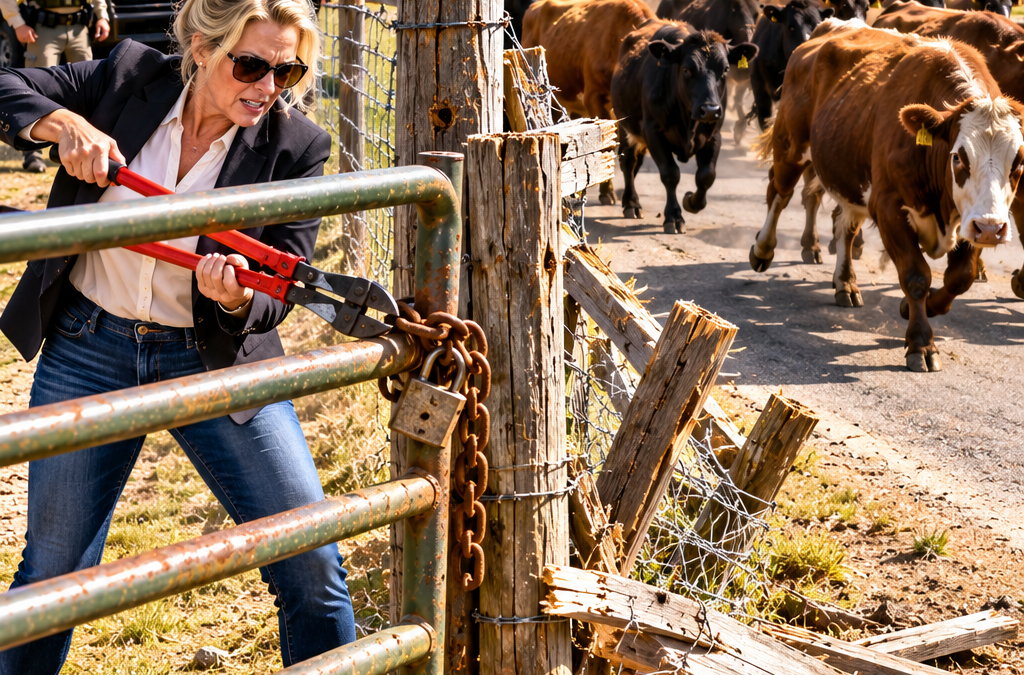
Three men in dark HOA polos were standing at my eastern utility gate.
One held bolt cutters.
For a second my brain refused to process what I was seeing.
Then the lock dropped into the mud.
I was running before I realized I had left my coffee on the porch railing.
“Hey!”
All three turned.
One man opened the gate.
“What the hell are you doing?”
“We’re inspecting line clearance.”
“Close that gate.”
“We were authorized.”
“By who?”
“The HOA.”
I walked faster.
“Close the gate.”
The oldest man raised both hands.
“Sir, we need access to the transformer corridor.”
“Then you call me.”
“We were told access is covered by the easement.”
“You were told wrong.”
Behind them, a second man pushed the gate wider.
The lower hinge caught against a cedar panel.
Wood cracked.
A cow in the nearest pasture lifted her head.
Then another.
Anyone who works cattle knows how quickly calm can become movement.
Especially in bad weather.
“Stop!”
The man pulled harder.
A second rail snapped.
Then the gate swung open completely.
Twenty-three head were in that field.
At first, they only stared.
Then one heifer moved toward the opening.
Cattle are not stupid.
But an open gate is an invitation they understand perfectly.
I ran toward her.
“Back! Get back!”
Too late.
She passed the men.
Another followed.
Then three.
Then the herd began moving.
“Close the damn gate!”
The workers jumped aside.
One tried to pull the damaged panel back.
It collapsed.
Cattle poured through.
Toward the county road.
There are few sounds that scare me the way hooves on wet gravel do when traffic is nearby.
I grabbed my phone and called the county dispatcher.
Not because I wanted anyone arrested.
Because I needed traffic stopped before somebody died.
Then I ran.
For the next four hours, nothing mattered except getting cattle back.
Not Deborah.
Not the HOA.
Not the lock.
Rain soaked through my coat.
Mud filled my boots.
My neighbor Gary arrived with his truck.
Deputy Alvarez blocked one end of the county road.
Another deputy slowed traffic from the south.
We pushed cattle out of ditches.
Turned them away from driveways.
Tried to keep them calm.
One steer slipped near the shoulder.
A car braked hard.
The sound nearly stopped my heart.
I grabbed a sorting stick and kept moving.
By noon, every animal was accounted for.
No one had been hit.
No cattle were seriously injured.
That was luck.
Nothing more.
I stood beside the broken gate with rain running off my hat.
The padlock lay in the mud.
Cut clean through.
Three fence sections were damaged.
Orange inspection tape fluttered beside the utility pole.
One of the HOA crewmen had left a clipboard in the grass.
I picked it up.
At the top was a work order.
Authorized by Deborah Whitfield.
That was the moment something in me changed.
I had been irritated before.
Angry, even.
But anger had always been mixed with disbelief.
Surely she would stop.
Surely somebody on the board would tell her no.
Surely common sense would appear.
Standing there soaked, exhausted, staring at a cut lock while my cattle bawled from the holding pasture, the reflective part of me went quiet.
The practical part took over.
I went inside.
Changed clothes.
Made one phone call.
Not to the sheriff.
To my attorney.
Her name was Laura Bennett.
She had reviewed ranch agreements for me before.
I explained everything.
She interrupted only twice.
“They cut the lock?”
“Yes.”
“Emergency utility situation?”
“No.”
“Did anyone contact you beforehand?”
“No.”
“Any notice?”
“No.”
“Did they damage livestock fencing?”
“Three panels.”
“And cattle entered a public road?”
“Yes.”
There was a long pause.
“Do you still have the utility right-of-way agreement?”
“On my desk.”
“Photograph every page that addresses access and termination.”
“I will.”
“Photograph the gate.”
“Already did.”
“Do you have cameras?”
That stopped me.
Trail cameras.
Two years earlier, coyotes had started testing the calf pasture, so I mounted several cameras near the eastern fence.
One faced the utility gate.
I pulled the memory card.
There it was.
Time stamped.
Three HOA employees arriving.
One examining the lock.
Another making a phone call.
Bolt cutters.
The cut.
The gate opening.
Fence breaking.
Cattle leaving.
Clear as daylight.
Laura watched the clips that afternoon.
Then she called me back.
“Russ, do not contact Deborah.”
“Wasn’t planning to.”
“Do not threaten to shut anything off.”
“I won’t.”
“Do not touch utility equipment.”
“I know.”
“We are going to send formal notice under the agreement.”
“Termination?”
“If the contract supports it after full review, yes.”
Before we finished, another vehicle pulled into my driveway.
White SUV.
I looked through the window.
“You have got to be kidding me.”
“What?”
“Deborah’s here.”
“Do not argue.”
“She brought deputies.”
Laura went silent.
“Call me afterward.”
I stepped outside.
Deputy Alvarez got out of one cruiser.
The second deputy was younger.
Deborah climbed from her SUV holding the clipboard.
A different clipboard.
Apparently she had reserves.
“Russ,” Alvarez said.
“Deputy.”
He looked apologetic already.
“We got a complaint.”
I looked at Deborah.
“Let me guess.”
She stepped forward.
“He has interfered with community infrastructure and threatened HOA personnel.”
I stared at her.
“I haven’t spoken to you since yesterday.”
“You confronted authorized workers.”
“After they cut my lock.”
“They were exercising easement rights.”
“They weren’t.”
“That is not your decision.”
Alvarez looked toward the broken gate.
Then at the mud.
Then toward the cattle.
“Were animals out?”
“For four hours.”
“I know. I helped stop traffic.”
Deborah spoke quickly.
“The workers were forced to enter because he has obstructed utility access.”
“Emergency?” Alvarez asked.
“No, but—”
“Power outage?”
“No.”
“Fire?”
“No.”
“Downed line?”
“No.”
“Then why wasn’t he contacted?”
Deborah raised the clipboard.
“The board has authority over shared utilities.”
Alvarez looked at me.
“Who owns the pole corridor?”
“The land belongs to me. Utility use is by recorded agreement.”
Deborah cut in.
“It is community infrastructure.”
I turned toward her.
“You keep confusing use with ownership.”
“You are not an attorney.”
“No. But mine is.”
Her face changed.
Small change.
Still, I saw it.
Alvarez walked toward the utility gate.
He looked at the severed lock.
The snapped rails.
“Who cut this?”
Deborah answered.
“Our maintenance personnel.”
“On his gate?”
“The easement allows access.”
“Does it allow cutting locks?”
“He denied reasonable access.”
“I was never contacted.”
“That’s false.”
“When?”
She flipped through papers.
No answer.
Alvarez looked at her.
“Ma’am.”
She lifted the clipboard higher, almost like a shield.
“The association cannot be held hostage every time one rancher decides rules don’t apply to him.”
Alvarez’s expression hardened.
“This is his property.”
“That easement is community infrastructure.”
“The infrastructure may serve your community. The pole does not become HOA property because electricity passes through it.”
She stared at him.
“The board has legal authority.”
“Then let your lawyer handle the agreement.”
Her voice rose.
“So you’re doing nothing?”
“I’m documenting property damage and a dispute involving unauthorized entry.”
That was not what she expected.
Not at all.
She pointed toward me.
“He threatened our personnel.”
“I told them to close my gate.”
“Aggressively.”
“I was trying to keep twenty-three cows off a county road.”
The younger deputy looked toward the damaged fence.
Then at Deborah.
“Seems like a reasonable priority.”
Her cheeks flushed.
She turned back to Alvarez.
“Are you saying we need his permission every time we maintain our own utility infrastructure?”
“I’m saying you should probably read the agreement before cutting another lock.”
Silence.
Deborah looked at me.
The old certainty returned.
“You think this is a victory?”
I was too tired to be baited.
“No.”
“You’ve been trying to undermine the association since I took office.”
“I was raising cattle before you knew Metobrook existed.”
“You paid the fine.”
“Yes.”
“That acknowledged our authority.”
“No.”
Her expression sharpened.
“Then why did you pay it?”
I looked at her.
“Because I wanted a receipt.”
For the first time, Deborah looked genuinely confused.
I turned away.
“I’m done talking.”
That evening, Laura came to the ranch.
We spread documents across my kitchen table.
The original easement.
My father’s renewal.
My amendment with the developer.
HOA letters.
The work order.
Trail-camera stills.
Photographs of the cut padlock.
Pictures of the broken fence.
The sheriff’s incident report number.
Everything.
She read for almost two hours.
Then she tapped one paragraph.
“This is the clause.”
“Ninety days?”
“Yes.”
“If they violate access terms and fail to cure?”
“Correct.”
“Can we use it?”
“We can issue notice.”
“What does that mean practically?”
“It means the parties benefiting from the right-of-way have ninety days to cure the material breach or negotiate a compliant arrangement. Nobody is touching the electrical system themselves. Any operational change has to be handled lawfully and safely.”
I nodded.
“I don’t want people losing power in their homes.”
“Neither do I.”
“The clubhouse is on the same feed.”
“Yes.”
“What about houses?”
She reviewed the map.
“The residential distribution has redundancy through another connection. The clubhouse feed and several common-area loads appear to depend on this corridor more directly.”
That mattered.
I did not want families sitting in dark houses because Deborah had cut my lock.
Laura saw that immediately.
“This is leverage to force compliance, not revenge.”
“Good.”
“You need to understand something else.”
“What?”
“Once we send this, the story will spread.”
“I know.”
“You’ll be painted as the rancher threatening the community.”
“I know.”
“You still want to proceed?”
I looked at the broken gate through the kitchen window.
One new temporary panel stood where my old fence had been.
Mud still showed hoofprints leading toward the road.
“Yes.”
The ninety-day notice went out certified mail.
Not dramatic.
Not emotional.
It identified the access violations.
Unauthorized entry.
Destruction of a lock.
Damage to livestock fencing.
Failure to provide notice.
Interference with ranch operations.
Resulting livestock escape.
It referenced the termination provision exactly.
Ninety days to cure.
I signed it.
Laura signed the legal cover letter.
Then I mailed it.
I did not post online.
Did not call neighbors.
Did not announce anything.
Deborah had spent months using public pressure.
I had no interest in doing the same.
Word spread anyway.
Metobrook had dozens of neighborhood chats.
Parents groups.
Golf groups.
Security groups.
Ladies’ social clubs.
Committee threads.
Half the subdivision probably knew about the notice before I finished repairing the second fence rail.
Three days later, I received my first call from a homeowner.
A man named Peter.
“Russ, are you shutting off our electricity?”
“No.”
“That’s what people are saying.”
“Who?”
“The HOA.”
“I sent a contractual notice after your HOA cut my lock and let my cattle onto a county road.”
“So we’re losing power?”
“I didn’t say that.”
“Deborah said you’re holding the utility corridor hostage.”
I closed my eyes.
“Peter, nobody in your house is being held hostage.”
“Then what’s happening?”
“Your board needs to resolve a right-of-way problem.”
“That sounds like lawyer talk.”
“It is lawyer talk.”
“Are my kids going to wake up without heat?”
“No.”
“How do you know?”
“Because the residential system has another feed.”
Silence.
“Deborah didn’t tell us that.”
“I’m not surprised.”
That call was followed by others.
Some angry.
Some worried.
Some apologetic.
I gave the same answer.
I was not threatening families.
I wanted the easement terms honored.
I wanted reimbursement for property damage.
I wanted written procedures preventing unannounced entry.
I wanted the HOA to stop pretending it controlled land it did not own.
A week later, Metobrook held an emergency meeting.
I did not attend.
Laura advised against it.
But enough people told me afterward that I eventually pieced together almost the entire evening.
The clubhouse was packed.
Around sixty homeowners.
Maybe more.
Deborah stood behind a podium beneath the largest chandelier.
She told everyone there had been “a misunderstanding involving legacy utility documents.”
Apparently that was what cutting a lock and releasing cattle had become.
A misunderstanding.
She assured residents that the situation was being resolved through legal channels.
Then a man named Marcus Feld stood up.
Marcus was the HOA treasurer.
Quiet man.
Accountant.
Glasses.
Never seemed interested in drama.
He had served on the board for three years.
According to three separate people who called me afterward, Marcus held a stack of printed emails.
He did not shout.
He did not need to.
“It is not a misunderstanding,” he said.
Deborah looked toward him.
“Marcus, this isn’t the time.”
“I think it is exactly the time.”
“Sit down.”
“No.”
People went quiet.
Deborah’s voice tightened.
“We have counsel handling this.”
Marcus held up the papers.
“I have the correspondence.”
“What correspondence?”
“The easement.”
Deborah froze.
Marcus continued.
“You knew about the access restrictions two years ago.”
The room changed.
He had found emails between Deborah, the prior management company, and HOA counsel.
The utility agreement had been discussed.
Notice requirements had been identified.
One email specifically warned that Metobrook did not possess unrestricted entry rights across my ranch.
Another discussed the problem of HOA rules being applied beyond recorded association parcels.
Deborah knew.
Not every detail perhaps.
But enough.
More than enough.
Marcus passed copies down the rows.
People read them.
Somebody asked why the board had never been told.
Another asked why HOA workers had been ordered through a locked private gate.
Then came the issue of the bylaws.
Marcus had those emails too.
Deborah had pushed revised enforcement language internally.
She had treated it as effective policy.
But the amendment process required by the governing documents had not been properly completed or recorded.
The same fake authority used to fine me four hundred dollars had not even been properly adopted.
Deborah tried to interrupt.
Marcus kept going.
“You knew the fence rule was not in the recorded covenant.”
“We had counsel review enforcement standards.”
“That is not the same as filing an amendment.”
“You are oversimplifying this.”
“No.”
He held up another email.
“You told management to issue the violation anyway.”
I wish I had been there to see that moment.
Not because I wanted to watch Deborah humiliated.
Because after months of being treated as though I was unreasonable, facts were finally entering the room without me having to defend them.
Someone told me Deborah gripped the sides of the podium.
Her voice cracked.
“You don’t understand what I built here.”
Marcus answered:
“You built it on his land.”
A pause.
Then:
“With his power.”
Nobody forgot that line.
Certainly not Deborah.
After that meeting, the board fractured.
Two members demanded an independent legal review.
Marcus resigned as treasurer temporarily until records could be examined.
The management company distanced itself from Deborah’s enforcement directives.
The HOA insurer opened a claim regarding the gate and fence damage.
Deborah still refused to call me.
I was grateful.
Day thirty passed.
Then forty.
Then sixty.
Repairs were paid for by the insurance carrier.
The four-hundred-dollar fine was refunded.
The HOA sent a letter suspending all enforcement actions involving my property.
Still, they did not resolve the utility agreement.
The board argued over terms.
Deborah insisted the existing easement was sufficient.
Laura disagreed.
The agreement contained cure obligations.
The physical damage had been paid for, but access procedures and repeated interference remained unresolved.
The ninety-day clock kept moving.
By day seventy-five, Metobrook’s attorney began calling Laura almost daily.
By day eighty, proposals were being exchanged.
I was willing to grant a new permanent agreement.
I made that clear.
But it had to include specific entry procedures.
Emergency exception.
Advance notice for routine work.
Defined corridor.
No authority over my adjacent ranch property.
Restoration requirements.
Liability.
Protection for livestock.
No unilateral HOA alterations.
And, most importantly, no clause allowing the HOA to treat the easement as ownership.
Deborah called the demands “punitive.”
I called them common sense.
On day eighty-seven, negotiations stalled.
The board had a gala scheduled that Saturday at the clubhouse.
Some annual charity event.
Catering.
String quartet.
Outdoor lights.
Fountains.
I knew about it only because half the county seemed to know.
Day ninety fell on Saturday.
Laura contacted the utility operator days in advance.
Everything was coordinated legally.
Nobody was going to walk onto my land and pull a switch.
Nobody was going to touch energized equipment.
The rights under the old agreement expired according to the notice, and the utility company handled the affected common-area service in accordance with its own procedures.
I spent Saturday working cattle.
I tried not to think about the clubhouse.
Around six that evening, I came inside.
A storm had passed earlier, leaving the air unusually clear.
I reheated stew.
Sat at the kitchen table.
At 6:47 p.m., my phone buzzed.
One text.
From Marcus.
It happened.
That was all.
I learned the details later.
The gala was already underway.
Cars lined the clubhouse drive.
Women in dresses.
Men in jackets.
A string quartet playing near the main hall.
Lights wrapped around trees.
Fountains running.
Caterers moving through the kitchen.
Deborah was there.
Of course she was.
She had reportedly told people all week that the easement dispute would be resolved before any service issue occurred.
At 6:47, the clubhouse lights went out.
Every chandelier.
Every exterior string light.
The speakers.
The fountain pumps.
Kitchen equipment on the affected service.
All dark.
The quartet kept playing for several seconds because violins do not need electricity.
Then they stopped too.
People began using phone flashlights.
Someone laughed nervously.
Someone else swore.
Nobody had to ask why.
The residential homes remained lit.
That mattered to me.
Children were not sitting in darkness.
Refrigerators kept running.
Heating and cooling continued.
But the monument Deborah cared about most—the $2.4 million clubhouse she had spent years presenting as proof of what she had “built”—went dark in the middle of its own gala.
I did not see it.
I did not need to.
I sat at my kitchen table with a bowl of stew cooling in front of me.
I expected to feel satisfaction.
Instead, I felt tired.
There is a strange thing about finally reaching the moment you thought would vindicate you.
Sometimes it feels smaller than expected.
The lights were off.
My cattle were safe.
The fence was repaired.
Deborah had been proven wrong.
And still my grandfather was dead.
My father was dead.
The ranch needed work in the morning.
Life did not stop to applaud.
The consequences came quickly.
The county reviewed the unauthorized work within the utility corridor and the HOA’s handling of access.
Additional compliance issues were cited.
Two maintenance crew members received citations related to trespass and property damage from the gate incident.
The HOA’s insurance paid the physical claim.
Then came the board fallout.
Deborah resigned less than a month later.
“Personal reasons.”
That was what the email said.
Nobody believed it.
I read it once and deleted it.
No victory lap.
No social media post.
No satisfaction in watching a woman lose a title she had treated like a crown.
The title had never been the real problem.
The belief behind it was.
A new board election took place that fall.
Marcus ran.
Won.
Several other members were replaced.
The first formal letter I received from the new board began with:
Mr. Hale, on behalf of Metobrook Ranch Estates, we owe you an apology.
I sat on the porch while I read it.
They apologized for the improper fine.
The unauthorized access.
Property damage.
The mishandling of the easement.
The treatment of my ranch as though it fell under HOA authority.
No excuses.
No “misunderstanding.”
No blame shifted onto a management company.
Just an apology.
That mattered.
A week later, Marcus came to the ranch.
Alone.
No clipboard.
He stopped at the gate.
Did not enter.
Called me.
“Russ?”
“I can see you.”
He looked toward the house and laughed.
“Can I come in?”
“Yes.”
That question meant more than he probably realized.
Permission.
Such a simple thing.
He walked to the porch.
I poured coffee.
We sat outside.
For several minutes neither of us discussed the easement.
Then Marcus put a folder on the table.
“We want to fix it.”
“Good.”
“We’re prepared to accept most of Laura’s terms.”
“Most?”
He smiled.
“Had to try.”
“What do you want changed?”
We spent two hours talking.
No shouting.
No threats.
No pretending the HOA owned something it did not.
We discussed actual problems.
Utility crews needed reliable access during emergencies.
I needed gates closed.
They needed vegetation clearance.
I needed notice before routine work.
Their contractors needed enough room for equipment.
My cattle needed barriers.
Both sides needed liability rules.
That was negotiation.
Not obedience.
Not enforcement.
Negotiation.
The permanent agreement took three weeks to finalize.
Every term was written.
Measured.
Defined.
Signed by both sides.
A locked utility gate was replaced with a controlled access system.
I retained access.
The utility operator received emergency entry rights.
Routine work required notice.
HOA personnel could not enter the ranch merely because they believed something concerned community infrastructure.
Any physical alteration required approval under the agreement.
Fence damage had to be restored.
Livestock security was mandatory.
Most importantly, the document stated clearly:
The easement granted use.
Not ownership.
The clubhouse power returned after three weeks under the new arrangement.
Different terms.
Different tone.
No one cut my lock.
No one scattered cattle.
No one arrived carrying a clipboard and announcing that my land had somehow become community property.
I thought that would be the end.
Legally, it was.
Emotionally, not quite.
The morning after the final agreement was signed, I woke before sunrise.
Habit.
I made coffee.
Walked outside.
Fog covered the east pasture.
Everything was quiet.
The kind of quiet that existed before subdivisions and HOAs and $2.4 million clubhouses.
Cattle moved like dark shapes through the mist.
I stood on the porch until the coffee went lukewarm.
I expected to feel proud.
Instead I thought about the broken fence.
So I went out and repaired another panel.
It did not need much.
A brace.
Two nails.
New wire.
I fixed more than necessary.
That is what my grandfather used to do.
He never repaired something just enough.
“Enough fails when you’re tired,” he used to say.
“Do it right while you’re standing there.”
I thought about him while I worked.
I imagined explaining the whole story.
An HOA president measuring a fence post.
Four-hundred-dollar fine for cattle odor.
A clubhouse with marble floors.
Somebody cutting his lock.
Ninety-day notice.
A gala in the dark.
He would probably have listened without saying anything.
Then he would have asked one question.
“Cattle okay?”
That would have been what mattered to him.
“Yes,” I said aloud.
A cow looked at me.
I laughed.
“They’re fine.”
A week after the agreement took effect, I found an envelope in my mailbox.
No stamp.
Hand delivered.
I almost expected another HOA letter out of habit.
Instead, inside was a sheet of white paper folded in half.
A child had drawn a map in crayon.
Houses on one side.
My ranch on the other.
The clubhouse was a large square with yellow windows.
Between the ranch and the clubhouse, a single yellow line crossed the page.
The child had labeled it:
THE POWER ROAD
Underneath:
Thank you for the lights.
I stood beside the mailbox for a long time.
I had no idea which child drew it.
Still do not.
I took it inside.
Taped it to the refrigerator.
It is there today.
The paper has curled slightly at the corners.
The yellow crayon is fading.
I could put it in a frame.
Maybe I should.
But I like it where it is.
Because that drawing reminds me of something all the legal paperwork nearly made me forget.
Most people in Metobrook were never my enemies.
They were families.
Children.
Neighbors.
People who bought houses believing utilities were settled and boundaries were accurate.
They did not cut my lock.
They did not invent a fence regulation.
They did not call deputies to accuse me of trespassing.
Deborah did that.
And even with Deborah, I eventually stopped thinking of the whole thing as winning or losing.
For a long time, I believed the conflict was about power.
In one sense, it was.
Electrical power.
Board power.
Property rights.
The power to issue fines.
The power to say no.
But underneath all of it was something simpler.
Respect.
Deborah believed respect meant obedience.
If she carried the title, other people should comply.
If the HOA had money, lawyers, a management company, and branded letterhead, a rancher with cedar fencing should step aside.
She saw my silence as weakness.
My four-hundred-dollar payment as surrender.
My unwillingness to create a public scene as proof she could keep pushing.
What she never understood was that quiet people can still keep records.
Quiet people can read agreements.
Quiet people can call lawyers.
Quiet people can say no.
My grandfather understood boundaries better than anybody I ever knew.
Not because he had legal training.
Because a ranch teaches boundaries every day.
A bad fence means cattle move where they should not.
A gate left open has consequences.
A creek changes course if you ignore erosion.
One broken wire can turn into an accident two miles away.
Boundaries are not insults.
They are agreements about where responsibility changes hands.
Deborah treated every boundary she disliked as something to overcome.
That was her failure.
Not the clipboard.
Not the sunglasses.
Not even the arrogance.
Her mistake was believing another person’s boundary existed only until she decided her authority was more important.
Years have passed.
Metobrook looks mostly the same.
The clubhouse still sits across the fields.
Chandeliers glowing at night.
Fountains running.
Cars arriving for weddings and fundraisers.
Sometimes I can hear music when the wind is right.
The power line still crosses my land.
Legally.
Clearly.
Under an agreement everyone understands.
Marcus remains one of the few HOA people whose calls I answer without wondering what went wrong.
Once or twice a year, he comes over for coffee.
He jokes about the gala.
I never find it as funny as he does.
“You realize,” he told me once, “half the neighborhood thought you were sitting up here with a giant switch.”
“I know.”
“One woman thought you personally turned off the clubhouse.”
“I know.”
“Were you even home?”
“Eating stew.”
He laughed.
“That’s somehow better.”
Maybe.
But I still do not enjoy the image of dozens of people confused in a dark building.
I never wanted that.
I wanted the HOA to understand that rights written into an easement matter.
Unfortunately, Deborah had spent so long ignoring every quiet warning that the lesson eventually arrived in a form nobody could ignore.
She moved away two years after resigning.
I saw the moving truck.
Did not wave.
Did not celebrate.
She was simply gone.
The ranch remained.
The cattle remained.
The power line remained.
That is another lesson land teaches you.
People pass through.
Titles disappear.
Boards change.
Rules get rewritten.
Land remembers none of the drama.
It waits for rain.
It grows grass.
It becomes mud.
It dries.
It does not care who won an argument.
Sometimes, late in the afternoon, I walk the eastern fence and stop near the utility gate.
The new lock is heavy.
The hinges are reinforced.
There is a small metal sign:
UTILITY ACCESS BY AGREEMENT — CLOSE GATE
I insisted on that last part.
Close gate.
Three words.
More useful than fifty pages of HOA policy.
Whenever I see it, I remember that Friday morning.
Rain.
Broken cedar.
Cattle running.
A steer slipping near the county road.
Deputy Alvarez waving traffic down.
My hands shaking from exhaustion and anger.
That memory never became funny.
People sometimes tell me I got the better of Deborah.
I do not think that way.
There is no victory in almost having livestock hit by a car.
There is no victory in neighbors paying legal fees because their president refused to read an agreement.
There is no victory in a community turning against itself.
The good part came afterward.
Clear terms.
Accountability.
A board willing to ask before entering.
A permanent agreement that should protect both sides long after I am gone.
That is what winning looks like to me now.
Not darkness in a clubhouse.
Not a resignation email.
A gate that stays closed when cattle are behind it.
A utility crew that calls before coming.
Neighbors who understand the difference between access and ownership.
A child’s crayon drawing on my refrigerator.
That is enough.
The cedar post that started everything is still standing.
Six inches taller than Deborah wanted.
I could cut it down now.
Nobody would care.
Sometimes I think about doing it because the top has started splitting.
Then I remember her standing beside the gate saying, “Rustic charm has limits.”
I leave it alone.
Not out of spite.
Mostly because it still holds the fence.
That is the difference between us, I suppose.
Deborah saw rules as proof of control.
I see a fence post as something that either does its job or does not.
That cedar post has held cattle for years.
Good enough.
The propane tank is still visible from the cul-de-sac.
The pasture still produces agricultural odor whenever forty cows decide the wind is blowing toward Metobrook.
My landscaping remains aggressively natural.
Grass grows.
Trees drop leaves.
Mud appears after rain.
Coyotes still test the fence.
Nothing about my ranch has become a lifestyle brand.
Thank God.
One spring morning, a young couple from Metobrook walked up to the gate.
They had two children.
The father called out before entering.
“Mr. Hale?”
“Russ.”
“Can we come closer?”
I smiled.
“Yes.”
Their little girl wanted to see a newborn calf.
I opened the pedestrian gate.
They stayed where I told them.
The calf stood shakily beside her mother.
The girl whispered like she was inside a church.
“She’s tiny.”
“For now.”
Her little brother pointed toward the utility poles.
“Is that the power road?”
I looked at his father.
He looked embarrassed.
“Apparently that story has become local history.”
I laughed.
The boy continued.
“Did you turn off the whole neighborhood?”
“No.”
“But you own the electricity?”
“No.”
He looked disappointed.
I crouched so we were closer to eye level.
“I own the land.”
“And the power?”
“The power company handles the power.”
“So what happened?”
I thought about explaining easements.
Property rights.
Contractual access.
Then I looked at a six-year-old face and simplified it.
“Some people forgot to ask permission before they came through my gate.”
He considered that.
“Did they get in trouble?”
“Yes.”
He nodded.
“Because they didn’t ask?”
“Pretty much.”
The father smiled.
There it was.
The entire conflict reduced to something a child could understand.
Ask.
Listen to the answer.
Respect the boundary.
Everything else had been paperwork.
When the family left, I closed the gate behind them.
I checked the latch twice.
Habit.
Then I stood in the pasture looking toward the clubhouse roof in the distance.
Sunlight reflected off the windows.
For years I had seen that building as a symbol of everything Deborah represented.
Money.
Control.
Appearance.
Rules for the sake of rules.
I do not see it that way anymore.
It is just a building.
People get married there.
Kids attend birthday parties.
Neighbors hold meetings.
Lights come on at night because electricity crosses my land under an agreement everyone now respects.
That is better.
My grandfather would have preferred that too.
He was stubborn.
But he was never unreasonable.
If someone needed to cross his land, he usually let them.
If a neighbor needed water, tools, hay, help with a fence, he gave it.
But he expected people to ask.
Once, when I was a boy, I watched a hunter climb over our fence without permission.
Granddad drove out in the truck.
He did not yell.
He did not threaten him.
He simply said:
“Son, there’s a gate thirty yards behind you.”
The man apologized.
Granddad opened the gate and let him leave.
Later I asked why he cared which way the man entered.
He told me:
“A gate is a question. A cut fence is an answer you gave yourself.”
I did not understand then.
I do now.
Deborah cut the gate.
Literally.
That was the moment she answered a question nobody had given her the right to answer.
Everything afterward came from that choice.
The certified notice.
The emergency meeting.
Marcus’s emails.
The ninety-day deadline.
The dark clubhouse.
The new agreement.
All because someone decided asking permission was beneath her authority.
There are still days when another HOA letter arrives.
Usually about road maintenance schedules or utility work now.
The difference is obvious before I open it.
The letters no longer begin:
NOTICE OF VIOLATION
They begin:
REQUEST FOR ACCESS
Those three words tell the entire story.
Request.
Not demand.
Access.
Not ownership.
Sometimes language matters more than people think.
The first time I received one, I read it twice.
Then I called Marcus.
“Your crew needs the east corridor Thursday?”
“If that works.”
“What time?”
“Eight.”
“Cattle will be in the south field.”
“We’ll call when we arrive.”
“Gate gets closed behind every truck.”
“It will.”
“Then you’re good.”
That was it.
Thirty seconds.
No lawyers.
No deputies.
No broken fencing.
No gala in the dark.
Just two people treating each other like adults.
Imagine how much trouble Deborah could have avoided with thirty seconds.
I am older now than my grandfather was when he first signed the utility right-of-way.
That realization unsettles me.
When you are young, the people who built everything seem ancient.
Permanent.
Then one morning you realize you are standing where they stood.
Holding the documents they once held.
Making choices that someone else will inherit.
I do not know who will own this ranch after me.
Maybe family.
Maybe someone else.
But the paperwork is organized.
The easement is clear.
The gate procedures are written.
The county records match the agreement.
No future HOA president should be able to claim confusion.
That may be the most useful thing I leave behind.
Not cattle.
Not fences.
Clarity.
My grandfather gave me that old filing cabinet almost accidentally.
Yellow envelope.
Fading ink.
One line in one deed.
Without it, Deborah might have succeeded simply because nobody remembered the terms.
People often think power belongs to whoever speaks loudest.
Sometimes it belongs to whoever kept the original document.
There was no dramatic secret switch in my barn.
No illegal trick.
No revenge scheme.
There was a contract.
A deadline.
A right to say:
You violated the terms.
Fix it.
And when they refused, consequences followed.
That distinction matters to me.
Because I never wanted to become Deborah in reverse.
I did not want my ownership to become an excuse to bully people.
I did not want families afraid of me.
I did not want people looking at my ranch and seeing one bitter old man who could ruin their lives.
Rights need limits too.
Mine included responsibility.
So when the new board negotiated fairly, I negotiated fairly.
When they apologized, I accepted it.
When the utility company asked for practical emergency access, I gave it.
That was not weakness.
That was the entire point.
Respect cannot mean one person wins forever.
It means both sides understand where the line is.
This morning, I walked the northern fence.
The old cedar post is leaning slightly.
Probably needs replacement before winter.
I put one hand on it.
Thought about Deborah.
Not with anger.
Mostly disbelief.
All that trouble over six inches.
But maybe it was never about six inches.
Maybe the post simply gave her an excuse to test whether I would accept her authority.
I paid the first fine.
She mistook that for surrender.
She returned.
She pushed harder.
She sent workers.
They cut the lock.
And by the time she understood that I had been quietly reading every document she had ignored, the problem was far larger than a fence post.
I pulled the post straight temporarily and packed soil around the base.
It will hold another month.
Maybe two.
As I worked, I could hear a mower running in Metobrook.
Farther away, somebody was setting up tables on the clubhouse lawn.
Probably another wedding.
The lights will come on tonight.
The fountains will run.
Music will carry over the pasture if the wind turns east.
That does not bother me.
In fact, I like it better this way.
Their community on their land.
My ranch on mine.
One yellow line between us carrying power under terms we both understand.
When I return to the house, I pass the refrigerator.
The child’s drawing is still there.
My ranch.
The clubhouse.
That crooked yellow crayon line.
THE POWER ROAD.
And underneath:
Thank you for the lights.
Every time I see it, I think about how complicated adults can make something simple.
Deborah believed power came from a title.
The board believed power came from policy.
The clubhouse literally depended on electrical power.
But the only thing that finally fixed the conflict was something none of those kinds of power could replace.
Permission.
My grandfather understood it.
My father understood it.
Now Metobrook does too.
And that old cedar fence post is still six inches too tall.





