𝗙𝗨𝗟𝗟 𝗦𝗧𝗢𝗥𝗬 The HOA President Crossed My Property Line With a Clipboard, a Foreclosure Threat, and No Idea What Was Locked Inside My Barn
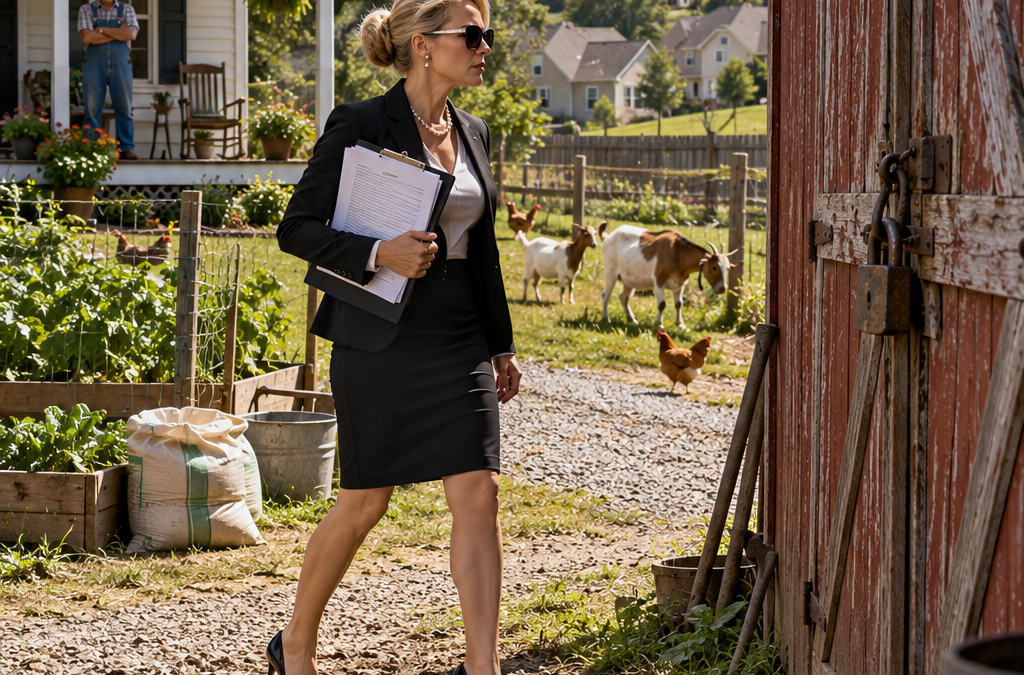
𝗙𝗨𝗟𝗟 𝗦𝗧𝗢𝗥𝗬
Then county mapping and subdivision paperwork changed several years after I bought the property.
I received notices so dense with planning language that I read them once, filed them, and went back to work.
Some combination of boundary adjustments and recorded community documents apparently brought part of my parcel within Meadowbrook’s expanded jurisdiction.
At least that was what the association later claimed.
I had never paid much attention because nobody had bothered me.
I was still agricultural.
I still had my animals.
I still had the barn.
Nothing changed physically.
Then one Tuesday morning, Linda arrived.
I had taken the morning off.
It had rained overnight, and part of the goat pen had become a shallow lake.
By eight-thirty, my boots were covered in mud.
I was carrying a fifty-pound feed bag from the shed when I heard gravel crunch behind me.
Not tires on the public road.
My gravel.
Someone was coming up my driveway.
I turned.
A white golf cart rolled toward the house.
Not a utility cart.
One of those polished neighborhood carts with tan seats, cup holders, and a little Meadowbrook Estates emblem on the front.
Linda sat behind the wheel.
She wore beige slacks.
A blue blouse.
A white visor.
Oversized sunglasses.
Her hair looked as though it had been sprayed into a shape capable of surviving severe weather.
She drove past the end of the driveway.
Past the point where any reasonable visitor would have stopped.
Past the house.
Straight toward me.
She finally parked beside the garden.
No greeting.
No introduction.
No question about whether she had permission to be there.
She stepped down, immediately regretted wearing low heels in soft dirt, and looked around with the expression of someone inspecting a condemned property.
A clipboard was tucked against her chest.
“Sarah Whitfield?”
“Yes.”
“I’m Linda Puit.”
She said it like the name should mean something.
I waited.
“President of Meadowbrook Estates.”
“Okay.”
Her lips tightened slightly.
People apparently reacted with more reverence.
“I’m here for the routine compliance inspection.”
I looked toward the road.
Then back at her.
“Routine what?”
“Compliance inspection.”
“I didn’t schedule one.”
“You don’t schedule compliance inspections.”
The way she said it made me smile.
Wrong reaction.
Linda noticed.
“This isn’t amusing.”
“I haven’t decided yet.”
She pulled a pen from the clipboard.
“Your chicken coop appears to extend approximately eighteen inches beyond the approved accessory-structure setback.”
I looked at the coop.
Then at her.
“You measured it from the road?”
“Association mapping.”
“The coop was here before Meadowbrook’s boundary paperwork changed.”
“Existing structures do not automatically receive permanent exemptions.”
“This property was agricultural before Meadowbrook existed.”
Linda smiled.
Not kindly.
“Not anymore, sweetheart.”
The word sweetheart landed exactly the way she intended.
Small.
Condescending.
A reminder that in her mind I was a confused woman in muddy boots and she was the person who understood serious things.
I set the feed bag down.
“Don’t call me sweetheart.”
Her eyebrows rose.
“Rules changed.”
“And?”
“And your property is now subject to community standards.”
“My county zoning didn’t disappear.”
“HOA restrictions can be more restrictive than county zoning.”
“Sometimes.”
She looked satisfied.
“Good. So you understand.”
“I understand you drove onto my property without asking and started measuring a chicken coop.”
Her smile vanished.
“I have inspection authority.”
“Show me.”
“I don’t need to carry the entire declaration around.”
“But you carry a clipboard.”
Her eyes narrowed.
That was the moment Linda decided she disliked me.
I saw it happen.
Maybe she had arrived expecting resistance.
But I don’t think she expected calm resistance.
People like Linda understand anger.
Anger lets them accuse you of being unreasonable.
Calm makes them work harder.
She clicked her pen.
“We can do this cooperatively.”
“I thought this was routine.”
“It is.”
“Then inspect whatever you’re legally allowed to inspect from wherever you’re legally allowed to stand.”
Her jaw tightened.
“You’re going to make this difficult.”
“You crossed my property line.”
She ignored that and began walking.
Not toward the road.
Deeper onto my land.
I watched her photograph the chicken coop.
One angle.
Then another.
She crouched slightly to photograph the foundation.
She took pictures of the garden beds.
“Those raised beds are not approved either.”
“They’re vegetables.”
“That doesn’t mean they’re compliant.”
“They’ve been here four years.”
“Past non-enforcement doesn’t create future permission.”
She moved toward the goat pen.
My two goats, June and Otis, approached the fence because they assumed any visitor had food.
Linda stepped backward.
“Are those permitted?”
“They’re goats.”
“I can see that.”
“Then we’re making progress.”
She glared at me.
“How many livestock units are authorized on this parcel?”
“County zoning allows them.”
“I asked about HOA authorization.”
“I didn’t ask HOA permission because I owned the goats before your organization decided it had something to say about my land.”
Her pen moved across the clipboard.
“Unauthorized livestock density.”
I almost asked whether two goats qualified as density.
Then I realized she would answer seriously.
For twenty minutes, Linda walked my farm as though she were assessing property she had recently inherited.
She photographed the rain barrels.
She photographed a stack of firewood.
She photographed my truck.
She photographed the garden.
At one point, she took a picture of a wheelbarrow resting upside down beside the shed.
“What violation is that?”
“I’m documenting overall exterior conditions.”
“It’s a wheelbarrow.”
“Your property is visible from Meadowbrook.”
“So is Meadowbrook visible from mine. Should I start issuing citations?”
“You aren’t being productive.”
“No, Linda. I’m feeding goats. You’re the one turning it into government work.”
She stopped.
“I am trying to prevent this from becoming expensive for you.”
There it was.
The first threat.
Still wrapped politely.
I recognized the style.
I’d heard suspects use it in interviews.
Not quite a threat.
Not quite an offer.
A suggestion that cooperation would make your life easier.
I had spent years listening to people with something to hide speak exactly that way.
The difference was that Linda believed she was the interrogator.
She finally returned to the porch.
From her clipboard, she removed a stack of papers.
Then, with unnecessary force, she slapped them against the railing.
“Cease and desist.”
I looked at the pages.
“From what?”
“Noncompliant agricultural use.”
I actually laughed.
Linda’s face hardened.
“This isn’t funny.”
“It is a little.”
“You have thirty days.”
“For what?”
“Removal of the unauthorized livestock.”
I looked at June.
June was chewing something that might have been a piece of my jacket.
“The chickens?”
“All noncompliant animals.”
“And?”
“Removal of the coop.”
I stopped smiling.
“You’re telling me to tear down my chicken coop.”
“Correct.”
“What else?”
“Restore the property to residential standards.”
“This is still agricultural land.”
“You keep saying that as though it controls everything.”
“It controls quite a bit.”
“The association has enforcement authority.”
“According to you.”
“According to recorded documents.”
“Then send them to me.”
Her voice sharpened.
“Do you think I drive around inventing rules?”
I looked at the clipboard.
“I’ve known you twenty minutes. I don’t have enough data yet.”
She stared at me.
I knew I should stop.
I didn’t.
“What happens if I don’t tear it down?”
Linda straightened.
“Daily fines.”
“How much?”
“That depends on continuing violations.”
“And if I refuse to pay?”
“A lien.”
“Against my house?”
“Against your property.”
“Over chickens.”
“Over violations.”
She emphasized the word violations as if livestock were contraband.
Then she leaned closer.
“If necessary, the association can pursue foreclosure remedies.”
I studied her face.
“Foreclosure.”
“Yes.”
“For a chicken coop.”
“For unpaid liens resulting from violations.”
There it was.
That was what Linda liked.
The escalation.
A chicken coop became a notice.
A notice became a fine.
A fine became a lien.
A lien became losing your property.
She had built a staircase from eighteen inches of setback to foreclosure, and she seemed almost pleased to walk me up it.
I repeated the word slowly.
“Foreclosure.”
Linda nodded.
“I don’t make exceptions.”
I looked down at myself.
Mud-covered jeans.
Old work boots.
Faded flannel shirt.
Then I saw Linda looking too.
Her eyes traveled toward my truck.
The cracked plastic on the bumper.
The rust near one wheel arch.
Then back to me.
She had completed whatever calculation she was making.
I had seen that look professionally.
People deciding who has money.
Who has influence.
Who will fight.
Who can be scared.
Linda concluded I was none of those things.
“You may want to consider whether this is a battle you can afford,” she said.
I felt something inside me cool.
“What does that mean?”
“It means legal disputes are expensive.”
“I know.”
“Whatever job keeps you leaving before sunrise and coming home at strange hours clearly hasn’t taught you how property associations work.”
I said nothing.
She continued because silence made her confident.
“And frankly, judging by the condition of some of this property, I doubt you’re in a position to spend tens of thousands of dollars fighting rules that apply whether you like them or not.”
There are insults that make you angry immediately.
That one didn’t.
It made me observant.
Her tone.
Her posture.
The satisfaction in her expression.
Linda wasn’t merely enforcing rules.
She enjoyed believing she had identified weakness.
She thought money would frighten me.
She thought embarrassment would finish the job.
Then she pulled out her phone.
“I’m posting these violations to the resident group.”
I stared at her.
“You’re doing what?”
“Homeowners have a right to know what enforcement issues are affecting community standards.”
“This is my private property.”
“Visible violations are not confidential.”
“You’ve been photographing me.”
“Documentation.”
“You’ve photographed parts of my property that are not visible from Meadowbrook.”
She shrugged.
“Everything relevant to the inspection.”
Then she began typing.
I could see the Meadowbrook community page on her screen.
Hundreds of members.
She uploaded a picture of the coop.
Another of the goat pen.
One of my truck.
Then she turned toward the back of the property.
Toward the barn.
Every muscle in my body tightened.
The barn looked ordinary.
That was the point.
Weathered siding.
Metal roof.
Double doors.
Padlock.
Nothing about it suggested anything unusual.
But inside, behind an interior partition, was equipment related to an active investigation.
Surveillance receivers.
Secured evidence storage.
Monitoring equipment temporarily staged under authorization for an operation involving suspected financial crimes connected to people in the surrounding area.
It was not a secret government bunker.
It was not some action-movie command center.
But it contained material nobody without authorization should have been photographing, documenting, or posting to a four-hundred-member social-media group.
Linda started walking toward it.
I moved.
“Linda.”
She kept going.
“I need photographs of all accessory structures.”
“Stop.”
Something in my voice changed.
Not louder.
Lower.
Flat.
The tone I used in interviews when conversation ended and instruction began.
Linda slowed.
She looked over her shoulder.
I repeated myself.
“Stop where you are.”
She turned fully.
“Excuse me?”
“Do not approach that building.”
Her mouth curled into a smirk.
“Why?”
“Because I’m telling you not to.”
“I have inspection authority.”
“Not there.”
“Is there something inside you’re trying to hide?”
That was the wrong question.
Not legally.
Not morally.
Strategically.
Because it made her curious.
She lifted her phone.
“Actually, if you’re concealing unapproved use—”
“Put the phone down.”
Linda laughed.
“Or what? You’re going to call the sheriff?”
“No.”
She smiled.
“I’ll call my supervisor.”
The smile disappeared.
Not because she understood.
Because the sentence didn’t fit the person she thought she was speaking to.
“My supervisor?” she repeated.
“Yes.”
“At whatever job you do?”
“Yes.”
She looked at me differently.
For the first time that morning, Linda Puit was uncertain.
I could have let it end there.
I could have called my supervisor without explaining anything.
But she was already holding photographs.
She had already aimed the camera toward the barn.
I needed her to understand why this was no longer a neighborhood argument.
I reached toward my back pocket.
Linda stiffened.
My wallet came out first.
Inside was a leather credential case.
I opened it.
The badge caught the morning light.
Her eyes dropped to it.
Then to the identification card.
Then back to my face.
“Federal Bureau of Investigation,” I said.
The color left her expression.
“Special Agent Sarah Whitfield.”
Linda did not speak.
Her phone lowered several inches.
I continued.
“The building you were about to photograph is connected to an active federal investigation.”
Her mouth opened.
Closed.
“You have spent the last twenty minutes taking photographs across an area currently being used in support of federal investigative activity.”
“I…”
“And you were preparing to upload those photographs to a private social-media group with hundreds of members.”
“I didn’t know.”
“No.”
I closed the credential case.
“You didn’t ask.”
Linda’s eyes moved toward the barn.
Then back to me.
“I thought this was just a farm.”
“That was the idea.”
“I wasn’t trying to interfere with anything.”
“You were trying to humiliate me publicly.”
“No.”
“You told me exactly what you were doing.”
“That’s HOA procedure.”
“Posting photographs of private property?”
“We notify residents.”
“Of what?”
“Compliance concerns.”
“Are compliance concerns more important than asking whether you’re authorized to walk around photographing locked buildings?”
She didn’t answer.
The clipboard shifted in her hand.
Then slipped.
It hit the porch step.
Papers scattered.
Linda stared at them but didn’t bend down.
She looked frightened now.
I wish I could tell you that felt satisfying.
It didn’t.
I had been angry at her arrogance.
But this was no longer about winning.
An active case existed.
Photographs existed.
I had to protect the investigation.
“Give me the phone.”
Linda pulled it toward her chest.
“What?”
“I need to see what you photographed.”
“You can’t just take my phone.”
“I’m not seizing it.”
I kept my voice controlled.
“I’m asking you to show me exactly what you captured so I can determine whether anything sensitive is on it.”
She hesitated.
“Linda.”
She unlocked the phone.
Her hands had begun shaking.
We went through the photographs together.
Chicken coop.
Garden.
Goats.
Truck.
Side of the barn.
Zoomed shot of one window.
Rear access area.
Nothing that revealed classified information.
Nothing dramatic.
But several images showed enough of temporary exterior equipment placement to create concerns.
More importantly, she had almost posted them.
I looked at the draft post.
The caption made my jaw tighten.
ONGOING ENFORCEMENT: NONCOMPLIANT AGRICULTURAL PROPERTY UNDER REVIEW. ADDITIONAL UNAUTHORIZED STRUCTURES OBSERVED.
Under review.
As though I were a failed restaurant inspection.
“Delete the draft.”
She did.
“Delete the photographs of the barn.”
She hesitated.
“Now.”
She deleted them.
“Recently deleted folder.”
Her face flushed.
She opened it.
I watched her remove them there too.
Then I called my supervisor.
Linda stood in my driveway while I explained what happened.
I kept it factual.
No drama.
No exaggeration.
Unauthorized HOA inspection.
Photographs taken.
Potential social-media disclosure.
No evidence yet that the images had been distributed.
My supervisor went silent for several seconds.
Then:
“Don’t let her leave yet.”
I looked at Linda.
“Stay here.”
Her eyes widened.
“Am I being detained?”
“Not by me.”
“Then I can leave.”
“You can make your own decision.”
That stopped her.
She stayed.
Two other agents arrived less than an hour later.
No lights.
No sirens.
Plain government vehicle.
Professional.
Quiet.
That somehow frightened Linda more.
They documented the barn exterior.
Reviewed what had been visible from her position.
Recorded my statement.
Then hers.
One agent asked, “Did you transmit any of these photographs?”
“No.”
“Text?”
“No.”
“Email?”
“No.”
“Cloud upload?”
“I don’t know. My phone backs up automatically.”
That created another hour of work.
We verified synchronization.
Documented deletion.
Preserved what needed preserving without exposing unrelated personal data.
Nobody arrested Linda.
Nobody threatened her.
Nobody shouted.
That wasn’t necessary.
Facts were doing enough damage.
Linda’s confidence had disappeared.
She kept apologizing.
Not like before.
Not the empty kind people use when they want an argument to stop.
These apologies came out broken.
“I didn’t know.”
“I thought…”
“I was only…”
“I didn’t realize…”
Finally, I looked at her.
“That’s the problem.”
She stopped.
“You keep saying you didn’t know.”
“I didn’t.”
“You never wanted to know.”
Her eyes dropped.
“You saw boots with mud on them.”
I pointed toward my truck.
“You saw an old pickup.”
Then toward the coop.
“You saw chickens.”
Back to her.
“And within five minutes, you decided you were smarter, richer, more informed, and more important than the person who actually lives here.”
Linda’s face reddened.
“That isn’t fair.”
“It is exactly what happened.”
“I was doing my job.”
“No. You were enjoying it.”
That hurt her.
I could tell.
I continued.
“You could have knocked.”
Silence.
“You could have called.”
Silence.
“You could have asked for records.”
Silence.
“Instead, you walked onto my property, told me I was too poor to fight you, threatened foreclosure, photographed private areas, and prepared a public post designed to embarrass me.”
“I never said you were poor.”
“You didn’t need that exact word.”
She looked toward the federal vehicle.
“I made a mistake.”
“Yes.”
That was all.
Eventually, the agents finished.
Linda left in her golf cart.
She drove slowly this time.
No swagger.
No clipboard.
One of the agents watched her disappear.
“She’s your HOA president?”
“Apparently.”
He looked at the chickens.
“Interesting neighborhood.”
“You have no idea.”
The investigation itself wasn’t compromised.
That was the most important thing.
No suspect had seen the photographs.
No operational details had been publicly released.
Nothing Linda had captured was enough to force us to abandon the setup.
Still, procedures changed immediately.
Equipment was repositioned.
Documentation was completed.
The temporary use of the barn was reviewed.
Everybody involved became more cautious.
For two days, I was furious.
Not only at Linda.
At myself.
I had let home and work overlap because circumstances made the barn useful.
Everything had been approved.
Everything had been controlled.
But the whole reason I bought the farm was separation.
Now Linda had dragged Meadowbrook straight through that boundary.
I found myself walking the perimeter at night.
Checking locks.
Watching headlights.
Listening for golf carts.
That angered me even more.
Home should not have felt operational.
The barn should have been a barn again.
Then something unexpected happened.
People began calling me.
Not federal colleagues.
Neighbors.
The first was a man named Mark who lived three streets inside Meadowbrook.
“I heard Linda was at your place.”
“She was.”
“Is it true federal agents came?”
“I’m not discussing my work.”
“Fair enough.”
He hesitated.
“Did she threaten you with foreclosure?”
I went quiet.
“Why?”
“Because she did it to us last year.”
That got my attention.
“Over what?”
“A fence.”
Of course.
Mark had installed a rear fence after receiving what he thought was architectural approval.
Months later, Linda claimed the approval hadn’t been final.
Fine.
Late charges.
Legal notices.
Eventually, she threatened a lien.
“We paid,” he said.
“Why?”
“My wife was pregnant. I wasn’t spending ten grand on a lawyer over a fence.”
That sentence stayed with me.
The next call came from a retired woman whose mailbox had been cited repeatedly.
Then another neighbor.
Trash cans.
Exterior lights.
A shed.
Landscaping stones.
A contractor’s truck parked overnight.
None of the stories by themselves sounded earth-shattering.
Together, they created a pattern.
Linda didn’t simply enforce.
She escalated.
People had learned that resisting her made the next letter worse.
I had seen the same dynamic in larger investigations.
Authority becoming self-reinforcing.
People comply because resistance becomes expensive.
Then compliance is interpreted as proof the authority was legitimate.
By the end of the week, word had spread that Linda had entered my property, encountered federal agents, and left visibly shaken.
Most of the rumors were wrong.
One version had me arresting her personally.
Another claimed the FBI had raided the HOA office.
Somebody said Meadowbrook was under federal investigation.
None of that was true.
I corrected what I could.
But one fact became difficult for Linda to escape.
She had crossed a line.
People who had been afraid to question her started doing exactly that.
The board scheduled an emergency meeting.
I did not attend.
I had no interest in turning my job into a weapon in an HOA dispute.
I also refused to provide any confidential case information.
The only thing I gave the board was a written statement describing Linda’s conduct on my property.
Entry without prior notice.
Photography.
Foreclosure threat.
Attempted public posting.
Approach toward a clearly restricted structure after being told to stop.
Nothing more.
Apparently, it was enough.
Three days later, I received an email.
President Linda Puit has elected to step down from her leadership position for personal reasons.
Personal reasons.
I read it twice.
Then deleted it.
No triumphant music played.
The goats didn’t care.
June tried to eat the corner of the feed bucket.
Life went on.
The cease-and-desist order vanished.
I received another letter from the HOA’s management company a week later.
Much less dramatic.
It acknowledged that the status of pre-existing agricultural structures required further review.
No thirty-day demolition demand.
No foreclosure language.
No five-hundred-dollar fines.
My attorney reviewed the recorded documents and county history.
The final result was considerably more boring than Linda had made it sound.
My agricultural use predated the changes.
The coop remained.
The animals remained.
The garden remained.
Certain future alterations might require notification.
Fine.
That was reasonable.
I never wanted exemption from every rule.
I wanted rules applied honestly.
Linda had never been interested in honest application.
She wanted obedience.
My barn continued serving the investigation for several more months.
By then, everyone treated the location more cautiously.
The case had begun long before Linda appeared.
It involved a financial network moving fraud proceeds through layered accounts, shell businesses, and seemingly legitimate local transactions.
Several subjects lived in or around Meadowbrook.
That was the irony.
While Linda was measuring chicken coops, people inside her meticulously controlled neighborhood were moving money through accounts tied to fraud.
She had issued one of the men a mailbox violation months earlier.
That part almost made me laugh.
Apparently even suspected financial criminals had to maintain approved mailbox standards.
Four months after Linda’s visit, the investigation reached the point where enforcement action became appropriate.
Two arrests were made.
One occurred at a residence inside Meadowbrook.
I wasn’t the arresting agent.
By design.
I had become too visible in the neighborhood after the Linda incident.
But I was there later during follow-up work.
Residents watched from windows while federal vehicles lined the street.
I wondered what Linda thought when she heard.
She had once treated my goats like the greatest threat Meadowbrook faced.
Meanwhile, something real had been happening around her the entire time.
The arrests closed the operational chapter of the barn.
Equipment left.
The secured partition was dismantled.
Sensitive materials went back where they belonged.
For the first time in months, the barn became completely mine again.
I remember standing inside after everything was removed.
The space felt strangely empty.
I opened both doors.
Late afternoon sunlight stretched across the floor.
June bleated outside.
Chickens scratched near the fence.
Normal.
Beautifully normal.
I realized how badly I had missed that.
I didn’t want my farm to represent federal power.
I didn’t want neighbors respecting me because I had a badge.
I wanted them to respect a property line.
That was different.
The badge solved one morning.
Boundaries had to solve the rest.
Linda remained in Meadowbrook.
I saw her occasionally.
The first encounter after her resignation happened near the subdivision entrance.
I was driving home.
She was walking a small dog.
Our eyes met.
She looked away.
Months earlier, she would have marched directly toward me if she saw something she disliked.
Now she kept walking.
Another time, she was getting mail when I drove past.
She gave a small wave.
I almost didn’t notice.
I waved back.
Not because I had forgotten.
Because I didn’t need to punish her.
She had already lost the thing she valued most.
Authority.
People sometimes imagine justice as humiliation.
I don’t.
Professional experience cured me of that fantasy.
I’ve seen guilty people scream.
I’ve seen innocent people cry.
I’ve seen powerful people handcuffed and frightened people vindicated.
None of it is as satisfying as television makes it look.
Real consequences are often quiet.
Linda’s consequence was that people stopped believing her automatically.
That was enough.
New HOA leadership came in.
Meetings changed.
Not radically.
Meadowbrook remained Meadowbrook.
There were still rules.
Still violation letters.
Still arguments about landscaping.
But notices became less aggressive.
Appeals were actually heard.
The board clarified inspection procedures.
Nobody wandered onto my property without permission.
A year later, I received a letter concerning a proposed fence near the subdivision boundary.
The wording made me laugh.
We would appreciate the opportunity to coordinate with you regarding the shared visual boundary.
Appreciate.
Coordinate.
With you.
Apparently vocabulary improves dramatically after litigation counsel reviews it.
I agreed to discuss the fence.
We worked it out in fifteen minutes.
That’s the thing Linda never understood.
I wasn’t difficult.
I wasn’t anti-HOA.
I wasn’t looking for a fight.
If she had arrived that Tuesday morning and said:
“Hi, I’m Linda. There have been some boundary changes, and we think part of your property may be affected by updated association rules. Can we go through it together?”
I would have made coffee.
We would have pulled records.
We probably would have discovered my pre-existing agricultural rights.
The chicken coop would have stayed.
The goats would have stayed.
She never would have seen my badge.
She never would have photographed the barn.
She might still be HOA president.
But that conversation required something Linda did not know how to give.
Respect before proof of status.
She could respect a badge.
She struggled to respect muddy boots.
That was the real problem.
I have thought about that morning many times since.
Especially the moment I showed my credentials.
People tend to tell that part as if it were satisfying.
Surprise.
Power reversal.
The arrogant HOA president discovers the farmer is FBI.
But that’s not the part I remember most.
I remember the twenty minutes before the badge.
That’s the part that mattered.
Because I was the same person before I opened the credential case.
Same training.
Same career.
Same legal rights.
Same intelligence.
Same property owner.
Same woman.
Linda treated me differently only after she saw metal and federal lettering.
That says more about her than anything that happened afterward.
Respect that appears only after discovering someone’s title isn’t respect.
It’s fear with better manners.
I didn’t want Linda afraid of me.
I wanted her to understand that the woman carrying goat feed deserved the same basic courtesy as the federal agent.
She never fully apologized for that.
About two years later, she stopped me near the road.
I was repairing a gate hinge.
Linda was walking her dog.
She hesitated.
Then approached.
“Sarah?”
I stood.
“Linda.”
The dog sniffed the fence post.
She looked older.
Less polished somehow.
Maybe that was imagination.
“I’ve wanted to say something.”
I waited.
“I’m sorry about that day.”
It was the first direct apology.
Not “I’m sorry things escalated.”
Not “I’m sorry you felt threatened.”
Just sorry.
I leaned against the gate.
“For which part?”
She gave me a tired smile.
“Fair question.”
I didn’t make it easy for her.
She looked toward my barn.
“I was out of line.”
“Yes.”
“I believed I was protecting the community.”
“I know.”
“I still think boards have to enforce rules.”
“So do I.”
That surprised her.
I continued.
“Rules weren’t the problem.”
She looked down.
“My approach.”
“Your assumption.”
“That too.”
She scratched the dog’s head.
Then said quietly, “I shouldn’t have spoken to you the way I did.”
No argument from me.
She looked embarrassed.
“I thought you were…”
She stopped.
“What?”
“Someone who would just ignore the rules.”
I almost laughed.
“No.”
“Someone who didn’t understand.”
“Because of the truck?”
She looked uncomfortable.
“The farm.”
“The boots?”
She said nothing.
“Linda.”
She finally met my eyes.
“Yes.”
I nodded.
At least she admitted it.
She continued.
“I made assumptions.”
“Lots of them.”
“I know.”
We stood in silence.
Then she nodded toward the barn.
“Was it really an FBI operation?”
“I’m still not discussing federal cases with you.”
For the first time, we both laughed.
That was enough.
She walked home.
I returned to the gate hinge.
I didn’t forgive every part of what she had done instantly.
But the conversation closed something.
Not the HOA dispute.
That had ended long before.
It closed the personal question.
Did she ever understand?
Maybe partly.
Sometimes partly is all you get.
My farm remains my sanctuary.
The vegetable garden is still too large.
Every July, I promise myself I’ll plant less next year.
Every spring, I forget.
June is gone now.
She lived a good life.
Otis lasted longer than anyone expected.
The chicken coop has been repaired twice and still sits exactly where Linda measured it that first morning.
Eighteen inches beyond whatever line she thought mattered.
I never moved it.
Nobody has asked me to.
The barn looks ordinary again.
That matters most.
No surveillance equipment.
No temporary secured workspace.
No agents arriving quietly.
Just tools, hay, feed, and a workbench.
My badge rarely comes home anymore.
When it does, it stays secured.
Exactly where it belongs.
For years after the incident, people in Meadowbrook occasionally introduced me to new residents as “the FBI woman.”
I hated that.
Eventually I started correcting them.
“Sarah is fine.”
Because the badge was never the point.
The badge simply interrupted Linda’s assumptions violently enough that she had to reconsider them.
What protected me over the long term wasn’t federal employment.
It was documentation.
Property records.
County zoning history.
Written communication.
Knowing where legitimate authority ended.
Knowing when to stay calm.
Knowing when to say no.
The career helped with the calm part.
Everything else was ordinary homeowner discipline.
I sometimes wonder what would have happened if I hadn’t been a federal agent.
That’s the uncomfortable question.
Would Linda have kept going?
Probably.
Would she have posted the photographs?
Almost certainly.
Would the HOA have escalated fines?
Maybe.
Would they have tried a lien?
Possibly.
Would I have fought?
Yes.
It would simply have taken longer.
That’s why I don’t tell this story as a lesson about badges.
Most people don’t have one.
They shouldn’t need one.
A property owner should not need a federal credential to make someone respect a boundary.
A woman shouldn’t need a government title before someone stops calling her sweetheart.
A person in muddy boots shouldn’t need to reveal a career before being treated as intelligent.
Linda thought the badge changed who I was.
It didn’t.
It changed what she could see.
That difference has stayed with me.
The morning after the arrests connected to our case, I woke before sunrise.
I made coffee.
Walked outside.
Mist covered the lower pasture.
The subdivision was still asleep.
I fed the chickens.
Checked the goats.
Then I stood between the house and barn.
Everything looked peaceful.
Nothing about the farm suggested what had happened there.
I liked that.
Privacy had returned.
For a long time, I watched the sun come up.
Then I noticed tire tracks near the old spot where Linda’s golf cart had parked years earlier.
They were mine.
From the tractor.
The mud had erased whatever marks her cart once left.
That felt appropriate.
Some people arrive in your life believing they will leave permanent damage.
Most don’t.
Time covers tracks.
Boards change.
Titles disappear.
People move.
What matters is what remains after the noise stops.
My farm remained.
My animals remained.
My career continued.
The investigation closed.
Linda’s presidency ended.
And Meadowbrook discovered that rules work much better when the people enforcing them understand they are not weapons.
I never forgot the image of Linda standing beside my porch with that clipboard on the ground.
Not because it was funny.
Because twenty minutes earlier, she had been absolutely certain of everything.
She knew what kind of property owner I was.
She knew what I could afford.
She knew what rules applied.
She knew what was inside my buildings.
She knew how frightened I would become when she said foreclosure.
She knew I would comply.
Then one small leather case opened.
Suddenly, Linda understood that she had known almost nothing.
That is the danger of judging people quickly.
It isn’t merely rude.
It makes you stupid.
You stop asking questions.
You replace evidence with assumptions.
You become so confident in the version of someone you’ve invented that you never notice the real person standing in front of you.
Linda crossed my property line looking for eighteen inches of chicken-coop setback.
Instead, she found the limit of her own authority.
She thought the lesson came from the badge.
It didn’t.
The badge only made the lesson impossible for her to ignore.
I had been entitled to respect before she ever saw it.
𝗧𝗛𝗘 𝗘𝗡𝗗
The HOA President Crossed My Property Line With a Clipboard, a Foreclosure Threat, and No Idea What Was Locked Inside My Barn
Linda Puit had already decided what kind of woman I was before her heels ever touched the mud in my driveway.
By the time she reached the locked barn at the back of my property, she had no idea she was seconds away from photographing something far more serious than an HOA violation.
Call me Sarah.
Five years earlier, I had bought twelve acres on the outer edge of Millbrook, where suburban streets gave way to pasture, drainage ditches, old oak trees, and the kind of gravel roads nobody bothered naming until developers arrived.
It wasn’t a glamorous property.
That was one reason I loved it.
The house was a simple one-story place with white siding and a deep porch. The barn sat farther back near the tree line. There was enough pasture for a couple of goats, enough space for chickens, and a vegetable garden large enough that by midsummer I was giving tomatoes and zucchini to anyone willing to take them.
To the people who lived in Meadowbrook Estates, the subdivision bordering my eastern property line, I was mostly a mystery.
They saw a woman in work boots.
A beat-up pickup.
Mud on my jeans.
Feed sacks stacked beside the garage.
Some mornings they saw me leave before sunrise in a plain gray sedan.
Often I returned after dark.
Nobody knew where I went.
That was deliberate.
I liked it that way.
My career depended on discretion.
My sanity depended on privacy.
For more than a decade, I had worked federal investigations.
Most of my cases were not the kind that made television exciting.
Wire fraud.
Complex financial crimes.
Shell companies.
Electronic transfers.
People who believed moving money through enough accounts could make it disappear.
Occasionally, a case became more dangerous.
A suspect had weapons.
An informant got nervous.
A seemingly boring financial investigation crossed into organized criminal activity.
When that happened, you learned to compartmentalize.
Work stayed at work.
Home had to remain home.
That little farm became the place where I could shut the door on everything else.
Goats did not care about subpoenas.
Chickens didn’t understand indictments.
Tomato plants never lied during interviews.
After spending twelve hours listening to people explain why obviously fraudulent transactions were completely innocent, there was something deeply peaceful about carrying feed to animals that wanted nothing more complicated than breakfast.
I guarded that peace carefully.
I didn’t tell neighbors I was an FBI special agent.
I didn’t display agency stickers.
I didn’t bring a government vehicle home unless there was a reason.
My badge stayed secured when I was off duty.
If somebody asked what I did, I usually said I worked in federal financial compliance.
Boring enough that people changed the subject.
Perfect.
For four years, that strategy worked.
Then Linda Puit noticed me.
Linda had been president of the Meadowbrook Estates HOA for eleven years.
That was not technically supposed to make her royalty.
Nobody had told Linda.
She was the kind of person who had transformed volunteer neighborhood governance into a personality.
People didn’t say, “The HOA sent us a notice.”
They said, “Linda sent us a notice.”
Linda approved fences.
Linda questioned landscaping.
Linda measured grass.
Linda decided whether holiday lights remained up too long.
Linda once fined a man because his mailbox was dark bronze instead of the association-approved satin black.
Another resident received a warning because a garden gnome had been placed in a front flower bed without architectural approval.
According to the story I heard later, Linda had actually written that the gnome’s “orientation toward pedestrian traffic created an inconsistent visual impression.”
A gnome.
Its crime was apparently looking at people.
That was Linda.
She loved rules not because she valued order.
She loved what rules allowed her to do to other people.
That difference matters.
Most well-run HOAs use regulations to solve problems.
Linda used problems to justify authority.
The more trivial the violation, the more she seemed to enjoy correcting it.
I stayed out of her way.
My property had originally been separate from Meadowbrook.
Agricultural zoning.
Older parcel.
Different development history.
Then county mapping and subdivision paperwork changed several years after I bought the property.
I received notices so dense with planning language that I read them once, filed them, and went back to work.
Some combination of boundary adjustments and recorded community documents apparently brought part of my parcel within Meadowbrook’s expanded jurisdiction.
At least that was what the association later claimed.
I had never paid much attention because nobody had bothered me.
I was still agricultural.
I still had my animals.
I still had the barn.
Nothing changed physically.
Then one Tuesday morning, Linda arrived.
I had taken the morning off.
It had rained overnight, and part of the goat pen had become a shallow lake.
By eight-thirty, my boots were covered in mud.
I was carrying a fifty-pound feed bag from the shed when I heard gravel crunch behind me.
Not tires on the public road.
My gravel.
Someone was coming up my driveway.
I turned.
A white golf cart rolled toward the house.
Not a utility cart.
One of those polished neighborhood carts with tan seats, cup holders, and a little Meadowbrook Estates emblem on the front.
Linda sat behind the wheel.
She wore beige slacks.
A blue blouse.
A white visor.
Oversized sunglasses.
Her hair looked as though it had been sprayed into a shape capable of surviving severe weather.
She drove past the end of the driveway.
Past the point where any reasonable visitor would have stopped.
Past the house.
Straight toward me.
She finally parked beside the garden.
No greeting.
No introduction.
No question about whether she had permission to be there.
She stepped down, immediately regretted wearing low heels in soft dirt, and looked around with the expression of someone inspecting a condemned property.
A clipboard was tucked against her chest.
“Sarah Whitfield?”
“Yes.”
“I’m Linda Puit.”
She said it like the name should mean something.
I waited.
“President of Meadowbrook Estates.”
“Okay.”
Her lips tightened slightly.
People apparently reacted with more reverence.
“I’m here for the routine compliance inspection.”
I looked toward the road.
Then back at her.
“Routine what?”
“Compliance inspection.”
“I didn’t schedule one.”
“You don’t schedule compliance inspections.”
The way she said it made me smile.
Wrong reaction.
Linda noticed.
“This isn’t amusing.”
“I haven’t decided yet.”
She pulled a pen from the clipboard.
“Your chicken coop appears to extend approximately eighteen inches beyond the approved accessory-structure setback.”
I looked at the coop.
Then at her.
“You measured it from the road?”
“Association mapping.”
“The coop was here before Meadowbrook’s boundary paperwork changed.”
“Existing structures do not automatically receive permanent exemptions.”
“This property was agricultural before Meadowbrook existed.”
Linda smiled.
Not kindly.
“Not anymore, sweetheart.”
The word sweetheart landed exactly the way she intended.
Small.
Condescending.
A reminder that in her mind I was a confused woman in muddy boots and she was the person who understood serious things.
I set the feed bag down.
“Don’t call me sweetheart.”
Her eyebrows rose.
“Rules changed.”
“And?”
“And your property is now subject to community standards.”
“My county zoning didn’t disappear.”
“HOA restrictions can be more restrictive than county zoning.”
“Sometimes.”
She looked satisfied.
“Good. So you understand.”
“I understand you drove onto my property without asking and started measuring a chicken coop.”
Her smile vanished.
“I have inspection authority.”
“Show me.”
“I don’t need to carry the entire declaration around.”
“But you carry a clipboard.”
Her eyes narrowed.
That was the moment Linda decided she disliked me.
I saw it happen.
Maybe she had arrived expecting resistance.
But I don’t think she expected calm resistance.
People like Linda understand anger.
Anger lets them accuse you of being unreasonable.
Calm makes them work harder.
She clicked her pen.
“We can do this cooperatively.”
“I thought this was routine.”
“It is.”
“Then inspect whatever you’re legally allowed to inspect from wherever you’re legally allowed to stand.”
Her jaw tightened.
“You’re going to make this difficult.”
“You crossed my property line.”
She ignored that and began walking.
Not toward the road.
Deeper onto my land.
I watched her photograph the chicken coop.
One angle.
Then another.
She crouched slightly to photograph the foundation.
She took pictures of the garden beds.
“Those raised beds are not approved either.”
“They’re vegetables.”
“That doesn’t mean they’re compliant.”
“They’ve been here four years.”
“Past non-enforcement doesn’t create future permission.”
She moved toward the goat pen.
My two goats, June and Otis, approached the fence because they assumed any visitor had food.
Linda stepped backward.
“Are those permitted?”
“They’re goats.”
“I can see that.”
“Then we’re making progress.”
She glared at me.
“How many livestock units are authorized on this parcel?”
“County zoning allows them.”
“I asked about HOA authorization.”
“I didn’t ask HOA permission because I owned the goats before your organization decided it had something to say about my land.”
Her pen moved across the clipboard.
“Unauthorized livestock density.”
I almost asked whether two goats qualified as density.
Then I realized she would answer seriously.
For twenty minutes, Linda walked my farm as though she were assessing property she had recently inherited.
She photographed the rain barrels.
She photographed a stack of firewood.
She photographed my truck.
She photographed the garden.
At one point, she took a picture of a wheelbarrow resting upside down beside the shed.
“What violation is that?”
“I’m documenting overall exterior conditions.”
“It’s a wheelbarrow.”
“Your property is visible from Meadowbrook.”
“So is Meadowbrook visible from mine. Should I start issuing citations?”
“You aren’t being productive.”
“No, Linda. I’m feeding goats. You’re the one turning it into government work.”
She stopped.
“I am trying to prevent this from becoming expensive for you.”
There it was.
The first threat.
Still wrapped politely.
I recognized the style.
I’d heard suspects use it in interviews.
Not quite a threat.
Not quite an offer.
A suggestion that cooperation would make your life easier.
I had spent years listening to people with something to hide speak exactly that way.
The difference was that Linda believed she was the interrogator.
She finally returned to the porch.
From her clipboard, she removed a stack of papers.
Then, with unnecessary force, she slapped them against the railing.
“Cease and desist.”
I looked at the pages.
“From what?”
“Noncompliant agricultural use.”
I actually laughed.
Linda’s face hardened.
“This isn’t funny.”
“It is a little.”
“You have thirty days.”
“For what?”
“Removal of the unauthorized livestock.”
I looked at June.
June was chewing something that might have been a piece of my jacket.
“The chickens?”
“All noncompliant animals.”
“And?”
“Removal of the coop.”
I stopped smiling.
“You’re telling me to tear down my chicken coop.”
“Correct.”
“What else?”
“Restore the property to residential standards.”
“This is still agricultural land.”
“You keep saying that as though it controls everything.”
“It controls quite a bit.”
“The association has enforcement authority.”
“According to you.”
“According to recorded documents.”
“Then send them to me.”
Her voice sharpened.
“Do you think I drive around inventing rules?”
I looked at the clipboard.
“I’ve known you twenty minutes. I don’t have enough data yet.”
She stared at me.
I knew I should stop.
I didn’t.
“What happens if I don’t tear it down?”
Linda straightened.
“Daily fines.”
“How much?”
“That depends on continuing violations.”
“And if I refuse to pay?”
“A lien.”
“Against my house?”
“Against your property.”
“Over chickens.”
“Over violations.”
She emphasized the word violations as if livestock were contraband.
Then she leaned closer.
“If necessary, the association can pursue foreclosure remedies.”
I studied her face.
“Foreclosure.”
“Yes.”
“For a chicken coop.”
“For unpaid liens resulting from violations.”
There it was.
That was what Linda liked.
The escalation.
A chicken coop became a notice.
A notice became a fine.
A fine became a lien.
A lien became losing your property.
She had built a staircase from eighteen inches of setback to foreclosure, and she seemed almost pleased to walk me up it.
I repeated the word slowly.
“Foreclosure.”
Linda nodded.
“I don’t make exceptions.”
I looked down at myself.
Mud-covered jeans.
Old work boots.
Faded flannel shirt.
Then I saw Linda looking too.
Her eyes traveled toward my truck.
The cracked plastic on the bumper.
The rust near one wheel arch.
Then back to me.
She had completed whatever calculation she was making.
I had seen that look professionally.
People deciding who has money.
Who has influence.
Who will fight.
Who can be scared.
Linda concluded I was none of those things.
“You may want to consider whether this is a battle you can afford,” she said.
I felt something inside me cool.
“What does that mean?”
“It means legal disputes are expensive.”
“I know.”
“Whatever job keeps you leaving before sunrise and coming home at strange hours clearly hasn’t taught you how property associations work.”
I said nothing.
She continued because silence made her confident.
“And frankly, judging by the condition of some of this property, I doubt you’re in a position to spend tens of thousands of dollars fighting rules that apply whether you like them or not.”
There are insults that make you angry immediately.
That one didn’t.
It made me observant.
Her tone.
Her posture.
The satisfaction in her expression.
Linda wasn’t merely enforcing rules.
She enjoyed believing she had identified weakness.
She thought money would frighten me.
She thought embarrassment would finish the job.
Then she pulled out her phone.
“I’m posting these violations to the resident group.”
I stared at her.
“You’re doing what?”
“Homeowners have a right to know what enforcement issues are affecting community standards.”
“This is my private property.”
“Visible violations are not confidential.”
“You’ve been photographing me.”
“Documentation.”
“You’ve photographed parts of my property that are not visible from Meadowbrook.”
She shrugged.
“Everything relevant to the inspection.”
Then she began typing.
I could see the Meadowbrook community page on her screen.
Hundreds of members.
She uploaded a picture of the coop.
Another of the goat pen.
One of my truck.
Then she turned toward the back of the property.
Toward the barn.
Every muscle in my body tightened.
The barn looked ordinary.
That was the point.
Weathered siding.
Metal roof.
Double doors.
Padlock.
Nothing about it suggested anything unusual.
But inside, behind an interior partition, was equipment related to an active investigation.
Surveillance receivers.
Secured evidence storage.
Monitoring equipment temporarily staged under authorization for an operation involving suspected financial crimes connected to people in the surrounding area.
It was not a secret government bunker.
It was not some action-movie command center.
But it contained material nobody without authorization should have been photographing, documenting, or posting to a four-hundred-member social-media group.
Linda started walking toward it.
I moved.
“Linda.”
She kept going.
“I need photographs of all accessory structures.”
“Stop.”
Something in my voice changed.
Not louder.
Lower.
Flat.
The tone I used in interviews when conversation ended and instruction began.
Linda slowed.
She looked over her shoulder.
I repeated myself.
“Stop where you are.”
She turned fully.
“Excuse me?”
“Do not approach that building.”
Her mouth curled into a smirk.
“Why?”
“Because I’m telling you not to.”
“I have inspection authority.”
“Not there.”
“Is there something inside you’re trying to hide?”
That was the wrong question.
Not legally.
Not morally.
Strategically.
Because it made her curious.
She lifted her phone.
“Actually, if you’re concealing unapproved use—”
“Put the phone down.”
Linda laughed.
“Or what? You’re going to call the sheriff?”
“No.”
She smiled.
“I’ll call my supervisor.”
The smile disappeared.
Not because she understood.
Because the sentence didn’t fit the person she thought she was speaking to.
“My supervisor?” she repeated.
“Yes.”
“At whatever job you do?”
“Yes.”
She looked at me differently.
For the first time that morning, Linda Puit was uncertain.
I could have let it end there.
I could have called my supervisor without explaining anything.
But she was already holding photographs.
She had already aimed the camera toward the barn.
I needed her to understand why this was no longer a neighborhood argument.
I reached toward my back pocket.
Linda stiffened.
My wallet came out first.
Inside was a leather credential case.
I opened it.
The badge caught the morning light.
Her eyes dropped to it.
Then to the identification card.
Then back to my face.
“Federal Bureau of Investigation,” I said.
The color left her expression.
“Special Agent Sarah Whitfield.”
Linda did not speak.
Her phone lowered several inches.
I continued.
“The building you were about to photograph is connected to an active federal investigation.”
Her mouth opened.
Closed.
“You have spent the last twenty minutes taking photographs across an area currently being used in support of federal investigative activity.”
“I…”
“And you were preparing to upload those photographs to a private social-media group with hundreds of members.”
“I didn’t know.”
“No.”
I closed the credential case.
“You didn’t ask.”
Linda’s eyes moved toward the barn.
Then back to me.
“I thought this was just a farm.”
“That was the idea.”
“I wasn’t trying to interfere with anything.”
“You were trying to humiliate me publicly.”
“No.”
“You told me exactly what you were doing.”
“That’s HOA procedure.”
“Posting photographs of private property?”
“We notify residents.”
“Of what?”
“Compliance concerns.”
“Are compliance concerns more important than asking whether you’re authorized to walk around photographing locked buildings?”
She didn’t answer.
The clipboard shifted in her hand.
Then slipped.
It hit the porch step.
Papers scattered.
Linda stared at them but didn’t bend down.
She looked frightened now.
I wish I could tell you that felt satisfying.
It didn’t.
I had been angry at her arrogance.
But this was no longer about winning.
An active case existed.
Photographs existed.
I had to protect the investigation.
“Give me the phone.”
Linda pulled it toward her chest.
“What?”
“I need to see what you photographed.”
“You can’t just take my phone.”
“I’m not seizing it.”
I kept my voice controlled.
“I’m asking you to show me exactly what you captured so I can determine whether anything sensitive is on it.”
She hesitated.
“Linda.”
She unlocked the phone.
Her hands had begun shaking.
We went through the photographs together.
Chicken coop.
Garden.
Goats.
Truck.
Side of the barn.
Zoomed shot of one window.
Rear access area.
Nothing that revealed classified information.
Nothing dramatic.
But several images showed enough of temporary exterior equipment placement to create concerns.
More importantly, she had almost posted them.
I looked at the draft post.
The caption made my jaw tighten.
ONGOING ENFORCEMENT: NONCOMPLIANT AGRICULTURAL PROPERTY UNDER REVIEW. ADDITIONAL UNAUTHORIZED STRUCTURES OBSERVED.
Under review.
As though I were a failed restaurant inspection.
“Delete the draft.”
She did.
“Delete the photographs of the barn.”
She hesitated.
“Now.”
She deleted them.
“Recently deleted folder.”
Her face flushed.
She opened it.
I watched her remove them there too.
Then I called my supervisor.
Linda stood in my driveway while I explained what happened.
I kept it factual.
No drama.
No exaggeration.
Unauthorized HOA inspection.
Photographs taken.
Potential social-media disclosure.
No evidence yet that the images had been distributed.
My supervisor went silent for several seconds.
Then:
“Don’t let her leave yet.”
I looked at Linda.
“Stay here.”
Her eyes widened.
“Am I being detained?”
“Not by me.”
“Then I can leave.”
“You can make your own decision.”
That stopped her.
She stayed.
Two other agents arrived less than an hour later.
No lights.
No sirens.
Plain government vehicle.
Professional.
Quiet.
That somehow frightened Linda more.
They documented the barn exterior.
Reviewed what had been visible from her position.
Recorded my statement.
Then hers.
One agent asked, “Did you transmit any of these photographs?”
“No.”
“Text?”
“No.”
“Email?”
“No.”
“Cloud upload?”
“I don’t know. My phone backs up automatically.”
That created another hour of work.
We verified synchronization.
Documented deletion.
Preserved what needed preserving without exposing unrelated personal data.
Nobody arrested Linda.
Nobody threatened her.
Nobody shouted.
That wasn’t necessary.
Facts were doing enough damage.
Linda’s confidence had disappeared.
She kept apologizing.
Not like before.
Not the empty kind people use when they want an argument to stop.
These apologies came out broken.
“I didn’t know.”
“I thought…”
“I was only…”
“I didn’t realize…”
Finally, I looked at her.
“That’s the problem.”
She stopped.
“You keep saying you didn’t know.”
“I didn’t.”
“You never wanted to know.”
Her eyes dropped.
“You saw boots with mud on them.”
I pointed toward my truck.
“You saw an old pickup.”
Then toward the coop.
“You saw chickens.”
Back to her.
“And within five minutes, you decided you were smarter, richer, more informed, and more important than the person who actually lives here.”
Linda’s face reddened.
“That isn’t fair.”
“It is exactly what happened.”
“I was doing my job.”
“No. You were enjoying it.”
That hurt her.
I could tell.
I continued.
“You could have knocked.”
Silence.
“You could have called.”
Silence.
“You could have asked for records.”
Silence.
“Instead, you walked onto my property, told me I was too poor to fight you, threatened foreclosure, photographed private areas, and prepared a public post designed to embarrass me.”
“I never said you were poor.”
“You didn’t need that exact word.”
She looked toward the federal vehicle.
“I made a mistake.”
“Yes.”
That was all.
Eventually, the agents finished.
Linda left in her golf cart.
She drove slowly this time.
No swagger.
No clipboard.
One of the agents watched her disappear.
“She’s your HOA president?”
“Apparently.”
He looked at the chickens.
“Interesting neighborhood.”
“You have no idea.”
The investigation itself wasn’t compromised.
That was the most important thing.
No suspect had seen the photographs.
No operational details had been publicly released.
Nothing Linda had captured was enough to force us to abandon the setup.
Still, procedures changed immediately.
Equipment was repositioned.
Documentation was completed.
The temporary use of the barn was reviewed.
Everybody involved became more cautious.
For two days, I was furious.
Not only at Linda.
At myself.
I had let home and work overlap because circumstances made the barn useful.
Everything had been approved.
Everything had been controlled.
But the whole reason I bought the farm was separation.
Now Linda had dragged Meadowbrook straight through that boundary.
I found myself walking the perimeter at night.
Checking locks.
Watching headlights.
Listening for golf carts.
That angered me even more.
Home should not have felt operational.
The barn should have been a barn again.
Then something unexpected happened.
People began calling me.
Not federal colleagues.
Neighbors.
The first was a man named Mark who lived three streets inside Meadowbrook.
“I heard Linda was at your place.”
“She was.”
“Is it true federal agents came?”
“I’m not discussing my work.”
“Fair enough.”
He hesitated.
“Did she threaten you with foreclosure?”
I went quiet.
“Why?”
“Because she did it to us last year.”
That got my attention.
“Over what?”
“A fence.”
Of course.
Mark had installed a rear fence after receiving what he thought was architectural approval.
Months later, Linda claimed the approval hadn’t been final.
Fine.
Late charges.
Legal notices.
Eventually, she threatened a lien.
“We paid,” he said.
“Why?”
“My wife was pregnant. I wasn’t spending ten grand on a lawyer over a fence.”
That sentence stayed with me.
The next call came from a retired woman whose mailbox had been cited repeatedly.
Then another neighbor.
Trash cans.
Exterior lights.
A shed.
Landscaping stones.
A contractor’s truck parked overnight.
None of the stories by themselves sounded earth-shattering.
Together, they created a pattern.
Linda didn’t simply enforce.
She escalated.
People had learned that resisting her made the next letter worse.
I had seen the same dynamic in larger investigations.
Authority becoming self-reinforcing.
People comply because resistance becomes expensive.
Then compliance is interpreted as proof the authority was legitimate.
By the end of the week, word had spread that Linda had entered my property, encountered federal agents, and left visibly shaken.
Most of the rumors were wrong.
One version had me arresting her personally.
Another claimed the FBI had raided the HOA office.
Somebody said Meadowbrook was under federal investigation.
None of that was true.
I corrected what I could.
But one fact became difficult for Linda to escape.
She had crossed a line.
People who had been afraid to question her started doing exactly that.
The board scheduled an emergency meeting.
I did not attend.
I had no interest in turning my job into a weapon in an HOA dispute.
I also refused to provide any confidential case information.
The only thing I gave the board was a written statement describing Linda’s conduct on my property.
Entry without prior notice.
Photography.
Foreclosure threat.
Attempted public posting.
Approach toward a clearly restricted structure after being told to stop.
Nothing more.
Apparently, it was enough.
Three days later, I received an email.
President Linda Puit has elected to step down from her leadership position for personal reasons.
Personal reasons.
I read it twice.
Then deleted it.
No triumphant music played.
The goats didn’t care.
June tried to eat the corner of the feed bucket.
Life went on.
The cease-and-desist order vanished.
I received another letter from the HOA’s management company a week later.
Much less dramatic.
It acknowledged that the status of pre-existing agricultural structures required further review.
No thirty-day demolition demand.
No foreclosure language.
No five-hundred-dollar fines.
My attorney reviewed the recorded documents and county history.
The final result was considerably more boring than Linda had made it sound.
My agricultural use predated the changes.
The coop remained.
The animals remained.
The garden remained.
Certain future alterations might require notification.
Fine.
That was reasonable.
I never wanted exemption from every rule.
I wanted rules applied honestly.
Linda had never been interested in honest application.
She wanted obedience.
My barn continued serving the investigation for several more months.
By then, everyone treated the location more cautiously.
The case had begun long before Linda appeared.
It involved a financial network moving fraud proceeds through layered accounts, shell businesses, and seemingly legitimate local transactions.
Several subjects lived in or around Meadowbrook.
That was the irony.
While Linda was measuring chicken coops, people inside her meticulously controlled neighborhood were moving money through accounts tied to fraud.
She had issued one of the men a mailbox violation months earlier.
That part almost made me laugh.
Apparently even suspected financial criminals had to maintain approved mailbox standards.
Four months after Linda’s visit, the investigation reached the point where enforcement action became appropriate.
Two arrests were made.
One occurred at a residence inside Meadowbrook.
I wasn’t the arresting agent.
By design.
I had become too visible in the neighborhood after the Linda incident.
But I was there later during follow-up work.
Residents watched from windows while federal vehicles lined the street.
I wondered what Linda thought when she heard.
She had once treated my goats like the greatest threat Meadowbrook faced.
Meanwhile, something real had been happening around her the entire time.
The arrests closed the operational chapter of the barn.
Equipment left.
The secured partition was dismantled.
Sensitive materials went back where they belonged.
For the first time in months, the barn became completely mine again.
I remember standing inside after everything was removed.
The space felt strangely empty.
I opened both doors.
Late afternoon sunlight stretched across the floor.
June bleated outside.
Chickens scratched near the fence.
Normal.
Beautifully normal.
I realized how badly I had missed that.
I didn’t want my farm to represent federal power.
I didn’t want neighbors respecting me because I had a badge.
I wanted them to respect a property line.
That was different.
The badge solved one morning.
Boundaries had to solve the rest.
Linda remained in Meadowbrook.
I saw her occasionally.
The first encounter after her resignation happened near the subdivision entrance.
I was driving home.
She was walking a small dog.
Our eyes met.
She looked away.
Months earlier, she would have marched directly toward me if she saw something she disliked.
Now she kept walking.
Another time, she was getting mail when I drove past.
She gave a small wave.
I almost didn’t notice.
I waved back.
Not because I had forgotten.
Because I didn’t need to punish her.
She had already lost the thing she valued most.
Authority.
People sometimes imagine justice as humiliation.
I don’t.
Professional experience cured me of that fantasy.
I’ve seen guilty people scream.
I’ve seen innocent people cry.
I’ve seen powerful people handcuffed and frightened people vindicated.
None of it is as satisfying as television makes it look.
Real consequences are often quiet.
Linda’s consequence was that people stopped believing her automatically.
That was enough.
New HOA leadership came in.
Meetings changed.
Not radically.
Meadowbrook remained Meadowbrook.
There were still rules.
Still violation letters.
Still arguments about landscaping.
But notices became less aggressive.
Appeals were actually heard.
The board clarified inspection procedures.
Nobody wandered onto my property without permission.
A year later, I received a letter concerning a proposed fence near the subdivision boundary.
The wording made me laugh.
We would appreciate the opportunity to coordinate with you regarding the shared visual boundary.
Appreciate.
Coordinate.
With you.
Apparently vocabulary improves dramatically after litigation counsel reviews it.
I agreed to discuss the fence.
We worked it out in fifteen minutes.
That’s the thing Linda never understood.
I wasn’t difficult.
I wasn’t anti-HOA.
I wasn’t looking for a fight.
If she had arrived that Tuesday morning and said:
“Hi, I’m Linda. There have been some boundary changes, and we think part of your property may be affected by updated association rules. Can we go through it together?”
I would have made coffee.
We would have pulled records.
We probably would have discovered my pre-existing agricultural rights.
The chicken coop would have stayed.
The goats would have stayed.
She never would have seen my badge.
She never would have photographed the barn.
She might still be HOA president.
But that conversation required something Linda did not know how to give.
Respect before proof of status.
She could respect a badge.
She struggled to respect muddy boots.
That was the real problem.
I have thought about that morning many times since.
Especially the moment I showed my credentials.
People tend to tell that part as if it were satisfying.
Surprise.
Power reversal.
The arrogant HOA president discovers the farmer is FBI.
But that’s not the part I remember most.
I remember the twenty minutes before the badge.
That’s the part that mattered.
Because I was the same person before I opened the credential case.
Same training.
Same career.
Same legal rights.
Same intelligence.
Same property owner.
Same woman.
Linda treated me differently only after she saw metal and federal lettering.
That says more about her than anything that happened afterward.
Respect that appears only after discovering someone’s title isn’t respect.
It’s fear with better manners.
I didn’t want Linda afraid of me.
I wanted her to understand that the woman carrying goat feed deserved the same basic courtesy as the federal agent.
She never fully apologized for that.
About two years later, she stopped me near the road.
I was repairing a gate hinge.
Linda was walking her dog.
She hesitated.
Then approached.
“Sarah?”
I stood.
“Linda.”
The dog sniffed the fence post.
She looked older.
Less polished somehow.
Maybe that was imagination.
“I’ve wanted to say something.”
I waited.
“I’m sorry about that day.”
It was the first direct apology.
Not “I’m sorry things escalated.”
Not “I’m sorry you felt threatened.”
Just sorry.
I leaned against the gate.
“For which part?”
She gave me a tired smile.
“Fair question.”
I didn’t make it easy for her.
She looked toward my barn.
“I was out of line.”
“Yes.”
“I believed I was protecting the community.”
“I know.”
“I still think boards have to enforce rules.”
“So do I.”
That surprised her.
I continued.
“Rules weren’t the problem.”
She looked down.
“My approach.”
“Your assumption.”
“That too.”
She scratched the dog’s head.
Then said quietly, “I shouldn’t have spoken to you the way I did.”
No argument from me.
She looked embarrassed.
“I thought you were…”
She stopped.
“What?”
“Someone who would just ignore the rules.”
I almost laughed.
“No.”
“Someone who didn’t understand.”
“Because of the truck?”
She looked uncomfortable.
“The farm.”
“The boots?”
She said nothing.
“Linda.”
She finally met my eyes.
“Yes.”
I nodded.
At least she admitted it.
She continued.
“I made assumptions.”
“Lots of them.”
“I know.”
We stood in silence.
Then she nodded toward the barn.
“Was it really an FBI operation?”
“I’m still not discussing federal cases with you.”
For the first time, we both laughed.
That was enough.
She walked home.
I returned to the gate hinge.
I didn’t forgive every part of what she had done instantly.
But the conversation closed something.
Not the HOA dispute.
That had ended long before.
It closed the personal question.
Did she ever understand?
Maybe partly.
Sometimes partly is all you get.
My farm remains my sanctuary.
The vegetable garden is still too large.
Every July, I promise myself I’ll plant less next year.
Every spring, I forget.
June is gone now.
She lived a good life.
Otis lasted longer than anyone expected.
The chicken coop has been repaired twice and still sits exactly where Linda measured it that first morning.
Eighteen inches beyond whatever line she thought mattered.
I never moved it.
Nobody has asked me to.
The barn looks ordinary again.
That matters most.
No surveillance equipment.
No temporary secured workspace.
No agents arriving quietly.
Just tools, hay, feed, and a workbench.
My badge rarely comes home anymore.
When it does, it stays secured.
Exactly where it belongs.
For years after the incident, people in Meadowbrook occasionally introduced me to new residents as “the FBI woman.”
I hated that.
Eventually I started correcting them.
“Sarah is fine.”
Because the badge was never the point.
The badge simply interrupted Linda’s assumptions violently enough that she had to reconsider them.
What protected me over the long term wasn’t federal employment.
It was documentation.
Property records.
County zoning history.
Written communication.
Knowing where legitimate authority ended.
Knowing when to stay calm.
Knowing when to say no.
The career helped with the calm part.
Everything else was ordinary homeowner discipline.
I sometimes wonder what would have happened if I hadn’t been a federal agent.
That’s the uncomfortable question.
Would Linda have kept going?
Probably.
Would she have posted the photographs?
Almost certainly.
Would the HOA have escalated fines?
Maybe.
Would they have tried a lien?
Possibly.
Would I have fought?
Yes.
It would simply have taken longer.
That’s why I don’t tell this story as a lesson about badges.
Most people don’t have one.
They shouldn’t need one.
A property owner should not need a federal credential to make someone respect a boundary.
A woman shouldn’t need a government title before someone stops calling her sweetheart.
A person in muddy boots shouldn’t need to reveal a career before being treated as intelligent.
Linda thought the badge changed who I was.
It didn’t.
It changed what she could see.
That difference has stayed with me.
The morning after the arrests connected to our case, I woke before sunrise.
I made coffee.
Walked outside.
Mist covered the lower pasture.
The subdivision was still asleep.
I fed the chickens.
Checked the goats.
Then I stood between the house and barn.
Everything looked peaceful.
Nothing about the farm suggested what had happened there.
I liked that.
Privacy had returned.
For a long time, I watched the sun come up.
Then I noticed tire tracks near the old spot where Linda’s golf cart had parked years earlier.
They were mine.
From the tractor.
The mud had erased whatever marks her cart once left.
That felt appropriate.
Some people arrive in your life believing they will leave permanent damage.
Most don’t.
Time covers tracks.
Boards change.
Titles disappear.
People move.
What matters is what remains after the noise stops.
My farm remained.
My animals remained.
My career continued.
The investigation closed.
Linda’s presidency ended.
And Meadowbrook discovered that rules work much better when the people enforcing them understand they are not weapons.
I never forgot the image of Linda standing beside my porch with that clipboard on the ground.
Not because it was funny.
Because twenty minutes earlier, she had been absolutely certain of everything.
She knew what kind of property owner I was.
She knew what I could afford.
She knew what rules applied.
She knew what was inside my buildings.
She knew how frightened I would become when she said foreclosure.
She knew I would comply.
Then one small leather case opened.
Suddenly, Linda understood that she had known almost nothing.
That is the danger of judging people quickly.
It isn’t merely rude.
It makes you stupid.
You stop asking questions.
You replace evidence with assumptions.
You become so confident in the version of someone you’ve invented that you never notice the real person standing in front of you.
Linda crossed my property line looking for eighteen inches of chicken-coop setback.
Instead, she found the limit of her own authority.
She thought the lesson came from the badge.
It didn’t.
The badge only made the lesson impossible for her to ignore.
I had been entitled to respect before she ever saw it.





