𝗙𝗨𝗟𝗟 𝗦𝗧𝗢𝗥𝗬 The HOA President Chained Off My Driveway With Six Steel Bollards and Warned Me Not to Challenge Section 4.2
𝗙𝗨𝗟𝗟 𝗦𝗧𝗢𝗥𝗬
That is only half true.
Bureaucracy becomes powerful when exhausted people stop asking whether the rule being quoted actually applies.
My confrontation with Denise began over six hydrangeas.
They had been planted by my mother.
Blue and violet in early summer, fading gradually toward dusty pink as the season changed.
When she became too sick to garden, I took over their care.
After she died, I kept them alive partly because I loved them and partly because I liked seeing something she had touched survive her.
One Tuesday morning, I was kneeling beside the front bed trimming dead blossoms when I heard the low idle of the Yukon.
I did not look up immediately.
The driver’s door closed.
Then came the measured click of Denise’s shoes on my driveway.
“Mara?”
I set the clippers down.
“Morning, Denise.”
She stopped at the edge of the flowerbed.
White blouse.
Pressed khaki pants.
Large sunglasses.
Clipboard.
Of course.
She stared at the hydrangeas as though they had been caught committing fraud.
“Do you know why I’m here?”
“No.”
“Your landscaping is encroaching.”
“On what?”
“The roadway right-of-way.”
I glanced from the flowers to the asphalt.
The nearest branch was several feet from the pavement.
“Those?”
“Yes.”
“They’re not encroaching on anything.”
She flipped a page on the clipboard.
“Section 4.2 of the Hollow Pines covenant. Landscaping within ten feet of the roadway requires board approval.”
I stood.
I remember brushing dirt from my palms before answering.
“Denise, that isn’t your right-of-way.”
She looked at me over the top of her sunglasses.
“Excuse me?”
“That strip belongs to my family. The association has access rights. It doesn’t own the roadway.”
She stared at me for half a second.
Then she laughed.
Not nervously.
Not because she thought I was joking.
It was the small, dismissive laugh people use when a child announces something ridiculous.
“Cute.”
I felt something shift inside me.
Not anger exactly.
Not yet.
“What is?”
“This whole ‘my family owns the road’ thing.”
“It isn’t a thing.”
“Mara, Hollow Pines has existed for decades.”
“So has the deed.”
She sighed.
“The HOA maintains all community roadways.”
“No, it doesn’t.”
Her smile disappeared.
“Section 4.2 says otherwise.”
“Section 4.2 can say the moon belongs to the HOA. That wouldn’t make it true.”
Her eyes narrowed.
I knew that was the moment I stopped being a resident in her mind and became a problem.
She lowered her pen to the clipboard.
“I’ll note the violation.”
I looked at the pen.
“You do that.”
She wrote deliberately.
I could hear the scratch of ink.
Then she turned, walked back to the Yukon, and drove away.
Three days later, a certified envelope arrived.
Violation: Unauthorized Landscaping Obstruction.
Fine: $50.
Authority cited: Hollow Pines Covenants, Section 4.2.
The letter referred to the pavement in front of my house as a “private HOA roadway.”
I read that phrase twice.
Then a third time.
Private HOA roadway.
It was astonishing how confidently a falsehood could be printed on letterhead.
I pulled my copy of the 1978 instrument from the fireproof box in my home office.
I did not need to.
I knew what it said.
Still, I opened it.
The paper was a county-certified copy, yellowing around the edges.
My grandfather’s signature appeared at the bottom in the severe handwriting I remembered from birthday cards.
STEFAN VOSS.
The developer’s name was beneath his.
The legal description followed.
Then the operative language.
License for ingress and egress.
No permanent improvements or obstructions without grantor approval.
Rights binding on successors.
Revocable upon material breach.
I leaned back in my chair.
I could have ended the issue that afternoon.
One email.
One attachment.
One paragraph written in the language Denise pretended to understand.
But I did not.
Looking back, I have asked myself why.
Part of it was fatigue.
My father had died the previous year.
I was still cleaning out his workshop, still finding his handwriting on masking tape wrapped around old tool handles.
I had enough conflict inside my life already.
Part of it was professional instinct.
People reveal far more about themselves when they think nobody is resisting.
And part of it, if I am being fair, was pride.
Denise had laughed at me.
I wanted to see how far she would go before she discovered she was wrong.
So I paid the fifty dollars.
Not because I believed I owed it.
Because fifty dollars was cheap compared with the education I suspected Denise was about to buy for herself.
Two weeks passed.
Then the Yukon returned.
This time I was bringing groceries inside when Denise stepped out.
She did not bother walking all the way to the porch.
“We’re restriping the road next month,” she called.
I set a bag on the hood of my car.
“We?”
“The association.”
“Why?”
“The markings are faded.”
“There are no markings in front of my property.”
“There will be.”
She looked at her clipboard.
“Residents are required to remove vehicles from affected areas between seven a.m. and five p.m. Contractors will be working.”
I stared at her.
“Denise.”
“Yes?”
“It’s my road.”
Her lips compressed.
“Per Section 4.2—”
“No.”
That stopped her.
She looked almost offended.
I walked toward her slowly.
“Do not quote Section 4.2 to me again until you’ve read the document Section 4.2 depends on.”
“I have read the covenants.”
“I’m not talking about the covenants.”
She folded her arms and pinned the clipboard against her chest.
“The HOA maintains all roadways within Hollow Pines.”
“You’ve never maintained this section.”
“That’s not true.”
“Who paid for the patch near my mailbox last year?”
“The association.”
“I did.”
Silence.
“Who paid when the drainage ditch collapsed?”
She stared at me.
“I did.”
“Mara—”
“Who paid to seal the cracks near the western culvert?”
She did not answer.
“I did.”
“That doesn’t change jurisdiction.”
I nearly smiled.
“Jurisdiction?”
“You know what I mean.”
“I know exactly what you mean. I also know that isn’t the correct word.”
Her face tightened.
I should have stopped there.
Instead, I added, “Read the deed, Denise.”
Her voice dropped.
“You need to move your vehicle during the work period.”
“No.”
“If it interferes with an HOA contractor, we can have it towed.”
“Try it.”
For a moment neither of us moved.
The neighborhood was quiet.
A sprinkler clicked somewhere across the street.
Then Denise opened the Yukon door.
Before getting in, she looked back at me.
“You know, most people try to cooperate with the community they live in.”
I held her gaze.
“Most communities understand the difference between cooperation and ownership.”
She got into the SUV.
The clipboard landed on the passenger seat.
She drove away.
That evening I finally called an old colleague, Daniel Price.
Daniel had worked with me on title matters for almost twelve years.
He answered on the second ring.
“You sound annoyed,” he said after I explained what was happening.
“I’m not annoyed.”
“You only say that when you’re furious.”
I looked through the kitchen window toward the road.
“Do me a favor tomorrow.”
“Pull the Hollow Pines filings?”
“Yes.”
“You already have them.”
“I want everything recorded since incorporation. Road amendments. Maintenance declarations. Annexations. Any instrument referencing the Voss license.”
There was a pause.
“You think they tried to modify it?”
“No.”
“Then what?”
“I want to know whether I missed anything.”
Daniel knew me well enough not to tease me.
“I’ll pull it.”
The next day we reviewed the chain.
Nothing had changed.
No conveyance.
No dedication.
No amendment signed by a Voss successor.
No extinguishment.
No merger.
Nothing.
The HOA had exactly what my grandfather had granted.
Access.
Conditional access.
That was all.
Daniel whistled softly over the phone.
“You realize their covenant actually references the original instrument.”
“I know.”
“By number.”
“I know.”
“And by grantor.”
“I know.”
“So their own Section 4.2 points directly to your grandfather.”
“Yes.”
“And they still sent you that notice?”
“Yes.”
He laughed.
I did not.
“Don’t,” I said.
“Sorry.”
“I don’t want this turning into something ugly.”
“Mara, they threatened to tow your car from a road they don’t own.”
“I know.”
“What are you going to do?”
“Nothing yet.”
Daniel sighed.
“You have always had a disturbing amount of patience.”
“My father called it stubbornness.”
“Your father was right.”
The next two weeks were quiet.
Too quiet.
No notices.
No Yukon.
No clipboard.
I began to believe Denise had finally pulled the document.
Maybe she had called counsel.
Maybe somebody had told her to stop.
I wanted that to be true.
Not because I was afraid of conflict.
Because conflict in neighborhoods poisons ordinary things.
You stop waving.
You notice curtains moving.
You think about who spoke to whom at the mailbox.
I liked Hollow Pines.
I liked hearing children ride bicycles past my porch.
I liked that Mrs. Patterson across the street brought me banana bread at Christmas.
I liked knowing which dog belonged to which bark.
I did not want my home reduced to opposing camps over six hydrangeas and a woman with a clipboard.
Then Friday night came.
I woke at 11:43 to metal grinding against asphalt.
At first I thought a car had crashed.
I sat up.
The sound came again.
A heavy mechanical whine.
Then a hammering impact.
I crossed the bedroom barefoot and looked through the blinds.
Work lights flooded the road.
Two men in reflective vests stood beside a utility truck.
A compact hydraulic auger was drilling into the pavement.
For several seconds, I could not understand what I was seeing.
Then I saw the first steel post.
Bollard.
Thick.
Black.
Waist-high.
Installed directly across the mouth of my driveway.
I pulled on jeans and shoes and walked outside.
The night air smelled like hot asphalt and cut metal.
One contractor looked up.
“Ma’am, you need to stay back.”
“What are you installing?”
“Traffic-control bollards.”
“Authorized by whom?”
“The HOA.”
“Who signed the work order?”
He glanced toward the truck.
“I don’t handle that.”
“This road is under a private access instrument. Did anyone show you authorization from the landowner?”
He frowned.
“The HOA hired us.”
“That is not what I asked.”
The second man stopped drilling.
The first contractor shifted uncomfortably.
“You’ll have to talk to your association.”
“I am talking to the people drilling holes into my property at midnight.”
“Ma’am—”
Headlights appeared at the far end of the street.
White Yukon.
Of course.
It rolled slowly toward us and stopped fifty yards away.
Denise did not get out.
She sat behind the wheel.
Watching.
Even from that distance, I could see the outline of the clipboard on her dashboard.
Something inside me went completely still.
Until that moment, the dispute had been irritating.
Petty.
Ridiculous.
Now two strangers were driving permanent fixtures into land my grandfather had once walked, under authority Denise did not possess, specifically to block access to my own driveway.
I took out my phone.
I photographed the truck.
The plates.
The contractor logos.
The work order taped inside the windshield.
The location of each drilled hole.
The men watched me.
Neither told me to stop.
I walked toward Denise.
Her window lowered when I reached the Yukon.
“You approved this?”
Her expression was calm.
“Temporary traffic-control measures.”
“They’re drilling them into the road.”
“They are removable.”
“That isn’t the same as temporary.”
“Mara, you were warned.”
“Warned about what?”
“Repeated refusal to cooperate.”
“So you’re blocking my driveway.”
“We’re regulating access.”
“To my house.”
“To the roadway.”
“My roadway.”
She smiled slightly.
That smile did more than her laughter had.
“Section 4.2 gives the board authority to control obstructions and vehicle access.”
“You really haven’t read it.”
“I am done discussing this.”
“You are having steel posts installed across a property interest you do not own.”
Her voice sharpened.
“And I am done listening to you claim ownership over a community road.”
I stared at her.
For the first time, I understood that facts were not going to correct Denise.
She did not misunderstand.
She had built her identity around being obeyed.
Admitting she was wrong would cost her more psychologically than escalating.
That made her dangerous in the most ordinary way possible.
I stepped away from the Yukon.
“Have a good night, Denise.”
She seemed surprised.
“That’s it?”
“That’s it.”
I walked home.
Behind me, the drilling resumed.
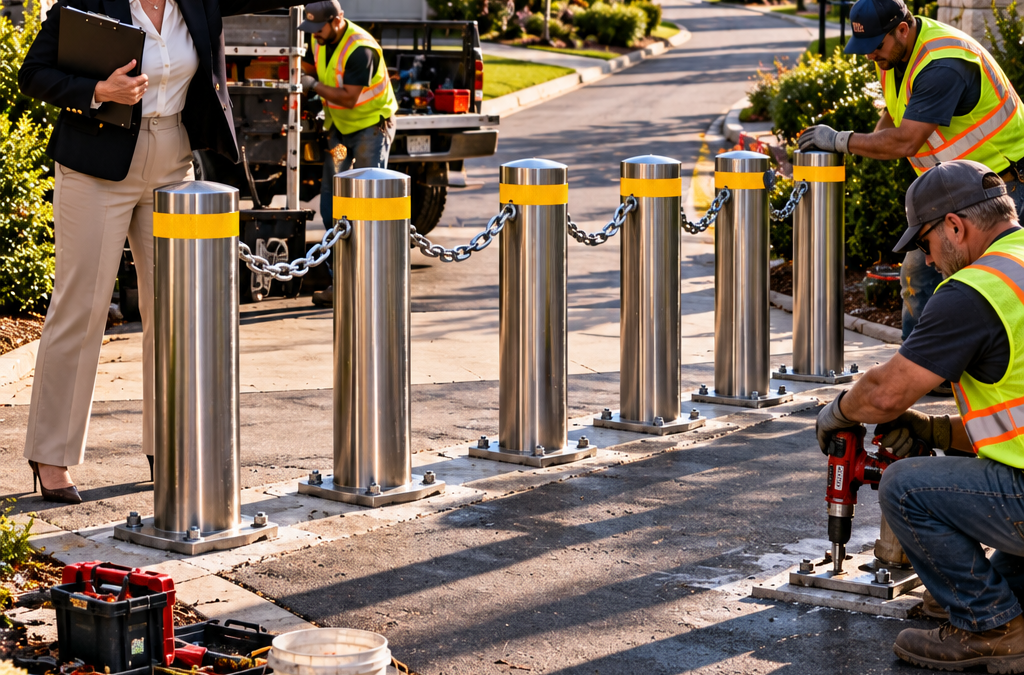
By sunrise, six steel bollards stood across the road.
They were arranged in a clean row near my driveway entrance, with a heavy chain threaded between them and secured by padlocks.
A laminated sign hung from the center post.
ROAD CLOSED
PER HOA BOARD ORDER
SECTION 4.2
I stood there with coffee in one hand.
Six bollards.
One chain.
One laminated sign.
Denise had meant to trap me.
What she had actually done was obstruct the only continuous access route serving the entire subdivision.
The geography of Hollow Pines was simple.
One primary road entered from the county route, passed my property, then branched into the interior streets.
There was an emergency gravel trail at the rear boundary, but it was gated, narrow, and not approved for ordinary residential traffic.
The road Denise had obstructed was not just how I reached my driveway.
It was how roughly 140 households reached everything outside Hollow Pines.
She thought she had blocked one resident.
She had blocked everyone.
I walked back inside.
At 7:08, I called Daniel.
He answered sounding half asleep.
“What happened?”
“How did you know something happened?”
“You don’t call at seven on Saturday to discuss recreational easements.”
“She installed bollards.”
There was silence.
“Where?”
“Across the roadway.”
“Permanent?”
“Drilled into the asphalt.”
“Without your consent?”
“Yes.”
Another pause.
Then Daniel said, very softly, “Oh.”
That one syllable contained an entire legal analysis.
“I’m coming in,” I said.
“Mara, it’s Saturday.”
“I know.”
“So you’re going to the office?”
“Yes.”
“I’ll meet you there.”
Our office occupied the second floor of a brick building near the county courthouse.
By eight fifteen, I was sitting at a conference table surrounded by copies of the 1978 license, Hollow Pines covenants, subdivision plats, contractor photographs, and the fine notice Denise had sent over my hydrangeas.
Daniel stood at the window reading paragraph six.
Again.
“You’re sure?” he asked.
“I’m sure.”
“This clause is broader than I remembered.”
“My grandfather wanted control.”
“He certainly kept it.”
I pointed at the language.
Permanent obstruction or modification of the licensed way without written consent constituted material breach.
Material breach allowed revocation.
Not after thirty days.
Not after arbitration.
Not after board review.
Revocation by the grantor or successors.
Daniel looked at me.
“If you do this, every resident loses access.”
“Temporarily.”
“They’ll panic.”
“I know.”
“Denise will blame you.”
“I know.”
“She’ll say you’re holding the neighborhood hostage.”
“I know.”
He closed the file.
“Are you prepared for that?”
That question bothered me more than the legal issue.
I thought about Mrs. Patterson.
The Ruiz family.
The children who rode bikes past my porch.
None of them had installed the bollards.
None of them had fined my hydrangeas.
None of them deserved to be trapped inside a power struggle between Denise and me.
But then I thought about the alternative.
I could remove the bollards myself and invite an accusation of tampering.
I could seek an injunction and spend weeks litigating while Denise continued pretending the road belonged to the HOA.
I could send another warning.
Another letter.
Another opportunity for her to ignore the instrument she had already been told existed.
Or I could use the mechanism my grandfather had placed in the deed precisely for this kind of abuse.
I looked at Daniel.
“I’m not closing the road.”
His eyebrows lifted.
“I’m revoking their license because they obstructed it. The physical obstruction is theirs.”
He nodded slowly.
“That distinction will matter.”
“It’s the only distinction that matters.”
We drafted the notice.
FORMAL NOTICE OF REVOCATION OF ROADWAY LICENSE.
We cited the recorded instrument.
We identified the breach.
We attached photographs.
We stated that the license permitting Hollow Pines residents and associated invitees to use the Voss roadway was revoked effective immediately because permanent fixtures had been installed without the easement holder’s consent, materially obstructing access in violation of paragraph six.
I read every line twice.
Then I read it again.
I had drafted similar documents for clients.
Never for myself.
At 9:32, Daniel looked at me.
“Last chance to reconsider.”
I signed.
“No.”
We recorded it electronically with the county.
Confirmation arrived shortly before ten.
At 10:17, I was back at Hollow Pines with printed copies.
I taped one to every bollard.
I attached another to the laminated Section 4.2 sign.
Then I photographed each notice in place.
Residents had begun gathering.
A man from Willow Court approached first.
“Mara, what is going on?”
“The HOA installed these last night.”
“Why?”
“You’ll need to ask the board.”
He pointed at the notice.
“What does revocation mean?”
“It means the association no longer has legal permission to use this roadway under the existing agreement.”
His eyes widened.
“You can do that?”
“The recorded instrument says I can.”
“Are we trapped?”
“The physical barrier is the HOA’s.”
“But can we drive on the road?”
I looked at him.
“Not under the revoked license.”
His face changed.
I hated that expression.
Fear mixed with disbelief.
This was no longer paperwork.
It was somebody wondering whether his family could get home.
Before I could say more, the Yukon came around the corner.
It stopped hard.
Denise climbed out so fast she left the driver’s door open.
No clipboard.
For the first time since I had known her, she was holding only her phone.
She was filming.
“What did you do?”
I pointed at the bollards.
“You did this.”
She marched toward me.
“What is this notice?”
“Exactly what it says.”
“You revoked access?”
“Yes.”
“You can’t.”
“I already did.”
“People live here!”
Her voice carried across the street.
More doors opened.
Residents stepped onto lawns.
A woman in jogging clothes stopped on the sidewalk.
Denise kept filming me.
“Children live here, Mara. Elderly people live here. People need to get to work.”
I looked directly at her phone.
“You put the bollards up, Denise.”
“This is because you refuse to obey community regulations.”
“No. This is because you installed permanent fixtures on land governed by a private recorded instrument without obtaining consent from the holder.”
“You’re punishing an entire neighborhood over flowers.”
“No. You blocked the neighborhood over flowers.”
Her face reddened.
“This is insane.”
“No. It’s recorded.”
“We’ll sue you.”
“Then your lawyer can read paragraph six.”
“I don’t care what paragraph six says.”
That sentence changed the mood around us.
People heard it.
I saw two neighbors exchange looks.
I lowered my voice.
“You should care.”
She stepped closer.
“Section 4.2 gives the HOA authority over private roadways inside Hollow Pines.”
“Section 4.2 does not apply the way you think it does.”
“I am the president of this association.”
“And I am the successor easement holder.”
“You don’t get to invent rights because your grandfather owned some land fifty years ago.”
My anger finally surfaced.
“I didn’t invent anything.”
I took a folded copy of the covenant from my bag.
“You keep quoting Section 4.2. Read the footnote.”
She did not take it.
“Read it.”
“I know what it says.”
“No, Denise. You know what you’ve been telling people it says.”
I opened the page myself.
“‘Roadway rights subject to recorded private access agreement granted by Stefan Voss, Instrument 78-11462.’ That is my grandfather.”
Her face changed.
Not dramatically.
Just enough.
The color drained slightly from around her mouth.
I saw it.
Everyone near us saw it.
“You didn’t know,” I said.
She stopped filming for half a second.
Then raised the phone again.
“This means nothing.”
“It means your covenant cites the exact document you violated.”
“You’re interpreting it wrong.”
“I file instruments like this for a living.”
That got her attention.
“What?”
“You never asked what I do.”
Silence.
“I work in land records and easement documentation.”
Denise stared at me.
“You expect me to believe that?”
“I don’t care what you believe.”
For the first time, she had no immediate answer.
Then a horn sounded from the entrance.
A sedan had pulled up behind the bollards.
Another vehicle stopped behind it.
Then another.
Within thirty minutes, the line reached beyond the subdivision monument.
Parents trying to leave for youth sports were stuck.
A home-care nurse could not get through.
A moving truck arrived for a family on Birch Hollow and stopped with its hazards blinking.
The driver climbed down and stared at the chain.
“You’ve got to be kidding me.”
Denise began making calls.
I heard fragments.
“Emergency board meeting.”
“Get counsel.”
“No, she cannot do that.”
“Call the contractor.”
The contractor apparently told her removing the bollards required equipment.
By noon, anger had spread through Hollow Pines.
Some residents blamed Denise.
Some blamed me.
Most blamed both of us.
I understood.
A father approached with a little girl beside him.
“She has a soccer game.”
I looked at the child.
Her shin guards were already on.
“I’m sorry.”
“Can you reopen it?”
“I didn’t install the chain.”
“But you revoked the easement.”
“Yes.”
He shook his head.
“This is ridiculous.”
“It is.”
“That doesn’t help us.”
“No.”
I did not defend myself.
There are moments when being legally correct does not make somebody less inconvenienced.
I could see the consequences of my signature lined up in idling cars.
And for perhaps ten minutes, I considered rescinding it.
Then the county sheriff arrived.
A deputy parked outside the obstruction and walked toward us.
Behind him came a second cruiser.
Denise intercepted them.
“Thank God. This woman has illegally closed our road.”
The deputy looked at the bollards.
“Who installed those?”
“The HOA, but—”
“Who physically installed them?”
“Our contractor.”
He wrote something down.
Denise pointed at me.
“She revoked our access.”
The deputy turned.
“Ma’am?”
I handed him the recorded notice and the underlying instrument.
He read.
Slowly.
Then he called somebody.
Another deputy photographed the posts.
The first one returned.
“I’m not adjudicating property rights on the roadside,” he said. “That’s civil.”
Denise crossed her arms.
“So make her open it.”
“I can’t.”
“She closed the road.”
He looked at the steel posts.
“No, ma’am. According to everybody here, your contractor installed the physical obstruction.”
“She created the legal issue.”
“That may be. But the immediate public-safety obstruction is the hardware.”
Denise’s mouth opened.
He continued.
“We need emergency access restored.”
“My contractor is coming.”
“When?”
“I’m waiting on a call.”
The deputy glanced at the line of vehicles.
“You should call again.”
The sheriff’s report ultimately identified the HOA as the party responsible for placing the physical obstruction.
That mattered.
Not because it absolved me emotionally.
But because Denise had spent the morning telling everybody that I had “closed the road.”
The report forced the distinction into the open.
I had exercised a recorded right.
She had drilled steel into asphalt.
At about three that afternoon, a local news van arrived.
I almost laughed when I saw it.
Not because anything was funny.
Because once a neighborhood dispute attracts a camera, dignity usually leaves before the reporter gets out.
A young reporter named Claire Benton walked toward the crowd with a microphone.
Her camera operator filmed the bollards.
Then the line of cars.
Then the laminated Section 4.2 sign.
Denise immediately positioned herself in front of the HOA monument.
She had found the clipboard.
Of course she had.
Claire asked what happened.
Denise gave the version she had been repeating all day.
“This is a private roadway maintained by the Hollow Pines Homeowners Association under Section 4.2 of our covenants. One resident is attempting to weaponize an outdated family document to disrupt the entire community.”
Claire looked at her notes.
“County land records list the roadway as subject to a private Voss family access instrument. Were you aware of that?”
Denise blinked.
“The HOA has maintained authority over roads here for decades.”
“That wasn’t my question.”
Denise’s fingers tightened around the clipboard.
Claire tried again.
“Were you aware that the association did not own the underlying roadway?”
“We have authority under Section 4.2.”
“County records appear to say Section 4.2 is subject to the Voss instrument.”
Denise stared at her.
The camera kept recording.
“Were you aware of that?”
Denise looked away.
That clip aired that evening.
I did not watch it live.
I was exhausted.
By then, the contractor had removed enough hardware to allow controlled vehicle passage under county supervision.
The formal access issue still had to be resolved, but emergency movement resumed.
I sat in my kitchen eating cold soup while my phone vibrated almost continuously.
Neighbors.
Coworkers.
People I had not spoken to in years.
Daniel finally texted:
You’re on television.
I replied:
My condolences to television.
He sent back a laughing emoji.
Then, at 8:46, an email arrived.
The sender was Phil Mercer.
Hollow Pines HOA Treasurer.
Phil was one of those men who seemed to become part of furniture during meetings.
Thin.
Quiet.
Glasses.
He had served on the board for three years.
I could barely remember hearing him speak.
The subject line said:
YOU SHOULD SEE THIS.
The message contained forwarded emails.
Internal board discussions.
PDF attachments.
Minutes from a closed session.
I began reading.
Then I stopped.
Went back to the beginning.
Read them again.
Denise had known.
Not everything.
But enough.
More than a year earlier, a former board member named Howard Klein had raised concerns about the road.
He had located the 1978 instrument during a dispute over snow-removal responsibility.
His email to Denise was explicit.
The association does not appear to own the roadway. Our covenant authority is subordinate to the recorded Voss access agreement. We should obtain counsel before asserting ownership or making alterations.
Denise’s response:
We have exercised control for decades. Raising technical ownership questions will only create unnecessary conflict.
Another email.
Howard:
Longstanding practice does not necessarily override recorded title. We need clarification.
Denise:
This discussion is becoming disruptive.
Two months later, Howard was removed from the board after Denise led a vote accusing him of creating “administrative instability.”
I kept reading.
There was more.
A message sent shortly before my first hydrangea notice.
Denise to Phil:
Voss has been passive for years. Treat her property the same as everyone else. Do not create a special exception based on old family paperwork.
Another, after I challenged the restriping.
She’s bluffing. People like her usually back down once fines begin.
Then the one that made me put my phone down.
It had been sent the afternoon before the bollards were installed.
Contractor is cleared to proceed. If she objects, document noncompliance. Once physical control is established, she’ll have little practical choice.
Physical control.
I read those two words again.
This had not been ignorance.
Not entirely.
Denise had known there was a problem with her authority.
She simply assumed I would surrender before anyone examined it closely.
That realization hurt in a way the fines had not.
Because there is something especially humiliating about discovering that someone did not misunderstand your rights.
They calculated that you would be too tired, too quiet, or too intimidated to use them.
I called Phil.
He answered immediately.
“I’m sorry,” he said.
No hello.
Just that.
“You knew?”
His silence answered before he did.
“Not all of it.”
“Phil.”
“I knew Howard raised the issue.”
“And you did nothing.”
“I should have.”
“Yes.”
“I kept telling myself Denise had talked to counsel.”
“Did she?”
“I don’t think so.”
“You signed board minutes.”
“I know.”
“You approved fines.”
“I know.”
“Why are you sending this now?”
His breathing came through the phone.
“Because today I watched a hundred people stranded because none of us had the courage to tell her no.”
I said nothing.
Phil continued.
“She runs every meeting. If someone challenges her, she humiliates them. Howard tried. Look what happened.”
“That doesn’t excuse you.”
“No.”
His answer was immediate.
“I know.”
That mattered.
He was not asking me to forgive him.
“I kept thinking the next thing wouldn’t be as bad,” he said. “Then the next thing came.”
I understood that sentence more than I wanted to.
The fifty-dollar fine.
The restriping threat.
The towing threat.
The bollards.
Every escalation had been survivable on its own.
Together, they became something else.
I forwarded Phil’s records to Daniel.
Then to county counsel.
Then, after removing residents’ personal information, to Claire Benton.
The next day, the story changed.
The question was no longer whether I had overreacted.
The question became why the HOA president had proceeded after receiving written notice that the road was not association property.
County officials opened a review of the unpermitted installation.
The contractor produced the work order.
Denise had signed it.
No county permit.
No written consent from the easement holder.
No legal opinion authorizing permanent fixtures.
Just Denise’s signature.
Within the week, the remaining bollards were removed at HOA expense.
The pavement had to be repaired where the anchors had been drilled.
The county issued penalties related to the unpermitted installation and the public-safety obstruction.
The association’s attorney sent me a letter.
The tone was very different from Denise’s notices.
Respectful.
Precise.
Almost painfully polite.
They proposed negotiations to restore the access license under updated terms.
Daniel read the letter in my office.
“This is what fear sounds like in legal stationery.”
I gave him a look.
He smiled.
“Sorry.”
“You enjoy this too much.”
“I enjoy people finally reading documents.”
“So do I.”
That was the closest I came to celebrating.
Denise resigned two days after the second news segment aired.
Her resignation email was circulated to residents.
She described the controversy as “a regrettable breakdown in communication concerning historic property records.”
That phrase irritated me.
Breakdown in communication.
As though six steel bollards had appeared because of a misunderstanding about meeting times.
She did not mention Howard.
She did not mention the emails.
She did not mention the sentence about establishing physical control.
Two other board members resigned within forty-eight hours.
Phil stayed.
At the next meeting, he stood before the residents and apologized.
Not elegantly.
Not dramatically.
But sincerely.
“I knew there were questions,” he said. “I did not ask enough of them. I let one person’s confidence substitute for due diligence.”
For once, nobody interrupted.
A new board was elected within a month.
Their first formal item was the road.
They asked me to attend.
I almost declined.
The thought of sitting beneath fluorescent lights while neighbors debated something my grandfather had settled on paper decades earlier sounded exhausting.
But I went.
The meeting room was full.
I sat near the back.
No special seat.
No speech prepared.
The new president, Caroline West, opened the discussion.
“We are not here to decide who won,” she said. “We are here to make sure this never happens again.”
That was the first intelligent sentence I had heard from an HOA meeting in months.
Their attorney explained the existing instrument.
He did not dramatize it.
Did not blame anyone.
He simply described the problem.
The 1978 license had been designed for a much smaller development.
Maintenance responsibilities were vague.
Insurance provisions were outdated.
Emergency-access language needed modernization.
The revocation clause, however, was valid under the terms as recorded.
The new board proposed replacing the old license with a modern agreement.
Not seizing it.
Not rewriting history.
Replacing it with my consent.
We negotiated for several weeks.
The association accepted formal maintenance responsibility.
They agreed no permanent modification could be made without written approval from the underlying owner.
Emergency-access provisions were clarified.
Insurance requirements were updated.
Dispute-resolution procedures were added so no future disagreement could escalate from flowerbeds to road closures in six weeks.
Most importantly, everybody signed.
Me.
The association.
Their counsel.
The new instrument was recorded with the county.
Actual terms.
Actual obligations.
Actual signatures.
Paperwork done correctly.
The entire matter stayed out of court.
That surprised people.
They assumed after the news coverage I would sue Denise personally.
Some neighbors almost seemed disappointed when I did not.
I had grounds to pursue additional claims.
Daniel told me so.
But by then, I was tired.
Not weak.
Tired.
There is a difference.
Winning every possible argument would not bring my father back.
It would not restore the weekends I had spent reading hostile notices.
It would not make the holes disappear from the asphalt faster.
It would only keep Denise in my life longer.
I had already spent enough time thinking about her.
So I let the legal corrections stand.
The county handled its penalties.
The HOA handled its governance.
The residents handled their election.
And I went home.
That Sunday morning, I sat on my porch with coffee.
Traffic moved along the road again.
Slow.
Ordinary.
A minivan passed.
Then a pickup.
Then Mrs. Patterson in her little red sedan.
She waved.
I waved back.
No bollards.
No chains.
No contractors.
No clipboard.
For weeks, I had imagined that moment would feel triumphant.
It did not.
Mostly, I felt tired.
And relieved.
There was grief mixed into it too.
My grandfather had signed that original document almost half a century earlier.
My father had understood it.
They were both gone.
For a few strange weeks, the piece of land they had left behind became the center of a fight neither of them would have wanted.
I wondered what my father would have said.
Probably something irritatingly simple.
Read before you sign.
He used to say that about everything.
Car loans.
Plumbing contracts.
Birthday cards with suspiciously long messages.
Read before you sign, Mara.
Maybe Denise’s entire downfall came from refusing to do exactly that.
I do not think she was evil.
That would make the story easier.
People like to imagine bullies as monsters because monsters are simple.
Denise was not simple.
She was a woman who enjoyed being obeyed.
She had spent years carrying a clipboard until she began to confuse documentation with authority.
People complied.
That compliance became habit.
Habit became entitlement.
And entitlement eventually became certainty.
By the time someone told her no, she could no longer distinguish disagreement from insubordination.
That was the dangerous part.
Not the clipboard.
Not the Yukon.
Not even Section 4.2.
The dangerous part was the belief that if she repeated a rule confidently enough, nobody would ever ask whether it was real.
A child from two houses down was drawing on the sidewalk that morning.
His name was Tyler.
He had a bucket of chalk beside him.
Blue.
Yellow.
Pink.
White.
He had drawn the street from the entrance all the way toward Birch Hollow.
Little rectangles for houses.
Squares for mailboxes.
A lopsided dog beside one driveway.
I watched him add my house.
He looked up.
“Miss Mara?”
“Yes?”
“Is this your driveway?”
He pointed at a crooked chalk line.
“That’s supposed to be it?”
“Yeah.”
“It’s very accurate.”
He grinned.
Then he drew a long gray line down the middle of his chalk neighborhood.
“The road goes here.”
I looked at it.
A child’s version of the thing adults had spent weeks arguing about.
No deed references.
No covenant sections.
No grantor language.
Just a road connecting houses.
“Looks right,” I said.
He went back to drawing.
I sat there for another hour.
Cars passed.
Doors opened.
Somebody walked a golden retriever.
A delivery van stopped at the Patterson house.
Life resumed the way life usually does after conflict.
Quietly.
Without music.
Without applause.
That turned out to be the part I valued most.
For years, Hollow Pines had treated the road as though it belonged to everyone because functionally, that was what my grandfather intended.
Access.
Connection.
A way home.
Denise had mistaken permission for possession.
Then she had mistaken silence for surrender.
She was wrong about both.
I still keep the original 1978 document in my fireproof box.
Beside it is the new agreement.
The old one bears my grandfather’s signature.
The new one bears mine.
Sometimes I think about those two sheets of paper separated by nearly fifty years.
Neither looks powerful.
Neither is dramatic.
Just text.
Margins.
Signatures.
Recording stamps.
But that is the strange thing about property rights.
Most of the time, they sleep.
Nobody thinks about them.
Nobody notices them.
Until someone pushes too far.
Then the quiet language buried in an old document becomes louder than a person who has spent years shouting.
Denise spent a long time believing Hollow Pines belonged to whoever held the clipboard.
She never understood that authority does not come from speaking first, speaking loudest, or printing rules on laminated paper.
Sometimes authority is much quieter than that.
Sometimes it sits forgotten in a county archive.
Sometimes it passes from a grandfather to a father to a daughter.
And sometimes the person everyone overlooks is the only one in the room who bothered to read the deed.
𝗧𝗛𝗘 𝗘𝗡𝗗
The HOA President Chained Off My Driveway With Six Steel Bollards and Warned Me Not to Challenge Section 4.2
Nobody notices the quiet woman at the end of the street until somebody with a clipboard decides silence means weakness. Denise Kowalski had spent years bullying Hollow Pines with rules she barely understood, and the night she drove six steel bollards into the road in front of my house, she finally gave me a reason to stop being quiet.
My name is Mara Voss.
For most of my adult life, I have made a living doing work that causes people’s eyes to glaze over the moment I explain it.
I file easements.
I review deeds, plats, access agreements, covenants, rights-of-way, licenses, boundary descriptions, title exceptions, and the other pieces of paper people ignore until one of those pieces of paper suddenly becomes the most important thing they own.
It is not glamorous.
I do not wear expensive suits.
I do not spend my mornings arguing dramatically in courtrooms.
Most days, I sit in front of two monitors with a legal pad beside me, reading documents written before I was born and making sure somebody forty years from now will understand exactly what somebody today intended.
I drove a twelve-year-old gray Subaru.
I lived in a modest cedar-sided house near the western edge of Hollow Pines.
I kept hydrangeas along the front walk.
I drank my coffee without sugar.
And because I was quiet, because I attended almost no HOA meetings, and because I never felt the need to tell my neighbors what I did for a living, most people in Hollow Pines assumed I was just another middle-aged woman who worked some boring office job downtown.
Denise Kowalski certainly did.
That was her first mistake.
Her second was believing that a laminated rule carried more authority than a recorded deed.
Hollow Pines had been built in phases beginning in the early 1980s, though the road leading through it was older.
Much older.
My grandfather, Stefan Voss, had owned the original acreage before there were cul-de-sacs, decorative entrance stones, mailbox clusters, or signs reminding residents what color they were allowed to paint their shutters.
In 1978, a developer approached him about access.
The development planned east of his property had no practical connection to the county road without crossing a strip of Voss land.
My grandfather was not sentimental about paperwork.
He was a farmer who believed a handshake mattered, but he was also smart enough to know that a handshake should be backed by ink.
So he granted the developer a private roadway license over a defined strip of land.
Not ownership.
Not a transfer.
Not a dedication to the HOA.
Permission.
That distinction mattered.
The document granted access for residents and their guests, provided certain conditions were met.
The roadway could be used.
It could be maintained.
It could not be permanently altered without the consent of the easement holder.
And the license contained a provision almost nobody would include today because lawyers prefer stability.
It was revocable at the sole discretion of the grantor or the grantor’s successors if the terms were materially breached.
When my grandfather died, my father inherited the underlying parcel and the corresponding rights.
When my father died, they passed to me.
The houses changed hands.
Board members came and went.
Hollow Pines incorporated its HOA.
The neighborhood installed signs with names like Fox Run, Willow Court, and Birch Hollow.
But the strip of asphalt connecting all of them to the county road never stopped being governed by that 1978 document.
The residents used it every morning without thinking about it.
School buses used it.
Garbage trucks used it.
Delivery vans used it.
Denise drove her white GMC Yukon over it several times a day.
And every time she did, she was crossing land whose underlying title and access rights remained attached to my family.
I had known that since I inherited the house.
I never cared.
Why would I?
Roads were meant to be driven on.
My grandfather had not granted access so his granddaughter could someday stand at the edge of the pavement shouting, Mine.
He had done it because communities grow, people need homes, and sometimes allowing somebody to cross your land is simply the sensible thing to do.
For years, Hollow Pines and I coexisted without trouble.
Then Denise became HOA president.
She had a habit of arriving at people’s houses without warning.
You always knew it was her before she knocked because the Yukon would remain running at the curb, air conditioner humming, while she marched up the driveway carrying a black clipboard.
The clipboard became a neighborhood joke.
Residents saw it and immediately checked their trash cans, lawns, garden hoses, flags, vehicles, and flowerbeds.
A clipboard should not inspire fear.
Hers did.
Denise had an extraordinary ability to make small inconveniences feel like disciplinary hearings.
She corrected people in public.
She photographed violations.
She left fluorescent notices under windshield wipers.
She once made an elderly widower remove a wooden bench from beneath his maple tree because, according to her, it constituted “unapproved exterior furniture visible from a common roadway.”
The bench had been built by his son.
His son had died overseas.
Everybody knew it.
Denise knew it too.
She still cited him.
Another neighbor, Elena Ruiz, received three notices because her garbage container remained beside her garage until 8:15 the morning after pickup instead of being moved by 8:00.
Fifteen minutes.
Denise fined her.
When Elena explained that she worked an overnight shift at the hospital and did not get home until after eight, Denise told her, “Work schedules do not supersede community standards.”
That sentence traveled through Hollow Pines faster than gossip usually did.
Nobody liked Denise.
But people complied.
That was how she became powerful.
Not because she had much authority.
Because everyone assumed challenging her would cost more time, money, and energy than surrendering.
I understood that better than most.
People imagine bureaucracy is powerful because rules are complicated.
That is only half true.
Bureaucracy becomes powerful when exhausted people stop asking whether the rule being quoted actually applies.
My confrontation with Denise began over six hydrangeas.
They had been planted by my mother.
Blue and violet in early summer, fading gradually toward dusty pink as the season changed.
When she became too sick to garden, I took over their care.
After she died, I kept them alive partly because I loved them and partly because I liked seeing something she had touched survive her.
One Tuesday morning, I was kneeling beside the front bed trimming dead blossoms when I heard the low idle of the Yukon.
I did not look up immediately.
The driver’s door closed.
Then came the measured click of Denise’s shoes on my driveway.
“Mara?”
I set the clippers down.
“Morning, Denise.”
She stopped at the edge of the flowerbed.
White blouse.
Pressed khaki pants.
Large sunglasses.
Clipboard.
Of course.
She stared at the hydrangeas as though they had been caught committing fraud.
“Do you know why I’m here?”
“No.”
“Your landscaping is encroaching.”
“On what?”
“The roadway right-of-way.”
I glanced from the flowers to the asphalt.
The nearest branch was several feet from the pavement.
“Those?”
“Yes.”
“They’re not encroaching on anything.”
She flipped a page on the clipboard.
“Section 4.2 of the Hollow Pines covenant. Landscaping within ten feet of the roadway requires board approval.”
I stood.
I remember brushing dirt from my palms before answering.
“Denise, that isn’t your right-of-way.”
She looked at me over the top of her sunglasses.
“Excuse me?”
“That strip belongs to my family. The association has access rights. It doesn’t own the roadway.”
She stared at me for half a second.
Then she laughed.
Not nervously.
Not because she thought I was joking.
It was the small, dismissive laugh people use when a child announces something ridiculous.
“Cute.”
I felt something shift inside me.
Not anger exactly.
Not yet.
“What is?”
“This whole ‘my family owns the road’ thing.”
“It isn’t a thing.”
“Mara, Hollow Pines has existed for decades.”
“So has the deed.”
She sighed.
“The HOA maintains all community roadways.”
“No, it doesn’t.”
Her smile disappeared.
“Section 4.2 says otherwise.”
“Section 4.2 can say the moon belongs to the HOA. That wouldn’t make it true.”
Her eyes narrowed.
I knew that was the moment I stopped being a resident in her mind and became a problem.
She lowered her pen to the clipboard.
“I’ll note the violation.”
I looked at the pen.
“You do that.”
She wrote deliberately.
I could hear the scratch of ink.
Then she turned, walked back to the Yukon, and drove away.
Three days later, a certified envelope arrived.
Violation: Unauthorized Landscaping Obstruction.
Fine: $50.
Authority cited: Hollow Pines Covenants, Section 4.2.
The letter referred to the pavement in front of my house as a “private HOA roadway.”
I read that phrase twice.
Then a third time.
Private HOA roadway.
It was astonishing how confidently a falsehood could be printed on letterhead.
I pulled my copy of the 1978 instrument from the fireproof box in my home office.
I did not need to.
I knew what it said.
Still, I opened it.
The paper was a county-certified copy, yellowing around the edges.
My grandfather’s signature appeared at the bottom in the severe handwriting I remembered from birthday cards.
STEFAN VOSS.
The developer’s name was beneath his.
The legal description followed.
Then the operative language.
License for ingress and egress.
No permanent improvements or obstructions without grantor approval.
Rights binding on successors.
Revocable upon material breach.
I leaned back in my chair.
I could have ended the issue that afternoon.
One email.
One attachment.
One paragraph written in the language Denise pretended to understand.
But I did not.
Looking back, I have asked myself why.
Part of it was fatigue.
My father had died the previous year.
I was still cleaning out his workshop, still finding his handwriting on masking tape wrapped around old tool handles.
I had enough conflict inside my life already.
Part of it was professional instinct.
People reveal far more about themselves when they think nobody is resisting.
And part of it, if I am being fair, was pride.
Denise had laughed at me.
I wanted to see how far she would go before she discovered she was wrong.
So I paid the fifty dollars.
Not because I believed I owed it.
Because fifty dollars was cheap compared with the education I suspected Denise was about to buy for herself.
Two weeks passed.
Then the Yukon returned.
This time I was bringing groceries inside when Denise stepped out.
She did not bother walking all the way to the porch.
“We’re restriping the road next month,” she called.
I set a bag on the hood of my car.
“We?”
“The association.”
“Why?”
“The markings are faded.”
“There are no markings in front of my property.”
“There will be.”
She looked at her clipboard.
“Residents are required to remove vehicles from affected areas between seven a.m. and five p.m. Contractors will be working.”
I stared at her.
“Denise.”
“Yes?”
“It’s my road.”
Her lips compressed.
“Per Section 4.2—”
“No.”
That stopped her.
She looked almost offended.
I walked toward her slowly.
“Do not quote Section 4.2 to me again until you’ve read the document Section 4.2 depends on.”
“I have read the covenants.”
“I’m not talking about the covenants.”
She folded her arms and pinned the clipboard against her chest.
“The HOA maintains all roadways within Hollow Pines.”
“You’ve never maintained this section.”
“That’s not true.”
“Who paid for the patch near my mailbox last year?”
“The association.”
“I did.”
Silence.
“Who paid when the drainage ditch collapsed?”
She stared at me.
“I did.”
“Mara—”
“Who paid to seal the cracks near the western culvert?”
She did not answer.
“I did.”
“That doesn’t change jurisdiction.”
I nearly smiled.
“Jurisdiction?”
“You know what I mean.”
“I know exactly what you mean. I also know that isn’t the correct word.”
Her face tightened.
I should have stopped there.
Instead, I added, “Read the deed, Denise.”
Her voice dropped.
“You need to move your vehicle during the work period.”
“No.”
“If it interferes with an HOA contractor, we can have it towed.”
“Try it.”
For a moment neither of us moved.
The neighborhood was quiet.
A sprinkler clicked somewhere across the street.
Then Denise opened the Yukon door.
Before getting in, she looked back at me.
“You know, most people try to cooperate with the community they live in.”
I held her gaze.
“Most communities understand the difference between cooperation and ownership.”
She got into the SUV.
The clipboard landed on the passenger seat.
She drove away.
That evening I finally called an old colleague, Daniel Price.
Daniel had worked with me on title matters for almost twelve years.
He answered on the second ring.
“You sound annoyed,” he said after I explained what was happening.
“I’m not annoyed.”
“You only say that when you’re furious.”
I looked through the kitchen window toward the road.
“Do me a favor tomorrow.”
“Pull the Hollow Pines filings?”
“Yes.”
“You already have them.”
“I want everything recorded since incorporation. Road amendments. Maintenance declarations. Annexations. Any instrument referencing the Voss license.”
There was a pause.
“You think they tried to modify it?”
“No.”
“Then what?”
“I want to know whether I missed anything.”
Daniel knew me well enough not to tease me.
“I’ll pull it.”
The next day we reviewed the chain.
Nothing had changed.
No conveyance.
No dedication.
No amendment signed by a Voss successor.
No extinguishment.
No merger.
Nothing.
The HOA had exactly what my grandfather had granted.
Access.
Conditional access.
That was all.
Daniel whistled softly over the phone.
“You realize their covenant actually references the original instrument.”
“I know.”
“By number.”
“I know.”
“And by grantor.”
“I know.”
“So their own Section 4.2 points directly to your grandfather.”
“Yes.”
“And they still sent you that notice?”
“Yes.”
He laughed.
I did not.
“Don’t,” I said.
“Sorry.”
“I don’t want this turning into something ugly.”
“Mara, they threatened to tow your car from a road they don’t own.”
“I know.”
“What are you going to do?”
“Nothing yet.”
Daniel sighed.
“You have always had a disturbing amount of patience.”
“My father called it stubbornness.”
“Your father was right.”
The next two weeks were quiet.
Too quiet.
No notices.
No Yukon.
No clipboard.
I began to believe Denise had finally pulled the document.
Maybe she had called counsel.
Maybe somebody had told her to stop.
I wanted that to be true.
Not because I was afraid of conflict.
Because conflict in neighborhoods poisons ordinary things.
You stop waving.
You notice curtains moving.
You think about who spoke to whom at the mailbox.
I liked Hollow Pines.
I liked hearing children ride bicycles past my porch.
I liked that Mrs. Patterson across the street brought me banana bread at Christmas.
I liked knowing which dog belonged to which bark.
I did not want my home reduced to opposing camps over six hydrangeas and a woman with a clipboard.
Then Friday night came.
I woke at 11:43 to metal grinding against asphalt.
At first I thought a car had crashed.
I sat up.
The sound came again.
A heavy mechanical whine.
Then a hammering impact.
I crossed the bedroom barefoot and looked through the blinds.
Work lights flooded the road.
Two men in reflective vests stood beside a utility truck.
A compact hydraulic auger was drilling into the pavement.
For several seconds, I could not understand what I was seeing.
Then I saw the first steel post.
Bollard.
Thick.
Black.
Waist-high.
Installed directly across the mouth of my driveway.
I pulled on jeans and shoes and walked outside.
The night air smelled like hot asphalt and cut metal.
One contractor looked up.
“Ma’am, you need to stay back.”
“What are you installing?”
“Traffic-control bollards.”
“Authorized by whom?”
“The HOA.”
“Who signed the work order?”
He glanced toward the truck.
“I don’t handle that.”
“This road is under a private access instrument. Did anyone show you authorization from the landowner?”
He frowned.
“The HOA hired us.”
“That is not what I asked.”
The second man stopped drilling.
The first contractor shifted uncomfortably.
“You’ll have to talk to your association.”
“I am talking to the people drilling holes into my property at midnight.”
“Ma’am—”
Headlights appeared at the far end of the street.
White Yukon.
Of course.
It rolled slowly toward us and stopped fifty yards away.
Denise did not get out.
She sat behind the wheel.
Watching.
Even from that distance, I could see the outline of the clipboard on her dashboard.
Something inside me went completely still.
Until that moment, the dispute had been irritating.
Petty.
Ridiculous.
Now two strangers were driving permanent fixtures into land my grandfather had once walked, under authority Denise did not possess, specifically to block access to my own driveway.
I took out my phone.
I photographed the truck.
The plates.
The contractor logos.
The work order taped inside the windshield.
The location of each drilled hole.
The men watched me.
Neither told me to stop.
I walked toward Denise.
Her window lowered when I reached the Yukon.
“You approved this?”
Her expression was calm.
“Temporary traffic-control measures.”
“They’re drilling them into the road.”
“They are removable.”
“That isn’t the same as temporary.”
“Mara, you were warned.”
“Warned about what?”
“Repeated refusal to cooperate.”
“So you’re blocking my driveway.”
“We’re regulating access.”
“To my house.”
“To the roadway.”
“My roadway.”
She smiled slightly.
That smile did more than her laughter had.
“Section 4.2 gives the board authority to control obstructions and vehicle access.”
“You really haven’t read it.”
“I am done discussing this.”
“You are having steel posts installed across a property interest you do not own.”
Her voice sharpened.
“And I am done listening to you claim ownership over a community road.”
I stared at her.
For the first time, I understood that facts were not going to correct Denise.
She did not misunderstand.
She had built her identity around being obeyed.
Admitting she was wrong would cost her more psychologically than escalating.
That made her dangerous in the most ordinary way possible.
I stepped away from the Yukon.
“Have a good night, Denise.”
She seemed surprised.
“That’s it?”
“That’s it.”
I walked home.
Behind me, the drilling resumed.
By sunrise, six steel bollards stood across the road.
They were arranged in a clean row near my driveway entrance, with a heavy chain threaded between them and secured by padlocks.
A laminated sign hung from the center post.
ROAD CLOSED
PER HOA BOARD ORDER
SECTION 4.2
I stood there with coffee in one hand.
Six bollards.
One chain.
One laminated sign.
Denise had meant to trap me.
What she had actually done was obstruct the only continuous access route serving the entire subdivision.
The geography of Hollow Pines was simple.
One primary road entered from the county route, passed my property, then branched into the interior streets.
There was an emergency gravel trail at the rear boundary, but it was gated, narrow, and not approved for ordinary residential traffic.
The road Denise had obstructed was not just how I reached my driveway.
It was how roughly 140 households reached everything outside Hollow Pines.
She thought she had blocked one resident.
She had blocked everyone.
I walked back inside.
At 7:08, I called Daniel.
He answered sounding half asleep.
“What happened?”
“How did you know something happened?”
“You don’t call at seven on Saturday to discuss recreational easements.”
“She installed bollards.”
There was silence.
“Where?”
“Across the roadway.”
“Permanent?”
“Drilled into the asphalt.”
“Without your consent?”
“Yes.”
Another pause.
Then Daniel said, very softly, “Oh.”
That one syllable contained an entire legal analysis.
“I’m coming in,” I said.
“Mara, it’s Saturday.”
“I know.”
“So you’re going to the office?”
“Yes.”
“I’ll meet you there.”
Our office occupied the second floor of a brick building near the county courthouse.
By eight fifteen, I was sitting at a conference table surrounded by copies of the 1978 license, Hollow Pines covenants, subdivision plats, contractor photographs, and the fine notice Denise had sent over my hydrangeas.
Daniel stood at the window reading paragraph six.
Again.
“You’re sure?” he asked.
“I’m sure.”
“This clause is broader than I remembered.”
“My grandfather wanted control.”
“He certainly kept it.”
I pointed at the language.
Permanent obstruction or modification of the licensed way without written consent constituted material breach.
Material breach allowed revocation.
Not after thirty days.
Not after arbitration.
Not after board review.
Revocation by the grantor or successors.
Daniel looked at me.
“If you do this, every resident loses access.”
“Temporarily.”
“They’ll panic.”
“I know.”
“Denise will blame you.”
“I know.”
“She’ll say you’re holding the neighborhood hostage.”
“I know.”
He closed the file.
“Are you prepared for that?”
That question bothered me more than the legal issue.
I thought about Mrs. Patterson.
The Ruiz family.
The children who rode bikes past my porch.
None of them had installed the bollards.
None of them had fined my hydrangeas.
None of them deserved to be trapped inside a power struggle between Denise and me.
But then I thought about the alternative.
I could remove the bollards myself and invite an accusation of tampering.
I could seek an injunction and spend weeks litigating while Denise continued pretending the road belonged to the HOA.
I could send another warning.
Another letter.
Another opportunity for her to ignore the instrument she had already been told existed.
Or I could use the mechanism my grandfather had placed in the deed precisely for this kind of abuse.
I looked at Daniel.
“I’m not closing the road.”
His eyebrows lifted.
“I’m revoking their license because they obstructed it. The physical obstruction is theirs.”
He nodded slowly.
“That distinction will matter.”
“It’s the only distinction that matters.”
We drafted the notice.
FORMAL NOTICE OF REVOCATION OF ROADWAY LICENSE.
We cited the recorded instrument.
We identified the breach.
We attached photographs.
We stated that the license permitting Hollow Pines residents and associated invitees to use the Voss roadway was revoked effective immediately because permanent fixtures had been installed without the easement holder’s consent, materially obstructing access in violation of paragraph six.
I read every line twice.
Then I read it again.
I had drafted similar documents for clients.
Never for myself.
At 9:32, Daniel looked at me.
“Last chance to reconsider.”
I signed.
“No.”
We recorded it electronically with the county.
Confirmation arrived shortly before ten.
At 10:17, I was back at Hollow Pines with printed copies.
I taped one to every bollard.
I attached another to the laminated Section 4.2 sign.
Then I photographed each notice in place.
Residents had begun gathering.
A man from Willow Court approached first.
“Mara, what is going on?”
“The HOA installed these last night.”
“Why?”
“You’ll need to ask the board.”
He pointed at the notice.
“What does revocation mean?”
“It means the association no longer has legal permission to use this roadway under the existing agreement.”
His eyes widened.
“You can do that?”
“The recorded instrument says I can.”
“Are we trapped?”
“The physical barrier is the HOA’s.”
“But can we drive on the road?”
I looked at him.
“Not under the revoked license.”
His face changed.
I hated that expression.
Fear mixed with disbelief.
This was no longer paperwork.
It was somebody wondering whether his family could get home.
Before I could say more, the Yukon came around the corner.
It stopped hard.
Denise climbed out so fast she left the driver’s door open.
No clipboard.
For the first time since I had known her, she was holding only her phone.
She was filming.
“What did you do?”
I pointed at the bollards.
“You did this.”
She marched toward me.
“What is this notice?”
“Exactly what it says.”
“You revoked access?”
“Yes.”
“You can’t.”
“I already did.”
“People live here!”
Her voice carried across the street.
More doors opened.
Residents stepped onto lawns.
A woman in jogging clothes stopped on the sidewalk.
Denise kept filming me.
“Children live here, Mara. Elderly people live here. People need to get to work.”
I looked directly at her phone.
“You put the bollards up, Denise.”
“This is because you refuse to obey community regulations.”
“No. This is because you installed permanent fixtures on land governed by a private recorded instrument without obtaining consent from the holder.”
“You’re punishing an entire neighborhood over flowers.”
“No. You blocked the neighborhood over flowers.”
Her face reddened.
“This is insane.”
“No. It’s recorded.”
“We’ll sue you.”
“Then your lawyer can read paragraph six.”
“I don’t care what paragraph six says.”
That sentence changed the mood around us.
People heard it.
I saw two neighbors exchange looks.
I lowered my voice.
“You should care.”
She stepped closer.
“Section 4.2 gives the HOA authority over private roadways inside Hollow Pines.”
“Section 4.2 does not apply the way you think it does.”
“I am the president of this association.”
“And I am the successor easement holder.”
“You don’t get to invent rights because your grandfather owned some land fifty years ago.”
My anger finally surfaced.
“I didn’t invent anything.”
I took a folded copy of the covenant from my bag.
“You keep quoting Section 4.2. Read the footnote.”
She did not take it.
“Read it.”
“I know what it says.”
“No, Denise. You know what you’ve been telling people it says.”
I opened the page myself.
“‘Roadway rights subject to recorded private access agreement granted by Stefan Voss, Instrument 78-11462.’ That is my grandfather.”
Her face changed.
Not dramatically.
Just enough.
The color drained slightly from around her mouth.
I saw it.
Everyone near us saw it.
“You didn’t know,” I said.
She stopped filming for half a second.
Then raised the phone again.
“This means nothing.”
“It means your covenant cites the exact document you violated.”
“You’re interpreting it wrong.”
“I file instruments like this for a living.”
That got her attention.
“What?”
“You never asked what I do.”
Silence.
“I work in land records and easement documentation.”
Denise stared at me.
“You expect me to believe that?”
“I don’t care what you believe.”
For the first time, she had no immediate answer.
Then a horn sounded from the entrance.
A sedan had pulled up behind the bollards.
Another vehicle stopped behind it.
Then another.
Within thirty minutes, the line reached beyond the subdivision monument.
Parents trying to leave for youth sports were stuck.
A home-care nurse could not get through.
A moving truck arrived for a family on Birch Hollow and stopped with its hazards blinking.
The driver climbed down and stared at the chain.
“You’ve got to be kidding me.”
Denise began making calls.
I heard fragments.
“Emergency board meeting.”
“Get counsel.”
“No, she cannot do that.”
“Call the contractor.”
The contractor apparently told her removing the bollards required equipment.
By noon, anger had spread through Hollow Pines.
Some residents blamed Denise.
Some blamed me.
Most blamed both of us.
I understood.
A father approached with a little girl beside him.
“She has a soccer game.”
I looked at the child.
Her shin guards were already on.
“I’m sorry.”
“Can you reopen it?”
“I didn’t install the chain.”
“But you revoked the easement.”
“Yes.”
He shook his head.
“This is ridiculous.”
“It is.”
“That doesn’t help us.”
“No.”
I did not defend myself.
There are moments when being legally correct does not make somebody less inconvenienced.
I could see the consequences of my signature lined up in idling cars.
And for perhaps ten minutes, I considered rescinding it.
Then the county sheriff arrived.
A deputy parked outside the obstruction and walked toward us.
Behind him came a second cruiser.
Denise intercepted them.
“Thank God. This woman has illegally closed our road.”
The deputy looked at the bollards.
“Who installed those?”
“The HOA, but—”
“Who physically installed them?”
“Our contractor.”
He wrote something down.
Denise pointed at me.
“She revoked our access.”
The deputy turned.
“Ma’am?”
I handed him the recorded notice and the underlying instrument.
He read.
Slowly.
Then he called somebody.
Another deputy photographed the posts.
The first one returned.
“I’m not adjudicating property rights on the roadside,” he said. “That’s civil.”
Denise crossed her arms.
“So make her open it.”
“I can’t.”
“She closed the road.”
He looked at the steel posts.
“No, ma’am. According to everybody here, your contractor installed the physical obstruction.”
“She created the legal issue.”
“That may be. But the immediate public-safety obstruction is the hardware.”
Denise’s mouth opened.
He continued.
“We need emergency access restored.”
“My contractor is coming.”
“When?”
“I’m waiting on a call.”
The deputy glanced at the line of vehicles.
“You should call again.”
The sheriff’s report ultimately identified the HOA as the party responsible for placing the physical obstruction.
That mattered.
Not because it absolved me emotionally.
But because Denise had spent the morning telling everybody that I had “closed the road.”
The report forced the distinction into the open.
I had exercised a recorded right.
She had drilled steel into asphalt.
At about three that afternoon, a local news van arrived.
I almost laughed when I saw it.
Not because anything was funny.
Because once a neighborhood dispute attracts a camera, dignity usually leaves before the reporter gets out.
A young reporter named Claire Benton walked toward the crowd with a microphone.
Her camera operator filmed the bollards.
Then the line of cars.
Then the laminated Section 4.2 sign.
Denise immediately positioned herself in front of the HOA monument.
She had found the clipboard.
Of course she had.
Claire asked what happened.
Denise gave the version she had been repeating all day.
“This is a private roadway maintained by the Hollow Pines Homeowners Association under Section 4.2 of our covenants. One resident is attempting to weaponize an outdated family document to disrupt the entire community.”
Claire looked at her notes.
“County land records list the roadway as subject to a private Voss family access instrument. Were you aware of that?”
Denise blinked.
“The HOA has maintained authority over roads here for decades.”
“That wasn’t my question.”
Denise’s fingers tightened around the clipboard.
Claire tried again.
“Were you aware that the association did not own the underlying roadway?”
“We have authority under Section 4.2.”
“County records appear to say Section 4.2 is subject to the Voss instrument.”
Denise stared at her.
The camera kept recording.
“Were you aware of that?”
Denise looked away.
That clip aired that evening.
I did not watch it live.
I was exhausted.
By then, the contractor had removed enough hardware to allow controlled vehicle passage under county supervision.
The formal access issue still had to be resolved, but emergency movement resumed.
I sat in my kitchen eating cold soup while my phone vibrated almost continuously.
Neighbors.
Coworkers.
People I had not spoken to in years.
Daniel finally texted:
You’re on television.
I replied:
My condolences to television.
He sent back a laughing emoji.
Then, at 8:46, an email arrived.
The sender was Phil Mercer.
Hollow Pines HOA Treasurer.
Phil was one of those men who seemed to become part of furniture during meetings.
Thin.
Quiet.
Glasses.
He had served on the board for three years.
I could barely remember hearing him speak.
The subject line said:
YOU SHOULD SEE THIS.
The message contained forwarded emails.
Internal board discussions.
PDF attachments.
Minutes from a closed session.
I began reading.
Then I stopped.
Went back to the beginning.
Read them again.
Denise had known.
Not everything.
But enough.
More than a year earlier, a former board member named Howard Klein had raised concerns about the road.
He had located the 1978 instrument during a dispute over snow-removal responsibility.
His email to Denise was explicit.
The association does not appear to own the roadway. Our covenant authority is subordinate to the recorded Voss access agreement. We should obtain counsel before asserting ownership or making alterations.
Denise’s response:
We have exercised control for decades. Raising technical ownership questions will only create unnecessary conflict.
Another email.
Howard:
Longstanding practice does not necessarily override recorded title. We need clarification.
Denise:
This discussion is becoming disruptive.
Two months later, Howard was removed from the board after Denise led a vote accusing him of creating “administrative instability.”
I kept reading.
There was more.
A message sent shortly before my first hydrangea notice.
Denise to Phil:
Voss has been passive for years. Treat her property the same as everyone else. Do not create a special exception based on old family paperwork.
Another, after I challenged the restriping.
She’s bluffing. People like her usually back down once fines begin.
Then the one that made me put my phone down.
It had been sent the afternoon before the bollards were installed.
Contractor is cleared to proceed. If she objects, document noncompliance. Once physical control is established, she’ll have little practical choice.
Physical control.
I read those two words again.
This had not been ignorance.
Not entirely.
Denise had known there was a problem with her authority.
She simply assumed I would surrender before anyone examined it closely.
That realization hurt in a way the fines had not.
Because there is something especially humiliating about discovering that someone did not misunderstand your rights.
They calculated that you would be too tired, too quiet, or too intimidated to use them.
I called Phil.
He answered immediately.
“I’m sorry,” he said.
No hello.
Just that.
“You knew?”
His silence answered before he did.
“Not all of it.”
“Phil.”
“I knew Howard raised the issue.”
“And you did nothing.”
“I should have.”
“Yes.”
“I kept telling myself Denise had talked to counsel.”
“Did she?”
“I don’t think so.”
“You signed board minutes.”
“I know.”
“You approved fines.”
“I know.”
“Why are you sending this now?”
His breathing came through the phone.
“Because today I watched a hundred people stranded because none of us had the courage to tell her no.”
I said nothing.
Phil continued.
“She runs every meeting. If someone challenges her, she humiliates them. Howard tried. Look what happened.”
“That doesn’t excuse you.”
“No.”
His answer was immediate.
“I know.”
That mattered.
He was not asking me to forgive him.
“I kept thinking the next thing wouldn’t be as bad,” he said. “Then the next thing came.”
I understood that sentence more than I wanted to.
The fifty-dollar fine.
The restriping threat.
The towing threat.
The bollards.
Every escalation had been survivable on its own.
Together, they became something else.
I forwarded Phil’s records to Daniel.
Then to county counsel.
Then, after removing residents’ personal information, to Claire Benton.
The next day, the story changed.
The question was no longer whether I had overreacted.
The question became why the HOA president had proceeded after receiving written notice that the road was not association property.
County officials opened a review of the unpermitted installation.
The contractor produced the work order.
Denise had signed it.
No county permit.
No written consent from the easement holder.
No legal opinion authorizing permanent fixtures.
Just Denise’s signature.
Within the week, the remaining bollards were removed at HOA expense.
The pavement had to be repaired where the anchors had been drilled.
The county issued penalties related to the unpermitted installation and the public-safety obstruction.
The association’s attorney sent me a letter.
The tone was very different from Denise’s notices.
Respectful.
Precise.
Almost painfully polite.
They proposed negotiations to restore the access license under updated terms.
Daniel read the letter in my office.
“This is what fear sounds like in legal stationery.”
I gave him a look.
He smiled.
“Sorry.”
“You enjoy this too much.”
“I enjoy people finally reading documents.”
“So do I.”
That was the closest I came to celebrating.
Denise resigned two days after the second news segment aired.
Her resignation email was circulated to residents.
She described the controversy as “a regrettable breakdown in communication concerning historic property records.”
That phrase irritated me.
Breakdown in communication.
As though six steel bollards had appeared because of a misunderstanding about meeting times.
She did not mention Howard.
She did not mention the emails.
She did not mention the sentence about establishing physical control.
Two other board members resigned within forty-eight hours.
Phil stayed.
At the next meeting, he stood before the residents and apologized.
Not elegantly.
Not dramatically.
But sincerely.
“I knew there were questions,” he said. “I did not ask enough of them. I let one person’s confidence substitute for due diligence.”
For once, nobody interrupted.
A new board was elected within a month.
Their first formal item was the road.
They asked me to attend.
I almost declined.
The thought of sitting beneath fluorescent lights while neighbors debated something my grandfather had settled on paper decades earlier sounded exhausting.
But I went.
The meeting room was full.
I sat near the back.
No special seat.
No speech prepared.
The new president, Caroline West, opened the discussion.
“We are not here to decide who won,” she said. “We are here to make sure this never happens again.”
That was the first intelligent sentence I had heard from an HOA meeting in months.
Their attorney explained the existing instrument.
He did not dramatize it.
Did not blame anyone.
He simply described the problem.
The 1978 license had been designed for a much smaller development.
Maintenance responsibilities were vague.
Insurance provisions were outdated.
Emergency-access language needed modernization.
The revocation clause, however, was valid under the terms as recorded.
The new board proposed replacing the old license with a modern agreement.
Not seizing it.
Not rewriting history.
Replacing it with my consent.
We negotiated for several weeks.
The association accepted formal maintenance responsibility.
They agreed no permanent modification could be made without written approval from the underlying owner.
Emergency-access provisions were clarified.
Insurance requirements were updated.
Dispute-resolution procedures were added so no future disagreement could escalate from flowerbeds to road closures in six weeks.
Most importantly, everybody signed.
Me.
The association.
Their counsel.
The new instrument was recorded with the county.
Actual terms.
Actual obligations.
Actual signatures.
Paperwork done correctly.
The entire matter stayed out of court.
That surprised people.
They assumed after the news coverage I would sue Denise personally.
Some neighbors almost seemed disappointed when I did not.
I had grounds to pursue additional claims.
Daniel told me so.
But by then, I was tired.
Not weak.
Tired.
There is a difference.
Winning every possible argument would not bring my father back.
It would not restore the weekends I had spent reading hostile notices.
It would not make the holes disappear from the asphalt faster.
It would only keep Denise in my life longer.
I had already spent enough time thinking about her.
So I let the legal corrections stand.
The county handled its penalties.
The HOA handled its governance.
The residents handled their election.
And I went home.
That Sunday morning, I sat on my porch with coffee.
Traffic moved along the road again.
Slow.
Ordinary.
A minivan passed.
Then a pickup.
Then Mrs. Patterson in her little red sedan.
She waved.
I waved back.
No bollards.
No chains.
No contractors.
No clipboard.
For weeks, I had imagined that moment would feel triumphant.
It did not.
Mostly, I felt tired.
And relieved.
There was grief mixed into it too.
My grandfather had signed that original document almost half a century earlier.
My father had understood it.
They were both gone.
For a few strange weeks, the piece of land they had left behind became the center of a fight neither of them would have wanted.
I wondered what my father would have said.
Probably something irritatingly simple.
Read before you sign.
He used to say that about everything.
Car loans.
Plumbing contracts.
Birthday cards with suspiciously long messages.
Read before you sign, Mara.
Maybe Denise’s entire downfall came from refusing to do exactly that.
I do not think she was evil.
That would make the story easier.
People like to imagine bullies as monsters because monsters are simple.
Denise was not simple.
She was a woman who enjoyed being obeyed.
She had spent years carrying a clipboard until she began to confuse documentation with authority.
People complied.
That compliance became habit.
Habit became entitlement.
And entitlement eventually became certainty.
By the time someone told her no, she could no longer distinguish disagreement from insubordination.
That was the dangerous part.
Not the clipboard.
Not the Yukon.
Not even Section 4.2.
The dangerous part was the belief that if she repeated a rule confidently enough, nobody would ever ask whether it was real.
A child from two houses down was drawing on the sidewalk that morning.
His name was Tyler.
He had a bucket of chalk beside him.
Blue.
Yellow.
Pink.
White.
He had drawn the street from the entrance all the way toward Birch Hollow.
Little rectangles for houses.
Squares for mailboxes.
A lopsided dog beside one driveway.
I watched him add my house.
He looked up.
“Miss Mara?”
“Yes?”
“Is this your driveway?”
He pointed at a crooked chalk line.
“That’s supposed to be it?”
“Yeah.”
“It’s very accurate.”
He grinned.
Then he drew a long gray line down the middle of his chalk neighborhood.
“The road goes here.”
I looked at it.
A child’s version of the thing adults had spent weeks arguing about.
No deed references.
No covenant sections.
No grantor language.
Just a road connecting houses.
“Looks right,” I said.
He went back to drawing.
I sat there for another hour.
Cars passed.
Doors opened.
Somebody walked a golden retriever.
A delivery van stopped at the Patterson house.
Life resumed the way life usually does after conflict.
Quietly.
Without music.
Without applause.
That turned out to be the part I valued most.
For years, Hollow Pines had treated the road as though it belonged to everyone because functionally, that was what my grandfather intended.
Access.
Connection.
A way home.
Denise had mistaken permission for possession.
Then she had mistaken silence for surrender.
She was wrong about both.
I still keep the original 1978 document in my fireproof box.
Beside it is the new agreement.
The old one bears my grandfather’s signature.
The new one bears mine.
Sometimes I think about those two sheets of paper separated by nearly fifty years.
Neither looks powerful.
Neither is dramatic.
Just text.
Margins.
Signatures.
Recording stamps.
But that is the strange thing about property rights.
Most of the time, they sleep.
Nobody thinks about them.
Nobody notices them.
Until someone pushes too far.
Then the quiet language buried in an old document becomes louder than a person who has spent years shouting.
Denise spent a long time believing Hollow Pines belonged to whoever held the clipboard.
She never understood that authority does not come from speaking first, speaking loudest, or printing rules on laminated paper.
Sometimes authority is much quieter than that.
Sometimes it sits forgotten in a county archive.
Sometimes it passes from a grandfather to a father to a daughter.
And sometimes the person everyone overlooks is the only one in the room who bothered to read the deed.





