𝗙𝗨𝗟𝗟 𝗦𝗧𝗢𝗥𝗬 The HOA President Called Three Sheriff’s Cars to My $5 Million Estate and Ordered Them to Remove Me From My Own Home
𝗙𝗨𝗟𝗟 𝗦𝗧𝗢𝗥𝗬
The difference between matte black and satin black was almost impossible to see unless direct sunlight struck the metal at a particular angle.
Still, I hired a contractor.
He looked at me as though I were insane when I explained why.
“You want me to repaint all of this?”
“Apparently.”
He rubbed the gate with his thumb.
“There’s nothing wrong with this finish.”
“I know.”
“HOA?”
I nodded.
He laughed.
“Say no more.”
I paid him.
The gate was refinished.
That should have satisfied anyone genuinely interested in compliance.
Instead, the notices became more frequent.
One concerned ornamental lighting near my driveway.
Another questioned the location of a portable basketball hoop that had been left outside for less than a day after my nephew visited.
Another warned that a contractor’s vehicle had remained in the driveway beyond “normal service hours.”
The contractor had been repairing a plumbing leak.
Then I received a letter claiming vegetation along my rear property line might be obstructing a “community sightline.”
The rear of my property faced woods.
There was no community sightline.
There wasn’t even a neighboring house close enough to see.
I started keeping the letters.
At first in a kitchen drawer.
Then in a folder.
Then in a binder.
By month six, the binder was thick enough that I stopped finding any of it funny.
The violations weren’t serious.
That was exactly what made them disturbing.
Diane seemed to be searching for technicalities.
And every time I corrected one without argument, she found another.
It was as if compliance disappointed her.
I began to suspect she didn’t actually want me to follow the rules.
She wanted resistance.
She wanted the confrontation.
Frank was the first person who said it out loud.
He lived three properties down from me and had been in the neighborhood for nearly thirty years, long before the landscaping matured and property values climbed.
He was a widower in his seventies with a dry sense of humor and the habit of walking his old Labrador past my gate every morning.
One Saturday, he stopped while I was checking the mail.
“You’re keeping Diane busy.”
I looked at him.
“Apparently my existence requires constant supervision.”
He laughed.
“How many letters?”
“Eleven.”
His smile vanished.
“Eleven?”
“In six months.”
“For what?”
I started listing them.
By the time I got to the gate finish, Frank shook his head.
“She’s building a record.”
I had already thought the same thing.
“Why?”
“That’s the question.”
“You’ve known her a long time.”
“Unfortunately.”
He leaned against the stone mailbox pillar.
“Diane needs people in categories. Supporter. Problem. Useful. Enemy. She doesn’t do neutral very well.”
“What category am I?”
“You’re worse.”
“What’s worse than enemy?”
“Mystery.”
I almost smiled.
He didn’t.
“She doesn’t know what you do.”
“That’s because it isn’t her business.”
“Exactly.”
Frank looked toward the house behind the gates.
“Big house. Private person. No parties. No gossip. You don’t attend her little social things. You don’t explain yourself.”
“And that’s enough?”
“For Diane?”
He shrugged.
“Sometimes.”
I should have dismissed the conversation.
Instead, a few weeks later, I saw what Frank meant.
The monthly HOA meeting was held in a small community building near the subdivision entrance.
I rarely attended because the published agendas were usually dominated by landscaping contracts, reserve funds, gate maintenance, and complaints about delivery trucks.
That month, however, I went.
I took a seat in the back.
Diane was already at the front arranging papers.
She noticed me almost immediately.
I watched her expression change.
Not fear.
Not surprise.
Annoyance.
The meeting went through routine business.
Then Diane introduced a section she called “community safety concerns.”
She didn’t use my name.
She didn’t have to.
“We have received questions,” she said, “regarding certain properties displaying unusual security measures and a concerning lack of transparency.”
A few people shifted in their chairs.
Diane continued.
“While every homeowner has a right to privacy, privacy should not become secrecy where neighborhood safety is involved.”
I sat still.
One board member beside her glanced sideways.
He looked uncomfortable.
Diane went on.
“Some residents have expressed concern about extensive surveillance equipment, restricted access, and unknown activity occurring behind private gates.”
Unknown activity.
I owned a house.
I went to work.
I came home.
Sometimes I grilled steaks.
Apparently this required investigation.
A woman in the front row asked, “Is there an actual complaint?”
Diane smiled.
“We are simply encouraging openness.”
I raised my hand.
Her expression tightened.
“Yes?”
“What property are you talking about?”
She paused.
“I didn’t identify a particular property.”
“Then what security concern are you asking the neighborhood to discuss?”
“This isn’t a debate.”
“I’m not debating. I’m asking whether you’ve received a report of illegal activity.”
She straightened.
“Nobody used the word illegal.”
“You used the words concerning activity.”
“Security can involve more than criminal behavior.”
“So what behavior are you referring to?”
The room became very quiet.
Diane looked at me.
Then she gave that same practiced smile I would later see in my driveway when the patrol cars arrived.
“If you feel personally targeted by a general safety discussion, perhaps you should ask yourself why.”
There it was.
A trap disguised as a question.
If I defended myself, I looked defensive.
If I stayed silent, she could imply guilt.
I smiled.
“No. I think I’ll ask you why.”
The meeting moved on quickly after that.
Two days later, Frank knocked on my door.
He held his phone.
“I probably shouldn’t show you this.”
“Then why are you here?”
“Because she’s crossed a line.”
He handed me the phone.
It was a neighborhood group chat.
I wasn’t part of it.
Diane was.
The messages went back weeks.
At first, they were ordinary.
Lost dog.
Road maintenance.
Pool repairs.
Then my address started appearing.
Diane had written:
Has anyone noticed how many cameras he has?
Another message:
Does anyone actually know what he does for a living?
Another:
I think parents should be cautious about allowing children near that property until we know more.
I read that one twice.
“What exactly are children supposed to be afraid of?”
Frank sighed.
“Keep reading.”
There were more.
Diane speculated that the estate might be used for “business activities not disclosed to the association.”
She suggested my privacy was “abnormal.”
She asked whether anyone had noticed deliveries.
She wondered whether my gate was designed to prevent “community oversight.”
Community oversight.
I looked at Frank.
“She wants access to my property.”
“She wants control.”
“Has she done this to other people?”
“Not like this.”
I handed back the phone.
“Why me?”
Frank hesitated.
“I think because you don’t react.”
“That makes no sense.”
“It does to someone like her.”
He slipped the phone into his pocket.
“Every time she pushes, you fix the tiny violation and go back to ignoring her. She can’t make you angry in public. She can’t make you apologize. She can’t make you explain who you are.”
“So she’s escalating.”
“Yes.”
Frank looked toward my gate.
“And I don’t think she’s finished.”
He was right.
By month eight, Diane stopped relying on letters.
She began appearing in person.
The first time, I was working in my home office when the intercom buzzed.
I checked the gate camera.
Diane stood outside with her golf cart parked partly across my driveway.
Clipboard in hand.
I pressed the speaker.
“Can I help you?”
“I need access.”
“For what?”
“Inspection.”
“What are you inspecting?”
“Exterior compliance.”
“You can see the exterior from where you’re standing.”
“I need to verify conditions inside the gate.”
“No.”
There was a pause.
“No?”
“No.”
“I am the HOA president.”
“I’m aware.”
“The association has inspection authority.”
“Send me the relevant provision and a written request.”
“This is the request.”
“No. This is you arriving unannounced at my gate.”
Her face hardened.
“Homeowners who cooperate generally find these matters much easier.”
“I have cooperated with every legitimate written notice you’ve sent.”
“Then open the gate.”
“No.”
She stared directly into the camera.
“You’re creating unnecessary suspicion.”
I almost admired the audacity.
“You came to my home demanding entry and I’m suspicious because I won’t let you in?”
“I’m documenting your refusal.”
“Please do.”
I ended the call.
For the next fifteen minutes, she stood outside taking photographs.
My gate.
My landscaping.
My camera.
Even the intercom panel.
Then she left.
The next week she returned.
Then again.
Sometimes she brought another board member.
Sometimes she came alone.
Once I found her golf cart stopped near the side boundary of my property while she photographed the house through the trees.
Another time, she stood outside the gate narrating into her phone.
“Large surveillance camera positioned toward roadway…”
“Security gate remains visually inconsistent…”
“Homeowner continues restrictive access…”
She spoke as though preparing evidence for a criminal trial.
I began saving every camera recording.
My binder became two binders.
Frank continued forwarding screenshots when Diane’s group chat became particularly ugly.
I disliked being the subject of gossip.
But what bothered me more was the way she framed ordinary privacy as evidence of wrongdoing.
She never said, “I don’t like him.”
She said, “We should ask questions.”
She never said, “I want access to his property.”
She said, “The community deserves transparency.”
She never accused me directly of committing a crime.
She simply placed suspicion in front of people and allowed them to imagine the rest.
That strategy worked on some neighbors.
A few stopped waving.
One mother who used to walk past with her children began crossing the street near my gate.
A contractor told me someone had asked him what kind of work he was doing inside my property.
Another neighbor casually asked whether I “worked for the government.”
I asked why.
He became embarrassed and changed the subject.
For the first time since buying the estate, my privacy no longer felt peaceful.
It felt defensive.
Every black camera on the house looked like something I had to justify.
Every closed gate became evidence in Diane’s story.
I considered moving.
I am not proud of that.
The rational part of me knew leaving would reward her.
The tired part didn’t care.
I had worked twenty years for the ability to come home and breathe.
Now I drove through my own gates wondering which ordinary thing Diane would convert into the next accusation.
One evening Frank came by with his dog.
We sat on the front steps.
“I heard you’re thinking about selling.”
“Who told you?”
“You asked someone about current values.”
I laughed.
“Nothing stays private here.”
“Not with Diane around.”
I looked across the lawn.
“Maybe it’s not worth it.”
Frank was quiet.
Then he said, “That’s how she wins.”
“I don’t care about winning.”
“You should.”
“Why?”
“Because you’re not the first person she’s done this to.”
That got my attention.
He told me about a family who had lived near the entrance several years earlier.
The father had challenged Diane over landscaping fines.
According to Frank, she began citing them repeatedly afterward.
Noise.
Parking.
A basketball goal.
A shed.
They eventually sold.
Another homeowner challenged a board decision about a fence.
Suddenly every visible feature of his property became subject to review.
“He called it selective enforcement,” Frank said.
“What happened?”
“He moved too.”
I looked at him.
“You think she wants me gone?”
“I think she wants you submissive.”
That was worse.
The harassment continued.
And then, several months before everything exploded, I attended a community safety event organized by the county sheriff’s department.
I didn’t go because of Diane.
It was open to several neighborhoods in the area, and Frank had mentioned there would be information about burglary prevention and emergency response.
I attended mostly because I had recently upgraded some exterior security equipment and wanted to understand how law enforcement recommended residents document suspicious activity.
The event was held at a local civic center.
Maybe fifty people showed up.
Deputies spoke about vehicle theft, home burglaries, emergency calls, and neighborhood watch programs.
Afterward, I had a short conversation with one deputy.
Ten minutes at most.
We talked about camera positioning.
He explained what types of footage were most useful during investigations.
I asked about equipment needs because the department had recently announced a community funding initiative.
I had already planned to contribute anonymously to a program helping purchase updated emergency equipment.
The deputy recognized the project and thanked me for supporting it.
That was all.
There was no special relationship.
No favors.
No promise of special treatment.
I certainly didn’t walk away thinking the conversation would ever matter again.
But months later, when Diane called deputies to my house, that brief interaction would stop her from controlling one very important thing:
The first impression.
She had spent more than a year telling anyone who would listen that I was suspicious.
That I was hiding something.
That my privacy was dangerous.
When the deputy stepped from his cruiser, he didn’t see the mysterious man Diane had described.
He saw someone he had already met in an ordinary civic setting.
And Diane had no idea.
Her obsession reached its breaking point on a Tuesday evening.
I had stopped at a grocery store on the way home.
When I pulled through the gates, I noticed Diane’s golf cart parked farther down the road.
I ignored it.
I backed my SUV near the garage and started unloading.
Two bags into the house, I heard the electric whine of the golf cart approaching.
I kept walking.
“Dana!”
I stopped.
Diane pulled into my driveway.
She shouldn’t have been inside the gates.
I realized I had left them open while unloading groceries.
She had taken the opportunity immediately.
“Diane, leave.”
She climbed out.
Her face was flushed.
Phone in one hand.
Clipboard in the other.
“I’m done.”
“Good. Then leave.”
“I’m done with your attitude.”
“I didn’t invite you onto my property.”
“I’m the HOA president.”
“That doesn’t make this property yours.”
She pointed toward the house.
“I know something is happening in there.”
I stared at her.
“Groceries are happening.”
“Don’t be cute.”
“I’m not.”
She stepped closer.
“For eighteen months you have refused to be transparent with this community.”
“Transparent about what?”
“Your activities.”
“What activities?”
“Exactly.”
I genuinely laughed.
That infuriated her.
“You think this is funny?”
“I think you came through my private gate because you saw it open and are now demanding that I explain what I do inside my own house.”
“People are concerned.”
“You are concerned.”
“People talk to me.”
“You talk at people until they become concerned.”
Her face went red.
“You have cameras everywhere.”
“For security.”
“You keep people out.”
“That’s what gates do.”
“Nobody knows what you do.”
“Correct.”
“Why?”
“Because my job isn’t HOA business.”
“What are you hiding?”
“Nothing.”
“Then tell me.”
“No.”
That single word hit her harder than anything else I could have said.
Her expression changed.
I could see years of frustration in it.
Every violation she had sent.
Every photograph she had taken.
Every rumor she had started.
Every attempt to make me defend myself.
And still I was standing there telling her no.
She raised her phone.
“I’m going to prove there’s something wrong here.”
“How?”
“I’ll call the authorities.”
I almost shrugged.
“Go ahead.”
The moment the words left my mouth, she smiled.
It wasn’t a normal smile.
It was satisfaction.
As if I had finally stepped into the trap she’d been building.
“You think I won’t?”
“I think if you believe a crime is happening, you should call law enforcement.”
“Oh, I do.”
“Then call.”
She unlocked her phone.
I assumed she might contact the non-emergency number.
She dialed 911.
Right there in my driveway.
I heard the dispatcher answer.
Diane’s voice changed instantly.
Calm.
Urgent.
Concerned.
“I’m calling about a suspicious individual in our neighborhood.”
I stared at her.
She looked directly at me while she spoke.
“Yes. He’s refusing to explain what he’s doing at the property.”
The dispatcher said something.
Diane continued.
“It’s a very large estate. There are cameras everywhere. He’s extremely evasive.”
I shook my head.
“Diane.”
She turned away so she could keep talking.
“I believe there may be illegal activity.”
That was different.
The word illegal changed the entire situation.
I stepped closer.
“What crime?”
She ignored me.
“No, I haven’t personally been inside.”
A pause.
“Because he refuses access.”
Another pause.
“No, I haven’t seen a weapon.”
Another.
“No, nobody has been physically harmed.”
Her answers were dismantling her own story one question at a time.
But she kept going.
“He won’t tell me what he does.”
I could hear the dispatcher’s voice faintly.
Diane’s face tightened.
“I’m the homeowners association president.”
Apparently, the dispatcher had asked why that mattered.
She finally ended the call.
I looked at her.
“What exactly did you report?”
“I reported suspicious activity.”
“What activity?”
“Your behavior.”
“Standing in my driveway unloading groceries?”
“Your entire pattern.”
“Being private isn’t a crime.”
“We’ll see.”
That sentence told me everything.
This wasn’t about safety.
She wanted uniforms.
Authority greater than hers.
She wanted someone with a badge to arrive and validate everything she had been saying about me.
She wanted neighbors watching.
She wanted humiliation.
Most of all, she wanted me forced to submit in front of her.
I closed the rear door of my SUV.
“Leave my property.”
“I’m staying until they arrive.”
“No.”
“You can’t remove me while there’s an active police matter.”
I stared at her.
“You created the police matter.”
“I’m preserving the scene.”
I almost laughed again.
Instead, I walked to the gate control panel and closed the gates.
Then I called the sheriff’s department non-emergency line myself.
I explained that a woman identifying herself as my HOA president had called 911 from my private property alleging unspecified suspicious activity.
I told them I was the homeowner.
I told them she had entered through an open gate without permission.
I said I would cooperate fully with responding deputies.
Then I waited.
Twenty minutes later, blue light flashed through the trees.
One sheriff’s SUV appeared.
Then a second.
Then a third.
Diane saw them before I did.
Her whole posture changed.
She straightened her blouse.
Smoothed her hair.
Walked toward the center of the driveway.
For the first time all evening, she looked happy.
The first vehicle rolled to a stop.
Before the deputy had even fully opened his door, Diane rushed toward him.
“Thank God you’re here.”
The deputy stepped out.
Diane pointed her manicured finger toward my front door.
“Get him out of here now.”
I stood beside my SUV.
She continued before the deputy could respond.
“I want him removed from this property. He’s been intimidating the entire neighborhood for months.”
The deputy looked toward the house.
Then toward me.
His expression changed.
Recognition.
He smiled slightly.
“Good evening, sir.”
Diane stopped speaking.
The deputy walked past her and extended his hand.
“Good to see you again.”
I shook it.
“You too.”
Diane’s mouth opened.
Nothing came out.
It was the same deputy from the community safety event.
The interaction lasted only seconds.
But those seconds changed the atmosphere completely.
Not because I suddenly had special protection.
I didn’t.
He still had a job to do.
If Diane had reported an actual crime, he would have investigated it.
The difference was that her story had depended on presenting me as an unknown, suspicious stranger whose mere existence should frighten everyone.
That illusion died before she could finish her first sentence.
The deputy stepped back.
“Okay. Let’s start over.”
Diane found her voice.
“This man has been refusing to cooperate with the HOA for over a year.”
The deputy looked at her.
“That’s a civil matter.”
“It’s more than that.”
“What crime are you reporting?”
“The cameras.”
“What about them?”
“They’re excessive.”
“Is it illegal for him to have cameras?”
She hesitated.
“I don’t know, but—”
“What crime did you personally witness?”
“He’s secretive.”
“Ma’am, being private isn’t a crime.”
Her face reddened.
“You don’t understand. Nobody knows what happens inside that house.”
The deputy looked toward the house.
“Do you have evidence of illegal activity inside?”
“No, because he won’t let anyone in.”
“That’s his house.”
“He lives in an HOA.”
“That does not give you general authority to enter his residence.”
Diane crossed her arms.
“You don’t understand how difficult he’s been.”
The deputy remained calm.
“I’m trying to understand why you called 911.”
“He has refused inspections.”
“Was someone in immediate danger?”
“No.”
“Did you witness a crime?”
“I told you, he’s suspicious.”
“Suspicion of what specifically?”
She looked at me.
Then back at him.
“Cameras. Gates. Deliveries. Contractors. Nobody knows what he does professionally.”
One of the other deputies looked away.
Not dramatically.
But I saw his jaw tighten as though he were resisting a reaction.
The first deputy asked, “Did he threaten you tonight?”
“No.”
“Did he prevent you from leaving?”
“No.”
“Did he display a weapon?”
“No.”
“Did you see illegal contraband?”
“No.”
“Did you hear anyone asking for help?”
“No.”
“Did you observe forced entry, theft, assault, property damage, or any other offense?”
“No, but that’s not the point.”
“It is exactly the point.”
Diane looked stunned.
She had spent eleven years operating in a world where declaring something a violation usually made it one.
Now she was speaking to someone whose authority depended on facts.
She tried a different angle.
“I am the president of this homeowners association.”
The deputy nodded.
“That doesn’t expand criminal law.”
“This man has repeatedly defied board authority.”
“Then use whatever lawful civil process your governing documents provide.”
“He won’t cooperate.”
“With what?”
“Transparency.”
The deputy paused.
“Ma’am, homeowners aren’t required to explain their careers or private activities to their HOA president.”
Her face changed again.
I saw something close to panic.
Not fear of arrest.
Fear of losing control of the narrative.
She turned toward me.
“Tell him about all your cameras.”
“I already told him I have security cameras.”
“Tell him why.”
“For security.”
“See?”
The deputy looked at her.
“That’s a normal answer.”
“You know him.”
The accusation came suddenly.
Everyone went quiet.
Diane pointed between us.
“You know him.”
“We’ve met before.”
Her expression hardened.
“Of course.”
The deputy’s tone changed.
“Careful.”
“I’m just saying this suddenly makes sense.”
“No, ma’am. What makes sense is that we responded to your emergency call, and so far you’ve been unable to identify an emergency or a crime.”
“I want another deputy.”
“There are two standing behind me.”
That silenced her.
For the first time since the patrol cars arrived, I almost felt sorry for her.
Almost.
Then she looked toward my front door and said, “I want the house searched.”
The deputy stared at her.
“On what basis?”
“Suspicion.”
“Whose?”
“Mine.”
“That isn’t enough.”
“He refuses to explain himself.”
“Still not enough.”
“I am telling you there is something wrong.”
“And I’m asking for evidence.”
“I don’t need evidence to be concerned.”
“You need more than concern for me to search someone’s home.”
Her shoulders dropped slightly.
The battle she had imagined wasn’t happening.
There would be no dramatic escort.
No handcuffs.
No deputies marching through my house while she watched.
No neighbors whispering that Diane had finally exposed me.
Instead, the questions were turning toward her.
The deputy pulled out a small notebook.
“Let’s go back to the call.”
Diane’s eyes narrowed.
“What about it?”
“You told dispatch you believed illegal activity was occurring.”
“I do.”
“Based on what?”
“Everything I’ve explained.”
“Which is cameras, a gate, privacy, and the fact that you don’t know his occupation.”
“And his refusal to cooperate.”
“That’s not evidence of a crime.”
The deputy started writing.
“What are you writing?”
“My report.”
Her face lost color.
“Why?”
“Because we document calls.”
“This doesn’t need a report.”
“You called 911 and three units responded.”
“I was acting as HOA president.”
“That doesn’t change how emergency calls are documented.”
She stared at the notebook.
For perhaps the first time that evening, Diane seemed to understand that official documentation worked both ways.
She loved records when she controlled them.
Violation notices.
Photographs.
Meeting minutes.
Compliance files.
Screenshots.
Now someone else was making a record.
And she couldn’t edit it.
The deputy asked whether she had previously called law enforcement regarding me.
No.
Whether anyone else had reported criminal conduct at the property.
Not that she knew of.
Whether she had evidence beyond personal suspicion.
No.
Whether I had asked her to leave before she called.
Diane hesitated.
I answered.
“Several times.”
The deputy looked at her.
“Is that true?”
“I was conducting HOA business.”
“Were you invited onto the property?”
“The gate was open.”
“That’s not what I asked.”
Her mouth tightened.
“No.”
“Did he ask you to leave?”
“He was being hostile.”
“Did he ask you to leave?”
“Yes.”
The deputy wrote again.
Then he looked at me.
“Do you want her off your property?”
“Yes.”
Diane spun toward him.
“This is ridiculous.”
The deputy gestured toward her golf cart.
“Ma’am, the homeowner has asked you to leave. Unless you have some legal authority allowing you to remain here, you need to go.”
“I am the HOA president.”
“We’ve covered that.”
Diane looked at me with pure hatred.
Not irritation.
Not frustration.
Hatred.
“You planned this.”
I almost didn’t understand the accusation.
“Planned what?”
“You knew them.”
“I met one deputy at a public safety event months ago.”
“You set me up.”
“You called 911.”
Her lips pressed together.
“You’ve been waiting for this.”
“No, Diane. For eighteen months I’ve been waiting for you to leave me alone.”
The deputy stepped slightly between us.
“That’s enough.”
Diane turned toward her golf cart.
Then stopped.
“What happens now?”
The deputy looked at his notes.
“A report will be completed regarding the call.”
“Am I being charged?”
“I’m not making that determination here.”
She visibly relaxed.
He continued.
“But emergency services aren’t a tool for settling HOA disputes. Future calls need to be based on actual emergencies or articulable criminal conduct.”
Her relief disappeared.
The distinction mattered.
The deputies weren’t putting Diane in handcuffs.
They weren’t making some dramatic roadside arrest.
Reality was less theatrical and, in some ways, more damaging.
They were creating a neutral public record documenting exactly what she had done.
And Diane had provided most of the evidence herself.
One deputy walked her to the golf cart.
Another stayed with me.
He asked whether I had recordings from the driveway.
I pointed toward the camera above the garage.
“Audio too.”
“Save it.”
“I already do.”
He smiled.
“I remember.”
That was the only reference he made to our previous safety conversation.
Then his expression became serious.
“Document everything.”
“I have eighteen months of everything.”
“Good.”
After the patrol cars left, I stood alone in the driveway.
The silence felt strange.
For eighteen months, Diane had been escalating.
I had always wondered where it would end.
That night, for the first time, I understood that she had finally escalated beyond the boundaries of her own little system.
Inside the HOA, Diane could influence letters.
Meetings.
Fines.
Inspections.
Neighbors.
But she couldn’t control a sheriff’s report.
She couldn’t rewrite dispatch recordings.
She couldn’t change my security footage.
She couldn’t turn “I don’t know what he does for a living” into probable cause simply by repeating it louder.
The next morning, Frank called.
“What happened?”
“How do you know something happened?”
“Three sheriff’s cars drove through the neighborhood with lights on. Diane’s group chat is melting down.”
I sat at the kitchen counter.
“She called 911 on me.”
There was a long silence.
“For what?”
“Existing suspiciously.”
“I’m serious.”
“So am I.”
I explained.
When I finished, Frank let out a slow breath.
“She’s finished.”
“I don’t know about that.”
“I do.”
He was closer to the truth than I realized.
By noon, neighbors were asking questions.
Not about me.
About Diane.
Why had she called emergency services?
What crime had she witnessed?
Why were three units sent?
Why had she entered my gated property?
Why had she told people law enforcement was “investigating” me when the deputies had apparently left without taking any action against me?
That last question mattered because Diane made one final mistake.
She tried to control the story afterward.
She posted in the neighborhood group chat that law enforcement had “responded to ongoing safety concerns involving a noncooperative resident.”
Frank sent me the screenshot.
Her wording made it sound as though deputies had validated her complaint.
So I did something I had avoided for eighteen months.
I responded publicly.
Not emotionally.
Not with insults.
I wrote four sentences.
I explained that Diane had entered my property without invitation, called 911 alleging unspecified illegal activity, and that responding deputies found no evidence of a crime.
I stated that I had asked her to leave.
I added that the entire interaction was recorded.
Then I stopped.
No accusations.
No threats.
No long explanation.
The word recorded did everything else.
Within an hour, people started asking Diane to clarify her version.
She deleted her post.
That made things worse.
Frank wasn’t the only neighbor who had grown tired of her.
People started talking.
Years of stories surfaced.
Selective fines.
Aggressive inspections.
Threatening messages.
Retaliation after disagreements.
Rules enforced against one homeowner but ignored for another.
A widow who had been threatened with collections over a minor landscaping dispute.
A young family fined repeatedly after questioning a board expense.
A retired couple who had received violation notices within days of criticizing Diane at a meeting.
Individually, every story had seemed small.
Together, they looked like a pattern.
An emergency HOA meeting was requested.
Diane opposed it.
Homeowners had enough support to force one under the governing documents.
For once, someone else had read the rules more carefully than she had.
The meeting room was packed.
I almost didn’t attend.
Frank insisted.
“You need to hear this.”
“I’ve heard enough Diane for one lifetime.”
“This isn’t about Diane talking.”
So I went.
She sat at the front table.
No golf cart.
No clipboard.
No sunglasses.
Just a stack of papers and a face that looked ten years older than it had a month earlier.
Residents spoke one after another.
Not yelling.
That was what made it powerful.
The widow described threatening letters she had received.
The young father talked about repeated fines after challenging a board decision.
Another homeowner presented dates showing enforcement suddenly intensified after he disagreed with Diane.
Frank spoke about the group chat.
Then someone asked about me.
Diane stiffened.
“I will not discuss an ongoing safety matter.”
I stood.
“There is no ongoing safety matter.”
The room went quiet.
Diane glared at me.
I continued.
“You called emergency services. Deputies responded. They asked you repeatedly what crime you had witnessed. You identified none.”
“That’s your interpretation.”
“No. It’s recorded.”
She looked toward the board attorney.
He said nothing.
I didn’t play the footage.
I didn’t need to.
The possibility that I could was enough.
Another resident stood.
“Did the deputies search his house?”
Diane didn’t answer.
“Was he arrested?”
Silence.
“Was he cited?”
Nothing.
Someone else asked, “Were you cited?”
Diane snapped.
“No.”
The room murmured.
Then Frank asked the question that ended her presidency.
“Why did you tell this neighborhood for months that he was dangerous when you had no evidence he’d done anything?”
Diane looked at me.
Not Frank.
Me.
“Because responsible people don’t hide everything.”
I felt something inside me finally go quiet.
For eighteen months, I had wondered whether there was some forgotten interaction that triggered her obsession.
Some misunderstood remark.
Some violation I had taken too lightly.
Some reason.
There wasn’t.
She had just said it.
I was private.
She couldn’t stand it.
She believed my refusal to explain myself was an offense.
Worse, she believed her position entitled her to answers.
The vote to remove her from the presidency wasn’t close.
Within the month, Diane was formally removed from the board altogether.
The report from the 911 incident remained part of the sheriff’s department’s records.
There were discussions about whether her conduct could support additional consequences related to misuse of emergency services or false reporting, but I never built my life around hoping she would be criminally charged.
I didn’t need revenge.
The truth had done enough.
Diane lost the one thing she valued most.
Authority.
She could still live in the neighborhood.
She could still have opinions.
She could still dislike me.
But she could no longer print those opinions on HOA letterhead and make them look like law.
The new board reviewed several years of enforcement practices.
Some fines were reconsidered.
Inspection procedures were tightened.
Individual board members could no longer conduct surprise “compliance visits” alone.
Complaints involving alleged criminal activity were to be referred to actual law enforcement based on evidence, not gossip.
Most importantly, the HOA president became exactly what the position was supposed to be.
A volunteer administrator.
Not a ruler.
My life became quiet again slowly.
At first, every golf cart motor made me look toward the gate.
Every HOA envelope made my stomach tighten.
That reaction lasted longer than I expected.
People tend to think harassment only matters when something dramatic happens.
A broken window.
A physical threat.
A lawsuit.
But sometimes the damage is quieter.
It is the slow destruction of comfort.
The feeling that someone is always watching for the next technical mistake.
The hesitation before opening your mailbox.
The instinct to check cameras because a particular vehicle passed your house.
The realization that your own home no longer feels private because someone in a position of petty authority has decided privacy itself is suspicious.
It took time to lose that feeling.
Frank helped.
So did ordinary neighbors.
People started waving again.
The mother who had been crossing the street apologized one afternoon.
“Diane told us there had been police concerns about your house.”
“There weren’t.”
“I know that now.”
She looked embarrassed.
“I’m sorry.”
I appreciated that more than she probably realized.
Another neighbor admitted Diane had once told him my business activities were “under review.”
“They never were,” I said.
“I figured that out.”
We both laughed.
Even the gate became funny eventually.
After everything Diane had done over its finish, I noticed sunlight hitting the metal one afternoon and realized the contractor’s supposed satin-black repaint still looked almost completely matte.
I called him.
“Remember my HOA gate?”
He laughed immediately.
“Unfortunately.”
“I think it’s still matte.”
“Want me to fix it?”
I looked toward the road.
“No.”
The gate stayed exactly as it was.
Not as a statement.
Not as rebellion.
Because I no longer cared.
That was the real end of Diane’s power over me.
Not the board vote.
Not the sheriff’s report.
Not the neighborhood turning against her.
It was the day I stopped mentally asking whether she would approve of something.
Months after the incident, I saw the deputy again.
He was fueling his patrol vehicle at a station near town.
He recognized me.
“Everything quiet?”
“Very.”
“Good.”
I thanked him for how professionally he had handled the call.
He shook his head.
“We responded to the facts.”
That sentence mattered.
He hadn’t defended me because we had met before.
He hadn’t defended me because I had supported a department program.
He had done what law enforcement was supposed to do.
He asked for evidence.
Diane didn’t have any.
That was all.
For months afterward, people retold the story as though the deputy recognizing me had magically destroyed Diane.
It didn’t.
Recognition simply denied her the advantage of defining me before I spoke.
What destroyed her credibility was everything she said after that.
She accused without evidence.
She demanded a search without cause.
She admitted there was no threat.
No weapon.
No victim.
No crime she could name.
She revealed that her entire suspicion came from cameras, gates, privacy, and the fact that I wouldn’t tell her what I did for a living.
She had called three sheriff’s vehicles because a homeowner had refused to satisfy her curiosity.
Nobody did that to Diane.
Diane did it to herself.
Frank still walks past my gate most mornings.
His Labrador is older now.
Slower.
Sometimes Frank stops and we talk.
One morning he looked at the house and said, “Funny thing.”
“What?”
“Everybody knows what you do now?”
“No.”
“Exactly.”
I smiled.
He was right.
After all of it, most of the neighborhood still didn’t know the details of my career.
Because they didn’t need to.
I paid my dues.
I maintained my property.
I obeyed legitimate rules.
I treated people respectfully.
That was all the community was entitled to.
Diane had spent eighteen months trying to prove that privacy was evidence.
In the end, she proved something else.
Suspicion isn’t evidence.
A title isn’t unlimited authority.
And the loudest person in a neighborhood doesn’t get to turn curiosity into probable cause.
The estate is still mine.
The cameras are still there.
The iron gates still close every night.
The house is still quiet.
And when blue lights occasionally pass the entrance now, they keep driving.
No one points at my front door.
No one demands that I be removed from my own property.
No one asks me to explain why I value privacy.
Sometimes, standing at the end of the driveway, I think back to that Tuesday evening.
Diane in her golf cart.
Phone in her hand.
Three patrol vehicles behind her.
Her finger pointed toward the house I had spent twenty years working for.
She looked absolutely certain.
Certain the uniforms were there for her.
Certain authority would automatically take her side.
Certain that if she said “suspicious” loudly enough, somebody would finally force me to answer all the questions I had refused to answer for eighteen months.
Then the deputy stepped from the cruiser.
He looked past her.
He recognized me.
And the first crack appeared in the world Diane had built around herself.
The rest didn’t collapse because I was richer than her.
It didn’t collapse because I knew a deputy.
It didn’t collapse because I had a large house, expensive cameras, or better lawyers.
It collapsed because, for the first time, Diane had taken her accusations somewhere that required evidence.
And she had none.
𝗧𝗛𝗘 𝗘𝗡𝗗
The HOA President Called Three Sheriff’s Cars to My $5 Million Estate and Ordered Them to Remove Me From My Own Home
Three sheriff’s vehicles rolled through my iron gates because Diane had told 911 I was secretive, dangerous, and possibly involved in something criminal.
She stood in my driveway smiling like she had finally found the weapon that would force me out, never realizing the first deputy who stepped from the cruiser already knew exactly who I was.
By the time the blue lights washed across the stone front of my house, Diane had been trying to make my life miserable for eighteen months.
It had started with two inches.
That was all.
Two inches of mailbox post.
I had moved into the neighborhood four months earlier, and until that first violation notice arrived, I had barely thought about the homeowners association.
The house sat on four acres at the end of a private lane, behind black iron gates and a long circular drive lined with mature oaks. It was larger than anything I had ever expected to own—roughly twelve thousand square feet, stone exterior, slate roof, deep porches, a detached workshop, and enough trees around the perimeter that most of the house disappeared from view once you passed the gate.
People called it a five-million-dollar estate.
To me, it was simply the place I had worked twenty years to reach.
I wasn’t born into money.
There had been no inheritance waiting for me.
No family company.
No trust fund.
I spent two decades building a career that rewarded patience more than attention. The work was demanding, highly regulated, and mostly invisible to anyone outside my profession.
That was how I preferred it.
I didn’t buy exotic cars.
I didn’t throw parties.
I didn’t need strangers knowing how I earned my living.
After years of answering phones at all hours and spending more nights in hotel rooms than I cared to remember, privacy had become more valuable to me than status.
The estate gave me that.
At least I thought it would.
The subdivision itself was upscale but quiet. Most of the properties sat on large lots, and the HOA existed mainly to maintain the entrance, common landscaping, private roads, and a few architectural standards.
That was acceptable to me.
I had read the covenants before buying.
I knew what I was signing.
Roof materials were regulated.
Exterior paint colors required approval.
Fences had to follow certain designs.
Trash containers had to be concealed except on collection day.
Nothing unusual.
Nothing I couldn’t live with.
Then I met Diane.
Diane had been on the HOA board for eleven years.
For most of that time, according to neighbors, she had either been president or positioned herself close enough to the president that the distinction barely mattered.
By the time I arrived, she had become president again.
And Diane did not treat that position like volunteer community service.
She treated it like jurisdiction.
She was in her late fifties, always dressed as though someone might photograph her for a neighborhood newsletter—pressed slacks, expensive sunglasses, manicured nails, immaculate hair.
She drove a cream-colored golf cart around the development more often than she drove her car.
A clipboard usually rode in the passenger seat.
When she spoke about HOA rules, she never said, “The board decided.”
She said, “I don’t allow that.”
Or, “I require homeowners to…”
Or, “That isn’t acceptable to me.”
At first, I thought it was just personality.
Then the mailbox letter arrived.
I opened it at my kitchen counter.
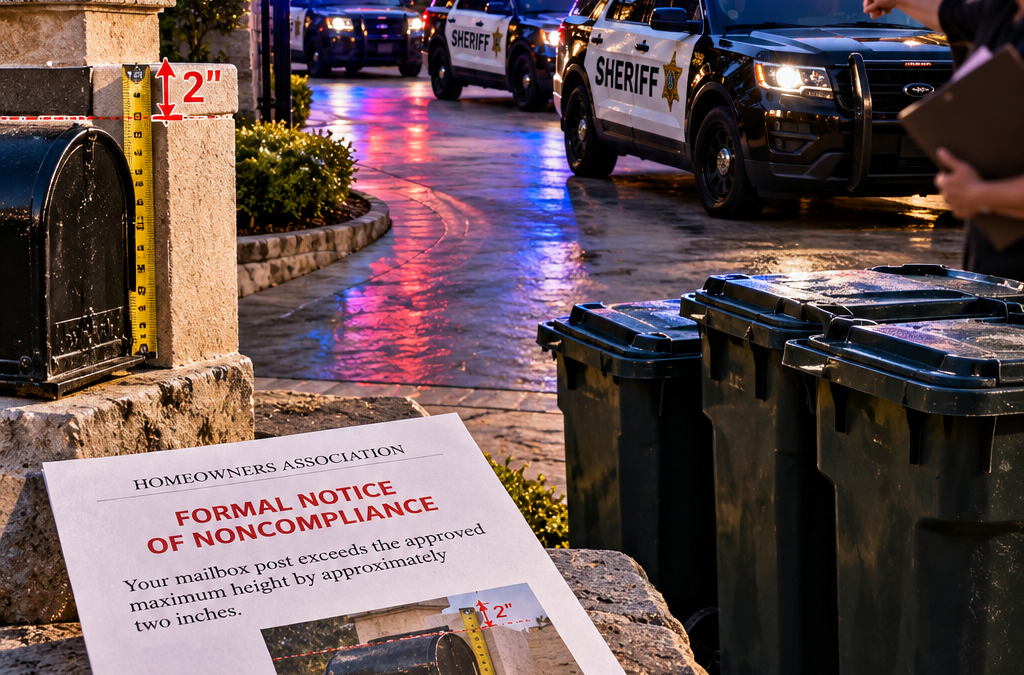
FORMAL NOTICE OF NONCOMPLIANCE.
My mailbox post exceeded the approved maximum height by approximately two inches.
I actually laughed.
Not because I thought I was above the rules.
It was just difficult to imagine someone measuring mailbox posts closely enough to discover a two-inch discrepancy.
Still, I wanted a quiet life.
That Saturday, I pulled the post, cut it down, reset the box, took a photograph, and sent it to the HOA management address.
Problem solved.
Or so I thought.
Two weeks later, another notice appeared.
My trash bins had remained visible from the street for approximately ninety minutes beyond the permitted collection window.
I stared at the letter.
Ninety minutes.
Trash had been collected while I was working.
I brought the containers inside when I got home.
Apparently, somewhere between the sanitation truck arriving and my return, somebody had documented exactly how long the bins remained outside.
Again, I complied.
No argument.
Then came the security camera warning.
According to the HOA, one camera mounted near my front gate was “oriented toward shared community airspace.”
I read that phrase three times.
Shared community airspace.
My gate camera faced my own driveway.
The edge of the road could be seen in the background because roads tend to exist near driveways.
I adjusted it slightly anyway.
Then came the gate.
Matte black, apparently, was unacceptable.
The approved finish was satin black.
I wish I were exaggerating.
The gate had already existed when I purchased the estate.
It had passed inspection during the sale.
Nobody had objected for years.
But Diane had apparently decided the finish did not reflect the current architectural standard.
The difference between matte black and satin black was almost impossible to see unless direct sunlight struck the metal at a particular angle.
Still, I hired a contractor.
He looked at me as though I were insane when I explained why.
“You want me to repaint all of this?”
“Apparently.”
He rubbed the gate with his thumb.
“There’s nothing wrong with this finish.”
“I know.”
“HOA?”
I nodded.
He laughed.
“Say no more.”
I paid him.
The gate was refinished.
That should have satisfied anyone genuinely interested in compliance.
Instead, the notices became more frequent.
One concerned ornamental lighting near my driveway.
Another questioned the location of a portable basketball hoop that had been left outside for less than a day after my nephew visited.
Another warned that a contractor’s vehicle had remained in the driveway beyond “normal service hours.”
The contractor had been repairing a plumbing leak.
Then I received a letter claiming vegetation along my rear property line might be obstructing a “community sightline.”
The rear of my property faced woods.
There was no community sightline.
There wasn’t even a neighboring house close enough to see.
I started keeping the letters.
At first in a kitchen drawer.
Then in a folder.
Then in a binder.
By month six, the binder was thick enough that I stopped finding any of it funny.
The violations weren’t serious.
That was exactly what made them disturbing.
Diane seemed to be searching for technicalities.
And every time I corrected one without argument, she found another.
It was as if compliance disappointed her.
I began to suspect she didn’t actually want me to follow the rules.
She wanted resistance.
She wanted the confrontation.
Frank was the first person who said it out loud.
He lived three properties down from me and had been in the neighborhood for nearly thirty years, long before the landscaping matured and property values climbed.
He was a widower in his seventies with a dry sense of humor and the habit of walking his old Labrador past my gate every morning.
One Saturday, he stopped while I was checking the mail.
“You’re keeping Diane busy.”
I looked at him.
“Apparently my existence requires constant supervision.”
He laughed.
“How many letters?”
“Eleven.”
His smile vanished.
“Eleven?”
“In six months.”
“For what?”
I started listing them.
By the time I got to the gate finish, Frank shook his head.
“She’s building a record.”
I had already thought the same thing.
“Why?”
“That’s the question.”
“You’ve known her a long time.”
“Unfortunately.”
He leaned against the stone mailbox pillar.
“Diane needs people in categories. Supporter. Problem. Useful. Enemy. She doesn’t do neutral very well.”
“What category am I?”
“You’re worse.”
“What’s worse than enemy?”
“Mystery.”
I almost smiled.
He didn’t.
“She doesn’t know what you do.”
“That’s because it isn’t her business.”
“Exactly.”
Frank looked toward the house behind the gates.
“Big house. Private person. No parties. No gossip. You don’t attend her little social things. You don’t explain yourself.”
“And that’s enough?”
“For Diane?”
He shrugged.
“Sometimes.”
I should have dismissed the conversation.
Instead, a few weeks later, I saw what Frank meant.
The monthly HOA meeting was held in a small community building near the subdivision entrance.
I rarely attended because the published agendas were usually dominated by landscaping contracts, reserve funds, gate maintenance, and complaints about delivery trucks.
That month, however, I went.
I took a seat in the back.
Diane was already at the front arranging papers.
She noticed me almost immediately.
I watched her expression change.
Not fear.
Not surprise.
Annoyance.
The meeting went through routine business.
Then Diane introduced a section she called “community safety concerns.”
She didn’t use my name.
She didn’t have to.
“We have received questions,” she said, “regarding certain properties displaying unusual security measures and a concerning lack of transparency.”
A few people shifted in their chairs.
Diane continued.
“While every homeowner has a right to privacy, privacy should not become secrecy where neighborhood safety is involved.”
I sat still.
One board member beside her glanced sideways.
He looked uncomfortable.
Diane went on.
“Some residents have expressed concern about extensive surveillance equipment, restricted access, and unknown activity occurring behind private gates.”
Unknown activity.
I owned a house.
I went to work.
I came home.
Sometimes I grilled steaks.
Apparently this required investigation.
A woman in the front row asked, “Is there an actual complaint?”
Diane smiled.
“We are simply encouraging openness.”
I raised my hand.
Her expression tightened.
“Yes?”
“What property are you talking about?”
She paused.
“I didn’t identify a particular property.”
“Then what security concern are you asking the neighborhood to discuss?”
“This isn’t a debate.”
“I’m not debating. I’m asking whether you’ve received a report of illegal activity.”
She straightened.
“Nobody used the word illegal.”
“You used the words concerning activity.”
“Security can involve more than criminal behavior.”
“So what behavior are you referring to?”
The room became very quiet.
Diane looked at me.
Then she gave that same practiced smile I would later see in my driveway when the patrol cars arrived.
“If you feel personally targeted by a general safety discussion, perhaps you should ask yourself why.”
There it was.
A trap disguised as a question.
If I defended myself, I looked defensive.
If I stayed silent, she could imply guilt.
I smiled.
“No. I think I’ll ask you why.”
The meeting moved on quickly after that.
Two days later, Frank knocked on my door.
He held his phone.
“I probably shouldn’t show you this.”
“Then why are you here?”
“Because she’s crossed a line.”
He handed me the phone.
It was a neighborhood group chat.
I wasn’t part of it.
Diane was.
The messages went back weeks.
At first, they were ordinary.
Lost dog.
Road maintenance.
Pool repairs.
Then my address started appearing.
Diane had written:
Has anyone noticed how many cameras he has?
Another message:
Does anyone actually know what he does for a living?
Another:
I think parents should be cautious about allowing children near that property until we know more.
I read that one twice.
“What exactly are children supposed to be afraid of?”
Frank sighed.
“Keep reading.”
There were more.
Diane speculated that the estate might be used for “business activities not disclosed to the association.”
She suggested my privacy was “abnormal.”
She asked whether anyone had noticed deliveries.
She wondered whether my gate was designed to prevent “community oversight.”
Community oversight.
I looked at Frank.
“She wants access to my property.”
“She wants control.”
“Has she done this to other people?”
“Not like this.”
I handed back the phone.
“Why me?”
Frank hesitated.
“I think because you don’t react.”
“That makes no sense.”
“It does to someone like her.”
He slipped the phone into his pocket.
“Every time she pushes, you fix the tiny violation and go back to ignoring her. She can’t make you angry in public. She can’t make you apologize. She can’t make you explain who you are.”
“So she’s escalating.”
“Yes.”
Frank looked toward my gate.
“And I don’t think she’s finished.”
He was right.
By month eight, Diane stopped relying on letters.
She began appearing in person.
The first time, I was working in my home office when the intercom buzzed.
I checked the gate camera.
Diane stood outside with her golf cart parked partly across my driveway.
Clipboard in hand.
I pressed the speaker.
“Can I help you?”
“I need access.”
“For what?”
“Inspection.”
“What are you inspecting?”
“Exterior compliance.”
“You can see the exterior from where you’re standing.”
“I need to verify conditions inside the gate.”
“No.”
There was a pause.
“No?”
“No.”
“I am the HOA president.”
“I’m aware.”
“The association has inspection authority.”
“Send me the relevant provision and a written request.”
“This is the request.”
“No. This is you arriving unannounced at my gate.”
Her face hardened.
“Homeowners who cooperate generally find these matters much easier.”
“I have cooperated with every legitimate written notice you’ve sent.”
“Then open the gate.”
“No.”
She stared directly into the camera.
“You’re creating unnecessary suspicion.”
I almost admired the audacity.
“You came to my home demanding entry and I’m suspicious because I won’t let you in?”
“I’m documenting your refusal.”
“Please do.”
I ended the call.
For the next fifteen minutes, she stood outside taking photographs.
My gate.
My landscaping.
My camera.
Even the intercom panel.
Then she left.
The next week she returned.
Then again.
Sometimes she brought another board member.
Sometimes she came alone.
Once I found her golf cart stopped near the side boundary of my property while she photographed the house through the trees.
Another time, she stood outside the gate narrating into her phone.
“Large surveillance camera positioned toward roadway…”
“Security gate remains visually inconsistent…”
“Homeowner continues restrictive access…”
She spoke as though preparing evidence for a criminal trial.
I began saving every camera recording.
My binder became two binders.
Frank continued forwarding screenshots when Diane’s group chat became particularly ugly.
I disliked being the subject of gossip.
But what bothered me more was the way she framed ordinary privacy as evidence of wrongdoing.
She never said, “I don’t like him.”
She said, “We should ask questions.”
She never said, “I want access to his property.”
She said, “The community deserves transparency.”
She never accused me directly of committing a crime.
She simply placed suspicion in front of people and allowed them to imagine the rest.
That strategy worked on some neighbors.
A few stopped waving.
One mother who used to walk past with her children began crossing the street near my gate.
A contractor told me someone had asked him what kind of work he was doing inside my property.
Another neighbor casually asked whether I “worked for the government.”
I asked why.
He became embarrassed and changed the subject.
For the first time since buying the estate, my privacy no longer felt peaceful.
It felt defensive.
Every black camera on the house looked like something I had to justify.
Every closed gate became evidence in Diane’s story.
I considered moving.
I am not proud of that.
The rational part of me knew leaving would reward her.
The tired part didn’t care.
I had worked twenty years for the ability to come home and breathe.
Now I drove through my own gates wondering which ordinary thing Diane would convert into the next accusation.
One evening Frank came by with his dog.
We sat on the front steps.
“I heard you’re thinking about selling.”
“Who told you?”
“You asked someone about current values.”
I laughed.
“Nothing stays private here.”
“Not with Diane around.”
I looked across the lawn.
“Maybe it’s not worth it.”
Frank was quiet.
Then he said, “That’s how she wins.”
“I don’t care about winning.”
“You should.”
“Why?”
“Because you’re not the first person she’s done this to.”
That got my attention.
He told me about a family who had lived near the entrance several years earlier.
The father had challenged Diane over landscaping fines.
According to Frank, she began citing them repeatedly afterward.
Noise.
Parking.
A basketball goal.
A shed.
They eventually sold.
Another homeowner challenged a board decision about a fence.
Suddenly every visible feature of his property became subject to review.
“He called it selective enforcement,” Frank said.
“What happened?”
“He moved too.”
I looked at him.
“You think she wants me gone?”
“I think she wants you submissive.”
That was worse.
The harassment continued.
And then, several months before everything exploded, I attended a community safety event organized by the county sheriff’s department.
I didn’t go because of Diane.
It was open to several neighborhoods in the area, and Frank had mentioned there would be information about burglary prevention and emergency response.
I attended mostly because I had recently upgraded some exterior security equipment and wanted to understand how law enforcement recommended residents document suspicious activity.
The event was held at a local civic center.
Maybe fifty people showed up.
Deputies spoke about vehicle theft, home burglaries, emergency calls, and neighborhood watch programs.
Afterward, I had a short conversation with one deputy.
Ten minutes at most.
We talked about camera positioning.
He explained what types of footage were most useful during investigations.
I asked about equipment needs because the department had recently announced a community funding initiative.
I had already planned to contribute anonymously to a program helping purchase updated emergency equipment.
The deputy recognized the project and thanked me for supporting it.
That was all.
There was no special relationship.
No favors.
No promise of special treatment.
I certainly didn’t walk away thinking the conversation would ever matter again.
But months later, when Diane called deputies to my house, that brief interaction would stop her from controlling one very important thing:
The first impression.
She had spent more than a year telling anyone who would listen that I was suspicious.
That I was hiding something.
That my privacy was dangerous.
When the deputy stepped from his cruiser, he didn’t see the mysterious man Diane had described.
He saw someone he had already met in an ordinary civic setting.
And Diane had no idea.
Her obsession reached its breaking point on a Tuesday evening.
I had stopped at a grocery store on the way home.
When I pulled through the gates, I noticed Diane’s golf cart parked farther down the road.
I ignored it.
I backed my SUV near the garage and started unloading.
Two bags into the house, I heard the electric whine of the golf cart approaching.
I kept walking.
“Dana!”
I stopped.
Diane pulled into my driveway.
She shouldn’t have been inside the gates.
I realized I had left them open while unloading groceries.
She had taken the opportunity immediately.
“Diane, leave.”
She climbed out.
Her face was flushed.
Phone in one hand.
Clipboard in the other.
“I’m done.”
“Good. Then leave.”
“I’m done with your attitude.”
“I didn’t invite you onto my property.”
“I’m the HOA president.”
“That doesn’t make this property yours.”
She pointed toward the house.
“I know something is happening in there.”
I stared at her.
“Groceries are happening.”
“Don’t be cute.”
“I’m not.”
She stepped closer.
“For eighteen months you have refused to be transparent with this community.”
“Transparent about what?”
“Your activities.”
“What activities?”
“Exactly.”
I genuinely laughed.
That infuriated her.
“You think this is funny?”
“I think you came through my private gate because you saw it open and are now demanding that I explain what I do inside my own house.”
“People are concerned.”
“You are concerned.”
“People talk to me.”
“You talk at people until they become concerned.”
Her face went red.
“You have cameras everywhere.”
“For security.”
“You keep people out.”
“That’s what gates do.”
“Nobody knows what you do.”
“Correct.”
“Why?”
“Because my job isn’t HOA business.”
“What are you hiding?”
“Nothing.”
“Then tell me.”
“No.”
That single word hit her harder than anything else I could have said.
Her expression changed.
I could see years of frustration in it.
Every violation she had sent.
Every photograph she had taken.
Every rumor she had started.
Every attempt to make me defend myself.
And still I was standing there telling her no.
She raised her phone.
“I’m going to prove there’s something wrong here.”
“How?”
“I’ll call the authorities.”
I almost shrugged.
“Go ahead.”
The moment the words left my mouth, she smiled.
It wasn’t a normal smile.
It was satisfaction.
As if I had finally stepped into the trap she’d been building.
“You think I won’t?”
“I think if you believe a crime is happening, you should call law enforcement.”
“Oh, I do.”
“Then call.”
She unlocked her phone.
I assumed she might contact the non-emergency number.
She dialed 911.
Right there in my driveway.
I heard the dispatcher answer.
Diane’s voice changed instantly.
Calm.
Urgent.
Concerned.
“I’m calling about a suspicious individual in our neighborhood.”
I stared at her.
She looked directly at me while she spoke.
“Yes. He’s refusing to explain what he’s doing at the property.”
The dispatcher said something.
Diane continued.
“It’s a very large estate. There are cameras everywhere. He’s extremely evasive.”
I shook my head.
“Diane.”
She turned away so she could keep talking.
“I believe there may be illegal activity.”
That was different.
The word illegal changed the entire situation.
I stepped closer.
“What crime?”
She ignored me.
“No, I haven’t personally been inside.”
A pause.
“Because he refuses access.”
Another pause.
“No, I haven’t seen a weapon.”
Another.
“No, nobody has been physically harmed.”
Her answers were dismantling her own story one question at a time.
But she kept going.
“He won’t tell me what he does.”
I could hear the dispatcher’s voice faintly.
Diane’s face tightened.
“I’m the homeowners association president.”
Apparently, the dispatcher had asked why that mattered.
She finally ended the call.
I looked at her.
“What exactly did you report?”
“I reported suspicious activity.”
“What activity?”
“Your behavior.”
“Standing in my driveway unloading groceries?”
“Your entire pattern.”
“Being private isn’t a crime.”
“We’ll see.”
That sentence told me everything.
This wasn’t about safety.
She wanted uniforms.
Authority greater than hers.
She wanted someone with a badge to arrive and validate everything she had been saying about me.
She wanted neighbors watching.
She wanted humiliation.
Most of all, she wanted me forced to submit in front of her.
I closed the rear door of my SUV.
“Leave my property.”
“I’m staying until they arrive.”
“No.”
“You can’t remove me while there’s an active police matter.”
I stared at her.
“You created the police matter.”
“I’m preserving the scene.”
I almost laughed again.
Instead, I walked to the gate control panel and closed the gates.
Then I called the sheriff’s department non-emergency line myself.
I explained that a woman identifying herself as my HOA president had called 911 from my private property alleging unspecified suspicious activity.
I told them I was the homeowner.
I told them she had entered through an open gate without permission.
I said I would cooperate fully with responding deputies.
Then I waited.
Twenty minutes later, blue light flashed through the trees.
One sheriff’s SUV appeared.
Then a second.
Then a third.
Diane saw them before I did.
Her whole posture changed.
She straightened her blouse.
Smoothed her hair.
Walked toward the center of the driveway.
For the first time all evening, she looked happy.
The first vehicle rolled to a stop.
Before the deputy had even fully opened his door, Diane rushed toward him.
“Thank God you’re here.”
The deputy stepped out.
Diane pointed her manicured finger toward my front door.
“Get him out of here now.”
I stood beside my SUV.
She continued before the deputy could respond.
“I want him removed from this property. He’s been intimidating the entire neighborhood for months.”
The deputy looked toward the house.
Then toward me.
His expression changed.
Recognition.
He smiled slightly.
“Good evening, sir.”
Diane stopped speaking.
The deputy walked past her and extended his hand.
“Good to see you again.”
I shook it.
“You too.”
Diane’s mouth opened.
Nothing came out.
It was the same deputy from the community safety event.
The interaction lasted only seconds.
But those seconds changed the atmosphere completely.
Not because I suddenly had special protection.
I didn’t.
He still had a job to do.
If Diane had reported an actual crime, he would have investigated it.
The difference was that her story had depended on presenting me as an unknown, suspicious stranger whose mere existence should frighten everyone.
That illusion died before she could finish her first sentence.
The deputy stepped back.
“Okay. Let’s start over.”
Diane found her voice.
“This man has been refusing to cooperate with the HOA for over a year.”
The deputy looked at her.
“That’s a civil matter.”
“It’s more than that.”
“What crime are you reporting?”
“The cameras.”
“What about them?”
“They’re excessive.”
“Is it illegal for him to have cameras?”
She hesitated.
“I don’t know, but—”
“What crime did you personally witness?”
“He’s secretive.”
“Ma’am, being private isn’t a crime.”
Her face reddened.
“You don’t understand. Nobody knows what happens inside that house.”
The deputy looked toward the house.
“Do you have evidence of illegal activity inside?”
“No, because he won’t let anyone in.”
“That’s his house.”
“He lives in an HOA.”
“That does not give you general authority to enter his residence.”
Diane crossed her arms.
“You don’t understand how difficult he’s been.”
The deputy remained calm.
“I’m trying to understand why you called 911.”
“He has refused inspections.”
“Was someone in immediate danger?”
“No.”
“Did you witness a crime?”
“I told you, he’s suspicious.”
“Suspicion of what specifically?”
She looked at me.
Then back at him.
“Cameras. Gates. Deliveries. Contractors. Nobody knows what he does professionally.”
One of the other deputies looked away.
Not dramatically.
But I saw his jaw tighten as though he were resisting a reaction.
The first deputy asked, “Did he threaten you tonight?”
“No.”
“Did he prevent you from leaving?”
“No.”
“Did he display a weapon?”
“No.”
“Did you see illegal contraband?”
“No.”
“Did you hear anyone asking for help?”
“No.”
“Did you observe forced entry, theft, assault, property damage, or any other offense?”
“No, but that’s not the point.”
“It is exactly the point.”
Diane looked stunned.
She had spent eleven years operating in a world where declaring something a violation usually made it one.
Now she was speaking to someone whose authority depended on facts.
She tried a different angle.
“I am the president of this homeowners association.”
The deputy nodded.
“That doesn’t expand criminal law.”
“This man has repeatedly defied board authority.”
“Then use whatever lawful civil process your governing documents provide.”
“He won’t cooperate.”
“With what?”
“Transparency.”
The deputy paused.
“Ma’am, homeowners aren’t required to explain their careers or private activities to their HOA president.”
Her face changed again.
I saw something close to panic.
Not fear of arrest.
Fear of losing control of the narrative.
She turned toward me.
“Tell him about all your cameras.”
“I already told him I have security cameras.”
“Tell him why.”
“For security.”
“See?”
The deputy looked at her.
“That’s a normal answer.”
“You know him.”
The accusation came suddenly.
Everyone went quiet.
Diane pointed between us.
“You know him.”
“We’ve met before.”
Her expression hardened.
“Of course.”
The deputy’s tone changed.
“Careful.”
“I’m just saying this suddenly makes sense.”
“No, ma’am. What makes sense is that we responded to your emergency call, and so far you’ve been unable to identify an emergency or a crime.”
“I want another deputy.”
“There are two standing behind me.”
That silenced her.
For the first time since the patrol cars arrived, I almost felt sorry for her.
Almost.
Then she looked toward my front door and said, “I want the house searched.”
The deputy stared at her.
“On what basis?”
“Suspicion.”
“Whose?”
“Mine.”
“That isn’t enough.”
“He refuses to explain himself.”
“Still not enough.”
“I am telling you there is something wrong.”
“And I’m asking for evidence.”
“I don’t need evidence to be concerned.”
“You need more than concern for me to search someone’s home.”
Her shoulders dropped slightly.
The battle she had imagined wasn’t happening.
There would be no dramatic escort.
No handcuffs.
No deputies marching through my house while she watched.
No neighbors whispering that Diane had finally exposed me.
Instead, the questions were turning toward her.
The deputy pulled out a small notebook.
“Let’s go back to the call.”
Diane’s eyes narrowed.
“What about it?”
“You told dispatch you believed illegal activity was occurring.”
“I do.”
“Based on what?”
“Everything I’ve explained.”
“Which is cameras, a gate, privacy, and the fact that you don’t know his occupation.”
“And his refusal to cooperate.”
“That’s not evidence of a crime.”
The deputy started writing.
“What are you writing?”
“My report.”
Her face lost color.
“Why?”
“Because we document calls.”
“This doesn’t need a report.”
“You called 911 and three units responded.”
“I was acting as HOA president.”
“That doesn’t change how emergency calls are documented.”
She stared at the notebook.
For perhaps the first time that evening, Diane seemed to understand that official documentation worked both ways.
She loved records when she controlled them.
Violation notices.
Photographs.
Meeting minutes.
Compliance files.
Screenshots.
Now someone else was making a record.
And she couldn’t edit it.
The deputy asked whether she had previously called law enforcement regarding me.
No.
Whether anyone else had reported criminal conduct at the property.
Not that she knew of.
Whether she had evidence beyond personal suspicion.
No.
Whether I had asked her to leave before she called.
Diane hesitated.
I answered.
“Several times.”
The deputy looked at her.
“Is that true?”
“I was conducting HOA business.”
“Were you invited onto the property?”
“The gate was open.”
“That’s not what I asked.”
Her mouth tightened.
“No.”
“Did he ask you to leave?”
“He was being hostile.”
“Did he ask you to leave?”
“Yes.”
The deputy wrote again.
Then he looked at me.
“Do you want her off your property?”
“Yes.”
Diane spun toward him.
“This is ridiculous.”
The deputy gestured toward her golf cart.
“Ma’am, the homeowner has asked you to leave. Unless you have some legal authority allowing you to remain here, you need to go.”
“I am the HOA president.”
“We’ve covered that.”
Diane looked at me with pure hatred.
Not irritation.
Not frustration.
Hatred.
“You planned this.”
I almost didn’t understand the accusation.
“Planned what?”
“You knew them.”
“I met one deputy at a public safety event months ago.”
“You set me up.”
“You called 911.”
Her lips pressed together.
“You’ve been waiting for this.”
“No, Diane. For eighteen months I’ve been waiting for you to leave me alone.”
The deputy stepped slightly between us.
“That’s enough.”
Diane turned toward her golf cart.
Then stopped.
“What happens now?”
The deputy looked at his notes.
“A report will be completed regarding the call.”
“Am I being charged?”
“I’m not making that determination here.”
She visibly relaxed.
He continued.
“But emergency services aren’t a tool for settling HOA disputes. Future calls need to be based on actual emergencies or articulable criminal conduct.”
Her relief disappeared.
The distinction mattered.
The deputies weren’t putting Diane in handcuffs.
They weren’t making some dramatic roadside arrest.
Reality was less theatrical and, in some ways, more damaging.
They were creating a neutral public record documenting exactly what she had done.
And Diane had provided most of the evidence herself.
One deputy walked her to the golf cart.
Another stayed with me.
He asked whether I had recordings from the driveway.
I pointed toward the camera above the garage.
“Audio too.”
“Save it.”
“I already do.”
He smiled.
“I remember.”
That was the only reference he made to our previous safety conversation.
Then his expression became serious.
“Document everything.”
“I have eighteen months of everything.”
“Good.”
After the patrol cars left, I stood alone in the driveway.
The silence felt strange.
For eighteen months, Diane had been escalating.
I had always wondered where it would end.
That night, for the first time, I understood that she had finally escalated beyond the boundaries of her own little system.
Inside the HOA, Diane could influence letters.
Meetings.
Fines.
Inspections.
Neighbors.
But she couldn’t control a sheriff’s report.
She couldn’t rewrite dispatch recordings.
She couldn’t change my security footage.
She couldn’t turn “I don’t know what he does for a living” into probable cause simply by repeating it louder.
The next morning, Frank called.
“What happened?”
“How do you know something happened?”
“Three sheriff’s cars drove through the neighborhood with lights on. Diane’s group chat is melting down.”
I sat at the kitchen counter.
“She called 911 on me.”
There was a long silence.
“For what?”
“Existing suspiciously.”
“I’m serious.”
“So am I.”
I explained.
When I finished, Frank let out a slow breath.
“She’s finished.”
“I don’t know about that.”
“I do.”
He was closer to the truth than I realized.
By noon, neighbors were asking questions.
Not about me.
About Diane.
Why had she called emergency services?
What crime had she witnessed?
Why were three units sent?
Why had she entered my gated property?
Why had she told people law enforcement was “investigating” me when the deputies had apparently left without taking any action against me?
That last question mattered because Diane made one final mistake.
She tried to control the story afterward.
She posted in the neighborhood group chat that law enforcement had “responded to ongoing safety concerns involving a noncooperative resident.”
Frank sent me the screenshot.
Her wording made it sound as though deputies had validated her complaint.
So I did something I had avoided for eighteen months.
I responded publicly.
Not emotionally.
Not with insults.
I wrote four sentences.
I explained that Diane had entered my property without invitation, called 911 alleging unspecified illegal activity, and that responding deputies found no evidence of a crime.
I stated that I had asked her to leave.
I added that the entire interaction was recorded.
Then I stopped.
No accusations.
No threats.
No long explanation.
The word recorded did everything else.
Within an hour, people started asking Diane to clarify her version.
She deleted her post.
That made things worse.
Frank wasn’t the only neighbor who had grown tired of her.
People started talking.
Years of stories surfaced.
Selective fines.
Aggressive inspections.
Threatening messages.
Retaliation after disagreements.
Rules enforced against one homeowner but ignored for another.
A widow who had been threatened with collections over a minor landscaping dispute.
A young family fined repeatedly after questioning a board expense.
A retired couple who had received violation notices within days of criticizing Diane at a meeting.
Individually, every story had seemed small.
Together, they looked like a pattern.
An emergency HOA meeting was requested.
Diane opposed it.
Homeowners had enough support to force one under the governing documents.
For once, someone else had read the rules more carefully than she had.
The meeting room was packed.
I almost didn’t attend.
Frank insisted.
“You need to hear this.”
“I’ve heard enough Diane for one lifetime.”
“This isn’t about Diane talking.”
So I went.
She sat at the front table.
No golf cart.
No clipboard.
No sunglasses.
Just a stack of papers and a face that looked ten years older than it had a month earlier.
Residents spoke one after another.
Not yelling.
That was what made it powerful.
The widow described threatening letters she had received.
The young father talked about repeated fines after challenging a board decision.
Another homeowner presented dates showing enforcement suddenly intensified after he disagreed with Diane.
Frank spoke about the group chat.
Then someone asked about me.
Diane stiffened.
“I will not discuss an ongoing safety matter.”
I stood.
“There is no ongoing safety matter.”
The room went quiet.
Diane glared at me.
I continued.
“You called emergency services. Deputies responded. They asked you repeatedly what crime you had witnessed. You identified none.”
“That’s your interpretation.”
“No. It’s recorded.”
She looked toward the board attorney.
He said nothing.
I didn’t play the footage.
I didn’t need to.
The possibility that I could was enough.
Another resident stood.
“Did the deputies search his house?”
Diane didn’t answer.
“Was he arrested?”
Silence.
“Was he cited?”
Nothing.
Someone else asked, “Were you cited?”
Diane snapped.
“No.”
The room murmured.
Then Frank asked the question that ended her presidency.
“Why did you tell this neighborhood for months that he was dangerous when you had no evidence he’d done anything?”
Diane looked at me.
Not Frank.
Me.
“Because responsible people don’t hide everything.”
I felt something inside me finally go quiet.
For eighteen months, I had wondered whether there was some forgotten interaction that triggered her obsession.
Some misunderstood remark.
Some violation I had taken too lightly.
Some reason.
There wasn’t.
She had just said it.
I was private.
She couldn’t stand it.
She believed my refusal to explain myself was an offense.
Worse, she believed her position entitled her to answers.
The vote to remove her from the presidency wasn’t close.
Within the month, Diane was formally removed from the board altogether.
The report from the 911 incident remained part of the sheriff’s department’s records.
There were discussions about whether her conduct could support additional consequences related to misuse of emergency services or false reporting, but I never built my life around hoping she would be criminally charged.
I didn’t need revenge.
The truth had done enough.
Diane lost the one thing she valued most.
Authority.
She could still live in the neighborhood.
She could still have opinions.
She could still dislike me.
But she could no longer print those opinions on HOA letterhead and make them look like law.
The new board reviewed several years of enforcement practices.
Some fines were reconsidered.
Inspection procedures were tightened.
Individual board members could no longer conduct surprise “compliance visits” alone.
Complaints involving alleged criminal activity were to be referred to actual law enforcement based on evidence, not gossip.
Most importantly, the HOA president became exactly what the position was supposed to be.
A volunteer administrator.
Not a ruler.
My life became quiet again slowly.
At first, every golf cart motor made me look toward the gate.
Every HOA envelope made my stomach tighten.
That reaction lasted longer than I expected.
People tend to think harassment only matters when something dramatic happens.
A broken window.
A physical threat.
A lawsuit.
But sometimes the damage is quieter.
It is the slow destruction of comfort.
The feeling that someone is always watching for the next technical mistake.
The hesitation before opening your mailbox.
The instinct to check cameras because a particular vehicle passed your house.
The realization that your own home no longer feels private because someone in a position of petty authority has decided privacy itself is suspicious.
It took time to lose that feeling.
Frank helped.
So did ordinary neighbors.
People started waving again.
The mother who had been crossing the street apologized one afternoon.
“Diane told us there had been police concerns about your house.”
“There weren’t.”
“I know that now.”
She looked embarrassed.
“I’m sorry.”
I appreciated that more than she probably realized.
Another neighbor admitted Diane had once told him my business activities were “under review.”
“They never were,” I said.
“I figured that out.”
We both laughed.
Even the gate became funny eventually.
After everything Diane had done over its finish, I noticed sunlight hitting the metal one afternoon and realized the contractor’s supposed satin-black repaint still looked almost completely matte.
I called him.
“Remember my HOA gate?”
He laughed immediately.
“Unfortunately.”
“I think it’s still matte.”
“Want me to fix it?”
I looked toward the road.
“No.”
The gate stayed exactly as it was.
Not as a statement.
Not as rebellion.
Because I no longer cared.
That was the real end of Diane’s power over me.
Not the board vote.
Not the sheriff’s report.
Not the neighborhood turning against her.
It was the day I stopped mentally asking whether she would approve of something.
Months after the incident, I saw the deputy again.
He was fueling his patrol vehicle at a station near town.
He recognized me.
“Everything quiet?”
“Very.”
“Good.”
I thanked him for how professionally he had handled the call.
He shook his head.
“We responded to the facts.”
That sentence mattered.
He hadn’t defended me because we had met before.
He hadn’t defended me because I had supported a department program.
He had done what law enforcement was supposed to do.
He asked for evidence.
Diane didn’t have any.
That was all.
For months afterward, people retold the story as though the deputy recognizing me had magically destroyed Diane.
It didn’t.
Recognition simply denied her the advantage of defining me before I spoke.
What destroyed her credibility was everything she said after that.
She accused without evidence.
She demanded a search without cause.
She admitted there was no threat.
No weapon.
No victim.
No crime she could name.
She revealed that her entire suspicion came from cameras, gates, privacy, and the fact that I wouldn’t tell her what I did for a living.
She had called three sheriff’s vehicles because a homeowner had refused to satisfy her curiosity.
Nobody did that to Diane.
Diane did it to herself.
Frank still walks past my gate most mornings.
His Labrador is older now.
Slower.
Sometimes Frank stops and we talk.
One morning he looked at the house and said, “Funny thing.”
“What?”
“Everybody knows what you do now?”
“No.”
“Exactly.”
I smiled.
He was right.
After all of it, most of the neighborhood still didn’t know the details of my career.
Because they didn’t need to.
I paid my dues.
I maintained my property.
I obeyed legitimate rules.
I treated people respectfully.
That was all the community was entitled to.
Diane had spent eighteen months trying to prove that privacy was evidence.
In the end, she proved something else.
Suspicion isn’t evidence.
A title isn’t unlimited authority.
And the loudest person in a neighborhood doesn’t get to turn curiosity into probable cause.
The estate is still mine.
The cameras are still there.
The iron gates still close every night.
The house is still quiet.
And when blue lights occasionally pass the entrance now, they keep driving.
No one points at my front door.
No one demands that I be removed from my own property.
No one asks me to explain why I value privacy.
Sometimes, standing at the end of the driveway, I think back to that Tuesday evening.
Diane in her golf cart.
Phone in her hand.
Three patrol vehicles behind her.
Her finger pointed toward the house I had spent twenty years working for.
She looked absolutely certain.
Certain the uniforms were there for her.
Certain authority would automatically take her side.
Certain that if she said “suspicious” loudly enough, somebody would finally force me to answer all the questions I had refused to answer for eighteen months.
Then the deputy stepped from the cruiser.
He looked past her.
He recognized me.
And the first crack appeared in the world Diane had built around herself.
The rest didn’t collapse because I was richer than her.
It didn’t collapse because I knew a deputy.
It didn’t collapse because I had a large house, expensive cameras, or better lawyers.
It collapsed because, for the first time, Diane had taken her accusations somewhere that required evidence.
And she had none.





