𝗙𝗨𝗟𝗟 𝗦𝗧𝗢𝗥𝗬 The HOA Posted a Squatter Notice on My Family’s 100-Year-Old Fence and Claimed the Only Road to My Farm Belonged to Them
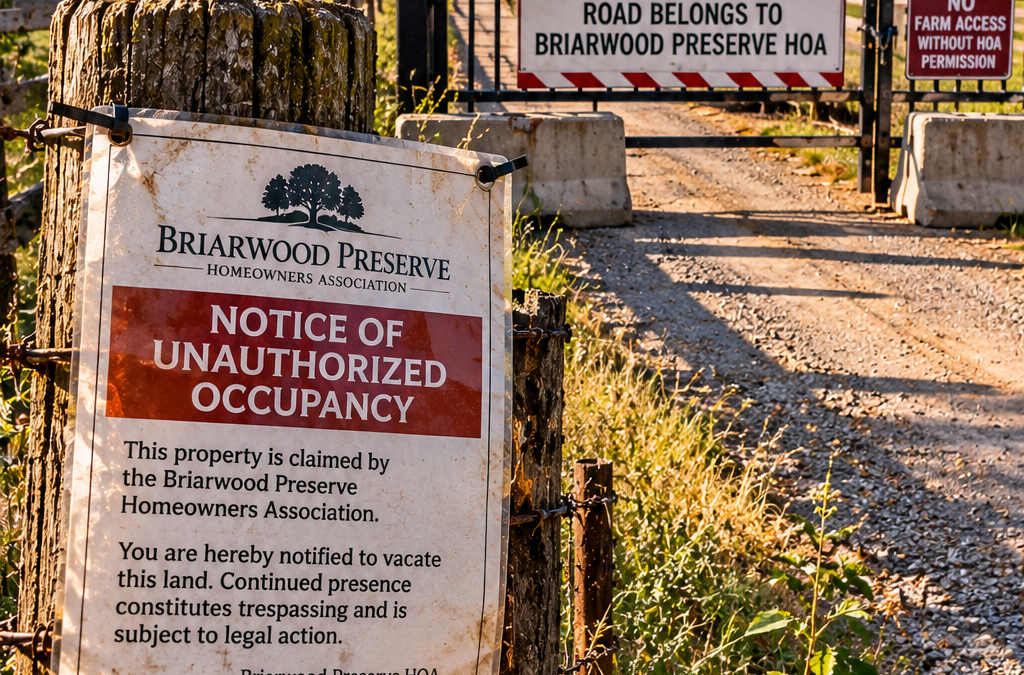
𝗙𝗨𝗟𝗟 𝗦𝗧𝗢𝗥𝗬
They called the development Briarwood Preserve.
There wasn’t much preserved about it.
The first thing they did was cut down nearly everything.
Then they replanted young trees between sidewalks and installed a monument sign tall enough to announce to passing traffic that people with very expensive landscaping lived behind it.
With the neighborhood came Briarwood Preserve Homeowners Association.
I didn’t care.
Why would I?
Their property was their property.
Mine was mine.
They could regulate mailbox styles, garage doors, fence colors, lawn heights, holiday decorations, trash cans, basketball hoops, and whatever else people voluntarily agreed to regulate when they bought houses inside a planned community.
None of that had anything to do with me.
I farmed.
I repaired equipment.
I cut hay.
I paid county taxes.
I watched their construction traffic come and go.
Occasionally a resident jogged past my property.
Sometimes kids rode bicycles down toward the edge of the farm.
Once a woman stopped beside my fence and asked if my cows were “part of the development’s rural aesthetic.”
I told her no.
The cows seemed relieved.
For six years, that was the extent of our relationship.
I knew an HOA existed.
I assumed they knew I wasn’t part of it.
What I didn’t know was that somewhere in their office, someone had drawn a map.
And on that map, eleven acres of land my family had owned since 1924 had quietly disappeared.
I found out on a Tuesday morning.
I had gone down to check fencing along the northern pasture after a storm.
One section of wire had sagged, and I suspected a fallen branch.
Instead, I found a laminated sheet attached to the oldest fence line on the property.
It had been secured with two plastic zip ties.
The header read:
BRIARWOOD PRESERVE HOMEOWNERS ASSOCIATION
NOTICE OF UNAUTHORIZED OCCUPANCY
I stood there for several seconds.
Then I laughed.
I genuinely laughed.
I assumed some teenager from the subdivision had played a joke.
Then I read the rest.
The notice alleged that structures under my control occupied property inside an association easement corridor.
It identified my farmhouse.
My equipment shed.
Part of the barn.
Several acres of pasture.
And according to the language at the bottom, continued unauthorized occupancy could result in legal removal.
There was another phrase beneath that.
SQUATTER VIOLATION.
The laughter stopped.
I pulled out my phone and photographed the notice.
Then I cut the zip ties.
The fence post it had been attached to was so old that the heartwood had turned almost black.
My great-grandfather had installed that line.
I knew because it matched the original survey boundary, and because my grandfather had preserved several of Samuel’s corner posts when he replaced the rest of the fence decades later.
The absurdity was almost difficult to process.
An organization created six years earlier had stapled a squatter notice to a fence nearly a century old and claimed the man living behind it had no right to be there.
I called the number.
A woman answered on the third ring.
“Briarwood Preserve Property Management.”
“My name is Daniel Whitfield.”
There was a short pause.
“Yes, Mr. Whitfield.”
That pause told me she already knew exactly who I was.
“I’m standing beside a notice someone attached to my fence.”
“Yes.”
“You know about it?”
“I authorized it.”
Her voice was smooth.
Professional.
Almost bored.
“And you are?”
“Carla Benson. Community property manager.”
“Good. Carla, someone made a serious mistake.”
“I understand you’re probably frustrated.”
That sentence irritated me immediately.
Not because it was rude.
Because it was the kind of sentence people use when they’ve already decided they are right and your only remaining role is emotional.
“I’m not frustrated yet.”
I looked at the notice in my hand.
“I’m confused.”
“All right.”
“This says I’m occupying association property.”
“That is correct.”
“No, it isn’t.”
“According to our updated boundary survey, a portion of your residence parcel overlaps with the association’s recorded corridor.”
I almost smiled.
“My residence parcel?”
“Yes.”
“My family has owned this farm since 1924.”
“I’m aware you’ve occupied the property for a considerable period.”
Occupied.
I tightened my grip on the phone.
“I don’t occupy it. I own it.”
“That is the matter currently in dispute.”
“There is no dispute.”
“Mr. Whitfield—”
“I have deeds.”
“I’m sure you do.”
“I have surveys.”
“Then you’ll want to bring them to the hearing.”
I went silent.
“What hearing?”
“The association has scheduled a boundary-compliance hearing for next Thursday.”
“Why would I attend an HOA hearing? I’m not in your HOA.”
“The issue involves association property.”
“No. The issue involves my property and someone in your office who can’t read a county map.”
Her tone changed.
Only slightly.
“The updated survey was prepared professionally.”
“So was mine.”
“Then the hearing is the appropriate place to resolve the conflict.”
I looked across my pasture toward the farmhouse.
The roof was visible above the trees.
My father had replaced that roof.
My mother had planted two dogwoods near the porch.
I had learned to drive a tractor in the field beyond it.
And this woman was speaking as though my family’s presence there was some recent administrative inconvenience.
“Carla.”
“Yes?”
“Who told you those eleven acres belong to Briarwood?”
“The association’s survey establishes the boundary.”
“Who authorized the survey?”
“The board.”
“Who checked the county deed records?”
“I’m not involved in the technical process.”
“Apparently nobody was.”
“Mr. Whitfield, hostile language won’t change the documentation.”
I almost laughed again.
“Hostile?”
“You’ll have an opportunity to present contrary evidence.”
“I shouldn’t need an opportunity to prove I own land I’ve been paying taxes on my entire adult life.”
“That is what the hearing is designed to determine.”
“No.”
I pulled the laminated notice away from my face.
“A county courthouse determines property ownership. Not five people sitting in a subdivision clubhouse.”
There was silence.
Then Carla said, “If you fail to participate, enforcement may proceed without you.”
“Enforcement of what?”
“Removal of unauthorized structures.”
I felt something cold settle into my chest.
“You’re threatening my house.”
“I’m informing you of procedure.”
“My house was built before your neighborhood existed.”
“Age doesn’t determine title.”
Neither does arrogance, I thought.
But I didn’t say it.
Not yet.
“I’ll bring my records.”
“That would be advisable.”
Then she hung up.
For the rest of that morning, I kept replaying the conversation.
Part of me still assumed it would disappear the moment someone competent reviewed the deeds.
Surely no functioning organization could mistake eleven acres.
Not eleven feet.
Not a narrow fence-line disagreement.
Eleven acres.
My farmhouse sat inside the area they claimed.
Part of my barn.
Part of my pasture.
The mistake was too large to survive basic scrutiny.
I underestimated how committed they were to it.
The first certified letter arrived four days later.
DEMAND TO VACATE DISPUTED STRUCTURES.
Thirty days.
Failure to comply could result in legal action seeking removal and possession.
I read the letter at my kitchen table.
My father’s old barn was visible through the window.
The absurdity no longer felt funny.
I called the county assessor.
They confirmed the parcel ID was mine.
I called the tax office.
They confirmed I had paid taxes on the entire acreage.
I located the most recent survey my father had commissioned years earlier.
The disputed eleven acres fell clearly inside the Whitfield tract.
I made copies.
I expected those documents to end the problem.
Instead, Briarwood escalated.
A neighbor from two miles down the county road called me one afternoon.
“Daniel, you know you’re in some newsletter?”
“What newsletter?”
“Briarwood’s.”
I drove to his house.
He had received a copy because his sister lived inside the development.
On page three was a section titled:
BOUNDARY AND ACCESS VIOLATIONS.
My name appeared beneath it.
Daniel Whitfield—unauthorized occupancy pending resolution.
My stomach turned.
There were more than four hundred households in Briarwood.
Four hundred families had received a newsletter implying I was a squatter.
A man whose family had lived there for generations had been turned into a trespasser in one paragraph.
The humiliation bothered me more than I expected.
I began noticing cars slowing near the farm.
People looking.
One man actually stopped near the gate and raised his phone as though taking a picture.
I walked toward him.
He drove away.
Another day, two women in exercise clothes passed while I was fixing fencing.
One whispered something to the other.
Both looked at the farmhouse.
For the first time in my life, I understood how quickly paperwork can alter the way strangers see you.
Nothing about me had changed.
My deed hadn’t changed.
My ownership hadn’t changed.
But someone had printed the word unauthorized beside my name.
That was enough.
Then they blocked the road.
The road was the only practical access from my farm to the county highway.
It ran north from my property, curved beside the development, then connected with the main county road.
My grandfather had graded the original track in the 1960s.
He hauled gravel himself.
My father helped maintain it.
When Briarwood was developed, the builders widened and resurfaced portions of it.
I had never objected.
More people used it.
So what?
A road exists to be traveled.
At least that was how my family saw it.
One Wednesday morning, I started my truck to pick up feed.
Less than half a mile from my gate, I found orange construction barriers stretched across both lanes.
Beside them stood a temporary sign.
PRIVATE ROAD
BRIARWOOD RESIDENTS ONLY
I stopped.
For several seconds, I simply stared.
Then I got out.
There was no construction.
No road crew.
No damaged pavement.
Nothing.
Just barriers.
I walked around them and found a laminated notice zip-tied to one.
ACCESS RESTRICTED PENDING PROPERTY DISPUTE.
I called Carla.
She answered quickly.
“Mr. Whitfield.”
“You blocked the road.”
“Access restrictions were approved yesterday.”
“Remove them.”
“I’m afraid I can’t do that.”
“I have feed coming in two hours.”
“Delivery vehicles serving unauthorized property cannot use association roads.”
Association roads.
I looked at the pavement beneath my boots.
My grandfather had built the original road.
I remembered photographs of him standing beside a grader.
“You do understand this is my only access to the highway.”
“There may be alternative agricultural routes.”
“There aren’t.”
“Then I recommend resolving the boundary issue quickly.”
That sentence changed everything.
Until then, I had believed the HOA was stubborn.
Sloppy.
Overconfident.
Now I understood they were applying pressure.
This wasn’t merely about identifying a boundary.
They were making the farm harder to operate so I would surrender the dispute.
“Carla.”
“Yes?”
“Are you personally telling me Briarwood blocked the only vehicle access to my farm because I won’t accept your boundary claim?”
“I’m telling you the board has restricted use of private association infrastructure.”
“What happens if I move the barrier?”
“I would strongly advise against damaging association property.”
I looked at the sign again.
“Send me that in writing.”
“Excuse me?”
“Everything you just said. Send it in writing.”
Her voice became careful.
“All board actions are documented.”
“Good.”
I hung up.
I didn’t move the barrier.
I wanted to.
Every instinct in me wanted to hook a chain to it and drag it into a ditch.
Instead, I called my feed supplier, canceled the delivery, and drove the truck back toward the house.
I barely slept that night.
Farmers understand access differently from people who only use roads to commute.
If your road is blocked, livestock still eat.
Equipment still breaks.
Fuel still needs to arrive.
Veterinarians still need access.
Hay still needs hauling.
A blocked road isn’t inconvenience.
It’s leverage against everything you depend on.
By morning, I had decided I was done arguing with Carla.
If Briarwood wanted to fight through documents, then I would learn every document that existed.
I started at the county courthouse.
The clerk’s office smelled like paper, dust, and old carpet.
I began with my current deed.
Then my father’s.
Then my grandfather’s.
Then older plats.
I traced the property backward.
Nothing was wrong.
The Whitfield boundary remained where it had always been.
That should have been enough.
But the blocked road bothered me.
If Briarwood truly believed the road belonged to them, I wanted to know why.
I asked for easement records.
The clerk brought several old indexes.
I spent hours searching.
Names.
Book numbers.
Parcel references.
Then I found it.
Henry Whitfield.
My grandfather.
Recorded road-access easement.
I requested the original image.
When it appeared on the monitor, I recognized his signature before I read anything else.
He had used the same sharp, slanted handwriting until the day he died.
I printed the document.
Then I sat down and read every line.
My grandfather hadn’t merely constructed the road.
He had legally created an access easement over Whitfield property.
The language was remarkably clear.
The Whitfield family retained fee ownership of the roadway.
Future adjoining landowners received rights of passage.
Use could expand with lawful development.
Maintenance could be shared.
But the road itself remained part of the Whitfield tract.
I read the paragraph again.
Then again.
The subdivision wasn’t merely using a road my grandfather had once built.
Legally, they were using a road my family still owned.
The entire northern section of Briarwood accessed the county highway through rights originating from my grandfather’s 1968 easement.
I sat very still.
Then I laughed.
Not because anything was funny.
Because sometimes arrogance becomes so complete that the only response your body can find is laughter.
They had called me a squatter.
They had blocked me from my own road.
And hundreds of their residents were driving across Whitfield land every day because my grandfather had granted future owners the right to pass.
I carried the document outside.
I sat in my truck in the courthouse parking lot and called an attorney.
His name was Jonathan Pierce.
He specialized in boundary disputes, deed conflicts, easements, title defects, and land-use litigation.
I met him the next morning.
His office walls were covered with survey maps.
I placed the 1968 easement on his desk.
He began reading.
About thirty seconds later, he stopped.
He looked at me.
“Where did you get this?”
“County records.”
He read again.
Then he leaned back.
“Did the HOA see this?”
“Apparently not.”
“You sure?”
“If they did, they’re even stupider than I thought.”
A slight smile appeared.
He continued reading.
After several minutes, he said, “Daniel, this isn’t only a defense.”
“What is it?”
“It’s a countersuit waiting to happen.”
That was the first moment I felt the balance shift.
Jonathan spread the documents across his conference table.
“The boundary claim and the road claim are connected, but legally they’re separate.”
“Explain.”
“If your deed and historical surveys establish the eleven acres as yours, their occupancy accusation fails.”
“Right.”
“But blocking this road creates another issue entirely.”
He tapped the 1968 filing.
“They have an easement right to use it.”
“So I can’t shut them out.”
“Correct.”
“I wasn’t planning to.”
“Good. But an easement doesn’t give them ownership. They can’t exclude the servient estate owner from his own property unless the instrument specifically grants that authority, and this one absolutely does not.”
I looked at the page.
“So when they blocked me—”
“They obstructed the underlying owner’s lawful access over his own roadway.”
I felt my jaw tighten.
“And they put my name in that newsletter.”
“Keep the newsletter.”
“I did.”
“Good.”
He leaned back.
“What exactly did they say?”
“Unauthorized occupancy.”
“Any mention of squatting?”
“The notice on the fence says squatter violation.”
He held out his hand.
I passed it over.
Jonathan read it.
Then he looked at me.
“This was publicly posted?”
“On my fence.”
“Visible from the road?”
“Yes.”
“And the newsletter went to residents?”
“Hundreds.”
He nodded slowly.
“We’ll evaluate a defamation claim.”
For the first time in weeks, I didn’t feel like I was trying to explain reality to people who had already rejected it.
I had someone beside me who understood exactly why the documents mattered.
We filed.
Wrongful obstruction.
Trespass related to placement of notices and barriers.
Declaratory relief regarding boundary ownership.
Defamation arising from the public characterization of me as an unauthorized occupant and boundary violator.
Then Jonathan requested everything Briarwood had relied on.
Board minutes.
Internal correspondence.
Title records.
The survey.
Especially the survey.
Carla’s entire position rested on that document.
For almost two weeks, the HOA resisted producing it.
They sent summaries.
They sent a reduced map.
They sent a letter from their attorney insisting the full survey was proprietary work product.
Jonathan sent one response.
Produce it.
Eventually they did.
He called me the same afternoon.
“Come in.”
“Bad?”
“Interesting.”
That was lawyer language.
I drove to his office.
The Briarwood survey was spread across a large table.
Jonathan pointed to a shaded corridor near my northern boundary.
“There are your missing eleven acres.”
I looked at it.
On their map, my property line had shifted.
My farmhouse sat partially inside Briarwood’s claimed easement corridor.
“How?”
“Watch.”
He placed another map beside it.
County remapping, 1991.
Then an older tax parcel sheet.
Pre-1991.
The numbers differed.
“So what am I looking at?”
“Their surveyor referenced outdated tax parcel geometry.”
“Meaning?”
“The county renumbered and remapped parcels in 1991. The underlying deeds didn’t change, but the administrative mapping did.”
I stared at the lines.
“And Briarwood used the old one?”
“Exactly.”
“How does that erase eleven acres?”
“Because they treated an obsolete parcel reference as though it represented the current deed boundary.”
“Is that normal?”
“No competent boundary determination should rely on that alone.”
“So the surveyor screwed up?”
“Possibly.”
Jonathan looked at me.
“But that’s not the whole problem.”
“What is?”
“A surveying error can happen. What’s harder to explain is what the HOA did after the error.”
He began counting on his fingers.
“They never reconciled it against your deed.”
“They never checked the recorded historical surveys.”
“They never pulled the 1968 road easement.”
“They publicly accused you of unauthorized occupancy.”
“They threatened removal.”
“And they physically blocked access.”
I felt heat rise into my face.
“So they could’ve found this immediately.”
“A basic title examination should have raised serious questions.”
“How basic?”
He looked at me.
“I found the remapping issue in about four minutes.”
I stared at him.
Four minutes.
They had humiliated me for weeks.
Blocked my road.
Threatened my home.
Published my name.
All because nobody had spent four minutes comparing their map with county records.
Or worse, because they had decided they didn’t need to.
The hearing date arrived three weeks later.
By then, word had spread.
The room was packed.
Some people were there because they lived in Briarwood and wanted to know whether the road to their neighborhood was somehow owned by the farmer their newsletter had called a boundary violator.
Others were board members.
Carla sat in the front row beside the HOA attorney.
When I entered with Jonathan, she looked at me.
Her face was composed.
Arms crossed.
She still had that same confidence she’d had on the phone.
I wondered whether she knew about the 1968 easement.
Judging by what happened next, she didn’t.
The proceeding began with the HOA attorney describing the dispute as a reasonable boundary disagreement caused by conflicting surveys.
Jonathan waited.
When it was our turn, he walked to the projector.
He placed two documents on the screen.
On the left:
Briarwood Preserve’s 2020 boundary survey.
On the right:
Henry Whitfield’s 1968 recorded easement.
The county stamp was clearly visible.
Jonathan faced the judge.
“The association’s position depends on two propositions.”
He pointed to the first map.
“First, that my client occupies approximately eleven acres belonging to Briarwood Preserve.”
Then to the easement.
“Second, that the only roadway connecting his farm to the county highway is private association property from which the association may exclude him.”
He paused.
“Both propositions are contradicted by public records filed in this courthouse.”
The room changed.
You could feel it.
People leaned forward.
Jonathan zoomed in on the 1968 language.
“This road was constructed by Henry Whitfield and legally recorded as an easement in 1968.”
He highlighted a paragraph.
“The Whitfield family retained fee ownership.”
Another paragraph.
“Future adjoining owners were granted passage.”
Then he turned toward the Briarwood side.
“In other words, the subdivision does not own the roadway.”
Carla’s arms uncrossed.
Jonathan continued.
“The subdivision benefits from the roadway.”
Silence.
“Every resident who uses this route does so because Daniel Whitfield’s grandfather preserved legal access for future neighboring landowners more than fifty years ago.”
Someone in the back whispered.
The judge raised her eyes.
“Counsel, are you saying the association placed a barrier across property owned by Mr. Whitfield?”
“Yes, Your Honor.”
The HOA attorney stood.
“We dispute characterization of the underlying fee ownership.”
Jonathan didn’t even look at him.
“Recorded instrument, page six.”
The judge read.
A long silence followed.
Then she looked toward the HOA attorney.
“Do you have a superseding conveyance?”
He shuffled papers.
“Not in our present exhibit set.”
“Any condemnation?”
“No.”
“Any later deed transferring roadway ownership?”
“Not that I’m aware of.”
The judge looked back at the easement.
“Then what exactly was the legal basis for excluding the fee owner?”
The HOA attorney began talking about private community access management.
The judge interrupted.
“That’s not my question.”
The room became completely still.
“What gave your client authority to prevent Mr. Whitfield from traveling over property he owns?”
There was no good answer.
I watched Carla.
The color had drained from her face.
Jonathan wasn’t finished.
He changed the projection.
Now the 2020 Briarwood survey appeared beside the 1991 county remapping.
He explained the parcel-number transition.
The obsolete tax data.
The failure to reconcile the old administrative geometry with recorded deeds.
The judge asked several technical questions.
Jonathan answered each one.
Then she looked at the HOA survey.
“So the eleven-acre discrepancy results from reliance on pre-remapping tax parcel data?”
“That is our expert’s conclusion.”
“Did the association conduct a title search before issuing its notice?”
The HOA attorney hesitated.
“The association reasonably relied on the professional survey.”
The judge’s expression hardened.
“That wasn’t my question.”
He looked down.
“I don’t have evidence of a separate title search.”
Jonathan stood.
“We do.”
That surprised me.
He held up several pages.
“These are the HOA’s document-production responses.”
He read from them.
“No title report was commissioned.”
“No chain-of-title analysis was conducted.”
“No historic easement search was performed.”
“No deed reconciliation was completed.”
He lowered the paper.
“Yet the association declared my client an unauthorized occupant, threatened to remove structures, published his name to hundreds of residents, and barricaded his sole road access.”
I looked at Carla.
She was staring at the table.
The HOA attorney tried again.
“The association acted in good faith based on the information available.”
The judge leaned forward.
“Counsel, the information was available.”
Silence.
“It was in the county records.”
Another silence.
“A basic ownership investigation would have revealed that this family had recorded title extending back generations and that the roadway your client barricaded was subject to an easement created by that same family.”
She looked toward Carla.
“Calling someone a squatter before verifying whether they own the land is not a minor administrative step.”
Carla shifted.
The judge continued.
“Blocking their only access makes the consequences considerably more serious.”
For weeks, I had imagined what I would feel if someone finally said that aloud.
Vindication, maybe.
Satisfaction.
Instead, I felt tired.
Because the moment proved how unnecessary all of it had been.
One courthouse search.
One deed check.
One responsible person asking, “Are we sure?”
That was all it would have taken.
Instead, they had treated confidence as evidence.
The final ruling came after a recess.
Briarwood was ordered to remove every barrier restricting my access.
Immediately.
The association was required to publish a written retraction in the same newsletter distribution that had identified me as a boundary violator.
The retraction had to state that the earlier characterization was incorrect and that the disputed acreage belonged to the Whitfield property.
Damages were awarded for wrongful obstruction.
Additional damages addressed the publication and reputational harm.
The HOA was prohibited from asserting ownership over the eleven acres based on the defective survey.
I thought that was the end.
It wasn’t.
The judge turned to the road.
“The 1968 easement is unusually explicit.”
Jonathan nodded.
“Yes, Your Honor.”
“It grants passage but retains fee title in the Whitfield family.”
“Correct.”
“And there has been no subsequent transfer?”
“None we have located.”
She looked at the HOA attorney.
“Then the association’s residents hold access rights, not ownership rights.”
He nodded reluctantly.
“Yes.”
The judge looked back at us.
“Mr. Whitfield therefore has standing as the underlying landowner to seek reasonable conditions governing use and maintenance, provided those conditions do not unlawfully interfere with established easement rights.”
I glanced at Jonathan.
He gave me a slight nod.
That sentence changed the balance completely.
For weeks, Briarwood had acted as though I depended on their permission to leave my property.
Now the law had clarified something almost comically opposite.
Their neighborhood depended on rights crossing mine.
After the hearing, reporters weren’t waiting.
There was no dramatic television interview.
No cheering crowd.
People simply walked into the hallway.
A few Briarwood residents avoided looking at me.
Others stared.
One older man approached.
“I live on Magnolia Ridge.”
I nodded.
He seemed embarrassed.
“I didn’t know about the road.”
“Neither did your HOA.”
He gave a humorless smile.
“Apparently.”
Then he said something I didn’t expect.
“I’m sorry about the newsletter.”
I studied him.
He hadn’t written it.
He hadn’t posted the notice.
Still, I appreciated the words.
“Thank you.”
He walked away.
Carla came out several minutes later with the board president and their attorney.
She saw me.
For a second, we just looked at each other.
The last time we’d spoken, she had suggested I find an alternative agricultural route while Briarwood blocked the road my family owned.
Now there was no condescension in her face.
Only exhaustion.
She began to walk past.
I spoke.
“Carla.”
She stopped.
I didn’t raise my voice.
“Next time you call somebody a squatter, check the deed first.”
Her jaw tightened.
She said nothing.
Then she left.
I could have made things very difficult after that.
Legally, I had leverage.
The easement allowed Briarwood residents passage, so I couldn’t simply close the road and trap four hundred families.
And I wouldn’t have wanted to.
The people living there hadn’t created the original survey error.
Most of them probably hadn’t even read the newsletter section closely.
They were homeowners trying to get to work, school, grocery stores, doctor appointments, football practice.
Punishing them because their HOA had behaved recklessly would have made me exactly the kind of person I had spent weeks fighting.
But I also wasn’t going to leave the arrangement vague.
Vagueness had caused enough damage.
Jonathan and I drafted a new permanent easement agreement.
Not a replacement of the old ownership.
A clarification.
It reaffirmed Whitfield ownership of the underlying road.
It preserved Briarwood residents’ lawful access.
It established shared maintenance obligations.
It prohibited obstruction of Whitfield access.
It required advance notice for any major road alterations.
It established procedures for drainage work, resurfacing, utilities, and emergency access.
And most importantly, it contained language so clear that no future board, property manager, developer, lawyer, or surveyor could reasonably pretend the ownership arrangement was something else.
Jonathan read the final draft.
“This is what your grandfather probably would’ve written if he’d known a subdivision would be here fifty years later.”
I looked at his signature on the 1968 document.
“Maybe.”
“You want any punitive conditions?”
“What do you mean?”
“Tight restrictions. Formal approvals. Cost recovery beyond standard maintenance.”
I thought about it.
Then shook my head.
“No.”
“Sure?”
“They blocked me because they thought power meant keeping somebody else out.”
I pushed the document back toward him.
“I’m not doing the same thing.”
Jonathan nodded.
“Then we’ll make it fair.”
The HOA signed within a week.
They had little reason not to.
Their attorney understood the alternative.
Without a negotiated clarification, future road disputes could become expensive.
The residents needed certainty.
So did I.
The document was recorded at the same courthouse where my grandfather’s original easement had sat quietly for more than half a century.
I was there when it was filed.
I didn’t have to be.
Jonathan could have handled it.
But I wanted to see the stamp.
The clerk pressed it onto the page.
Date.
Book.
Page.
Permanent public record.
I looked at my name.
Daniel Whitfield.
Then I looked at the original easement copy beside it.
Henry Whitfield.
Two generations separated by fifty-eight years.
Same road.
Same land.
Same courthouse.
When I drove home, the barrier was gone.
Nothing dramatic marked the change.
There was no ceremony.
No sign announcing that Briarwood had lost.
Cars simply moved normally again.
A delivery truck passed me headed toward the subdivision.
A woman in a white SUV waved.
I waved back.
Then I turned onto my farm.
Several days later, the Briarwood newsletter arrived in my mailbox.
I hadn’t subscribed.
Someone had mailed it deliberately.
On page three, in the same section where my name had appeared before, was a boxed statement.
CORRECTION AND RETRACTION.
The association acknowledged that prior communications identifying Daniel Whitfield as an unauthorized occupant or boundary violator were inaccurate.
The disputed acreage was recognized as belonging to the Whitfield property.
The road-access dispute had been resolved.
I read the notice once.
Then I folded the newsletter and put it in the same file as the squatter notice.
I kept both.
The first because I never wanted to forget how easily authority could be manufactured.
The second because I never wanted to forget how quickly manufactured authority collapsed when someone checked the records.
A month later, I went back to the old fence.
The zip ties had left shallow marks around the wood.
I ran my hand across the post.
My great-grandfather had probably cut that timber from the property itself.
He couldn’t have imagined an HOA.
He couldn’t have imagined laminated notices.
He couldn’t have imagined four hundred suburban homes where farmland once stretched toward the highway.
But I think he would have understood the essential part.
Someone claimed his land.
His family proved otherwise.
That part is older than any homeowners association.
I replaced one section of wire that afternoon.
While I worked, I thought about the century behind me.
Samuel clearing the land in 1924.
Henry building the road in 1968.
My father raising the barn in 1979.
The county remapping parcels in 1991.
The subdivision appearing decades later.
Then me, standing at a fence post with a plastic notice calling me a squatter.
There was something almost insulting about how quickly history could be flattened into one administrative mistake.
A line on the wrong map.
A stale parcel number.
A property manager who trusted a survey more than a deed.
A board that trusted its property manager.
A newsletter editor who trusted the board.
And suddenly a hundred years of ownership became “unauthorized occupancy.”
That frightened me more than the lawsuit ever did.
Not because they almost took the farm.
I don’t believe they realistically could have once the title was examined.
What frightened me was how many people accepted the accusation before anyone verified it.
The board accepted it.
Carla accepted it.
Residents accepted it.
Contractors accepted it.
The people who installed the road barrier accepted it.
Every step depended on the same assumption.
If an organization prints something on official letterhead, it must be true.
It isn’t.
Sometimes letterhead is just expensive paper carrying somebody’s mistake.
Sometimes a laminated sign is just plastic wrapped around arrogance.
And sometimes the oldest document in the room is the one that matters most.
Life on the farm returned to normal.
Almost.
I noticed changes in Briarwood.
The new newsletter contained a property-record verification policy.
Boundary disputes now required title review before enforcement.
Road restrictions required legal review.
Someone told me Carla remained property manager for several months before leaving the position.
I never asked why.
It wasn’t my concern.
I didn’t hate her.
For a while, I thought I did.
What I hated was the certainty.
The way she had told me to bring my deeds as though I were asking permission to remain in my own house.
The way the HOA had turned uncertainty in their records into certainty about my guilt.
That was the part I couldn’t forgive quickly.
But anger takes maintenance.
Eventually I had other work to do.
A fence doesn’t care about court orders.
A tractor doesn’t care about defamation claims.
Cattle don’t care whether a judge understood easement law.
Farm life has a useful way of shrinking human ego.
The morning after we recorded the permanent agreement, I had a broken irrigation pump.
Two weeks later, part of the barn roof started leaking.
By summer, weeds had grown along the road ditch.
Normal problems.
Beautiful problems.
Problems nobody could solve with a newsletter.
One evening, I drove the full length of the road my grandfather built.
I had done it thousands of times.
But that night I saw it differently.
The gravel base beneath the modern pavement was his.
The original grade was his.
The route bending around the low ground was his decision.
He had filed the easement because he believed landowners should be able to reach their property.
He had intentionally made room for people who didn’t exist yet.
That was the irony.
The same document Briarwood had ignored was generous to them.
Without it, their access history would have been much more complicated.
My grandfather had preserved passage for future neighbors.
Decades later, those neighbors’ HOA used that passage to keep his grandson out.
I parked near the old oak where the road met my fence.
The evening was warm.
Cars moved through Briarwood in the distance.
Families were going home.
I could hear children somewhere behind the tree line.
For several minutes, I sat on the hood of my truck.
I tried to imagine my grandfather beside me.
He died before the subdivision was built.
I wondered what he would think of it.
Probably complain about the traffic.
Definitely complain about the speed bumps.
But I think he would have been pleased by the agreement.
Not because we won.
I had stopped thinking of it that way.
Winning would have been shutting everyone out.
I had the leverage to make the HOA’s life unpleasant.
Instead, we made the road harder to misuse.
That felt more permanent.
Power isn’t proving you can close a gate.
Sometimes power is making sure nobody can close it incorrectly again.
My father used to say land remembers who stood on it.
He was right.
But records remember too.
That was the lesson Briarwood learned too late.
The 1924 deed remembered.
The later deeds remembered.
The old surveys remembered.
The 1968 easement remembered.
The 1991 remapping remembered.
Every document sat quietly in the courthouse while people thirty years later invented a different version of reality.
The papers didn’t argue.
They didn’t threaten.
They didn’t send newsletters.
They simply waited.
When someone finally read them together, the truth was still there.
About a year after the dispute, Briarwood held a community meeting about road resurfacing.
I received a formal notice because the agreement required them to consult me.
I attended.
Walking into that clubhouse felt strange.
I had never been inside.
It was exactly what I expected.
Neutral walls.
Stackable chairs.
Coffee machine.
A projector.
About thirty residents sat facing the board.
The new property manager introduced herself and treated me like what I was.
The underlying road owner and neighboring landowner.
No tension.
No accusation.
No squatter.
We discussed drainage.
Cost sharing.
Construction dates.
Emergency access.
One resident asked whether resurfacing would affect farm equipment.
The manager turned to me.
“Mr. Whitfield?”
That small gesture mattered.
A year earlier, the organization had treated my presence as an error.
Now they were asking whether their road work interfered with my tractors.
“Keep the shoulder reinforced near the southern bend,” I said. “Heavy equipment drops off there.”
The engineer wrote it down.
That was it.
No revenge.
No speech.
No one needed one.
After the meeting, an elderly woman approached me.
“I remember the newsletter,” she said.
I wasn’t sure where she was going.
She looked embarrassed.
“I believed it.”
I nodded.
“Most people probably did.”
“I’m sorry.”
“You didn’t write it.”
“No. But I repeated it.”
That caught me.
She looked toward the floor.
“I told my daughter there was some man trying to claim HOA land.”
I didn’t know what to say.
Finally, I said, “Now you know.”
She nodded.
“Now I know.”
She left.
I stood alone in the clubhouse for a moment.
Her apology stayed with me.
Because that was the real damage of the newsletter.
Money could be repaid.
Barriers could be removed.
Maps could be corrected.
But accusations travel through people.
They become conversations.
Assumptions.
Stories.
The man on the farm became the squatter.
The old farmhouse became disputed property.
A family history became suspicious occupancy.
One paragraph had done that.
The retraction could correct the record.
It couldn’t pull every earlier conversation backward through time.
Maybe nothing can.
Still, I preferred knowing at least one person had reconsidered.
Years from now, Briarwood will probably change again.
Boards change.
Managers change.
Residents move.
New residents arrive.
Most of them will never know about the dispute.
They’ll drive the road without thinking about whose land lies beneath it.
That’s fine.
My grandfather didn’t record the easement so people would thank him every morning.
He recorded it because good property documents outlive the people who sign them.
The new agreement will do the same.
Long after I’m gone, someone may pull it from county records.
Maybe one of my children.
Maybe one of theirs.
Maybe a future Briarwood board member facing some question nobody has thought of yet.
They’ll see the language.
Whitfield ownership.
Briarwood access.
Shared responsibilities.
No exclusion.
No ambiguity.
And maybe that will be enough to prevent another stupid war.
The original squatter notice still sits in my desk.
Sometimes I pull it out.
The laminate has curled slightly at one edge.
The black letters remain sharp.
NOTICE OF UNAUTHORIZED OCCUPANCY.
I always notice the same thing.
There is no question mark.
No “potential.”
No “alleged.”
No request to contact the association to verify title before enforcement.
Just certainty.
That piece of paper assumed an entire century could be erased because someone drew a line incorrectly.
They were wrong.
Not because my family history was emotionally meaningful.
Courts don’t decide title because your grandfather loved the land.
They were wrong because the records said they were wrong.
That distinction matters.
Sentiment told me to fight.
Evidence allowed me to win.
The deed mattered.
The surveys mattered.
The easement mattered.
The remapping mattered.
My anger alone would have accomplished nothing.
If I had dragged the barrier into a ditch, they could have called law enforcement.
If I had threatened Carla, they could have used it against me.
If I had ignored the letters, they might have obtained orders before I ever organized a defense.
Instead, I went to the courthouse.
That decision changed everything.
The HOA had expected emotion.
They got records.
They expected me to argue from family tradition.
I argued from recorded title.
They expected me to defend my use of their road.
I proved they were traveling on mine.
That was the part they never saw coming.
Not because I was smarter.
Because they never bothered to ask the oldest question in property law.
Who actually owns this?
My great-grandfather cleared that farm in 1924.
A hundred years later, I still walk some of the paths he created.
The barn my father built still stands.
The irrigation lines my grandfather installed have mostly been replaced, but parts of his system are still visible near the lower field.
History on a farm isn’t displayed behind glass.
You work around it.
You repair it.
You lean tools against it.
Sometimes you don’t even notice it until someone threatens to take it away.
That’s what Briarwood gave me, unintentionally.
A sharper understanding of what I had inherited.
Before the dispute, ownership felt passive.
The deed was in my name.
The land was there.
I worked it.
That was enough.
Afterward, I understood ownership requires attention.
You don’t only maintain fences.
You maintain records.
You know your boundaries.
You know your easements.
You know what someone else has a right to do and what they don’t.
Because someday someone may arrive with a very confident piece of paper.
Confidence does not transfer title.
A logo does not create jurisdiction.
A board vote does not move a deed line.
And a bad survey does not erase a family.
The fence post where they attached the notice is still standing.
I could replace it.
Probably should.
The wood is cracked near the bottom and soft on one side.
But every year I leave it.
Not because it’s practical.
Because I like seeing it.
One hundred years ago, Samuel Whitfield put that boundary where the deed said it belonged.
A century later, an HOA put a squatter notice on it.
The notice lasted less than a month.
The post is still there.
That seems about right.
𝗧𝗛𝗘 𝗘𝗡𝗗
The HOA Posted a Squatter Notice on My Family’s 100-Year-Old Fence and Claimed the Only Road to My Farm Belonged to Them
The notice was fastened to a fence post my great-grandfather had driven into Georgia soil in 1924, and in bold black letters it called me an unauthorized occupant on land my family had owned for a century.
By the time the HOA blocked the only road out of my farm, I knew this was no longer a boundary dispute—it was an attempt to erase my family with paperwork.
My family had been on that land longer than anyone alive could remember.
Long before the gated subdivision.
Long before the stone entrance sign.
Long before landscaped medians, community newsletters, architectural committees, monthly dues, and people in golf carts carrying clipboards.
My great-grandfather, Samuel Whitfield, cleared the first fields in 1924.
According to family stories, he arrived with two mules, a borrowed wagon, and enough money to buy tools but not enough to replace them if they broke.
There was almost nothing there then.
No paved county road.
No utility lines.
No development.
No rows of houses.
Just timber, red Georgia clay, creek bottom, and enough stubbornness in one man to believe he could turn it into a farm.
He did.
My grandfather Henry inherited it.
He dug irrigation ditches and expanded the pasture.
He built fencing along the eastern ridge.
He was the one who figured out how to run water farther toward the southern fields without flooding half the lower acreage every spring.
My father, Robert, built the barn that still stood behind my farmhouse.
He poured the footings with his brothers.
He framed the roof himself.
I still had photographs of him standing on a ladder in the summer of 1979, shirtless and sunburned, grinning like a man who believed he would live forever.
By the time the property reached me, almost one hundred years had passed since Samuel Whitfield first signed his deed.
Four generations.
One unbroken chain of ownership.
No contested probate.
No tax sale.
No foreclosure.
No mystery heirs.
No questionable transfer.
Every deed recorded.
Every survey filed.
Every county tax bill paid.
I knew the history because my father had drilled it into me from childhood.
“Land isn’t like money,” he once told me while repairing fence along the creek.
I had been maybe fourteen.
“Money leaves.”
He drove a staple into an oak post.
“Land remembers who stood on it.”
At fourteen, I thought that sounded like one of those things older men say because they want you to stop complaining about carrying fence wire.
Years later, I understood what he meant.
The farm wasn’t valuable to me because of what a developer might pay for it.
It was valuable because every acre contained evidence that someone before me had refused to let it disappear.
I thought that history made the land secure.
For most of my life, it did.
Then a subdivision appeared half a mile away.
It began quietly.
Survey stakes.
Orange ribbons tied to trees.
Then bulldozers.
Then earthmovers.
Then concrete trucks.
Within two years, what had been open land became several hundred homes arranged around curved streets with names like Willow Crest Lane and Magnolia Ridge Drive.
They called the development Briarwood Preserve.
There wasn’t much preserved about it.
The first thing they did was cut down nearly everything.
Then they replanted young trees between sidewalks and installed a monument sign tall enough to announce to passing traffic that people with very expensive landscaping lived behind it.
With the neighborhood came Briarwood Preserve Homeowners Association.
I didn’t care.
Why would I?
Their property was their property.
Mine was mine.
They could regulate mailbox styles, garage doors, fence colors, lawn heights, holiday decorations, trash cans, basketball hoops, and whatever else people voluntarily agreed to regulate when they bought houses inside a planned community.
None of that had anything to do with me.
I farmed.
I repaired equipment.
I cut hay.
I paid county taxes.
I watched their construction traffic come and go.
Occasionally a resident jogged past my property.
Sometimes kids rode bicycles down toward the edge of the farm.
Once a woman stopped beside my fence and asked if my cows were “part of the development’s rural aesthetic.”
I told her no.
The cows seemed relieved.
For six years, that was the extent of our relationship.
I knew an HOA existed.
I assumed they knew I wasn’t part of it.
What I didn’t know was that somewhere in their office, someone had drawn a map.
And on that map, eleven acres of land my family had owned since 1924 had quietly disappeared.
I found out on a Tuesday morning.
I had gone down to check fencing along the northern pasture after a storm.
One section of wire had sagged, and I suspected a fallen branch.
Instead, I found a laminated sheet attached to the oldest fence line on the property.
It had been secured with two plastic zip ties.
The header read:
BRIARWOOD PRESERVE HOMEOWNERS ASSOCIATION
NOTICE OF UNAUTHORIZED OCCUPANCY
I stood there for several seconds.
Then I laughed.
I genuinely laughed.
I assumed some teenager from the subdivision had played a joke.
Then I read the rest.
The notice alleged that structures under my control occupied property inside an association easement corridor.
It identified my farmhouse.
My equipment shed.
Part of the barn.
Several acres of pasture.
And according to the language at the bottom, continued unauthorized occupancy could result in legal removal.
There was another phrase beneath that.
SQUATTER VIOLATION.
The laughter stopped.
I pulled out my phone and photographed the notice.
Then I cut the zip ties.
The fence post it had been attached to was so old that the heartwood had turned almost black.
My great-grandfather had installed that line.
I knew because it matched the original survey boundary, and because my grandfather had preserved several of Samuel’s corner posts when he replaced the rest of the fence decades later.
The absurdity was almost difficult to process.
An organization created six years earlier had stapled a squatter notice to a fence nearly a century old and claimed the man living behind it had no right to be there.
I called the number.
A woman answered on the third ring.
“Briarwood Preserve Property Management.”
“My name is Daniel Whitfield.”
There was a short pause.
“Yes, Mr. Whitfield.”
That pause told me she already knew exactly who I was.
“I’m standing beside a notice someone attached to my fence.”
“Yes.”
“You know about it?”
“I authorized it.”
Her voice was smooth.
Professional.
Almost bored.
“And you are?”
“Carla Benson. Community property manager.”
“Good. Carla, someone made a serious mistake.”
“I understand you’re probably frustrated.”
That sentence irritated me immediately.
Not because it was rude.
Because it was the kind of sentence people use when they’ve already decided they are right and your only remaining role is emotional.
“I’m not frustrated yet.”
I looked at the notice in my hand.
“I’m confused.”
“All right.”
“This says I’m occupying association property.”
“That is correct.”
“No, it isn’t.”
“According to our updated boundary survey, a portion of your residence parcel overlaps with the association’s recorded corridor.”
I almost smiled.
“My residence parcel?”
“Yes.”
“My family has owned this farm since 1924.”
“I’m aware you’ve occupied the property for a considerable period.”
Occupied.
I tightened my grip on the phone.
“I don’t occupy it. I own it.”
“That is the matter currently in dispute.”
“There is no dispute.”
“Mr. Whitfield—”
“I have deeds.”
“I’m sure you do.”
“I have surveys.”
“Then you’ll want to bring them to the hearing.”
I went silent.
“What hearing?”
“The association has scheduled a boundary-compliance hearing for next Thursday.”
“Why would I attend an HOA hearing? I’m not in your HOA.”
“The issue involves association property.”
“No. The issue involves my property and someone in your office who can’t read a county map.”
Her tone changed.
Only slightly.
“The updated survey was prepared professionally.”
“So was mine.”
“Then the hearing is the appropriate place to resolve the conflict.”
I looked across my pasture toward the farmhouse.
The roof was visible above the trees.
My father had replaced that roof.
My mother had planted two dogwoods near the porch.
I had learned to drive a tractor in the field beyond it.
And this woman was speaking as though my family’s presence there was some recent administrative inconvenience.
“Carla.”
“Yes?”
“Who told you those eleven acres belong to Briarwood?”
“The association’s survey establishes the boundary.”
“Who authorized the survey?”
“The board.”
“Who checked the county deed records?”
“I’m not involved in the technical process.”
“Apparently nobody was.”
“Mr. Whitfield, hostile language won’t change the documentation.”
I almost laughed again.
“Hostile?”
“You’ll have an opportunity to present contrary evidence.”
“I shouldn’t need an opportunity to prove I own land I’ve been paying taxes on my entire adult life.”
“That is what the hearing is designed to determine.”
“No.”
I pulled the laminated notice away from my face.
“A county courthouse determines property ownership. Not five people sitting in a subdivision clubhouse.”
There was silence.
Then Carla said, “If you fail to participate, enforcement may proceed without you.”
“Enforcement of what?”
“Removal of unauthorized structures.”
I felt something cold settle into my chest.
“You’re threatening my house.”
“I’m informing you of procedure.”
“My house was built before your neighborhood existed.”
“Age doesn’t determine title.”
Neither does arrogance, I thought.
But I didn’t say it.
Not yet.
“I’ll bring my records.”
“That would be advisable.”
Then she hung up.
For the rest of that morning, I kept replaying the conversation.
Part of me still assumed it would disappear the moment someone competent reviewed the deeds.
Surely no functioning organization could mistake eleven acres.
Not eleven feet.
Not a narrow fence-line disagreement.
Eleven acres.
My farmhouse sat inside the area they claimed.
Part of my barn.
Part of my pasture.
The mistake was too large to survive basic scrutiny.
I underestimated how committed they were to it.
The first certified letter arrived four days later.
DEMAND TO VACATE DISPUTED STRUCTURES.
Thirty days.
Failure to comply could result in legal action seeking removal and possession.
I read the letter at my kitchen table.
My father’s old barn was visible through the window.
The absurdity no longer felt funny.
I called the county assessor.
They confirmed the parcel ID was mine.
I called the tax office.
They confirmed I had paid taxes on the entire acreage.
I located the most recent survey my father had commissioned years earlier.
The disputed eleven acres fell clearly inside the Whitfield tract.
I made copies.
I expected those documents to end the problem.
Instead, Briarwood escalated.
A neighbor from two miles down the county road called me one afternoon.
“Daniel, you know you’re in some newsletter?”
“What newsletter?”
“Briarwood’s.”
I drove to his house.
He had received a copy because his sister lived inside the development.
On page three was a section titled:
BOUNDARY AND ACCESS VIOLATIONS.
My name appeared beneath it.
Daniel Whitfield—unauthorized occupancy pending resolution.
My stomach turned.
There were more than four hundred households in Briarwood.
Four hundred families had received a newsletter implying I was a squatter.
A man whose family had lived there for generations had been turned into a trespasser in one paragraph.
The humiliation bothered me more than I expected.
I began noticing cars slowing near the farm.
People looking.
One man actually stopped near the gate and raised his phone as though taking a picture.
I walked toward him.
He drove away.
Another day, two women in exercise clothes passed while I was fixing fencing.
One whispered something to the other.
Both looked at the farmhouse.
For the first time in my life, I understood how quickly paperwork can alter the way strangers see you.
Nothing about me had changed.
My deed hadn’t changed.
My ownership hadn’t changed.
But someone had printed the word unauthorized beside my name.
That was enough.
Then they blocked the road.
The road was the only practical access from my farm to the county highway.
It ran north from my property, curved beside the development, then connected with the main county road.
My grandfather had graded the original track in the 1960s.
He hauled gravel himself.
My father helped maintain it.
When Briarwood was developed, the builders widened and resurfaced portions of it.
I had never objected.
More people used it.
So what?
A road exists to be traveled.
At least that was how my family saw it.
One Wednesday morning, I started my truck to pick up feed.
Less than half a mile from my gate, I found orange construction barriers stretched across both lanes.
Beside them stood a temporary sign.
PRIVATE ROAD
BRIARWOOD RESIDENTS ONLY
I stopped.
For several seconds, I simply stared.
Then I got out.
There was no construction.
No road crew.
No damaged pavement.
Nothing.
Just barriers.
I walked around them and found a laminated notice zip-tied to one.
ACCESS RESTRICTED PENDING PROPERTY DISPUTE.
I called Carla.
She answered quickly.
“Mr. Whitfield.”
“You blocked the road.”
“Access restrictions were approved yesterday.”
“Remove them.”
“I’m afraid I can’t do that.”
“I have feed coming in two hours.”
“Delivery vehicles serving unauthorized property cannot use association roads.”
Association roads.
I looked at the pavement beneath my boots.
My grandfather had built the original road.
I remembered photographs of him standing beside a grader.
“You do understand this is my only access to the highway.”
“There may be alternative agricultural routes.”
“There aren’t.”
“Then I recommend resolving the boundary issue quickly.”
That sentence changed everything.
Until then, I had believed the HOA was stubborn.
Sloppy.
Overconfident.
Now I understood they were applying pressure.
This wasn’t merely about identifying a boundary.
They were making the farm harder to operate so I would surrender the dispute.
“Carla.”
“Yes?”
“Are you personally telling me Briarwood blocked the only vehicle access to my farm because I won’t accept your boundary claim?”
“I’m telling you the board has restricted use of private association infrastructure.”
“What happens if I move the barrier?”
“I would strongly advise against damaging association property.”
I looked at the sign again.
“Send me that in writing.”
“Excuse me?”
“Everything you just said. Send it in writing.”
Her voice became careful.
“All board actions are documented.”
“Good.”
I hung up.
I didn’t move the barrier.
I wanted to.
Every instinct in me wanted to hook a chain to it and drag it into a ditch.
Instead, I called my feed supplier, canceled the delivery, and drove the truck back toward the house.
I barely slept that night.
Farmers understand access differently from people who only use roads to commute.
If your road is blocked, livestock still eat.
Equipment still breaks.
Fuel still needs to arrive.
Veterinarians still need access.
Hay still needs hauling.
A blocked road isn’t inconvenience.
It’s leverage against everything you depend on.
By morning, I had decided I was done arguing with Carla.
If Briarwood wanted to fight through documents, then I would learn every document that existed.
I started at the county courthouse.
The clerk’s office smelled like paper, dust, and old carpet.
I began with my current deed.
Then my father’s.
Then my grandfather’s.
Then older plats.
I traced the property backward.
Nothing was wrong.
The Whitfield boundary remained where it had always been.
That should have been enough.
But the blocked road bothered me.
If Briarwood truly believed the road belonged to them, I wanted to know why.
I asked for easement records.
The clerk brought several old indexes.
I spent hours searching.
Names.
Book numbers.
Parcel references.
Then I found it.
Henry Whitfield.
My grandfather.
Recorded road-access easement.
I requested the original image.
When it appeared on the monitor, I recognized his signature before I read anything else.
He had used the same sharp, slanted handwriting until the day he died.
I printed the document.
Then I sat down and read every line.
My grandfather hadn’t merely constructed the road.
He had legally created an access easement over Whitfield property.
The language was remarkably clear.
The Whitfield family retained fee ownership of the roadway.
Future adjoining landowners received rights of passage.
Use could expand with lawful development.
Maintenance could be shared.
But the road itself remained part of the Whitfield tract.
I read the paragraph again.
Then again.
The subdivision wasn’t merely using a road my grandfather had once built.
Legally, they were using a road my family still owned.
The entire northern section of Briarwood accessed the county highway through rights originating from my grandfather’s 1968 easement.
I sat very still.
Then I laughed.
Not because anything was funny.
Because sometimes arrogance becomes so complete that the only response your body can find is laughter.
They had called me a squatter.
They had blocked me from my own road.
And hundreds of their residents were driving across Whitfield land every day because my grandfather had granted future owners the right to pass.
I carried the document outside.
I sat in my truck in the courthouse parking lot and called an attorney.
His name was Jonathan Pierce.
He specialized in boundary disputes, deed conflicts, easements, title defects, and land-use litigation.
I met him the next morning.
His office walls were covered with survey maps.
I placed the 1968 easement on his desk.
He began reading.
About thirty seconds later, he stopped.
He looked at me.
“Where did you get this?”
“County records.”
He read again.
Then he leaned back.
“Did the HOA see this?”
“Apparently not.”
“You sure?”
“If they did, they’re even stupider than I thought.”
A slight smile appeared.
He continued reading.
After several minutes, he said, “Daniel, this isn’t only a defense.”
“What is it?”
“It’s a countersuit waiting to happen.”
That was the first moment I felt the balance shift.
Jonathan spread the documents across his conference table.
“The boundary claim and the road claim are connected, but legally they’re separate.”
“Explain.”
“If your deed and historical surveys establish the eleven acres as yours, their occupancy accusation fails.”
“Right.”
“But blocking this road creates another issue entirely.”
He tapped the 1968 filing.
“They have an easement right to use it.”
“So I can’t shut them out.”
“Correct.”
“I wasn’t planning to.”
“Good. But an easement doesn’t give them ownership. They can’t exclude the servient estate owner from his own property unless the instrument specifically grants that authority, and this one absolutely does not.”
I looked at the page.
“So when they blocked me—”
“They obstructed the underlying owner’s lawful access over his own roadway.”
I felt my jaw tighten.
“And they put my name in that newsletter.”
“Keep the newsletter.”
“I did.”
“Good.”
He leaned back.
“What exactly did they say?”
“Unauthorized occupancy.”
“Any mention of squatting?”
“The notice on the fence says squatter violation.”
He held out his hand.
I passed it over.
Jonathan read it.
Then he looked at me.
“This was publicly posted?”
“On my fence.”
“Visible from the road?”
“Yes.”
“And the newsletter went to residents?”
“Hundreds.”
He nodded slowly.
“We’ll evaluate a defamation claim.”
For the first time in weeks, I didn’t feel like I was trying to explain reality to people who had already rejected it.
I had someone beside me who understood exactly why the documents mattered.
We filed.
Wrongful obstruction.
Trespass related to placement of notices and barriers.
Declaratory relief regarding boundary ownership.
Defamation arising from the public characterization of me as an unauthorized occupant and boundary violator.
Then Jonathan requested everything Briarwood had relied on.
Board minutes.
Internal correspondence.
Title records.
The survey.
Especially the survey.
Carla’s entire position rested on that document.
For almost two weeks, the HOA resisted producing it.
They sent summaries.
They sent a reduced map.
They sent a letter from their attorney insisting the full survey was proprietary work product.
Jonathan sent one response.
Produce it.
Eventually they did.
He called me the same afternoon.
“Come in.”
“Bad?”
“Interesting.”
That was lawyer language.
I drove to his office.
The Briarwood survey was spread across a large table.
Jonathan pointed to a shaded corridor near my northern boundary.
“There are your missing eleven acres.”
I looked at it.
On their map, my property line had shifted.
My farmhouse sat partially inside Briarwood’s claimed easement corridor.
“How?”
“Watch.”
He placed another map beside it.
County remapping, 1991.
Then an older tax parcel sheet.
Pre-1991.
The numbers differed.
“So what am I looking at?”
“Their surveyor referenced outdated tax parcel geometry.”
“Meaning?”
“The county renumbered and remapped parcels in 1991. The underlying deeds didn’t change, but the administrative mapping did.”
I stared at the lines.
“And Briarwood used the old one?”
“Exactly.”
“How does that erase eleven acres?”
“Because they treated an obsolete parcel reference as though it represented the current deed boundary.”
“Is that normal?”
“No competent boundary determination should rely on that alone.”
“So the surveyor screwed up?”
“Possibly.”
Jonathan looked at me.
“But that’s not the whole problem.”
“What is?”
“A surveying error can happen. What’s harder to explain is what the HOA did after the error.”
He began counting on his fingers.
“They never reconciled it against your deed.”
“They never checked the recorded historical surveys.”
“They never pulled the 1968 road easement.”
“They publicly accused you of unauthorized occupancy.”
“They threatened removal.”
“And they physically blocked access.”
I felt heat rise into my face.
“So they could’ve found this immediately.”
“A basic title examination should have raised serious questions.”
“How basic?”
He looked at me.
“I found the remapping issue in about four minutes.”
I stared at him.
Four minutes.
They had humiliated me for weeks.
Blocked my road.
Threatened my home.
Published my name.
All because nobody had spent four minutes comparing their map with county records.
Or worse, because they had decided they didn’t need to.
The hearing date arrived three weeks later.
By then, word had spread.
The room was packed.
Some people were there because they lived in Briarwood and wanted to know whether the road to their neighborhood was somehow owned by the farmer their newsletter had called a boundary violator.
Others were board members.
Carla sat in the front row beside the HOA attorney.
When I entered with Jonathan, she looked at me.
Her face was composed.
Arms crossed.
She still had that same confidence she’d had on the phone.
I wondered whether she knew about the 1968 easement.
Judging by what happened next, she didn’t.
The proceeding began with the HOA attorney describing the dispute as a reasonable boundary disagreement caused by conflicting surveys.
Jonathan waited.
When it was our turn, he walked to the projector.
He placed two documents on the screen.
On the left:
Briarwood Preserve’s 2020 boundary survey.
On the right:
Henry Whitfield’s 1968 recorded easement.
The county stamp was clearly visible.
Jonathan faced the judge.
“The association’s position depends on two propositions.”
He pointed to the first map.
“First, that my client occupies approximately eleven acres belonging to Briarwood Preserve.”
Then to the easement.
“Second, that the only roadway connecting his farm to the county highway is private association property from which the association may exclude him.”
He paused.
“Both propositions are contradicted by public records filed in this courthouse.”
The room changed.
You could feel it.
People leaned forward.
Jonathan zoomed in on the 1968 language.
“This road was constructed by Henry Whitfield and legally recorded as an easement in 1968.”
He highlighted a paragraph.
“The Whitfield family retained fee ownership.”
Another paragraph.
“Future adjoining owners were granted passage.”
Then he turned toward the Briarwood side.
“In other words, the subdivision does not own the roadway.”
Carla’s arms uncrossed.
Jonathan continued.
“The subdivision benefits from the roadway.”
Silence.
“Every resident who uses this route does so because Daniel Whitfield’s grandfather preserved legal access for future neighboring landowners more than fifty years ago.”
Someone in the back whispered.
The judge raised her eyes.
“Counsel, are you saying the association placed a barrier across property owned by Mr. Whitfield?”
“Yes, Your Honor.”
The HOA attorney stood.
“We dispute characterization of the underlying fee ownership.”
Jonathan didn’t even look at him.
“Recorded instrument, page six.”
The judge read.
A long silence followed.
Then she looked toward the HOA attorney.
“Do you have a superseding conveyance?”
He shuffled papers.
“Not in our present exhibit set.”
“Any condemnation?”
“No.”
“Any later deed transferring roadway ownership?”
“Not that I’m aware of.”
The judge looked back at the easement.
“Then what exactly was the legal basis for excluding the fee owner?”
The HOA attorney began talking about private community access management.
The judge interrupted.
“That’s not my question.”
The room became completely still.
“What gave your client authority to prevent Mr. Whitfield from traveling over property he owns?”
There was no good answer.
I watched Carla.
The color had drained from her face.
Jonathan wasn’t finished.
He changed the projection.
Now the 2020 Briarwood survey appeared beside the 1991 county remapping.
He explained the parcel-number transition.
The obsolete tax data.
The failure to reconcile the old administrative geometry with recorded deeds.
The judge asked several technical questions.
Jonathan answered each one.
Then she looked at the HOA survey.
“So the eleven-acre discrepancy results from reliance on pre-remapping tax parcel data?”
“That is our expert’s conclusion.”
“Did the association conduct a title search before issuing its notice?”
The HOA attorney hesitated.
“The association reasonably relied on the professional survey.”
The judge’s expression hardened.
“That wasn’t my question.”
He looked down.
“I don’t have evidence of a separate title search.”
Jonathan stood.
“We do.”
That surprised me.
He held up several pages.
“These are the HOA’s document-production responses.”
He read from them.
“No title report was commissioned.”
“No chain-of-title analysis was conducted.”
“No historic easement search was performed.”
“No deed reconciliation was completed.”
He lowered the paper.
“Yet the association declared my client an unauthorized occupant, threatened to remove structures, published his name to hundreds of residents, and barricaded his sole road access.”
I looked at Carla.
She was staring at the table.
The HOA attorney tried again.
“The association acted in good faith based on the information available.”
The judge leaned forward.
“Counsel, the information was available.”
Silence.
“It was in the county records.”
Another silence.
“A basic ownership investigation would have revealed that this family had recorded title extending back generations and that the roadway your client barricaded was subject to an easement created by that same family.”
She looked toward Carla.
“Calling someone a squatter before verifying whether they own the land is not a minor administrative step.”
Carla shifted.
The judge continued.
“Blocking their only access makes the consequences considerably more serious.”
For weeks, I had imagined what I would feel if someone finally said that aloud.
Vindication, maybe.
Satisfaction.
Instead, I felt tired.
Because the moment proved how unnecessary all of it had been.
One courthouse search.
One deed check.
One responsible person asking, “Are we sure?”
That was all it would have taken.
Instead, they had treated confidence as evidence.
The final ruling came after a recess.
Briarwood was ordered to remove every barrier restricting my access.
Immediately.
The association was required to publish a written retraction in the same newsletter distribution that had identified me as a boundary violator.
The retraction had to state that the earlier characterization was incorrect and that the disputed acreage belonged to the Whitfield property.
Damages were awarded for wrongful obstruction.
Additional damages addressed the publication and reputational harm.
The HOA was prohibited from asserting ownership over the eleven acres based on the defective survey.
I thought that was the end.
It wasn’t.
The judge turned to the road.
“The 1968 easement is unusually explicit.”
Jonathan nodded.
“Yes, Your Honor.”
“It grants passage but retains fee title in the Whitfield family.”
“Correct.”
“And there has been no subsequent transfer?”
“None we have located.”
She looked at the HOA attorney.
“Then the association’s residents hold access rights, not ownership rights.”
He nodded reluctantly.
“Yes.”
The judge looked back at us.
“Mr. Whitfield therefore has standing as the underlying landowner to seek reasonable conditions governing use and maintenance, provided those conditions do not unlawfully interfere with established easement rights.”
I glanced at Jonathan.
He gave me a slight nod.
That sentence changed the balance completely.
For weeks, Briarwood had acted as though I depended on their permission to leave my property.
Now the law had clarified something almost comically opposite.
Their neighborhood depended on rights crossing mine.
After the hearing, reporters weren’t waiting.
There was no dramatic television interview.
No cheering crowd.
People simply walked into the hallway.
A few Briarwood residents avoided looking at me.
Others stared.
One older man approached.
“I live on Magnolia Ridge.”
I nodded.
He seemed embarrassed.
“I didn’t know about the road.”
“Neither did your HOA.”
He gave a humorless smile.
“Apparently.”
Then he said something I didn’t expect.
“I’m sorry about the newsletter.”
I studied him.
He hadn’t written it.
He hadn’t posted the notice.
Still, I appreciated the words.
“Thank you.”
He walked away.
Carla came out several minutes later with the board president and their attorney.
She saw me.
For a second, we just looked at each other.
The last time we’d spoken, she had suggested I find an alternative agricultural route while Briarwood blocked the road my family owned.
Now there was no condescension in her face.
Only exhaustion.
She began to walk past.
I spoke.
“Carla.”
She stopped.
I didn’t raise my voice.
“Next time you call somebody a squatter, check the deed first.”
Her jaw tightened.
She said nothing.
Then she left.
I could have made things very difficult after that.
Legally, I had leverage.
The easement allowed Briarwood residents passage, so I couldn’t simply close the road and trap four hundred families.
And I wouldn’t have wanted to.
The people living there hadn’t created the original survey error.
Most of them probably hadn’t even read the newsletter section closely.
They were homeowners trying to get to work, school, grocery stores, doctor appointments, football practice.
Punishing them because their HOA had behaved recklessly would have made me exactly the kind of person I had spent weeks fighting.
But I also wasn’t going to leave the arrangement vague.
Vagueness had caused enough damage.
Jonathan and I drafted a new permanent easement agreement.
Not a replacement of the old ownership.
A clarification.
It reaffirmed Whitfield ownership of the underlying road.
It preserved Briarwood residents’ lawful access.
It established shared maintenance obligations.
It prohibited obstruction of Whitfield access.
It required advance notice for any major road alterations.
It established procedures for drainage work, resurfacing, utilities, and emergency access.
And most importantly, it contained language so clear that no future board, property manager, developer, lawyer, or surveyor could reasonably pretend the ownership arrangement was something else.
Jonathan read the final draft.
“This is what your grandfather probably would’ve written if he’d known a subdivision would be here fifty years later.”
I looked at his signature on the 1968 document.
“Maybe.”
“You want any punitive conditions?”
“What do you mean?”
“Tight restrictions. Formal approvals. Cost recovery beyond standard maintenance.”
I thought about it.
Then shook my head.
“No.”
“Sure?”
“They blocked me because they thought power meant keeping somebody else out.”
I pushed the document back toward him.
“I’m not doing the same thing.”
Jonathan nodded.
“Then we’ll make it fair.”
The HOA signed within a week.
They had little reason not to.
Their attorney understood the alternative.
Without a negotiated clarification, future road disputes could become expensive.
The residents needed certainty.
So did I.
The document was recorded at the same courthouse where my grandfather’s original easement had sat quietly for more than half a century.
I was there when it was filed.
I didn’t have to be.
Jonathan could have handled it.
But I wanted to see the stamp.
The clerk pressed it onto the page.
Date.
Book.
Page.
Permanent public record.
I looked at my name.
Daniel Whitfield.
Then I looked at the original easement copy beside it.
Henry Whitfield.
Two generations separated by fifty-eight years.
Same road.
Same land.
Same courthouse.
When I drove home, the barrier was gone.
Nothing dramatic marked the change.
There was no ceremony.
No sign announcing that Briarwood had lost.
Cars simply moved normally again.
A delivery truck passed me headed toward the subdivision.
A woman in a white SUV waved.
I waved back.
Then I turned onto my farm.
Several days later, the Briarwood newsletter arrived in my mailbox.
I hadn’t subscribed.
Someone had mailed it deliberately.
On page three, in the same section where my name had appeared before, was a boxed statement.
CORRECTION AND RETRACTION.
The association acknowledged that prior communications identifying Daniel Whitfield as an unauthorized occupant or boundary violator were inaccurate.
The disputed acreage was recognized as belonging to the Whitfield property.
The road-access dispute had been resolved.
I read the notice once.
Then I folded the newsletter and put it in the same file as the squatter notice.
I kept both.
The first because I never wanted to forget how easily authority could be manufactured.
The second because I never wanted to forget how quickly manufactured authority collapsed when someone checked the records.
A month later, I went back to the old fence.
The zip ties had left shallow marks around the wood.
I ran my hand across the post.
My great-grandfather had probably cut that timber from the property itself.
He couldn’t have imagined an HOA.
He couldn’t have imagined laminated notices.
He couldn’t have imagined four hundred suburban homes where farmland once stretched toward the highway.
But I think he would have understood the essential part.
Someone claimed his land.
His family proved otherwise.
That part is older than any homeowners association.
I replaced one section of wire that afternoon.
While I worked, I thought about the century behind me.
Samuel clearing the land in 1924.
Henry building the road in 1968.
My father raising the barn in 1979.
The county remapping parcels in 1991.
The subdivision appearing decades later.
Then me, standing at a fence post with a plastic notice calling me a squatter.
There was something almost insulting about how quickly history could be flattened into one administrative mistake.
A line on the wrong map.
A stale parcel number.
A property manager who trusted a survey more than a deed.
A board that trusted its property manager.
A newsletter editor who trusted the board.
And suddenly a hundred years of ownership became “unauthorized occupancy.”
That frightened me more than the lawsuit ever did.
Not because they almost took the farm.
I don’t believe they realistically could have once the title was examined.
What frightened me was how many people accepted the accusation before anyone verified it.
The board accepted it.
Carla accepted it.
Residents accepted it.
Contractors accepted it.
The people who installed the road barrier accepted it.
Every step depended on the same assumption.
If an organization prints something on official letterhead, it must be true.
It isn’t.
Sometimes letterhead is just expensive paper carrying somebody’s mistake.
Sometimes a laminated sign is just plastic wrapped around arrogance.
And sometimes the oldest document in the room is the one that matters most.
Life on the farm returned to normal.
Almost.
I noticed changes in Briarwood.
The new newsletter contained a property-record verification policy.
Boundary disputes now required title review before enforcement.
Road restrictions required legal review.
Someone told me Carla remained property manager for several months before leaving the position.
I never asked why.
It wasn’t my concern.
I didn’t hate her.
For a while, I thought I did.
What I hated was the certainty.
The way she had told me to bring my deeds as though I were asking permission to remain in my own house.
The way the HOA had turned uncertainty in their records into certainty about my guilt.
That was the part I couldn’t forgive quickly.
But anger takes maintenance.
Eventually I had other work to do.
A fence doesn’t care about court orders.
A tractor doesn’t care about defamation claims.
Cattle don’t care whether a judge understood easement law.
Farm life has a useful way of shrinking human ego.
The morning after we recorded the permanent agreement, I had a broken irrigation pump.
Two weeks later, part of the barn roof started leaking.
By summer, weeds had grown along the road ditch.
Normal problems.
Beautiful problems.
Problems nobody could solve with a newsletter.
One evening, I drove the full length of the road my grandfather built.
I had done it thousands of times.
But that night I saw it differently.
The gravel base beneath the modern pavement was his.
The original grade was his.
The route bending around the low ground was his decision.
He had filed the easement because he believed landowners should be able to reach their property.
He had intentionally made room for people who didn’t exist yet.
That was the irony.
The same document Briarwood had ignored was generous to them.
Without it, their access history would have been much more complicated.
My grandfather had preserved passage for future neighbors.
Decades later, those neighbors’ HOA used that passage to keep his grandson out.
I parked near the old oak where the road met my fence.
The evening was warm.
Cars moved through Briarwood in the distance.
Families were going home.
I could hear children somewhere behind the tree line.
For several minutes, I sat on the hood of my truck.
I tried to imagine my grandfather beside me.
He died before the subdivision was built.
I wondered what he would think of it.
Probably complain about the traffic.
Definitely complain about the speed bumps.
But I think he would have been pleased by the agreement.
Not because we won.
I had stopped thinking of it that way.
Winning would have been shutting everyone out.
I had the leverage to make the HOA’s life unpleasant.
Instead, we made the road harder to misuse.
That felt more permanent.
Power isn’t proving you can close a gate.
Sometimes power is making sure nobody can close it incorrectly again.
My father used to say land remembers who stood on it.
He was right.
But records remember too.
That was the lesson Briarwood learned too late.
The 1924 deed remembered.
The later deeds remembered.
The old surveys remembered.
The 1968 easement remembered.
The 1991 remapping remembered.
Every document sat quietly in the courthouse while people thirty years later invented a different version of reality.
The papers didn’t argue.
They didn’t threaten.
They didn’t send newsletters.
They simply waited.
When someone finally read them together, the truth was still there.
About a year after the dispute, Briarwood held a community meeting about road resurfacing.
I received a formal notice because the agreement required them to consult me.
I attended.
Walking into that clubhouse felt strange.
I had never been inside.
It was exactly what I expected.
Neutral walls.
Stackable chairs.
Coffee machine.
A projector.
About thirty residents sat facing the board.
The new property manager introduced herself and treated me like what I was.
The underlying road owner and neighboring landowner.
No tension.
No accusation.
No squatter.
We discussed drainage.
Cost sharing.
Construction dates.
Emergency access.
One resident asked whether resurfacing would affect farm equipment.
The manager turned to me.
“Mr. Whitfield?”
That small gesture mattered.
A year earlier, the organization had treated my presence as an error.
Now they were asking whether their road work interfered with my tractors.
“Keep the shoulder reinforced near the southern bend,” I said. “Heavy equipment drops off there.”
The engineer wrote it down.
That was it.
No revenge.
No speech.
No one needed one.
After the meeting, an elderly woman approached me.
“I remember the newsletter,” she said.
I wasn’t sure where she was going.
She looked embarrassed.
“I believed it.”
I nodded.
“Most people probably did.”
“I’m sorry.”
“You didn’t write it.”
“No. But I repeated it.”
That caught me.
She looked toward the floor.
“I told my daughter there was some man trying to claim HOA land.”
I didn’t know what to say.
Finally, I said, “Now you know.”
She nodded.
“Now I know.”
She left.
I stood alone in the clubhouse for a moment.
Her apology stayed with me.
Because that was the real damage of the newsletter.
Money could be repaid.
Barriers could be removed.
Maps could be corrected.
But accusations travel through people.
They become conversations.
Assumptions.
Stories.
The man on the farm became the squatter.
The old farmhouse became disputed property.
A family history became suspicious occupancy.
One paragraph had done that.
The retraction could correct the record.
It couldn’t pull every earlier conversation backward through time.
Maybe nothing can.
Still, I preferred knowing at least one person had reconsidered.
Years from now, Briarwood will probably change again.
Boards change.
Managers change.
Residents move.
New residents arrive.
Most of them will never know about the dispute.
They’ll drive the road without thinking about whose land lies beneath it.
That’s fine.
My grandfather didn’t record the easement so people would thank him every morning.
He recorded it because good property documents outlive the people who sign them.
The new agreement will do the same.
Long after I’m gone, someone may pull it from county records.
Maybe one of my children.
Maybe one of theirs.
Maybe a future Briarwood board member facing some question nobody has thought of yet.
They’ll see the language.
Whitfield ownership.
Briarwood access.
Shared responsibilities.
No exclusion.
No ambiguity.
And maybe that will be enough to prevent another stupid war.
The original squatter notice still sits in my desk.
Sometimes I pull it out.
The laminate has curled slightly at one edge.
The black letters remain sharp.
NOTICE OF UNAUTHORIZED OCCUPANCY.
I always notice the same thing.
There is no question mark.
No “potential.”
No “alleged.”
No request to contact the association to verify title before enforcement.
Just certainty.
That piece of paper assumed an entire century could be erased because someone drew a line incorrectly.
They were wrong.
Not because my family history was emotionally meaningful.
Courts don’t decide title because your grandfather loved the land.
They were wrong because the records said they were wrong.
That distinction matters.
Sentiment told me to fight.
Evidence allowed me to win.
The deed mattered.
The surveys mattered.
The easement mattered.
The remapping mattered.
My anger alone would have accomplished nothing.
If I had dragged the barrier into a ditch, they could have called law enforcement.
If I had threatened Carla, they could have used it against me.
If I had ignored the letters, they might have obtained orders before I ever organized a defense.
Instead, I went to the courthouse.
That decision changed everything.
The HOA had expected emotion.
They got records.
They expected me to argue from family tradition.
I argued from recorded title.
They expected me to defend my use of their road.
I proved they were traveling on mine.
That was the part they never saw coming.
Not because I was smarter.
Because they never bothered to ask the oldest question in property law.
Who actually owns this?
My great-grandfather cleared that farm in 1924.
A hundred years later, I still walk some of the paths he created.
The barn my father built still stands.
The irrigation lines my grandfather installed have mostly been replaced, but parts of his system are still visible near the lower field.
History on a farm isn’t displayed behind glass.
You work around it.
You repair it.
You lean tools against it.
Sometimes you don’t even notice it until someone threatens to take it away.
That’s what Briarwood gave me, unintentionally.
A sharper understanding of what I had inherited.
Before the dispute, ownership felt passive.
The deed was in my name.
The land was there.
I worked it.
That was enough.
Afterward, I understood ownership requires attention.
You don’t only maintain fences.
You maintain records.
You know your boundaries.
You know your easements.
You know what someone else has a right to do and what they don’t.
Because someday someone may arrive with a very confident piece of paper.
Confidence does not transfer title.
A logo does not create jurisdiction.
A board vote does not move a deed line.
And a bad survey does not erase a family.
The fence post where they attached the notice is still standing.
I could replace it.
Probably should.
The wood is cracked near the bottom and soft on one side.
But every year I leave it.
Not because it’s practical.
Because I like seeing it.
One hundred years ago, Samuel Whitfield put that boundary where the deed said it belonged.
A century later, an HOA put a squatter notice on it.
The notice lasted less than a month.
The post is still there.
That seems about right.




