𝗙𝗨𝗟𝗟 𝗦𝗧𝗢𝗥𝗬 The HOA Had Me Removed From My Own Land Because They Thought the Road Belonged to Them
𝗙𝗨𝗟𝗟 𝗦𝗧𝗢𝗥𝗬
“Because your property adjoins Fairbrook Ridge and contains infrastructure used by the community.”
“You mean the gravel road?”
“Yes.”
“So?”
“The board considers that road community property.”
I looked through the window toward the trees.
“The county deed says otherwise.”
She sighed as if I were the difficult one.
“The road has been maintained and continuously used by Fairbrook Ridge residents for decades.”
“That still doesn’t make my cabin part of your HOA.”
“The board believes the road and the surrounding buffer area fall under community authority.”
I leaned against the counter.
“Believes based on what?”
“Based on longstanding use.”
“No. I mean legally. Show me the document.”
There was silence.
Then she said, “The board will contact you.”
“Who am I speaking with?”
Another small pause.
“Margaret Whitmore. HOA president.”
That was my introduction to Margaret.
I would eventually learn that she had been president of the Fairbrook Ridge board for almost six years.
She was in her late fifties, drove a pearl-white SUV, and had the kind of personality that transformed the smallest rule into a test of loyalty.
Residents later told me she walked the neighborhood most mornings photographing violations with her phone.
Garbage can visible from the street?
Picture.
Truck parked overnight?
Picture.
Children’s basketball hoop too close to the curb?
Picture.
Someone painted a front door without board approval?
Margaret knew before the paint dried.
At first, I did not care.
She could run Fairbrook Ridge like a military installation if the residents wanted to tolerate it.
My land was not Fairbrook Ridge.
I thought that distinction would end the problem.
Instead, it became the problem.
A week after our phone conversation, I was working beside the road when Margaret’s SUV came down the gravel and stopped beside me.
She lowered the window.
“You’re Daniel?”
I wiped dust from my hands.
“You’re Margaret?”
She parked without asking and stepped out.
She was dressed as though she were attending a neighborhood committee meeting instead of walking onto someone else’s rural property—pressed slacks, expensive sunglasses, cream-colored blouse, clipboard tucked against her chest.
She looked past me toward the split-rail fence I had installed several days earlier.
“This needs to come down.”
No greeting.
No explanation.
Just an order.
I stared at her.
“What?”
She pointed with her pen.
“That fence.”
The fence ran parallel to the road, about six feet inside my surveyed boundary. I had built it partly to keep deer away from a small garden and partly because drivers had begun widening the road by cutting across the shoulder whenever two vehicles passed each other.
“Why would I take down my fence?”
“It interferes with the community road buffer.”
“What community road buffer?”
“The maintained area adjacent to the roadway.”
“You mean my land.”
She tightened her mouth.
“The road has served Fairbrook Ridge for more than twenty years.”
“That wasn’t my question.”
“We require clear access along both sides.”
“We?”
“The association.”
I laughed once because the situation was becoming absurd.
“Margaret, your association doesn’t own this parcel.”
“You keep saying that.”
“Because it’s true.”
“Longstanding community use establishes certain rights.”
“Then show me those rights on paper.”
Her expression hardened.
“Mr. Mercer, I’m trying to handle this politely.”
That sentence irritated me more than anything she had said so far.
She had driven onto my property without invitation, ordered me to remove my fence, and was now framing herself as the reasonable person.
I stepped closer, not threateningly, but enough to make the boundary clear.
“You came here and told me what I could build on land you don’t own. That isn’t polite.”
“You’re creating an unnecessary conflict.”
“No. I built a fence.”
“The board can issue fines.”
“To whom?”
“To the property.”
“You don’t have authority over the property.”
“That may be your interpretation.”
I shook my head.
“It’s the county recorder’s interpretation.”
She stared at me for several seconds.
Then she tucked the clipboard under her arm.
“This isn’t over.”
I opened the gate beside me.
“You’re right. It isn’t. Because now I’m formally asking you to leave my property.”
Her face turned red.
“You’re asking the HOA president to leave a community roadway?”
“I’m asking a private individual standing outside her vehicle on my parcel to leave.”
She walked back to her SUV.
Before getting in, she turned toward me.
“You’re going to make this much harder than it needs to be.”
“I was thinking the same thing.”
She drove away fast enough to throw gravel against my fence.
That should have been another warning.
Instead, I told myself she was embarrassed.
People said stupid things when they were embarrassed.
I went back to work.
Two weeks passed.
Then the police came.
It was a clear Saturday morning.
I was replacing a damaged fence post near the road when I heard tires on gravel.
I expected another resident.
Instead, a patrol car turned the bend.
Its lights were flashing.
Behind it came Margaret’s white SUV.
My stomach tightened.
The cruiser stopped about thirty feet from me.
An officer stepped out.
Another officer remained in the passenger seat for a moment before joining him.
The first officer approached carefully.
“Morning, sir.”
“Morning.”
“Can you set the tool down for me?”
I looked at the wrench in my hand.
It suddenly occurred to me how the scene might look from his perspective.
I placed it on the ground.
“Sure.”
“Are you Daniel Mercer?”
“Yes.”
He nodded toward the road.
“We received a complaint about a trespass and possible obstruction.”
I actually looked behind myself, expecting there to be someone else.
“What trespass?”
Margaret had already gotten out of her SUV.
She walked toward us.
“Him,” she said.
The officer raised a hand.
“Ma’am, give me a second.”
She stopped, visibly annoyed.
The officer looked back at me.
“The complainant says you’re working on property belonging to the Fairbrook Ridge Homeowners Association and interfering with access.”
I felt something inside me go very still.
“Officer, I own this land.”
Margaret spoke immediately.
“The association owns the roadway and adjacent buffer.”
The officer looked between us.
“Do either of you have documentation?”
“I do,” I said.
“So do we,” Margaret snapped.
I turned toward her.
“Then show it.”
She ignored me and addressed the officer.
“This man has repeatedly interfered with community property. We have sent notices. We have spoken to him. He refuses to comply.”
“Because I’m not in your HOA.”
“You’re standing inside the Fairbrook Ridge access corridor.”
“I’m standing on parcel 11-684-03. My parcel.”
The officer’s expression changed slightly.
“You know the parcel number?”
“I bought it three years ago.”
Margaret crossed her arms.
“The roadway has belonged to the community since the development was constructed.”
“Belonged how?” I asked.
“Stop arguing with me.”
“You called the police on me.”
“And I’ll do it again if you continue obstructing association property.”
The officer stepped between us verbally before either of us could continue.
“Okay. Nobody’s deciding ownership standing here in the road.”
He walked back to his cruiser.
Margaret followed him.
I stayed where I was.
My hands were shaking.
Not from fear.
From humiliation.
A school bus passed while the officer sat in his cruiser checking records.
Several residents slowed their cars.
People stared.
I could imagine exactly what they saw.
Police.
The HOA president.
Me standing beside a half-finished fence.
To anyone who did not know the facts, I looked like the problem.
I had spent years saving money before I could afford that land.
I had checked the deed.
Paid taxes.
Hired a surveyor.
Built legally.
And now two officers had been sent to tell me I might need to leave because Margaret Whitmore had decided repetition could substitute for ownership.
The officer returned about five minutes later.
He held a tablet in his hand.
“Mr. Mercer?”
“Yes.”
“I pulled the county parcel map.”
Margaret stepped closer.
He continued.
“The registered owner of parcel 11-684-03 is Daniel Mercer.”
“That’s me.”
He nodded.
“And according to the GIS layer I’m looking at, this road segment crosses that parcel.”
Margaret interrupted.
“But the HOA has rights to the roadway.”
“Do you have an easement document?”
“The development has used it for decades.”
“That wasn’t my question.”
I almost smiled.
He had asked her exactly what I had.
Margaret’s jaw tightened.
“The records should reflect our rights.”
“They might. I’m not saying they don’t. But ownership is showing in his name.”
She looked furious.
“He’s interfering with access.”
“I’m repairing a fence.”
The officer glanced at the post.
“Is the road currently blocked?”
“No.”
“Has he threatened anyone?”
“No.”
“Damaged HOA property?”
“He’s altering the buffer.”
The officer exhaled.
“Ma’am, this sounds like a civil property dispute. I’m not removing the registered landowner based on what I have here.”
Margaret stared at him.
“You’re refusing to enforce trespassing laws?”
“I’m telling you the person you accused of trespassing appears to own the property.”
“That road belongs to Fairbrook Ridge.”
“Then you’ll need to establish that through the appropriate civil process.”
The second officer had remained quiet until then.
Now he looked at me.
“Sir, I apologize for the inconvenience.”
I nodded.
“I understand. You’re responding to a call.”
Margaret did not apologize.
The officers returned to their cruiser.
The lights went dark.
They drove away.
For several seconds Margaret and I stood on opposite sides of the road.
She looked different now.
The polish was still there.
So was the certainty.
But underneath it, I saw something uglier.
Not embarrassment.
Resentment.
She was angry that the officer had not accepted her authority simply because she claimed to have it.
She pointed at me.
“You’ll regret pushing this.”
That was the moment something changed in me.
Until then, I had been defending myself.
Explaining.
Correcting.
Responding.
I was done responding.
I picked up my wrench.
“We’ll see.”
She drove away.
I finished the fence post, but I barely remember doing it.
That evening, I sat on my porch with a beer and watched the last light disappear through the trees.
Cars continued moving down the gravel road.
One after another.
Headlights.
Tires.
Engines.
Every vehicle crossed my property.
I started thinking about Margaret’s words.
Longstanding use.
Community roadway.
Association rights.
She had said those phrases repeatedly, but she had never produced a document.
That bothered me.
If the HOA really had a recorded easement, finding it should have been easy.
Why had nobody shown it to me?
Why had Margaret called police instead?
The following Monday, I went to the county records office.
I expected to spend an hour there.
I spent nearly the entire day.
The clerk helped me pull the current deed first.
Nothing surprising.
Eleven acres.
My name.
The metes-and-bounds description included the strip beneath the gravel road.
Then I asked for recorded easements.
She searched the parcel.
Nothing.
“Maybe it’s under an older parcel number,” she said.
That made sense.
The land had been divided decades earlier.
We traced it backward.
The parcel before mine.
Then the parent parcel before that.
Then records dating into the 1980s.
Still nothing.
I returned the next morning.
And the morning after that.
Eventually, curiosity became obsession.
I pulled plats.
Subdivision maps.
Right-of-way dedications.
Utility easements.
Old deeds.
Planning commission documents.
Anything connected to the northern corner of my property.
The paper trail went back to 1962.
There was no road easement.
Not one.
Fairbrook Ridge had been developed in phases during the 1990s.
The original construction maps showed the gravel road being used as a temporary access route.
Temporary.
I stared at that word for a long time.
The developer had apparently begun using an existing farm track across what was then privately owned acreage.
Construction trucks used it.
Workers used it.
Later, residents used it.
But somewhere between temporary construction access and permanent neighborhood traffic, no one had recorded a legal easement.
No grant.
No purchase agreement.
No dedication.
No signed access contract.
Nothing.
Decades of use had turned assumption into habit.
Habit had turned into expectation.
And Margaret had mistaken expectation for ownership.
I still did not completely trust my own interpretation.
Property law could be complicated.
Prescriptive easements existed.
Implied easements existed.
There were doctrines I only vaguely understood.
So I hired an attorney.
Her name was Rebecca Hale.
She specialized in land-use and boundary disputes.
Her office was above a bank downtown, with old wooden floors and shelves full of binders thick enough to stop bullets.
I brought everything.
The current deed.
Historic deeds.
Parcel maps.
Subdivision plats.
The HOA letters.
Photographs of the fence.
The police incident report.
Rebecca spent almost an hour reading before asking many questions.
“Did the prior owner ever sign an access agreement?”
“Not that I can find.”
“Did they receive payment from the HOA?”
“No.”
“Did the developer purchase rights?”
“Nothing recorded.”
“Have you ever signed anything allowing access?”
“No.”
“Have you ever charged them?”
“No.”
She read another document.
Then another.
Finally, she leaned back.
“This is interesting.”
I did not like the way attorneys used that word.
“Interesting good or interesting expensive?”
She smiled.
“Potentially both.”
She explained that long-term use could create arguments the HOA might attempt to make.
But based on the records, the facts were much worse for them than they apparently realized.
Most important, nobody had transferred ownership of the road.
The HOA had repeatedly represented the roadway as association property despite county records showing otherwise.
And there was no clearly recorded easement granting Fairbrook Ridge permanent access across my parcel.
“So what does that mean?” I asked.
“It means they should have been very careful before calling the police and accusing you of trespassing.”
I leaned forward.
“Can I close the road?”
She looked directly at me.
“Based on what I’ve reviewed, you have a strong basis to control access across your parcel. I would not recommend dragging a barricade out there tonight without notice, because they may seek emergency relief and argue reliance or implied rights. But yes, absent a valid easement or court order, ownership gives you significant control.”
“What would you do?”
“I’d give them written notice.”
“How long?”
“Thirty days is reasonable.”
I nodded slowly.
“Then let’s give them thirty.”
Rebecca studied me.
“You understand what closing that road will do?”
“Yes.”
“School buses use it.”
“They have another entrance.”
“Residents will be furious.”
“They should probably talk to Margaret.”
A faint smile crossed her face.
“That is not legal advice.”
“It doesn’t have to be.”
She drafted the notice.
It was professional, factual, and devastating.
The letter identified my parcel, attached the recorded deed, described the absence of any discovered easement, and formally revoked informal permissive access effective thirty days from the date of notice.
It also invited the association to produce any legal instrument granting roadway rights if such an instrument existed.
Rebecca sent it by certified mail.
Margaret received it three days later.
Her response came that afternoon.
Not through an attorney.
Not through formal correspondence.
She called me.
I answered because I wanted to hear what she had to say.
“Daniel.”
No hello.
“Margaret.”
“You need to withdraw that letter.”
“No.”
“This is absurd.”
“It’s accurate.”
“You cannot shut down a community roadway.”
“It isn’t a community roadway.”
“Hundreds of people depend on it.”
“Then your board should probably find the easement.”
“We do not need your permission to use that road.”
“Great. Send Rebecca the document proving it.”
“This is retaliation because we enforced community standards.”
I laughed.
“You called the police and accused me of trespassing on my own land.”
“You were deliberately provoking the situation.”
“By fixing my fence?”
“You knew that area was disputed.”
“It wasn’t disputed until you decided county records didn’t matter.”
Her voice became sharper.
“You are trying to punish innocent homeowners.”
“No. I’m giving your association thirty days to establish its legal right to cross my property.”
“And if we don’t?”
“The road closes.”
“You wouldn’t dare.”
There it was.
Not legal reasoning.
Not documentation.
Just disbelief that someone she had tried to control might tell her no.
“Thirty days,” I said.
Then I ended the call.
For the next month, Fairbrook Ridge behaved as though nothing was going to happen.
The HOA sent two more letters claiming the closure would violate “established community access.”
Rebecca answered both with the same request.
Provide the recorded easement.
They never did.
Margaret posted on the neighborhood message board.
A resident later sent me screenshots.
She described me as a “disgruntled adjacent landowner” attempting to disrupt residents over a “manufactured property dispute.”
She wrote that the board was “confident established access rights would prevail.”
She also claimed my thirty-day notice was an intimidation tactic.
That part almost impressed me.
A month earlier, she had sent police to remove me from my property.
Now a certified legal notice was intimidation.
Several residents began contacting me directly.
Most were angry.
A few were curious.
One man named Tom stopped his pickup near my gate while I was clearing brush.
“You really closing the road?”
“Unless the HOA produces a legal access agreement.”
He frowned.
“They told us they own it.”
“They don’t.”
“You sure?”
I pointed toward the laminated parcel map I had begun carrying in my truck.
“Pretty sure.”
Tom looked at it.
Then at the gravel beneath his tires.
“No kidding.”
“No kidding.”
He scratched his chin.
“That’s gonna make the morning commute hell.”
“Probably.”
“You mad at all of us?”
The question caught me off guard.
“No.”
“Feels like we’re caught in the middle.”
“You are.”
He nodded slowly.
Then he surprised me.
“Margaret told everybody you were trying to extort the neighborhood.”
“I asked for proof they have the right to use my land.”
“That’s not exactly how she said it.”
“I figured.”
Tom looked toward Fairbrook Ridge.
“You know she fined my daughter two hundred dollars last year because her car sat in my driveway for four nights?”
I smiled despite myself.
“Sounds like Margaret.”
He laughed.
“Yeah.”
Then his expression became serious again.
“I don’t blame you for being pissed about the cops.”
That was the first time anyone from Fairbrook Ridge said it plainly.
I appreciated it more than he probably realized.
On day twenty-seven, Margaret drove by while I was working near the road.
She slowed but did not stop.
On day twenty-eight, I received an email from the HOA’s attorney warning that any obstruction could expose me to damages.
Rebecca answered within an hour.
Produce the easement.
No response.
On day twenty-nine, I hired a fencing contractor.
At seven the next morning, a flatbed truck arrived carrying steel gate frames, posts, concrete, signs, and equipment.
We installed one gate at the highway end of the road where it entered my parcel.
The second gate went at the opposite boundary where the road entered Fairbrook Ridge.
Both gates sat completely inside my property.
I had surveyed the locations twice.
The signs were simple.
PRIVATE PROPERTY
NO TRESPASSING
ACCESS REQUIRES OWNER AUTHORIZATION
I also laminated copies of the parcel map and the relevant deed description and secured them beside each gate.
At 5:42 p.m., the crew finished.
I stood beside the road.
Traffic continued flowing through.
The notice period expired at midnight.
I slept badly.
Not because I doubted the ownership.
Because I knew the next morning would be ugly.
At 6:00 a.m., I drove to the north gate.
Rebecca had advised me not to create a confrontation, so I locked the gates before the morning rush and returned to my cabin.
By 6:18, the first horn sounded.
Then another.
Then several.
At 6:30, my phone began ringing.
At 6:45, there were at least twenty vehicles lined up behind the gate.
By 7:00, the line disappeared around the bend.
People got out of their cars.
Some photographed the signs.
Some called the HOA.
One man shouted toward the trees as though I were hiding nearby listening.
I was.
At 7:12, Margaret arrived.
Even from a distance I could tell she was furious.
She parked sideways near the gate and walked directly to the lock.
She pulled it.
Then pulled harder.
Then read the laminated documents.
I watched through binoculars from my porch and saw her take out her phone.
Mine rang seconds later.
I let it go to voicemail.
She called again.
And again.
At 7:28, a school bus approached.
The driver stopped.
After several minutes, the bus backed carefully away and rerouted through the subdivision’s secondary entrance.
By 7:40, traffic was backed up roughly a quarter mile.
The consequences spread immediately.
Delivery trucks had to turn around.
Residents trying to reach the highway rerouted through the eastern entrance.
That route added around fifteen minutes in normal traffic and longer during school hours.
The post office temporarily altered its delivery pattern.
Calls went to the sheriff’s office.
Calls went to the county.
Calls went to Rebecca.
By eight o’clock, Margaret had left me seven voicemails.
I listened to the first.
“This is reckless. Open the road immediately.”
The second was longer.
“You are obstructing emergency access and placing residents at risk.”
The third sounded less controlled.
“If you think this little stunt gives you leverage, you are mistaken.”
I stopped listening.
At 9:15, a sheriff’s deputy arrived at the gate.
Not the same officer from before.
He called the number printed on my sign.
I walked down to meet him.
Margaret was already there.
Of course she was.
“This is him,” she said as soon as I approached.
The deputy looked exhausted.
“Mr. Mercer?”
“Yes.”
“Do you own the parcel?”
“Yes.”
“I’ve seen the deed.”
Margaret interrupted.
“We have historic access.”
The deputy held up a hand.
“Ma’am, we’ve been through this with the county attorney this morning. Unless someone produces a court order or documented easement requiring access, I’m not cutting a lock on private property.”
Margaret looked stunned.
“So he can trap an entire neighborhood?”
“There’s another entrance.”
“That is not the point.”
“It matters legally and practically.”
She turned toward me.
“You’re enjoying this.”
I stared at her.
“No. I enjoyed my life before you sent police to accuse me of trespassing.”
Her face tightened.
“This is vindictive.”
“No, Margaret. Vindictive would have been closing it without notice. I gave you thirty days.”
“You knew we couldn’t resolve a property issue in thirty days.”
“You spent the first twenty-eight telling everyone I was bluffing.”
She stepped closer.
“Open the gate.”
“No.”
“That’s an order from the association president.”
I almost could not believe she had said it.
The deputy looked away, possibly to hide a reaction.
I spoke slowly.
“You are standing outside a locked gate on property your association does not own, giving the property owner an order.”
“This community has used this road longer than you have owned it.”
“And yet you still can’t show me an easement.”
“I am warning you—”
“No. You’re finished warning me.”
The anger I had kept contained for weeks finally reached the surface.
“You sent violation notices to land outside your jurisdiction. You came onto my property and ordered me to remove my fence. You called police and falsely identified me as a trespasser. Then, when county records proved I owned the land, you threatened me instead of apologizing. I gave your board thirty days to show one piece of paper proving your right to use this road, and instead of doing that, you called me a liar in front of your residents.”
People nearby had stopped talking.
Margaret’s cheeks flushed.
I continued.
“You wanted to make ownership a technical issue. Fine. Technically, legally, and according to the deed, you are on the wrong side of my gate.”
For once, she had nothing to say.
The deputy cleared his throat.
“I think everyone should let the attorneys handle it.”
Margaret left.
By noon, my phone was receiving calls from numbers I did not recognize.
Residents.
A county commissioner’s assistant.
A local transportation official.
Even a delivery company supervisor.
I forwarded almost everything to Rebecca.
At 2:06 p.m., she called.
“They want an emergency meeting.”
“Who?”
“The HOA board.”
“Margaret too?”
“She’s president.”
“Then yes. But I want you there.”
“I planned to be.”
“And I want it recorded.”
“Agreed.”
The meeting took place the following morning in the Fairbrook Ridge clubhouse.
I had never been inside.
It was exactly what I imagined.
Polished wood conference table.
Landscape photographs.
Coffee station.
A framed copy of the neighborhood bylaws in the hallway.
Margaret sat at the head of the table.
Four other board members sat beside her.
Their attorney, a man named Charles Benton, had a stack of papers in front of him.
Rebecca and I sat across from them.
A digital recorder rested between us.
Margaret began before anyone else could.
“This closure has created unacceptable disruption for more than two hundred households.”
Rebecca replied calmly.
“We understand the impact.”
Margaret looked at me.
“Apparently he doesn’t.”
“I understand it perfectly,” I said.
Charles raised a hand slightly.
“Perhaps we can keep this productive.”
Margaret leaned back.
“Fine.”
Charles turned toward Rebecca.
“Our position is that Fairbrook Ridge has established access rights based on continuous, open, notorious use for more than two decades.”
Rebecca nodded.
“Under what recorded instrument?”
“We’re reviewing the chain of title.”
“You’ve had more than thirty days.”
“Historic property records are complicated.”
“I agree. We reviewed sixty-four years of them.”
She opened a folder.
The room became quieter.
Rebecca slid copies across the table.
“Current deed.”
Another document.
“Predecessor deed.”
Another.
“Parent parcel.”
Then the subdivision plat.
“Fairbrook Ridge development map.”
Charles read silently.
Rebecca placed one final document beside the others.
“This is the original construction plan identifying the road as temporary access.”
Margaret spoke.
“Temporary doesn’t mean private.”
Rebecca looked at her.
“No. The deed means private.”
Margaret went silent.
Rebecca continued.
“We found no recorded easement granting Fairbrook Ridge permanent use of Mr. Mercer’s parcel.”
Charles folded his hands.
“As I said, we believe continuous use creates rights independent of recording.”
“You’re free to litigate that theory.”
Margaret jumped in.
“We will.”
Rebecca looked directly at her.
“Then we should also discuss Mr. Mercer’s counterclaims.”
That changed the room.
One board member shifted in his chair.
Charles frowned.
“What counterclaims?”
“Unauthorized use of private property. Misrepresentation of ownership. Interference with use and enjoyment. And potentially abuse related to the false trespass complaint, depending on the evidence surrounding what was represented to law enforcement.”
Margaret’s expression changed.
“You’re threatening us now?”
“No,” Rebecca said. “I am explaining the litigation landscape you just proposed entering.”
Charles stared at the police report.
Rebecca had brought that too.
She continued.
“Your client told officers Mr. Mercer was trespassing on property owned by the association. County records established that representation was false within minutes.”
“I acted on the understanding of the board,” Margaret said.
“Did you possess a deed?”
Margaret did not answer.
“An easement?”
Silence.
“A survey showing association ownership?”
Nothing.
Rebecca leaned back.
“Then perhaps litigation is not the most efficient path.”
For several seconds, nobody spoke.
The anger that had filled the room when we entered slowly drained away.
This was the moment the argument changed.
Until then, Margaret had treated access as something I was obligated to provide.
Now everyone at that table understood it was something they might need to purchase.
One of the quieter board members, a man named Robert, finally spoke.
“What would Daniel want for an easement?”
Margaret turned sharply.
“We are not paying for a road we have used for twenty-five years.”
Robert looked at her.
“We’re currently not using it at all.”
She stared at him.
He continued.
“And residents are furious.”
“At him.”
“Some are furious at us.”
That was new.
Margaret looked around the table.
Another board member avoided her eyes.
Charles asked the practical question.
“If Mr. Mercer were open to a formal access agreement, what terms would he require?”
Rebecca looked at me.
We had already discussed this.
I took a breath.
“First, the HOA acknowledges in writing that the road crosses private property and that neither the road nor adjacent land belongs to Fairbrook Ridge.”
Margaret shook her head.
“That wording is unnecessary.”
“It’s necessary to me.”
I continued.
“Second, you pay fair compensation for a permanent recorded easement.”
“How much?”
Rebecca gave them the figure based on an appraisal and the value of the burden placed on the property.
It was not outrageous.
It was also not symbolic.
Margaret’s eyes widened.
“You’re extorting us.”
Charles immediately said, “Margaret.”
She ignored him.
“You shut down access and now you’re demanding money.”
“No,” I said. “You used my land for free for decades, told me it belonged to you, and sent police when I disagreed. I’m offering you the chance to formalize access instead of leaving the gate closed.”
“You’re exploiting residents.”
“I’m negotiating with an HOA.”
“You know exactly what this will do to our budget.”
I looked at the other board members.
“Then perhaps your president should have investigated ownership before turning this into a war.”
Margaret’s face went pale.
Robert rubbed his forehead.
Charles asked, “Anything else?”
“Yes.”
I had saved the one condition Margaret would hate most for last.
“A written apology.”
She laughed.
“No.”
I looked at her.
“Then the road stays closed.”
“This is childish.”
“It’s accountability.”
“I will not sign some humiliating statement because you got offended.”
“You accused me of trespassing on my own property.”
“You were behaving aggressively.”
“I was repairing a fence.”
“You were confrontational.”
“You brought police.”
“You refused to cooperate with the association.”
“I don’t belong to the association.”
Her palm hit the table.
“That road serves our neighborhood!”
“And that sentence is exactly why we’re here.”
The room went silent again.
I felt Rebecca’s hand lightly touch the folder beside her, a quiet signal not to let the argument spiral.
So I lowered my voice.
“I am not asking you to apologize for disagreeing with me. I’m asking the board to acknowledge that it asserted authority it did not have and caused police to confront me on property the county records showed was mine.”
Margaret stared at me.
For the first time since I had met her, she looked uncertain.
Not humbled.
Margaret Whitmore did not do humble.
But isolated.
She had spent weeks telling the neighborhood I was bluffing.
Now the gate was closed.
She had claimed the road belonged to the HOA.
Now her own attorney could not produce the deed.
She had called me unreasonable.
Now every board member was looking at the financial consequences of her refusal to compromise.
Robert spoke again.
“I think the apology is reasonable.”
Margaret turned toward him.
“You cannot be serious.”
“I’m very serious.”
Another board member nodded.
“We should resolve this.”
Margaret looked at each of them.
“You’re rewarding him for holding the neighborhood hostage.”
“No,” Robert said. “We’re correcting a legal problem that apparently existed before any of us joined the board.”
Her expression hardened.
“And what message does that send?”
I answered before anyone else could.
“That ownership matters.”
She looked at me with pure contempt.
I looked back.
Charles requested a short recess.
Rebecca and I stepped outside.
Through the clubhouse windows, I could see the board arguing.
Margaret stood.
Robert stayed seated.
Hands moved.
Papers moved.
At one point Margaret pointed toward the door where I was standing.
Rebecca glanced at me.
“You okay?”
“Better than I expected.”
“She’s going to fight the apology.”
“I know.”
“You willing to walk away if she refuses?”
I looked toward the road in the distance.
Cars were moving through the secondary entrance.
Slowly.
Inconveniently.
But the neighborhood was not trapped.
Nobody was endangered.
The only real crisis was that a shortcut they had treated as an entitlement was no longer free.
“Yes,” I said.
Rebecca nodded.
“Good.”
Twenty minutes later, we were called back inside.
Charles spoke.
“The board is prepared to negotiate a permanent recorded easement under the compensation framework your counsel proposed.”
Margaret sat rigidly at the end of the table.
He continued.
“The board will also issue a written clarification acknowledging ownership of the underlying parcel.”
I waited.
“And?”
Charles glanced at Margaret.
“And a written apology related to the law-enforcement complaint.”
Margaret stared at the tabletop.
It was not enough for me that an attorney said it.
I needed to hear whether she understood what had just happened.
“Margaret?”
Her head snapped up.
“What?”
“Do you agree?”
Her eyes narrowed.
“You’ve gotten everything you wanted.”
“That wasn’t my question.”
Rebecca did not stop me.
Neither did Charles.
Margaret inhaled slowly.
“Yes.”
The word sounded painful.
“Yes, what?”
“Daniel,” Charles warned gently.
I stopped.
There was no reason to humiliate her.
That was the difference between us.
I did not need her submission.
I needed boundaries.
“Good,” I said.
The formal agreement took several weeks to complete.
The gates stayed closed until every document was signed.
That detail mattered.
Margaret tried twice during negotiations to have them opened “in good faith.”
Rebecca’s response was simple.
The gate would reopen when the right to cross the land legally existed.
Not before.
A title company reviewed everything.
Surveyors marked the easement.
The HOA paid compensation.
The access rights were recorded with the county.
The agreement defined the exact roadway width, maintenance responsibilities, liability provisions, drainage obligations, and restrictions on expansion.
Most importantly, it made clear that the underlying land remained mine.
Then came the apology.
It arrived on Fairbrook Ridge letterhead.
Unlike the violation notice that started everything, this letter was only one page.
The board acknowledged that my parcel was not subject to Fairbrook Ridge HOA covenants.
It acknowledged that the roadway crossed my privately owned property.
It acknowledged that the association had incorrectly asserted ownership.
And it apologized for the police complaint and resulting confrontation.
Margaret’s signature appeared at the bottom.
I read it twice.
Then I folded it and put it in the same file as the first violation letter.
Not because I wanted a trophy.
Because I wanted to remember how quickly people can begin doubting their own rights when someone with enough confidence tells them they have none.
The gate reopened the next morning.
I stood there while a locksmith changed the temporary lock to the permanent access system required by the easement agreement.
The first vehicle through belonged to Tom.
He slowed beside me and rolled down his window.
“So I guess we’re legal now.”
I smiled.
“For the first time in about twenty-five years.”
He laughed.
“Margaret’s gonna love that sentence.”
“I’m sure.”
His expression became more serious.
“People found out about the police thing.”
“I figured.”
“A lot of them aren’t happy with her.”
“That’s between you and your HOA.”
“Yeah.”
He paused.
“For what it’s worth, you were right to check.”
Then he drove on.
Over the next several weeks, the story spread through Fairbrook Ridge.
Residents who had believed the association owned the road began asking questions.
Not just about the road.
About everything.
People requested copies of board records.
They challenged old fines.
They asked how decisions were approved.
They started attending meetings that used to attract only five or six residents.
Margaret apparently hated it.
Two months later, she resigned as HOA president.
I did not attend the meeting.
I heard about it from Tom.
“She said the board had become impossible to work with.”
I almost laughed.
“What did everyone else say?”
“Mostly nothing.”
He smiled.
“Sometimes silence says enough.”
Margaret moved out of Fairbrook Ridge the following year.
I saw her white SUV only once after her resignation.
She drove down the road slowly.
When she reached my gate, she glanced toward the sign beside it.
The old NO TRESPASSING sign was gone.
In its place was a smaller permanent plaque required by the agreement.
PRIVATE ROAD
ACCESS BY RECORDED EASEMENT ONLY
She stared at it for a second.
Then she continued.
I never spoke to her again.
Life returned to something close to what it had been before the first letter arrived.
I still spent weekends at the cabin.
I still fished the creek.
I still cut my grass when I felt it needed cutting, not when somebody carrying a clipboard decided it had grown a quarter inch too tall.
The fence stayed exactly where I built it.
So did the shed.
I never changed the stain on the cabin.
No fines ever appeared because the HOA finally admitted what the deed had said from the beginning.
I was not a member.
The strangest part was that I never actually wanted the road.
I did not buy those eleven acres because I dreamed of controlling access to a subdivision.
For almost three years, I had allowed everyone to cross freely.
I had never charged them.
Never complained.
Never threatened to close it.
If Margaret had left me alone, I probably would have continued that way indefinitely.
That was what stayed with me.
The entire conflict had been unnecessary.
Nobody forced the HOA to send violation notices.
Nobody forced Margaret to walk onto my land and order me to remove my fence.
Nobody forced her to call police and accuse me of trespassing.
She created the fight because she could not tolerate one parcel sitting beside Fairbrook Ridge that she could not control.
And when the documents contradicted her, she did not reconsider.
She escalated.
That was her mistake.
She thought authority was created by saying something confidently enough.
She thought twenty-five years of habit could erase a deed.
She thought a clipboard, a board title, and a police complaint could turn my property into hers.
But land does not care how certain you sound.
A deed does not become less valid because someone finds it inconvenient.
And ownership does not disappear because a neighborhood has grown accustomed to pretending it belongs to them.
Sometimes, on quiet evenings, I sit on my porch and hear tires moving across the gravel beyond the trees.
The sound used to mean nothing.
Now it reminds me of that morning when the patrol lights reflected across my fence and I stood wondering how I had somehow become the trespasser on land with my name attached to it.
For a few minutes that day, Margaret succeeded in making me feel like I was defending something I had no right to possess.
That was the most dangerous part of the whole experience.
Not the letters.
Not the threats.
Not even the police.
It was how easily relentless confidence could make a reasonable person begin questioning facts they already knew.
That is why I kept every document.
The original violation letter.
The certified notice.
The police report.
The ancient plats.
The temporary-access construction plan.
The recorded easement.
And the apology.
They sit together in a thick folder in the bottom drawer of my desk.
Occasionally, when someone tells me about a dispute with an association, a neighbor, a contractor, or anyone else who insists they have rights over property they cannot prove belongs to them, I think about that folder.
The lesson was not that the loudest person loses.
Sometimes they do not.
The lesson was that confidence and authority are not the same thing.
Margaret had confidence.
I had the deed.
And when everything else was stripped away—the warnings, the accusations, the angry meetings, the flashing lights on my fence—only one of those things mattered.
The gate is still there today.
Most residents barely notice it anymore.
Children who moved into Fairbrook Ridge after the dispute probably have no idea why it exists.
Drivers slow automatically as they pass through.
Delivery trucks cross.
School buses cross.
Mail carriers cross.
Hundreds of tires roll over that gravel every week.
The neighborhood has the access it needs.
I have the privacy and legal protection I should have had from the beginning.
It turned out there had always been room for both.
All anyone had to do was respect the boundary.
I wish Margaret had understood that before she called the police.
But in a strange way, I am glad she did.
Because if she had never tried to remove me from my own land, I might never have searched those old records.
I might never have discovered that the road everyone believed belonged to the HOA had no permanent legal access at all.
I might have spent the next twenty years allowing people to cross my property under the mistaken belief that I was the one who had no choice.
Instead, every vehicle that uses that road now does so under a recorded agreement.
Not an assumption.
Not a threat.
Not because someone on a board decided they had authority over land they had never owned.
Because I granted the right.
On paper.
With boundaries.
With compensation.
With responsibility.
Exactly the way it should have been from the beginning.
And whenever I hear tires crunch across the gravel while I am sitting beside the creek with a fishing rod in my hand, I do not feel angry anymore.
I feel something quieter.
Relief.
The kind that comes when you finally understand you do not have to keep defending yourself against someone else’s invented authority.
The county record had been there all along.
My name.
My acreage.
My road.
Margaret just assumed nobody would ever bother to look.
She was wrong.
𝗧𝗛𝗘 𝗘𝗡𝗗
The HOA Had Me Removed From My Own Land Because They Thought the Road Belonged to Them
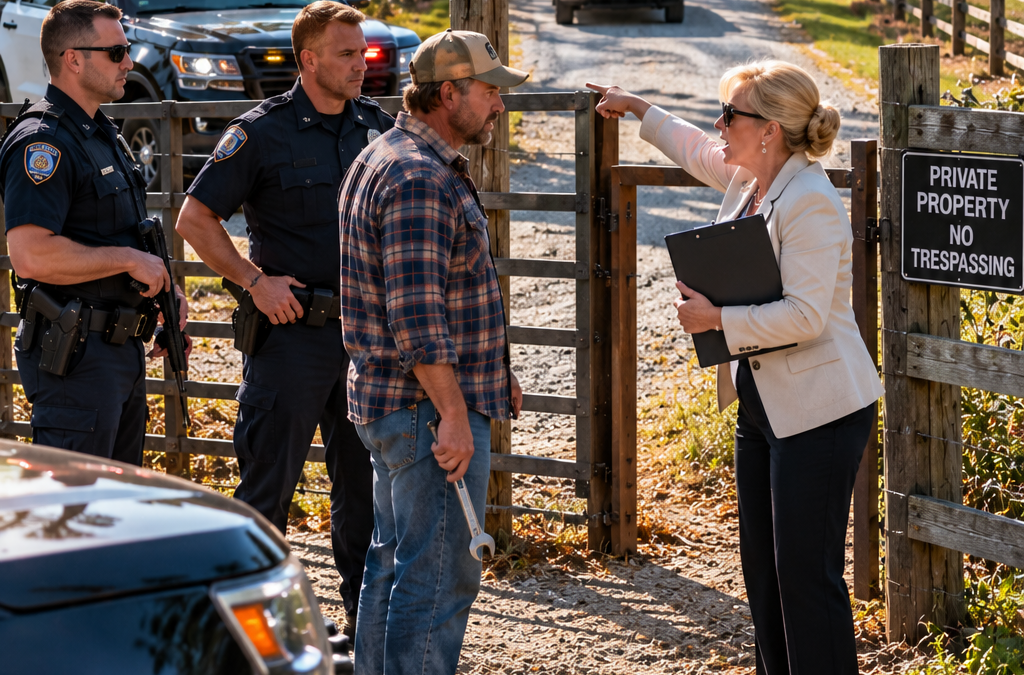
The first time police lights flashed across my fence, I was standing on land I had paid for, holding a wrench in one hand while a woman from the HOA told two officers I was trespassing. What she did not understand was that the road she used every morning—the road every family in her neighborhood depended on—was sitting entirely on property that belonged to me.
Three years earlier, I had bought eleven acres at the edge of a subdivision called Fairbrook Ridge.
The subdivision itself was exactly the kind of place I had spent most of my adult life avoiding.
Every lawn looked measured.
Every mailbox matched.
Every house had some variation of beige, gray, or pale blue siding.
There were regulations about garbage cans, parking, porch furniture, seasonal decorations, fence materials, grass height, and, according to one document my realtor showed me, even the acceptable color temperature of exterior lighting.
None of that bothered me because none of it applied to me.
My land sat behind the development on a separate parcel that existed decades before Fairbrook Ridge had been built. It was eleven acres of woods, low meadow, and a narrow creek that widened into a fishing hole near the eastern property line.
There was a small clearing where I eventually built my cabin.
Nothing extravagant.
Two bedrooms.
A porch facing the trees.
A wood stove.
A shed.
Enough room for my tools, fishing gear, and the old aluminum boat I dragged down to the creek whenever the water was high enough.
Before buying the property, I had asked my realtor the same question at least three times.
“Are you absolutely certain this parcel isn’t part of the HOA?”
She had laughed the third time.
“Daniel, I promise you. It predates the development. Separate deed. Separate parcel number. No recorded covenants tying it to Fairbrook Ridge. You’re not one of them.”
“Meaning?”
“Meaning their board can send you Christmas cards if they want. They can’t tell you what color to paint your cabin.”
That was good enough for me.
I signed.
For almost a year, life was exactly what I had hoped for.
I worked during the week, disappeared to the cabin whenever I could, and rarely thought about the neighborhood beside me.
There was only one thing connecting my property to Fairbrook Ridge in any practical sense.
The road.
It was a gravel road, maybe twenty feet wide in most places, cutting through the northern corner of my parcel before joining the state highway.
Fairbrook Ridge had another entrance on the opposite side of the subdivision, but this road was shorter and far more convenient. Nearly everyone used it.
Residents drove across it every morning.
School buses crossed it.
Delivery trucks crossed it.
The postal carrier crossed it.
Landscaping crews, utility contractors, moving vans, garbage trucks—everyone treated it as though it were a normal neighborhood street.
When I bought the property, I knew the road ran across my land.
I just assumed there was an easement.
Why wouldn’t there be?
No sane developer would build a neighborhood and route hundreds of vehicles across private land without securing the legal right to do so.
At least that was what I believed.
More importantly, I did not care enough to investigate.
The road had apparently been used for years before I arrived. It did not interfere with my cabin. It only clipped a corner of my acreage, and most drivers passed through without bothering me.
I believed in leaving people alone when they left me alone.
That arrangement worked perfectly until the HOA decided leaving me alone was no longer acceptable.
The first letter arrived on a Thursday afternoon.
I found it folded inside my mailbox beneath an electric bill.
Fairbrook Ridge Homeowners Association.
The envelope looked more formal than necessary, with the HOA seal printed in dark blue above the return address.
I opened it standing beside my truck.
The first paragraph informed me that my property was “in violation of community appearance standards.”
I read that sentence twice.
Then I laughed.
The letter listed four alleged violations.
Grass exceeding approved height.
Unapproved exterior stain on my cabin.
Unauthorized fencing.
Improper placement of an accessory structure.
My shed, apparently.
At the bottom was a warning that failure to correct the violations could result in monetary penalties and additional enforcement action.
I carried the letter inside, put it on the kitchen table, and read it again.
Then I pulled out my closing documents.
Nothing had changed.
My property was still outside the HOA.
No restrictive covenants.
No membership agreement.
No dues obligation.
No architectural control.
It seemed so obviously ridiculous that I assumed someone at the HOA office had made a clerical mistake.
The next morning, I called.
A woman answered after three rings.
“Fairbrook Ridge Homeowners Association.”
“Hi. My name is Daniel Mercer. I received a violation notice yesterday, but I think somebody has the wrong parcel.”
There was a pause.
“Address?”
I gave it to her.
Another pause while she typed.
“No, sir. That is the correct address.”
I almost smiled.
“Then the mistake is that I’m not part of Fairbrook Ridge.”
She did not respond immediately.
“My parcel predates the subdivision,” I continued. “I have a separate deed. I’ve never signed your CC&Rs. I don’t pay dues. Your rules don’t apply to my property.”
Her voice changed slightly.
Not angry.
Colder.
“I understand your position.”
“It isn’t a position. It’s how the property is recorded.”
“Well, the board has discussed your parcel.”
That got my attention.
“Why?”
“Because your property adjoins Fairbrook Ridge and contains infrastructure used by the community.”
“You mean the gravel road?”
“Yes.”
“So?”
“The board considers that road community property.”
I looked through the window toward the trees.
“The county deed says otherwise.”
She sighed as if I were the difficult one.
“The road has been maintained and continuously used by Fairbrook Ridge residents for decades.”
“That still doesn’t make my cabin part of your HOA.”
“The board believes the road and the surrounding buffer area fall under community authority.”
I leaned against the counter.
“Believes based on what?”
“Based on longstanding use.”
“No. I mean legally. Show me the document.”
There was silence.
Then she said, “The board will contact you.”
“Who am I speaking with?”
Another small pause.
“Margaret Whitmore. HOA president.”
That was my introduction to Margaret.
I would eventually learn that she had been president of the Fairbrook Ridge board for almost six years.
She was in her late fifties, drove a pearl-white SUV, and had the kind of personality that transformed the smallest rule into a test of loyalty.
Residents later told me she walked the neighborhood most mornings photographing violations with her phone.
Garbage can visible from the street?
Picture.
Truck parked overnight?
Picture.
Children’s basketball hoop too close to the curb?
Picture.
Someone painted a front door without board approval?
Margaret knew before the paint dried.
At first, I did not care.
She could run Fairbrook Ridge like a military installation if the residents wanted to tolerate it.
My land was not Fairbrook Ridge.
I thought that distinction would end the problem.
Instead, it became the problem.
A week after our phone conversation, I was working beside the road when Margaret’s SUV came down the gravel and stopped beside me.
She lowered the window.
“You’re Daniel?”
I wiped dust from my hands.
“You’re Margaret?”
She parked without asking and stepped out.
She was dressed as though she were attending a neighborhood committee meeting instead of walking onto someone else’s rural property—pressed slacks, expensive sunglasses, cream-colored blouse, clipboard tucked against her chest.
She looked past me toward the split-rail fence I had installed several days earlier.
“This needs to come down.”
No greeting.
No explanation.
Just an order.
I stared at her.
“What?”
She pointed with her pen.
“That fence.”
The fence ran parallel to the road, about six feet inside my surveyed boundary. I had built it partly to keep deer away from a small garden and partly because drivers had begun widening the road by cutting across the shoulder whenever two vehicles passed each other.
“Why would I take down my fence?”
“It interferes with the community road buffer.”
“What community road buffer?”
“The maintained area adjacent to the roadway.”
“You mean my land.”
She tightened her mouth.
“The road has served Fairbrook Ridge for more than twenty years.”
“That wasn’t my question.”
“We require clear access along both sides.”
“We?”
“The association.”
I laughed once because the situation was becoming absurd.
“Margaret, your association doesn’t own this parcel.”
“You keep saying that.”
“Because it’s true.”
“Longstanding community use establishes certain rights.”
“Then show me those rights on paper.”
Her expression hardened.
“Mr. Mercer, I’m trying to handle this politely.”
That sentence irritated me more than anything she had said so far.
She had driven onto my property without invitation, ordered me to remove my fence, and was now framing herself as the reasonable person.
I stepped closer, not threateningly, but enough to make the boundary clear.
“You came here and told me what I could build on land you don’t own. That isn’t polite.”
“You’re creating an unnecessary conflict.”
“No. I built a fence.”
“The board can issue fines.”
“To whom?”
“To the property.”
“You don’t have authority over the property.”
“That may be your interpretation.”
I shook my head.
“It’s the county recorder’s interpretation.”
She stared at me for several seconds.
Then she tucked the clipboard under her arm.
“This isn’t over.”
I opened the gate beside me.
“You’re right. It isn’t. Because now I’m formally asking you to leave my property.”
Her face turned red.
“You’re asking the HOA president to leave a community roadway?”
“I’m asking a private individual standing outside her vehicle on my parcel to leave.”
She walked back to her SUV.
Before getting in, she turned toward me.
“You’re going to make this much harder than it needs to be.”
“I was thinking the same thing.”
She drove away fast enough to throw gravel against my fence.
That should have been another warning.
Instead, I told myself she was embarrassed.
People said stupid things when they were embarrassed.
I went back to work.
Two weeks passed.
Then the police came.
It was a clear Saturday morning.
I was replacing a damaged fence post near the road when I heard tires on gravel.
I expected another resident.
Instead, a patrol car turned the bend.
Its lights were flashing.
Behind it came Margaret’s white SUV.
My stomach tightened.
The cruiser stopped about thirty feet from me.
An officer stepped out.
Another officer remained in the passenger seat for a moment before joining him.
The first officer approached carefully.
“Morning, sir.”
“Morning.”
“Can you set the tool down for me?”
I looked at the wrench in my hand.
It suddenly occurred to me how the scene might look from his perspective.
I placed it on the ground.
“Sure.”
“Are you Daniel Mercer?”
“Yes.”
He nodded toward the road.
“We received a complaint about a trespass and possible obstruction.”
I actually looked behind myself, expecting there to be someone else.
“What trespass?”
Margaret had already gotten out of her SUV.
She walked toward us.
“Him,” she said.
The officer raised a hand.
“Ma’am, give me a second.”
She stopped, visibly annoyed.
The officer looked back at me.
“The complainant says you’re working on property belonging to the Fairbrook Ridge Homeowners Association and interfering with access.”
I felt something inside me go very still.
“Officer, I own this land.”
Margaret spoke immediately.
“The association owns the roadway and adjacent buffer.”
The officer looked between us.
“Do either of you have documentation?”
“I do,” I said.
“So do we,” Margaret snapped.
I turned toward her.
“Then show it.”
She ignored me and addressed the officer.
“This man has repeatedly interfered with community property. We have sent notices. We have spoken to him. He refuses to comply.”
“Because I’m not in your HOA.”
“You’re standing inside the Fairbrook Ridge access corridor.”
“I’m standing on parcel 11-684-03. My parcel.”
The officer’s expression changed slightly.
“You know the parcel number?”
“I bought it three years ago.”
Margaret crossed her arms.
“The roadway has belonged to the community since the development was constructed.”
“Belonged how?” I asked.
“Stop arguing with me.”
“You called the police on me.”
“And I’ll do it again if you continue obstructing association property.”
The officer stepped between us verbally before either of us could continue.
“Okay. Nobody’s deciding ownership standing here in the road.”
He walked back to his cruiser.
Margaret followed him.
I stayed where I was.
My hands were shaking.
Not from fear.
From humiliation.
A school bus passed while the officer sat in his cruiser checking records.
Several residents slowed their cars.
People stared.
I could imagine exactly what they saw.
Police.
The HOA president.
Me standing beside a half-finished fence.
To anyone who did not know the facts, I looked like the problem.
I had spent years saving money before I could afford that land.
I had checked the deed.
Paid taxes.
Hired a surveyor.
Built legally.
And now two officers had been sent to tell me I might need to leave because Margaret Whitmore had decided repetition could substitute for ownership.
The officer returned about five minutes later.
He held a tablet in his hand.
“Mr. Mercer?”
“Yes.”
“I pulled the county parcel map.”
Margaret stepped closer.
He continued.
“The registered owner of parcel 11-684-03 is Daniel Mercer.”
“That’s me.”
He nodded.
“And according to the GIS layer I’m looking at, this road segment crosses that parcel.”
Margaret interrupted.
“But the HOA has rights to the roadway.”
“Do you have an easement document?”
“The development has used it for decades.”
“That wasn’t my question.”
I almost smiled.
He had asked her exactly what I had.
Margaret’s jaw tightened.
“The records should reflect our rights.”
“They might. I’m not saying they don’t. But ownership is showing in his name.”
She looked furious.
“He’s interfering with access.”
“I’m repairing a fence.”
The officer glanced at the post.
“Is the road currently blocked?”
“No.”
“Has he threatened anyone?”
“No.”
“Damaged HOA property?”
“He’s altering the buffer.”
The officer exhaled.
“Ma’am, this sounds like a civil property dispute. I’m not removing the registered landowner based on what I have here.”
Margaret stared at him.
“You’re refusing to enforce trespassing laws?”
“I’m telling you the person you accused of trespassing appears to own the property.”
“That road belongs to Fairbrook Ridge.”
“Then you’ll need to establish that through the appropriate civil process.”
The second officer had remained quiet until then.
Now he looked at me.
“Sir, I apologize for the inconvenience.”
I nodded.
“I understand. You’re responding to a call.”
Margaret did not apologize.
The officers returned to their cruiser.
The lights went dark.
They drove away.
For several seconds Margaret and I stood on opposite sides of the road.
She looked different now.
The polish was still there.
So was the certainty.
But underneath it, I saw something uglier.
Not embarrassment.
Resentment.
She was angry that the officer had not accepted her authority simply because she claimed to have it.
She pointed at me.
“You’ll regret pushing this.”
That was the moment something changed in me.
Until then, I had been defending myself.
Explaining.
Correcting.
Responding.
I was done responding.
I picked up my wrench.
“We’ll see.”
She drove away.
I finished the fence post, but I barely remember doing it.
That evening, I sat on my porch with a beer and watched the last light disappear through the trees.
Cars continued moving down the gravel road.
One after another.
Headlights.
Tires.
Engines.
Every vehicle crossed my property.
I started thinking about Margaret’s words.
Longstanding use.
Community roadway.
Association rights.
She had said those phrases repeatedly, but she had never produced a document.
That bothered me.
If the HOA really had a recorded easement, finding it should have been easy.
Why had nobody shown it to me?
Why had Margaret called police instead?
The following Monday, I went to the county records office.
I expected to spend an hour there.
I spent nearly the entire day.
The clerk helped me pull the current deed first.
Nothing surprising.
Eleven acres.
My name.
The metes-and-bounds description included the strip beneath the gravel road.
Then I asked for recorded easements.
She searched the parcel.
Nothing.
“Maybe it’s under an older parcel number,” she said.
That made sense.
The land had been divided decades earlier.
We traced it backward.
The parcel before mine.
Then the parent parcel before that.
Then records dating into the 1980s.
Still nothing.
I returned the next morning.
And the morning after that.
Eventually, curiosity became obsession.
I pulled plats.
Subdivision maps.
Right-of-way dedications.
Utility easements.
Old deeds.
Planning commission documents.
Anything connected to the northern corner of my property.
The paper trail went back to 1962.
There was no road easement.
Not one.
Fairbrook Ridge had been developed in phases during the 1990s.
The original construction maps showed the gravel road being used as a temporary access route.
Temporary.
I stared at that word for a long time.
The developer had apparently begun using an existing farm track across what was then privately owned acreage.
Construction trucks used it.
Workers used it.
Later, residents used it.
But somewhere between temporary construction access and permanent neighborhood traffic, no one had recorded a legal easement.
No grant.
No purchase agreement.
No dedication.
No signed access contract.
Nothing.
Decades of use had turned assumption into habit.
Habit had turned into expectation.
And Margaret had mistaken expectation for ownership.
I still did not completely trust my own interpretation.
Property law could be complicated.
Prescriptive easements existed.
Implied easements existed.
There were doctrines I only vaguely understood.
So I hired an attorney.
Her name was Rebecca Hale.
She specialized in land-use and boundary disputes.
Her office was above a bank downtown, with old wooden floors and shelves full of binders thick enough to stop bullets.
I brought everything.
The current deed.
Historic deeds.
Parcel maps.
Subdivision plats.
The HOA letters.
Photographs of the fence.
The police incident report.
Rebecca spent almost an hour reading before asking many questions.
“Did the prior owner ever sign an access agreement?”
“Not that I can find.”
“Did they receive payment from the HOA?”
“No.”
“Did the developer purchase rights?”
“Nothing recorded.”
“Have you ever signed anything allowing access?”
“No.”
“Have you ever charged them?”
“No.”
She read another document.
Then another.
Finally, she leaned back.
“This is interesting.”
I did not like the way attorneys used that word.
“Interesting good or interesting expensive?”
She smiled.
“Potentially both.”
She explained that long-term use could create arguments the HOA might attempt to make.
But based on the records, the facts were much worse for them than they apparently realized.
Most important, nobody had transferred ownership of the road.
The HOA had repeatedly represented the roadway as association property despite county records showing otherwise.
And there was no clearly recorded easement granting Fairbrook Ridge permanent access across my parcel.
“So what does that mean?” I asked.
“It means they should have been very careful before calling the police and accusing you of trespassing.”
I leaned forward.
“Can I close the road?”
She looked directly at me.
“Based on what I’ve reviewed, you have a strong basis to control access across your parcel. I would not recommend dragging a barricade out there tonight without notice, because they may seek emergency relief and argue reliance or implied rights. But yes, absent a valid easement or court order, ownership gives you significant control.”
“What would you do?”
“I’d give them written notice.”
“How long?”
“Thirty days is reasonable.”
I nodded slowly.
“Then let’s give them thirty.”
Rebecca studied me.
“You understand what closing that road will do?”
“Yes.”
“School buses use it.”
“They have another entrance.”
“Residents will be furious.”
“They should probably talk to Margaret.”
A faint smile crossed her face.
“That is not legal advice.”
“It doesn’t have to be.”
She drafted the notice.
It was professional, factual, and devastating.
The letter identified my parcel, attached the recorded deed, described the absence of any discovered easement, and formally revoked informal permissive access effective thirty days from the date of notice.
It also invited the association to produce any legal instrument granting roadway rights if such an instrument existed.
Rebecca sent it by certified mail.
Margaret received it three days later.
Her response came that afternoon.
Not through an attorney.
Not through formal correspondence.
She called me.
I answered because I wanted to hear what she had to say.
“Daniel.”
No hello.
“Margaret.”
“You need to withdraw that letter.”
“No.”
“This is absurd.”
“It’s accurate.”
“You cannot shut down a community roadway.”
“It isn’t a community roadway.”
“Hundreds of people depend on it.”
“Then your board should probably find the easement.”
“We do not need your permission to use that road.”
“Great. Send Rebecca the document proving it.”
“This is retaliation because we enforced community standards.”
I laughed.
“You called the police and accused me of trespassing on my own land.”
“You were deliberately provoking the situation.”
“By fixing my fence?”
“You knew that area was disputed.”
“It wasn’t disputed until you decided county records didn’t matter.”
Her voice became sharper.
“You are trying to punish innocent homeowners.”
“No. I’m giving your association thirty days to establish its legal right to cross my property.”
“And if we don’t?”
“The road closes.”
“You wouldn’t dare.”
There it was.
Not legal reasoning.
Not documentation.
Just disbelief that someone she had tried to control might tell her no.
“Thirty days,” I said.
Then I ended the call.
For the next month, Fairbrook Ridge behaved as though nothing was going to happen.
The HOA sent two more letters claiming the closure would violate “established community access.”
Rebecca answered both with the same request.
Provide the recorded easement.
They never did.
Margaret posted on the neighborhood message board.
A resident later sent me screenshots.
She described me as a “disgruntled adjacent landowner” attempting to disrupt residents over a “manufactured property dispute.”
She wrote that the board was “confident established access rights would prevail.”
She also claimed my thirty-day notice was an intimidation tactic.
That part almost impressed me.
A month earlier, she had sent police to remove me from my property.
Now a certified legal notice was intimidation.
Several residents began contacting me directly.
Most were angry.
A few were curious.
One man named Tom stopped his pickup near my gate while I was clearing brush.
“You really closing the road?”
“Unless the HOA produces a legal access agreement.”
He frowned.
“They told us they own it.”
“They don’t.”
“You sure?”
I pointed toward the laminated parcel map I had begun carrying in my truck.
“Pretty sure.”
Tom looked at it.
Then at the gravel beneath his tires.
“No kidding.”
“No kidding.”
He scratched his chin.
“That’s gonna make the morning commute hell.”
“Probably.”
“You mad at all of us?”
The question caught me off guard.
“No.”
“Feels like we’re caught in the middle.”
“You are.”
He nodded slowly.
Then he surprised me.
“Margaret told everybody you were trying to extort the neighborhood.”
“I asked for proof they have the right to use my land.”
“That’s not exactly how she said it.”
“I figured.”
Tom looked toward Fairbrook Ridge.
“You know she fined my daughter two hundred dollars last year because her car sat in my driveway for four nights?”
I smiled despite myself.
“Sounds like Margaret.”
He laughed.
“Yeah.”
Then his expression became serious again.
“I don’t blame you for being pissed about the cops.”
That was the first time anyone from Fairbrook Ridge said it plainly.
I appreciated it more than he probably realized.
On day twenty-seven, Margaret drove by while I was working near the road.
She slowed but did not stop.
On day twenty-eight, I received an email from the HOA’s attorney warning that any obstruction could expose me to damages.
Rebecca answered within an hour.
Produce the easement.
No response.
On day twenty-nine, I hired a fencing contractor.
At seven the next morning, a flatbed truck arrived carrying steel gate frames, posts, concrete, signs, and equipment.
We installed one gate at the highway end of the road where it entered my parcel.
The second gate went at the opposite boundary where the road entered Fairbrook Ridge.
Both gates sat completely inside my property.
I had surveyed the locations twice.
The signs were simple.
PRIVATE PROPERTY
NO TRESPASSING
ACCESS REQUIRES OWNER AUTHORIZATION
I also laminated copies of the parcel map and the relevant deed description and secured them beside each gate.
At 5:42 p.m., the crew finished.
I stood beside the road.
Traffic continued flowing through.
The notice period expired at midnight.
I slept badly.
Not because I doubted the ownership.
Because I knew the next morning would be ugly.
At 6:00 a.m., I drove to the north gate.
Rebecca had advised me not to create a confrontation, so I locked the gates before the morning rush and returned to my cabin.
By 6:18, the first horn sounded.
Then another.
Then several.
At 6:30, my phone began ringing.
At 6:45, there were at least twenty vehicles lined up behind the gate.
By 7:00, the line disappeared around the bend.
People got out of their cars.
Some photographed the signs.
Some called the HOA.
One man shouted toward the trees as though I were hiding nearby listening.
I was.
At 7:12, Margaret arrived.
Even from a distance I could tell she was furious.
She parked sideways near the gate and walked directly to the lock.
She pulled it.
Then pulled harder.
Then read the laminated documents.
I watched through binoculars from my porch and saw her take out her phone.
Mine rang seconds later.
I let it go to voicemail.
She called again.
And again.
At 7:28, a school bus approached.
The driver stopped.
After several minutes, the bus backed carefully away and rerouted through the subdivision’s secondary entrance.
By 7:40, traffic was backed up roughly a quarter mile.
The consequences spread immediately.
Delivery trucks had to turn around.
Residents trying to reach the highway rerouted through the eastern entrance.
That route added around fifteen minutes in normal traffic and longer during school hours.
The post office temporarily altered its delivery pattern.
Calls went to the sheriff’s office.
Calls went to the county.
Calls went to Rebecca.
By eight o’clock, Margaret had left me seven voicemails.
I listened to the first.
“This is reckless. Open the road immediately.”
The second was longer.
“You are obstructing emergency access and placing residents at risk.”
The third sounded less controlled.
“If you think this little stunt gives you leverage, you are mistaken.”
I stopped listening.
At 9:15, a sheriff’s deputy arrived at the gate.
Not the same officer from before.
He called the number printed on my sign.
I walked down to meet him.
Margaret was already there.
Of course she was.
“This is him,” she said as soon as I approached.
The deputy looked exhausted.
“Mr. Mercer?”
“Yes.”
“Do you own the parcel?”
“Yes.”
“I’ve seen the deed.”
Margaret interrupted.
“We have historic access.”
The deputy held up a hand.
“Ma’am, we’ve been through this with the county attorney this morning. Unless someone produces a court order or documented easement requiring access, I’m not cutting a lock on private property.”
Margaret looked stunned.
“So he can trap an entire neighborhood?”
“There’s another entrance.”
“That is not the point.”
“It matters legally and practically.”
She turned toward me.
“You’re enjoying this.”
I stared at her.
“No. I enjoyed my life before you sent police to accuse me of trespassing.”
Her face tightened.
“This is vindictive.”
“No, Margaret. Vindictive would have been closing it without notice. I gave you thirty days.”
“You knew we couldn’t resolve a property issue in thirty days.”
“You spent the first twenty-eight telling everyone I was bluffing.”
She stepped closer.
“Open the gate.”
“No.”
“That’s an order from the association president.”
I almost could not believe she had said it.
The deputy looked away, possibly to hide a reaction.
I spoke slowly.
“You are standing outside a locked gate on property your association does not own, giving the property owner an order.”
“This community has used this road longer than you have owned it.”
“And yet you still can’t show me an easement.”
“I am warning you—”
“No. You’re finished warning me.”
The anger I had kept contained for weeks finally reached the surface.
“You sent violation notices to land outside your jurisdiction. You came onto my property and ordered me to remove my fence. You called police and falsely identified me as a trespasser. Then, when county records proved I owned the land, you threatened me instead of apologizing. I gave your board thirty days to show one piece of paper proving your right to use this road, and instead of doing that, you called me a liar in front of your residents.”
People nearby had stopped talking.
Margaret’s cheeks flushed.
I continued.
“You wanted to make ownership a technical issue. Fine. Technically, legally, and according to the deed, you are on the wrong side of my gate.”
For once, she had nothing to say.
The deputy cleared his throat.
“I think everyone should let the attorneys handle it.”
Margaret left.
By noon, my phone was receiving calls from numbers I did not recognize.
Residents.
A county commissioner’s assistant.
A local transportation official.
Even a delivery company supervisor.
I forwarded almost everything to Rebecca.
At 2:06 p.m., she called.
“They want an emergency meeting.”
“Who?”
“The HOA board.”
“Margaret too?”
“She’s president.”
“Then yes. But I want you there.”
“I planned to be.”
“And I want it recorded.”
“Agreed.”
The meeting took place the following morning in the Fairbrook Ridge clubhouse.
I had never been inside.
It was exactly what I imagined.
Polished wood conference table.
Landscape photographs.
Coffee station.
A framed copy of the neighborhood bylaws in the hallway.
Margaret sat at the head of the table.
Four other board members sat beside her.
Their attorney, a man named Charles Benton, had a stack of papers in front of him.
Rebecca and I sat across from them.
A digital recorder rested between us.
Margaret began before anyone else could.
“This closure has created unacceptable disruption for more than two hundred households.”
Rebecca replied calmly.
“We understand the impact.”
Margaret looked at me.
“Apparently he doesn’t.”
“I understand it perfectly,” I said.
Charles raised a hand slightly.
“Perhaps we can keep this productive.”
Margaret leaned back.
“Fine.”
Charles turned toward Rebecca.
“Our position is that Fairbrook Ridge has established access rights based on continuous, open, notorious use for more than two decades.”
Rebecca nodded.
“Under what recorded instrument?”
“We’re reviewing the chain of title.”
“You’ve had more than thirty days.”
“Historic property records are complicated.”
“I agree. We reviewed sixty-four years of them.”
She opened a folder.
The room became quieter.
Rebecca slid copies across the table.
“Current deed.”
Another document.
“Predecessor deed.”
Another.
“Parent parcel.”
Then the subdivision plat.
“Fairbrook Ridge development map.”
Charles read silently.
Rebecca placed one final document beside the others.
“This is the original construction plan identifying the road as temporary access.”
Margaret spoke.
“Temporary doesn’t mean private.”
Rebecca looked at her.
“No. The deed means private.”
Margaret went silent.
Rebecca continued.
“We found no recorded easement granting Fairbrook Ridge permanent use of Mr. Mercer’s parcel.”
Charles folded his hands.
“As I said, we believe continuous use creates rights independent of recording.”
“You’re free to litigate that theory.”
Margaret jumped in.
“We will.”
Rebecca looked directly at her.
“Then we should also discuss Mr. Mercer’s counterclaims.”
That changed the room.
One board member shifted in his chair.
Charles frowned.
“What counterclaims?”
“Unauthorized use of private property. Misrepresentation of ownership. Interference with use and enjoyment. And potentially abuse related to the false trespass complaint, depending on the evidence surrounding what was represented to law enforcement.”
Margaret’s expression changed.
“You’re threatening us now?”
“No,” Rebecca said. “I am explaining the litigation landscape you just proposed entering.”
Charles stared at the police report.
Rebecca had brought that too.
She continued.
“Your client told officers Mr. Mercer was trespassing on property owned by the association. County records established that representation was false within minutes.”
“I acted on the understanding of the board,” Margaret said.
“Did you possess a deed?”
Margaret did not answer.
“An easement?”
Silence.
“A survey showing association ownership?”
Nothing.
Rebecca leaned back.
“Then perhaps litigation is not the most efficient path.”
For several seconds, nobody spoke.
The anger that had filled the room when we entered slowly drained away.
This was the moment the argument changed.
Until then, Margaret had treated access as something I was obligated to provide.
Now everyone at that table understood it was something they might need to purchase.
One of the quieter board members, a man named Robert, finally spoke.
“What would Daniel want for an easement?”
Margaret turned sharply.
“We are not paying for a road we have used for twenty-five years.”
Robert looked at her.
“We’re currently not using it at all.”
She stared at him.
He continued.
“And residents are furious.”
“At him.”
“Some are furious at us.”
That was new.
Margaret looked around the table.
Another board member avoided her eyes.
Charles asked the practical question.
“If Mr. Mercer were open to a formal access agreement, what terms would he require?”
Rebecca looked at me.
We had already discussed this.
I took a breath.
“First, the HOA acknowledges in writing that the road crosses private property and that neither the road nor adjacent land belongs to Fairbrook Ridge.”
Margaret shook her head.
“That wording is unnecessary.”
“It’s necessary to me.”
I continued.
“Second, you pay fair compensation for a permanent recorded easement.”
“How much?”
Rebecca gave them the figure based on an appraisal and the value of the burden placed on the property.
It was not outrageous.
It was also not symbolic.
Margaret’s eyes widened.
“You’re extorting us.”
Charles immediately said, “Margaret.”
She ignored him.
“You shut down access and now you’re demanding money.”
“No,” I said. “You used my land for free for decades, told me it belonged to you, and sent police when I disagreed. I’m offering you the chance to formalize access instead of leaving the gate closed.”
“You’re exploiting residents.”
“I’m negotiating with an HOA.”
“You know exactly what this will do to our budget.”
I looked at the other board members.
“Then perhaps your president should have investigated ownership before turning this into a war.”
Margaret’s face went pale.
Robert rubbed his forehead.
Charles asked, “Anything else?”
“Yes.”
I had saved the one condition Margaret would hate most for last.
“A written apology.”
She laughed.
“No.”
I looked at her.
“Then the road stays closed.”
“This is childish.”
“It’s accountability.”
“I will not sign some humiliating statement because you got offended.”
“You accused me of trespassing on my own property.”
“You were behaving aggressively.”
“I was repairing a fence.”
“You were confrontational.”
“You brought police.”
“You refused to cooperate with the association.”
“I don’t belong to the association.”
Her palm hit the table.
“That road serves our neighborhood!”
“And that sentence is exactly why we’re here.”
The room went silent again.
I felt Rebecca’s hand lightly touch the folder beside her, a quiet signal not to let the argument spiral.
So I lowered my voice.
“I am not asking you to apologize for disagreeing with me. I’m asking the board to acknowledge that it asserted authority it did not have and caused police to confront me on property the county records showed was mine.”
Margaret stared at me.
For the first time since I had met her, she looked uncertain.
Not humbled.
Margaret Whitmore did not do humble.
But isolated.
She had spent weeks telling the neighborhood I was bluffing.
Now the gate was closed.
She had claimed the road belonged to the HOA.
Now her own attorney could not produce the deed.
She had called me unreasonable.
Now every board member was looking at the financial consequences of her refusal to compromise.
Robert spoke again.
“I think the apology is reasonable.”
Margaret turned toward him.
“You cannot be serious.”
“I’m very serious.”
Another board member nodded.
“We should resolve this.”
Margaret looked at each of them.
“You’re rewarding him for holding the neighborhood hostage.”
“No,” Robert said. “We’re correcting a legal problem that apparently existed before any of us joined the board.”
Her expression hardened.
“And what message does that send?”
I answered before anyone else could.
“That ownership matters.”
She looked at me with pure contempt.
I looked back.
Charles requested a short recess.
Rebecca and I stepped outside.
Through the clubhouse windows, I could see the board arguing.
Margaret stood.
Robert stayed seated.
Hands moved.
Papers moved.
At one point Margaret pointed toward the door where I was standing.
Rebecca glanced at me.
“You okay?”
“Better than I expected.”
“She’s going to fight the apology.”
“I know.”
“You willing to walk away if she refuses?”
I looked toward the road in the distance.
Cars were moving through the secondary entrance.
Slowly.
Inconveniently.
But the neighborhood was not trapped.
Nobody was endangered.
The only real crisis was that a shortcut they had treated as an entitlement was no longer free.
“Yes,” I said.
Rebecca nodded.
“Good.”
Twenty minutes later, we were called back inside.
Charles spoke.
“The board is prepared to negotiate a permanent recorded easement under the compensation framework your counsel proposed.”
Margaret sat rigidly at the end of the table.
He continued.
“The board will also issue a written clarification acknowledging ownership of the underlying parcel.”
I waited.
“And?”
Charles glanced at Margaret.
“And a written apology related to the law-enforcement complaint.”
Margaret stared at the tabletop.
It was not enough for me that an attorney said it.
I needed to hear whether she understood what had just happened.
“Margaret?”
Her head snapped up.
“What?”
“Do you agree?”
Her eyes narrowed.
“You’ve gotten everything you wanted.”
“That wasn’t my question.”
Rebecca did not stop me.
Neither did Charles.
Margaret inhaled slowly.
“Yes.”
The word sounded painful.
“Yes, what?”
“Daniel,” Charles warned gently.
I stopped.
There was no reason to humiliate her.
That was the difference between us.
I did not need her submission.
I needed boundaries.
“Good,” I said.
The formal agreement took several weeks to complete.
The gates stayed closed until every document was signed.
That detail mattered.
Margaret tried twice during negotiations to have them opened “in good faith.”
Rebecca’s response was simple.
The gate would reopen when the right to cross the land legally existed.
Not before.
A title company reviewed everything.
Surveyors marked the easement.
The HOA paid compensation.
The access rights were recorded with the county.
The agreement defined the exact roadway width, maintenance responsibilities, liability provisions, drainage obligations, and restrictions on expansion.
Most importantly, it made clear that the underlying land remained mine.
Then came the apology.
It arrived on Fairbrook Ridge letterhead.
Unlike the violation notice that started everything, this letter was only one page.
The board acknowledged that my parcel was not subject to Fairbrook Ridge HOA covenants.
It acknowledged that the roadway crossed my privately owned property.
It acknowledged that the association had incorrectly asserted ownership.
And it apologized for the police complaint and resulting confrontation.
Margaret’s signature appeared at the bottom.
I read it twice.
Then I folded it and put it in the same file as the first violation letter.
Not because I wanted a trophy.
Because I wanted to remember how quickly people can begin doubting their own rights when someone with enough confidence tells them they have none.
The gate reopened the next morning.
I stood there while a locksmith changed the temporary lock to the permanent access system required by the easement agreement.
The first vehicle through belonged to Tom.
He slowed beside me and rolled down his window.
“So I guess we’re legal now.”
I smiled.
“For the first time in about twenty-five years.”
He laughed.
“Margaret’s gonna love that sentence.”
“I’m sure.”
His expression became more serious.
“People found out about the police thing.”
“I figured.”
“A lot of them aren’t happy with her.”
“That’s between you and your HOA.”
“Yeah.”
He paused.
“For what it’s worth, you were right to check.”
Then he drove on.
Over the next several weeks, the story spread through Fairbrook Ridge.
Residents who had believed the association owned the road began asking questions.
Not just about the road.
About everything.
People requested copies of board records.
They challenged old fines.
They asked how decisions were approved.
They started attending meetings that used to attract only five or six residents.
Margaret apparently hated it.
Two months later, she resigned as HOA president.
I did not attend the meeting.
I heard about it from Tom.
“She said the board had become impossible to work with.”
I almost laughed.
“What did everyone else say?”
“Mostly nothing.”
He smiled.
“Sometimes silence says enough.”
Margaret moved out of Fairbrook Ridge the following year.
I saw her white SUV only once after her resignation.
She drove down the road slowly.
When she reached my gate, she glanced toward the sign beside it.
The old NO TRESPASSING sign was gone.
In its place was a smaller permanent plaque required by the agreement.
PRIVATE ROAD
ACCESS BY RECORDED EASEMENT ONLY
She stared at it for a second.
Then she continued.
I never spoke to her again.
Life returned to something close to what it had been before the first letter arrived.
I still spent weekends at the cabin.
I still fished the creek.
I still cut my grass when I felt it needed cutting, not when somebody carrying a clipboard decided it had grown a quarter inch too tall.
The fence stayed exactly where I built it.
So did the shed.
I never changed the stain on the cabin.
No fines ever appeared because the HOA finally admitted what the deed had said from the beginning.
I was not a member.
The strangest part was that I never actually wanted the road.
I did not buy those eleven acres because I dreamed of controlling access to a subdivision.
For almost three years, I had allowed everyone to cross freely.
I had never charged them.
Never complained.
Never threatened to close it.
If Margaret had left me alone, I probably would have continued that way indefinitely.
That was what stayed with me.
The entire conflict had been unnecessary.
Nobody forced the HOA to send violation notices.
Nobody forced Margaret to walk onto my land and order me to remove my fence.
Nobody forced her to call police and accuse me of trespassing.
She created the fight because she could not tolerate one parcel sitting beside Fairbrook Ridge that she could not control.
And when the documents contradicted her, she did not reconsider.
She escalated.
That was her mistake.
She thought authority was created by saying something confidently enough.
She thought twenty-five years of habit could erase a deed.
She thought a clipboard, a board title, and a police complaint could turn my property into hers.
But land does not care how certain you sound.
A deed does not become less valid because someone finds it inconvenient.
And ownership does not disappear because a neighborhood has grown accustomed to pretending it belongs to them.
Sometimes, on quiet evenings, I sit on my porch and hear tires moving across the gravel beyond the trees.
The sound used to mean nothing.
Now it reminds me of that morning when the patrol lights reflected across my fence and I stood wondering how I had somehow become the trespasser on land with my name attached to it.
For a few minutes that day, Margaret succeeded in making me feel like I was defending something I had no right to possess.
That was the most dangerous part of the whole experience.
Not the letters.
Not the threats.
Not even the police.
It was how easily relentless confidence could make a reasonable person begin questioning facts they already knew.
That is why I kept every document.
The original violation letter.
The certified notice.
The police report.
The ancient plats.
The temporary-access construction plan.
The recorded easement.
And the apology.
They sit together in a thick folder in the bottom drawer of my desk.
Occasionally, when someone tells me about a dispute with an association, a neighbor, a contractor, or anyone else who insists they have rights over property they cannot prove belongs to them, I think about that folder.
The lesson was not that the loudest person loses.
Sometimes they do not.
The lesson was that confidence and authority are not the same thing.
Margaret had confidence.
I had the deed.
And when everything else was stripped away—the warnings, the accusations, the angry meetings, the flashing lights on my fence—only one of those things mattered.
The gate is still there today.
Most residents barely notice it anymore.
Children who moved into Fairbrook Ridge after the dispute probably have no idea why it exists.
Drivers slow automatically as they pass through.
Delivery trucks cross.
School buses cross.
Mail carriers cross.
Hundreds of tires roll over that gravel every week.
The neighborhood has the access it needs.
I have the privacy and legal protection I should have had from the beginning.
It turned out there had always been room for both.
All anyone had to do was respect the boundary.
I wish Margaret had understood that before she called the police.
But in a strange way, I am glad she did.
Because if she had never tried to remove me from my own land, I might never have searched those old records.
I might never have discovered that the road everyone believed belonged to the HOA had no permanent legal access at all.
I might have spent the next twenty years allowing people to cross my property under the mistaken belief that I was the one who had no choice.
Instead, every vehicle that uses that road now does so under a recorded agreement.
Not an assumption.
Not a threat.
Not because someone on a board decided they had authority over land they had never owned.
Because I granted the right.
On paper.
With boundaries.
With compensation.
With responsibility.
Exactly the way it should have been from the beginning.
And whenever I hear tires crunch across the gravel while I am sitting beside the creek with a fishing rod in my hand, I do not feel angry anymore.
I feel something quieter.
Relief.
The kind that comes when you finally understand you do not have to keep defending yourself against someone else’s invented authority.
The county record had been there all along.
My name.
My acreage.
My road.
Margaret just assumed nobody would ever bother to look.
She was wrong.




