𝗙𝗨𝗟𝗟 𝗦𝗧𝗢𝗥𝗬 The HOA Fenced Off My Father’s Lake While I Was Gone and Called It Community Property—They Had No Idea Why Four Black SUVs Were Coming Down the Road
𝗙𝗨𝗟𝗟 𝗦𝗧𝗢𝗥𝗬
The water access attached to that parcel was mine.
The HOA maintained some roads, common landscaping, and two shared recreation areas farther north.
It had no ownership interest in my land.
For years, there was never a serious problem.
Then my work changed.
I’m not going to name the federal agency I work for.
I couldn’t then.
I won’t now.
What matters is that eighteen months before I came home, I received assignment orders that required me to leave quickly.
I had forty-eight hours.
That was it.
There was no option to commute.
No opportunity to return every weekend.
No predictable schedule.
I didn’t know exactly how long I would be gone.
I knew it could be months.
Maybe longer.
So I did everything I thought a responsible property owner should do.
I paid the HOA dues a full year in advance.
I set all county taxes to automatic payment.
I maintained insurance.
I arranged for my neighbor, Russell Hayes, to watch the cabin under a written caretaker agreement.
Russell lived four houses up the road and had known my father for almost twenty years.
He had a key.
He could enter the property.
He could call a plumber, an electrician, or emergency services if needed.
He agreed to walk the shoreline after storms.
Nothing transferred ownership.
Nothing gave him authority to sell, lease, or alter the property.
It was basic caretaking.
The morning I left, I stood on the dock alone.
It was February.
Thin ice covered the shaded edge of the lake.
The cabin looked smaller than usual behind me.
I remember thinking eighteen months away would feel impossible.
I had no idea how much could change in eighteen months.
The assignment took me far enough away that coming home was not practical.
Communication was irregular.
There were stretches when I could use my personal phone and stretches when I couldn’t.
At one point I went almost seven weeks without checking personal email.
But that was expected.
I trusted Russell.
I trusted the documents.
More than anything, I trusted the basic reality that recorded property ownership did not disappear because the owner happened to leave town.
That assumption almost cost me everything.
The investigation I was assigned to was financial.
At first, it seemed like one of those cases that would take three months, generate thirty boxes of records, and quietly end in charges nobody outside our field would ever hear about.
Then the money started moving.
Shell entities.
Management companies.
Contractors billing associations for work that either never happened or cost a fraction of the amount charged.
Funds routed through consulting companies.
Repair accounts that disappeared into private investment vehicles.
It crossed county lines.
Then state lines.
Then the names multiplied.
Homeowners associations.
Property-management firms.
Maintenance vendors.
Board members.
At some point, it stopped being one fraud case and became a network.
I spent eighteen months buried in financial records, witness interviews, subpoenas, and long days in places I’m not going to describe.
I was tired when I finally came home.
Not movie tired.
Not dramatic.
The kind of tired where you stop noticing how exhausted you are because exhaustion has become the normal background of your life.
My only thought during the final drive into Cedar Hollow was the lake.
I wanted to stand on my father’s dock.
That was it.
No celebration.
No reunion party.
Just water.
Silence.
Home.
Lake View Drive curved through a stand of pine before dropping toward my parcel.
I turned the last corner.
And hit the brakes.
At first, I genuinely thought I had taken the wrong road.
An eight-foot chain-link fence ran across the lower section of my property.
Green privacy mesh had been fastened over most of it.
New steel posts were set into concrete.
The open view from the road to the shoreline was gone.
I sat behind the wheel staring at it.
My mind tried to catch up.
I knew every fence around that lake.
This one had never existed.
I drove closer.
The driveway I had used since I was sixteen was blocked by a locked vehicle gate.
I parked on the shoulder.
The silence felt wrong.
Even the lake looked different.
The waterline was lower.
Not slightly.
Significantly.
Mud extended several yards beyond sections that used to be underwater.
At first I thought drought.
Then I saw the drainage equipment near the south bank.
My chest tightened.
I walked to the gate.
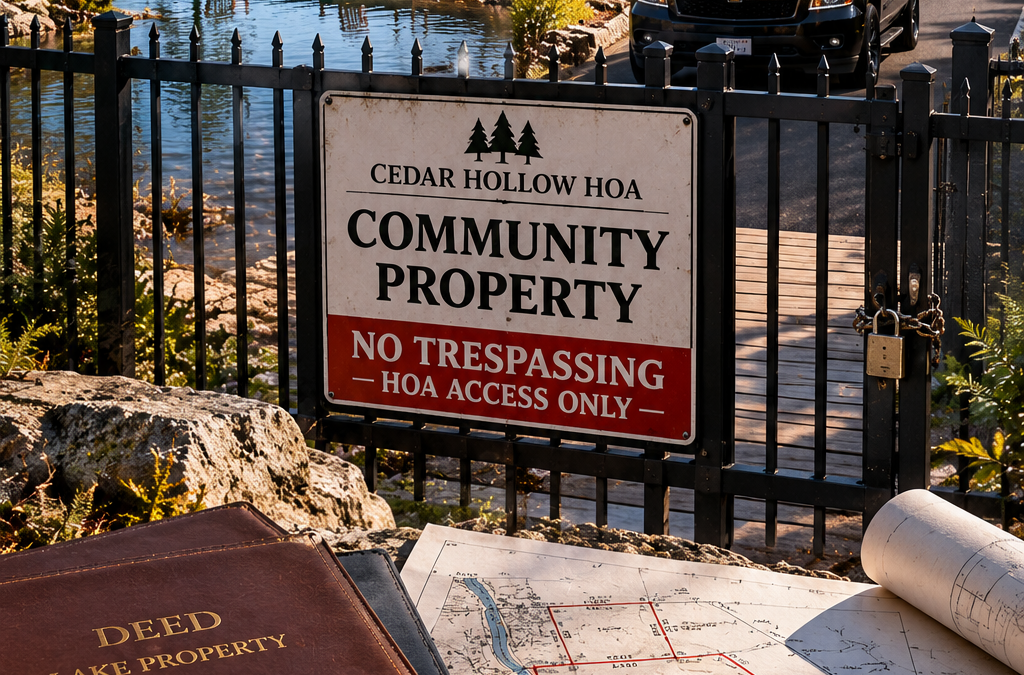
That was when I saw the sign.
Laminated.
Zip-tied to the metal.
Professional lettering.
LAKE ACCESS RESTRICTED
PROPERTY OF CEDAR HOLLOW HOA COMMUNITY TRUST
I stared at those words.
My hands began shaking.
Not from fear.
I have felt fear.
Fear is loud.
It accelerates everything.
This was colder.
My father’s cabin stood behind that fence.
My dock was behind that fence.
The ground where he taught me to cast a line when I was eight years old was behind that fence.
And some board had attached a sign claiming it belonged to them.
I pulled out my phone.
No signal.
That was normal deep in Cedar Hollow, but suddenly it felt suspicious.
Russell had stopped responding regularly several weeks before I returned.
I had assumed poor coverage.
I had left messages.
Nothing urgent.
Just, “I’m coming back soon.”
“Call when you can.”
Now I wondered why.
I drove two miles uphill until I got enough reception to call the HOA’s emergency line.
A woman answered on the fourth ring.
“Cedar Hollow Association, this is Denise.”
Her voice was slow and pleasant.
Administrative.
I gave her my name.
There was a pause.
Then her tone changed in a way I will never forget.
“Oh.”
Another pause.
“You’re back.”
Not “Welcome home.”
Not “I’m sorry, there’s been a problem.”
You’re back.
Like my return was an inconvenience they had been expecting.
“I’m standing in front of my property,” I said.
“Yes.”
“There’s a fence across it.”
“I’m aware.”
“There’s a sign claiming my land belongs to something called the Cedar Hollow HOA Community Trust.”
“That matter was addressed by the board last year.”
I closed my eyes.
“Addressed how?”
“The parcel was reclassified.”
I thought I had misheard her.
“Reclassified as what?”
“An abandoned amenity parcel.”
For two seconds, neither of us spoke.
Then I said, “That is not a legal category.”
“It is under the association’s internal preservation policy.”
“My property is privately deeded.”
“The board determined that the parcel had been effectively abandoned.”
“I did not abandon anything.”
“You were absent.”
“That isn’t abandonment.”
“We were unable to establish contact with you.”
“I’m on federal assignment.”
“I wouldn’t have any knowledge of that.”
“Exactly.”
She continued as if she had just proven her case.
“Your dues account also became delinquent.”
That made me stop.
“No, it didn’t.”
“Our records show otherwise.”
“I prepaid.”
“There was apparently a processing discrepancy.”
“A processing discrepancy?”
“Yes.”
“My payment cleared.”
“I would have to review that.”
“Then review it.”
She sighed.
“We sent three certified notices.”
“To where?”
She gave me an address.
I laughed once.
No humor in it.
I had not lived there in eighteen months.
“That wasn’t my correspondence address.”
“It was the address in our file.”
“You had my email.”
“We received no response.”
“I had restricted access.”
“We couldn’t know that.”
“No, Denise. You couldn’t. Which means you had no basis to assume I had abandoned real estate.”
Her tone hardened slightly.
“The board followed the bylaws.”
“Your bylaws cannot transfer title to three acres of privately owned land.”
“The community trust was created to preserve abandoned recreational resources.”
“Stop saying abandoned.”
“I understand you’re upset.”
That sentence almost made me lose my temper.
Almost.
I spent eighteen months working around people who used politeness as a weapon.
I knew better than to give her something she could later describe as threatening.
So I lowered my voice.
“Who authorized the fence?”
“The board.”
“Who authorized lowering the lake?”
“The board approved erosion work.”
“On whose property?”
“The trust’s.”
I stared down the hill toward my cabin.
“It is not the trust’s property.”
“That determination has already been made.”
“By whom?”
“The board.”
“That is not how property law works.”
“You can appeal.”
“When?”
“The next quarterly review.”
“When is that?”
“Four months.”
I said nothing.
Denise apparently mistook silence for resignation.
She softened her voice again.
“If you submit the documentation, the board can consider your position.”
“My position?”
“Yes.”
“My position is recorded at the county courthouse.”
“I understand.”
“No. I don’t think you do.”
I hung up.
Then I went to find Russell.
His house sat farther uphill behind an old cedar windbreak.
His truck was in the driveway.
I knocked.
Nothing.
I knocked again.
Finally the door opened.
Russell looked twenty years older than the last time I had seen him.
Gray stubble.
Hollow eyes.
Shoulders curved forward.
When he recognized me, his entire expression collapsed.
“Jesus.”
“Russell.”
He looked past me toward the road.
“Come inside.”
That told me almost everything.
We sat in his kitchen.
He didn’t offer coffee.
He just sat across from me and rubbed his face.
“How long?” I asked.
He knew exactly what I meant.
“Most of it started about two months after you left.”
“Tell me everything.”
He stared at the table.
“Gary came first.”
“Gary who?”
“Whitfield. HOA president.”
I knew the name vaguely.
I had met him once at a community road meeting.
Late fifties.
Expensive truck.
The kind of man who liked explaining rules that nobody had asked him about.
Russell continued.
“He showed up with Denise, another board member, and a contractor.”
“At my property?”
“Yes.”
“For what?”
“They said the shoreline had become hazardous.”
“How?”
“Erosion.”
“There wasn’t serious erosion when I left.”
“I told them that.”
“What happened?”
“They said your parcel was in violation and the association had emergency authority.”
I leaned back.
“Emergency authority to enter?”
“That’s what they claimed.”
“What did you do?”
“I showed them your caretaker agreement.”
“And?”
“They said it proved you weren’t occupying the property.”
My jaw tightened.
Russell looked ashamed.
“I told them I had authority to watch the place.”
“You did.”
“They said I didn’t have standing to challenge the board.”
“What happened next?”
“They brought equipment in.”
“What kind?”
“Pump. Mini excavator. Gravel trucks.”
I looked toward the window.
“The lake level.”
Russell nodded.
“They drained the south section down to work on the bank.”
“How much?”
“Too much.”
“Why didn’t you call the county?”
“I did.”
“And?”
“They said it sounded like a civil property issue unless there was an environmental violation.”
“You called me?”
“Every number I had.”
I nodded.
There were stretches where my old voicemail account had filled.
Weeks when calls went unanswered.
I hated that.
But none of it gave the HOA legal authority.
Russell stood and opened a drawer.
He pulled out a stack of papers.
Notices.
Violation letters.
Certified mail receipts.
Photographs.
He pushed them toward me.
“I started documenting everything.”
I looked up at him.
“What did they do after the drainage?”
“Built the fence.”
“And then?”
“Fishing pier.”
I froze.
“They built a pier?”
“Yeah.”
“On my shoreline.”
“Yes.”
“Why?”
Russell looked at me.
“You really don’t know?”
“Know what?”
“They’ve been renting it.”
For a moment, I couldn’t process the sentence.
“Renting what?”
“Lake access.”
I felt the muscles in my shoulders lock.
“To residents?”
“Not just residents.”
“How much?”
“Two hundred dollars a weekend for non-resident packages. More if they reserved the pier for private events.”
I stared at him.
“They are charging strangers to use my lake?”
Russell nodded.
“Started maybe eight months ago.”
My anger changed.
Until that moment, I had still allowed for stupidity.
HOAs do stupid things.
Boards misread bylaws.
Volunteers confuse authority with ownership.
People overreach.
But fencing land, draining water, building improvements, and selling weekend access was not a clerical error.
It was monetization.
“Why didn’t you stop them?”
Russell flinched.
The question came out harsher than I intended.
“I tried.”
He reached for another paper.
This one had his name at the top.
NOTICE OF INTENT TO LIEN
I read it.
They had accused Russell of interference with association contractors.
Then threatened enforcement action against his own property for repeated violations.
“They threatened to lien you?”
“Gary told me if I kept blocking access, they’d bury me in assessments.”
I looked at him.
“I’m sorry.”
“No.”
He shook his head.
“I should’ve done more.”
“You documented it.”
“I should’ve stood in front of the equipment.”
“And then what? Get arrested on my land because some contractor called the sheriff?”
He looked miserable.
“My father trusted me to watch that place.”
“So did I.”
“I failed.”
“No.”
I slid the lien notice back toward him.
“You were threatened by an organization pretending it had authority it didn’t have. That’s on them.”
He didn’t answer.
I gathered every document.
Then I asked one question.
“Where is Gary right now?”
Russell looked at the clock.
“Probably the clubhouse.”
I drove there immediately.
The Cedar Hollow clubhouse had changed since I last saw it.
New stonework.
New landscaping.
New sign.
I noticed that because after what Russell told me, every improvement suddenly looked like money.
Money from where?
I parked and walked inside.
Gary Whitfield sat behind a folding table with Denise and two other board members.
The table was covered with laminated lake-rules signs.
For my lake.
NO GLASS CONTAINERS
CATCH LIMIT THREE
PIER CLOSES AT 9:00 PM
I stood in the doorway.
Gary saw me.
And smiled.
Not surprised.
Not worried.
Smiled.
“We were wondering when you’d show up.”
I walked toward the table.
“Were you?”
Denise looked uncomfortable.
Gary leaned back.
“I understand you spoke with Denise.”
“I did.”
“Then you know the board had to act.”
“Had to?”
“Your parcel was becoming a liability.”
“To whom?”
“To the community.”
“My property was not community property.”
“It bordered shared access.”
“No.”
He waved one hand.
“Look, I understand this is emotional.”
There it was again.
That language.
Make the owner emotional.
Make the board reasonable.
“You left for an extended period,” he continued. “There was no response to notices. Maintenance stopped. Dues became delinquent.”
“My dues were paid.”
“Our books showed a lapse.”
“Your books were wrong.”
“That may be.”
“Then your enforcement was based on false records.”
Gary’s smile faded slightly.
“We had more than one basis.”
“What basis gives an HOA power to seize deeded land?”
“We didn’t seize anything.”
“You put up a fence.”
“For safety.”
“You put up a sign saying the property belongs to your community trust.”
“The board transferred management authority.”
“You cannot transfer management authority over land you don’t own.”
“The matter was handled under the abandoned amenity provision.”
“My parcel was never an amenity.”
“It provided recreational value to the area.”
“So does the mountain behind your house. You don’t own that either.”
One of the board members looked down.
Gary’s face hardened.
“Your absence created a difficult situation.”
“I was on federal deployment.”
That got his attention.
Not much.
Just enough.
“What?”
“I was working under federal orders.”
“I wasn’t aware of that.”
“I have documentation.”
For the first time, the certainty in his face slipped.
Only for a second.
Then it returned.
“Well, that’s unfortunate timing.”
I stared at him.
“Unfortunate timing?”
“The board acted on information available at the time.”
“You had no information showing abandonment.”
“We had eighteen months without occupancy.”
“Occupancy is not ownership.”
“You can make that argument during appeal.”
I almost laughed.
“When?”
“Quarterly session.”
“Four months.”
“That’s the schedule.”
“You want me to wait four months to ask your board for permission to recover my own property?”
“You’re framing this aggressively.”
“I’m describing what happened.”
“The vote already passed.”
“A board vote cannot rewrite a deed.”
Gary leaned forward.
“Then prove it.”
The room became very quiet.
I looked at him for several seconds.
Something inside me settled.
Not anger.
Decision.
“You should be careful, Gary.”
He smiled again.
“Is that a threat?”
“No.”
I placed both hands flat on the table.
“It’s advice.”
He sat back.
I continued.
“You have no idea what I actually do for a living.”
That amused him.
He laughed.
Actually laughed.
Then he said, “Everybody works for somebody.”
“True.”
“Come back with your paperwork.”
“I will.”
I left.
That afternoon, I drove to the county records office.
I requested a certified copy of my deed.
Parcel map.
Tax history.
Lien records.
Transfer records.
There had been no legal transfer.
No foreclosure.
No tax sale.
No recorded encumbrance that could possibly explain the HOA’s claim.
I was still the titled owner.
Exactly as I knew.
I also requested documentation connected to the HOA’s so-called community trust.
Nothing appeared in the land records linking that trust to my parcel.
The next morning, I called the county assessor.
It took three hours and four transfers to reach someone who understood the issue.
When I explained the HOA claimed to have reclassified my land, she actually laughed.
Then stopped when she realized I was serious.
“HOA boards don’t reclassify private parcels for county ownership purposes.”
“I know.”
“Our record still shows you.”
“I know.”
“Then what exactly are they claiming?”
“That their internal policy gave them control.”
“That is not something our office recognizes.”
“I need that in writing.”
She agreed to meet me at the property.
I spent the rest of the day organizing documents.
Deed.
Survey.
Tax receipts.
HOA payment confirmation.
My deployment orders.
Russell’s caretaker agreement.
Photographs of the fence.
Notices he had saved.
I also took pictures of the lowered waterline.
Every fence post.
The pier.
Construction equipment.
Signs.
If this became litigation, I wanted a record.
Two days after confronting Gary, I stood beside the fence holding that folder.
The county assessor was twenty minutes late.
I kept checking the road.
That was when I heard engines.
Not one.
Several.
The sound came from uphill.
Heavy vehicles moving together.
I looked toward Lake View Drive.
Four black SUVs appeared around the bend.
Same model.
Same spacing.
No hesitation.
They moved in a formation I recognized immediately.
That was not a county assessor.
The first SUV slowed near the HOA clubhouse.
The others followed.
They turned together and blocked the clubhouse driveway.
My pulse changed.
Not because I was afraid.
Because I knew that pattern.
Doors opened.
Men and women stepped out wearing dark windbreakers.
Large yellow letters across the back.
FBI.
I stood motionless beside my fence.
Across the road, residents started coming out of houses.
Gary emerged from the clubhouse holding a coffee mug.
He looked annoyed.
Then he saw the jackets.
I watched the color leave his face.
The mug remained halfway between his chest and his mouth.
For one absurd second, neither side moved.
Then an agent stepped from the lead vehicle.
I knew him.
Agent Daniel Marquez.
Three years earlier, we had trained together on a joint task force.
Different agencies.
Same program.
Long days.
Longer nights.
We had stayed loosely in contact afterward.
But I had not spoken with him in months.
I stared.
He stared back.
Then his eyes moved from me to the fence.
Then to the clubhouse.
Then back to me.
His face changed.
“What are you doing here?”
I almost laughed.
“I live here.”
Marquez looked at the eight-foot fence.
“Behind that?”
“Technically.”
He shook his head.
“Small world.”
That phrase turned out to be an understatement.
Gary walked toward them.
“What is this about?”
Marquez turned professional immediately.
“Gary Whitfield?”
Gary’s hand tightened around the mug.
“Yes.”
Two agents moved closer.
“Federal Bureau of Investigation. We have a warrant to search these premises and seize specified financial and electronic records.”
Gary looked toward me.
That was the moment he made the wrong assumption.
His face twisted.
“You called the FBI over a property dispute?”
Marquez looked at me.
Then at him.
“Nobody called us over your property dispute.”
Gary stopped.
I felt cold move through my chest.
Something was connecting.
Something I had not understood yet.
Marquez handed documentation to another agent.
Then he looked at me again.
“You still working the association-fee case?”
I didn’t answer immediately.
Gary heard him.
His expression changed.
Marquez saw it too.
That was when everything clicked.
The eighteen-month investigation.
The shell entities.
Inflated maintenance invoices.
HOA management fees.
Multiple states.
A network we had spent more than a year tracing.
Names had been compartmentalized across teams.
Not every investigator knew every target.
I knew certain entities.
I knew vendor chains.
I knew suspicious transfers.
But I had not personally worked every local board president tied to those accounts.
Marquez had.
And one name had brought him to Cedar Hollow.
Gary Whitfield.
I looked at Gary.
Then at Marquez.
“No.”
Marquez understood my expression.
“You didn’t know?”
“Know what?”
He looked toward the clubhouse.
“Cedar Hollow is in the case.”
For several seconds, I could hear nothing except wind moving through trees.
My own HOA.
My own lake.
Gary.
The fraud investigation I had spent eighteen months working.
They had collided in my driveway.
Not because I had engineered it.
Not because I had called a favor.
Because Gary had apparently been part of the same network we were already closing in on.
Marquez stepped closer to me.
“We’ve been following transfers through something called Cedar Hollow Community Trust.”
I stared at him.
“That sign says my property belongs to Cedar Hollow Community Trust.”
His eyes moved toward the fence.
“You’re kidding.”
“No.”
“What is this?”
“They fenced off my property while I was gone.”
Marquez went still.
Then he slowly looked at Gary.
Gary had stopped speaking.
I asked, “What exactly is the trust?”
Marquez lowered his voice.
“Not what they’ve been telling residents.”
The details came out over the next several hours.
Not all at once.
But enough.
Cedar Hollow Community Trust was not functioning as the benevolent community asset vehicle Gary had represented.
It was a private financial structure tied to accounts controlled by Gary and associated entities.
Money had flowed into it from multiple sources.
Maintenance assessments.
Contractor rebates.
Weekend recreation fees.
Special project charges.
Some transfers were then routed through vendors connected to two HOA presidents in other parts of the state.
From there, money moved offshore.
The arrangement was part of a broader scheme.
The Bureau had been tracing it for more than a year.
The lake rentals were not the central fraud.
But they were part of the money stream.
My property had become an asset Gary could monetize without purchasing it.
He had fenced it.
Branded it.
Improved it using association funds.
Then sold access.
Every weekend rental was revenue derived from land he did not own.
The “erosion repair” was even worse.
The invoice was massively inflated.
A contractor tied to the network had billed Cedar Hollow far more than the actual work cost.
Part of that payment had apparently returned through another entity.
That lowered waterline I had stared at in disbelief was not simply evidence of HOA overreach.
It was connected to a fraudulent invoice.
My father’s shoreline had become a line item in a financial scheme.
Gary’s confidence made sense now.
He had not merely convinced himself the HOA had authority.
He needed the appearance of authority.
The fence.
The signs.
The board vote.
The community trust.
All of it created paperwork he could point to while money moved.
Residents saw an amenity.
Accountants saw maintenance.
Vendors saw contracts.
Gary saw cash flow.
My absence made the property convenient.
An owner who wasn’t around.
Limited contact.
A caretaker who could be intimidated.
A prepaid dues payment that could mysteriously become a “processing error.”
Then came the three certified letters sent to the wrong address.
A paper trail manufactured to show abandonment.
I realized something that made me feel sick.
They had not stumbled into the situation.
They had built it.
Gary stood near the clubhouse entrance as agents moved past him carrying boxes.
Another agent photographed file cabinets.
Two technicians began cataloging computers.
Residents gathered across the road.
Whispers moved through the crowd.
Denise arrived about ten minutes later.
She drove up fast, parked crookedly, and climbed out holding a binder.
“What’s happening?”
An agent approached her.
“Denise Harper?”
Her expression disappeared.
“Yes.”
“We need you to step inside.”
She looked toward Gary.
He wouldn’t meet her eyes.
Then she saw me.
For once, there was nothing sweet in her voice.
“What did you do?”
I almost answered.
Marquez spoke first.
“He didn’t do anything.”
Denise looked at him.
“This is a federal investigation.”
Her hands tightened around the binder.
I recognized the label.
LIEN ENFORCEMENT
The irony was almost unbearable.
Denise had spent months threatening homeowners with association enforcement.
Now she was walking into a clubhouse full of federal agents while holding the paperwork.
She was escorted inside.
Marquez remained outside with me for a moment.
“You really had no idea?”
“No.”
“I assumed you knew Cedar Hollow was one of the targets.”
“My team worked the cross-state vendor side.”
He nodded.
“Compartmentalization.”
“Apparently.”
He looked toward the fence.
“How long has that been there?”
“About a year, according to my neighbor.”
“They took your land?”
“They tried.”
“While you were working the same case?”
I laughed once.
“That part feels personal.”
Marquez shook his head.
“I’m going to need you to stay completely separate from the local warrant execution.”
“I know.”
“You’re potentially a victim now.”
“I know.”
“And a witness.”
“I know.”
He smiled slightly.
“Still hate paperwork?”
“More than ever.”
Then his expression became serious.
“Document everything you found before we arrived.”
“I already did.”
“Of course you did.”
My father would have appreciated that.
Never trust the first number.
Check everything.
By evening, the clubhouse looked like the aftermath of a move.
Agents had carried out boxes of financial records.
Computers were seized.
Hard drives.
Contract files.
Bank statements.
Vendor records.
Digital access logs.
The residents who had gathered stayed for hours.
Some were angry.
Others were stunned.
Several approached me.
Most had assumed the lake legitimately belonged to the HOA.
One elderly man looked genuinely sick when I showed him my deed.
“We’ve been paying for fishing access.”
“I know.”
“For years.”
“I know.”
“I thought the association bought the parcel.”
“They didn’t.”
He stared toward the clubhouse.
“I brought my grandchildren down there.”
“That wasn’t your fault.”
He looked relieved.
I meant it.
The residents were not my enemy.
They had paid what they were told to pay.
They saw a gate, rules, HOA booking forms, and an official pier.
Why would an ordinary family assume all of that was built on stolen access?
The next morning, Gary was taken into custody.
I wasn’t present for the arrest itself.
But by then federal charges related to the broader fraud scheme were being prepared, and the local facts were being reviewed separately.
The news spread quickly through Cedar Hollow.
Suddenly everyone remembered conversations.
Things Gary had said.
Invoices he had pushed through.
Emergency assessments.
Contracts awarded without competitive bids.
One homeowner brought forward emails showing Gary had discouraged questions about maintenance costs.
Another had photographs of contractors working only two days on a project billed as two weeks.
The same people who once trusted him started opening drawers.
Fraud thrives on isolation.
Each person sees one suspicious thing.
A strange fee.
A high invoice.
An aggressive letter.
A board president insisting there is no time for questions.
One person assumes everyone else understands.
Another person thinks it must be legal because nobody is objecting.
Then the moment somebody starts laying all the records side by side, the pattern appears.
That was exactly what happened.
Within days, the Cedar Hollow board collapsed.
Some members resigned immediately.
Others claimed they had no knowledge of the financial scheme.
That became a question for investigators.
Denise was removed from her role pending the investigation.
The association’s outside counsel advised the remaining leadership to stop using the Community Trust structure entirely.
Then came my land.
That was the part I cared about most.
I did not want a symbolic apology.
I wanted the fence gone.
I wanted the false signs removed.
I wanted legal confirmation that no internal HOA resolution, trust declaration, vote, or assessment had altered title.
My attorney filed for emergency relief using the deed, tax records, the assessor’s confirmation, my deployment orders, and the HOA records Russell had preserved.
The judge did not need four months.
It did not require a quarterly board meeting.
It took days.
The HOA was ordered to cease all access claims against my parcel.
The fence could not remain as an assertion of community control.
The lake-rental program was suspended.
The trust’s claimed interest in the property was rejected.
Seventy-two hours later, contractors arrived to remove the fence.
I stood there with Russell.
Neither of us spoke much.
The first section came down with a metallic groan.
The green privacy mesh collapsed into the dirt.
Then another section.
Then another.
For months, Russell had looked through that fence knowing it was wrong and knowing the people responsible could retaliate against him.
Now he watched the posts come out.
At one point, he said, “Your dad would’ve lost his mind.”
I smiled.
“No.”
Russell looked at me.
“He would’ve gone completely silent.”
Russell laughed.
We both knew what that meant.
My father was never loud when he was truly angry.
The pier was different.
Gary had built it on my shoreline without authorization.
I could have demanded its removal.
My attorney initially recommended that.
Then we inspected it.
The structure itself was professionally built.
Stable.
Useful.
And, whether I liked it or not, already there.
Removing it would damage the bank again.
The association’s insurer ultimately covered it as part of the property-restoration process.
Title to the structure remained with the land.
My land.
Gary had managed to build me a fishing pier using money that became part of the restitution dispute.
That outcome was almost too ridiculous to appreciate.
The greater damage was the lake itself.
The drainage work had exposed shoreline and disturbed habitat.
Mud flats remained where water had once reached the grass.
A biologist inspected it.
Fortunately, permanent damage was limited.
The lake would recover as levels stabilized.
Some sections needed restoration.
The association was responsible for remediation costs tied to unauthorized work.
I spent weeks dealing with contractors.
Surveyors.
Attorneys.
Insurance adjusters.
County officials.
Environmental consultants.
None of it was glamorous.
Justice rarely looks like a dramatic final scene.
Usually it looks like invoices.
Certified letters.
Site inspections.
Bank records.
People signing documents in fluorescent-lit offices.
But slowly, the land returned.
The last fence post came out.
The false sign disappeared.
The old driveway reopened.
I drove my truck through for the first time in eighteen months.
I stopped halfway down.
The cabin came into view.
Nothing dramatic happened.
No music.
No sudden sense that everything was fixed.
I just sat there gripping the steering wheel.
The place looked smaller than I remembered.
Paint peeling near one window.
Pine needles piled on the roof.
A shutter hanging slightly crooked.
Home.
I walked inside.
Russell had kept it clean as long as he was able.
Dust covered the shelves.
A stack of mail sat on the kitchen counter.
My father’s old coffee mug was still hanging from the hook beside the sink.
I touched it.
That was when everything finally caught up with me.
Not the FBI.
Not Gary.
Not the fence.
My father.
I had promised him.
Don’t sell it.
I won’t.
People will tell you it’s just dirt.
I know.
It isn’t.
I stood in that kitchen and realized how close I had come to returning to a world where other people had decided his land no longer belonged to us.
They had not succeeded legally.
But they had behaved as if the outcome was inevitable.
That was what disturbed me.
They assumed absence meant weakness.
They assumed distance meant ignorance.
They assumed nobody would come back with enough documentation to challenge them.
Gary’s fraud case became public months later.
I won’t pretend every charge centered on Cedar Hollow.
It didn’t.
The federal investigation was far larger.
Several HOAs.
Management entities.
Contractors.
Financial transfers across multiple jurisdictions.
Cedar Hollow was one branch of a much bigger structure.
Gary was accused of participating in a scheme that diverted association-related funds through fraudulent contracts and connected entities.
The lake revenue helped establish another part of the pattern.
Money came in under the appearance of legitimate community operations.
Then portions moved elsewhere.
The investigation eventually included two other HOA presidents tied to the same network.
What happened to me mattered.
But it was not the whole case.
That distinction matters.
I did not bring the FBI down on Gary because I was angry about my fence.
I had no authority to do that.
No federal agency exists to settle personal HOA grudges.
They arrived because they already had evidence.
They already had warrants.
They already had an investigation.
My property dispute happened to expose another place Gary had become comfortable taking what did not belong to him.
That coincidence terrified him.
I saw it in his face.
At the clubhouse, Gary believed he controlled the timeline.
Four months to appeal.
Board rules.
Internal procedures.
Community trust documents.
Then four black SUVs arrived carrying a completely different timeline.
One he did not control.
The remaining Cedar Hollow board was replaced through emergency elections.
The new members hired a forensic accountant.
That audit uncovered enough irregularities to keep lawyers busy for a long time.
Residents learned that several “community improvement” costs had been inflated.
Some maintenance vendors were legitimate.
Others were connected to entities under investigation.
The new board sent me a formal apology.
I read it once.
Then placed it in my father’s metal file box.
I didn’t need an apology.
I needed records.
Clear ones.
The HOA signed an acknowledgement stating it had no ownership interest in my parcel.
No recreational easement.
No trust interest.
No authority to rent the shoreline.
No ability to charge access fees.
The county records already said that.
Now the HOA’s records said it too.
Russell received a written withdrawal of every violation and lien threat issued against him for interfering with the unauthorized work.
That mattered to me almost as much as recovering the land.
He had spent months believing he failed my father.
He hadn’t.
The people who threatened him failed.
One evening, a few weeks after the fence came down, we stood on the new pier.
The lake was refilling naturally.
The mud line was still visible, but water had returned several feet higher than when I arrived.
Russell handed me a beer.
I don’t remember what brand.
We watched the sunset.
He said, “You going to sell?”
I looked at him.
He smiled.
“Had to ask.”
“No.”
“Good.”
We stood there quietly.
Then he asked, “Did you really know those agents?”
“Some of them.”
“Gary looked like he was going to faint when those trucks came around the corner.”
“He probably had several reasons.”
Russell laughed.
After a while, he became serious.
“You ever think about what would’ve happened if you stayed away another year?”
That question stayed with me.
Because I had.
I had thought about it constantly.
Another year.
Another round of HOA minutes.
Another budget cycle.
Another batch of rental revenue.
Maybe the trust would have existed long enough that residents started genuinely believing the land was legally communal.
Maybe Gary would have created more paperwork.
Maybe he would have tried to record something.
Maybe the pier would become known publicly as Cedar Hollow Pier.
Maybe children would grow up hearing that the lake had always belonged to the community.
That was how these things became dangerous.
Not because time magically changes ownership.
It doesn’t.
But time changes perception.
A false claim repeated long enough starts sounding familiar.
Familiarity starts sounding legitimate.
Then the person with the actual deed looks like the outsider.
I had already seen it happening.
When I first walked into the clubhouse, Gary did not act like a man stealing my property.
He acted like I was interfering with his.
That level of confidence does not appear overnight.
He had built a system around the lie.
Forms.
Signs.
Rules.
Payments.
Meetings.
Contractors.
He had wrapped illegality in administration.
And administration can make almost anything look official.
That lesson changed the way I handled the property.
After everything ended, I had a new survey completed.
Every boundary marker was verified.
Copies went into three locations.
The original deed stayed in a secure box.
Digital copies were encrypted.
The county assessor had updated contact information.
My attorney had authority to respond if I became unreachable again.
The next time duty called, nobody would be able to pretend silence meant abandonment.
I also changed the lake itself.
Not dramatically.
I repaired sections of shoreline.
Restored vegetation.
Let the water level recover.
The pier stayed.
At first, I hated looking at it.
Every plank reminded me of Gary.
Then one afternoon, Russell came down with his granddaughter.
She was six.
He asked if she could fish.
I said yes.
She sat on the pier with her feet swinging above the water and spent forty minutes trying to catch something.
Finally a bluegill took the bait.
She screamed so loudly I thought she had fallen in.
Russell laughed harder than I had heard him laugh since I returned.
I took a picture of them.
That changed the pier for me.
Gary built it for the wrong reasons.
That did not mean he owned what happened there afterward.
The structure became part of my land.
Part of the next chapter.
I started inviting neighbors occasionally.
Not through the HOA.
No rentals.
No access packages.
No signs calling it a community amenity.
Just people I trusted.
If I wanted someone there, they came.
If I didn’t, they didn’t.
That distinction seems simple.
It should be.
But after what happened, it meant everything.
Property rights are often described in legal language.
Title.
Possession.
Exclusion.
Use.
Transfer.
Those terms matter.
But for me, the entire issue eventually came down to one word.
Choice.
My father bought that land because he wanted the choice to build.
The choice to fish.
The choice to sit alone at sunset.
The choice to leave it to his son.
When Gary fenced it off, he did more than trespass.
He took choice away.
He decided the shoreline should be drained.
He decided a pier should exist.
He decided strangers could pay two hundred dollars to use it.
He decided my absence meant I no longer mattered.
He decided Russell’s objections could be silenced with lien threats.
Then he decided I could wait four months for his board to reconsider those decisions.
That was the arrogance underneath everything.
Not simply believing the HOA had authority.
Believing their authority did not need limits.
People sometimes ask what I felt when the FBI vehicles arrived.
Satisfaction would be the easy answer.
It would also be dishonest.
Mostly, I felt disbelief.
I had spent eighteen months working a case that demanded patience every day.
Hours following transfers that looked meaningless.
Invoices that seemed unrelated.
Corporate records designed to hide relationships.
There were times I wondered whether we would ever see the entire network clearly.
Then I came home, stood in front of a fence on my father’s land, and watched that same investigation drive directly into my neighborhood.
The odds felt impossible.
But fraud does that.
Networks that look separate often overlap because people who steal successfully once tend to repeat the behavior.
Gary had grown comfortable.
The community trusted him.
The board deferred to him.
Contractors knew him.
He had procedures.
He had explanations.
He had enough authority to make people doubt themselves.
Why wouldn’t he use someone else’s lake?
To him, my absence probably looked like another opportunity.
He could create a community trust.
Claim preservation authority.
Generate rental income.
Approve an erosion project.
Route money through a familiar contractor.
Everything fit the system.
Until I came home.
My federal work did not make me more entitled to the property than any other homeowner.
That is important.
I did not deserve my land because of my job.
I deserved it because I owned it.
A teacher should not have to be a federal investigator to challenge an HOA.
A nurse should not need agents in black SUVs to prove a deed matters.
A retired mechanic should not need connections to stop a board from fencing off his shoreline.
The paperwork should have been enough.
The deed should have been enough.
The tax records should have been enough.
Russell’s caretaker agreement should have been enough to show the parcel was not abandoned.
The fact that I happened to work inside a federal investigation connected to Gary was extraordinary.
The underlying violation was not.
That is what stayed with me.
Gary believed I was just another absent homeowner.
Had I been exactly that, the outcome should still have been the same.
He had no right to take the land.
Period.
My job only changed the speed at which his other problems arrived.
About a year after I returned, I found something in the cabin attic.
A cardboard box marked with my father’s handwriting.
LAKE
Inside were old photographs.
Receipts.
The original construction sketches for the cabin.
A worn survey from 1988.
Property-tax bills going back decades.
At the bottom was a photograph of my father standing on the unfinished dock.
He looked maybe forty.
Younger than I am now.
He held a hammer in one hand.
Behind him, the lake was bright with afternoon sun.
On the back, he had written a date.
Then beneath it:
Worth every hour.
I sat on the attic floor holding that photograph.
Those three acres had never made my father rich.
They cost him money.
Taxes.
Repairs.
Roof replacements.
Dock lumber.
Storm cleanup.
But he never talked about them as an investment.
He called the place ours.
That was the value.
I framed the photograph and hung it inside the cabin.
Now, every time I walk through the door, I see him standing in front of the lake before Cedar Hollow had gates, trusts, board resolutions, or rental packages.
Before Gary.
Before me.
Just a man who bought three acres and built something because he wanted one place in the world that belonged to his family.
The lake looks almost the same now.
The water level returned.
Grass regrew along the exposed shoreline.
The scar from the drainage work faded.
The fence is gone.
Only small concrete patches remain where the posts once stood.
I could remove them.
I haven’t.
Sometimes I think reminders are useful.
The community-property sign is gone too.
I kept that.
It hangs in the storage shed.
Not as decoration.
Evidence has a long memory.
So does land.
The last time I stood on the pier at sunset, the lake was perfectly still.
No strangers.
No rental groups.
No board members.
Russell had gone home.
The cabin windows reflected the last orange light.
I thought about the morning I left eighteen months earlier.
I had believed the hardest part would be being away.
I was wrong.
The hardest part was returning and realizing other people had used my absence to rewrite reality.
But they never actually changed the deed.
They only changed the signs.
That difference saved everything.
My father once told me never to trust the first number.
After all of this, I think he would have understood the lesson immediately.
Never trust the first notice either.
Or the first board vote.
Or the first person who says, “We already decided.”
Check the record.
Check the boundary.
Check the title.
And when somebody claims authority over something they never owned, make them show exactly where that authority came from.
Gary had signs.
He had minutes.
He had bylaws.
He had a trust with an official-sounding name.
I had one recorded deed.
In the end, that was enough.
The four black SUVs just happened to arrive at the same time.
𝗧𝗛𝗘 𝗘𝗡𝗗
The HOA Fenced Off My Father’s Lake While I Was Gone and Called It Community Property—They Had No Idea Why Four Black SUVs Were Coming Down the Road
Eighteen months after I left home on federal orders, I returned to find an eight-foot fence cutting me off from the only piece of land my father had ever left me.
The sign on that fence said my lake now belonged to the community, but the people who put it there had no idea that something much larger than a property dispute was already moving toward them.
The lake was the first thing my father ever taught me to protect.
Not because it was expensive.
Not because it was valuable.
Because it was ours.
He bought the land in 1987, when Cedar Hollow was little more than pine trees, dirt roads, and a handful of families scattered around a cold, narrow lake in the foothills.
Three acres.
That was all.
Three acres of sloping ground with eighty-seven feet of shoreline, a stand of old pines near the road, and enough room for the cabin he dreamed about building.
He worked construction then.
Not as an owner.
Not as a supervisor.
He was the man carrying lumber, setting forms, framing walls, fixing whatever somebody else had measured wrong.
Every paycheck, he put a little money aside.
The lake property took him six years to pay off.
Then he built the cabin almost entirely by himself.
I was a kid when he started.
Some of my earliest memories are of him standing in sawdust with a pencil tucked behind one ear, looking at a wall like it had personally offended him.
He would step back, squint, measure again, and say, “Never trust the first number.”
I used to laugh.
Later, I realized he wasn’t only talking about carpentry.
My father checked everything.
Receipts.
Boundary markers.
Tax bills.
Insurance policies.
Titles.
He came from a generation of men who believed that if something mattered, you put it in writing and kept the papers somewhere dry.
The deed to the lake property lived in a metal box beneath his bed for twenty-nine years.
When he died, that box became mine.
So did the land.
There was no complicated estate fight.
No siblings arguing over value.
No second family appearing from nowhere.
Just a will, one recorded deed, and one sentence from my father that stayed with me longer than anything written by a lawyer.
He said it three weeks before he died.
We were sitting on the old dock.
He was weaker than I had ever seen him, but he still insisted on walking down to the water every evening.
The sun had already fallen behind the western ridge.
The lake looked almost black.
He stared across it for a long time.
Then he said, “Don’t sell it.”
I looked at him.
“I won’t.”
“People will tell you it’s just dirt.”
“I know.”
“It isn’t.”
“I know.”
He nodded once.
“Good.”
That was the entire conversation.
No dramatic speech.
No explanation.
He didn’t need one.
After his funeral, I transferred everything properly.
The taxes were current.
The title was clean.
The parcel had its own legal description.
I joined the Cedar Hollow Homeowners Association because by then the surrounding development had expanded and membership was tied to certain shared-road obligations.
But the lake parcel itself remained separate.
My cabin was mine.
My shoreline was mine.
The water access attached to that parcel was mine.
The HOA maintained some roads, common landscaping, and two shared recreation areas farther north.
It had no ownership interest in my land.
For years, there was never a serious problem.
Then my work changed.
I’m not going to name the federal agency I work for.
I couldn’t then.
I won’t now.
What matters is that eighteen months before I came home, I received assignment orders that required me to leave quickly.
I had forty-eight hours.
That was it.
There was no option to commute.
No opportunity to return every weekend.
No predictable schedule.
I didn’t know exactly how long I would be gone.
I knew it could be months.
Maybe longer.
So I did everything I thought a responsible property owner should do.
I paid the HOA dues a full year in advance.
I set all county taxes to automatic payment.
I maintained insurance.
I arranged for my neighbor, Russell Hayes, to watch the cabin under a written caretaker agreement.
Russell lived four houses up the road and had known my father for almost twenty years.
He had a key.
He could enter the property.
He could call a plumber, an electrician, or emergency services if needed.
He agreed to walk the shoreline after storms.
Nothing transferred ownership.
Nothing gave him authority to sell, lease, or alter the property.
It was basic caretaking.
The morning I left, I stood on the dock alone.
It was February.
Thin ice covered the shaded edge of the lake.
The cabin looked smaller than usual behind me.
I remember thinking eighteen months away would feel impossible.
I had no idea how much could change in eighteen months.
The assignment took me far enough away that coming home was not practical.
Communication was irregular.
There were stretches when I could use my personal phone and stretches when I couldn’t.
At one point I went almost seven weeks without checking personal email.
But that was expected.
I trusted Russell.
I trusted the documents.
More than anything, I trusted the basic reality that recorded property ownership did not disappear because the owner happened to leave town.
That assumption almost cost me everything.
The investigation I was assigned to was financial.
At first, it seemed like one of those cases that would take three months, generate thirty boxes of records, and quietly end in charges nobody outside our field would ever hear about.
Then the money started moving.
Shell entities.
Management companies.
Contractors billing associations for work that either never happened or cost a fraction of the amount charged.
Funds routed through consulting companies.
Repair accounts that disappeared into private investment vehicles.
It crossed county lines.
Then state lines.
Then the names multiplied.
Homeowners associations.
Property-management firms.
Maintenance vendors.
Board members.
At some point, it stopped being one fraud case and became a network.
I spent eighteen months buried in financial records, witness interviews, subpoenas, and long days in places I’m not going to describe.
I was tired when I finally came home.
Not movie tired.
Not dramatic.
The kind of tired where you stop noticing how exhausted you are because exhaustion has become the normal background of your life.
My only thought during the final drive into Cedar Hollow was the lake.
I wanted to stand on my father’s dock.
That was it.
No celebration.
No reunion party.
Just water.
Silence.
Home.
Lake View Drive curved through a stand of pine before dropping toward my parcel.
I turned the last corner.
And hit the brakes.
At first, I genuinely thought I had taken the wrong road.
An eight-foot chain-link fence ran across the lower section of my property.
Green privacy mesh had been fastened over most of it.
New steel posts were set into concrete.
The open view from the road to the shoreline was gone.
I sat behind the wheel staring at it.
My mind tried to catch up.
I knew every fence around that lake.
This one had never existed.
I drove closer.
The driveway I had used since I was sixteen was blocked by a locked vehicle gate.
I parked on the shoulder.
The silence felt wrong.
Even the lake looked different.
The waterline was lower.
Not slightly.
Significantly.
Mud extended several yards beyond sections that used to be underwater.
At first I thought drought.
Then I saw the drainage equipment near the south bank.
My chest tightened.
I walked to the gate.
That was when I saw the sign.
Laminated.
Zip-tied to the metal.
Professional lettering.
LAKE ACCESS RESTRICTED
PROPERTY OF CEDAR HOLLOW HOA COMMUNITY TRUST
I stared at those words.
My hands began shaking.
Not from fear.
I have felt fear.
Fear is loud.
It accelerates everything.
This was colder.
My father’s cabin stood behind that fence.
My dock was behind that fence.
The ground where he taught me to cast a line when I was eight years old was behind that fence.
And some board had attached a sign claiming it belonged to them.
I pulled out my phone.
No signal.
That was normal deep in Cedar Hollow, but suddenly it felt suspicious.
Russell had stopped responding regularly several weeks before I returned.
I had assumed poor coverage.
I had left messages.
Nothing urgent.
Just, “I’m coming back soon.”
“Call when you can.”
Now I wondered why.
I drove two miles uphill until I got enough reception to call the HOA’s emergency line.
A woman answered on the fourth ring.
“Cedar Hollow Association, this is Denise.”
Her voice was slow and pleasant.
Administrative.
I gave her my name.
There was a pause.
Then her tone changed in a way I will never forget.
“Oh.”
Another pause.
“You’re back.”
Not “Welcome home.”
Not “I’m sorry, there’s been a problem.”
You’re back.
Like my return was an inconvenience they had been expecting.
“I’m standing in front of my property,” I said.
“Yes.”
“There’s a fence across it.”
“I’m aware.”
“There’s a sign claiming my land belongs to something called the Cedar Hollow HOA Community Trust.”
“That matter was addressed by the board last year.”
I closed my eyes.
“Addressed how?”
“The parcel was reclassified.”
I thought I had misheard her.
“Reclassified as what?”
“An abandoned amenity parcel.”
For two seconds, neither of us spoke.
Then I said, “That is not a legal category.”
“It is under the association’s internal preservation policy.”
“My property is privately deeded.”
“The board determined that the parcel had been effectively abandoned.”
“I did not abandon anything.”
“You were absent.”
“That isn’t abandonment.”
“We were unable to establish contact with you.”
“I’m on federal assignment.”
“I wouldn’t have any knowledge of that.”
“Exactly.”
She continued as if she had just proven her case.
“Your dues account also became delinquent.”
That made me stop.
“No, it didn’t.”
“Our records show otherwise.”
“I prepaid.”
“There was apparently a processing discrepancy.”
“A processing discrepancy?”
“Yes.”
“My payment cleared.”
“I would have to review that.”
“Then review it.”
She sighed.
“We sent three certified notices.”
“To where?”
She gave me an address.
I laughed once.
No humor in it.
I had not lived there in eighteen months.
“That wasn’t my correspondence address.”
“It was the address in our file.”
“You had my email.”
“We received no response.”
“I had restricted access.”
“We couldn’t know that.”
“No, Denise. You couldn’t. Which means you had no basis to assume I had abandoned real estate.”
Her tone hardened slightly.
“The board followed the bylaws.”
“Your bylaws cannot transfer title to three acres of privately owned land.”
“The community trust was created to preserve abandoned recreational resources.”
“Stop saying abandoned.”
“I understand you’re upset.”
That sentence almost made me lose my temper.
Almost.
I spent eighteen months working around people who used politeness as a weapon.
I knew better than to give her something she could later describe as threatening.
So I lowered my voice.
“Who authorized the fence?”
“The board.”
“Who authorized lowering the lake?”
“The board approved erosion work.”
“On whose property?”
“The trust’s.”
I stared down the hill toward my cabin.
“It is not the trust’s property.”
“That determination has already been made.”
“By whom?”
“The board.”
“That is not how property law works.”
“You can appeal.”
“When?”
“The next quarterly review.”
“When is that?”
“Four months.”
I said nothing.
Denise apparently mistook silence for resignation.
She softened her voice again.
“If you submit the documentation, the board can consider your position.”
“My position?”
“Yes.”
“My position is recorded at the county courthouse.”
“I understand.”
“No. I don’t think you do.”
I hung up.
Then I went to find Russell.
His house sat farther uphill behind an old cedar windbreak.
His truck was in the driveway.
I knocked.
Nothing.
I knocked again.
Finally the door opened.
Russell looked twenty years older than the last time I had seen him.
Gray stubble.
Hollow eyes.
Shoulders curved forward.
When he recognized me, his entire expression collapsed.
“Jesus.”
“Russell.”
He looked past me toward the road.
“Come inside.”
That told me almost everything.
We sat in his kitchen.
He didn’t offer coffee.
He just sat across from me and rubbed his face.
“How long?” I asked.
He knew exactly what I meant.
“Most of it started about two months after you left.”
“Tell me everything.”
He stared at the table.
“Gary came first.”
“Gary who?”
“Whitfield. HOA president.”
I knew the name vaguely.
I had met him once at a community road meeting.
Late fifties.
Expensive truck.
The kind of man who liked explaining rules that nobody had asked him about.
Russell continued.
“He showed up with Denise, another board member, and a contractor.”
“At my property?”
“Yes.”
“For what?”
“They said the shoreline had become hazardous.”
“How?”
“Erosion.”
“There wasn’t serious erosion when I left.”
“I told them that.”
“What happened?”
“They said your parcel was in violation and the association had emergency authority.”
I leaned back.
“Emergency authority to enter?”
“That’s what they claimed.”
“What did you do?”
“I showed them your caretaker agreement.”
“And?”
“They said it proved you weren’t occupying the property.”
My jaw tightened.
Russell looked ashamed.
“I told them I had authority to watch the place.”
“You did.”
“They said I didn’t have standing to challenge the board.”
“What happened next?”
“They brought equipment in.”
“What kind?”
“Pump. Mini excavator. Gravel trucks.”
I looked toward the window.
“The lake level.”
Russell nodded.
“They drained the south section down to work on the bank.”
“How much?”
“Too much.”
“Why didn’t you call the county?”
“I did.”
“And?”
“They said it sounded like a civil property issue unless there was an environmental violation.”
“You called me?”
“Every number I had.”
I nodded.
There were stretches where my old voicemail account had filled.
Weeks when calls went unanswered.
I hated that.
But none of it gave the HOA legal authority.
Russell stood and opened a drawer.
He pulled out a stack of papers.
Notices.
Violation letters.
Certified mail receipts.
Photographs.
He pushed them toward me.
“I started documenting everything.”
I looked up at him.
“What did they do after the drainage?”
“Built the fence.”
“And then?”
“Fishing pier.”
I froze.
“They built a pier?”
“Yeah.”
“On my shoreline.”
“Yes.”
“Why?”
Russell looked at me.
“You really don’t know?”
“Know what?”
“They’ve been renting it.”
For a moment, I couldn’t process the sentence.
“Renting what?”
“Lake access.”
I felt the muscles in my shoulders lock.
“To residents?”
“Not just residents.”
“How much?”
“Two hundred dollars a weekend for non-resident packages. More if they reserved the pier for private events.”
I stared at him.
“They are charging strangers to use my lake?”
Russell nodded.
“Started maybe eight months ago.”
My anger changed.
Until that moment, I had still allowed for stupidity.
HOAs do stupid things.
Boards misread bylaws.
Volunteers confuse authority with ownership.
People overreach.
But fencing land, draining water, building improvements, and selling weekend access was not a clerical error.
It was monetization.
“Why didn’t you stop them?”
Russell flinched.
The question came out harsher than I intended.
“I tried.”
He reached for another paper.
This one had his name at the top.
NOTICE OF INTENT TO LIEN
I read it.
They had accused Russell of interference with association contractors.
Then threatened enforcement action against his own property for repeated violations.
“They threatened to lien you?”
“Gary told me if I kept blocking access, they’d bury me in assessments.”
I looked at him.
“I’m sorry.”
“No.”
He shook his head.
“I should’ve done more.”
“You documented it.”
“I should’ve stood in front of the equipment.”
“And then what? Get arrested on my land because some contractor called the sheriff?”
He looked miserable.
“My father trusted me to watch that place.”
“So did I.”
“I failed.”
“No.”
I slid the lien notice back toward him.
“You were threatened by an organization pretending it had authority it didn’t have. That’s on them.”
He didn’t answer.
I gathered every document.
Then I asked one question.
“Where is Gary right now?”
Russell looked at the clock.
“Probably the clubhouse.”
I drove there immediately.
The Cedar Hollow clubhouse had changed since I last saw it.
New stonework.
New landscaping.
New sign.
I noticed that because after what Russell told me, every improvement suddenly looked like money.
Money from where?
I parked and walked inside.
Gary Whitfield sat behind a folding table with Denise and two other board members.
The table was covered with laminated lake-rules signs.
For my lake.
NO GLASS CONTAINERS
CATCH LIMIT THREE
PIER CLOSES AT 9:00 PM
I stood in the doorway.
Gary saw me.
And smiled.
Not surprised.
Not worried.
Smiled.
“We were wondering when you’d show up.”
I walked toward the table.
“Were you?”
Denise looked uncomfortable.
Gary leaned back.
“I understand you spoke with Denise.”
“I did.”
“Then you know the board had to act.”
“Had to?”
“Your parcel was becoming a liability.”
“To whom?”
“To the community.”
“My property was not community property.”
“It bordered shared access.”
“No.”
He waved one hand.
“Look, I understand this is emotional.”
There it was again.
That language.
Make the owner emotional.
Make the board reasonable.
“You left for an extended period,” he continued. “There was no response to notices. Maintenance stopped. Dues became delinquent.”
“My dues were paid.”
“Our books showed a lapse.”
“Your books were wrong.”
“That may be.”
“Then your enforcement was based on false records.”
Gary’s smile faded slightly.
“We had more than one basis.”
“What basis gives an HOA power to seize deeded land?”
“We didn’t seize anything.”
“You put up a fence.”
“For safety.”
“You put up a sign saying the property belongs to your community trust.”
“The board transferred management authority.”
“You cannot transfer management authority over land you don’t own.”
“The matter was handled under the abandoned amenity provision.”
“My parcel was never an amenity.”
“It provided recreational value to the area.”
“So does the mountain behind your house. You don’t own that either.”
One of the board members looked down.
Gary’s face hardened.
“Your absence created a difficult situation.”
“I was on federal deployment.”
That got his attention.
Not much.
Just enough.
“What?”
“I was working under federal orders.”
“I wasn’t aware of that.”
“I have documentation.”
For the first time, the certainty in his face slipped.
Only for a second.
Then it returned.
“Well, that’s unfortunate timing.”
I stared at him.
“Unfortunate timing?”
“The board acted on information available at the time.”
“You had no information showing abandonment.”
“We had eighteen months without occupancy.”
“Occupancy is not ownership.”
“You can make that argument during appeal.”
I almost laughed.
“When?”
“Quarterly session.”
“Four months.”
“That’s the schedule.”
“You want me to wait four months to ask your board for permission to recover my own property?”
“You’re framing this aggressively.”
“I’m describing what happened.”
“The vote already passed.”
“A board vote cannot rewrite a deed.”
Gary leaned forward.
“Then prove it.”
The room became very quiet.
I looked at him for several seconds.
Something inside me settled.
Not anger.
Decision.
“You should be careful, Gary.”
He smiled again.
“Is that a threat?”
“No.”
I placed both hands flat on the table.
“It’s advice.”
He sat back.
I continued.
“You have no idea what I actually do for a living.”
That amused him.
He laughed.
Actually laughed.
Then he said, “Everybody works for somebody.”
“True.”
“Come back with your paperwork.”
“I will.”
I left.
That afternoon, I drove to the county records office.
I requested a certified copy of my deed.
Parcel map.
Tax history.
Lien records.
Transfer records.
There had been no legal transfer.
No foreclosure.
No tax sale.
No recorded encumbrance that could possibly explain the HOA’s claim.
I was still the titled owner.
Exactly as I knew.
I also requested documentation connected to the HOA’s so-called community trust.
Nothing appeared in the land records linking that trust to my parcel.
The next morning, I called the county assessor.
It took three hours and four transfers to reach someone who understood the issue.
When I explained the HOA claimed to have reclassified my land, she actually laughed.
Then stopped when she realized I was serious.
“HOA boards don’t reclassify private parcels for county ownership purposes.”
“I know.”
“Our record still shows you.”
“I know.”
“Then what exactly are they claiming?”
“That their internal policy gave them control.”
“That is not something our office recognizes.”
“I need that in writing.”
She agreed to meet me at the property.
I spent the rest of the day organizing documents.
Deed.
Survey.
Tax receipts.
HOA payment confirmation.
My deployment orders.
Russell’s caretaker agreement.
Photographs of the fence.
Notices he had saved.
I also took pictures of the lowered waterline.
Every fence post.
The pier.
Construction equipment.
Signs.
If this became litigation, I wanted a record.
Two days after confronting Gary, I stood beside the fence holding that folder.
The county assessor was twenty minutes late.
I kept checking the road.
That was when I heard engines.
Not one.
Several.
The sound came from uphill.
Heavy vehicles moving together.
I looked toward Lake View Drive.
Four black SUVs appeared around the bend.
Same model.
Same spacing.
No hesitation.
They moved in a formation I recognized immediately.
That was not a county assessor.
The first SUV slowed near the HOA clubhouse.
The others followed.
They turned together and blocked the clubhouse driveway.
My pulse changed.
Not because I was afraid.
Because I knew that pattern.
Doors opened.
Men and women stepped out wearing dark windbreakers.
Large yellow letters across the back.
FBI.
I stood motionless beside my fence.
Across the road, residents started coming out of houses.
Gary emerged from the clubhouse holding a coffee mug.
He looked annoyed.
Then he saw the jackets.
I watched the color leave his face.
The mug remained halfway between his chest and his mouth.
For one absurd second, neither side moved.
Then an agent stepped from the lead vehicle.
I knew him.
Agent Daniel Marquez.
Three years earlier, we had trained together on a joint task force.
Different agencies.
Same program.
Long days.
Longer nights.
We had stayed loosely in contact afterward.
But I had not spoken with him in months.
I stared.
He stared back.
Then his eyes moved from me to the fence.
Then to the clubhouse.
Then back to me.
His face changed.
“What are you doing here?”
I almost laughed.
“I live here.”
Marquez looked at the eight-foot fence.
“Behind that?”
“Technically.”
He shook his head.
“Small world.”
That phrase turned out to be an understatement.
Gary walked toward them.
“What is this about?”
Marquez turned professional immediately.
“Gary Whitfield?”
Gary’s hand tightened around the mug.
“Yes.”
Two agents moved closer.
“Federal Bureau of Investigation. We have a warrant to search these premises and seize specified financial and electronic records.”
Gary looked toward me.
That was the moment he made the wrong assumption.
His face twisted.
“You called the FBI over a property dispute?”
Marquez looked at me.
Then at him.
“Nobody called us over your property dispute.”
Gary stopped.
I felt cold move through my chest.
Something was connecting.
Something I had not understood yet.
Marquez handed documentation to another agent.
Then he looked at me again.
“You still working the association-fee case?”
I didn’t answer immediately.
Gary heard him.
His expression changed.
Marquez saw it too.
That was when everything clicked.
The eighteen-month investigation.
The shell entities.
Inflated maintenance invoices.
HOA management fees.
Multiple states.
A network we had spent more than a year tracing.
Names had been compartmentalized across teams.
Not every investigator knew every target.
I knew certain entities.
I knew vendor chains.
I knew suspicious transfers.
But I had not personally worked every local board president tied to those accounts.
Marquez had.
And one name had brought him to Cedar Hollow.
Gary Whitfield.
I looked at Gary.
Then at Marquez.
“No.”
Marquez understood my expression.
“You didn’t know?”
“Know what?”
He looked toward the clubhouse.
“Cedar Hollow is in the case.”
For several seconds, I could hear nothing except wind moving through trees.
My own HOA.
My own lake.
Gary.
The fraud investigation I had spent eighteen months working.
They had collided in my driveway.
Not because I had engineered it.
Not because I had called a favor.
Because Gary had apparently been part of the same network we were already closing in on.
Marquez stepped closer to me.
“We’ve been following transfers through something called Cedar Hollow Community Trust.”
I stared at him.
“That sign says my property belongs to Cedar Hollow Community Trust.”
His eyes moved toward the fence.
“You’re kidding.”
“No.”
“What is this?”
“They fenced off my property while I was gone.”
Marquez went still.
Then he slowly looked at Gary.
Gary had stopped speaking.
I asked, “What exactly is the trust?”
Marquez lowered his voice.
“Not what they’ve been telling residents.”
The details came out over the next several hours.
Not all at once.
But enough.
Cedar Hollow Community Trust was not functioning as the benevolent community asset vehicle Gary had represented.
It was a private financial structure tied to accounts controlled by Gary and associated entities.
Money had flowed into it from multiple sources.
Maintenance assessments.
Contractor rebates.
Weekend recreation fees.
Special project charges.
Some transfers were then routed through vendors connected to two HOA presidents in other parts of the state.
From there, money moved offshore.
The arrangement was part of a broader scheme.
The Bureau had been tracing it for more than a year.
The lake rentals were not the central fraud.
But they were part of the money stream.
My property had become an asset Gary could monetize without purchasing it.
He had fenced it.
Branded it.
Improved it using association funds.
Then sold access.
Every weekend rental was revenue derived from land he did not own.
The “erosion repair” was even worse.
The invoice was massively inflated.
A contractor tied to the network had billed Cedar Hollow far more than the actual work cost.
Part of that payment had apparently returned through another entity.
That lowered waterline I had stared at in disbelief was not simply evidence of HOA overreach.
It was connected to a fraudulent invoice.
My father’s shoreline had become a line item in a financial scheme.
Gary’s confidence made sense now.
He had not merely convinced himself the HOA had authority.
He needed the appearance of authority.
The fence.
The signs.
The board vote.
The community trust.
All of it created paperwork he could point to while money moved.
Residents saw an amenity.
Accountants saw maintenance.
Vendors saw contracts.
Gary saw cash flow.
My absence made the property convenient.
An owner who wasn’t around.
Limited contact.
A caretaker who could be intimidated.
A prepaid dues payment that could mysteriously become a “processing error.”
Then came the three certified letters sent to the wrong address.
A paper trail manufactured to show abandonment.
I realized something that made me feel sick.
They had not stumbled into the situation.
They had built it.
Gary stood near the clubhouse entrance as agents moved past him carrying boxes.
Another agent photographed file cabinets.
Two technicians began cataloging computers.
Residents gathered across the road.
Whispers moved through the crowd.
Denise arrived about ten minutes later.
She drove up fast, parked crookedly, and climbed out holding a binder.
“What’s happening?”
An agent approached her.
“Denise Harper?”
Her expression disappeared.
“Yes.”
“We need you to step inside.”
She looked toward Gary.
He wouldn’t meet her eyes.
Then she saw me.
For once, there was nothing sweet in her voice.
“What did you do?”
I almost answered.
Marquez spoke first.
“He didn’t do anything.”
Denise looked at him.
“This is a federal investigation.”
Her hands tightened around the binder.
I recognized the label.
LIEN ENFORCEMENT
The irony was almost unbearable.
Denise had spent months threatening homeowners with association enforcement.
Now she was walking into a clubhouse full of federal agents while holding the paperwork.
She was escorted inside.
Marquez remained outside with me for a moment.
“You really had no idea?”
“No.”
“I assumed you knew Cedar Hollow was one of the targets.”
“My team worked the cross-state vendor side.”
He nodded.
“Compartmentalization.”
“Apparently.”
He looked toward the fence.
“How long has that been there?”
“About a year, according to my neighbor.”
“They took your land?”
“They tried.”
“While you were working the same case?”
I laughed once.
“That part feels personal.”
Marquez shook his head.
“I’m going to need you to stay completely separate from the local warrant execution.”
“I know.”
“You’re potentially a victim now.”
“I know.”
“And a witness.”
“I know.”
He smiled slightly.
“Still hate paperwork?”
“More than ever.”
Then his expression became serious.
“Document everything you found before we arrived.”
“I already did.”
“Of course you did.”
My father would have appreciated that.
Never trust the first number.
Check everything.
By evening, the clubhouse looked like the aftermath of a move.
Agents had carried out boxes of financial records.
Computers were seized.
Hard drives.
Contract files.
Bank statements.
Vendor records.
Digital access logs.
The residents who had gathered stayed for hours.
Some were angry.
Others were stunned.
Several approached me.
Most had assumed the lake legitimately belonged to the HOA.
One elderly man looked genuinely sick when I showed him my deed.
“We’ve been paying for fishing access.”
“I know.”
“For years.”
“I know.”
“I thought the association bought the parcel.”
“They didn’t.”
He stared toward the clubhouse.
“I brought my grandchildren down there.”
“That wasn’t your fault.”
He looked relieved.
I meant it.
The residents were not my enemy.
They had paid what they were told to pay.
They saw a gate, rules, HOA booking forms, and an official pier.
Why would an ordinary family assume all of that was built on stolen access?
The next morning, Gary was taken into custody.
I wasn’t present for the arrest itself.
But by then federal charges related to the broader fraud scheme were being prepared, and the local facts were being reviewed separately.
The news spread quickly through Cedar Hollow.
Suddenly everyone remembered conversations.
Things Gary had said.
Invoices he had pushed through.
Emergency assessments.
Contracts awarded without competitive bids.
One homeowner brought forward emails showing Gary had discouraged questions about maintenance costs.
Another had photographs of contractors working only two days on a project billed as two weeks.
The same people who once trusted him started opening drawers.
Fraud thrives on isolation.
Each person sees one suspicious thing.
A strange fee.
A high invoice.
An aggressive letter.
A board president insisting there is no time for questions.
One person assumes everyone else understands.
Another person thinks it must be legal because nobody is objecting.
Then the moment somebody starts laying all the records side by side, the pattern appears.
That was exactly what happened.
Within days, the Cedar Hollow board collapsed.
Some members resigned immediately.
Others claimed they had no knowledge of the financial scheme.
That became a question for investigators.
Denise was removed from her role pending the investigation.
The association’s outside counsel advised the remaining leadership to stop using the Community Trust structure entirely.
Then came my land.
That was the part I cared about most.
I did not want a symbolic apology.
I wanted the fence gone.
I wanted the false signs removed.
I wanted legal confirmation that no internal HOA resolution, trust declaration, vote, or assessment had altered title.
My attorney filed for emergency relief using the deed, tax records, the assessor’s confirmation, my deployment orders, and the HOA records Russell had preserved.
The judge did not need four months.
It did not require a quarterly board meeting.
It took days.
The HOA was ordered to cease all access claims against my parcel.
The fence could not remain as an assertion of community control.
The lake-rental program was suspended.
The trust’s claimed interest in the property was rejected.
Seventy-two hours later, contractors arrived to remove the fence.
I stood there with Russell.
Neither of us spoke much.
The first section came down with a metallic groan.
The green privacy mesh collapsed into the dirt.
Then another section.
Then another.
For months, Russell had looked through that fence knowing it was wrong and knowing the people responsible could retaliate against him.
Now he watched the posts come out.
At one point, he said, “Your dad would’ve lost his mind.”
I smiled.
“No.”
Russell looked at me.
“He would’ve gone completely silent.”
Russell laughed.
We both knew what that meant.
My father was never loud when he was truly angry.
The pier was different.
Gary had built it on my shoreline without authorization.
I could have demanded its removal.
My attorney initially recommended that.
Then we inspected it.
The structure itself was professionally built.
Stable.
Useful.
And, whether I liked it or not, already there.
Removing it would damage the bank again.
The association’s insurer ultimately covered it as part of the property-restoration process.
Title to the structure remained with the land.
My land.
Gary had managed to build me a fishing pier using money that became part of the restitution dispute.
That outcome was almost too ridiculous to appreciate.
The greater damage was the lake itself.
The drainage work had exposed shoreline and disturbed habitat.
Mud flats remained where water had once reached the grass.
A biologist inspected it.
Fortunately, permanent damage was limited.
The lake would recover as levels stabilized.
Some sections needed restoration.
The association was responsible for remediation costs tied to unauthorized work.
I spent weeks dealing with contractors.
Surveyors.
Attorneys.
Insurance adjusters.
County officials.
Environmental consultants.
None of it was glamorous.
Justice rarely looks like a dramatic final scene.
Usually it looks like invoices.
Certified letters.
Site inspections.
Bank records.
People signing documents in fluorescent-lit offices.
But slowly, the land returned.
The last fence post came out.
The false sign disappeared.
The old driveway reopened.
I drove my truck through for the first time in eighteen months.
I stopped halfway down.
The cabin came into view.
Nothing dramatic happened.
No music.
No sudden sense that everything was fixed.
I just sat there gripping the steering wheel.
The place looked smaller than I remembered.
Paint peeling near one window.
Pine needles piled on the roof.
A shutter hanging slightly crooked.
Home.
I walked inside.
Russell had kept it clean as long as he was able.
Dust covered the shelves.
A stack of mail sat on the kitchen counter.
My father’s old coffee mug was still hanging from the hook beside the sink.
I touched it.
That was when everything finally caught up with me.
Not the FBI.
Not Gary.
Not the fence.
My father.
I had promised him.
Don’t sell it.
I won’t.
People will tell you it’s just dirt.
I know.
It isn’t.
I stood in that kitchen and realized how close I had come to returning to a world where other people had decided his land no longer belonged to us.
They had not succeeded legally.
But they had behaved as if the outcome was inevitable.
That was what disturbed me.
They assumed absence meant weakness.
They assumed distance meant ignorance.
They assumed nobody would come back with enough documentation to challenge them.
Gary’s fraud case became public months later.
I won’t pretend every charge centered on Cedar Hollow.
It didn’t.
The federal investigation was far larger.
Several HOAs.
Management entities.
Contractors.
Financial transfers across multiple jurisdictions.
Cedar Hollow was one branch of a much bigger structure.
Gary was accused of participating in a scheme that diverted association-related funds through fraudulent contracts and connected entities.
The lake revenue helped establish another part of the pattern.
Money came in under the appearance of legitimate community operations.
Then portions moved elsewhere.
The investigation eventually included two other HOA presidents tied to the same network.
What happened to me mattered.
But it was not the whole case.
That distinction matters.
I did not bring the FBI down on Gary because I was angry about my fence.
I had no authority to do that.
No federal agency exists to settle personal HOA grudges.
They arrived because they already had evidence.
They already had warrants.
They already had an investigation.
My property dispute happened to expose another place Gary had become comfortable taking what did not belong to him.
That coincidence terrified him.
I saw it in his face.
At the clubhouse, Gary believed he controlled the timeline.
Four months to appeal.
Board rules.
Internal procedures.
Community trust documents.
Then four black SUVs arrived carrying a completely different timeline.
One he did not control.
The remaining Cedar Hollow board was replaced through emergency elections.
The new members hired a forensic accountant.
That audit uncovered enough irregularities to keep lawyers busy for a long time.
Residents learned that several “community improvement” costs had been inflated.
Some maintenance vendors were legitimate.
Others were connected to entities under investigation.
The new board sent me a formal apology.
I read it once.
Then placed it in my father’s metal file box.
I didn’t need an apology.
I needed records.
Clear ones.
The HOA signed an acknowledgement stating it had no ownership interest in my parcel.
No recreational easement.
No trust interest.
No authority to rent the shoreline.
No ability to charge access fees.
The county records already said that.
Now the HOA’s records said it too.
Russell received a written withdrawal of every violation and lien threat issued against him for interfering with the unauthorized work.
That mattered to me almost as much as recovering the land.
He had spent months believing he failed my father.
He hadn’t.
The people who threatened him failed.
One evening, a few weeks after the fence came down, we stood on the new pier.
The lake was refilling naturally.
The mud line was still visible, but water had returned several feet higher than when I arrived.
Russell handed me a beer.
I don’t remember what brand.
We watched the sunset.
He said, “You going to sell?”
I looked at him.
He smiled.
“Had to ask.”
“No.”
“Good.”
We stood there quietly.
Then he asked, “Did you really know those agents?”
“Some of them.”
“Gary looked like he was going to faint when those trucks came around the corner.”
“He probably had several reasons.”
Russell laughed.
After a while, he became serious.
“You ever think about what would’ve happened if you stayed away another year?”
That question stayed with me.
Because I had.
I had thought about it constantly.
Another year.
Another round of HOA minutes.
Another budget cycle.
Another batch of rental revenue.
Maybe the trust would have existed long enough that residents started genuinely believing the land was legally communal.
Maybe Gary would have created more paperwork.
Maybe he would have tried to record something.
Maybe the pier would become known publicly as Cedar Hollow Pier.
Maybe children would grow up hearing that the lake had always belonged to the community.
That was how these things became dangerous.
Not because time magically changes ownership.
It doesn’t.
But time changes perception.
A false claim repeated long enough starts sounding familiar.
Familiarity starts sounding legitimate.
Then the person with the actual deed looks like the outsider.
I had already seen it happening.
When I first walked into the clubhouse, Gary did not act like a man stealing my property.
He acted like I was interfering with his.
That level of confidence does not appear overnight.
He had built a system around the lie.
Forms.
Signs.
Rules.
Payments.
Meetings.
Contractors.
He had wrapped illegality in administration.
And administration can make almost anything look official.
That lesson changed the way I handled the property.
After everything ended, I had a new survey completed.
Every boundary marker was verified.
Copies went into three locations.
The original deed stayed in a secure box.
Digital copies were encrypted.
The county assessor had updated contact information.
My attorney had authority to respond if I became unreachable again.
The next time duty called, nobody would be able to pretend silence meant abandonment.
I also changed the lake itself.
Not dramatically.
I repaired sections of shoreline.
Restored vegetation.
Let the water level recover.
The pier stayed.
At first, I hated looking at it.
Every plank reminded me of Gary.
Then one afternoon, Russell came down with his granddaughter.
She was six.
He asked if she could fish.
I said yes.
She sat on the pier with her feet swinging above the water and spent forty minutes trying to catch something.
Finally a bluegill took the bait.
She screamed so loudly I thought she had fallen in.
Russell laughed harder than I had heard him laugh since I returned.
I took a picture of them.
That changed the pier for me.
Gary built it for the wrong reasons.
That did not mean he owned what happened there afterward.
The structure became part of my land.
Part of the next chapter.
I started inviting neighbors occasionally.
Not through the HOA.
No rentals.
No access packages.
No signs calling it a community amenity.
Just people I trusted.
If I wanted someone there, they came.
If I didn’t, they didn’t.
That distinction seems simple.
It should be.
But after what happened, it meant everything.
Property rights are often described in legal language.
Title.
Possession.
Exclusion.
Use.
Transfer.
Those terms matter.
But for me, the entire issue eventually came down to one word.
Choice.
My father bought that land because he wanted the choice to build.
The choice to fish.
The choice to sit alone at sunset.
The choice to leave it to his son.
When Gary fenced it off, he did more than trespass.
He took choice away.
He decided the shoreline should be drained.
He decided a pier should exist.
He decided strangers could pay two hundred dollars to use it.
He decided my absence meant I no longer mattered.
He decided Russell’s objections could be silenced with lien threats.
Then he decided I could wait four months for his board to reconsider those decisions.
That was the arrogance underneath everything.
Not simply believing the HOA had authority.
Believing their authority did not need limits.
People sometimes ask what I felt when the FBI vehicles arrived.
Satisfaction would be the easy answer.
It would also be dishonest.
Mostly, I felt disbelief.
I had spent eighteen months working a case that demanded patience every day.
Hours following transfers that looked meaningless.
Invoices that seemed unrelated.
Corporate records designed to hide relationships.
There were times I wondered whether we would ever see the entire network clearly.
Then I came home, stood in front of a fence on my father’s land, and watched that same investigation drive directly into my neighborhood.
The odds felt impossible.
But fraud does that.
Networks that look separate often overlap because people who steal successfully once tend to repeat the behavior.
Gary had grown comfortable.
The community trusted him.
The board deferred to him.
Contractors knew him.
He had procedures.
He had explanations.
He had enough authority to make people doubt themselves.
Why wouldn’t he use someone else’s lake?
To him, my absence probably looked like another opportunity.
He could create a community trust.
Claim preservation authority.
Generate rental income.
Approve an erosion project.
Route money through a familiar contractor.
Everything fit the system.
Until I came home.
My federal work did not make me more entitled to the property than any other homeowner.
That is important.
I did not deserve my land because of my job.
I deserved it because I owned it.
A teacher should not have to be a federal investigator to challenge an HOA.
A nurse should not need agents in black SUVs to prove a deed matters.
A retired mechanic should not need connections to stop a board from fencing off his shoreline.
The paperwork should have been enough.
The deed should have been enough.
The tax records should have been enough.
Russell’s caretaker agreement should have been enough to show the parcel was not abandoned.
The fact that I happened to work inside a federal investigation connected to Gary was extraordinary.
The underlying violation was not.
That is what stayed with me.
Gary believed I was just another absent homeowner.
Had I been exactly that, the outcome should still have been the same.
He had no right to take the land.
Period.
My job only changed the speed at which his other problems arrived.
About a year after I returned, I found something in the cabin attic.
A cardboard box marked with my father’s handwriting.
LAKE
Inside were old photographs.
Receipts.
The original construction sketches for the cabin.
A worn survey from 1988.
Property-tax bills going back decades.
At the bottom was a photograph of my father standing on the unfinished dock.
He looked maybe forty.
Younger than I am now.
He held a hammer in one hand.
Behind him, the lake was bright with afternoon sun.
On the back, he had written a date.
Then beneath it:
Worth every hour.
I sat on the attic floor holding that photograph.
Those three acres had never made my father rich.
They cost him money.
Taxes.
Repairs.
Roof replacements.
Dock lumber.
Storm cleanup.
But he never talked about them as an investment.
He called the place ours.
That was the value.
I framed the photograph and hung it inside the cabin.
Now, every time I walk through the door, I see him standing in front of the lake before Cedar Hollow had gates, trusts, board resolutions, or rental packages.
Before Gary.
Before me.
Just a man who bought three acres and built something because he wanted one place in the world that belonged to his family.
The lake looks almost the same now.
The water level returned.
Grass regrew along the exposed shoreline.
The scar from the drainage work faded.
The fence is gone.
Only small concrete patches remain where the posts once stood.
I could remove them.
I haven’t.
Sometimes I think reminders are useful.
The community-property sign is gone too.
I kept that.
It hangs in the storage shed.
Not as decoration.
Evidence has a long memory.
So does land.
The last time I stood on the pier at sunset, the lake was perfectly still.
No strangers.
No rental groups.
No board members.
Russell had gone home.
The cabin windows reflected the last orange light.
I thought about the morning I left eighteen months earlier.
I had believed the hardest part would be being away.
I was wrong.
The hardest part was returning and realizing other people had used my absence to rewrite reality.
But they never actually changed the deed.
They only changed the signs.
That difference saved everything.
My father once told me never to trust the first number.
After all of this, I think he would have understood the lesson immediately.
Never trust the first notice either.
Or the first board vote.
Or the first person who says, “We already decided.”
Check the record.
Check the boundary.
Check the title.
And when somebody claims authority over something they never owned, make them show exactly where that authority came from.
Gary had signs.
He had minutes.
He had bylaws.
He had a trust with an official-sounding name.
I had one recorded deed.
In the end, that was enough.
The four black SUVs just happened to arrive at the same time.




