𝗙𝗨𝗟𝗟 𝗦𝗧𝗢𝗥𝗬 The first time the HOA president told me my family’s boat ramp belonged to the community, she smiled like the deed in my hand was nothing more than sentimental paper. What she didn’t understand was that the harder she pushed, the closer she came to forcing open a piece of history nobody on that lake had bothered to read.
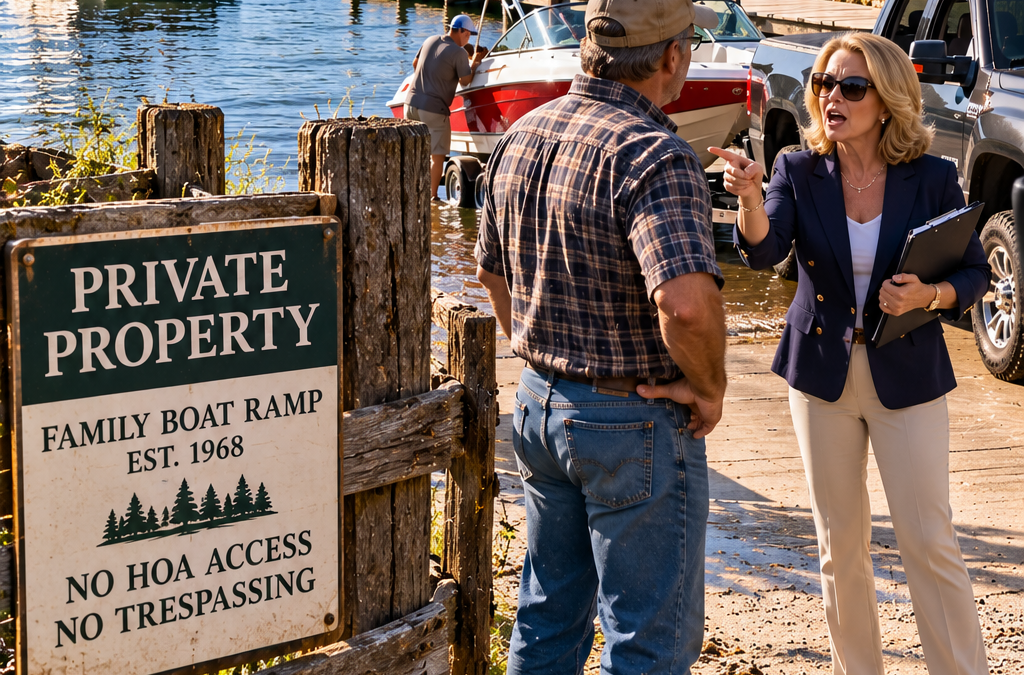
𝗙𝗨𝗟𝗟 𝗦𝗧𝗢𝗥𝗬
She smiled.
“Yes. That one.”
There was something about the way she said it that made me notice the distinction.
Not your ramp.
The old boat ramp.
“Yes,” I said. “It belongs to me.”
She tilted her head slightly.
“We’ve been reviewing shoreline access.”
“Okay.”
“The board is trying to improve consistency around the lake.”
“I’m not part of the HOA.”
“I know.”
She smiled again.
It was the kind of smile people use when they want you to believe a disagreement has already been resolved.
“We’re aware of that technicality.”
Technicality.
That word stayed with me.
My property ownership was not a technicality.
Neither was my grandfather’s deed.
I looked directly at her.
“It isn’t a technicality.”
Her expression barely changed.
“I didn’t mean anything by it.”
“I’m sure.”
She tapped one finger on the steering wheel.
“The board may be reaching out to you soon. We think the ramp could be integrated into the community’s lake-access plan.”
“No.”
She blinked.
I don’t think she expected an answer that quickly.
“I haven’t explained the proposal.”
“You don’t need to.”
“We’re talking about maintenance, insurance, safety—”
“It’s private property.”
“You might want to hear what we’re offering.”
“If you’re offering to buy it, send me something in writing.”
“We’re not talking about buying it.”
“Then there’s nothing to discuss.”
For the first time, the smile disappeared.
Only for a second.
Then it returned.
“Well,” she said, “I’m sure we’ll find a reasonable solution.”
She rolled up the window and drove away.
I stood beside the mailbox watching her SUV disappear around the corner.
At the time, I thought it was merely another HOA president with an inflated sense of jurisdiction.
I had no idea that conversation was the opening move.
Three weeks later, the first certified letter arrived.
The envelope carried the HOA’s logo.
Inside were four pages of carefully formatted legal language.
According to the letter, my boat ramp supposedly fell within a “shared lake access easement” governed by the association.
It claimed all lake-entry points serving the community were required to operate under HOA maintenance and safety standards.
The final section stated that the board had voted to request a transfer of “maintenance and administrative control” over the ramp.
I read that sentence three times.
Transfer control.
Not purchase.
Not lease.
Not negotiate.
Transfer.
They wanted me to give them authority over a piece of my land without paying for it.
I called the phone number at the bottom of the letter.
A woman answered with the calm, rehearsed tone of somebody who had handled angry homeowners before.
I gave her my name.
“Yes,” she said immediately. “Mr. Mercer’s office—excuse me, President Mercer’s office—was expecting your call.”
“I’m sure they were.”
She paused.
“What can I help you with?”
“You can explain why the HOA thinks it controls property that isn’t inside the HOA.”
She started reading from what sounded like prepared language.
“The association has determined that your shoreline structure falls within a broader community lake-access framework—”
“Stop.”
Silence.
“Do you have a recorded easement on my deed?”
“I don’t personally have access to—”
“Then transfer me to someone who does.”
Another pause.
“President Mercer is unavailable.”
“Of course.”
“I can take a message.”
“Tell her the answer is no.”
“Would you like to schedule a discussion?”
“No.”
“A board representative could explain—”
“There’s nothing to explain.”
I hung up.
Then I went upstairs.
In the back of my bedroom closet sat a heavy fireproof document box.
My father gave it to me after my grandfather died.
Inside were property records, tax documents, old surveys, photographs, and my grandfather’s original deed.
That box had survived two moves and one house fire.
The outside was scorched.
One hinge was slightly warped.
The papers inside had survived.
I took the deed to the kitchen table and read it slowly.
Then I read it again.
There was no language giving the HOA control of my shoreline.
There could not have been.
The HOA had not existed in 1968.
There was no communitywide agreement.
No transfer.
No dedication of the ramp.
Nothing.
I scanned the relevant documents and sent a written response.
It was short.
The property was privately owned.
My parcel was not subject to the HOA.
The boat ramp was located entirely within my property boundary.
I would not transfer ownership, maintenance authority, control, or access rights to the association.
I thought that would end it.
It did not.
Two weeks later, another certified envelope arrived.
This letter was different.
The polite language was gone.
The board now claimed that its governing documents recognized a “communitywide lake-access agreement” covering all practical shoreline access points.
It further claimed that my ramp represented the only “viable emergency and recreational water-entry location” along that section of the lake.
The final paragraph said the association was prepared to pursue “all available legal remedies” if I refused to cooperate.
I felt something change inside me as I read it.
The first letter had irritated me.
The second made me angry.
Not frightened.
Angry.
There is something uniquely infuriating about being threatened over something you know belongs to you.
They were not asking.
They were trying to manufacture authority through official-looking paper.
I drove to the HOA office the following morning.
Diane was there.
She sat behind a large desk in a room decorated with framed photographs of the lake.
She did not invite me to sit.
I placed the letter in front of her.
“What legal remedy?”
She looked at the paper.
“You received our notice.”
“I did.”
“Then you understand the board’s position.”
“No. I understand the board made a claim. I’m asking what legal remedy you think allows you to take my ramp.”
Her mouth tightened.
“Nobody is taking anything.”
“You want control over it.”
“For liability purposes.”
“On my land.”
“For community safety.”
“My community?”
“You live inside the geographic boundaries of the neighborhood.”
“That doesn’t put me inside your association.”
“Your property benefits from community infrastructure.”
“I pay county taxes.”
“You use our roads.”
“They’re public until the gate.”
She leaned back.
“You’re being unnecessarily adversarial.”
I almost laughed.
“You sent me a legal threat because I wouldn’t give you control of my property.”
“We sent you notice.”
“You threatened legal action.”
“Because we would prefer not to reach that point.”
That sentence told me everything I needed to know.
Diane did not see herself as the aggressor.
In her mind, my refusal was the problem.
She folded her hands.
“Why are you fighting this so hard?”
I stared at her.
“Because it’s mine.”
“It’s a wooden ramp.”
“It’s my wooden ramp.”
“The association could maintain it.”
“I maintain it.”
“We could insure it.”
“I insure my property.”
“We could improve it.”
“I didn’t ask you to.”
“We could turn it into something useful for everyone.”
There it was.
I had been waiting for honesty.
Not safety.
Not liability.
Not emergency access.
They wanted an amenity.
“What exactly are you planning?” I asked.
Her expression changed just enough to tell me I had touched something.
“That isn’t relevant.”
“It is when you’re threatening to sue me.”
“The board is reviewing several shoreline improvement concepts.”
“Using my land.”
“Potentially incorporating your access point.”
“That means using my land.”
She sighed.
“You’re looking at this emotionally.”
I felt my jaw tighten.
“My grandfather bought that land before your neighborhood existed.”
“That doesn’t mean the community should be denied reasonable access fifty years later.”
I stared at her.
That sentence still makes me angry when I remember it.
Denied.
As though nearly four hundred homeowners had somehow been deprived because I refused to surrender private property they had never owned.
“You’re not entitled to something because it would be convenient to have it.”
Diane stood.
“I think this conversation is becoming unproductive.”
“It became unproductive when you decided no wasn’t an answer.”
Her face hardened.
“The board will proceed accordingly.”
“So will I.”
I left.
That evening, I started making phone calls.
One former HOA board member spoke to me on the condition that I keep his name out of it.
He had served several years earlier.
When I explained what was happening, there was a long silence.
Then he asked, “Did they use the phrase communitywide access agreement?”
“Yes.”
He exhaled.
“That again.”
“What does that mean?”
“It means they’ve used similar arguments before.”
“With who?”
“Several owners.”
My stomach tightened.
He told me about small shoreline strips and access paths around the neighborhood.
Places where property lines were old, descriptions were vague, or owners simply did not have money for lawyers.
The HOA had pressured some of them into agreements.
One widow had signed over maintenance authority to a path beside her home because she feared litigation.
Another homeowner accepted a small payment for perpetual access after receiving repeated letters warning that resisting could expose him to substantial legal costs.
The HOA had discovered something simple.
Most people do not want a legal war with an organization funded by hundreds of dues-paying members.
Threaten enough expense, and people compromise.
Sometimes even when the law is on their side.
I understood then that Diane’s confidence had not come from certainty.
It came from precedent.
Other people had folded.
She expected me to do the same.
I decided to attend the next HOA meeting.
Not to speak.
To listen.
Technically, I was not a member, but the meeting involved community lake access and the board had already made my property part of its agenda.
The clubhouse was packed.
Nearly two hundred residents filled the room.
I took a seat in the back.
Diane stood at the front beside a large easel covered by a cloth.
She worked through ordinary business first.
Landscaping budget.
Pool repairs.
Security contracts.
Then she smiled.
“We have one exciting project to discuss tonight.”
She removed the cloth.
Underneath was a professionally rendered drawing of the shoreline.
I recognized my property immediately.
Except it did not look like my property anymore.
My simple wooden ramp had been replaced by a wide concrete launch area.
Beside it was a floating dock system.
A rental building.
Covered seating.
A small lakeside clubhouse.
Landscaped walkways.
Kayak racks.
Boat storage.
People around me murmured approvingly.
Diane pointed to the rendering.
“The board has been exploring a comprehensive lake-access initiative designed to improve recreational opportunities and property values throughout the community.”
She moved to another rendering.
“We currently have several shoreline access points that are underutilized or inconsistently managed.”
Underutilized.
I felt my hands tighten.
One slide showed highlighted sections around the lake.
Mine was marked as the first phase.
Diane continued.
“Our goal is to bring all significant access points under coordinated association management.”
A homeowner raised his hand.
“Does the HOA own all that property?”
Diane barely hesitated.
“There are historical easements and community-access rights involved. Our legal team is reviewing several technical title issues.”
Technical title issues.
That was what my deed had become.
Another homeowner asked about cost.
Diane smiled.
“Preliminary estimates suggest the project would require a special assessment.”
The room changed immediately.
“How much?”
“We’re still finalizing numbers.”
“How much?”
A board member leaned toward the microphone.
“Potentially between eight and twelve thousand dollars per household, depending on financing.”
People erupted.
Diane raised both hands.
“Please. Please. Property values could increase substantially.”
Someone near the front shouted, “Why are we paying twelve grand for boat rentals?”
Another voice said, “I don’t even own a boat.”
Diane kept talking.
She spoke about resort-style living.
Premium amenities.
Competitive resale value.
The ability to market the neighborhood as having unified private lake access.
That phrase caught me.
Unified private lake access.
They were not solving a safety problem.
They were building a product.
And they intended to use my property as the centerpiece.
I stayed quiet until the meeting ended.
Then I walked outside.
Diane spotted me near the entrance.
For one second, surprise crossed her face.
Then her smile returned.
“Well,” she said. “Now you understand the larger vision.”
“I understand it perfectly.”
“You can see why the ramp matters.”
“I can see why you want it.”
“We’re trying to benefit everyone.”
“With property you don’t own.”
Her smile vanished.
“We have counsel reviewing that question.”
“There’s nothing to review.”
“That’s your opinion.”
“No. That’s my deed.”
She stepped closer.
“You should think carefully before turning this into an expensive legal dispute.”
There it was again.
Not a legal argument.
A financial threat.
I looked at her.
“Was that advice?”
“It’s reality.”
“So is this. I’m not giving you the ramp.”
She lowered her voice.
“You may not ultimately have that choice.”
I went home furious.
But underneath the anger was something else.
A question.
If Diane and the board were so convinced they could claim broad community lake access, what exactly were they relying on?
I had focused entirely on my deed.
Maybe I needed to look at theirs.
Three days later, I walked into the county recorder’s office.
I expected to spend a few hours there.
I ended up spending most of the weekend.
I pulled every document I could find connected to the lake.
Old subdivision maps.
Developer deeds.
Easements.
Shoreline surveys.
Water-management records.
Transfer filings.
Historical plats.
Some documents went back to the 1950s.
Others were handwritten copies of even older descriptions.
At first, nothing seemed important.
Then I noticed my grandfather’s name appearing in places I had never seen before.
Not only on our deed.
On shoreline agreements.
On access maps.
On old water-management filings.
I requested everything associated with his parcel number.
The clerk brought out another set of records.
I sat at a table under fluorescent lights and started reading.
Hours passed.
Then I found it.
An old water-access filing tied to the original parcel.
I read it once.
Then again.
Then a third time.
My grandfather had acquired more than the physical shoreline parcel.
He held underlying legal access rights associated with a substantial portion of the usable shoreline on that side of the lake.
Approximately forty percent.
The rights had been preserved years later when the state redrew water-management boundaries.
They had never been extinguished.
Never transferred to the developer.
Never sold to the HOA.
I felt my pulse begin to climb.
I pulled the developer’s acquisition records.
They had purchased surrounding land.
They had purchased road access.
They had purchased parcels for homes.
They had recorded some recreational easements.
But the documentation transferring those underlying lake-access rights was missing.
I checked again.
Nothing.
The developer appeared to have assumed access came automatically with the land.
It didn’t.
That assumption had then passed forward.
From developer.
To community.
To HOA.
For decades.
I requested the shared dock easements.
That was when the situation became even stranger.
Several of the routes leading residents from common property toward the water were legally described through old easement language connected to the original property holdings from which my grandfather’s parcel had been carved.
My grandfather’s property was not subordinate to the HOA’s lake rights.
Their historic lake-access framework appeared to depend, at least in significant part, on rights originating from his.
I sat back.
For several seconds, I could hear only the hum of the lights.
I thought about Diane telling me I might not have a choice.
I thought about the rendering of my property turned into a resort facility.
I thought about the letters.
The threats.
The phrase communitywide access agreement.
Then I realized what the board had done.
By threatening legal action against me, they had forced me to examine the title history closely enough to discover a gap nobody had apparently confronted in thirty years.
I copied everything.
Then I sat in my truck in the parking lot and read the key filing one more time.
I wanted to make sure anger was not making me see something that was not there.
The language was still there.
The parcel references matched.
The dates matched.
The recorded instruments matched.
I called a real estate attorney.
Her name was Rebecca Sloan.
She specialized in land-use disputes, easements, and complicated title histories.
I brought her two boxes of documents.
She spent almost an hour reading without saying much.
Occasionally she asked a question.
“Your grandfather never sold any portion of these rights?”
“Not that I can find.”
“Your father?”
“No.”
“You?”
“Absolutely not.”
She kept reading.
Finally, she leaned back.
“This is interesting.”
“That sounds expensive.”
She almost smiled.
“It probably will be.”
I waited.
She tapped one of the HOA letters.
“They should never have written this.”
“Why?”
“Because this language matters.”
She pointed to the section where the HOA claimed my ramp fell within their broader community access framework.
“They’re asserting a legal relationship between your parcel and the neighborhood’s lake access.”
“That’s what they’ve been saying.”
“Yes, but they’re doing it while threatening legal action. That means they’re creating a written record of their interpretation.”
“Which is wrong.”
“Potentially very wrong.”
She pulled the old filing closer.
“Based on what I’m seeing, your grandfather’s rights were never properly conveyed to the developer.”
I leaned forward.
“So what does that mean?”
“It means the association’s current lake-access arrangements may not be nearly as secure as they think.”
“How insecure?”
She paused.
“I’m not going to tell you four hundred people suddenly have to stop touching the lake. Decades of use can create complicated legal questions. There may be prescriptive rights, implied rights, later agreements, reliance arguments. We need to review everything.”
That was why I liked her immediately.
She did not promise a dramatic courtroom victory.
She did not pretend old property law was simple.
She told me what she knew and what she did not.
Then she looked at the HOA’s second letter again.
“But they just handed you the exact leverage you needed.”
I stared at her.
“How?”
“Because they came after the one property with the strongest paper trail.”
Over the next two weeks, Rebecca’s office verified the chain of title.
She found additional historical records I had missed.
The situation became clearer.
The HOA had access.
People had been using the lake for decades.
But the legal foundation supporting several of those access points was incomplete.
The developer had built the community around a lake-access assumption without fully securing the underlying rights.
Nobody had challenged it because nobody had needed to.
Until Diane threatened me.
Rebecca sent a formal response to the HOA.
It rejected every claim against my ramp.
It also placed the association on notice that its own use of several shoreline-access routes was subject to unresolved recorded property rights connected to my parcel.
The response requested that the HOA cease making ownership claims against my ramp and enter negotiations to formalize any future access arrangement.
Diane’s attorney replied within forty-eight hours.
Suddenly, their tone was different.
Gone were the threats about legal remedies.
Now they wanted “cooperative clarification.”
Rebecca read the letter across her desk.
“They’re worried.”
“Good.”
“Don’t celebrate yet.”
“I’m not celebrating.”
I was.
A little.
But Rebecca was right.
This was not only about me anymore.
Hundreds of homeowners had bought property believing lake access was secure.
Most of them had nothing to do with Diane’s arrogance.
Some had spent their life savings on those homes.
Others were retirees.
Young families.
People who had trusted closing attorneys, title companies, developers, and the HOA.
I did not want to hurt them.
I wanted the board to stop trying to take what belonged to me.
That distinction mattered.
Diane called me personally two days later.
I almost did not answer.
“Hello?”
Her voice sounded different.
Still controlled.
Less confident.
“I think we should talk.”
“My attorney can talk to yours.”
“This doesn’t need to become hostile.”
I almost dropped the phone.
“You sent me two legal threats.”
“We sent notices.”
“You told me I might not have a choice.”
“I think both sides have made statements under stress.”
“No, Diane. I said no. You made threats.”
Silence.
Then she said, “There are hundreds of families involved now.”
“They were involved when you announced your resort project.”
“That project is obviously under review.”
“Because you discovered you don’t own what you thought you owned?”
Her voice sharpened.
“That is not an accurate characterization.”
“Then correct it at the next board meeting.”
“I’m calling because we can resolve this privately.”
There it was.
Privately.
Before homeowners learned what had happened.
“What are you offering?”
“We withdraw our request regarding the ramp.”
“And?”
“And you withdraw the notice challenging community access.”
I laughed once.
Not because it was funny.
Because the entitlement was unbelievable.
“You want me to give up my legal position in exchange for you agreeing not to take my property.”
“That is not how I would characterize it.”
“I know.”
“We need stability.”
“You should have thought about stability before threatening a lawsuit.”
“This could damage property values.”
“You created this.”
“That kind of language isn’t productive.”
“No. What wasn’t productive was showing two hundred people a rendering of my private land turned into your clubhouse.”
She was silent again.
Finally she said, “What do you want?”
It was the first intelligent question she had asked me.
“I want the board to acknowledge the ramp is private.”
“That can be discussed.”
“I want every claim against my property withdrawn.”
“Fine.”
“I want the community’s actual lake access documented legally.”
Another pause.
“You’re suggesting an easement.”
“I’m suggesting that if hundreds of families depend on rights connected to my land, then those rights should exist on paper instead of assumption.”
“And what would you want in exchange?”
“My attorney will send terms.”
Her voice became colder.
“You’re going to charge the community.”
“I’m going to require the HOA to pay for legal access.”
“For something residents have used for thirty years.”
“Something you just threatened me over.”
“That’s punitive.”
“No. What you tried to do to me was punitive.”
I ended the call.
The next board meeting drew almost three hundred residents.
Word had spread that there was some kind of dispute involving the lake.
Diane had tried to keep the agenda vague.
Rebecca advised me not to let the board frame the issue first.
So I requested time to speak.
They reluctantly approved it.
When I entered the clubhouse that evening, I could feel people watching me.
Some recognized me as the man with the old ramp.
Others had probably heard that I was challenging the HOA’s lake rights.
A few looked angry.
I understood.
Fear makes people look for somebody to blame.
Diane sat at the front table.
She wore a dark blazer and had a stack of papers arranged perfectly in front of her.
When our eyes met, she looked away.
The board handled several minor agenda items first.
Nobody cared.
Everyone was waiting.
Finally, the meeting moderator called my name.
I walked to the microphone carrying a folder.
My hands were steady.
I was surprised by that.
I looked around the room.
“I want to start with something important,” I said. “I am not trying to take the lake away from anyone.”
The room became quiet.
“I’m not trying to stop families from boating. I’m not trying to shut down docks. I’m not trying to damage your homes.”
A man near the aisle said, “Then what is happening?”
I nodded.
“That’s a fair question.”
I held up the first HOA letter.
“Several months ago, your board told me the boat ramp on my private property was subject to HOA control.”
Murmurs moved across the room.
I held up the second.
“When I refused, I was threatened with legal action.”
Diane leaned toward her microphone.
“That is an unfair description.”
I looked at the moderator.
“May I finish?”
He nodded.
I continued.
“My property predates this community. My grandfather bought it in 1968. It was never incorporated into the HOA.”
Someone called out, “We know that.”
“Apparently the board didn’t.”
A few people laughed nervously.
Diane’s face tightened.
I opened the folder.
“Because the HOA threatened legal action, I reviewed the historical title records associated with my property and this lake.”
Now nobody moved.
“What I found was something I don’t believe most people in this room know.”
I lifted a certified copy of the old filing.
“My grandfather didn’t only own the land beneath my boat ramp. Recorded documents show that his property retained underlying access rights tied to a substantial portion of the usable shoreline on this side of the lake.”
Someone near the front said, “What?”
I continued.
“When the developer built this community, those rights were never properly purchased from my family.”
The room erupted.
Diane reached for her microphone.
“There is significant legal disagreement about that statement.”
Rebecca had prepared me for exactly that.
I turned toward her.
“Then you’ll have no objection to residents reviewing the recorded documents.”
I handed copies to the moderator.
Several more packets were passed through the room.
People began reading.
Diane looked furious.
“This material has not been fully adjudicated.”
“I never said it had.”
“You are implying residents have no lake access.”
“No.”
I looked around the room again.
“I am telling residents that the board threatened to seize my ramp using an access framework that their own records do not clearly secure.”
A woman in the second row raised her hand.
“Did the board know this before they announced the new lake project?”
Diane answered quickly.
“No.”
The woman looked stunned.
“So they were planning to spend millions of dollars developing access they didn’t know they legally controlled?”
“That is an oversimplification.”
Another homeowner stood.
“Did counsel review title before proposing the special assessment?”
A board member whispered something to Diane.
She ignored him.
“Our legal team was reviewing multiple property interests.”
The man held up the rendering from the previous meeting.
“You showed us a clubhouse on land you don’t own.”
Applause broke out.
Diane struck the gavel.
“Order.”
A voice shouted from the back.
“Did you threaten him?”
Diane’s face reddened.
“We sent standard legal correspondence.”
I held up the second letter.
“It says the association was prepared to pursue all available legal remedies if I refused to transfer control.”
Several people started talking at once.
Someone shouted, “That sounds like a threat.”
Another yelled, “Why were we never told?”
Diane kept hitting the gavel.
The moderator stood.
“Please. Everyone sit down.”
I waited.
Then I said the sentence I had been holding inside for weeks.
“You didn’t just try to take my boat ramp.”
The room went quiet again.
I looked directly at Diane.
“By forcing me to defend it, you exposed the fact that this entire community never secured the lake rights you assumed it had.”
For several seconds, nobody spoke.
Then chaos exploded.
Residents shouted questions.
People demanded copies.
Someone asked whether their title insurance covered the issue.
Another homeowner wanted to know whether the developer could be sued.
Someone else asked whether the HOA had spent association money threatening me.
Diane’s control of the room disappeared almost instantly.
She kept trying to answer, but every answer created another question.
Finally she stood.
“This meeting is adjourned.”
People booed.
She left through a side door.
I stayed.
Not because I enjoyed what was happening.
I didn’t.
Several residents approached me.
Some were angry.
Most were scared.
An older man named Frank grabbed my arm gently.
“My wife and I bought here because of the lake.”
“I understand.”
“Are you going to block us?”
“No.”
He searched my face.
“You promise?”
“I’m not interested in punishing homeowners.”
His shoulders dropped slightly.
“Then what happens?”
“We put the rights on paper.”
That became my position.
Simple.
Permanent.
Legal.
The HOA would drop every claim against my ramp.
My property would be formally recognized as private.
The association would receive a properly drafted easement securing continued lake access through defined routes.
The agreement would specify maintenance obligations, insurance, liability, access boundaries, and exactly what the HOA could and could not do.
They would not gain authority to expand onto my land.
They would not acquire my boat ramp.
They would not install facilities.
They would not advertise my property as a community amenity.
And they would pay the legal costs required to fix the problem they had forced into the open.
Negotiations lasted four months.
They were ugly.
Diane fought almost every provision.
She objected to language identifying my ramp as exclusively private.
She wanted emergency authority broad enough to allow HOA personnel onto my property whenever the board considered it necessary.
Rebecca crossed that section out.
She wanted the right to perform “improvements” along the access corridor.
Crossed out.
She wanted the ability to assign access rights to future commercial recreational operators.
Crossed out.
She wanted a clause allowing the board to modify shoreline facilities with majority approval.
Rebecca actually laughed when she read that one.
“No.”
The HOA attorney looked exhausted.
Diane leaned forward.
“This community cannot function if one property owner has veto authority over every lake-related decision.”
I looked at her.
“I don’t want authority over your lake decisions.”
“Then why are you restricting improvements?”
“Because you keep calling my property an improvement opportunity.”
“This agreement needs flexibility.”
“It needs boundaries.”
“You’re holding four hundred households hostage.”
That was the moment I finally lost patience.
I stood.
“No.”
Everyone at the table went silent.
“You don’t get to say that.”
Diane stared at me.
“I beg your pardon?”
“You came after me.”
I pointed at her.
“You sent the letters. You threatened legal action. You announced plans to build on my land before you had my permission. You told me I might not have a choice.”
Her jaw tightened.
“And when your mistake exposed a thirty-year title problem, I offered to fix it in a way that keeps every family in this neighborhood on the water.”
I leaned both hands on the table.
“So don’t sit there and call me the hostage-taker because I won’t let you write yourself another loophole into my property.”
Nobody spoke.
Rebecca quietly closed her pen.
Diane sat back.
The HOA attorney rubbed his forehead.
Then he said, “I think we should take a recess.”
After that meeting, something changed.
Not legally.
Politically.
Residents had begun requesting records.
Emails.
Meeting minutes.
Legal invoices.
Project documents.
The proposed resort-style lake facility became especially damaging.
People discovered the board had already spent money on preliminary designs before securing control of my property.
They had discussed marketing the upgraded lake access as a community amenity.
They had even spoken with consultants about boat rentals.
Diane’s claim that the ramp dispute was mainly about safety became harder to defend.
At the next open meeting, one homeowner stood and asked her directly:
“Why did the board spend association money designing facilities on land the HOA did not own?”
Diane gave a long answer about conceptual planning.
Nobody seemed impressed.
Another resident asked why the board’s lawyers had threatened litigation before completing a historical title review.
Diane blamed outdated county records.
Then somebody asked whether the HOA intended to reimburse me for my attorney fees.
She said that had not been decided.
The room erupted again.
By then, I no longer needed to argue.
The homeowners were doing it for me.
The board had tried to frame me as one stubborn man standing in the way of community progress.
Instead, residents increasingly saw something else.
An HOA board that had grown so confident in its own authority that it had stopped asking whether the authority actually existed.
Three board members resigned before the next election.
One sent a short letter saying he had not been fully informed about the legal notices sent to me.
Another said he no longer had confidence in the board’s handling of the dispute.
Diane remained until the end.
She fought harder as her support weakened.
At our final major negotiation, she arrived twenty minutes late.
She placed her folder on the table and said, “We need to finish this.”
Rebecca slid the final draft toward her attorney.
“We agree.”
Diane looked at him.
He nodded.
Her face changed.
Only slightly.
But I saw it.
For months, she had treated compromise as something I was eventually going to be forced into.
Now her own lawyer was telling her the fight was over.
She opened the agreement.
The first important section confirmed that my parcel was outside HOA jurisdiction.
The next confirmed that the ramp remained exclusively private property.
No community recreational access.
No association maintenance authority.
No development rights.
No implied permission.
The easement section granted the HOA specific legal access through designated shoreline routes necessary to preserve the neighborhood’s longstanding use of the lake.
It protected residents.
But it also protected me.
The boundaries were precise.
The permitted uses were precise.
The maintenance responsibilities were precise.
There would be no more vague language.
No more assumptions.
No more board president pointing at a map and deciding private property had become a “community resource.”
The HOA agreed to cover the costs of drafting and recording the easement.
It also agreed to reimburse my reasonable attorney fees connected to defending my ramp and resolving the title issue.
Diane reached the acknowledgment section.
Her eyes stopped.
“This wording is unnecessary.”
Rebecca did not look up.
“It stays.”
Diane read it aloud.
“The association acknowledges that the privately owned boat ramp located on the adjacent parcel is not and has never been an HOA common amenity.”
She looked at me.
“You really need this?”
“Yes.”
“You know what this will look like.”
I thought about my grandfather building that ramp in the mud more than fifty years earlier.
I thought about the first letter.
The second.
The rendering.
The threat.
You may not ultimately have that choice.
“Yes,” I said. “I know exactly what it will look like.”
She signed.
The documents were recorded.
The lake access became secure.
My ramp remained mine.
The resort project died.
Not because I demanded that it die.
Because once residents understood the cost, the title problems, and how the project had been handled, there was no appetite for it anymore.
At the next election, Diane lost her seat.
She did not speak to me afterward.
I saw her once in the parking lot outside the clubhouse.
She looked at me.
I looked at her.
Neither of us said anything.
There was nothing left to say.
Life around the lake slowly returned to normal.
Families used the docks.
Children launched kayaks.
Retirees fished in the mornings.
Pontoon boats moved across the water on summer evenings.
The community did not collapse.
Property values did not disappear.
Nobody lost the lake.
The only thing that disappeared was the board’s assumption that it could claim whatever it wanted if it used enough official language.
My ramp is still there.
The wood has weathered silver.
One of the old support beams was replaced last year.
Every spring, I pressure-wash the surface and inspect the bolts.
Sometimes I stand there with coffee before sunrise.
The lake is busier than it was when my grandfather bought the land.
You can hear garage doors opening across the water.
Boat motors starting.
Children laughing from docks that did not exist when he was alive.
But early enough in the morning, before everybody wakes up, the place still feels almost the way he described it.
Quiet.
Mist over the water.
Pine trees reflected on the surface.
A small ramp leading into the lake.
I keep the old fireproof box in the same closet.
The outside is still blackened from the fire.
The hinge still sticks.
Inside are the deed, the old filings, my grandfather’s documents, and now one more thing.
A certified copy of the easement agreement.
Every time I open that box, I think about how little paper can look like until somebody tries to take what the paper protects.
Diane saw an old ramp.
She saw an amenity waiting to be absorbed.
She saw one homeowner standing between the HOA and a more marketable shoreline.
What she never understood was that private ownership is not measured by how impressive something looks.
My grandfather’s ramp did not have polished concrete.
It did not have landscaping.
It did not have rental slips or decorative lights.
It did not appear in glossy development brochures.
It was just timber, gravel, bolts, and history.
But history mattered.
The deed mattered.
The records mattered.
And most of all, the word no mattered.
Years later, the HOA still has legal access to the lake.
That access is documented now.
Protected.
Defined.
Nobody has to wonder whether some forgotten title defect will suddenly shut families away from the water.
That part of the story ended better than it could have.
But the access exists because an agreement was finally made between people who actually possessed the rights involved.
Not because a board voted itself authority.
And every time the easement paperwork arrives for review, I remember the first conversation beside my mailbox.
Diane sitting behind the wheel of her SUV.
Calling my ownership a technicality.
Telling me the board wanted to “integrate” the ramp.
Smiling as though my answer had already been decided for me.
She had looked at one narrow strip of shoreline and seen something easy to take.
What she could not see was everything underneath it.
My grandfather’s signature.
Fifty years of records.
A chain of ownership nobody had broken.
And a mistake buried so deep in the history of that lake that nobody would have discovered it if she had simply left my family’s property alone.
In the end, I never took the lake away from anybody.
I did the opposite.
I helped make sure the people living there could keep using it legally.
All I demanded in return was something the HOA should have respected from the beginning.
My land was mine.
My grandfather’s ramp was mine.
And no board meeting, threatening letter, architectural rendering, or self-important president was ever going to change that simply because they had decided they wanted it.
𝗧𝗛𝗘 𝗘𝗡𝗗
The first time the HOA president told me my family’s boat ramp belonged to the community, she smiled like the deed in my hand was nothing more than sentimental paper. What she didn’t understand was that the harder she pushed, the closer she came to forcing open a piece of history nobody on that lake had bothered to read.
My grandfather bought the land in 1968.
Back then, there was no gated entrance.
No stone monument with a neighborhood name carved into it.
No rows of matching mailboxes.
No homeowners association.
There were no tennis courts, no landscaped walking paths, no clubhouse overlooking the water, and certainly no board of directors holding monthly meetings to decide what color someone could paint a fence.
There was only forest, shoreline, and a rough dirt road that turned to mud whenever it rained.
My grandfather liked it that way.
He was not a wealthy man.
He worked with his hands his entire life, saved carefully, and bought things only when he believed they would last.
The land was one of those things.
He used to tell me that when he first saw the property, he stood under an old pine tree near the water and knew immediately that he wanted his children and grandchildren to grow up there.
The lake was quieter then.
On summer mornings, mist hung so low over the surface that the opposite shoreline almost disappeared.
My grandfather would wake before sunrise, make coffee so strong it could have stripped paint, and walk down the narrow path toward the water with a tackle box in one hand and a fishing rod in the other.
Dragging a boat through the mud every time became old quickly.
So he built a ramp.
Nothing elaborate.
Just a simple wooden structure reinforced with gravel and timber, angled toward the water so our family could launch a fishing boat without getting buried axle-deep in mud.
He built most of it himself.
My father helped him later with repairs.
Eventually, I helped too.
That ramp was never glamorous.
It was never meant to be.
It was useful.
Private.
Ours.
And for most of my life, nobody questioned that.
The world around it simply changed.
Over the decades, wooded parcels surrounding the lake began selling.
Developers arrived.
Survey markers appeared.
Bulldozers cut roads through land where deer trails had once been the only paths.
By the 1990s, the largest developer in the area had assembled enough property to create what eventually became one of the county’s most expensive gated lake communities.
Nearly four hundred homes were eventually built around the water.
Large homes.
Private cul-de-sacs.
Stone entrances.
Landscaped common areas.
A clubhouse with floor-to-ceiling windows facing the lake.
The brochures sold a particular kind of dream.
Exclusive waterfront living.
Community boating.
Scenic shoreline access.
A private retreat minutes from town.
There was only one problem.
My grandfather’s parcel sat right in the middle of it.
He had never sold.
Neither had my father.
Neither had I.
Our property predated the development by decades, and when the HOA was eventually created, our land was never legally incorporated into it.
That mattered.
It meant I did not pay HOA dues.
I did not vote in HOA elections.
I was not bound by their architectural rules.
Their board could not fine me because my mailbox was the wrong shade of brown or because my grass was half an inch too tall.
My grandfather’s deed remained what it had always been.
Independent property.
For years, everybody seemed to understand that.
Most of my neighbors were perfectly decent people.
Some would wave when I drove past.
A few occasionally asked whether they could launch a kayak from my ramp.
If I knew them, I usually said yes.
Sometimes their children fished from the edge of my property.
I didn’t mind.
Respect went a long way with me.
The trouble began when people stopped asking.
At first, I thought it was accidental.
I would find tire tracks near the ramp.
A boat trailer would appear early Saturday morning.
A family I had never met would be unloading paddleboards.
I would walk down and say, politely, “This is private property.”
Most people apologized.
Some genuinely had no idea.
They assumed everything touching the lake belonged to the HOA.
I understood the confusion.
The neighborhood had been marketed as a lake community for years.
People paid enormous premiums for homes there.
They saw water.
They saw docks.
They saw walking paths.
They naturally assumed the HOA owned whatever gave them access to those things.
The problem was that assumptions do not rewrite deeds.
And they certainly do not transfer ownership.
Things changed when the HOA elected a new board president.
Her name was Diane Mercer.
Diane moved into the neighborhood only a few years before she became president, but she behaved as though she had personally surveyed every acre of it.
She was the kind of person who rarely raised her voice because she had learned that speaking slowly and confidently could be more intimidating.
She dressed immaculately even for Saturday morning board meetings.
Pressed slacks.
Expensive sunglasses.
A leather folder tucked under one arm.
She had a habit of saying the phrase “community standards” as though it were a constitutional principle.
The first conversation I had with her seemed harmless.
I was getting my mail when she pulled her SUV beside the curb.
She lowered the window.
“You’re the owner of the old boat ramp, correct?”
I looked at her.
“The ramp on my property?”
She smiled.
“Yes. That one.”
There was something about the way she said it that made me notice the distinction.
Not your ramp.
The old boat ramp.
“Yes,” I said. “It belongs to me.”
She tilted her head slightly.
“We’ve been reviewing shoreline access.”
“Okay.”
“The board is trying to improve consistency around the lake.”
“I’m not part of the HOA.”
“I know.”
She smiled again.
It was the kind of smile people use when they want you to believe a disagreement has already been resolved.
“We’re aware of that technicality.”
Technicality.
That word stayed with me.
My property ownership was not a technicality.
Neither was my grandfather’s deed.
I looked directly at her.
“It isn’t a technicality.”
Her expression barely changed.
“I didn’t mean anything by it.”
“I’m sure.”
She tapped one finger on the steering wheel.
“The board may be reaching out to you soon. We think the ramp could be integrated into the community’s lake-access plan.”
“No.”
She blinked.
I don’t think she expected an answer that quickly.
“I haven’t explained the proposal.”
“You don’t need to.”
“We’re talking about maintenance, insurance, safety—”
“It’s private property.”
“You might want to hear what we’re offering.”
“If you’re offering to buy it, send me something in writing.”
“We’re not talking about buying it.”
“Then there’s nothing to discuss.”
For the first time, the smile disappeared.
Only for a second.
Then it returned.
“Well,” she said, “I’m sure we’ll find a reasonable solution.”
She rolled up the window and drove away.
I stood beside the mailbox watching her SUV disappear around the corner.
At the time, I thought it was merely another HOA president with an inflated sense of jurisdiction.
I had no idea that conversation was the opening move.
Three weeks later, the first certified letter arrived.
The envelope carried the HOA’s logo.
Inside were four pages of carefully formatted legal language.
According to the letter, my boat ramp supposedly fell within a “shared lake access easement” governed by the association.
It claimed all lake-entry points serving the community were required to operate under HOA maintenance and safety standards.
The final section stated that the board had voted to request a transfer of “maintenance and administrative control” over the ramp.
I read that sentence three times.
Transfer control.
Not purchase.
Not lease.
Not negotiate.
Transfer.
They wanted me to give them authority over a piece of my land without paying for it.
I called the phone number at the bottom of the letter.
A woman answered with the calm, rehearsed tone of somebody who had handled angry homeowners before.
I gave her my name.
“Yes,” she said immediately. “Mr. Mercer’s office—excuse me, President Mercer’s office—was expecting your call.”
“I’m sure they were.”
She paused.
“What can I help you with?”
“You can explain why the HOA thinks it controls property that isn’t inside the HOA.”
She started reading from what sounded like prepared language.
“The association has determined that your shoreline structure falls within a broader community lake-access framework—”
“Stop.”
Silence.
“Do you have a recorded easement on my deed?”
“I don’t personally have access to—”
“Then transfer me to someone who does.”
Another pause.
“President Mercer is unavailable.”
“Of course.”
“I can take a message.”
“Tell her the answer is no.”
“Would you like to schedule a discussion?”
“No.”
“A board representative could explain—”
“There’s nothing to explain.”
I hung up.
Then I went upstairs.
In the back of my bedroom closet sat a heavy fireproof document box.
My father gave it to me after my grandfather died.
Inside were property records, tax documents, old surveys, photographs, and my grandfather’s original deed.
That box had survived two moves and one house fire.
The outside was scorched.
One hinge was slightly warped.
The papers inside had survived.
I took the deed to the kitchen table and read it slowly.
Then I read it again.
There was no language giving the HOA control of my shoreline.
There could not have been.
The HOA had not existed in 1968.
There was no communitywide agreement.
No transfer.
No dedication of the ramp.
Nothing.
I scanned the relevant documents and sent a written response.
It was short.
The property was privately owned.
My parcel was not subject to the HOA.
The boat ramp was located entirely within my property boundary.
I would not transfer ownership, maintenance authority, control, or access rights to the association.
I thought that would end it.
It did not.
Two weeks later, another certified envelope arrived.
This letter was different.
The polite language was gone.
The board now claimed that its governing documents recognized a “communitywide lake-access agreement” covering all practical shoreline access points.
It further claimed that my ramp represented the only “viable emergency and recreational water-entry location” along that section of the lake.
The final paragraph said the association was prepared to pursue “all available legal remedies” if I refused to cooperate.
I felt something change inside me as I read it.
The first letter had irritated me.
The second made me angry.
Not frightened.
Angry.
There is something uniquely infuriating about being threatened over something you know belongs to you.
They were not asking.
They were trying to manufacture authority through official-looking paper.
I drove to the HOA office the following morning.
Diane was there.
She sat behind a large desk in a room decorated with framed photographs of the lake.
She did not invite me to sit.
I placed the letter in front of her.
“What legal remedy?”
She looked at the paper.
“You received our notice.”
“I did.”
“Then you understand the board’s position.”
“No. I understand the board made a claim. I’m asking what legal remedy you think allows you to take my ramp.”
Her mouth tightened.
“Nobody is taking anything.”
“You want control over it.”
“For liability purposes.”
“On my land.”
“For community safety.”
“My community?”
“You live inside the geographic boundaries of the neighborhood.”
“That doesn’t put me inside your association.”
“Your property benefits from community infrastructure.”
“I pay county taxes.”
“You use our roads.”
“They’re public until the gate.”
She leaned back.
“You’re being unnecessarily adversarial.”
I almost laughed.
“You sent me a legal threat because I wouldn’t give you control of my property.”
“We sent you notice.”
“You threatened legal action.”
“Because we would prefer not to reach that point.”
That sentence told me everything I needed to know.
Diane did not see herself as the aggressor.
In her mind, my refusal was the problem.
She folded her hands.
“Why are you fighting this so hard?”
I stared at her.
“Because it’s mine.”
“It’s a wooden ramp.”
“It’s my wooden ramp.”
“The association could maintain it.”
“I maintain it.”
“We could insure it.”
“I insure my property.”
“We could improve it.”
“I didn’t ask you to.”
“We could turn it into something useful for everyone.”
There it was.
I had been waiting for honesty.
Not safety.
Not liability.
Not emergency access.
They wanted an amenity.
“What exactly are you planning?” I asked.
Her expression changed just enough to tell me I had touched something.
“That isn’t relevant.”
“It is when you’re threatening to sue me.”
“The board is reviewing several shoreline improvement concepts.”
“Using my land.”
“Potentially incorporating your access point.”
“That means using my land.”
She sighed.
“You’re looking at this emotionally.”
I felt my jaw tighten.
“My grandfather bought that land before your neighborhood existed.”
“That doesn’t mean the community should be denied reasonable access fifty years later.”
I stared at her.
That sentence still makes me angry when I remember it.
Denied.
As though nearly four hundred homeowners had somehow been deprived because I refused to surrender private property they had never owned.
“You’re not entitled to something because it would be convenient to have it.”
Diane stood.
“I think this conversation is becoming unproductive.”
“It became unproductive when you decided no wasn’t an answer.”
Her face hardened.
“The board will proceed accordingly.”
“So will I.”
I left.
That evening, I started making phone calls.
One former HOA board member spoke to me on the condition that I keep his name out of it.
He had served several years earlier.
When I explained what was happening, there was a long silence.
Then he asked, “Did they use the phrase communitywide access agreement?”
“Yes.”
He exhaled.
“That again.”
“What does that mean?”
“It means they’ve used similar arguments before.”
“With who?”
“Several owners.”
My stomach tightened.
He told me about small shoreline strips and access paths around the neighborhood.
Places where property lines were old, descriptions were vague, or owners simply did not have money for lawyers.
The HOA had pressured some of them into agreements.
One widow had signed over maintenance authority to a path beside her home because she feared litigation.
Another homeowner accepted a small payment for perpetual access after receiving repeated letters warning that resisting could expose him to substantial legal costs.
The HOA had discovered something simple.
Most people do not want a legal war with an organization funded by hundreds of dues-paying members.
Threaten enough expense, and people compromise.
Sometimes even when the law is on their side.
I understood then that Diane’s confidence had not come from certainty.
It came from precedent.
Other people had folded.
She expected me to do the same.
I decided to attend the next HOA meeting.
Not to speak.
To listen.
Technically, I was not a member, but the meeting involved community lake access and the board had already made my property part of its agenda.
The clubhouse was packed.
Nearly two hundred residents filled the room.
I took a seat in the back.
Diane stood at the front beside a large easel covered by a cloth.
She worked through ordinary business first.
Landscaping budget.
Pool repairs.
Security contracts.
Then she smiled.
“We have one exciting project to discuss tonight.”
She removed the cloth.
Underneath was a professionally rendered drawing of the shoreline.
I recognized my property immediately.
Except it did not look like my property anymore.
My simple wooden ramp had been replaced by a wide concrete launch area.
Beside it was a floating dock system.
A rental building.
Covered seating.
A small lakeside clubhouse.
Landscaped walkways.
Kayak racks.
Boat storage.
People around me murmured approvingly.
Diane pointed to the rendering.
“The board has been exploring a comprehensive lake-access initiative designed to improve recreational opportunities and property values throughout the community.”
She moved to another rendering.
“We currently have several shoreline access points that are underutilized or inconsistently managed.”
Underutilized.
I felt my hands tighten.
One slide showed highlighted sections around the lake.
Mine was marked as the first phase.
Diane continued.
“Our goal is to bring all significant access points under coordinated association management.”
A homeowner raised his hand.
“Does the HOA own all that property?”
Diane barely hesitated.
“There are historical easements and community-access rights involved. Our legal team is reviewing several technical title issues.”
Technical title issues.
That was what my deed had become.
Another homeowner asked about cost.
Diane smiled.
“Preliminary estimates suggest the project would require a special assessment.”
The room changed immediately.
“How much?”
“We’re still finalizing numbers.”
“How much?”
A board member leaned toward the microphone.
“Potentially between eight and twelve thousand dollars per household, depending on financing.”
People erupted.
Diane raised both hands.
“Please. Please. Property values could increase substantially.”
Someone near the front shouted, “Why are we paying twelve grand for boat rentals?”
Another voice said, “I don’t even own a boat.”
Diane kept talking.
She spoke about resort-style living.
Premium amenities.
Competitive resale value.
The ability to market the neighborhood as having unified private lake access.
That phrase caught me.
Unified private lake access.
They were not solving a safety problem.
They were building a product.
And they intended to use my property as the centerpiece.
I stayed quiet until the meeting ended.
Then I walked outside.
Diane spotted me near the entrance.
For one second, surprise crossed her face.
Then her smile returned.
“Well,” she said. “Now you understand the larger vision.”
“I understand it perfectly.”
“You can see why the ramp matters.”
“I can see why you want it.”
“We’re trying to benefit everyone.”
“With property you don’t own.”
Her smile vanished.
“We have counsel reviewing that question.”
“There’s nothing to review.”
“That’s your opinion.”
“No. That’s my deed.”
She stepped closer.
“You should think carefully before turning this into an expensive legal dispute.”
There it was again.
Not a legal argument.
A financial threat.
I looked at her.
“Was that advice?”
“It’s reality.”
“So is this. I’m not giving you the ramp.”
She lowered her voice.
“You may not ultimately have that choice.”
I went home furious.
But underneath the anger was something else.
A question.
If Diane and the board were so convinced they could claim broad community lake access, what exactly were they relying on?
I had focused entirely on my deed.
Maybe I needed to look at theirs.
Three days later, I walked into the county recorder’s office.
I expected to spend a few hours there.
I ended up spending most of the weekend.
I pulled every document I could find connected to the lake.
Old subdivision maps.
Developer deeds.
Easements.
Shoreline surveys.
Water-management records.
Transfer filings.
Historical plats.
Some documents went back to the 1950s.
Others were handwritten copies of even older descriptions.
At first, nothing seemed important.
Then I noticed my grandfather’s name appearing in places I had never seen before.
Not only on our deed.
On shoreline agreements.
On access maps.
On old water-management filings.
I requested everything associated with his parcel number.
The clerk brought out another set of records.
I sat at a table under fluorescent lights and started reading.
Hours passed.
Then I found it.
An old water-access filing tied to the original parcel.
I read it once.
Then again.
Then a third time.
My grandfather had acquired more than the physical shoreline parcel.
He held underlying legal access rights associated with a substantial portion of the usable shoreline on that side of the lake.
Approximately forty percent.
The rights had been preserved years later when the state redrew water-management boundaries.
They had never been extinguished.
Never transferred to the developer.
Never sold to the HOA.
I felt my pulse begin to climb.
I pulled the developer’s acquisition records.
They had purchased surrounding land.
They had purchased road access.
They had purchased parcels for homes.
They had recorded some recreational easements.
But the documentation transferring those underlying lake-access rights was missing.
I checked again.
Nothing.
The developer appeared to have assumed access came automatically with the land.
It didn’t.
That assumption had then passed forward.
From developer.
To community.
To HOA.
For decades.
I requested the shared dock easements.
That was when the situation became even stranger.
Several of the routes leading residents from common property toward the water were legally described through old easement language connected to the original property holdings from which my grandfather’s parcel had been carved.
My grandfather’s property was not subordinate to the HOA’s lake rights.
Their historic lake-access framework appeared to depend, at least in significant part, on rights originating from his.
I sat back.
For several seconds, I could hear only the hum of the lights.
I thought about Diane telling me I might not have a choice.
I thought about the rendering of my property turned into a resort facility.
I thought about the letters.
The threats.
The phrase communitywide access agreement.
Then I realized what the board had done.
By threatening legal action against me, they had forced me to examine the title history closely enough to discover a gap nobody had apparently confronted in thirty years.
I copied everything.
Then I sat in my truck in the parking lot and read the key filing one more time.
I wanted to make sure anger was not making me see something that was not there.
The language was still there.
The parcel references matched.
The dates matched.
The recorded instruments matched.
I called a real estate attorney.
Her name was Rebecca Sloan.
She specialized in land-use disputes, easements, and complicated title histories.
I brought her two boxes of documents.
She spent almost an hour reading without saying much.
Occasionally she asked a question.
“Your grandfather never sold any portion of these rights?”
“Not that I can find.”
“Your father?”
“No.”
“You?”
“Absolutely not.”
She kept reading.
Finally, she leaned back.
“This is interesting.”
“That sounds expensive.”
She almost smiled.
“It probably will be.”
I waited.
She tapped one of the HOA letters.
“They should never have written this.”
“Why?”
“Because this language matters.”
She pointed to the section where the HOA claimed my ramp fell within their broader community access framework.
“They’re asserting a legal relationship between your parcel and the neighborhood’s lake access.”
“That’s what they’ve been saying.”
“Yes, but they’re doing it while threatening legal action. That means they’re creating a written record of their interpretation.”
“Which is wrong.”
“Potentially very wrong.”
She pulled the old filing closer.
“Based on what I’m seeing, your grandfather’s rights were never properly conveyed to the developer.”
I leaned forward.
“So what does that mean?”
“It means the association’s current lake-access arrangements may not be nearly as secure as they think.”
“How insecure?”
She paused.
“I’m not going to tell you four hundred people suddenly have to stop touching the lake. Decades of use can create complicated legal questions. There may be prescriptive rights, implied rights, later agreements, reliance arguments. We need to review everything.”
That was why I liked her immediately.
She did not promise a dramatic courtroom victory.
She did not pretend old property law was simple.
She told me what she knew and what she did not.
Then she looked at the HOA’s second letter again.
“But they just handed you the exact leverage you needed.”
I stared at her.
“How?”
“Because they came after the one property with the strongest paper trail.”
Over the next two weeks, Rebecca’s office verified the chain of title.
She found additional historical records I had missed.
The situation became clearer.
The HOA had access.
People had been using the lake for decades.
But the legal foundation supporting several of those access points was incomplete.
The developer had built the community around a lake-access assumption without fully securing the underlying rights.
Nobody had challenged it because nobody had needed to.
Until Diane threatened me.
Rebecca sent a formal response to the HOA.
It rejected every claim against my ramp.
It also placed the association on notice that its own use of several shoreline-access routes was subject to unresolved recorded property rights connected to my parcel.
The response requested that the HOA cease making ownership claims against my ramp and enter negotiations to formalize any future access arrangement.
Diane’s attorney replied within forty-eight hours.
Suddenly, their tone was different.
Gone were the threats about legal remedies.
Now they wanted “cooperative clarification.”
Rebecca read the letter across her desk.
“They’re worried.”
“Good.”
“Don’t celebrate yet.”
“I’m not celebrating.”
I was.
A little.
But Rebecca was right.
This was not only about me anymore.
Hundreds of homeowners had bought property believing lake access was secure.
Most of them had nothing to do with Diane’s arrogance.
Some had spent their life savings on those homes.
Others were retirees.
Young families.
People who had trusted closing attorneys, title companies, developers, and the HOA.
I did not want to hurt them.
I wanted the board to stop trying to take what belonged to me.
That distinction mattered.
Diane called me personally two days later.
I almost did not answer.
“Hello?”
Her voice sounded different.
Still controlled.
Less confident.
“I think we should talk.”
“My attorney can talk to yours.”
“This doesn’t need to become hostile.”
I almost dropped the phone.
“You sent me two legal threats.”
“We sent notices.”
“You told me I might not have a choice.”
“I think both sides have made statements under stress.”
“No, Diane. I said no. You made threats.”
Silence.
Then she said, “There are hundreds of families involved now.”
“They were involved when you announced your resort project.”
“That project is obviously under review.”
“Because you discovered you don’t own what you thought you owned?”
Her voice sharpened.
“That is not an accurate characterization.”
“Then correct it at the next board meeting.”
“I’m calling because we can resolve this privately.”
There it was.
Privately.
Before homeowners learned what had happened.
“What are you offering?”
“We withdraw our request regarding the ramp.”
“And?”
“And you withdraw the notice challenging community access.”
I laughed once.
Not because it was funny.
Because the entitlement was unbelievable.
“You want me to give up my legal position in exchange for you agreeing not to take my property.”
“That is not how I would characterize it.”
“I know.”
“We need stability.”
“You should have thought about stability before threatening a lawsuit.”
“This could damage property values.”
“You created this.”
“That kind of language isn’t productive.”
“No. What wasn’t productive was showing two hundred people a rendering of my private land turned into your clubhouse.”
She was silent again.
Finally she said, “What do you want?”
It was the first intelligent question she had asked me.
“I want the board to acknowledge the ramp is private.”
“That can be discussed.”
“I want every claim against my property withdrawn.”
“Fine.”
“I want the community’s actual lake access documented legally.”
Another pause.
“You’re suggesting an easement.”
“I’m suggesting that if hundreds of families depend on rights connected to my land, then those rights should exist on paper instead of assumption.”
“And what would you want in exchange?”
“My attorney will send terms.”
Her voice became colder.
“You’re going to charge the community.”
“I’m going to require the HOA to pay for legal access.”
“For something residents have used for thirty years.”
“Something you just threatened me over.”
“That’s punitive.”
“No. What you tried to do to me was punitive.”
I ended the call.
The next board meeting drew almost three hundred residents.
Word had spread that there was some kind of dispute involving the lake.
Diane had tried to keep the agenda vague.
Rebecca advised me not to let the board frame the issue first.
So I requested time to speak.
They reluctantly approved it.
When I entered the clubhouse that evening, I could feel people watching me.
Some recognized me as the man with the old ramp.
Others had probably heard that I was challenging the HOA’s lake rights.
A few looked angry.
I understood.
Fear makes people look for somebody to blame.
Diane sat at the front table.
She wore a dark blazer and had a stack of papers arranged perfectly in front of her.
When our eyes met, she looked away.
The board handled several minor agenda items first.
Nobody cared.
Everyone was waiting.
Finally, the meeting moderator called my name.
I walked to the microphone carrying a folder.
My hands were steady.
I was surprised by that.
I looked around the room.
“I want to start with something important,” I said. “I am not trying to take the lake away from anyone.”
The room became quiet.
“I’m not trying to stop families from boating. I’m not trying to shut down docks. I’m not trying to damage your homes.”
A man near the aisle said, “Then what is happening?”
I nodded.
“That’s a fair question.”
I held up the first HOA letter.
“Several months ago, your board told me the boat ramp on my private property was subject to HOA control.”
Murmurs moved across the room.
I held up the second.
“When I refused, I was threatened with legal action.”
Diane leaned toward her microphone.
“That is an unfair description.”
I looked at the moderator.
“May I finish?”
He nodded.
I continued.
“My property predates this community. My grandfather bought it in 1968. It was never incorporated into the HOA.”
Someone called out, “We know that.”
“Apparently the board didn’t.”
A few people laughed nervously.
Diane’s face tightened.
I opened the folder.
“Because the HOA threatened legal action, I reviewed the historical title records associated with my property and this lake.”
Now nobody moved.
“What I found was something I don’t believe most people in this room know.”
I lifted a certified copy of the old filing.
“My grandfather didn’t only own the land beneath my boat ramp. Recorded documents show that his property retained underlying access rights tied to a substantial portion of the usable shoreline on this side of the lake.”
Someone near the front said, “What?”
I continued.
“When the developer built this community, those rights were never properly purchased from my family.”
The room erupted.
Diane reached for her microphone.
“There is significant legal disagreement about that statement.”
Rebecca had prepared me for exactly that.
I turned toward her.
“Then you’ll have no objection to residents reviewing the recorded documents.”
I handed copies to the moderator.
Several more packets were passed through the room.
People began reading.
Diane looked furious.
“This material has not been fully adjudicated.”
“I never said it had.”
“You are implying residents have no lake access.”
“No.”
I looked around the room again.
“I am telling residents that the board threatened to seize my ramp using an access framework that their own records do not clearly secure.”
A woman in the second row raised her hand.
“Did the board know this before they announced the new lake project?”
Diane answered quickly.
“No.”
The woman looked stunned.
“So they were planning to spend millions of dollars developing access they didn’t know they legally controlled?”
“That is an oversimplification.”
Another homeowner stood.
“Did counsel review title before proposing the special assessment?”
A board member whispered something to Diane.
She ignored him.
“Our legal team was reviewing multiple property interests.”
The man held up the rendering from the previous meeting.
“You showed us a clubhouse on land you don’t own.”
Applause broke out.
Diane struck the gavel.
“Order.”
A voice shouted from the back.
“Did you threaten him?”
Diane’s face reddened.
“We sent standard legal correspondence.”
I held up the second letter.
“It says the association was prepared to pursue all available legal remedies if I refused to transfer control.”
Several people started talking at once.
Someone shouted, “That sounds like a threat.”
Another yelled, “Why were we never told?”
Diane kept hitting the gavel.
The moderator stood.
“Please. Everyone sit down.”
I waited.
Then I said the sentence I had been holding inside for weeks.
“You didn’t just try to take my boat ramp.”
The room went quiet again.
I looked directly at Diane.
“By forcing me to defend it, you exposed the fact that this entire community never secured the lake rights you assumed it had.”
For several seconds, nobody spoke.
Then chaos exploded.
Residents shouted questions.
People demanded copies.
Someone asked whether their title insurance covered the issue.
Another homeowner wanted to know whether the developer could be sued.
Someone else asked whether the HOA had spent association money threatening me.
Diane’s control of the room disappeared almost instantly.
She kept trying to answer, but every answer created another question.
Finally she stood.
“This meeting is adjourned.”
People booed.
She left through a side door.
I stayed.
Not because I enjoyed what was happening.
I didn’t.
Several residents approached me.
Some were angry.
Most were scared.
An older man named Frank grabbed my arm gently.
“My wife and I bought here because of the lake.”
“I understand.”
“Are you going to block us?”
“No.”
He searched my face.
“You promise?”
“I’m not interested in punishing homeowners.”
His shoulders dropped slightly.
“Then what happens?”
“We put the rights on paper.”
That became my position.
Simple.
Permanent.
Legal.
The HOA would drop every claim against my ramp.
My property would be formally recognized as private.
The association would receive a properly drafted easement securing continued lake access through defined routes.
The agreement would specify maintenance obligations, insurance, liability, access boundaries, and exactly what the HOA could and could not do.
They would not gain authority to expand onto my land.
They would not acquire my boat ramp.
They would not install facilities.
They would not advertise my property as a community amenity.
And they would pay the legal costs required to fix the problem they had forced into the open.
Negotiations lasted four months.
They were ugly.
Diane fought almost every provision.
She objected to language identifying my ramp as exclusively private.
She wanted emergency authority broad enough to allow HOA personnel onto my property whenever the board considered it necessary.
Rebecca crossed that section out.
She wanted the right to perform “improvements” along the access corridor.
Crossed out.
She wanted the ability to assign access rights to future commercial recreational operators.
Crossed out.
She wanted a clause allowing the board to modify shoreline facilities with majority approval.
Rebecca actually laughed when she read that one.
“No.”
The HOA attorney looked exhausted.
Diane leaned forward.
“This community cannot function if one property owner has veto authority over every lake-related decision.”
I looked at her.
“I don’t want authority over your lake decisions.”
“Then why are you restricting improvements?”
“Because you keep calling my property an improvement opportunity.”
“This agreement needs flexibility.”
“It needs boundaries.”
“You’re holding four hundred households hostage.”
That was the moment I finally lost patience.
I stood.
“No.”
Everyone at the table went silent.
“You don’t get to say that.”
Diane stared at me.
“I beg your pardon?”
“You came after me.”
I pointed at her.
“You sent the letters. You threatened legal action. You announced plans to build on my land before you had my permission. You told me I might not have a choice.”
Her jaw tightened.
“And when your mistake exposed a thirty-year title problem, I offered to fix it in a way that keeps every family in this neighborhood on the water.”
I leaned both hands on the table.
“So don’t sit there and call me the hostage-taker because I won’t let you write yourself another loophole into my property.”
Nobody spoke.
Rebecca quietly closed her pen.
Diane sat back.
The HOA attorney rubbed his forehead.
Then he said, “I think we should take a recess.”
After that meeting, something changed.
Not legally.
Politically.
Residents had begun requesting records.
Emails.
Meeting minutes.
Legal invoices.
Project documents.
The proposed resort-style lake facility became especially damaging.
People discovered the board had already spent money on preliminary designs before securing control of my property.
They had discussed marketing the upgraded lake access as a community amenity.
They had even spoken with consultants about boat rentals.
Diane’s claim that the ramp dispute was mainly about safety became harder to defend.
At the next open meeting, one homeowner stood and asked her directly:
“Why did the board spend association money designing facilities on land the HOA did not own?”
Diane gave a long answer about conceptual planning.
Nobody seemed impressed.
Another resident asked why the board’s lawyers had threatened litigation before completing a historical title review.
Diane blamed outdated county records.
Then somebody asked whether the HOA intended to reimburse me for my attorney fees.
She said that had not been decided.
The room erupted again.
By then, I no longer needed to argue.
The homeowners were doing it for me.
The board had tried to frame me as one stubborn man standing in the way of community progress.
Instead, residents increasingly saw something else.
An HOA board that had grown so confident in its own authority that it had stopped asking whether the authority actually existed.
Three board members resigned before the next election.
One sent a short letter saying he had not been fully informed about the legal notices sent to me.
Another said he no longer had confidence in the board’s handling of the dispute.
Diane remained until the end.
She fought harder as her support weakened.
At our final major negotiation, she arrived twenty minutes late.
She placed her folder on the table and said, “We need to finish this.”
Rebecca slid the final draft toward her attorney.
“We agree.”
Diane looked at him.
He nodded.
Her face changed.
Only slightly.
But I saw it.
For months, she had treated compromise as something I was eventually going to be forced into.
Now her own lawyer was telling her the fight was over.
She opened the agreement.
The first important section confirmed that my parcel was outside HOA jurisdiction.
The next confirmed that the ramp remained exclusively private property.
No community recreational access.
No association maintenance authority.
No development rights.
No implied permission.
The easement section granted the HOA specific legal access through designated shoreline routes necessary to preserve the neighborhood’s longstanding use of the lake.
It protected residents.
But it also protected me.
The boundaries were precise.
The permitted uses were precise.
The maintenance responsibilities were precise.
There would be no more vague language.
No more assumptions.
No more board president pointing at a map and deciding private property had become a “community resource.”
The HOA agreed to cover the costs of drafting and recording the easement.
It also agreed to reimburse my reasonable attorney fees connected to defending my ramp and resolving the title issue.
Diane reached the acknowledgment section.
Her eyes stopped.
“This wording is unnecessary.”
Rebecca did not look up.
“It stays.”
Diane read it aloud.
“The association acknowledges that the privately owned boat ramp located on the adjacent parcel is not and has never been an HOA common amenity.”
She looked at me.
“You really need this?”
“Yes.”
“You know what this will look like.”
I thought about my grandfather building that ramp in the mud more than fifty years earlier.
I thought about the first letter.
The second.
The rendering.
The threat.
You may not ultimately have that choice.
“Yes,” I said. “I know exactly what it will look like.”
She signed.
The documents were recorded.
The lake access became secure.
My ramp remained mine.
The resort project died.
Not because I demanded that it die.
Because once residents understood the cost, the title problems, and how the project had been handled, there was no appetite for it anymore.
At the next election, Diane lost her seat.
She did not speak to me afterward.
I saw her once in the parking lot outside the clubhouse.
She looked at me.
I looked at her.
Neither of us said anything.
There was nothing left to say.
Life around the lake slowly returned to normal.
Families used the docks.
Children launched kayaks.
Retirees fished in the mornings.
Pontoon boats moved across the water on summer evenings.
The community did not collapse.
Property values did not disappear.
Nobody lost the lake.
The only thing that disappeared was the board’s assumption that it could claim whatever it wanted if it used enough official language.
My ramp is still there.
The wood has weathered silver.
One of the old support beams was replaced last year.
Every spring, I pressure-wash the surface and inspect the bolts.
Sometimes I stand there with coffee before sunrise.
The lake is busier than it was when my grandfather bought the land.
You can hear garage doors opening across the water.
Boat motors starting.
Children laughing from docks that did not exist when he was alive.
But early enough in the morning, before everybody wakes up, the place still feels almost the way he described it.
Quiet.
Mist over the water.
Pine trees reflected on the surface.
A small ramp leading into the lake.
I keep the old fireproof box in the same closet.
The outside is still blackened from the fire.
The hinge still sticks.
Inside are the deed, the old filings, my grandfather’s documents, and now one more thing.
A certified copy of the easement agreement.
Every time I open that box, I think about how little paper can look like until somebody tries to take what the paper protects.
Diane saw an old ramp.
She saw an amenity waiting to be absorbed.
She saw one homeowner standing between the HOA and a more marketable shoreline.
What she never understood was that private ownership is not measured by how impressive something looks.
My grandfather’s ramp did not have polished concrete.
It did not have landscaping.
It did not have rental slips or decorative lights.
It did not appear in glossy development brochures.
It was just timber, gravel, bolts, and history.
But history mattered.
The deed mattered.
The records mattered.
And most of all, the word no mattered.
Years later, the HOA still has legal access to the lake.
That access is documented now.
Protected.
Defined.
Nobody has to wonder whether some forgotten title defect will suddenly shut families away from the water.
That part of the story ended better than it could have.
But the access exists because an agreement was finally made between people who actually possessed the rights involved.
Not because a board voted itself authority.
And every time the easement paperwork arrives for review, I remember the first conversation beside my mailbox.
Diane sitting behind the wheel of her SUV.
Calling my ownership a technicality.
Telling me the board wanted to “integrate” the ramp.
Smiling as though my answer had already been decided for me.
She had looked at one narrow strip of shoreline and seen something easy to take.
What she could not see was everything underneath it.
My grandfather’s signature.
Fifty years of records.
A chain of ownership nobody had broken.
And a mistake buried so deep in the history of that lake that nobody would have discovered it if she had simply left my family’s property alone.
In the end, I never took the lake away from anybody.
I did the opposite.
I helped make sure the people living there could keep using it legally.
All I demanded in return was something the HOA should have respected from the beginning.
My land was mine.
My grandfather’s ramp was mine.
And no board meeting, threatening letter, architectural rendering, or self-important president was ever going to change that simply because they had decided they wanted it.




