𝗙𝗨𝗟𝗟 𝗦𝗧𝗢𝗥𝗬 The first time the HOA fined me for talking on my own front porch, I thought it was ridiculous enough to laugh about. The moment they started watching my house because I found a way to obey their rule without giving them control, I understood that noise had never been the real problem.
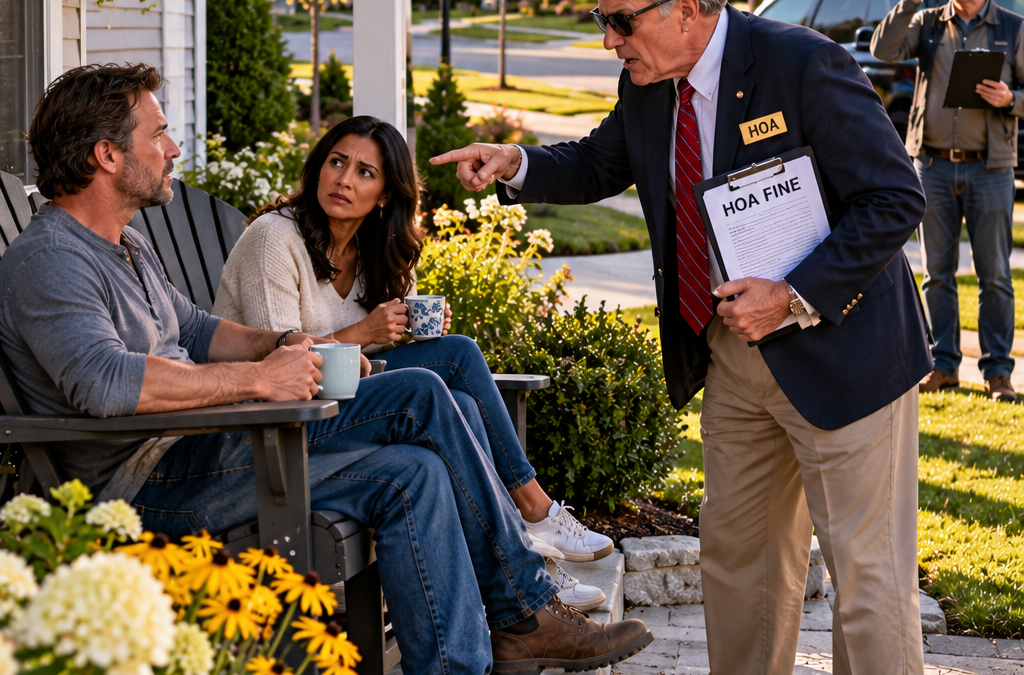
𝗙𝗨𝗟𝗟 𝗦𝗧𝗢𝗥𝗬
Whether rabbits were getting into her raised beds.
Whether my maple tree was dying or just dramatic.
Normal neighbor conversation.
Neither of us raised our voices.
Neither of us drank enough to become loud.
There was no music.
No television.
No crowd.
Just two adults talking on a front porch.
Apparently, that was enough.
One Tuesday morning, I opened my front door and found a yellow sticky note attached beside the handle.
PLEASE KEEP PORCH NOISE TO A MINIMUM AFTER 8:00 P.M.
COMMUNITY STANDARDS COMMITTEE
There was no signature.
No date.
No reference to any actual rule.
I stared at it for a few seconds.
Then I laughed.
I took a picture, sent it to Priya, and wrote:
Apparently our discussion about tomato blight got out of control.
She replied:
I’ll try to whisper about zucchini.
That evening she came over at seven-thirty.
We talked exactly the way we always did.
At eight, neither of us suddenly lowered our voices because we weren’t loud to begin with.
Nothing happened.
The next evening was the same.
And the next.
About two weeks later, I received an official HOA envelope.
This one had Maple Hollow letterhead.
The language was more serious.
NOTICE OF VIOLATION
The letter claimed that I had conducted an “audible conversation” on my front porch at a volume “exceeding the acceptable decibel range for a residential zone.”
Fine: twenty-five dollars.
Evidence:
“Observed by board member.”
I read that line twice.
Observed.
Not measured.
There was no decibel reading.
No time duration.
No meter calibration.
No description of where the supposed sound had been measured from.
Someone had heard me talking and decided that hearing me was evidence enough that I was too loud.
I pulled out the HOA bylaws.
I’d received them when I bought the house.
The entire packet was barely longer than a restaurant menu.
I found the section on nuisance noise.
It prohibited “excessive, prolonged, or unreasonable disturbance.”
That was it.
No decibel limit.
No porch restriction.
No eight o’clock cutoff.
No rule against conversations.
I called the management company.
A woman named Tracy answered.
I gave her the violation number.
I heard keyboard clicking.
Then she said, “That was submitted directly by the board.”
“Was there a measurement?”
“I’m not showing one.”
“The notice specifically says I exceeded an acceptable decibel range.”
“That’s what the board submitted.”
“What range?”
Silence.
More clicking.
“I’m not seeing a numerical standard in the file.”
“So how did I exceed it?”
Another pause.
“The board has discretion regarding nuisance enforcement.”
There it was.
Discretion.
A word that sounds reasonable until the wrong person discovers how much he enjoys using it.
I paid the twenty-five dollars.
Not because I thought the fine was valid.
Because at that point, twenty-five dollars seemed cheaper than arguing with Roy Falner.
That was my first mistake.
The following Saturday, I walked to the community mailbox and found Roy standing beside his Suburban.
Clipboard under one arm.
Sunglasses on despite a sky the color of wet cement.
He waited until I had taken my mail out.
“Daniel.”
I turned.
“Roy.”
“I saw the payment came through.”
“Congratulations.”
His mouth tightened.
“I don’t think sarcasm is helpful.”
“I wasn’t trying to be helpful.”
He shifted the clipboard against his ribs.
“Community standards aren’t optional, Daniel.”
There it was again.
I looked at him.
“Roy, Priya and I were talking about tomatoes.”
“It doesn’t matter what you’re talking about.”
“Apparently not.”
“It’s how sound carries.”
“How loud were we?”
“Loud enough for me to hear.”
“From where?”
He pointed toward the street.
“My vehicle.”
I glanced at the Suburban.
“You were sitting in your car?”
“I was conducting a neighborhood observation.”
“With the window down?”
His expression changed slightly.
That was answer enough.
“You sat across from my house with your window open and listened to us talking?”
“You make it sound inappropriate.”
“I’m describing what you just told me.”
“I don’t have to justify how the board monitors compliance.”
I felt something shift inside me.
Not anger exactly.
At least not yet.
Recognition.
I’d dealt with administrators like Roy before.
People who treated uncertainty as a weakness and authority as a personality.
Once they decided they were entitled to control a situation, the facts became secondary.
“I’ll keep that in mind,” I said.
Roy smiled faintly.
“I suggest you do.”
I went home.
That night, I sat alone on the porch longer than usual.
The street was quiet.
A sprinkler clicked three houses away.
Somebody closed a garage door.
A child laughed somewhere behind the row of houses across from me.
Normal sounds.
Human sounds.
I kept thinking about Roy sitting in his Suburban with the window down, waiting to hear my voice.
And something about it bothered me more than the twenty-five dollars.
It wasn’t the money.
It was the idea that I had started monitoring myself.
I had actually caught myself wondering whether I should avoid using my porch.
My porch.
My chair.
My home.
That was when I made a decision.
The next evening, Priya came over carrying her tea.
She stepped onto the porch.
“Are we risking another twenty-five-dollar tomato conversation?”
I didn’t answer.
Instead, I lifted my hands.
Good evening.
How are you?
Her expression changed immediately.
She stared at my hands.
Then at me.
“You know sign language?”
I nodded.
I signed:
Nine years.
Then I spoke.
“I taught in the deaf and hard-of-hearing program before I changed careers.”
Her mouth opened.
“You never told me that.”
“You never asked.”
“Nine years?”
“Elementary program. Mostly second through fifth grade.”
She sat down slowly.
“That is possibly the most interesting thing I have learned about you.”
“That says something depressing about me.”
She laughed.
“Teach me.”
So I did.
We started with basic greetings.
Hello.
How are you?
Good.
Bad.
Coffee.
Tea.
Neighbor.
Garden.
Priya learned fast.
Within forty minutes she was fingerspelling the names of vegetables.
Within an hour she could tell me, very slowly, that a rabbit had destroyed three pepper plants.
By the second hour, our conversation had become a strange combination of ASL, improvised gestures, facial expressions, and Priya pointing angrily toward her garden while signing a very inaccurate version of rabbit.
We laughed.
Quietly.
For the first time in weeks, I sat on my porch without thinking about Roy.
No volume.
No “audible conversation.”
No supposed decibel violation.
Just hands moving beneath the porch light.
I slept better that night.
The next evening, we did it again.
And the next.
Within a week, Priya had learned enough to hold a basic conversation.
Sometimes we spoke before eight and signed after.
Eventually we stopped speaking almost entirely.
Not because we were afraid of Roy.
Because signing had become enjoyable.
There was a concentration to it.
A rhythm.
You looked directly at the person you were talking to.
You noticed expressions.
Small movements mattered.
Priya said it felt like conversation without static.
I liked that description.
Roy did not.
The first time I noticed him watching us, he was walking his dog.
He slowed down in front of my house.
Priya saw him too.
She signed:
Clipboard.
I looked.
Sure enough.
Tucked beneath Roy’s arm.
I signed:
Natural habitat.
She laughed silently.
Roy stopped.
He stared at us.
Not casually.
Not curiously.
He stared with the offended confusion of a person who had issued a command and discovered obedience hadn’t produced submission.
We were quiet.
Completely quiet.
He had nothing.
So he kept walking.
Two days later, I found him outside again.
This time he was standing near the curb.
Watching.
Priya was telling me about a client who wanted native landscaping but kept rejecting every native plant because they “looked too natural.”
I noticed Roy over her shoulder.
His eyes followed our hands.
He wrote something on his clipboard.
Priya turned.
She saw him.
Her expression hardened.
“Is he taking notes?”
I nodded.
She switched back to signing.
About what?
I answered:
Maybe our dangerous hands.
She didn’t laugh.
Neither did I.
Something had changed.
When people complain about noise, silence is supposed to solve the problem.
But silence hadn’t solved Roy’s problem.
It had irritated him.
That was when I understood the problem wasn’t our conversations.
The problem was that Roy had created a rule around us, and we’d found a way to live normally without violating it.
He couldn’t stand that.
A few days later, I received another HOA letter.
No fine this time.
Instead, it informed me that the board had received concerns regarding “unusual non-verbal activity occurring regularly on the front porch of the residence.”
I actually set the letter down and walked away.
Then I came back and read it again.
Unusual non-verbal activity.
I called Tracy at the management company.
“I need you to explain something to me.”
I gave her the letter number.
There was a long pause.
“Oh.”
That “oh” told me everything.
“You’ve seen it?”
“Yes.”
“What exactly is unusual non-verbal activity?”
“I can’t interpret board language.”
“It’s sign language.”
“I understand.”
“I was fined for talking.”
“I see the prior violation.”
“So I stopped talking.”
“Yes.”
“Now I’m being warned for not talking.”
She exhaled softly.
“Mr. Oay, I think you should address this directly with the board.”
“No. I want the official complaint.”
“I’m not sure I can release internal correspondence.”
“Then tell me who filed it.”
Another pause.
“The board president.”
Roy.
Of course.
That afternoon, Priya came over.
I handed her the letter.
She read it.
Then she read it again.
“This can’t be real.”
“It is.”
“‘Unusual non-verbal activity’?”
“Apparently we’re suspicious.”
“We’re discussing compost.”
“Extremely suspicious compost.”
She didn’t smile.
“Danny, this isn’t funny anymore.”
“I know.”
“What is he trying to do?”
That was the question.
I didn’t know yet.
Three days later, I found out.
I came home from work just before five and noticed something mounted on the upper corner of Roy’s side fence.
Small.
Black.
Angled.
A camera.
Roy lived diagonally across from me.
The camera had a clean line of sight across the street.
Directly toward my porch.
I stood in my driveway staring at it.
At first, I tried to give him the benefit of the doubt.
Maybe it covered his own driveway.
Maybe the angle only looked suspicious.
Then I walked toward the sidewalk.
The lens moved.
Not much.
Just enough.
It was pointed at my house.
Priya arrived twenty minutes later.
I didn’t say hello.
I pointed.
She followed my finger.
“Oh, absolutely not.”
“Could be covering the street.”
“Danny.”
“I know.”
“That thing is pointed at your chair.”
I took photographs from several angles.
Then I walked across the street.
Roy was in his garage.
Of course, the clipboard was on his workbench.
He looked up.
“Daniel.”
“Is that camera yours?”
He didn’t bother pretending.
“Yes.”
“Why is it aimed at my house?”
“It’s monitoring an area of community concern.”
“My porch is not HOA property.”
“The street is.”
“Your camera isn’t on the street.”
“It’s on my fence.”
“And pointed through the street into my home.”
“It’s pointed at a general exterior area.”
“No, Roy. It’s pointed at my porch.”
He crossed his arms.
“If you’re not doing anything inappropriate, I don’t understand why you’re concerned.”
That sentence did it.
Something inside me went completely still.
I’d heard versions of it before.
From administrators.
From landlords.
From agencies.
From people who wanted to justify surveillance by shifting the burden onto the person being watched.
If you have nothing to hide.
If you’re not doing anything wrong.
If you’re following the rules.
Then why object?
I looked at him.
“Did the board approve the camera?”
“I don’t need your permission to secure my property.”
“That wasn’t my question.”
His face changed.
Barely.
“Board security matters are confidential.”
“So no.”
“I didn’t say that.”
“You didn’t need to.”
“Community standards—”
“Don’t.”
He stopped.
It was the first time I’d interrupted that sentence.
I stepped closer to the edge of his driveway.
“Do not say that to me again.”
Roy stared.
For a second, neither of us moved.
Then he picked up his clipboard.
The gesture was almost instinctive.
“You’ve become unnecessarily confrontational.”
“I’m asking why you installed a camera pointed at my home after filing a complaint about sign language.”
“I never complained about sign language.”
“You complained about non-verbal behavior.”
“There have been concerns.”
“From whom?”
“I’m not obligated to identify complainants.”
“Was there anyone besides you?”
He didn’t answer.
That was answer enough.
I walked away.
What Roy didn’t know was that teaching had not been the only work I’d done during those nine years.
For three years, I had also served as an expert witness and training consultant with a state disability compliance office.
Most of the work wasn’t dramatic.
It involved schools, accommodations, communication access, documentation, retaliation claims, and administrators who had created legal problems because they didn’t understand where discretionary authority stopped.
I wasn’t a lawyer.
I never claimed to be.
But I knew how systems worked.
More importantly, I knew what good documentation looked like.
And I knew what bad documentation looked like.
Roy had been producing bad documentation for months.
Now he had produced something potentially worse.
A pattern.
The next morning, before work, I created a folder on my laptop.
MAPLE HOLLOW.
I scanned every letter.
The sticky note.
The first violation.
The noise complaint.
The receipt showing I’d paid the fine.
The letter about “unusual non-verbal activity.”
Photographs of the camera.
Pictures showing its angle toward my porch.
Dates.
Times.
Names.
Then I requested my full violation history from the management company.
Tracy sent it that afternoon.
I read the file carefully.
There were entries I’d never seen.
“Verbal warning.”
“Second verbal observation.”
“Continued resident disregard.”
None of those things had happened.
Nobody had verbally warned me before the sticky note.
Nobody had spoken to me twice.
The records made it look as though there had been a long escalation before the fine.
There hadn’t.
That interested me.
I called Priya.
“Do you remember anyone warning us before the sticky note?”
“No.”
“Anyone speaking to you?”
“No.”
“Anyone telling us we were loud?”
“Not once.”
“You’re sure?”
“Danny, I remember Roy staring at us like we’d committed tax fraud because we had tea after eight. Nobody warned us.”
I thanked her.
Then I called the county fair housing office.
I explained the sequence carefully.
I didn’t exaggerate.
I didn’t call Roy names.
I didn’t say the HOA was discriminating because I knew legal conclusions mattered less than documented behavior.
I told them:
I had been cited for audible conversation.
I changed communication methods.
I began using sign language.
The HOA president then documented that sign language as suspicious non-verbal activity.
He requested heightened monitoring.
Then he installed a camera aimed at the area where the signed conversations occurred.
The intake officer asked questions.
“Are you deaf?”
“No.”
“Is your neighbor deaf?”
“No.”
“Why were you using ASL?”
“I taught deaf and hard-of-hearing students for nine years. We switched to signing after being cited for ordinary conversation.”
There was a pause.
“So the use of sign language began specifically in response to the noise enforcement?”
“Yes.”
“And after you began signing, the board president’s scrutiny increased?”
“Yes.”
“Do you have the complaints in writing?”
“Yes.”
“The camera?”
“Photographed.”
“Any HOA authorization?”
“Not that I’ve been able to obtain.”
“Send everything.”
So I did.
Then I filed a separate complaint with the state’s consumer affairs division that handled HOA governance disputes.
That complaint was simpler.
I challenged the noise fine.
I challenged the board’s use of undefined “decibel” standards that didn’t exist in the bylaws.
I challenged the undocumented warning history.
I challenged the surveillance escalation and the president’s apparent use of personal monitoring as official HOA enforcement without documented board authorization.
Then I did one more thing.
I printed the actual bylaws.
All of them.
I highlighted the enforcement provisions.
I highlighted the noise provision.
I highlighted the section requiring board action for official association expenditures and enforcement procedures.
Then I wrote a one-page cover letter.
No insults.
No accusations.
Just dates.
March 4: informal note.
March 19: fine issued without measured decibel reading.
March 27: resident begins using ASL to avoid audible conversation.
April 8: board president files complaint regarding “unusual non-verbal activity.”
April 12: surveillance camera observed aimed toward residence.
Records received from management company contain warnings resident disputes ever occurred.
I made forty copies.
Every homeowner in Maple Hollow received one.
I didn’t knock on doors.
I didn’t campaign.
I put the packet in envelopes and mailed them.
If Roy wanted community standards, the community could read the standards.
The emergency board meeting was announced three days later.
Normally, Maple Hollow meetings attracted seven people.
Eight if someone was angry about landscaping.
The emergency meeting drew forty.
Out of forty-one houses.
The clubhouse parking lot filled before the meeting started.
People parked along the curb.
Someone brought folding chairs.
When I walked in, conversations stopped briefly.
Not because people were against me.
Because almost everyone had received my packet and suddenly realized their HOA rulebook was much smaller than the authority Roy had been claiming for years.
Priya saved me a seat.
“You started something.”
“I mailed paper.”
“You mailed gasoline.”
I sat down.
At the front of the room stood Roy.
Clipboard in hand.
Marne Keller sat beside him.
Marne was the HOA secretary.
She had worked with Roy for years.
Quiet woman.
Efficient.
She typed nearly every violation notice the board sent.
If Roy was the face of the HOA, Marne was the machinery behind him.
Roy tapped the microphone.
It squealed.
People winced.
He adjusted it.
“This meeting has been called to address recent misinformation being circulated regarding board enforcement authority.”
Immediately, someone behind me said, “Misinformation?”
Roy ignored it.
“We are also here to discuss an ongoing pattern of resident conduct that has created unnecessary disruption.”
He looked directly at me.
“Specifically, Daniel Oay’s escalating non-verbal behavior.”
The room went strangely still.
I almost couldn’t believe he had said it that plainly.
I stood.
“You mean sign language.”
A few people laughed.
Roy’s face tightened.
“This is exactly the kind of dismissive response that makes productive governance difficult.”
“Roy, you just called sign language escalating behavior.”
“I called your conduct disruptive.”
“What conduct?”
“Highly visible gesturing, prolonged front-porch activity, and behavior that has drawn attention from other residents.”
Priya stood beside me.
“We’re having conversations.”
Roy lifted one palm.
“Please wait until recognized.”
“No.”
The room stirred.
Priya pointed toward him.
“You fined us for talking. So we stopped talking. Now you’re angry because you can still see us communicating.”
“I am not angry.”
“You installed a camera.”
“That camera is on private property.”
“Yours,” someone called.
Another voice said, “Pointed at Danny’s.”
Roy raised the microphone.
“Order.”
The room got louder.
“Order.”
Nothing changed.
He slammed his clipboard against the podium.
That worked.
Silence fell.
Roy looked around the room.
“I will remind everyone that this association operates under established community standards.”
I stood completely still.
Then I said, “Show us.”
Roy looked at me.
“What?”
“The standard.”
“I don’t understand.”
“The noise standard.”
“It’s in the governing documents.”
“Show me.”
He glanced down.
I continued.
“My violation says I exceeded an acceptable decibel range.”
“Correct.”
“What range?”
Roy didn’t answer.
“Forty decibels? Fifty? Sixty?”
“The board evaluates nuisance conditions based on reasonableness.”
“Then why does the violation say decibel range?”
“Daniel—”
“What instrument measured it?”
“There is no requirement that—”
“What instrument?”
His jaw flexed.
“Board observations are permissible.”
“So no instrument.”
“That’s not relevant.”
“It is if you’re claiming I exceeded a measurement.”
A murmur moved through the room.
I picked up my folder.
“This is the complaint you submitted.”
I held up a page.
“Your evidence says, ‘audible from board member vehicle.'”
I looked at the room.
“He was sitting in his Suburban across from my house with his window down.”
Someone laughed.
Roy snapped, “I was not sitting there specifically to monitor him.”
I looked at him.
“You told me you were conducting a neighborhood observation.”
“I conduct routine inspections.”
“At eight-thirty at night?”
No answer.
I took out another page.
“After I received the fine, I stopped talking on the porch. Priya and I started signing.”
Roy crossed his arms.
“I don’t dispute that.”
“Then you filed this.”
I read the exact phrase.
“‘Ongoing suspicious non-verbal behavior occurring on front porch.'”
The laughter disappeared.
That wording sounded different when read aloud in a room full of people.
I continued.
“I spent nine years teaching in the county deaf and hard-of-hearing program.”
Nobody said anything.
“Second graders. Third graders. Fourth graders. Kids who were learning how to communicate in classrooms where people sometimes treated their language like an inconvenience.”
I looked directly at Roy.
“For three of those years, I also worked with state disability compliance investigations.”
Roy’s expression changed.
Not dramatically.
But enough.
For the first time, the clipboard didn’t seem to help him.
“I know what retaliation documentation looks like.”
“Are you threatening the board?”
“No.”
I held up the letter.
“I’m reading the board’s own words.”
I put another photograph on the table.
“This is the camera.”
Then another.
“This angle shows the lens pointed toward my porch.”
Another.
“This is the county permit search.”
I looked at Roy.
“There isn’t one.”
Roy leaned toward the microphone.
“My personal security equipment does not require approval from Mr. Oay.”
“Then why did your HOA complaint request surveillance of my porch before the camera appeared?”
That landed.
People started talking at once.
I waited.
Roy didn’t.
He raised his voice.
“This is being deliberately distorted.”
“Then clarify it.”
“You have turned a simple noise enforcement issue into an attack on the association.”
“No, Roy.”
My voice stayed level.
“You fined me for speaking.”
The room went quiet again.
“So I stopped speaking.”
I pointed to the complaint.
“Then you documented my silence as suspicious.”
I pointed toward the window facing his house.
“Then you watched my home.”
Roy stared at me.
“This was never about noise.”
I hadn’t planned to say that.
But once it was out, I knew it was true.
“If it had been about noise, silence would have solved it.”
Nobody spoke.
I continued.
“But silence made you angrier because I was still doing something you couldn’t regulate.”
Roy picked up his clipboard.
“That is your interpretation.”
“Yes.”
I nodded.
“And that’s why I filed outside complaints. Other people can determine what it means.”
Something moved beside Roy.
Marne.
Until then, she’d barely looked up.
She had been sitting with her hands folded over a binder.
Now she pushed her chair back.
Roy glanced at her.
“Marne?”
She stood.
Her face had gone pale.
“I need to say something.”
Roy’s tone changed.
“We can address administrative matters after—”
“No.”
Her voice was soft.
But the microphone carried it.
“I need to say it now.”
Roy stared at her.
Marne looked at me.
Then at the room.
“Some of the records Danny received are not accurate.”
The room went silent.
Roy took one step toward her.
“Marne.”
She flinched.
Then kept going.
“The violation log shows prior warnings.”
I nodded.
“There weren’t any.”
Roy said sharply, “That’s not true.”
Marne turned toward him.
“Roy, stop.”
I’d never heard anyone speak to him that way.
Her hands were shaking.
She opened the binder.
“There was the sticky note.”
She looked down.
“Then the fine.”
She swallowed.
“After Danny challenged it, Roy told me to add earlier warning entries.”
Noise exploded around the room.
People shouted questions.
Someone near the back said, “He told you to fake records?”
Roy grabbed the microphone.
“That is a gross mischaracterization.”
Marne raised her voice.
“You told me to backdate the log.”
Silence again.
She looked at me.
“He said we needed the file to show progressive enforcement.”
I felt strangely calm.
Almost numb.
“I asked him whether we’d actually warned Danny.”
She paused.
“He said it didn’t matter because the sticky note proved he knew there was a concern.”
Roy shook his head.
“You’re confused about the procedure.”
“I’m not confused.”
“You misunderstood what I asked.”
“You told me what dates to enter.”
“Marne.”
“I still have the email.”
That ended it.
Roy stopped moving.
Marne closed her eyes briefly.
“I did it.”
Her voice cracked.
“I shouldn’t have.”
Nobody laughed.
Nobody shouted.
For a moment, the room felt smaller.
Marne looked ashamed.
Not defensive.
Ashamed.
“I’ve typed letters for years because I thought we were enforcing rules people agreed to when they moved here.”
She looked around the room.
“But lately…”
Her eyes went back to Roy.
“Lately everything became a violation.”
Roy stepped toward her.
“This is not the appropriate forum.”
“It’s exactly the forum.”
That came from Mr. Alvarez, who lived near the entrance.
He stood.
“You fined me seventy-five dollars because my granddaughter’s car was in my driveway for two nights.”
Roy frowned.
“That involved parking policy.”
“No.”
Mr. Alvarez held up the bylaws.
“It doesn’t.”
Another woman stood.
“You sent me a warning because my trash can was visible from the sidewalk for four hours.”
Someone else spoke.
“You threatened a landscaping fine because my mulch was too light.”
Another voice.
“You told me my garage door was open too long.”
Roy’s face changed as the room turned.
This was bigger than my porch now.
People hadn’t suddenly discovered that Roy was controlling.
They had known.
What they hadn’t known was that everybody else was tired of it too.
For years, each person had treated his own ridiculous warning like an isolated annoyance.
Now they were comparing notes.
And Roy’s authority was collapsing under the weight of his own paperwork.
He tried the phrase one last time.
“Community standards are not optional.”
Nobody responded.
The words had lost whatever power they’d once carried.
Mrs. Jenkins, a retired nurse who rarely attended meetings, raised her hand.
“Neither are bylaws, Roy.”
Someone clapped.
Then another person.
Within seconds, half the room was applauding.
Roy looked furious.
Not embarrassed.
Not reflective.
Furious.
He grabbed the edge of the podium.
“This meeting is out of control.”
Priya spoke from beside me.
“No.”
She shook her head.
“For the first time, it’s not under yours.”
That was the moment I remember most clearly.
Not because it was dramatic.
Not because people were shouting.
Because Roy looked down at his clipboard.
For years, that clipboard had been part of the performance.
The prop that told everyone he was documenting them.
Tracking them.
Watching.
Deciding.
Now several sheets had slipped halfway over the edge.
One fell to the floor.
He didn’t pick it up.
Nobody looked at the clipboard.
Nobody cared what was written on it.
Roy stood at the podium surrounded by forty neighbors and looked completely alone.
I expected to feel satisfaction.
I didn’t.
Mostly I felt tired.
This had started with tea on a porch.
A conversation about tomatoes.
Twenty-five dollars.
It should never have reached this point.
The meeting lasted almost three hours.
By the end, homeowners had voted to request an immediate independent review of all fines issued during Roy’s term.
Two board members publicly withdrew support from him.
Marne turned over the email concerning the backdated entries.
The vice president scheduled a formal board session for the following Monday.
Roy left without speaking to me.
For once, he didn’t carry the clipboard under his arm.
He carried it down at his side.
The following week moved fast.
The county responded first regarding the camera.
Whatever Roy believed about his right to record from his property, the placement and use created enough concern that he was ordered to reposition and remove the device from the disputed surveillance angle pending review.
He removed it.
I watched from my kitchen window as he climbed a ladder and unscrewed it from the fence.
He never looked toward my house.
The state HOA complaint went further.
The investigator requested board minutes, enforcement records, violation logs, governing documents, and communications related to my case.
Suddenly “discretion” wasn’t enough.
They wanted dates.
Policies.
Authority.
Measurements.
Documentation.
They wanted to know where the claimed decibel standard came from.
There wasn’t one.
They wanted the progressive enforcement history.
The history had been altered.
They wanted evidence that the camera had been authorized as part of HOA enforcement.
There was none.
They wanted an explanation for why my use of sign language had been described as suspicious after I’d adopted it in direct response to a noise fine.
Nobody on the board had a good answer.
The fair housing office did not need me to dramatize what happened.
The documents were enough.
The sequence mattered.
Talk.
Fine.
Silence.
Sign language.
Complaint.
Surveillance.
Those dates told the story better than I could.
Roy resigned as HOA president before the investigation process had even finished.
His resignation letter was six paragraphs long.
I know because someone forwarded it to me.
He blamed “hostility toward volunteer community leadership.”
He blamed “misinformation.”
He blamed “an increasingly adversarial climate.”
He blamed “individuals unwilling to respect neighborhood expectations.”
He did not mention the backdated logs.
He did not mention the camera.
He did not mention sign language.
He did not mention me by name.
For once, I was grateful.
Marne received a formal reprimand from the interim board.
She wasn’t removed.
Some homeowners wanted her gone.
Others argued that she had admitted what she’d done before investigators forced the issue and had turned over the email that proved it.
I stayed out of that debate.
What Marne did was wrong.
Her decision to admit it mattered.
Both things could be true.
My twenty-five-dollar fine was refunded.
Then something interesting happened.
During the review, the board found two other noise fines issued under the same nonexistent “acceptable decibel range.”
One belonged to a young couple whose friends had been talking in their driveway after dinner.
The other belonged to a widower named Frank who sometimes sat on his porch talking to his brother on speakerphone.
Neither had fought the fine.
Both had paid.
Their money was refunded too.
Frank stopped me at the mailbox a few days later.
He was seventy-three.
I’d probably spoken to him three times in four years.
He held the refund check in his hand.
“I thought it was just me.”
I knew exactly what he meant.
“So did I.”
He looked toward Roy’s house.
“You know why I paid it?”
“Why?”
“Didn’t want trouble.”
I nodded.
“Same.”
Frank folded the check and put it into his pocket.
“Funny how much trouble you can get trying to avoid trouble.”
That stayed with me.
Two weeks after Roy resigned, Maple Hollow elected a new board.
I didn’t run.
Several people asked me to.
I said no every time.
I had no interest in replacing Roy.
That was never the point.
Priya did join the standards committee, mostly because she said somebody needed to protect the neighborhood from criminal zucchini discussions.
The first major change the new board made involved noise.
If noise was going to be regulated, it would be measurable.
They consulted the local ordinance.
They wrote an actual policy.
Specific quiet hours.
Defined thresholds where applicable.
Repeated disturbances required documentation.
Complaints required more than “board member observed.”
No resident could be fined because one person said something sounded annoying.
Board members also had to disclose when they were personally involved in a dispute.
It wasn’t revolutionary.
It was boring.
And that was exactly what HOA policy should be.
Boring.
Predictable.
Limited.
The second change required formal authorization before association resources could be used for surveillance or resident monitoring.
The third required violation histories to be automatically shared with residents before fines escalated.
No hidden notes.
No invented warning trail.
No private mythology growing inside an administrative file.
A month after the emergency meeting, Maple Hollow felt different.
Not transformed.
The houses were the same.
The same cars backed out every morning.
The same sprinklers ran before sunrise.
The clubhouse was still mostly empty.
But people talked more.
Strangely, the fight over noise made the neighborhood less quiet.
Frank started sitting outside more often.
Mrs. Jenkins brought cookies to Priya.
A family near the corner started letting their kids draw chalk pictures across the driveway without worrying someone would call them visually disruptive.
And my porch returned to being a porch.
One evening, about a week after the new board took office, Priya came over with tea.
She sat in her usual chair.
Neither of us spoke.
We didn’t need to.
Signing had become habit.
She had improved dramatically.
Her grammar was still chaotic.
Her fingerspelling was fast enough that I sometimes had to ask her to slow down.
She looked at me.
You okay?
I nodded.
Then signed:
Tired.
She smiled.
Worth it?
I thought about that.
Across the street, Roy’s Suburban was parked in his driveway.
The magnetic HOA logos were gone.
Just a white SUV now.
Nothing more.
I looked back at Priya.
I signed:
Ask me later.
She laughed silently.
There was no victory speech.
No celebration.
I didn’t feel like I’d defeated anybody.
I felt like I’d gotten my own porch back.
That’s different.
People like Roy often imagine conflict in terms of winners and losers because power is the only language they trust.
If they can order you, they win.
If you resist, you’re challenging them.
If they punish you, order has been restored.
But that wasn’t what any of this had been about for me.
I hadn’t wanted power over Roy.
I wanted him to stop claiming power over things that were never his.
My voice.
My porch.
My conversations.
My hands.
There is a difference between a rule and control.
Good rules describe boundaries everybody can understand.
Control changes shape whenever obedience isn’t satisfying enough.
That’s what Roy had done.
Talking was the problem until I stopped talking.
Then silence became suspicious.
The porch was too loud until it became quiet.
Then the movement of my hands became disruptive.
When one justification disappeared, he created another.
Because the goal wasn’t peace.
The goal was compliance.
Complete compliance.
The kind where you don’t merely follow the rule.
You accept that the person enforcing it has the right to keep creating new ones.
I’d seen that mentality before.
Years earlier, one of my students had been a nine-year-old boy named Marcus.
Bright kid.
Funny.
Stubborn.
He had been born profoundly deaf.
At his previous school, an administrator once complained that his interpreter was “distracting” other students because children sometimes watched her sign.
The administrator’s proposed solution was to move Marcus to the back of the classroom.
Not because Marcus had done anything wrong.
Because his accommodation was visible.
I remember sitting in that meeting thinking how easily people confuse difference with disruption.
If something catches their attention, they assume the thing itself is the problem.
Marcus wasn’t the problem.
The interpreter wasn’t the problem.
The discomfort of the adults was the problem.
We fought that placement.
Marcus stayed in the front.
He eventually became one of the strongest readers in his grade.
I’d forgotten about that meeting for years.
Roy made me remember it.
Not because my situation was comparable to what Marcus faced.
It wasn’t.
I could hear.
I could speak.
I had chosen to sign.
Marcus didn’t have the luxury of treating ASL like an amusing workaround for an HOA fine.
But that difference was exactly why Roy’s reaction bothered me.
I’d chosen silence for convenience.
He saw it for a few weeks and still found it suspicious enough to document.
What would he have thought if signing had been the only language available to me?
What would his “community standards” have looked like then?
That question stayed with me longer than the fine.
A week later, I came home and found something in my mailbox.
Not an HOA letter.
Not a violation.
A laminated card.
It was homemade.
The edges were uneven.
On the front was a hand-drawn fingerspelling alphabet, twenty-six little pictures outlined in black marker and colored with pencils.
Some of the hand shapes were wrong.
Several were impressively accurate.
Underneath, written in blue marker, were four words.
CAN YOU TEACH ME?
No name.
I stood beside the mailbox for a moment holding it.
Then I noticed a little girl three houses down watching me from behind a maple tree.
Maybe eight years old.
Her name was Lily.
I’d seen her riding a purple bicycle.
I lifted the card.
She immediately hid behind the tree.
I smiled.
Then I raised one hand.
I fingerspelled:
Y-E-S.
Her head appeared.
She didn’t understand.
Not yet.
But she grinned anyway.
That Saturday, Lily showed up on my porch with her father.
Then her younger brother came.
Then Priya joined us.
Within twenty minutes, we had six children trying to learn the alphabet with varying levels of success.
One boy kept confusing F and T.
Lily became obsessed with spelling everyone’s names.
Priya tried to help and accidentally taught one child the wrong sign for cucumber, which I corrected before it became neighborhood doctrine.
For about an hour, my porch was busier than it had ever been.
Hands moving.
Kids laughing.
Parents talking.
Nobody complained.
Nobody measured anything.
Nobody sat across the street in a parked Suburban.
At one point, I looked toward Roy’s house.
The blinds were closed.
I turned back.
Lily was trying to fingerspell her brother’s name so quickly her hands had become a blur.
“Slow down,” I said.
She laughed.
Then she tried again.
I taped her laminated alphabet card to the inside of my front door after everyone left.
It’s still there.
I see it every morning.
Sometimes I think about that first yellow sticky note.
Please keep porch noise to a minimum.
At the time, I thought it was absurd.
Then irritating.
Then invasive.
But underneath all of that was something I didn’t understand until much later.
Roy had mistaken quietness for weakness.
I had spent years being the neighbor who nodded.
The guy who paid twenty-five dollars instead of arguing.
The resident who said “noted” and walked away.
People like Roy build their confidence from people like me.
Not because quiet people agree with them.
Because silence leaves room for interpretation.
Roy interpreted mine as permission.
Permission to warn me.
Permission to fine me.
Permission to monitor me.
Permission to invent a record.
Permission to escalate whenever I found a way around his control.
And he kept going until the silence changed meaning.
That’s the irony.
I didn’t beat Roy by becoming louder.
I didn’t stand in the street screaming.
I didn’t threaten him.
I didn’t insult him at meetings.
I didn’t start a neighborhood war.
I documented.
I read.
I waited.
I communicated in a way his rule couldn’t reach.
Then, when he kept escalating, I put his own words in front of everyone.
That was enough.
Years ago, when I taught children who were learning to advocate for themselves, one of the most important lessons wasn’t about vocabulary.
It was about presence.
Your voice isn’t limited to sound.
Your voice is whatever allows you to say:
I am here.
I understand what you’re doing.
I know what I am allowed to do.
And you don’t get to erase me simply because my existence makes your authority uncomfortable.
Roy thought silence meant I had nothing to say.
He was wrong.
I had plenty to say.
I just stopped saying it his way.
And once I did, everyone finally started listening.
𝗧𝗛𝗘 𝗘𝗡𝗗
The first time the HOA fined me for talking on my own front porch, I thought it was ridiculous enough to laugh about. The moment they started watching my house because I found a way to obey their rule without giving them control, I understood that noise had never been the real problem.
My name is Danny Oay, and until last March, the loudest thing most people on Maple Hollow Drive ever heard from my house was my coffee grinder at six in the morning.
I wasn’t the kind of neighbor people complained about.
I didn’t throw parties. I didn’t own a motorcycle. I didn’t blast music while washing my car on Saturdays. I had no barking dog, no teenagers revving engines in the driveway, no garage band rehearsing until midnight.
Most evenings, my house was so quiet I could hear the refrigerator compressor kick on from the living room.
That suited me.
I’ve never been much of a talker.
At neighborhood gatherings, I was the guy standing near the food table with a paper plate, nodding while everyone else argued about property taxes or school district boundaries. If someone waved from across the street, I waved back instead of crossing over to make conversation.
People sometimes mistake quiet for shyness.
It wasn’t exactly that.
After spending nine years working with deaf and hard-of-hearing children in the county school district, I’d learned that communication didn’t need volume to have weight. Some of the most important conversations I’d ever had happened without anyone making a sound.
But nobody in Maple Hollow knew that part of my life.
There had never been a reason to tell them.
Maple Hollow Estates was one of those subdivisions developers build to look older than it is.
Forty-one houses curved around two looping streets lined with young maple trees planted at identical distances from the curb. There was a stone entrance sign, a small retention pond, and a clubhouse that looked impressive from the road but sat empty most of the year.
We also had an HOA.
Technically, the homeowners association existed to maintain the entrance landscaping, manage the clubhouse, and make sure nobody parked a broken-down RV in their front yard.
In practice, it had become something else.
And that was mostly because of one man.
Roy Falner.
Roy was our HOA president.
He was somewhere in his early sixties, retired from what he described as “regional corporate sales leadership,” though nobody seemed to know exactly what he’d sold. He drove a white Chevrolet Suburban that was always polished, always parked perfectly centered in his driveway, and always decorated with a magnetic sign on the driver’s door that read:
MAPLE HOLLOW ESTATES
HOMEOWNERS ASSOCIATION
He had ordered the signs himself.
There was no HOA vehicle.
There was no official neighborhood patrol.
There was Roy, his Suburban, and a clipboard he carried everywhere.
He took that clipboard to board meetings.
He carried it while walking his dog.
I once saw him holding it outside the grocery store while talking to a neighbor about trash bins.
Another time I watched him step out of church with his wife, Bible under one arm and clipboard under the other.
The clipboard was more than an object to Roy.
It was theater.
He held it the way a police officer might rest a hand near a badge.
And Roy had a favorite sentence.
“Community standards aren’t optional, Daniel.”
He always called me Daniel.
Never Danny.
Something about using my full name seemed to give him satisfaction, as if he were addressing a child whose permanent record was about to be affected.
The first time he said it to me was over my recycling bin.
I’d left it beside the garage until noon the day after collection.
Roy stopped at the edge of my driveway and pointed.
“Containers are supposed to be returned behind the sightline by ten.”
I looked at my watch.
It was 10:17.
“I’ll move it.”
“Community standards aren’t optional, Daniel.”
I almost smiled.
“Understood.”
That should have been the end of it.
But with men like Roy, quick compliance doesn’t satisfy them.
It teaches them where to look next.
My real trouble began with my neighbor, Priya Shah.
Priya lived two houses down.
She was a landscape architect who somehow managed to grow tomatoes the size of softballs in soil that killed nearly everything I planted. She had an easy laugh, a sharp sense of humor, and a habit of walking over in the evening carrying tea in a stainless-steel mug.
She’d sit on the second chair on my porch.
We’d talk.
That was it.
Most evenings our conversations started around seven.
Sometimes they lasted twenty minutes.
Sometimes an hour.
We talked about ordinary things.
Her garden.
My work.
Neighborhood gossip.
A book one of us had read.
Whether rabbits were getting into her raised beds.
Whether my maple tree was dying or just dramatic.
Normal neighbor conversation.
Neither of us raised our voices.
Neither of us drank enough to become loud.
There was no music.
No television.
No crowd.
Just two adults talking on a front porch.
Apparently, that was enough.
One Tuesday morning, I opened my front door and found a yellow sticky note attached beside the handle.
PLEASE KEEP PORCH NOISE TO A MINIMUM AFTER 8:00 P.M.
COMMUNITY STANDARDS COMMITTEE
There was no signature.
No date.
No reference to any actual rule.
I stared at it for a few seconds.
Then I laughed.
I took a picture, sent it to Priya, and wrote:
Apparently our discussion about tomato blight got out of control.
She replied:
I’ll try to whisper about zucchini.
That evening she came over at seven-thirty.
We talked exactly the way we always did.
At eight, neither of us suddenly lowered our voices because we weren’t loud to begin with.
Nothing happened.
The next evening was the same.
And the next.
About two weeks later, I received an official HOA envelope.
This one had Maple Hollow letterhead.
The language was more serious.
NOTICE OF VIOLATION
The letter claimed that I had conducted an “audible conversation” on my front porch at a volume “exceeding the acceptable decibel range for a residential zone.”
Fine: twenty-five dollars.
Evidence:
“Observed by board member.”
I read that line twice.
Observed.
Not measured.
There was no decibel reading.
No time duration.
No meter calibration.
No description of where the supposed sound had been measured from.
Someone had heard me talking and decided that hearing me was evidence enough that I was too loud.
I pulled out the HOA bylaws.
I’d received them when I bought the house.
The entire packet was barely longer than a restaurant menu.
I found the section on nuisance noise.
It prohibited “excessive, prolonged, or unreasonable disturbance.”
That was it.
No decibel limit.
No porch restriction.
No eight o’clock cutoff.
No rule against conversations.
I called the management company.
A woman named Tracy answered.
I gave her the violation number.
I heard keyboard clicking.
Then she said, “That was submitted directly by the board.”
“Was there a measurement?”
“I’m not showing one.”
“The notice specifically says I exceeded an acceptable decibel range.”
“That’s what the board submitted.”
“What range?”
Silence.
More clicking.
“I’m not seeing a numerical standard in the file.”
“So how did I exceed it?”
Another pause.
“The board has discretion regarding nuisance enforcement.”
There it was.
Discretion.
A word that sounds reasonable until the wrong person discovers how much he enjoys using it.
I paid the twenty-five dollars.
Not because I thought the fine was valid.
Because at that point, twenty-five dollars seemed cheaper than arguing with Roy Falner.
That was my first mistake.
The following Saturday, I walked to the community mailbox and found Roy standing beside his Suburban.
Clipboard under one arm.
Sunglasses on despite a sky the color of wet cement.
He waited until I had taken my mail out.
“Daniel.”
I turned.
“Roy.”
“I saw the payment came through.”
“Congratulations.”
His mouth tightened.
“I don’t think sarcasm is helpful.”
“I wasn’t trying to be helpful.”
He shifted the clipboard against his ribs.
“Community standards aren’t optional, Daniel.”
There it was again.
I looked at him.
“Roy, Priya and I were talking about tomatoes.”
“It doesn’t matter what you’re talking about.”
“Apparently not.”
“It’s how sound carries.”
“How loud were we?”
“Loud enough for me to hear.”
“From where?”
He pointed toward the street.
“My vehicle.”
I glanced at the Suburban.
“You were sitting in your car?”
“I was conducting a neighborhood observation.”
“With the window down?”
His expression changed slightly.
That was answer enough.
“You sat across from my house with your window open and listened to us talking?”
“You make it sound inappropriate.”
“I’m describing what you just told me.”
“I don’t have to justify how the board monitors compliance.”
I felt something shift inside me.
Not anger exactly.
At least not yet.
Recognition.
I’d dealt with administrators like Roy before.
People who treated uncertainty as a weakness and authority as a personality.
Once they decided they were entitled to control a situation, the facts became secondary.
“I’ll keep that in mind,” I said.
Roy smiled faintly.
“I suggest you do.”
I went home.
That night, I sat alone on the porch longer than usual.
The street was quiet.
A sprinkler clicked three houses away.
Somebody closed a garage door.
A child laughed somewhere behind the row of houses across from me.
Normal sounds.
Human sounds.
I kept thinking about Roy sitting in his Suburban with the window down, waiting to hear my voice.
And something about it bothered me more than the twenty-five dollars.
It wasn’t the money.
It was the idea that I had started monitoring myself.
I had actually caught myself wondering whether I should avoid using my porch.
My porch.
My chair.
My home.
That was when I made a decision.
The next evening, Priya came over carrying her tea.
She stepped onto the porch.
“Are we risking another twenty-five-dollar tomato conversation?”
I didn’t answer.
Instead, I lifted my hands.
Good evening.
How are you?
Her expression changed immediately.
She stared at my hands.
Then at me.
“You know sign language?”
I nodded.
I signed:
Nine years.
Then I spoke.
“I taught in the deaf and hard-of-hearing program before I changed careers.”
Her mouth opened.
“You never told me that.”
“You never asked.”
“Nine years?”
“Elementary program. Mostly second through fifth grade.”
She sat down slowly.
“That is possibly the most interesting thing I have learned about you.”
“That says something depressing about me.”
She laughed.
“Teach me.”
So I did.
We started with basic greetings.
Hello.
How are you?
Good.
Bad.
Coffee.
Tea.
Neighbor.
Garden.
Priya learned fast.
Within forty minutes she was fingerspelling the names of vegetables.
Within an hour she could tell me, very slowly, that a rabbit had destroyed three pepper plants.
By the second hour, our conversation had become a strange combination of ASL, improvised gestures, facial expressions, and Priya pointing angrily toward her garden while signing a very inaccurate version of rabbit.
We laughed.
Quietly.
For the first time in weeks, I sat on my porch without thinking about Roy.
No volume.
No “audible conversation.”
No supposed decibel violation.
Just hands moving beneath the porch light.
I slept better that night.
The next evening, we did it again.
And the next.
Within a week, Priya had learned enough to hold a basic conversation.
Sometimes we spoke before eight and signed after.
Eventually we stopped speaking almost entirely.
Not because we were afraid of Roy.
Because signing had become enjoyable.
There was a concentration to it.
A rhythm.
You looked directly at the person you were talking to.
You noticed expressions.
Small movements mattered.
Priya said it felt like conversation without static.
I liked that description.
Roy did not.
The first time I noticed him watching us, he was walking his dog.
He slowed down in front of my house.
Priya saw him too.
She signed:
Clipboard.
I looked.
Sure enough.
Tucked beneath Roy’s arm.
I signed:
Natural habitat.
She laughed silently.
Roy stopped.
He stared at us.
Not casually.
Not curiously.
He stared with the offended confusion of a person who had issued a command and discovered obedience hadn’t produced submission.
We were quiet.
Completely quiet.
He had nothing.
So he kept walking.
Two days later, I found him outside again.
This time he was standing near the curb.
Watching.
Priya was telling me about a client who wanted native landscaping but kept rejecting every native plant because they “looked too natural.”
I noticed Roy over her shoulder.
His eyes followed our hands.
He wrote something on his clipboard.
Priya turned.
She saw him.
Her expression hardened.
“Is he taking notes?”
I nodded.
She switched back to signing.
About what?
I answered:
Maybe our dangerous hands.
She didn’t laugh.
Neither did I.
Something had changed.
When people complain about noise, silence is supposed to solve the problem.
But silence hadn’t solved Roy’s problem.
It had irritated him.
That was when I understood the problem wasn’t our conversations.
The problem was that Roy had created a rule around us, and we’d found a way to live normally without violating it.
He couldn’t stand that.
A few days later, I received another HOA letter.
No fine this time.
Instead, it informed me that the board had received concerns regarding “unusual non-verbal activity occurring regularly on the front porch of the residence.”
I actually set the letter down and walked away.
Then I came back and read it again.
Unusual non-verbal activity.
I called Tracy at the management company.
“I need you to explain something to me.”
I gave her the letter number.
There was a long pause.
“Oh.”
That “oh” told me everything.
“You’ve seen it?”
“Yes.”
“What exactly is unusual non-verbal activity?”
“I can’t interpret board language.”
“It’s sign language.”
“I understand.”
“I was fined for talking.”
“I see the prior violation.”
“So I stopped talking.”
“Yes.”
“Now I’m being warned for not talking.”
She exhaled softly.
“Mr. Oay, I think you should address this directly with the board.”
“No. I want the official complaint.”
“I’m not sure I can release internal correspondence.”
“Then tell me who filed it.”
Another pause.
“The board president.”
Roy.
Of course.
That afternoon, Priya came over.
I handed her the letter.
She read it.
Then she read it again.
“This can’t be real.”
“It is.”
“‘Unusual non-verbal activity’?”
“Apparently we’re suspicious.”
“We’re discussing compost.”
“Extremely suspicious compost.”
She didn’t smile.
“Danny, this isn’t funny anymore.”
“I know.”
“What is he trying to do?”
That was the question.
I didn’t know yet.
Three days later, I found out.
I came home from work just before five and noticed something mounted on the upper corner of Roy’s side fence.
Small.
Black.
Angled.
A camera.
Roy lived diagonally across from me.
The camera had a clean line of sight across the street.
Directly toward my porch.
I stood in my driveway staring at it.
At first, I tried to give him the benefit of the doubt.
Maybe it covered his own driveway.
Maybe the angle only looked suspicious.
Then I walked toward the sidewalk.
The lens moved.
Not much.
Just enough.
It was pointed at my house.
Priya arrived twenty minutes later.
I didn’t say hello.
I pointed.
She followed my finger.
“Oh, absolutely not.”
“Could be covering the street.”
“Danny.”
“I know.”
“That thing is pointed at your chair.”
I took photographs from several angles.
Then I walked across the street.
Roy was in his garage.
Of course, the clipboard was on his workbench.
He looked up.
“Daniel.”
“Is that camera yours?”
He didn’t bother pretending.
“Yes.”
“Why is it aimed at my house?”
“It’s monitoring an area of community concern.”
“My porch is not HOA property.”
“The street is.”
“Your camera isn’t on the street.”
“It’s on my fence.”
“And pointed through the street into my home.”
“It’s pointed at a general exterior area.”
“No, Roy. It’s pointed at my porch.”
He crossed his arms.
“If you’re not doing anything inappropriate, I don’t understand why you’re concerned.”
That sentence did it.
Something inside me went completely still.
I’d heard versions of it before.
From administrators.
From landlords.
From agencies.
From people who wanted to justify surveillance by shifting the burden onto the person being watched.
If you have nothing to hide.
If you’re not doing anything wrong.
If you’re following the rules.
Then why object?
I looked at him.
“Did the board approve the camera?”
“I don’t need your permission to secure my property.”
“That wasn’t my question.”
His face changed.
Barely.
“Board security matters are confidential.”
“So no.”
“I didn’t say that.”
“You didn’t need to.”
“Community standards—”
“Don’t.”
He stopped.
It was the first time I’d interrupted that sentence.
I stepped closer to the edge of his driveway.
“Do not say that to me again.”
Roy stared.
For a second, neither of us moved.
Then he picked up his clipboard.
The gesture was almost instinctive.
“You’ve become unnecessarily confrontational.”
“I’m asking why you installed a camera pointed at my home after filing a complaint about sign language.”
“I never complained about sign language.”
“You complained about non-verbal behavior.”
“There have been concerns.”
“From whom?”
“I’m not obligated to identify complainants.”
“Was there anyone besides you?”
He didn’t answer.
That was answer enough.
I walked away.
What Roy didn’t know was that teaching had not been the only work I’d done during those nine years.
For three years, I had also served as an expert witness and training consultant with a state disability compliance office.
Most of the work wasn’t dramatic.
It involved schools, accommodations, communication access, documentation, retaliation claims, and administrators who had created legal problems because they didn’t understand where discretionary authority stopped.
I wasn’t a lawyer.
I never claimed to be.
But I knew how systems worked.
More importantly, I knew what good documentation looked like.
And I knew what bad documentation looked like.
Roy had been producing bad documentation for months.
Now he had produced something potentially worse.
A pattern.
The next morning, before work, I created a folder on my laptop.
MAPLE HOLLOW.
I scanned every letter.
The sticky note.
The first violation.
The noise complaint.
The receipt showing I’d paid the fine.
The letter about “unusual non-verbal activity.”
Photographs of the camera.
Pictures showing its angle toward my porch.
Dates.
Times.
Names.
Then I requested my full violation history from the management company.
Tracy sent it that afternoon.
I read the file carefully.
There were entries I’d never seen.
“Verbal warning.”
“Second verbal observation.”
“Continued resident disregard.”
None of those things had happened.
Nobody had verbally warned me before the sticky note.
Nobody had spoken to me twice.
The records made it look as though there had been a long escalation before the fine.
There hadn’t.
That interested me.
I called Priya.
“Do you remember anyone warning us before the sticky note?”
“No.”
“Anyone speaking to you?”
“No.”
“Anyone telling us we were loud?”
“Not once.”
“You’re sure?”
“Danny, I remember Roy staring at us like we’d committed tax fraud because we had tea after eight. Nobody warned us.”
I thanked her.
Then I called the county fair housing office.
I explained the sequence carefully.
I didn’t exaggerate.
I didn’t call Roy names.
I didn’t say the HOA was discriminating because I knew legal conclusions mattered less than documented behavior.
I told them:
I had been cited for audible conversation.
I changed communication methods.
I began using sign language.
The HOA president then documented that sign language as suspicious non-verbal activity.
He requested heightened monitoring.
Then he installed a camera aimed at the area where the signed conversations occurred.
The intake officer asked questions.
“Are you deaf?”
“No.”
“Is your neighbor deaf?”
“No.”
“Why were you using ASL?”
“I taught deaf and hard-of-hearing students for nine years. We switched to signing after being cited for ordinary conversation.”
There was a pause.
“So the use of sign language began specifically in response to the noise enforcement?”
“Yes.”
“And after you began signing, the board president’s scrutiny increased?”
“Yes.”
“Do you have the complaints in writing?”
“Yes.”
“The camera?”
“Photographed.”
“Any HOA authorization?”
“Not that I’ve been able to obtain.”
“Send everything.”
So I did.
Then I filed a separate complaint with the state’s consumer affairs division that handled HOA governance disputes.
That complaint was simpler.
I challenged the noise fine.
I challenged the board’s use of undefined “decibel” standards that didn’t exist in the bylaws.
I challenged the undocumented warning history.
I challenged the surveillance escalation and the president’s apparent use of personal monitoring as official HOA enforcement without documented board authorization.
Then I did one more thing.
I printed the actual bylaws.
All of them.
I highlighted the enforcement provisions.
I highlighted the noise provision.
I highlighted the section requiring board action for official association expenditures and enforcement procedures.
Then I wrote a one-page cover letter.
No insults.
No accusations.
Just dates.
March 4: informal note.
March 19: fine issued without measured decibel reading.
March 27: resident begins using ASL to avoid audible conversation.
April 8: board president files complaint regarding “unusual non-verbal activity.”
April 12: surveillance camera observed aimed toward residence.
Records received from management company contain warnings resident disputes ever occurred.
I made forty copies.
Every homeowner in Maple Hollow received one.
I didn’t knock on doors.
I didn’t campaign.
I put the packet in envelopes and mailed them.
If Roy wanted community standards, the community could read the standards.
The emergency board meeting was announced three days later.
Normally, Maple Hollow meetings attracted seven people.
Eight if someone was angry about landscaping.
The emergency meeting drew forty.
Out of forty-one houses.
The clubhouse parking lot filled before the meeting started.
People parked along the curb.
Someone brought folding chairs.
When I walked in, conversations stopped briefly.
Not because people were against me.
Because almost everyone had received my packet and suddenly realized their HOA rulebook was much smaller than the authority Roy had been claiming for years.
Priya saved me a seat.
“You started something.”
“I mailed paper.”
“You mailed gasoline.”
I sat down.
At the front of the room stood Roy.
Clipboard in hand.
Marne Keller sat beside him.
Marne was the HOA secretary.
She had worked with Roy for years.
Quiet woman.
Efficient.
She typed nearly every violation notice the board sent.
If Roy was the face of the HOA, Marne was the machinery behind him.
Roy tapped the microphone.
It squealed.
People winced.
He adjusted it.
“This meeting has been called to address recent misinformation being circulated regarding board enforcement authority.”
Immediately, someone behind me said, “Misinformation?”
Roy ignored it.
“We are also here to discuss an ongoing pattern of resident conduct that has created unnecessary disruption.”
He looked directly at me.
“Specifically, Daniel Oay’s escalating non-verbal behavior.”
The room went strangely still.
I almost couldn’t believe he had said it that plainly.
I stood.
“You mean sign language.”
A few people laughed.
Roy’s face tightened.
“This is exactly the kind of dismissive response that makes productive governance difficult.”
“Roy, you just called sign language escalating behavior.”
“I called your conduct disruptive.”
“What conduct?”
“Highly visible gesturing, prolonged front-porch activity, and behavior that has drawn attention from other residents.”
Priya stood beside me.
“We’re having conversations.”
Roy lifted one palm.
“Please wait until recognized.”
“No.”
The room stirred.
Priya pointed toward him.
“You fined us for talking. So we stopped talking. Now you’re angry because you can still see us communicating.”
“I am not angry.”
“You installed a camera.”
“That camera is on private property.”
“Yours,” someone called.
Another voice said, “Pointed at Danny’s.”
Roy raised the microphone.
“Order.”
The room got louder.
“Order.”
Nothing changed.
He slammed his clipboard against the podium.
That worked.
Silence fell.
Roy looked around the room.
“I will remind everyone that this association operates under established community standards.”
I stood completely still.
Then I said, “Show us.”
Roy looked at me.
“What?”
“The standard.”
“I don’t understand.”
“The noise standard.”
“It’s in the governing documents.”
“Show me.”
He glanced down.
I continued.
“My violation says I exceeded an acceptable decibel range.”
“Correct.”
“What range?”
Roy didn’t answer.
“Forty decibels? Fifty? Sixty?”
“The board evaluates nuisance conditions based on reasonableness.”
“Then why does the violation say decibel range?”
“Daniel—”
“What instrument measured it?”
“There is no requirement that—”
“What instrument?”
His jaw flexed.
“Board observations are permissible.”
“So no instrument.”
“That’s not relevant.”
“It is if you’re claiming I exceeded a measurement.”
A murmur moved through the room.
I picked up my folder.
“This is the complaint you submitted.”
I held up a page.
“Your evidence says, ‘audible from board member vehicle.'”
I looked at the room.
“He was sitting in his Suburban across from my house with his window down.”
Someone laughed.
Roy snapped, “I was not sitting there specifically to monitor him.”
I looked at him.
“You told me you were conducting a neighborhood observation.”
“I conduct routine inspections.”
“At eight-thirty at night?”
No answer.
I took out another page.
“After I received the fine, I stopped talking on the porch. Priya and I started signing.”
Roy crossed his arms.
“I don’t dispute that.”
“Then you filed this.”
I read the exact phrase.
“‘Ongoing suspicious non-verbal behavior occurring on front porch.'”
The laughter disappeared.
That wording sounded different when read aloud in a room full of people.
I continued.
“I spent nine years teaching in the county deaf and hard-of-hearing program.”
Nobody said anything.
“Second graders. Third graders. Fourth graders. Kids who were learning how to communicate in classrooms where people sometimes treated their language like an inconvenience.”
I looked directly at Roy.
“For three of those years, I also worked with state disability compliance investigations.”
Roy’s expression changed.
Not dramatically.
But enough.
For the first time, the clipboard didn’t seem to help him.
“I know what retaliation documentation looks like.”
“Are you threatening the board?”
“No.”
I held up the letter.
“I’m reading the board’s own words.”
I put another photograph on the table.
“This is the camera.”
Then another.
“This angle shows the lens pointed toward my porch.”
Another.
“This is the county permit search.”
I looked at Roy.
“There isn’t one.”
Roy leaned toward the microphone.
“My personal security equipment does not require approval from Mr. Oay.”
“Then why did your HOA complaint request surveillance of my porch before the camera appeared?”
That landed.
People started talking at once.
I waited.
Roy didn’t.
He raised his voice.
“This is being deliberately distorted.”
“Then clarify it.”
“You have turned a simple noise enforcement issue into an attack on the association.”
“No, Roy.”
My voice stayed level.
“You fined me for speaking.”
The room went quiet again.
“So I stopped speaking.”
I pointed to the complaint.
“Then you documented my silence as suspicious.”
I pointed toward the window facing his house.
“Then you watched my home.”
Roy stared at me.
“This was never about noise.”
I hadn’t planned to say that.
But once it was out, I knew it was true.
“If it had been about noise, silence would have solved it.”
Nobody spoke.
I continued.
“But silence made you angrier because I was still doing something you couldn’t regulate.”
Roy picked up his clipboard.
“That is your interpretation.”
“Yes.”
I nodded.
“And that’s why I filed outside complaints. Other people can determine what it means.”
Something moved beside Roy.
Marne.
Until then, she’d barely looked up.
She had been sitting with her hands folded over a binder.
Now she pushed her chair back.
Roy glanced at her.
“Marne?”
She stood.
Her face had gone pale.
“I need to say something.”
Roy’s tone changed.
“We can address administrative matters after—”
“No.”
Her voice was soft.
But the microphone carried it.
“I need to say it now.”
Roy stared at her.
Marne looked at me.
Then at the room.
“Some of the records Danny received are not accurate.”
The room went silent.
Roy took one step toward her.
“Marne.”
She flinched.
Then kept going.
“The violation log shows prior warnings.”
I nodded.
“There weren’t any.”
Roy said sharply, “That’s not true.”
Marne turned toward him.
“Roy, stop.”
I’d never heard anyone speak to him that way.
Her hands were shaking.
She opened the binder.
“There was the sticky note.”
She looked down.
“Then the fine.”
She swallowed.
“After Danny challenged it, Roy told me to add earlier warning entries.”
Noise exploded around the room.
People shouted questions.
Someone near the back said, “He told you to fake records?”
Roy grabbed the microphone.
“That is a gross mischaracterization.”
Marne raised her voice.
“You told me to backdate the log.”
Silence again.
She looked at me.
“He said we needed the file to show progressive enforcement.”
I felt strangely calm.
Almost numb.
“I asked him whether we’d actually warned Danny.”
She paused.
“He said it didn’t matter because the sticky note proved he knew there was a concern.”
Roy shook his head.
“You’re confused about the procedure.”
“I’m not confused.”
“You misunderstood what I asked.”
“You told me what dates to enter.”
“Marne.”
“I still have the email.”
That ended it.
Roy stopped moving.
Marne closed her eyes briefly.
“I did it.”
Her voice cracked.
“I shouldn’t have.”
Nobody laughed.
Nobody shouted.
For a moment, the room felt smaller.
Marne looked ashamed.
Not defensive.
Ashamed.
“I’ve typed letters for years because I thought we were enforcing rules people agreed to when they moved here.”
She looked around the room.
“But lately…”
Her eyes went back to Roy.
“Lately everything became a violation.”
Roy stepped toward her.
“This is not the appropriate forum.”
“It’s exactly the forum.”
That came from Mr. Alvarez, who lived near the entrance.
He stood.
“You fined me seventy-five dollars because my granddaughter’s car was in my driveway for two nights.”
Roy frowned.
“That involved parking policy.”
“No.”
Mr. Alvarez held up the bylaws.
“It doesn’t.”
Another woman stood.
“You sent me a warning because my trash can was visible from the sidewalk for four hours.”
Someone else spoke.
“You threatened a landscaping fine because my mulch was too light.”
Another voice.
“You told me my garage door was open too long.”
Roy’s face changed as the room turned.
This was bigger than my porch now.
People hadn’t suddenly discovered that Roy was controlling.
They had known.
What they hadn’t known was that everybody else was tired of it too.
For years, each person had treated his own ridiculous warning like an isolated annoyance.
Now they were comparing notes.
And Roy’s authority was collapsing under the weight of his own paperwork.
He tried the phrase one last time.
“Community standards are not optional.”
Nobody responded.
The words had lost whatever power they’d once carried.
Mrs. Jenkins, a retired nurse who rarely attended meetings, raised her hand.
“Neither are bylaws, Roy.”
Someone clapped.
Then another person.
Within seconds, half the room was applauding.
Roy looked furious.
Not embarrassed.
Not reflective.
Furious.
He grabbed the edge of the podium.
“This meeting is out of control.”
Priya spoke from beside me.
“No.”
She shook her head.
“For the first time, it’s not under yours.”
That was the moment I remember most clearly.
Not because it was dramatic.
Not because people were shouting.
Because Roy looked down at his clipboard.
For years, that clipboard had been part of the performance.
The prop that told everyone he was documenting them.
Tracking them.
Watching.
Deciding.
Now several sheets had slipped halfway over the edge.
One fell to the floor.
He didn’t pick it up.
Nobody looked at the clipboard.
Nobody cared what was written on it.
Roy stood at the podium surrounded by forty neighbors and looked completely alone.
I expected to feel satisfaction.
I didn’t.
Mostly I felt tired.
This had started with tea on a porch.
A conversation about tomatoes.
Twenty-five dollars.
It should never have reached this point.
The meeting lasted almost three hours.
By the end, homeowners had voted to request an immediate independent review of all fines issued during Roy’s term.
Two board members publicly withdrew support from him.
Marne turned over the email concerning the backdated entries.
The vice president scheduled a formal board session for the following Monday.
Roy left without speaking to me.
For once, he didn’t carry the clipboard under his arm.
He carried it down at his side.
The following week moved fast.
The county responded first regarding the camera.
Whatever Roy believed about his right to record from his property, the placement and use created enough concern that he was ordered to reposition and remove the device from the disputed surveillance angle pending review.
He removed it.
I watched from my kitchen window as he climbed a ladder and unscrewed it from the fence.
He never looked toward my house.
The state HOA complaint went further.
The investigator requested board minutes, enforcement records, violation logs, governing documents, and communications related to my case.
Suddenly “discretion” wasn’t enough.
They wanted dates.
Policies.
Authority.
Measurements.
Documentation.
They wanted to know where the claimed decibel standard came from.
There wasn’t one.
They wanted the progressive enforcement history.
The history had been altered.
They wanted evidence that the camera had been authorized as part of HOA enforcement.
There was none.
They wanted an explanation for why my use of sign language had been described as suspicious after I’d adopted it in direct response to a noise fine.
Nobody on the board had a good answer.
The fair housing office did not need me to dramatize what happened.
The documents were enough.
The sequence mattered.
Talk.
Fine.
Silence.
Sign language.
Complaint.
Surveillance.
Those dates told the story better than I could.
Roy resigned as HOA president before the investigation process had even finished.
His resignation letter was six paragraphs long.
I know because someone forwarded it to me.
He blamed “hostility toward volunteer community leadership.”
He blamed “misinformation.”
He blamed “an increasingly adversarial climate.”
He blamed “individuals unwilling to respect neighborhood expectations.”
He did not mention the backdated logs.
He did not mention the camera.
He did not mention sign language.
He did not mention me by name.
For once, I was grateful.
Marne received a formal reprimand from the interim board.
She wasn’t removed.
Some homeowners wanted her gone.
Others argued that she had admitted what she’d done before investigators forced the issue and had turned over the email that proved it.
I stayed out of that debate.
What Marne did was wrong.
Her decision to admit it mattered.
Both things could be true.
My twenty-five-dollar fine was refunded.
Then something interesting happened.
During the review, the board found two other noise fines issued under the same nonexistent “acceptable decibel range.”
One belonged to a young couple whose friends had been talking in their driveway after dinner.
The other belonged to a widower named Frank who sometimes sat on his porch talking to his brother on speakerphone.
Neither had fought the fine.
Both had paid.
Their money was refunded too.
Frank stopped me at the mailbox a few days later.
He was seventy-three.
I’d probably spoken to him three times in four years.
He held the refund check in his hand.
“I thought it was just me.”
I knew exactly what he meant.
“So did I.”
He looked toward Roy’s house.
“You know why I paid it?”
“Why?”
“Didn’t want trouble.”
I nodded.
“Same.”
Frank folded the check and put it into his pocket.
“Funny how much trouble you can get trying to avoid trouble.”
That stayed with me.
Two weeks after Roy resigned, Maple Hollow elected a new board.
I didn’t run.
Several people asked me to.
I said no every time.
I had no interest in replacing Roy.
That was never the point.
Priya did join the standards committee, mostly because she said somebody needed to protect the neighborhood from criminal zucchini discussions.
The first major change the new board made involved noise.
If noise was going to be regulated, it would be measurable.
They consulted the local ordinance.
They wrote an actual policy.
Specific quiet hours.
Defined thresholds where applicable.
Repeated disturbances required documentation.
Complaints required more than “board member observed.”
No resident could be fined because one person said something sounded annoying.
Board members also had to disclose when they were personally involved in a dispute.
It wasn’t revolutionary.
It was boring.
And that was exactly what HOA policy should be.
Boring.
Predictable.
Limited.
The second change required formal authorization before association resources could be used for surveillance or resident monitoring.
The third required violation histories to be automatically shared with residents before fines escalated.
No hidden notes.
No invented warning trail.
No private mythology growing inside an administrative file.
A month after the emergency meeting, Maple Hollow felt different.
Not transformed.
The houses were the same.
The same cars backed out every morning.
The same sprinklers ran before sunrise.
The clubhouse was still mostly empty.
But people talked more.
Strangely, the fight over noise made the neighborhood less quiet.
Frank started sitting outside more often.
Mrs. Jenkins brought cookies to Priya.
A family near the corner started letting their kids draw chalk pictures across the driveway without worrying someone would call them visually disruptive.
And my porch returned to being a porch.
One evening, about a week after the new board took office, Priya came over with tea.
She sat in her usual chair.
Neither of us spoke.
We didn’t need to.
Signing had become habit.
She had improved dramatically.
Her grammar was still chaotic.
Her fingerspelling was fast enough that I sometimes had to ask her to slow down.
She looked at me.
You okay?
I nodded.
Then signed:
Tired.
She smiled.
Worth it?
I thought about that.
Across the street, Roy’s Suburban was parked in his driveway.
The magnetic HOA logos were gone.
Just a white SUV now.
Nothing more.
I looked back at Priya.
I signed:
Ask me later.
She laughed silently.
There was no victory speech.
No celebration.
I didn’t feel like I’d defeated anybody.
I felt like I’d gotten my own porch back.
That’s different.
People like Roy often imagine conflict in terms of winners and losers because power is the only language they trust.
If they can order you, they win.
If you resist, you’re challenging them.
If they punish you, order has been restored.
But that wasn’t what any of this had been about for me.
I hadn’t wanted power over Roy.
I wanted him to stop claiming power over things that were never his.
My voice.
My porch.
My conversations.
My hands.
There is a difference between a rule and control.
Good rules describe boundaries everybody can understand.
Control changes shape whenever obedience isn’t satisfying enough.
That’s what Roy had done.
Talking was the problem until I stopped talking.
Then silence became suspicious.
The porch was too loud until it became quiet.
Then the movement of my hands became disruptive.
When one justification disappeared, he created another.
Because the goal wasn’t peace.
The goal was compliance.
Complete compliance.
The kind where you don’t merely follow the rule.
You accept that the person enforcing it has the right to keep creating new ones.
I’d seen that mentality before.
Years earlier, one of my students had been a nine-year-old boy named Marcus.
Bright kid.
Funny.
Stubborn.
He had been born profoundly deaf.
At his previous school, an administrator once complained that his interpreter was “distracting” other students because children sometimes watched her sign.
The administrator’s proposed solution was to move Marcus to the back of the classroom.
Not because Marcus had done anything wrong.
Because his accommodation was visible.
I remember sitting in that meeting thinking how easily people confuse difference with disruption.
If something catches their attention, they assume the thing itself is the problem.
Marcus wasn’t the problem.
The interpreter wasn’t the problem.
The discomfort of the adults was the problem.
We fought that placement.
Marcus stayed in the front.
He eventually became one of the strongest readers in his grade.
I’d forgotten about that meeting for years.
Roy made me remember it.
Not because my situation was comparable to what Marcus faced.
It wasn’t.
I could hear.
I could speak.
I had chosen to sign.
Marcus didn’t have the luxury of treating ASL like an amusing workaround for an HOA fine.
But that difference was exactly why Roy’s reaction bothered me.
I’d chosen silence for convenience.
He saw it for a few weeks and still found it suspicious enough to document.
What would he have thought if signing had been the only language available to me?
What would his “community standards” have looked like then?
That question stayed with me longer than the fine.
A week later, I came home and found something in my mailbox.
Not an HOA letter.
Not a violation.
A laminated card.
It was homemade.
The edges were uneven.
On the front was a hand-drawn fingerspelling alphabet, twenty-six little pictures outlined in black marker and colored with pencils.
Some of the hand shapes were wrong.
Several were impressively accurate.
Underneath, written in blue marker, were four words.
CAN YOU TEACH ME?
No name.
I stood beside the mailbox for a moment holding it.
Then I noticed a little girl three houses down watching me from behind a maple tree.
Maybe eight years old.
Her name was Lily.
I’d seen her riding a purple bicycle.
I lifted the card.
She immediately hid behind the tree.
I smiled.
Then I raised one hand.
I fingerspelled:
Y-E-S.
Her head appeared.
She didn’t understand.
Not yet.
But she grinned anyway.
That Saturday, Lily showed up on my porch with her father.
Then her younger brother came.
Then Priya joined us.
Within twenty minutes, we had six children trying to learn the alphabet with varying levels of success.
One boy kept confusing F and T.
Lily became obsessed with spelling everyone’s names.
Priya tried to help and accidentally taught one child the wrong sign for cucumber, which I corrected before it became neighborhood doctrine.
For about an hour, my porch was busier than it had ever been.
Hands moving.
Kids laughing.
Parents talking.
Nobody complained.
Nobody measured anything.
Nobody sat across the street in a parked Suburban.
At one point, I looked toward Roy’s house.
The blinds were closed.
I turned back.
Lily was trying to fingerspell her brother’s name so quickly her hands had become a blur.
“Slow down,” I said.
She laughed.
Then she tried again.
I taped her laminated alphabet card to the inside of my front door after everyone left.
It’s still there.
I see it every morning.
Sometimes I think about that first yellow sticky note.
Please keep porch noise to a minimum.
At the time, I thought it was absurd.
Then irritating.
Then invasive.
But underneath all of that was something I didn’t understand until much later.
Roy had mistaken quietness for weakness.
I had spent years being the neighbor who nodded.
The guy who paid twenty-five dollars instead of arguing.
The resident who said “noted” and walked away.
People like Roy build their confidence from people like me.
Not because quiet people agree with them.
Because silence leaves room for interpretation.
Roy interpreted mine as permission.
Permission to warn me.
Permission to fine me.
Permission to monitor me.
Permission to invent a record.
Permission to escalate whenever I found a way around his control.
And he kept going until the silence changed meaning.
That’s the irony.
I didn’t beat Roy by becoming louder.
I didn’t stand in the street screaming.
I didn’t threaten him.
I didn’t insult him at meetings.
I didn’t start a neighborhood war.
I documented.
I read.
I waited.
I communicated in a way his rule couldn’t reach.
Then, when he kept escalating, I put his own words in front of everyone.
That was enough.
Years ago, when I taught children who were learning to advocate for themselves, one of the most important lessons wasn’t about vocabulary.
It was about presence.
Your voice isn’t limited to sound.
Your voice is whatever allows you to say:
I am here.
I understand what you’re doing.
I know what I am allowed to do.
And you don’t get to erase me simply because my existence makes your authority uncomfortable.
Roy thought silence meant I had nothing to say.
He was wrong.
I had plenty to say.
I just stopped saying it his way.
And once I did, everyone finally started listening.





