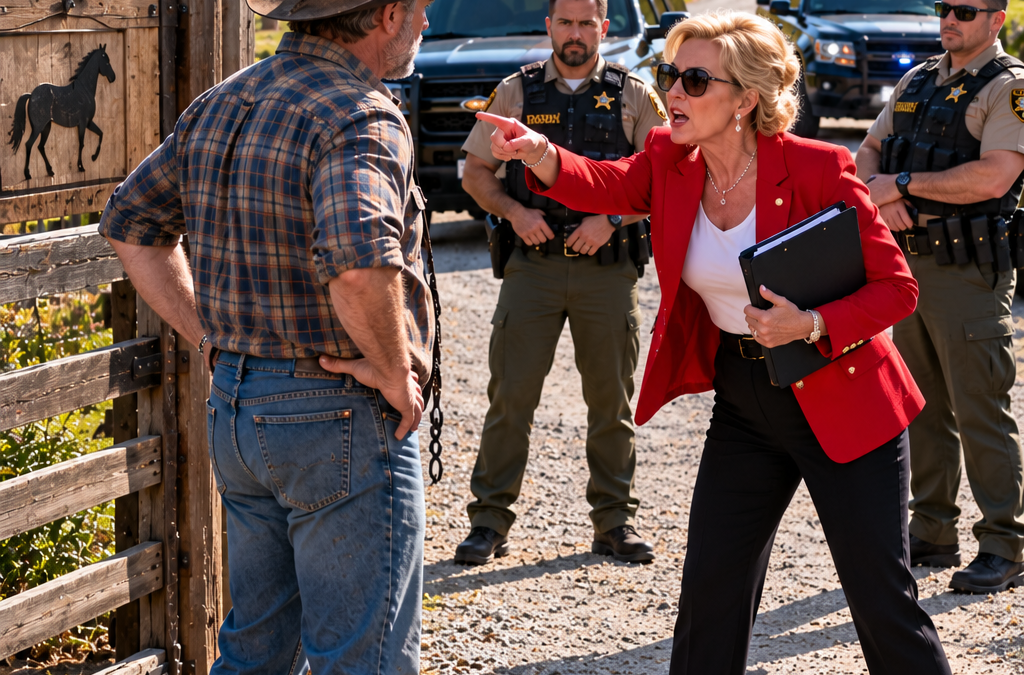
𝗙𝗨𝗟𝗟 𝗦𝗧𝗢𝗥𝗬 The deputy’s hand rested on his belt while Regina Ashcroft pointed at me like she had finally caught the criminal she had been warning everyone about. I looked at her red blazer, then at the patrol cars blocking the gravel road my grandfather had built with his own hands, and said the only thing she had refused to understand from the beginning: “I am not a member of your HOA.”
𝗙𝗨𝗟𝗟 𝗦𝗧𝗢𝗥𝗬
The road did cross through land shown on newer HOA maps as common area.
What those maps did not show clearly was the older property relationship.
The road predated the HOA.
It predated the subdivision.
It predated most of the houses.
I knew my grandfather had retained access rights when parcels were transferred.
I had never had any reason to pull every recorded document because nobody had ever challenged us.
Until Regina.
At the bottom of the violation notice was her signature.
Regina Ashcroft
President
Ashwood Ridge Homeowners Association
Below that was a warning.
Failure to comply could result in fines, legal action, removal of unauthorized infrastructure, and recovery of enforcement costs.
I laughed.
Actually laughed.
Clara didn’t.
“You think this is funny?”
“Not really.”
“You’re laughing.”
“Because she thinks she can fine me.”
“Can she?”
“No.”
“You sound very sure.”
“I am.”
She gave me the look she used whenever confidence started sounding too much like stubbornness.
“Maybe talk to a lawyer before you drive over there.”
“I’m just going to explain it.”
Clara sighed.
“That sentence has gotten you in trouble before.”
She wasn’t wrong.
I drove over that afternoon anyway.
The clubhouse sat near the center of Ashwood Ridge.
Large stone entrance.
Wide parking lot.
Decorative landscaping.
A porch with white columns.
Regina was walking down the front steps when I arrived.
Red blazer.
Leather binder.
Exactly as expected.
She saw my truck and stopped.
“Silas.”
“Regina.”
“I assume you received the notice.”
“That’s why I’m here.”
“Good.”
No hello.
No invitation inside.
No attempt to soften the conversation.
I held up the letter.
“The road predates your HOA.”
“We know the road is old.”
“It predates the neighborhood.”
“That doesn’t make it authorized.”
I stared at her.
“Authorized by who?”
“The association.”
“The association didn’t exist when it was built.”
“That isn’t relevant.”
There it was.
The first version of the phrase I would hear over and over.
Not relevant.
I unfolded the notice.
“You’re saying a road my grandfather built in 1961 needs permission from an HOA created fifty years later.”
“It crosses association common property.”
“It crosses land that was transferred subject to existing access.”
“According to you.”
“According to the deed history.”
She tapped her binder.
“Our property manager reviewed the plats.”
“Which plats?”
“The recorded neighborhood plats.”
“The neighborhood plat was drawn after the road.”
“That doesn’t matter.”
I smiled.
“There it is again.”
Her eyes narrowed.
“What?”
“That doesn’t matter.”
“Silas, you are not going to turn this into one of your philosophical arguments about land ownership.”
“I didn’t realize asking who owns a road was philosophy.”
“The board voted unanimously.”
“That’s nice.”
“It means the matter has been decided.”
“By people with no authority over me.”
Her face changed.
Only slightly.
“I’m sorry?”
“I’m not a member.”
“You’re within our jurisdictional boundary.”
“No.”
“Yes.”
“No, Regina.”
I pointed toward the surrounding houses.
“Your map was drawn around property my family already owned.”
“The community boundary encompasses this area.”
“Your colored map doesn’t rewrite my deed.”
“The road intersects common property.”
“My access rights run through it.”
“You haven’t provided proof.”
“You didn’t ask.”
“We sent a violation notice.”
“That isn’t asking.”
She crossed her arms.
“We are trying to give you options.”
“No. You gave me three versions of surrender.”
“That is unnecessarily dramatic.”
“One option destroys my road. One forces me to pave it for your standards. One gives you the lock.”
“The lock would improve community security.”
“I don’t live in your community.”
“You border it.”
“I border three other properties too. None of them have keys to my gates.”
Her jaw tightened.
“Your road allows uncontrolled entry.”
“It allows me to reach my barn.”
“It creates a security concern.”
“For who?”
“Our homeowners.”
“Then secure your property without taking control of mine.”
That was when she reached for her phone.
I remember it because of how calm she looked.
No warning.
No “we’ll pursue this through counsel.”
She simply unlocked the screen.
“What are you doing?”
“Calling the sheriff.”
I laughed again.
“Go ahead.”
“You are currently standing on association property after refusing a direct request to comply.”
“You invited nobody to leave.”
“I am now.”
I looked down.
The gravel under my boots connected directly to the road my grandfather had built.
“Regina, before you do something stupid, look at the deed.”
“I’ve heard enough about your deed.”
Then she made the call.
“Trespassing,” she told the dispatcher.
“Unauthorized development.”
She gave my name.
Described my truck.
Then she looked directly at me while she said:
“He’s being confrontational.”
That one almost made me lose my temper.
Almost.
I put my hands in my pockets.
“What?”
she asked after hanging up.
“Nothing.”
“You think this is funny?”
“No.”
“You smiled.”
“I’m trying very hard not to say what I’m thinking.”
“Maybe that would be wise.”
We stood there for nineteen minutes.
I know because I checked later.
Nineteen minutes from her call until two sheriff’s patrol cars rolled into the parking lot.
The younger deputy got out first.
Mid-thirties, cautious eyes.
The older one came around from the second cruiser.
He looked like he had been working county disputes longer than either Regina or I had been arguing with anybody.
Regina moved toward them immediately.
“Officers, thank you.”
Deputies.
Not officers.
Neither corrected her.
She pointed toward me.
“That’s him.”
The older deputy looked at me.
“That’s the man trespassing on HOA land.”
Her voice carried across the parking lot.
People nearby were watching now.
A couple walking a dog stopped near the sidewalk.
Two women stood outside the clubhouse door.
I felt my face get hot.
Not from fear.
Humiliation.
There are few things more infuriating than being publicly accused of trespassing on land connected to your own family history.
The younger deputy’s hand rested near his belt.
“Sir, can I get your name?”
“Silas Ventry.”
“Identification?”
I handed it over.
Regina started talking before he finished reading.
“He has repeatedly refused HOA directives. He maintains an unauthorized road through association property and has now come onto the property to intimidate board members.”
I turned toward her.
“Intimidate?”
“Sir,” the older deputy said calmly, “let’s let one person speak at a time.”
I nodded.
Regina folded her arms.
The older deputy looked at her.
“What specifically do you want him removed from?”
“This parking lot. The common area. The access corridor.”
He looked around.
“Do you own all of this?”
“The HOA does.”
“Do you have the deed or plat?”
Her expression changed.
“I have board records.”
“I need property records.”
“The association has title.”
“That may be. Do you have documentation available?”
“I can get it.”
I spoke.
“I have my deed in the truck.”
Regina rolled her eyes.
The older deputy looked at me.
“Get it.”
I walked back to my pickup.
I kept a copy of the deed and survey in a document case behind the seat because rural boundary disputes have a way of appearing when you least expect them.
When I returned, I handed him both.
He read the deed.
Then the survey.
Then the deed again.
Regina grew impatient.
“Deputy, this is very straightforward.”
He did not look up.
“Property disputes almost never are.”
“He’s not in the HOA.”
“Correct.”
“He’s using HOA land.”
“Maybe.”
“Maybe?”
Now he looked at her.
“Ma’am, I’m trying to understand the boundary.”
“We have maps inside.”
“Get them.”
She turned sharply and walked into the clubhouse.
The younger deputy looked at me.
“You been using this road long?”
“My entire life.”
“Your family?”
“Since 1961.”
He looked toward the gravel road.
“And the HOA?”
“Twelve years.”
He raised his eyebrows.
“Okay.”
Regina returned carrying a large printed plat.
She laid it across the hood of the patrol car.
“There.”
She pointed.
“This entire section is common property.”
The older deputy compared it with my survey.
His finger moved slowly over both maps.
Then stopped.
“What’s this line?”
Regina leaned closer.
“That’s the old parcel boundary.”
“Old?”
“Before the subdivision was finalized.”
I said nothing.
The deputy looked at me.
Then back at the map.
“Sir, can you step over here?”
I moved beside him.
He pointed toward the parking lot.
“According to your survey, where does your boundary run?”
“Along the original Parcel C line.”
“Which appears to cross through here.”
“Yes.”
Regina interrupted.
“That line was superseded.”
“By what?”
“The development plat.”
“Was the underlying parcel transferred?”
“Of course.”
“Do you have the deed showing that?”
She hesitated.
“The developer acquired everything necessary.”
“That’s not what I asked.”
Her face tightened.
The older deputy walked away and made a phone call.
First dispatch.
Then, from what I could hear, someone at the county assessor’s office.
The wait felt much longer than it was.
Regina stood rigid beside the cruiser.
The younger deputy stared at the maps.
I leaned against my truck.
Then the older deputy returned.
His tone had changed.
“Ms. Ashcroft.”
“Yes?”
“According to the county parcel information we can access, Mr. Ventry’s property boundary may run through part of this parking lot.”
Regina blinked.
“No.”
“That’s what the county data indicates.”
“That’s impossible.”
“I’m not saying he owns the clubhouse. I’m saying the boundary issue is unclear enough that I’m not removing him for criminal trespass.”
She stared at him.
“This is HOA property.”
“Maybe. Maybe not. That’s a civil question.”
“You’re just going to let him stay?”
“He isn’t threatening anyone.”
“He’s violating board directives.”
“That isn’t criminal law.”
For the first time since she called the sheriff, Regina’s confidence cracked.
Only slightly.
But I saw it.
Her face darkened.
The deputy handed my paperwork back.
“If either side wants this resolved, get a title attorney.”
Then he looked at me.
“And until you do, don’t escalate anything.”
“I won’t.”
Regina started to protest.
The deputy cut her off politely.
“We’re done here, ma’am.”
Both patrol cars left.
I looked at Regina.
She looked at me.
Neither of us spoke.
Then I got into my truck and drove home.
I should tell you something here.
Something even Clara didn’t know.
Three months earlier, my grandfather had died.
He was ninety-two.
He had been slowing down for years, but until the final months, he still insisted on walking out to the barn every morning.
After the funeral, I began going through his belongings.
Tools.
Old tax papers.
Receipts.
Photographs.
Boxes of things he had kept for reasons only he understood.
One afternoon, I moved an old cabinet away from the back wall of the barn.
Behind it was a steel plate.
At first, I thought it covered an electrical box.
Then I noticed the latch.
Behind the plate was a recessed safe.
I had never seen it.
Never heard him mention it.
Inside were two bundles of papers and an envelope of cash so old some bills looked almost unused.
One folder caught my attention.
Yellowed.
Tied with twine.
My grandfather had written on the front:
ASHWOOD GROUND LEASE
DO NOT FORGET
I remember standing in the barn staring at those words.
I meant to open the folder.
Then life got in the way.
Funeral paperwork.
Farm repairs.
Taxes.
A sick cow.
A water line break.
I moved the folder into my office and forgot about it.
Until Regina called the sheriff on me.
Two days later, another certified letter arrived.
This one was worse.
The HOA claimed I owed unpaid association assessments dating back years.
Not months.
Years.
The amount was absurd.
Dues.
Late fees.
Interest.
Administrative charges.
Enforcement penalties.
The letter threatened a lien against my property if I failed to pay.
I read it twice.
Then a third time.
Clara stood beside me.
“They can’t do that.”
“I know.”
“Can they file it anyway?”
“Anybody can file something.”
“That’s not what I mean.”
“I know.”
She sat at the table.
“Silas, this woman is not stopping.”
No.
She wasn’t.
Then Thomas Weaver, one of the few Ashwood residents I knew well, called.
“You need to see Facebook.”
“I don’t use Facebook.”
“I know.”
“What happened?”
“Regina posted about you.”
My stomach tightened.
“What did she say?”
There was a pause.
“She called you a squatter.”
I laughed once.
Not because it was funny.
Thomas continued.
“She said you’re exploiting old paperwork to avoid paying your fair share.”
“My fair share of an HOA I don’t belong to?”
“I know.”
“What else?”
“Comments are getting ugly.”
“How ugly?”
“People talking about forcing a sale.”
I went to Clara’s phone.
Thomas sent screenshots.
Forty-three comments in six hours.
Who does this guy think he is?
Put a lien on him.
Take the land.
If he benefits from our roads, he should pay dues.
Squatters always have excuses.
One person wrote:
Maybe the HOA should seize the access strip and end this nonsense permanently.
I sat there reading comments from people who had never spoken to me.
People living on land my grandfather had sold.
People whose houses existed because my family had once decided to let go of those parcels.
And now they were cheering for the seizure of what remained.
That hurt more than Regina’s letter.
Clara sat beside me.
“Don’t respond.”
“I wasn’t going to.”
“You look like you want to.”
“I want to drive over there.”
“That’s worse.”
She was right again.
I walked outside instead.
Past the machine shed.
Past the field.
Into the old barn.
The folder was still in my office drawer.
ASHWOOD GROUND LEASE.
DO NOT FORGET.
I untied the twine.
Inside was a contract dated 1994.
The original developer of Ashwood Ridge had approached my grandfather years before the modern subdivision was fully established.
They needed a central parcel for administrative buildings and future community facilities.
The problem was financing.
Rather than buy the land immediately, the developer negotiated a ground lease.
The document covered approximately half an acre.
I turned to the legal description.
Then I stopped.
The coordinates looked familiar.
Very familiar.
I found an old survey map.
Laid it beside the lease.
The half-acre parcel was exactly where the clubhouse now stood.
I read the lease again.
Ninety-nine years.
Renewable.
Ground only.
Title retained by lessor.
A future purchase had apparently been contemplated.
But the lease itself did not transfer ownership.
Then I found correspondence clipped behind it.
The developer had experienced financial problems.
Bankruptcy proceedings.
Restructuring.
Various parcels transferred.
Others sold.
The final purchase of the clubhouse ground had never closed.
At least not according to the folder.
I sat down in my grandfather’s old wooden chair.
For several minutes, I simply stared at the papers.
The significance was almost too strange to process.
The clubhouse.
The boardroom.
Regina’s office.
The parking lot where she had called the sheriff.
The place where she sat every month voting to fine homeowners.
The land beneath all of it might still belong to my family.
I called a real estate attorney the next morning.
His name was Andrew Cole.
He specialized in title disputes and commercial property.
I explained enough over the phone that he asked me to bring everything immediately.
He spent almost two hours reading.
Then he asked:
“Where did you get this?”
“My grandfather’s barn.”
“You knew about the lease?”
“Not really.”
“He never told you?”
“No.”
Andrew looked at the document again.
“Was your grandfather paid?”
“There are old deposits.”
“Annual rent?”
“Looks like it.”
“Recent?”
“I don’t know.”
He leaned back.
“We need the recorder’s chain.”
“How bad is this?”
“For who?”
I smiled for the first time in days.
“That’s what I’m trying to figure out.”
Forty-eight hours later, we had confirmation.
The ground parcel had never been sold.
The developer had leased it.
The developer’s later bankruptcy had transferred operating interests and improvements, but the underlying land title remained where the original lease placed it.
With my grandfather.
Then his estate.
Then me.
Andrew spread the documents across his desk.
“The HOA owns the building.”
“Okay.”
“You own the land under it.”
I stared at him.
“So what does that make me?”
He smiled.
“Their landlord.”
I actually laughed.
Long enough that Andrew eventually laughed too.
Then the absurdity settled over me.
Regina had called the sheriff to remove me from land the HOA might not even own.
She had called me a squatter from an office standing on ground I legally owned.
She had threatened to lien my property while her board was occupying my property under an old lease most of them apparently did not know existed.
“Can they still claim dues?”
Andrew shook his head.
“Not based on anything I’ve seen. Your acreage was never annexed into the HOA.”
“So the lien?”
“We’ll challenge it immediately.”
“What about the clubhouse?”
“That requires care.”
I nodded.
I didn’t want revenge.
At least I didn’t want to want revenge.
Part of me did.
The part that had read forty-three comments calling me a squatter.
The part that had stood under the stare of two deputies while Regina pointed at me.
The part that had listened to her say the board’s jurisdiction mattered more than my deed.
But anger is a poor foundation for property decisions.
My grandfather had taught me that too.
“If you can win without burning the barn,” he used to say, “don’t burn the barn.”
So I didn’t.
Andrew drafted one letter.
Plain white paper.
No gold seal.
No threats in capital letters.
No fake urgency.
Just facts.
The letter informed Ashwood Ridge HOA that I was the successor lessor of the parcel underlying the clubhouse property.
It included the legal description.
The original ground lease.
The recorded chain of title.
And one simple notice.
Because the existing lease documentation had not been properly updated through successive entities, continued occupancy and use would require formal negotiation of a new lease agreement.
We also disputed every assessment claim against my unrelated acreage and demanded immediate withdrawal of any lien filing.
Andrew sent it by certified mail.
Then we waited.
Regina called me personally two days later.
I let it ring twice before answering.
“Silas.”
“Regina.”
“What is this?”
“You’ll need to be more specific.”
“This letter.”
“My attorney sent it.”
“I know who sent it.”
“Then why are you calling me?”
“You’re claiming you own the clubhouse.”
“No.”
“That’s what the letter says.”
“It says I own the land under it.”
“That is ridiculous.”
“So was trespassing.”
Silence.
Then:
“This is retaliation.”
“No.”
“You suddenly discover this after our enforcement action?”
“I discovered the folder months ago. I opened it after you threatened a lien.”
“You expect anyone to believe that?”
“I don’t care what you believe.”
“You have been planning this.”
“I didn’t know what was in the folder.”
“Convenient.”
“Regina, you called the sheriff on me.”
“Because you were trespassing.”
“On my own parcel line.”
“You refused to respect association authority.”
“I’m not in the association.”
“Your property benefits from Ashwood Ridge infrastructure.”
“My property existed before Ashwood Ridge infrastructure.”
“You use our roads.”
“I use the gravel road my grandfather built.”
She changed direction.
“The clubhouse lease is invalid.”
“Then your attorney can explain that to mine.”
“The HOA owns that facility.”
“I’ve never disputed the building.”
“This is extortion.”
I felt my jaw tighten.
“Be careful.”
“You are demanding a lease because we enforced our rules.”
“No. I’m demanding a lease because you’re occupying land you don’t own.”
Her voice rose.
“We have been in that building for twelve years.”
“Yes.”
“Without objection.”
“My grandfather was the lessor.”
“And he never said anything.”
“Apparently he didn’t need to.”
“This is outrageous.”
I almost reminded her of the Facebook post.
Of the word squatter.
Instead I said:
“Do not contact me directly again. Talk to Andrew.”
Then I hung up.
Three days later, the HOA removed Regina’s Facebook post.
The lien threat vanished from the online account portal.
A week after that, Andrew received a formal letter confirming that all claimed assessments against my property had been withdrawn pending review.
No admission of error.
No apology yet.
Just withdrawal.
Meanwhile, the clubhouse issue got worse for Regina.
The board had to notify its insurer.
Then its attorneys.
Then its lender.
The association’s existing title materials showed ownership of improvements, but the underlying ground parcel was tangled in the old lease chain.
The more lawyers looked, the clearer it became.
My grandfather had never sold the half acre.
The developer had never completed the purchase.
Ashwood Ridge had inherited a building on leased ground.
And somewhere along the way, people simply stopped paying attention.
At the next HOA meeting, more than a hundred homeowners showed up.
I didn’t attend.
Thomas did.
He called me afterward.
“You missed a war.”
“What happened?”
“Regina tried to explain the lease.”
“How’d that go?”
“Badly.”
He laughed.
“Someone asked her how she managed to accuse you of trespassing from a building sitting on your property.”
I closed my eyes.
“Please tell me nobody said it like that.”
“Almost exactly.”
“What did she do?”
“Called it inflammatory.”
“Of course.”
“Then somebody asked about the lien.”
“And?”
“She blamed legal counsel.”
I wasn’t surprised.
Regina seemed to believe responsibility was something that moved away from her whenever consequences arrived.
But the board was changing.
Two members resigned from their officer roles.
A third requested an independent title review.
Homeowners demanded records showing what Regina had known when she called the sheriff.
The younger families were angry about legal expenses.
Older residents were embarrassed by the Facebook post.
People who had originally supported aggressive enforcement started asking whether the board had gone too far.
Then I received an apology letter.
It was remarkable mostly for how carefully it avoided saying the word sorry.
The association acknowledged that “certain statements concerning Mr. Ventry’s membership status and property obligations were made prior to completion of a full title review.”
It confirmed I was not an HOA member.
It confirmed no assessments were owed.
It confirmed no lien would be filed.
And it stated that the board regretted “any misunderstanding arising from prior communications.”
Clara read it.
“This went through lawyers.”
“Several.”
“How many?”
“At least three.”
She smiled.
“You’re keeping it?”
“Absolutely.”
The ground lease negotiations took longer.
I could have made them painful.
Andrew told me I had leverage.
A lot of leverage.
The HOA needed stability.
Insurance companies dislike unclear land tenure.
Lenders dislike it even more.
And the clubhouse was central to the association.
Board meetings.
Community events.
Pool access.
Administrative offices.
Architectural committee hearings.
Everything ran through that building.
Some neighbors expected me to demand a huge rent increase.
One man called and practically begged me not to punish everyone for Regina’s behavior.
That bothered me.
Because that was never my intention.
“I’m not trying to punish the neighborhood.”
“I know, but people are scared.”
“Why?”
“Because we don’t know what you can do.”
I understood.
For months, Regina had used uncertainty against me.
Now the uncertainty belonged to them.
I didn’t want to become her in reverse.
So I told Andrew:
“Fair market lease.”
He looked at me.
“You’re sure?”
“Yes.”
“You could negotiate higher.”
“I know.”
“Association wants a long term.”
“Fine.”
“Escalation clause?”
“Reasonable.”
“Maintenance?”
“Their building, their responsibility.”
“Land taxes?”
“Allocated clearly.”
He nodded.
“No punitive language?”
“No.”
Then I added:
“But I want one thing.”
“What?”
“I want the agreement to state clearly that the HOA’s authority does not extend to my remaining acreage, road, or access rights.”
Andrew smiled.
“That I can do.”
Regina fought it.
Of course she did.
Even with her presidency collapsing around her, she could not tolerate a sentence limiting HOA jurisdiction.
During mediation, she sat across from me wearing the red blazer.
For once, it looked less like armor.
More like a costume she had outgrown.
“This provision is unnecessary.”
Andrew answered.
“Recent events suggest otherwise.”
She ignored him.
“Silas, you’re using the clubhouse lease to obtain concessions unrelated to the property.”
I looked at her.
“Unrelated?”
“Yes.”
“You tried to control my road.”
“The road crosses association property.”
“Subject to recorded access.”
“That remains disputed.”
“It was confirmed in the title review.”
She pressed her lips together.
I continued.
“You claimed I owed years of dues.”
“That was based on advice available at the time.”
“You called me a squatter.”
“I didn’t use that word in an official notice.”
“You used it on Facebook.”
“That was an informal community communication.”
I actually laughed.
“Informal?”
“Yes.”
“Forty-three comments calling for my land to be seized was informal?”
“I cannot control what residents comment.”
“You started the thread.”
She turned toward the mediator.
“This is exactly the hostility I was concerned about.”
I leaned back.
The old version of me might have argued.
Instead I said:
“I don’t want control over Ashwood Ridge.”
Nobody spoke.
“I don’t want a board seat.”
“I don’t want voting rights.”
“I don’t want to tell your residents what color their fences should be.”
A few people at the table smiled.
“I want exactly what I wanted from the beginning.”
I looked directly at Regina.
“To be left alone on land my family has worked for sixty years.”
Her face stayed expressionless.
I continued.
“If the HOA rents land from me, we’ll have a professional lease.”
“You’ll pay fair rent.”
“You’ll maintain your building.”
“I’ll fulfill my obligations.”
“And none of that gives you authority over the rest of my property.”
“That sentence is staying.”
Regina stared at me.
Then she said:
“You’ve enjoyed humiliating me.”
The room went quiet.
That accusation surprised me.
I thought about the patrol cars.
The Facebook comments.
The lien threat.
The red blazer in the parking lot.
Then I thought about my grandfather’s handwriting.
DO NOT FORGET.
“No,” I said.
“I didn’t enjoy any of this.”
She looked skeptical.
“I enjoyed being right about my land.”
“That isn’t the same thing.”
The mediator cleared his throat.
We finished the lease.
Fair rent.
Long term.
Clear renewals.
Recorded notice.
Clear responsibility.
No hidden assumptions.
No vague jurisdiction language.
No opportunity for some future board president to repeat the same mistake.
The HOA signed.
I signed.
The agreement was recorded.
The clubhouse stayed exactly where it was.
Nobody lost access.
Nobody was evicted.
Nobody paid some outrageous penalty because I was angry.
That mattered to me.
A month later, Regina resigned from the board.
The official explanation said she wanted to devote more time to family and professional obligations.
I heard she sold her house not long afterward.
Thomas later told me she moved two neighborhoods away.
Another HOA.
I laughed when I heard that.
“Did she join?”
“Apparently.”
“Voluntarily?”
“Yep.”
“That might be the funniest part of this whole thing.”
After she left, Ashwood Ridge changed.
Not dramatically.
HOAs don’t become different organizations overnight because one president resigns.
But the tone changed.
The new board contacted me before doing work near the gravel road.
They reviewed title documents.
They stopped sending me violation notices.
They installed a proper boundary marker near the clubhouse parcel.
The road remained gravel.
No HOA-controlled lock.
No mandatory paving.
No fines.
Exactly as it had been before Regina decided history was an inconvenience.
One afternoon the younger deputy who had responded that day stopped by.
He was driving past and saw me repairing fence.
He pulled over.
“You ever get that property mess straightened out?”
“Eventually.”
He smiled.
“Who owned the parking lot?”
“Depends which part.”
He laughed.
“That’s what I figured.”
“And the clubhouse ground?”
“That one was mine.”
He stared at me.
“No kidding.”
“No kidding.”
He shook his head.
“So she called us to remove the landlord?”
“Basically.”
He laughed hard enough that I started laughing too.
Then his expression changed.
“You handled that better than a lot of people would’ve.”
I looked toward the road.
“I had help.”
“Lawyer?”
“Him too.”
But that wasn’t what I meant.
I meant my grandfather.
The man had been dead three months when Regina first sent me that violation letter.
Still, every important decision in that fight had traces of him in it.
The road.
The lease.
The boundaries.
The folder.
Even the habit of keeping old paperwork.
My grandfather saved everything.
Receipts for tractor parts from 1974.
Handwritten grazing agreements.
Old checks.
Survey notes.
Tax maps.
As a kid, I thought it was clutter.
As an adult, I sometimes thought it was stubbornness.
After Ashwood Ridge, I understood.
Land has a long memory.
People don’t.
People move in.
Move out.
Elect boards.
Replace officers.
Change rules.
Rename roads.
Draw new maps.
Eventually somebody looks at something old and assumes nobody will question the new version.
Paper remembers.
Recorded documents remember.
Survey pins remember.
The old gravel road remembers.
That is why I kept Regina’s first violation letter.
It’s in the same fireproof cabinet where I now keep the ground lease.
Cream paper.
Gold seal.
All that official language.
Unauthorized access infrastructure.
I still smile when I read it.
Not because the whole experience was funny.
Much of it wasn’t.
Standing in front of two deputies wasn’t funny.
Reading strangers demand that my property be seized wasn’t funny.
Watching Clara worry about liens wasn’t funny.
Paying an attorney because someone refused to read a deed wasn’t funny.
What makes me smile is how certain Regina had been.
Authority can be intoxicating.
Especially small authority.
A title.
A board vote.
A binder.
A logo on a letterhead.
Sometimes people begin believing the tools of administration are the same as ownership.
They aren’t.
A vote cannot create property rights.
A Facebook post cannot rewrite a deed.
A fine cannot bind a person who never agreed to the covenant behind it.
And a red blazer does not turn assumption into law.
I still own the same 840 acres.
The cattle still cross the western pasture.
The creek still floods after hard rain.
The old barn still leans slightly east because my grandfather never fixed the foundation the way my father told him to.
And the gravel road is still gravel.
Sometimes I drive it early in the morning.
Past the fence.
Past the line where Ashwood Ridge begins.
Past the clubhouse parking lot.
I can see the building through the trees.
Most residents probably never think about who owns the half acre underneath it.
That’s fine with me.
I don’t need them to.
That’s the difference between ownership and control.
Regina needed people to know when she thought she had authority.
I don’t.
The lease payment arrives.
The responsibilities are clear.
The documents are recorded.
That is enough.
I did add one new habit after everything happened.
Whenever I inherit, purchase, or transfer any property interest now, I read every page.
Every easement.
Every attachment.
Every ancient clause that looks meaningless.
I learned what my grandfather already knew.
The sentence nobody notices can become the most important sentence in the entire file.
And sometimes the document everyone forgot is the only thing standing between a family and someone else’s confidence.
I wish I had opened that yellow folder sooner.
Maybe I could have avoided the patrol cars.
Maybe I could have stopped the lien letter before it arrived.
Maybe Regina would have treated me differently if I had walked into the first conversation carrying the ground lease.
Then again, I doubt it.
People like Regina usually don’t change when shown evidence.
They change when evidence begins to cost them something.
She had the opportunity to stop.
More than once.
When I told her the road predated the association.
She could have checked.
When I told her I wasn’t a member.
She could have checked.
When I handed the deputy my deed.
She could have stepped back.
When the county map raised questions about the parking lot.
She could have apologized.
Instead, she doubled down.
She filed another claim.
Threatened a lien.
Called me a squatter.
And pushed until she finally forced me to open a folder that exposed something far more uncomfortable for her than the gravel road had ever been.
That was the irony.
I didn’t go looking for leverage.
She pushed me toward it.
If Regina had left me alone, the ground lease might have remained buried in that cabinet for another decade.
The HOA would have continued using the clubhouse.
I would have continued driving my road.
Nobody would have cared.
Instead, her determination to prove that I was subject to her authority forced everyone to discover just how limited that authority actually was.
I thought about that on the day we signed the final lease.
After everyone else left, I stayed in the conference room for a moment.
Through the window, I could see part of the clubhouse grounds.
The same parking lot where the sheriff had stood.
The same place Regina pointed at me.
I remembered her words.
That’s him.
That’s the man trespassing on HOA land.
I had been furious that day.
Later, I was embarrassed.
Now the memory mostly makes me sad.
Because none of it was necessary.
She could have walked to my truck and said:
“Silas, our records show a boundary issue. Can we compare documents?”
That’s all.
No deputies.
No threats.
No public accusations.
No legal mess.
No humiliation.
Just two property owners checking paperwork.
But Regina didn’t want clarification.
She wanted submission.
And that made everything harder than it needed to be.
My grandfather used to say something whenever two neighbors argued over fences.
“Never start by asking who is louder.”
He would point at the ground.
“Start by asking where the pin is.”
Meaning the survey marker.
The fact.
The thing that doesn’t care who is angry.
That’s what eventually saved me.
Not power.
Not connections.
Not intimidation.
The record.
The line.
The lease.
The deed.
People sometimes hear this story and focus on the funny part.
The HOA president accidentally discovered I was her landlord.
I understand why.
It sounds ridiculous.
It was ridiculous.
But the part I remember most isn’t the irony.
It’s the feeling of standing on gravel my grandfather laid down while someone who had lived there for two years told armed deputies that I didn’t belong.
That stays with you.
Land means different things to different people.
To Regina, Ashwood Ridge was a community she managed.
To its residents, it was home.
To the developer, years earlier, it had been a project.
To me, the dirt under all of it was family history.
I knew where my father taught me to drive.
I knew which oak my grandfather sat under during lunch.
I knew where the creek used to run before a storm moved the bank twenty feet.
I knew where the barn roof leaked.
I knew where we buried the first horse I ever owned.
Those things aren’t written on HOA maps.
But they matter.
That is why being called a squatter cut so deeply.
Not because the accusation was legally ridiculous.
Because it tried to erase history.
My grandfather wasn’t a perfect man.
He trusted too easily.
He made deals he should have documented better.
He sold land I sometimes wish he had kept.
But he understood ownership.
He understood responsibility.
And somewhere in 1994, when a developer needed half an acre and couldn’t afford to buy it outright, he kept one document safe enough that nearly thirty years later it could still speak for him.
ASHWOOD GROUND LEASE.
DO NOT FORGET.
I don’t forget anymore.
The folder sits in a proper safe now.
Digitized copies exist in three places.
The lease is recorded clearly.
My estate plan names the parcel specifically.
Whoever inherits this property after me will never have to find a hidden box behind a barn wall to understand what belongs to them.
That may be the most important thing I changed.
Not the HOA.
Not the rent.
The record.
The next person won’t have to fight the same battle.
And if another board president ever stands in that parking lot and decides the association controls everything the eye can see, the answer won’t require a sheriff.
It will be one page away.
Ashwood Ridge still has its clubhouse.
Meetings still happen there.
Committees still argue about paint colors.
Residents still complain about dues.
Children still ride bicycles along the same streets.
Life moved on.
That’s what communities do.
The red blazer disappeared.
The gravel road stayed.
And every time my tires crunch across it, I think about how close I came to letting another person’s confidence make me question something my family had known for sixty years.
I was never trespassing.
I was never a squatter.
I was never an HOA member.
I was simply a landowner who had grown too accustomed to being left alone to remember that sometimes leaving people alone is a privilege they only respect after the paperwork forces them to.
Regina taught me that.
Not intentionally.
But she did.
She wanted control over one gravel road.
Instead, she forced everyone to discover who owned the ground beneath the room where she exercised that control.
And once that truth was written clearly in front of all of us, there was nothing left to argue about.
𝗧𝗛𝗘 𝗘𝗡𝗗
The deputy’s hand rested on his belt while Regina Ashcroft pointed at me like she had finally caught the criminal she had been warning everyone about. I looked at her red blazer, then at the patrol cars blocking the gravel road my grandfather had built with his own hands, and said the only thing she had refused to understand from the beginning: “I am not a member of your HOA.”
For the first time that afternoon, the younger deputy looked at Regina instead of me.
Regina smiled.
It was a small, satisfied smile, the kind people wear when they believe the law has arrived to validate them.
“That doesn’t matter,” she said.
I remember those three words better than almost anything else that happened.
That doesn’t matter.
My deed didn’t matter.
My family history didn’t matter.
The fact that my road existed before Ashwood Ridge had ever been imagined didn’t matter.
The only thing Regina Ashcroft believed mattered was the authority she thought she had.
My name is Silas Ventry.
My family had been working that land for three generations before Ashwood Ridge existed.
My grandfather bought the first tract in the late 1950s.
Over the years, he added more parcels until the family controlled nearly nine hundred acres of pasture, timber, creek bottom, and gently rolling ground outside town.
By the time I inherited most of it, I owned about 840 acres bordering what had become Ashwood Ridge.
The neighborhood itself sat on property my grandfather had sold off in sections decades earlier.
He had never planned for a luxury gated community.
Back then, he had simply sold pieces when money was tight or when he no longer needed certain fields.
He trusted handshakes more than lawyers.
Sometimes that worked.
Sometimes it didn’t.
What he kept was the part that mattered most to him.
The creek.
The old barn.
The higher pasture.
The family cemetery.
And a gravel road that cut through part of what eventually became Ashwood Ridge’s common area.
That road had been there since 1961.
My grandfather graded the first version himself with a borrowed tractor.
My father later widened it.
I had re-graveled it twice.
It connected the western pasture to the county road and gave us direct access to the old barn during wet weather.
I had used it since I was old enough to drive.
Nobody questioned it.
Not the original developer.
Not the county.
Not the homeowners who moved into the first phase of Ashwood Ridge.
For the first ten years after the development was built, we mostly left one another alone.
That suited me.
I didn’t want to join their HOA.
They didn’t need anything from me.
I waved at people walking their dogs.
They occasionally stopped to ask about the cattle or the history of the old barn.
Some of their children liked watching the horses from behind the fence.
I had no problem with any of that.
Then Regina Ashcroft became HOA president.
She had lived in Ashwood Ridge for less than three years when the board elected her.
Within months, she had turned what had once been an annoying but mostly harmless homeowners association into something much more aggressive.
Regina believed every unresolved question was evidence of weak leadership.
She believed every exception threatened order.
And she seemed to believe the red blazer she wore to almost every board meeting was some kind of official uniform.
I saw her in that blazer at least a dozen times.
At meetings.
At inspections.
At neighborhood events.
Once while she was photographing a man’s basketball hoop because she thought it sat too close to the sidewalk.
She carried a leather binder everywhere.
People joked about it when she wasn’t around.
Nobody joked when she was.
Regina had a talent for making ordinary disagreements feel like disciplinary proceedings.
She fined a retired couple because their wooden fence faded unevenly.
She sent three notices to a family whose moving pod remained in the driveway one day longer than the rules allowed.
She threatened legal action against a homeowner who installed solar equipment before receiving the board’s architectural approval.
The board backed her because she was organized.
That was the word people used.
Organized.
I used another word.
Controlling.
Still, none of it involved me.
My property was never part of Ashwood Ridge.
I had never signed their declaration.
Never agreed to their covenants.
Never paid an assessment.
Never attended a meeting unless some issue touched the boundary between our properties.
My land had existed long before their association.
That should have been the end of it.
Then one Tuesday afternoon, I opened my mailbox and found a cream-colored envelope with a gold seal.
ASHWOOD RIDGE HOMEOWNERS ASSOCIATION.
I carried it inside.
My wife, Clara, was making coffee.
“What did they want now?”
I looked at her.
“Now?”
“They’ve been driving past the west fence all week.”
I hadn’t noticed.
I opened the envelope.
Inside was a formal violation notice.
The first line almost made me laugh.
UNAUTHORIZED ACCESS INFRASTRUCTURE.
I read farther.
The HOA claimed my gravel road crossed association common property without authorization.
I had three options.
Remove the road.
Upgrade it to HOA paving standards.
Or install a controlled access gate with a lock managed by the association.
I read that part twice.
“They want control of the gate?”
Clara asked.
“Apparently.”
“To your road?”
“Yes.”
“On your land?”
“That’s where this gets interesting.”
The road did cross through land shown on newer HOA maps as common area.
What those maps did not show clearly was the older property relationship.
The road predated the HOA.
It predated the subdivision.
It predated most of the houses.
I knew my grandfather had retained access rights when parcels were transferred.
I had never had any reason to pull every recorded document because nobody had ever challenged us.
Until Regina.
At the bottom of the violation notice was her signature.
Regina Ashcroft
President
Ashwood Ridge Homeowners Association
Below that was a warning.
Failure to comply could result in fines, legal action, removal of unauthorized infrastructure, and recovery of enforcement costs.
I laughed.
Actually laughed.
Clara didn’t.
“You think this is funny?”
“Not really.”
“You’re laughing.”
“Because she thinks she can fine me.”
“Can she?”
“No.”
“You sound very sure.”
“I am.”
She gave me the look she used whenever confidence started sounding too much like stubbornness.
“Maybe talk to a lawyer before you drive over there.”
“I’m just going to explain it.”
Clara sighed.
“That sentence has gotten you in trouble before.”
She wasn’t wrong.
I drove over that afternoon anyway.
The clubhouse sat near the center of Ashwood Ridge.
Large stone entrance.
Wide parking lot.
Decorative landscaping.
A porch with white columns.
Regina was walking down the front steps when I arrived.
Red blazer.
Leather binder.
Exactly as expected.
She saw my truck and stopped.
“Silas.”
“Regina.”
“I assume you received the notice.”
“That’s why I’m here.”
“Good.”
No hello.
No invitation inside.
No attempt to soften the conversation.
I held up the letter.
“The road predates your HOA.”
“We know the road is old.”
“It predates the neighborhood.”
“That doesn’t make it authorized.”
I stared at her.
“Authorized by who?”
“The association.”
“The association didn’t exist when it was built.”
“That isn’t relevant.”
There it was.
The first version of the phrase I would hear over and over.
Not relevant.
I unfolded the notice.
“You’re saying a road my grandfather built in 1961 needs permission from an HOA created fifty years later.”
“It crosses association common property.”
“It crosses land that was transferred subject to existing access.”
“According to you.”
“According to the deed history.”
She tapped her binder.
“Our property manager reviewed the plats.”
“Which plats?”
“The recorded neighborhood plats.”
“The neighborhood plat was drawn after the road.”
“That doesn’t matter.”
I smiled.
“There it is again.”
Her eyes narrowed.
“What?”
“That doesn’t matter.”
“Silas, you are not going to turn this into one of your philosophical arguments about land ownership.”
“I didn’t realize asking who owns a road was philosophy.”
“The board voted unanimously.”
“That’s nice.”
“It means the matter has been decided.”
“By people with no authority over me.”
Her face changed.
Only slightly.
“I’m sorry?”
“I’m not a member.”
“You’re within our jurisdictional boundary.”
“No.”
“Yes.”
“No, Regina.”
I pointed toward the surrounding houses.
“Your map was drawn around property my family already owned.”
“The community boundary encompasses this area.”
“Your colored map doesn’t rewrite my deed.”
“The road intersects common property.”
“My access rights run through it.”
“You haven’t provided proof.”
“You didn’t ask.”
“We sent a violation notice.”
“That isn’t asking.”
She crossed her arms.
“We are trying to give you options.”
“No. You gave me three versions of surrender.”
“That is unnecessarily dramatic.”
“One option destroys my road. One forces me to pave it for your standards. One gives you the lock.”
“The lock would improve community security.”
“I don’t live in your community.”
“You border it.”
“I border three other properties too. None of them have keys to my gates.”
Her jaw tightened.
“Your road allows uncontrolled entry.”
“It allows me to reach my barn.”
“It creates a security concern.”
“For who?”
“Our homeowners.”
“Then secure your property without taking control of mine.”
That was when she reached for her phone.
I remember it because of how calm she looked.
No warning.
No “we’ll pursue this through counsel.”
She simply unlocked the screen.
“What are you doing?”
“Calling the sheriff.”
I laughed again.
“Go ahead.”
“You are currently standing on association property after refusing a direct request to comply.”
“You invited nobody to leave.”
“I am now.”
I looked down.
The gravel under my boots connected directly to the road my grandfather had built.
“Regina, before you do something stupid, look at the deed.”
“I’ve heard enough about your deed.”
Then she made the call.
“Trespassing,” she told the dispatcher.
“Unauthorized development.”
She gave my name.
Described my truck.
Then she looked directly at me while she said:
“He’s being confrontational.”
That one almost made me lose my temper.
Almost.
I put my hands in my pockets.
“What?”
she asked after hanging up.
“Nothing.”
“You think this is funny?”
“No.”
“You smiled.”
“I’m trying very hard not to say what I’m thinking.”
“Maybe that would be wise.”
We stood there for nineteen minutes.
I know because I checked later.
Nineteen minutes from her call until two sheriff’s patrol cars rolled into the parking lot.
The younger deputy got out first.
Mid-thirties, cautious eyes.
The older one came around from the second cruiser.
He looked like he had been working county disputes longer than either Regina or I had been arguing with anybody.
Regina moved toward them immediately.
“Officers, thank you.”
Deputies.
Not officers.
Neither corrected her.
She pointed toward me.
“That’s him.”
The older deputy looked at me.
“That’s the man trespassing on HOA land.”
Her voice carried across the parking lot.
People nearby were watching now.
A couple walking a dog stopped near the sidewalk.
Two women stood outside the clubhouse door.
I felt my face get hot.
Not from fear.
Humiliation.
There are few things more infuriating than being publicly accused of trespassing on land connected to your own family history.
The younger deputy’s hand rested near his belt.
“Sir, can I get your name?”
“Silas Ventry.”
“Identification?”
I handed it over.
Regina started talking before he finished reading.
“He has repeatedly refused HOA directives. He maintains an unauthorized road through association property and has now come onto the property to intimidate board members.”
I turned toward her.
“Intimidate?”
“Sir,” the older deputy said calmly, “let’s let one person speak at a time.”
I nodded.
Regina folded her arms.
The older deputy looked at her.
“What specifically do you want him removed from?”
“This parking lot. The common area. The access corridor.”
He looked around.
“Do you own all of this?”
“The HOA does.”
“Do you have the deed or plat?”
Her expression changed.
“I have board records.”
“I need property records.”
“The association has title.”
“That may be. Do you have documentation available?”
“I can get it.”
I spoke.
“I have my deed in the truck.”
Regina rolled her eyes.
The older deputy looked at me.
“Get it.”
I walked back to my pickup.
I kept a copy of the deed and survey in a document case behind the seat because rural boundary disputes have a way of appearing when you least expect them.
When I returned, I handed him both.
He read the deed.
Then the survey.
Then the deed again.
Regina grew impatient.
“Deputy, this is very straightforward.”
He did not look up.
“Property disputes almost never are.”
“He’s not in the HOA.”
“Correct.”
“He’s using HOA land.”
“Maybe.”
“Maybe?”
Now he looked at her.
“Ma’am, I’m trying to understand the boundary.”
“We have maps inside.”
“Get them.”
She turned sharply and walked into the clubhouse.
The younger deputy looked at me.
“You been using this road long?”
“My entire life.”
“Your family?”
“Since 1961.”
He looked toward the gravel road.
“And the HOA?”
“Twelve years.”
He raised his eyebrows.
“Okay.”
Regina returned carrying a large printed plat.
She laid it across the hood of the patrol car.
“There.”
She pointed.
“This entire section is common property.”
The older deputy compared it with my survey.
His finger moved slowly over both maps.
Then stopped.
“What’s this line?”
Regina leaned closer.
“That’s the old parcel boundary.”
“Old?”
“Before the subdivision was finalized.”
I said nothing.
The deputy looked at me.
Then back at the map.
“Sir, can you step over here?”
I moved beside him.
He pointed toward the parking lot.
“According to your survey, where does your boundary run?”
“Along the original Parcel C line.”
“Which appears to cross through here.”
“Yes.”
Regina interrupted.
“That line was superseded.”
“By what?”
“The development plat.”
“Was the underlying parcel transferred?”
“Of course.”
“Do you have the deed showing that?”
She hesitated.
“The developer acquired everything necessary.”
“That’s not what I asked.”
Her face tightened.
The older deputy walked away and made a phone call.
First dispatch.
Then, from what I could hear, someone at the county assessor’s office.
The wait felt much longer than it was.
Regina stood rigid beside the cruiser.
The younger deputy stared at the maps.
I leaned against my truck.
Then the older deputy returned.
His tone had changed.
“Ms. Ashcroft.”
“Yes?”
“According to the county parcel information we can access, Mr. Ventry’s property boundary may run through part of this parking lot.”
Regina blinked.
“No.”
“That’s what the county data indicates.”
“That’s impossible.”
“I’m not saying he owns the clubhouse. I’m saying the boundary issue is unclear enough that I’m not removing him for criminal trespass.”
She stared at him.
“This is HOA property.”
“Maybe. Maybe not. That’s a civil question.”
“You’re just going to let him stay?”
“He isn’t threatening anyone.”
“He’s violating board directives.”
“That isn’t criminal law.”
For the first time since she called the sheriff, Regina’s confidence cracked.
Only slightly.
But I saw it.
Her face darkened.
The deputy handed my paperwork back.
“If either side wants this resolved, get a title attorney.”
Then he looked at me.
“And until you do, don’t escalate anything.”
“I won’t.”
Regina started to protest.
The deputy cut her off politely.
“We’re done here, ma’am.”
Both patrol cars left.
I looked at Regina.
She looked at me.
Neither of us spoke.
Then I got into my truck and drove home.
I should tell you something here.
Something even Clara didn’t know.
Three months earlier, my grandfather had died.
He was ninety-two.
He had been slowing down for years, but until the final months, he still insisted on walking out to the barn every morning.
After the funeral, I began going through his belongings.
Tools.
Old tax papers.
Receipts.
Photographs.
Boxes of things he had kept for reasons only he understood.
One afternoon, I moved an old cabinet away from the back wall of the barn.
Behind it was a steel plate.
At first, I thought it covered an electrical box.
Then I noticed the latch.
Behind the plate was a recessed safe.
I had never seen it.
Never heard him mention it.
Inside were two bundles of papers and an envelope of cash so old some bills looked almost unused.
One folder caught my attention.
Yellowed.
Tied with twine.
My grandfather had written on the front:
ASHWOOD GROUND LEASE
DO NOT FORGET
I remember standing in the barn staring at those words.
I meant to open the folder.
Then life got in the way.
Funeral paperwork.
Farm repairs.
Taxes.
A sick cow.
A water line break.
I moved the folder into my office and forgot about it.
Until Regina called the sheriff on me.
Two days later, another certified letter arrived.
This one was worse.
The HOA claimed I owed unpaid association assessments dating back years.
Not months.
Years.
The amount was absurd.
Dues.
Late fees.
Interest.
Administrative charges.
Enforcement penalties.
The letter threatened a lien against my property if I failed to pay.
I read it twice.
Then a third time.
Clara stood beside me.
“They can’t do that.”
“I know.”
“Can they file it anyway?”
“Anybody can file something.”
“That’s not what I mean.”
“I know.”
She sat at the table.
“Silas, this woman is not stopping.”
No.
She wasn’t.
Then Thomas Weaver, one of the few Ashwood residents I knew well, called.
“You need to see Facebook.”
“I don’t use Facebook.”
“I know.”
“What happened?”
“Regina posted about you.”
My stomach tightened.
“What did she say?”
There was a pause.
“She called you a squatter.”
I laughed once.
Not because it was funny.
Thomas continued.
“She said you’re exploiting old paperwork to avoid paying your fair share.”
“My fair share of an HOA I don’t belong to?”
“I know.”
“What else?”
“Comments are getting ugly.”
“How ugly?”
“People talking about forcing a sale.”
I went to Clara’s phone.
Thomas sent screenshots.
Forty-three comments in six hours.
Who does this guy think he is?
Put a lien on him.
Take the land.
If he benefits from our roads, he should pay dues.
Squatters always have excuses.
One person wrote:
Maybe the HOA should seize the access strip and end this nonsense permanently.
I sat there reading comments from people who had never spoken to me.
People living on land my grandfather had sold.
People whose houses existed because my family had once decided to let go of those parcels.
And now they were cheering for the seizure of what remained.
That hurt more than Regina’s letter.
Clara sat beside me.
“Don’t respond.”
“I wasn’t going to.”
“You look like you want to.”
“I want to drive over there.”
“That’s worse.”
She was right again.
I walked outside instead.
Past the machine shed.
Past the field.
Into the old barn.
The folder was still in my office drawer.
ASHWOOD GROUND LEASE.
DO NOT FORGET.
I untied the twine.
Inside was a contract dated 1994.
The original developer of Ashwood Ridge had approached my grandfather years before the modern subdivision was fully established.
They needed a central parcel for administrative buildings and future community facilities.
The problem was financing.
Rather than buy the land immediately, the developer negotiated a ground lease.
The document covered approximately half an acre.
I turned to the legal description.
Then I stopped.
The coordinates looked familiar.
Very familiar.
I found an old survey map.
Laid it beside the lease.
The half-acre parcel was exactly where the clubhouse now stood.
I read the lease again.
Ninety-nine years.
Renewable.
Ground only.
Title retained by lessor.
A future purchase had apparently been contemplated.
But the lease itself did not transfer ownership.
Then I found correspondence clipped behind it.
The developer had experienced financial problems.
Bankruptcy proceedings.
Restructuring.
Various parcels transferred.
Others sold.
The final purchase of the clubhouse ground had never closed.
At least not according to the folder.
I sat down in my grandfather’s old wooden chair.
For several minutes, I simply stared at the papers.
The significance was almost too strange to process.
The clubhouse.
The boardroom.
Regina’s office.
The parking lot where she had called the sheriff.
The place where she sat every month voting to fine homeowners.
The land beneath all of it might still belong to my family.
I called a real estate attorney the next morning.
His name was Andrew Cole.
He specialized in title disputes and commercial property.
I explained enough over the phone that he asked me to bring everything immediately.
He spent almost two hours reading.
Then he asked:
“Where did you get this?”
“My grandfather’s barn.”
“You knew about the lease?”
“Not really.”
“He never told you?”
“No.”
Andrew looked at the document again.
“Was your grandfather paid?”
“There are old deposits.”
“Annual rent?”
“Looks like it.”
“Recent?”
“I don’t know.”
He leaned back.
“We need the recorder’s chain.”
“How bad is this?”
“For who?”
I smiled for the first time in days.
“That’s what I’m trying to figure out.”
Forty-eight hours later, we had confirmation.
The ground parcel had never been sold.
The developer had leased it.
The developer’s later bankruptcy had transferred operating interests and improvements, but the underlying land title remained where the original lease placed it.
With my grandfather.
Then his estate.
Then me.
Andrew spread the documents across his desk.
“The HOA owns the building.”
“Okay.”
“You own the land under it.”
I stared at him.
“So what does that make me?”
He smiled.
“Their landlord.”
I actually laughed.
Long enough that Andrew eventually laughed too.
Then the absurdity settled over me.
Regina had called the sheriff to remove me from land the HOA might not even own.
She had called me a squatter from an office standing on ground I legally owned.
She had threatened to lien my property while her board was occupying my property under an old lease most of them apparently did not know existed.
“Can they still claim dues?”
Andrew shook his head.
“Not based on anything I’ve seen. Your acreage was never annexed into the HOA.”
“So the lien?”
“We’ll challenge it immediately.”
“What about the clubhouse?”
“That requires care.”
I nodded.
I didn’t want revenge.
At least I didn’t want to want revenge.
Part of me did.
The part that had read forty-three comments calling me a squatter.
The part that had stood under the stare of two deputies while Regina pointed at me.
The part that had listened to her say the board’s jurisdiction mattered more than my deed.
But anger is a poor foundation for property decisions.
My grandfather had taught me that too.
“If you can win without burning the barn,” he used to say, “don’t burn the barn.”
So I didn’t.
Andrew drafted one letter.
Plain white paper.
No gold seal.
No threats in capital letters.
No fake urgency.
Just facts.
The letter informed Ashwood Ridge HOA that I was the successor lessor of the parcel underlying the clubhouse property.
It included the legal description.
The original ground lease.
The recorded chain of title.
And one simple notice.
Because the existing lease documentation had not been properly updated through successive entities, continued occupancy and use would require formal negotiation of a new lease agreement.
We also disputed every assessment claim against my unrelated acreage and demanded immediate withdrawal of any lien filing.
Andrew sent it by certified mail.
Then we waited.
Regina called me personally two days later.
I let it ring twice before answering.
“Silas.”
“Regina.”
“What is this?”
“You’ll need to be more specific.”
“This letter.”
“My attorney sent it.”
“I know who sent it.”
“Then why are you calling me?”
“You’re claiming you own the clubhouse.”
“No.”
“That’s what the letter says.”
“It says I own the land under it.”
“That is ridiculous.”
“So was trespassing.”
Silence.
Then:
“This is retaliation.”
“No.”
“You suddenly discover this after our enforcement action?”
“I discovered the folder months ago. I opened it after you threatened a lien.”
“You expect anyone to believe that?”
“I don’t care what you believe.”
“You have been planning this.”
“I didn’t know what was in the folder.”
“Convenient.”
“Regina, you called the sheriff on me.”
“Because you were trespassing.”
“On my own parcel line.”
“You refused to respect association authority.”
“I’m not in the association.”
“Your property benefits from Ashwood Ridge infrastructure.”
“My property existed before Ashwood Ridge infrastructure.”
“You use our roads.”
“I use the gravel road my grandfather built.”
She changed direction.
“The clubhouse lease is invalid.”
“Then your attorney can explain that to mine.”
“The HOA owns that facility.”
“I’ve never disputed the building.”
“This is extortion.”
I felt my jaw tighten.
“Be careful.”
“You are demanding a lease because we enforced our rules.”
“No. I’m demanding a lease because you’re occupying land you don’t own.”
Her voice rose.
“We have been in that building for twelve years.”
“Yes.”
“Without objection.”
“My grandfather was the lessor.”
“And he never said anything.”
“Apparently he didn’t need to.”
“This is outrageous.”
I almost reminded her of the Facebook post.
Of the word squatter.
Instead I said:
“Do not contact me directly again. Talk to Andrew.”
Then I hung up.
Three days later, the HOA removed Regina’s Facebook post.
The lien threat vanished from the online account portal.
A week after that, Andrew received a formal letter confirming that all claimed assessments against my property had been withdrawn pending review.
No admission of error.
No apology yet.
Just withdrawal.
Meanwhile, the clubhouse issue got worse for Regina.
The board had to notify its insurer.
Then its attorneys.
Then its lender.
The association’s existing title materials showed ownership of improvements, but the underlying ground parcel was tangled in the old lease chain.
The more lawyers looked, the clearer it became.
My grandfather had never sold the half acre.
The developer had never completed the purchase.
Ashwood Ridge had inherited a building on leased ground.
And somewhere along the way, people simply stopped paying attention.
At the next HOA meeting, more than a hundred homeowners showed up.
I didn’t attend.
Thomas did.
He called me afterward.
“You missed a war.”
“What happened?”
“Regina tried to explain the lease.”
“How’d that go?”
“Badly.”
He laughed.
“Someone asked her how she managed to accuse you of trespassing from a building sitting on your property.”
I closed my eyes.
“Please tell me nobody said it like that.”
“Almost exactly.”
“What did she do?”
“Called it inflammatory.”
“Of course.”
“Then somebody asked about the lien.”
“And?”
“She blamed legal counsel.”
I wasn’t surprised.
Regina seemed to believe responsibility was something that moved away from her whenever consequences arrived.
But the board was changing.
Two members resigned from their officer roles.
A third requested an independent title review.
Homeowners demanded records showing what Regina had known when she called the sheriff.
The younger families were angry about legal expenses.
Older residents were embarrassed by the Facebook post.
People who had originally supported aggressive enforcement started asking whether the board had gone too far.
Then I received an apology letter.
It was remarkable mostly for how carefully it avoided saying the word sorry.
The association acknowledged that “certain statements concerning Mr. Ventry’s membership status and property obligations were made prior to completion of a full title review.”
It confirmed I was not an HOA member.
It confirmed no assessments were owed.
It confirmed no lien would be filed.
And it stated that the board regretted “any misunderstanding arising from prior communications.”
Clara read it.
“This went through lawyers.”
“Several.”
“How many?”
“At least three.”
She smiled.
“You’re keeping it?”
“Absolutely.”
The ground lease negotiations took longer.
I could have made them painful.
Andrew told me I had leverage.
A lot of leverage.
The HOA needed stability.
Insurance companies dislike unclear land tenure.
Lenders dislike it even more.
And the clubhouse was central to the association.
Board meetings.
Community events.
Pool access.
Administrative offices.
Architectural committee hearings.
Everything ran through that building.
Some neighbors expected me to demand a huge rent increase.
One man called and practically begged me not to punish everyone for Regina’s behavior.
That bothered me.
Because that was never my intention.
“I’m not trying to punish the neighborhood.”
“I know, but people are scared.”
“Why?”
“Because we don’t know what you can do.”
I understood.
For months, Regina had used uncertainty against me.
Now the uncertainty belonged to them.
I didn’t want to become her in reverse.
So I told Andrew:
“Fair market lease.”
He looked at me.
“You’re sure?”
“Yes.”
“You could negotiate higher.”
“I know.”
“Association wants a long term.”
“Fine.”
“Escalation clause?”
“Reasonable.”
“Maintenance?”
“Their building, their responsibility.”
“Land taxes?”
“Allocated clearly.”
He nodded.
“No punitive language?”
“No.”
Then I added:
“But I want one thing.”
“What?”
“I want the agreement to state clearly that the HOA’s authority does not extend to my remaining acreage, road, or access rights.”
Andrew smiled.
“That I can do.”
Regina fought it.
Of course she did.
Even with her presidency collapsing around her, she could not tolerate a sentence limiting HOA jurisdiction.
During mediation, she sat across from me wearing the red blazer.
For once, it looked less like armor.
More like a costume she had outgrown.
“This provision is unnecessary.”
Andrew answered.
“Recent events suggest otherwise.”
She ignored him.
“Silas, you’re using the clubhouse lease to obtain concessions unrelated to the property.”
I looked at her.
“Unrelated?”
“Yes.”
“You tried to control my road.”
“The road crosses association property.”
“Subject to recorded access.”
“That remains disputed.”
“It was confirmed in the title review.”
She pressed her lips together.
I continued.
“You claimed I owed years of dues.”
“That was based on advice available at the time.”
“You called me a squatter.”
“I didn’t use that word in an official notice.”
“You used it on Facebook.”
“That was an informal community communication.”
I actually laughed.
“Informal?”
“Yes.”
“Forty-three comments calling for my land to be seized was informal?”
“I cannot control what residents comment.”
“You started the thread.”
She turned toward the mediator.
“This is exactly the hostility I was concerned about.”
I leaned back.
The old version of me might have argued.
Instead I said:
“I don’t want control over Ashwood Ridge.”
Nobody spoke.
“I don’t want a board seat.”
“I don’t want voting rights.”
“I don’t want to tell your residents what color their fences should be.”
A few people at the table smiled.
“I want exactly what I wanted from the beginning.”
I looked directly at Regina.
“To be left alone on land my family has worked for sixty years.”
Her face stayed expressionless.
I continued.
“If the HOA rents land from me, we’ll have a professional lease.”
“You’ll pay fair rent.”
“You’ll maintain your building.”
“I’ll fulfill my obligations.”
“And none of that gives you authority over the rest of my property.”
“That sentence is staying.”
Regina stared at me.
Then she said:
“You’ve enjoyed humiliating me.”
The room went quiet.
That accusation surprised me.
I thought about the patrol cars.
The Facebook comments.
The lien threat.
The red blazer in the parking lot.
Then I thought about my grandfather’s handwriting.
DO NOT FORGET.
“No,” I said.
“I didn’t enjoy any of this.”
She looked skeptical.
“I enjoyed being right about my land.”
“That isn’t the same thing.”
The mediator cleared his throat.
We finished the lease.
Fair rent.
Long term.
Clear renewals.
Recorded notice.
Clear responsibility.
No hidden assumptions.
No vague jurisdiction language.
No opportunity for some future board president to repeat the same mistake.
The HOA signed.
I signed.
The agreement was recorded.
The clubhouse stayed exactly where it was.
Nobody lost access.
Nobody was evicted.
Nobody paid some outrageous penalty because I was angry.
That mattered to me.
A month later, Regina resigned from the board.
The official explanation said she wanted to devote more time to family and professional obligations.
I heard she sold her house not long afterward.
Thomas later told me she moved two neighborhoods away.
Another HOA.
I laughed when I heard that.
“Did she join?”
“Apparently.”
“Voluntarily?”
“Yep.”
“That might be the funniest part of this whole thing.”
After she left, Ashwood Ridge changed.
Not dramatically.
HOAs don’t become different organizations overnight because one president resigns.
But the tone changed.
The new board contacted me before doing work near the gravel road.
They reviewed title documents.
They stopped sending me violation notices.
They installed a proper boundary marker near the clubhouse parcel.
The road remained gravel.
No HOA-controlled lock.
No mandatory paving.
No fines.
Exactly as it had been before Regina decided history was an inconvenience.
One afternoon the younger deputy who had responded that day stopped by.
He was driving past and saw me repairing fence.
He pulled over.
“You ever get that property mess straightened out?”
“Eventually.”
He smiled.
“Who owned the parking lot?”
“Depends which part.”
He laughed.
“That’s what I figured.”
“And the clubhouse ground?”
“That one was mine.”
He stared at me.
“No kidding.”
“No kidding.”
He shook his head.
“So she called us to remove the landlord?”
“Basically.”
He laughed hard enough that I started laughing too.
Then his expression changed.
“You handled that better than a lot of people would’ve.”
I looked toward the road.
“I had help.”
“Lawyer?”
“Him too.”
But that wasn’t what I meant.
I meant my grandfather.
The man had been dead three months when Regina first sent me that violation letter.
Still, every important decision in that fight had traces of him in it.
The road.
The lease.
The boundaries.
The folder.
Even the habit of keeping old paperwork.
My grandfather saved everything.
Receipts for tractor parts from 1974.
Handwritten grazing agreements.
Old checks.
Survey notes.
Tax maps.
As a kid, I thought it was clutter.
As an adult, I sometimes thought it was stubbornness.
After Ashwood Ridge, I understood.
Land has a long memory.
People don’t.
People move in.
Move out.
Elect boards.
Replace officers.
Change rules.
Rename roads.
Draw new maps.
Eventually somebody looks at something old and assumes nobody will question the new version.
Paper remembers.
Recorded documents remember.
Survey pins remember.
The old gravel road remembers.
That is why I kept Regina’s first violation letter.
It’s in the same fireproof cabinet where I now keep the ground lease.
Cream paper.
Gold seal.
All that official language.
Unauthorized access infrastructure.
I still smile when I read it.
Not because the whole experience was funny.
Much of it wasn’t.
Standing in front of two deputies wasn’t funny.
Reading strangers demand that my property be seized wasn’t funny.
Watching Clara worry about liens wasn’t funny.
Paying an attorney because someone refused to read a deed wasn’t funny.
What makes me smile is how certain Regina had been.
Authority can be intoxicating.
Especially small authority.
A title.
A board vote.
A binder.
A logo on a letterhead.
Sometimes people begin believing the tools of administration are the same as ownership.
They aren’t.
A vote cannot create property rights.
A Facebook post cannot rewrite a deed.
A fine cannot bind a person who never agreed to the covenant behind it.
And a red blazer does not turn assumption into law.
I still own the same 840 acres.
The cattle still cross the western pasture.
The creek still floods after hard rain.
The old barn still leans slightly east because my grandfather never fixed the foundation the way my father told him to.
And the gravel road is still gravel.
Sometimes I drive it early in the morning.
Past the fence.
Past the line where Ashwood Ridge begins.
Past the clubhouse parking lot.
I can see the building through the trees.
Most residents probably never think about who owns the half acre underneath it.
That’s fine with me.
I don’t need them to.
That’s the difference between ownership and control.
Regina needed people to know when she thought she had authority.
I don’t.
The lease payment arrives.
The responsibilities are clear.
The documents are recorded.
That is enough.
I did add one new habit after everything happened.
Whenever I inherit, purchase, or transfer any property interest now, I read every page.
Every easement.
Every attachment.
Every ancient clause that looks meaningless.
I learned what my grandfather already knew.
The sentence nobody notices can become the most important sentence in the entire file.
And sometimes the document everyone forgot is the only thing standing between a family and someone else’s confidence.
I wish I had opened that yellow folder sooner.
Maybe I could have avoided the patrol cars.
Maybe I could have stopped the lien letter before it arrived.
Maybe Regina would have treated me differently if I had walked into the first conversation carrying the ground lease.
Then again, I doubt it.
People like Regina usually don’t change when shown evidence.
They change when evidence begins to cost them something.
She had the opportunity to stop.
More than once.
When I told her the road predated the association.
She could have checked.
When I told her I wasn’t a member.
She could have checked.
When I handed the deputy my deed.
She could have stepped back.
When the county map raised questions about the parking lot.
She could have apologized.
Instead, she doubled down.
She filed another claim.
Threatened a lien.
Called me a squatter.
And pushed until she finally forced me to open a folder that exposed something far more uncomfortable for her than the gravel road had ever been.
That was the irony.
I didn’t go looking for leverage.
She pushed me toward it.
If Regina had left me alone, the ground lease might have remained buried in that cabinet for another decade.
The HOA would have continued using the clubhouse.
I would have continued driving my road.
Nobody would have cared.
Instead, her determination to prove that I was subject to her authority forced everyone to discover just how limited that authority actually was.
I thought about that on the day we signed the final lease.
After everyone else left, I stayed in the conference room for a moment.
Through the window, I could see part of the clubhouse grounds.
The same parking lot where the sheriff had stood.
The same place Regina pointed at me.
I remembered her words.
That’s him.
That’s the man trespassing on HOA land.
I had been furious that day.
Later, I was embarrassed.
Now the memory mostly makes me sad.
Because none of it was necessary.
She could have walked to my truck and said:
“Silas, our records show a boundary issue. Can we compare documents?”
That’s all.
No deputies.
No threats.
No public accusations.
No legal mess.
No humiliation.
Just two property owners checking paperwork.
But Regina didn’t want clarification.
She wanted submission.
And that made everything harder than it needed to be.
My grandfather used to say something whenever two neighbors argued over fences.
“Never start by asking who is louder.”
He would point at the ground.
“Start by asking where the pin is.”
Meaning the survey marker.
The fact.
The thing that doesn’t care who is angry.
That’s what eventually saved me.
Not power.
Not connections.
Not intimidation.
The record.
The line.
The lease.
The deed.
People sometimes hear this story and focus on the funny part.
The HOA president accidentally discovered I was her landlord.
I understand why.
It sounds ridiculous.
It was ridiculous.
But the part I remember most isn’t the irony.
It’s the feeling of standing on gravel my grandfather laid down while someone who had lived there for two years told armed deputies that I didn’t belong.
That stays with you.
Land means different things to different people.
To Regina, Ashwood Ridge was a community she managed.
To its residents, it was home.
To the developer, years earlier, it had been a project.
To me, the dirt under all of it was family history.
I knew where my father taught me to drive.
I knew which oak my grandfather sat under during lunch.
I knew where the creek used to run before a storm moved the bank twenty feet.
I knew where the barn roof leaked.
I knew where we buried the first horse I ever owned.
Those things aren’t written on HOA maps.
But they matter.
That is why being called a squatter cut so deeply.
Not because the accusation was legally ridiculous.
Because it tried to erase history.
My grandfather wasn’t a perfect man.
He trusted too easily.
He made deals he should have documented better.
He sold land I sometimes wish he had kept.
But he understood ownership.
He understood responsibility.
And somewhere in 1994, when a developer needed half an acre and couldn’t afford to buy it outright, he kept one document safe enough that nearly thirty years later it could still speak for him.
ASHWOOD GROUND LEASE.
DO NOT FORGET.
I don’t forget anymore.
The folder sits in a proper safe now.
Digitized copies exist in three places.
The lease is recorded clearly.
My estate plan names the parcel specifically.
Whoever inherits this property after me will never have to find a hidden box behind a barn wall to understand what belongs to them.
That may be the most important thing I changed.
Not the HOA.
Not the rent.
The record.
The next person won’t have to fight the same battle.
And if another board president ever stands in that parking lot and decides the association controls everything the eye can see, the answer won’t require a sheriff.
It will be one page away.
Ashwood Ridge still has its clubhouse.
Meetings still happen there.
Committees still argue about paint colors.
Residents still complain about dues.
Children still ride bicycles along the same streets.
Life moved on.
That’s what communities do.
The red blazer disappeared.
The gravel road stayed.
And every time my tires crunch across it, I think about how close I came to letting another person’s confidence make me question something my family had known for sixty years.
I was never trespassing.
I was never a squatter.
I was never an HOA member.
I was simply a landowner who had grown too accustomed to being left alone to remember that sometimes leaving people alone is a privilege they only respect after the paperwork forces them to.
Regina taught me that.
Not intentionally.
But she did.
She wanted control over one gravel road.
Instead, she forced everyone to discover who owned the ground beneath the room where she exercised that control.
And once that truth was written clearly in front of all of us, there was nothing left to argue about.





