“Put Your Hands Behind Your Back! You’re Under Arrest for Defying Our Community Bylaws!” HOA Karen Sent Two Fake Police Officers to Drag Me From My Own Front Porch Over $125 in Lawn and Trash Can Violations. She Watched Them Handcuff Me in Front of My Neighbors, Grinning Like She’d Won—But Neither of Her Officers Could Explain the Name on Their Arrest Warrant…
“Put Your Hands Behind Your Back! You’re Under Arrest for Defying Our Community Bylaws!” HOA Karen Sent Two Fake Police Officers to Drag Me From My Own Front Porch Over $125 in Lawn and Trash Can Violations. She Watched Them Handcuff Me in Front of My Neighbors, Grinning Like She’d Won—But Neither of Her Officers Could Explain the Name on Their Arrest Warrant…
“STEP OUTSIDE AND PUT YOUR HANDS BEHIND YOUR BACK!”
Two men wearing black police-style uniforms stood on my front porch.
A black SUV waited beside the sidewalk.
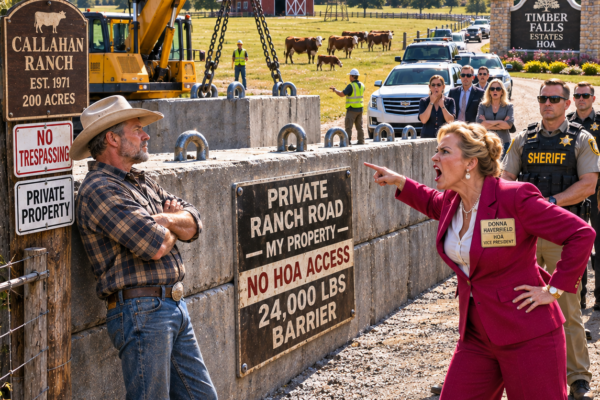
Behind them stood Karen Van Fleet, holding her burgundy clipboard and smiling.
I set my coffee on the windowsill.
“What’s the charge?”
“Criminal defiance of community bylaws.”
I looked at Karen.
She lifted a bright red violation notice.
“You were given multiple opportunities to comply.”
“With what?”
“Your outstanding penalties.”
“One hundred twenty-five dollars?”
“Plus enforcement expenses.”
The larger officer stepped forward.
“You need to come with us.”
“Which department?”
“Special community enforcement.”
“Never heard of it.”
Karen rolled her eyes.
“Stop wasting their time.”
Across the street, my neighbor Duke stood beside his garage, holding a leaf blower in one hand and his phone in the other.
Several curtains opened.
The younger officer handed me a document.
An arrest warrant.
Supposedly.
I recognized the judge’s name.
Judge William Hargrove.
He’d retired five years earlier.
“Interesting,” I said.
Karen mistook my reaction for fear.
“Not so confident now, are you?”
The larger man grabbed my wrist.
I didn’t resist.
There was a young mother standing beside her driveway with two children.
I wasn’t about to turn my front porch into a wrestling match.
“Sir, you’re making a mistake.”
“SHUT YOUR MOUTH!”
Metal cuffs closed around my wrists.
Duke shouted from across the street.
“HEY! WHAT THE HELL ARE YOU DOING?”
Karen pointed toward him.
“Interference with law enforcement is also punishable!”
He raised his phone.
“Then you’d better arrest my camera, too.”
The men escorted me toward their SUV.
Karen followed, practically glowing with satisfaction.
“Perhaps you’ll respect my authority when you get back.”
I looked directly at her.
“Karen, do you actually know what I do for a living?”
She laughed.
“Whatever it is, you’re about to lose your job.”
The younger officer opened the rear passenger door.
I looked toward the security camera above my garage.
Then at Duke.
He was still recording.
The door slammed shut.
And Karen’s phone started ringing.
part2
Through the tinted window, I watched Karen glance at her screen.
She ignored the call.
Then she looked toward the SUV and made a small gesture with her clipboard.
The driver pulled away.
I sat in the back seat with my hands restrained, watching the houses pass.
My front porch disappeared behind us.
The younger man turned around.
“You’re going to learn some respect today.”
“For whom?”
“The association.”
I looked at him.
He didn’t look back.
I had spent twenty years in law enforcement.
Fifteen in SWAT.
Five as a police chief.
I’d encountered frightened people pretending to be dangerous and dangerous people pretending to be harmless.
These men concerned me because I couldn’t establish which category they belonged to.
Their uniforms were wrong.
Their paperwork was worthless.
Their confidence was manufactured.
But their willingness to physically restrain somebody was real.
That was enough to make them dangerous.
I didn’t announce my profession.
Didn’t threaten them.
Didn’t tell them what was happening back at my house.
I concentrated on remaining calm.
My neighbors had witnessed the abduction.
My security system had recorded it.
And because of the events leading up to that morning, the appropriate law enforcement personnel already knew there was a credible threat involving Karen’s enforcement operation.
I trusted them to do their jobs.
The larger man glanced at me through the rearview mirror.
“You got any idea how much trouble you’re in?”
“Probably less than you.”
He frowned.
“You think you’re funny?”
“Not particularly.”
The younger man told him to keep driving.
For the first time, I noticed genuine tension between them.
Whatever confidence they’d displayed on my porch was beginning to deteriorate.
Eventually, we entered an older industrial district on the outskirts of town.
Vacant warehouses stood beside fenced equipment yards.
The SUV stopped near a commercial storage facility.
The younger man got out and approached my door.
Before he could open it, a police vehicle appeared.
Then another.
Real officers.
Clearly identified.
The driver stared through the windshield.
“Oh, hell.”
A loud command came from outside.
Both men froze.
I recognized one of the officers.
Marcus Boone.
Six foot four, built like a refrigerator, and possessed of the calmest temperament of anybody I’d ever worked with.
The younger man began talking rapidly.
“We’re authorized contractors!”
Boone wasn’t interested in his job description.
He was interested in the restrained man sitting in the back seat.
The officers secured the scene and separated the suspects.
Within minutes, I was outside the SUV.
Boone removed the handcuffs.
“Chief, you hurt?”
“Wrists are a little sore.”
“Anything else?”
“My coffee’s probably cold.”
He almost smiled.
Then he remembered the circumstances.
A familiar voice came from behind him.
“Jack Mercer, don’t you dare make a joke about this.”
I turned.
Deputy Chief Danny Ray was standing beside one of the police vehicles.
She looked furious.
“Morning, Danny.”
“Morning?”
She stared at my wrists.
“That’s what you’ve got?”
“Would you prefer good afternoon?”
“Get in the ambulance.”
“I’m fine.”
“Jack.”
I got in the ambulance.
Danny had been my deputy chief for four years.
She was exceptionally good at her job.
She was also one of the few people in the department who could give me an instruction in front of six patrol officers without worrying about my response.
At that moment, I was grateful for both qualities.
The officers handled the suspects, obtained initial statements, and secured the SUV pending the appropriate searches.
I wasn’t involved in questioning either man.
I was a victim and a witness.
My professional position didn’t change that.
Before the ambulance departed, Boone approached Danny.
“Duke’s video came through. Clear picture of the woman directing them.”
Danny nodded.
“Make sure the investigators get the original.”
Then she looked at me.
“We’ve got her instructions on video, Jack.”
I thought about Karen standing beside my porch.
The smile.
The clipboard.
The absolute certainty that everybody would obey her.
“Good.”
Danny studied my face.
“You really picked a peaceful neighborhood, didn’t you?”
I looked toward the ambulance ceiling.
“That was the idea.”
It really had been.
And until three weeks earlier, I’d thought I’d finally found one.
I purchased the house on Oak Street six months after losing my wife.
Laura and I had talked about moving somewhere quieter for years.
She wanted mature trees, a decent garden, and neighbors who didn’t communicate exclusively through complaints.
I wanted a garage large enough for my tools.
Neither of us considered those unreasonable ambitions.
But police work had a way of postponing ordinary dreams.
There was always another emergency.
Another staffing problem.
Another difficult case.
Another evening when dinner went cold because I couldn’t get home.
Laura used to joke that she’d married me and the entire department.
Then came her diagnosis.
Everything changed.
The last year of her life consisted of hospital visits, treatment schedules, and conversations neither of us wanted to have.
She handled those months with humor that occasionally bordered on inappropriate.
One afternoon, while I was struggling to assemble a piece of medical equipment in our living room, she watched me fight with the instructions.
“Fifteen years in SWAT,” she said.
“Yep.”
“Five years running a police department.”
“Correct.”
“And you’re getting defeated by a plastic shower chair.”
I laughed.
So did she.
It was one of the last genuinely carefree afternoons we shared.
After she died, our old house became difficult to live in.
Every room reminded me of something that wasn’t coming back.
Her coffee mug.
Her slippers.
The dent in the couch cushion where she always sat.
Eventually, I started looking for a smaller place.
Somewhere I could establish a different routine without feeling as though I was abandoning her.
Oak Street seemed perfect.
A modest ranch-style house beneath two enormous oak trees.
A wide front porch.
A fenced backyard.
No elaborate entrance monument.
No gated community.
Just ordinary houses on an ordinary street.
The real estate agent explained that the neighborhood had been established in the late 1970s.
When I asked about HOA obligations, she checked the property disclosure.
“None listed.”
“Even better.”
I signed the closing papers.
The first evening, I sat on my porch surrounded by moving boxes.
Laura had labeled several of them before her condition worsened.
One contained my police commendations, photographs, and old certificates.
Across the top, she’d written:
BURN FILES — Nobody wants to hear another war story.
I couldn’t bring myself to remove the label.
The box went into my study.
Still sealed.
For three weeks, Oak Street was everything I’d hoped it would be.
Children rode bicycles past my house.
A young couple named Michael and Ashley Bennett brought cookies after discovering I’d moved in.
Their daughters, Sophie and Claire, insisted on introducing me to their dog.
A man across the street named Duke Henderson wandered over while I was assembling a workbench.
He wore faded overalls and had a laugh that sounded like an old lawnmower finally starting.
“New guy!”
“That’s me.”
“Got any idea what you’re doing?”
“Sometimes.”
“Good enough. Need a hand?”
We finished the workbench together.
Then we sat in his garage drinking coffee and discussing absolutely nothing important.
I hadn’t realized how much I needed that.
I wasn’t Chief Mercer on Oak Street.
I was Jack.
The guy with the pickup truck.
The neighbor who occasionally borrowed a wrench.
The man trying to figure out what to do with a flower bed his wife would’ve known exactly how to handle.
Then, on a Monday morning, I found a bright red envelope tucked beneath my windshield wiper.
And Oak Street stopped feeling quite so ordinary.
The notice was printed on heavy paper with a gold emblem at the top.
Oak Street Homeowners Association.
Beneath that appeared an enforcement reference number and a photograph of my front lawn.
The alleged violation was excessive grass height.
One-quarter of an inch above the permitted maximum.
Penalty: $50.
Payment was required within five business days.
The signature belonged to Karen Van Fleet, association president.
I looked at the lawn.
Then at Duke’s.
Then at the notice again.
Somebody had apparently measured my grass while I was at work.
I considered calling the number printed at the bottom.
Instead, I put the notice inside my truck and went to the grocery store.
After twenty years of handling real emergencies, I wasn’t particularly interested in declaring one over a quarter inch of grass.
That was my first mistake.
The following morning, two more envelopes appeared.
One concerned the original lawn violation.
The other accused me of leaving my garbage can visible for three hours beyond the designated collection period.
Additional penalties brought the total to $125.
The language had changed, too.
Immediate compliance required.
Escalated enforcement pending.
Failure to respond may result in compulsory administrative action.
That last phrase caught my attention.
It sounded official.
It also meant absolutely nothing without context.
I called the listed number.
A woman answered.
“Oak Street compliance office.”
“Good morning. My name’s Jack Mercer.”
“Oh, yes. The new resident.”
“I received several violation notices.”
“Your account is currently delinquent.”
“The first notice arrived yesterday.”
“Then you should’ve responded yesterday.”
“Could you send me a copy of the governing documents?”
“The applicable standards were provided to all residents.”
“I haven’t received any.”
“That’s not our responsibility.”
“Whose responsibility is it?”
“Homeowners are expected to educate themselves before purchasing property.”
I glanced toward the closing folder sitting on my kitchen counter.
“I’d still appreciate a copy.”
“You’ll need to discuss that with Mrs. Van Fleet.”
“Who am I speaking with?”
The woman hung up.
I wrote down the time.
Then I went outside.
A woman with sharply cut blonde hair was standing beside my mailbox.
She wore an ivory blazer and carried a burgundy clipboard.
A tiny white dog strained against its leash.
She was examining my driveway.
“Can I help you?”
She turned.
“Mr. Mercer?”
“Yes.”
“Karen Van Fleet.”
She offered her hand without looking away from the driveway.
“Association president.”
I shook it.
“I’m glad you’re here. I have some questions about those notices.”
“Then you’ve read them.”
“I have.”
“Excellent. When can we expect payment?”
“Once you establish that I owe it.”
Her expression changed.
“The notices explain your obligations.”
“They explain the amount you want.”
“Excuse me?”
“I’m asking for the document establishing the association’s authority.”
She smiled patiently, as though explaining arithmetic to a particularly slow child.
“This is a private residential community.”
“It’s a public street.”
“The association maintains standards.”
“Which association?”
She pointed toward the gold emblem on her clipboard.
“Oak Street.”
“I understand the name. Where are the recorded covenants?”
Her dog barked at my work boots.
Karen pulled it closer.
“Every resident is subject to our regulations.”
“Could I see them?”
“You have a very unusual attitude for somebody who just moved here.”
“I’m asking a reasonable question.”
She examined my driveway again.
“Your truck is also improperly positioned.”
I looked at it.
The truck sat entirely within the driveway.
“What exactly is improper about it?”
“The front tires aren’t aligned with the garage entrance.”
I stared at her.
She appeared completely serious.
“Is that a rule?”
“It’s a standard.”
“Written somewhere?”
“Mr. Mercer, you can make this difficult if you want.”
She leaned closer.
“But people who refuse to cooperate eventually discover there are consequences.”
Her tone bothered me.
I’d heard variations of that sentence throughout my career.
Usually from people who wanted someone else to surrender something voluntarily rather than risk discovering what would happen if they refused.
I stepped back toward my porch.
“Send me the documents.”
She made a note on her clipboard.
Then she walked away.
Duke emerged from his garage moments later.
“Congratulations.”
“On what?”
“You’ve met the queen.”
He laughed.
I didn’t.
“Is she always like that?”
“That’s one of her better moods.”
“How long has this association existed?”
Duke shrugged.
“Depends who you ask.”
“What does that mean?”
He looked toward Karen’s house.
“Come over later. I’ll show you something.”
That evening, Duke opened a drawer beneath his workbench.
Inside was a stack of red violation notices held together with rubber bands.
“Two years’ worth.”
I examined the first.
Improper vehicle maintenance.
The second concerned a decorative American flag mounted beside his garage.
The third accused him of operating lawn equipment during unauthorized hours.
“Have you paid any of these?”
“Some.”
“How much?”
He rubbed his chin.
“Probably fifteen hundred dollars.”
“Duke.”
“I know.”
He looked embarrassed.
“When my sister was sick, I was traveling back and forth to help her. I couldn’t keep dealing with Karen. Paid a few just to make her disappear.”
“Did it work?”
“For a week.”
He pulled out another notice.
This one threatened a property lien.
“That’s when I stopped paying.”
“Did she ever file one?”
“Not that I know of.”
He leaned against the workbench.
“She started sending people around.”
“What people?”
“Two guys. Said they worked for the association.”
“Were they wearing uniforms?”
“Sometimes.”
That got my attention.
“What did the uniforms look like?”
“Black shirts. Badges. One of them had a belt full of stuff.”
“Did they identify themselves as police?”
Duke thought about it.
“One said he was an enforcement officer.”
“Did they ever threaten to arrest you?”
“Not exactly. Said I could be removed from my property if things escalated.”
I put the notice down.
“Do you still have their contact information?”
He handed me another envelope.
The bottom contained a separate number for field enforcement services.
I photographed the document with his permission.
Before leaving, I asked whether other residents had experienced similar visits.
Duke looked toward the Bennett house.
“Talk to Ashley.”
I did.
She invited me inside the following evening.
Michael was working late.
Their daughters were doing homework at the kitchen table.
Ashley brought out a folder and sat across from me.
“Karen told us you were causing problems.”
“I’m asking about the association.”
“That’s what I figured.”
She opened the folder.
The first notice concerned a child’s bicycle left on the front lawn.
Another involved a basketball hoop.
Then came penalties associated with the girls’ chalk drawings on the sidewalk.
Ashley pointed to a handwritten note attached to the latest demand.
Failure to comply may affect residential occupancy.
“What does that mean?” she asked.
“I’d need to see what authority they’re claiming.”
“She told Michael we could lose the house.”
“Did she show him a court document?”
“No.”
“Any recorded lien?”
“Not that we know of.”
Ashley looked toward the kitchen table.
“We’re already struggling a little with the mortgage. We can’t afford lawyers.”
“How much have you paid her?”
“Almost nine hundred dollars.”
She spoke so quietly I barely heard her.
“Michael says it’s better than having trouble.”
I examined the payment receipts.
Some identified Oak Street Homeowners Association.
Others listed a business called Community Residential Administration.
One receipt contained no identifiable company name at all.
“Where did the payments go?”
“Sometimes a bank account. Sometimes Karen collected cash.”
“Did she issue receipts every time?”
“No.”
I felt that familiar tightness in my stomach.
The feeling that came when a seemingly minor complaint began revealing something larger.
I wasn’t looking at two neighbors who disagreed about lawn maintenance.
I was looking at residents surrendering money because they believed somebody possessed the power to take their homes.
And the person demanding that money couldn’t produce her governing documents.
The next morning, I went to the county recorder’s office.
An employee named Marjorie sat behind the counter wearing glasses attached to a silver chain.
“What can I help you find?”
“Recorded restrictions affecting properties on Oak Street.”
“Specific address?”
I gave her mine.
She searched the available property records.
Then she reviewed the subdivision documents.
“Any particular restriction you’re concerned about?”
“Homeowners association membership.”
She tapped her keyboard.
Scrolled.
Opened another record.
Then frowned.
“What’s the association called?”
“Oak Street Homeowners Association.”
She searched again.
“I’m not finding a declaration under that name.”
“Any recorded covenants binding my parcel?”
“Nothing establishing the association you’re describing.”
We reviewed the original subdivision plat and subsequent recordings affecting my property.
There were ordinary utility easements and other standard property documents.
No recorded HOA declaration.
No amendments annexing the parcel into an association.
No recorded agreement establishing the assessments Karen demanded.
I also checked the available state business registration records.
There was no entity registered under the exact association name appearing on the notices.
That alone didn’t settle every possible question about an informal neighborhood organization.
But an informal organization couldn’t automatically impose mandatory assessments on landowners who had never agreed to its authority.
Marjorie looked at the red notice I’d brought.
“Where did you get this?”
“Under my windshield wiper.”
She examined the gold emblem.
“That’s impressive.”
“Is it official?”
“Not anything I recognize.”
I requested certified copies of the applicable recorded documents and a formal written confirmation of the records search that had been conducted.
I also arranged for a local property attorney to review the title history independently.
By the time I left, the situation was considerably clearer.
My supposed HOA president had no established authority over my property.
The same appeared true of numerous neighboring parcels.
Karen wasn’t enforcing a valid covenant badly.
She appeared to be inventing the entire legal framework she claimed to represent.
I could have walked straight to her house and confronted her.
The evidence would’ve made for a satisfying conversation.
But then I remembered Ashley counting out nine hundred dollars her family couldn’t afford.
Duke paying penalties while his sister was sick.
The threatened liens.
The unexplained payment accounts.
And the men with badges.
If I confronted Karen immediately, she’d have an opportunity to destroy records, change her story, and disappear behind another business name.
More importantly, I had a responsibility to handle the situation properly.
So I called Danny Ray.
“Got a minute?”
“For you? Usually.”
“I need to report something.”
Her tone changed.
“What happened?”
I explained the notices, the county records, and the accounts from my neighbors.
When I finished, she was quiet.
“Jack, are you telling me somebody invented a homeowners association?”
“That’s what the records suggest.”
“And they’re collecting money?”
“Apparently.”
“Any threats involving actual police authority?”
“That’s where it gets interesting.”
I told her about Duke’s account.
Then I sent her copies of the documents.
Danny reviewed them.
“Your new address falls within the county sheriff’s primary jurisdiction, right?”
“Correct.”
“Then we’re referring this through the proper channels. You’re personally involved, so you don’t get to run the investigation.”
“I know.”
“I’m saying that out loud because I know you.”
I laughed.
She didn’t.
“I’m serious.”
“So am I.”
My department served a neighboring municipality.
The county investigators were better positioned to handle incidents on Oak Street, and involving them would prevent legitimate questions about my using public resources to pursue a personal dispute.
Danny helped coordinate the referral and identified contacts who could assist if the investigation developed into a wider financial crime case.
I submitted a formal complaint.
Duke provided his records voluntarily.
Ashley and Michael agreed to speak with an investigator.
Nobody accessed private information without proper authority.
Nobody conducted an unofficial background check because I happened to know somebody.
We wanted a case that would survive scrutiny.
Not a shortcut Karen’s attorney could later exploit.
The initial review identified something interesting.
Community Residential Administration was an actual registered business.
Its principal officer was a man named Leonard Price.
The mailing address connected it to several other residential compliance companies.
Karen Van Fleet appeared in records associated with one of those businesses.
Investigators also identified complaints from other parts of the city involving similar notices.
Different association names.
Similar wording.
Sometimes the same gold emblem.
In one neighborhood, an elderly resident had complained about being charged for an unauthorized mailbox.
In another, a family had received threats concerning a basketball hoop.
The complaints hadn’t initially been connected.
Some had been treated as private HOA disputes.
Others had lacked enough documentation to establish what organization was involved.
That was beginning to change.
Meanwhile, Karen continued treating Oak Street as her personal collection territory.
Three days after my conversation with Danny, another notice arrived.
This one demanded an additional $200 for failure to acknowledge the association’s authority.
I almost admired the creativity.
Apparently, asking whether a debt existed had become an expensive offense.
I photographed the envelope.
Then I called Duke.
“Got another one.”
He laughed.
“What’d you do?”
“Asked questions.”
“That’s a premium violation.”
I smiled.
Unfortunately, what happened at Ashley’s house that afternoon wasn’t nearly as funny.
Two men arrived in dark uniforms.
They told her she needed to resolve the family’s outstanding compliance account immediately.
Michael wasn’t home.
The girls were playing in the backyard.
Ashley became frightened when the men suggested that nonpayment could result in further action against the house.
She called the sheriff’s office after they departed.
Then she called me.
“Jack, they knew the girls’ names.”
I stood up.
“What?”
“They mentioned Sophie and Claire. Asked whether Michael was usually home in the afternoons.”
“Are they still there?”
“No.”
“Did they threaten anybody physically?”
“Not exactly.”
Her voice broke.
“But I don’t know how they knew their names.”
I asked her to remain inside while the responding deputy arrived.
Then I contacted the investigator handling the complaints.
By the time I crossed the street, Ashley was sitting beside her kitchen window.
Sophie had abandoned her coloring book.
“Mommy, are we in trouble?”
Ashley shook her head.
“No, honey.”
The little girl looked at me.
“Are we bad neighbors?”
I felt my jaw tighten.
“No, sweetheart.”
“Then why do those people keep coming?”
I knelt beside her chair.
“Sometimes grown-ups make mistakes. Other grown-ups have to sort them out.”
She seemed satisfied with that.
I wasn’t.
I’d spent years protecting people from threats.
I’d understood that fear could change how a child saw the world.
But watching a seven-year-old wonder whether riding a bicycle or drawing with chalk made her a bad neighbor brought the situation into painful focus.
Whatever Karen was doing, the consequences were no longer confined to bank accounts.
She was making children afraid of their own homes.
And she hadn’t finished.
The following Sunday, Duke introduced me to a woman named Ruth Miller.
Ruth was seventy-eight and lived near the far end of Oak Street.
Her husband had been a machinist.
After he died, she continued living in the little brick house they’d purchased in 1982.
Her living room contained photographs of grandchildren, ceramic figurines, and a grandfather clock that struck the hour several minutes early.
“I’m terrible with paperwork,” she explained.
She brought out a shoebox.
Inside were receipts totaling $2,680.
Every payment had been made to Karen or an individual claiming to represent the association.
The violations concerned her flowerpots, a cracked section of sidewalk, a garden bench, and an exterior light that supposedly exceeded permitted brightness.
“Why did you pay?” I asked.
Ruth folded her hands.
“She said she could have me evicted.”
“Did she explain how?”
“She brought a man wearing a badge.”
Ruth’s eyes moved toward the window.
“He told me I wouldn’t want to spend my birthday in jail.”
I stopped writing.
“What was his name?”
“I don’t remember. He called himself an officer.”
“Did he show you identification?”
“He had a badge.”
She looked embarrassed.
“I suppose I should’ve known better.”
“No, Ruth.”
I closed the notebook.
“The person wearing the badge should’ve known better.”
She nodded slowly.
Then she told me she’d canceled a planned visit to her grandson because the penalties had consumed the money she’d saved for the trip.
That was what $2,680 meant to Ruth.
Not a line in an accounting spreadsheet.
A missed birthday.
An empty seat at a family dinner.
Another year she couldn’t get back.
With her permission, I connected her with the investigators.
She wasn’t the only one.
A widower named Thomas had paid nearly $1,100 after being threatened over his late wife’s wind chimes.
Another resident had received notices demanding money for an American flag displayed beside his garage.
A young mother had been told that refusing to register her children’s bicycles could result in criminal penalties.
The stories sounded ridiculous until you heard them from the people who’d experienced them.
Then they stopped being funny.
One afternoon, Karen noticed Ruth speaking with me beside my mailbox.
She walked across the street.
“Mrs. Miller, I need to discuss your account.”
Ruth looked frightened.
“I thought I’d paid everything.”
“We’ve identified additional deficiencies.”
“What deficiencies?”
Karen glanced at me.
“Association business is confidential.”
Ruth took a breath.
“I’d like everything in writing.”
Karen’s expression changed.
“Excuse me?”
“Please send me the rules and the amount you believe I owe.”
It was the first time I’d heard Ruth challenge her.
Karen stared.
“Who told you to say that?”
Ruth looked at me.
Then back at Karen.
“Nobody needed to.”
Karen wrote something on her clipboard.
“Your cooperation will be reflected in the enforcement decision.”
Ruth’s hands were trembling.
But she didn’t back down.
“Put it in writing.”
Karen walked away.
Ruth watched her disappear.
Then she turned to me.
“Was that all right?”
“Perfectly reasonable.”
A small smile appeared.
“Good.”
She straightened her shoulders.
“I’m getting tired of giving that woman money.”
I smiled, too.
For the first time, somebody on Oak Street had discovered that Karen’s confidence could weaken when confronted with an ordinary request for evidence.
The difficulty was that Karen recognized it as well.
That evening, several neighbors received messages warning against participating in unauthorized discussions concerning association finances.
The following morning, I found a notice accusing me of organizing disruptive activity.
Then Karen’s BMW appeared outside my house.
She sat behind the wheel for nearly twenty minutes, talking on her phone.
I documented the encounter.
I also reviewed my property’s security arrangements.
The cameras covered my driveway, porch, and entrances.
They existed because legitimate concerns about harassment had developed.
I wasn’t interested in creating a dramatic confrontation.
In fact, Danny and the county investigators had specifically advised against one.
If Karen or her associates attempted to enter my property or threaten me, I was to avoid escalation and contact the appropriate authorities.
I informed my neighbors of the same thing.
Duke took the instructions with considerable enthusiasm.
“So if she starts another circus, I record it?”
“From somewhere safe.”
“Got it.”
“Don’t go outside to confront anybody.”
“Define confront.”
“Duke.”
“All right, all right.”
The Bennetts were more apprehensive.
Michael asked whether he should remove the basketball hoop.
“That’s your decision,” I said.
“But don’t make it because somebody threatened you with fake legal consequences.”
He looked toward his daughters.
“They use it every afternoon.”
“Then you already know what matters to you.”
He left it standing.
By Thursday, the county investigators had identified the two men appearing in several residents’ accounts.
Their names were Derek Walsh and Nathan Cole.
Neither was a sworn police officer.
Both had performed work for Community Residential Administration and associated businesses.
They had been presenting themselves to homeowners as enforcement personnel.
Investigators were still establishing the precise nature of those representations and the collection activity associated with them.
Then I received a call from an unknown number.
“Mr. Mercer?”
“Speaking.”
“This is Officer Walsh.”
“Which department?”
“Residential Enforcement Division.”
“Is that a government agency?”
“I’m calling regarding your failure to resolve outstanding violations.”
“Could you identify your employer?”
He ignored the question.
“You’ll be receiving a compulsory enforcement visit.”
“When?”
“You’ll be notified.”
“Do you have a court order?”
“Continued resistance will result in your removal.”
“Removal from my home?”
“That’s correct.”
The call ended.
I reported it immediately.
An investigator contacted me and arranged for the threat to receive further attention.
The following afternoon, Karen approached my driveway.
This time, she didn’t have her dog.
Just the clipboard.
“Mr. Mercer, you’ve become quite a problem.”
“I’ve heard.”
“You’re encouraging people not to pay their obligations.”
“People are entitled to ask whether your demands are legitimate.”
“You have no idea what you’re interfering with.”
I thought that was an interesting choice of words.
“What am I interfering with?”
She looked at me for several seconds.
Then she smiled.
“You’ll find out.”
She walked away.
I watched her return to her house.
Something about her certainty concerned me.
People running dishonest collection operations generally preferred victims who could be intimidated without generating attention.
Karen was doing the opposite.
She appeared determined to demonstrate her authority publicly.
Perhaps she believed that humiliating the most difficult resident would frighten everyone else into compliance.
Unfortunately, that determination eventually brought two fake officers to my porch.
Their arrival was faster and more aggressive than the previous threats had suggested.
I had been preparing breakfast.
Duke had been working in his garage.
The Bennetts were heading outside with their daughters.
Then came the black SUV.
The false warrant.
The handcuffs.
And Karen’s triumphant smile.
Once I saw the children watching, I decided against physically struggling with the men.
I wasn’t certain what they were carrying.
I also knew that resistance could place innocent people at unnecessary risk.
So I concentrated on avoiding escalation until real officers could intervene.
It wasn’t a heroic moment.
It was an unpleasant judgment made under circumstances I hadn’t chosen.
And when the county officers finally secured the SUV in the industrial district, I was grateful they’d arrived before anything worse happened.
At the hospital, a nurse examined my wrists.
Danny sat beside the doorway.
“Anything broken?” she asked.
“Just my morning plans.”
“You know, sometimes I think Laura left me instructions to keep you out of trouble.”
“She probably did.”
Danny smiled.
Then her expression softened.
“You scared the hell out of everybody.”
I looked down.
“I know.”
The nurse finished documenting the minor injuries.
Afterward, I gave a formal statement to an investigator.
I described everything I remembered.
The false warrant.
The men’s representations.
Karen’s directions.
Their statements inside the vehicle.
I was careful to distinguish what I’d personally seen from what I’d merely suspected.
Danny drove me home.
When we reached Oak Street, several neighbors were waiting outside.
Duke approached before I’d closed the passenger door.
“Holy hell, Jack.”
“Language.”
He laughed.
Then grabbed my shoulder.
“You all right?”
“Fine.”
Ashley was standing beside him.
She looked as though she’d been crying.
“I called as soon as they put you in the car.”
“Thank you.”
“Michael recorded the SUV. Duke got everything.”
Danny introduced herself.
Ashley looked confused.
“Deputy Chief?”
Danny nodded.
“Jack’s our chief.”
Duke’s mouth fell open.
“YOUR WHAT?”
I sighed.
“Police chief.”
He stared at me.
Then toward Karen’s house.
Then back at me.
“She had two fake cops arrest an actual police chief?”
“That’s one way to describe it.”
Duke bent forward, laughing so hard he had to rest his hands on his knees.
Ashley covered her mouth.
Even Danny smiled.
For a few seconds, the absurdity of what had happened overwhelmed the fear.
Then Sophie approached.
“Mr. Jack?”
“Hey, kiddo.”
“Are you going to jail?”
“No.”
“Promise?”
“Promise.”
She nodded.
Then handed me a drawing.
It showed my house, a very large police car, and a person wearing what appeared to be a superhero cape.
“That’s you,” she explained.
I examined it.
“I’m not sure about the cape.”
“You need one.”
“Apparently.”
I carried the drawing inside.
For the first time since I’d moved to Oak Street, I wished Laura had been there.
She would’ve found the whole neighborhood standing around laughing.
She would’ve shaken her head at me.
And she absolutely would’ve told Sophie that the cape was an unnecessary uniform expense.
Instead, I placed the drawing beside Laura’s photograph.
Then I sat down and finally finished the breakfast I’d started that morning.
Investigators obtained the necessary authorization to search the SUV.
What they found confirmed that the operation extended considerably beyond my $125 in supposed violations.
Inside the vehicle were stacks of red enforcement notices, additional imitation badges, documents identifying residential addresses, and a weapon that raised separate concerns.
There was also more than $5,000 in cash.
Several bundles were marked with homeowners’ names or account references.
One belonged to Ruth Miller.
When I heard that, I thought about her missed trip to see her grandson.
The money she’d surrendered because a man wearing a badge had threatened her with jail.
Some of it had been sitting inside the same vehicle used to transport me.
Investigators also recovered a phone containing communications relevant to the collection operation.
Among those communications were messages between the men and Karen concerning my property.
One message was particularly revealing.
Has the trash been taken out?
A response indicated that I’d been removed from the house.
Karen’s next message instructed the men to ensure that I understood the consequences of refusing to cooperate.
When the investigator described that exchange during a subsequent interview, I asked him to repeat it.
He did.
I sat there for a moment.
Trash.
That’s how she’d described me.
Not a neighbor.
Not a homeowner.
Not even somebody she disliked.
Something that needed removing.
The communications helped establish that Karen’s involvement wasn’t limited to standing beside my porch and watching the incident unfold.
They indicated that she’d been directing aspects of the operation.
Additional evidence was necessary to determine the full extent of her involvement.
But the investigation now had something it previously lacked.
A direct connection between the woman issuing the demands and the men carrying them out.
The two suspects obtained attorneys.
One eventually began cooperating with investigators.
According to information later established through the proceedings, the original arrangement involved collecting money from residents through intimidating visits and misleading representations of authority.
Payments were divided among the participants.
Karen identified households she believed would be particularly susceptible to pressure.
Leonard Price handled portions of the administrative and financial operation.
The men were compensated for collection visits and other assignments.
When I refused to pay and encouraged neighbors to question their demands, Karen apparently viewed me as a threat to the entire operation.
She wanted an example made of me.
That decision transformed an already serious fraud investigation into something considerably more dangerous.
Investigators subsequently obtained search warrants covering a commercial storage unit connected to Karen’s businesses.
The facility looked ordinary from outside.
Inside, they discovered what amounted to an administrative office for an entirely fabricated system of neighborhood governance.
Printers.
Stacks of stationery.
Rubber stamps.
Accounting ledgers.
Cabinets containing property files.
There were photographs of houses from several neighborhoods.
Files contained residents’ names, alleged violations, payment histories, and notes concerning collection activity.
Some residents were identified as elderly.
Others were described as recently divorced, financially strained, or new to their neighborhoods.
My own file contained photographs of my house, my truck, and several notes concerning my refusal to cooperate.
There was also a copy of my property purchase information.
Nothing established that Karen knew my actual occupation when she initiated the enforcement campaign.
Apparently, she’d assumed I was another middle-aged man trying to start over after a difficult personal experience.
She wasn’t entirely wrong.
She’d simply failed to account for the other twenty years of my life.
The records identified multiple neighborhood names under which similar collection schemes had operated.
Investigators traced payments through related businesses and accounts.
They compared correspondence with the complaints received by local agencies.
Former victims began identifying the same individuals.
One woman remembered Derek visiting her house after she’d refused to replace her mailbox.
Another recognized Nathan from a threatening collection encounter involving her father.
The same red envelopes appeared repeatedly.
Different addresses.
Different amounts.
Different excuses.
The same operation.
What Karen had presented as a neighborhood association was actually a business built around manufactured authority.
And Oak Street was only one of its sources of income.
The evidence was referred for coordinated review by county, state, and federal authorities.
Electronic payment records and communications involving interstate transactions supported federal interest in the wider fraud investigation.
The physical abduction and police impersonation raised separate criminal issues within the applicable jurisdictions.
My involvement remained limited to providing evidence and testimony.
Danny kept me informed about matters directly affecting my safety and victim status.
One afternoon, she stopped by my office.
“There’s a warrant for Karen.”
I leaned back.
“Everything supported?”
“Prosecutors reviewed it.”
“Good.”
She placed a folder on my desk.
“The county’s handling the arrest.”
“Where?”
“They’re coordinating that now.”
I nodded.
For years, I’d supervised operations involving suspects considerably more dangerous than Karen Van Fleet.
Normally, I’d have been reviewing assignments, discussing safety concerns, and ensuring that everybody understood their responsibilities.
This time, I closed the folder.
It wasn’t my operation.
I wasn’t going to let personal anger become part of somebody else’s professional decision.
Then Danny noticed the old photograph of Laura beside my computer.
“You know what she’d say?”
“Don’t encourage me?”
“Probably that.”
Danny smiled.
“And that you should take a day off.”
I laughed.
“Sounds about right.”
That evening, I returned to Oak Street and discovered that Karen had scheduled an emergency board meeting.
The notice was taped to several mailboxes.
It warned residents that recent developments threatened neighborhood security and that decisive action was required to preserve the association’s authority.
Apparently, she intended to continue pretending the organization existed.
Her meeting would take place inside her garage.
Several folding chairs had already been arranged.
A portable podium stood beside a whiteboard.
Karen’s gold association emblem was displayed on the wall.
I watched from my porch.
Duke wandered over carrying two cans of soda.
“Meeting of the royal council tonight.”
“Apparently.”
“Think they’re discussing your grass?”
“I hope they’ve moved on.”
He handed me a drink.
At seven, several people arrived.
I recognized two of Karen’s regular supporters.
Leonard Price arrived shortly afterward.
He wore a dark jacket and carried a briefcase.
Karen began addressing the gathering.
Her voice carried across the driveway.
“The recent attack on our association demonstrates why we cannot tolerate individuals who undermine community enforcement.”
Duke looked at me.
“Attack?”
“Interesting interpretation.”
Karen continued.
“We have been subjected to false accusations by a disruptive resident who believes his personal connections place him above our regulations.”
Several people inside the garage nodded.
Then she began discussing emergency financial contributions to fund a legal response.
Duke shook his head.
“She’s asking for more money?”
“Sounds like it.”
A sheriff’s vehicle turned onto Oak Street.
Then another.
Karen stopped speaking.
Officers approached the garage and identified themselves.
One addressed her directly.
“Karen Van Fleet?”
She stepped away from the podium.
“This is a private meeting.”
He informed her that they had a warrant for her arrest.
Her expression changed.
“No, you don’t.”
The officer remained calm.
“Please step outside.”
“ON WHAT AUTHORITY?”
He showed her the warrant.
Karen barely looked at it.
Instead, she pointed toward my house.
“HE’S THE ONE YOU SHOULD BE ARRESTING!”
I remained beside Duke.
The officer repeated his instruction.
Karen backed into the garage, knocking the lightweight podium sideways.
Then she moved toward the interior doorway.
An officer stopped her and directed her back toward the driveway.
Within moments, she was in handcuffs.
Real ones.
Leonard was also taken into custody under a separate warrant.
The other attendees stood beside the folding chairs, apparently uncertain what to do.
Karen looked across the street.
She saw me.
“YOU’RE GOING TO PAY FOR THIS!”
I didn’t respond.
She shouted again.
“I’LL SUE YOUR ENTIRE DEPARTMENT!”
Duke raised his soda can.
“She better ask for a payment plan.”
“Duke.”
“What?”
I shook my head.
As Karen was escorted toward the vehicle, Ruth Miller emerged from her house.
She stood quietly beside her mailbox.
Ashley and Michael came outside.
Other neighbors gathered along the sidewalks.
Karen looked from one familiar face to another.
For months, she’d expected those people to lower their eyes whenever she approached.
This time, they didn’t.
Ruth watched her pass.
Then she said, quietly enough that only a few of us heard her, “I want my money back.”
Karen said nothing.
The patrol car door closed.
The lights reflected across the houses on Oak Street.
And the woman who’d insisted that everybody else respect her authority disappeared from view.
Nobody needed to announce that the association’s emergency meeting had ended.
The empty podium made that fairly obvious.
Duke walked back across the street with me.
“Well, Chief Mercer.”
“Jack.”
“Sorry. Chief Jack.”
I laughed.
He looked toward my flower beds.
“You know what the funniest part is?”
“What?”
“Your grass really does need mowing.”
I looked down.
He was right.
The aftermath lasted much longer than the arrests.
Investigators continued identifying victims, tracing payments, and establishing the financial losses connected to the various businesses.
Karen and her associates faced criminal proceedings.
The kidnapping, unlawful restraint, impersonation, forgery, and fraud-related allegations were addressed through the appropriate state and federal cases.
The prosecution presented financial records, witness statements, original enforcement notices, and preserved communications.
My neighbors’ recordings helped establish what had happened on Oak Street.
The supposed arrest warrant was examined.
Judge Hargrove, whose name appeared on the document, had never issued it.
He learned about the forgery through investigators.
I happened to encounter him several months later at a community event.
“Mercer,” he said.
“Judge.”
“I understand somebody’s been using my name.”
“Apparently.”
“Should’ve picked somebody younger.”
I laughed.
He shook his head.
“Arresting people over lawn ornaments. What a world.”
“Grass, technically.”
“Even worse.”
Eventually, Derek and Nathan entered plea agreements addressing their participation in the operation.
Their cooperation helped establish additional facts about Karen’s role and the financial arrangements.
Leonard Price faced separate consequences for his involvement.
Karen initially denied responsibility.
She claimed the enforcement contractors had exceeded their instructions and that her organizations provided legitimate residential services.
The preserved communications and financial records undermined those explanations.
Ultimately, she pleaded guilty to serious fraud-related offenses and accepted responsibility for conduct connected to the unlawful enforcement operation.
Prosecutors sought a substantial prison sentence.
The court imposed a lengthy custodial term, restitution obligations, and restrictions appropriate to the offenses and applicable law.
Karen wasn’t returning to Oak Street anytime soon.
More importantly, the victims finally received recognition that their payments hadn’t been ordinary HOA assessments.
They’d been obtained through deception and intimidation.
Recovery efforts began.
Not every dollar could immediately be returned.
Some funds had been spent.
Others required separate legal proceedings to recover.
But investigators had located significant assets, and restitution was established through the criminal cases.
Consumer protection authorities provided information for additional victims.
The wider publicity brought forward complaints concerning similar operations in other communities.
Two unrelated copycat schemes were eventually identified and investigated.
Oak Street’s experience had helped authorities recognize a pattern they might otherwise have overlooked.
Ruth was among the first neighbors to receive a substantial recovery payment.
She came to my house carrying the envelope.
“Guess what?”
“What?”
She opened it.
Inside was a reimbursement check.
“I’m going to see my grandson.”
I smiled.
“That’s excellent.”
“He doesn’t know yet.”
“Then you’d better call him.”
She laughed.
Before leaving, she stopped beside my porch.
“Jack?”
“Yeah?”
“I bought a new garden bench.”
“Congratulations.”
“It’s bright red.”
I grinned.
“Sounds perfect.”
She walked home without asking anybody’s permission to install it.
Michael and Ashley received recovery payments, too.
They put some of the money toward household expenses.
The girls got a new basketball.
Duke used part of his recovery to repair his old pickup.
He also purchased a particularly ugly decorative rooster for his front yard.
“Think it’s compliant?” he asked.
“With what?”
“Exactly.”
Without Karen, Oak Street didn’t suddenly need a new homeowners association.
There hadn’t been a legitimate one in the first place.
Instead, residents organized a voluntary neighborhood gathering several times a year.
They shared contact information for emergencies, helped elderly neighbors with household repairs, and coordinated holiday events.
Nobody collected mandatory dues.
Nobody imposed fines.
Nobody appointed themselves president of everybody else’s property.
Duke suggested calling the group the Oak Street Anti-Association Association.
Ashley voted against it.
Mostly because she didn’t want to print the name on invitations.
They settled on Oak Street Neighbors.
Simple enough.
The first gathering took place the following spring.
People brought folding chairs, grills, and homemade food.
Ruth baked a peach pie.
The Bennett girls organized a sidewalk chalk contest.
Nobody complained about the drawings.
Duke spent the afternoon telling increasingly exaggerated versions of the day I’d been arrested.
According to his fourth version, he’d personally rescued me using nothing but his leaf blower.
I threatened to write him a citation for excessive storytelling.
He laughed until he started coughing.
Later, Ashley approached me carrying a plate of food.
“Can I ask you something?”
“Sure.”
“Why didn’t you tell everybody you were a police chief when you moved in?”
I thought about it.
“Because I wanted to be your neighbor.”
She smiled.
“You are.”
That answer meant more than she realized.
For years, my professional identity had followed me everywhere.
People introduced me by rank.
They asked about investigations.
They wanted stories.
Sometimes they expected me to solve problems that had nothing to do with police work.
Laura had understood how exhausting that could become.
She always reminded me that I was allowed to have a life outside my uniform.
After losing her, I’d moved to Oak Street hoping to rediscover that part of myself.
Karen had nearly taken it away.
But the neighbors had given it back.
That evening, I returned home and opened the old cardboard box in my study.
BURN FILES — Nobody wants to hear another war story.
I smiled at Laura’s handwriting.
Inside were commendations, certificates, department photographs, and several small keepsakes from my career.
At the bottom, I found an envelope containing a photograph of Laura and me standing outside our first house.
We were young.
Exhausted.
Proud.
Our lawn looked terrible.
The paint was peeling beside the front door.
Neither of us cared.
We’d bought a home.
And that was enough.
I placed the photograph beside Sophie’s superhero drawing.
Then I added a printed photograph from the public case records showing one of Karen’s imitation badges.
The actual items remained subject to the appropriate evidence and property procedures.
I didn’t need one.
The photograph was sufficient.
One real photograph of my wife.
One child’s drawing.
One reminder of a woman who’d confused the appearance of authority with the responsibility that came with it.
I closed the box.
The following morning, I stepped onto my porch wearing jeans, an old T-shirt, and slippers.
Coffee in hand.
Duke was mowing his lawn.
Ruth was arranging flowers beside her new red bench.
Across the street, Sophie and Claire were drawing enormous yellow stars on the sidewalk.
I looked at my own lawn.
Probably a quarter of an inch too high.
Maybe half an inch.
I considered getting the mower.
Then I remembered something Laura used to tell me whenever I tried to turn a peaceful morning into another list of unfinished tasks.
“Jack, the grass can wait.”
I sat down.
Duke waved.
I raised my coffee.
The oak trees rustled above the street.
Nobody approached with a clipboard.
Nobody slipped a red envelope beneath my windshield wiper.
Nobody demanded that I put my hands behind my back.
For once, there wasn’t an emergency I needed to handle.
There was just a quiet neighborhood, a warm cup of coffee, and the porch Laura would’ve loved.
I leaned back in my chair.
And let the grass grow.