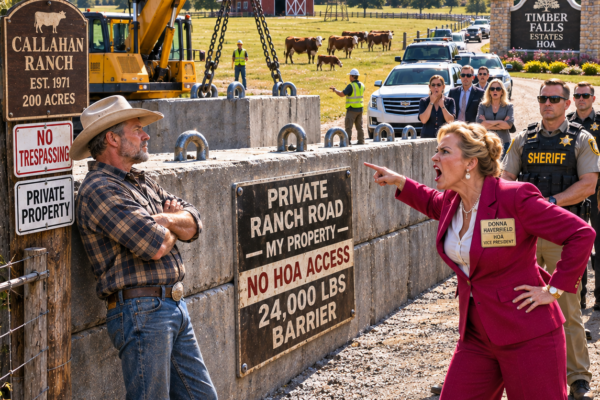
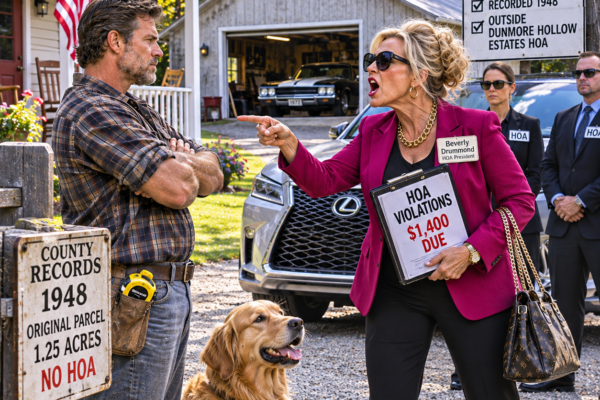
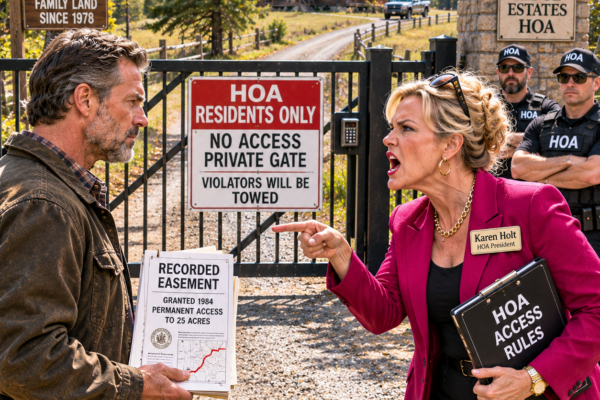
“PAY THE $4,800 YOU OWE US, OR WE’LL PUT A LIEN ON YOUR CABIN!” HOA Karen Declared as Her Inspectors Photographed the Off-Grid Home My Grandfather Had Left Me. My Property Had Never Belonged to Her Association, but She Started Charging Me Daily Fines and Padlocked My Only Access Road. When I Called the County Recorder to Verify My Deed, the Clerk Discovered Something Disturbing in My Property File…
“PAY THE $4,800 YOU OWE US, OR WE’LL PUT A LIEN ON YOUR CABIN!” HOA Karen Declared as Her Inspectors Photographed the Off-Grid Home My Grandfather Had Left Me. My Property Had Never Belonged to Her Association, but She Started Charging Me Daily Fines and Padlocked My Only Access Road. When I Called the County Recorder to Verify My Deed, the Clerk Discovered Something Disturbing in My Property File…
“YOU ARE ILLEGALLY OCCUPYING HOA PROPERTY, AND WE EXPECT IMMEDIATE PAYMENT!”
I stood barefoot inside my cabin, staring at three strangers on my porch.
One held a camera.
Another carried a folder.
The third was Karen Whitmore, president of the neighboring Lakeside Ridge Homeowners Association.
She shoved a payment demand against my chest.
$4,800.
“What the hell is this?”
“Outstanding association dues.”
“I don’t belong to your association.”
“That is no longer relevant.”
I looked at her.
“Excuse me?”
“Your property falls within our updated community boundaries.”
Behind her, a man wearing a gray jacket began photographing my solar panels.
“Document the roof, windows, and deck,” Karen instructed.
He moved toward my open doorway.
I blocked him.
“Don’t photograph the inside of my house.”
Karen lowered her sunglasses.
“If you have nothing to hide, you shouldn’t be concerned.”
“Get off my porch.”
She smiled.
“You’re already facing significant penalties, Mr. Walker. I wouldn’t recommend adding obstruction to your violations.”
“My grandfather built this cabin thirty years before your association existed.”
“Circumstances change.”
“Property ownership doesn’t change because you buy a clipboard.”
Her smile vanished.
“Daily fines begin tomorrow. We can pursue a lien against this structure if you continue refusing payment.”
I stared at the document.
Failure to pay dues.
Unauthorized solar installation.
Unapproved exterior modifications.
Illegal use of association infrastructure.
Even my grandfather’s wooden dock was listed.
“You have absolutely no jurisdiction here.”
Karen pointed toward the gravel road behind her.
“You use our access road.”
“My family has used that road for decades.”
“Then I suggest you start paying for the privilege.”
She turned toward her inspectors.
“We’re finished.”
I watched them walk away.
Then I called the county recorder’s office.
A clerk named Rebecca answered.
I provided my parcel number and asked her to confirm my property’s recorded boundaries.
There was a long silence.
“Mr. Walker, could you repeat that parcel number?”
I did.
More typing.
Then Rebecca spoke again.
“That’s strange.”
“What is?”
“There’s a second boundary document associated with your parcel.”
My fingers tightened around the phone.
“Who filed it?”
“I’ll need to retrieve the complete record.”
She paused.
“Mr. Walker, has anyone asked you to sign away any portion of your property recently?”
“No.”
Another silence.
“Then I think you need to come down here.”
part2
Rebecca gave me an appointment time and advised me to bring whatever ownership documents I had.
I ended the call.
Then I stood in my kitchen, looking at the notice Karen had left behind.
Until that morning, the most threatening document I’d received at my cabin was a reminder that my vehicle registration was about to expire.
Now somebody was demanding thousands of dollars and claiming authority over my home.
I walked into my bedroom and opened the bottom drawer of an old oak dresser.
My grandfather’s property records were inside a metal document box.
The original deed.
A recorded survey.
Property tax receipts.
Construction permits.
A legal description of the access easement.
He’d kept everything.
Even the receipt for the first woodstove he’d installed.
When I inherited the cabin, the estate attorney had advised me to keep those records somewhere secure.
I’d assumed they would remain undisturbed for another thirty years.
Apparently, my grandfather’s habit of saving paperwork was about to become extremely useful.
I dressed, packed the documents into a canvas bag, and drove toward town.
As I passed the entrance to Lakeside Ridge, I noticed Karen standing beside a landscaping crew.
She watched my pickup go by.
Then she raised her phone and photographed my license plate.
I kept driving.
The county recorder’s office occupied a modest brick building beside the courthouse.
Rebecca met me at the public counter.
She examined my identification and retrieved the relevant property records.
“Your ownership is reflected correctly in our records,” she explained.
I felt some relief.
“Then what’s the problem?”
She turned her monitor toward me.
A scanned map appeared on the screen.
The original Lakeside Ridge subdivision boundary was outlined in black.
My parcel sat beyond its western edge.
Then Rebecca opened another document.
A proposed amended subdivision map.
The boundary extended outward, curved around a section of woodland, and enclosed my entire property.
My cabin.
My dock.
My access road.
All of it.
I leaned closer.
“When was this submitted?”
“About six months ago.”
“By whom?”
She displayed the accompanying submission information.
Lakeside Ridge Homeowners Association.
Authorized representative: Karen Whitmore.
I stared at the name.
“Does that mean they own my property?”
“No. Absolutely not.”
Rebecca explained that a document appearing in a county file did not necessarily mean its contents had been approved or had legally changed anyone’s ownership.
The proposed map had been included in an administrative submission associated with several parcels.
Its presence in the system had created an additional reference to mine.
But the submitted amendment had not been accepted as a legally effective boundary change.
She retrieved another page.
A deficiency notice.
The county had requested supporting ownership documentation, affected property owners’ consent where required, and properly prepared survey materials.
Those requirements had not been satisfied.
I looked back at the map.
“So Karen knew this hadn’t been approved?”
“The notice was sent to the submitting party.”
“Can I obtain certified copies?”
“Certainly.”
She examined the original deed I’d brought.
“Your grandfather’s recorded legal description appears consistent with the current ownership record. If there’s an actual dispute over the boundary or easement, though, you’ll want professional legal and surveying assistance.”
I nodded.
Before I left, she printed the available submission history and directed me toward the county planning department for additional records.
I paid for the certified copies.
Then I sat in my truck for nearly twenty minutes.
Karen hadn’t merely misunderstood where her neighborhood ended.
She’d submitted a document attempting to bring my property inside it.
The county hadn’t approved that attempt.
Yet she’d appeared at my house demanding dues as though the proposed change were already official.
I looked at the payment notice again.
At the threats.
At the photographs her inspector had taken.
And I began to understand why she’d been so confident.
She wasn’t expecting me to check.
My name is Daniel Walker.
I was forty-three when this happened, and until Karen arrived, I’d considered myself one of the luckiest men in the county.
My grandfather, Henry Walker, purchased the lakeside property in the late seventies.
The land consisted of twelve acres of woodland, rocky shoreline, and a small clearing overlooking the water.
He built the cabin gradually.
Weekends.
Vacations.
Whatever time he could spare from his job repairing agricultural equipment.
There were photographs of him standing beside the original foundation wearing jeans, work boots, and an old baseball cap.
My grandmother was holding a thermos in nearly every picture.
She claimed she supervised construction.
Grandpa claimed supervision involved drinking coffee and telling him when something looked crooked.
They were both probably right.
I spent most of my childhood summers there.
Grandpa taught me how to repair roof shingles, sharpen tools, and recognize when a storm was coming across the lake.
He also taught me that borrowing something required permission.
Whether it was a hammer, a boat, or somebody’s land.
When he died, the cabin passed to me.
At the time, I was working a demanding technology consulting job in the city.
My days consisted of deadlines, meetings, and an alarming number of conversations about spreadsheets.
I had money coming in.
But I never seemed to have time for anything.
After Grandpa’s funeral, I spent a week at the cabin.
On the first morning, I woke to sunlight coming through the bedroom window.
No alarm.
No traffic.
No messages demanding immediate attention.
I sat on the porch drinking coffee and watching the lake.
By the end of that week, I’d made a decision.
I would work remotely whenever possible and make the cabin my permanent home.
Over the following two years, I upgraded its solar power system, repaired the roof, improved the water storage equipment, and maintained the existing sanitation system in accordance with the applicable requirements.
I wasn’t trying to escape civilization entirely.
I simply wanted civilization to stop knocking on my door every fifteen minutes.
For a while, it did.
Then Lakeside Ridge expanded.
The subdivision had existed for years beyond the tree line.
Originally, it consisted of a modest collection of vacation homes.
A developer purchased additional neighboring land and built larger residences with lake views.
The entrance acquired decorative stone walls.
The homes acquired matching exterior lights.
And the association acquired Karen Whitmore.
She introduced herself at the local hardware store.
I’d been buying screws.
She was discussing exterior paint colors with an employee.
When she learned where I lived, her expression brightened.
“Oh, you’re the gentleman in the old cabin.”
“That would be me.”
“We’ve been discussing that property.”
“Have you?”
“It occupies a rather important position in the community.”
I smiled.
“It’s occupied the same position since my grandfather built it.”
She didn’t laugh.
“Would you ever consider selling?”
“No.”
“Everyone has a price.”
“Apparently, I don’t.”
She handed me a business card anyway.
Several weeks later, a real estate agent contacted me.
He represented an interested buyer who wanted to acquire my cabin and surrounding acreage.
The initial offer was considerably below what comparable lakefront properties were worth.
I declined.
Another offer arrived two months later.
I declined that one too.
Then Karen started complaining about the access road.
The gravel road crossed land now owned by the association before reaching my property.
My grandfather had secured a recorded access easement long before the subdivision existed.
The right to use that road remained associated with my parcel.
I maintained the section on my property and contributed to necessary repairs under the existing arrangement when appropriate.
Karen argued that the association should charge me full membership dues because part of the road crossed its land.
I sent her a copy of the easement.
She stopped contacting me for several weeks.
I assumed she’d consulted someone who understood property law.
Instead, she’d apparently been working on an updated map.
When I returned from the county office, I found another envelope taped to my front door.
Bright orange.
The document announced that daily fines would begin the following morning.
$150 for unpaid dues.
$200 for refusing an association inspection.
Additional penalties could be assessed for unauthorized structures.
At the bottom, Karen had written a personal note.
Your continued refusal to cooperate will leave the board with no alternative but to pursue collection against your property.
I photographed the envelope before removing it.
Then I scanned every page.
I created a folder for the county records.
Another for the notices.
Another for photographs and correspondence.
My background in technology had taught me something useful.
When a system became unreliable, you preserved its history before trying to repair it.
The same principle apparently applied to homeowners associations.
I contacted an attorney named Melissa Grant.
A friend in town had recommended her after she’d helped him resolve a property access dispute.
Her office asked me to send the basic documents before our appointment.
I did.
Then I wrote a short letter to the HOA disputing its alleged jurisdiction.
I attached copies of the recorded deed and survey, together with the county’s deficiency notice concerning the proposed amendment.
I stated that I did not consent to annexation, association membership, or unauthorized inspections.
I requested immediate withdrawal of the payment demand.
Karen responded the following afternoon.
The association does not recognize your interpretation of the boundary documents.
I read that sentence twice.
Apparently, official property records were now a matter of personal preference.
She continued.
Your concerns can be addressed through our standard compliance process after your account is brought current.
In other words, she expected me to pay nearly five thousand dollars before she’d consider whether I owed her anything.
I forwarded the message to Melissa.
Her response was brief.
Do not pay. Bring the originals when we meet.
Three days later, a county environmental services vehicle appeared outside my cabin.
A technician stepped out carrying an identification badge and an inspection folder.
“Mr. Walker?”
“Yes.”
“We received a complaint concerning a potential sanitation problem.”
“What kind?”
“An alleged discharge affecting the lake.”
My stomach tightened.
“Who’s complaining?”
“The report was submitted anonymously.”
I suspected Karen.
But suspicion wasn’t evidence.
I invited him to examine the relevant systems and provided the permits and maintenance records.
He spent nearly an hour checking the installation.
Then he walked the shoreline.
When he finished, he closed his folder.
“I haven’t identified evidence of the reported discharge.”
“Can I obtain the written findings?”
“Of course.”
He looked toward the cabin.
“Has there been some disagreement concerning your property?”
“That’s one way to describe it.”
He nodded.
“We’ve received several recent complaints involving properties around this lake. I can’t discuss other cases, but I’d recommend keeping your records organized.”
“I’ve started.”
“Good.”
His written report arrived two days later.
No observed evidence supporting the reported sewage leakage.
No corrective action required for the allegation investigated.
I saved it.
The following morning, I needed to drive into town for groceries.
I loaded an empty propane cylinder into my pickup and headed down the gravel road.
I rounded a bend.
Then slammed on the brakes.
Two steel posts stood on opposite sides of the road.
A heavy chain stretched between them.
A red-and-white sign hung from the center.
PRIVATE HOA ACCESS.
NO TRESPASSING.
I sat behind the wheel.
For several seconds, I couldn’t believe what I was seeing.
There had never been a gate there.
Not during my grandfather’s ownership.
Not during the estate transfer.
Not during the fifteen years Lakeside Ridge had existed.
I climbed out.
The posts looked freshly installed.
Loose gravel surrounded their bases.
A substantial padlock secured the chain.
I took photographs.
Then I called the association’s management number.
The woman who answered seemed genuinely confused.
“A gate?”
“Your association has blocked my access road.”
“Let me check with the board president.”
A few minutes later, Karen called.
“Good morning, Daniel.”
I looked at the chain.
“Open the road.”
“Access privileges have been temporarily suspended pending resolution of your account.”
“It’s a recorded easement.”
“You’ve made your position very clear.”
“Then you know I have a legal right to use this road.”
“The board disagrees.”
“Who voted on this?”
She ignored the question.
“You have an outstanding balance.”
“I’m not paying it.”
“Then I can’t help you.”
I felt my face grow hot.
“What happens if an ambulance needs to reach my house?”
“Emergency personnel can make appropriate arrangements.”
“With whom?”
“The association.”
“You’re blocking my only vehicle access.”
“That sounds like something you should have considered before refusing to cooperate.”
She ended the call.
I stood beside the chain listening to the wind move through the trees.
I wanted to remove it.
I owned tools capable of dealing with an ordinary padlock.
But Karen had created enough problems already.
I wasn’t going to give her an opportunity to accuse me of damaging association property.
I contacted the sheriff’s office and explained the obstruction.
A deputy arrived from the public-road side.
He examined the gate and reviewed the easement document I provided.
He explained that the recorded property rights were significant but that he couldn’t conclusively resolve a disputed easement at the roadside.
He documented the obstruction and contacted the association.
Karen told him the matter involved a private property dispute.
She also claimed that the access issue was temporary.
The deputy warned her against interfering with emergency access and advised me to pursue appropriate civil relief.
He provided an incident number.
I called Melissa immediately.
Her tone changed when I described the chain.
“This is different from the dues notices.”
“I noticed.”
“Do you have another vehicle route?”
“No.”
“Any agreement authorizing them to restrict access?”
“Not that I’m aware of.”
“Send me the easement and photographs right now.”
I did.
She began reviewing the matter urgently.
Meanwhile, my grocery trip became a hike.
I left my pickup beside the road and walked around the obstruction using a route I was permitted to cross on foot.
The ground was muddy from recent rain.
Branches caught my jacket.
By the time I reached the public road, my boots were soaked.
A neighbor named Paul offered me a ride into town.
He’d seen me walking and stopped.
“What happened?”
“Karen.”
He nodded as though that single word adequately explained everything.
At the grocery store, I purchased what I could reasonably carry.
The clerk recognized me.
“You live in that cabin beyond Lakeside Ridge, don’t you?”
“Yeah.”
She looked uncomfortable.
“Someone brought in their neighborhood newsletter yesterday.”
“What about it?”
“There’s something in there about a property near the lake creating environmental problems.”
I placed a bag of bread on the counter.
“Did it identify the property?”
“Not by name. But it mentioned an off-grid cabin.”
I took a breath.
“The county inspected my system. They didn’t find the alleged problem.”
She looked relieved.
“I figured there was more to the story.”
I paid for the groceries.
Then I walked back toward Paul’s truck.
Karen was doing more than demanding money.
She was trying to establish a version of events in which I was an irresponsible outsider.
Someone illegally occupying land.
Someone polluting the lake.
Someone refusing to pay his fair share.
If enough people accepted that story, perhaps nobody would object when she tried to take the property itself.
That evening, I sat on my porch with the orange envelopes stacked beside me.
The lake was beautiful.
The sky was turning pink above the trees.
Normally, that view made every other problem seem smaller.
Not that night.
I kept imagining a lien notice appearing in the county records.
An emergency vehicle stopped at the chain.
An insurance company discovering false allegations associated with my address.
I’d worked hard to create a peaceful life.
Now I was spending every waking hour defending it.
I looked at the old wooden railing Grandpa had built.
One of its corners still carried a pencil mark where he’d measured a replacement board.
I’d never removed it.
I rested my hand over that mark.
“What would you do, Grandpa?”
The lake didn’t answer.
But somebody walking up my gravel path did.
“I’d start by finding the original survey monuments.”
I turned.
An elderly man stood near the porch steps carrying a rolled map.
He wore a faded canvas jacket and mud-covered boots.
“Daniel Walker?”
“Yes.”
“My name’s Arthur Bennett.”
He held out his hand.
“I surveyed this property for your grandfather.”
Arthur was seventy-eight.
He had retired from land surveying nearly fifteen years earlier and lived on the opposite side of the lake.
My grandfather had mentioned him occasionally, but I’d never met him.
He sat on the porch while I made coffee.
Then he unfolded the map.
It was a copy of the original survey from his professional records.
“Henry was particular about his boundaries,” Arthur said.
I smiled.
“That sounds like him.”
“He made me walk the entire perimeter twice.”
“Also sounds like him.”
Arthur pointed toward a series of marked locations.
“Original monuments. Bearings. Distances. Everything tied to the recorded legal description.”
Then I showed him Karen’s proposed map.
He examined it quietly.
His expression changed.
“Where did you get this?”
“County records.”
“Has it been approved?”
“No.”
He traced a line with his finger.
“Someone’s shifted this boundary around your cabin.”
“Could that happen legally?”
“Not with somebody else’s permission substituted for yours.”
He looked at me.
“I can tell you what I remember and identify my original work. But you’ll need a currently licensed surveyor if you want an updated professional boundary determination.”
I nodded.
“Can you recommend someone?”
“Already called her.”
I laughed for the first time that day.
Her name was Amanda Price.
She had worked with Arthur before establishing her own surveying business.
She arrived the following morning.
Using the available recorded documents and appropriate field equipment, Amanda began examining the property’s boundary.
Arthur accompanied us for part of the work.
Near the eastern corner of my land, he stopped beside a large cedar.
“Should be somewhere around here.”
Amanda checked her equipment and began investigating the area.
Beneath years of accumulated leaves and soil, she located an original survey monument.
A weathered metal marker.
Still in place.
Still corresponding to the recorded survey.
Arthur smiled.
“Hello, old friend.”
We found additional monuments during the examination.
Some required careful searching.
Others were surprisingly accessible.
Amanda documented each one and completed the measurements necessary for her professional assessment.
When she eventually delivered her report, the result was exactly what I’d expected.
My cabin and the surrounding acreage remained outside the association’s established boundaries.
The proposed amendment was inconsistent with the existing property descriptions and had not established a valid change in ownership or association membership.
I thanked her.
Then I paid the invoice.
It wasn’t cheap.
But looking at those original markers had given me something I’d been missing since Karen appeared on my porch.
Confidence.
Not the kind Karen carried around with her clipboard.
The kind supported by measurements, records, and a professional willing to put her name on the findings.
That afternoon, Arthur and I were reviewing old documents when a woman knocked on my door.
Her name was Susan Miller.
I recognized her from a community gathering at the lake several years earlier.
She had served on the Lakeside Ridge board before resigning.
“Can I come in?”
“Of course.”
She glanced toward the road.
“I parked outside the chain. Walked the rest.”
“Sorry about that.”
“Don’t apologize. I’m not the one you should be apologizing to.”
She sat at my kitchen table and placed a flash drive in front of me.
“I think you’ll want to see this.”
Inside were copies of association communications she’d retained from her time on the board.
Susan explained that Karen had proposed expanding the association’s boundaries on two previous occasions.
The board had rejected both proposals.
Some directors objected because the surrounding land belonged to independent owners.
Others questioned whether the expansion made financial sense.
Karen insisted additional properties would provide new assessment revenue.
“That’s why she wants my land?”
“Partly.”
Susan opened a printed email.
It referred to a proposed shoreline improvement project.
The association had been discussing new recreational facilities, walking paths, and improved lake access.
My property occupied a particularly valuable stretch of shoreline.
The project couldn’t proceed as Karen envisioned it without securing rights across privately owned parcels.
Including mine.
I stared at the document.
“She wants to turn my cabin into part of their recreational area?”
“She talked about acquiring it eventually.”
Susan showed me another email.
Karen had suggested that nonmember property owners benefiting from nearby infrastructure could be subjected to additional pressure through maintenance obligations and regulatory complaints.
The messages didn’t establish every aspect of her intentions.
But they gave the dispute a context I hadn’t previously understood.
My land was valuable.
My refusal to sell was inconvenient.
And Karen apparently believed that enough financial pressure might change my mind.
Susan opened another folder.
“There’s something else.”
She showed me a series of association contractor payments.
Several had been made to a company operated by Karen’s cousin.
The invoices described road maintenance and landscaping.
Some of the work appeared legitimate.
Other entries concerned locations that Susan didn’t recognize as common association property.
One invoice referred to improvements near Karen’s own residence.
“Did the board authorize these?”
“Some of them. I don’t know about all of them.”
“Do you have the complete financial records?”
“No. That’s why I resigned. I kept asking questions and stopped getting answers.”
She looked exhausted.
“I didn’t want to spend my retirement fighting with her.”
I understood completely.
Susan glanced toward my window.
“But when I heard she’d blocked your road, I couldn’t keep pretending it wasn’t my problem.”
I contacted Melissa and explained what Susan had provided.
Melissa arranged to review the relevant records and advised us not to make public accusations about financial misconduct before the documents could be properly examined.
We followed that advice.
The next visitor arrived shortly before dark.
Paul.
The neighbor who’d driven me to the grocery store.
He carried his phone and a small flashlight.
“I’ve got something for you.”
His driveway overlooked part of the road where the association had installed its chain.
A security camera covered the entrance to his property.
It had also captured portions of the installation work.
Paul played the recording.
A contractor’s truck.
Two workers unloading the posts.
Karen standing nearby.
The camera’s microphone captured part of the conversation.
One worker asked whether the road served the cabin.
Karen answered.
“He’ll have no choice once the access is gone.”
I looked at Paul.
“Can you save the original?”
“Already did.”
He handed me a copy and agreed to provide the original file to my attorney through an appropriate process.
Then he looked toward the lake.
“She’s been threatening my wife over our garden for eight months.”
I shook my head.
“What now?”
“Now we’re done being quiet.”
By the following afternoon, Melissa had enough information to pursue immediate court intervention concerning my access.
She filed a civil action requesting a declaration of my property rights, appropriate injunctive relief, and compensation for documented damages arising from the interference.
The HOA and Karen were named where appropriate based on the allegations and requested remedies.
Melissa sought expedited consideration of the blocked road.
She also contacted the association’s attorney directly.
That produced an unexpected response.
According to the attorney, the association had not authorized any attempt to seize my cabin.
He was aware of a proposed boundary adjustment but understood that it remained incomplete.
He also hadn’t approved the installation of an obstruction interfering with a recorded easement.
Melissa sent him the notices Karen had delivered.
Then the photographs.
Then the relevant county records.
He promised to contact the board.
A few hours later, Karen arrived outside my cabin.
This time, she was alone.
She pounded on my door.
“Daniel! We need to discuss your recent conduct!”
I opened the door but remained inside.
“Contact my attorney.”
“You’ve been making false statements about the association!”
“Contact my attorney.”
“You can’t involve the courts every time you disagree with a community decision!”
“You blocked my road.”
“It was an administrative access restriction.”
“It’s a chain, Karen.”
She stepped closer.
“I can make this considerably worse for you.”
I looked toward the security camera mounted above the porch.
“Is that another official association decision?”
She followed my gaze.
Then stepped backward.
“This conversation is over.”
“Good.”
I closed the door.
That was the last direct conversation we had before the community meeting.
The meeting was scheduled for Thursday evening at the Lakeside Ridge clubhouse.
Although I wasn’t a member, the board invited me to attend the portion concerning my property and the access dispute.
Melissa accompanied me.
Arthur and Amanda were available to explain their respective survey records and findings.
Susan intended to address the board.
Paul brought his recording.
I’d expected Karen to cancel the discussion.
Instead, she apparently believed she could still persuade everyone that she was right.
When we arrived, nearly every chair in the clubhouse was occupied.
Several homeowners stood against the walls.
Karen sat behind the head table beneath a large association logo.
Her sunglasses rested on top of her head.
The burgundy clipboard lay in front of her.
She looked at Melissa.
Then at me.
“I wasn’t informed that we’d be conducting a legal hearing.”
Melissa pulled out a chair.
“We’re not. Mr. Walker was invited to address the board.”
Karen turned toward the other directors.
“I’d like to begin by explaining the circumstances surrounding this resident’s noncompliance.”
A man in the front row raised his hand.
“Is he actually a resident?”
Karen frowned.
“His property falls within our service area.”
“That wasn’t what I asked.”
The vice president, Michael Torres, motioned for her to continue.
Karen displayed a map on the projector.
I recognized it immediately.
The proposed amended boundary.
She pointed toward my cabin.
“This property benefits directly from Lakeside Ridge infrastructure while contributing nothing toward our operating expenses.”
Several residents murmured.
She continued.
“The owner has refused to comply with architectural standards, pay applicable assessments, or permit routine inspections.”
Melissa raised her hand.
“Can we clarify which recorded declaration subjects his parcel to the association?”
Karen looked annoyed.
“The updated boundary map establishes our jurisdiction.”
Melissa nodded toward the screen.
“When was that amendment legally approved?”
Karen shuffled her papers.
“The submission process is underway.”
“Then why have you already assessed dues?”
“Because the property is within our expanded service area.”
Michael turned toward her.
“Karen, you told us the boundary issue had been finalized.”
She looked at him.
“The remaining steps are administrative.”
Melissa retrieved the certified county documents.
“I have the submission history and the county’s deficiency notice.”
She provided copies to the directors.
Michael began reading.
His eyebrows slowly rose.
Karen reached toward his copy.
“Those aren’t the latest records.”
Melissa placed another document beside it.
“This is the current recorded ownership information.”
Amanda opened her survey report.
“And these are the findings of my recent boundary survey.”
She displayed the original parcel description, the documented monuments, and the existing subdivision boundary.
The difference was immediately visible.
My property remained outside the association.
Arthur stood beside the table.
“I performed the original survey,” he explained.
He pointed toward the relevant markers.
“Those monuments were located during the recent fieldwork.”
Karen folded her arms.
“Old surveys don’t account for modern community needs.”
Arthur looked at her.
“Land boundaries aren’t determined by community needs.”
A few residents laughed.
He didn’t.
He continued explaining the records.
Then Amanda identified the access easement.
The recorded description crossed the section of road Karen had blocked.
Michael examined the document.
“This was recorded before Lakeside Ridge was established?”
“Yes,” Amanda replied.
“So the association purchased its land subject to that existing right?”
Melissa answered carefully.
“The recorded easement is part of the property history. Its legal effect is central to the pending dispute.”
Karen slammed her pen onto the table.
“We maintain that road!”
I stood.
“And I’ve never disputed legitimate maintenance responsibilities under the existing arrangement.”
She pointed at me.
“You refuse to contribute!”
“I refuse to pay membership dues to an association I never joined.”
A woman near the back spoke.
“Those are different things, Karen.”
Karen ignored her.
I placed the $4,800 demand on the table.
Then the daily penalty notices.
Then the threat concerning my cabin.
Michael stared at them.
“Did you issue all of these?”
Karen straightened.
“As president, I have enforcement authority.”
“Over association properties.”
“He benefits from our community!”
Another director shook his head.
“That doesn’t make him a member.”
I displayed the photographs of the chain.
“This is what happened after I refused payment.”
A woman gasped.
“That’s the road behind Paul’s house.”
Paul stood.
“Yes.”
He connected his phone to the presentation equipment.
The recording played.
The workers installing the posts.
Karen standing beside them.
Then her voice.
“He’ll have no choice once the access is gone.”
Nobody moved.
Karen stared at the screen.
Paul stopped the recording.
“That’s from my security camera.”
Karen turned toward him.
“You recorded a private conversation!”
“It was outside my house.”
“You have no right to distribute that!”
Michael raised his hand.
“Karen, did the board authorize restricting Daniel’s access?”
She glanced down.
“It was an operational decision.”
“Who made it?”
“I did.”
The room erupted.
Residents began demanding answers.
Who paid for the installation?
Had the association’s attorney reviewed it?
What would happen if an emergency vehicle couldn’t reach the cabin?
Why was their money being spent on an access dispute involving property outside the neighborhood?
Karen tried to speak over everyone.
For years, she’d controlled meetings by deciding which questions deserved answers.
That evening, nobody was waiting for permission.
Michael called for order.
Then Susan approached the table.
“I’d like to address the proposed boundary expansion.”
Karen’s face changed.
“You resigned from the board.”
“That’s correct.”
“Then you have no authority here.”
Susan smiled faintly.
“I’m still a homeowner.”
She distributed copies of the earlier meeting records.
The rejected expansion proposals.
The correspondence about assessment revenue.
The discussions about acquiring shoreline access.
Michael looked toward the documents.
“Both proposals were rejected?”
Susan nodded.
“The first by three votes to two. The second never received approval.”
Karen shook her head.
“Those were different proposals.”
“Then when did the board approve this one?”
She didn’t answer.
Susan placed another email on the table.
It discussed increasing pressure on owners whose properties interfered with planned improvements.
I recognized my parcel number in the correspondence.
A man near the window stood.
“Were we planning to purchase his land?”
Karen waved dismissively.
“We explored opportunities for improved shoreline amenities.”
“With whose permission?”
She looked at him.
“Development discussions are confidential.”
Michael closed his folder.
“Not when you’re using association funds to pursue a project the board hasn’t approved.”
Then Susan raised the financial concerns.
She didn’t accuse Karen of stealing money.
She presented specific invoices and asked the board to establish whether the expenditures had been properly authorized and whether the association had received the services it paid for.
One director examined the contractor’s name.
“Isn’t this your cousin’s business?”
Karen’s lips tightened.
“He provides competitive pricing.”
“Did you disclose the relationship?”
“Everyone knows we’re related.”
“Was it disclosed in the purchasing records?”
She looked away.
Michael asked the association’s attorney to review the matter independently.
A homeowner called for a formal financial audit.
Another demanded that Karen step aside during the investigation.
Then Janet Phillips, a resident sitting near the front, stood holding the latest neighborhood newsletter.
“Can someone explain this sewage allegation?”
Karen’s expression hardened.
“Environmental concerns were reported.”
“Was there a violation?”
I handed Michael the county inspection findings.
He read the conclusion aloud.
No evidence supporting the reported discharge.
No corrective action required.
Janet looked at Karen.
“You told us the cabin was contaminating the lake.”
“The matter was under investigation.”
“You printed that newsletter after the inspection.”
Karen reached for her papers.
Janet held up the dated copy.
“Two days after.”
Silence.
Michael looked from the newsletter to the inspection record.
Then he removed his glasses.
“Karen, we need you to stop speaking on behalf of the association concerning this dispute.”
She stared at him.
“You can’t do that.”
“The board can address who is authorized to represent it.”
“I’m the president!”
“And we have responsibilities too.”
She grabbed her clipboard.
“This entire meeting is a coordinated smear campaign.”
Susan looked at her.
“No, Karen. These are our records.”
For several seconds, Karen remained standing.
Her fingers tightened around the clipboard.
Then she turned and walked out.
The door slammed behind her.
Nobody followed.
The board remained in session.
Michael asked the association’s attorney whether the existing gate could be reopened immediately.
The attorney advised the directors against continuing to interfere with access while the legal dispute was pending.
A motion passed authorizing removal of the obstruction.
Another suspended all enforcement actions against my property.
The directors also voted to preserve the relevant records and retain independent professionals to review the association’s finances and the proposed boundary amendment.
I packed my documents.
Melissa touched my arm.
“Don’t cancel tomorrow’s court appearance.”
“Even if they remove the chain?”
“We still need enforceable protection for your access.”
She was right.
Karen had already demonstrated how quickly an informal arrangement could disappear.
I wasn’t going to spend the next twenty years depending on somebody’s promise not to lock a gate.
The following morning, I sat beside Melissa in the county courthouse.
Judge Stern presided over the expedited hearing.
Karen attended with her personal attorney.
The association had separate representation.
That distinction alone told me how much the situation had changed.
Only days earlier, Karen had been threatening me in the association’s name.
Now its attorney was explaining that the board had voted to withdraw the disputed enforcement actions.
Melissa presented the recorded easement, photographs of the obstruction, the survey findings, and the communications establishing the reason access had been restricted.
She explained that the chain prevented ordinary vehicle access to my residence and created potential emergency-access concerns.
Karen’s attorney argued that the association had a legitimate interest in maintaining and controlling its property.
Judge Stern looked toward the relevant exhibit.
“Is the plaintiff’s access easement recorded?”
“Yes, Your Honor.”
“Is the validity of that original recording disputed?”
The attorney hesitated.
“There are questions regarding the scope of its application.”
The judge examined the document again.
“Is there language authorizing suspension of residential access for failure to pay unrelated association dues?”
Another hesitation.
“Not expressly, Your Honor.”
Judge Stern looked toward the association’s attorney.
“What’s the association’s current position regarding the obstruction?”
“We have authorized its removal and do not intend to interfere with the plaintiff’s access while the matter is pending.”
“Very well.”
The judge issued a preliminary order protecting my access during the proceedings.
The obstruction had to be removed promptly, and the defendants were prohibited from interfering with my use of the recorded route in the manner addressed by the order.
The remaining questions concerning jurisdiction, damages, and permanent relief would proceed through the ordinary civil process.
Melissa gathered her paperwork.
I leaned toward her.
“Does that mean I can drive home?”
“Yes.”
I closed my eyes.
Those three letters had never sounded so good.
Outside the courtroom, Karen stood beside her attorney.
She was arguing quietly.
When she noticed me, she stopped.
I didn’t approach her.
I didn’t need to.
The court order accomplished more than any argument I’d ever had with her.
By the time I returned to the road, the contractor was already removing the chain.
Paul stood nearby.
Arthur had driven over to watch.
Michael supervised the work on behalf of the association.
One worker lifted the red-and-white sign from its mounting.
Michael approached my truck.
“Daniel, I’m sorry.”
I nodded.
“Thank you for getting it opened.”
“It shouldn’t have happened.”
“No.”
He looked at the steel posts.
“We’ve got a lot of things to straighten out.”
“I imagine you do.”
The contractor finished removing the obstruction.
I drove slowly through the opening.
No detour.
No muddy hike.
No permission from Karen.
Just the same gravel road my grandfather had traveled for decades.
When I reached the cabin, I parked beside the porch and sat behind the wheel for a moment.
I’d never appreciated an ordinary driveway quite so much.
The legal dispute continued for several months.
During that period, the association’s independent review uncovered additional problems.
The proposed expansion paperwork included a certification suggesting that necessary property-owner permissions had been obtained.
Investigators and attorneys examined the supporting documents.
There was no signed authorization from me.
Another landowner identified in the submission confirmed that he hadn’t consented either.
The county’s deficiency notice had been entirely justified.
The matter was referred to the appropriate authorities for further investigation into the representations contained in the filing.
Meanwhile, the financial review identified payments to Karen’s cousin’s company that lacked adequate supporting documentation or approval.
Some expenditures involved legitimate work.
Others concerned improvements outside the association’s authorized responsibilities.
Photographs, contractor records, and invoices helped establish which services had actually been performed and where.
The review recommended recovery of unsupported expenditures and substantial improvements to the association’s purchasing controls.
Several disputed payments were eventually returned through negotiated resolutions.
The board referred the remaining concerns to its attorney and the appropriate authorities.
Karen insisted that every decision she’d made had been motivated by protecting property values.
The records showed otherwise in several important instances.
She resigned as president before the scheduled membership proceedings concerning her removal.
The homeowners subsequently replaced her on the board through their established procedures.
Michael was selected as the new president.
Susan agreed to help with a temporary financial oversight committee.
Paul volunteered to assist with documenting the association’s common infrastructure.
For once, there were people in charge who understood the difference between managing shared property and claiming ownership of everything surrounding it.
My own case reached a resolution after the parties exchanged evidence and participated in settlement discussions.
The association formally acknowledged that my parcel was not subject to its declaration or membership assessments.
Every purported violation and fine against my property was withdrawn.
The disputed proposed boundary amendment was abandoned, and the relevant county records were updated to reflect its rejected status clearly.
The settlement addressed my recorded access rights and prohibited further unauthorized interference.
It also provided compensation toward my documented losses, surveying expenses, and legal costs.
Those terms were incorporated into the final resolution of the civil proceedings.
No payment to Karen.
No invented membership obligation.
No lien against my cabin.
And no ambiguity about where Lakeside Ridge ended.
The criminal investigation proceeded independently.
I cooperated when investigators requested information concerning the boundary submission and the obstruction of my road.
I provided my documents.
I answered their questions.
Then I returned home.
I didn’t need to spend every morning checking whether Karen had been charged.
My immediate objective had already been accomplished.
My property was protected.
My access was restored.
And the people responsible for examining the additional allegations were doing their jobs.
I understood that civil findings, suspicious records, and criminal guilt weren’t interchangeable.
Whatever further consequences Karen faced would depend on the evidence and the applicable legal process.
She had already lost the authority she’d used against me.
That was enough to let me begin rebuilding my peace.
One Saturday morning, Michael arrived with three neighbors and a pickup loaded with gravel.
The installation of the chain had damaged part of the road shoulder.
The association had agreed to restore the affected area.
I offered them coffee.
Paul arrived carrying a shovel.
Arthur appeared shortly afterward, apparently determined to supervise everyone.
“You’re spreading that too thick,” he told Michael.
Michael looked down.
“How thick should it be?”
Arthur shrugged.
“Less thick than that.”
I laughed.
Grandpa would’ve enjoyed the morning.
We worked until lunchtime.
Afterward, a woman named Janet brought homemade bread to the cabin.
She stood awkwardly on my porch.
“I believed that newsletter.”
I looked at her.
“About the lake?”
She nodded.
“I told my husband someone should do something about your cabin.”
Her cheeks reddened.
“I should’ve checked.”
I accepted the bread.
“Thank you for coming over.”
She smiled.
“It’s still warm.”
We sat on the porch for a while.
She told me she’d moved to Lakeside Ridge because she loved the water.
I told her about my grandfather.
She looked at the cabin’s weathered exterior.
“It’s beautiful, actually.”
“Needs a little work.”
“Everything does.”
Before leaving, she asked whether I ever considered selling.
I laughed.
She immediately raised both hands.
“Not asking for myself!”
“I know.”
I looked toward the lake.
“No. I’m staying.”
Over the following months, my relationship with the surrounding community changed.
People who had previously avoided me began waving when I drove past.
A few stopped to introduce themselves.
Some apologized for believing the association’s accusations.
Others had never believed them but admitted they’d been afraid to challenge Karen.
I understood that fear better than I wished I did.
There was something particularly exhausting about defending yourself against a person who could create new allegations faster than you could answer the old ones.
But eventually, the neighbors had realized that silence wasn’t protecting them.
It was protecting her.
Arthur became a regular visitor.
He’d bring coffee, sit beside the dock, and tell me stories about Grandpa.
Apparently, my grandfather had once argued with him for forty minutes over the location of a fence.
“Was Grandpa right?”
Arthur looked offended.
“Of course not.”
I laughed.
“Did he admit it?”
“Eventually. Bought me lunch.”
That sounded exactly like him.
One afternoon, Arthur helped me locate an old photograph from the original survey work.
In it, my grandfather stood beside one of the property markers.
Young.
Strong.
Holding a shovel.
The cabin was visible through the trees.
I framed the photograph and hung it above my desk.
Beside it, I placed a copy of Amanda’s recent survey.
The same property.
The same boundaries.
Separated by decades.
Neither document needed Karen’s approval.
Winter arrived quietly that year.
Snow accumulated on the cabin roof.
My solar panels continued charging the batteries.
The woodstove kept the house warm.
One morning, shortly after seven, I woke to someone knocking on my door.
My heart immediately started racing.
For a moment, I was back in that first confrontation.
The camera.
The clipboard.
The $4,800 demand.
Then I heard Paul’s voice.
“Daniel! Got some coffee for you!”
I opened the door.
He stood there holding two travel mugs.
“Thought we’d check the road after last night’s snow.”
I smiled.
“Give me a minute.”
We walked toward the bend where Karen’s chain had once stood.
Nothing obstructed the road.
Only fresh snow and the tracks of a deer.
Paul pointed toward a small wooden sign Michael had installed with my agreement.
PRIVATE ROAD — AUTHORIZED PROPERTY ACCESS.
PLEASE KEEP CLEAR.
No association membership requirement.
No warning about trespassing homeowners.
Just a practical reminder to respect everyone’s existing rights.
Paul handed me a coffee.
“Better than the old sign.”
“Much better.”
We stood there for a while, watching snow fall through the trees.
Later that morning, I returned to the cabin.
I added another piece of wood to the stove and opened my laptop.
For the first time in months, I had no legal correspondence waiting for me.
No inspection appointments.
No emergency calls from my attorney.
I finished my work before noon.
Then I walked down to the dock.
The lake was perfectly still.
I remembered the afternoon Grandpa had taught me how to replace one of its damaged boards.
I’d complained that the work was taking too long.
He’d handed me another screw and told me that anything worth keeping deserved a little effort.
At twelve years old, I’d assumed he was talking about the dock.
Standing there now, I understood that he might have meant something more.
Karen had believed my home was an obstacle.
A valuable parcel that could be absorbed into her association.
A source of additional revenue.
A piece of shoreline that stood between her and a development plan.
To me, it was the sound of Grandpa’s boots crossing the porch.
The smell of woodsmoke on cold mornings.
The old fishing rod hanging inside the garage.
The pencil mark on the railing.
Things that wouldn’t appear in any property valuation.
Things I could never replace.
I returned to the porch and opened the metal document box one final time.
I placed the settlement papers beside the original deed.
Then I closed the lid.
My grandfather had kept the records that protected my inheritance.
I’d added the ones that protected its future.
Outside, the gravel road remained open.
The boundary markers remained exactly where they’d always been.
And when the sun began setting across the lake, I carried my coffee onto the porch, settled into Grandpa’s old rocking chair, and listened to the water.
Nobody came to inspect my roof.
Nobody demanded money.
Nobody threatened to take my home.
I reached over and rested my hand against that old pencil mark.
“Still ours, Grandpa.”
The porch boards creaked beneath my chair.
Just like they always had.