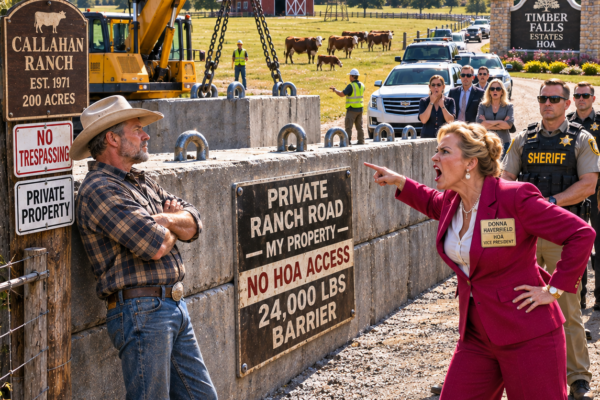
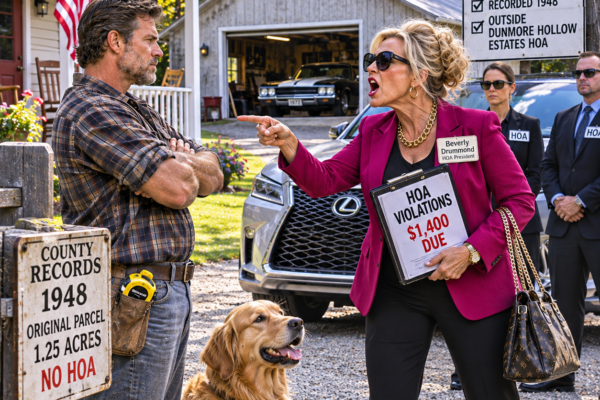
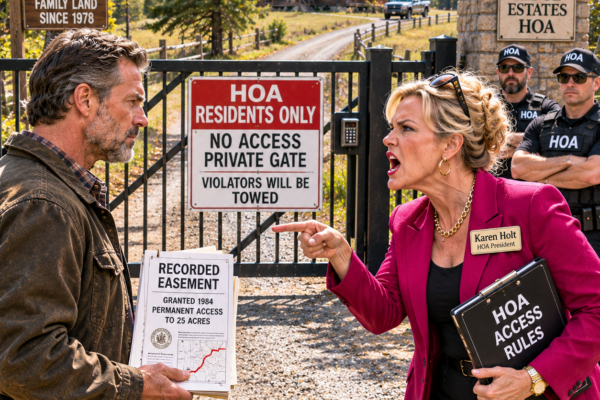
“GO FIND A MOTEL, HONEY. YOUR UNCLE’S DRIVEWAY BELONGS TO THE COMMUNITY NOW!” HOA Karen Laughed as She Parked Her 40-Foot RV Across My Inherited Lakefront Cabin and Planted a Pink Flamingo in My Late Aunt’s Rose Garden. When She Threatened Me With $800 in Daily Fines for Demanding My Property Back, a Retired Schoolteacher Handed Me an Envelope My Uncle Had Been Saving for Three Years…
“GO FIND A MOTEL, HONEY. YOUR UNCLE’S DRIVEWAY BELONGS TO THE COMMUNITY NOW!” HOA Karen Laughed as She Parked Her 40-Foot RV Across My Inherited Lakefront Cabin and Planted a Pink Flamingo in My Late Aunt’s Rose Garden. When She Threatened Me With $800 in Daily Fines for Demanding My Property Back, a Retired Schoolteacher Handed Me an Envelope My Uncle Had Been Saving for Three Years…
“YOU CAN’T PARK HERE, HONEY. THIS SPACE IS RESERVED FOR ASSOCIATION USE!”
I stared through my windshield.
A forty-foot RV blocked the entire driveway of the cabin I’d inherited from my uncle.
Pink lawn chairs stood beneath its extended awning.
Electrical cables stretched toward my workshop.
And a woman wearing enormous pink sunglasses stood beside a portable barbecue grill.
I lowered my window.
“I’m the new owner.”
Delilah Hutchkins smiled.
“Oh, we know.”
“Then move your RV.”
She laughed.
“Your uncle understood the community’s parking arrangements. You’ll learn.”
“What parking arrangements?”
“Emergency overflow accommodation.”
I looked around.
There wasn’t an emergency anywhere.
“That’s my driveway.”
“Not while the association needs it.”
I stepped out of my truck.
After three hours of driving, all I wanted was to unlock my cabin, take a shower, and sit beside the lake.
Instead, I was negotiating access to my own front door.
Delilah picked up a plastic pink flamingo and pushed it into the soil beside my uncle’s rose bushes.
“Don’t touch those flowers,” I said.
She glanced at me.
“Community beautification, sweetheart.”
“My uncle planted those after his wife died.”
“How sentimental.”
She pushed the flamingo deeper.
My jaw tightened.
“Move the RV.”
“Or what?”
“I’ll have it removed.”
Her smile disappeared.
“I’m the vice president of this homeowners association. Interfering with authorized community operations carries serious penalties.”
She retrieved a laminated document from her folding table.
“Furthermore, your cabin has several unresolved compliance issues.”
I examined the paper.
Eight hundred dollars in potential daily fines.
Unauthorized electrical modifications.
Obstruction of association access.
Failure to cooperate with community officials.
“You’ve got to be kidding.”
“Your uncle was much more cooperative.”
Before I could respond, an elderly woman approached from the neighboring cabin.
Beatrice Caldwell.
I recognized her immediately.
She carried a large manila envelope.
“Delilah,” she said, “did you ever wonder why Cornelius had that property surveyed?”
Delilah’s expression changed.
“Stay out of this, Beatrice.”
Beatrice handed me the envelope.
“Your uncle wanted you to have this.”
I opened it.
Inside was a certified survey, several photographs, and a handwritten letter.
The survey showed something Delilah clearly hadn’t expected me to discover.
Then I read the first sentence of my uncle’s letter.
If she’s still there when you arrive, don’t believe a word she tells you.
part2
I read the sentence again.
Then I looked at Delilah.
She was standing beside the RV with her arms folded.
“What did she give you?”
“Something that belongs to me.”
“Association business is confidential.”
Beatrice laughed.
“It’s a property survey, Delilah. Not a nuclear launch code.”
I unfolded the document across the hood of my truck.
The survey showed the cabin, workshop, driveway, shoreline, and the recorded access easement serving the neighboring properties.
The eastern boundary extended ten feet beyond the old landscaping fence.
Delilah’s RV sat entirely inside my property.
Even the concrete blocks beneath its leveling jacks were on my land.
I pointed toward the survey.
“According to this, you’re trespassing.”
“That’s an outdated document.”
Beatrice adjusted her glasses.
“It was completed eleven months ago.”
“Then Cornelius commissioned an unauthorized survey.”
I stared at her.
“Do you seriously believe I need HOA permission to determine where my property ends?”
“Community boundaries are established through association policy.”
“That’s not how property ownership works.”
She snatched up her purse.
“You have seventy-two hours to submit a formal objection.”
“An objection to what?”
“My authorized occupancy.”
I almost laughed.
Instead, I photographed the RV, its license plate, the electrical cables, and the surrounding property.
Delilah immediately protested.
“You don’t have permission to photograph my residence!”
“Your residence is blocking my driveway.”
“I’m calling the sheriff!”
“Please do.”
She disappeared inside the RV.
Beatrice touched my arm.
“Come over for coffee when you’re finished.”
“Thank you.”
“And don’t throw away anything she gives you.”
She glanced toward the RV.
“Your uncle never did.”
Something about the way she said that made me look down at the envelope again.
Cornelius hadn’t simply left me a cabin.
He’d left me unfinished business.
My name is Benjamin Carter.
Most people called me Ben.
I was forty-one years old, recently divorced, and employed as a construction project manager in Denver.
The previous eighteen months had been difficult.
My marriage ended.
The house I’d spent nine years renovating was sold.
My savings took a considerable hit.
And the apartment I moved into afterward never felt like home.
Then my uncle Cornelius died.
He was my mother’s older brother and probably the closest thing I’d ever had to a second father.
Whenever something broke during my childhood, Cornelius appeared with a toolbox.
Whenever somebody needed help, he appeared with his truck.
He rarely charged neighbors full price for repairs.
Sometimes he didn’t charge them anything.
His workshop beside Lake Serenity carried a hand-painted sign.
FAIR PRICES. GOOD WORK. BETTER COFFEE.
People came for all three.
My aunt June died seven years before him.
After her funeral, Cornelius planted twelve rose bushes beside the cabin.
He told me she had always wanted a proper rose garden.
He’d spent the next seven years making sure she got one.
When his heart finally gave out, the county church couldn’t accommodate everyone who attended his funeral.
People stood outside.
Former customers.
Neighbors.
Volunteer firefighters.
Families whose furnaces he’d repaired during winter emergencies.
I hadn’t realized how many lives he’d touched.
Two weeks later, his estate attorney contacted me.
Cornelius had left me his A-frame cabin, workshop, and approximately one hundred feet of privately owned shoreline.
There were no complicated conditions attached to the inheritance.
Just a key and a handwritten note.
Start over, Ben. Make it yours.
I’d read that note so many times that the folds had begun wearing out.
I eventually arranged to work remotely whenever possible and made plans to relocate permanently.
I imagined quiet mornings.
Fishing.
Coffee beside the lake.
A workshop where I could repair things without being reminded of everything else that had fallen apart.
What I hadn’t imagined was Delilah Hutchkins treating my inheritance as her personal campground.
After our confrontation, I managed to squeeze past the RV and reach the cabin on foot.
A motel business card had been taped to the front door.
Someone had written across it in pink ink.
TEMPORARY ACCOMMODATIONS AVAILABLE.
I removed it.
Then unlocked the cabin.
The familiar smell of cedar greeted me.
Cornelius’s old leather chair stood beside the fireplace.
His fishing rods leaned against the wall.
June’s photographs remained on the mantel.
Nothing inside had changed.
But when I tried turning on the lights, I discovered that somebody had disconnected several circuits at the workshop and run an extension cable toward the RV.
I didn’t touch the arrangement.
I photographed everything and called a licensed electrician.
He couldn’t arrive until the following morning.
Outside, Delilah’s generator started.
The noise carried across the lake.
I stood beside my uncle’s chair, listening to it.
For a moment, I seriously considered leaving.
Selling the cabin.
Taking whatever money remained and finding somewhere that didn’t come with a neighborhood dictator.
I’d already spent too much time fighting over property during my divorce.
I wasn’t eager to do it again.
But then I noticed June’s photograph.
She was standing beside Cornelius in front of the workshop, holding a coffee mug and laughing at something outside the camera’s view.
Behind them, the driveway was empty.
That photograph made my decision easier.
I wasn’t selling.
And I wasn’t leaving permanently.
Not because I wanted another fight.
Because I was tired of losing places that mattered to me.
That evening, I drove to Sal’s Diner.
Parking inside my own driveway remained impossible.
Sal recognized me immediately.
“Cornelius’s nephew.”
“That’s me.”
He came around the counter and hugged me.
“Your uncle talked about you all the time.”
“Hopefully the good things.”
“Mostly complained you didn’t visit enough.”
I laughed.
“That sounds right.”
He poured me coffee without asking.
Then looked toward the window.
“You met Delilah?”
“Apparently, she’s living in my driveway.”
Sal stopped pouring.
“She hasn’t moved that damn thing?”
“No.”
He shook his head.
“Cornelius told her to get it out of there before he went into the hospital.”
“Why was it there originally?”
“She claimed her usual parking space was being repaired. Asked him for a couple of days.”
“How long ago?”
“Almost three weeks.”
I set down my coffee.
“Three weeks?”
“Your uncle got sick shortly afterward. She took advantage.”
Sal disappeared into the kitchen.
When he returned, he placed a small brass key beside my cup.
“Cornelius left this with me.”
“What does it open?”
“His workshop filing cabinet.”
I picked it up.
“He said if anything happened to him, you should have it.”
Sal leaned closer.
“He’d been keeping records on Delilah.”
“What kind of records?”
“Everything.”
He told me about a widow who’d received repeated fines over bird feeders.
A family assessed eight hundred dollars for growing tomatoes in their front garden.
A Vietnam veteran ordered to remove a flagpole because Delilah considered it visually disruptive.
“She always finds something,” Sal said. “Usually when somebody refuses to do what she wants.”
“Where’s the actual HOA president?”
“Tom Redding. He’s recovering from surgery. Delilah’s been acting like she’s president, treasurer, and sheriff combined.”
“Does the board let her?”
“Most of them stopped arguing.”
Sal poured himself coffee.
“Your uncle didn’t.”
I looked at the little key.
“Why didn’t he tell me?”
“He didn’t want you worrying about him.”
That sounded exactly like Cornelius.
Sal pointed toward the lake.
“Whatever you decide, don’t trust her paperwork just because it’s laminated.”
The following morning, I returned with coffee and a box of pastries.
I intended to attempt one final reasonable conversation.
That intention lasted approximately thirty seconds.
Delilah had installed plastic fence posts around the RV.
Yellow caution tape stretched across my driveway.
A handwritten sign read:
AUTHORIZED HOA PERSONNEL ONLY.
She emerged wearing a pink tracksuit and carrying another laminated document.
“You’re not permitted inside the designated area.”
I looked at the tape.
“It’s my property.”
“This is a temporary mutual-aid accommodation site.”
“What does that mean?”
She handed me the document.
It cited a supposed seventy-two-hour emergency camping provision.
According to Delilah, association officers could establish temporary accommodation areas on private residential properties when community circumstances required them.
“What emergency are you experiencing?”
“That’s confidential.”
“Then show me the board’s authorization.”
“I don’t have to disclose internal association decisions.”
“Where’s the original rule?”
She tapped the laminated sheet.
“Right here.”
I read it carefully.
There was no adoption date.
No recording reference.
No board resolution number.
Not even a proper signature.
“Did you print this yourself?”
Her face reddened.
“You’re becoming hostile.”
“No. I’m becoming curious.”
Beatrice appeared beside the fence carrying a gardening bag.
“Delilah, your emergency seems to have lasted longer than seventy-two hours.”
“This doesn’t concern you.”
“Neither does Ben’s driveway concern you, but here we are.”
I nearly laughed.
Delilah went inside the RV and slammed the door.
Beatrice looked at the caution tape.
“Very tasteful.”
“I’m thinking about submitting it for architectural approval.”
She smiled.
Then showed me a small metal marker partially concealed beneath a shrub.
“Your uncle watched the surveyor install this.”
I compared its position with the certified drawing.
The old fence wasn’t the boundary.
It stood several feet inside my parcel.
Beatrice pointed toward the RV’s rear wheels.
“Cornelius tried explaining that to her.”
“What happened?”
“She threatened to fine him for interfering with association parking.”
I took more photographs.
Then I called the attorney who had handled the estate.
His name was Gerald Mason.
He confirmed that Cornelius’s property records contained no conveyance transferring the driveway to the association.
There was a recorded easement serving an access lane farther east.
But it didn’t authorize parking inside my driveway.
He recommended that I consult Janet Brooks, a local attorney specializing in property disputes and association governance.
I called her before lunch.
“Forty-foot RV?” she asked.
“Yes.”
“Blocking your driveway?”
“Completely.”
“Permission from you?”
“None.”
“Permission from your uncle?”
“Originally for a couple of days, apparently.”
“And she’s refusing to leave?”
“She’s installed a perimeter.”
Janet sighed.
“Of course she has.”
I sent her photographs and the relevant documents.
She told me not to tow the RV myself or interfere with its occupied living space.
We needed to establish the proper removal procedure, particularly because Delilah appeared to be using it as temporary housing.
“We’ll get this handled,” she said. “But don’t give her an opportunity to turn a property dispute into a claim against you.”
I agreed.
Then walked toward the workshop.
The brass key Sal had given me opened a gray metal filing cabinet beneath Cornelius’s workbench.
Inside were dozens of neatly labeled folders.
DELILAH HUTCHKINS — CORRESPONDENCE.
ASSOCIATION PARKING.
SHORELINE VIOLATIONS.
CONTRACTOR INVOICES.
BOARD MINUTES.
I stood there for several seconds.
My uncle hadn’t been collecting complaints randomly.
He’d organized them by subject and date.
I opened the first folder.
Photographs showed Delilah’s RV parked across a fire access lane near the clubhouse.
Another showed it occupying an accessible parking space.
There were copies of complaints Cornelius had submitted to the association.
Most had received no meaningful response.
One reply came directly from Delilah.
Association officials are exempt from certain parking restrictions when conducting community business.
Cornelius had written beneath it in blue ink.
Which restrictions? Where does it say that?
The next folder contained invoices.
Landscaping.
Electrical repairs.
Drainage maintenance.
Inspection services.
Several came from companies sharing telephone numbers or business addresses.
Cornelius had circled identical charges appearing on different invoices.
Beside one payment, he’d written:
No work performed. Spoke with Frank on 8/14. Check minutes.
I called Janet again.
“There’s a lot more here than parking.”
“How much more?”
“Three years of records.”
She paused.
“Bring them to my office.”
Before leaving the workshop, I found another handwritten note.
Originals and additional records in bank box. Gerald has access information.
I photographed the note and contacted the estate attorney.
Cornelius had prepared for this.
He’d apparently known that someday somebody would need more than his word.
I wished he’d told me while he was alive.
But I was beginning to understand why he hadn’t.
He’d been trying to protect me from a fight he intended to finish himself.
At Janet’s office, we spent nearly four hours reviewing the files.
She separated the materials into different categories.
My immediate property dispute.
Potential association financial misconduct.
Possible permit violations.
Evidence requiring further verification.
“We shouldn’t assume every allegation in these notes is proven,” she said.
“I know.”
“But your uncle certainly documented his concerns.”
She held up an invoice.
“Do you recognize this company?”
“Hutchkins Property Inspection Services.”
“Delilah’s cousin owns it.”
“That explains the inspection notice on my cabin.”
“It might.”
Janet reviewed the association’s original declaration.
My property was a member parcel, but the restrictions were considerably narrower than Delilah claimed.
The association maintained certain shared roads and recreational facilities.
It had limited architectural authority over specified improvements.
Nothing in the recorded documents gave its officers unrestricted access to private driveways.
There was no emergency camping provision resembling the document Delilah had produced.
Janet also reviewed the fine procedures.
“Eight hundred dollars a day is not something she can simply announce because she’s unhappy.”
“So she has no authority to do this?”
“She hasn’t demonstrated any. We’ll formally demand the supporting documents and challenge the assessment.”
Then she drafted a notice withdrawing any temporary parking permission Cornelius might previously have granted.
It required Delilah to remove the RV within the applicable period.
It also prohibited further unauthorized connections to my utilities and requested that she stop making alterations to the land.
The notice was delivered and documented.
Delilah responded within an hour.
I reject your attorney’s unauthorized interference with association operations.
Janet read the message.
“That’s adorable.”
“Is it?”
“People can’t reject legal correspondence by declaring it unauthorized.”
She placed the message in the file.
“Let her keep writing.”
When I returned to the cabin, I discovered a concrete mixer beside the RV.
Two contractors were digging shallow holes near the rose garden.
I climbed out of my truck.
“What are you doing?”
The older contractor looked at me.
“Putting in footings.”
“For what?”
“Mrs. Hutchkins ordered a covered patio.”
I stared at him.
“A patio?”
“Temporary structure.”
“On concrete foundations?”
He shrugged.
“That’s what the work order says.”
Delilah appeared beneath the awning.
“Don’t interfere with my contractors.”
“Stop the work.”
“They’re performing authorized improvements.”
“To my land?”
“To the community accommodation area.”
I approached the contractor.
“I’m the property owner. I haven’t authorized any construction.”
He immediately set down his shovel.
Delilah raised her voice.
“KEEP WORKING!”
The second man looked between us.
“Ma’am, we need the owner’s permission.”
“You have mine!”
“Do you own this property?”
She hesitated.
Then pointed toward the clubhouse.
“The association exercises supervisory authority.”
The contractor removed his gloves.
“That’s not what I asked.”
I showed him the ownership records on my phone.
He called his supervisor.
Within fifteen minutes, the crew stopped work.
Unfortunately, two small concrete footings had already been poured.
One sat within inches of June’s roses.
Several branches had been broken.
I looked at them.
Then at Delilah.
“You damaged my aunt’s garden.”
“They’re just plants.”
I don’t think she understood how close I came to losing my temper.
Instead, I walked back to the truck and retrieved my camera.
Delilah laughed.
“Take all the pictures you want.”
So I did.
Monday morning brought a county electrical inspector named Carl Peterson.
Delilah had filed a complaint alleging dangerous modifications inside my workshop.
She accompanied him to the property, acting as though she were leading an official investigation.
“There are serious hazards here,” she announced.
Carl looked at her.
“I’ll determine that, ma’am.”
I introduced myself, explained the ownership dispute, and showed him the electrical records Cornelius had maintained.
My uncle had hired qualified professionals for the original work.
The permits and inspection reports were neatly filed.
Carl examined the workshop and identified no evidence supporting Delilah’s description of dangerous unauthorized modifications.
He did notice the cable running toward her RV.
“Who installed this?”
Delilah answered immediately.
“It’s a temporary connection.”
“Was it installed by an electrician?”
“It doesn’t require one.”
Carl looked at me.
“Did you authorize it?”
“No.”
He documented the arrangement and explained that the temporary supply needed to be made safe.
My electrician, who had arrived earlier, coordinated the necessary work with him.
Delilah protested.
“I need electricity for medical equipment!”
Carl stopped.
“What equipment?”
“That’s private information.”
“Then you should arrange a safe independent supply and contact the appropriate medical or emergency services if needed.”
She claimed that disconnecting the unauthorized arrangement would constitute discrimination.
Carl remained professional.
He didn’t dismiss the possibility that she had medical needs.
He simply explained that those needs didn’t authorize an unsafe electrical connection to somebody else’s property.
My electrician ensured the work was completed appropriately.
Then Carl noticed the fresh concrete.
“What are those?”
Delilah looked toward the footings.
“Temporary landscaping improvements.”
Carl examined them.
“Who’s the permit applicant?”
“There isn’t a permit requirement.”
“Have you verified that with the building department?”
“The association approved it.”
Carl took several photographs.
“The association isn’t the building department.”
I turned away to hide my smile.
Before leaving, he provided information about the relevant county requirements and explained that the additional issues would be referred for review.
Delilah stood beside the RV, gripping her clipboard.
That morning, she’d expected an official to condemn my workshop.
Instead, he’d found questions concerning her own arrangements.
She looked at me.
“You’re going to regret encouraging these people.”
I remembered Janet’s advice.
So I documented that, too.
Over the next several days, Delilah began sending notices almost continuously.
She accused me of obstructing association personnel.
Maintaining an unauthorized workshop.
Operating a commercial business without approval.
Creating a visual disturbance with my truck.
Failing to provide adequate accommodations for an association officer.
I forwarded everything to Janet.
Meanwhile, the estate attorney arranged access to Cornelius’s bank box.
Inside were the original association documents, additional financial records, and a sealed envelope addressed to me.
I opened the letter at the bank.
Ben,
If you’re reading this, I’m probably not around to make you coffee.
I smiled despite myself.
Don’t let anybody tell you that cabin belongs to the community. It belongs to you. Your aunt and I worked too damn hard for it.
He explained that Delilah had been approaching older property owners about selling their cabins.
Sometimes she described the offers as opportunities to avoid future association expenses.
Other times she warned that substantial fines or infrastructure assessments could make continued ownership difficult.
Cornelius believed some offers were connected to businesses associated with her preferred contractors.
He hadn’t been able to verify every connection.
But he’d collected enough records to justify concern.
The letter continued.
She tried it with me last year. Told me my workshop would probably have to come down. Offered to introduce me to a buyer who wouldn’t care about the violations.
Funny thing. The violations didn’t exist until I refused the offer.
I lowered the letter.
Cornelius had mentioned nothing about selling.
He’d apparently been fighting to preserve the property while dealing with declining health.
Near the end, he’d written:
Don’t waste your life being angry at her. Just make sure she doesn’t get to do this to the next person.
I folded the letter carefully.
Then sat there looking at the bank box.
The property suddenly felt different.
It wasn’t simply something he’d left behind.
It was something he’d fought to keep.
And I wasn’t going to let that effort go to waste.
Janet contacted several former and current board members.
Tom Redding, the association president, was still recovering from surgery but agreed to speak with us.
We visited him at his home.
He sat in a recliner with a blanket over his knees.
“Cornelius was a good man,” he said.
“He warned me about Delilah.”
Tom looked uncomfortable.
“I should’ve listened more closely.”
Janet asked whether the board had authorized the RV’s placement.
“No.”
“Did the board approve any emergency camping provision?”
“Not that I’m aware of.”
“Did you delegate your full enforcement authority to Mrs. Hutchkins?”
“I asked her to handle routine administrative matters while I recovered.”
He shook his head.
“That’s apparently become something else.”
Tom retrieved a folder containing recent meeting records.
Several minutes appeared incomplete.
One recorded a contractor approval without identifying the amount.
Another referred to emergency spending but didn’t identify the actual emergency.
Janet asked whether Tom had access to complete financial statements.
“Delilah handles most of that with the treasurer.”
“Have you requested copies?”
“Several times.”
“What happened?”
“She said she was preparing a consolidated report.”
Janet looked at me.
Then returned to Tom.
“You need independent association counsel and a proper review of the finances.”
Tom nodded slowly.
“I think you’re right.”
Before we left, he signed a statement confirming that Delilah had no board authorization to occupy my driveway.
For the first time, I had written confirmation from the association’s actual president.
Delilah’s story was becoming increasingly difficult to maintain.
Then she made another mistake.
On Thursday morning, Beatrice knocked on my cabin door.
She carried an official-looking envelope.
“Ben, can you tell me what this means?”
The notice appeared to come from the county tax office.
It claimed that her property taxes were delinquent and warned that enforcement proceedings could result in the loss of her cabin.
Beatrice’s hands were shaking.
“I paid those taxes.”
“When?”
“October. I have the receipt.”
I examined the letter.
It contained a county seal, a reference number, and a telephone number directing her toward an unfamiliar collection service.
“Don’t call this number,” I said. “Let’s verify it with the county directly.”
I contacted the tax office using its published contact information.
An employee reviewed Beatrice’s account.
Her taxes were current.
There was no delinquency proceeding.
The employee asked where she’d received the notice.
“In her mailbox.”
“Could you send us a copy?”
We did.
The employee called back shortly afterward.
“This document did not originate from our office.”
Beatrice sat down.
“Then who sent it?”
I looked toward Delilah’s RV.
“I don’t know yet.”
By lunchtime, two more residents reported receiving similar notices.
One was a retired veteran named Frank Wilkins.
The other was an eighty-three-year-old widow named Dorothy Hayes.
Both had current tax accounts.
Both letters directed recipients toward the same supposed assistance company.
And both contained language suggesting that an expedited private property sale might resolve their financial difficulties.
Janet immediately advised us to preserve the original documents and contact the appropriate authorities.
County personnel began reviewing the apparent misuse of their official identity.
The relevant law enforcement referrals followed.
We didn’t have proof identifying the person responsible.
Not yet.
But Cornelius’s records contained a troubling connection.
One of the private property buyers he’d investigated used a mailing address associated with a company mentioned in the fraudulent notices.
I showed Janet.
She leaned back.
“Your uncle was paying attention.”
“Apparently, nobody else was.”
She shook her head.
“Somebody is now.”
That afternoon, Dorothy visited my cabin.
She carried an old photograph of herself and her husband standing beside their dock.
“He built this place,” she told me.
“We’ve lived here since 1979.”
I invited her inside.
She explained that Delilah had visited her twice during the previous month.
The first conversation concerned shoreline maintenance.
The second involved an offer from a private buyer.
Dorothy had refused.
Then the fake tax notice arrived.
“I thought maybe I’d made a mistake,” she whispered.
“Maybe I’d forgotten something.”
She looked ashamed.
“I’m getting older.”
I placed the county’s confirmation beside her letter.
“You didn’t forget anything.”
She looked at the document.
“I’m not losing my house?”
“Not because of that notice.”
Her eyes filled.
I thought about Cornelius’s letter.
Make sure she doesn’t get to do this to the next person.
I understood exactly what he meant.
People like Dorothy shouldn’t have needed a lawyer simply to determine whether the government was actually threatening them.
Somebody had taken advantage of the trust that an official-looking envelope created.
And if the scheme had worked, she might have surrendered a home worth hundreds of thousands of dollars because she was frightened of losing it anyway.
I promised Janet would review the relevant records.
Then drove Dorothy home.
Her little cabin looked almost exactly like the one in the photograph.
I hoped it would remain hers for many more years.
Delilah’s deadline to remove the RV approached.
Instead of preparing to leave, she extended her awning and installed additional outdoor furniture.
She also attached a sign reading:
PROTECTED RESIDENTIAL OCCUPANCY.
I photographed it.
Janet reviewed the circumstances and explained that Delilah’s assertions didn’t automatically create tenancy or ownership rights.
Still, the removal process needed to account for the RV’s occupancy and any applicable procedures.
We weren’t taking shortcuts.
My uncle had spent three years building a record.
I wasn’t going to undermine it because I was impatient.
Janet contacted Big Mountain Towing.
Cornelius had previously obtained a written proposal from the company concerning the removal of Delilah’s vehicle.
The owner, Jake Morgan, remembered him.
“Your uncle was worried about that RV blocking emergency access,” Jake told me.
“He asked what would be required to remove it legally.”
“What did you tell him?”
“Documentation, proper authorization, and coordination with whoever needs to be there.”
I sent him the property information and Janet’s instructions.
The company agreed to handle the removal once the necessary requirements were satisfied.
Meanwhile, code enforcement officer Rita Lawson visited the property.
She inspected the unpermitted alterations and documented additional concerns involving the RV’s placement, access clearance, utility arrangements, and shoreline protection.
Some issues required corrective notices.
Others needed further assessment.
Delilah argued with her for nearly twenty minutes.
Rita listened.
Then handed her written findings.
Delilah tore the top page in half.
Rita looked at the pieces.
“I have another copy.”
I nearly applauded.
Instead, I went inside and made coffee.
The next morning, Delilah submitted a doctor’s note claiming that relocation would create medical difficulties.
Janet took the matter seriously.
We requested appropriate clarification through lawful channels and made sure Delilah was informed of available assistance and alternative accommodation resources.
Nothing established that she needed to remain specifically on my land.
I also offered to allow reasonable supervised access for the removal of her belongings.
Delilah refused.
“She doesn’t want accommodation,” Janet said afterward. “She wants control over the location.”
We completed the additional steps necessary to authorize removal.
Finally, Janet called me on a Friday afternoon.
“Everything is in order.”
“When?”
“Monday morning.”
I looked through the cabin window.
Delilah was arranging pink cushions beneath the RV awning.
“Does she know?”
“She’s received the notices.”
“Think she’ll cooperate?”
Janet laughed.
“Have you met her?”
Monday arrived.
I woke before sunrise.
Made coffee in Cornelius’s old percolator.
Then stood on the porch watching the mist drift across Lake Serenity.
The RV generator was running again.
Delilah had arranged an independent power source after the unauthorized connection was addressed.
The noise interrupted the quiet.
But for once, it didn’t bother me.
At eight thirty, a heavy-duty tow truck appeared at the end of the lane.
Jake climbed out.
Two employees followed.
Rita arrived shortly afterward.
A sheriff’s deputy named Matthew Collins attended to keep the peace.
Janet parked beside my truck.
Neighbors began gathering along the public access area.
Beatrice arrived carrying a folding chair.
Sal brought a box of pastries.
“You’re enjoying this too much,” I told him.
“I’m providing catering services.”
Delilah burst out of the RV.
“WHAT ARE THESE PEOPLE DOING HERE?”
Jake introduced himself and explained the authorized removal.
She stared at him.
“You’re not touching my vehicle.”
Janet stepped forward.
“Mrs. Hutchkins, you’ve received the required notices. The property owner has withdrawn permission for your continued occupancy.”
“I HAVE ASSOCIATION AUTHORIZATION!”
Janet held up Tom’s written statement.
“The association president confirms otherwise.”
Delilah looked at the document.
“Tom doesn’t understand the current emergency.”
Deputy Collins spoke.
“Ma’am, are you ready to collect your remaining belongings?”
She turned toward him.
“I demand that you arrest this man!”
She pointed at me.
“For what?” he asked.
“Harassment! Discrimination! Interfering with my residence!”
The deputy explained that her complaints could be submitted through appropriate channels, but they didn’t authorize her to obstruct the documented removal process.
She rushed back into the RV.
For a moment, I thought she might finally prepare to leave.
Instead, she emerged carrying a length of chain.
Jake stopped his crew.
“Ma’am, please don’t do that.”
Delilah attached herself to part of the RV’s exterior framework.
Then raised both hands.
“YOU’LL HAVE TO DRAG ME OUT WITH IT!”
Nobody moved.
The deputy immediately instructed the towing crew to suspend operations.
He approached Delilah and attempted to persuade her to release herself voluntarily.
Rita called for additional assistance in case it became necessary.
Janet stood beside me.
“This is precisely why we arranged witnesses.”
Delilah began shouting about medical emergencies, religious discrimination, and constitutional rights.
She waved freshly printed papers toward the neighbors.
Beatrice lowered her sunglasses.
“Good heavens.”
Sal handed me a pastry.
“Breakfast?”
“Absolutely.”
The deputy continued speaking with Delilah.
He offered her an opportunity to cooperate without escalating the situation.
Eventually, after considerable discussion and appropriate safety measures, she was separated from the chain.
Jake’s crew removed the remaining obstruction only after the area was clear.
Delilah was furious.
“You’re destroying my home!”
Janet responded calmly.
“Your vehicle is being relocated through the applicable process. You’ve been provided information concerning its destination and the arrangements for retrieving it.”
Delilah pointed toward me.
“HE’S STEALING EVERYTHING!”
I looked at the RV.
Then at my cabin.
“I’m getting my driveway back.”
Jake began preparing the vehicle for removal.
The crew secured its equipment.
The awning was retracted.
Loose belongings were collected.
The pink lawn chairs disappeared.
For the first time in weeks, I could see the entire front of my workshop.
Then the tow truck began moving.
Slowly.
Carefully.
Forty feet of diesel-powered entitlement rolled out of my driveway.
Delilah stood beside the deputy, screaming that she would sue everyone involved.
The RV continued down the lane.
As it passed Sal, he raised his coffee cup.
Beatrice started applauding.
Several neighbors joined her.
I didn’t.
I watched until the vehicle disappeared around the bend.
Then I turned toward the rose garden.
The plastic flamingo was still there.
I pulled it from the soil.
Beneath it, one of June’s rose bushes had started producing a new green shoot.
I stood looking at that little branch for a long time.
It had survived.
So had the cabin.
For the first time since arriving, I parked my truck in my own driveway.
I should have felt finished.
But the evidence Cornelius had collected was about to expose something far larger than an unauthorized RV.
Two days after the removal, Tom called a special board meeting.
He arranged for independent legal counsel and requested that the treasurer provide complete financial records.
Delilah arrived wearing a dark pink blazer.
She looked determined to reestablish her authority.
“This meeting is unnecessary,” she announced.
Tom looked at her.
“We have serious issues to address.”
“Ben Carter has manufactured a crisis.”
Janet attended with me for the portion concerning my property.
She presented the ownership documents, photographs, notices, and records relating to the unauthorized occupation.
Tom acknowledged that no valid board decision supported Delilah’s actions.
Then he withdrew the disputed fines against my cabin, subject to the appropriate board authorization and administrative corrections.
Delilah objected.
“You can’t cancel enforcement decisions merely because somebody complains!”
Tom opened the association declaration.
“Where’s the authority for the eight-hundred-dollar daily penalty?”
She looked toward the treasurer.
“That’s established policy.”
“Show me.”
The treasurer searched through several folders.
Nothing appeared.
Tom asked about the emergency camping provision.
Delilah produced another laminated copy.
The independent attorney examined it.
“When was this adopted?”
“Several years ago.”
“Which meeting?”
“I don’t remember.”
“Where are the minutes?”
“Probably archived.”
The attorney looked at the document.
“Who prepared it?”
Delilah folded her arms.
“Why does that matter?”
“Because we’re being asked to enforce it.”
The room grew quiet.
A board member named Louise finally spoke.
“I’ve never seen that rule before.”
Another agreed.
Tom turned toward Delilah.
“Did you create this document?”
She refused to answer directly.
That refusal seemed to tell the other board members everything they needed to know.
Then came the contractor invoices.
Cornelius had documented several charges for work supposedly completed around the lake.
An independent review had already identified discrepancies requiring further examination.
Tom displayed one invoice for shoreline maintenance.
Frank Wilkins raised his hand.
“I live beside that section. Nobody did that work.”
Delilah interrupted.
“You’re not qualified to evaluate contractor performance.”
Frank laughed.
“I spent thirty-two years operating construction equipment.”
Tom requested supporting records.
Work orders.
Completion photographs.
Competitive bids.
Payment authorizations.
Some documents were missing.
Others contained inconsistencies.
One contractor had received multiple payments for substantially similar services.
Another company belonged to Delilah’s cousin.
A third shared an address with a business involved in private property acquisition.
The independent attorney recommended preserving all records and commissioning a full financial audit.
Delilah stood.
“I will not participate in this witch hunt.”
Tom looked at her.
“You’re welcome to provide the records that would resolve these questions.”
She grabbed her purse.
“This community will collapse without me.”
Beatrice called from the front row.
“We’re willing to take that chance.”
Delilah walked out.
The meeting continued.
For the first time in years, residents were discussing association business without waiting for her permission.
The financial review took several months.
Investigators and independent accountants examined bank records, contractor payments, reimbursements, and the relationship between the association’s enforcement practices and property acquisition efforts.
Cornelius’s records provided useful leads.
His photographs established when certain areas had actually been maintained.
His notes identified residents who could describe work that supposedly occurred.
His copies of meeting minutes helped reconstruct decisions that had been poorly documented elsewhere.
Several invoices couldn’t be adequately supported.
Certain payments had gone to connected businesses without proper disclosure.
The audit also identified reimbursements used for expenses relating to Delilah’s RV.
Fuel.
Temporary electrical equipment.
Outdoor furnishings.
Items presented as community emergency supplies.
I remembered the pink lawn chairs.
Apparently, the neighborhood had helped pay for the furniture blocking my driveway.
The apparent property acquisition scheme was more disturbing.
Investigators identified connections between several businesses operating around Lake Serenity and entities associated with previous complaints in Nevada, Utah, and Arizona.
The details emerged gradually through official proceedings and properly disclosed records.
In some cases, property owners had faced aggressive enforcement campaigns shortly before receiving purchase offers.
Some complaints involved allegedly fabricated assessments or misleading representations about ownership obligations.
Not every allegation resulted in a criminal charge.
Some were civil matters.
Others lacked sufficient evidence.
But the pattern was serious enough to attract investigators beyond our county.
One afternoon, Janet called me into her office.
“Remember the fraudulent tax notices?”
“Of course.”
“Investigators have identified additional records connecting the collection contact listed on them to a business associated with Delilah’s associates.”
“Do they know who produced the letters?”
“They’re developing that evidence.”
She showed me information that had become available through the relevant proceedings.
The fake notices weren’t merely intended to frighten people.
They directed vulnerable owners toward supposed assistance providers connected with property acquisition interests.
Someone could create a false financial emergency, offer a convenient solution, and profit from a hurried sale.
I thought about Dorothy’s photograph.
Her husband had built that cabin.
She’d nearly believed somebody could take it away because of a government notice that wasn’t even genuine.
“Cornelius figured this out,” I said.
“Part of it.”
“He would’ve been furious.”
Janet closed the folder.
“He was smart enough to document it instead.”
That made me proud.
It also made me sad.
My uncle should have been sitting beside me.
Drinking terrible coffee.
Making jokes about fraudulent paperwork.
Watching the people who’d threatened his home finally answer questions they couldn’t dismiss.
Instead, I was carrying his records.
Finishing what he’d started.
The association removed Delilah from her officer position through the applicable governance procedures.
A separate election filled the vacant board position.
Her access to association accounts and administrative systems was terminated.
The board notified residents that disputed enforcement matters would be reviewed independently.
Several previous fines were withdrawn.
Some homeowners obtained refunds or negotiated resolutions.
The association pursued recovery of improperly spent funds.
Regulatory proceedings concerning the RV’s placement and alterations also continued.
Documented penalties, removal expenses, restitution claims, and related financial obligations accumulated.
Eventually, the total assessed against Delilah across the relevant proceedings exceeded twenty thousand dollars.
That figure didn’t include every potential civil liability or legal expense.
She contested several items.
Some matters required separate hearings.
But she was no longer the person deciding which rules applied.
One of the first homeowners to benefit from the review was Frank.
The veteran whose flagpole had been declared visually inappropriate.
He stopped by my cabin carrying an old photograph.
It showed Cornelius helping him install the pole.
“Your uncle did most of the work,” he said.
“Wouldn’t take a dime.”
Frank had removed the flagpole after Delilah threatened escalating fines.
Following the review, the disputed assessment was withdrawn and the installation was reconsidered under the proper requirements.
Frank asked whether I would help him put it back.
“Absolutely.”
We spent a Saturday morning working together.
When the flag rose above his yard, Frank stood quietly beside it.
Then he looked toward the lake.
“Wish Cornelius could see this.”
“So do I.”
Frank placed a hand on my shoulder.
“Maybe he knew we’d get here eventually.”
I watched the flag move in the breeze.
I hoped he was right.
Delilah eventually filed a civil claim against me.
She alleged wrongful removal of her RV, interference with her occupancy, property damage, and emotional distress.
Janet called me after receiving the paperwork.
“Your former tenant has discovered the courthouse.”
“She wasn’t my tenant.”
“I know. That appears to be a significant problem for her argument.”
We responded with the documented ownership records, notices, photographs, association statements, and removal information.
The towing company supplied its records.
The attending officials provided the relevant documentation through proper channels.
Delilah’s claims didn’t survive the proceedings.
The court rejected her attempt to establish an enforceable right to remain on my driveway under the circumstances.
Her unsupported demands against me failed.
The resulting resolution also addressed recoverable costs and certain damages associated with her occupation.
The RV remained at the storage facility while the related obligations and ownership issues were processed.
Delilah had opportunities to arrange its release.
She failed to resolve the necessary matters.
Eventually, after the applicable notices and lien procedures, the vehicle was sold through an authorized auction.
Sal sent me a photograph from the listing.
There it was.
The forty-foot RV.
Pink curtains still hanging behind the windshield.
No flamingos.
No caution tape.
No signs declaring emergency association authority.
Just an expensive vehicle somebody else could purchase.
Sal added a message.
Think we should buy it for community overflow parking?
I replied.
Absolutely not.
He sent six laughing emojis.
The criminal investigation proceeded separately.
Authorities eventually announced charges involving fraudulent documents, financial misconduct, and related coordinated activity against Delilah and several associates.
The evidence varied by defendant and allegation.
Some defendants entered negotiated pleas.
Others contested the charges.
Delilah eventually faced a conviction through the resulting proceedings, along with financial penalties, restitution requirements, and other court-imposed consequences.
Her former business associates faced their own legal outcomes.
The entire process lasted considerably longer than the removal of the RV.
I didn’t follow every hearing.
I provided evidence and attended when required.
But I had a cabin to restore.
And I was finally learning how to stop organizing my entire life around somebody else’s misconduct.
One afternoon, I received a letter from Dorothy.
Inside was a photograph of her cabin.
She was sitting beside the dock, smiling.
On the back, she’d written:
Still mine.
I placed it beside Cornelius’s photograph on my mantel.
That little note meant more to me than any financial penalty Delilah received.
By the following spring, Lake Serenity felt different.
Tom remained involved with the association but decided not to seek another term as president.
He encouraged a new group of residents to establish clearer procedures.
Beatrice became part of the governance review committee.
Nobody could intimidate her.
At one meeting, somebody suggested creating stricter rules concerning exterior decorations.
Beatrice raised her hand.
“Before we do that, can anybody explain why we need them?”
The proposal died shortly afterward.
The association revised its enforcement procedures with professional guidance.
Homeowners received proper notices and opportunities to challenge assessments.
Financial records became accessible through established processes.
Contractors were selected using transparent procedures.
Conflicts of interest required disclosure.
The board clarified its responsibilities concerning shared property and its limitations concerning private land.
Nobody was granted emergency authority to occupy another homeowner’s driveway.
That last part received particularly enthusiastic support.
I attended several meetings but declined a board position.
I’d had enough association politics to last me several lifetimes.
Instead, I started working on Cornelius’s workshop.
The roof needed repairs.
Several shelves required reinforcement.
The old coffee machine had finally stopped working.
But most of his tools remained in excellent condition.
There were wrenches older than I was.
Woodworking equipment.
A drill press.
Fishing tackle.
Boxes containing every screw size imaginable.
Cornelius had always believed that people shouldn’t need to purchase an expensive tool for one small job.
So I decided to convert part of the workshop into a community tool library.
Sal offered to help.
Frank repaired the benches.
Beatrice organized an inventory.
Dorothy donated her late husband’s gardening equipment.
Within a few weeks, neighbors began borrowing tools and returning them with handwritten thank-you notes.
We established simple borrowing arrangements.
Nothing elaborate.
Nothing involving architectural committees.
Just enough structure to make sure everybody had a fair opportunity to use the equipment.
I kept Cornelius’s original sign above the entrance.
FAIR PRICES. GOOD WORK. BETTER COFFEE.
The tools were free to borrow.
The coffee remained dangerously strong.
On opening day, Sal stood beside the workbench and tasted his first cup.
He immediately made a face.
“Good Lord, Ben.”
“What?”
“You trying to remove paint with this?”
“Cornelius’s recipe.”
He took another sip.
“Perfect.”
We laughed.
Then Frank arrived carrying a broken lawn mower.
A young couple borrowed a ladder.
Beatrice sat near the door explaining our inventory system to anybody willing to listen.
For the first time, the workshop sounded like it had when Cornelius was alive.
People talking.
Tools moving.
Somebody laughing too loudly.
Coffee cups clinking against the workbench.
I stood beside the window for several minutes.
I’d inherited more than land and a building.
I’d inherited a way of being part of a community.
It had nothing to do with declaring authority.
Everything to do with showing up when somebody needed help.
The shoreline improved, too.
The association arranged professional assessments of previously neglected environmental concerns and completed the necessary corrective work.
Unauthorized arrangements were removed.
Damaged areas were restored.
Residents participated in cleanup days.
One Saturday, nearly thirty people gathered beside the lake to collect litter and clear approved areas under the guidance of the relevant professionals.
Children carried small bags.
Adults repaired benches.
Sal supplied sandwiches.
Nobody circulated a mandatory attendance notice.
Nobody threatened fines against residents who couldn’t participate.
People came because they wanted to.
That was a new experience for Lake Serenity.
Later that afternoon, Beatrice sat beside me on the dock.
“Your uncle would’ve enjoyed today.”
“He would’ve complained about my coffee.”
“Probably.”
She smiled.
“You know, he used to worry that people around here had forgotten how to be neighbors.”
I looked toward the workshop.
“They’re remembering.”
She nodded.
Then pointed toward the water.
“Listen.”
I heard a loon calling across the lake.
It was the first time I’d noticed one since arriving.
Without Delilah’s generator running, the sound carried clearly through the trees.
Beatrice closed her eyes.
“That’s what this place is supposed to sound like.”
I agreed.
We sat there until the sun started dropping behind the pines.
Several months later, I received my final correspondence concerning the property dispute.
The records confirmed the resolution of the unsupported association assessments against my cabin.
The ownership issue had been addressed.
The association’s obligations and the relevant settlement terms were documented.
The remaining enforcement and criminal proceedings belonged to the appropriate authorities.
I placed the paperwork inside Cornelius’s old filing cabinet.
Then I closed the drawer.
For nearly a year, that cabinet had been central to my life.
I opened it every morning.
Added photographs.
Printed correspondence.
Reviewed timelines.
Searched for records whenever another unexpected problem appeared.
Now there was nothing left for me to add.
I took the little brass key and placed it on a hook above the workbench.
It could stay there.
The evidence remained safe.
But I no longer needed to carry it everywhere.
Outside, the concrete footings Delilah’s contractors had poured still stood beside the driveway.
I’d considered removing them.
Then Beatrice suggested something better.
We cleaned the surrounding area, incorporated the small bases into a new landscaping arrangement, and placed large planters above them.
I planted roses.
Pink ones.
Not the obnoxious artificial pink of Delilah’s flamingos.
The softer color June had loved.
Several of the original bushes had recovered completely.
The damaged one beside the former RV developed new branches and eventually produced flowers.
I watered it every morning.
Sometimes I talked to it.
I figured Cornelius would’ve understood.
On the anniversary of his death, I made coffee and carried two mugs onto the porch.
One for me.
One I placed beside his empty chair.
The lake was perfectly still.
Sunlight moved through the pines.
My truck stood in the driveway.
Exactly where his truck used to stand.
I took his handwritten note from my pocket.
Start over, Ben. Make it yours.
For months, I’d interpreted those words as instructions to protect the property.
Now I understood something else.
Cornelius hadn’t wanted me to spend the rest of my life fighting Delilah.
He wanted me to have a life worth protecting.
A home.
Friends.
Work that meant something.
Mornings when I could sit quietly without waiting for another threatening envelope.
I looked toward the workshop.
Frank was borrowing a wrench.
Beatrice was rearranging the flowerpots.
Sal was walking up the driveway carrying a paper bag that probably contained breakfast.
He raised his hand.
“COFFEE READY?”
“Always!”
He climbed onto the porch and glanced at the empty mug beside Cornelius’s chair.
For a moment, his expression softened.
Then he sat beside me.
Neither of us needed to explain.
Across the yard, June’s roses moved gently in the breeze.
The driveway was clear.
The workshop was open.
The loons were calling again.
And near the entrance, where Delilah had once planted her ridiculous pink flamingo, stood a small wooden sign I’d carved myself.
PRIVATE PROPERTY — NEIGHBORS WELCOME.
Sal read it.
“Cornelius would’ve liked that.”
I smiled.
“I think so, too.”
Then I poured him a cup of coffee.