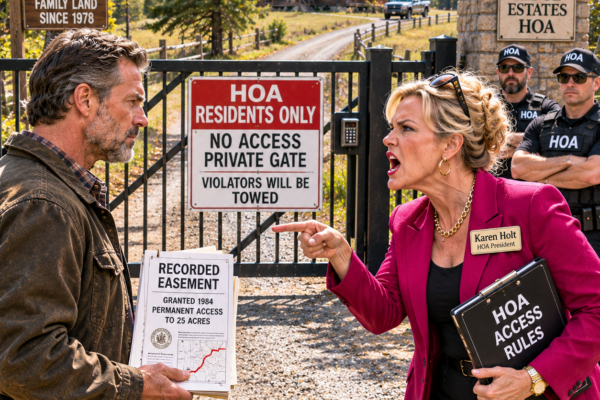
“Pay Your Fines, Dan, or We’ll Put a Lien on Your House!” HOA Karen Snapped After Charging Me Eleven Times in Eight Months for Everything From Tall Grass to the Color of My Mailbox. She Expected Me to Hand Over Another Check Without Questioning Her Authority. Instead, I Brought Her Own 62-Page Rulebook to the Hearing—And Asked Her Treasurer to Read One Particular Paragraph Aloud…
“Pay Your Fines, Dan, or We’ll Put a Lien on Your House!” HOA Karen Snapped After Charging Me Eleven Times in Eight Months for Everything From Tall Grass to the Color of My Mailbox. She Expected Me to Hand Over Another Check Without Questioning Her Authority. Instead, I Brought Her Own 62-Page Rulebook to the Hearing—And Asked Her Treasurer to Read One Particular Paragraph Aloud…
“YOU DON’T GET TO QUESTION EVERY FINE JUST BECAUSE YOU DON’T FEEL LIKE PAYING IT!”
Margaret Voss slammed her pen against the folding table.
Behind her hung a framed photograph of Maple Grove’s entrance beneath the words COMMUNITY, INTEGRITY, EXCELLENCE.
Apparently, irony wasn’t included in the annual landscaping budget.
I placed eleven violation notices in front of her.
“I’m questioning how they were issued.”
“You violated our community standards.”
“Where are the written warnings?”
Margaret sighed.
“Mr. Lawson, we’ve already explained our enforcement process.”
“No. You’ve explained how you collect money.”
Beside me sat Curtis Miller, my six-foot-four neighbor, who’d spent twenty years working in private security.
He hadn’t said a word.
He didn’t need to.
I opened my highlighted copy of the association’s governing documents.
“Page thirty-seven. Section twelve.”
Margaret barely glanced at it.
“We’ve streamlined certain administrative procedures.”
“Who authorized that?”
“The board.”
“When?”
“I don’t have the date memorized.”
“Then show me the meeting minutes.”
Her expression hardened.
“Dan, you’re making a fifty-dollar grass violation unnecessarily complicated.”
I pushed the remaining ten notices toward her.
“Seven hundred and thirty dollars, actually.”
“Those fines were legitimate.”
“Then this should be easy.”
Harold Jenkins, the association’s longtime treasurer, shifted uncomfortably in his chair.
The third board member, Susan Bell, stopped writing.
I turned the rulebook toward them.
“Written warning first. Five business days to respond. Notice of hearing rights.”
Margaret crossed her arms.
“That’s outdated language.”
“Was it amended?”
“We don’t need to amend every administrative detail.”
“Your own documents say otherwise.”
She leaned forward.
“If you continue interfering with association business, we’ll refer your account to our attorney. You could be responsible for additional legal expenses.”
Curtis finally looked up.
Harold reached for my rulebook.
“May I?”
“Absolutely.”
Margaret immediately objected.
“Harold, we’ve discussed this.”
He adjusted his glasses.
Then he read the highlighted paragraph.
Once.
Twice.
His forehead wrinkled.
“Margaret?”
“What?”
“These really do require a written warning.”
She reached for the document.
Harold held onto it.
Then he turned to the next page.
And stopped.
part2
“There’s another requirement here,” Harold said.
Margaret reached across the table.
“Give me that.”
He moved the document closer to himself.
“Owners must receive written notification of their right to request a hearing within ten days of the fine notice.”
He looked at my eleven envelopes.
“Did we include that?”
Margaret’s jaw tightened.
“Our management process doesn’t require unnecessary duplication.”
Harold looked confused.
“But the declaration requires it.”
“Harold, I’m perfectly familiar with our declaration.”
“Then why aren’t we doing this?”
For the first time since the hearing began, Margaret had nothing to say.
Susan picked up one of my violation notices.
She examined the front.
Then the back.
“Dan, is this everything you received?”
“Yes.”
“No accompanying letter?”
“No.”
“No email?”
“Nothing.”
She looked toward Margaret.
“Where are the warning notices?”
Margaret removed her glasses.
“This hearing is getting completely off track.”
I almost laughed.
We were finally getting onto the track.
She just didn’t like where it led.
“Let’s postpone this matter,” she announced.
Harold frowned.
“We’ve already postponed two other hearings this month.”
“This requires legal review.”
“Then we should probably stop issuing fines until we receive that review.”
Margaret stared at him.
It was the first time I’d ever seen Harold disagree with her.
And judging by her expression, it was probably the first time she’d seen it too.
Curtis leaned back in his chair.
I gathered my documents.
“Please include my objections and the board’s responses in the official meeting minutes.”
Margaret stood.
“This isn’t over, Dan.”
“I certainly hope not.”
We walked outside.
The community center’s parking lot was nearly empty.
Curtis waited until the door closed behind us.
Then he grinned.
“Man, she looked like somebody unplugged her refrigerator.”
I laughed.
“You didn’t say much.”
“Didn’t need to. Harold finally discovered how to read.”
We shook hands beside my truck.
As I drove home, I realized something important.
Margaret had spent eight months convincing me that questioning her would make my life more difficult.
It had taken forty-five minutes and a yellow highlighter to discover that questioning her might make her life considerably more difficult.
And it had all started with fifty dollars.
My name was Dan Lawson.
I was sixty-one years old and had recently retired after thirty-five years as an industrial electrician.
I’d worked in manufacturing plants, commercial buildings, distribution facilities, and occasionally places where the electrical equipment was older than the men responsible for maintaining it.
My wife, Linda, used to joke that I could spend three hours studying a wiring diagram but couldn’t remember where we’d agreed to eat dinner.
She wasn’t entirely wrong.
Electricity had taught me several useful things.
Follow the specifications.
Verify the connections.
Never assume somebody else checked the important details.
And when a system failed, find the underlying problem instead of repeatedly replacing the same damaged component.
I hadn’t expected those principles to become useful in retirement.
Certainly not while dealing with neighborhood landscaping regulations.
Linda and I moved into Maple Grove after selling the house where we’d raised our two children.
Our daughter lived in Colorado.
Our son worked in telecommunications several hours away.
We wanted a smaller home, a manageable yard, friendly neighbors, and somewhere I could watch football without hearing the emergency phone from work.
Maple Grove seemed ideal.
Two hundred homes.
Tree-lined streets.
A community center.
Walking paths.
And a heated swimming pool prominently featured in the real estate advertisement.
Unfortunately, the pool heater wasn’t working.
Neither was one of the circulation pumps.
The association had been investigating repair options for three years.
Every monthly newsletter announced progress.
Actual progress remained surprisingly difficult to locate.
The newsletter was called The Grove Gazette.
Linda referred to it as the world’s longest discussion about mulch.
Four pages every month.
Seasonal reminders.
Approved flower recommendations.
Parking regulations.
A photograph of Margaret Voss smiling beside something she’d organized.
Margaret was sixty-three.
She drove a spotless white Cadillac, wore expensive sunglasses, and carried a burgundy clipboard as though somebody had issued it alongside a government commission.
She’d been association president for nine years.
According to several neighbors, she’d never faced a serious election challenge.
Nobody wanted the responsibility.
Nobody wanted the arguments.
And absolutely nobody wanted Margaret examining their mailbox more closely than she already did.
Our first meeting occurred while I was installing a new light fixture beside the garage.
She parked her Cadillac across the street.
Then she walked toward me.
“You must be our new resident.”
“Dan Lawson.”
“Margaret Voss. Association president.”
“Nice to meet you.”
She examined the fixture.
“Was that approved?”
I looked up.
“The light?”
“Yes.”
“I’m replacing an existing fixture.”
“Exterior modifications require authorization.”
“It’s the same size and color.”
She studied it.
“You should submit a request anyway.”
“Okay.”
She smiled.
“We run a very orderly community here.”
“That sounds good.”
I meant it.
I didn’t object to reasonable neighborhood rules.
I appreciated clean common areas, maintained roads, and neighbors who didn’t leave broken refrigerators in their front yards.
I believed associations could provide useful services.
What I hadn’t yet discovered was that Margaret considered reasonable cooperation and unquestioning obedience the same thing.
The first violation notice appeared three weeks later.
It was taped to my front door at six in the morning.
My coffee was still brewing when I opened it.
EXCESSIVE GRASS HEIGHT.
FINE: $50.
I stepped outside.
My lawn looked perfectly normal.
I’d mowed it several days earlier.
A photograph attached to the notice showed a ruler positioned beside a particularly tall section near the driveway.
According to Margaret, my grass exceeded the permitted height by approximately an inch.
I laughed.
Then I paid the fine.
That was my first mistake.
Not because paying fifty dollars ruined us.
Because I assumed Margaret had followed whatever procedures the association required.
I didn’t bother checking.
Retirement was supposed to involve fewer documents.
I certainly wasn’t interested in arguing over grass.
Two weeks later, another notice arrived.
My truck had been parked too close to the sidewalk.
Another fifty dollars.
Then came a citation concerning decorative stones beside the flower beds.
Then one involving the color of our mailbox.
Linda had chosen a dark bronze mailbox that matched the exterior fixtures.
Margaret claimed it was one shade darker than the approved color palette.
I held the notice beside the mailbox.
“Can you see the difference?”
Linda examined it.
“No.”
“Apparently, we’re criminals.”
“Should I start packing?”
“Only if they object to the suitcase color.”
We laughed.
Then I paid another fine.
Over eight months, eleven notices arrived.
Seven hundred and thirty dollars altogether.
Each contained the same payment instructions and the same implied threat.
Pay promptly or the situation would become more expensive.
There were no preliminary warning letters.
No opportunities to correct the alleged violations before being charged.
No explanations of how to challenge the fines.
I simply received a bill.
Eventually, I started noticing how often Margaret drove through our street.
Sometimes she photographed houses.
Sometimes she stopped to examine gardens.
Once, I watched her step onto a neighbor’s driveway to photograph a basketball hoop.
Her Cadillac became a familiar warning.
People straightened trash containers when they saw it approaching.
Children moved bicycles.
Homeowners checked whether their garage doors were closed.
It would’ve been funny if the people involved hadn’t been genuinely nervous.
Curtis lived across the street.
He was fifty-eight, built like a refrigerator, and possessed a remarkably gentle personality for somebody who looked capable of moving furniture without assistance.
One afternoon, he found me examining my latest violation notice.
“What’d you do now?”
“Decorative stone placement.”
He looked at my garden.
“Dangerous stuff.”
“Apparently.”
He told me Margaret had fined him a hundred dollars after his visiting brother parked a motorcycle in the driveway.
The motorcycle wasn’t prohibited by the governing documents.
Curtis had paid anyway.
“Didn’t want the hassle,” he explained.
That sentence bothered me.
Mostly because I’d been saying the same thing.
The turning point came on a Friday evening.
Linda and I were preparing dinner when she opened another envelope from Maple Grove.
She read it.
Then she placed it beside my plate.
“Dan, I’m getting tired of this.”
The notice concerned the two flowerpots she’d placed beside our front steps.
Margaret considered their positioning inconsistent with approved entrance aesthetics.
Linda had spent the afternoon planting them.
Now she was being charged for the result.
“Want me to move them?” I asked.
“No.”
She sat down.
“I want to know why somebody gets to make me feel like I’m doing something wrong every time I enjoy my own house.”
I stopped cutting vegetables.
Linda rarely complained.
She’d supported me through decades of demanding work, unpredictable schedules, and emergency calls in the middle of the night.
Retirement was supposed to give us something back.
Instead, she was worrying about flowerpots.
I opened the kitchen drawer where we kept the association documents.
There was a thick packet from our closing paperwork.
I pulled out the recorded Declaration of Covenants, Conditions, and Restrictions.
Sixty-two pages.
I placed it on the dining table.
Linda looked at it.
“What are you doing?”
“Finding out what we actually agreed to.”
She smiled.
“There’s my electrician.”
The following Saturday, I brewed a terrible pot of coffee, found a yellow highlighter, and began reading.
Most of the document was exactly what I’d expected.
Property maintenance.
Architectural standards.
Use restrictions.
Common-area responsibilities.
Definitions written by somebody who apparently believed ordinary English was insufficiently expensive.
I read everything.
Then I reached the enforcement provisions.
That’s where the document became considerably more interesting.
Before imposing a monetary penalty for an ordinary violation, the association was required to issue a written warning.
The owner had five business days to respond or correct the identified problem.
If a fine was subsequently imposed, the notice had to explain the owner’s right to request a hearing within ten days.
Certain exceptions existed for genuine emergencies and immediate safety concerns.
My grass wasn’t an emergency.
Neither was Linda’s mailbox.
I highlighted the relevant paragraphs.
Then I retrieved every violation notice we’d received.
I spread them across the dining table in chronological order.
Eleven notices.
Not one written warning.
Not one five-business-day correction period.
Not one explanation of our hearing rights.
I checked our email accounts.
Then the association’s resident portal.
Nothing.
I spent another hour examining the board’s authority to adopt administrative policies.
That section was important too.
The board could establish reasonable procedures consistent with the governing documents.
It couldn’t simply discard requirements contained in the declaration.
At least, nothing I read authorized that.
I leaned back.
“Linda?”
She appeared in the doorway.
“What?”
“I think Margaret’s been skipping something.”
“How much?”
“Approximately seven hundred and thirty dollars’ worth.”
She sat beside me.
I showed her the highlighted language.
She read it herself.
“That’s pretty clear.”
“Exactly.”
“Why haven’t they been doing it?”
“That is an excellent question.”
On Monday morning, I called the association office.
Margaret answered.
“Maple Grove.”
“Margaret, it’s Dan Lawson.”
“Good morning, Dan.”
“I’d like to request a formal hearing concerning my fines.”
There was a brief silence.
“Which fine?”
“All eleven.”
She laughed softly.
“Most of those have already been paid.”
“I know.”
“Payment generally closes the matter.”
“Where does the declaration say that?”
Another silence.
“Dan, the purpose of our enforcement process is to encourage compliance.”
“I’d like to discuss whether the process itself complies.”
Her voice cooled.
“What exactly are you suggesting?”
“I haven’t received the warnings or hearing information required by the declaration.”
“Our board uses an established administrative procedure.”
“Then I’d appreciate a copy.”
She scheduled a hearing three weeks later.
I confirmed the request in writing and preserved her response.
Then I asked Curtis whether he’d accompany me as a support person and witness.
“Absolutely.”
“You don’t have to argue.”
“Good. I hate arguing.”
“You just need to observe.”
He grinned.
“I can sit aggressively.”
And that was how I ended up across from Margaret, Harold, and Susan with eleven violation notices and sixty-two pages of rules Margaret apparently preferred nobody read.
After the hearing, I didn’t immediately expect a refund.
I expected another argument.
Perhaps a letter explaining why the declaration meant something entirely different from what it said.
Instead, two days passed without communication.
Then Margaret emailed me.
The board is reviewing historical administrative practices in consultation with its legal representatives.
No admission.
No apology.
But something had changed.
For eight months, every message from her had contained instructions.
Now she was reviewing things.
I sent a written summary of the hearing to the management office and requested confirmation that it would be preserved with the association’s records.
I also submitted a complaint through the county’s consumer affairs office, describing the procedural discrepancies and providing copies of the relevant documents.
I understood that the county wasn’t automatically empowered to decide every private association dispute.
But the office could review the complaint, identify matters within its authority, and make appropriate referrals.
I wanted an independent record.
Then I wrote to the association’s insurance carrier.
I didn’t claim its policy guaranteed compensation.
I simply described the disputed enforcement practices and asked how concerns involving potential claims against association directors should be reported.
I attached the relevant language and notices.
The carrier acknowledged my correspondence.
A representative subsequently contacted association management for information.
That was all I knew.
But judging by Margaret’s reaction, the questions had reached somebody she couldn’t order around.
Her Cadillac stopped beside my driveway the following Thursday.
She lowered the passenger window.
“Dan.”
I was washing my truck.
“Morning.”
“Did you contact our insurance company?”
“Yes.”
“Why?”
“I had questions.”
“You should’ve directed those questions to the board.”
“I did.”
“This creates unnecessary complications.”
I turned off the hose.
“Margaret, following your declaration would’ve been considerably simpler.”
She stared at me.
“You’re treating a few minor administrative issues as though they’re something serious.”
“Then they should be easy to correct.”
She raised the window.
Her Cadillac disappeared down the street.
Linda watched from the porch.
“What’d she want?”
“Fewer questions.”
“Good luck with that.”
Two weeks after the hearing, I received a certified letter.
The board had voted to rescind all eleven fines.
The letter described the decision as an administrative resolution without admission of liability.
I didn’t particularly care what they called it.
That afternoon, seven hundred and thirty dollars appeared in our bank account.
Linda looked at the balance.
“Did you sell something?”
“No.”
“Then what’s that?”
“Our grass settlement.”
She started laughing.
I printed the refund confirmation.
Then I placed it inside a small picture frame and hung it on the wall beside the garage entrance.
It occupied the exact location where Margaret’s first violation notice had been taped.
Linda shook her head.
“You’re ridiculous.”
“It’s a certificate of agricultural innocence.”
I thought the matter was finished.
I’d recovered my money.
My flowerpots remained beside the front door.
The mailbox hadn’t changed color.
And nobody had measured my lawn for nearly three weeks.
I figured retirement could finally begin.
Then Curtis knocked on my door carrying a folder.
“You busy?”
“Watching football.”
“This’ll only take a minute.”
He opened the folder.
Inside were nine violation notices issued against his property over the previous two years.
“Think you could look at these?”
I glanced through them.
The same formatting.
The same payment instructions.
The same missing information.
“Did you receive any warnings before these?”
“No.”
“Any opportunity to respond?”
“No.”
“Any hearing instructions?”
He shook his head.
I handed the notices back.
“Read section twelve.”
Curtis sat at our dining table for twenty minutes.
When he finished, he looked at me.
“She owes me four hundred and eighty dollars.”
“Possibly. You should formally dispute the charges and ask for the relevant records.”
He smiled.
“Beautiful.”
Three days later, Susan Patterson from two streets over appeared with a shoebox full of paperwork.
Then came Carl Kowalski.
Then Nancy Whitmore, a retired elementary school teacher who’d received repeated fines concerning her grandchildren’s bicycles.
The stories differed.
The process didn’t.
Margaret identified something she disliked.
A fine appeared.
Residents paid.
Most assumed they didn’t have a choice.
I reminded every one of them that I wasn’t an attorney.
I couldn’t provide legal representation or promise particular outcomes.
But we could read the same document.
We could compare its requirements against what had happened.
And we could ask the association to explain the differences.
Linda started calling our gatherings the Maple Grove Document Club.
Every Wednesday evening, several neighbors occupied our dining room with folders, highlighters, and questionable refreshments.
Curtis brought doughnuts.
Nancy brought a portable scanner.
Carl brought his Labrador, Biscuit, who immediately established himself as the least confrontational participant.
One evening, we identified sixteen fines across several households that appeared to lack required procedural protections.
We organized them into a table.
Property address.
Alleged violation.
Fine amount.
Date issued.
Written warning received?
Response period provided?
Hearing rights disclosed?
The last three columns contained an extraordinary number of empty boxes.
Nancy stared at the spreadsheet.
“How long has she been doing this?”
“Long enough that people think it’s normal,” Curtis replied.
Carl pointed toward his own notices.
“I paid one because the letter mentioned foreclosure.”
His voice became quieter.
“My wife was receiving cancer treatment. I didn’t have the energy to argue.”
Nobody made another joke.
Suddenly, our ridiculous little document club didn’t feel ridiculous anymore.
We submitted a consolidated complaint with supporting records and authorized copies of the residents’ notices.
The county office opened a preliminary inquiry and requested additional information.
It also identified other channels available for addressing the association’s conduct.
Word spread through Maple Grove.
Several residents started asking the board for copies of its enforcement policies.
The management office became unusually busy.
Margaret responded with a special edition of The Grove Gazette.
Its main article was titled:
PRESERVING COMMUNITY HARMONY.
It warned residents against misinformation and encouraged them to trust established association procedures.
Linda read it over breakfast.
“That’s about you.”
“Probably.”
“Congratulations. You made the newsletter.”
“Didn’t even have to plant approved flowers.”
The following Monday, a letter arrived from an attorney representing the association.
It suggested my activities could constitute malicious interference with the administration of a nonprofit governing organization.
It demanded that I stop encouraging residents to disregard association enforcement decisions.
I read the letter several times.
Then I contacted an attorney named Rebecca Foster.
Rebecca handled property and association disputes.
I’d been comfortable reviewing documents myself, but receiving a legal threat changed the situation.
She examined the letter, my refund confirmation, and the declaration.
“What exactly have you told these residents?” she asked.
“To read their documents and submit written objections if the procedures weren’t followed.”
“Have you told anybody to stop paying ordinary dues?”
“No.”
“Threatened board members?”
“No.”
“Accessed confidential records without authorization?”
“No.”
She nodded.
“Good.”
She explained the distinction between legitimate association obligations and disputed penalties.
We prepared a concise response.
It stated that the residents were exercising rights identified in the association’s own documents.
It requested clarification concerning the specific conduct and governing provisions allegedly violated.
It also asked that relevant records be preserved.
Rebecca advised us not to make personal accusations we couldn’t substantiate.
We agreed.
The association’s attorney didn’t respond to the questions.
Instead, the management office began insisting all resident complaints be submitted through a new online form.
Unfortunately, the form contained no option for challenging an improperly issued fine.
Nancy discovered that first.
She called me.
“Dan, it says I can submit a landscaping complaint, a parking complaint, or an architectural request.”
“What about enforcement appeals?”
“Nothing.”
“Then submit your appeal in writing through the existing designated address and preserve the correspondence.”
She laughed.
“You make this sound easy.”
“It’s mostly refusing to let them send you in circles.”
The next week, Margaret approached Curtis outside his garage.
According to him, she expressed concerns about the document club and suggested his involvement could damage his relationship with the association.
Curtis listened politely.
Then he asked whether she intended to fine him for reading.
She left.
The more she tried to discourage questions, the more people became interested in asking them.
And then we discovered the turquoise house.
It belonged to another Dan, Daniel Mercer, who lived two streets over.
Daniel was a graphic designer.
He’d painted his front door and shutters a shade of turquoise that Margaret considered unacceptable.
He arrived at one of our meetings carrying a color chart.
Not a small one.
An enormous professional color chart containing more shades of blue than I’d previously believed existed.
“Look at this,” he said.
He placed it across the table.
“The board approved this color.”
He pointed toward one square.
“And that’s what I used.”
Curtis squinted.
“Looks blue.”
“It’s a blue-green.”
“Okay.”
“Margaret says it’s turquoise.”
“Isn’t that a blue-green?”
Daniel stared at him.
I interrupted before the discussion became a professional argument about wavelengths.
“Do you have the approval?”
Daniel produced an email from the architectural committee.
The approved paint manufacturer and color code matched his purchase receipt.
Margaret had issued a fine anyway.
We compared the documents.
Then Daniel showed us something more troubling.
A newer version of the approved exterior color list had appeared on the resident portal after he’d completed the work.
His previously approved shade was missing.
The revised list didn’t include a clear adoption date.
Nor did the association provide evidence that the later revision invalidated existing approvals.
“She keeps telling me I should’ve known,” Daniel said.
“Known what?”
“That the rules changed.”
I studied the original approval email.
“Did anybody tell you?”
“No.”
That case changed the direction of our meetings.
We’d initially focused on missing warnings and hearing rights.
Now we were examining whether the alleged rules themselves had been properly adopted, accurately communicated, and consistently applied.
Daniel ultimately obtained a reversal of his disputed fine after presenting the approval records.
He kept his turquoise shutters.
Margaret continued calling them unattractive.
Fortunately, her personal opinion wasn’t an enforceable architectural standard.
The annual association election was approaching.
I intended to vote.
Nothing more.
Then Nancy suggested I run for president.
I laughed.
“Absolutely not.”
“Why?”
“Because I’m retired.”
“So is Margaret.”
“That’s not a convincing argument.”
Curtis supported her.
“You should do it.”
“No.”
“You’d be good.”
“I’m good at watching football.”
Linda listened from the kitchen.
“Dan, you’ve been attending unofficial board meetings in our dining room for two months.”
“Those are different.”
“How?”
“We have doughnuts.”
She smiled.
“I’m sure you can arrange doughnuts at the clubhouse.”
I genuinely didn’t want the position.
The prospect of monthly arguments about fences, gutters, and acceptable wreath sizes wasn’t particularly appealing.
But I started considering something Rebecca had mentioned.
Rescinding individual fines corrected individual problems.
It didn’t necessarily correct the system producing them.
As long as Margaret controlled enforcement policy, residents might spend years fighting the same battles.
I reviewed the election provisions.
Under Maple Grove’s particular bylaws, the membership elected the president directly from eligible candidates. The president served alongside four other directors, with separate staggered terms for those board seats.
Margaret also held an unexpired director position from an earlier election.
Losing the presidency wouldn’t automatically remove her from the board.
I thought that arrangement was imperfect.
But it was what the documents provided.
And unlike Margaret, I wasn’t going to disregard a provision just because it was inconvenient.
I filed my candidacy the following Monday.
By Tuesday, Margaret knew.
By Wednesday, half of Maple Grove knew.
By Thursday, somebody had attached a handwritten sign to Curtis’s mailbox.
DAN LAWSON FOR PRESIDENT.
Curtis insisted he hadn’t made it.
His handwriting suggested otherwise.
My campaign consisted mostly of walking around the neighborhood and introducing myself to people I’d never met.
I didn’t promise lower dues.
I didn’t promise to eliminate every landscaping rule.
I didn’t promise to repair the swimming pool immediately without reviewing the costs.
I told residents two things.
I’d read the governing documents.
And I believed the rules should apply equally to everybody, including the people responsible for enforcing them.
That message received more attention than I’d expected.
One evening, a homeowner named George Beck stopped me beside his driveway.
“What would you do about the pool?”
“Find out why it hasn’t been repaired.”
“Margaret says it’s complicated.”
“Most equipment problems are only complicated until somebody identifies what’s broken.”
He laughed.
“It’s been broken for three years.”
“Then we’ve probably spent enough time identifying it.”
Another resident asked whether I’d cancel every fine.
“No.”
She looked disappointed.
“What if somebody actually violates a legitimate rule?” I asked.
“I suppose they’d need to correct it.”
“Exactly. And they should receive the warning and opportunity our documents require.”
She nodded.
“That’s fair.”
Fairness turned out to be a more popular campaign promise than luxury landscaping.
Margaret ran on experience.
Her campaign letter highlighted nine years of leadership, preservation of property values, community beautification, and continuity.
She described recent disputes as politically motivated distractions.
She also suggested replacing experienced leadership with individuals lacking administrative qualifications could create financial instability.
I read the letter while sitting beside the broken pool.
Then I looked at the faded sign attached to its equipment enclosure.
MAINTENANCE REVIEW IN PROGRESS.
The sign had been there so long that the corners had started peeling.
Financial stability apparently had an interesting definition.
The election meeting took place on a Tuesday evening.
The clubhouse was packed.
Harold and Susan sat beside two other board members whose seats hadn’t been involved in my earlier hearing.
The election committee explained the voting procedures.
Margaret addressed the residents first.
She spoke about standards, order, and protecting the value of their investments.
Then she looked toward me.
“Leadership requires considerably more than highlighting a few paragraphs.”
When my turn arrived, I carried the same rulebook I’d brought to my hearing.
I held it up.
“I agree with Margaret.”
She looked surprised.
“Leadership requires more than reading this. It requires following it.”
Several residents applauded.
I opened the declaration.
“Nothing I’ve proposed tonight requires us to abandon community standards. I’m asking us to administer them the way we agreed to administer them.”
I described the warning requirements.
The correction periods.
The hearing procedures.
Then I explained what I’d learned from the residents who’d approached me.
“We’ve made ordinary homeowners afraid to question ordinary bills. I don’t believe that’s healthy for a neighborhood.”
Margaret crossed her arms.
I continued.
“If you elect me, I’d like us to review historical enforcement practices, correct mistakes, and publish understandable financial reports.”
A man near the back raised his hand.
“What about the pool?”
“I’d like somebody to fix it before it becomes a historical landmark.”
The room laughed.
Even Harold smiled.
Voting began shortly afterward.
Linda waited beside me while the election committee counted the ballots.
Curtis paced near the refreshment table.
Carl Kowalski stood outside with Biscuit because the clubhouse didn’t ordinarily permit dogs.
Apparently, Biscuit had acquired a political following.
Several residents had jokingly written his name on their ballots.
When the committee reported the raw ballot percentages, approximately fifty-eight percent supported me.
Thirty-one percent supported Margaret.
The remaining eleven percent contained miscellaneous write-ins, most of them naming Biscuit.
The ineligible write-ins weren’t counted as valid votes for an eligible candidate.
Even without them, my lead was decisive.
Margaret had lost.
For several seconds, she simply stared at the election committee.
“Are you certain?”
The committee chair nodded.
“Yes.”
“Were all ballots verified?”
“Yes.”
“I’d like a recount.”
The committee followed the applicable procedure and checked the results again.
Nothing changed.
I stood near the front while residents congratulated me.
Curtis shook my hand so enthusiastically that my shoulder hurt.
Linda kissed my cheek.
Carl opened the clubhouse door.
Biscuit stuck his head inside.
Somebody shouted, “Better luck next year!”
The dog wagged his tail.
He handled defeat considerably better than Margaret.
She collected her belongings without speaking to me.
Before leaving, she approached Harold.
They exchanged a few quiet words.
Then she walked toward her Cadillac.
I watched her through the window.
For nine years, she’d occupied the most influential position in Maple Grove.
Now the neighborhood had chosen a retired electrician whose primary campaign material was her own rulebook.
I understood why she was upset.
But she’d had nine years to listen to the people living there.
They’d finally found a way to make her listen.
My first official board meeting took place the following week.
I arrived twenty minutes early with copies of the agenda.
Margaret arrived precisely on time.
She remained a director because her separate board term hadn’t expired.
I greeted her politely.
She nodded.
Then she examined the agenda.
“Compliance audit?”
“Yes.”
“What exactly are you proposing?”
“A review of every monetary penalty issued during the previous three years.”
Harold looked up.
“Every fine?”
“Yes.”
Susan asked how we intended to conduct it.
I proposed retaining an independent reviewer with relevant accounting experience and obtaining guidance from association counsel concerning the governing requirements.
Board members would supply records.
Residents could provide missing correspondence.
The reviewer would examine warning notices, correction periods, hearing information, payments, and subsequent resolutions.
We would also protect confidential homeowner information.
Margaret smiled.
“Excellent.”
Her reaction surprised me.
Then she seconded the motion before I’d finished explaining it.
“I welcome an opportunity to establish that our enforcement practices have been responsible and consistent.”
I looked at Harold.
He looked at Susan.
Nobody said anything.
Apparently, Margaret believed the audit would vindicate her.
The motion passed unanimously.
That afternoon, I went to the management office and began identifying the available records.
There were more than I’d expected.
Electronic notices.
Payment records.
Photographs.
Violation reports.
Board communications.
Some files were neatly organized.
Others looked like somebody had thrown several years of paperwork into a digital drawer and hoped nobody would ever open it.
I didn’t personally decide which fines were valid.
That responsibility belonged to the independent review process and subsequent board decisions.
But I could help ensure the necessary records were available.
Within days, the reviewer identified an unexpected problem.
The association maintained copies of fine notices.
It also maintained a database showing payment dates.
But there was no consistent system for documenting the required preliminary warnings.
Some files contained them.
Many didn’t.
The management company’s software had a warning function.
That function was frequently bypassed.
The reviewer requested an explanation.
Margaret provided one.
The board, she said, had adopted an efficiency-oriented enforcement approach several years earlier.
Under that approach, obvious violations could be processed directly as monetary penalties.
I asked whether the approach had been formally adopted.
She supplied a policy memorandum.
The memorandum authorized management to accelerate routine enforcement.
It hadn’t amended the declaration.
Nor had it undergone any process that could replace the declaration’s explicit procedural protections.
Association counsel reviewed the discrepancy.
The resulting advice was not favorable to Margaret’s interpretation.
At our next meeting, she appeared irritated.
“We’ve been operating this way for years.”
Susan replied, “That doesn’t make it correct.”
“Everybody agreed to the policy.”
Harold looked down.
“I don’t remember being told it eliminated written warnings.”
Margaret turned toward him.
“You voted for it.”
“I voted to reduce administrative delays.”
“That’s exactly what we did.”
I opened the declaration.
“The delays you’re referring to were the homeowners’ opportunity to respond.”
She stared at me.
I continued.
“We don’t get to improve efficiency by eliminating somebody else’s procedural rights.”
For once, nobody disagreed.
The audit continued.
A week later, the reviewer requested interviews with former management employees.
One woman named Patricia Wilson had worked in the Maple Grove office for nearly six years before leaving.
She agreed to speak with the reviewer.
Her account clarified how the shortcuts had become routine.
Originally, management generated written warnings and tracked response deadlines.
Margaret considered the system too slow.
She instructed employees to issue immediate fines for certain violations she regarded as obvious.
Patricia questioned the instruction.
Margaret told her the board had approved it.
After several months, immediate fines became increasingly common.
Employees stopped asking.
New staff members were trained using the altered procedure.
Eventually, the proper warning process survived only in the rulebook most homeowners never opened.
Patricia also described situations in which Margaret personally instructed staff to continue issuing penalties against residents who’d questioned her decisions.
The reviewer sought supporting records.
Several emails corroborated portions of her account.
One involved Nancy’s bicycles.
Another concerned Curtis’s visiting brother.
A third referred to a homeowner who’d challenged a proposed landscaping expenditure.
The evidence didn’t prove every fine was malicious.
But it showed the practice had become more than occasional administrative carelessness.
Margaret had been informed about the proper process.
She’d chosen a different one.
Meanwhile, the pool became the next problem.
I’d promised residents we would finally examine the maintenance situation.
I requested the existing contractor reports, inspection records, equipment specifications, and financial history.
The documents arrived in a large binder.
Three years of correspondence.
Several preliminary assessments.
Repeated recommendations for additional evaluation.
And remarkably little actual repair work.
I contacted a qualified commercial pool contractor and arranged an independent inspection authorized by the board.
His name was Steve Harris.
Steve arrived carrying testing equipment and a toolbox.
I accompanied him to the equipment enclosure but left the specialized inspection to him.
He examined the circulation system.
Then the pump assembly.
Then several electrical and control components.
After completing his initial work, he looked at me.
“Who told you this needed three years of investigation?”
“The association.”
He shook his head.
“You’ve got a failed pump assembly, related control issues, and some maintenance deficiencies. There are things we need to address before reopening, but this isn’t an archaeological expedition.”
I laughed.
“Can you prepare a detailed proposal?”
“Absolutely.”
The estimated repair cost was significant but manageable relative to the association’s existing maintenance resources.
The previous board had repeatedly deferred the work while authorizing additional consultations.
I examined the financial records.
The pool reserve hadn’t disappeared.
But repeated diagnostic charges and administrative expenditures had reduced the money available.
The association was also maintaining a discretionary services contract containing work that wasn’t particularly useful.
With proper budget adjustments, the cancellation of unnecessary recurring expenditures, and the use of designated maintenance funds, the repair could proceed without relying on money owed back to homeowners.
That distinction mattered.
Refunding invalid fines was one responsibility.
Repairing common property was another.
We couldn’t pretend the same dollar could accomplish both.
At the following meeting, I presented the contractor’s findings.
Margaret immediately raised concerns.
“We’ve had professionals examine this facility before.”
“I know.”
“Then why would this assessment be any different?”
“Because it includes an actual repair proposal.”
She studied the document.
“There could be hidden complications.”
“Of course. That’s why we’ve included a reasonable contingency.”
“What about further review?”
Harold interrupted.
“Margaret, we’ve been reviewing it for three years.”
She turned toward him.
He continued.
“My grandchildren are getting older faster than we’re fixing this pool.”
Susan laughed.
The board authorized the necessary next steps, subject to the appropriate contract review and available funding.
For the first time in three years, the equipment enclosure had a legitimate repair schedule.
The Grove Gazette announced it in a short article.
No photograph of me.
No inspirational leadership message.
Just the anticipated work and the relevant safety restrictions.
Linda was delighted.
“Finally. A newsletter with news.”
Then the audit report arrived.
The independent reviewer requested a full board presentation.
We scheduled a meeting and distributed the material in advance, with homeowner information appropriately protected.
I opened my copy at the dining table.
Three hundred and fourteen fines had been issued during the reviewed period beginning in 2021.
One hundred and eight failed to satisfy at least one applicable procedural requirement.
Some lacked written warnings.
Some were imposed before the required response period expired.
Some omitted hearing rights.
Others combined multiple deficiencies.
One hundred and eight.
More than a third.
The projected refunds for amounts actually collected on the affected fines totaled just under twenty-two thousand dollars, accounting for previous corrections to avoid duplicate payments.
I stared at the report.
My original fifty-dollar fine had exposed a five-figure problem.
Linda sat beside me.
“How bad?”
I turned the summary toward her.
She read it silently.
Then she shook her head.
“Those poor people.”
That was my reaction too.
Not excitement.
Not celebration.
Twenty-two thousand dollars represented groceries, utility bills, car repairs, medication, school supplies, and countless other expenses residents could have covered with money they’d been pressured into paying.
For some households, fifty dollars wasn’t particularly significant.
For others, it mattered considerably.
I thought about Carl and his wife’s medical treatment.
Nancy living on a fixed retirement income.
Curtis paying fines because he didn’t want another argument.
And my own decision to pay the first notice simply because I wanted a quiet life.
Margaret had counted on that decision.
Repeated two hundred times across a neighborhood, ordinary reluctance to fight became a very effective collection system.
The board meeting was one of the most uncomfortable evenings of my retirement.
Margaret arrived carrying her own marked-up copy of the audit.
The independent reviewer explained the methodology.
He described the files examined.
The applicable requirements.
The distinction between a legitimate violation and an improperly administered penalty.
Margaret interrupted several times.
“What if the grass was actually too tall?”
The reviewer explained that a factual violation didn’t establish that the required enforcement procedures had been followed.
“What if the owner knew the rules?”
The requirement remained.
“What if they paid voluntarily?”
Payment didn’t establish procedural compliance.
“What if the warning was delivered verbally?”
The declaration required written warnings for the relevant violations.
Every answer returned to the same problem.
The governing documents said something.
The association had done something else.
Finally, Margaret closed her report.
“This is an excessively technical interpretation.”
I almost couldn’t believe it.
“Margaret, these aren’t electrical wiring specifications. We’re talking about sending somebody a letter before charging them money.”
She glared at me.
“Do you understand the administrative burden that creates?”
“Yes.”
“And the expense?”
“Yes.”
“We’re managing two hundred homes!”
“Then we should manage them properly.”
The room went silent.
Harold removed his glasses.
“I think we need to correct this.”
Susan agreed.
The two remaining directors asked several questions concerning the financial impact and implementation.
Association counsel explained the available options and recommended a documented resolution of the deficient penalties.
We considered the payment records, previous reversals, any unresolved individual circumstances, and the need to avoid duplicate refunds.
Then I introduced the motion.
Rescind the procedurally deficient fines identified in the audit.
Cancel unpaid balances associated with those invalid penalties.
Refund eligible amounts already collected.
Provide each affected homeowner with a written explanation.
Correct the association’s account records.
And replace the defective enforcement process with procedures consistent with the declaration.
Harold voted yes.
Susan voted yes.
The remaining directors voted yes.
Margaret voted no.
Four to one.
The motion passed.
Margaret remained seated.
“You’re establishing a terrible precedent.”
I looked at her.
“I hope so.”
She frowned.
“Excuse me?”
“I hope correcting mistakes becomes our standard practice.”
She gathered her papers.
The meeting continued.
We assigned responsibility for processing the refunds and arranged appropriate oversight.
Then we addressed the association’s finances.
The refund obligation wasn’t insignificant.
It required careful planning.
But continuing to retain money collected through a process the board’s own review had identified as deficient wasn’t an acceptable solution.
The necessary corrections would be made.
When I returned home, Linda was waiting.
“Well?”
“Four to one.”
“Margaret?”
“Take a wild guess.”
She smiled.
Then she handed me a plate of leftover dinner.
It was nearly ten o’clock.
I hadn’t eaten since lunch.
I sat at the kitchen table and realized how hungry I was.
Being president of Maple Grove apparently involved less ceremonial authority and considerably more reheated chicken than Margaret had advertised.
Refund notices began arriving the following month.
Curtis received his.
Nancy received hers.
Several families I’d never met stopped me while I was walking through the neighborhood.
An elderly woman named Alice brought a handwritten thank-you card.
She’d paid repeated penalties concerning landscaping maintenance while recovering from surgery.
The refund allowed her to replace a failing kitchen appliance.
A young couple used their returned money toward a child’s dental expenses.
Carl Kowalski stood beside my driveway one evening holding an envelope.
“Got ours.”
“Good.”
He looked down.
“My wife wanted to thank you.”
“Tell her she doesn’t have to.”
“She knows.”
He paused.
“But when you’re dealing with medical bills, every extra charge feels like somebody putting another brick on your chest.”
I nodded.
“She cried when she opened this.”
For a moment, I didn’t know what to say.
Then Biscuit pulled toward my lawn and began enthusiastically sniffing the flower beds.
Carl laughed.
“Sorry. He’s checking compliance.”
“Tell him his campaign’s over.”
We stood there until Biscuit finished his inspection.
Apparently, my landscaping passed.
Not every resident appreciated the changes.
One homeowner complained that refunding fines rewarded people who’d violated neighborhood rules.
I explained that the association could still enforce legitimate restrictions.
It simply had to do so properly.
Another worried that requiring warnings would encourage residents to ignore maintenance standards.
We reviewed the actual requirements and established a tracking system.
Warnings would identify the specific provision involved.
Owners would receive the required response period.
Any subsequent fine notice would explain the applicable hearing rights.
Photographs and supporting information would be preserved.
Emergency matters would be handled under the provisions actually applicable to them.
The new procedure wasn’t particularly revolutionary.
It was simply the procedure we’d already been obligated to follow.
We also established a consistent hearing schedule with reasonable arrangements for residents who couldn’t attend during ordinary working hours.
And we began examining conflict-of-interest provisions.
Margaret had participated in the audit vote concerning the enforcement system she’d previously directed.
Her participation was permitted under the existing arrangements governing that particular decision, but I believed the association needed clearer safeguards.
Any future changes would require the appropriate approvals rather than another improvised policy.
I wasn’t interested in replacing Margaret’s shortcuts with shortcuts of my own.
The county inquiry eventually concluded its review of the matters submitted through our complaint.
The documented corrective action and refund process addressed much of what we’d originally raised.
Other private governance matters remained subject to the appropriate association and legal mechanisms.
Rebecca helped us ensure the resolutions were properly recorded.
The insurance-related questions were also handled through the association’s authorized representatives.
There was no dramatic police raid.
No criminal mastermind dragged away in handcuffs.
No courtroom packed with television reporters.
The evidence established a longstanding failure to follow required procedures, supported by records showing how those failures had developed.
The consequences were financial correction, loss of leadership, independent oversight, and changes to the enforcement system.
That was enough.
Sometimes justice looked less like a movie and more like a homeowner receiving money that never should have been taken.
The swimming pool repair began in early spring.
A contractor’s truck pulled into the recreation center parking lot.
Residents gathered near the fence to watch.
After years of newsletters promising progress, actual workers had arrived carrying actual equipment.
Curtis stood beside me.
“Should we notify the newspapers?”
“Let’s wait until there’s water moving.”
Steve and his crew completed the approved repairs, addressed related maintenance issues, and coordinated the necessary checks before reopening.
The association published regular updates.
We didn’t announce completion until the required work and verification were finished.
When the pool finally reopened, children lined up outside the entrance.
Parents carried towels.
The equipment operated normally.
The water was heated.
George Beck arrived with his grandchildren.
He looked toward me.
“Three years.”
“I know.”
“Three years.”
“George, go swimming.”
He laughed.
Then he took his grandchildren inside.
Linda and I sat beneath an umbrella near the pool.
She watched the children splashing.
“Remember when we bought the house?”
“Unfortunately.”
“The real estate agent said this was one of the neighborhood’s finest amenities.”
“Technically, it was an excellent place to store maintenance signs.”
She laughed.
Then she reached for my hand.
“I’m proud of you.”
I squeezed hers.
For months, she’d tolerated our dining room becoming an unofficial document review center.
She’d listened to me complain about spreadsheets and association correspondence.
She’d answered the door when nervous homeowners arrived carrying envelopes.
The victory belonged to her as much as anybody.
Especially considering it had begun with her flowerpots.
Margaret attended the next board meeting carrying a new folder.
She’d prepared detailed meeting notes, organized several maintenance proposals, and attached copies of the relevant governing provisions.
I looked through her materials.
They were thorough.
Surprisingly thorough.
During discussion of a landscaping proposal, she identified a provision I’d overlooked concerning the association’s approval responsibilities.
She was correct.
I acknowledged it.
“Good catch.”
She looked surprised.
Then she nodded.
“Thank you.”
Our relationship didn’t become friendly.
We still disagreed.
Frequently.
She preferred carefully coordinated decorative planting.
I preferred vegetation that didn’t require a committee to explain its existence.
She thought uniform mailboxes improved neighborhood appearance.
I thought a mailbox’s most important responsibility was remaining upright.
But our disagreements began taking place within an understandable process.
She brought documents.
I asked questions.
We voted.
We recorded decisions.
Neither of us was entitled to invent authority.
One evening, after a meeting, Margaret remained behind while the other directors gathered their belongings.
“Dan?”
I looked up.
“Yes?”
“I genuinely believed we were protecting the neighborhood.”
I closed my folder.
“I understand that.”
“People expect standards when they buy here.”
“I agree.”
She hesitated.
“We couldn’t spend weeks debating every blade of grass.”
“That’s why warnings are useful. Most people correct a problem without requiring further action.”
She looked toward the empty chairs.
“I suppose things got away from us.”
It wasn’t an apology.
Not exactly.
But it was the closest she’d come to acknowledging what had happened.
I didn’t push her.
“Then let’s keep them from getting away from us again.”
She nodded.
We left the clubhouse separately.
Her Cadillac was parked beside my truck.
For months, that car had represented the possibility of another fine appearing on my front door.
Now it was simply an expensive white car belonging to someone I disagreed with.
That felt like progress.
The Maple Grove Document Club continued meeting occasionally.
Not every week.
Most of us had better things to do.
Nancy still brought her scanner.
Daniel still brought color charts whenever an architectural question arose.
Curtis stopped attending after declaring the meetings had become too peaceful.
“There’s no tension anymore,” he complained.
“That’s the idea.”
“Terrible entertainment.”
He preferred visiting when football was on.
Biscuit remained a regular participant whenever Carl came by.
He also developed a friendship with another Labrador named Senator.
Between them, they possessed more popularity than most of Maple Grove’s elected officials.
We joked about forming a bipartisan canine committee.
Linda vetoed the idea after Biscuit stole a sandwich from the dining table.
“Financial misconduct,” she announced.
The dog showed no remorse.
Over the following year, we helped residents understand two additional disputed enforcement matters.
Both were addressed through the proper procedures.
Neither required a threatened lawsuit.
One involved an approved exterior improvement that had been incorrectly identified in a complaint.
The other concerned a penalty issued before the relevant correction deadline.
The mistakes were acknowledged and reversed.
That was exactly how the system should work.
A mistake didn’t need to become a personal war.
Correct it.
Document the correction.
Move forward.
Eventually, I started spending less time answering questions about association documents.
Residents had become more comfortable finding the relevant information themselves.
We made commonly requested governing materials easier for members to access.
We included clear instructions with enforcement notices.
We published understandable budget summaries.
We encouraged residents to request clarification without treating questions as acts of rebellion.
The association didn’t become perfect.
No organization involving two hundred households was ever going to be perfect.
But people stopped describing ordinary board decisions in whispers.
They attended meetings.
They disagreed openly.
Sometimes they changed my mind.
Occasionally, somebody would ask whether I regretted getting involved.
Usually, I thought about the evening Linda received the flowerpot notice.
Her disappointment.
The way she’d asked why enjoying her own house had become something she needed permission to do.
Then I’d think about the families who’d recovered money.
The children swimming in the repaired pool.
The neighbors who no longer rushed outside whenever Margaret’s Cadillac appeared.
No.
I didn’t regret it.
I regretted that it had taken me eight months to open the rulebook.
One Saturday morning, nearly two years after my first violation notice, I woke shortly before six.
I brewed coffee.
Then I stepped onto the porch.
The neighborhood was quiet.
Linda’s flowerpots stood beside the steps.
Our bronze mailbox caught the first light of the morning.
Curtis was walking toward his garage in an old football sweatshirt.
Across the street, Biscuit was conducting a detailed examination of a fire hydrant.
Everything looked ordinary.
Then I noticed my grass.
It was getting a little tall near the driveway.
I retrieved the old ruler I’d used when documenting my original fine.
The longest section was slightly above the established maintenance standard.
I laughed.
Linda appeared behind me.
“What are you doing?”
“Investigating a violation.”
“Should I notify the president?”
“Probably.”
She looked around theatrically.
“Oh, Mr. President?”
I raised my hand.
“Yes, ma’am?”
“Your grass needs cutting.”
“Thank you for the warning.”
“You’ve got five business days.”
“Understood.”
She went inside laughing.
I returned the ruler to the garage.
Beside the workbench hung the framed confirmation of my seven-hundred-and-thirty-dollar refund.
I’d considered removing it several times.
But I liked having it there.
Not because of the money.
Because it reminded me how easily I’d accepted something I should have questioned.
Eleven envelopes.
Eight months.
Sixty-two pages.
And one Saturday spent reading what had been sitting inside my kitchen drawer the entire time.
I took the lawn mower outside.
Checked the fuel.
Started the engine.
Margaret’s white Cadillac passed while I was cutting the section beside the driveway.
She slowed down.
Lowered her window.
“Morning, Dan.”
I waved.
“Morning, Margaret.”
She glanced at the lawn.
“Looks good.”
“Thanks.”
Then she continued down the street.
No photographs.
No clipboard.
No fifty-dollar envelope.
I finished mowing, returned the equipment to the garage, and poured myself another cup of coffee.
Linda was waiting on the porch.
A football game would be starting shortly.
The swimming pool was open.
Our mailbox was still bronze.
And the most expensive inch of grass in Maple Grove’s history was finally back where it belonged.
In the lawn mower bag.