Four Men in “HOA Security” Vests Gave My 74-Year-Old Grandfather Ten Minutes to Leave His Own 42 Acres, but They Never Checked What Was Happening at the Gates Behind Them
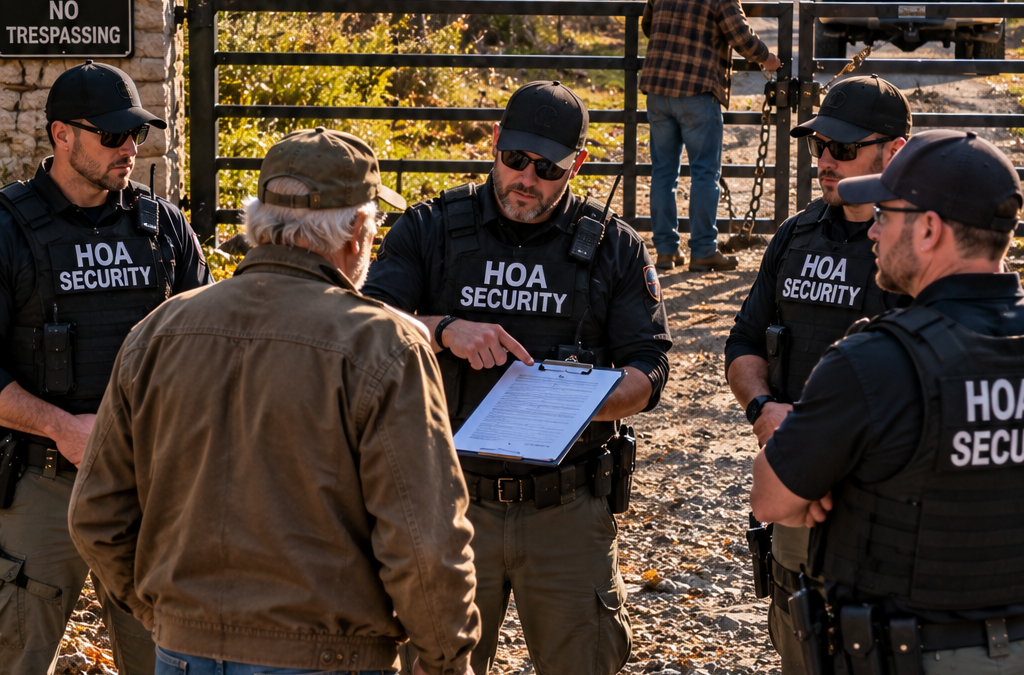
Four Men in “HOA Security” Vests Gave My 74-Year-Old Grandfather Ten Minutes to Leave His Own 42 Acres, but They Never Checked What Was Happening at the Gates Behind Them
The men in tactical vests gave my seventy-four-year-old grandfather ten minutes to get off land his family had hunted for sixty years, as if a laminated clipboard could erase three generations of ownership. What none of them noticed was my cousin disappearing down the ridge toward the gates while Grandpa stood in front of them with the kind of calm that had always meant somebody had badly underestimated him.
My grandfather, Earl Whitaker, bought those forty-two acres in 1961.
I have seen the original deed so many times that I can picture the creases in the paper with my eyes closed.
It hangs in a simple wooden frame on the cabin wall beside an old survey map, both yellowed with age but still perfectly legible. Grandpa never displayed them because he was sentimental about paperwork.
He displayed them because, according to him, people respected fences until they wanted something on the other side of one.
Then suddenly everybody became an expert on property lines.
The land sits along a wooded ridge outside a small town where the hills roll gradually into farmland. It isn’t spectacular in the postcard sense. There are no dramatic mountains or famous rivers.
Just hardwood forest, creek bottoms, narrow trails, deer tracks, and a ridge that catches the first cold wind every October.
To my family, it has always been priceless.
When Grandpa bought it, there wasn’t much around.
The road leading toward the property was gravel.
There were no subdivisions.
No decorative stone entrances.
No rows of identical mailboxes.
No homeowners associations.
Just woods.
He was twenty-nine years old and working six days a week at a machine shop when he bought it.
He used to tell me he couldn’t afford forty-two acres.
He could only afford the monthly payment.
There was a difference.
For years, every spare dollar went toward that land.
He cleared the first driveway himself.
He dug drainage ditches with a shovel.
He hauled lumber in the bed of a borrowed pickup and built the cabin slowly, one wall at a time.
There was no running water at first.
No electricity.
Just a wood stove, lanterns, and a hand pump.
My grandmother used to joke that Grandpa’s idea of luxury was having a roof that didn’t leak directly over the bed.
But he loved the place.
My father grew up there.
He learned to identify oak, hickory, maple, and sycamore before he learned multiplication.
He learned where the creek rose after heavy rain.
He learned which ridge caught the evening wind.
He learned to walk quietly in dry leaves because Grandpa would stop, look back, and say, “The deer heard you before breakfast.”
When my father was old enough, Grandpa taught him to hunt there.
Years later, Dad taught me.
There is an old deer stand overlooking a bend in the creek where three generations of Whitakers have sat before sunrise.
The trail leading toward it is worn into the earth.
Not by ATVs.
Not by construction equipment.
By boots.
Grandpa’s.
My father’s.
Mine.
Later, my cousin Danny’s.
The first time Grandpa took me down that trail, I was twelve.
I remember struggling to match his pace.
He was already in his sixties then, but the woods seemed to make him younger.
He knew every turn.
Every fallen tree.
Every shallow crossing.
At one point he stopped, pointed toward the dirt, and asked, “What do you see?”
“Nothing.”
He smiled.
“That’s why I’m asking.”
I looked again.
Eventually, I noticed a faint print near the edge of the trail.
Deer.
He nodded.
“Land tells you what’s happening if you learn to look before you talk.”
That was Grandpa.
He wasn’t loud.
He wasn’t aggressive.
He wasn’t the kind of man who needed everybody in a room to know he was there.
He simply paid attention.
And he hated bullies.
The trouble began about fifteen years ago when Ridgemont Estates appeared a little over a mile down the county road.
At first, nobody in our family cared.
The county approved a large residential development on what had once been pastureland and scrub timber.
Within a few years, the empty fields became cul-de-sacs.
Then came sidewalks.
Streetlights.
Decorative ponds.
A clubhouse.
A stone monument at the entrance.
Then an HOA.
Grandpa’s land never became part of any of it.
His property had been deeded decades earlier.
The boundaries were professionally surveyed.
The parcel retained agricultural and recreational use rights.
The development plat stopped well short of his property.
There was no easement giving Ridgemont access.
No common-area claim.
No HOA covenant.
No annexation agreement.
Nothing.
To most people, that should have ended the question.
But development changed the area.
Where Grandpa had once heard nothing but birds, trucks, and wind through leaves, he could sometimes hear lawn equipment from distant backyards.
New residents began walking near county roads that had once been almost empty.
A few complained about hunters during deer season.
One year, somebody called the sheriff after hearing rifle fire from Grandpa’s ridge.
The deputy who arrived looked at Grandpa’s hunting license, checked the property map, and shrugged.
“You’re legal.”
Grandpa smiled.
“I know.”
The deputy smiled too.
That was usually how those situations ended.
Until Ridgemont Estates began stretching its imagination farther than its property lines.
The first sign was almost laughable.
A bright orange notice appeared on Grandpa’s lower gate one spring.
AUTHORIZED COMMUNITY ACCESS ROUTE.
Grandpa found it while checking fence posts.
He brought it back to the cabin and put it on the kitchen table.
My father stared at it.
“What’s that?”
“Decoration.”
“Where’d you get it?”
“My gate.”
Dad’s face changed.
“Who put it there?”
Grandpa pointed toward the subdivision.
“Somebody who doesn’t understand maps.”
Dad wanted to call the HOA immediately.
Grandpa didn’t.
He removed the notice, photographed it, and saved it.
A few months later, another one appeared.
This time it referred to a “recreational corridor.”
Grandpa removed that one too.
Then a pair of Ridgemont residents wandered onto the property while walking dogs.
Grandpa met them near the creek.
They apologized and left.
No problem.
The next incident was different.
A man told Grandpa that the ridge trail would probably become part of a future community hiking system.
Grandpa asked who had told him that.
“The HOA.”
Grandpa laughed.
“Then the HOA’s selling you land it doesn’t own.”
The man didn’t like that answer.
Over time, the complaints increased.
Some Ridgemont homeowners didn’t like hearing shots during hunting season.
Others disliked seeing trucks with hunting gear driving down the county road.
One resident told my father that hunting “lowered the character of the area.”
Dad asked what the character of the area had been before her house existed.
She didn’t answer.
Still, we never believed the problem would become serious.
Grandpa’s property was legally separate.
His boundaries were marked.
His gates were posted.
He kept copies of the survey in the cabin.
What could they possibly do?
Then came opening week of hunting season.
It was a crisp October morning.
The kind of morning Grandpa waits for all year.
Cold enough that your breath hangs in front of you before sunrise.
The leaves had turned copper and yellow across the ridge.
I wasn’t there when the vehicles first arrived.
I wish I had been.
Danny was.
My cousin Danny is nine years younger than me and probably closer to Grandpa than anyone in the family.
He lives only twenty minutes away and helps maintain the property.
That morning, Danny had parked near the cabin before dawn.
Grandpa had already headed toward the old tree stand while Danny stayed behind to load gear and organize equipment.
Around eight-thirty, Danny heard engines.
At first, he assumed it was one of us.
Then two dark SUVs rolled up the private drive.
Both had magnetic decals stuck to the doors.
RIDGEMONT ESTATES HOA PATROL.
Danny later told me his first reaction was confusion.
His second was anger.
The lower gate had been closed.
So had the second interior gate.
The men had opened both.
That meant they had passed two separate signs.
PRIVATE PROPERTY.
NO TRESPASSING.
AUTHORIZED VEHICLES ONLY.
The first SUV stopped near the cabin.
The second pulled beside it.
Four men got out.
Danny said they looked like they had spent all morning deciding how official they wanted to appear.
Dark tactical-style vests.
Sunglasses.
Radios clipped to their belts.
Black cargo pants.
One of them wore gloves even though it wasn’t cold enough to need them.
Another had a bright yellow Taser clipped to his belt.
The man in front carried a clipboard.
That was Roy Kesler.
I had never met him before that day, but I knew the name.
He lived in Ridgemont Estates.
The type of man who seemed to find his way onto every committee without ever actually being elected to anything important.
Neighborhood beautification.
Parking concerns.
Safety committee.
Holiday decorations.
He wasn’t the HOA president.
He wasn’t even a board member.
We learned that later.
But you would never have guessed it from the way he walked toward Danny.
He stopped about ten feet away.
“Who’s responsible for this property?”
Danny looked around deliberately.
“My family.”
Kesler lifted the clipboard.
“This trail falls within the Ridgemont Estates common-land easement.”
Danny stared at him.
“No, it doesn’t.”
Kesler didn’t even look at the property.
He looked at the paper.
“We’ve received multiple reports of illegal hunting activity near community recreational corridors.”
Danny laughed once.
“Community what?”
“Recreational corridors.”
“There aren’t any community corridors here.”
Kesler’s jaw tightened.
“We’re conducting a patrol authorized by the association.”
“On private property?”
“This parcel is adjacent to Ridgemont.”
“So?”
Kesler looked irritated by the question.
“So there are boundary concerns.”
Danny pointed toward the driveway.
“You passed two boundary markers coming in.”
One of the men behind Kesler raised the camera hanging around his neck.
He began filming.
Danny noticed.
“Why are you filming me?”
“Documentation.”
“Of what?”
“Potential violations.”
Danny laughed again.
“You’re standing on my grandfather’s land telling me I’m violating your rules.”
Kesler stepped closer.
“You folks need to vacate immediately.”
Danny stopped smiling.
“What did you say?”
“You heard me.”
“Vacate where?”
“This area.”
“You want us to leave our own property?”
Kesler lifted his clipboard.
“You have ten minutes.”
That was when Danny radioed Grandpa.
The radios were old hunting units we used because cell service on the ridge was terrible.
“Grandpa?”
A few seconds passed.
Grandpa answered.
“Yeah.”
“We got visitors.”
“What kind?”
Danny looked directly at Kesler.
“The stupid kind.”
Grandpa was silent for a moment.
“Where?”
“Cabin.”
“I’m coming.”
Grandpa climbed down from the tree stand slowly.
At seventy-four, he was still capable of moving through those woods better than men half his age, but he no longer rushed unnecessarily.
He unloaded his rifle before walking back.
The action was open.
The weapon was slung safely over his shoulder.
That detail mattered later.
He wasn’t approaching them aggressively.
He wasn’t threatening anybody.
He was simply returning to his own cabin.
Danny told me the men’s posture changed the second they saw the rifle.
Not because Grandpa pointed it.
He never touched it.
But suddenly these self-appointed enforcers realized they had walked onto hunting property during hunting season.
Kesler straightened.
The man with the Taser shifted his stance.
Grandpa stopped a few yards away.
His first words weren’t angry.
“Morning.”
Kesler replied, “Are you the property owner?”
Grandpa looked at Danny.
Then at the cabin.
Then back at Kesler.
“That’s generally why I keep paying taxes on it.”
Danny had to look away because he almost laughed.
Kesler didn’t.
“I’m Roy Kesler with Ridgemont Estates HOA security.”
Grandpa studied his vest.
“Security?”
“That’s right.”
“You a deputy?”
“No.”
“Police?”
“No.”
“Licensed security?”
Kesler hesitated.
“We are authorized community enforcement representatives.”
Grandpa nodded slowly.
Then he asked the question our family still quotes.
“You got a badge, or you got a fantasy?”
Danny said the silence afterward was beautiful.
One of the other men stepped forward.
His hand hovered near the Taser on his belt.
Not touching it.
Just close enough that Grandpa would notice.
Grandpa noticed everything.
The man said, “There’s no reason to become confrontational.”
Grandpa looked at his hand.
Then at his face.
“I’m standing on my land.”
Nobody spoke.
Grandpa continued.
“You’re wearing a costume with your hand near a Taser, telling my grandson to leave property my name has been on since Kennedy was president. Which one of us is being confrontational?”
Kesler interrupted.
“This property borders an active residential community, and we’ve received reports of illegal firearm use.”
Grandpa asked, “From who?”
“Residents.”
“Names?”
“Confidential.”
“Reports filed with the sheriff?”
“We’re handling this internally.”
Grandpa’s eyebrows rose.
“Internally?”
“Through the association.”
Grandpa looked toward the ridge.
“This isn’t inside your association.”
Kesler tapped the clipboard.
“The board has identified this trail as part of a community-adjacent recreational corridor.”
Grandpa stared at him.
“A what?”
Kesler repeated it.
Grandpa looked at Danny.
“You know what that means?”
Danny shook his head.
“Nope.”
“Me neither.”
Kesler became visibly annoyed.
“This land is expected to be incorporated into future development planning.”
Grandpa’s expression changed.
Just slightly.
“What?”
“Ridgemont may eventually expand in this direction.”
“May?”
“The county’s growth plan—”
“You own this land?”
“No.”
“Your HOA own it?”
“Not yet.”
Grandpa paused.
“Not yet.”
The words hung there.
That was the moment he understood what this really was.
It wasn’t a misunderstanding.
They weren’t confused about a property line.
They knew the land wasn’t theirs.
They simply believed it might become convenient for Ridgemont someday.
And they had decided to start acting as if that future had already arrived.
Later, one of the Ridgemont residents admitted what several people had been saying privately.
They wanted the hunting trail gone.
Some new buyers had complained about hearing gunfire near the subdivision.
Future homes might be built closer to the ridge.
The hunting land had become inconvenient.
Instead of respecting the property boundary, Kesler had apparently convinced himself that intimidation was faster.
Grandpa looked at all four men.
“How’d you get in?”
Kesler frowned.
“What?”
“How did you get onto my property?”
“We drove.”
“I know what a car does. How’d you get through the gates?”
Nobody answered.
Grandpa looked down the private road.
“You opened them.”
Kesler shrugged.
“They weren’t locked.”
“They were closed.”
“We believed this was an access road.”
Grandpa pointed toward the large NO TRESPASSING sign.
“That sign confusing?”
Kesler said, “We believed we had authority to enter.”
“Based on what?”
Kesler lifted the clipboard again.
Grandpa sighed.
“That thing isn’t magical.”
Behind the men, Danny was already moving.
Grandpa noticed.
He didn’t look at him.
That was how well they understood each other.
Danny walked toward his truck.
One of the men asked, “Where are you going?”
Danny said, “Bathroom.”
The man looked suspicious.
Danny pointed toward the trees.
“You want to supervise?”
Nobody stopped him.
Instead of heading toward the trees, Danny got into his truck and drove slowly down the property.
Years earlier, Grandpa had modified both gates after problems with coyotes, trespassers, and teenagers using the lower trail at night.
The gates could be closed from remote controls kept in the vehicles.
They still had manual chains and padlocks.
Danny reached the lower gate first.
Closed it.
Locked it.
Then the second.
Closed.
Locked.
No interior keypad.
No easy vehicle exit.
By the time he drove back, the men were still arguing with Grandpa.
Kesler was saying, “You have ten minutes to clear your equipment and leave.”
Grandpa asked, “After ten minutes?”
“We document noncompliance and contact law enforcement.”
Grandpa looked at him.
“You planning on calling the sheriff?”
“If necessary.”
“Good.”
Kesler blinked.
Grandpa smiled.
“I like the sheriff.”
That answer threw him.
Then Danny pulled back up.
He stepped out and leaned casually against the truck.
Grandpa looked at him.
“Everything good?”
Danny nodded.
“All secure.”
Grandpa said, “Good.”
Kesler heard it.
“What does that mean?”
Grandpa ignored him.
Kesler turned toward Danny.
“What did you secure?”
Danny smiled.
“The property.”
One of the men looked down the road.
Kesler’s face changed.
“You locked the gates?”
Danny didn’t answer.
Kesler turned back to Grandpa.
“You need to open them.”
Grandpa removed the rifle sling from his shoulder and placed the unloaded rifle carefully in the back of his truck.
Then he closed the door.
“No.”
“You can’t lock us in.”
Grandpa looked genuinely puzzled.
“Locked you in?”
“Open the gate.”
Grandpa pointed toward the road.
“That’s private property all the way to the county line.”
“We need to leave.”
“You said you were calling the sheriff.”
Kesler’s mouth tightened.
“We will if you don’t cooperate.”
Grandpa nodded.
“Sounds good.”
The man with the camera was still filming.
That turned out to be another mistake.
Grandpa looked directly toward the camera.
“I’m not preventing anybody from walking off this property. Public road’s outside the lower gate. You want to leave on foot, go ahead. I’m just not opening private vehicle gates on demand for people who entered without permission.”
Kesler snapped, “That’s ridiculous.”
Grandpa shrugged.
“Life’s hard.”
The men began checking their phones.
No signal.
The ridge is terrible for cell service.
Everyone in the family knows where you might catch one bar.
The Ridgemont men didn’t.
Kesler walked several yards uphill holding his phone above his head.
Nothing.
Another man climbed onto a rock.
Nothing.
Grandpa opened the tailgate of his truck.
Danny handed him a cooler.
Grandpa sat down.
Then he pulled out a sandwich.
Danny told me that was the moment the whole scene became almost impossible to believe.
Four men in tactical vests pacing around his cabin.
One filming.
One checking his phone.
One staring down the drive.
Kesler demanding access through a locked gate.
And Grandpa sitting on his tailgate eating ham and cheese.
Kesler walked over.
“This isn’t funny.”
Grandpa took another bite.
“Didn’t say it was.”
“We have places to be.”
“So do I.”
“Then open the gate.”
Grandpa chewed.
Swallowed.
“I was in my deer stand until you showed up.”
Kesler stared at him.
“You’re deliberately obstructing us.”
“No.”
Grandpa took another bite.
“My gate’s closed.”
“You know what you’re doing.”
“Yes.”
“What?”
“Eating lunch early.”
Danny nearly lost it.
Kesler turned away.
The men started arguing among themselves.
One blamed Kesler for bringing them.
Another asked why nobody had verified the boundary first.
Kesler insisted the HOA map showed some kind of corridor.
The man with the camera lowered it.
Kesler barked, “Keep recording.”
“For what?”
“Evidence.”
“Of us being stuck?”
Grandpa looked toward them.
“That’s your footage.”
Another twenty minutes passed.
Then Kesler walked toward the cabin.
Grandpa stood.
“Where you going?”
“To use the phone.”
“No.”
“You said there’s a landline.”
“I said there’s a working phone.”
“We need law enforcement.”
Grandpa nodded.
“Already handled.”
Kesler froze.
“What does that mean?”
Grandpa looked at Danny.
Danny looked at his watch.
“Shouldn’t be much longer.”
That was when the confidence finally drained out of Kesler’s face.
Because Grandpa and Danny had never been improvising.
The moment those SUVs entered through the first gate, Danny had contacted the sheriff’s department from the one spot near the cabin where the radio relay could reach.
Grandpa didn’t lock the gates because he wanted revenge.
He locked them because he wanted the situation frozen exactly as it was.
Two vehicles.
Four men.
Unauthorized decals.
Tactical vests.
Clipboard.
Camera.
Taser.
All standing well inside clearly marked private property.
Nobody could later claim they had merely stopped near the entrance.
Nobody could quietly drive away before law enforcement arrived.
Grandpa wanted a record.
Forty minutes into the standoff, we could hear a vehicle approaching from the lower road.
Kesler visibly relaxed.
“Finally.”
Grandpa smiled.
“Probably.”
Then another twenty minutes passed.
The county deputy couldn’t get through the outer gate.
Deputy Aaron Marsh had known Grandpa for years.
Not personally enough to call him a friend, but enough to know the property.
He had responded to hunting complaints before.
Danny drove his truck down toward the second gate while Grandpa stayed near the cabin with the four men.
Eventually, Deputy Marsh came walking up the road carrying a bolt cutter.
When he reached the cabin, he looked at the SUVs first.
Then the decals.
Then the men.
Then the vests.
Then the clipboard.
His expression became harder with each thing he saw.
“Who’s Roy Kesler?”
Kesler stepped forward.
“I am.”
Deputy Marsh looked at his vest.
“HOA security?”
“Community patrol.”
“Licensed?”
Kesler hesitated.
“We’re operating under neighborhood authority.”
“That wasn’t what I asked.”
“We’re a volunteer patrol.”
Deputy Marsh looked at the crooked magnetic decal on the SUV.
Then at the clipboard.
Then back at Kesler.
“You got a badge or is this cosplay?”
Danny actually coughed because he was trying not to laugh.
Grandpa didn’t move.
Kesler looked offended.
“We are conducting security operations for Ridgemont Estates.”
Deputy Marsh asked, “Who authorized you?”
“The community.”
“The board?”
Kesler paused.
“We’ve discussed neighborhood safety concerns.”
“That wasn’t my question.”
Kesler glanced toward the others.
“The board is aware of concerns.”
Deputy Marsh looked at Grandpa.
“Mr. Whitaker, what happened?”
Grandpa spoke calmly.
“These four entered through both gates. Told Danny and me this trail belongs to Ridgemont. Ordered us off. Said we had ten minutes. Said they’d enforce violations.”
Deputy Marsh looked toward Kesler.
“That accurate?”
Kesler shook his head.
“Not exactly.”
The man with the camera stopped recording.
Deputy Marsh pointed at him.
“Keep that footage.”
The man looked nervous.
“What?”
“Don’t delete anything.”
Kesler said, “Deputy, this is really a misunderstanding about the property boundary.”
Grandpa walked into the cabin.
For half a second, one of the men looked relieved.
Then Grandpa came back holding the framed survey.
He handed it to Deputy Marsh.
The deputy looked at it.
The survey was clear.
Old, but clear.
The ridge.
Creek.
Driveway.
Parcel corners.
Forty-two acres.
No Ridgemont anything.
The development didn’t even exist when the survey was drawn.
Deputy Marsh asked Kesler, “Show me your map.”
Kesler handed him several papers from the clipboard.
The deputy compared them.
One was a subdivision map.
The lines ended more than a mile away.
Another contained handwritten arrows.
One arrow extended toward Grandpa’s ridge.
Deputy Marsh stared at it.
“Who drew this?”
Kesler said nothing.
“Who drew the arrow?”
“I don’t know.”
Deputy Marsh looked at Grandpa.
Grandpa shrugged.
“Maybe the clipboard.”
Kesler snapped, “This isn’t funny.”
The deputy looked back at him.
“No. It isn’t.”
Then he turned to the other men.
“Anyone here employed by the Ridgemont Estates HOA?”
Silence.
“Board members?”
Nobody.
“Licensed security?”
Nothing.
“Law enforcement?”
Nothing.
The deputy’s face hardened.
“So what exactly are you?”
One man finally said, “Neighborhood watch.”
Deputy Marsh pointed toward the decal.
“Neighborhood watch isn’t HOA security.”
Kesler interrupted.
“We never claimed to be police.”
Grandpa said, “You claimed the right to remove us.”
Deputy Marsh looked toward the camera operator.
“Is that on the video?”
The man swallowed.
“Probably.”
“Good.”
The deputy examined the Taser.
“Whose is that?”
The second man raised his hand.
“Mine.”
“Why’d you bring it onto private property?”
“For personal protection.”
“Against what?”
The man looked toward Grandpa.
That was the worst possible answer without words.
Grandpa’s expression changed.
Deputy Marsh noticed.
“Did you threaten Mr. Whitaker with it?”
“No.”
“Touch it?”
The man hesitated.
“My hand may have been near it.”
Danny stepped forward.
“You stepped toward a seventy-four-year-old man and put your hand next to it while telling him to leave his property.”
The man looked at the ground.
Deputy Marsh wrote something down.
Kesler tried again.
“We came here because residents are concerned about unsafe hunting near homes.”
Deputy Marsh said, “Then residents call my department.”
“We were trying to prevent a problem.”
“You caused one.”
“This is being blown out of proportion.”
The deputy looked at the vest.
“You dressed four civilians as security personnel, put HOA patrol markings on vehicles, crossed two private gates, ignored trespassing signs, entered hunting property, and ordered the landowner to leave based on a map with handwritten arrows.”
He paused.
“Which part is small?”
Kesler didn’t answer.
Deputy Marsh walked toward the cabin and examined the posted property signs.
Then he checked the gates.
He photographed tire tracks.
The vehicles.
The decals.
The vests.
The clipboard.
The Taser.
The camera.
He asked Grandpa whether he wanted trespassing charges documented.
Grandpa looked at all four men.
For the first time that morning, I think Kesler understood that the old man he had tried to intimidate held all the leverage.
Grandpa could have been cruel.
He wasn’t.
He simply said, “I want the record clear.”
The deputy nodded.
Trespassing citations were issued.
All four men.
Kesler began protesting immediately.
“We thought we had authority.”
Deputy Marsh said, “You didn’t.”
“We thought the property was subject to Ridgemont access.”
“It isn’t.”
“The boundary wasn’t clear.”
Grandpa pointed toward the sign.
“Letters are four inches tall.”
The deputy almost smiled.
Then his expression became serious again.
He pulled Kesler aside.
I learned about that conversation later from the incident report.
The deputy warned him that the use of security-style clothing, patrol markings, enforcement language, and implied authority could create additional legal problems if the conduct continued.
Especially if residents believed they were dealing with actual authorized security personnel.
Kesler insisted nobody had intentionally impersonated law enforcement.
Deputy Marsh replied that intentions would matter less if someone got hurt because they believed Kesler had authority he didn’t possess.
Then came the gate.
Deputy Marsh had already cut one lock to get inside.
The second gate still needed opening.
Grandpa checked his pockets.
Slowly.
Then his jacket.
Then the truck console.
Danny said, “Can’t find the key?”
Grandpa looked thoughtful.
“Must’ve misplaced it.”
Kesler glared at him.
Deputy Marsh looked at Grandpa.
Grandpa looked at Deputy Marsh.
There was a long pause.
Finally the deputy shook his head.
“I have bolt cutters.”
Grandpa smiled.
“That’ll work.”
The lock was cut.
The four men were told to leave.
Before Kesler got into his SUV, Grandpa called his name.
Kesler turned.
Grandpa stood beside the trail.
No weapon.
No raised voice.
Just an old man who had owned that ridge longer than Kesler had probably been alive.
“You came here wanting boundaries.”
Kesler stared at him.
Grandpa pointed toward the open gate.
“That’s one.”
Kesler drove away without answering.
I got the call that afternoon.
Danny told me the story so quickly I thought he was exaggerating.
“Wait,” I said. “They wore security vests?”
“Yep.”
“With HOA patrol decals?”
“Yep.”
“They ordered Grandpa off the ridge?”
“Ten minutes.”
“And Grandpa locked them in?”
“The vehicles.”
I laughed.
Then I stopped.
“Was anybody hurt?”
“No.”
“Taser?”
“One guy had one.”
My stomach dropped.
“He threatened Grandpa?”
“Not exactly. But he made sure Grandpa saw it.”
That part made me angry.
Not the signs.
Not the fake patrol.
Not even the trespassing.
The Taser.
Grandpa was seventy-four years old.
He had worked his entire life.
He had paid taxes on that land for more than sixty years.
Four grown men had driven onto his property dressed to look like an enforcement team.
Then one had placed his hand near a Taser while Grandpa stood there trying to explain that he owned the dirt under their boots.
I drove to the cabin the next morning.
Grandpa was outside repairing the gate lock.
He looked completely normal.
“How are you?”
“Fine.”
“Danny told me everything.”
“Then you know too much.”
“Grandpa.”
He looked at me.
“That guy had a Taser.”
“Didn’t use it.”
“That’s not the point.”
He went back to working on the chain.
I watched him for a moment.
“You weren’t scared?”
He stopped.
That question bothered him.
Not because he was offended.
Because he knew I wanted the truth.
Finally, he sat on the tailgate.
“Of course I was.”
I hadn’t expected that.
Grandpa rarely admitted fear.
He looked toward the ridge.
“Four men come onto your land dressed like they got authority. One’s got something on his belt. Another one’s filming. They’re talking about enforcement.”
He rubbed his hands together.
“You don’t know what stupid idea they talked themselves into before they got here.”
“Then why were you so calm?”
He looked at me.
“Because scared people don’t need more scared people.”
That stayed with me.
He wasn’t fearless.
He was disciplined.
There is a difference.
He had understood that yelling could make the situation dangerous.
Touching the rifle could make it catastrophic.
So he unloaded it.
Kept his hands visible.
Let their own words become the evidence against them.
And waited for the real authority to arrive.
Two days later, Grandpa showed me the trail-camera footage.
That camera had been mounted near the second gate months earlier because of deer activity.
By accident, it captured almost the entire confrontation from a wide angle.
The SUVs entering.
The men getting out.
The vests.
The camera.
The Taser.
Kesler gesturing with the clipboard.
Grandpa returning from the ridge.
Danny leaving toward the gate.
Then, later, the four men discovering they couldn’t drive out.
There was no audio at that distance.
It didn’t need audio.
Their body language told the story.
At first, they stood tall.
Wide stances.
Arms moving.
Kesler pointing.
Then came confusion.
Phones came out.
They walked toward the road.
Back toward the cabin.
Toward the road again.
One man paced beside the fence.
Meanwhile, Grandpa sat on his tailgate.
Even from a distance, you could see him eating.
I laughed when I watched that part.
Grandpa didn’t.
“What’s funny?”
“You.”
“I was hungry.”
Within a week, word spread through Ridgemont Estates.
Fast.
One resident heard about the citations.
Then another.
Someone obtained part of the deputy’s incident report.
The story reached a local reporter.
Suddenly, the Ridgemont board had a problem.
Because Roy Kesler had apparently told people that the patrol had HOA backing.
The actual board denied it.
Completely.
They released a statement saying there was no authorized HOA security patrol and that residents were not permitted to conduct enforcement activities outside subdivision property.
That raised an obvious question.
If the board never authorized him, what exactly had Kesler been doing driving around in vehicles labeled RIDGEMONT ESTATES HOA PATROL?
Residents demanded answers.
The board called an emergency meeting.
This time, our family attended.
I sat beside Grandpa.
He didn’t want to go.
“They already got cited.”
“Grandpa, they’re going to talk about you.”
“People talk.”
“They’re going to talk about your land.”
He looked at me.
“Now you’re making it personal.”
The meeting room was packed.
Kesler sat near the front.
Without the vest, he looked smaller.
Ordinary.
That fascinated me.
The clothing had been part of the performance.
The dark vest.
The radio.
The decals.
The clipboard.
Remove those things and Roy Kesler was simply a middle-aged homeowner sitting in a folding chair.
The HOA president opened the meeting.
“I want to state clearly that the board did not authorize any security operation outside Ridgemont Estates.”
A resident shouted, “Did you authorize one inside Ridgemont?”
“No.”
“So why did Roy have HOA patrol decals?”
The president looked toward Kesler.
“Mr. Kesler acted independently.”
Kesler stood.
“That’s not accurate.”
The room erupted.
The president struck the table.
“Please sit down.”
Kesler remained standing.
“We’ve discussed security concerns for months.”
“Discussing concerns is not authorization.”
“You knew about the patrol idea.”
“We knew you wanted a neighborhood watch.”
“Same thing.”
“No, it isn’t.”
For the first time, I saw why people like Kesler got as far as they did.
They lived in the space between informal conversation and formal authority.
Someone says, “Maybe residents should keep an eye out.”
A man like Kesler hears, “You are now security.”
Someone mentions future development.
He hears, “That land is basically ours.”
Someone complains about gunshots.
He hears, “Go stop the hunters.”
Every vague suggestion becomes permission if it gives him more control.
Then a resident stood.
“Did the board know he was using tactical vests?”
The president said no.
“Did you know about the decals?”
“No.”
“The clipboards?”
“No.”
“Did you know he was writing violations?”
That caused another reaction.
I looked toward Grandpa.
He leaned forward.
Kesler had apparently created his own violation forms.
Not official HOA forms.
His own.
The clipboard he carried onto Grandpa’s property contained notes about hunting activity, fence placement, and “unauthorized recreational use.”
Unauthorized.
On Grandpa’s land.
The absurdity of it almost made me laugh again.
Then one resident asked Kesler directly, “Why did you go onto Whitaker’s property?”
Kesler turned.
For a moment, our eyes met.
Then he looked at Grandpa.
“The trail runs close to Ridgemont.”
Grandpa said nothing.
Kesler continued.
“There have been concerns about firearms.”
The resident asked, “So you called the sheriff?”
Kesler hesitated.
“No.”
“Why not?”
“We believed community intervention would be faster.”
Grandpa finally spoke.
“Intervention.”
Everyone looked toward him.
He stayed seated.
“You drove onto my land and told me to leave.”
Kesler replied, “We believed the property situation was unclear.”
Grandpa nodded toward me.
I pulled the survey copy from my folder.
“You walked past a sign.”
Kesler said, “Signs don’t resolve disputed easements.”
Grandpa’s eyes narrowed.
“What easement?”
Kesler didn’t answer.
Grandpa repeated himself.
“What easement?”
The room went quiet.
Kesler looked toward the HOA board.
Nobody helped him.
Grandpa continued.
“You had no deed.”
Silence.
“No easement.”
Silence.
“No survey.”
Nothing.
“No badge.”
A few people laughed.
Grandpa didn’t.
“You had a clipboard.”
Kesler’s face reddened.
Then Grandpa said the sentence that shifted the whole meeting.
“Four men dressed like security walked onto my property because you thought an old man would move if you sounded official enough.”
Nobody laughed after that.
Because that was the truth underneath all of it.
They didn’t believe Grandpa was mistaken.
They believed he could be intimidated.
He was seventy-four.
Outnumbered.
Far from town.
They had uniforms, or something meant to resemble uniforms.
They had a camera.
A Taser.
A clipboard.
A threat.
Ten minutes.
That wasn’t property management.
That was theater designed to make somebody surrender.
Grandpa looked around the room.
“I don’t care what rules you make inside your subdivision.”
He pointed toward the wall, in the direction of the ridge.
“But my family was there before your first road was paved.”
His voice stayed steady.
“My father never walked that land. I bought it myself. My son learned to hunt there. My grandchildren learned there.”
He looked at Kesler.
“You don’t get to turn sixty years of my family into a recreational corridor because somebody bought a house nearby and doesn’t like hearing hunting season.”
A woman near the back began clapping.
Then another.
Soon half the room joined.
Grandpa looked embarrassed.
He hated applause.
I loved every second.
The board formally disavowed Kesler’s patrol.
They ordered all HOA-related markings removed from any private vehicles.
They issued a written notice reminding residents that neighborhood committees had no authority beyond the subdivision.
They also announced that any future neighborhood watch would require board approval, written procedures, and clear limits.
Kesler resigned from every committee he was on.
Not the next day.
Immediately.
He left the meeting before it ended.
The three men who had gone with him disappeared from community life almost as quickly.
Two eventually sold their homes within the following year.
I don’t pretend it happened solely because of Grandpa.
Small communities are complicated.
People move for all kinds of reasons.
But after the story spread, everybody knew who they were.
And everybody knew what happened on the ridge.
The sheriff’s department added a note to its local property records.
Ridgemont Estates had no authorized patrol.
No enforcement authority outside its plat.
Grandpa’s parcel was private.
Any future unauthorized entry would be handled accordingly.
That mattered to Grandpa more than apologies.
Paper.
Documentation.
A record.
“People forget conversations,” he told me.
“They have a harder time forgetting reports.”
For a few months, things became unusually quiet.
No notices appeared on the gate.
No Ridgemont residents wandered onto the ridge.
Nobody complained about hunting season.
Grandpa replaced the cut lock with a heavier one.
Then added a second sign.
PRIVATE PROPERTY.
NO HOA ACCESS.
I told him that last part was unnecessary.
He smiled.
“Helps the confused.”
The following October, I brought my two kids to the cabin.
Grandpa was seventy-five by then.
Slower.
Not much.
But enough that I noticed.
My son walked behind him carrying a small backpack.
My daughter kept asking questions about animal tracks.
Grandpa answered every one.
We followed the old trail toward the deer stand.
Leaves cracked under our boots.
The creek moved below us.
At one point, my daughter slipped on a root.
Grandpa caught her arm.
“Watch the ground.”
She nodded.
Then he pointed toward the dirt.
“What do you see?”
She looked.
“Leaves.”
“Look again.”
I stopped walking.
I knew that question.
My father had heard it.
I had heard it.
Now she was hearing it.
She crouched.
Then smiled.
“Deer track.”
Grandpa nodded.
“Good.”
I looked down that trail.
Grandpa’s bootprints.
Mine.
My children’s.
Four generations now.
The trail didn’t belong to Ridgemont.
It didn’t belong to a committee.
It didn’t belong to a future development map.
It belonged to forty-two acres of dirt legally held by one family that had cared for it longer than the subdivision down the road had existed.
That afternoon, we sat outside the cabin eating sandwiches.
My son asked Grandpa about the “security guys.”
Kids absorb family stories quickly.
Especially ridiculous ones.
“Did you really lock them in?”
Grandpa frowned.
“Locked their cars in.”
“Why?”
Grandpa took a bite of his sandwich.
“Because they wanted to talk about boundaries.”
My daughter asked, “Were they bad guys?”
Grandpa thought about it.
He never liked simple answers.
“No.”
She looked confused.
“They did a bad thing.”
“What’s the difference?”
Grandpa wiped his hands on a napkin.
“Most trouble comes from regular people convincing themselves they’re entitled to something they aren’t.”
I watched him.
He continued.
“They probably woke up that morning thinking they were protecting their neighborhood.”
My son asked, “But they weren’t.”
“No.”
“Why?”
“Because protecting what’s yours doesn’t mean taking what’s somebody else’s.”
That may have been the most important thing anyone said about the whole incident.
Roy Kesler didn’t arrive wearing a villain’s costume.
He arrived believing his concerns mattered more than Grandpa’s rights.
He thought a growing subdivision gave him moral ownership over the landscape around it.
He thought four men looked more official than one elderly landowner.
He thought confidence could substitute for jurisdiction.
And he thought the word HOA carried farther than a property line.
It didn’t.
Years later, the trail is still there.
So is the cabin.
The old survey still hangs on the wall.
The original deed remains beside it.
Grandpa is older now.
His steps are slower.
Some mornings, Danny carries more of the gear.
Sometimes Grandpa sits closer to the cabin instead of walking all the way to the ridge.
But every October, somebody from our family walks that path.
And whenever we pass the second gate, one of us inevitably brings up Roy Kesler.
Grandpa always tells the story the same way.
Never dramatically.
Never with anger.
He doesn’t talk much about the citations.
He barely mentions the emergency meeting.
He skips almost everything that happened afterward.
He always returns to that first argument beside the cabin.
Four men in tactical vests.
One clipboard.
One camera.
One Taser.
One seventy-four-year-old landowner.
They told him he had ten minutes to leave.
He asked whether they had a badge or a fantasy.
Then they discovered the gates were locked.
Whenever my kids laugh, Grandpa takes his time finishing the story.
He’ll chew whatever he’s eating.
Look toward the woods.
Then say:
“They wanted to enforce boundaries.”
A pause.
“So I gave them one they couldn’t argue with.”
And every time he says it, I look toward that ridge and understand why the story matters to me far more than the citations ever did.
It isn’t really a story about an HOA.
It isn’t even a story about four men pretending to have authority.
It’s about what happens when somebody mistakes age for weakness.
When they mistake politeness for surrender.
When they believe a title, a vest, or a clipboard gives them ownership over another person’s history.
My grandfather didn’t win that morning because he was louder.
He didn’t win because he had a rifle.
He didn’t win because he frightened anybody.
He won because he knew exactly where his rights ended and theirs began.
He knew the land.
He knew the deed.
He knew the survey.
And most importantly, he refused to let four strangers redefine reality simply because they arrived dressed like people who expected to be obeyed.
They gave him ten minutes to leave the land he had owned since 1961.
More than sixty years of taxes.
Repairs.
Hunting seasons.
Family memories.
Birthdays.
Funerals.
Cold mornings.
Creek crossings.
Bootprints.
They reduced all of that to something on a clipboard.
But paper only has power when the right name is written on it.
Roy Kesler had a clipboard.
Grandpa had the deed.
That difference was forty-two acres wide.
And the gates are still locked every October.
𝗧𝗛𝗘 𝗘𝗡𝗗
Four Men in “HOA Security” Vests Gave My 74-Year-Old Grandfather Ten Minutes to Leave His Own 42 Acres, but They Never Checked What Was Happening at the Gates Behind Them
The men in tactical vests gave my seventy-four-year-old grandfather ten minutes to get off land his family had hunted for sixty years, as if a laminated clipboard could erase three generations of ownership. What none of them noticed was my cousin disappearing down the ridge toward the gates while Grandpa stood in front of them with the kind of calm that had always meant somebody had badly underestimated him.
My grandfather, Earl Whitaker, bought those forty-two acres in 1961.
I have seen the original deed so many times that I can picture the creases in the paper with my eyes closed.
It hangs in a simple wooden frame on the cabin wall beside an old survey map, both yellowed with age but still perfectly legible. Grandpa never displayed them because he was sentimental about paperwork.
He displayed them because, according to him, people respected fences until they wanted something on the other side of one.
Then suddenly everybody became an expert on property lines.
The land sits along a wooded ridge outside a small town where the hills roll gradually into farmland. It isn’t spectacular in the postcard sense. There are no dramatic mountains or famous rivers.
Just hardwood forest, creek bottoms, narrow trails, deer tracks, and a ridge that catches the first cold wind every October.
To my family, it has always been priceless.
When Grandpa bought it, there wasn’t much around.
The road leading toward the property was gravel.
There were no subdivisions.
No decorative stone entrances.
No rows of identical mailboxes.
No homeowners associations.
Just woods.
He was twenty-nine years old and working six days a week at a machine shop when he bought it.
He used to tell me he couldn’t afford forty-two acres.
He could only afford the monthly payment.
There was a difference.
For years, every spare dollar went toward that land.
He cleared the first driveway himself.
He dug drainage ditches with a shovel.
He hauled lumber in the bed of a borrowed pickup and built the cabin slowly, one wall at a time.
There was no running water at first.
No electricity.
Just a wood stove, lanterns, and a hand pump.
My grandmother used to joke that Grandpa’s idea of luxury was having a roof that didn’t leak directly over the bed.
But he loved the place.
My father grew up there.
He learned to identify oak, hickory, maple, and sycamore before he learned multiplication.
He learned where the creek rose after heavy rain.
He learned which ridge caught the evening wind.
He learned to walk quietly in dry leaves because Grandpa would stop, look back, and say, “The deer heard you before breakfast.”
When my father was old enough, Grandpa taught him to hunt there.
Years later, Dad taught me.
There is an old deer stand overlooking a bend in the creek where three generations of Whitakers have sat before sunrise.
The trail leading toward it is worn into the earth.
Not by ATVs.
Not by construction equipment.
By boots.
Grandpa’s.
My father’s.
Mine.
Later, my cousin Danny’s.
The first time Grandpa took me down that trail, I was twelve.
I remember struggling to match his pace.
He was already in his sixties then, but the woods seemed to make him younger.
He knew every turn.
Every fallen tree.
Every shallow crossing.
At one point he stopped, pointed toward the dirt, and asked, “What do you see?”
“Nothing.”
He smiled.
“That’s why I’m asking.”
I looked again.
Eventually, I noticed a faint print near the edge of the trail.
Deer.
He nodded.
“Land tells you what’s happening if you learn to look before you talk.”
That was Grandpa.
He wasn’t loud.
He wasn’t aggressive.
He wasn’t the kind of man who needed everybody in a room to know he was there.
He simply paid attention.
And he hated bullies.
The trouble began about fifteen years ago when Ridgemont Estates appeared a little over a mile down the county road.
At first, nobody in our family cared.
The county approved a large residential development on what had once been pastureland and scrub timber.
Within a few years, the empty fields became cul-de-sacs.
Then came sidewalks.
Streetlights.
Decorative ponds.
A clubhouse.
A stone monument at the entrance.
Then an HOA.
Grandpa’s land never became part of any of it.
His property had been deeded decades earlier.
The boundaries were professionally surveyed.
The parcel retained agricultural and recreational use rights.
The development plat stopped well short of his property.
There was no easement giving Ridgemont access.
No common-area claim.
No HOA covenant.
No annexation agreement.
Nothing.
To most people, that should have ended the question.
But development changed the area.
Where Grandpa had once heard nothing but birds, trucks, and wind through leaves, he could sometimes hear lawn equipment from distant backyards.
New residents began walking near county roads that had once been almost empty.
A few complained about hunters during deer season.
One year, somebody called the sheriff after hearing rifle fire from Grandpa’s ridge.
The deputy who arrived looked at Grandpa’s hunting license, checked the property map, and shrugged.
“You’re legal.”
Grandpa smiled.
“I know.”
The deputy smiled too.
That was usually how those situations ended.
Until Ridgemont Estates began stretching its imagination farther than its property lines.
The first sign was almost laughable.
A bright orange notice appeared on Grandpa’s lower gate one spring.
AUTHORIZED COMMUNITY ACCESS ROUTE.
Grandpa found it while checking fence posts.
He brought it back to the cabin and put it on the kitchen table.
My father stared at it.
“What’s that?”
“Decoration.”
“Where’d you get it?”
“My gate.”
Dad’s face changed.
“Who put it there?”
Grandpa pointed toward the subdivision.
“Somebody who doesn’t understand maps.”
Dad wanted to call the HOA immediately.
Grandpa didn’t.
He removed the notice, photographed it, and saved it.
A few months later, another one appeared.
This time it referred to a “recreational corridor.”
Grandpa removed that one too.
Then a pair of Ridgemont residents wandered onto the property while walking dogs.
Grandpa met them near the creek.
They apologized and left.
No problem.
The next incident was different.
A man told Grandpa that the ridge trail would probably become part of a future community hiking system.
Grandpa asked who had told him that.
“The HOA.”
Grandpa laughed.
“Then the HOA’s selling you land it doesn’t own.”
The man didn’t like that answer.
Over time, the complaints increased.
Some Ridgemont homeowners didn’t like hearing shots during hunting season.
Others disliked seeing trucks with hunting gear driving down the county road.
One resident told my father that hunting “lowered the character of the area.”
Dad asked what the character of the area had been before her house existed.
She didn’t answer.
Still, we never believed the problem would become serious.
Grandpa’s property was legally separate.
His boundaries were marked.
His gates were posted.
He kept copies of the survey in the cabin.
What could they possibly do?
Then came opening week of hunting season.
It was a crisp October morning.
The kind of morning Grandpa waits for all year.
Cold enough that your breath hangs in front of you before sunrise.
The leaves had turned copper and yellow across the ridge.
I wasn’t there when the vehicles first arrived.
I wish I had been.
Danny was.
My cousin Danny is nine years younger than me and probably closer to Grandpa than anyone in the family.
He lives only twenty minutes away and helps maintain the property.
That morning, Danny had parked near the cabin before dawn.
Grandpa had already headed toward the old tree stand while Danny stayed behind to load gear and organize equipment.
Around eight-thirty, Danny heard engines.
At first, he assumed it was one of us.
Then two dark SUVs rolled up the private drive.
Both had magnetic decals stuck to the doors.
RIDGEMONT ESTATES HOA PATROL.
Danny later told me his first reaction was confusion.
His second was anger.
The lower gate had been closed.
So had the second interior gate.
The men had opened both.
That meant they had passed two separate signs.
PRIVATE PROPERTY.
NO TRESPASSING.
AUTHORIZED VEHICLES ONLY.
The first SUV stopped near the cabin.
The second pulled beside it.
Four men got out.
Danny said they looked like they had spent all morning deciding how official they wanted to appear.
Dark tactical-style vests.
Sunglasses.
Radios clipped to their belts.
Black cargo pants.
One of them wore gloves even though it wasn’t cold enough to need them.
Another had a bright yellow Taser clipped to his belt.
The man in front carried a clipboard.
That was Roy Kesler.
I had never met him before that day, but I knew the name.
He lived in Ridgemont Estates.
The type of man who seemed to find his way onto every committee without ever actually being elected to anything important.
Neighborhood beautification.
Parking concerns.
Safety committee.
Holiday decorations.
He wasn’t the HOA president.
He wasn’t even a board member.
We learned that later.
But you would never have guessed it from the way he walked toward Danny.
He stopped about ten feet away.
“Who’s responsible for this property?”
Danny looked around deliberately.
“My family.”
Kesler lifted the clipboard.
“This trail falls within the Ridgemont Estates common-land easement.”
Danny stared at him.
“No, it doesn’t.”
Kesler didn’t even look at the property.
He looked at the paper.
“We’ve received multiple reports of illegal hunting activity near community recreational corridors.”
Danny laughed once.
“Community what?”
“Recreational corridors.”
“There aren’t any community corridors here.”
Kesler’s jaw tightened.
“We’re conducting a patrol authorized by the association.”
“On private property?”
“This parcel is adjacent to Ridgemont.”
“So?”
Kesler looked irritated by the question.
“So there are boundary concerns.”
Danny pointed toward the driveway.
“You passed two boundary markers coming in.”
One of the men behind Kesler raised the camera hanging around his neck.
He began filming.
Danny noticed.
“Why are you filming me?”
“Documentation.”
“Of what?”
“Potential violations.”
Danny laughed again.
“You’re standing on my grandfather’s land telling me I’m violating your rules.”
Kesler stepped closer.
“You folks need to vacate immediately.”
Danny stopped smiling.
“What did you say?”
“You heard me.”
“Vacate where?”
“This area.”
“You want us to leave our own property?”
Kesler lifted his clipboard.
“You have ten minutes.”
That was when Danny radioed Grandpa.
The radios were old hunting units we used because cell service on the ridge was terrible.
“Grandpa?”
A few seconds passed.
Grandpa answered.
“Yeah.”
“We got visitors.”
“What kind?”
Danny looked directly at Kesler.
“The stupid kind.”
Grandpa was silent for a moment.
“Where?”
“Cabin.”
“I’m coming.”
Grandpa climbed down from the tree stand slowly.
At seventy-four, he was still capable of moving through those woods better than men half his age, but he no longer rushed unnecessarily.
He unloaded his rifle before walking back.
The action was open.
The weapon was slung safely over his shoulder.
That detail mattered later.
He wasn’t approaching them aggressively.
He wasn’t threatening anybody.
He was simply returning to his own cabin.
Danny told me the men’s posture changed the second they saw the rifle.
Not because Grandpa pointed it.
He never touched it.
But suddenly these self-appointed enforcers realized they had walked onto hunting property during hunting season.
Kesler straightened.
The man with the Taser shifted his stance.
Grandpa stopped a few yards away.
His first words weren’t angry.
“Morning.”
Kesler replied, “Are you the property owner?”
Grandpa looked at Danny.
Then at the cabin.
Then back at Kesler.
“That’s generally why I keep paying taxes on it.”
Danny had to look away because he almost laughed.
Kesler didn’t.
“I’m Roy Kesler with Ridgemont Estates HOA security.”
Grandpa studied his vest.
“Security?”
“That’s right.”
“You a deputy?”
“No.”
“Police?”
“No.”
“Licensed security?”
Kesler hesitated.
“We are authorized community enforcement representatives.”
Grandpa nodded slowly.
Then he asked the question our family still quotes.
“You got a badge, or you got a fantasy?”
Danny said the silence afterward was beautiful.
One of the other men stepped forward.
His hand hovered near the Taser on his belt.
Not touching it.
Just close enough that Grandpa would notice.
Grandpa noticed everything.
The man said, “There’s no reason to become confrontational.”
Grandpa looked at his hand.
Then at his face.
“I’m standing on my land.”
Nobody spoke.
Grandpa continued.
“You’re wearing a costume with your hand near a Taser, telling my grandson to leave property my name has been on since Kennedy was president. Which one of us is being confrontational?”
Kesler interrupted.
“This property borders an active residential community, and we’ve received reports of illegal firearm use.”
Grandpa asked, “From who?”
“Residents.”
“Names?”
“Confidential.”
“Reports filed with the sheriff?”
“We’re handling this internally.”
Grandpa’s eyebrows rose.
“Internally?”
“Through the association.”
Grandpa looked toward the ridge.
“This isn’t inside your association.”
Kesler tapped the clipboard.
“The board has identified this trail as part of a community-adjacent recreational corridor.”
Grandpa stared at him.
“A what?”
Kesler repeated it.
Grandpa looked at Danny.
“You know what that means?”
Danny shook his head.
“Nope.”
“Me neither.”
Kesler became visibly annoyed.
“This land is expected to be incorporated into future development planning.”
Grandpa’s expression changed.
Just slightly.
“What?”
“Ridgemont may eventually expand in this direction.”
“May?”
“The county’s growth plan—”
“You own this land?”
“No.”
“Your HOA own it?”
“Not yet.”
Grandpa paused.
“Not yet.”
The words hung there.
That was the moment he understood what this really was.
It wasn’t a misunderstanding.
They weren’t confused about a property line.
They knew the land wasn’t theirs.
They simply believed it might become convenient for Ridgemont someday.
And they had decided to start acting as if that future had already arrived.
Later, one of the Ridgemont residents admitted what several people had been saying privately.
They wanted the hunting trail gone.
Some new buyers had complained about hearing gunfire near the subdivision.
Future homes might be built closer to the ridge.
The hunting land had become inconvenient.
Instead of respecting the property boundary, Kesler had apparently convinced himself that intimidation was faster.
Grandpa looked at all four men.
“How’d you get in?”
Kesler frowned.
“What?”
“How did you get onto my property?”
“We drove.”
“I know what a car does. How’d you get through the gates?”
Nobody answered.
Grandpa looked down the private road.
“You opened them.”
Kesler shrugged.
“They weren’t locked.”
“They were closed.”
“We believed this was an access road.”
Grandpa pointed toward the large NO TRESPASSING sign.
“That sign confusing?”
Kesler said, “We believed we had authority to enter.”
“Based on what?”
Kesler lifted the clipboard again.
Grandpa sighed.
“That thing isn’t magical.”
Behind the men, Danny was already moving.
Grandpa noticed.
He didn’t look at him.
That was how well they understood each other.
Danny walked toward his truck.
One of the men asked, “Where are you going?”
Danny said, “Bathroom.”
The man looked suspicious.
Danny pointed toward the trees.
“You want to supervise?”
Nobody stopped him.
Instead of heading toward the trees, Danny got into his truck and drove slowly down the property.
Years earlier, Grandpa had modified both gates after problems with coyotes, trespassers, and teenagers using the lower trail at night.
The gates could be closed from remote controls kept in the vehicles.
They still had manual chains and padlocks.
Danny reached the lower gate first.
Closed it.
Locked it.
Then the second.
Closed.
Locked.
No interior keypad.
No easy vehicle exit.
By the time he drove back, the men were still arguing with Grandpa.
Kesler was saying, “You have ten minutes to clear your equipment and leave.”
Grandpa asked, “After ten minutes?”
“We document noncompliance and contact law enforcement.”
Grandpa looked at him.
“You planning on calling the sheriff?”
“If necessary.”
“Good.”
Kesler blinked.
Grandpa smiled.
“I like the sheriff.”
That answer threw him.
Then Danny pulled back up.
He stepped out and leaned casually against the truck.
Grandpa looked at him.
“Everything good?”
Danny nodded.
“All secure.”
Grandpa said, “Good.”
Kesler heard it.
“What does that mean?”
Grandpa ignored him.
Kesler turned toward Danny.
“What did you secure?”
Danny smiled.
“The property.”
One of the men looked down the road.
Kesler’s face changed.
“You locked the gates?”
Danny didn’t answer.
Kesler turned back to Grandpa.
“You need to open them.”
Grandpa removed the rifle sling from his shoulder and placed the unloaded rifle carefully in the back of his truck.
Then he closed the door.
“No.”
“You can’t lock us in.”
Grandpa looked genuinely puzzled.
“Locked you in?”
“Open the gate.”
Grandpa pointed toward the road.
“That’s private property all the way to the county line.”
“We need to leave.”
“You said you were calling the sheriff.”
Kesler’s mouth tightened.
“We will if you don’t cooperate.”
Grandpa nodded.
“Sounds good.”
The man with the camera was still filming.
That turned out to be another mistake.
Grandpa looked directly toward the camera.
“I’m not preventing anybody from walking off this property. Public road’s outside the lower gate. You want to leave on foot, go ahead. I’m just not opening private vehicle gates on demand for people who entered without permission.”
Kesler snapped, “That’s ridiculous.”
Grandpa shrugged.
“Life’s hard.”
The men began checking their phones.
No signal.
The ridge is terrible for cell service.
Everyone in the family knows where you might catch one bar.
The Ridgemont men didn’t.
Kesler walked several yards uphill holding his phone above his head.
Nothing.
Another man climbed onto a rock.
Nothing.
Grandpa opened the tailgate of his truck.
Danny handed him a cooler.
Grandpa sat down.
Then he pulled out a sandwich.
Danny told me that was the moment the whole scene became almost impossible to believe.
Four men in tactical vests pacing around his cabin.
One filming.
One checking his phone.
One staring down the drive.
Kesler demanding access through a locked gate.
And Grandpa sitting on his tailgate eating ham and cheese.
Kesler walked over.
“This isn’t funny.”
Grandpa took another bite.
“Didn’t say it was.”
“We have places to be.”
“So do I.”
“Then open the gate.”
Grandpa chewed.
Swallowed.
“I was in my deer stand until you showed up.”
Kesler stared at him.
“You’re deliberately obstructing us.”
“No.”
Grandpa took another bite.
“My gate’s closed.”
“You know what you’re doing.”
“Yes.”
“What?”
“Eating lunch early.”
Danny nearly lost it.
Kesler turned away.
The men started arguing among themselves.
One blamed Kesler for bringing them.
Another asked why nobody had verified the boundary first.
Kesler insisted the HOA map showed some kind of corridor.
The man with the camera lowered it.
Kesler barked, “Keep recording.”
“For what?”
“Evidence.”
“Of us being stuck?”
Grandpa looked toward them.
“That’s your footage.”
Another twenty minutes passed.
Then Kesler walked toward the cabin.
Grandpa stood.
“Where you going?”
“To use the phone.”
“No.”
“You said there’s a landline.”
“I said there’s a working phone.”
“We need law enforcement.”
Grandpa nodded.
“Already handled.”
Kesler froze.
“What does that mean?”
Grandpa looked at Danny.
Danny looked at his watch.
“Shouldn’t be much longer.”
That was when the confidence finally drained out of Kesler’s face.
Because Grandpa and Danny had never been improvising.
The moment those SUVs entered through the first gate, Danny had contacted the sheriff’s department from the one spot near the cabin where the radio relay could reach.
Grandpa didn’t lock the gates because he wanted revenge.
He locked them because he wanted the situation frozen exactly as it was.
Two vehicles.
Four men.
Unauthorized decals.
Tactical vests.
Clipboard.
Camera.
Taser.
All standing well inside clearly marked private property.
Nobody could later claim they had merely stopped near the entrance.
Nobody could quietly drive away before law enforcement arrived.
Grandpa wanted a record.
Forty minutes into the standoff, we could hear a vehicle approaching from the lower road.
Kesler visibly relaxed.
“Finally.”
Grandpa smiled.
“Probably.”
Then another twenty minutes passed.
The county deputy couldn’t get through the outer gate.
Deputy Aaron Marsh had known Grandpa for years.
Not personally enough to call him a friend, but enough to know the property.
He had responded to hunting complaints before.
Danny drove his truck down toward the second gate while Grandpa stayed near the cabin with the four men.
Eventually, Deputy Marsh came walking up the road carrying a bolt cutter.
When he reached the cabin, he looked at the SUVs first.
Then the decals.
Then the men.
Then the vests.
Then the clipboard.
His expression became harder with each thing he saw.
“Who’s Roy Kesler?”
Kesler stepped forward.
“I am.”
Deputy Marsh looked at his vest.
“HOA security?”
“Community patrol.”
“Licensed?”
Kesler hesitated.
“We’re operating under neighborhood authority.”
“That wasn’t what I asked.”
“We’re a volunteer patrol.”
Deputy Marsh looked at the crooked magnetic decal on the SUV.
Then at the clipboard.
Then back at Kesler.
“You got a badge or is this cosplay?”
Danny actually coughed because he was trying not to laugh.
Grandpa didn’t move.
Kesler looked offended.
“We are conducting security operations for Ridgemont Estates.”
Deputy Marsh asked, “Who authorized you?”
“The community.”
“The board?”
Kesler paused.
“We’ve discussed neighborhood safety concerns.”
“That wasn’t my question.”
Kesler glanced toward the others.
“The board is aware of concerns.”
Deputy Marsh looked at Grandpa.
“Mr. Whitaker, what happened?”
Grandpa spoke calmly.
“These four entered through both gates. Told Danny and me this trail belongs to Ridgemont. Ordered us off. Said we had ten minutes. Said they’d enforce violations.”
Deputy Marsh looked toward Kesler.
“That accurate?”
Kesler shook his head.
“Not exactly.”
The man with the camera stopped recording.
Deputy Marsh pointed at him.
“Keep that footage.”
The man looked nervous.
“What?”
“Don’t delete anything.”
Kesler said, “Deputy, this is really a misunderstanding about the property boundary.”
Grandpa walked into the cabin.
For half a second, one of the men looked relieved.
Then Grandpa came back holding the framed survey.
He handed it to Deputy Marsh.
The deputy looked at it.
The survey was clear.
Old, but clear.
The ridge.
Creek.
Driveway.
Parcel corners.
Forty-two acres.
No Ridgemont anything.
The development didn’t even exist when the survey was drawn.
Deputy Marsh asked Kesler, “Show me your map.”
Kesler handed him several papers from the clipboard.
The deputy compared them.
One was a subdivision map.
The lines ended more than a mile away.
Another contained handwritten arrows.
One arrow extended toward Grandpa’s ridge.
Deputy Marsh stared at it.
“Who drew this?”
Kesler said nothing.
“Who drew the arrow?”
“I don’t know.”
Deputy Marsh looked at Grandpa.
Grandpa shrugged.
“Maybe the clipboard.”
Kesler snapped, “This isn’t funny.”
The deputy looked back at him.
“No. It isn’t.”
Then he turned to the other men.
“Anyone here employed by the Ridgemont Estates HOA?”
Silence.
“Board members?”
Nobody.
“Licensed security?”
Nothing.
“Law enforcement?”
Nothing.
The deputy’s face hardened.
“So what exactly are you?”
One man finally said, “Neighborhood watch.”
Deputy Marsh pointed toward the decal.
“Neighborhood watch isn’t HOA security.”
Kesler interrupted.
“We never claimed to be police.”
Grandpa said, “You claimed the right to remove us.”
Deputy Marsh looked toward the camera operator.
“Is that on the video?”
The man swallowed.
“Probably.”
“Good.”
The deputy examined the Taser.
“Whose is that?”
The second man raised his hand.
“Mine.”
“Why’d you bring it onto private property?”
“For personal protection.”
“Against what?”
The man looked toward Grandpa.
That was the worst possible answer without words.
Grandpa’s expression changed.
Deputy Marsh noticed.
“Did you threaten Mr. Whitaker with it?”
“No.”
“Touch it?”
The man hesitated.
“My hand may have been near it.”
Danny stepped forward.
“You stepped toward a seventy-four-year-old man and put your hand next to it while telling him to leave his property.”
The man looked at the ground.
Deputy Marsh wrote something down.
Kesler tried again.
“We came here because residents are concerned about unsafe hunting near homes.”
Deputy Marsh said, “Then residents call my department.”
“We were trying to prevent a problem.”
“You caused one.”
“This is being blown out of proportion.”
The deputy looked at the vest.
“You dressed four civilians as security personnel, put HOA patrol markings on vehicles, crossed two private gates, ignored trespassing signs, entered hunting property, and ordered the landowner to leave based on a map with handwritten arrows.”
He paused.
“Which part is small?”
Kesler didn’t answer.
Deputy Marsh walked toward the cabin and examined the posted property signs.
Then he checked the gates.
He photographed tire tracks.
The vehicles.
The decals.
The vests.
The clipboard.
The Taser.
The camera.
He asked Grandpa whether he wanted trespassing charges documented.
Grandpa looked at all four men.
For the first time that morning, I think Kesler understood that the old man he had tried to intimidate held all the leverage.
Grandpa could have been cruel.
He wasn’t.
He simply said, “I want the record clear.”
The deputy nodded.
Trespassing citations were issued.
All four men.
Kesler began protesting immediately.
“We thought we had authority.”
Deputy Marsh said, “You didn’t.”
“We thought the property was subject to Ridgemont access.”
“It isn’t.”
“The boundary wasn’t clear.”
Grandpa pointed toward the sign.
“Letters are four inches tall.”
The deputy almost smiled.
Then his expression became serious again.
He pulled Kesler aside.
I learned about that conversation later from the incident report.
The deputy warned him that the use of security-style clothing, patrol markings, enforcement language, and implied authority could create additional legal problems if the conduct continued.
Especially if residents believed they were dealing with actual authorized security personnel.
Kesler insisted nobody had intentionally impersonated law enforcement.
Deputy Marsh replied that intentions would matter less if someone got hurt because they believed Kesler had authority he didn’t possess.
Then came the gate.
Deputy Marsh had already cut one lock to get inside.
The second gate still needed opening.
Grandpa checked his pockets.
Slowly.
Then his jacket.
Then the truck console.
Danny said, “Can’t find the key?”
Grandpa looked thoughtful.
“Must’ve misplaced it.”
Kesler glared at him.
Deputy Marsh looked at Grandpa.
Grandpa looked at Deputy Marsh.
There was a long pause.
Finally the deputy shook his head.
“I have bolt cutters.”
Grandpa smiled.
“That’ll work.”
The lock was cut.
The four men were told to leave.
Before Kesler got into his SUV, Grandpa called his name.
Kesler turned.
Grandpa stood beside the trail.
No weapon.
No raised voice.
Just an old man who had owned that ridge longer than Kesler had probably been alive.
“You came here wanting boundaries.”
Kesler stared at him.
Grandpa pointed toward the open gate.
“That’s one.”
Kesler drove away without answering.
I got the call that afternoon.
Danny told me the story so quickly I thought he was exaggerating.
“Wait,” I said. “They wore security vests?”
“Yep.”
“With HOA patrol decals?”
“Yep.”
“They ordered Grandpa off the ridge?”
“Ten minutes.”
“And Grandpa locked them in?”
“The vehicles.”
I laughed.
Then I stopped.
“Was anybody hurt?”
“No.”
“Taser?”
“One guy had one.”
My stomach dropped.
“He threatened Grandpa?”
“Not exactly. But he made sure Grandpa saw it.”
That part made me angry.
Not the signs.
Not the fake patrol.
Not even the trespassing.
The Taser.
Grandpa was seventy-four years old.
He had worked his entire life.
He had paid taxes on that land for more than sixty years.
Four grown men had driven onto his property dressed to look like an enforcement team.
Then one had placed his hand near a Taser while Grandpa stood there trying to explain that he owned the dirt under their boots.
I drove to the cabin the next morning.
Grandpa was outside repairing the gate lock.
He looked completely normal.
“How are you?”
“Fine.”
“Danny told me everything.”
“Then you know too much.”
“Grandpa.”
He looked at me.
“That guy had a Taser.”
“Didn’t use it.”
“That’s not the point.”
He went back to working on the chain.
I watched him for a moment.
“You weren’t scared?”
He stopped.
That question bothered him.
Not because he was offended.
Because he knew I wanted the truth.
Finally, he sat on the tailgate.
“Of course I was.”
I hadn’t expected that.
Grandpa rarely admitted fear.
He looked toward the ridge.
“Four men come onto your land dressed like they got authority. One’s got something on his belt. Another one’s filming. They’re talking about enforcement.”
He rubbed his hands together.
“You don’t know what stupid idea they talked themselves into before they got here.”
“Then why were you so calm?”
He looked at me.
“Because scared people don’t need more scared people.”
That stayed with me.
He wasn’t fearless.
He was disciplined.
There is a difference.
He had understood that yelling could make the situation dangerous.
Touching the rifle could make it catastrophic.
So he unloaded it.
Kept his hands visible.
Let their own words become the evidence against them.
And waited for the real authority to arrive.
Two days later, Grandpa showed me the trail-camera footage.
That camera had been mounted near the second gate months earlier because of deer activity.
By accident, it captured almost the entire confrontation from a wide angle.
The SUVs entering.
The men getting out.
The vests.
The camera.
The Taser.
Kesler gesturing with the clipboard.
Grandpa returning from the ridge.
Danny leaving toward the gate.
Then, later, the four men discovering they couldn’t drive out.
There was no audio at that distance.
It didn’t need audio.
Their body language told the story.
At first, they stood tall.
Wide stances.
Arms moving.
Kesler pointing.
Then came confusion.
Phones came out.
They walked toward the road.
Back toward the cabin.
Toward the road again.
One man paced beside the fence.
Meanwhile, Grandpa sat on his tailgate.
Even from a distance, you could see him eating.
I laughed when I watched that part.
Grandpa didn’t.
“What’s funny?”
“You.”
“I was hungry.”
Within a week, word spread through Ridgemont Estates.
Fast.
One resident heard about the citations.
Then another.
Someone obtained part of the deputy’s incident report.
The story reached a local reporter.
Suddenly, the Ridgemont board had a problem.
Because Roy Kesler had apparently told people that the patrol had HOA backing.
The actual board denied it.
Completely.
They released a statement saying there was no authorized HOA security patrol and that residents were not permitted to conduct enforcement activities outside subdivision property.
That raised an obvious question.
If the board never authorized him, what exactly had Kesler been doing driving around in vehicles labeled RIDGEMONT ESTATES HOA PATROL?
Residents demanded answers.
The board called an emergency meeting.
This time, our family attended.
I sat beside Grandpa.
He didn’t want to go.
“They already got cited.”
“Grandpa, they’re going to talk about you.”
“People talk.”
“They’re going to talk about your land.”
He looked at me.
“Now you’re making it personal.”
The meeting room was packed.
Kesler sat near the front.
Without the vest, he looked smaller.
Ordinary.
That fascinated me.
The clothing had been part of the performance.
The dark vest.
The radio.
The decals.
The clipboard.
Remove those things and Roy Kesler was simply a middle-aged homeowner sitting in a folding chair.
The HOA president opened the meeting.
“I want to state clearly that the board did not authorize any security operation outside Ridgemont Estates.”
A resident shouted, “Did you authorize one inside Ridgemont?”
“No.”
“So why did Roy have HOA patrol decals?”
The president looked toward Kesler.
“Mr. Kesler acted independently.”
Kesler stood.
“That’s not accurate.”
The room erupted.
The president struck the table.
“Please sit down.”
Kesler remained standing.
“We’ve discussed security concerns for months.”
“Discussing concerns is not authorization.”
“You knew about the patrol idea.”
“We knew you wanted a neighborhood watch.”
“Same thing.”
“No, it isn’t.”
For the first time, I saw why people like Kesler got as far as they did.
They lived in the space between informal conversation and formal authority.
Someone says, “Maybe residents should keep an eye out.”
A man like Kesler hears, “You are now security.”
Someone mentions future development.
He hears, “That land is basically ours.”
Someone complains about gunshots.
He hears, “Go stop the hunters.”
Every vague suggestion becomes permission if it gives him more control.
Then a resident stood.
“Did the board know he was using tactical vests?”
The president said no.
“Did you know about the decals?”
“No.”
“The clipboards?”
“No.”
“Did you know he was writing violations?”
That caused another reaction.
I looked toward Grandpa.
He leaned forward.
Kesler had apparently created his own violation forms.
Not official HOA forms.
His own.
The clipboard he carried onto Grandpa’s property contained notes about hunting activity, fence placement, and “unauthorized recreational use.”
Unauthorized.
On Grandpa’s land.
The absurdity of it almost made me laugh again.
Then one resident asked Kesler directly, “Why did you go onto Whitaker’s property?”
Kesler turned.
For a moment, our eyes met.
Then he looked at Grandpa.
“The trail runs close to Ridgemont.”
Grandpa said nothing.
Kesler continued.
“There have been concerns about firearms.”
The resident asked, “So you called the sheriff?”
Kesler hesitated.
“No.”
“Why not?”
“We believed community intervention would be faster.”
Grandpa finally spoke.
“Intervention.”
Everyone looked toward him.
He stayed seated.
“You drove onto my land and told me to leave.”
Kesler replied, “We believed the property situation was unclear.”
Grandpa nodded toward me.
I pulled the survey copy from my folder.
“You walked past a sign.”
Kesler said, “Signs don’t resolve disputed easements.”
Grandpa’s eyes narrowed.
“What easement?”
Kesler didn’t answer.
Grandpa repeated himself.
“What easement?”
The room went quiet.
Kesler looked toward the HOA board.
Nobody helped him.
Grandpa continued.
“You had no deed.”
Silence.
“No easement.”
Silence.
“No survey.”
Nothing.
“No badge.”
A few people laughed.
Grandpa didn’t.
“You had a clipboard.”
Kesler’s face reddened.
Then Grandpa said the sentence that shifted the whole meeting.
“Four men dressed like security walked onto my property because you thought an old man would move if you sounded official enough.”
Nobody laughed after that.
Because that was the truth underneath all of it.
They didn’t believe Grandpa was mistaken.
They believed he could be intimidated.
He was seventy-four.
Outnumbered.
Far from town.
They had uniforms, or something meant to resemble uniforms.
They had a camera.
A Taser.
A clipboard.
A threat.
Ten minutes.
That wasn’t property management.
That was theater designed to make somebody surrender.
Grandpa looked around the room.
“I don’t care what rules you make inside your subdivision.”
He pointed toward the wall, in the direction of the ridge.
“But my family was there before your first road was paved.”
His voice stayed steady.
“My father never walked that land. I bought it myself. My son learned to hunt there. My grandchildren learned there.”
He looked at Kesler.
“You don’t get to turn sixty years of my family into a recreational corridor because somebody bought a house nearby and doesn’t like hearing hunting season.”
A woman near the back began clapping.
Then another.
Soon half the room joined.
Grandpa looked embarrassed.
He hated applause.
I loved every second.
The board formally disavowed Kesler’s patrol.
They ordered all HOA-related markings removed from any private vehicles.
They issued a written notice reminding residents that neighborhood committees had no authority beyond the subdivision.
They also announced that any future neighborhood watch would require board approval, written procedures, and clear limits.
Kesler resigned from every committee he was on.
Not the next day.
Immediately.
He left the meeting before it ended.
The three men who had gone with him disappeared from community life almost as quickly.
Two eventually sold their homes within the following year.
I don’t pretend it happened solely because of Grandpa.
Small communities are complicated.
People move for all kinds of reasons.
But after the story spread, everybody knew who they were.
And everybody knew what happened on the ridge.
The sheriff’s department added a note to its local property records.
Ridgemont Estates had no authorized patrol.
No enforcement authority outside its plat.
Grandpa’s parcel was private.
Any future unauthorized entry would be handled accordingly.
That mattered to Grandpa more than apologies.
Paper.
Documentation.
A record.
“People forget conversations,” he told me.
“They have a harder time forgetting reports.”
For a few months, things became unusually quiet.
No notices appeared on the gate.
No Ridgemont residents wandered onto the ridge.
Nobody complained about hunting season.
Grandpa replaced the cut lock with a heavier one.
Then added a second sign.
PRIVATE PROPERTY.
NO HOA ACCESS.
I told him that last part was unnecessary.
He smiled.
“Helps the confused.”
The following October, I brought my two kids to the cabin.
Grandpa was seventy-five by then.
Slower.
Not much.
But enough that I noticed.
My son walked behind him carrying a small backpack.
My daughter kept asking questions about animal tracks.
Grandpa answered every one.
We followed the old trail toward the deer stand.
Leaves cracked under our boots.
The creek moved below us.
At one point, my daughter slipped on a root.
Grandpa caught her arm.
“Watch the ground.”
She nodded.
Then he pointed toward the dirt.
“What do you see?”
She looked.
“Leaves.”
“Look again.”
I stopped walking.
I knew that question.
My father had heard it.
I had heard it.
Now she was hearing it.
She crouched.
Then smiled.
“Deer track.”
Grandpa nodded.
“Good.”
I looked down that trail.
Grandpa’s bootprints.
Mine.
My children’s.
Four generations now.
The trail didn’t belong to Ridgemont.
It didn’t belong to a committee.
It didn’t belong to a future development map.
It belonged to forty-two acres of dirt legally held by one family that had cared for it longer than the subdivision down the road had existed.
That afternoon, we sat outside the cabin eating sandwiches.
My son asked Grandpa about the “security guys.”
Kids absorb family stories quickly.
Especially ridiculous ones.
“Did you really lock them in?”
Grandpa frowned.
“Locked their cars in.”
“Why?”
Grandpa took a bite of his sandwich.
“Because they wanted to talk about boundaries.”
My daughter asked, “Were they bad guys?”
Grandpa thought about it.
He never liked simple answers.
“No.”
She looked confused.
“They did a bad thing.”
“What’s the difference?”
Grandpa wiped his hands on a napkin.
“Most trouble comes from regular people convincing themselves they’re entitled to something they aren’t.”
I watched him.
He continued.
“They probably woke up that morning thinking they were protecting their neighborhood.”
My son asked, “But they weren’t.”
“No.”
“Why?”
“Because protecting what’s yours doesn’t mean taking what’s somebody else’s.”
That may have been the most important thing anyone said about the whole incident.
Roy Kesler didn’t arrive wearing a villain’s costume.
He arrived believing his concerns mattered more than Grandpa’s rights.
He thought a growing subdivision gave him moral ownership over the landscape around it.
He thought four men looked more official than one elderly landowner.
He thought confidence could substitute for jurisdiction.
And he thought the word HOA carried farther than a property line.
It didn’t.
Years later, the trail is still there.
So is the cabin.
The old survey still hangs on the wall.
The original deed remains beside it.
Grandpa is older now.
His steps are slower.
Some mornings, Danny carries more of the gear.
Sometimes Grandpa sits closer to the cabin instead of walking all the way to the ridge.
But every October, somebody from our family walks that path.
And whenever we pass the second gate, one of us inevitably brings up Roy Kesler.
Grandpa always tells the story the same way.
Never dramatically.
Never with anger.
He doesn’t talk much about the citations.
He barely mentions the emergency meeting.
He skips almost everything that happened afterward.
He always returns to that first argument beside the cabin.
Four men in tactical vests.
One clipboard.
One camera.
One Taser.
One seventy-four-year-old landowner.
They told him he had ten minutes to leave.
He asked whether they had a badge or a fantasy.
Then they discovered the gates were locked.
Whenever my kids laugh, Grandpa takes his time finishing the story.
He’ll chew whatever he’s eating.
Look toward the woods.
Then say:
“They wanted to enforce boundaries.”
A pause.
“So I gave them one they couldn’t argue with.”
And every time he says it, I look toward that ridge and understand why the story matters to me far more than the citations ever did.
It isn’t really a story about an HOA.
It isn’t even a story about four men pretending to have authority.
It’s about what happens when somebody mistakes age for weakness.
When they mistake politeness for surrender.
When they believe a title, a vest, or a clipboard gives them ownership over another person’s history.
My grandfather didn’t win that morning because he was louder.
He didn’t win because he had a rifle.
He didn’t win because he frightened anybody.
He won because he knew exactly where his rights ended and theirs began.
He knew the land.
He knew the deed.
He knew the survey.
And most importantly, he refused to let four strangers redefine reality simply because they arrived dressed like people who expected to be obeyed.
They gave him ten minutes to leave the land he had owned since 1961.
More than sixty years of taxes.
Repairs.
Hunting seasons.
Family memories.
Birthdays.
Funerals.
Cold mornings.
Creek crossings.
Bootprints.
They reduced all of that to something on a clipboard.
But paper only has power when the right name is written on it.
Roy Kesler had a clipboard.
Grandpa had the deed.
That difference was forty-two acres wide.
And the gates are still locked every October.




