𝗙𝗨𝗟𝗟 𝗦𝗧𝗢𝗥𝗬 Every Monday the HOA President Slid Another Fine Under My Barn Door, Smiling Like the Four Acres I Owned Belonged to Her
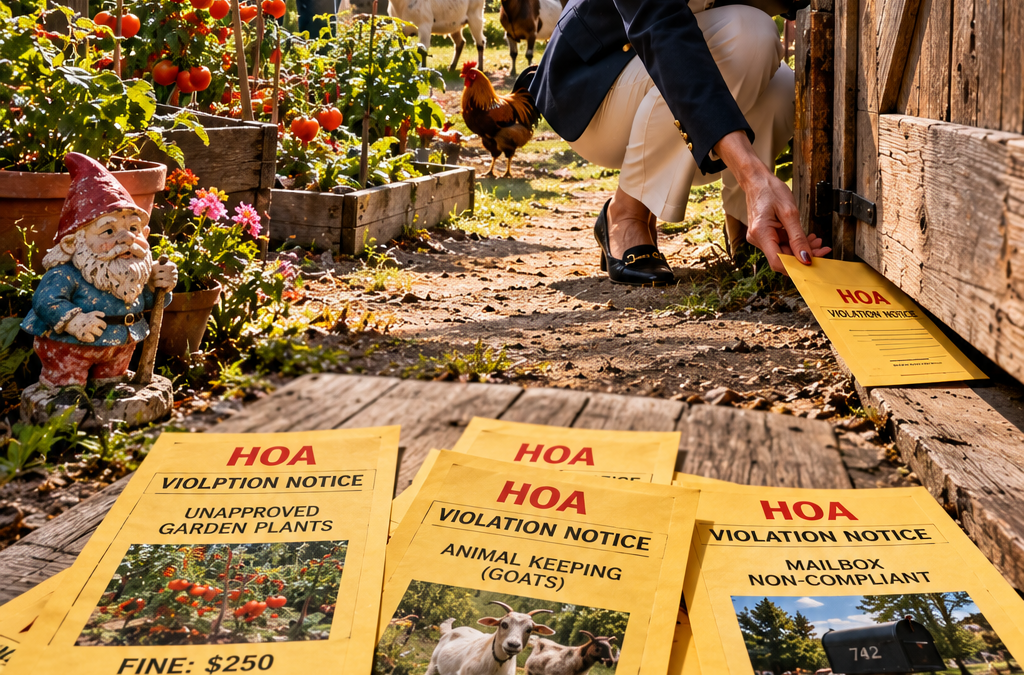
𝗙𝗨𝗟𝗟 𝗦𝗧𝗢𝗥𝗬
She did not smile.
“Crop rows visible from common thoroughfares must be uniform and positioned at least fifteen feet from the fence line.”
I looked at the plants again.
They were vegetables.
Not junk cars.
Not leaking chemical drums.
Tomatoes.
My father had grown the same varieties when I was a boy.
Cherokee Purple.
Brandywine.
Mortgage Lifter.
I planted them because the smell reminded me of summers before life became complicated.
“Those beds have been there for years,” I said.
“That does not exempt you from compliance.”
“My property is agricultural-residential.”
“That is irrelevant.”
“It seems fairly relevant when you’re fining me for growing food.”
Her expression changed.
Not much.
Just enough for me to see that she did not appreciate being questioned.
Patricia tore a yellow slip from beneath the top sheet of her clipboard and held it toward me.
“Fifty dollars.”
I did not take it immediately.
“For tomatoes.”
“For noncompliance.”
“Which consists of tomatoes.”
“Due within ten days.”
I finally accepted the paper.
Patricia smiled.
Not warmly.
It was the satisfied smile of someone who believed the conversation had ended because she had decided it was over.
“Have a good day, Mr. Cole.”
She turned and walked back toward her SUV.
“Patricia.”
She stopped.
I held up the slip.
“Does the board know you’re issuing this?”
Her shoulders became rigid.
“I am the president of the board.”
“That wasn’t my question.”
She turned halfway toward me.
“The association has given me full authority to enforce community standards.”
Then she got into her SUV and left.
I watched the white vehicle disappear beyond the maple trees.
Franklin crowed from beside the barn.
One of my goats chewed on a fence rail.
I looked down at the yellow notice.
Fifty dollars.
I should have challenged it immediately.
I could have.
I knew enough about municipal law, land-use classifications, association covenants, and administrative enforcement to understand that her interpretation was questionable at best.
But something in Patricia’s tone bothered me more than the money.
She had not come to discuss a problem.
She had come to demonstrate authority.
There is a difference.
Reasonable people tell you what concerns them.
People obsessed with control tell you what you are allowed to do.
So I folded the notice, put it in my pocket, and went back to tying my tomatoes.
That afternoon, I made a copy.
I wrote the date and time on it.
I noted exactly what Patricia had said.
Then I paid the fine.
The following Monday, she returned.
Same white SUV.
Same clipboard.
Different clothes.
This time she found me carrying hay toward the small shelter beside my pasture.
Two of my goats trotted behind me.
Patricia stopped beside the fence.
“Mr. Cole.”
“Morning.”
She looked at the goats.
“I was hoping you would have corrected this voluntarily.”
I set the hay down.
“Corrected what?”
“The livestock.”
I glanced toward Daisy and Buckley.
Daisy stared back at Patricia while chewing.
“Those?”
“Unauthorized livestock within a residential community.”
I leaned against the fence.
“This parcel has an agricultural use designation.”
“I am not discussing county zoning.”
“You probably should be.”
She frowned.
“The HOA restrictions supersede your personal interpretation.”
“It isn’t my personal interpretation. It’s the recorded classification.”
She flipped through the pages on her clipboard with exaggerated impatience.
“I’m not here to debate you.”
“That’s becoming obvious.”
Her eyes snapped up.
“Excuse me?”
“You keep telling me things. You don’t seem particularly interested in whether they’re true.”
For the first time, the pleasant mask slipped.
“Mr. Cole, people move into a managed community because they expect standards.”
I looked around at my place.
The barn was freshly painted.
The pasture was fenced.
The driveway was clean.
There was no garbage.
No abandoned equipment.
No waist-high weeds.
“What standard are the goats violating?”
“The presence of livestock.”
“According to what section?”
She pointed at a paragraph.
I read it.
It prohibited residents from keeping livestock on lots designated solely for residential use.
Mine was not.
I looked at her.
“Patricia.”
“Yes?”
“This says residential lots.”
“You live here.”
“That doesn’t make the zoning residential-only.”
She stared at me for several seconds.
Then she pulled out another slip.
“One hundred dollars.”
“You’re fining me anyway?”
“I’m enforcing community standards.”
“You just showed me language that doesn’t apply to this parcel.”
Her voice became colder.
“If you disagree, you can submit a written appeal.”
“To a board you control.”
“To the association.”
“Which you control.”
“I’m sorry you feel that way.”
That phrase told me almost everything I needed to know about Patricia Vance.
People use it when they want the sound of sympathy without accepting an ounce of responsibility.
She handed me the fine.
Daisy bleated.
Patricia looked at her as if the goat had personally insulted her.
“I expect the animals removed.”
“No.”
The word came out quietly.
Patricia blinked.
“What did you say?”
“I said no.”
Her mouth tightened.
“You are putting yourself in a very difficult position.”
“They stay.”
“I can continue fining you.”
“Apparently.”
“I can also recommend further enforcement.”
“Then put that in writing too.”
She stared at me.
I had expected anger.
Instead, I saw something more interesting.
Confusion.
People like Patricia understood fear.
They understood submission.
They understood loud resistance because loud resistance could be labeled unreasonable.
What they did not understand was calm.
Calm made them nervous.
She left another yellow notice.
That afternoon, I copied it.
Logged it.
Paid it.
And added the relevant zoning documents behind it in a folder.
The third Monday was my mailbox.
According to Patricia, it exceeded the approved height by three inches.
The mailbox had been there for nine years.
She measured it herself.
She knelt beside the road in khaki pants and used a tape measure while I stood near the porch drinking coffee.
“Forty-five inches,” she announced.
“And?”
“The standard is forty-two.”
“Measured from where?”
“Ground level.”
“The road shoulder was resurfaced two years ago.”
“That is not the association’s concern.”
“So the county raised the shoulder and somehow my mailbox became illegal.”
“Fifty dollars.”
I looked at her.
“Do you wake up looking forward to this?”
She straightened.
“I take pride in protecting property values.”
“Three inches of mailbox height is protecting property values?”
“Rules matter.”
“They do.”
I took the fine.
“So does applying them correctly.”
The fourth Monday, she came for the garden gnome.
His name was Winston.
He was ugly.
I knew he was ugly.
That was half the reason I kept him.
My niece had given him to me years earlier after finding him at a flea market.
He had a chipped red hat, a ridiculous white beard, and one eye painted slightly higher than the other.
He stood beside the flower bed near my porch.
Patricia classified him as “visually disruptive lawn ornamentation.”
I read the notice twice.
Then I looked at Winston.
Then at Patricia.
“You’re serious.”
“Decorative objects visible from the roadway require architectural approval.”
“He’s eighteen inches tall.”
“That is not relevant.”
“He has been there for seven years.”
“That is not approval.”
“Do you think he’s lowering property values?”
“I think uniformity creates stability.”
“Uniformity.”
“Yes.”
I looked past her at Maple Hollow Road.
Different houses.
Different porches.
Different trees planted by families over decades.
Mrs. Ferris had wind chimes shaped like hummingbirds.
The Hendersons had a wooden swing their father had built.
George Whitfield had a little stone angel near his front steps because his late wife had loved angels.
Patricia looked at that street and saw things to correct.
I saw people.
“One hundred dollars?” I asked.
“Seventy-five.”
“Winston will be relieved.”
She stared at me.
“You think this is funny.”
“No.”
I folded the notice.
“I think it’s sad.”
Her expression hardened.
“You have ten days.”
“For what?”
“To remove it.”
“I’m not removing it.”
“Then additional penalties may apply.”
She walked away.
That was the morning I stopped believing Patricia was merely overzealous.
She enjoyed this.
I saw it in the way she timed her visits.
At first, she came early.
Then she started arriving later in the morning, when people were mowing lawns, walking dogs, or checking their mail.
She wanted an audience.
One Monday, she parked halfway into my driveway while George Whitfield was trimming roses across the road.
She called my name loudly before she even reached the porch.
“Mr. Cole, we have another problem.”
George looked up.
Patricia noticed.
That tiny smile appeared.
She handed me a fine for “improper agricultural screening.”
“What does that mean?” I asked.
“Your vegetable garden can be seen from the road.”
“Patricia, we established that the first week.”
“This concerns screening, not placement.”
“You’re fining the same tomatoes twice under different labels.”
“No.”
“Yes.”
Her voice rose.
“Perhaps if you made an effort to cooperate, enforcement would not be necessary.”
George stopped clipping roses.
I looked at Patricia.
That sentence was not about my garden.
It was about obedience.
“You want me to cooperate with rules you keep inventing.”
Her face flushed.
“I do not invent anything.”
“Then show me the section.”
She flipped through her papers.
For almost thirty seconds, she said nothing.
Finally, she tapped a line concerning “unsightly exterior storage and equipment.”
“That says storage.”
“A garden constitutes maintained exterior use.”
“That isn’t what the language says.”
“It is the board’s interpretation.”
“Was there a board vote?”
Silence.
“Patricia?”
“I am authorized to enforce standards.”
“That still isn’t an answer.”
She shoved the notice toward me.
“Fifty dollars.”
Behind her, George slowly shook his head.
She saw him.
“What are you looking at, Mr. Whitfield?”
George froze.
He was seventy-six.
His wife had died the year before.
Since then, he had become quieter.
Some mornings I saw him sitting alone on his porch with two coffee cups on the table, because after fifty-one years of marriage, his hands still prepared hers before his mind remembered she was gone.
He looked down at his clippers.
“Nothing.”
Patricia smiled.
“That’s what I thought.”
Something cold moved through me.
Until then, I had treated what she was doing to me like an experiment.
I could afford the fines.
I knew how to document them.
I understood legal procedure.
George did not have those advantages.
Neither did a lot of people on our road.
After Patricia left, I walked across the street.
George was still working on his roses.
“You all right?”
He nodded without looking up.
“Sure.”
“That didn’t sound convincing.”
He clipped a dead bloom.
Then another.
Finally, he sighed.
“She got me too.”
“For what?”
“My trash cans.”
I already knew about it vaguely, but not the details.
“How much?”
“Started at twenty-five.”
“Started?”
He gave a bitter little laugh.
“I left them by the curb too long.”
“How long?”
“Pickup is Wednesday morning. I brought them in Wednesday afternoon.”
“That’s normal.”
“She says they have to be removed by noon.”
“Do the covenants say noon?”
“I don’t know anymore.”
He rubbed the back of his neck.
“She came by around two. Ruth used to bring them in.”
He stopped.
Ruth was his wife.
He swallowed.
“I forgot.”
That changed the weight of the conversation.
Patricia had fined a grieving widower because two plastic garbage containers remained at the roadside for two extra hours.
George continued.
“I told her I’d forgotten. Told her Ruth had always handled trash day.”
“What did she say?”
His eyes stayed on the roses.
“She said personal circumstances did not exempt me from community standards.”
For several seconds, I could not speak.
“How much have you paid her?”
“About three hundred altogether.”
“For trash cans?”
“That and some weeds near the shed. She said my porch chair wasn’t approved either.”
“Your porch chair?”
“It belonged to Ruth.”
He looked toward the house.
A pale blue rocking chair sat near the front door.
“She picked it out twenty years ago.”
His voice dropped.
“I’m not getting rid of it.”
“You shouldn’t.”
George finally looked at me.
“You fight her and she’ll make it worse.”
That sentence stayed with me.
Not because it frightened me.
Because George believed it.
A seventy-six-year-old man was afraid that the president of his homeowners association would punish him for keeping his dead wife’s rocking chair.
That night, I opened a new folder.
On the label I wrote:
MAPLE HOLLOW HOA ENFORCEMENT.
I put my notices inside.
Then I began asking questions.
Not as mayor.
As a neighbor.
Mrs. Ferris lived two houses down.
She was a retired elementary school teacher who kept bird feeders in her backyard and a stone birdbath beneath a dogwood tree.
Patricia had fined her because the birdbath had not been approved.
“It was my retirement gift from the school,” Mrs. Ferris told me.
We stood in her kitchen while she made tea.
“The children’s parents bought it.”
“How much was the fine?”
“Seventy-five dollars.”
“Did you appeal?”
She laughed softly.
“I went to a board meeting.”
“What happened?”
“Patricia interrupted me three times.”
“Were the other board members there?”
“Yes.”
“And?”
Mrs. Ferris looked embarrassed.
That bothered me.
People who had done nothing wrong should not look embarrassed when describing how someone else mistreated them.
“She said if I couldn’t follow simple guidelines, maybe an HOA community wasn’t appropriate for me.”
I felt my jaw tighten.
“You’ve lived here nineteen years.”
“Twenty in November.”
“Patricia’s been here six.”
“I know.”
“Did the board vote on your appeal?”
“I don’t think so.”
“Did they issue a written decision?”
“No.”
“Do you still have the notice?”
She nodded.
“I keep everything.”
“So do I.”
A faint smile crossed her face.
I went next to the Hendersons.
Their flagpole had stood in the yard for fifteen years.
Patricia fined them because the pole was four feet taller than an architectural guideline adopted five years after it had been installed.
She refused to recognize the preexisting structure exemption.
Their son was serving overseas.
Mrs. Henderson cried when she told me Patricia had suggested they simply remove the pole and hang a smaller flag from the porch.
“My husband put it up when Tyler enlisted,” she said. “Every morning he raises that flag.”
Her husband stood at the window, arms crossed.
“I told Patricia she could fine me every day before I took it down.”
“How much have you paid?”
“Six hundred.”
Mrs. Henderson turned toward him.
“Seven hundred.”
He looked at her.
“She fined us again?”
“This morning.”
That evening, I added their documents to the folder.
Then I started a spreadsheet.
Date.
Resident.
Alleged violation.
Bylaw cited.
Fine amount.
Appeal offered.
Board vote documented.
Outcome.
By the end of the week, I had seventeen households.
By the end of the next, twenty-three.
The pattern was worse than I expected.
Patricia was not merely enforcing rules harshly.
She was changing interpretations from house to house.
One resident got a warning for lawn length.
Another was immediately fined.
One family had forty-eight hours to remove a basketball hoop.
Another family with the same model never received a notice.
Decorations she liked were ignored.
Decorations she disliked became violations.
She cited sections that did not apply.
Sometimes she cited sections that did not exist.
In at least six cases, she increased fines without the written notice period required by the association’s own rules.
And always, always, she used the same language.
“Standards.”
“Compliance.”
“Property values.”
“Authority.”
People who abuse small amounts of power rarely describe what they are doing as control.
They describe it as order.
At City Hall, I said nothing publicly.
I did, however, ask our city attorney, Elena Ramirez, a hypothetical question after a budget meeting.
We were alone in the conference room.
Elena had worked with me for three years.
She was one of those people who could tell when I was not really asking a hypothetical.
“If a common-interest association were issuing penalties beyond its recorded authority,” I said, “what exposure could that create?”
She looked up from her laptop.
“How hypothetical is hypothetical?”
“Very.”
“Meaning not at all.”
I smiled.
She closed the laptop.
“Depends. State homeowner statutes. Contract law. Due process provisions in the governing documents. Potential consumer protection issues if fees are misrepresented. Why?”
“No reason.”
“Daniel.”
“Elena.”
She stared at me.
I lasted about four seconds.
“I’m gathering documents.”
“From where?”
“My neighborhood.”
Her eyebrows rose.
“You live under an HOA?”
“Apparently with great enthusiasm.”
“How bad?”
“They fined a garden gnome.”
She stared at me.
I nodded.
“Seventy-five dollars.”
Her expression changed from amusement to professional concern.
“Send me the governing documents.”
“Not yet.”
“Why?”
“Because if this is one woman behaving badly, I want to know how far the pattern goes before anyone realizes I’m looking.”
Elena leaned back.
“You’re letting them fine you?”
“I’m paying every one.”
“That is possibly the most stubborn thing you’ve ever done.”
“Thank you.”
“It wasn’t praise.”
“I know.”
She shook her head.
“Be careful.”
“With what?”
“Your position.”
That part mattered.
Being mayor did not make my private disputes public business.
I could not use municipal power because someone annoyed me personally.
If anything happened, it had to be based on documented violations of law or ordinance affecting residents generally, not on my bruised pride.
That was one reason I had stayed quiet.
Patricia believed my silence meant weakness.
In reality, my silence was partly restraint.
Power means less when you use it every time you are angry.
The next Monday, Patricia returned at 8:12 in the morning.
I remember the exact time because I had started recording every visit in a notebook.
She stepped from the SUV before I reached the driveway.
“Mr. Cole.”
“Patricia.”
She handed me another notice.
This one said my rooster created a recurring nuisance.
“Franklin?”
“Excessive noise.”
“He’s a rooster.”
“That does not excuse repeated disturbance.”
“What time did someone complain?”
She hesitated.
“The association received concerns.”
“What time?”
“That information is confidential.”
“Because there wasn’t a complaint?”
Her eyes narrowed.
“Are you accusing me of falsifying enforcement?”
“I asked what time the complaint was made.”
“I do not appreciate your tone.”
“My tone isn’t costing you a hundred dollars.”
“Haven’t you learned anything from the last several weeks?”
The question surprised me.
“What should I have learned?”
“That this would be easier if you stopped resisting.”
There it was.
Clearer than she had ever said it before.
I folded the notice slowly.
“I’ve paid every fine you’ve issued.”
“Payment is not compliance.”
“You don’t want compliance.”
Her face stiffened.
“You want submission.”
For a moment, neither of us spoke.
The morning felt suddenly still.
Even Franklin had gone quiet.
Patricia stepped closer.
“You think because you sit out here playing farmer that rules don’t apply to you.”
Playing farmer.
I looked down at my hands.
There was dirt beneath my nails.
A callus across my palm from repairing fencing the previous afternoon.
She saw costume.
I saw the life I had built.
“You don’t know anything about me,” I said.
“I know exactly the kind of resident you are.”
“No, Patricia.”
My voice stayed low.
“You really don’t.”
Something about the way I said it made her pause.
Only for a second.
Then arrogance returned.
“One hundred dollars. Due in ten days.”
She turned away.
I watched her walk back toward her vehicle.
For the first time, I almost told her.
Not because I wanted to scare her.
Because I wanted to wipe that smug certainty off her face.
I could have said three words.
I’m the mayor.
That would have been enough.
She would have searched my name.
She would have found photographs.
She would have gone very quiet.
And maybe the fines against me would have stopped.
But George would still have his trash-can notices.
Mrs. Ferris would still have lost seventy-five dollars over a birdbath.
The Hendersons would still be paying for a flagpole they had legally installed fifteen years earlier.
If I revealed myself now, Patricia might simply become careful.
I did not want her careful.
I wanted the truth.
So I paid the rooster fine.
By then, Founders Day was less than three weeks away.
Founders Day was Willow Creek’s biggest annual event.
The town closed three blocks around the old courthouse square.
Schools performed.
Local businesses set up booths.
Veterans marched with the color guard.
There were food trucks, craft tables, antique cars, children running around with painted faces, and enough politicians shaking hands to make any sane person avoid the center of town.
As mayor, I gave the main civic address every year.
Patricia apparently did not know that.
The idea seemed impossible at first.
Then I thought about it.
She had moved to town after my first election.
She rarely attended municipal events.
The HOA newsletters focused almost entirely on neighborhood issues.
Our interactions had always happened while I was dirty, unshaven, and dressed in work clothes.
When she called me Mr. Cole, she probably saw the name only as another line on a property record.
One Thursday afternoon, I ran into her at a grocery store.
I was wearing jeans and a faded flannel shirt.
She stood near the produce section examining avocados.
She saw me and gave me a thin smile.
“Mr. Cole.”
“Patricia.”
Her gaze moved toward the tomatoes in my basket.
“Buying them now?”
For a second, I did not understand.
Then I realized she was making a joke about my garden.
“No. These are for salsa.”
She smiled as if she had won something.
“I suppose growing your own would be easier if you followed the approved layout.”
I looked at her.
There were people around us.
A young mother with a toddler.
An employee stacking apples.
An older man reading labels.
Patricia loved public spaces.
“I like mine where they are.”
“We’ll see how long that lasts.”
She walked away.
The grocery employee glanced at me.
“Friend of yours?”
“Something like that.”
He nodded sympathetically.
“You have my condolences.”
I laughed for the first time all week.
But the humor did not last.
The following Monday, Patricia did something that changed my attitude completely.
She arrived while George was standing in my driveway.
He had brought me a box of old documents from his basement.
His hands were shaking slightly.
“Found these,” he said. “Ruth kept every HOA paper since we moved in.”
“That could help.”
“I don’t want my name in anything public.”
“It won’t be without your permission.”
He nodded.
Then Patricia’s SUV appeared.
George’s whole body changed.
His shoulders tightened.
He looked toward the road.
“I should go.”
“You don’t have to.”
“I don’t want trouble.”
That sentence angered me more than any fine she had given me.
He crossed the road before Patricia got out.
She watched him leave.
Then she approached me.
“Mr. Whitfield discussing association matters with you?”
“He’s my neighbor.”
“That wasn’t my question.”
“I’m aware.”
She held out another notice.
“Your side fence has unauthorized discoloration.”
I stared at the page.
“Unauthorized discoloration.”
“The stain is uneven.”
“The fence is cedar.”
“There are darker sections.”
“It rained.”
“That doesn’t explain long-term inconsistencies.”
“Wood weathers.”
She looked irritated.
“Do you ever take anything seriously?”
“I take a lot seriously.”
I glanced toward George’s house.
“More than you realize.”
She followed my eyes.
“I hope you’re not encouraging other residents to challenge legitimate enforcement.”
I looked back at her.
“What happens if I am?”
“Creating hostility toward the board can itself become a community issue.”
I almost laughed.
“Is that another rule?”
“You should be careful, Mr. Cole.”
There was no humor in her voice.
No smile.
For the first time, it sounded like a threat.
“People who create unnecessary conflict often discover that living in a regulated community becomes unpleasant.”
I stepped closer.
Not aggressively.
Just enough that she had to look directly at me.
“Did you just threaten to make my life unpleasant?”
“I said nothing of the sort.”
“You came onto my property, handed me another questionable fine, asked whether my neighbor was talking to me, and warned me about challenging you.”
“The board.”
“No. You.”
Her jaw tightened.
“You have developed a serious attitude problem.”
“No, Patricia. I’ve developed a documentation habit.”
For the first time since this began, her eyes dropped to the folder on the workbench inside my barn.
She saw the yellow slips.
All of them.
Arranged by date.
Behind them were copies of covenants, county zoning records, written statements from neighbors, and my notes.
Her face changed slightly.
“What is that?”
“My paperwork.”
“Regarding?”
“You.”
She looked at me.
I smiled.
“Have a good Monday.”
She did not move for several seconds.
Then she turned and walked back to her SUV.
She drove away faster than usual.
That afternoon, Elena came to the farm.
I had never invited our city attorney there before.
She arrived carrying a laptop and two legal pads.
I spread everything across the dining-room table.
For nearly three hours, we reviewed documents.
At first Elena was quiet.
Then she began muttering.
“That section doesn’t say this.”
A few minutes later:
“They increased this without notice.”
Then:
“Where did she get this citation?”
“She wrote it.”
“No, I mean where is the authority?”
“There isn’t any.”
She looked at me.
“You’re sure?”
“I’ve searched every version of the bylaws I can find.”
She checked again.
Then shook her head.
“This one appears invented.”
“That was my impression.”
By the time we reached George’s records, Elena had stopped looking amused entirely.
“This is bad.”
“How bad?”
“I need to separate what is merely improper HOA procedure from what might violate state statute or municipal consumer provisions. But there’s a pattern here.”
“I know.”
“If the board authorized all of this, the association has a serious problem.”
“And if they didn’t?”
“Then Patricia has an even bigger one.”
She picked up another notice.
“You’ve paid all of yours?”
“Yes.”
“Why?”
“Clean record.”
She exhaled.
“Of course.”
“I also wanted proof of collection, not just attempted enforcement.”
“Daniel, normal people take vacations.”
“I have tomatoes.”
“That is not a vacation.”
“It is if nobody brings a clipboard.”
Elena almost smiled.
Then she looked toward the window.
“Founders Day is coming.”
“Nine days.”
She turned back toward me.
“You’re thinking about saying something publicly.”
“I’m thinking about telling the town that we’ve received enough complaints to justify a formal review.”
“You need to be careful about naming anyone before the facts are verified.”
“I know.”
“And this cannot look like the mayor retaliating because his garden gnome got fined.”
“Winston would object to that characterization.”
She pointed her pen at me.
“I’m serious.”
“So am I.”
My smile disappeared.
“This stopped being about me weeks ago.”
I told her about George.
About Ruth.
About the rocking chair.
About the way his shoulders tightened when Patricia’s SUV appeared.
I told her about Mrs. Ferris being humiliated at the board meeting.
About the Hendersons paying hundreds of dollars because they refused to remove the flagpole they had erected for their son.
Elena listened.
Then she closed the folder.
“All right.”
That was the beginning of the formal review.
Not a personal investigation ordered by an angry homeowner.
A legal assessment of whether enforcement practices affecting multiple Willow Creek residents violated applicable law and the association’s own governing documents.
For nine days, we worked quietly.
Elena reviewed notices.
Her office cross-referenced recorded covenants and amendments.
Residents who had already approached me voluntarily provided copies of fines and proof of payment.
The numbers grew.
Five thousand.
Eleven thousand.
Twenty-three thousand.
By the time the review expanded to the entire year, the total amount of fines issued across the neighborhood was more than forty thousand dollars.
Some were legitimate.
Most of the questionable ones shared Patricia’s signature.
Several board members appeared not to know she had issued them.
That mattered.
Two days before Founders Day, I received one more yellow notice.
Patricia did not hand it to me.
She slid it beneath the barn door.
I found it after sunrise.
Violation:
Failure to maintain association-approved exterior agricultural appearance.
Fine:
One hundred dollars.
No specific section.
No photograph.
No explanation.
Just Patricia Vance’s signature.
I stood alone in the barn holding that piece of paper.
For two months, I had been remarkably calm.
That morning, I finally felt tired.
Not defeated.
Tired.
There is a particular exhaustion that comes from being forced to defend ordinary life against someone who has decided ordinary life needs her permission.
I thought about George.
About the rocking chair.
About Mrs. Ferris.
About every person who had paid because fighting felt harder than surrendering.
Patricia believed the amount was the weapon.
Fifty dollars.
Seventy-five.
One hundred.
Small enough that most people would rather pay than hire a lawyer.
Small enough that outsiders might say, “Why make such a big deal about it?”
That was precisely why it worked.
Control does not always arrive with sirens.
Sometimes it arrives on yellow paper in fifty-dollar increments.
I put the final notice into my folder.
Then I went inside and ironed my Founders Day suit.
Saturday morning arrived bright and warm.
By ten o’clock, the courthouse square was packed.
Blue tents lined the sidewalks.
Children chased each other around the fountain.
The high-school marching band was warming up near First Street.
Smoke from barbecue grills drifted over the square.
Someone from the fire department had brought an antique engine.
Every bench was occupied.
Every patch of shade had people beneath it.
I arrived through the rear entrance of City Hall.
My chief of staff, Rebecca, met me with the event schedule.
“You’re on at eleven forty.”
“I know.”
“Veterans tribute first. Then chamber awards. Then you.”
“Good.”
She studied my face.
“You look unusually happy.”
“I slept well.”
“That’s never a good sign.”
I smiled.
From an upstairs window, I could see the crowd gathering before the stage.
Then I saw a white SUV parked near the east side of the square.
Patricia.
Of course.
She was sitting in the front section.
Clipboard on her lap.
I actually laughed.
Rebecca looked over.
“What?”
“Nothing.”
At eleven thirty-eight, I stood behind the stage curtain.
The master of ceremonies finished introducing the previous speaker.
I could hear applause.
Elena stood a few feet away.
“You’re sure?”
“Yes.”
“Keep it factual.”
“I will.”
“No theatrics.”
“Elena.”
She raised one eyebrow.
“No unnecessary theatrics.”
“I’m the mayor. Founders Day is ninety percent unnecessary theatrics.”
She did not laugh.
“All right.”
The master of ceremonies began my introduction.
“And now, please welcome the mayor of Willow Creek, Daniel Cole.”
Applause rose across the square.
I stepped onto the stage.
For years, I had stood at that podium and looked out over my town.
Usually I saw familiar faces.
Business owners.
Teachers.
Parents.
Retirees.
Council members.
Friends.
That morning, I looked immediately at Patricia.
She was clapping politely.
Then she saw me.
Her hands stopped.
At first, her expression showed only confusion.
She leaned forward slightly.
Her eyes narrowed.
I watched the recognition arrive piece by piece.
The gray hair she had only seen beneath an old cap.
The face usually dusty from the garden.
The voice.
The name.
Daniel Cole.
Mayor Daniel Cole.
Her arms fell to her sides.
Her mouth opened.
The clipboard shifted against her knees.
I almost felt sorry for her.
Almost.
“Thank you,” I began.
The applause faded.
“It’s good to see so many people here today.”
I gave the opening remarks I had prepared weeks earlier.
I spoke about Willow Creek’s history.
About families who had stayed through hard years.
About newcomers who had invested in the community.
About growth.
About responsibility.
Then I reached the section Elena and I had rewritten the previous evening.
“There is one subject I want to address today that was not originally part of this speech.”
The square became quieter.
“For the past four years, I have argued that local institutions should exist to serve people, not dominate them.”
I paused.
“Rules matter. Contracts matter. Community standards matter.”
Patricia looked almost relieved.
Then I continued.
“But authority without accountability is not order. It is abuse.”
The square went silent.
I saw Elena near the side of the stage.
I saw George Whitfield standing near the back.
Mrs. Ferris was beside him.
The Hendersons stood near a food booth.
“For the last two months,” I said, “I have experienced this issue personally.”
A few people shifted.
“I own four acres at the end of Maple Hollow Road.”
Whispers started immediately.
Patricia was motionless.
“Some of you know me there simply as Dan.”
I looked directly at her.
“I grow tomatoes.”
Someone laughed softly.
“I keep three goats.”
More murmurs.
“And apparently, I own a dangerously disruptive garden gnome.”
This time the laughter was louder.
I let it pass.
Then my voice became serious.
“Over the past several weeks, I have received repeated fines from my homeowners association.”
Patricia’s face had gone pale.
“Fifty dollars because my tomatoes were allegedly too visible. One hundred dollars because livestock was supposedly prohibited on land specifically classified for agricultural use. Additional fines for my mailbox. My fence. My rooster. And yes, my garden gnome.”
People began turning toward Patricia.
She stared straight ahead.
“I paid those fines.”
A ripple moved through the crowd.
“I paid every one.”
I held up the folder.
“And I kept every notice.”
The square became very still.
“But this is not about my money.”
I saw George lower his head.
“This is about an elderly widower fined because grief caused him to leave his garbage cans beside the road two hours longer than somebody preferred.”
Patricia shifted in her chair.
“It is about a retired teacher ordered to remove a birdbath given to her by the families of children she taught.”
Mrs. Ferris covered her mouth.
“It is about a family fined repeatedly for a flagpole installed years before the current restrictions existed.”
Mr. Henderson’s jaw tightened.
“And it is about whether anybody entrusted with authority gets to reinterpret rules, invent violations, ignore required procedures, and intimidate residents into silence.”
No one was laughing now.
“We have reviewed every available Maple Hollow enforcement notice issued this year.”
Patricia stood.
Her chair scraped loudly against the pavement.
“Daniel.”
She said my first name as if we were suddenly old acquaintances.
I looked at her.
She seemed to realize hundreds of people were watching.
“This is completely inappropriate,” she said.
Her voice trembled despite her effort to control it.
I remained at the microphone.
“You’ll have an opportunity to respond through the formal process.”
“You are using your office to attack me.”
“No.”
I held up the folder.
“I used my own money to pay every fine you issued me. I used the same appeal procedures available to every other resident. The review began only after evidence showed a broader pattern affecting multiple households.”
Her face reddened.
“You have no right to publicly humiliate me.”
The irony of that statement moved through the crowd like electricity.
Somebody behind her laughed once.
A bitter sound.
George spoke from the back.
“You did it to us.”
Patricia turned.
George’s voice shook, but he did not look away.
“You did it to all of us.”
I had never seen him confront her before.
Neither had she.
Patricia pointed toward the stage.
“This is political retaliation.”
Elena stepped forward but remained beside the curtain.
I continued.
“The legal review found substantial evidence of unauthorized fees, misapplied provisions, procedural violations, and fines that cannot be supported by the association’s recorded governing documents.”
I made sure every word was precise.
“The matter will now proceed through the appropriate association, municipal, and state-law processes.”
Patricia stared at me.
For once, there was no smile.
No condescension.
No little yellow slip in her hand.
Just shock.
I looked across the square.
“Mrs. Vance, you may want to sit down.”
She did not.
So I finished my speech.
Not with a threat.
Not with celebration.
With the principle I had run for office on four years earlier.
“A town is not strong because everybody obeys the loudest person in the room. It is strong because rules are clear, authority is limited, and ordinary people know they can challenge wrongdoing without being punished for it.”
I closed the folder.
“That protection belongs to everyone.”
The applause did not begin immediately.
For two or three seconds, there was complete silence.
Then George started clapping.
Mrs. Ferris joined him.
The Hendersons did too.
Within seconds, the square erupted.
I did not look at Patricia again until I stepped off the stage.
Her chair was empty.
The clipboard was gone.
The formal investigation moved faster after Founders Day because residents who had been afraid to speak suddenly came forward.
That was the part Patricia had never understood.
Fear can look like loyalty from a distance.
It is not.
People had not supported her.
They had been waiting for someone else to go first.
Once they realized they were not alone, the stories poured in.
There were fine notices tucked into kitchen drawers.
Letters saved in filing cabinets.
Emails Patricia had sent late at night.
Photographs of supposed violations.
Records of payments.
Board meeting minutes.
Appeals that had never been heard.
Warnings based on restrictions that did not exist.
The forty-thousand-dollar figure became impossible to ignore.
A significant portion of the penalties had either been exaggerated, improperly assessed, procedurally defective, or unsupported by the association’s charter.
The remaining board members called an emergency meeting.
For the first time in years, the community room was not half-empty.
People stood along the walls.
Others waited outside.
I attended as a homeowner, not as mayor.
I wore jeans.
Patricia sat at the head table.
No clipboard.
Her attorney sat beside her.
The board treasurer read the findings.
His voice was strained.
When he finished, one board member made a motion to remove Patricia as president pending final resolution of the claims.
Another seconded it.
Patricia rose.
“This community will collapse without standards.”
Nobody answered.
She looked around the room.
“I have spent years protecting your property values.”
Mrs. Ferris spoke from the second row.
“You fined me over a birdbath.”
Patricia ignored her.
“I volunteered hundreds of hours.”
Mr. Henderson stood.
“And charged us seven hundred dollars over a flagpole you had no authority to regulate retroactively.”
“You refused to cooperate.”
His face hardened.
“My son was serving his country while you were threatening liens over the flag we flew for him.”
The room went quiet.
Patricia looked toward me.
There was hatred in her expression now.
“You did this.”
I shook my head.
“No.”
“You planned this.”
“I documented what you did.”
“You could have told me who you were.”
That sentence stunned me more than anything else she said that night.
The room seemed to feel it too.
I leaned forward.
“Why should that have mattered?”
Patricia opened her mouth.
Nothing came out.
“If your fines were legitimate,” I continued, “my job shouldn’t have made any difference.”
She stared at me.
“If your rules were fair, it shouldn’t matter whether I was a farmer, a teacher, a widower, a mechanic, or the mayor.”
Still nothing.
“You’re angry because you think you would have treated me differently if you had known.”
Her face tightened.
“That is not what I meant.”
“It’s exactly what you meant.”
I looked around the room.
“And that is the problem.”
The vote was taken.
Patricia was removed from the board.
Two weeks after Founders Day, the association formally rescinded the invalid fines.
Restitution notices went out.
Residents received refunds.
Mine came by check.
So did George’s.
So did Mrs. Ferris’s.
So did the Hendersons’.
Where applicable under the governing rules and local restitution requirements, the refunded amounts included interest.
George walked over to my farm the afternoon his check arrived.
He held the envelope in one hand.
“I got it.”
“I heard.”
He looked down.
“Three hundred and twenty-five dollars.”
“That sounds about right.”
He stood quietly beside the fence.
Daisy pushed her nose between the rails.
George scratched her forehead.
“I almost got rid of Ruth’s chair.”
I looked at him.
He kept stroking the goat.
“After the second notice. Patricia told me additional penalties were coming.”
His voice weakened.
“I carried that chair to the garage.”
I said nothing.
“I got halfway there and couldn’t do it.”
He swallowed.
“Last thing Ruth bought for that porch.”
We stood together in silence.
Finally, George looked at me.
“Thank you.”
“You don’t owe me that.”
“Yes, I do.”
“No.”
I shook my head.
“You kept your chair. Mrs. Ferris kept her birdbath. The Hendersons kept their flagpole. You all did that.”
He gave me a small smile.
“You know what I mean.”
I did.
But I also knew something else.
I had spent weeks thinking I was waiting to reveal Patricia.
In truth, what mattered was giving everyone else enough room to reveal what she had done to them.
The story was never really about the mayor outsmarting an HOA president.
It was about twenty-three households who had been made to feel individually powerless until they discovered their experiences formed one pattern.
Patricia stayed in Willow Creek through the summer.
I saw her only once.
It was late August.
I was loading bags of feed into the back of my sedan outside the farm-supply store.
Her white SUV was parked two rows away.
She came out pushing a cart.
We saw each other at the same moment.
For a second, neither of us moved.
She looked different.
Not physically.
She still dressed carefully.
Still held herself straight.
But something had disappeared from her face.
That certainty.
The assumption that everyone else would move because she had entered the room.
She walked toward her vehicle.
When she passed me, she stopped.
“You ruined my life.”
I set the feed bag down.
“No, Patricia.”
She looked at me sharply.
“I had friends here.”
“I didn’t issue those fines.”
“You turned everyone against me.”
“I didn’t invent those violations.”
“You could have handled it privately.”
“And George?”
She went silent.
“Mrs. Ferris?”
Nothing.
“The Hendersons?”
Her fingers tightened around the shopping cart.
“You could have told me to stop.”
“I did.”
“No, you didn’t.”
“I questioned your authority every week.”
“That’s not the same.”
“You mean I could have told you I was mayor.”
She looked away.
There it was again.
I lowered my voice.
“You still don’t understand.”
She turned back.
“You shouldn’t have needed to know who I was.”
Her expression changed.
Not remorse.
I never saw enough from Patricia to call it remorse.
But perhaps, for a fraction of a second, she understood the sentence.
I continued.
“George shouldn’t have needed a title for you to treat him decently.”
She said nothing.
“Neither should anyone else.”
I lifted the feed bag again.
“Take care of yourself, Patricia.”
I walked away.
By autumn, the white SUV was gone from her driveway.
A FOR SALE sign appeared on the lawn.
A few weeks later, movers came.
Patricia left Willow Creek without ceremony.
There was no goodbye notice.
No final board message.
No explanation.
One day she lived there.
A few days later, she did not.
The neighborhood changed gradually afterward.
The HOA did not disappear.
I did not want it to.
Most associations are not inherently evil.
People need mechanisms for shared maintenance, common property, drainage issues, road agreements, and genuine nuisances.
The new board revised its enforcement procedures.
Written warnings came before fines except in emergencies.
Every citation had to identify the exact governing provision.
Appeals had deadlines and written decisions.
No single board officer could invent an interpretation and immediately attach money to it.
Several outdated restrictions were removed.
And most importantly, residents started attending meetings.
George came every month.
He rarely spoke.
He just sat in the second row and listened.
Mrs. Ferris volunteered for the landscaping committee.
The Hendersons never joined any committee, which I considered evidence of excellent judgment.
As for me, I went back to my farm.
My tomatoes grew unevenly that year.
Some leaned toward the fence.
Some vines twisted around each other.
One plant became so heavy with fruit that the wooden stake snapped and I had to prop it up with an old shovel handle.
Patricia would have hated it.
I loved every inch.
The goats stayed.
Franklin kept crowing.
My mailbox remained exactly where it had always been.
And Winston, my visually disruptive garden gnome, stood beside the porch with his chipped red hat and crooked eyes.
Mrs. Ferris eventually brought him a tiny ceramic companion from a yard sale.
I told her that might violate architectural standards.
She laughed so hard she had to sit down.
George’s blue rocking chair remained on his porch.
That mattered to me more than anything.
Some evenings, after work, I would see him sitting there while the sun dropped behind the trees.
Sometimes there was one coffee cup on the table.
Sometimes two.
I never asked.
Every Monday morning, I still woke before sunrise.
Habit.
I pulled on old jeans.
Made coffee.
Walked outside.
For a while, I kept expecting to hear tires on gravel.
I expected the white SUV.
The sharp knock.
The clipboard.
The yellow slip beneath the barn door.
But nothing came.
The first Monday without Patricia felt strangely empty.
The second felt peaceful.
By the third, I stopped listening for her.
I would walk the rows with coffee in one hand, touching tomato leaves, checking soil, listening to Franklin announce himself to an audience that had never asked.
No fines.
No manufactured violations.
No woman standing in my driveway explaining that I needed permission to live on land I had maintained for years.
Just quiet.
Exactly what I had bought the farm for.
People occasionally asked why I had waited so long.
Some thought I had been playing a game.
Others assumed I wanted a dramatic public reveal.
That was not really it.
I could have ended my personal problem on the first Monday.
Maybe even the second.
I could have taken out my phone, shown Patricia the town website, and watched her face change.
Mayor Daniel Cole.
There.
Problem solved.
For me.
That was the problem.
It would have solved it only for me.
She would have driven across the road and continued fining George.
She would have gone after the birdbath.
The flagpole.
The porch chair.
The next homeowner who did not know enough about bylaws to challenge her.
The next person who could not afford an attorney.
The next widow, retiree, young family, or exhausted worker who looked at a fifty-dollar notice and decided surrender was cheaper than fighting.
I needed to know whether I was dealing with one bad interpretation or a system of intimidation.
Once I knew, silence no longer served any purpose.
Patricia thought my quiet meant she had won.
She thought paying meant submission.
She thought overalls meant ignorance.
She saw a farmer standing in front of a crooked barn and assumed there was nothing else worth knowing about him.
That was her mistake.
Not that she failed to recognize the mayor.
Her real mistake was believing she had the right to mistreat someone until she discovered he possessed enough status to fight back.
That distinction stayed with me.
Years in public office had taught me that titles distort rooms.
People become kinder.
More careful.
Sometimes more dishonest.
They laugh harder at your jokes.
Return your calls faster.
Choose their words.
A title can show you how people behave around power.
But anonymity can show you who they are without it.
Patricia met me when she believed I had none.
And she showed me exactly who she was.
In the end, I never needed to threaten her.
I never needed to raise my voice.
I never needed to tell her she had picked the wrong man.
I just kept the papers.
I listened to my neighbors.
I waited until the facts were stronger than her authority.
And when the truth finally reached the same people she had spent years trying to control, her little kingdom collapsed under the weight of its own records.
The farm still looks imperfect.
That is one of my favorite things about it.
The cedar fence has weathered.
The tomato rows wander slightly.
The goats chew things they should not.
Franklin remains offensively loud.
Winston still stands beside my porch looking ridiculous.
And every time I see him, I remember that yellow notice calling him visually disruptive.
Sometimes I smile.
Not because Patricia lost.
Because George kept Ruth’s chair.
Mrs. Ferris kept her birdbath.
The Hendersons kept their flagpole.
And Maple Hollow finally became quiet again.
That is what I had wanted from the beginning.
Not revenge.
Not humiliation.
Just the right to wake up on my own four acres, step into the dirt, and live an ordinary life without someone arriving every Monday morning to tell me that ordinary life required her permission.
For eleven years, I had protected my farm from the noise of public office.
For two months, Patricia Vance brought another kind of noise to my door.
When it finally stopped, I understood something I should have understood much earlier.
The most dangerous kind of petty authority is not powerful because the rules are strong.
It is powerful because decent people get tired of arguing.
Because fifty dollars seems easier than a fight.
Because an elderly man does not want trouble.
Because a retired teacher does not want to be embarrassed at another meeting.
Because one household believes it is the only household being targeted.
Patricia depended on that exhaustion.
What ended her control was not my title.
It was the moment everyone realized they were no longer standing alone.
And on Monday mornings, when the sun comes up over Maple Hollow and there is nothing beneath my barn door but a thin line of daylight, that is the part I remember most.




