𝗙𝗨𝗟𝗟 𝗦𝗧𝗢𝗥𝗬 By the time Diane sent two police cruisers into our cul-de-sac, she had already fined us for flower pots, stalked our driveway, and accused my wife of breaking rules that did not exist. What she still did not understand was that Renata had spent her entire career dealing with people who believed a title, a uniform, or a piece of paper gave them more power than the law actually did.
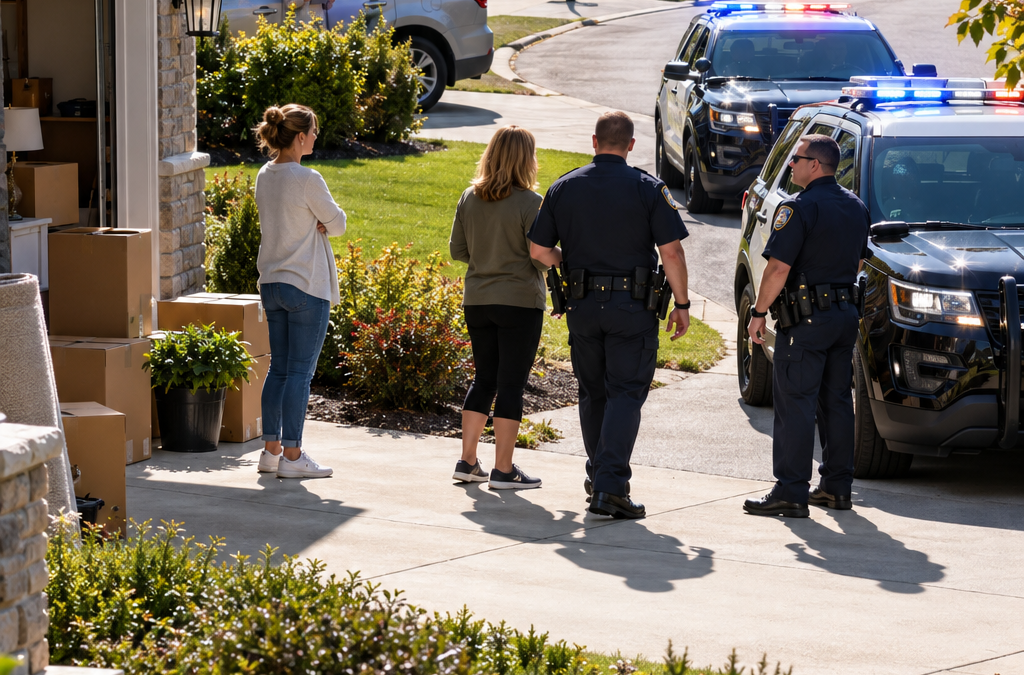
𝗙𝗨𝗟𝗟 𝗦𝗧𝗢𝗥𝗬
Her tone wasn’t unfriendly exactly.
But it wasn’t welcoming either.
It sounded more like verification.
“That’s us,” I said.
“I’m Danny. This is my wife, Renata.”
The woman barely acknowledged my introduction.
“I’m Diane Mercer.”
She paused as if the name should mean something.
When neither of us reacted, she added, “HOA president.”
“Oh.”
That was apparently not enough enthusiasm.
Diane shifted the clipboard higher.
“I like to personally introduce myself to new residents.”
“Nice to meet you,” Renata said.
Diane looked past her at the porch.
We had set two terracotta pots beside the front steps. One contained basil. The other contained mint.
They were small.
Ordinary.
The kind of thing no reasonable human being would notice unless they were actively searching for something to criticize.
Diane noticed immediately.
Her pen touched the clipboard.
“Those permanent?”
Renata looked at the pots.
“The herbs?”
“Exterior decorative containers.”
“They’re flower pots.”
“Plant containers,” Diane corrected. “Our architectural standards cover exterior presentation.”
I thought she was joking.
She wasn’t.
“They’re basil and mint,” I said.
Diane gave me a tight smile.
“Just so you’re aware, we maintain standards here.”
There was something about the way she said standards.
Not rules.
Standards.
Like we had arrived from a place where people routinely parked livestock in their living rooms.
Renata glanced at me.
I knew that expression.
She was amused.
Diane continued.
“You’ll receive a community handbook. Trash placement, vehicles, lawn maintenance, decorative items, seasonal displays, hose storage, guest parking. Nothing complicated if everyone cooperates.”
“We’ll read it,” Renata said.
“Good.”
Diane tapped the clipboard.
“You’ll probably see this again.”
She actually said that.
Then she smiled.
Not warmly.
More like a promise.
When she walked away, I watched her return to the silver SUV.
“Interesting woman,” I said.
Renata picked up another box.
“That’s one word.”
“I think she just threatened us with office supplies.”
That made Renata laugh.
At the time, it was funny.
Three days later, the first violation notice appeared on our front door.
It had been taped exactly at eye level.
Not slipped discreetly under the mat.
Not mailed.
Not placed inside an envelope.
Taped to the center of the door where anyone walking past our house could read the bold red heading:
NOTICE OF NONCOMPLIANCE.
I stared at it for several seconds before pulling it down.
Renata was unpacking dishes in the kitchen.
“You need to see this.”
She took the page.
Read it once.
Then again.
Then she looked toward the front porch.
“Unauthorized exterior plant placement.”
“Apparently.”
“Two pots.”
“Apparently.”
She read farther.
“Architectural harmony.”
I leaned against the counter.
“I didn’t realize basil was capable of destroying architectural harmony.”
That got one laugh from her.
A short one.
She walked to the refrigerator, found a magnet, and stuck the notice beside our grocery list.
“Souvenir,” she said.
That should have been the end of it.
Any normal HOA president might have mentioned the rule, asked us to move the pots, and gone on with her life.
Diane wasn’t interested in solving problems.
I eventually understood that.
She was interested in establishing hierarchy.
The violation wasn’t about terracotta.
It was about whether we obeyed when she pointed at something.
A week later, a letter arrived.
This one looked official enough to belong in a courthouse.
HOA letterhead.
Reference numbers.
Bold headings.
Threats of escalating penalties.
The original flower pots had somehow become a $200 fine.
Then I saw another line.
VISIBLE GARDEN HOSE: PENDING VIOLATION — $100.
I stared through the kitchen window.
Our green garden hose was coiled beside the outdoor faucet.
Not across the driveway.
Not blocking anything.
Coiled.
Against our own house.
Renata came in from work while I was still holding the letter.
She took off her jacket, set her bag on the counter, and saw my face.
“What?”
I handed her the notice.
She read it slowly.
I could almost watch her work-brain switch on.
“Did we get the handbook?”
“Yesterday.”
“Bring it.”
I found the binder.
She sat at the kitchen table and began turning pages.
Landscaping.
Vehicles.
Garbage containers.
Architectural modifications.
Fences.
Roofing.
Satellite equipment.
Holiday decorations.
She went through the entire thing.
Then she went through it again.
“There is nothing about garden hoses,” she said.
“I know.”
“And the language about planters only applies to permanent structures attached to the exterior.”
“I know.”
She looked at me.
“So this is nonsense.”
“That’s what I was thinking.”
The doorbell rang.
We both looked toward the hallway.
I already knew.
Diane stood outside.
Clipboard in hand.
Visor on.
At seven fifteen in the evening.
Renata opened the door but didn’t invite her inside.
“Evening.”
Diane smiled.
“I’m following up on your compliance notice.”
“We received it.”
“I noticed the containers were still outside this morning.”
“They’re inside now,” Renata said.
Diane leaned slightly, trying to look past her.
“And the hose?”
“What about it?”
“Visible from the street.”
“Show me the rule.”
The smile disappeared.
“Excuse me?”
“The rule prohibiting a visible garden hose.”
Diane tapped the clipboard.
“It’s covered under community appearance standards.”
“Which section?”
“Exterior maintenance.”
“Which section?”
Diane’s jaw tightened.
“Residents are expected to cooperate instead of looking for technical loopholes.”
Renata stayed perfectly calm.
“I’m not looking for a loophole. I’m asking you to identify the rule you’re fining us under.”
Diane’s voice sharpened.
“Rules apply to everyone equally.”
“Then identifying the rule should be easy.”
I had to look away because I almost smiled.
Diane noticed.
Her face hardened.
“The fine remains.”
She turned toward me.
“And future noncompliance may result in additional penalties.”
Renata rested one hand against the doorframe.
“Good night, Diane.”
“Rules apply to everyone equally,” Diane repeated.
Renata closed the door.
For several seconds neither of us spoke.
Then I said, “She likes that sentence.”
Renata went back to the kitchen.
“People repeat slogans when specifics are inconvenient.”
I looked at the $200 notice.
“Do we fight it?”
She considered the question.
Then shook her head.
“No.”
“Seriously?”
“We just moved in.”
“She’s making things up.”
“I know.”
“That’s exactly why we should push back.”
Renata exhaled.
“Or we pay two hundred dollars, put the pots inside, roll the hose into the garage, and find out whether she’s annoying or dangerous.”
I stared at her.
“Dangerous?”
“Not physically.”
She paused.
“Probably.”
“That’s comforting.”
She almost smiled.
“Pick your battles, Danny. This isn’t one yet.”
So we paid.
I hated doing it.
Not because of the money.
Because Diane learned the wrong lesson.
She learned that pressure worked.
Within two weeks, her silver SUV became part of our morning routine.
I would make coffee at six thirty and see it parked near the curb.
Some mornings she sat inside.
Other mornings it was empty.
But always positioned where she could see our driveway.
Once I stepped outside carrying trash and found Diane standing near our mailbox writing on the clipboard.
“Morning,” I said.
She looked up.
“Your bin was curbside thirty-two minutes beyond the collection window.”
I thought I had misheard her.
“Thirty-two minutes?”
“Collection concluded at one twenty-eight.”
“I got home at two.”
“Bins should be retrieved promptly.”
“I was at work.”
“So is everyone else.”
She made another mark.
“Are you timing people?”
Diane stared at me over her sunglasses.
“I’m maintaining standards.”
That sentence started to make my teeth hurt.
Our neighbors noticed too.
At first nobody said much.
People would wave and disappear into garages.
Then small comments started slipping out.
A man named Curtis who lived three houses down caught me getting the mail one afternoon.
“She get you yet?”
I knew instantly who he meant.
“The pots.”
He laughed without humor.
“Mine was a basketball hoop.”
“What’s wrong with your basketball hoop?”
“Nothing.”
He shrugged.
“My kid left it facing the street.”
“What?”
“Apparently it was supposed to face sideways.”
“Is that actually a rule?”
Curtis looked toward Diane’s house before answering.
“With her, does it matter?”
That bothered me more than the fine.
Not what Diane was doing.
What everyone had learned to do around her.
Lower their voices.
Check whether she was nearby.
Move things before she complained.
Avoid giving her reasons.
A grown neighborhood behaving like students when the strictest teacher walked into the room.
Then came the car.
Renata’s work sedan was intentionally plain.
Dark gray.
Government fleet registration.
Nothing printed on the doors.
No agency seal.
No obvious emergency lights.
To anyone who didn’t know what they were looking at, it was just another boring sedan.
One Saturday afternoon, Renata was unloading groceries when Diane crossed the street.
Clipboard.
Visor.
Purposeful march.
“Ma’am.”
Renata kept lifting grocery bags.
“Afternoon, Diane.”
“We need to discuss your vehicle registration.”
Renata stopped.
“Which vehicle?”
“The sedan.”
“What about it?”
“No visible HOA parking sticker.”
“It doesn’t require one.”
Diane looked offended by the confidence in her answer.
“All resident vehicles require registration.”
“Not that one.”
“Section four.”
Renata tilted her head.
“Section four of what?”
“The parking regulations.”
“There is no section four.”
Diane froze.
Just for a fraction of a second.
But we both saw it.
Renata had read the handbook closely enough to know.
The parking article had three sections.
Not four.
Diane looked down at her clipboard as though the missing regulation might materialize if she stared hard enough.
Then she said something I will never forget.
“There will be.”
Renata went completely still.
Not angry.
Still.
That was worse.
I was standing near the garage holding a bag of oranges.
“Did you just say there will be?”
Diane turned toward me.
“HOA rules are amended as needed.”
“After a vote,” Renata said.
“We’ll see.”
Diane wrote something down.
Then she walked away.
I watched her cross the street.
“That felt like a threat.”
Renata took the grocery bag from my hand.
“It was.”
“So now?”
“Now we document.”
Her voice had changed.
Barely.
But I heard it.
The situation had just crossed some invisible line for her.
That evening she created a folder.
Not dramatic.
Not secretive.
Just organized.
Every notice.
Every envelope.
Every date.
Every photograph.
She saved screenshots from the HOA portal.
Downloaded the bylaws.
Printed the current county filing showing the board’s registered officers.
I noticed her reading one page longer than the others.
“What?”
“Nothing yet.”
“That’s not an answer.”
She turned the page around.
Diane’s name appeared in an older filing.
Her term expiration date was eight months earlier.
“She’s not president?”
“According to this, her term ended.”
“Maybe they forgot to update it.”
“Maybe.”
“You don’t believe that.”
“I believe documents before people.”
That was Renata.
She wouldn’t jump from suspicion to accusation.
She collected facts.
Two nights later, somebody slashed our garden hose.
Not once.
Three times.
Clean cuts.
One near the nozzle.
One halfway along.
One near the spigot.
I found it after dinner when I went outside to water a planter we’d moved into the backyard.
“Renata.”
She came outside.
I held up the severed hose.
Neither of us spoke.
Then she noticed the porch light.
The glass cover had been cracked.
The bulb inside shattered.
A small pile of glass lay beneath it.
My stomach tightened.
“This isn’t HOA nonsense anymore.”
“No,” she said.
Across the street, Diane’s house was dark.
Her silver SUV wasn’t in the driveway.
Then I noticed it.
One house down.
Parked along the curb.
Engine off.
Metal ticking softly as it cooled.
Renata followed my eyes.
“Don’t touch anything else.”
She took out her phone.
Photographed the hose.
The cuts.
The fixture.
The broken glass.
The curb.
The SUV.
Then she checked the time.
“What are you doing?”
“Documenting.”
She made a call.
Her tone changed the moment the other person answered.
“Hey. It’s Renata.”
Pause.
“I need a favor.”
Another pause.
“No, not work-related.”
She looked toward the neighboring houses.
“Possibly doorbell footage. Between eight forty and nine fifteen.”
I waited until she hung up.
“Who was that?”
“Someone who owed me one.”
“That clears everything up.”
“It should.”
“It really doesn’t.”
She touched my arm.
“Let’s not accuse anyone until we know.”
I wanted to accuse Diane.
I wanted to walk across the street, knock on her door, and ask why her SUV had been near our house immediately after our property was damaged.
But Renata knew me well enough to see exactly what I was thinking.
“No.”
“I didn’t say anything.”
“You didn’t have to.”
“She has been watching us for weeks.”
“I know.”
“She invents rules.”
“I know.”
“Now our stuff gets destroyed while her car is sitting thirty yards away.”
“I know.”
“And we’re doing what?”
“Making sure that when we speak, nobody can call it speculation.”
I hated how reasonable that was.
The next morning, I drove to work with that anger sitting under my ribs.
For the first time since moving in, our house didn’t feel completely like ours.
That was the part people underestimate about harassment.
It isn’t always the big thing.
It’s accumulation.
The car outside.
The note on the door.
The footsteps across your lawn.
The sense that somebody is keeping count.
You begin checking through windows before going outside.
You start wondering whether the mailbox moved because the wind caught it or because somebody touched it.
You hear a car slow down and look toward the blinds.
You become alert in a place you paid for specifically because you wanted to relax.
And Diane seemed to enjoy that.
Three days after the hose was cut, another letter arrived.
This one accused us of “hostile conduct toward HOA leadership.”
There had been no hostile conduct.
Renata read the letter at the kitchen table.
“What exactly did we do?”
I asked.
She pointed to a paragraph.
“Apparently questioning the legitimacy of a vehicle regulation constitutes intimidation.”
“You’re kidding.”
“No.”
“Can she fine us for asking questions now?”
“She can print whatever she wants.”
“That’s not what I asked.”
Renata folded the letter.
“No. She can’t.”
Something about the way she said it made me feel better.
Until Tuesday afternoon.
I got home early.
Two police cruisers were turning into Larksburg Court.
No sirens.
Lights flashing.
Slow.
Controlled.
Every curtain in the cul-de-sac suddenly became occupied.
I parked behind the second cruiser and got out.
Diane was already standing in the street.
Clipboard raised.
Visor on.
She looked energized.
Vindicated.
Like she had finally summoned people whose uniforms could transform her imaginary authority into something real.
Renata stood near our driveway.
Still in work clothes.
Calm.
Too calm.
I knew that calm.
It meant she was furious.
Diane pointed as the officers approached.
“These are the residents I called about.”
The older officer nodded.
“What seems to be the issue?”
“Repeated noncompliance,” Diane said. “Unregistered vehicle. Unpaid assessments. Intimidation of board leadership.”
We had paid every legitimate assessment.
And the only vehicle she questioned was exempt from her made-up sticker requirement.
The younger officer looked from Diane to Renata.
“This is a civil HOA issue?”
“It has escalated,” Diane said.
“How?”
Diane hesitated.
Then she did something that changed everything.
She lied.
“Last week they threatened me.”
I felt the words physically.
Like something dropped inside my chest.
“What?”
Diane ignored me.
“I have documentation.”
She lifted the clipboard.
Renata spoke.
“Diane.”
Her voice was quiet.
“Be very careful.”
Diane pointed at her.
“That. That’s exactly the tone I’m talking about.”
The younger officer turned to Renata.
“Ma’am, can I see some identification?”
Diane’s mouth tightened into something almost satisfied.
She thought the moment had arrived.
The troublesome new residents were finally being corrected by real authority.
Renata didn’t argue.
She didn’t announce who she was.
She didn’t raise her voice.
She reached into her handbag and removed her wallet.
Then she handed the officer her federal identification.
His eyes dropped to it.
His entire posture changed.
Not dramatically.
Professionally.
His shoulders straightened.
His expression sharpened.
He looked at Renata again.
“You’re with—”
He stopped himself before naming the agency.
A second later he gave the ID back.
“Understood, ma’am.”
Then, more quietly, “Sorry for the confusion.”
Diane’s clipboard lowered about an inch.
Her sunglasses came off.
For the first time since I had met her, she looked uncertain.
“What is that?”
Renata slipped the ID back into her wallet.
“My identification.”
“I can see that. Identification for what?”
Renata looked directly at her.
“The kind that means if I file a formal harassment complaint supported by documented false statements and property damage, people actually review the evidence.”
Diane’s face changed.
Only slightly.
But enough.
“Are you threatening me?”
“No.”
Renata’s voice stayed level.
“I’m explaining the difference between a threat and a process.”
The older officer stepped in.
“Let’s slow this down.”
Diane turned toward him.
“I called you because these people have been violating neighborhood regulations for months.”
“HOA violations aren’t generally a police matter.”
“They threatened me.”
“No,” I said. “We didn’t.”
The officer looked at me.
“Sir, let her answer.”
Renata touched my arm.
It wasn’t a warning.
It was reassurance.
She had this.
“Diane,” the officer said, “when exactly were you threatened?”
“Last week.”
“What day?”
She looked at the clipboard.
“Thursday.”
Renata spoke.
“I wasn’t home Thursday evening.”
Diane blinked.
“Then Wednesday.”
The younger officer’s expression changed.
“Which is it?”
“I’d have to check.”
Renata reached into her bag again.
This time she pulled out a thin folder.
“She’s been issuing written notices under rules that do not appear in the recorded HOA bylaws. She has repeatedly approached our property after being asked to identify those rules. Two nights after we challenged one of those notices, our garden hose was deliberately cut and our porch light was broken.”
Diane threw up one hand.
“That has nothing to do with me.”
Renata nodded.
“I didn’t say it did.”
That answer hurt Diane more than an accusation would have.
Because Renata wasn’t emotional.
She wasn’t guessing.
She was building a timeline.
The younger officer walked toward the side of our porch.
Renata showed him the photographs.
He inspected the damaged light.
Then the hose.
“Still have the damaged sections?”
“In the garage,” I said.
“Don’t throw them away.”
Diane stepped forward.
“This is absurd.”
The older officer held up one hand.
“Ma’am.”
“I called you.”
“Yes.”
“And you’re investigating their hose?”
“We’re trying to understand why we’re here.”
“Because they are noncompliant residents.”
“That’s not a criminal offense.”
Diane’s face reddened.
“I’m president of the homeowners association.”
From two houses down, a voice said quietly:
“No, you’re not.”
Everyone turned.
Curtis stood near his driveway.
His wife was beside him.
Then another neighbor came outside.
Then another.
The strange thing about bullies is how powerful they can seem when everyone deals with them alone.
A private warning here.
A fine there.
A threatening letter delivered to one house at a time.
But the moment people realize their private problem is shared, fear changes shape.
Diane saw that happening.
“Everyone please go back inside,” she said sharply.
Nobody moved.
The older officer looked almost confused.
“Do you have authority to order people inside their homes?”
Diane opened her mouth.
Closed it.
Curtis crossed his arms.
“She fined me four hundred dollars last year for a basketball hoop.”
A woman near the corner spoke next.
“She threatened a lien over my daughter’s graduation decorations.”
Another neighbor called from a porch.
“She made me remove my bird feeder.”
Diane spun slowly toward them.
“Those were valid violations.”
Renata looked at the officers.
“This is why I started documenting.”
The younger officer checked his phone.
Then looked at Renata.
“The video?”
She nodded.
“I have it.”
Diane went still.
“What video?”
Renata looked at her for a long second.
“A neighbor’s doorbell camera recorded activity near our property the night the hose was damaged.”
For the first time, Diane looked scared.
Not annoyed.
Not offended.
Scared.
The younger officer watched the footage.
I couldn’t see the screen from where I stood.
His expression gave nothing away.
Then he showed it to the older officer.
Diane tried to step closer.
“Let me see that.”
“No, ma’am.”
“What does it show?”
Neither officer answered immediately.
I looked at Renata.
“Did you see it already?”
“Yes.”
“Why didn’t you tell me?”
“Because I wanted the original preserved before anyone knew it existed.”
Diane’s voice rose.
“That video doesn’t prove anything.”
Nobody had told her what was on it.
The older officer looked up.
“What do you think it shows?”
Silence.
You could almost hear the neighborhood thinking.
Diane realized her mistake.
“I don’t know. I’m saying whatever it shows could be misleading.”
The younger officer walked toward the curb where Diane’s SUV had been parked the night of the damage.
He studied the angle.
Then the camera location.
Then our porch.
Diane’s hands tightened around the clipboard.
And that was when her husband came outside.
His name was Mark.
I had seen him maybe five times.
Quiet man.
Usually working in his garage.
He crossed their driveway slowly.
No shoes.
Gray T-shirt.
Face pale.
“Diane.”
She turned.
“Go inside.”
He stopped.
“I told you.”
Her expression changed instantly.
“Mark.”
“I told you to stop.”
She took a step toward him.
“Go back inside.”
The older officer looked between them.
“Sir, is there something we should know?”
Diane’s voice sharpened.
“No.”
Mark looked at her.
Then at the officer.
Then at Renata.
His hands were shaking.
“She wrote half those notices herself.”
Diane’s face drained.
“Shut up.”
The entire street went silent.
Mark swallowed.
“The board never approved them.”
“Mark.”
“I told her to stop months ago.”
Diane moved toward him.
“You don’t know what you’re talking about.”
He actually laughed.
But there was no humor in it.
“I printed some of them for you.”
The clipboard slipped lower.
Not out of her hand.
But close.
“Sir,” the officer said, “what exactly are you saying?”
Mark rubbed both hands over his face.
“Her term ended last year.”
Diane snapped, “It was a procedural delay.”
“No.”
Mark looked exhausted.
“The board wouldn’t reelect her.”
Several neighbors reacted at once.
Whispers.
Questions.
A stunned laugh from somewhere behind me.
Mark continued.
“She kept the old letterhead. The password to the old email account. Some blank notice forms.”
Diane stepped toward him.
“You have no right.”
“No right?”
His voice cracked.
“I’ve been begging you to stop terrorizing these people.”
“Everything I did was for this neighborhood.”
Curtis laughed openly now.
“You fined my ten-year-old over a basketball hoop.”
“Because rules matter.”
“What rules?”
That question came from Renata.
Not loud.
But it cut through everything.
Diane turned toward her.
Renata held the official handbook in one hand.
“What rules, Diane?”
“The community standards.”
“Show us.”
“I don’t have to justify—”
“Yes, you do.”
It was the first time Renata raised her voice.
Not much.
But enough.
She stepped forward.
“For six months, you’ve put notices on our door where our neighbors could read them. You’ve photographed our property. You’ve monitored our driveway. You attempted to regulate a vehicle you had no authority over. You cited a section that does not exist. You accused us of threatening you after we asked you to identify the rule you were supposedly enforcing.”
Diane’s lips parted.
Nothing came out.
Renata continued.
“You charged us money under authority you did not have.”
“I was acting on behalf of the association.”
“The association didn’t authorize it.”
“You don’t understand how this community works.”
“No.”
Renata shook her head.
“I understand exactly how you made it work.”
That landed.
Not just on Diane.
On everyone.
Because suddenly the whole pattern was visible.
Diane didn’t have power because the bylaws gave it to her.
She had power because people believed resisting her would cost more than obeying.
A hundred dollars here.
Four hundred there.
A threat of a lien.
A nasty letter.
A humiliating notice taped to the front door.
A silver SUV idling outside.
She had created authority out of persistence.
And we had all helped her by assuming somebody somewhere must have approved it.
The police didn’t arrest Diane that afternoon.
Not immediately.
Real investigations aren’t television.
Evidence gets collected.
Statements get taken.
Documents get reviewed.
But once the first thread came loose, the rest unraveled quickly.
Renata filed a formal harassment complaint.
Not because she wanted revenge.
Because by then it was obvious we weren’t the only ones affected.
The legitimate HOA board held an emergency meeting three days later.
For the first time since we moved in, nearly every household attended.
People brought folders.
Receipts.
Photographs.
Emails.
Violation letters.
Old payment confirmations.
Diane did not attend.
Mark did.
He sat in the back row looking like he hadn’t slept.
The acting board treasurer stood at the front of the clubhouse holding a stack of papers.
“I need to make something very clear,” she said. “A large number of enforcement notices issued during the last eight months were not approved by this board.”
Someone yelled, “How many?”
She looked down.
“We’re still counting.”
The room erupted.
I had never heard so much anger in one place.
People weren’t screaming because of money.
Not really.
They were angry because they had been made to feel small in their own homes.
A retired teacher named Evelyn stood up with tears in her eyes.
“She threatened to put a lien on my house over wind chimes.”
Nobody laughed.
That was what struck me.
Six months earlier, wind chimes would have sounded ridiculous.
Now nobody laughed.
Another resident raised his hand.
“She charged me six hundred dollars because my nephew parked overnight.”
A woman across the aisle said, “She made my mother move her wheelchair ramp decorations.”
Someone else said, “She photographed my backyard over the fence.”
Another voice:
“She told my daughter she couldn’t chalk on our driveway.”
Every story had sounded isolated when it happened.
Together they were a campaign.
The board hired outside counsel.
Then contacted the county office responsible for HOA filings and consumer complaints.
Renata provided copies of everything we had received.
The nonexistent section four.
The planters.
The garden hose notice.
The hostile-conduct accusation.
The timing of the property damage.
The doorbell footage.
The older HOA records showing Diane’s term had expired.
Mark turned over boxes from their home office.
That was where they found the old letterhead.
Blank notices.
Draft fines.
Lists of properties.
Some with handwritten comments.
“Uncooperative.”
“Watch.”
“Repeat offender.”
Our address appeared beside one word.
“Problem.”
I stared at it for a long time.
Problem.
We had lived there six months.
Paid every legitimate fee.
Kept the lawn cut.
Put the trash away.
Waved to neighbors.
The only thing we had done wrong was ask her to identify the rules she claimed gave her authority over us.
That made us a problem.
I took the page home and left it on the kitchen counter.
Renata found me staring at it.
“You okay?”
“I don’t know.”
I tapped the word.
“This bothers me more than it should.”
She sat across from me.
“Why?”
“Because we tried so hard not to be difficult.”
“You weren’t.”
“We paid that stupid first fine.”
“I know.”
“We moved the pots.”
“I know.”
“We hid the hose.”
“Danny.”
“We did everything she wanted because we thought if we were reasonable she’d leave us alone.”
Renata was quiet.
I looked toward the front windows.
For months, Diane’s SUV had been part of that view.
Now her driveway was empty.
“Maybe we taught her she could keep going.”
Renata shook her head.
“No.”
“We made it easier.”
“That’s different.”
“It doesn’t feel different.”
She reached across the table.
“Most people don’t wake up expecting a neighbor to manufacture authority and use it against them. You gave her the benefit of the doubt.”
“And she used it.”
“Yes.”
That was the hardest part for Renata.
Not admitting Diane had lied.
Admitting that sometimes restraint doesn’t calm unreasonable people.
Sometimes they interpret it as permission.
Within a week, local reporters heard about the investigation.
I hated that part.
A van parked near the entrance.
A camera crew interviewed residents.
The story ran that evening under a headline about a former HOA president accused of conducting a fake enforcement campaign.
For years, Diane had apparently told people she was protecting property values.
Now television cameras were filming outside her house.
I expected to feel satisfied.
I didn’t.
Neither did Renata.
There was something ugly about watching a person’s life collapse, even when that collapse began with choices they had repeatedly made themselves.
But consequences kept coming.
Investigators concluded the damage to our property was connected to Diane’s harassment campaign.
The doorbell footage had captured enough to establish a timeline and support further investigation.
She was charged with criminal mischief related to the property damage and faced additional allegations tied to misrepresenting her authority and issuing unauthorized enforcement documents.
The exact legal language changed as lawyers and investigators sorted through the case.
What didn’t change was the central fact:
Diane had not been the HOA president when she terrorized us.
She had simply acted like she was.
And almost everyone believed her.
The legitimate board voided every unauthorized fine it could identify.
Nearly fourteen thousand dollars in charges across the neighborhood were reversed or refunded.
Our $200 came back too.
The check arrived in a plain envelope.
I held it up when Renata got home.
“Justice.”
She looked at the amount.
“Expensive basil.”
“Very.”
She put the check on the counter.
“Buy new pots.”
“I thought you’d never ask.”
The board itself dissolved and reorganized under new leadership.
That sounds dramatic, but the old members believed trust had been damaged too badly to continue as if nothing had happened.
New elections were scheduled.
Meeting minutes were posted publicly.
Every enforcement action now required documented authorization.
No single board member could issue fines independently.
Several neighbors pushed for an appeal process.
Others demanded clearer language around landscaping, parking, and minor exterior items.
For the first time, people actually read the bylaws.
It turned out they were far less oppressive than Diane had convinced everyone they were.
Most of the neighborhood rules were ordinary.
Maintain the property.
Don’t block sidewalks.
Don’t leave garbage containers at the curb for days.
Get approval before building major structures.
Nothing about basil.
Nothing about mint.
Nothing about basketball hoops facing the wrong direction.
Nothing about garden hoses being visible in daylight.
And absolutely nothing about Diane driving slowly past houses with a clipboard.
Her marriage did not survive the fallout.
Mark filed for divorce two weeks after the investigation became public.
People whispered about it.
I tried not to.
Whatever happened inside their marriage was theirs.
But I did remember him standing barefoot in the driveway, hands shaking, finally saying out loud what he had apparently been trying to tell her privately for months.
Stop.
Sometimes one word arrives too late.
I saw Diane only once after that.
It was about three weeks after the emergency meeting.
I was getting the mail.
She came out of her house carrying a box.
No visor.
No clipboard.
I almost didn’t recognize her.
We stood maybe forty feet apart.
She looked at me.
I looked at her.
For a moment I thought she might say something.
Apologize.
Accuse.
Explain.
Anything.
Instead she got into a car and left.
I felt no victory.
That surprised me.
For months I had imagined what it would be like if Diane finally lost the authority she had used against us.
I thought I would feel relief mixed with satisfaction.
Instead I mostly felt tired.
Because the real damage hadn’t been a hose or a porch light or two hundred dollars.
It was what she had done to the atmosphere of the place.
Neighbors had stopped trusting knocks on their doors.
People had hidden harmless things because they were afraid of being fined.
Families had argued over whether decorations were worth attracting attention.
People had paid money they didn’t owe because challenging Diane felt exhausting.
She had converted ordinary neighborliness into caution.
And rebuilding that took longer than removing her.
But it did happen.
Slowly.
Curtis turned his basketball hoop back toward the street.
His son started playing after school.
The sound of the ball hitting pavement became part of the neighborhood again.
Evelyn put her wind chimes back up.
Nobody complained.
The woman near the corner decorated her porch for her daughter’s birthday with enough ribbons and balloons to be visible from space.
People laughed.
For the first time, laughter didn’t feel like something done quietly behind closed doors.
A month later, the new board held a neighborhood picnic.
No speeches.
No enforcement reminders.
No clipboards.
Just folding tables, burgers, paper plates, kids running through sprinklers, and neighbors finally learning one another’s names.
I was standing near the grill when Curtis handed me a drink.
“You know what’s crazy?”
“What?”
“I’ve lived here nine years.”
He nodded toward a man talking to Renata.
“That’s Mike. He lives four houses from me. I learned his last name today.”
I smiled.
“What did you call him before?”
“Guy with the blue truck.”
“Efficient.”
Curtis laughed.
Then his expression softened.
“Your wife really changed things.”
I looked toward Renata.
She was listening to Evelyn tell some long story, coffee cup in one hand.
“No.”
Curtis raised an eyebrow.
“No?”
“She helped make people stop pretending nothing was happening.”
“Same difference.”
“It isn’t.”
That mattered to me.
Because Renata never wanted to be the hero of anybody’s neighborhood war.
She had spent her career around systems, investigations, evidence, and authority.
She understood something Diane never did.
Real authority comes with limits.
Documentation.
Oversight.
Responsibility.
You don’t become powerful because you carry a clipboard.
You don’t become right because people are afraid to argue.
And you don’t get to create rules simply because nobody has challenged you yet.
One Sunday morning, I woke before Renata.
The house was quiet.
I made coffee and stepped onto the porch.
The two terracotta pots were back.
Basil on the left.
Mint on the right.
I had bought replacements even though technically the original pots had never been damaged.
I wanted new ones.
Fresh start.
A few minutes later Renata came outside wearing sweatpants, carrying her coffee.
She sat beside me.
For a while we watched sunlight move across the cul-de-sac.
No silver SUV.
No clipboard.
No one taking photographs.
Just sprinklers ticking softly somewhere down the street.
A dog barking behind a fence.
A garage door opening.
Normal sounds.
“You could have shown them your ID on the first day,” I said.
Renata took a sip.
“I know.”
“Diane would’ve probably backed off.”
“Maybe.”
“You never thought about it?”
“Of course I did.”
“Then why didn’t you?”
She stared out at the street for several seconds before answering.
“Because I didn’t want to win because of my badge.”
I turned toward her.
She continued.
“If I’d shown it to her the first time she bothered us, she might have left us alone.”
“Exactly.”
“And then she would’ve gone after Curtis.”
I said nothing.
“Or Evelyn. Or the family on the corner. Or somebody who didn’t have an ID that made a police officer straighten his posture.”
That hit me harder than I expected.
Renata looked down at her coffee.
“A badge shouldn’t be the reason someone gets treated fairly.”
“No.”
“It should be the paperwork. The rules. The evidence. The same process everyone gets.”
“So you waited.”
“I documented.”
“You waited too.”
She gave me a look.
“Fine. I waited.”
“Why?”
Her expression changed.
The toughness dropped.
What remained was something sadder.
“Because I kept hoping she would stop before it became something bigger.”
There it was.
The part Renata rarely admitted.
She had wanted peace too.
She didn’t enjoy investigations.
She didn’t enjoy watching police question our neighbor.
She didn’t enjoy reporters showing up or marriages breaking apart or people crying at HOA meetings.
She hadn’t been waiting for the perfect moment to destroy Diane.
She had been waiting for Diane to choose not to destroy herself.
“Do you feel bad for her?” I asked.
Renata thought about it.
“A little.”
That surprised me.
“Seriously?”
“Feeling bad for someone doesn’t mean excusing them.”
“No.”
“She could’ve stopped at any point.”
“The pots.”
“The hose.”
“The fake parking rule.”
“The police.”
Renata nodded.
“Any point.”
I leaned back in my chair.
“What do you think she actually wanted?”
“Control.”
“That’s it?”
“Control is rarely ‘it.'”
I waited.
Renata looked toward Diane’s empty driveway.
“Some people need to feel important. Some people are terrified of being ignored. Some people convince themselves that keeping everyone else in line gives their life structure.”
“And some people are just jerks.”
She smiled.
“That too.”
We sat quietly.
Then I noticed something near the entrance to the cul-de-sac.
A small wooden sign had appeared sometime overnight.
Hand-painted.
Nothing fancy.
Just a white board with dark letters.
LARKSBURG COURT
GOOD NEIGHBORS. NO CLIPBOARDS.
I laughed so hard coffee nearly came out of my nose.
Renata leaned forward.
“Oh no.”
“You see it?”
“Who did that?”
“Curtis.”
“You don’t know that.”
“That’s absolutely Curtis.”
Later that afternoon he denied everything while smiling like a guilty child.
The sign stayed.
Technically, according to the bylaws, somebody probably should have requested approval before installing it.
Nobody complained.
Our basil grew.
The mint grew faster.
By summer, the mint had nearly taken over its pot.
Sometimes when I watered it, I thought about that first notice taped to our door.
Unauthorized exterior plant placement.
It seemed ridiculous now.
Almost funny.
But I don’t laugh at it the same way anymore.
Because the flower pots were never really the problem.
They were a test.
A small demand designed to answer a larger question:
Will you obey me simply because I told you I have authority?
We did.
At first.
Not because we were weak.
Because we were reasonable.
Because most of us move through life assuming other people are operating in reasonably good faith.
We assume the person issuing the fine has the authority to issue it.
We assume the rule printed on official letterhead probably exists.
We assume the neighbor claiming to represent an organization has actually been authorized by that organization.
Civil society depends on some amount of that trust.
People like Diane exploit it.
They discover that if they speak confidently enough, print professional-looking documents, repeat the same phrases, and punish anyone who questions them, most people will eventually decide that resistance isn’t worth the trouble.
Rules apply to everyone equally.
That had been Diane’s favorite sentence.
She repeated it every time someone questioned her.
The irony is that she was right.
Just not in the way she intended.
Rules do apply to everyone.
Including the person holding the clipboard.
Including the person issuing the fine.
Including the person claiming authority.
Especially them.
I learned something else too.
You don’t always recognize the moment a boundary matters.
Sometimes it looks too small.
A flower pot.
A garden hose.
A parking sticker.
Two hundred dollars.
You tell yourself it isn’t worth the argument.
Maybe sometimes it isn’t.
You can’t fight every irritation.
You can’t treat every unreasonable person like a constitutional crisis.
Life would be unbearable.
But there is a difference between inconvenience and coercion.
I understand that difference better now.
An inconvenience asks you to adjust.
Coercion punishes you for asking why.
That was Diane’s mistake.
If she had simply been annoying, we probably would have tolerated her forever.
If she had been strict but legitimate, people would have complained and complied.
But she could not tolerate questions.
The moment Renata asked her to identify the rule, Diane stopped pretending her goal was neighborhood order.
From then on, the goal was submission.
The missing section four.
The surveillance.
The false accusation.
The police.
Each escalation happened because the last one failed to make us stop asking.
And that was why the ending could never have been avoided by obeying more.
We tried that.
We paid.
We moved the pots.
We hid the hose.
We stayed polite.
It only taught her to move the line.
For months after everything ended, people occasionally asked me whether Renata had planned the whole thing.
They imagined her sitting quietly, secretly waiting to spring some federal trap.
The truth was much less dramatic.
She wanted to live in her house.
That’s all.
She wanted to come home from work, take off her shoes, make dinner, sit on our porch, grow basil, and not spend her evening reading fabricated HOA regulations.
She never wanted Diane arrested.
Never wanted television cameras.
Never wanted the whole neighborhood choosing sides.
What Renata wanted was boring.
And I think that is what makes the entire thing sad.
Diane could have had the same thing.
A quiet street.
Neighbors who waved.
A decent home.
Morning coffee.
Normal disagreements.
Instead she needed everybody to know who was in charge.
Eventually that need cost her the very thing she was trying so desperately to protect.
Her status.
Her reputation.
Her authority.
And, in ways none of us celebrated, much more than that.
Our life went back to normal.
Not immediately.
But enough.
Six months after the police came, Renata and I celebrated one year in the house.
We didn’t throw a party.
We ordered takeout and sat on the porch.
The basil smelled sharp in the evening air.
The mint had become completely unreasonable and probably deserved its own violation notice.
Kids were playing basketball down the street.
Somebody had music on.
Curtis walked past with his dog.
He looked at the pots.
“Those approved?”
I stared at him.
He lifted both hands.
“Just asking.”
Renata laughed.
A real laugh this time.
Not the short amused sound she’d made when the first notice appeared.
Not the tired laugh of someone watching nonsense become dangerous.
Just laughter.
When Curtis disappeared around the corner, Renata rested her head against my shoulder.
“You happy here?” I asked.
She took her time answering.
“Now?”
“Yeah.”
She looked across the street at the house that had once belonged to Diane and Mark.
New people lived there.
A young couple.
They had a stroller in the driveway and three completely unauthorized-looking flower pots near their garage.
Renata smiled.
“Yeah.”
I looked down at our own pots.
Two little terracotta containers.
Basil.
Mint.
The things that started everything.
For months I had thought the lesson of what happened was that we should have fought sooner.
Maybe that’s part of it.
But I think the larger lesson is that ordinary people shouldn’t have to become experts in bylaws, investigations, evidence preservation, and local government filings simply to be left alone in their own homes.
Authority should be accountable before someone has to challenge it.
Rules should be visible before someone is punished for violating them.
And nobody should be able to manufacture power simply by speaking confidently enough that everyone else becomes afraid to ask questions.
I reached down and rubbed one basil leaf between my fingers.
The scent stayed on my hand.
Across the cul-de-sac, somebody waved.
I waved back.
No clipboard appeared.
No silver SUV rolled slowly past.
No violation notice waited on our door.
For the first time since we had moved to Larksburg Court, our porch felt like what it had always been supposed to be.
Ours.
𝗧𝗛𝗘 𝗘𝗡𝗗
By the time Diane sent two police cruisers into our cul-de-sac, she had already fined us for flower pots, stalked our driveway, and accused my wife of breaking rules that did not exist. What she still did not understand was that Renata had spent her entire career dealing with people who believed a title, a uniform, or a piece of paper gave them more power than the law actually did.
Six months earlier, all I wanted was a quiet house.
That was it.
I wasn’t looking for a fight with anybody. I wasn’t trying to challenge a homeowners association, expose corruption, embarrass a neighbor, or become the subject of whispered conversations every time I walked to the mailbox.
Renata and I had spent three years saving for that house.
It wasn’t enormous. It wasn’t glamorous. It sat near the end of Larksburg Court, a curved little cul-de-sac lined with maple trees, trimmed lawns, two-story homes, and mailboxes that all looked almost exactly alike.
The kind of neighborhood where people waved from driveways.
The kind where somebody would probably bring you cookies when you moved in.
At least that was what I imagined.
I remember standing in the empty living room the afternoon we got the keys. Cardboard boxes were stacked against the walls. Sunlight came through the front windows in long golden rectangles. Renata stood in the middle of the room holding two paper cups of bad coffee, and for the first time in months she looked completely relaxed.
“We actually did it,” she said.
I took one of the cups.
“We owe a bank an obscene amount of money.”
She smiled.
“That too.”
Renata had a way of making exhaustion look graceful.
She worked long hours. Longer than most people knew.
If a neighbor asked what she did, she usually said she worked for the federal government.
That was true.
It was also deliberately vague.
She wasn’t secretive because she enjoyed mystery. She was private because privacy was part of how she had learned to live. Her work occasionally required discretion, odd hours, secure phone calls, sudden schedule changes, and access to places where I would never have been allowed through the front door.
Most people never noticed those things.
They saw a woman in jeans carrying groceries.
They saw somebody who smiled at cashiers and held doors open for strangers.
They didn’t see the government parking permit tucked low on our windshield.
They didn’t notice the second phone she kept separate from her personal one.
They certainly didn’t know what kind of identification she carried in her wallet.
And Renata preferred it that way.
Our first afternoon at the house, we were halfway through unloading the moving truck when I noticed a silver SUV parked across the street.
A woman sat behind the wheel.
White visor.
Large sunglasses.
Clipboard.
At first I assumed she was waiting for someone.
Then I looked again twenty minutes later.
Same SUV.
Same woman.
Same clipboard.
Watching us.
“Do we know her?” I asked.
Renata glanced toward the street.
“No.”
“She’s been sitting there since we got here.”
Renata looked for another second.
“Maybe she’s the welcoming committee.”
I laughed.
She went back to carrying boxes.
Ten minutes later, the woman emerged from the SUV.
She was probably in her late fifties, dressed in pressed white shorts and a pale blue polo shirt with a tiny embroidered neighborhood logo over the chest.
The visor stayed on.
So did the sunglasses.
And the clipboard was pressed against her ribs as though it contained classified documents.
She didn’t come up the driveway immediately.
She stopped at the curb.
Looked at the moving truck.
Looked at our garage.
Looked at the temporary cardboard boxes near the porch.
Then she made a mark on the clipboard.
I remember that because it struck me as strange.
We hadn’t even finished moving into our house, and this woman had already found something to write down.
Finally she walked toward us.
“New owners?”
Her tone wasn’t unfriendly exactly.
But it wasn’t welcoming either.
It sounded more like verification.
“That’s us,” I said.
“I’m Danny. This is my wife, Renata.”
The woman barely acknowledged my introduction.
“I’m Diane Mercer.”
She paused as if the name should mean something.
When neither of us reacted, she added, “HOA president.”
“Oh.”
That was apparently not enough enthusiasm.
Diane shifted the clipboard higher.
“I like to personally introduce myself to new residents.”
“Nice to meet you,” Renata said.
Diane looked past her at the porch.
We had set two terracotta pots beside the front steps. One contained basil. The other contained mint.
They were small.
Ordinary.
The kind of thing no reasonable human being would notice unless they were actively searching for something to criticize.
Diane noticed immediately.
Her pen touched the clipboard.
“Those permanent?”
Renata looked at the pots.
“The herbs?”
“Exterior decorative containers.”
“They’re flower pots.”
“Plant containers,” Diane corrected. “Our architectural standards cover exterior presentation.”
I thought she was joking.
She wasn’t.
“They’re basil and mint,” I said.
Diane gave me a tight smile.
“Just so you’re aware, we maintain standards here.”
There was something about the way she said standards.
Not rules.
Standards.
Like we had arrived from a place where people routinely parked livestock in their living rooms.
Renata glanced at me.
I knew that expression.
She was amused.
Diane continued.
“You’ll receive a community handbook. Trash placement, vehicles, lawn maintenance, decorative items, seasonal displays, hose storage, guest parking. Nothing complicated if everyone cooperates.”
“We’ll read it,” Renata said.
“Good.”
Diane tapped the clipboard.
“You’ll probably see this again.”
She actually said that.
Then she smiled.
Not warmly.
More like a promise.
When she walked away, I watched her return to the silver SUV.
“Interesting woman,” I said.
Renata picked up another box.
“That’s one word.”
“I think she just threatened us with office supplies.”
That made Renata laugh.
At the time, it was funny.
Three days later, the first violation notice appeared on our front door.
It had been taped exactly at eye level.
Not slipped discreetly under the mat.
Not mailed.
Not placed inside an envelope.
Taped to the center of the door where anyone walking past our house could read the bold red heading:
NOTICE OF NONCOMPLIANCE.
I stared at it for several seconds before pulling it down.
Renata was unpacking dishes in the kitchen.
“You need to see this.”
She took the page.
Read it once.
Then again.
Then she looked toward the front porch.
“Unauthorized exterior plant placement.”
“Apparently.”
“Two pots.”
“Apparently.”
She read farther.
“Architectural harmony.”
I leaned against the counter.
“I didn’t realize basil was capable of destroying architectural harmony.”
That got one laugh from her.
A short one.
She walked to the refrigerator, found a magnet, and stuck the notice beside our grocery list.
“Souvenir,” she said.
That should have been the end of it.
Any normal HOA president might have mentioned the rule, asked us to move the pots, and gone on with her life.
Diane wasn’t interested in solving problems.
I eventually understood that.
She was interested in establishing hierarchy.
The violation wasn’t about terracotta.
It was about whether we obeyed when she pointed at something.
A week later, a letter arrived.
This one looked official enough to belong in a courthouse.
HOA letterhead.
Reference numbers.
Bold headings.
Threats of escalating penalties.
The original flower pots had somehow become a $200 fine.
Then I saw another line.
VISIBLE GARDEN HOSE: PENDING VIOLATION — $100.
I stared through the kitchen window.
Our green garden hose was coiled beside the outdoor faucet.
Not across the driveway.
Not blocking anything.
Coiled.
Against our own house.
Renata came in from work while I was still holding the letter.
She took off her jacket, set her bag on the counter, and saw my face.
“What?”
I handed her the notice.
She read it slowly.
I could almost watch her work-brain switch on.
“Did we get the handbook?”
“Yesterday.”
“Bring it.”
I found the binder.
She sat at the kitchen table and began turning pages.
Landscaping.
Vehicles.
Garbage containers.
Architectural modifications.
Fences.
Roofing.
Satellite equipment.
Holiday decorations.
She went through the entire thing.
Then she went through it again.
“There is nothing about garden hoses,” she said.
“I know.”
“And the language about planters only applies to permanent structures attached to the exterior.”
“I know.”
She looked at me.
“So this is nonsense.”
“That’s what I was thinking.”
The doorbell rang.
We both looked toward the hallway.
I already knew.
Diane stood outside.
Clipboard in hand.
Visor on.
At seven fifteen in the evening.
Renata opened the door but didn’t invite her inside.
“Evening.”
Diane smiled.
“I’m following up on your compliance notice.”
“We received it.”
“I noticed the containers were still outside this morning.”
“They’re inside now,” Renata said.
Diane leaned slightly, trying to look past her.
“And the hose?”
“What about it?”
“Visible from the street.”
“Show me the rule.”
The smile disappeared.
“Excuse me?”
“The rule prohibiting a visible garden hose.”
Diane tapped the clipboard.
“It’s covered under community appearance standards.”
“Which section?”
“Exterior maintenance.”
“Which section?”
Diane’s jaw tightened.
“Residents are expected to cooperate instead of looking for technical loopholes.”
Renata stayed perfectly calm.
“I’m not looking for a loophole. I’m asking you to identify the rule you’re fining us under.”
Diane’s voice sharpened.
“Rules apply to everyone equally.”
“Then identifying the rule should be easy.”
I had to look away because I almost smiled.
Diane noticed.
Her face hardened.
“The fine remains.”
She turned toward me.
“And future noncompliance may result in additional penalties.”
Renata rested one hand against the doorframe.
“Good night, Diane.”
“Rules apply to everyone equally,” Diane repeated.
Renata closed the door.
For several seconds neither of us spoke.
Then I said, “She likes that sentence.”
Renata went back to the kitchen.
“People repeat slogans when specifics are inconvenient.”
I looked at the $200 notice.
“Do we fight it?”
She considered the question.
Then shook her head.
“No.”
“Seriously?”
“We just moved in.”
“She’s making things up.”
“I know.”
“That’s exactly why we should push back.”
Renata exhaled.
“Or we pay two hundred dollars, put the pots inside, roll the hose into the garage, and find out whether she’s annoying or dangerous.”
I stared at her.
“Dangerous?”
“Not physically.”
She paused.
“Probably.”
“That’s comforting.”
She almost smiled.
“Pick your battles, Danny. This isn’t one yet.”
So we paid.
I hated doing it.
Not because of the money.
Because Diane learned the wrong lesson.
She learned that pressure worked.
Within two weeks, her silver SUV became part of our morning routine.
I would make coffee at six thirty and see it parked near the curb.
Some mornings she sat inside.
Other mornings it was empty.
But always positioned where she could see our driveway.
Once I stepped outside carrying trash and found Diane standing near our mailbox writing on the clipboard.
“Morning,” I said.
She looked up.
“Your bin was curbside thirty-two minutes beyond the collection window.”
I thought I had misheard her.
“Thirty-two minutes?”
“Collection concluded at one twenty-eight.”
“I got home at two.”
“Bins should be retrieved promptly.”
“I was at work.”
“So is everyone else.”
She made another mark.
“Are you timing people?”
Diane stared at me over her sunglasses.
“I’m maintaining standards.”
That sentence started to make my teeth hurt.
Our neighbors noticed too.
At first nobody said much.
People would wave and disappear into garages.
Then small comments started slipping out.
A man named Curtis who lived three houses down caught me getting the mail one afternoon.
“She get you yet?”
I knew instantly who he meant.
“The pots.”
He laughed without humor.
“Mine was a basketball hoop.”
“What’s wrong with your basketball hoop?”
“Nothing.”
He shrugged.
“My kid left it facing the street.”
“What?”
“Apparently it was supposed to face sideways.”
“Is that actually a rule?”
Curtis looked toward Diane’s house before answering.
“With her, does it matter?”
That bothered me more than the fine.
Not what Diane was doing.
What everyone had learned to do around her.
Lower their voices.
Check whether she was nearby.
Move things before she complained.
Avoid giving her reasons.
A grown neighborhood behaving like students when the strictest teacher walked into the room.
Then came the car.
Renata’s work sedan was intentionally plain.
Dark gray.
Government fleet registration.
Nothing printed on the doors.
No agency seal.
No obvious emergency lights.
To anyone who didn’t know what they were looking at, it was just another boring sedan.
One Saturday afternoon, Renata was unloading groceries when Diane crossed the street.
Clipboard.
Visor.
Purposeful march.
“Ma’am.”
Renata kept lifting grocery bags.
“Afternoon, Diane.”
“We need to discuss your vehicle registration.”
Renata stopped.
“Which vehicle?”
“The sedan.”
“What about it?”
“No visible HOA parking sticker.”
“It doesn’t require one.”
Diane looked offended by the confidence in her answer.
“All resident vehicles require registration.”
“Not that one.”
“Section four.”
Renata tilted her head.
“Section four of what?”
“The parking regulations.”
“There is no section four.”
Diane froze.
Just for a fraction of a second.
But we both saw it.
Renata had read the handbook closely enough to know.
The parking article had three sections.
Not four.
Diane looked down at her clipboard as though the missing regulation might materialize if she stared hard enough.
Then she said something I will never forget.
“There will be.”
Renata went completely still.
Not angry.
Still.
That was worse.
I was standing near the garage holding a bag of oranges.
“Did you just say there will be?”
Diane turned toward me.
“HOA rules are amended as needed.”
“After a vote,” Renata said.
“We’ll see.”
Diane wrote something down.
Then she walked away.
I watched her cross the street.
“That felt like a threat.”
Renata took the grocery bag from my hand.
“It was.”
“So now?”
“Now we document.”
Her voice had changed.
Barely.
But I heard it.
The situation had just crossed some invisible line for her.
That evening she created a folder.
Not dramatic.
Not secretive.
Just organized.
Every notice.
Every envelope.
Every date.
Every photograph.
She saved screenshots from the HOA portal.
Downloaded the bylaws.
Printed the current county filing showing the board’s registered officers.
I noticed her reading one page longer than the others.
“What?”
“Nothing yet.”
“That’s not an answer.”
She turned the page around.
Diane’s name appeared in an older filing.
Her term expiration date was eight months earlier.
“She’s not president?”
“According to this, her term ended.”
“Maybe they forgot to update it.”
“Maybe.”
“You don’t believe that.”
“I believe documents before people.”
That was Renata.
She wouldn’t jump from suspicion to accusation.
She collected facts.
Two nights later, somebody slashed our garden hose.
Not once.
Three times.
Clean cuts.
One near the nozzle.
One halfway along.
One near the spigot.
I found it after dinner when I went outside to water a planter we’d moved into the backyard.
“Renata.”
She came outside.
I held up the severed hose.
Neither of us spoke.
Then she noticed the porch light.
The glass cover had been cracked.
The bulb inside shattered.
A small pile of glass lay beneath it.
My stomach tightened.
“This isn’t HOA nonsense anymore.”
“No,” she said.
Across the street, Diane’s house was dark.
Her silver SUV wasn’t in the driveway.
Then I noticed it.
One house down.
Parked along the curb.
Engine off.
Metal ticking softly as it cooled.
Renata followed my eyes.
“Don’t touch anything else.”
She took out her phone.
Photographed the hose.
The cuts.
The fixture.
The broken glass.
The curb.
The SUV.
Then she checked the time.
“What are you doing?”
“Documenting.”
She made a call.
Her tone changed the moment the other person answered.
“Hey. It’s Renata.”
Pause.
“I need a favor.”
Another pause.
“No, not work-related.”
She looked toward the neighboring houses.
“Possibly doorbell footage. Between eight forty and nine fifteen.”
I waited until she hung up.
“Who was that?”
“Someone who owed me one.”
“That clears everything up.”
“It should.”
“It really doesn’t.”
She touched my arm.
“Let’s not accuse anyone until we know.”
I wanted to accuse Diane.
I wanted to walk across the street, knock on her door, and ask why her SUV had been near our house immediately after our property was damaged.
But Renata knew me well enough to see exactly what I was thinking.
“No.”
“I didn’t say anything.”
“You didn’t have to.”
“She has been watching us for weeks.”
“I know.”
“She invents rules.”
“I know.”
“Now our stuff gets destroyed while her car is sitting thirty yards away.”
“I know.”
“And we’re doing what?”
“Making sure that when we speak, nobody can call it speculation.”
I hated how reasonable that was.
The next morning, I drove to work with that anger sitting under my ribs.
For the first time since moving in, our house didn’t feel completely like ours.
That was the part people underestimate about harassment.
It isn’t always the big thing.
It’s accumulation.
The car outside.
The note on the door.
The footsteps across your lawn.
The sense that somebody is keeping count.
You begin checking through windows before going outside.
You start wondering whether the mailbox moved because the wind caught it or because somebody touched it.
You hear a car slow down and look toward the blinds.
You become alert in a place you paid for specifically because you wanted to relax.
And Diane seemed to enjoy that.
Three days after the hose was cut, another letter arrived.
This one accused us of “hostile conduct toward HOA leadership.”
There had been no hostile conduct.
Renata read the letter at the kitchen table.
“What exactly did we do?”
I asked.
She pointed to a paragraph.
“Apparently questioning the legitimacy of a vehicle regulation constitutes intimidation.”
“You’re kidding.”
“No.”
“Can she fine us for asking questions now?”
“She can print whatever she wants.”
“That’s not what I asked.”
Renata folded the letter.
“No. She can’t.”
Something about the way she said it made me feel better.
Until Tuesday afternoon.
I got home early.
Two police cruisers were turning into Larksburg Court.
No sirens.
Lights flashing.
Slow.
Controlled.
Every curtain in the cul-de-sac suddenly became occupied.
I parked behind the second cruiser and got out.
Diane was already standing in the street.
Clipboard raised.
Visor on.
She looked energized.
Vindicated.
Like she had finally summoned people whose uniforms could transform her imaginary authority into something real.
Renata stood near our driveway.
Still in work clothes.
Calm.
Too calm.
I knew that calm.
It meant she was furious.
Diane pointed as the officers approached.
“These are the residents I called about.”
The older officer nodded.
“What seems to be the issue?”
“Repeated noncompliance,” Diane said. “Unregistered vehicle. Unpaid assessments. Intimidation of board leadership.”
We had paid every legitimate assessment.
And the only vehicle she questioned was exempt from her made-up sticker requirement.
The younger officer looked from Diane to Renata.
“This is a civil HOA issue?”
“It has escalated,” Diane said.
“How?”
Diane hesitated.
Then she did something that changed everything.
She lied.
“Last week they threatened me.”
I felt the words physically.
Like something dropped inside my chest.
“What?”
Diane ignored me.
“I have documentation.”
She lifted the clipboard.
Renata spoke.
“Diane.”
Her voice was quiet.
“Be very careful.”
Diane pointed at her.
“That. That’s exactly the tone I’m talking about.”
The younger officer turned to Renata.
“Ma’am, can I see some identification?”
Diane’s mouth tightened into something almost satisfied.
She thought the moment had arrived.
The troublesome new residents were finally being corrected by real authority.
Renata didn’t argue.
She didn’t announce who she was.
She didn’t raise her voice.
She reached into her handbag and removed her wallet.
Then she handed the officer her federal identification.
His eyes dropped to it.
His entire posture changed.
Not dramatically.
Professionally.
His shoulders straightened.
His expression sharpened.
He looked at Renata again.
“You’re with—”
He stopped himself before naming the agency.
A second later he gave the ID back.
“Understood, ma’am.”
Then, more quietly, “Sorry for the confusion.”
Diane’s clipboard lowered about an inch.
Her sunglasses came off.
For the first time since I had met her, she looked uncertain.
“What is that?”
Renata slipped the ID back into her wallet.
“My identification.”
“I can see that. Identification for what?”
Renata looked directly at her.
“The kind that means if I file a formal harassment complaint supported by documented false statements and property damage, people actually review the evidence.”
Diane’s face changed.
Only slightly.
But enough.
“Are you threatening me?”
“No.”
Renata’s voice stayed level.
“I’m explaining the difference between a threat and a process.”
The older officer stepped in.
“Let’s slow this down.”
Diane turned toward him.
“I called you because these people have been violating neighborhood regulations for months.”
“HOA violations aren’t generally a police matter.”
“They threatened me.”
“No,” I said. “We didn’t.”
The officer looked at me.
“Sir, let her answer.”
Renata touched my arm.
It wasn’t a warning.
It was reassurance.
She had this.
“Diane,” the officer said, “when exactly were you threatened?”
“Last week.”
“What day?”
She looked at the clipboard.
“Thursday.”
Renata spoke.
“I wasn’t home Thursday evening.”
Diane blinked.
“Then Wednesday.”
The younger officer’s expression changed.
“Which is it?”
“I’d have to check.”
Renata reached into her bag again.
This time she pulled out a thin folder.
“She’s been issuing written notices under rules that do not appear in the recorded HOA bylaws. She has repeatedly approached our property after being asked to identify those rules. Two nights after we challenged one of those notices, our garden hose was deliberately cut and our porch light was broken.”
Diane threw up one hand.
“That has nothing to do with me.”
Renata nodded.
“I didn’t say it did.”
That answer hurt Diane more than an accusation would have.
Because Renata wasn’t emotional.
She wasn’t guessing.
She was building a timeline.
The younger officer walked toward the side of our porch.
Renata showed him the photographs.
He inspected the damaged light.
Then the hose.
“Still have the damaged sections?”
“In the garage,” I said.
“Don’t throw them away.”
Diane stepped forward.
“This is absurd.”
The older officer held up one hand.
“Ma’am.”
“I called you.”
“Yes.”
“And you’re investigating their hose?”
“We’re trying to understand why we’re here.”
“Because they are noncompliant residents.”
“That’s not a criminal offense.”
Diane’s face reddened.
“I’m president of the homeowners association.”
From two houses down, a voice said quietly:
“No, you’re not.”
Everyone turned.
Curtis stood near his driveway.
His wife was beside him.
Then another neighbor came outside.
Then another.
The strange thing about bullies is how powerful they can seem when everyone deals with them alone.
A private warning here.
A fine there.
A threatening letter delivered to one house at a time.
But the moment people realize their private problem is shared, fear changes shape.
Diane saw that happening.
“Everyone please go back inside,” she said sharply.
Nobody moved.
The older officer looked almost confused.
“Do you have authority to order people inside their homes?”
Diane opened her mouth.
Closed it.
Curtis crossed his arms.
“She fined me four hundred dollars last year for a basketball hoop.”
A woman near the corner spoke next.
“She threatened a lien over my daughter’s graduation decorations.”
Another neighbor called from a porch.
“She made me remove my bird feeder.”
Diane spun slowly toward them.
“Those were valid violations.”
Renata looked at the officers.
“This is why I started documenting.”
The younger officer checked his phone.
Then looked at Renata.
“The video?”
She nodded.
“I have it.”
Diane went still.
“What video?”
Renata looked at her for a long second.
“A neighbor’s doorbell camera recorded activity near our property the night the hose was damaged.”
For the first time, Diane looked scared.
Not annoyed.
Not offended.
Scared.
The younger officer watched the footage.
I couldn’t see the screen from where I stood.
His expression gave nothing away.
Then he showed it to the older officer.
Diane tried to step closer.
“Let me see that.”
“No, ma’am.”
“What does it show?”
Neither officer answered immediately.
I looked at Renata.
“Did you see it already?”
“Yes.”
“Why didn’t you tell me?”
“Because I wanted the original preserved before anyone knew it existed.”
Diane’s voice rose.
“That video doesn’t prove anything.”
Nobody had told her what was on it.
The older officer looked up.
“What do you think it shows?”
Silence.
You could almost hear the neighborhood thinking.
Diane realized her mistake.
“I don’t know. I’m saying whatever it shows could be misleading.”
The younger officer walked toward the curb where Diane’s SUV had been parked the night of the damage.
He studied the angle.
Then the camera location.
Then our porch.
Diane’s hands tightened around the clipboard.
And that was when her husband came outside.
His name was Mark.
I had seen him maybe five times.
Quiet man.
Usually working in his garage.
He crossed their driveway slowly.
No shoes.
Gray T-shirt.
Face pale.
“Diane.”
She turned.
“Go inside.”
He stopped.
“I told you.”
Her expression changed instantly.
“Mark.”
“I told you to stop.”
She took a step toward him.
“Go back inside.”
The older officer looked between them.
“Sir, is there something we should know?”
Diane’s voice sharpened.
“No.”
Mark looked at her.
Then at the officer.
Then at Renata.
His hands were shaking.
“She wrote half those notices herself.”
Diane’s face drained.
“Shut up.”
The entire street went silent.
Mark swallowed.
“The board never approved them.”
“Mark.”
“I told her to stop months ago.”
Diane moved toward him.
“You don’t know what you’re talking about.”
He actually laughed.
But there was no humor in it.
“I printed some of them for you.”
The clipboard slipped lower.
Not out of her hand.
But close.
“Sir,” the officer said, “what exactly are you saying?”
Mark rubbed both hands over his face.
“Her term ended last year.”
Diane snapped, “It was a procedural delay.”
“No.”
Mark looked exhausted.
“The board wouldn’t reelect her.”
Several neighbors reacted at once.
Whispers.
Questions.
A stunned laugh from somewhere behind me.
Mark continued.
“She kept the old letterhead. The password to the old email account. Some blank notice forms.”
Diane stepped toward him.
“You have no right.”
“No right?”
His voice cracked.
“I’ve been begging you to stop terrorizing these people.”
“Everything I did was for this neighborhood.”
Curtis laughed openly now.
“You fined my ten-year-old over a basketball hoop.”
“Because rules matter.”
“What rules?”
That question came from Renata.
Not loud.
But it cut through everything.
Diane turned toward her.
Renata held the official handbook in one hand.
“What rules, Diane?”
“The community standards.”
“Show us.”
“I don’t have to justify—”
“Yes, you do.”
It was the first time Renata raised her voice.
Not much.
But enough.
She stepped forward.
“For six months, you’ve put notices on our door where our neighbors could read them. You’ve photographed our property. You’ve monitored our driveway. You attempted to regulate a vehicle you had no authority over. You cited a section that does not exist. You accused us of threatening you after we asked you to identify the rule you were supposedly enforcing.”
Diane’s lips parted.
Nothing came out.
Renata continued.
“You charged us money under authority you did not have.”
“I was acting on behalf of the association.”
“The association didn’t authorize it.”
“You don’t understand how this community works.”
“No.”
Renata shook her head.
“I understand exactly how you made it work.”
That landed.
Not just on Diane.
On everyone.
Because suddenly the whole pattern was visible.
Diane didn’t have power because the bylaws gave it to her.
She had power because people believed resisting her would cost more than obeying.
A hundred dollars here.
Four hundred there.
A threat of a lien.
A nasty letter.
A humiliating notice taped to the front door.
A silver SUV idling outside.
She had created authority out of persistence.
And we had all helped her by assuming somebody somewhere must have approved it.
The police didn’t arrest Diane that afternoon.
Not immediately.
Real investigations aren’t television.
Evidence gets collected.
Statements get taken.
Documents get reviewed.
But once the first thread came loose, the rest unraveled quickly.
Renata filed a formal harassment complaint.
Not because she wanted revenge.
Because by then it was obvious we weren’t the only ones affected.
The legitimate HOA board held an emergency meeting three days later.
For the first time since we moved in, nearly every household attended.
People brought folders.
Receipts.
Photographs.
Emails.
Violation letters.
Old payment confirmations.
Diane did not attend.
Mark did.
He sat in the back row looking like he hadn’t slept.
The acting board treasurer stood at the front of the clubhouse holding a stack of papers.
“I need to make something very clear,” she said. “A large number of enforcement notices issued during the last eight months were not approved by this board.”
Someone yelled, “How many?”
She looked down.
“We’re still counting.”
The room erupted.
I had never heard so much anger in one place.
People weren’t screaming because of money.
Not really.
They were angry because they had been made to feel small in their own homes.
A retired teacher named Evelyn stood up with tears in her eyes.
“She threatened to put a lien on my house over wind chimes.”
Nobody laughed.
That was what struck me.
Six months earlier, wind chimes would have sounded ridiculous.
Now nobody laughed.
Another resident raised his hand.
“She charged me six hundred dollars because my nephew parked overnight.”
A woman across the aisle said, “She made my mother move her wheelchair ramp decorations.”
Someone else said, “She photographed my backyard over the fence.”
Another voice:
“She told my daughter she couldn’t chalk on our driveway.”
Every story had sounded isolated when it happened.
Together they were a campaign.
The board hired outside counsel.
Then contacted the county office responsible for HOA filings and consumer complaints.
Renata provided copies of everything we had received.
The nonexistent section four.
The planters.
The garden hose notice.
The hostile-conduct accusation.
The timing of the property damage.
The doorbell footage.
The older HOA records showing Diane’s term had expired.
Mark turned over boxes from their home office.
That was where they found the old letterhead.
Blank notices.
Draft fines.
Lists of properties.
Some with handwritten comments.
“Uncooperative.”
“Watch.”
“Repeat offender.”
Our address appeared beside one word.
“Problem.”
I stared at it for a long time.
Problem.
We had lived there six months.
Paid every legitimate fee.
Kept the lawn cut.
Put the trash away.
Waved to neighbors.
The only thing we had done wrong was ask her to identify the rules she claimed gave her authority over us.
That made us a problem.
I took the page home and left it on the kitchen counter.
Renata found me staring at it.
“You okay?”
“I don’t know.”
I tapped the word.
“This bothers me more than it should.”
She sat across from me.
“Why?”
“Because we tried so hard not to be difficult.”
“You weren’t.”
“We paid that stupid first fine.”
“I know.”
“We moved the pots.”
“I know.”
“We hid the hose.”
“Danny.”
“We did everything she wanted because we thought if we were reasonable she’d leave us alone.”
Renata was quiet.
I looked toward the front windows.
For months, Diane’s SUV had been part of that view.
Now her driveway was empty.
“Maybe we taught her she could keep going.”
Renata shook her head.
“No.”
“We made it easier.”
“That’s different.”
“It doesn’t feel different.”
She reached across the table.
“Most people don’t wake up expecting a neighbor to manufacture authority and use it against them. You gave her the benefit of the doubt.”
“And she used it.”
“Yes.”
That was the hardest part for Renata.
Not admitting Diane had lied.
Admitting that sometimes restraint doesn’t calm unreasonable people.
Sometimes they interpret it as permission.
Within a week, local reporters heard about the investigation.
I hated that part.
A van parked near the entrance.
A camera crew interviewed residents.
The story ran that evening under a headline about a former HOA president accused of conducting a fake enforcement campaign.
For years, Diane had apparently told people she was protecting property values.
Now television cameras were filming outside her house.
I expected to feel satisfied.
I didn’t.
Neither did Renata.
There was something ugly about watching a person’s life collapse, even when that collapse began with choices they had repeatedly made themselves.
But consequences kept coming.
Investigators concluded the damage to our property was connected to Diane’s harassment campaign.
The doorbell footage had captured enough to establish a timeline and support further investigation.
She was charged with criminal mischief related to the property damage and faced additional allegations tied to misrepresenting her authority and issuing unauthorized enforcement documents.
The exact legal language changed as lawyers and investigators sorted through the case.
What didn’t change was the central fact:
Diane had not been the HOA president when she terrorized us.
She had simply acted like she was.
And almost everyone believed her.
The legitimate board voided every unauthorized fine it could identify.
Nearly fourteen thousand dollars in charges across the neighborhood were reversed or refunded.
Our $200 came back too.
The check arrived in a plain envelope.
I held it up when Renata got home.
“Justice.”
She looked at the amount.
“Expensive basil.”
“Very.”
She put the check on the counter.
“Buy new pots.”
“I thought you’d never ask.”
The board itself dissolved and reorganized under new leadership.
That sounds dramatic, but the old members believed trust had been damaged too badly to continue as if nothing had happened.
New elections were scheduled.
Meeting minutes were posted publicly.
Every enforcement action now required documented authorization.
No single board member could issue fines independently.
Several neighbors pushed for an appeal process.
Others demanded clearer language around landscaping, parking, and minor exterior items.
For the first time, people actually read the bylaws.
It turned out they were far less oppressive than Diane had convinced everyone they were.
Most of the neighborhood rules were ordinary.
Maintain the property.
Don’t block sidewalks.
Don’t leave garbage containers at the curb for days.
Get approval before building major structures.
Nothing about basil.
Nothing about mint.
Nothing about basketball hoops facing the wrong direction.
Nothing about garden hoses being visible in daylight.
And absolutely nothing about Diane driving slowly past houses with a clipboard.
Her marriage did not survive the fallout.
Mark filed for divorce two weeks after the investigation became public.
People whispered about it.
I tried not to.
Whatever happened inside their marriage was theirs.
But I did remember him standing barefoot in the driveway, hands shaking, finally saying out loud what he had apparently been trying to tell her privately for months.
Stop.
Sometimes one word arrives too late.
I saw Diane only once after that.
It was about three weeks after the emergency meeting.
I was getting the mail.
She came out of her house carrying a box.
No visor.
No clipboard.
I almost didn’t recognize her.
We stood maybe forty feet apart.
She looked at me.
I looked at her.
For a moment I thought she might say something.
Apologize.
Accuse.
Explain.
Anything.
Instead she got into a car and left.
I felt no victory.
That surprised me.
For months I had imagined what it would be like if Diane finally lost the authority she had used against us.
I thought I would feel relief mixed with satisfaction.
Instead I mostly felt tired.
Because the real damage hadn’t been a hose or a porch light or two hundred dollars.
It was what she had done to the atmosphere of the place.
Neighbors had stopped trusting knocks on their doors.
People had hidden harmless things because they were afraid of being fined.
Families had argued over whether decorations were worth attracting attention.
People had paid money they didn’t owe because challenging Diane felt exhausting.
She had converted ordinary neighborliness into caution.
And rebuilding that took longer than removing her.
But it did happen.
Slowly.
Curtis turned his basketball hoop back toward the street.
His son started playing after school.
The sound of the ball hitting pavement became part of the neighborhood again.
Evelyn put her wind chimes back up.
Nobody complained.
The woman near the corner decorated her porch for her daughter’s birthday with enough ribbons and balloons to be visible from space.
People laughed.
For the first time, laughter didn’t feel like something done quietly behind closed doors.
A month later, the new board held a neighborhood picnic.
No speeches.
No enforcement reminders.
No clipboards.
Just folding tables, burgers, paper plates, kids running through sprinklers, and neighbors finally learning one another’s names.
I was standing near the grill when Curtis handed me a drink.
“You know what’s crazy?”
“What?”
“I’ve lived here nine years.”
He nodded toward a man talking to Renata.
“That’s Mike. He lives four houses from me. I learned his last name today.”
I smiled.
“What did you call him before?”
“Guy with the blue truck.”
“Efficient.”
Curtis laughed.
Then his expression softened.
“Your wife really changed things.”
I looked toward Renata.
She was listening to Evelyn tell some long story, coffee cup in one hand.
“No.”
Curtis raised an eyebrow.
“No?”
“She helped make people stop pretending nothing was happening.”
“Same difference.”
“It isn’t.”
That mattered to me.
Because Renata never wanted to be the hero of anybody’s neighborhood war.
She had spent her career around systems, investigations, evidence, and authority.
She understood something Diane never did.
Real authority comes with limits.
Documentation.
Oversight.
Responsibility.
You don’t become powerful because you carry a clipboard.
You don’t become right because people are afraid to argue.
And you don’t get to create rules simply because nobody has challenged you yet.
One Sunday morning, I woke before Renata.
The house was quiet.
I made coffee and stepped onto the porch.
The two terracotta pots were back.
Basil on the left.
Mint on the right.
I had bought replacements even though technically the original pots had never been damaged.
I wanted new ones.
Fresh start.
A few minutes later Renata came outside wearing sweatpants, carrying her coffee.
She sat beside me.
For a while we watched sunlight move across the cul-de-sac.
No silver SUV.
No clipboard.
No one taking photographs.
Just sprinklers ticking softly somewhere down the street.
A dog barking behind a fence.
A garage door opening.
Normal sounds.
“You could have shown them your ID on the first day,” I said.
Renata took a sip.
“I know.”
“Diane would’ve probably backed off.”
“Maybe.”
“You never thought about it?”
“Of course I did.”
“Then why didn’t you?”
She stared out at the street for several seconds before answering.
“Because I didn’t want to win because of my badge.”
I turned toward her.
She continued.
“If I’d shown it to her the first time she bothered us, she might have left us alone.”
“Exactly.”
“And then she would’ve gone after Curtis.”
I said nothing.
“Or Evelyn. Or the family on the corner. Or somebody who didn’t have an ID that made a police officer straighten his posture.”
That hit me harder than I expected.
Renata looked down at her coffee.
“A badge shouldn’t be the reason someone gets treated fairly.”
“No.”
“It should be the paperwork. The rules. The evidence. The same process everyone gets.”
“So you waited.”
“I documented.”
“You waited too.”
She gave me a look.
“Fine. I waited.”
“Why?”
Her expression changed.
The toughness dropped.
What remained was something sadder.
“Because I kept hoping she would stop before it became something bigger.”
There it was.
The part Renata rarely admitted.
She had wanted peace too.
She didn’t enjoy investigations.
She didn’t enjoy watching police question our neighbor.
She didn’t enjoy reporters showing up or marriages breaking apart or people crying at HOA meetings.
She hadn’t been waiting for the perfect moment to destroy Diane.
She had been waiting for Diane to choose not to destroy herself.
“Do you feel bad for her?” I asked.
Renata thought about it.
“A little.”
That surprised me.
“Seriously?”
“Feeling bad for someone doesn’t mean excusing them.”
“No.”
“She could’ve stopped at any point.”
“The pots.”
“The hose.”
“The fake parking rule.”
“The police.”
Renata nodded.
“Any point.”
I leaned back in my chair.
“What do you think she actually wanted?”
“Control.”
“That’s it?”
“Control is rarely ‘it.'”
I waited.
Renata looked toward Diane’s empty driveway.
“Some people need to feel important. Some people are terrified of being ignored. Some people convince themselves that keeping everyone else in line gives their life structure.”
“And some people are just jerks.”
She smiled.
“That too.”
We sat quietly.
Then I noticed something near the entrance to the cul-de-sac.
A small wooden sign had appeared sometime overnight.
Hand-painted.
Nothing fancy.
Just a white board with dark letters.
LARKSBURG COURT
GOOD NEIGHBORS. NO CLIPBOARDS.
I laughed so hard coffee nearly came out of my nose.
Renata leaned forward.
“Oh no.”
“You see it?”
“Who did that?”
“Curtis.”
“You don’t know that.”
“That’s absolutely Curtis.”
Later that afternoon he denied everything while smiling like a guilty child.
The sign stayed.
Technically, according to the bylaws, somebody probably should have requested approval before installing it.
Nobody complained.
Our basil grew.
The mint grew faster.
By summer, the mint had nearly taken over its pot.
Sometimes when I watered it, I thought about that first notice taped to our door.
Unauthorized exterior plant placement.
It seemed ridiculous now.
Almost funny.
But I don’t laugh at it the same way anymore.
Because the flower pots were never really the problem.
They were a test.
A small demand designed to answer a larger question:
Will you obey me simply because I told you I have authority?
We did.
At first.
Not because we were weak.
Because we were reasonable.
Because most of us move through life assuming other people are operating in reasonably good faith.
We assume the person issuing the fine has the authority to issue it.
We assume the rule printed on official letterhead probably exists.
We assume the neighbor claiming to represent an organization has actually been authorized by that organization.
Civil society depends on some amount of that trust.
People like Diane exploit it.
They discover that if they speak confidently enough, print professional-looking documents, repeat the same phrases, and punish anyone who questions them, most people will eventually decide that resistance isn’t worth the trouble.
Rules apply to everyone equally.
That had been Diane’s favorite sentence.
She repeated it every time someone questioned her.
The irony is that she was right.
Just not in the way she intended.
Rules do apply to everyone.
Including the person holding the clipboard.
Including the person issuing the fine.
Including the person claiming authority.
Especially them.
I learned something else too.
You don’t always recognize the moment a boundary matters.
Sometimes it looks too small.
A flower pot.
A garden hose.
A parking sticker.
Two hundred dollars.
You tell yourself it isn’t worth the argument.
Maybe sometimes it isn’t.
You can’t fight every irritation.
You can’t treat every unreasonable person like a constitutional crisis.
Life would be unbearable.
But there is a difference between inconvenience and coercion.
I understand that difference better now.
An inconvenience asks you to adjust.
Coercion punishes you for asking why.
That was Diane’s mistake.
If she had simply been annoying, we probably would have tolerated her forever.
If she had been strict but legitimate, people would have complained and complied.
But she could not tolerate questions.
The moment Renata asked her to identify the rule, Diane stopped pretending her goal was neighborhood order.
From then on, the goal was submission.
The missing section four.
The surveillance.
The false accusation.
The police.
Each escalation happened because the last one failed to make us stop asking.
And that was why the ending could never have been avoided by obeying more.
We tried that.
We paid.
We moved the pots.
We hid the hose.
We stayed polite.
It only taught her to move the line.
For months after everything ended, people occasionally asked me whether Renata had planned the whole thing.
They imagined her sitting quietly, secretly waiting to spring some federal trap.
The truth was much less dramatic.
She wanted to live in her house.
That’s all.
She wanted to come home from work, take off her shoes, make dinner, sit on our porch, grow basil, and not spend her evening reading fabricated HOA regulations.
She never wanted Diane arrested.
Never wanted television cameras.
Never wanted the whole neighborhood choosing sides.
What Renata wanted was boring.
And I think that is what makes the entire thing sad.
Diane could have had the same thing.
A quiet street.
Neighbors who waved.
A decent home.
Morning coffee.
Normal disagreements.
Instead she needed everybody to know who was in charge.
Eventually that need cost her the very thing she was trying so desperately to protect.
Her status.
Her reputation.
Her authority.
And, in ways none of us celebrated, much more than that.
Our life went back to normal.
Not immediately.
But enough.
Six months after the police came, Renata and I celebrated one year in the house.
We didn’t throw a party.
We ordered takeout and sat on the porch.
The basil smelled sharp in the evening air.
The mint had become completely unreasonable and probably deserved its own violation notice.
Kids were playing basketball down the street.
Somebody had music on.
Curtis walked past with his dog.
He looked at the pots.
“Those approved?”
I stared at him.
He lifted both hands.
“Just asking.”
Renata laughed.
A real laugh this time.
Not the short amused sound she’d made when the first notice appeared.
Not the tired laugh of someone watching nonsense become dangerous.
Just laughter.
When Curtis disappeared around the corner, Renata rested her head against my shoulder.
“You happy here?” I asked.
She took her time answering.
“Now?”
“Yeah.”
She looked across the street at the house that had once belonged to Diane and Mark.
New people lived there.
A young couple.
They had a stroller in the driveway and three completely unauthorized-looking flower pots near their garage.
Renata smiled.
“Yeah.”
I looked down at our own pots.
Two little terracotta containers.
Basil.
Mint.
The things that started everything.
For months I had thought the lesson of what happened was that we should have fought sooner.
Maybe that’s part of it.
But I think the larger lesson is that ordinary people shouldn’t have to become experts in bylaws, investigations, evidence preservation, and local government filings simply to be left alone in their own homes.
Authority should be accountable before someone has to challenge it.
Rules should be visible before someone is punished for violating them.
And nobody should be able to manufacture power simply by speaking confidently enough that everyone else becomes afraid to ask questions.
I reached down and rubbed one basil leaf between my fingers.
The scent stayed on my hand.
Across the cul-de-sac, somebody waved.
I waved back.
No clipboard appeared.
No silver SUV rolled slowly past.
No violation notice waited on our door.
For the first time since we had moved to Larksburg Court, our porch felt like what it had always been supposed to be.
Ours.





