PART 2: We Thought the Old Man Had Died in the Fire—Then His Burned Dog Started Digging Through the Ashes
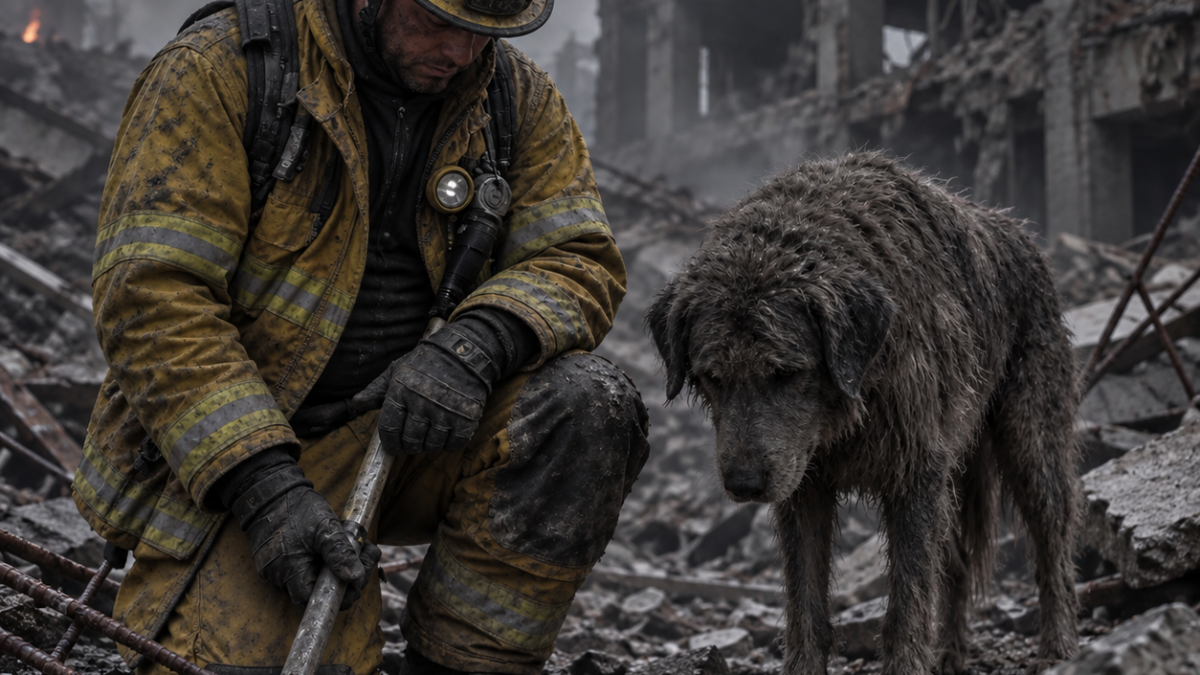
PART 2
Captain Dana Mitchell reached us in less than thirty seconds.
Buster was still struggling against Noah’s arms.
The dog’s paws were injured, his breathing was fast, and his entire body trembled beneath the soot covering his coat.
But he had only one thought.
Get back.
Back to the wreckage.
Back to the exact place where he’d been digging.
“What have you got?” Dana asked.
I pointed toward the dark surface beneath the ash.
“Something solid.”
“Foundation?”
“I don’t think so.”
She looked at the ruined farmhouse.
The roof had collapsed inward.
Several walls were unstable.
Steam still rose from pockets of debris.
The place was dangerous enough without an injured dog trying to run into it.
Dana turned toward Noah.
“Get Buster into the ambulance staging area. Have somebody contact an emergency veterinarian.”
Buster cried out when Noah began carrying him away.
Not because Noah hurt him.
Because he could see us staying behind.
He twisted his head toward the wreckage.
Barked.
Then whined so desperately that I felt the sound in my chest.
“Easy, buddy,” Noah whispered. “We’re not forgetting.”
Buster didn’t believe him.
I couldn’t blame him.
Dana looked at me.
“Joe, tell me what you saw.”
I crouched beside the area Buster had been clawing at.
“There was a different sound when his paws hit the surface.”
“What kind of sound?”
“Hard. Hollow, maybe.”
She studied the surrounding debris.
“Could be the basement floor.”
“Arthur didn’t have a basement.”
“Are you sure?”
I hesitated.
“No.”
Dana looked toward the remains of the kitchen.
Then back at me.
“Keep everybody outside the unstable section. I’m calling the rescue team.”
I stared at the spot.
“Dana—”
“I know what you’re thinking.”
I swallowed.
“If there’s even a chance—”
“Then we do it correctly.”
She put a hand on my shoulder.
“We already almost lost two firefighters in that house. I’m not losing another because we rushed into a collapse zone.”
I nodded.
She was right.
But standing there was agony.
Somewhere near the ambulance, Buster continued barking.
Every sound made me look toward the wreckage.
I had spent twenty-two years learning how to recognize an emergency.
And something inside me was screaming that the emergency wasn’t finished.
***
Our rescue specialists began assessing the collapsed area.
They checked for unstable overhead debris, remaining heat, and hazards that could injure anyone working near the ruins.
Once the immediate area had been made safe enough for a controlled operation, we began clearing loose material from the place Buster had marked.
A pike pole moved the lighter debris.
Another firefighter carefully removed sections of charred wood.
Ash fell away.
The hard surface became clearer.
Concrete.
Smooth.
Old.
And completely different from the surrounding remains of the wooden farmhouse.
I knelt.
My flashlight moved across it.
Then I saw a seam.
A straight line.
Too clean to be accidental.
“Dana.”
She crouched beside me.
I pointed.
“Look.”
She followed the edge with her eyes.
Then she saw it.
A steel ring embedded in the concrete.
For several seconds, neither of us spoke.
Finally, Dana whispered, “A hatch?”
I brushed away more ash.
The ring was attached to a heavy metal plate set into the slab.
A trapdoor.
My pulse began pounding.
“Arthur had a storm cellar.”
Dana reached for her radio.
“Rescue One, bring hydraulic equipment to the south side. Possible confined-space access beneath the structure.”
I put my hand against the metal.
It was still warm.
Not burning hot.
But warm enough to remind me what had been sitting above it only hours earlier.
“Arthur!” I shouted.
Nothing.
I leaned closer.
“Arthur Bennett! Fire department!”
Silence.
My heart sank.
Maybe the cellar was empty.
Maybe Arthur had never reached it.
Maybe the dog had been digging because that was where he last smelled his owner.
Then something moved beneath the hatch.
Or maybe I only imagined it.
I pressed my ear closer.
“Everybody quiet!”
The firefighters stopped talking.
A hose shifted somewhere behind me.
Water dripped from a broken gutter.
For several seconds, all I heard was wind.
Then—
Tap.
Tap.
Tap.
Three faint sounds.
From below.
I stared at Dana.
She stared back.
“Did you hear that?”
I nodded.
My voice barely worked.
“Yes.”
I leaned toward the hatch.
“Arthur! If you can hear me, make a noise!”
Nothing.
Then—
Tap.
Tap.
Tap.
Dana stood immediately.
“Get the equipment here now!”
I reached for my radio.
“Dispatch, possible live victim located beneath the fire structure. Request additional EMS and technical rescue support.”
My hands were shaking.
I had fought through one of the worst fires of my career.
I had watched the upper floor collapse.
I had spent hours believing we were searching for a body.
Now somebody was tapping beneath the ashes.
And somewhere behind us, an injured dog had known it all along.
***
The steel hatch wouldn’t open by hand.
Debris had bent part of its frame.
The handle was damaged.
And the weight of collapsed material had forced one edge against the surrounding concrete.
We stabilized the area and began working carefully.
A hydraulic tool was brought forward.
Dana supervised every movement.
“Slow,” she warned. “We don’t know what’s directly underneath.”
I knelt beside the hatch.
“Arthur!”
A faint sound answered.
Not tapping this time.
A voice.
So weak I almost missed it.
“Help.”
Everything inside me stopped.
Then I shouted, “He’s alive!”
Someone behind me repeated it.
“Live victim!”
I leaned closer.
“Arthur, my name is Joe. I’m with the fire department.”
A pause.
Then a whisper.
“Buster?”
My throat closed.
Of all the things he could have asked, those were his first words.
Not where am I.
Not what happened.
Not am I going to die.
Buster.
“Your dog’s alive, Arthur!”
A faint sound came from below.
It might have been a sob.
“Stay with us,” I said. “We’re getting you out.”
We worked the hatch open enough to gain access.
A narrow black opening appeared beneath the steel.
Cooler air rose from below, mixed with smoke and the damp smell of concrete.
A rescue specialist checked the atmosphere before anyone entered.
The cellar had been protected from the direct flames, but that didn’t mean the air was safe.
We brought equipment forward.
A firefighter lowered a light.
Then we saw him.
Arthur Bennett.
Sitting on the concrete floor.
Back against an old storage cabinet.
One hand raised weakly toward us.
His face was covered in soot.
His gray hair was plastered against his forehead.
And his eyes—
I’ll never forget those eyes.
He looked like a man who had already said goodbye to the world.
Then heard somebody call his name.
“Arthur!”
He blinked.
“Joe?”
“Yes, sir.”
He tried to smile.
“Thought that sounded like you.”
I laughed.
It came out broken.
“Just keep talking.”
Arthur coughed.
“My dog.”
“Buster’s outside.”
“He got out?”
“He did.”
Arthur closed his eyes.
“Good.”
Then his body began sliding sideways.
“Arthur?”
He didn’t answer.
“Arthur!”
The rescue specialist moved immediately.
We secured access and reached him as quickly and safely as conditions allowed.
Arthur was conscious again when we placed him on the rescue stretcher.
Barely.
He kept trying to speak.
I leaned closer.
“What is it?”
His lips moved.
I lowered my head.
“Don’t… let him…”
I frowned.
“Don’t let who?”
Arthur coughed.
His eyes opened.
Then he whispered something I couldn’t understand.
Before I could ask again, the paramedics moved him toward the ambulance.
I followed.
And that was when Buster heard his voice.
***
Buster had been wrapped in blankets near the medical staging area.
One of our firefighters was keeping him warm while an emergency veterinarian was being contacted.
The dog had been lying quietly.
Exhausted.
Then Arthur spoke.
“Joe?”
Buster’s head snapped up.
His ears lifted.
For one second, he froze.
Then he began barking.
Not the frantic, desperate barking we’d heard near the ruins.
Something different.
Sharp.
Excited.
Almost disbelieving.
He struggled to stand.
The firefighter gently supported him.
“Easy, buddy.”
Buster pulled forward.
Arthur heard him.
His head turned on the stretcher.
“Buster?”
The dog let out a sound I had never heard before.
Half bark.
Half cry.
He was trying to reach the man he had spent the night digging out of a burning house.
The paramedics stopped for a brief moment while maintaining Arthur’s care.
I helped bring Buster close enough for Arthur to see him.
“Here he is.”
Arthur reached out.
His hand trembled.
“Come here, boy.”
Buster pressed his head into Arthur’s fingers.
And the old man started crying.
Not loudly.
Just tears moving down his soot-covered cheeks.
“Good boy.”
Buster’s tail moved.
Arthur stroked the singed fur along his forehead.
“You came back.”
I looked away.
So did Noah.
Dana stood a few feet behind us, one gloved hand resting against the ambulance door.
For twenty-two years, I’d watched firefighters save people.
I’d seen strangers risk their lives for people they’d never met.
I’d seen parents carry children out of smoke.
I’d seen crews work until their strength was gone.
But I’d never seen anything like that moment.
A dog with injured paws had refused to leave a collapsed house.
A man buried beneath concrete had used his last strength to ask whether that dog was alive.
And somehow they had found each other again.
Arthur squeezed Buster’s head gently.
“My boy.”
Then the paramedic leaned toward him.
“We need to go now, sir.”
Arthur nodded weakly.
Buster tried to follow.
I crouched beside him.
“Don’t worry, buddy.”
He looked at me.
“I know you don’t believe anybody right now.”
His ears moved.
“But he’s alive because of you.”
Buster leaned against my leg.
I scratched the cleanest part of his neck.
“And we’re going to make sure you see him again.”
***
Arthur was taken to the regional hospital.
Buster went to an emergency veterinary clinic.
I wanted to follow both ambulances.
Instead, I remained at the fire scene.
Because something had changed.
The moment Arthur was found alive, the operation stopped being only a recovery and rescue.
It became an investigation into how the farmhouse had burned.
And what Arthur had whispered on the stretcher would not leave my mind.
Don’t let him.
Don’t let who?
At first, I told myself the words were meaningless.
Arthur had inhaled smoke.
He was dehydrated.
Exhausted.
Possibly confused.
He could have been speaking about anything.
But I kept remembering the way his eyes had changed when he said it.
Not confusion.
Fear.
Captain Mitchell found me standing beside the ruined chimney.
“You’ve been staring at that wall for ten minutes.”
I looked at her.
“Have I?”
She nodded.
“Go sit down.”
“I’m fine.”
“Joe.”
I sighed.
She stepped closer.
“What happened down there?”
I looked toward the concrete hatch.
“He said something.”
“Arthur?”
“Yeah.”
“What?”
I hesitated.
“He told me not to let someone do something.”
Dana frowned.
“Who?”
“He didn’t finish.”
She looked toward the farmhouse.
“Could be delirium.”
“Could be.”
“But?”
I shook my head.
“I don’t know.”
Dana studied me for a moment.
Then said, “The fire marshal is on his way.”
I looked toward the driveway.
“Good.”
She narrowed her eyes.
“Why do you look relieved?”
I stared at the ashes.
“Because I want to know how this started.”
***
The fire marshal arrived shortly after eight.
His name was Theodore Lang.
Most firefighters called him Theo.
He had worked investigations for nearly fifteen years and possessed the sort of patience that made impatient people furious.
He didn’t guess.
He didn’t jump to conclusions.
And he never treated a terrible-looking fire as proof of what caused it.
I liked that about him.
He walked the perimeter with Dana.
Photographed the debris.
Reviewed our initial observations.
Then asked me to describe our entry.
“Which rooms did you reach?”
“Living room and part of the kitchen.”
“Conditions?”
“Severe heat. Heavy smoke. Stairwell involved.”
“Any unusual smells?”
I considered that.
There had been too much smoke to distinguish much.
“Nothing I can say with confidence.”
Theo nodded.
“Good answer.”
I frowned.
“Why?”
“Because half the trouble in investigations comes from people remembering things they didn’t actually perceive.”
I almost smiled.
That was Theo.
He moved toward the south side of the house.
Stopped.
Then looked back.
“Joe, did Arthur ever mention a basement?”
“No.”
“Storm cellar?”
“Not to me.”
Theo studied the concrete hatch.
“Interesting place for it.”
“Why?”
“Protected by the old kitchen slab. Probably built before the house was remodeled.”
I looked toward the ruins.
“Arthur was down there for hours.”
Theo nodded.
“Lucky the cellar had a usable air vent.”
“More than lucky.”
He looked at me.
I thought about Buster.
“His dog knew.”
Theo’s expression softened.
“I heard.”
Then his eyes shifted toward the debris.
He crouched near what remained of a side entrance.
“What?”
He didn’t answer immediately.
He photographed something.
Then called an evidence technician.
I watched them examine the area.
Theo stood.
“Joe, do me a favor.”
“Sure.”
“Don’t touch anything on this side.”
My stomach tightened.
“Why?”
He looked toward the blackened foundation.
“Because I haven’t figured out what bothers me about it yet.”
***
By noon, the news had reached the entire county.
Arthur Bennett was alive.
His dog had helped firefighters locate a hidden storm cellar.
The farmhouse was gone.
But the old man had survived.
Reporters gathered near the police barricade.
Neighbors arrived carrying coffee and blankets.
People who hadn’t spoken to Arthur in years asked where they could send flowers.
The diner owner brought sandwiches for the crews.
Someone taped a handwritten sign to a fence post.
**PRAYING FOR ARTHUR AND BUSTER.**
I saw it while walking toward my truck.
It should have made me feel better.
Instead, I felt exhausted.
I hadn’t slept since the previous afternoon.
My hands hurt.
My throat was raw.
And every time I closed my eyes, I saw the ceiling coming down behind Noah and me.
Then my phone rang.
The hospital.
I answered immediately.
“This is Joe.”
A nurse introduced herself.
“Mr. Bennett is awake and asking for the firefighter who found him.”
I closed my eyes.
“Is he okay?”
“He’s receiving treatment for smoke exposure and other injuries. He’s stable enough to speak briefly.”
I looked toward Dana.
She had heard enough to understand.
“Go,” she said.
“What about—”
“Joe.”
I stopped.
“Go see Arthur.”
***
The hospital room smelled of disinfectant and warm blankets.
Arthur lay in bed with an oxygen cannula beneath his nose.
His hair had been washed.
Most of the soot was gone.
But the burns along his forearms were bandaged, and his skin looked pale beneath the overhead lights.
He seemed smaller.
Older.
When I entered, his eyes opened.
“There he is.”
I smiled.
“Morning, Arthur.”
He looked toward the window.
“Is it morning?”
“Almost noon.”
“Hell of a night.”
I laughed softly.
“That’s one way to put it.”
He studied me.
“You look terrible.”
“Thanks.”
“You always looked terrible. Just more than usual.”
I pulled a chair closer.
It was such an Arthur thing to say.
Even after everything, he still wanted the last word.
I sat.
For a moment, neither of us spoke.
Then Arthur looked at me.
“Buster?”
“He’s at the veterinary hospital.”
His expression changed.
“How bad?”
“Some burns. Injured paws. Smoke exposure. They’re treating him.”
Arthur swallowed.
“Will he live?”
“I haven’t heard anything suggesting otherwise.”
He closed his eyes.
“Thank God.”
I leaned forward.
“Arthur, how did you get into that cellar?”
He opened his eyes again.
Then stared toward the ceiling.
“My father built it.”
“The storm cellar?”
He nodded.
“Back in fifty-eight. After the tornado took the Miller barn.”
I listened.
“House had one before, but it flooded every spring. Dad poured new walls. Concrete roof. Steel door.”
“Why didn’t anybody know?”
Arthur smiled faintly.
“Everybody did once.”
I shook my head.
“Not us.”
“You weren’t born.”
“Fair point.”
He coughed.
I waited.
Then he continued.
“I woke up smelling smoke.”
My body went still.
“Where?”
“Bedroom.”
“Upstairs?”
“Yeah.”
“What did you do?”
“Called Buster.”
He looked toward the window.
“He was barking before I got out of bed.”
I leaned forward.
“Then?”
Arthur took a slow breath.
“I opened the bedroom door. Smoke everywhere. Could hear fire downstairs.”
“Did you try the stairs?”
“Couldn’t.”
He swallowed.
“Went out the back way. Small landing. Old service steps.”
I knew the area.
A rear passage had connected the upper floor to the old kitchen section.
“What happened?”
“Buster wouldn’t leave me.”
His voice softened.
“Kept pushing against my leg.”
I waited.
“I got him toward the back porch. He slipped through the old dog opening.”
Arthur’s eyes filled.
“He came back.”
My throat tightened.
“He tried to come back?”
Arthur nodded.
“Started barking at me through the door.”
I pictured it.
Smoke filling the house.
Fire spreading.
Arthur trying to reach the cellar.
Buster refusing to abandon him.
“I told him to run,” Arthur whispered.
His hand trembled against the blanket.
“Then I went down.”
“Into the cellar?”
“Yeah.”
He swallowed.
“Pulled the hatch shut.”
I looked at him.
“How did you breathe?”
“Old vent runs through the hillside. Dad built it that way.”
He smiled faintly.
“Old man knew what he was doing.”
Then the smile disappeared.
“House came down over me.”
I nodded.
“We found the hatch buried.”
“I know.”
Arthur stared at his hands.
“I heard the crash.”
His voice became quiet.
“Thought that was it.”
I waited.
“Then hours passed.”
He swallowed.
“I tried yelling.”
My chest tightened.
“Couldn’t hear much. Just rumbling. Water.”
He looked at me.
“Then I heard scratching.”
I froze.
“What?”
“Something above me.”
His eyes filled.
“Scratching.”
I leaned forward.
“Buster?”
Arthur nodded.
“I knew it was him.”
His voice broke.
“I knew my boy hadn’t left.”
For several seconds, I couldn’t speak.
Then Arthur whispered, “I started tapping.”
I stared at him.
“Three times.”
He nodded.
“Three times.”
I leaned back.
Those faint sounds beneath the hatch.
Tap.
Tap.
Tap.
An old man answering his dog.
And a dog refusing to leave until somebody understood.
***
Arthur was quiet for a long time.
Then he turned toward me.
“Joe.”
“Yeah?”
“Who started it?”
I frowned.
“The fire?”
He nodded.
“We don’t know yet.”
His jaw tightened.
“Somebody came by.”
I sat straighter.
“When?”
“Before I went to bed.”
“Who?”
Arthur stared at me.
Then looked toward the door.
For a moment, I thought he was afraid someone might be listening.
Finally, he whispered, “Warren Pike.”
I knew the name.
Everybody in the county did.
Warren Pike owned Pike Development Group.
For years, he’d been buying farmland along the eastern highway corridor.
His company wanted to build a massive logistics complex outside town.
Most people considered him successful.
Some considered him ruthless.
And Arthur hated him.
I knew that much.
“What did Warren want?”
Arthur’s eyes narrowed.
“The land.”
“Your farm?”
He nodded.
“He’s been after it for two years.”
I frowned.
“That doesn’t mean he started the fire.”
“I know.”
Arthur stared toward the window.
“But he came by last night.”
My pulse quickened.
“What time?”
“Ten. Maybe ten-thirty.”
“What happened?”
“He wanted me to sign.”
“Sign what?”
“Access agreement.”
Arthur’s voice hardened.
“He said he had investors waiting. Said I was holding up a project worth millions.”
“What did you tell him?”
Arthur almost smiled.
“Same thing I’ve told him for two years.”
“No?”
“Not a chance.”
I sat quietly.
Then he said something that made the hair rise on my arms.
“He told me old houses have a way of becoming expensive problems.”
I looked at him.
Arthur’s eyes were fixed on mine.
“Joe, I know what he said.”
A cold feeling moved through my stomach.
“What did you say back?”
“Told him to get off my property.”
Arthur swallowed.
“He said I’d regret being stubborn.”
The room went quiet.
I looked toward the doorway.
Then back at him.
“Arthur, you need to tell the investigators.”
He nodded.
“I will.”
“Every word.”
“I know.”
I hesitated.
“Is that what you were trying to tell me at the fire?”
Arthur looked confused.
“What?”
“When we brought you out, you said, ‘Don’t let him…’”
His face changed.
Then he whispered, “Don’t let him take the farm.”
***
I left the hospital with my stomach in knots.
I didn’t know whether Arthur’s suspicions were correct.
I didn’t know whether Warren Pike had anything to do with the fire.
I knew only that a man had nearly died in a burning house shortly after refusing a powerful developer’s demand.
That was enough to make me uneasy.
I called Dana.
She listened without interrupting.
When I finished, she said, “Have you told Theo?”
“Not yet.”
“Do it.”
“Dana—”
“Joe, we’re firefighters. We don’t investigate crimes.”
“I know.”
“But we do report what we learn.”
I nodded.
“Right.”
She paused.
“And don’t go confronting anybody.”
I almost laughed.
“You know me too well.”
“Twenty-two years is a long time, Joe.”
I looked through the hospital window toward the parking lot.
“Something’s wrong.”
“Maybe.”
“You don’t sound convinced.”
“I sound like someone who’s seen a hundred fires people were sure were arson before the investigation proved otherwise.”
I sighed.
She softened her voice.
“Let Theo work.”
I nodded.
“Okay.”
Then I ended the call and drove toward the veterinary hospital.
I needed to see Buster.
***
Buster was lying on a padded blanket when I arrived.
His coat had been cleaned.
Several burned patches were clipped.
His paws were wrapped in protective dressings.
One hind leg was bandaged.
He wore a soft recovery collar.
And he looked furious about all of it.
The veterinarian, Dr. Leah Cooper, smiled when she saw me.
“You’re the firefighter?”
“Joe.”
“I’m Leah.”
We shook hands.
“How is he?”
“Lucky.”
I looked toward the dog.
“He seems to have a talent for that.”
She smiled.
“His burns are painful, but they’re treatable. We’re managing the wounds and monitoring his breathing after the smoke exposure.”
“His leg?”
“Strained and bruised. No major fracture on imaging.”
I released a breath.
“Good.”
She looked at Buster.
“He’s been refusing food.”
My stomach tightened.
“Why?”
“Could be stress. Pain. Nausea. We’re addressing those possibilities.”
I approached his enclosure.
Buster lifted his head.
His eyes fixed on me.
“Hey, buddy.”
His tail moved once.
I crouched.
“You remember me?”
He pushed himself forward.
Leah opened the door carefully.
I sat on the floor.
Buster pressed his nose against my hand.
Then looked past me.
Toward the hallway.
I felt my throat tighten.
“He’s looking for Arthur.”
Leah nodded.
“He does that whenever someone comes in.”
I stroked the fur behind his ear.
“He’s alive, Buster.”
The dog looked at me.
“Your man’s alive.”
His ears moved.
I wished dogs understood every word we said.
Or maybe Buster understood more than I realized.
I sat with him for almost an hour.
When I stood to leave, he lifted his head again.
I looked back.
“I’m going to bring him to you.”
Buster stared at me.
“I promise.”
***
The first strange thing happened two days later.
A black SUV pulled into the hospital parking lot while I was visiting Arthur.
I noticed it only because the driver parked directly outside the entrance and remained there for several minutes.
Then a man stepped out.
Tall.
Expensive coat.
Dark hair.
Warren Pike.
I knew him from town meetings and newspaper photographs.
He walked into the hospital carrying a leather folder.
Something about that folder bothered me.
He wasn’t carrying flowers.
Or a card.
Or anything that looked like a gift for a man who had nearly died.
I followed at a distance.
Not because I planned to confront him.
Because Arthur had made it clear he didn’t want Warren near him.
Warren stopped at the nurses’ station.
“I’m here to see Arthur Bennett.”
The nurse looked at her screen.
“Are you family?”
“Close business associate.”
I almost laughed.
The nurse asked whether Arthur was expecting him.
“Not exactly.”
She shook her head.
“I’ll need to check.”
Warren’s expression tightened.
“I’ve known the man thirty years.”
The nurse remained calm.
“Then you’ll understand why we confirm visitors.”
I stepped forward.
“Arthur doesn’t want to see him.”
Warren turned.
His eyes narrowed.
“And you are?”
“Joe.”
He looked at my fire department jacket.
Then recognition appeared.
“Ah. The firefighter.”
I nodded.
Warren smiled.
Not warmly.
“Quite the hero, from what I hear.”
I said nothing.
He glanced toward the hallway.
“I’m here to discuss some urgent business with Arthur.”
“He’s recovering.”
“I’m aware.”
“Then maybe let him recover.”
Warren’s smile disappeared.
“That’s between Arthur and me.”
The nurse looked up.
“Mr. Bennett has requested no business visitors. We won’t be admitting you.”
Warren stared at her.
Then slowly closed his folder.
“Tell him I came by.”
He looked at me.
“And tell your friend that refusing to face reality doesn’t make reality go away.”
I felt anger flash through me.
But I stayed quiet.
Warren turned and left.
The moment the doors closed, the nurse looked at me.
“Is he always like that?”
I exhaled.
“I hope not.”
She shook her head.
“He tried to tell me he had documents Arthur needed to sign before the end of the week.”
I looked toward the parking lot.
Documents.
The old man had nearly died.
His home was gone.
His dog was in a veterinary hospital.
And Warren Pike had come looking for a signature.
***
Arthur’s daughter arrived the following morning.
Her name was Rebecca Bennett.
She was forty-one and worked as a nurse in Columbus, Ohio.
I hadn’t seen her in years.
She looked like her father around the eyes.
Same gray-blue color.
Same stubborn expression.
When I walked into Arthur’s hospital room, she was standing near the window with her arms folded.
Arthur sat in bed looking miserable.
Not physically.
Emotionally.
I recognized the expression.
I’d seen it on men who’d rather run into a fire than admit they were afraid of an argument with their daughter.
“Morning,” I said.
Rebecca turned.
“Joe?”
I smiled.
“Hey, Rebecca.”
She crossed the room and hugged me.
“Thank you.”
I didn’t know what to say.
She held on tighter.
“Thank you for finding him.”
I swallowed.
“Buster found him.”
Rebecca stepped back.
Her eyes filled.
“I heard.”
Arthur cleared his throat.
“Dog’s always been smarter than the rest of us.”
Rebecca looked at him.
“Dad.”
He looked away.
“What?”
“You could’ve died.”
He stared at the blanket.
“I know.”
“You were in that cellar for hours.”
“I know.”
“You didn’t even tell me you had a storm cellar.”
Arthur frowned.
“Of course I told you.”
“When?”
“When you were little.”
“Dad, I was seven.”
“Well, you should’ve listened.”
I almost smiled.
Rebecca didn’t.
“You haven’t called me in three months.”
Arthur’s expression changed.
“Been busy.”
“Doing what?”
He looked at me.
I suddenly became fascinated by the wall clock.
Rebecca continued.
“Fixing tractors for people who don’t pay you?”
Arthur said nothing.
“Refusing to sell a house that’s falling apart?”
“Rebecca—”
“Living alone when you can barely manage the stairs?”
His jaw tightened.
“It’s my house.”
“And you almost died in it.”
The words landed hard.
Arthur looked toward the window.
Rebecca’s face changed.
She hadn’t meant to hurt him.
Or maybe she had.
Sometimes fear comes out sounding like anger.
I knew that better than most.
I stepped toward the door.
“I’ll give you two some time.”
Rebecca looked embarrassed.
“Joe, I’m sorry.”
I shook my head.
“No need.”
Then Arthur spoke.
“Don’t go.”
I stopped.
He looked at Rebecca.
“You want to know why I wouldn’t leave?”
She stared at him.
“Because Mom lived there?”
Arthur’s eyes filled.
Rebecca’s anger softened.
He nodded.
“Thirty-eight years.”
She sat slowly.
Arthur stared at his hands.
“Every board in that house had something of hers in it.”
Rebecca’s face crumpled.
He continued.
“Kitchen cabinet she painted blue because she hated the brown.”
A faint smile crossed his face.
“Window over the sink. She’d stand there every morning feeding birds.”
Rebecca whispered, “I remember.”
“The back porch where you learned to ride your bike.”
I looked away.
Arthur’s voice broke.
“After she died, I couldn’t figure out how to leave all that behind.”
Rebecca covered her mouth.
For several seconds, nobody spoke.
Then she moved to the side of the bed.
“Dad.”
He looked up.
“I wasn’t asking you to forget her.”
“I know.”
“I just wanted you safe.”
Arthur nodded.
“I know that too.”
She took his hand.
And for the first time since the fire, I saw Arthur cry without trying to hide it.
***
The fire marshal called that afternoon.
“Joe, can you come by the station?”
I looked at my watch.
“Sure.”
“Bring your notes from the initial entry.”
“Something wrong?”
Theo hesitated.
“Possibly.”
My stomach tightened.
“What did you find?”
“I’d rather show you.”
I drove straight there.
Theo was waiting in the conference room with Dana.
Photographs covered the table.
The ruined farmhouse.
The side entrance.
The remains of the kitchen.
The burned staircase.
I sat.
Theo pointed toward one photograph.
“We’ve been looking closely at the fire’s early development.”
I leaned forward.
“Okay.”
“Several observations don’t fit a simple electrical failure.”
My pulse quickened.
“What observations?”
He explained that investigators had documented patterns and recovered samples requiring laboratory analysis.
Nothing conclusive yet.
But enough to warrant further work.
Then he showed me a photograph of the side porch.
The area where Arthur said Warren had stood during their argument.
I stared at it.
“That’s the rear entrance.”
“Right.”
Theo nodded.
“And?”
“We’ve identified more than one area of concern.”
Dana looked at me.
“Joe, tell Theo what Arthur said.”
I did.
The late-night visit.
The access agreement.
The threat.
The words Warren Pike had used.
When I finished, Theo wrote several notes.
Then he looked at me.
“Did Arthur specifically say Warren threatened to burn the house?”
“No.”
“Did he see Warren do anything to the building?”
“Not that he told me.”
Theo nodded.
“Good. Don’t add anything.”
I looked at him.
“I wouldn’t.”
“I know.”
He closed his notebook.
“But I need you to understand that suspicion and proof are different things.”
I nodded.
He continued.
“If this turns out to be an intentionally set fire, we’re going to need a timeline supported by evidence.”
I stared at the photographs.
“And if it wasn’t?”
“Then we follow that evidence too.”
Dana leaned back.
“That’s why Theo gets the badge and we get the hoses.”
Theo almost smiled.
I didn’t.
Because I had seen Warren Pike standing in the hospital with a folder.
And I couldn’t shake the feeling that he had already decided Arthur Bennett’s future belonged to him.
***
Arthur’s recovery was slow.
The smoke exposure left him coughing for days.
His burns needed regular dressing changes.
His back hurt from spending hours crouched in the cellar.
And every time he slept, he dreamed of the fire.
Sometimes he woke convinced he was still trapped beneath the hatch.
Rebecca told me about one night when he sat straight up in bed and began pounding the mattress.
Three times.
Tap.
Tap.
Tap.
The nurse rushed in.
Arthur looked around, confused.
Then whispered, “Where’s Buster?”
Rebecca held his hand until he calmed down.
When she told me, I sat silently for a long time.
Because I understood.
The fire hadn’t ended for Arthur when we lifted him out.
It was still happening somewhere inside him.
And Buster wasn’t doing much better.
Dr. Cooper said the dog’s wounds were healing.
His breathing was improving.
But he remained restless.
He paced when able.
Whined at unfamiliar sounds.
And refused to settle at night.
Every time someone approached his enclosure, he lifted his head.
Hoping.
Waiting.
I knew exactly what he wanted.
So I spoke with the doctors.
Arthur was improving.
Buster was stable enough for carefully supervised transport.
The hospital approved a brief visit in an appropriate room, with staff involved.
And three days later, we brought Buster to Arthur.
***
I helped carry Buster into the hospital.
His paws were still bandaged.
He wore a comfortable harness.
His coat was patchy where the burned fur had been clipped.
He looked nothing like the strong, confident dog who once jumped into Arthur’s truck every morning.
But the moment he heard Arthur’s voice, everything changed.
“Buster?”
The dog’s ears lifted.
He stopped.
Then pulled toward the sound.
Arthur was waiting in a wheelchair near the window.
His eyes filled when he saw the dog.
“Oh, buddy.”
Buster moved faster.
Not running.
He couldn’t.
But determined.
He reached Arthur.
Pressed his head into the old man’s knees.
Then stood there trembling.
Arthur reached down.
His hand covered Buster’s head.
“Good boy.”
The dog whined.
Arthur’s face crumpled.
“You found me.”
Buster’s tail moved.
“You stubborn old fool.”
I laughed through tears.
Arthur lowered his forehead toward the dog’s.
“You weren’t supposed to go back in there.”
Buster pressed closer.
Arthur whispered, “But you did.”
Rebecca stood beside the door.
She was crying.
Dana had come too.
Even Dr. Cooper looked away for a moment.
I crouched beside Buster.
“You did good, buddy.”
The dog ignored me completely.
His entire world was sitting in that wheelchair.
And I was happy to disappear from it.
***
For the next twenty minutes, Arthur and Buster barely moved.
The dog rested his head against Arthur’s lap.
Arthur stroked him slowly.
Sometimes he whispered things only Buster could hear.
At one point, he looked toward me.
“Joe.”
“Yeah?”
“Do you know why he was digging?”
I smiled faintly.
“He heard you.”
Arthur shook his head.
“Maybe.”
Then he looked down at Buster.
“But there’s something else.”
I leaned closer.
“What?”
Arthur rested a hand on the dog’s shoulder.
“When Buster was a puppy, Ruth used to hide treats under the porch steps.”
I smiled.
“Ruth spoiled him?”
“Terribly.”
Arthur laughed softly.
“Dog figured out if he scratched at a board, somebody would come over and lift it.”
I nodded.
“Smart dog.”
“Smarter than me.”
He looked toward the window.
“After Ruth died, Buster kept scratching at the old porch sometimes.”
His voice softened.
“Like he thought there might still be something worth finding.”
I swallowed.
Arthur looked back at me.
“When I got trapped beneath that cellar, I heard him scratching.”
He paused.
“Maybe he remembered.”
I looked at Buster.
His eyes were closed beneath Arthur’s hand.
“Remembered what?”
Arthur smiled sadly.
“That when something you love is missing, you keep digging until somebody helps you find it.”
I couldn’t answer.
I just rested my hand on Buster’s back.
And let the silence say what I couldn’t.
***
Two weeks after the fire, the laboratory results came back.
Theo called me at home.
“Joe.”
Something in his voice made me sit down.
“What is it?”
“The fire has been classified as incendiary.”
I stared at the wall.
“What?”
“Investigators found evidence consistent with deliberate ignition.”
My throat went dry.
“You’re saying someone set Arthur’s house on fire?”
“Yes.”
I closed my eyes.
For several seconds, I couldn’t speak.
Then I asked, “Do you know who?”
“Not yet.”
I looked toward the window.
The late-night argument.
The developer.
The hospital visit.
The threats.
Everything came rushing back.
“Theo—”
“I know what you’re going to say.”
“Warren Pike.”
“His name is part of the investigation.”
I stood.
“That son of a—”
“Joe.”
I stopped.
“Don’t.”
I gripped the phone.
“He nearly killed Arthur.”
“We haven’t established who caused the fire.”
I took a breath.
Theo continued.
“We’re working with the sheriff’s investigators. They need to gather evidence without anyone interfering.”
I stared at the floor.
“Okay.”
“Promise me.”
I closed my eyes.
“I won’t confront anybody.”
“Good.”
He paused.
“And Joe?”
“Yeah?”
“This just became a much bigger case.”
***
The next morning, the sheriff’s office contacted Arthur.
Detective Ava Collins took the lead.
She was younger than Theo but had a reputation for being thorough.
Arthur gave a formal statement from his hospital room.
Rebecca was present.
So was a hospital social worker, who helped make sure the interview was conducted without exhausting him.
Arthur described Warren Pike’s visit.
The demand for access to the land.
The argument.
The threat.
Then he remembered something else.
A vehicle.
After Warren left, Arthur had heard another engine near the driveway.
He assumed it was Warren returning.
But when he looked through the bedroom window, the vehicle was farther down the lane.
Near the old machine shed.
He hadn’t thought much about it.
People sometimes used that road to reach the neighboring properties.
But now it bothered him.
Detective Collins asked for details.
“Make?”
“Pickup.”
“Color?”
“Dark.”
“License plate?”
“No.”
“Time?”
“Maybe eleven.”
Arthur shook his head.
“I didn’t look at the clock.”
Collins nodded.
“That’s okay.”
Then she asked another question.
“Mr. Bennett, did you have security cameras?”
Arthur almost laughed.
“I’m sixty-eight, Detective. Not a hundred.”
Rebecca looked at him.
“Dad.”
He smiled faintly.
“Yeah. I had a few.”
Collins leaned forward.
“Where?”
“Front porch. Barn. Deer camera near the east pasture.”
My pulse quickened when Rebecca told me later.
A trail camera.
Away from the burned house.
Potentially still intact.
Arthur continued.
“Used it to watch deer crossing the field.”
Detective Collins wrote it down.
“Do you know where the recording is stored?”
Arthur shook his head.
“Memory card in the camera.”
The detective stood.
“Then we’ll locate it.”
***
The trail camera was found the following afternoon.
It was mounted to an oak tree about sixty yards from the farmhouse.
The fire had not reached it.
Investigators recovered the card and preserved the footage.
I wasn’t allowed to see it immediately.
But Detective Collins later told me what mattered.
At 11:18 p.m., a dark pickup entered the property from the east access road.
It traveled toward the machine shed.
At 11:31, it returned.
The camera captured enough of the rear of the vehicle to show a distinctive damaged tailgate.
It also recorded part of the license plate.
Investigators compared it with vehicles connected to Warren Pike’s company.
One matched.
A pickup assigned to a subcontractor named Derek Voss.
That name meant nothing to me.
But it meant something to Arthur.
When Detective Collins showed him a photograph, his face hardened.
“He works for Warren.”
Collins nodded.
“How do you know him?”
“Been out to the farm twice.”
“For what?”
“Survey work.”
“Did he have permission?”
“First time, yes.”
“And the second?”
Arthur shook his head.
“No.”
Collins made another note.
Then Arthur looked at her.
“Detective, I don’t want to accuse a man without proof.”
She nodded.
“That’s our job.”
He swallowed.
“But if Warren sent somebody to hurt me over that land…”
His voice broke.
Rebecca took his hand.
Collins waited.
Arthur looked toward the window.
“I want him stopped.”
***
The evidence began building slowly.
Investigators obtained records related to Derek’s work for Pike Development.
They interviewed employees.
Reviewed vehicle logs.
Examined business communications.
And searched for surveillance footage along the route to Arthur’s property.
A gas station camera had recorded Derek’s truck late that evening.
Another camera captured it heading toward County Road 9.
The timing was consistent with the trail-camera footage.
That alone did not prove arson.
But it placed the vehicle near the farmhouse during the relevant period.
Then investigators obtained phone records and communications through the appropriate legal process.
Derek had exchanged several messages with Warren on the night of the fire.
One message was sent shortly after the late-night argument.
Warren wrote:
“Arthur is still refusing. Handle the property problem.”
Derek replied:
“Working on it.”
Hours later, after the fire was underway, Derek sent another message.
“It’s done.”
When I first learned about those messages, I felt physically sick.
The words were short.
Ordinary.
Almost casual.
A man’s home had burned.
An elderly homeowner had nearly died.
A dog had suffered painful injuries.
And somewhere in the middle of it were two words.
It’s done.
But Detective Collins warned us not to assume every message meant what it appeared to mean.
“Context matters,” she told Arthur.
He sat across from her in the hospital conference room.
“What else could it mean?”
“We have to establish that.”
Arthur looked toward Rebecca.
She squeezed his hand.
I stood near the door.
Collins continued.
“Evidence needs to hold up in court. That’s how we make sure the people responsible are actually held accountable.”
Arthur lowered his head.
Then nodded.
“Do it right.”
***
Meanwhile, Warren Pike began telling a different story.
He appeared at a county planning meeting and described the fire as a tragedy.
He said Pike Development had offered Arthur “a generous opportunity” to sell property that was becoming difficult for him to maintain.
He spoke about economic development.
Jobs.
Investment.
The future of the county.
Then he said something that made me nearly throw my coffee across the kitchen.
“Unfortunately, some landowners become emotionally attached to aging structures and fail to recognize the risks.”
I stared at the television.
Rebecca had sent me the recording.
Warren continued.
“While the investigation is ongoing, we shouldn’t rush to blame legitimate businesses for accidents that sometimes happen on older properties.”
I replayed that sentence.
Then again.
The man who had shown up at Arthur’s hospital room with documents to sign was now implying Arthur had caused his own disaster by refusing to sell.
I called Dana.
“Have you seen this?”
“Joe.”
“He’s blaming Arthur!”
“Joe.”
“His house burned down!”
“I know.”
“He almost died!”
“I know.”
“And Pike’s standing in front of the county talking about old buildings?”
Dana sighed.
“What do you want to do?”
I stopped.
For a moment, I couldn’t answer.
Because the truth was, I wanted to drive straight to Warren’s office.
I wanted to look him in the eye.
I wanted to ask whether he’d heard Buster crying beside the ashes.
Whether he’d seen Arthur’s burns.
Whether he understood what his words meant.
But I also knew what Dana was asking.
Would confronting Warren help Arthur?
Or would it simply make me feel better for five minutes?
I sat down.
“Nothing.”
“Good.”
“Not nothing forever.”
“Joe.”
I closed my eyes.
“I mean I’ll testify. I’ll tell the truth. Whatever they need.”
Dana’s voice softened.
“That’s how you help him.”
***
Arthur was discharged from the hospital nearly three weeks after the fire.
He couldn’t return home.
There was no home.
Rebecca rented a small furnished house near the medical center so he could continue his recovery.
It had two bedrooms.
A wheelchair-accessible entrance.
A kitchen with pale yellow cabinets.
And a little fenced backyard.
Arthur hated it immediately.
“Looks like a dentist’s waiting room.”
Rebecca sighed.
“Dad.”
“Everything’s beige.”
“The cabinets are yellow.”
“Sad yellow.”
I laughed.
Arthur glared at me.
“Don’t encourage her.”
Rebecca crossed her arms.
“You have a bedroom, a bathroom you can use safely, and a doctor five minutes away.”
Arthur looked toward the window.
“No barn.”
“Correct.”
“No workshop.”
“Correct.”
“No porch swing.”
“Dad.”
“And no dog.”
That last sentence changed the room.
Rebecca’s expression softened.
“Buster’s coming.”
Arthur looked at her.
“When?”
“Soon.”
“How soon?”
She smiled.
“Maybe check the driveway.”
Arthur froze.
I watched him.
Then he turned toward me.
“Joe?”
I stepped aside.
Noah opened the front door.
And Buster walked in.
***
The dog’s bandages were smaller now.
Most of his paw wounds had healed enough for gentle walking.
He still moved carefully.
His coat was patchy where the burned fur was growing back.
But his eyes were bright.
The moment he heard Arthur’s voice, his tail began moving.
“Buster?”
He walked straight toward the old man.
Arthur lowered himself into the armchair.
Buster pressed his head against his knees.
Then sighed.
A long, deep sound.
Arthur bent forward.
“There’s my boy.”
His hands moved over the dog’s face.
Behind the ears.
Across the shoulders.
Along the parts of his coat that had begun growing back.
“You look like somebody put you through a lawnmower.”
Buster’s tail wagged.
Arthur laughed.
Then began crying.
“You crazy dog.”
He pulled Buster closer.
“You were supposed to stay away from that house.”
Buster rested his head in Arthur’s lap.
Arthur whispered, “I’m glad you didn’t.”
I looked toward Rebecca.
She was crying too.
Noah stood beside the door pretending to study the ceiling.
Even Dana, who had driven over after her shift, wiped one eye.
I watched Arthur hold his dog.
And for the first time since the fire, I saw the old man look truly safe.
The house was gone.
His belongings were gone.
His workshop.
His photographs.
The kitchen his wife had painted.
Almost everything.
But Buster was there.
And somehow, that was enough to make Arthur smile.
***
The following weeks weren’t easy.
Arthur woke from nightmares.
Sometimes he dreamed that the cellar door wouldn’t open.
Sometimes he heard the roof collapsing again.
Sometimes he woke calling for Buster.
The dog always came.
Even with his injured leg, Buster would rise from his bed and move toward Arthur’s voice.
He would place his head on the old man’s knee.
Wait.
Then settle beside him until his breathing slowed.
Rebecca told me about one night when Arthur woke screaming.
She rushed into the living room.
Found him sitting upright on the couch, shaking.
Buster was already beside him.
Arthur had one hand buried in the dog’s fur.
Rebecca knelt.
“Dad?”
He looked at her.
For a second, he seemed not to recognize the room.
Then Buster nudged his hand.
Arthur closed his eyes.
“I’m here.”
Rebecca took his other hand.
“Yes.”
He swallowed.
“I’m here.”
That became a sentence he said often.
Sometimes in the morning.
Sometimes after a nightmare.
Sometimes when Buster approached him with his tail wagging.
I’m here.
At first, it sounded like something Arthur needed to remind himself.
Later, it became something he said with gratitude.
***
The farm remained surrounded by temporary fencing.
Investigators continued working.
The burned structure had to remain undisturbed until evidence collection was complete.
Arthur wasn’t allowed to wander through the ruins.
That frustrated him.
He wanted to see what was left.
Wanted to find his wife’s wedding photographs.
Wanted to recover her grandmother’s clock.
Wanted to know whether the old oak dining table had survived.
I knew most of those things were gone.
But I also knew why he needed to ask.
Losing a home isn’t only losing a building.
It’s losing thousands of small things that prove a life happened there.
The scratch on a doorframe where you measured your daughter’s height.
The chipped mug your wife refused to throw away.
The floorboard that creaked outside the bedroom.
The place where the dog slept every night.
Those things don’t show up on insurance inventories.
But they matter.
One afternoon, Arthur asked me to take him to the farm.
“Just the driveway.”
I hesitated.
“Arthur—”
“I’m not going inside.”
I looked at Rebecca.
She nodded.
“Doctor cleared him for a short outing.”
So we went.
I drove slowly down County Road 9.
The fields were brown.
The trees had lost most of their leaves.
A cold wind moved across the hills.
Arthur sat beside me.
Buster rested in the secured back seat.
Neither of them made a sound.
When we reached the driveway, I stopped.
The farmhouse was still there in outline only.
A blackened foundation.
A chimney.
The remains of two walls.
Nothing else.
Arthur stared.
For a long time, he didn’t speak.
Then he whispered, “Oh, Ruth.”
I looked away.
He opened the truck door.
I helped him stand.
We walked a few steps toward the fence.
Buster followed carefully.
Arthur looked at the ruins.
Then toward the old maple tree beside the driveway.
That tree had survived.
Its branches were bare.
But alive.
Arthur stared at it.
“Planted that the year Rebecca was born.”
I nodded.
“Good tree.”
He smiled faintly.
“Ruth said it would be.”
Then his expression changed.
He looked toward the east field.
“That’s what Pike wants.”
I followed his gaze.
Beyond the pasture, a wooded ridge rose above a narrow creek.
“Why that section?”
Arthur pointed.
“Access road.”
I frowned.
“For the distribution project?”
He nodded.
“Only straight route that keeps their trucks out of the neighboring township.”
“Couldn’t they go around?”
“Sure.”
“Then why not?”
“Costs money.”
Arthur looked at me.
“Millions.”
I stared toward the ridge.
Suddenly, the argument made more sense.
To Warren Pike, Arthur’s land wasn’t a home.
It was a missing piece in a business plan.
And Arthur Bennett was the man refusing to move.
***
The confrontation came six weeks after the fire.
Not with Arthur.
With me.
I was leaving the hardware store when Warren Pike stepped into my path.
“Joe.”
I stopped.
“Mr. Pike.”
He smiled.
“Got a minute?”
“Not really.”
“I’ll be quick.”
I looked toward the parking lot.
Warren stood beside a dark SUV.
His coat probably cost more than my monthly mortgage payment.
He looked perfectly comfortable.
As though nothing in the world had ever truly frightened him.
“I understand you’ve been spending a lot of time with Arthur.”
“Friend of mine.”
Warren nodded.
“Good man.”
I said nothing.
“Stubborn, though.”
I looked at him.
“What’s your point?”
Warren’s smile thinned.
“Arthur has people filling his head with nonsense.”
I felt my jaw tighten.
“What nonsense?”
“That Pike Development somehow caused his fire.”
I stared at him.
“Investigators are looking into it.”
“Investigators look into everything.”
He shrugged.
“Doesn’t make every rumor true.”
I said nothing.
Warren stepped closer.
“You’re a firefighter. People respect you.”
I watched him carefully.
“And?”
“You could help calm things down.”
I almost laughed.
“How?”
“Remind people old houses burn. Bad wiring. Old heating systems. Accidents happen.”
My hands curled into fists.
“We don’t know the cause publicly.”
Warren smiled.
“Exactly.”
I stared at him.
Then said quietly, “I was inside that house.”
His smile disappeared.
“What?”
“I went in looking for Arthur.”
Warren remained silent.
“My partner almost died beside me.”
He looked away.
I continued.
“I heard the roof collapse.”
My voice hardened.
“I saw Buster dig through ashes until his paws were bleeding.”
Warren’s expression tightened.
“And I’m not going to stand in front of anybody and guess what started the fire just because you want people to stop asking questions.”
He stared at me.
For several seconds, neither of us spoke.
Then he smiled again.
Coldly.
“You should be careful about involving yourself in business you don’t understand.”
I felt anger flash through me.
But I didn’t move.
“Then maybe you should stop trying to involve me.”
I stepped around him.
As I walked toward my truck, Warren called after me.
“Arthur can’t hold that property forever.”
I stopped.
Turned.
And looked at him.
“No,” I said.
“He can’t.”
Warren smiled faintly.
Then I added, “But I wouldn’t count on him giving it to you.”
His smile disappeared.
I got into my truck.
And drove away.
***
I reported the conversation to Detective Collins that afternoon.
She listened.
Took notes.
Asked me to repeat Warren’s exact words.
Then she looked up.
“Did he threaten you?”
“Depends how you define it.”
“Did he say he’d hurt you?”
“No.”
“Did he try to influence what you might say about the investigation?”
“Yes.”
She nodded.
“That’s relevant.”
I sat back.
“Are you getting close?”
She gave me the same patient look Theo always used.
“Joe.”
I sighed.
“I know.”
She smiled faintly.
“Then you know I can’t discuss everything.”
I looked down.
“Just tell me Arthur’s going to get justice.”
Collins became serious.
“I’m going to tell you something better.”
I looked up.
“We’re going to follow every piece of evidence wherever it leads.”
I held her gaze.
“And if it leads to Pike?”
“Then that’s where we go.”
***
Two months after the fire, Derek Voss was arrested.
The sheriff’s office announced charges relating to the intentionally set fire.
I learned about it while sitting in the fire station kitchen.
Noah was making coffee.
Dana was reviewing incident reports.
My phone buzzed.
A news alert.
**LOCAL CONTRACTOR ARRESTED IN COUNTY ROAD 9 FARMHOUSE FIRE.**
I stared at the screen.
Then read the headline again.
Derek Voss.
Twenty-nine years old.
Subcontractor.
Vehicle connected to the investigation.
I stood so quickly my chair scraped across the floor.
Dana looked up.
“Joe?”
I turned the phone toward her.
She read it.
Her expression changed.
Noah came closer.
“Is that the guy?”
I nodded.
“Looks like it.”
Dana took a breath.
“Sit down.”
I couldn’t.
For weeks, I’d tried not to imagine someone deliberately setting the fire.
Now a man had been arrested.
A real person.
Not a possibility.
Not a rumor.
A suspect facing criminal charges.
I looked toward the window.
Arthur had nearly died.
Buster had nearly died.
Noah and I had nearly died.
And someone had allegedly caused all of it on purpose.
My hands began shaking.
Noah noticed.
“Joe.”
I shook my head.
“I’m fine.”
He didn’t believe me.
Neither did Dana.
She stepped closer.
“Sit.”
This time I did.
Dana placed a hand on my shoulder.
“An arrest isn’t the end.”
I looked up.
“I know.”
“There’s still a case to prove.”
“I know.”
“But it’s something.”
I closed my eyes.
“Yes.”
Then I called Arthur.
***
Rebecca answered.
“Joe?”
“Turn on the news.”
She paused.
“Why?”
“They arrested someone.”
Silence.
Then I heard movement.
A television.
Arthur’s voice in the background.
“What?”
Rebecca whispered, “Dad, sit down.”
Then she came back.
“Who?”
“Derek Voss.”
Another silence.
I heard Arthur say, “That survey fellow?”
Rebecca looked away from the phone.
“Yes, Dad.”
Arthur spoke again.
Louder.
“Put Joe on speaker.”
Rebecca did.
“Joe.”
“I’m here.”
“Is he the one?”
“Arthur, he’s been arrested. The investigation is continuing.”
Arthur was quiet.
Then he asked, “What about Warren?”
I looked toward Dana.
“We don’t know yet.”
Arthur released a long breath.
“Okay.”
I waited.
Then he said something I didn’t expect.
“Buster’s asleep.”
I frowned.
“What?”
“Right here beside me.”
His voice softened.
“Hasn’t moved in two hours.”
I smiled faintly.
“Good.”
Arthur continued.
“Joe, I don’t want my whole life to become this fire.”
My throat tightened.
“I know.”
“I want my dog to heal.”
I looked down.
“And I want my daughter to stop crying every time I cough.”
I smiled sadly.
“Working on that one?”
“Trying.”
Then Arthur said, “But I also want the truth.”
I nodded.
“So do I.”
***
Derek initially denied setting the fire.
His attorney argued that the evidence placing his truck near the farmhouse was circumstantial.
But investigators continued gathering records.
The trail-camera footage.
The vehicle movements.
The laboratory findings.
The communications between Derek and Warren.
Additional digital evidence.
And eventually, something changed.
Derek requested a meeting with investigators through his attorney.
He wanted to discuss a possible agreement.
I didn’t know what he said immediately.
Neither did Arthur.
But Detective Collins later explained that Derek had provided information requiring further corroboration.
He claimed Warren Pike had directed him to create a “serious problem” at Arthur’s property.
He said Warren wanted Arthur frightened enough to reconsider selling.
According to Derek, the intention was to damage the house.
Not kill anyone.
That was the explanation he offered.
I hated it.
Because even if it were true, it changed nothing about what happened.
Arthur had been asleep.
The farmhouse was made of old wood.
The fire had spread rapidly.
Firefighters had entered looking for a trapped man.
A dog had suffered serious injuries.
And Arthur had spent hours beneath collapsed debris, wondering whether he’d die alone.
You don’t get to start a dangerous fire at an occupied home and then act surprised when lives are threatened.
But the prosecutor needed evidence.
Not my anger.
So the investigation continued.
***
The break came from Warren’s own business records.
Investigators discovered that Pike Development had been under enormous financial pressure.
The logistics project had missed several deadlines.
Investors were threatening to withdraw.
A major transportation agreement depended on securing access through Arthur’s property.
Warren had already made representations suggesting the land arrangement was nearly complete.
But Arthur had never agreed.
Without that access, the project would require a costly redesign.
Warren stood to lose millions.
The evidence also showed unusual payments to Derek’s subcontracting company shortly before and after the fire.
On their own, those payments could have been ordinary business expenses.
But the dates, amounts, and communications became important when combined with the rest of the evidence.
Investigators searched Derek’s devices under warrant.
They recovered messages that had been deleted but remained available through forensic examination and other records.
One conversation stood out.
Warren had written:
“He can’t hold everything up forever.”
Derek replied:
“What exactly do you want done?”
Warren answered:
“Make him understand the property is a liability.”
Then, later:
“Don’t involve me in the details.”
When Detective Collins told Arthur about the evidence, he stared at her for a long time.
Then whispered, “All over a road.”
Rebecca reached for his hand.
Arthur shook his head.
“All that because I wouldn’t let him put trucks through the field Ruth loved.”
His voice broke.
I stood beside the window.
For the first time, I felt something colder than anger.
I felt disgust.
Because the fire hadn’t been about a personal feud.
It hadn’t been about a long history of hatred.
It had been about money.
Someone had treated an elderly man’s home as an obstacle.
And decided the obstacle needed to disappear.
***
Warren Pike was arrested several weeks later.
The news spread through town faster than anything I’d seen in years.
His office closed for the day.
Employees gathered outside.
Reporters surrounded the courthouse.
Pike Development issued a statement insisting Warren was innocent and that the company had always acted lawfully.
Warren’s attorney called the allegations outrageous.
He said the prosecution was relying on the word of a contractor trying to save himself.
The case would be decided in court.
I understood that.
But I also knew what the investigators had found.
And I knew what Arthur had survived.
When the news broke, I went to see him.
He was sitting in the backyard of the rental house.
Buster lay beside his chair.
The dog’s coat was growing back.
His limp had nearly disappeared.
There was still a patch of lighter fur near one shoulder where the burn had healed.
Arthur looked up when I approached.
“Joe.”
I sat beside him.
“Morning.”
He nodded toward the newspaper on the table.
“Guess you saw.”
“Yeah.”
He stared toward the fence.
For a while, neither of us spoke.
Then he said, “I don’t feel better.”
I looked at him.
“You thought you would?”
He shrugged.
“Maybe.”
I nodded.
Arthur looked toward Buster.
The dog was sleeping peacefully.
“House is still gone.”
“I know.”
“Ruth’s things are still gone.”
“I know.”
He swallowed.
“And that dog still wakes up crying sometimes.”
I looked down.
Arthur’s voice hardened.
“So Warren getting arrested doesn’t fix anything.”
I considered that.
Then said, “No.”
He turned toward me.
“It doesn’t.”
I paused.
“But it means you weren’t imagining what happened.”
Arthur stared.
I continued.
“It means somebody finally has to answer for it.”
He looked back toward the yard.
After a moment, he nodded.
“Yeah.”
Then he leaned down and scratched Buster’s ear.
“Suppose that’s something.”
***
The criminal proceedings took nearly a year.
There were preliminary hearings.
Evidence challenges.
Witness interviews.
Expert testimony.
Delays that seemed endless.
Arthur grew impatient.
Rebecca grew protective.
The news outlets moved from one headline to another.
But the case kept going.
I continued working.
Fires didn’t stop because one investigation consumed our attention.
There were chimney fires.
Car accidents.
Kitchen emergencies.
A warehouse alarm that turned out to be malfunctioning equipment.
An elderly woman trapped in an elevator.
Ordinary calls.
Hard calls.
Calls that ended well.
Calls that didn’t.
Through all of it, I kept thinking about Buster.
Sometimes while riding in the engine, I’d remember him standing over the ashes.
Digging.
Refusing to leave.
And I’d wonder whether I would have noticed the cellar without him.
The answer bothered me.
Probably not.
Not soon enough.
Maybe not at all.
That dog had done something no firefighter in the county had been able to do.
He had recognized that Arthur was still there.
And he had refused to accept anything else.
***
The most difficult part of the year came unexpectedly.
Noah was injured during a separate call.
Not seriously.
A fall on icy pavement while carrying equipment.
A broken wrist.
Bruised ribs.
He was off duty for several weeks.
I visited him one afternoon.
He was sitting in his kitchen with his arm in a cast.
His wife had left a list of chores on the refrigerator.
He looked miserable.
“Don’t laugh.”
I tried.
Failed.
“You look terrible.”
“Thanks.”
“Always did. Just more than usual.”
He stared at me.
“You stole that from Arthur.”
I smiled.
“Good line.”
Noah leaned back.
For a while, we talked about the station.
Then he became quiet.
“Joe.”
“Yeah?”
“Do you ever think about that fire?”
I looked at him.
“All the time.”
He nodded.
“I keep hearing the stairs.”
My chest tightened.
“What?”
“The crack.”
I knew exactly what he meant.
The sound above us just before Dana ordered us out.
Noah looked down.
“Sometimes I wake up thinking we’re still inside.”
I sat quietly.
He continued.
“I always figured if I made it out, I’d forget the worst part.”
I shook my head.
“You don’t forget.”
He stared at me.
“Then how do you do this twenty-two years?”
I considered the question.
I could’ve given him the answer firefighters often give.
Training.
Discipline.
Experience.
Trust your crew.
All true.
But not complete.
So I told him something else.
“You learn that some calls stay with you.”
He listened.
“And you stop pretending you’re supposed to carry them alone.”
Noah looked away.
I continued.
“Talk to somebody. Me. Dana. A counselor. Your wife.”
He laughed bitterly.
“Feels stupid.”
“Being frightened?”
He nodded.
I shook my head.
“We were inside a burning house when the floor above us collapsed.”
I leaned forward.
“That’s not a stupid thing to remember.”
Noah was quiet.
Then he whispered, “I thought Arthur was dead.”
“So did I.”
“And Buster—”
His voice broke.
I waited.
“He kept digging.”
I nodded.
Noah covered his face.
“I still hear that dog.”
I moved to the chair beside him.
For several minutes, neither of us spoke.
Then I said, “Me too.”
And for the first time, Noah stopped trying to pretend he was fine.
***
Arthur’s recovery had setbacks too.
His lungs remained sensitive.
Some mornings he coughed until Rebecca brought him water.
His back hurt.
His sleep was poor.
But Buster improved steadily.
By spring, the dog could manage short walks.
Arthur began taking him to a small park near the rental house.
At first, they made it only to the first bench.
Then the second.
Then the little bridge overlooking the creek.
Every extra step became a victory.
One afternoon, Rebecca sent me a photograph.
Arthur standing beside Buster near the creek.
The old man held the dog’s leash loosely.
Buster looked up at him.
Both were smiling.
Or at least Arthur was.
Buster had that expression dogs get when they’re convinced the person beside them is the most important thing in the world.
I stared at the photograph for a long time.
Then saved it.
Underneath, Rebecca had written:
“Dad says Buster’s teaching him to walk again.”
I replied:
“Sounds about right.”
***
The civil problems began while the criminal case was still pending.
Pike Development had entered financial distress.
The company was selling assets.
Creditors were fighting over contracts.
Several local landowners who had signed preliminary agreements began asking questions about their rights.
Arthur’s farm remained central to the proposed access route.
And now there was another issue.
The insurance company had begun assessing the destroyed farmhouse.
They were reviewing the damage.
The investigation.
The property’s pre-fire condition.
Arthur’s coverage.
Everything took time.
More time than Arthur had patience for.
One afternoon, he called me furious.
“They want photographs of a house that’s ashes.”
I sighed.
“Arthur—”
“Photographs, Joe!”
“I know.”
“How am I supposed to take pictures of Ruth’s china cabinet?”
I closed my eyes.
“Rebecca has some old pictures, doesn’t she?”
“Maybe.”
“Then start there.”
Arthur was quiet.
Then he said, “I’m tired.”
My chest tightened.
“I know.”
“No, Joe.”
He swallowed.
“I’m tired of proving that my life existed.”
I didn’t answer immediately.
Because that was what the paperwork felt like to him.
Every lost possession required a description.
A value.
Proof.
Every memory reduced to an item.
Every piece of a home turned into a line on a form.
And Arthur had already lost more than any form could explain.
I drove over that evening.
Rebecca was sitting at the kitchen table with three boxes of old photographs.
Arthur sat beside her.
Buster slept near the door.
I pulled up a chair.
“Okay,” I said.
Arthur looked at me.
“What?”
“Let’s inventory a house.”
He laughed bitterly.
“Good luck.”
I opened the first box.
A photograph of Ruth standing in the kitchen.
Blue cabinets behind her.
A yellow curtain over the window.
She was smiling.
Arthur went still.
I held it out.
“That cabinet?”
He nodded slowly.
“Built it myself.”
I smiled.
“Then we’ll write that down.”
Rebecca reached for a notebook.
For the next four hours, we remembered a home.
Not just its price.
Its life.
***
The trial began the following September.
By then, nearly ten months had passed since the fire.
Arthur had moved into a smaller permanent house on the edge of town.
It wasn’t the farmhouse.
Nothing could be.
But he had chosen it himself.
One level.
Wide doorways.
A covered porch.
A little workshop in the garage.
And a fenced backyard where Buster could sleep in the sun.
Rebecca helped him move.
I helped build shelves.
Noah repaired the porch railing once his wrist healed.
Dana brought a ridiculous welcome mat that read:
**BEWARE OF DOG. HE’S SMARTER THAN YOU.**
Arthur laughed so hard he started coughing.
Then placed it at the front door anyway.
The farmhouse land remained his.
Forty-four acres.
The pasture.
The ridge.
The creek.
The maple tree Ruth had helped plant.
He hadn’t sold a foot.
And he had no intention of changing his mind.
***
The courtroom was full on the first day.
Reporters.
Neighbors.
Employees from Pike Development.
People who supported Warren.
People who despised him.
People who had never met Arthur but wanted to understand what happened.
I sat beside Noah.
Arthur and Rebecca sat two rows ahead.
Buster stayed home with a trusted friend.
He would have hated the noise.
The trial was not like television.
Most of it involved careful questions.
Documents.
Dates.
Technical explanations.
Photographs.
Experts.
Lawyers arguing about what evidence meant.
But every now and then, something happened that made the room go completely silent.
The first moment came when prosecutors played the trail-camera footage.
The dark pickup.
The east access road.
The timestamp.
The vehicle leaving.
The prosecutor asked the investigator to explain how the footage had been recovered and verified.
Then the prosecutor displayed the related phone records.
The communications.
The payments.
The business deadlines.
The pattern.
No single piece proved everything.
But together, the evidence became difficult to ignore.
The second moment came when Theo testified.
He explained his investigation.
The samples collected.
The laboratory findings.
Why the fire had been classified as intentionally set.
He did not speculate beyond his evidence.
When the defense suggested Arthur’s old house might have suffered an accidental electrical fire, Theo acknowledged that possibility had been considered.
Then he explained why investigators had ruled it out as the supported cause.
I watched the jurors.
They listened closely.
The third moment came when Arthur testified.
***
Arthur walked slowly to the witness stand.
He wore a dark suit that Rebecca had bought him for the occasion.
His hair was neatly combed.
His shoulders were straighter than they’d been in the hospital.
But I could see his hands trembling.
The prosecutor asked him about the farmhouse.
“How long had you lived there?”
“Forty-one years.”
“Who lived there with you?”
“My wife.”
Arthur paused.
“And my daughter, until she grew up.”
He smiled faintly.
“Then Buster, of course.”
The prosecutor asked about Ruth.
Arthur answered quietly.
“She died four years ago.”
“Did you intend to sell the property?”
“No.”
“Why not?”
Arthur considered the question.
Then looked toward the jury.
“Because it was my home.”
The prosecutor nodded.
“Did Warren Pike approach you about the property?”
“Yes.”
“How often?”
Arthur sighed.
“Too many times.”
A few people in the gallery shifted.
The prosecutor continued.
“Did you meet with him on the night of the fire?”
Arthur nodded.
“Yes.”
“Where?”
“My kitchen.”
“What did he want?”
“For me to sign an access agreement.”
“Did you agree?”
“No.”
“What happened?”
Arthur looked toward Warren Pike.
Then back at the prosecutor.
“He got angry.”
“What did he say?”
Arthur repeated the words as closely as he remembered them.
About the aging house.
About expensive problems.
About regretting stubbornness.
The courtroom was silent.
The prosecutor waited.
Then asked, “What happened later that night?”
Arthur stared at the floor.
“I went to bed.”
“And?”
“I woke up smelling smoke.”
His voice changed.
“I heard Buster barking.”
I felt my throat tighten.
Arthur continued.
He described the smoke.
The stairs.
The back passage.
The cellar.
The moment the roof collapsed.
He spoke slowly.
Sometimes he paused.
Sometimes he drank water.
But he kept going.
Then the prosecutor asked, “What did you believe was going to happen to you?”
Arthur looked toward Rebecca.
His eyes filled.
“I thought I was going to die.”
The room became completely still.
He swallowed.
“I was down there in the dark. Couldn’t open the hatch. Couldn’t get anybody to hear me.”
The prosecutor waited.
Then asked, “What happened next?”
Arthur’s voice broke.
“I heard my dog.”
I looked down.
“He was scratching above me.”
Arthur wiped his face.
“I knew it was Buster.”
He swallowed.
“So I started tapping.”
“Why?”
“Because I thought maybe he’d keep somebody there long enough.”
The prosecutor nodded.
“Did he?”
Arthur looked toward me.
For several seconds, neither of us moved.
Then he answered.
“Yes.”
***
The defense questioned Arthur carefully.
They asked about his memory.
His smoke exposure.
His age.
His disagreements with Pike Development.
They suggested that his resentment toward Warren could have colored his recollection of the conversation.
Arthur listened.
Then answered each question.
He didn’t shout.
Didn’t exaggerate.
Didn’t try to make Warren seem worse than the evidence allowed.
When asked whether he had personally seen Warren or Derek set the fire, he said no.
When asked whether he could prove the threat was directly connected to the blaze, he said he couldn’t.
Then the defense attorney asked, “Mr. Bennett, isn’t it true that you disliked Mr. Pike long before this fire?”
Arthur considered that.
“Yes.”
The lawyer nodded.
“And that you had repeatedly refused his business proposals?”
“Yes.”
“So you were already biased against him?”
Arthur looked toward the jury.
Then back at the lawyer.
“I didn’t like the man.”
The lawyer paused.
Arthur continued.
“But not liking somebody doesn’t mean you expect him to burn your house down while you’re asleep.”
The room went silent.
The judge instructed everyone to remain quiet as a few people shifted in their seats.
The attorney moved on.
Arthur answered the remaining questions.
Then stepped down.
Rebecca met him near the aisle.
She took his arm.
He whispered something to her.
She smiled through tears.
I couldn’t hear the words.
But I didn’t need to.
For the first time since the fire, Arthur had told his story in a room where everyone was required to listen.
***
I testified the following day.
I described the dispatch.
The arrival.
The fire conditions.
Our limited interior search.
The order to evacuate.
The collapse.
Then the morning.
Buster emerging through smoke.
Injured.
Limping.
Refusing help.
Returning to the same spot.
The prosecutor displayed a photograph of the dog.
Buster standing near the blackened ruins.
Bandaged paws.
Soot-covered fur.
His eyes fixed on the debris.
The image hit me harder than I expected.
I had seen it before.
But never that large.
Never in a courtroom.
Never with everyone staring at what the dog had survived.
The prosecutor asked, “What did Buster do?”
“He dug.”
“Where?”
“At the same spot repeatedly.”
“Did you initially understand why?”
“No.”
“What changed?”
I looked toward Arthur.
Then back at the prosecutor.
“He wouldn’t stop.”
I swallowed.
“Even when we tried to get him away, he kept trying to return.”
The prosecutor nodded.
“What did you find?”
“A concealed storm-cellar hatch.”
“And beneath it?”
I took a breath.
“Arthur Bennett.”
The prosecutor paused.
“Alive?”
I looked toward the jury.
“Yes.”
My voice broke.
“Alive.”
***
The defense asked whether a dog could reliably identify a human being beneath collapsed debris.
I answered carefully.
“I can’t testify to what Buster knew.”
The attorney nodded.
“But you’re claiming the dog saved Mr. Bennett’s life?”
“I can tell you what happened.”
He leaned forward.
“Please do.”
I looked toward the judge.
Then back at him.
“Buster repeatedly returned to one spot in the ruins.”
I paused.
“We investigated that spot.”
The courtroom was silent.
“We found the hatch.”
I swallowed.
“Arthur was underneath it.”
The attorney waited.
I continued.
“If Buster hadn’t drawn our attention to that location, we might not have found the cellar when we did.”
The lawyer looked at his notes.
“That’s speculation, isn’t it?”
I considered the question.
Then answered.
“It’s my professional assessment of the rescue.”
The attorney nodded.
“No further questions.”
I stepped down.
Noah met my eyes.
He nodded once.
I nodded back.
We didn’t need to speak.
We both remembered the dog.
And the scratching.
And the faint taps beneath the concrete.
***
The prosecution presented Derek’s testimony later in the trial.
It was difficult to listen to.
He admitted his involvement in the fire as part of the agreement under which he was cooperating.
He described pressure from Warren.
The late-night instructions.
The money.
The expectation that Arthur would finally abandon the property.
He acknowledged knowing the farmhouse was occupied.
That admission changed the room.
Arthur lowered his head.
Rebecca gripped his hand.
I stared at Derek.
He looked younger than I expected.
Nervous.
Pale.
He avoided looking toward Arthur.
The prosecutor asked, “Did Mr. Pike tell you to kill Arthur Bennett?”
Derek answered, “Not in those words.”
The prosecutor continued.
“Did you know Mr. Bennett lived in that house?”
“Yes.”
“Did you know he was elderly?”
“Yes.”
“Did you know he might be inside?”
Derek looked down.
“Yes.”
The prosecutor waited.
Then asked, “And you proceeded?”
Derek whispered, “Yes.”
Arthur closed his eyes.
I felt anger rise so sharply I had to grip the edge of the bench.
Because there it was.
The truth beneath all the documents.
Someone had known an elderly man could be asleep inside that house.
And gone ahead anyway.
Derek began crying during his testimony.
I watched him.
Part of me wanted to feel sympathy.
But I kept remembering Noah and me crawling through smoke.
Arthur trapped beneath concrete.
Buster clawing through ash with injured paws.
Crying afterward did not erase any of it.
***
Warren’s attorney attacked Derek’s credibility.
That was expected.
Derek had a reason to cooperate.
He wanted a lighter sentence.
The defense argued that he was blaming Warren to reduce his own responsibility.
But the prosecution had more than Derek’s word.
The communications.
The payments.
The vehicle records.
The timeline.
The financial pressure.
The attempt to influence the public explanation.
And the evidence that Warren had been at Arthur’s home shortly before the fire.
Each piece supported the others.
The trial lasted several weeks.
Some days I attended.
Some days I worked.
Arthur came when he was able.
Rebecca never left him alone for long.
Then came closing arguments.
And after that, the waiting began.
***
The jury deliberated into the next day.
I was at the fire station when Dana called.
“Joe.”
“Yeah?”
“Verdict’s coming.”
I stood.
“When?”
“Soon.”
I grabbed my jacket.
Noah looked up.
“What happened?”
I turned toward him.
“Verdict.”
He was already reaching for his keys.
We drove to the courthouse together.
By the time we arrived, the gallery was filling.
Arthur sat beside Rebecca.
He looked tired.
Buster was home.
I wished the dog could be there.
Not because he’d understand the verdict.
Because he had done more than any of us to make the trial possible.
The judge entered.
Everyone stood.
Then sat.
The jury returned.
I could hear my heartbeat.
The verdict was read.
Warren Pike was found guilty of the principal charges relating to the conspiracy and intentionally set fire.
Additional findings addressed the danger created to Arthur and the responding firefighters.
I won’t pretend I remember every legal phrase.
I don’t.
I remember Arthur’s hand tightening around Rebecca’s.
I remember Noah releasing a breath beside me.
I remember Warren staring straight ahead.
And I remember one sentence repeating inside my head.
They believed the evidence.
The case that had begun beneath a burning roof was finally reaching an answer.
Arthur leaned forward.
His shoulders began shaking.
Rebecca put her arm around him.
I looked away.
Not because I was ashamed of crying.
Because that moment belonged to them.
***
Sentencing happened later.
The court considered the convictions, the danger to life, the destruction, and the consequences of the crime.
Warren received a substantial prison sentence.
Derek also received prison time under his separate resolution, with his cooperation considered by the court.
Financial restitution and related orders addressed part of the losses, though no amount could restore everything.
The judge spoke about the deliberate creation of danger.
About the elderly homeowner.
About the firefighters who entered the burning building.
About the fact that the disaster could easily have ended with multiple deaths.
Arthur listened without moving.
When the hearing ended, he remained seated.
Rebecca leaned close.
“Dad?”
He didn’t answer immediately.
Then he whispered, “Ruth would’ve hated all this.”
Rebecca smiled sadly.
“Yeah.”
Arthur looked down at his hands.
“She would’ve told me to quit worrying about the farm and come eat supper.”
Rebecca laughed through tears.
“Probably.”
He nodded.
Then looked toward me.
“Joe.”
I stepped closer.
“Yeah?”
“Let’s go home.”
***
I expected Arthur to celebrate.
He didn’t.
There was no party.
No champagne.
No dramatic speech.
He went home.
Sat in his chair.
Called Buster over.
And spent the afternoon scratching the dog’s ears.
When I visited that evening, he was sitting on the porch.
Buster lay beside him.
The sun was setting behind the hills.
Arthur looked up.
“Sit.”
I sat.
For a while, we watched the road.
Then he said, “You know what I thought would happen today?”
“What?”
“I thought I’d feel like I won.”
I looked at him.
“And?”
He shook his head.
“I just feel tired.”
I nodded.
Arthur watched Buster.
“He took my house.”
His voice was quiet.
“Not the land. Not the memories. But the house.”
I said nothing.
“He nearly took my dog.”
Buster opened one eye.
Arthur scratched his ear.
“And he nearly took my life.”
I looked toward the hills.
Arthur continued.
“I kept thinking if the jury convicted him, everything would feel different.”
“Does it?”
He considered that.
“Some.”
Then he looked at me.
“But you know what I want now?”
“What?”
“I want to stop waking up angry.”
I nodded slowly.
Arthur looked toward Buster.
“I want to build something.”
That surprised me.
“What?”
He smiled faintly.
“Something that lasts longer than a house.”
***
Arthur began making plans that winter.
Not quickly.
He was still recovering.
But the idea gave him purpose.
He met with a land-use attorney.
A conservation organization.
The county.
And our fire department.
At first, I didn’t understand what he was doing.
Then he invited me to his kitchen.
Rebecca was there.
Dana too.
Buster lay beneath the table.
Arthur spread a map across the surface.
The map showed his forty-four acres.
The old farmhouse site.
The pasture.
The woods.
The creek.
The east access road Warren Pike had wanted.
Arthur pointed toward the ridge.
“This stays protected.”
Rebecca nodded.
“Dad’s working on a conservation agreement.”
I looked at him.
“To prevent development?”
“Certain kinds.”
Arthur smiled.
“The kind involving hundreds of trucks and a man who can’t take no for an answer.”
Dana raised an eyebrow.
“And the rest?”
Arthur pointed toward a flat section near the old machine shed.
“Want to donate a portion for community use.”
“What kind?”
He looked at Dana.
“Training.”
I frowned.
“Firefighter training?”
He nodded.
“Not a burn building. Something safe and properly planned.”
Dana leaned forward.
“What are you thinking?”
“Outdoor training area. Water access. Search-and-rescue exercises. Maybe a place for community safety demonstrations.”
I stared at him.
Arthur smiled.
“And I want the animal rescue folks involved too.”
Rebecca laughed.
“Dad has been calling everybody.”
Arthur shrugged.
“Somebody’s got to.”
I looked at the map.
The property Warren had tried to seize through fear was about to become something else entirely.
Not a distribution route.
Not a monument to the fire.
A place where people could learn how to save lives.
Arthur looked toward Buster.
“And I want a little memorial garden.”
Dana smiled.
“For Ruth?”
Arthur nodded.
“And for the dog.”
I looked at him.
“Buster isn’t dead.”
Arthur laughed.
“I know that, Joe.”
Buster lifted his head.
Arthur scratched his ears.
“But if I wait until he is, I’ll regret not giving him flowers while he can still smell them.”
I couldn’t argue with that.
***
Planning took time.
Permits.
Funding.
Insurance.
Accessibility.
Environmental review.
Meetings that lasted too long.
Documents nobody wanted to read.
But Arthur kept working.
He attended town meetings.
Spoke to neighbors.
Listened to concerns.
Adjusted the plans when necessary.
Rebecca helped with paperwork.
Dana worked with the department on training needs.
I helped clear brush on weekends.
Noah repaired fencing.
Local businesses donated supplies.
The diner hosted a fundraiser.
The animal rescue organization offered volunteers.
Little by little, the project became real.
One Saturday in spring, we began clearing the area near the old machine shed.
Buster followed Arthur across the grass.
His limp was almost gone.
His coat had grown back in most places.
He moved slowly now.
Not because of the fire.
Because he was getting older.
Arthur stopped beside the maple tree.
The one he and Ruth had planted when Rebecca was born.
He rested his hand against the trunk.
I stood beside him.
“Thinking about her?”
He nodded.
“Every day.”
I looked toward the old farmhouse foundation.
“You miss the house.”
“Of course.”
He turned toward me.
“But you know what I finally figured out?”
“What?”
Arthur looked across the fields.
“Ruth isn’t in that house.”
I waited.
“She was there.”
He smiled sadly.
“But she’s not trapped in what burned.”
I felt my throat tighten.
Arthur looked toward Buster.
“And neither am I.”
***
The first official event at the new site took place the following autumn.
Almost two years after the fire.
A small crowd gathered near the training area.
Firefighters.
Paramedics.
Volunteers.
Neighbors.
Families.
Arthur wore a blue jacket and stood beside Rebecca.
Buster sat at his feet.
The dog had slowed considerably.
His muzzle was almost completely gray.
But he was happy.
His tail moved whenever somebody said his name.
A sign stood near the entrance.
**BENNETT FAMILY RESCUE GROUNDS.**
Beneath it, smaller lettering honored Ruth’s memory and the volunteers who had helped make the project possible.
Arthur hated being the center of attention.
Naturally, everybody made him give a speech.
He stood before the crowd holding a folded piece of paper.
Then looked down at Buster.
“Should’ve made the dog do this.”
People laughed.
Arthur smiled.
Then became serious.
“Two years ago, I lost my home.”
The crowd quieted.
“I thought I’d lost everything.”
He paused.
“But I was wrong.”
I stood beside Dana.
Arthur continued.
“I had neighbors who brought food. Firefighters who risked their lives. Doctors who kept me breathing. A daughter who came home when I needed her.”
Rebecca wiped her eyes.
Arthur looked down.
“And a dog who refused to give up on me.”
Buster lifted his head.
Arthur smiled.
“That’s the part everybody knows.”
He unfolded his paper.
Then folded it again.
“I had a whole speech about that night.”
He looked toward the audience.
“But I’m tired of talking about the fire.”
The crowd remained silent.
Arthur gestured toward the training area.
“I’d rather talk about what happens next.”
His voice grew stronger.
“People will come here to learn how to help someone in danger. Volunteers will practice searching for people who are lost. Families will learn how to make their homes safer.”
He paused.
“That’s what this land is for now.”
He looked toward the old maple tree.
“Not because somebody tried to take it.”
His voice tightened.
“But because my wife and I spent forty-one years building a home here.”
He looked toward Buster.
“And because that dog reminded me there are still things worth staying alive for.”
I felt tears running down my face.
Arthur smiled.
“So welcome.”
Then he added, “And somebody please get Buster a biscuit before he starts barking.”
The crowd laughed.
Buster’s tail wagged.
And for the first time since the fire, County Road 9 felt like a place where something good had begun.
***
The story didn’t end there.
Life rarely gives us a clean final scene.
Arthur still had difficult mornings.
Sometimes his lungs bothered him.
Sometimes nightmares returned.
Sometimes he drove past the old farmhouse foundation and had to pull over because grief arrived without warning.
Buster aged.
His back legs grew stiff.
His hearing began fading.
Some days he slept through visitors arriving.
Other days, he lifted his head the moment Arthur moved.
Their bond never changed.
If Arthur walked toward the porch, Buster followed.
If Arthur sat in his chair, Buster lay beside him.
If Arthur went to the garden, Buster settled in the grass nearby.
And every night, before bed, Arthur checked that the dog was comfortable.
One evening, I found him sitting on the floor beside Buster’s bed.
The old dog was sleeping.
Arthur had one hand resting on his side.
I crouched.
“Everything okay?”
Arthur nodded.
“Just sitting with him.”
I looked at Buster.
His breathing was slow and steady.
Arthur smiled faintly.
“He’s getting old.”
“Yeah.”
“Funny thing.”
“What?”
Arthur stroked the dog’s shoulder.
“I used to think he followed me everywhere because he was afraid I’d leave him.”
I sat beside him.
Arthur looked down.
“Now I think maybe he knew I was afraid of being alone.”
I didn’t answer.
He continued.
“After Ruth died, I’d wake up some nights and sit in the kitchen.”
His voice softened.
“Buster always came.”
I nodded.
“Even if I didn’t call.”
Arthur smiled.
“He’d just lie on the floor beside me.”
He looked toward the dog.
“Like he was saying, ‘I’m here. You don’t have to do this by yourself.’”
My throat tightened.
Arthur took a slow breath.
“Guess that’s what he was telling me under the ashes too.”
***
Three years after the fire, Buster’s health began declining.
Not suddenly.
Not dramatically.
Just the slow, difficult changes that come with age.
His arthritis worsened.
He tired more easily.
His appetite varied.
The veterinarian adjusted his care.
Arthur followed every instruction.
He bought another orthopedic bed.
Then a second.
Then a third because he decided Buster needed one in every room.
Rebecca laughed.
“Dad, there are more dog beds in this house than people beds.”
Arthur looked offended.
“He’s earned them.”
I couldn’t argue.
Buster had earned more than a bed.
He’d earned a lifetime of comfort.
And Arthur gave him everything he could.
On good days, Buster walked slowly through the garden.
On difficult days, Arthur sat beside him.
Sometimes the dog rested his head on Arthur’s foot.
Sometimes Arthur read aloud from the newspaper.
Sometimes they simply sat together.
No words.
No urgency.
No fire.
Just two old friends sharing whatever time remained.
***
One cold November morning, almost exactly four years after the fire, Arthur called me.
His voice was quiet.
“Joe.”
I sat up.
“What happened?”
“Buster isn’t doing well.”
My chest tightened.
“How bad?”
“Vet’s coming.”
I looked at the clock.
“I’ll be there.”
Arthur started to protest.
I stopped him.
“I’m coming.”
Twenty minutes later, I pulled into his driveway.
Rebecca’s car was already there.
Arthur sat beside Buster’s bed in the living room.
The dog was lying quietly.
His gray muzzle rested against a soft blanket.
His breathing was calm but shallow.
He lifted one eye when I entered.
“Hey, buddy.”
His tail moved.
Just once.
I crouched.
Buster looked at me.
I scratched gently behind his ear.
“You remember me?”
His eyes remained on mine.
I smiled through tears.
“You stubborn old dog.”
Arthur laughed weakly.
“Same thing I told him the morning of the fire.”
I nodded.
Rebecca knelt beside her father.
The veterinarian arrived soon afterward.
She examined Buster carefully.
Spoke with Arthur about his comfort and quality of life.
Explained what she was seeing.
Then gave us time.
Arthur listened.
Asked questions.
Nodded.
Finally, he looked down at Buster.
“I promised you I’d never make you suffer just because I wasn’t ready.”
His voice broke.
Buster rested his head against Arthur’s hand.
I looked away.
There are moments when being brave doesn’t mean fighting harder.
Sometimes it means accepting that love cannot stop time.
Arthur made the decision no one who loves an animal ever wants to make.
He chose peace for Buster.
***
We gathered around the dog.
Arthur sat closest.
Rebecca held her father’s shoulder.
I knelt on the other side.
Buster’s favorite blanket covered the bed.
The veterinarian made sure he was comfortable.
Arthur stroked his gray muzzle.
“Good boy.”
Buster’s tail moved faintly.
“You were a good boy.”
Arthur leaned closer.
“Ruth would be so proud of you.”
His voice broke.
I felt my own eyes filling.
Arthur continued.
“You saved me, buddy.”
He paused.
“And I got four more years because of you.”
Buster’s breathing slowed as the veterinarian provided a peaceful, compassionate goodbye.
Arthur rested his forehead against the dog’s.
“It’s okay.”
His hand trembled.
“You can rest now.”
For the first time in his life, Buster didn’t have to get up when Arthur moved.
He didn’t have to follow him into another room.
He didn’t have to listen for his voice.
He didn’t have to search.
He had already found the person he loved.
And he had stayed beside him until the end.
***
The house felt impossibly quiet afterward.
Arthur kept looking toward Buster’s empty bed.
For weeks, he reached down automatically whenever he sat in his chair.
His hand would move toward the place where the dog’s head always rested.
Then stop.
Sometimes he laughed sadly.
Sometimes he cried.
Rebecca stayed close.
I visited often.
Dana brought meals.
Noah came by to repair a fence that didn’t really need repairing.
We all knew why.
Arthur had once been buried beneath a burning house.
Now he was buried beneath another kind of grief.
This time, there was no hatch to open.
No hydraulic equipment.
No rescue team.
Just people showing up.
Again and again.
Until he began finding his way forward.
***
The following spring, Arthur asked me to come to the rescue grounds.
He stood beside the maple tree.
A new stone marker had been placed near the garden.
Buster’s name was engraved on it.
Beneath the name were the words:
**HE KNEW WHERE TO LOOK.**
I stared at the stone.
Arthur stood beside me.
“What do you think?”
I swallowed.
“It’s perfect.”
He smiled.
Then shook his head.
“Rebecca wanted something longer.”
“What did she suggest?”
Arthur laughed softly.
“About three paragraphs.”
I smiled.
“Sounds like Rebecca.”
He looked toward the training area.
A group of volunteer rescuers was practicing a search exercise.
One young handler was working with a German shepherd.
The dog moved confidently across the field.
Stopped.
Then indicated a hidden training target.
The handler praised him.
Arthur watched.
His expression softened.
“Look at that.”
I followed his gaze.
A young dog helping someone learn how to save a life.
Arthur smiled.
“Buster would’ve liked this place.”
I nodded.
“Yeah.”
He looked toward the memorial stone.
Then whispered, “He helped build it.”
***
Years have passed since the night on County Road 9.
I’ve fought more fires.
Some terrible.
Some ordinary.
Some with endings I’ll never forget.
No firefighter gets through a twenty-two-year career and believes every story ends well.
We know better.
Sometimes we arrive too late.
Sometimes the flames have already taken everything.
Sometimes we search and search and find nothing.
And sometimes, against every expectation, something happens that reminds us why we keep going.
A dog appears through smoke.
A pair of injured paws begins digging.
A firefighter notices a strange sound beneath the ash.
A steel ring appears.
A hatch opens.
And beneath the ruins, a man raises his hand.
Alive.
I still remember the first thing Arthur asked.
“Buster?”
Not whether his house was gone.
Not whether he was hurt.
Not how long he’d been trapped.
His dog.
And I remember Buster hearing Arthur’s voice from the ambulance.
The way his head lifted.
The way he tried to run despite his injuries.
The way he pressed his face into Arthur’s trembling hand.
Those are the moments that stay.
Not the headlines.
Not the courtroom.
Not the developer’s expensive lawyers.
Not even the prison sentence.
Those things mattered.
Justice mattered.
The people responsible for the fire faced consequences.
But the most important part of that night happened before anyone knew the cause.
Before there were arrests.
Before the evidence.
Before the verdict.
It happened when an injured dog refused to leave a pile of ashes.
Because he knew the man he loved was still there.
***
One autumn afternoon, Arthur invited me to lunch at his house.
He was older now.
His hair had gone completely white.
He walked with a cane.
But his eyes were still sharp.
And his sense of humor was worse than ever.
I arrived carrying a pie from the diner.
Arthur opened the door.
“You’re late.”
I looked at my watch.
“Three minutes.”
“Firefighters are supposed to be fast.”
I laughed.
“Only when there’s an emergency.”
He pointed toward the kitchen.
“Pie qualifies.”
We ate at the table.
Talked about the rescue grounds.
Rebecca’s children.
Noah’s promotion.
Dana’s retirement plans.
Ordinary things.
Then Arthur looked toward the living room.
The place where Buster’s bed had once been.
A framed photograph stood on the shelf.
Arthur and Buster outside the farmhouse.
Taken years before the fire.
The dog was young.
Strong.
His muzzle black.
His eyes bright.
Arthur had one hand resting on Buster’s head.
Both looked happy.
Arthur noticed me staring.
“Good picture.”
I nodded.
“Yeah.”
He looked at it for a long time.
Then said, “You know what people get wrong about that night?”
I turned.
“What?”
“They say Buster saved me because he was loyal.”
I frowned.
“Wasn’t he?”
“Of course.”
Arthur smiled.
“But that’s not the whole thing.”
I waited.
He looked toward the photograph.
“He saved me because he knew me.”
I said nothing.
“He knew where I’d go when I was scared.”
Arthur’s voice softened.
“He knew I wouldn’t leave him unless I had to.”
I felt my throat tighten.
“And he knew I was still there.”
I looked toward the old man’s hands.
Arthur smiled faintly.
“That’s a different kind of love, Joe.”
I nodded.
“Yeah.”
He looked back at the photograph.
“It’s the kind that pays attention.”
***
Later that afternoon, I drove past the old farm.
The training grounds were busy.
A group of new volunteers was learning basic search-and-rescue procedures.
Children were visiting for a community fire-safety event.
A rescue organization had set up a small information tent.
Families walked along the path near the memorial garden.
The maple tree was taller than I remembered.
Its branches stretched above Buster’s stone.
I parked.
Walked toward it.
And stood for a moment.
The afternoon light moved through the leaves.
I looked toward the place where the farmhouse had once stood.
The concrete cellar entrance had been preserved as part of the site’s history, secured and incorporated into a small educational exhibit.
The steel ring was still there.
I thought about that morning.
The smoke.
The silence.
The dog.
The scratching.
Then the three taps.
Tap.
Tap.
Tap.
I closed my eyes.
For a moment, I could hear them again.
Then a child’s voice interrupted my thoughts.
“Mister?”
I turned.
A little boy stood beside his mother.
He pointed toward Buster’s memorial.
“Is that the dog who saved the man?”
I smiled.
“Yeah.”
The boy looked at the stone.
“Was he a police dog?”
“No.”
“A rescue dog?”
I thought about that.
Then shook my head.
“Not officially.”
The boy frowned.
“Then how did he know what to do?”
I looked toward the old cellar.
Then back at the child.
“He loved somebody.”
The boy considered that.
“That’s it?”
I smiled.
“Sometimes that’s enough.”
His mother rested a hand on his shoulder.
The boy looked at the stone again.
Then asked, “Did the man get to keep him?”
My throat tightened.
“Yes.”
“For a long time?”
I nodded.
“Four more years.”
The boy smiled.
“Good.”
Then he walked away with his mother.
I stood there for a moment.
And realized that was how I wanted Buster’s story remembered.
Not as a tragedy.
Not as a tale of fire and loss.
But as the story of a dog who gave his person four more years.
Four more years of mornings.
Meals.
Walks.
Family dinners.
Birthday candles.
Sunrises.
Arguments with Rebecca.
Repairing old tools.
Sitting beneath a maple tree.
Laughing at Noah’s terrible jokes.
And coming home.
Most of all, coming home.
***
People sometimes ask me whether I believe animals understand love the way we do.
I don’t know how to answer that.
I can’t explain what Buster thought while he scratched through the ashes.
I can’t know exactly what he remembered.
Or whether he understood the danger.
Or why he returned to the same spot again and again.
But I know what I saw.
A dog with burned fur and injured paws refused food, warmth, and safety.
He kept returning to one place.
He kept digging.
And beneath that place, we found Arthur.
Alive.
That isn’t something I’ll ever forget.
I also know what happened afterward.
Arthur survived.
Buster survived.
They went home together.
They spent four more years side by side.
And when the old dog finally grew too tired to continue, Arthur stayed with him.
Just as Buster had stayed with Arthur beneath the ashes.
There was no bargain.
No promise spoken aloud.
No understanding of contracts or gratitude.
Only a bond built from thousands of ordinary days.
The kind of love that develops when two lives become familiar enough that silence is no longer empty.
The kind that knows a footstep.
A voice.
A breathing pattern.
The sound of someone moving in another room.
The kind that recognizes when someone is missing.
And refuses to stop looking.
***
I was there the night we thought Arthur Bennett had died.
I watched the farmhouse collapse.
I stood beside the ruins, preparing myself for the possibility that we would recover his body.
I was there when Buster emerged from the smoke.
I watched him limp across the debris.
I heard his broken cries.
I saw his injured paws striking the same spot over and over.
And I was there when we opened the hatch.
When Arthur raised his hand.
When he whispered his dog’s name.
I have carried a lot of memories through twenty-two years of firefighting.
Some are heavy.
Some still hurt.
Some return unexpectedly when I smell smoke on a cold night.
But that one—
That one reminds me why we keep searching.
Why we listen.
Why we don’t always understand what an animal is trying to tell us.
And why sometimes the smallest detail can change everything.
A sound beneath the ash.
A steel ring.
A dog who won’t stop digging.
***
On the anniversary of the fire, I visited Arthur one last time before heading to the station.
He was sitting on his porch with a cup of coffee.
The morning was cold.
Frost covered the grass.
He looked toward my truck as I pulled into the driveway.
“Joe.”
I climbed out.
“Morning.”
He raised his cup.
“Coffee?”
“Can’t. Shift starts soon.”
Arthur nodded.
I walked up the porch steps.
We stood together looking toward the hills.
After a while, he said, “Four years.”
I nodded.
“Yeah.”
He looked toward the empty place beside his chair.
Then smiled sadly.
“Miss that old dog.”
I swallowed.
“Me too.”
Arthur took a sip of coffee.
Then looked toward the road.
“You know something?”
“What?”
“I used to think the fire was the night everything ended.”
I looked at him.
He shook his head.
“Turns out it was the night I found out how much I still had.”
I smiled.
Arthur looked toward the sky.
“Rebecca.”
He paused.
“You.”
Another pause.
“Everybody who came looking.”
His voice softened.
“And Buster.”
I nodded.
Arthur took a slow breath.
“Especially Buster.”
We stood quietly.
Then he looked at me.
“Joe.”
“Yeah?”
“Thanks for listening to him.”
My throat tightened.
I thought about the morning.
The ruins.
The dog.
The scratching.
The steel ring.
The faint tapping beneath the concrete.
I shook my head.
“Arthur, your dog did the hard part.”
He smiled.
“Maybe.”
Then he looked toward the hills.
“But somebody still had to believe him.”
I didn’t answer.
Because he was right.
***
Years ago, when I first became a firefighter, an older captain told me something.
“Never assume silence means nobody’s there.”
At the time, I thought he was talking about searching burned buildings.
Now I understand he meant something larger.
Sometimes hope is quiet.
Sometimes it arrives as a faint tapping beneath concrete.
Sometimes it comes from a voice too weak to shout.
And sometimes it comes from an injured dog who refuses to stop digging.
The flames took Arthur’s house.
They took photographs.
Furniture.
Tools.
The kitchen his wife had painted.
Decades of ordinary memories.
The men responsible eventually lost their freedom.
The farm remained Arthur’s.
And part of that land became a place where other people could learn how to save lives.
But the real victory wasn’t the courtroom.
It wasn’t the memorial.
It wasn’t the new house.
It was the moment a burned, trembling dog pressed his head into his owner’s hand beside an ambulance.
Because until then, Arthur had been a man everyone believed was gone.
And Buster had been a dog nobody understood.
Then the hatch opened.
A voice answered.
And suddenly, they had a future again.
Four more years.
Four years of love that almost never happened.
I still think about that whenever I pass County Road 9.
A dog refused to accept that his person was lost.
And because he refused to stop looking, we found him.
**We went into that fire believing our job was to bring Arthur Bennett home.**
**But when every firefighter finally stepped back from the ashes, it was Buster who showed us where home had been waiting all along.**
**THE END**








