PART 2: We Saved a Blind, Pregnant Dog Barely Able to Stand—Then a Stranger Came for Her Puppies
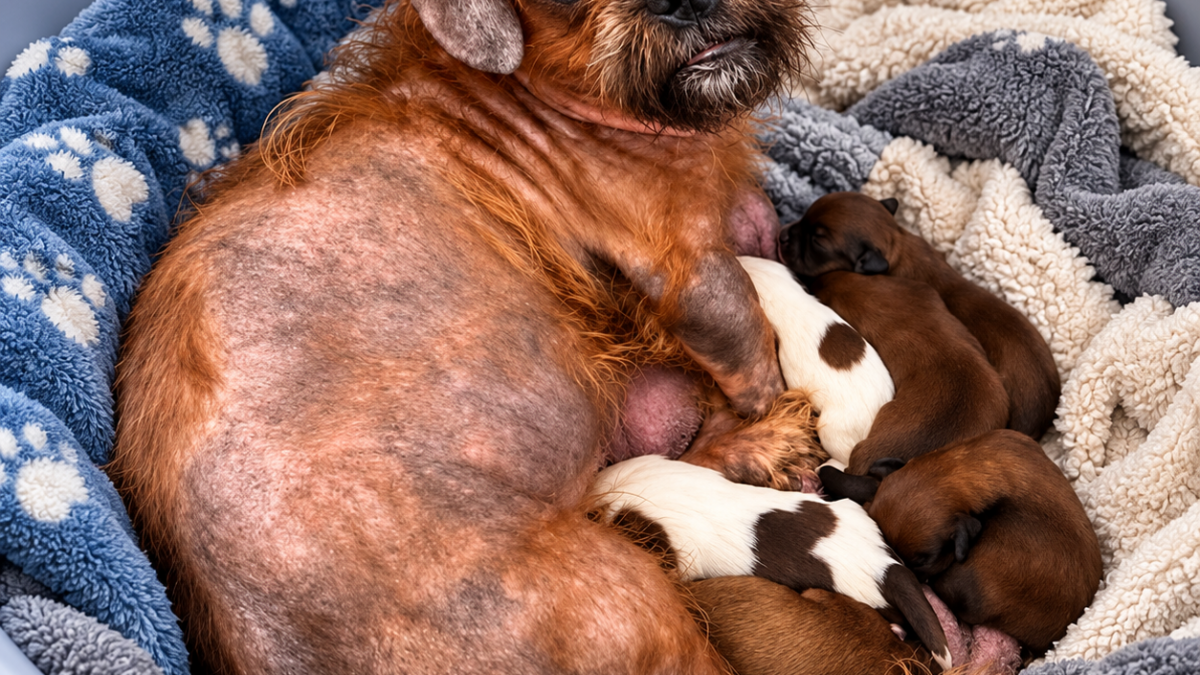
PART 2
For several seconds I thought I had misunderstood him.
“You’ll be taking what?”
“The puppies.”
He said it casually, as if he were talking about boxes stored in somebody else’s garage.
I kept one hand on the gate.
Behind me, Canila had stood from her bed.
Her tail was still moving.
Not wildly.
But enough to tell me she recognized him.
That complicated everything immediately.
“What’s your name?” I asked.
“Derek Walsh.”
“And you’re saying Canila belongs to you?”
He looked irritated.
“I just told you. Her name is Bella.”
I glanced back at her.
“Bella?”
Canila’s ears lifted sharply.
Her tail moved faster.
My stomach tightened.
There was no question.
She knew the name.
Derek saw my expression.
“Exactly.”
He reached for the gate latch.
I moved in front of it.
“Hold on.”
“What?”
“You can’t just walk in.”
“That’s my dog.”
“We need to verify ownership.”
He laughed once.
“Verify?”
“Yes.”
“I’ve had her for seven years.”
“If that’s true, documentation shouldn’t be a problem.”
His expression hardened.
“What kind of documentation?”
“Veterinary records. License records. Photos. Microchip information if she has one.”
“She doesn’t have a chip.”
That was true.
We had scanned her twice.
“Then anything showing consistent ownership.”
He pulled out his phone.
Within seconds, he found photographs.
Canila—Bella—lying on a porch.
Canila in a yard.
Canila beside a man I assumed was Derek.
Canila with puppies.
I stopped.
There were six puppies in that photograph.
“How old is this?”
He looked at the screen.
“Couple years.”
“You bred her before?”
“She had puppies.”
“That wasn’t my question.”
His jaw tightened.
“Yes.”
“How many litters?”
“What does that have to do with anything?”
Quite a lot, actually.
Dr. Evans had already told us Canila appeared to have carried multiple pregnancies.
Her mammary tissue, body condition, and age all suggested repeated breeding.
Derek shoved the phone toward me again.
“There. Proof. Now open the gate.”
I didn’t.
“We still need animal control involved before any transfer.”
His eyes narrowed.
“Why?”
“Because of the condition she was found in.”
“She was missing.”
“For how long?”
“A few days.”
I stared at him.
“A few?”
“Maybe a week.”
The woman who found Canila had reported seeing her around the vacant lots for closer to three weeks.
Maybe she had been mistaken.
Maybe there had been more than one similar dog.
But something already felt wrong.
“How did she go missing?”
“Got away on a walk.”
“Who was walking her?”
“I was.”
“Where?”
His face tightened.
“What is this, an interrogation?”
“No. It’s me trying to understand how an elderly, heavily pregnant dog with a severe untreated skin infection, permanent eye damage, dehydration, and anemia ended up collapsing behind a storage building.”
His cheeks reddened.
“She already had the eye thing.”
“How long?”
“Years.”
“And the skin?”
“She scratches.”
“That’s not an answer.”
He stepped closer.
“I came here to get my dog, not explain my life to you.”
“And you also asked for the puppies.”
“They’re mine.”
“That will be determined after ownership and welfare questions are reviewed.”
For the first time, his anger became obvious.
“They came from my dog.”
“They were born in our care.”
“Doesn’t matter.”
“It might.”
He looked through the gate again.
Canila was watching him.
One of the puppies squeaked from the bedding.
Derek smiled.
Not at Canila.
At the puppies.
“What colors are they?”
That question bothered me more than it should have.
“Why?”
“I’m looking.”
“You can see them later.”
“I want to know if there are males.”
I felt my shoulders tighten.
“Why?”
He looked at me as if I were stupid.
“People pay more for males.”
There it was.
Not grief.
Not relief that his missing dog had survived.
Not even a question about the three puppies who had died.
Value.
Price.
I said carefully, “Three of the puppies didn’t survive.”
He barely reacted.
“How many males are left?”
I stared at him.
“Did you hear what I said?”
“Yeah.”
“Three died.”
“That happens with litters.”
Something cold moved through me.
He may not have meant it cruelly.
Breeders sometimes lose puppies.
Farmers lose animals.
People who have lived around reproduction can become matter-of-fact in ways rescuers find harsh.
I reminded myself of that.
Still, I asked, “Do you want to know what happened?”
“What difference does it make now?”
That answered more than he realized.
I called animal control.
Officer Renee Carter arrived forty minutes later.
Derek waited beside his truck the entire time, occasionally making phone calls and staring through the gate.
When Officer Carter stepped out of her cruiser, I gave her a summary.
She spoke with Derek separately.
Then she came inside to inspect Canila.
Dr. Evans happened to be at the rescue that afternoon and gave her copies of the medical report.
“Could these conditions have developed while she was loose?” Carter asked.
“Some could have worsened,” he said.
“What about the skin disease?”
“Not in one week.”
“How long?”
“Likely months without effective treatment.”
“The anemia?”
“Could have several causes. Pregnancy contributes. Parasites, malnutrition, chronic disease—those are possibilities.”
“Was she underweight before giving birth?”
“Yes.”
“How severely?”
Dr. Evans showed her the intake photographs.
Officer Carter’s face changed.
“And she was this pregnant?”
“Yes.”
“What about the eye?”
“Old injury. Not recent.”
“Painful?”
“Probably not now. Whatever happened healed badly a long time ago.”
Carter looked through the nursery window at Canila.
“She’s friendly.”
“Very.”
“Fearful?”
“Initially. Less now.”
“What happens if Mr. Walsh takes her today?”
Dr. Evans glanced at me.
“Medically, I’d strongly prefer she remain here until the puppies are weaned and her treatment is complete.”
“Can she travel?”
“Yes.”
“So it’s preference, not an emergency medical prohibition?”
“That’s fair.”
I appreciated his honesty even though it worried me.
We did not get to keep animals simply because we thought we could provide better care.
Ownership mattered.
Law mattered.
Feelings were not enough.
Officer Carter returned outside.
Derek was leaning against his truck.
She asked him for vaccination and veterinary records.
He said he would bring them the following morning.
She issued a temporary hold while she reviewed the situation.
Derek did not like that.
“You’ve got proof she’s mine.”
“I have evidence you’ve had possession of her,” Carter said.
“She’s my property.”
“And I have a veterinarian documenting significant medical neglect concerns. Until I review both sides, the dog stays here.”
“Neglect?”
His voice rose.
“I didn’t neglect her.”
Carter remained calm.
“Then documentation will help establish that.”
“I fed her.”
“No one said you didn’t.”
“She lived inside.”
“Good.”
“I spent money on that dog.”
“Bring the records.”
Derek looked at me.
“This is because of her.”
Officer Carter stepped slightly between us.
“This is because I’m investigating an animal’s condition.”
“She filled your head with garbage.”
“I met her ten minutes ago.”
That shut him up briefly.
Then he pointed toward the nursery.
“My puppies stay there too?”
“Yes.”
“You let anything happen to them, that’s on you.”
My hand tightened.
We had already spent sleepless nights trying to keep them alive.
Officer Carter answered before I could.
“They’re receiving veterinary supervision.”
Derek got into his truck.
Before closing the door, he looked at me.
“You better not name them.”
Then he drove away.
I stood there staring after him.
One of our volunteers, Rachel, came beside me.
“Too late.”
I looked at her.
She smiled weakly.
“We named them yesterday.”
Despite everything, I laughed.
The four survivors were already Clover, June, Archie, and Finn.
Derek came back the next morning with a folder.
The records proved one thing clearly.
Canila—Bella—had belonged to him.
There were vaccination records.
An old county license.
Two veterinary invoices.
Photographs spanning years.
Ownership was real.
The medical history was another matter.
The records were inconsistent.
There was a vaccination visit three years earlier.
Then nothing for almost two years.
Then one appointment fourteen months before we found her.
The reason listed:
**Pregnancy confirmation.**
No treatment for skin disease.
No eye examination.
No senior bloodwork.
No parasite screening.
There was also an invoice for puppy vaccinations from a different clinic.
Twelve puppies.
I stared at the number.
Derek had told me Canila had “a litter” before.
Twelve vaccinated puppies suggested more than one litter or a very large litter.
Officer Carter noticed too.
She contacted the second clinic.
Because of the investigation, they released records to animal control.
Canila appeared in their files under a different name.
**Bella Walsh.**
Two litters had been documented there.
One when she was approximately five.
Another when she was six and a half.
The pregnancy we had just managed was at least her third documented litter.
Possibly more.
None of that was automatically illegal.
Plenty of dogs have multiple litters.
But Dr. Evans became concerned when he compared the records.
“She was already having skin issues during the second pregnancy.”
“How do you know?”
A note in the old file said:
**Owner declined dermatology workup. Plans to treat at home.**
Another note:
**Left eye opacity discussed. Owner declined referral.**
I read those lines twice.
Declined.
Declined.
Perhaps because money was tight.
Perhaps because Derek thought the conditions weren’t serious.
Again, neglect is not always dramatic cruelty.
Sometimes it is a long series of decisions to do nothing.
Then we found the advertisements.
Rachel found them first.
Public social media posts.
Derek had been advertising puppies for years.
Photos matched Canila.
One post showed her nursing eight puppies.
Another, eighteen months later, showed seven.
Then an advertisement from less than three months before we found her:
**Bella’s final litter coming soon. Taking deposits. Proven mom. Beautiful pups expected.**
The date made my stomach turn.
“Final litter.”
Rachel looked at me.
“He knew she was pregnant.”
“Obviously.”
“Then why did he say she got loose on a walk and he couldn’t find her?”
“That could still be true.”
Rachel scrolled.
Another post.
Three weeks after the pregnancy announcement:
**Still have deposit spots available. Message me for pricing.**
The next day:
**Bella missing. If seen, contact me.**
At least he had posted that.
But there was something strange.
The missing-dog post was dated only five days before we found Canila.
The woman who discovered her had been seeing her near the vacant lots much longer.
I contacted her.
Her name was Gloria.
“Are you sure it was the same dog?”
“Absolutely.”
“How long?”
“At least two weeks before you picked her up. Maybe closer to three.”
“Could you have the dates wrong?”
She went quiet.
Then said, “I took a picture.”
My pulse jumped.
“Why?”
“She kept sleeping behind the dumpster. I sent it to my daughter because I was worried.”
The photo metadata showed the date.
Sixteen days before Derek posted that Bella was missing.
That didn’t prove anything sinister by itself.
Maybe Derek didn’t realize she was gone.
Maybe someone else was caring for her.
Maybe she had been missing before he noticed.
But then another person contacted animal control.
A woman named Ashley Grant.
She lived two houses from Derek.
Officer Carter interviewed her first, then asked if I wanted to hear what she had said.
Ashley remembered Canila well.
“She was outside a lot,” Carter told me.
“How often?”
“Ashley says most afternoons.”
“Pregnant?”
“Yes.”
“Did she know when Canila disappeared?”
“Around the time Derek’s girlfriend moved out.”
That was unexpected.
“What does that have to do with anything?”
“Maybe nothing.”
It didn’t turn out to be nothing.
Derek’s girlfriend, Melissa, had lived with him for nearly two years.
She was the one who handled most of Canila’s feeding.
She was also apparently the person who objected to another litter.
Officer Carter eventually contacted her.
Melissa agreed to talk.
Not because she liked us.
Because she was furious with Derek.
That worried me.
Angry former partners can be valuable witnesses.
They can also exaggerate.
Carter knew that.
So she looked for things Melissa could prove.
Melissa said Canila did not escape during a walk.
“She got out of the yard,” Melissa told Carter.
“Through a broken gate.”
“How do you know?”
“I told him to fix it.”
“When?”
“Before I left.”
“Why didn’t you take Bella with you?”
“Because he said she was his dog.”
“Did you know she was pregnant?”
“Yes.”
“Did you support the breeding?”
“No.”
“Why not?”
Melissa reportedly laughed without humor.
“Because she was old, half bald, and tired.”
That sentence stayed with me.
Half bald and tired.
Exactly how we had found her.
Melissa said she had begged Derek not to breed Canila again.
Derek argued he had already taken deposits.
There was money involved.
Not a fortune.
But enough.
The previous litter had brought several thousand dollars after expenses.
Derek had recently lost overtime at work.
He wanted one more litter.
According to Melissa, Canila’s skin had deteriorated during pregnancy.
She offered to pay for a veterinary visit if Derek scheduled it.
He never did.
Then they broke up.
Melissa moved out.
Two weeks later, she drove past the house and noticed Canila wasn’t in the yard.
She texted Derek.
**Where’s Bella?**
He replied:
**She got out.**
Melissa:
**When?**
No response.
Officer Carter obtained screenshots.
The date was eighteen days before the public missing-dog post.
That mattered.
Not because being slow to post online is illegal.
But because Derek had claimed Canila disappeared during a walk only a week before we found her.
His timeline was collapsing.
Carter called him in for another interview.
He changed his story.
This time he said Canila escaped from the backyard, not during a walk.
He said he had been embarrassed because the gate had been broken.
“Why tell us it happened during a walk?” Carter asked.
“I didn’t think it mattered.”
“It matters because I asked how she became lost.”
“I panicked.”
“When did she actually disappear?”
“Maybe two weeks.”
“Melissa’s texts suggest longer.”
“I don’t remember.”
“Were you actively searching?”
“Yes.”
“Where?”
“Neighborhood.”
“Did you contact shelters?”
“I called around.”
There were no records of calls to us.
No reports with county animal control until the public post.
He had contacted one shelter the day before he arrived at our gate.
That was after a friend sent him Canila’s rescue photo.
Carter asked about the pregnancy deposits.
Derek became defensive.
“That’s legal.”
Nobody had said otherwise.
“Were you planning to sell the puppies?”
“They were mine.”
“Did you tell buyers Bella was missing?”
Silence.
“Mr. Walsh?”
“I was waiting.”
“For what?”
“To see if she came back.”
“Three puppies died.”
He looked away.
“What did you tell the people who paid deposits?”
“I’d refund them.”
“Have you?”
“Not yet.”
The investigation did not produce some dramatic moment where Derek confessed to abandoning Canila.
He maintained that she escaped.
And we had no evidence he had physically dumped her.
That distinction mattered.
What investigators could document was different:
Canila had a significant untreated skin condition before she disappeared.
Her eye had gone unaddressed for years.
She had been bred repeatedly.
Derek knew she was elderly and pregnant.
His broken gate had not been repaired despite warnings from Melissa.
He waited far longer than he initially admitted before reporting her missing.
And when she was found, his first major concern was reclaiming the surviving puppies.
Animal control issued citations related to failure to provide necessary veterinary care and licensing issues uncovered during the investigation.
But citations were not the biggest question.
Ownership was.
Legally, Derek still had a claim.
Unless he voluntarily surrendered Canila or a court authorized seizure, we could not simply keep her because we disliked him.
The puppies complicated matters further.
Depending on state law and ownership status, they could potentially be considered his property as offspring of his dog.
I hated even thinking about them that way.
Clover was not property when she squeaked in my hand during bottle feeding.
Archie was not property when he fell asleep inside Rachel’s sweatshirt.
June was not property when she learned to crawl out of the whelping box before her siblings.
Finn was not property when he almost stopped breathing at three days old and I spent an hour rubbing his tiny body while Dr. Evans adjusted his oxygen.
But law uses categories emotion does not.
So we prepared.
We documented everything.
Every medical bill.
Every feeding.
Every treatment.
Every weight.
Every photograph.
Every advertisement.
Every text investigators were legally permitted to use.
Derek hired an attorney.
That changed the tone immediately.
His attorney’s first letter demanded return of Canila and the four puppies.
It also demanded that we stop using photographs of them online.
Susan, our rescue director, handed me the letter.
“What happens now?”
“Our attorney responds.”
“And if we lose?”
Susan didn’t answer.
I stared through the nursery window.
Canila was nursing.
Clover slept on top of Finn.
Archie’s back leg twitched.
June was somehow upside down.
My throat tightened.
“She knows him.”
Susan looked at me.
“I know.”
“What if she wants to go back?”
That was the question nobody wanted to discuss.
We were talking as though Canila would obviously choose us.
Dogs don’t understand legal cases.
Canila had wagged when she saw Derek.
She had lived with him for years.
Whatever we thought of his decisions, he was familiar.
Maybe loved.
Maybe home.
The next controlled visit was arranged at animal control’s request.
Derek came without the attorney.
Canila was brought into a neutral meeting room.
I stood outside with Officer Carter.
The moment Derek entered, Canila’s tail began to wag.
He knelt.
“Bella.”
She walked toward him.
For one second my heart dropped.
Then something interesting happened.
Canila stopped about three feet away.
Derek patted his legs.
“Come on, girl.”
She approached.
He rubbed her head.
She allowed it.
Her tail moved.
There was recognition.
But when he reached for her collar, Canila backed away.
Derek frowned.
“Bella.”
She moved toward the door.
Toward me.
I stepped back so I wouldn’t influence her.
Derek crouched again.
“Come here.”
Canila looked between us.
Then walked to me.
She pressed against my legs.
I did not touch her.
Officer Carter watched carefully.
Derek stood.
“She’s confused.”
Maybe she was.
I didn’t pretend the moment proved abuse.
Dogs can attach to new caretakers quickly, especially after weeks of intensive nursing.
But Derek looked genuinely hurt.
“She always comes when I call.”
I believed him.
That made the whole situation sadder.
“You’ve been apart a long time,” Carter said.
Derek looked toward Canila.
“I raised her.”
His voice changed.
Less angry.
“I got her when she was twelve weeks old.”
I studied him.
“Then why another litter?”
His eyes snapped toward me.
Carter lifted a hand.
“Megan.”
But Derek answered.
“Because she was fine.”
“She wasn’t.”
“She looked worse because she got lost.”
“The skin infection predates that.”
“I didn’t know it was that bad.”
“You were living with her.”
“You think I inspected her every day?”
“She was missing half her fur.”
His face reddened.
“Not when Melissa was there.”
“So you noticed after she left?”
Silence.
That silence said enough.
Derek sat down heavily.
“I had stuff going on.”
I almost snapped.
Instead I waited.
“My hours got cut. Melissa left. Mortgage. Bills.”
He rubbed his forehead.
“I already had deposits.”
“So you bred an eight-year-old sick dog because you needed the puppy money?”
“I didn’t know she was eight.”
“You owned her seven years.”
“She was healthy before.”
“Dr. Evans disagrees.”
He stared at the floor.
“I thought she’d be okay.”
For the first time, he sounded less like a villain and more like what he probably was.
A man who kept choosing the convenient answer until the consequences became impossible to ignore.
That didn’t make the choices harmless.
Officer Carter asked the question that mattered.
“Are you willing to surrender Bella?”
Derek looked up sharply.
“No.”
“What about the puppies?”
“They’re mine.”
“Why do you want them?”
His face closed again.
“Because they’re mine.”
The meeting ended there.
Two days later, the legal hearing was scheduled.
I had never testified in an ownership seizure proceeding.
Our attorney warned us to keep emotion under control.
“The judge does not need speeches about how much you love the puppies.”
I nodded.
“The issue is whether returning the animals creates an unacceptable welfare risk based on documented facts.”
“What about Canila recognizing him?”
“That can matter emotionally. Legally, less than you think.”
“What if he wins?”
“Then we comply.”
I hated those words.
The night before the hearing, I stayed late at the rescue.
Canila’s puppies were nearly six weeks old now.
They were becoming actual dogs instead of squeaking potatoes.
Clover was fearless.
Archie was lazy.
June climbed everything.
Finn followed Canila everywhere.
Canila’s skin had improved dramatically.
Soft fur covered areas that had once been raw.
Her good eye looked brighter.
She had gained healthy weight even while nursing.
I sat inside the pen.
Canila walked over and placed her head against my shoulder.
“You have terrible timing.”
She sighed.
“I was doing fine before you came along.”
Tail wag.
“Now I have four tiny criminals and a lawyer.”
June bit my shoelace.
“Exhibit A.”
Canila leaned harder against me.
I wrapped one arm around her.
“I don’t know what happens tomorrow.”
Her eye closed.
“But whatever happens, we tried.”
That sounded weak.
I hated it.
Trying is not always enough.
The hearing began at nine.
Derek sat beside his attorney.
He wore a clean button-down shirt and looked nervous.
Not cruel.
Nervous.
That mattered because reality is rarely kind enough to give us obvious villains.
His attorney began with ownership.
Photographs.
License records.
Veterinary documents.
No one disputed that Canila had belonged to Derek.
Then he emphasized that she had escaped.
There was no direct evidence of intentional abandonment.
True.
He emphasized that Derek had posted publicly searching for her.
Also true, eventually.
He argued that a temporary period of financial stress did not justify permanently taking someone’s animal.
That argument was stronger than I wanted it to be.
Then Dr. Evans testified.
He described Canila’s intake condition.
Severe dermatological disease.
Underweight beneath pregnancy.
Dehydration.
Anemia.
Permanent blindness from an old untreated injury.
Advanced pregnancy in an older dog with prior litters.
Derek’s attorney asked, “Can you state with certainty that every one of those conditions resulted from neglect by Mr. Walsh?”
“No.”
“Could being loose for multiple weeks worsen weight loss and dehydration?”
“Absolutely.”
“Skin disease?”
“Could worsen it.”
“Anemia?”
“Potentially.”
“So your examination cannot tell this court exactly what Bella looked like the day she escaped.”
“No.”
The attorney nodded.
I felt sick.
Then our attorney stood.
“Doctor, could the severe skin infection you documented have developed entirely during the sixteen to eighteen days for which we have evidence the dog was loose?”
“Not to that degree.”
“Why?”
“The pattern included chronic thickening and pigmentation changes. Those indicate a longer process.”
“How much longer?”
“Likely months.”
“Was that condition visible to a layperson?”
“Yes.”
“How visible?”
Dr. Evans paused.
“Significant hair loss, scratching, inflamed skin, odor.”
“What about the blind eye?”
“Old damage.”
“Treatable when it happened?”
“Possibly. I can’t say now.”
“But it would have been obvious?”
“Yes.”
“Pregnancy?”
“Obviously visible late in gestation.”
“Would you recommend intentionally breeding a dog of Canila’s estimated age and condition?”
“No.”
Derek looked down.
Then Melissa testified.
That changed everything.
She was not dramatic.
That helped.
She admitted she disliked Derek now.
She admitted their breakup was ugly.
Then she produced texts.
Messages telling him to repair the gate.
Messages telling him Bella’s skin was getting worse.
A message from three months before rescue:
**Please don’t breed her again. She looks exhausted.**
Derek replied:
**Already got people interested. One more litter and she’s done.**
Another:
**She needs a vet before that.**
Derek:
**After puppies. Money’s tight.**
The room became silent.
There it was.
Not a confession of cruelty.
Something more believable.
A decision.
Veterinary care after puppies.
Money first.
Treatment later.
The final text hurt worst.
It had been sent two days before Melissa moved out.
**If you care about Bella, stop treating her like an ATM.**
Derek had replied:
**She’s my dog. Stay out of it.**
His attorney attacked Melissa’s credibility.
“You were angry when you sent those messages.”
“Yes.”
“You wanted to take Bella with you.”
“Yes.”
“You threatened my client during the breakup.”
“I told him I’d call animal control if he bred her again.”
“So you had a motive to make him look irresponsible.”
Melissa stared at him.
“I don’t need to make him look irresponsible. I kept the screenshots.”
That line landed.
Then Officer Carter testified about Derek’s conflicting timelines.
Walk versus yard.
Five days versus more than two weeks.
Public missing post versus earlier private knowledge.
Derek’s attorney had explanations for all of it.
Stress.
Confusion.
Embarrassment.
None were impossible.
Then the attorney made what I believe became his biggest mistake.
He put Derek on the stand.
At first, Derek did well.
He talked about getting Bella as a puppy.
Taking her camping.
Sleeping beside her when she was sick after her first vaccination.
He showed photographs where she looked genuinely loved.
I looked at them and felt something unexpected.
Sadness.
Because Canila had not spent seven years with a monster.
She had spent seven years with a person who probably loved her and still failed her.
That is harder to understand.
Derek’s attorney asked, “Did you intentionally harm Bella?”
“No.”
“Did you abandon her?”
“No.”
“Did you search for her?”
“Yes.”
“Do you want her back?”
“Yes.”
“Why?”
Derek looked toward our side of the room.
“Because she’s my dog.”
“And the puppies?”
“My responsibility.”
That answer was better than the first time I met him.
Then our attorney began cross-examination.
“Mr. Walsh, do you remember posting this?”
The puppy advertisement appeared on a monitor.
**Bella’s final litter coming soon. Taking deposits.**
“Yes.”
“How much were the deposits?”
“Two hundred.”
“How many did you accept?”
“Four.”
“So eight hundred dollars?”
“Yes.”
“And expected sale price?”
“Depends on the puppy.”
“Range?”
“Eight hundred to twelve hundred.”
“So the litter could generate several thousand dollars.”
“Before expenses.”
“What expenses had you incurred before Bella disappeared?”
“Food.”
“Veterinary care?”
Silence.
“Mr. Walsh?”
“Not yet.”
“Why?”
“I was going to.”
“When?”
“Before delivery.”
Our attorney lifted the old text.
**After puppies. Money’s tight.**
“Was that true when you wrote it?”
Derek stared.
“Yes.”
“So which was it? Veterinary care before delivery or after the puppies?”
“I don’t remember.”
“You knew Bella had severe hair loss.”
“She had allergies.”
“Diagnosed?”
“No.”
“Treatment?”
“Shampoo.”
“From a veterinarian?”
“Pet store.”
“You knew she was scratching constantly.”
“Yes.”
“You knew one eye was blind.”
“Yes.”
“You knew she was pregnant.”
“Yes.”
“You knew the gate was broken.”
His jaw tightened.
“Yes.”
“And you knew your former partner had warned you not to breed Bella again.”
“Yes.”
“Yet you accepted deposits.”
“Yes.”
Our attorney paused.
“After Bella disappeared, why did you wait at least thirteen days before making a public missing-dog post?”
“I looked myself.”
“Did you contact animal control?”
“No.”
“Local rescues?”
“I thought I did.”
“Phone records show no calls until after a friend sent you Canila’s rescue photograph.”
Derek said nothing.
“Did you contact the buyers whose deposits you held?”
“No.”
“Did you refund them?”
“Eventually.”
“When?”
“After the investigation started.”
The room became very quiet.
Then our attorney asked one final question.
“When you arrived at Greenfield and saw Bella alive for the first time after she had been missing for weeks, what did you ask about first?”
Derek’s attorney stood.
“Objection. Characterization.”
The judge allowed a narrower version.
Our attorney tried again.
“Do you remember asking staff about the puppies?”
“Yes.”
“Do you remember being told three had died?”
“Yes.”
“What did you ask immediately afterward?”
Derek looked toward me.
He knew I remembered.
So did he.
“I asked how many males were left.”
No one spoke.
The judge did not react visibly.
But something had shifted.
Derek tried to explain.
“I’d already taken deposits. I was trying to figure out what I needed to tell people.”
That was possible.
Maybe even partly true.
But combined with everything else, the picture was becoming clear.
Canila’s welfare had repeatedly come second.
Treatment after puppies.
Gate later.
Missing report later.
Refunds later.
Again and again, Derek’s preferred plan depended on Canila surviving until it was convenient to deal with her needs.
The judge did not rule immediately.
That was torture.
A temporary protective order kept Canila and the puppies with us while written findings were prepared.
For nine more days, we waited.
During those nine days, the puppies began eating softened food.
Canila started leaving the whelping area voluntarily.
That mattered.
She loved her babies.
But she was tired.
Sometimes she walked into the adjoining room, climbed onto a blanket, and slept so deeply I had to watch her breathing to reassure myself.
“You’re done,” I told her once.
She opened one eye.
“No more puppies.”
Tail thump.
“Retirement.”
Another thump.
“I’m serious.”
She put her head back down.
On the ninth morning, Susan ran into the nursery holding her phone.
“We got the order.”
I stood so quickly I hit my knee on the pen.
“What?”
“The court granted the seizure petition.”
I stared at her.
“All of them?”
“Canila and all four puppies.”
My knees went weak.
Rachel started crying immediately.
I took the phone.
The ruling was more measured than our emotions.
The judge specifically noted that ownership alone did not excuse failure to provide necessary care, and that the documented history showed repeated delay of veterinary treatment, breeding despite known health concerns, inadequate containment, and inconsistent efforts after Canila disappeared.
The ruling was not revenge.
It was not a declaration that Derek had never loved her.
It said something simpler.
Returning Canila and the litter presented an unacceptable welfare risk.
Custody transferred.
Derek could appeal.
For two weeks, we were afraid he would.
He didn’t.
Instead, his attorney contacted ours.
Derek agreed to relinquish any remaining claims in exchange for closure of the civil ownership dispute while the animal-control citations proceeded separately.
There were fines.
A requirement that any animals remaining in his possession receive documented veterinary care.
And restrictions related to future commercial breeding under local regulations.
Nothing spectacular.
No prison.
No dramatic handcuffs.
I was glad.
The point had never been to destroy Derek.
The point was that Canila would not be bred again because someone needed money.
When the legal hold officially ended, I sat beside her.
“You’re ours now.”
She licked my wrist.
“Well, technically the rescue’s.”
Another lick.
“I know. Details.”
The puppies reached eight weeks.
Then ten.
Healthy.
Round.
Impossible.
Clover developed Canila’s habit of leaning against people.
June had no fear of anything, including objects much larger than she was.
Archie slept through most minor emergencies.
Finn remained the smallest and followed his mother like a shadow.
Applications poured in.
This time, we were careful.
Very careful.
The publicity around the case meant plenty of people wanted “one of Canila’s puppies.”
We rejected anyone who seemed interested mainly because of the story.
They needed homes.
Not audiences.
Clover went first.
A retired couple named Janet and Paul had recently lost their senior dog.
They visited four times.
Janet spent most of the first visit sitting quietly while Clover chewed her shoelace.
Perfect.
June went to a family with two teenagers and a fenced yard large enough for her endless confidence.
Archie went to a veterinary technician who fell in love with how spectacularly lazy he was.
That left Finn.
And Canila.
Finn was almost twelve weeks old when a woman named Carol came to meet Canila.
She was sixty-three.
Widowed.
No other pets.
She had specifically asked about an older dog.
Not puppies.
When I brought Canila into the room, Carol sat on the floor.
She didn’t call her.
Didn’t reach.
Canila looked at her.
Then looked at me.
Then slowly walked over.
Carol whispered, “Hi.”
Canila leaned against her shoulder.
That was it.
I knew.
Carol laughed softly.
“She’s heavy.”
“She does that.”
“Does what?”
“Leans.”
Carol rubbed the side of Canila’s neck.
“Maybe she’s making sure you don’t leave.”
The sentence hit me harder than Carol knew.
Canila closed her eye.
Finn started whining from the adjacent pen.
Carol looked over.
“That one hers?”
“Yes.”
“The others adopted?”
“Yes.”
“What happens to him?”
“We’re reviewing applications.”
Carol nodded.
Then she asked, “Are they bonded?”
I hesitated.
“Not in the formal sense. He can be adopted separately. But he follows her everywhere.”
Carol was quiet.
“Can I meet him too?”
I laughed.
“Careful.”
“Why?”
“That’s how you accidentally leave with two dogs.”
She smiled.
Two weeks later, she did.
Canila and Finn went home together.
I cried so hard in the parking lot that Susan refused to make eye contact because she was crying too.
Carol had prepared everything.
A low bed.
A fenced yard.
Skin-safe shampoo recommended by Dr. Evans.
Medication chart.
Two water bowls.
Baby gates.
An appointment already scheduled with her veterinarian.
And because Canila was still sensitive about people approaching from the blind side, Carol had placed a note near her front door for visitors:
**PLEASE LET CANILA SEE YOU BEFORE TOUCHING HER.**
That tiny sign nearly broke me.
Someone had thought ahead about what Canila needed.
Before there was a problem.
Not later.
Before.
The first update arrived that evening.
Canila asleep on Carol’s couch.
Finn asleep across Canila’s stomach.
The next morning:
Canila standing in the yard with sunlight on her new coat.
Three months later, her fur had almost completely returned.
Not perfectly.
There were thin areas.
Scars.
The blind eye remained cloudy.
But she looked healthy.
Strong.
Comfortable.
Dr. Evans stared at the photographs.
“That’s the same dog?”
“You examined her.”
“I know.”
He zoomed in.
“She gained muscle.”
“She walks every morning.”
“How far?”
“Carol says Canila decides.”
He laughed.
“That sounds right.”
The other puppies grew beautifully too.
Clover became nearly as big as Canila.
June apparently destroyed an entire couch cushion at six months old and posed inside the stuffing.
Archie continued sleeping through life.
Finn stayed with Canila and became her shadow.
Carol sent one photograph I kept on my desk.
Canila was lying beneath a maple tree.
Finn had his head across her back.
Both were asleep.
No puppies nursing.
No raw skin.
No concrete corner supporting her weight.
Just a mother dog resting because she wanted to rest.
About a year after the rescue, I saw Derek again.
I was buying groceries.
He was in the next checkout line.
For a moment, neither of us spoke.
Then he said, “How is she?”
I knew exactly who he meant.
“Good.”
He nodded.
“The pups?”
“Good.”
“All adopted?”
I hesitated.
“Yes.”
He looked down at the belt.
“Did she get a good place?”
“She did.”
Another nod.
I expected anger.
There was none.
He looked tired.
“Can I see a picture?”
That surprised me.
I opened my phone.
Not because I owed him anything.
Because Canila had spent most of her life with him.
Whatever else had happened, part of her history belonged there.
I showed him the photograph under the maple tree.
Derek stared for a long time.
“She looks old.”
“She is.”
He almost smiled.
“She always slept like that.”
“On her side?”
“Anywhere she could block a doorway.”
I laughed despite myself.
“She still does.”
For a second, we were simply two people who knew the same dog.
Then his eyes filled.
He looked away.
“I screwed up.”
I didn’t answer.
“I kept thinking I’d fix stuff later.”
Still nothing.
“The skin. The gate. The vet.”
His hand tightened around the shopping cart.
“I wasn’t trying to hurt her.”
“I know.”
He looked at me.
That seemed to surprise him.
“I believe you.”
“Then why—”
“Because not trying to hurt her didn’t keep her from getting hurt.”
His face changed.
Not anger.
Acceptance, maybe.
I continued carefully.
“You kept choosing later.”
He nodded.
“I know.”
“Animals don’t understand later.”
He swallowed.
“No.”
The cashier called him forward.
Derek started to leave.
Then turned back.
“Tell whoever has her…”
He stopped.
“What?”
He shook his head.
“Nothing.”
Then he walked away.
I never saw him again.
Two years passed.
Then three.
Canila aged quickly after that.
Not dramatically.
Just the quiet slowing of an older dog whose body had worked too hard for too many years.
Carol kept her weight healthy.
Managed arthritis.
Continued dermatology treatment whenever her skin flared.
Finn grew into a large, ridiculous dog who seemed convinced he was still twelve weeks old.
Canila tolerated him with the patience of a mother who had already survived far worse.
When she was nearly eleven, Carol called me.
“I think you should come.”
My stomach tightened.
“What happened?”
“She’s not doing well.”
I drove over that afternoon.
Canila was lying on her bed near the back door.
Finn sat beside her.
She lifted her head when I entered.
Her tail moved.
Once.
Then again.
I sat down.
“Hey, mama.”
She leaned toward me automatically.
Even old and tired, she leaned.
Carol sat beside us.
“Kidneys.”
I nodded.
Dr. Evans had warned us at her last checkup.
Chronic kidney disease.
Medication and diet had helped.
Now it was progressing.
“How long?”
Carol’s eyes filled.
“The vet says we’re talking days, maybe a couple of weeks if she stays comfortable.”
Canila rested her head on my thigh.
I touched the fur along her back.
Full now.
Soft.
I remembered bare, inflamed skin.
The difference between the dog in front of me and the dog in that concrete corner felt impossible.
Finn nudged Canila’s ear.
She opened her eye.
He licked her face.
“Still bothering your mother,” I whispered.
Carol laughed through tears.
“He never stopped.”
Canila lived eleven more days.
On her final morning, she refused breakfast.
That was the sign Carol had promised herself she would not ignore.
A home veterinarian came that afternoon.
I came too.
So did Rachel.
Susan, retired by then, drove an hour.
We did not crowd Canila.
That would have been unfair.
Carol sat beside her.
Finn lay on the other side.
I stayed near her feet.
The veterinarian explained each step.
Carol nodded.
Then she looked at Canila.
“You’ve done enough.”
Canila’s good eye stayed on her.
“You don’t have to take care of anybody anymore.”
Finn lifted his head.
Carol smiled through tears.
“Except him. Apparently.”
Canila’s tail moved weakly.
The sedative went in.
Her body slowly relaxed.
Carol placed one hand beneath her head.
I thought about the first day.
Canila pressed into the corner because she could barely stand.
Her enormous belly.
The shaking legs.
The blind eye.
How she flinched when we touched her.
Then labor.
Seven puppies.
Three tiny bodies we could not save.
Four survivors.
Derek at the gate.
The hearing.
The months of healing.
And now this.
A warm living room.
Her son beside her.
Her person holding her.
No one asking her to produce anything.
No one waiting for puppies.
No one needing her body for money.
Just rest.
The veterinarian administered the final medication.
Canila took one deep breath.
Then another.
Her head became heavier in Carol’s hand.
And she was gone.
Finn stood.
He sniffed her face.
Then lay beside her.
We let him stay.
Animals deserve information too.
Afterward, Carol had Canila cremated.
She scattered part of the ashes beneath the maple tree from the photograph.
The rest stayed in a wooden box in the living room.
Finn slept beside it for weeks.
Years later, all four puppies were still doing well.
Clover became a gentle giant who slept between Janet and Paul every night.
June remained chaos with a tail.
Archie somehow grew into a dog who considered two walks a day an unreasonable labor demand.
Finn stayed with Carol.
His face eventually began turning gray around the muzzle.
Every year on the puppies’ birthday, the four families exchanged photographs.
We always included three small candles in the rescue office too.
For the puppies who did not make it.
They had names eventually.
Hope.
Mabel.
Tiny.
It felt wrong to remember them only as numbers.
Seven born.
Four survived.
They had existed.
So we remembered all seven.
One spring afternoon, Carol invited me over.
Finn was seven by then.
Large.
Gray around the chin.
Still sleeping in the exact spot where Canila used to rest.
Carol brought out the photograph from the first month after adoption.
Canila beneath the maple tree.
Finn across her back.
“I keep thinking about what you told me when I applied,” she said.
“What?”
“That she leaned because she wanted to make sure people stayed.”
“I might have been making that up.”
Carol smiled.
“Maybe.”
She looked toward Finn.
“But eventually she stopped.”
I thought about it.
She was right.
In later photographs, Canila slept stretched out.
Sometimes in another room.
Sometimes outside while Carol was inside.
She no longer needed to press her body against someone constantly.
She had learned something.
People could leave the room and come back.
Food could disappear and return tomorrow.
A door closing did not mean abandonment.
A human hand could approach without bringing pain.
And her body finally belonged to her.
That was the part of Canila’s story I remembered most.
Not the courtroom.
Not Derek.
Not even the terrible nights when we lost three puppies.
I remembered the morning several months after she moved in with Carol.
I had visited to check on her skin.
Carol opened the back door.
Canila walked into the yard alone.
No leash.
No hesitation.
Finn ran after her.
She ignored him.
She crossed the grass.
Found a patch of sunlight.
Turned twice.
Lay down.
Finn tried to climb onto her.
She pushed him away with one paw.
I laughed.
Carol called from the doorway.
“Look at her.”
Canila rolled onto her side.
Closed her eye.
And slept.
That image has stayed with me longer than all the others.
Because the first time I saw her lying down, she had collapsed from exhaustion.
The last time I remember her best, she lay down because she finally had nothing left to fear.
[END OF STORY]








